On Nov. 7, members of the Kalkman family – left to right are Danielle, Victoria, Matthew, Peter and Bonnie – received the Righteous Among the Nations award from the consulate general of Israel in Toronto and Western Canada and the Canadian Society for Yad Vashem, on behalf of Dirk and Klaasje Kalkman. (photo by Rhonda Dent Photography)
One night in the Dutch village of Moordrecht, the call went out: the Nazis were doing a round-up. In a round-up, the Nazis would surround a neighbourhood and then search house by house for those they hunted: Jews, resistance fighters and others they deemed enemies. Wim Kalkman’s family rushed to prepare for their arrival: two Dutchmen who refused to work as forced labour building battlements for the Nazis were taken through a trap door under the carpet in the living room. The really dangerous guest of the family, however, was hidden in plain view. Tanta Ina, they called her, saying she was an aunt who had fled the battle zone on the coast to find refuge with the family.
Tanta Ina was not related to the Kalkmans, however. She was a Jewish woman, the widow of a Dutch-Jewish nobleman who the family had been urged to protect by Reverend Henk Post, the brother of Dutch resistance fighter Johannes Post and a fellow clergyman to Wim’s father, Dirk.
Dirk Kalkman, a pastor in the Dutch Reformed Church, and his wife Klaasje, had taken Catharina Six tot Oterleek-Kuijper in and given her a new identity. They hid her, with the help of their four children, from 1943 to 1945, at great personal risk. On that fearful night, the Nazis did not discover the two Dutchmen or Tanta Ina, who sat on the couch with the rest of the family while they were all interrogated. When a Nazi soldier asked young Wim if the family was hiding anyone, he broke into a gale of nervous laughter, which confused the Nazis, who also began laughing. Fearful of Wim’s sister, who was suffering from diphtheria, the Nazis rushed their search and left.
This was the story that was told to Wim’s son, Peter, and his grandson, Matthew, both of whom were in Vancouver Nov. 7 to receive the Righteous Among the Nations award from the consulate general of Israel in Toronto and Western Canada and the Canadian Society for Yad Vashem, on behalf of Dirk and Klaasje Kalkman.
Righteous Among the Nations are non-Jews who assisted or sheltered Jews during the Holocaust, often at the risk of great peril for themselves and families. The project was established by Yad Vashem in 1963 and to date has granted the award to more than 26,000 people. It had been Wim Kalkman’s lifelong dream to see his parents honoured for their heroism, as Matthew Kalkman told those gathered at the Rothstein Theatre for the ceremony.
After Peter Kalkman read his father’s account of that terrifying night and told the story of his grandparents’ protection of Tanta Ina, Matthew Kalkman gave an emotional speech, often through tears, about the importance of his great-grandparents’ actions to his own life. He said he had first connected with the reality of what his great-grandparents had done when he visited the Anne Frank Museum in Amsterdam.
When his grandfather Wim died in 2014, they discovered a note expressing his dying wish that Wim’s father be honoured. Matthew took up the task personally and, together with researchers in the Netherlands, was able to find definitive evidence of what happened in the Kalkman household so many years ago.
The award was given to the Kalkmans by Consul General Galit Baram on behalf of the state of Israel and by Josh Hacker on behalf of the Canadian Society for Yad Vashem. Liel Amdour, a classical guitarist born in Israel, played two pieces of music that embodied hope and rebirth, and Dr. Ilona Shulman Spaar, education director of the Vancouver Holocaust Education Centre, and Salomon Casseres, president of the Jewish Community Centre of Greater Vancouver, also spoke, as did Karen James, the chair of the Jewish Federation of Greater Vancouver board. All of the speakers touched upon the importance of remembering the heroes of the Holocaust as inspirations in the current times of resurgent nationalism, racism and xenophobia.
Casseres, who has Dutch ancestry, also stressed the relevance of the Kalkmans’ story for himself, as a descendant of Dutch Jews who survived the Holocaust. “In Hebrew,” he said, “we say kol hakavod, which means ‘all the respect.’” In Dutch, he added, “A hearty thank you for your family’s deeds of heroism.”
Matthew Gindinis a freelance journalist, writer and lecturer. He is Pacific correspondent for the CJN, writes regularly for the Forward, Tricycle and the Wisdom Daily, and has been published in Sojourners, Religion Dispatches and elsewhere. He can be found on Medium and Twitter.
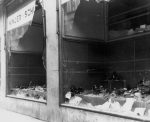
Kristallnacht, which took place 80 years ago this month, saw hundreds of synagogues burned, Jewish-owned businesses destroyed, 100 Jews murdered and 30,000 incarcerated. (photo from commons.wikimedia.org)
Kristallnacht, which took place 80 years ago this month, was the “Night of Broken Glass” that saw hundreds of synagogues burned, Jewish-owned businesses destroyed, 100 Jews murdered and 30,000 incarcerated. The state-sanctioned pogrom was staged to look like a spontaneous uprising against the Jews of Germany, annexed Austria and occupied Sudetenland. It is frequently seen as the beginning in earnest of the Holocaust. According to Prof. Chris Friedrichs, who delivered the keynote address at the annual Kristallnacht commemorative evening Nov. 8, global reaction to the attack, which took place on the night of Nov. 9-10, 1938, sent messages to both Nazis and Jews.
“The world was shocked,” said Friedrichs, professor emeritus of history at the University of British Columbia. “Newspapers in the free countries of Europe and all over the Americas reported on these events in detail. Editorials thundered against the Nazi thugs. Protests took place. Demonstrations were held. Opinion was mobilized – for a few days. But soon, Kristallnacht was no longer front-page news. What had happened was now the new normal in Germany, and the world’s attention moved elsewhere. And this is what the Nazis learned: we can do this, and more, and get away with it. Nothing will happen.
“And the Jews of Germany learned something too,” said Friedrichs, himself a son of parents who fled the Nazi regime. “By 1938, many Jews had emigrated from Germany – if they could find a country that would take them. But many others remained. Much had been taken away from them, but two things remained untouched: their houses of worship and their homes. Here, at least, one could be safe, sustained by the fellowship of other Jews and the comforts and consolations of religious faith and family life. But now, in one brutal night, these things, too, had been taken from them. Their synagogues were reduced to rubble, their shops vandalized, their homes desecrated. Nothing was safe or secure. The last lingering hopes of the Jews still living in Germany that, despite all they had suffered at the hands of the Nazis, they might at least be allowed to live quiet private lives of work and worship with family and friends, collapsed in the misery of fire, smashed glass, home invasions, mass arrests and psychological terror on Nov. 9, 1938.”
Friedrichs’ lecture followed a solemn procession of survivors of the Holocaust, who carried candles onto the bimah of Congregation Beth Israel. The evening, presented by the Vancouver Holocaust Education Centre (VHEC) and Beth Israel, was funded by the Jewish Federation of Greater Vancouver annual campaign, with support from the Robert and Marilyn Krell Endowment Fund of the VHEC and the Azrieli Foundation, which provided every attendee with a copy of Dangerous Measures, the memoir of Canadian Joseph Schwartzberg, who witnessed Kristallnacht and fled Germany with his family soon after.
“We are gathered tonight in the sanctuary of a synagogue,” said Friedrichs, who retired in June, after 45 years of teaching and researching at UBC. “A synagogue should indeed be a sanctuary, a quiet place where Jews can gather, chiefly but not only on the Sabbath, for prayer, worship and contemplation. Recent events have reminded us only too bitterly that this is not always the case.
“Our minds are full of mental images of what happened in Pittsburgh less than two weeks ago, but I invite you to call up a different mental image,” he said, taking the audience back to the time of Kristallnacht. “Think of a synagogue. Just a few days earlier, on the Sabbath, Jews had gathered there, as they have gathered in synagogues for 2,000 years, for prayer, worship and fellowship with other Jews. But now, suddenly, in the middle of the night, a firebomb is thrust through a window of the synagogue. As the window glass shatters to the floor, the firebomb ignites a piece of furniture. Within minutes the fire spreads. Soon the entire synagogue is engulfed in flames. It is an inferno. The next morning, the walls of the synagogue are still standing, but the interior is completely gutted. No worship will ever take place there again.”
Friedrichs paused to note that some in the audience would recall a similar attack that destroyed Vancouver’s Reform synagogue, Temple Sholom, on Jan. 25, 1985. He recounted the reaction of police and firefighters, civic leaders and the general public, who rallied around the Vancouver congregation at the time, and compared that with the reactions of non-Jews in Germany and the territories it controlled at the time of Kristallnacht.
“Police and firefighters are on the scene,” Friedrichs said of the situation during Kristallnacht. “But the firefighters are not there to put out the blaze. They are there only to make sure the fire does not spread to any nearby non-Jewish buildings. The police are there only to make sure no members of the congregation try to rescue anything from the building.
“The next morning, crowds of onlookers gape at the burnt-out shell of the synagogue. Some of the furnishings and ritual objects have survived the blaze, so they are dragged out to the street and a bonfire is prepared. But first, the local school principal must arrive with his pupils. Deprived of the opportunity to see the synagogue itself in flames during the night, when they were asleep, the children should at least have the satisfaction of seeing the furnishings and Jewish ritual objects go up in smoke. Most of those objects are added to the bonfire, but not all. Not the Torah scrolls – the Five Books of Moses, every single word of which, in translation, is identical to the words found in the first five books of every Christian Bible. No, the Torah scrolls are not added to the bonfire. They are dragged out to the street to be trampled on by the children, egged on by adult onlookers, while other adults rip apart the Torah covers to be taken home as souvenirs.
“And now consider this: events like this did not happen in just one town,” Friedrichs said. “The same things took place in hundreds upon hundreds of cities and towns throughout Germany and Austria, all on the very same evening and into the next morning. There were minor variations from town to town, but the basic events were exactly the same, for it was a nationwide pogrom, carefully planned in advance.”
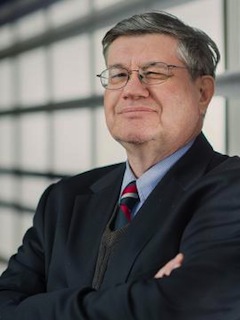
Prof. Chris Friedrichs (photo from VHEC)
Friedrichs, who devoted 25 years to serving on the organizing committee of the Kristallnacht commemorative committee, including eight as president, reflected on the history of Holocaust remembrance in Vancouver, including the decision to single out this date as one of the primary commemorative events of the calendar.
“Why should we commemorate the Shoah at this particular time in November?” he asked. “Consider this: 91 Jewish men died on Nov. 9th and 10th, 1938. Yet, on a single day in the busy summer of 1944, up to 5,000 Jewish men, women and children might be murdered in the gas chambers of Auschwitz on one day. Why not select some random date in August 1944 and make that the occasion to recall the victims of the Shoah? Why choose Kristallnacht?”
The earliest Holocaust commemorations in the city, he said, citing the work of local scholar Barbara Schober, was an event in 1948 marking the Warsaw Ghetto Uprising.
People who had founded the Peretz School in Vancouver, in 1945, hoped to preserve the memories and values of the East European Jewish culture, which had been almost totally wiped from the map, he said. “Yet, rather than focus on the six million deaths, their intention was to honour those Jews who had actually risen up to fight the Nazi menace – the hopeless but inspiring efforts exemplified above all by the heroic resistance of the Warsaw Ghetto fighters who used the pathetically meagre supply of weapons they could find to resist the final liquidation of the ghetto by the Nazis in the spring of 1943,” said Friedrichs. “That effort failed, but it was not forgotten.”
This event continued, with the support of Canadian Jewish Congress, into the 1970s, he explained.
“There was an emerging concern that Jews should not just recall and pay tribute to the victims of the Shoah,” said Friedrichs. “The increasing visibility of the Holocaust denial movement made it apparent that Jews should also make their contribution to educating society as a whole – and especially young people – about the true history of what had happened. Prof. Robert Krell and Dr. Graham Forst undertook to establish an annual symposium at UBC at which hundreds of high school students would learn about the Holocaust from experts and, even more importantly, from hearing the first-person accounts of survivors themselves. It was in those years, too, that the Vancouver Holocaust Education Society was established to coordinate these efforts. The survivor outreach program, through which dozens of survivors of the Shoah in our community spoke and continue to speak to students about what they experienced, became the cornerstone of these educational efforts. Their talks are always different, for no two survivors ever experienced the Shoah the same way, but the ultimate object is always the same – not just to teach students what happened to the Jews of Europe between 1939 and 1945, but to reflect on the danger that racist thinking of any kind can all too easily lead to.”
But this was education, he noted, not commemoration.
“With the decline of the Warsaw Ghetto event in Vancouver, the need to commemorate the Shoah came to be filled in other ways. One of those ways was the emergence of the Vancouver Kristallnacht commemoration. The origins of this form of commemoration lie right here in the Beth Israel congregation. In the late 1970s, members of the Gottfried family who had emigrated from Austria in the Nazi era, now members of Beth Israel, proposed that their synagogue host a commemoration of Kristallnacht.”
Friedrichs spoke of the burden carried by each of the survivors who carried candles onto the bimah moments earlier.
“You might think that a candle is not very hard to carry, but, for each one of these men and women, the flame of the candle has reignited painful memories stretching back 70 or 80 years, to a dimly remembered way of life before their world collapsed,” he said. “These men and women survived, and sometimes a few of their relatives did as well, but all of them, without exception, you’ve heard this before, had family members – whether parents, grandparents, uncles, aunts, siblings, or cousins – who were murdered. One could not reproach these men and women if they had chosen to stay home on a night like this. But, instead, they are here.
“Many of these men and women have done more, even more, as well,” he continued. “For many of them have done something for years and continue to do so even now: to speak of their experiences to students in the schools of our province. To stand in front of two or three or four or five hundred students of every race and every heritage and describe life in the ghetto or the camp or on the death march or the anxiety of living in hiding and being pushed into a basement or a closet every time some unwanted visitor arrived – this is not easy. But there is a purpose. The young people of our province are barraged with images and messages and texts telling them that people of certain religions or races or heritages are inferior and unwanted members of our society. They must be told just what that kind of thinking can lead to. No textbook, no video, no lecture can do the job as powerfully as hearing a survivor describe exactly what he or she experienced during the Shoah.”
Corinne Zimmerman, vice-president of the VHEC, welcomed guests and introduced the candlelighting procession. Cantor Yaacov Orzech chanted El Moleh Rachamim, the memorial prayer for the martyrs. UBC Prof. Richard Menkis delivered opening remarks and Helen Pinsky, president of Beth Israel, introduced Sarah Kirby-Yung, a Vancouver city councilor who read a proclamation from the mayor. Nina Krieger, executive director of the VHEC, introduced Friedrichs. Beth Israel’s Rabbi Jonathan Infeld provided closing remarks, and Jody Wilson-Raybould, minister of justice and member of Parliament for Vancouver Granville, sent greetings on behalf of the Government of Canada.
Jenn Griffin and Paul Herbert in Firehall Arts Centre’s production, The Enemy, which runs to Dec. 1. (photo by Pedro Meza)
A doctor in a small B.C. town discovers that the main tourist draw, the springs, are polluted. As she tries to raise the alarm, she runs into harsh resistance – after all, the town’s economic well-being is completely dependent on the tourism the springs, spa and waterpark attract. Among other things, her findings are discredited, the truth is characterized as “fake news,” and she ends up regarded as a pariah instead of a saviour.
This very current-day scenario is actually based on Henrik Ibsen’s 1882 play An Enemy of the People, the themes of which are as relevant as ever. Firehall Arts Centre artistic producer Donna Spencer has adapted Ibsen’s drama, not only bringing the spa to British Columbia, but making the character of Dr. Stockman a woman in her version, called The Enemy, which runs at the Firehall until Dec. 1.
Spencer, who also directs the production, said in a press release, “Recently, we witnessed a decision south of the border that many of that country’s constituents did not support for good reasons. But the majority of those who had the power to vote supported the choice, angering thousands and potentially impacting hard-earned freedoms and rights. With the Firehall’s presentation of The Enemy, I have adapted Henrik Ibsen’s drama – which asks the question, is the majority always right? – and applied it to a contemporary issue not unlike the one faced by Ibsen’s version of Dr. Stockman. In this contemporary context of The Enemy, the role of Dr. Stockman is written as a female and illustrates the challenges that women face when confronting and disputing the ‘powers-that-be’ or, as some would say, ‘the old boys’ club.’”
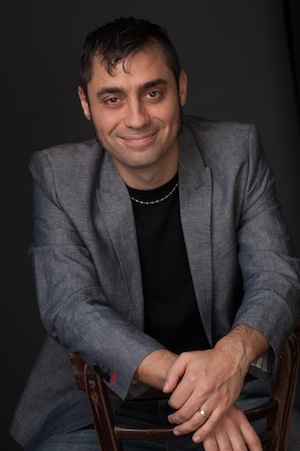
Michael Scholar Jr. (photo from Firehall)
Jenn Griffin plays the role of Dr. Stockman in The Enemy. Jewish community member Michael Scholar Jr., is also part of the cast.
“I play the role of David Horseman (after Captain Horster in the Ibsen), who is a pilot who charters flights to remote fishing and hunting locations across B.C.,” Scholar told the Jewish Independent. “He’s someone who used to work for oil companies, but is now his own boss, trying to keep a low profile, and stay out of political frays. David is a friend of Dr. Stockman, who tries to help her when she is censored and vilified. Throughout the story, we find the otherwise complacent David find his political voice, when he sees a restriction on freedoms of expression come to his small town.”
The Enemy explores the role of the media, the mob mentality, political extremism, corruption, elitism, the environment.
“Theatre is a very powerful medium,” said Scholar, who is also the founding artistic producer of November Theatre. “The way in which ideas are communicated in theatre are through emotion, images and even moral ambiguities. There have been scientific studies done on what happens to theatre audiences when they experience a play live, showing that, when a play is effective, the mirror neurons are firing on all cylinders, creating an emotional, engaging experience that can lead to feelings of empathy and, therefore, understanding.
“The poetic form of theatre, with its use of imagery and physicality, allow for abstract thought and even an awakening of the mind and spirit that is unlike any other form,” he explained. “The ancient Greeks presented dramas to allow their people to wrestle with moral issues communally. It was an important form of public discourse. And The Enemy and other socially conscious theatre are carrying on that tradition.”
Scholar said he is excited to be working with Spencer.
“I’ve known Donna for years, and am thrilled to be working with her and this amazing cast,” he said. “Some great friends of mine are in this show, like my old U of A school chum Daniel Arnold, Green Lake cast mate Donna Soares, and clown extraordinaire Peter Anderson. And I’m getting to know some other incredible talents, like Sharon Crandall, who I saw at Bard [on the Beach] this summer; Paul Herbert, who I’ve seen act since living in Edmonton; Agnes Tong, who was great in Les Belles Soeurs; Braiden Houle, who just did Kill Me Now at the Firehall; and our leading lady, Jenn Griffin, who I know as a playwright and is doing incredible work as Dr. Stockman.”
One of the many intriguing aspects of the play – both Ibsen’s original and Spencer’s adaptation – is how the hero, Dr. Stockman, is portrayed. The doctor is not a sympathetic character, in ways that liberals and progressives especially should note. Dr. Stockman considers herself superior to her critics and those who believe them. A recent article in the New York Times – about why Ibsen’s play is seeing so many remounts in the United States these days – compares some of Stockman’s language to that of Hillary Clinton’s “basket of deplorables” statement, “or other comments that people – perhaps audience members themselves – have made that imply that those they disagree with are inferior.”
There is an excellent article in a 2010 issue of Public Health Ethics that can be found online. In it, Terrance McConnell uses Ibsen’s play to examine the competing responsibilities of a physician: to their own ideals, to their family, to their fellow citizens and to public health.
“One message of the play is that those with vested interests will try to silence the idealist,” writes McConnell.
“A second message in the play concerns how the idealist is portrayed by others,” he adds, giving examples of how Dr. Stockman’s opponents succeed in branding the doctor as crazy.
“In this age of divisive rhetoric,” said Scholar, “this play wrestles with the concept of speaking truth to power even at great personal cost. Ibsen’s story is sadly still relevant today, and Donna’s adaptation puts it in the here and now. I think this production will elicit much discussion, and I look forward to being a part of that.”
The Enemy runs at various times Tuesdays through Sundays at the Firehall Arts Centre, with post-show talkbacks Nov. 22 and 29. Tickets start at $20 and can be purchased from firehallartscentre.ca or 604-689-0926.
Left to right are Megan Laskin, Sherri Wise, Karen James, Jane Stoller, Jeannie Smith, Alyssa Schottland-Bauman and Sharon Goldman. (photo from Jewish Federation)
For the past 14 years, the Jewish Federation of Greater Vancouver has organized a women’s philanthropy event called Choices. The evening is meant to inspire women to understand the power of their tzedakah and to feel part of the community. On Sunday, Nov. 4, in Congregation Beth Israel’s Gales Family Ballroom, the informal consensus in the room of more than 500 women was that Choices exceeded its objectives.
One of this year’s achievements, according to event co-chair Jane Stoller, was that there were 50 first-time attendees. Stoller explained that a table of Hillel BC students had been sponsored and there were new faces from Federation’s young adult program, Axis, in the crowd. In addition, she said a record number of Israeli women were among the new attendees.
As for the featured speakers this year, both not only spoke movingly, but they also tied in Federation as an important component of their respective stories.
Sherri Wise is a dentist who lives and works in Vancouver. She survived a triple bombing on Ben Yehuda Street in Jerusalem on Sept. 4, 1997.
Wise described the sequence of events that led her to be at a café on a beautiful sunny day and what transpired after three Palestinian terrorists each blew themselves up in the immediate vicinity. Wise was seriously injured, with more than 100 nails embedded in her limbs and second- and third-degree burns on many areas of her body. After recounting the details of this tragedy, Wise was able to focus on some of the positives that arose from the horror. “Someone from Jewish Federation in Vancouver contacted Federation in Jerusalem and a kind woman named Trudy came every day to visit me.… I never even learned her last name,” she said.
Wise said she has managed to get on with her life not only with the help of her parents and the Jewish community, but also by making a decision not to harbour anger or hatred toward those who injured her, killed seven and injured 200 others. “Those men were born innocent babies and they were taught to hate – what chance did they have?”
Wise has since helped craft, advocate for and see enacted the Justice for Victims of Terrorism Act. This bill includes deterrents to those who would support terrorist organizations financially and materially, and grants rights to Canadian victims of terrorism. Wise imparted a message of healing, gratitude and finding a way to make a positive difference.
Jeannie Smith, the daughter of Irene Gut Opdyke, was the second speaker. Opdyke, who passed away in 2003, saved the lives of 12 Jews in Poland during the Holocaust and was recognized by the Israeli Holocaust Commission as one of the Righteous Among the Nations. Smith recounted many details of her mother’s story to a captivated crowd.
At the age of 17, Gut was forced to work in, among other places, the home of a high-ranking German officer stationed in Poland near her hometown. Prior to “keeping house” for this officer, she had worked in a laundry facility at a German officer’s camp. When she learned that she would be relocated to a villa in the town and that the Jews of that town would be liquidated, she managed to smuggle the group of Jews she had worked with in the camp’s laundry into the basement of the villa.
Eventually, the officer discovered the hidden Jews but, for a variety of reasons – none of them altruistic – he did not turn them in. As the Soviets approached and the Germans fled Poland, the 12 Jews, one of whom was pregnant, fled to the forest and joined the partisans.
There are many more twists and turns to Gut Opdyke’s story, but she ended up in California, where she married an American man who was the only person in the United States who knew anything about her painful and heroic past. Gut Opdyke was moved to begin speaking about her experiences only after she received a random call from a Holocaust denier. For the rest of her life, she was a Holocaust educator who shared the story her daughter, Smith, shared with the women at Choices.
Smith expressed gratitude toward the Jewish Federation of Portland because they paid for her father to live out his life in the Jewish seniors home once he developed Alzheimer’s. Commenting about Federation, she said, “One person can make a difference, and an organization can make a mighty difference.” She concluded with what she said her mother used to end her speeches with as well: “Every day we have an opportunity to be kind, to stand up for what is right and to go against what is wrong. We can be the difference in someone’s life.”
Both Wise and Smith received standing ovations for their heartfelt stories of love and resilience.
Leanne Hazon was one of the first-time attendees at the event. Having lived in Toronto for the last 18 years, the Richmond native returned to Metro Vancouver earlier this year for work.
“I thought the whole event was amazing!” she said. “It had such a nice vibe and feeling of community, very warm and welcoming. And the speakers were exceptional…. Sherri Wise’s message of forgiveness was so powerful and Jeannie Smith’s story about her mom was very moving.”
For more information on Jewish Federation and its annual campaign, visit jewishvancouver.com.
Michelle Dodekis a freelance writer living in Vancouver.
On Remembrance Day, Nov. 11, a small group of Jewish community members gathered in the Jewish section of Mountain View Cemetery to commemorate Canadians who have served in the armed forces. Organized and led by Rabbi Steven L. Nemetz, a member of the Royal Canadian Legion Branch 179, the ceremony was attended by more than 30 people, including children, nieces and nephews, and grandchildren of men and women who served in the Allied armed forces. Many attendees brought with them wartime photos of their uniformed family member(s).
The 100-bell Bells of Peace ceremony marked 100 years since the end of the First World War. Each person present at the memorial was invited to step forward to ring a ship’s bell after the announcement of their name and the name, relation and rank or service of their fathers, uncles, aunts, and other relatives.
Kaddish was recited. “Last Post” was played by a cadet trumpeter and a piper played the lament, which recalls the end of battle, and “Amazing Grace.” The commemoration opened with O Canada and concluded with Hatikvah.
In the Wisconsin town of Baraboo, high school students in their final year before graduation take formal pictures on the steps of the town’s courthouse. Census figures say that the town of 12,000 in the country’s heartland is 94% white.
Among the pictures available for purchase on the website of a local photographer was one with only the boys and in which many – most, it appears – were performing a Nazi salute. (The photo disappeared from the site on Monday but is widely available online.) One of the students near the front did not make the Nazi salute – instead he made a hand signal made popular by far-right white supremacists. He’s the real rebel, we suppose.
Actions like these can often be sparked by the dumb idea of one or two kids, with others following along. It would be distressing and disgusting at the best of times but, now, when there is a clear, genuine resurgence of white supremacy, antisemitism, xenophobia and other forms of intolerance in the United States and worldwide, this takes on a deeper resonance. Is this an example of a bunch of high schoolers thinking (perversely) that this would be funny or kooky or somehow amusing? Or is there, among the crowd, a few or a lot who know what the salute really means, identify with the ideology behind it and, because of the mainstreaming of “alt-right” ideas in the country, felt emboldened to make this statement?
Certainly, there are worse hate crimes and other catastrophes in the United States – including racially motivated and gun violence – that deserve attention. Yet, this incident sticks out for a number of reasons.
The picture is jarring. Kids – young adults almost – well-dressed in their graduation suits, nearing a turning point in their lives, standing in front of the embodiment of justice and rule of law in their society, raising their arms aloft en masse in a motion determined to provoke.
But this is not the most alarming thing about the photo and how it came to be. Deep into the New York Times story about the incident, a recent alumna of the high school said she was disappointed but not shocked, knowing that a group of boys in the school were noted for bullying and offensive remarks. “I’m not surprised by them doing this,” she said.
Then she added: “But I’m surprised that there’s so many of them doing this. Photographers were there; the parents were there; community members were there.”
There’s more to the story. The photo was apparently taken months ago and it took this long for anyone to raise alarms.
Still more: a young man in the back of the photo whose arms remain by his side said, on Facebook, that the salute was the idea of the photographer. Should this make us feel better? If true, the photographer should suffer professional and social consequences. But were there parents and other community members who witnessed this live and stood by silently?
In a world not lacking in tragedies or social ills, this is not the worst of the week’s news. Yet it resonates because these young people are part of the next generation we are depending on to fix society’s ills and improve the world. Have their parents, grandparents and educators done their jobs in preparing them for the world and their responsibilities in it?
In a letter to parents, the superintendent of the school district said her team was “extremely troubled” by the image.
“Clearly, we have a lot of work to do to ensure that our schools remain positive and safe environments for all students, staff and community,” she wrote. “If the gesture is what it appears to be, the district will pursue any and all available and appropriate actions, including legal, to address the issue.”
Fair enough. But, first and foremost, perhaps they should look at their curriculum and also consider what messages are being sent consciously or unconsciously by teachers, administrators and other role models before they initiate legal or any other actions against the students.
While school administrators and teachers have much on their plates – shrinking budgets and broadening demands, as well as trying to prevent their charges from being murdered in yet another gun rampage – this should be a warning for educators everywhere to remember that success is not only measured in grades and that a proper education includes more than academics.
Isn’t life wonderful? It has such potential to deliver joy, beauty, poetry and music for every one of us. More’s the pity that so many of us get only a small fraction of that potential for our portion. Still, gratitude must be the order of the day because things could always be worse.
If we take the time to examine the simple pleasures that most of us benefit from, we should be able to swallow some of the less digestible bits with a little more grace. Nature is nearly everyone’s inheritance – sun, moon, sky and stars, the green around, with maybe a spot of colour. We breathe in and out, taste the sweet along with the sour, and sometimes hear a birdsong. And perhaps, from time to time, if we are fortunate, our lot allows us a warm embrace.
We start out as strangers in a world we know absolutely nothing about. We start out with only sensations: warmth, cold, discomfort, pain, or their absence, and hunger pangs. Our first lesson is the instinct to cry out in reaction to what we find uncomfortable. We soon learn whether our instinctive appeals for help are likely to be answered quickly or with an incomprehensible delay. Scientists tell us that this knowledge might play an important part in determining what sort of creature we will become in later life. (See, for example, “The Role of Parents in Early Childhood Learning” by Susan H. Landry, Children’s Learning Institute, University of Texas Health Science Centre, which was published online in 2008.)
Totally dependent on others, humans, like other mammals and many species, begin their lives in a precarious situation. We all know from our own learning that survival rates have markedly improved with living standards and advancing technology. An exploding world population provides solid evidence for that. So has the chance that the psyches present in adulthood will be healthier. By no means can it yet be said that such is a foregone conclusion.
We accept that our early years on this planet are the period when we consciously concentrate on amassing the information and knowledge that we need to negotiate our passage through life. In earlier times, that formal period of education, now increasingly financed in one way or another by the state, was much shorter than it has now become.
In the end, we often learn much more on the job, after formal education has ended, about what we must know to do our work. Life has become increasingly complicated though and even this learning will not suffice always, as the very nature of work is altered daily. Jobs disappear, never to return, and new skills become imperative.
I was born during the Great Depression. For a good number of years, my father never had a job. I don’t believe he ever had a formal education, arriving in Canada as a young man. Yet, hired as a labourer to feed coal into a boiler furnace, through self-study, he rose to be an engineer solely responsible for a vast industrial complex. He had some book-learning to get his papers, but mostly he learned his stuff from doing his work.
My degrees were in agriculture, but the only planting I ever did was in my home flower garden. I had four jobs in my career, but only one, the first, had any direct relationship with agriculture. Essentially, I became a manager and I never learned anything about doing that kind of work at school. If I learned anything at all during those years, it was certainly by doing things I had to do on the job.
So what is management? It has to do with trying to get thing done through other people. I know there are courses that try to give a head start on learning that, but I never had the good fortune to take any of them. I can’t say I was a good manager, but I certainly learned a lot about what not to do. And I am content that I learned enough to get all my work done well.
The truth is that learning on the job applies to almost everything we challenge ourselves to try and accomplish in life. This applies to parenting and partnering like everything else. This is not news to any of you out there.
What makes our current situation so much more challenging is the rapid rate of change we face in our lives. How can we give advice to our young when they know more about what is happening in our current reality than we can possibly keep up with?
Parenting may be one the most perplexing learning-on-the-job challenges we will face in our lives. And I don’t envy this generation of parents, who find their children more adept at the latest devices in every home than they ever will be. They will have to concentrate on the management skills they will have to pick up to deal with children who know more about important things in the world than they do.
From working to getting along with our partners to parenting and more, it fascinates me how much we have to learn on a continuing basis, throughout our lives.
Max Roytenberg is a Vancouver-based poet, writer and blogger. His book Hero in My Own Eyes: Tripping a Life Fantastic is available from Amazon and other online booksellers.
Inside the caterpillar shelter, an orange line indicates where one can safely stand beyond the range of flying shrapnel. (photo by Gil Zohar)
Miri Asulin personifies the contradictions of those who live in Israel’s cities and settlements bordering the Gaza Strip.
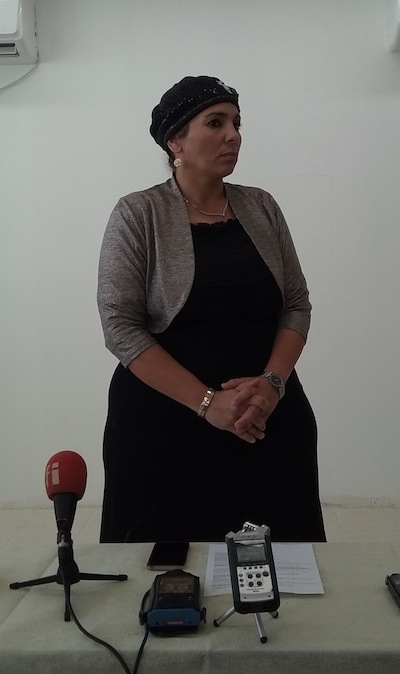
The 41-year-old mother of seven and principal of a brand-new elementary school in Ashkelon’s southern suburbs, 15 kilometres from the coastal enclave, commutes from her home in nearby Sderot, where she has been living for 26 years since she married. Until the barrage of 40 rockets fired from Gaza on the Sabbath of Oct. 26-27, she had dutifully and quietly followed Home Front Command orders. Though no one was killed in that bombardment, for Asulin it was the straw that broke the camel’s back.
Miri Asulin, mother of seven and principal of a brand-new elementary school, hosted the media recently to talk about the impacts of the rocket and mortar attacks from Gaza. (photo by Gil Zohar)
Addressing a pool of journalists in an air-conditioned classroom in her fortified building – the week before this Monday’s attacks from Gaza, which included more than 300 rockets or mortar bombs that day alone – Asulin asked that we not mention the name of her school since she has not received permission from the Ministry of Education to host the media. But she is unwilling to risk holding the interview outside on a pleasant fall day, lest a Colour Red rocket alert siren begin wailing.
“After 17 years [of rocket fire], I decided not to be quiet any longer about what is happening to us in Sderot and the south,” she began. “An attack on any Jew is an attack on all the Jewish people.”
What was it like that Shabbat as the sirens went off?
“The children were screaming,” she recalled. The worst part, she said, was the feeling of helplessness in the face of a “merciless enemy. We worship life. They worship death. One side has to be defeated.”
She said, “I’m no longer willing to remain silent. I’m not a politician or a cabinet member. I’m a mother.”
Asulin has witnessed the creeping paralysis of post-traumatic stress disorder. “Children have reverted to [being] bed-wetters, afraid to go to the bathroom alone. We’re going to have a generation of IDF soldiers who are traumatized,” she warned.
Ninety-four percent of Sderot’s children have PTSD symptoms, she said.
Mental health professionals treating PTSD say the best strategy for coping with psychological warfare is to maintain one’s daily routine. But those professionals urging resilience are themselves vulnerable and suffering from chronic burnout.
Asulin couldn’t sleep all night following the rocket barrage. “My body is in trauma,” she said. “I’m in shock.”
“With a snake, you cut off its head,” she said. Calling for reprisal attacks, she urged the Israeli government to kill 10 Hamas terrorists for every rocket fired.
***
As visceral as Asulin’s trauma is, Sderot itself shows few signs of the 25,000 Qassam rockets and mortars that have targeted the city and nearby kibbutzim for 17 years, killing 56 people. The city of 26,000 has no shattered glass, no bomb craters and no burned-out buildings. Superficially, Sderot looks green and prosperous.
Alon Davidi was reelected mayor in the Oct. 30 municipal elections, reflecting the satisfaction – or the apathy – of Sderot’s populace.
“Sderot is one of the most bombarded cities [in the world] since World War II,” according to Noam Bedein, the founder of the Sderot Media Centre. To his abiding frustration, there is no military solution to the rockets fired intermittently from Gaza, he said.
Sderot’s growing skyline. (photo by Gil Zohar)
Paradoxically, Sderot has been experiencing a construction boom in recent years, he explained. Founded in 1952 as a dumping ground for new immigrants from Morocco, the development town struggled in obscurity even as newcomers arrived from the Soviet Union, Ethiopia and India. The turning point came in 2013, he said, when the rail line opened, linking Sderot and nearby Ofakim and Netivot with Tel Aviv and Beer Sheva. Attracted by low real estate prices and tax benefits, tens of thousands of people have relocated to the former development towns and nearby communities. Construction cranes, new shopping malls and a burgeoning skyline of high-rise apartment towers reflect the wave of commuters who flock to Sderot’s underground train station. Two thousand apartments have been purchased in Sderot since the 2014 war. The population is projected to double in the coming years, to 50,000 people. Relatively few families abandon Sderot, in part because the value of their homes won’t allow them to purchase equivalent housing in the more expensive centre of Israel.
Everywhere in the city, bomb shelters have sprouted like mushrooms after a rain, making Sderot the bomb shelter capital of the world. Hoping to lower the odds in the game of Russian roulette, the ubiquitous reinforced concrete structures have been strategically placed so that one can race to a shelter anywhere in the 15 seconds notice that the siren provides. Every bus stop has an adjoining shelter.
A colourful concrete caterpillar crawls through a playground. There are no steel doors. Bedein explained that the precious seconds it takes a child to pull open a heavy door could mean the difference between life and death. Inside the caterpillar shelter, an orange line indicates where one can safely stand beyond the range of flying shrapnel.
***
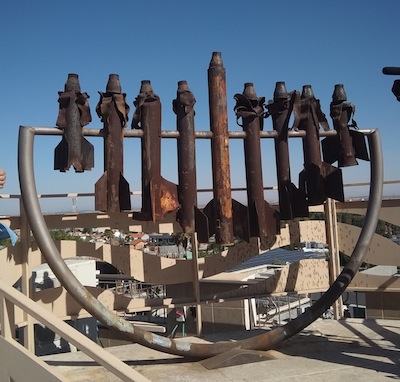
A chanukiyah, made from Qassam rockets, at Sderot’s Hesder Yeshiva. (photo by Gil Zohar)
Rabbi Ari Katz, the director of public relations at Sderot’s Hesder Yeshiva – where soldiers combine religious studies with army service for five years – has broad perspective on the rockets targeting Sderot. Originally from Chicago, he lived in Gush Katif until 2005, when the Israeli government uprooted the 8,000 Jews living in the Gaza Strip. It was that unilateral disengagement, followed by the 2007 Hamas takeover of Gaza from the Palestinian Authority, which created the conditions for the current rocket campaign, he said.
“We’re in a standing pattern, waiting to see what will be,” he said. Standing on the roof lookout point, which offers a panoramic view towards Gaza, one kilometre away, he proudly pointed to the new construction edging towards the frontier.
“They see the cranes,” he said, referring to the people of Gaza. “They think we’re crazy.”
Israeli President Reuven Rivlin addresses a group of local residents in a protected space in the northern Negev city of Netivot on Nov. 13. (photo by Ashernet)
On a tour of the city, Netivot Mayor Yehiel Zohar told President Reuven Rivlin about how buildings there are protected and about the events of the previous 24 hours. Rivlin also heard details about the work of the psychological and mental support services in the city, and the help given to children and the population as a whole after Monday’s missile launches from Gaza. “We are all under attack, under fire, whose aim is to disrupt our daily life,” said Rivlin. “Your strength gives us all strength. I have said in the past and I will continue to say, the area around Gaza is part of Israel. When the sirens are screaming here, we hear them in our hearts in Jerusalem, Tel Aviv and all over the country.” The president then visited one of the shelters in the town. In meeting local residents, he repeated appeals to follow the Israel Defence Forces’ orders.
Bennett and Sally Shaywitz co-founded the Yale Centre for Dyslexia and Creativity. (photo from the Shaywitzes)
One out of five people has dyslexia. Yet, even with this many people affected, not every school tests for it. This can lead to feelings of self-doubt and frustration for the child who has dyslexia but doesn’t know it. Parents and teachers may also become frustrated and the result can be children losing confidence in themselves.
Sally and Bennett Shaywitz, both academic physicians, say there is a simple test available for anyone to use to see if they have dyslexia.
Bennett Shaywitz was chief of child neurology at Yale for approximately 40 years, before stepping down a couple of years ago to devote all of his energy to dyslexia. “I’m the Charles and Helen Schwab Professor in Dyslexia at Yale,” he said. “Charles Schwab is very philanthropic and very dyslexic, so I’m very fortunate that I’m his name share.”
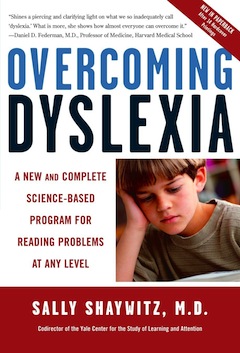
“Together, Bennett and I founded the Yale Centre for Dyslexia and Creativity,” Sally Shaywitz told the Independent. “I also wrote the bestselling book on dyslexia, called Overcoming Dyslexia.”
It all began when she was asked by Yale to work with children with learning disabilities, as none of the other faculty wanted to do it. “They thought it was beneath them,” she said. “I said, ‘Sure, I’ll do it part-time.’ And then I became intrigued with these children I saw who weren’t reading and whose parents were beside themselves and very worried. So, I began looking into it. Bennett was studying more basic science in attention. He got intrigued, so we worked together.”
As the research progressed, she discovered that there were many children who had problems with their reading yet seemed bright.
“Also, when I looked into it, they were studying children in schools and things, but there wasn’t a general study of a large population,” she said. “So, I started with the Connecticut Longitudinal Study. What differentiates that study is that it’s of a population, we work with a population statistician. We selected children from all over Connecticut and broke it into 14 towns. We invited all the children in kindergarten and, lo and behold, 95% of the ones we invited actually participated. That study is still going on. We are seeing those same people, about 375 of them, as adults, as 40-year-olds.”
The study started with 455 kids and 20% turned out to have dyslexia, while the schools had been under the impression that hardly any students were dyslexic.
“It taught me a lesson that I testified to the U.S. House of Representatives and the U.S. Senate,” she said. “It was that, to be counted, you had to be identified. Schools are not identifying kids, so they didn’t think they had any. Our data is very strong, and it goes along with data from the federal government that they’ve collected over the years. Dyslexia involves one out of five people – and we also discovered that it affects girls as well as boys.
“People used to say that it was just boys. What happens when people say that is that they only study boys. What we were able to do in the longitudinal study is we made up different instruments and validated them. One was a teacher instrument…. What we found was that, when boys and girls were tested, there were virtually equal numbers. But, when you ask the teacher about the child’s behaviour in class, they would say, oh, the boys were rowdy, pulling the girls’ hair, playing across the room, etc. And, the girls, they are so well behaved, but they never read a word. So, it was the boys that were sent for evaluation, because the teachers wanted to get them out of the room.
“We were able to show that dyslexia affects not only boys, but girls as well,” she said. “And, also, that it is persistent. It doesn’t go away. This study has made many major advancements.”
The Shaywitzes also found that, while, with non-dyslexics, reading and IQ are connected, with dyslexics, that correlation does not exist. This was in line with the very first description of dyslexia, in 1896, when a British physician referred to a young man who would have been the smartest in the class, if not for reading.
“People at the turn of the century really got it. They understood it,” said Sally Shaywitz. “But, over time, people stopped understanding it – deciding that, if you’re really smart, you can’t be dyslexic. So, what we were able to demonstrate is that, in fact, you can be very smart as well as dyslexic. The definition incorporates that dyslexia is an unexpected difficulty – unexpected, in that you can be very bright and yet read at a much lower level.”
The Shaywitzes said, due to such misconceptions, testing should be done as early as possible, around Grade 1.
“We developed a screener, called the Shaywitz Dyslexia Screen,” said Sally Shaywitz. “We gave it to Pearson Publishers, who I’ve worked with, wanting to involve teachers, as they know the child best and have mostly been ignored in a lot of these processes.
“There’s a kindergarten, Grade 1, Grade 2 or Grade 3 screening that has about 10 lead questions that the teacher responds to on a tablet. It takes five to seven minutes to get an answer as to whether or not the child is at-risk or not at-risk. You don’t have to test a kid and pull him out of his class or anything like that.
“So, the boys and girls start school and the parents say, ‘Oh, you’re gonna love it. You’ll learn to read. It’s going to be so much fun.’ Then, children enter school, waiting for this magical moment, and it doesn’t come. And, when they are called on to read aloud in class, the other kids giggle and make fun of them … and the teacher says, ‘How can you not know that?’ The kids lose confidence in themselves and begin to believe they are not very smart. That’s why children need to be screened and identified as at-risk very early on.”
Schools are way behind, she said. “Not every school identifies children with dyslexia.”
While the symptoms might improve, the person will always be dyslexic, she said. But, by identifying kids who have dyslexia early, parents and teachers can help the kids overcome their dyslexia in various ways.
The Shaywitzes have developed one tool, called the Key of Strength Model: Dyslexia and Creativity.
“They have almost an isolated island of weakness surrounded by a sea of a higher level of cognitive functions like reasoning, problem solving and critical thinking,” said Sally Shaywitz. “So, you want to identify the weakness and intervene. And, you want to identify the strengths and make sure kids can connect them.
“If they are not identified, they don’t know how smart they are and teachers mistakenly say, ‘Why don’t you try harder? Why didn’t you do that? Why didn’t you do your homework?’… things like that.
“In the case of dyslexia,” she said, “we have enough knowledge to do better. So, rather than a knowledge gap, we have an action gap. They have to implement the knowledge we have. It’s amazing that, in the 21st century, there is still so much misunderstanding of dyslexia that is harming so many.”
For more information on universal screening, dyslexia and more, visit dyslexia.yale.edu.