Skip to content
  • Home
  • Subscribe / donate
  • Events calendar
  • News
    • Local
    • National
    • Israel
    • World
    • עניין בחדשות
      A roundup of news in Canada and further afield, in Hebrew.
  • Opinion
    • From the JI
    • Op-Ed
  • Arts & Culture
    • Performing Arts
    • Music
    • Books
    • Visual Arts
    • TV & Film
  • Life
    • Celebrating the Holidays
    • Travel
    • The Daily Snooze
      Cartoons by Jacob Samuel
    • Mystery Photo
      Help the JI and JMABC fill in the gaps in our archives.
  • Community Links
    • Organizations, Etc.
    • Other News Sources & Blogs
    • Business Directory
  • FAQ
  • JI Chai Celebration
  • JI@88! video

Recent Posts

  • BGU fosters startup culture
  • Photography and glass
  • Is it the end of an era?
  • Taking life a step at a time
  • Nakba exhibit biased
  • Film festival starts next week
  • Musical with heart and soul
  • Rabbi marks 13 years
  • Keeper of VTT’s history
  • Gala fêtes Infeld’s 20th
  • Building JWest together
  • Challah Mom comes to Vancouver
  • What to do about media bias
  • Education offers hope
  • Remembrance – a moral act
  • What makes us human
  • המלחמות של נתניהו וטראמפ
  • Zionism wins big in Vegas
  • Different but connected
  • Survival not passive
  • Musical celebration of Israel
  • Shoppe celebrates 25 years
  • Human “book” event
  • Reclaiming Jewish stories
  • Bema presents Perseverance
  • CSS honours Bellas z”l
  • Sheba Promise here May 7
  • Reflections from Be’eri
  • New law a desecration
  • Resilient joy in tough times
  • Rescue dog brings joy
  • Art chosen for new museum
  • Reminder of hope, resilience
  • The national food of Israel?
  • Story of Israel’s north
  • Sheltering in train stations

Archives

Follow @JewishIndie
image - The CJN - Visit Us Banner - 300x600 - 101625

Month: November 2018

In solidarity against hatred

In solidarity against hatred

Selina Robinson, minister of municipal affairs and housing, speaks at the local memorial for the victims of the shooting at Tree of Life synagogue in Pittsburgh. (photo by Alan Katowitz)

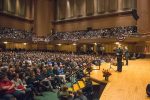
On Sunday afternoon, Oct. 28, the day after a gunman opened fire on Shabbat worshippers in Pittsburgh in the Tree of Life synagogue, hundreds gathered at the Jewish Community Centre of Greater Vancouver for a vigil for the victims.

Eleven congregants were murdered and four police officers wounded before the shooting suspect, Robert Bowers, was apprehended, in what the Anti-Defamation League is calling the greatest antisemitic massacre in American history. Above the crowd in the Wosk Auditorium at the JCCGV, a projector showed a version of the logo of the Pittsburgh Steelers that had been created in the wake of the shooting – it had one of the iconic stars replaced by a Star of David.

The local response was so large that a separate service had to be held in the community centre’s atrium. The Jewish Independent attended the vigil in the auditorium, which was opened by Rabbi Hannah Dresner, spiritual leader of Or Shalom Synagogue and head of the Rabbinical Association of Vancouver.

“We must stand with other minorities to combat hatred with nobility, goodness, and with radical love,” said Dresner. “We must strengthen our empathy with marginalized peoples and do the job, each of us, that is uniquely ours, to create a heaven right here on earth. But first, we must grieve a Jewish loss.”

The rabbi closed with reading a poetic translation of Psalm 23, which is traditionally read at funerals.

Rabbi Jonathan Infeld of Congregation Beth Israel said, “I’ve lived for the last 13 years in Vancouver but was born in and grew up in Pittsburgh. I went to Tree of Life many times as a teenager. HIAS [Hebrew Immigrant Aid Society], the organization the deranged individual was most upset about, was the organization that brought my parents to the sanctuary of Pittsburgh.”

The shooter, who had yelled, “All Jews must die!” before opening fire, had written on Facebook before the attack that he was incensed by Jewish support for immigrants and refugees, who he believed were entering the United States to slaughter white people.

“The massacre took place in Squirrel Hill, in Mr. Rogers’ neighbourhood, where Fred Rogers taught us the Torah verse, ‘you shall love your neighbour as yourself,’ so well,” Infeld noted. “The response to something like this is repairing the world.”

He appealed to everyone present, and all Jews, to fill every synagogue to capacity in the coming weekend. “I ask that all synagogues in Vancouver be filled, with not one seat empty,” he said.
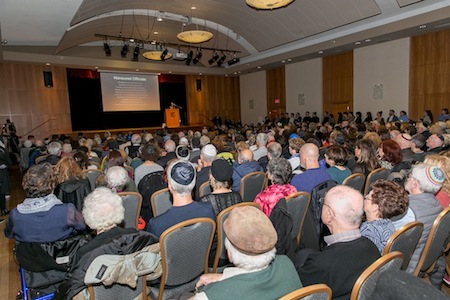
photo - Karen James, chair of the board of the Jewish Federation of Greater Vancouver, addresses the community in the Wosk Auditorium
Karen James, chair of the board of the Jewish Federation of Greater Vancouver, addresses the community in the Wosk Auditorium. (photo by Alan Katowitz)

Karen James, chair of the board of the Jewish Federation of Greater Vancouver, then spoke, followed by Selina Robinson, minister of municipal affairs and housing, who read a statement from B.C. Premier John Horgan.

“British Columbians’ hearts are broken, hearing the devastating news of the shooting at the Tree of Life synagogue in Pittsburgh. Everyone should feel safe in a place of worship,” said Horgan in his statement. “My caucus and I and everyone in the House reject antisemitism, racism, discrimination, intolerance and bigotry. When these rise up, we must stand up united and denounce them together in the strongest of terms. An attack like this is a deep violation of safety and security. Our thoughts are with the families of those targeted and Jewish people around the world.”

Robinson was among many officials present, including Bruce Ralston, minister of jobs, trade and technology; Ravi Kahlon, parliamentary secretary for sport and multiculturalism; Howard Chow, Vancouver Police Department deputy chief constable; Irene Lanzinger, president of the B.C. Federation of Labour; and several members of the Legislative Assembly. Richmond North Centre MLA Teresa Wat changed a flight to be there.

“I am quite connected to the Jewish community,” Wat told the Jewish Independent, “especially the Bayit congregation in Richmond. When I saw what’s happening, I felt really sad. We need to combat this kind of attack on humankind as a global village. Everyone is related and, if it happens to one ethnic group, it can happen to any other. I am happy to see this vigil and hope that all ethnic groups will gather in solidarity to condemn this kind of atrocity.”
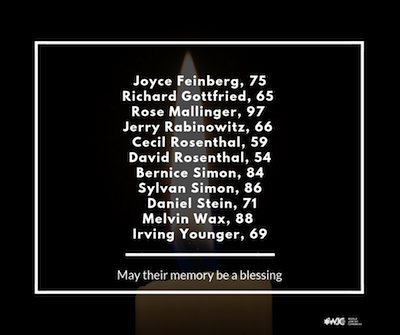
image - the names of those who were murdered in Pittsburgh shootingRabbi Dan Moskovitz of Temple Sholom led a candlelighting in remembrance of the victims, with help from Rabbi Adam Rubin of Beth Tikvah. Moskovitz read the names of each victim and shared something from their biography. “In the Jewish tradition,” said Moskovitz, “we need the names. To say Kaddish, to pray, to remember.”

Rabbi Aaron Bisno of Congregation Rodef Shalom in Pittsburgh then joined the service in the auditorium on video, thanking the Vancouver Jewish community for their solidarity. He told the story of being at his synagogue on the day of the shooting – where he was doing a baby naming for two Jewish fathers who had adopted a child – and hearing the news and having to tell the congregation that they were on lockdown until the shooter was apprehended. Bisno urged the crowd to “repair the world when we find it fractured instead of blaming each other for that which we find uncomfortable. I give you my most sincere blessing of gratitude.”

Rabbi Shlomo Gabay of Congregation Beth Hamidrash chanted El Male Rachamim (God Full of Compassion), a traditional prayer of mourning. Rabbi Philip Gibbs read an English translation.

Many non-Jewish community clergy were present at the vigil, including Dr. Kala Singh and Pritam Singh of the Sikh community, Prof. Harry O. Maier of the Vancouver School of Theology and Haroon Khan of the Al Jamia Masjid mosque.

Matthew Gindin is a freelance journalist, writer and lecturer. He is Pacific correspondent for the CJN, writes regularly for the Forward, Tricycle and the Wisdom Daily, and has been published in Sojourners, Religion Dispatches and elsewhere. He can be found on Medium and Twitter.

Format ImagePosted on November 2, 2018November 1, 2018Author Matthew GindinCategories LocalTags antisemitism, memorial, Pittsburgh shooting
Bennett makes official visit

Bennett makes official visit

Israeli Minister of Jews in the Diaspora and Minister of Education Naftali Bennett addresses a memorial in Pittsburgh on Oct. 28. (Alexi Rosenfeld courtesy Ashernet)

On Sunday, Oct. 28, Israeli Minister of Jews in the Diaspora and Minister of Education Naftali Bennett addressed a memorial vigil at the Soldiers and Sailors Memorial Hall and Museum in Pittsburgh, for the 11 members of the Jewish community murdered in the shooting attack at the Tree of Life synagogue the day before.

Bennett was visiting the city as an official emissary of the Government of Israel, to offer strength and support to the Jewish community following the tragedy. The minister met during the day with leaders of the Pittsburgh Jewish community, and wider American Jewry, as well as with Pennsylvania Governor Tom Wolf, Pittsburgh Mayor Bill Peduto and members of Congress representing the state.

In an emotional meeting, Bennett sat with Rabbi Jeffrey Myers, spiritual leader of the Tree of Life congregation. During the attack, Myers had led many of his congregants to safety.

“Our whole nation is feeling the pain you are feeling here after this heinous hate crime,” Bennett told the leaders of the Pittsburgh community. “I want to extend my condolences to the families of the victims. People who have seen so much in their lives could not imagine they would be gunned down in Shabbat prayer.”

The minister visited the site of the attack and met with ZAKA (Israel’s volunteer emergency response force) and other emergency crews, who had helped the local police, who he also thanked for their great bravery.

Addressing the memorial vigil – attended by more than 4,000 people from the Jewish and non-Jewish communities in the city, including the governor and mayor, senators and members of Congress, President Donald Trump’s Special Envoy Jason Greenblatt, Israeli Ambassador Ron Dermer and New York Israel Consul General Danny Dayan – he said, “Today, we stand in the shadow of death, in the shadow of evil, in the shadow of a cowardly terror attack on Jews who were in synagogue to pray – the deadliest antisemitic attack in the history of the United States.”

He added, “But, today, I met the people and the leaders of the community here in Pittsburgh and I didn’t see death. I saw life, strength. I saw a warm community of love and unity. I saw the Tree of Life, which will never be uprooted by hatred.”

He said, “We stand together, as Jews from all communities united, as well as members of all faiths. Together we stand. Americans and Israelis. People who are, together, saying no to hatred. The murderer’s bullet does not stop to ask, Are you Conservative or Reform, are you Orthodox? Are you right-wing or left-wing? It has one goal, and that is to kill innocent people. Innocent Jews.”

Bennett told the thousands at the memorial that he came to offer the support and condolences of all the Israeli people.

“Nearly 80 years since Kristallnacht, when the Jews of Europe perished in the flames of their houses of worship, one thing is clear,” he said. “Antisemitism, Jew-hating, is not a distant memory. Antisemitism is a clear and present danger. From Sderot [in southern Israel] to Pittsburgh, the hands that fire missiles are the same hands that shoot worshippers. We will fight against the hatred of Jews and antisemitism wherever it raises its head, and we will prevail.”

Stressing the shared values that bond the American and Israeli peoples together, Bennett concluded, “Freedom will overcome. Unity will defeat division. Love will defeat hatred. Light will defeat darkness. Am Yisrael Chai.”

Format ImagePosted on November 2, 2018November 1, 2018Author Edgar Asher ASHERNETCategories WorldTags antisemitism, memorial, Pittsburgh shooting
A moment of silence

A moment of silence

Sunday morning’s cabinet meeting in Israel. (photo from IGPO via Ashernet)

On Oct. 28, at the regular Sunday morning cabinet meeting in Israel, Prime Minister Binyamin Netanyahu, together with ministers, stood for a moment of silence. At the meeting, Netanyahu said, “The entire people of Israel grieve with the families of the people who were murdered in the shocking massacre at the Tree of Life synagogue in Pittsburgh [on Oct. 27]. On behalf of myself, the Government of Israel and the people of Israel, from the depth of our hearts, I send our condolences to the families who lost their loved ones. We all pray for the swift recovery of the wounded.”

He added, “It is very difficult to exaggerate the horror of the murder of Jews who had gathered in a synagogue on Shabbat and were murdered just because they were Jews. Israel stands at the forefront with the Jewish community of Pittsburgh, with all Jewish communities in the U.S. and with the American people. We stand together, at the forefront, against antisemitism and displays of such barbarity.

“I call upon the whole world to unite in the fight against antisemitism everywhere. Today, regretfully, we refer to the United States, where the largest antisemitic crime in its history took place, but we also mean, of course, Western Europe, where there is a tough struggle against the manifestations of a new antisemitism. Of course, there is also the old and familiar antisemitism, and that of radical Islam. On all these fronts, we must stand up and fight back against this brutal fanaticism. It starts with the Jews, but never ends with the Jews.”

Format ImagePosted on November 2, 2018November 1, 2018Author Edgar Asher ASHERNETCategories IsraelTags antisemitism, Israel, memorial, Netanyahu, Pittsburgh shooting
We must focus on justice

We must focus on justice

(photo by Alan Katowitz)

Hundreds of Vancouverites came together Sunday night, driven by the need for community after the news that 11 congregants were murdered during services at a Pittsburgh synagogue a day earlier.

The attack – the deadliest terror act against a Jewish community in North American history – devastated the Pennsylvania Jewish community and elicited grief, alarm and solidarity among Jews across the continent and beyond. As some commentators have said, shock may not have been a foremost response. The very fact that we in Vancouver and Jews almost everywhere else pass by security personnel and infrastructure every time we enter a Jewish facility conditions us to expect that something like this might happen.

The assembly at the Jewish Community Centre of Greater Vancouver, convened by the Rabbinical Association of Vancouver, drew hundreds of people, mostly Jews but also members and clergy of other faith communities, as well as elected officials and other individuals. The words from the speakers – mostly rabbis – were powerful and thoughtful, though perhaps the words were less significant than the simple sense of commonality of emotion among those assembled.

In the hours and days since the incident, so many of us have tried to somehow assimilate the meaning and implications of the violence.

Extremism has been growing worldwide. Antisemitism, racial supremacism, nativism and other dangerous tendencies have infiltrated societies throughout the Western world. We have seen political successes for once-fringe parties in Europe and, most recently, in South America. In the online and general discourses in North America, extremist commentary has become so commonplace that it approaches the mainstream, if that is not an oxymoron. Words have consequences. All actions, good and evil, begin as ideas, move into language and ultimately manifest in behaviours.

This raises the matter of free expression. While some seek to smother the expression of hateful and other repugnant ideas, the events of last weekend present an argument for more, not less, discussion. Open dialogue of all ideas, including appalling ones, is not just a theoretical value. It allows us to monitor antisocial ideas, rather than pushing them under rocks. The perpetrator’s long record of deranged rants about Jews did not prevent this tragedy. But knowledge of such ideas and those who hold them represent our best chance for preventing repetition of such terror acts. (This sort of knowledge is critical to intelligence-gathering services. In Israel, recent reports indicate, 10 potential attacks are thwarted for every one that is successfully executed.)

Americans’ access to guns is also raised as an issue when things like this happen. We have little optimism of seeing this matter resolved in our lifetimes. It is notable, though, that, in what should be a moment of national mourning, the U.S. president has aimed to score political points by advancing the idea that the synagogue should have been, essentially, an armed defensive encampment. This idea is not a solution. It is a capitulation to a dystopic reality. A better president would have had words of national unity and consolation.

While we seek healing as a community, welcome condolences from so many allies, and wish blessings on the murdered and comfort for the survivors, we also now enter unfamiliar realms. In many mass murder incidents, the perpetrator does not survive the attack. In this case, he has. We will watch as the victims’ families confront this terrible act through the justice system, hoping for something approaching closure. Some people are already calling for vengeance, and the death penalty is a possible punishment for the perpetrator, which raises additional quandaries for those among us for whom state-sanctioned killing is an evil unto itself.

The larger issue facing us in the coming weeks is that true justice, in a practical sense, must convey to all people that this is a society that rejects and condemns not only the act that took place Saturday, but the ideas that inspired it and other heinous hate crimes. The mantra of Simon Wiesenthal’s life, which was devoted to as proper a response as possible to the greatest crime perpetrated against the Jewish people, was “justice, not vengeance.” This was in keeping with the ancient obligation of Judaism – justice, justice, you shall pursue.

We grieve, we mourn, we console. But, through these processes and after, we continue what our tradition has demanded for millennia, the ultimate bulwark to this and every other wrong: we seek justice.

Format ImagePosted on November 2, 2018November 1, 2018Author The Editorial BoardCategories WorldTags antisemitism, Judaism, memorial, Pittsburgh shooting
Cairo geniza treasure

Cairo geniza treasure

Filmmaker Michelle Paymar. (photo from D-Facto Filmstudio)

In the 19th century, the hunt for ancient manuscripts was in vogue, and a tip from two Scottish Presbyterian identical twin sisters – Agnes Smith Lewis and Margaret Dunlop Gibson – led talmudic scholar Solomon Schechter of Cambridge University to one of the most incredible discoveries. In 1896, he headed to Egypt, to Ben Ezra Synagogue in Cairo, where he climbed through an opening high in a wall of the synagogue and found himself standing on countless documents that have “revolutionized our understanding of Jewish history.”

The documentary From Cairo to the Cloud, produced, directed and filmed by Vancouver-based filmmaker Michelle Paymar, chronicles the history of the search for the Cairo geniza, or storeroom, which contained more than 900 years’ worth of material – more than half a million fragments. There were religious texts, personal letters, bills, bureaucratic

reports, a child’s practise of the alphabet, artwork, prescriptions, what someone had for lunch and even handwritten drafts penned by 12th-century rabbi and physician Moses Maimonides. The geniza contained a written record of almost every aspect of Jewish life, in multiple languages: Hebrew, Arabic, Aramaic, Judeo-Greek, Judeo-Spanish, Judeo-Persian and Yiddish.

From Cairo to the Cloud sees its North American première at the Vancouver Jewish Film Festival on Nov. 12, 3:30 p.m., at Fifth Avenue Cinemas. It had its world première at the Cambridge Film Festival earlier this week.

“Many years ago, I learned about the existence of an archive that was essentially a time capsule of Jewish life in medieval Egypt,” Paymar told the Independent. “Then, in 2011, two books about the Cairo geniza appeared – one by Adina Hoffman and Peter Cole called Sacred Trash and one by Mark Glickman entitled Sacred Treasure.

“I was captivated by the immediacy of the voices from the geniza, the richness of Judeo-Arabic culture, and the sophistication of their milieu. When I learned that Cambridge was in the process of digitizing its final geniza documents for the Friedberg Genizah Project, I called Ben Outhwaite, the head of the geniza collection at the Cambridge University Library, to find out if any film crews would be documenting this momentous event. No one was planning to film the digitization of the last documents, so I grabbed my camera and my gear and went to Cambridge to film it myself.”

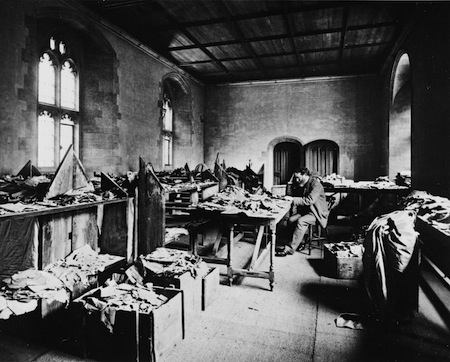
photo - Solomon Schechter at work in the old Cambridge University Library, with the crates of material from the Cairo geniza around him
Solomon Schechter at work in the old Cambridge University Library, with the crates of material from the Cairo geniza around him. (photo from Cambridge University Library via D-Facto Filmstudio)

Using narrations of various texts (translated into English), archival images, animation, visual effects and lots and lots of interviews, From Cairo to the Cloud does indeed take viewers from Cairo to the Cloud, or the internet. Thanks to the Friedberg Genizah Project, all the geniza fragments are now accessible by researchers around the world. With the physical manuscript pieces stored in different institutions, it used to be that, to study one document, a researcher might have to go to several cities just to puzzle together part of a page. Not only is that travel no longer necessary but, because every scribe writes in a unique way, computer programs have been able to match texts using a technology like that which is used in facial recognition, making it possible to join hundreds of pieces of a document within a couple of months.

Wherever you have a Jewish community, you must have a geniza, explains Prof. Hassan Khalilieh (University of Haifa) in the film. Rabbi and author Mark Glickman then explains that a geniza is a place to store damaged Jewish religious texts and documents. Geniza is a Hebrew word for hide, adds Prof. Yaacov Choueka (Friedberg Genizah Project). In Jewish law, he explains, you are not allowed to destroy or deal disrespectfully with written material with God’s name on it.

So, continues Prof. Janet Soskice (University of Cambridge), that document has to be treated with the reverence you would accord to a human body. Once a home’s or synagogue’s geniza is full, the stored material gets taken to the cemetery and buried. But, what author Dara Horn notes is that the Jews of medieval Cairo had a different method – they not only saved documents with God’s name in it but any document written in Hebrew letters, and they didn’t empty their geniza for more than 900 years.

Quick snippets of information from academics, librarians, writers and other experts keep From Cairo to the Cloud moving at a good pace, while not losing its educational aspect.

“I started with a few names and those names begat more names,” said Paymar. “I soon discovered that these ‘geniziologists’ were wonderful storytellers and passionate about the geniza. I ended up interviewing about 40 people representing a wide range of interests and three generations of geniza scholarship. The oldest – Mordechai Friedman, Avraham Udovitch and Mark Cohen – studied with [ethnographer] S.D. Goitein himself. Then there are the students of Goitein’s students, like Marina Rustow, and her student, Arnold Franklin.

“I have about 60 hours of interview material. Once I started piecing together the story, it became more or less clear which selections to use from each of the interviews.”

And what a story it is, between how the geniza was found – meeting people like the sisters Smith Lewis and Dunlop Gibson, who were academics in all but name, knowing 14 languages between them and taking multi-continent excursions, often in search of ancient manuscripts – and the documents from the geniza itself. The material in the storeroom roughly covers the period 1000 to 1250 in Fustat, which started as a separate city than Cairo, and was a major hub for trade.

“Gaining permission to film in the Ben Ezra Synagogue in Cairo,” explains Paymar in her director’s notes, “required nearly seven years, three Egyptian governments, gaining the support of representatives from the Jewish community of Cairo, the assistance of the Canadian consulate in Cairo, approval by the Egyptian ministries of the interior and antiquities, the Egyptian state police, the Egyptian tourist police, the Egyptian Press Office and the Jewish community of Cairo. I was the first filmmaker in decades to be allowed to film inside the synagogue.”

Because of Paymar’s efforts, the rest of us can see inside the Cairo geniza’s treasures much more easily. We should take the opportunity to do so. It is a fascinating journey.

For the full Vancouver Jewish Film Festival lineup, visit vjff.org.

Format ImagePosted on November 2, 2018November 1, 2018Author Cynthia RamsayCategories TV & FilmTags Cairo, Cambridge University, geniza, history, Solomon Schechter, Vancouver Jewish Film Festival, VJFF
Life lessons of an uncle

Life lessons of an uncle

Still from If You’re Hungry, Sing. If You Ache, Laugh.

When Vancouver freelance director and writer Michèle Smolkin interviewed her uncle, Sam Rechtman, he was 103 years old. Born on July 7, 1914, he has experienced two world wars, pogroms, poverty, hard manual labour, military service, loss, love and so much more, and yet he still approaches life with energy and cheer. Si tu as faim, chante. Si tu as mal, ris (If You’re Hungry, Sing. If You Ache, Laugh) is the perfect name for the documentary Smolkin has made on him.

The adage is an old saying from Chelm, explains the film, which happens to be the village in which Rechtman was born. At the time of his birth, Chelm was part of the Russian Empire. He was the second of four siblings.

We are merely introduced to Rechtman in this documentary, which runs just under an hour. With delightful, simply drawn animated sequences, along with music, archival film footage, old family photos and, of course, the interview with her uncle, Smolkin has created an inspiring reminder of just how much our attitude affects our lives.

In a brief interview for the DOXA Documentary Film Festival this past May, Smolkin explains that the film is “more than just a portrait of a man’s life and time, it’s also the portrait of a century in Europe. My uncle went through so much ordeal and such a dramatic life and is still this happy, simple, fun person who enjoys life and is not bitter or complaining. We are so privileged, that we should sometimes think, oh yeah, we could also enjoy life. That’s a life lesson.”

If You’re Hungry, Sing. If You Ache, Laugh screens on Nov. 11, 1 p.m., at Fifth Avenue Cinemas, as part of the Vancouver Jewish Film Festival, vjff.org.


Format ImagePosted on November 2, 2018November 1, 2018Author Cynthia RamsayCategories TV & FilmTags history, Michèle Smolkin, Sam Rechtman, Vancouver Jewish Film Festival, VJFF
Disagreeing respectfully

Disagreeing respectfully

Left to right: Nico Slobinsky (CIJA Pacific Region), Rabbi Adam Stein (Beth Israel), Rabbi Andrew Rosenblatt (Schara Tzedeck), speakers J.J. Goldberg and Jonathan S. Tobin, Cynthia Ramsay (Jewish Independent), Rabbi Hannah Dresner (Or Shalom and RAV) and Rabbi Dan Moskovitz (Temple Sholom). (photo by Glen Bullard)

“We have lost the ability to listen to each other. We have lost the ability to credit each other with good intentions when we disagree…. What we must do is somehow regain a sense of community.”

In his response to the last audience question at Left vs. Right: The Battle for Israel’s Soul, Jonathan S. Tobin, editor-in-chief of JNS.org and a contributing writer for National Review, among other publications, went on to say what he hoped the audience would take away from his 90-minute debate with J.J. Goldberg, editor-at-large and senior commentator at the Jewish Daily Forward.

“You have to open yourself up to both sides,” said Tobin. “You have to relearn the ability to listen, to be open. If you agreed with J.J., maybe you should read some of the things that I write… If you agreed with me, read J.J. at the Forward and his column…. It’s not what we’re used to anymore because we live in these social media silos…. It’s what we have to model for our kids. It’s what we have to model for ourselves because, when we listen, when we open ourselves up to ideas that are different from our own, that don’t just confirm what we already thought, we are reminded of something that is always true but we often forget…. That which unites us is still stronger than that which divides us.”

Ten community organizations united to host the Oct. 23 event in the Wosk Auditorium at the Jewish Community Centre of Greater Vancouver: the Jewish Federation of Greater Vancouver, the Centre for Israel and Jewish Affairs, the JCCGV, the Jewish Independent, Ameinu, Or Shalom, Congregation Schara Tzedeck, Congregation Beth Israel, Temple Sholom and the Rabbinical Association of Vancouver (RAV).

In his response to the last question of the night – on how young people could have similar respectful dialogues on Israel, which the speakers broadened to include all community members – Goldberg stressed the importance of having self-doubt. “If you believe the other side is saying something that could bring about the end of the world, the death of the Jewish people, you’re not going to be tolerant. And, as Jonathan says, if you listen, look for the grain of truth, because then you can allow yourself not to shout and scream when you hear something you don’t like, because it’s not the end of the world.”

Rabbi Hannah Dresner, spiritual leader of Or Shalom and head of the RAV, welcomed the approximately 100 people who came to hear Goldberg and Tobin engage in a formal debate on four prepared questions, and then on a handful of questions from the audience. “Our guests hold differing points of view and speak to one another with respect and we would like all to follow their examples,” she said. While there was some audible discomfort from listeners in a couple of instances, it was a model event, made easier by the fact that it featured two journalists who may disagree on the details, but who both agree that Israel has a right to exist and that Israel has a right to defend itself. As well, neither speaker is an ardent supporter of U.S. President Donald Trump – although Tobin gave the president credit for moving the U.S. embassy to Jerusalem and reinstating sanctions against Iran to delay its attainment of nuclear weapons, he criticized Trump’s relationship with Russia. One has to separate Trump the man and his Twitter account from the policies the administration has implemented, said Tobin. “It’s clear,” he said, “that Israel can count on the United States, certainly it can count on this administration to have its back.”

Tobin made these comments in response to the first question of the night, which was about Trump and whether Israel could rely on an “unstable United States as a shield in an unstable Middle East.” Goldberg was more concerned than Tobin, saying that character counts. “Having a president who is lacking in elementary characteristics of personal ethics and grace is a problem,” he said. “It is a problem that this is a president who has no respect or loyalty for America’s allies; and says he’s in love with the dictator in North Korea, who, by the way, does have nuclear bombs; and who can’t say a bad word about the dictator of Russia…. If Canada can’t rely on the United States, and France and Germany and Sweden can’t rely on the United States, how long can Israel rely on the United States?”

Goldberg and Tobin also had opposing views as to the continued relevance of a two-state Israeli-Palestinian peace agreement and whether the construction of settlements is an obstacle to peace.

Goldberg pointed to the 2002 Arab League declaration, which outlined the terms under which they would recognize Israel and normalize relations with it; the declaration has been renewed since then and, last year, “Iran voted yes.” He said we believed the Arab countries when, in the 1970s, they were talking about “driving Israel into the sea,” and we should believe them now when they say they would accept Israel. He argued that peace negotiations have not failed but been continually interrupted, giving several examples, including the assassination of Yitzhak Rabin and Ehud Olmert’s having to step down as prime minister when he was indicted on corruption charges.

While a two-state solution is the most rational, said Tobin, he argued that Israelis have made several attempts at peace and have shown their willingness to trade land for peace, but they are rightfully not willing to trade land for terror, which is what Israel got after the withdrawal from Gaza.

On the question of how much world opinion should matter to Israel, both Tobin and Goldberg said it does. Tobin gave examples – such as diplomatic trips to Africa by Prime Minister Binyamin Netanyahu – of how Israel is not isolated, despite an increase in the world of antisemitism disguised as anti-Israel sentiment. The boycott, divestment and sanction (BDS) movement, he said, won’t hurt Israel, but us. “Their target is us – Jews, Jews here,” he said. “We are their target. That’s why resistance against BDS, fighting back against it is, I think, the issue that should unite us, if anything could. It’s not a liberal issue, it’s not a conservative issue, it’s a Jewish issue.”

Goldberg said Israel “pretty much controls events on the ground” – noting that cooperation between Israeli and Palestinian security forces has decreased the number of deaths caused by terrorism significantly – but that the Palestinians “have the advantage in international opinion: they’re the underdogs, they’re the Third World, they’re the people of colour” and they use this advantage “as a way of fighting back against Israel.”

That said, Goldberg contended that Islam aspires to rule the world and there are Muslims who believe that to the extent that they will use violence. However, he added, no matter how right Israel is to defend itself, the optics of a tank shooting at a kid throwing rocks can never “look good on television” and “antisemitism increases, in part, because people are mad at Israel.” Since Diaspora Jews are one with Israel, then they become a target: “An Arab who’s willing to blow up a bus full of children in Haifa, who had nothing to do with this, is certainly willing to blow up a Federation building in Seattle.” World opinion is a problem “because there’s a war going on and it hasn’t ended yet,” he said. “If and when Israel enters into negotiations with the Arab League … one of the things Israel can and must demand is that Saudi Arabia stop teaching the hatred of Jews that it teaches in schools and mosques around the world.”

In response to the question about how Jews should position themselves in “this polarized and hyper-partisan political culture,” Goldberg said, “If we are attached to Israel at a time when our traditional allies on the left, in the liberal world, are souring on Israel, we don’t have to accept that. If the right is becoming more extreme … there are reasons we have our social values and we don’t need to give them up to be friends with the pro-Israel forces on the right.”

Goldberg noted that we often consider antisemitism, but overlook the respect the world holds towards Jews – as evidenced by the number of Nobel Prize winners, and three Jews out of nine justices on the U.S. Supreme Court. He said we must use this respect “not only to advance our own particular interests in defending our brothers and sisters in Israel, but in also defending the things that we believe in and the things that we believe make a better world.”

Tobin, on the other hand, said, “As Jews, we have an issue that should unite us – the survival of the Jewish people, the survival of the Jewish state. That should be a priority. We are probably more divided on it than we are on abortion, as my friend [J.J.] likes to say, but that is still our first obligation. And when we put that aside and instead favour partisanship, our partisan loyalties over that, I think we’re doing a disservice to our community….”

By the end of the night, Goldberg and Tobin fielded nine questions, responding to audience members’ concerns about such issues as the health of Israel’s democracy – Tobin thinks it is not declining, while Goldberg observed that the way in which governments are elected means that a democratically elected government does not always reflect the will of the majority population. They also responded to questions about the lack of leadership on the Israeli left, the impact of the ultra-Orthodox on Israeli society in the long-term, Trump’s popularity in Israel and how we can enable young people to have such discussions as took place that night.

Format ImagePosted on November 2, 2018November 1, 2018Author Cynthia RamsayCategories LocalTags antisemitism, BDS, boycott, civil discourse, Israel, J.J. Goldberg, Jonathan S. Tobin, peace, politics, Trump

Posts pagination

Previous page Page 1 … Page 7 Page 8
Proudly powered by WordPress