Skip to content
  • Home
  • Subscribe / donate
  • Events calendar
  • News
    • Local
    • National
    • Israel
    • World
    • עניין בחדשות
      A roundup of news in Canada and further afield, in Hebrew.
  • Opinion
    • From the JI
    • Op-Ed
  • Arts & Culture
    • Performing Arts
    • Music
    • Books
    • Visual Arts
    • TV & Film
  • Life
    • Celebrating the Holidays
    • Travel
    • The Daily Snooze
      Cartoons by Jacob Samuel
    • Mystery Photo
      Help the JI and JMABC fill in the gaps in our archives.
  • Community Links
    • Organizations, Etc.
    • Other News Sources & Blogs
    • Business Directory
  • FAQ
  • JI Chai Celebration
  • JI@88! video

Recent Posts

  • BGU fosters startup culture
  • Photography and glass
  • Is it the end of an era?
  • Taking life a step at a time
  • Nakba exhibit biased
  • Film festival starts next week
  • Musical with heart and soul
  • Rabbi marks 13 years
  • Keeper of VTT’s history
  • Gala fêtes Infeld’s 20th
  • Building JWest together
  • Challah Mom comes to Vancouver
  • What to do about media bias
  • Education offers hope
  • Remembrance – a moral act
  • What makes us human
  • המלחמות של נתניהו וטראמפ
  • Zionism wins big in Vegas
  • Different but connected
  • Survival not passive
  • Musical celebration of Israel
  • Shoppe celebrates 25 years
  • Human “book” event
  • Reclaiming Jewish stories
  • Bema presents Perseverance
  • CSS honours Bellas z”l
  • Sheba Promise here May 7
  • Reflections from Be’eri
  • New law a desecration
  • Resilient joy in tough times
  • Rescue dog brings joy
  • Art chosen for new museum
  • Reminder of hope, resilience
  • The national food of Israel?
  • Story of Israel’s north
  • Sheltering in train stations

Archives

Follow @JewishIndie
image - The CJN - Visit Us Banner - 300x600 - 101625

Month: November 2018

New principal at RJDS

New principal at RJDS

Richmond Jewish Day School principal Ronit Amihude with the award-winning children’s book What Do You Do With An Idea? by writer Kobi Yamada and illustrator Mae Besom. (photo by Coleen Lou)

Ronit Amihude is a leader with a vision. The new principal at Richmond Jewish Day School (RJDS) has been working in Jewish education since high school and in day school settings for more than two decades. She brings with her a passion for relevant, pluralistic Jewish education, and training in forward-looking pedagogical theory and practice.

Amihude was born in Winnipeg and moved to Toronto in the early 1990s to work at the Heschel School, at the time a small progressive Jewish school with a dream of crafting creative education that involved children in a way that was individualized and relational. Amihude did a little bit of everything in her 18 years there and was able, she told the Jewish Independent, “to see how you can take a small beautiful seed and turn it into a gorgeous garden.”

Amihude got a master’s in education while at Heschel and went through the Jewish Theological Seminary’s Day School Leadership Training Institute, a 15-month program which, according to their website, “prepares new and aspiring heads of school for their work in Jewish day schools by providing engaging experiential learning opportunities, cutting-edge leadership development, ongoing mentoring, and the chance to collaboratively problem-solve with cohort peers.”

While at Heschel, Amihude took on multiple leadership roles. After her tenure there, she was recruited to Atlanta, where she became the principal of learning, teaching and innovation at the Epstein School.

Richmond Jewish Day School began looking for a new principal after Abba Brodt, a beloved educator and administrator who had been with the school since 2010, left in 2017. Amihude had heard about RJDS over the years and felt it had “the same heimish [homey] feeling as Heschel” and was “a beautiful little school community” that believes all Jewish kids deserve a Jewish education and could be helped to get one.

“The feeling I got was that RJDS is a wonderful place where kids are supported and appreciated, where it is not just STEM that is taught, but kindness, perseverance and acceptance,” she said.

Amihude applied for the job last December and, after multiple Skype calls and phone chats, she flew out in February of this year and contracts were signed around Pesach.

When Amihude spoke with the Independent, it was her fifth day on the job and she generously made time in her hectic schedule to talk. Her first impressions of life at RJDS were resoundingly positive.

“It is a really diverse population where that is celebrated,” she said. “It’s a place where children of all levels of observance and non-observance from all over the world – Israel, Russia, Colombia and elsewhere – learn together. Kids who think everybody eats matzah balls on Yom Tov learn there are lots of ways to be Jewish.”

Amihude said a balance between tradition and pluralism is important for her, and the school community is open to different styles of being Jewish. This approach is showcased, in part, by their pluralistic approach to tefillah (prayer), which embraces Orthodox and progressive rituals. “If kids are given a hard line, telling them that only one way is authentic,” said Amihude, “then what message does that give them if that’s not the way of themselves or their family – that they’re not Jewish?”

This fall at RJDS, students took part in the international Kindness Rocks movement, where kids decorate rocks with messages of encouragement and kindness and place them out in the community. The school put a unique spin on this practice by integrating it into the days of teshuvah (repentance/return) between Rosh Hashanah and Yom Kippur.

Amihude said an essential part of her mission at RJDS is giving kids the tools to find their own Jewish selves outside of school and to help their families figure out who they are and what they want to be doing. She wants to see a collaborative space where kids can work together to create, to learn perseverance and problem solve.

“Can the kids build a model sukkah? Can they create a double-decker chanukiyah for parents and kids to light together? There is so much we can be doing with 21st-century skills, while celebrating the Jews that we are and the people that we want to be.”

Matthew Gindin is a freelance journalist, writer and lecturer. He is Pacific correspondent for the CJN, writes regularly for the Forward, Tricycle and the Wisdom Daily, and has been published in Sojourners, Religion Dispatches and elsewhere. He can be found on Medium and Twitter.

Format ImagePosted on November 9, 2018November 7, 2018Author Matthew GindinCategories LocalTags diversity, education, inclusion, Judaism, Richmond Jewish Day School, RJDS, Ronit Amihude
Politicon’s Jewish voices

Politicon’s Jewish voices

Ben Stein and Ann Coulter at Politicon in Los Angeles on Oct. 20. (photo by Rich Polk-Getty Images for Politicon)

From pundits to Hollywood types, there were many Jewish names on the speaker roster at this year’s Politicon, the fourth annual two-day convention in Los Angeles that ropes in high-wattage names from the left, right and centre. This year’s gathering took place Oct. 20-21.

In the panel called The Deep State, discussion revolved around the allegations of U.S. President Donald Trump’s collusion with Russia. Speakers included Dr. Vince Houghton (curator at the International Spy Museum), Dan Bongino (former U.S. secret service for George W. Bush and Barack Obama), Dr. Jason Johnson (professor at Morgan State University in Baltimore), former Trump aide David Urban and former George W. Bush speechwriter David Frum, a member of the Jewish community.

While Frum outlined some of the evidence on meetings and correspondences between Trump aides and various Russians, he also conceded that “there are things in collusion that are utterly reprehensible, which are not illegal.”

He said, “To what extent there was cooperation back and forth, remains unclear,” but he is convinced that the facts are quite damning.

photo - David Frum at Politicon in Los Angeles on Oct. 21
David Frum at Politicon in Los Angeles on Oct. 21. (photo by Phillip Faraone-Getty Images for Politicon)

As a counterpoint, Johnson said: “I don’t think the president has such discipline or organization to pull off this kind of thing. Hillary [Clinton] lost because she ran a bad campaign, not because of a meeting with the Russians.”

Two right-wing pundits – Ann Coulter and Ben Stein – took the stage in a session called Ask Ann Anything.

Stein, the Jewish actor whose politics date back to serving as a Richard Nixon aide, said that, if he could change any numbers about America, it would be to increase the number of better-educated individuals, as well as the number of fathers marrying the women they’ve had children with.

Coulter, often appearing on media to represent the far-right, is the bestselling author of Slander: Liberal Lies About the American Right, Treason: Liberal Treachery from the Cold War to the War on Terrorism and Godless: The Church of Liberalism, among others. Her key complaint was that Trump had yet to build the wall between the United States and Mexico, as he had promised, and she holds the left responsible for the immigration crisis.

Three generations ago, she said, “immigrants would come and 30 or 40% of them wouldn’t make it, and [would] go back home. Now, they all go on welfare. The Democrats pushed the bill that promised to [enshrine this],” she said.

The biggest surprise, she said, was that “despite all the race-baiting, Trump, as I thought he would, got more of the black and Hispanic votes than either [Mitt] Romney or [George W.] Bush … considering all of the racial incitement of the campaign.”

Three different questioners harshly criticized Coulter for avoiding debate with liberals, but Coulter dismissed them outright – “they couldn’t find a New York Times bestselling author to debate me?”

Yarmulke-wearing Ben Shapiro – who was in Vancouver for talks on Oct. 30 and 31 – covered the topics of free speech, constitutional rights and racism in America in his keynote address at Politicon.

“If my speech is violence,” said Shapiro, “and the government can shut down violence, then the government can shut down speech. This is ugly stuff.”

On the #MeToo movement and abortion, he paraphrased his opponents: “Men, sit down, shut up, you don’t know anything.” But, he said, “We can’t have a conversation if you’re simply going to assume I can’t understand you because of dint of birth … identity politics throws up a roadblock in the way of it. It prevents you from having these conversations.”

He said, “If you’re going to make a pro-choice argument, then make a pro-choice argument. An argument cannot be based on a woman knows better what constitutes life than a man.”

A questioner asked why, on YouTube, Shapiro appears to fume at ideological challengers.

“There are many more examples of me talking to the left in a respectful manner than there are tapes of me ‘destroying’ anybody,” noted Shapiro. “Those are the ones we like to watch because they’re more fun, but it’s not happening on a day-to-day basis.”

In a session called The Russian Menace, Jewish actor, director and author Henry Winkler interviewed author, terrorism expert and naval expert in cryptology Malcolm Nance. This year, Nance published The Plot to Destroy Democracy: How Putin and His Spies Are Undermining America and Dismantling the West.

After Obama was elected, said Nance, Trump and a representative of Russian intelligence exchanged private Twitter messages, with the latter expressing interest in helping the U.S. change governments. “Trump responded with a picture of double thumbs up,” noted Nance.

Winkler retorted, “Not mine!” – a reference to his Happy Days character the Fonz’s signature symbol.

According to Nance, a week after this Twitter exchange, Trump registered the trademark “Make America Great Again.” Subsequently, Trump met with Russian oligarchs in Moscow for two hours, something that should raise suspicions, Nance insisted.

At one time, he said, Russians wanted the “money and luxury” that the West had, but now they employ “an old KGB strategy” of propaganda to tear down the United States.

“You don’t go at the people by invading it,” but rather, through “fake news stories,” said Nance. “You co-opt their mind; you create a new reality for them. In the old days, they used to call that brainwashing. Today, they call it Facebook.”

Evan Sayet, who has written two speeches for Trump and is the author of Kindergarden of Eden: How the Modern Liberal Thinks, told the Jewish Independent that the panel he was on, 13 Reasons Why Not to be a Liberal, could be summed up thusly:

“Everybody in America – every ethnic group in America – blacks, Asians, Hispanics, they should all be conservative. They’re family-centric, church-goers, entrepreneurs. The left has done such a great job via the entertainment industry, schools and media, of villainizing the right. Those who vote for Democrats, don’t vote Democrats. They vote against Republicans. They are so in fear of what’s been portrayed as the right.”

Other Jews to appear as speakers or panelists at Politicon included Joel Pollak (Breitbart), Jennifer Rubin (Washington Post), author Eric Golub, NBC’s Ari Melber, comedian Ben Gleib, Bill Kristol (journalist and former chief-of-staff to vice-president Dan Quayle), TV host David Pakman, TV’s Drew Pinsky, commentator Sally Kohn, mayor of Knox County in Tennessee and former wrestler Glenn Jacobs, comedian Sam Seder, actor Richard Schiff, comedian Elayne Boosler, NBC’s Jacob Saboroff, writer Jamie Kilstein, actor Josh Malina, NBC’s Gadi Schwartz and entrepreneur Fred Guttenberg.

Dave Gordon is a Toronto-based freelance writer whose work has appeared in more than 100 publications around the world.

Format ImagePosted on November 9, 2018November 7, 2018Author Dave GordonCategories WorldTags Politicon, politics, United States
We’ve got a lot of work to do

We’ve got a lot of work to do

(photo from Tracy Le Blanc from Pexels)

I am not normally someone who is especially active on social media. I am not normally someone who curates current events, even though I consume them like undergrads do coffee – habitually, obsessively, out of necessity.

For a long time, my political associations and the extent to which I follow world news have been largely separate from the image I have cultivated for public view. As far as Facebook is concerned, I am represented through dog videos, feel-good intercommunity displays of solidarity, recipes and the occasional satire poking fun at the absurd and horrifying climate we’re living in – but there has been a shift. A shift toward police brutality, transphobia, racism. A shift toward synagogue shootings.

I do not share news stories on such topics because I enjoy doing so. I don’t enjoy reading about things that make my heart heavy, nor offering vulnerabilities to people who do not see me as a person, but rather the embodiment of an idea they disagree with. I do not take pleasure in sharing pain. It is my very nature to shield myself and others from it. Although part of love is letting others learn, and that involves experiencing pain and hurt.

It is easier to stick one’s head in the sand, but it doesn’t make it right. It is important to denounce insidiousness and nefariousness when you see it, especially if it does not directly affect you. It is important to hold space for those who are impacted by the injustices of the world, to hold them up and offer your strength. In doing so, we hope others do the same for us, and perhaps that is the only way we can get through these dark times with any semblance of sanity, of humanity.

I used to make a point of sharing light-hearted, feel-good posts, cognizant of the “bad news,” which is in no short supply. I believe my intention to provide some degree of respite from the political apocalypse we’re currently observing was a good one, but I would wager also misguided. To curate news is one thing, to disengage from it is another.

It became clear to me that, just because I am kept abreast of political happenings, and that I see them all over social media, does not mean others do; a classic cognitive bias that I should have spotted much earlier. This is true of what is happening in Trump’s America, to people of colour, LGBTQ folks, indigenous peoples, immigrants and refugees, Muslim communities. This is true of issues and current events related to antisemitism – I am now startlingly aware just how little people know about it. Not only the frequency of antisemitic incidents in North America and Europe, but, at a much more basic level, what antisemitism is and how to spot it.

For many of my friends, especially those who I’ve met in London, I am the only Jewish person they know. While it shouldn’t significantly impact the way I conduct myself, the weight my actions carry is not lost on me when I am the entire schematic representation of “Jew” for many of the people I come across. There is a pressure to behave in a way that is contrary to the many persistent stereotypes that precede my traditions and my culture. I must be generous to a fault lest I be stingy. I must laugh off antisemitism and micro-aggressions lest I be perceived as a paranoid, uppity Seinfeld type. I must be soft and kind and open, I must not have strong opinions lest I be the overbearing, naggy Jewish woman. I must downplay my love of bagels (they’re so damn good).

I also must be a political chameleon, dodging demonization from the left and right for equal and opposite accusations: we are the puppet masters, yet the infiltrators. We are the root of capitalism, yet the root of communism. We are somehow the one percent who controls the world’s wealth, yet we also fund the movement that rallies against it. We are insular elitists, yet permeating globalists. Those of us who look like me have assimilated to whiteness and reap the benefits, yet we will never be “white enough” to those who would see us dead.

Over time, the belief sticks: “I must not behave in any way, shape or form, in any manner that would give credence to the ideas that this is how Jews are, as I represent them to so many.” Yet it’s as exhausting for me to keep up as it is to keep this narrative straight.

I thought that, perhaps if I wanted to be a socially engaged citizen of the world, I could avoid these pitfalls by sharing information about the world as neutrally as I could. I could be the “impartial reporter,” make the news palatable, make it sterile. I could be taken more seriously, sanitized of emotional attachment that would otherwise be paint me as “irrational,” which is the ultimate insult in political and academic discourse. (Undoubtedly rooted in sexism and undoubtedly seen as weak, as it is perceived as feminine.)

But to do this serves no one well. It is inherently more harmful to the people who are affected by the issues being reported. To be “unbiased” in the wake of something that should not be polarizing, yet somehow is, ultimately reflects complicity. It is contrary to my values as a person. It is contrary to my values as a Jew.

This confuses many people, who know I am largely secular and open in my agnosticism. How can I profess myself to be as Jewish as I do, while maintaining such a wide berth from religiosity and theism? By that definition, I’m not “that Jewish.”

I may not believe in a God, but I do believe in my people, and in the traditions that shaped me to be who I am. I am Jewish insofar as my birth and upbringing, in my values and my conduct, in my pursuit of tikkun olam, repairing the world. I am “Jewish enough” to lead services despite my relationship with my faith. I am “Jewish enough” to abstain from pork but not “Jewish enough” to abstain from shellfish or cheeseburgers. I may not be “so Jewish” as to observe Shabbat to the letter, but I am Jewish enough to be gunned down in a synagogue.

My tradition is one of orthopraxy, of deed over creed. We are meant to “pray with our feet” as well as with our words. The Talmud teaches us not to be overwhelmed by the enormity of the world’s grief, but rather to do justly now, love mercy now, walk humbly now; that we are not obligated to complete the work of repairing the fractures and chasms in our world, but neither are we free to abandon it.

There is the story in the Talmud of a man who came to the great rabbis of the day and told them to teach him Torah while he stood on one foot. He did this to mock them. He first went to Rabbi Shammai, who refused to engage when he recognized the man’s intentions. The man went next to Rabbi Hillel and made the same challenge: teach me your Torah while I stand on one foot. Rabbi Hillel knew this man’s intention as well, but he was patient. He simply said, “What is hateful to you, do not do to others; all the rest is commentary. Go and study this.”

It should be that simple. If only it were that simple. I don’t know if the reason it isn’t is because of psycho-schematic representations in our minds, or nationalism, or capitalism, or groupthink, or whataboutisms, or strawmen, or ego, or that we forget that, when we bleed, we all bleed the same. I don’t know if it’s because we’ve forgotten how to be empathetic, or we’ve stopped doing it because it hurts, or that we feel powerless and that feels worse.

A friend told me recently that they don’t engage with this stuff because they’ve become numb to the horrors of the world. I can understand that, truly. Although I think it is precisely because of the commonplace, routinized nature of these injustices that we must engage because, when we don’t, they become routine, and they become a part of the fabric of our society that we will forget shouldn’t be there in the first place.

We have a saying in Judaism, “tzedek, tzedek, tirdof,” “justice, justice, you shall pursue.” But our understanding of tzedek is different to that of mishpat or din, other Hebrew words referring to justice or law in a strictly legal sense. Tzedek is tempered by compassion, of doing not necessarily what is lawful, but what is the right thing to do. And there is an emphasis on the action, on the doing. This may very well be rooted in some of the many names Jews use to refer to God, and the concept that people are made in God’s image.

In our tradition, there are many different names for God to reflect different aspects of God’s characteristics. Elohim is common, derived from the ancient word for judge. Certainly, people who are unfamiliar with the Torah often criticize the “Old Testament” for barbarism, for a wrathful, vengeful God that falls uncompromisingly into this depiction of an impartial, removed judge who delivers reward or punishment in accordance with the word that was given. I’m not about to unpack that, that’s a whole other essay in itself.

Unquestionably, the most sacred name we have for God is one we don’t even know how to pronounce, and are not supposed to pronounce, that is often anglicized as YHVH. It is derived from the Hebrew word for “to be,” and it is sometimes understood to translate roughly as “the Essence of Being.” This name is said to reflect an intimacy, a mercy, a love that perhaps we don’t even know how to name.

These different names may suggest a God of multiple beings, or even multiple gods, but Judaism is quite strict in its monotheism, and these names are used in scripture deliberately in ways that are context-dependent: Elohim deals justice, YHVH deals in mercy.

“Genesis tells two creation stories,” writes Rabbi Mark Glickman, “in the first, Elohim is the Creator, in the second, the creator is YHVH Elohim. To reconcile the accounts, ancient rabbis argued that God first tried to create the world using only justice, and it didn’t work.”

I’m very much a Darwinist by trade, but the message of this rings true to me. To exact change, to make something sustainable, we must do so with justice that is tempered by compassion.

Now, compassion does not mean, “try to understand neo-Nazis and justify their actions.” What compassion does mean, at least in part, is to show kindness and solidarity to other groups who are being hurt, even when we ourselves are licking our wounds and trying to find our feet. It means to support one another, even when we ourselves have trouble standing. It means speaking up for those whose voices are hoarse and raw from screaming. It means using our visibility to shed light on stories that are sequestered to shadows. It means form a patchwork quilt of community, which, when stitched together and reinforced, is warm, strong and unbreakable.

These are dark times. I say this not with the intent to be dramatic or prosaic, but simply factual. But that doesn’t mean we can’t kick at it until it bleeds something more hopeful. That being said, if we want any chance of making it out alive, we’ve got to get to work.

Sasha Kaye is currently studying in London, England. An alumnus of King David High School and the University of British Columbia, she enrolled at the Royal College of Music in London in performance science after her studies in classical voice performance and psychology at UBC. She was recently awarded a master’s of science with distinction for her research on the use of simulation technology as part of an intervention strategy to manage performance-anxiety symptoms. Now a doctoral student at RCM, Kaye is working to identify areas where elite musicians may require additional support to thrive in life, rather than simply survive.


Format ImagePosted on November 9, 2018November 7, 2018Author Sasha KayeCategories Op-EdTags antisemitism, culture, Judaism, politics, secularism, social media
GA pitches softballs to Bibi

GA pitches softballs to Bibi

Israel’s Prime Minister, Binyamin Netanyahu, addresses the General Assembly of the Jewish Federations of North America, in Tel Aviv Oct. 24. (photo by Pat Johnson)

The theme of the General Assembly of the Jewish Federations of North America in Tel Aviv was “We need to talk.” The conference was explicitly dedicated to confronting the issues that divide Jews and alienate the Diaspora from Israel. But, when the moment came to meet with the most powerful man in Israel, conference organizers folded like a house of cards.

Outgoing chair of the board of trustees of the JFNA, Richard Sandler, sat with Prime Minister Binyamin Netanyahu on a stage and performed what Haaretz rightly dismissed as a “fawning” conversation. More Oprah than interlocutor, Sandler first offered belated birthday wishes to the prime minister, then proceeded with one softball lob after another, allowing Netanyahu to control the dialogue – which he could have done more effectively if he had delivered a conventional address instead of the folksy sit-down – while Sandler offered no resistance or challenge to anything the prime minister said.

The JFNA is a non-partisan organization, of course. But the very nature of this meeting was to frankly confront the very real divisions between Jewish people in the Diaspora and those in Israel.

Here was the first question: “I’m just wondering, when you were back in high school or college, did you ever imagine someday you would be the prime minister of Israel, and would you share with us a little bit of the path from that time to what got you here?”

Even Netanyahu seemed a bit embarrassed by the question and offered assurances that he was not, in childhood or young adulthood, some Machiavellian born with his sights on the levers of power. What seasoned politician would respond to such a question with, “Yes, I’ve been planning this since I toddled”?

Next question: “I’m wondering, in all the years you’ve been doing this, how do you see the relationship between our two countries, between Israel and the United States, evolving – and what concerns you most, if anything, about that relationship today?”

“If anything”? Thousands of people had traveled from North America to Israel to address the very tangible friction points between the two Jewish communities and the inteviewer effectively invited the prime minister to assert that everything is rainbows and unicorns. And Netanyahu accepted the offering. Everything is pretty great, he contended. The trajectory of American support for Israel is increasing, he said. When he and his wife walk around Central Park or visit the Strand bookstore in Manhattan, they get warmly welcomed. The audience of 1,300 at a performance of Hamilton gave him a standing ovation. (“How did you get tickets?” heckled an audience member. “My cousin’s wife works in the production,” the PM replied.)

Then it was time for the interviewer to get tough.

“One of the things that we spoke about, Mr. Prime Minister, that we’ve been talking about the last couple of days, are all the things that we have in common,” said Sandler, moving in for the kill, “We’re having frank discussions on some of the issues that concern many North American Jews and I’m sure you are aware, as I am, that we have a number of concerns about pluralism, acceptance of Reform and Conservative Jews here in Israel, the Nation State Law and.…”

At this point, Sandler’s words were drowned out by applause from an audience who seemed to think they were finally going to get some red meat. Instead, Sandler asked, “Are we missing something? And where do we have it right?”

“I don’t think you should be concerned, but I think you should be informed,” Netanyahu responded to a room filled with the leadership of every major Jewish community in North America. “So much of this is – let me be charitable – misinformation.”

Netanyahu went on to say that, from the first prime minister on down, Israel’s leaders have managed the status quo by making modest, incremental compromises.

“We have a series of slowly evolving arrangements and that reflects the evolution of the Israeli electorate,” he said. On the issue of an egalitarian prayer space at the Western Wall, Netanyahu acknowledged a delay in the opening, but insisted his goal remains a place where women and men can pray together.

On a two-state solution, Netanyahu dismissed the terminology. “I believe that a potential solution is one in which the Palestinians have all the powers to govern themselves but not the power to threaten us,” he said. “What does that mean?”

He explained by recounting a conversation with then-U.S. vice-president Joe Biden.

“Well, Bibi,” Netanyahu said, describing the discussion, “are you for two states or are you not? I said, Joe, I don’t believe in labels.”

Netanyahu committed that Israel would retain security control west of the Jordan River, envisioning a situation where Palestinians would govern themselves but that overall security would remain in the hands of the Israeli military. This is not only good for Israel, the prime minister said, but for Palestinians, including Palestinian Authority President Mahmoud Abbas. Israel uncovered and foiled a plan by Hamas to not only overthrow Abbas, but to murder him, Netanyahu said. Without Israel’s military control in the West Bank, Hamas would swoop in, overthrow Abbas’s Fatah and Israel would have another Gaza to the east.

“They’d be overrun in two minutes,” he said.

This is all true enough, perhaps, and the first job of the prime minister of Israel is to ensure the security of his country and people. But, in acknowledging that his position would negate the possibility of an independent Palestinian state, Netanyahu reduced it to a matter of nomenclature.

“Give it any name you want,” he said. “But that’s the truth. And this truth is shared much more widely across the political spectrum than people understand, because we’re not going to imperil the life of the state for a label or for a good op-ed for six hours in the New York Times.” Like a flailing comedian, Netanyahu then turned to the audience and complained, “Nobody’s laughing.”

Sandler’s final question to the prime minister was, “What are you the most proud of about Israel today that you want us to think about when we’re going home?” And Netanyahu offered a response worthy of the question, a meandering reflection on visiting a synagogue in his family’s ancestral home of Lithuania.

As the loudspeaker was trying to advise people to remain in their seats while the prime minister’s entourage departed, Netanyahu, already standing for his farewell, interrupted to take the opportunity to tell the audience that his real concern for the Jewish people was the loss of identity. “It’s not conversion,” he said. “It’s the loss of identity.”

He warned, “Jewish survival is guaranteed in the Jewish state if we defend our state. But we have to also work at the continuity of Jewish communities in the world by developing Jewish education, the study of Hebrew and the contact of young Jews coming to Israel.”

He talked about additional funding for programs to support study-abroad programs in Israel and other things the Jewish state is doing to advance the strengthening of Jewish peoplehood.

Given the last word at the close of the three-day conference – a meeting explicitly convened to address contentious issues between the parties – Israel’s prime minister took the opportunity to school the leaders of Diaspora Jewry in how their shortcomings could imperil Jewish survival. Then he departed.

Format ImagePosted on November 9, 2018November 7, 2018Author Pat JohnsonCategories Op-EdTags Diaspora, Israel, JFNA, Netanyahu, politics, Richard Sandler
Four volunteers fêted

Four volunteers fêted

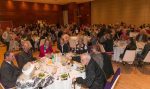
Jewish Seniors Alliance’s AGM was held on Oct. 11 at Congregation Beth Israel. (photo from JSA)

The annual general meeting of the Jewish Seniors Alliance was held on Oct. 11 at Congregation Beth Israel. As is customary, the AGM was followed by a gala dinner during which JSA honoured dedicated volunteers from three community organizations for their service to seniors in Vancouver.

The meeting was called to order by JSA president Ken Levitt. He introduced Rabbi Jonathan Infeld of Beth Israel, who gave a short d’var torah on the importance of community actions and involvement with seniors.

Levitt then asked everyone to rise in acknowledgement of JSA members who had passed away over the last year.

Several speakers offered greetings to JSA: Isobel MacKenzie, seniors advocate of British Columbia; Michael Lee, MLA for Vancouver-Langara; Ezra Shanken, chief executive officer of the Jewish Federation of Greater Vancouver; and Gudrun Langolf, president of the Council of Senior Citizens’ Organization of British Columbia (COSCO).

Reports were presented by JSA treasurer Larry Meyer; on peer support services by Gyda Chud for Pam Ottem; on membership by Binny Goldman; from Levitt, as president; and from the nomination committee by Marilyn Berger, who was especially emphatic, urging people who receive Senior Line magazine and are not JSA members to sign up.

In his report, Levitt emphasized JSA’s advocacy role and outlined five issues in particular for which JSA is advocating:

  1. For the B.C. Ministry of Health to provide the 25% more effective flu vaccine free of charge. It presently costs $75 for the high-dose flu shot.
  2. The implementation of a federal pharmacare program.
  3. For the City of Vancouver to allow applications for the provincial homeowners grant to be done in person, without use of a computer, as many seniors have difficulty using computers or do not have access to the internet.
  4. For the B.C. government to initiate a poverty reduction program similar to those that exist in other provinces.
  5. To reduce the need for food banks – JSA had made a presentation to Federation concerning the Food Security Program.

After the reports were completed, Levitt adjourned the meeting and invited everyone to be seated at the festively decorated tables. About 170 supporters of JSA enjoyed a glass of wine and a salmon or vegetarian lasagna dinner that was followed by the presentation of the awards.

This part of the evening was presented by emcee Ed Gavsie, who called upon Langolf to make the presentation to Sheila Pither. Pither has been active with COSCO for 18 years. For the past 10 years, she has coordinated the organization’s Health and Wellness Institute, promoting its expansion from one workshop topic to more than 40. Pither said she was honoured to have been chosen and was grateful to be at the ceremony with friends and family, at age 86, to accept the award.

The next awards went to Muriel Morris and Gary Zumar of JCC Showtime. Maurice Moses presented to Morris and Arnold Selwyn to Zumar.

Morris has been a volunteer piano accompanist since high school. She has accompanied more than 210 concerts since joining Showtime in 2013 and she noted the pleasure she gets when they perform at seniors facilities and she sees the people come alive to the music and the dancing.

Selwyn recounted how Zumar, with his wide experience in audio-visual technologies, has volunteered his services to many Jewish organizations. Zumar started with Jewish Heritage Players more than 40 years ago and has continued for more than 12 years with Showtime. Selwyn called him a volunteer’s volunteer. Zumar responded by thanking everyone at Showtime for this honour.

Toby Rubin of the Kehila Society then presented the final award to Pat Hoffman. Hoffman became involved with Kehila’s Monday Seniors Luncheon at Beth Tikvah 15 years ago. She has been involved in the working committee as the program has expanded to include activities such as English-as-a-second-language, fitness and entertainment. Rubin described Hoffman as the lifeline of the program, the first to arrive and the last to leave. Hoffman expressed her appreciation for the recognition and said she gets much satisfaction from being a volunteer.

While dessert was served, attendees were entertained by jazz singer Jill Samycia, the door prizes and 50/50 tickets were drawn and, after much shmoozing with old friends and dinner, everyone went home having spent the evening honouring four active seniors and again proving the JSA adage “seniors stronger together.”

Shanie Levin is an executive board member of Jewish Seniors Alliance and on the editorial board of Senior Line magazine.

Format ImagePosted on November 9, 2018November 7, 2018Author Shanie LevinCategories LocalTags health, Jewish Seniors Alliance, JSA, seniors, volunteers
Symposium provides healing

Symposium provides healing

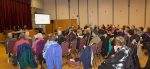
The Jewish Seniors Alliance fall symposium on Oct. 28 was about aging across cultures. (photo from JSA)

The Jewish Seniors Alliance fall symposium, Aging Across Cultures, took place on Oct. 28. The program dealt with inclusivity while Jews everywhere were trying to cope with the horrors of what hatred can do. Still newly mourning the victims of the shooting at the Tree Of Life synagogue in Pittsburgh, attending the symposium seemed strange, but it had healing properties.

The afternoon program was a time of unity and solidarity with other cultures. Attendees learned that loving and caring for seniors in our community and for our family elders is a universal value and touches all hearts in much the same way, as well as presenting similar challenges.

In welcoming the crowd, Ken Levitt, president of Jewish Seniors Alliance, turned the subject of the Pittsburgh shooting over to Rabbi Philip Bregman, who was the event chairperson. Bregman served as senior rabbi at Temple Sholom from 1980 to 2013. He is a founding member of Jewish Christian Dialogue (since 1995) and he now functions as Jewish chaplain for the University of British Columbia and is involved with Hillel BC.

Bregman spoke about the brutal murder of people at prayer. He highlighted the many calls he has received expressing sympathy and condolences. He recalled standing outside a mosque in Vancouver after the shootings at a Quebec City mosque in 2017, where six Muslim worshippers were murdered and 19 others wounded. Among the condolences he received after the murders in Pittsburgh was a message of sympathy from the imam in Quebec.

Bregman emphasized the difference between the word “killing,” which he categorized as meaning accidental, and the word “murder,” which is intentional.

“Where do we go from here?” he asked. “We bury our dead, we mourn and we meet as a community,” he said. “We must never allow hatred to win.”

The audience stood for a moment of silence in commemoration of the 11 murdered and those injured, including several police officers.

The afternoon’s program featured a panel consisting of three accomplished women of diverse ethnic origins.

• Zarghoona Wakil is the manager of the Settlement and Integration program at MOSAIC, a nonprofit organization that helps newcomers to Canada. She also supervises MOSAIC Seniors Club, which provides services to seniors of different cultural backgrounds.

• Sinder Kaur is the executive director of health services at SUCCESS, providing a continuum of quality, culturally appropriate care services to seniors with different needs. She has worked in different leadership roles with a passion to help seniors age in place.

• Deanna Lewis, known as Kalkalath, her ancestral name, was recently elected to the Squamish Nation Council, focusing on elders and their care. Kalkalath is a former teacher, working to preserve her Skwxwu7mesh culture, spirituality and language. Raised with the teachings of her grandfather, she knows the importance of knowing who you are and where you come from.

When Bregman introduced the three panelists, he asked them to share a little about themselves and to address the issue of how their various cultures celebrate seniors.

Wakil shared that she is originally from Afghanistan, then lived in Russia. She came to Vancouver 12 years ago and is now studying at Simon Fraser University for a master’s degree in public health. Kaur is Punjabi-born, lived for 20 years in Hong Kong and moved here 17 years ago. Kalkalath’s Squamish Nation family was removed from Khatsahlano (Kitsilano) in the early 1900s and her main efforts are to teach both adults and children the Squamish language.

Despite differing cultures and traditions, Wakil and Kaur both emphasized that it is seniors who hold history in their hands and only upon opening up their hearts are they able to tie generations together and build upon that knowledge for the future generations.

It was difficult to hear that Kalkalath had to learn about her heritage from others, as her history was erased and harshly taken from her elders. It was she who sought to learn about that past and is now feeling connected again, through the learning of her own language and the ways of her people from her grandfather.

A common thread between all the panelists was that grandparents and grandchildren have a special link that allows them to relax and truly enjoy one another while parents are occupied with the comfort and needs of both these family groups.

All three speakers provided vivid descriptions of the issues and areas of concern regarding elders in their cultures. JSA thanked them for their willingness to share personal stories and stories from their communities. The similarities between cultures superseded any differences.

Claudine Malto, director of community programs at Mount Pleasant Neighbourhood House, then spoke about the house’s new initiative: multicultural circles, where seniors share stories, food, textiles, cooking classes, dance and exercise. She noted that people generally like to sit in “pockets,” which creates a divide. The motivation for this project is to answer the question, “How can we best coexist?”

Larry Shapiro, JSA board member and second vice-president, wound up the afternoon with one of the best vocal advertisements for the Jewish Seniors Alliance that we have ever heard.

Attending the symposium made the sun come out, even on a rainy, tear-filled day.

Binny Goldman is an honorary life board member of Jewish Seniors Alliance.

Format ImagePosted on November 9, 2018November 7, 2018Author Binny GoldmanCategories LocalTags culture, health, interfaith, Jewish Seniors Alliance, JSA, multiculturalism, Pittsburgh shooting, seniors
New liaison job created

New liaison job created

Storeys, the Diamond Residences, is among the affordable housing sites where the new TCL will be working. (photo from jfsvancouver.ca)

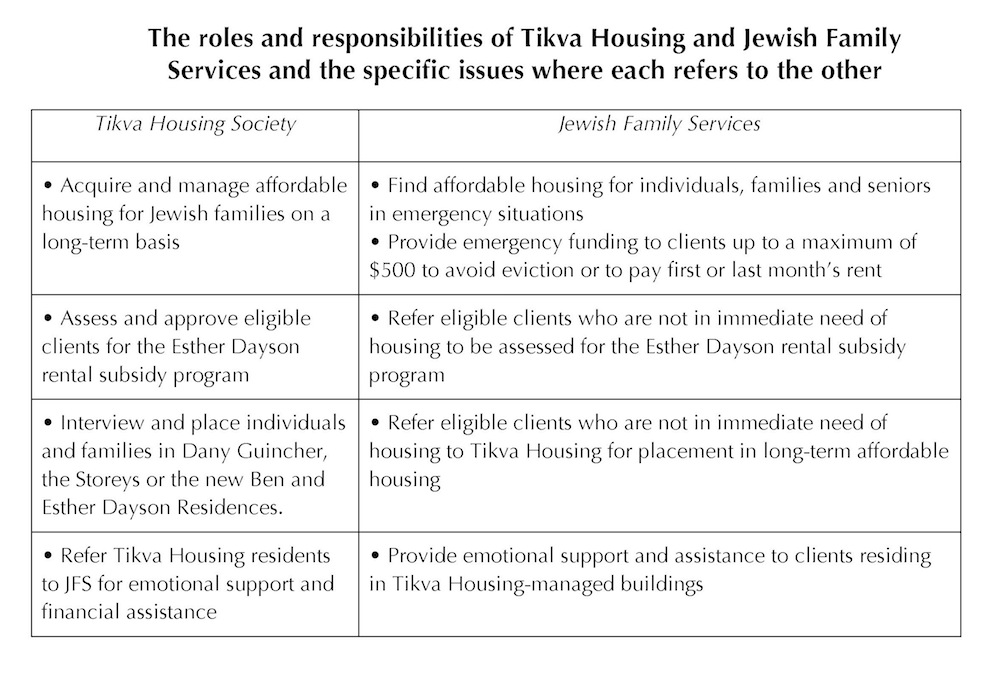
Jewish Family Services has launched a new tenant community liaison (TCL) position to provide stability and support for JFS clients receiving a Tikva Housing subsidy or who are housed in one of Tikva’s rental buildings for low- and moderate-income Jewish adults and families.

The purpose of the TCL position, which is funded by the Ben and Esther Dayson Foundation and a grant from the federal government, is to increase the long-term success of housing vulnerable and at-risk Jewish community members.

“Once JFS clients are settled in as new tenants, they often struggle to adjust to living in a permanent housing situation,” said Tanja Demajo, director of family and adult resources at JFS. “Many of our clients have a history of addiction, mental illness, a physical disability, and/or family abuse, so adapting to life in a new community is a challenge for them.”

The new TCL will act as a link between JFS and Tikva Housing to ensure that tenants who need support are settled in successfully and to help them understand their roles, rights and responsibilities. In addition, the TCL will provide workshops and counseling, as well as community-building activities, such as holiday celebrations and networking events. Tenants will also learn about appropriate services or resources.

Alice Sundberg, director of operations and housing development at Tikva Housing, said, “We value the collaborative relationship we have with JFS to make sure that those most in need in our community get access to affordable housing. The tenant community liaison will help to ensure that the people we serve have more than just a roof over their heads. We plan to work closely with the TCL to connect our more vulnerable tenants to support services, job and educational resources, as well as enhanced links to the Jewish community and culture.”

Affordable and social housing has become a critical issue in the Lower Mainland for almost all income levels. Following the trend in the general population, the part-time JFS housing coordinator has seen more than a 20% increase in the number of people asking for assistance, with an average of 55 new calls a week.

In the city of Vancouver, monthly rent of $1,730 for a one-bedroom unit is considered affordable. When a person on disability makes a yearly income below $18,000 per year and the minimum wage is $12.65 an hour, it is not surprising that the percentage of homelessness has increased by 30% since 2014. The 2017 Homelessness Count in Metro Vancouver confirmed that some of the main barriers to finding housing are the high cost of rent and the lack of income and shortage of units that suit clients’ needs.

As the Jewish community responds to the issue of affordable housing, the tenant community liaison is a step forward. “Lack of support for affordable and social housing damages clients lives and affects all of us directly or indirectly,” said Demajo. “Having a home is not a luxury, it is a basic need.”chart - roles and responsibilities of Tikva Housing and Jewish Family Services

Format ImagePosted on November 9, 2018November 9, 2018Author Jewish Family ServicesCategories LocalTags affordability, Alice Sundberg, housing, Jewish Family Services, JFS, Tanja Demajo, tikkun olam
Trying to meet needs

Trying to meet needs

Left to right: Anat Gogo, Tikva Housing administrator; Philip Dayson, donor; Shirley Barnett, donor; Heather Kenny, Tikva board member; Alice Sundberg, Tikva director of operations; Eric Fefer, Tikva development committee member; Shelley Karrel, Tikva board chair; and Kasimir Kish, Tikva board member. (photo from Tikva Housing)

There is so much in the news about Vancouver’s housing crisis – unaffordable rents, no vacancies and reno-viction notices. Having a safe, secure and affordable home is one of the most basic needs, which helps people to feel a sense of belonging and well-being. Many in our community lack this basic right.

On a daily basis, Tikva administrator Anat Gogo hears about people looking for affordable housing.

“It might be because they are in an abusive situation and need to make a change, or they are paying almost 50% of their monthly income on housing,” she said. “Whatever the reason, we do what we can.”

Thanks to the generosity of donors, Tikva has two residences that are fully occupied – Dany Guincher House and the Diamond Residences – and soon to open is the Ben and Esther Dayson Residences in the Fraserview district. These 32 new townhomes include two-, three- and four-bedroom units and, in adjacent towers, there is a common room where tenants will be able to gather for special events like Shabbat dinners and holiday celebrations.

In addition, more than 35 individuals and families are supported through the Esther Dayson Rent Subsidy Program.

Alice Sundberg, director of operations and housing development at Tikva, said the need to continue to increase “inventory” is constant.

For more information and to find out how you can help, contact Tikva Housing at 778-998-4582 or visit tikvahousing.org.

Format ImagePosted on November 9, 2018November 7, 2018Author Tikva HousingCategories LocalTags affordability, Anat Gogo, housing, Tikva Housing
Recalling the heyday of radio

Recalling the heyday of radio

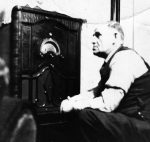
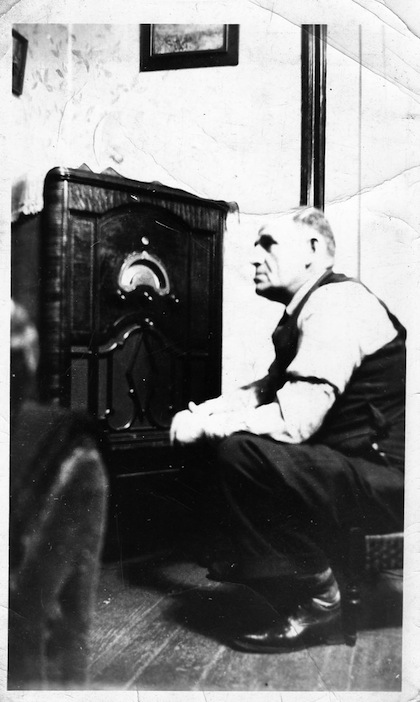
The writer’s father listening to the radio, circa 1940. (photo from Libby Simon)

This black-and-white picture, lined with age, was taken of Papa in about 1940. His attire reflects a time when a vest was commonly worn under a man’s suit jacket. It is rarely seen today, nor is the armband on his shirtsleeve. His white shirt makes the ensemble too formal to be worn at home, especially with his often-repaired dress shoes. But Papa was a Hebrew teacher and, perhaps uniquely to him, he always dressed as if he were going out. The bare, worn floor reveals a modest home, not uncommon in the 1930s, considering the widespread impacts of the Great Depression.

He sits in rapt attention, hunched on a stool, his expression tense, his eyes fixed on an old, brown, wooden floor radio. We grew up with that radio the way people grow up today with television. It connected our family with the outside world, but each for different reasons. As immigrants, Yiddish was our first language and, for him, radio undoubtedly served as an opportunity to hone his English, as well as to receive its messages. Although I was still a preschooler, I remember what he was listening to because the scene in this photo was repeated several times every day from 1939 to 1945, the years of the Second World War. Papa was listening to the news. But the true catastrophic human saga unfolding beyond the photo, even as he listened, would not emerge until after the war ended.

Fortunately, we here in Canada escaped the devastating fate of our relatives. As a child, I was only aware that certain foods were rationed, like tea, coffee, sugar and butter. My four brothers and I would fight over the krychik (Yiddish for the end piece of a rye bread). It was not the bread itself, but the limited availability of butter on the krychik that made this a special treat worthy enough to be fought over. If Papa were home, he would assign it to me as the youngest and as the only girl, much to the dismay of my brothers. But the rations coupon books provided by the Canadian government gradually extended to include many other staples, such as meat, cheese and evaporated milk. These were needed for the soldiers and the war effort.

I also remember short musical promotions appealing to Canadians to buy Victory Bonds. As a second-grader, I stood up in class one day and patriotically sang one such little ditty, which still reverberates in my memory. My substitution of the word “bun” for “bond” exposes my childhood ignorance that I only came to realize in retrospect as an adult. The lyrics go as follows:

“Buy a ‘bun’ V for Victory / Show you’re fond of your liberty / Keep on buying to keep them flying, / And don’t ever stop till they’re over the top.

“Every dollar makes Hitler holler / And every ‘bun’ you buy will make him groan / So help flood our Chest, / Do your best and invest / In Canada’s Victory Loan.

“Oh, Canada, we stand on guard for thee.”

photo - The writer’s father listening to the radio, circa 1940The radio became such a central focus and source of news that, when the war ended in 1945, I wondered what would happen to it. “Papa,” I asked, “now that the war is over, will they close the radio?”

“Why do you think they will close the radio?”

“Because,” I answered, “what else would they have to talk about?”

It was then I learned that radio not only delivered news about war. It also provided entertainment. For example, I discovered Hockey Night in Canada. My brothers and I would huddle around the radio every Saturday night and listen to Foster Hewitt, in his inimitable high-pitched excitement shout, “He shoots! He scores!” The contagion caused a clutch of five kids to holler in unison along with the sound of the roaring crowd – but only for the Toronto Maple Leafs. In time, I became a hockey aficionado, and could spout names like Syl Apps, Turk Broda or even Conn Smythe, their manager. Establishment of the Hot Stove League began during those early years and continues to this day.

We used to listen to shows like John & Judy, a serial about life in a small Canadian city, and Share the Wealth, with Bert Pearl. And Second World War songs filled the airwaves, like the “White Cliffs of Dover,” referring to the Battle of Britain. “We’ll Meet Again,” a song that resonated especially with soldiers off to battle and their families and sweethearts who had the heartbreak of waiting and not knowing if they would ever return.

Papa’s faded photo tells not only a personal story, but the story of many in Canada. It also highlights the role of radio in our lives. It served to bring the world into our homes between two catastrophic events – the Great Depression and the Second World War. We cannot overlook its importance as a medium of communication that brought the world into millions of living rooms across the country.

Of course, time brings change. My parents are long gone and my siblings and I have dispersed across North America. Radio was eventually muscled out by television but, today, you can “turn your radio on” in a resurgence of popularity. As a segment of mass media, the power of radio has infiltrated our lives again, even on the internet. And, online, you can go back to your childhood with “retro music” and shows like Roy Rogers and The Lone Ranger. It still connects us, though without taking up nearly as much floor space.

Libby Simon, MSW, worked in child welfare services prior to joining the Child Guidance Clinic in Winnipeg as a school social worker and parent educator for 20 years. Also a freelance writer, her writing has appeared in Canada, the United States, and internationally, in such outlets as Canadian Living, CBC, Winnipeg Free Press, PsychCentral and Cardus, a Canadian research and educational public policy think tank.

Format ImagePosted on November 9, 2018November 7, 2018Author Libby SimonCategories Op-EdTags Canada, history, radio, Second World War
כמו באגדות

כמו באגדות

ז’רמן מן

הסיפור הזה כאילו נלקח מאחת האגדות או מסרט בדיוני, ולא מן הנמנע שבקרוב יעשו עליו סרט אמיתי. אם קנדית מברמטון שבמחוז אונטריו שלא ראתה את בנה במשך שלושים ואחת שנים, זכתה סוף סוף לקבל את ההודעה המיוחלת: הוא חי וקיים וגר בקונטיקט שבארצות הברית. את המידע היא קיבלה מהאגודה הקנדית של ילדים שאבדו בראשות אמנדה פיק.

לינת מן-לואיס נפרדה בקנדה מבעלה אלן מן ג’וניור (יליד גינאה שעבר לקנדה) בשנת 1986. שנה לאחר מכן ביוני 1987 עת הבעל לשעבר קיבל אישור מבית המשפט לבקר את בנו בטורונטו, הוא ניצל את ההזדמנות וחטף את התינוק של השניים ז’רמן (שהיה אז רק בן עשרים ואחד חודשים), ועבר עימו לארה”ב ללא אישור כניסה. הוא בחר לגור בקונטיקט וסידר לו ולבנו מסמכים מזוייפים, תוך שהוא מגדל אותו לבד. האב קרא לעצמו היילי אנדולף דזוה, ולאורך השנים כשז’רמן שאל על אמו הוא אמר לו שהיא נפטרה כשהיה עוד תינוק.

רשויות החוק בארה”ב חשדו בשנים האחרונות שהמסמכים של האב והבן מזוייפים, ולאחר חקירה מאומצת בשותפות עם משטרת טורונטו שכללה שימוש בטכנולוגיות מתקדמות לזיהוי פנים, הם הגיעו למסקנה כבר לפני כשנתיים שיש אמת בדבר. האב (בן השישים ושש) נעצר סוף סוף במהלך אוקטובר ובקרוב יעמוד לדין בארה”ב. הפרקליטות המקומית תגיש נגדו כתב אישום שיכלול מספר אישומים פליליים. לאחר מכן לא מן הנמנע שקנדה תבקש את הסגרתו לכאן כדי להעמידו גם כן לדין. מאחורי החקירה לאורך לא פחות מעשרים שנים עמד שוטר לשעבר של משטרת קלגרי, טד דיוויס, שמשמש חוקר באגודה הקנדית של ילדים שאבדו, במשך עשרים ושלוש שנים. דייויס הקדיש זמן רב, אנרגיה וכל מה שאפשר לחקירה המסובכת הזו, והבטיח למן-לואיס ומשפחתה כי יעשה הכל ובכל כוחו למצוא את בנה האבוד ז’רמן. לדברי פיק כידוע זה מה שהוא באמת עשה.

לאחר שהתעשתה והבינה שלא מדובר במתיחה עשתה מן-לואיס את דרכה במהירות בטיסה לקונטיקט לראות לראשונה את בנה, מזה כשלושה עשורים תמימים. היא לא ישנה אפילו דקה אחת בלילה שלפני הטיסה. ז’רמן שהיום הוא כמעט בן שלושים ושלוש היה נרגש ביותר. גם הוא לא האמין כי יזכה לראות את אמו. מן-לואיס אמרה לעיתונאים לאחר הפגישה עם בנה שהתקיימה בדיסקרטיות לבקשתו: “אין מילים לתאר את מה שהרגשתי. המילים שבנך חי, מצאנו אותו – פשוט עצרו את נישמתי”. האם הוסיפה: “רציתי לראות שהוא אמיתי. אמרתי בקול הוא אלוהים זהו התינוק שלי”. לדבריה בנה אמר: “אמאלה. יש לך את העיניים שלי”. השניים בילו שעות ביחד ולא הפסיקו לשאול שאלות אחד את השני. בזמן שהאם הכינה ארוחה שכללה עוף לבנה, היא הבינה שהוא בכלל צמחוני. בשלב זה לא ברור האם ז’רמן יעדיף להישאר בארה”ב או לעבור לקנדה ולגור קרוב לאמו.

לשאלת עיתונאים מה היא היתה אומרת לבעלה לשעבר שחטף את בנה, אמרה האם: “אף פעם אך תקח ילד מההורה שלו בשום מקרה ולא משנה למה”.

למן-לואיס יש מסר ברור וחשוב לאימהות והורים שאיבדו את ילדיהם שנעלמו. היא מעודדת אותם ואומרת להם ישירות: “במפורש אל תאבדו את התיקווה לעולם, אף פעם”. היא הוסיפה: “הסיפור שלי הוא ההוכחה שגם אחרי שלושים ואחת שנים ארוכות של סבל אסור לאדם לוותר. הוא חייב להיות סבלני וחזק ולהאמין שהכל אפשרי בעולמנו”.

Format ImagePosted on November 7, 2018November 1, 2018Author Roni RachmaniCategories עניין בחדשותTags Jermaine Mann, Lyneth Mann-Lewis, ז'רמן מן, לינת מן-לואיס

Posts pagination

Previous page Page 1 … Page 6 Page 7 Page 8 Next page
Proudly powered by WordPress