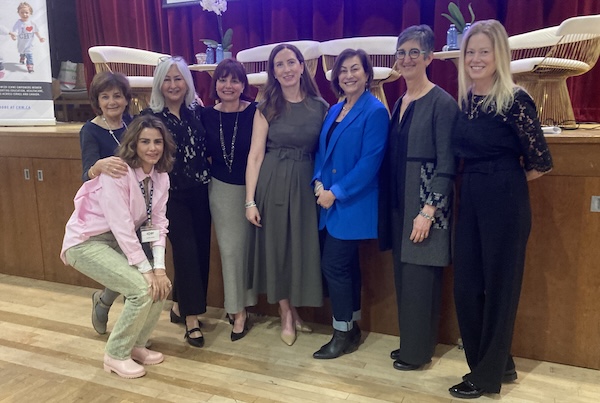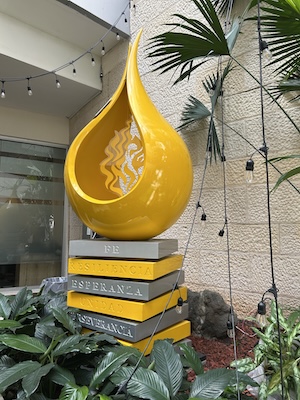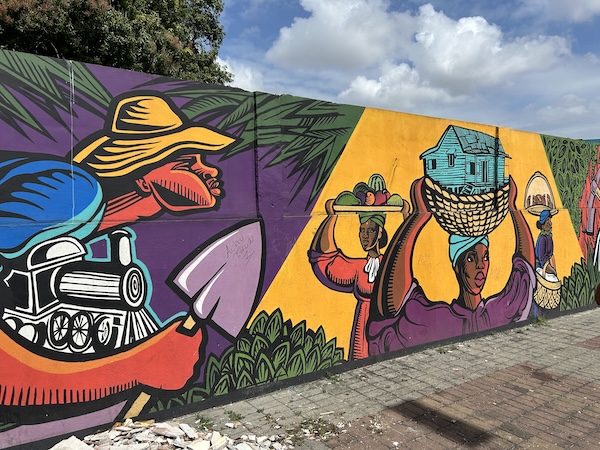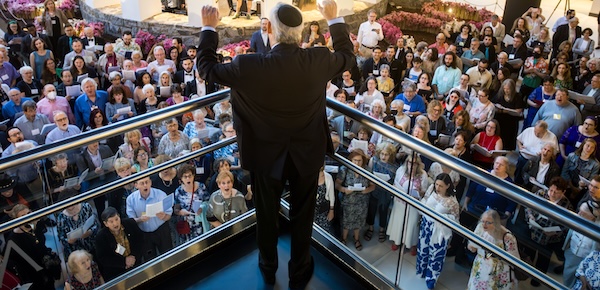
Cantor Eric Moses led a delegation from his synagogue to Havana, Cuba, this month. (photo from Beth Sholom)
Earlier this month, I traveled to Havana with a delegation from Beth Sholom, the Toronto synagogue where I serve as cantor. Together, we represented the first Canadian Jewish group to visit the island since 2019. Travel to Cuba has been complex and unpredictable for some, but our mission was simple – to support the Jewish community in Cuba and remind them that they are neither forgotten nor alone.
The island nation continues to face an unprecedented and protracted crisis. There is a shortage of nearly everything, most notably fuel. Gas stations, if open at all, have hours-long lineups. Illicit WhatsApp groups gouge desperate consumers for the little gasoline that remains. Electricity is out for 12 to 14 hours each day. Medical supplies are scarce to nonexistent. Surgeries have been canceled, public transportation suspended and schools closed. Along the highways, people stand with wads of Cuban pesos, hoping someone will stop and offer a ride. And yet, despite these hardships, the small but remarkably resilient Jewish community has not lost hope.
On Friday evening, we arrived at Beth Shalom Synagogue, locally known as the Patronato, before Shabbat for a briefing with the community’s vice-president. Moments into her remarks, the lights went out. There was no panic, no drama. She calmly pulled out a few flashlights and continued speaking, as though nothing unusual had happened. She then guided us through the synagogue’s modest pharmacy, where scarce medical supplies are distributed not only to Jewish families but to the broader community as well. We were proud to have brought generously donated supplies from pharmaceutical distributor Kohl & Frisch and members of our congregation – though we knew it would not be enough.
As I entered the sanctuary for services, my contact, William Miller, pulled me aside. “Eric, we have enough generator power for about 20 more minutes.” That meant the Shabbat dinner we had sponsored would likely be served in the dark and with cold food. Again, there was no panic, just another fact of life in today’s Havana. (Our group had helped purchase that very generator during a visit in 2008.)
Our time on the island was filled with meaningful encounters. We visited all three synagogues – Orthodox, Conservative and Sephardi – participated in hands-on volunteer activities and spent time connecting with community members. We toured the Jewish cemetery, the Holocaust memorial and museum, and visited shut-in seniors during a power outage. We visited the Canadian embassy and heard from the ambassador and her team about Cuba’s precarious future. We found brief moments to experience Havana’s incredible charm, including a ride in a classic car, the taste of a mojito and the sounds of Cuban music.
By the end of the trip, our group of 16 left Havana feeling enriched, united and deeply humbled. On Friday night, the entire service was led by the youth at the Patronato – a powerful testament to the community’s commitment. I was honoured to address the congregation and shared a simple reflection: in Canada, we have almost everything, while they have almost nothing; yet they possess something we can learn from, a profound sense of pride, spirit and the determination not merely to survive, but to thrive again. One taxi driver summed up the mood of the country when he told me, “We are in a dark tunnel without a way out.” But we were welcomed with open arms and open hearts.
We departed on Sunday evening on what felt like the last fumes of jet fuel, just hours before Air Canada and WestJet announced the suspension of flights. Those who remain behind do not have the option to leave. They continue to live with constant uncertainty, navigating daily hardships while carrying the weight of more than six decades of a revolution that has failed to deliver on its promises. And yet, the Jews of Havana remain determined, resilient and passionate about their heritage and their future.
Eric Moses is the cantor at Beth Sholom Synagogue in Toronto.
A note that was delivered to the Okanagan Chabad Centre recently. (photo from Okanagan Chabad Centre)
A handwritten note showed up in our mailbox a few weeks ago. It was from neighbours of a different faith, with just a few lines: “Best wishes for 2026! Thank you for bringing laughter & yummy bread to our neighbourhood.”
That was all. No mention of beliefs or interfaith-type language. No apparent agendas. Just the neighbourhood.
Here’s what happened.
On Friday afternoons, just before sunset, when our family welcomes Shabbat, a few fresh loaves of Fraidy’s homemade challah usually leave our house. Not for any special reason. It’s simply Friday. That’s what the end of the week looks like in our home.
We usually run out with some of the kids. We go next door, across the street, behind the alley, and beyond. We’re making connections, formed among people with very different beliefs and backgrounds.
One week, kosher wine appeared at our door. Another week, neighbours opened their home when our guests needed a place to sleep. Another week, children’s clothing arrived. Another week, unexpected help showed up when it was needed most. The small stories are endless.
All of this just because fresh yummy bread goes out consistently – with no strings attached. That’s all that really happened.
Kindness now moves back and forth the way it does when it’s real: without announcements, without keeping score, without any agendas.
People don’t live next to ideas. They live next to people.
Long before anyone asks what you believe, they already know whether life feels easier around you. Kinder. More decent. More human.
They know whether generosity shows up naturally, or only when it’s requested. Almost anyone can be kind once, or when there’s a need.
What changes the environment is when kindness happens often enough that it stops feeling like an act that someone did and starts feeling like the way things are.
They didn’t thank us for what we believed. They didn’t thank us for our faith. They didn’t even really thank us for the bread either. They thanked us for what the neighbourhood feels like.
That’s why this handwritten note is so special. Not because it notices an act we had done, but because it describes the laughter and yumminess that the neighbourhood is starting to feel. And what one neighbourhood feels like is what a city – and a world – will become.
Kindness will change the world when it grows from being a random act and starts becoming a matter of fact.
Rabbi Shmuly Hecht is co-director of the Okanagan Chabad Centre with his wife, Fraidy Hecht.
The author, Nicole Grubner, and Rabbi Levi Varnai reconnecting at the Yael Awards in Vienna. (photo by Nicole Grubner)
I grew up in West Vancouver, in a home where Jewish life mattered. We celebrated the chagim (holidays), gathered for family Shabbat dinners and went to synagogue. Jewish identity was present, familiar and important. But, when it came to school, the question my parents faced was not about ideology, but practicality.
At the time, I was attending our local public school, which I loved. The Jewish school was at least a 40-minute drive each way, which would reshape daily family life. This was not a small decision.
My parents had both attended Jewish schools – my father in Chile, my mother, in England – so the value was there. And, in the end, belief won.
It was my uncle, Claudio, who ultimately tipped the balance. He didn’t provide a checklist or a plan. As my mother put it, “He just appealed to us, from his heart to ours.”
In Grade 3, my parents moved me from public school to Vancouver Hebrew Academy. That decision marked the true beginning of my Jewish journey.
Once I arrived at VHA, any lingering doubts faded quickly. My parents felt, almost immediately, that they had made the right choice.
Rebbetzin Shayndel Feuerstein z”l didn’t need to convince them that Jewish education was about more than academics; they already knew that. What stood out was how she conducted herself and the seriousness with which she approached educational excellence. She personally traveled to Israel to interview and hand-pick teachers.
The underlying challenge facing the school was not vision or quality; it was financial. Fundraising was a constant reality and, from one school year to the next, there was never complete certainty that there would be enough resources to continue operating.
When I entered VHA, I joined a class filled with children whose lives were just beginning to take shape. One of them was a boy named Levi Varnai. We were classmates for two years, from 1996 to 1998, before I transferred to Vancouver Talmud Torah for Grade 5. A couple of years later, Levi and his family moved to Israel.
Levi went on to study in yeshivot in Israel and New York, receiving smicha (rabbinical ordination) in 2011, before returning to Vancouver in 2013 to work with the Community Kollel as an assistant rabbi and youth director. Since 2016, he has served as the congregational rabbi of the Bayit in Richmond. Alongside his wife, Rivky, an educator who grew up in Safed, Israel, they have built something truly special.
One of the most powerful expressions of that work is the Bayit’s Kids Zone, an after-school and Shabbat program. Through cooking, crafts, music, games, Torah stories, mitzvot and holiday celebrations, children experience Judaism as warm, relevant and exciting. Pre-teens are guided toward leadership and responsibility, learning values like tzedakah, friendship and connection to Israel.
Many of the children who attend Kids Zone are enrolled in public school. For them, the program becomes a vital Jewish anchor. Parents speak of children singing Hebrew songs at home, lighting Shabbat candles for the first time, and engaging more deeply with Jewish life.
Today, I live in Israel with my family and work in communications. One of my key clients is the Yael Foundation, whose mission is to ensure that every Jewish child has access to quality Jewish education and the opportunity to develop a strong Jewish identity, no matter where they live.
Earlier this month, in Vienna, the Yael Foundation hosted the Yael Awards, celebrating innovation and excellence in Jewish education worldwide. The Bayit’s Kids Zone was among the finalists for the Jewish Experience of the Year Award, recognized alongside outstanding programs from across Europe.
“At the Bayit, we believe that a strong Jewish identity is built through joy, connection and hands-on experiences that make Judaism come alive for every child,” said Rabbi Varnai. “Kids Zone is the heart of that mission – a warm, welcoming space where children explore their heritage, celebrate Jewish life and grow proud of who they are as Jews.”
This year’s Jewish Experience of the Year Award was presented to Beth Habad Canton Vert in France, a community-based program that exemplifies how Jewish life can be made accessible, meaningful and vibrant for families.
Reflecting on the breadth and quality of the finalists, Chaya Yosovich, chief executive officer of the Yael Foundation, noted, “Every one of these educators is deserving of an award. We see, year after year, how educators are raising the bar to ensure the next generation feels connected and proud of their Jewish identity.”
Across the world, Jewish schools and educational programs, particularly in smaller or less visible communities, operate with limited funding and stretched staff. These communities may not sit at the centre of global Jewish attention but, for the families who live there, they are often the entry point into Jewish communal life. By investing in Jewish education globally, the Yael Foundation tries to ensure that excellence is not reserved only for large, well-resourced centres.
A Jewish journey that began in a Grade 3 classroom in Vancouver has come full circle. A former classmate now leads a community where Jewish identity is being nurtured in the next generations. And, today, I help tell the stories of educators and communities quietly investing in the Jewish future.
Nicole Grubner, a former Vancouverite who now lives and works in Israel, is a partner at FINN Partners marketing and communications agency.
As part of its celebration of BC Heritage Week, the Vancouver Heritage Foundation held the online event Recipes of Resistance: Rebecca Teitelbaum and the Ravensbrück Recipe Book, presented by Lise Kirchner and Ellie Lawson of the Vancouver Holocaust Education Centre. Kirchner is the VHEC’s director of education, Lawson its education manager.
The theme of this year’s Heritage Week is “Stir the Pot,” explained VHF director of education Sarah Carlson. She encouraged viewers to “think about the ways that food brings us together, how it holds memory, and how it has contributed to the rich cultural tapestry of your community and beyond.”
Teitelbaum’s recipe book was donated to the VHEC by Teitelbaum’s nephew, Alex Buckman, also a Holocaust survivor, who died in 2023.
“He was Rebecca’s nephew, but he actually was raised as Rebecca’s son…. Rebecca was the only mother that Alex ever knew,” said Kirchner. “His parents perished in Auschwitz, and Rebecca made a promise to God that she would raise Alex as her own son, which she did.
“In the 1990s, Alex discovered this recipe book in the drawer of Rebecca’s home, and he asked her about it. He had never heard the story before. Apparently, she had never told anybody, but she explained to Alex the incredible story of this recipe book, how it was created and how it survived.”
Kirchner showed many archival photographs, including of Teitelbaum and one of Teitelbaum with her younger brother, Isaac Buckman, in the 1930s.
“Isaac is Alex’s father,” explained Kirchner. “These two siblings, Rebecca and Isaac, were very close. They also had a younger brother, Jacques.”
Herman and Rebecca Teitelbaum, 1938. (screenshot from VHEC presentation)
Rebecca and her husband Herman were married in 1938. “They had a daughter, Anny, in 1939, and they lived … near Brussels, before the Second World War. Rebecca worked in the accounting department of a department store in the city of Brussels.”
Kirchner also shared a photo of Isaac and Dworja Buckman, who married around the same time as the Teitelbaums.
“The same year that Rebecca’s daughter, Anny, was born, Isaac and Dworja had a son, Alex, in October 1939.”
In May 1940, Germany invaded Belgium and the Nazis set up a military occupation government. “Unlike many other countries where the civil administrations cooperated with Nazi deportations, the situation in Belgium was much different and, as a result, the survival rate of Belgian Jews was higher than many of the Western European countries,” said Kirchner.
Nonetheless, restrictions were placed on Jews and Kirchner went through the progression of anti-Jewish laws in Belgium. There were pogroms, as well, and, in May 1942, all Jews over the age of 6 hadto wear the yellow star to identify them as Jewish.
From 1941 to mid-1942, Anny and Alex were placed into hiding, which worked until their families ran out of money, said Kirchner. When the woman hiding the kids denounced them to the Nazi authorities, the families were in grave danger.
“Between 1942 and 1944, the German occupying forces deported around 25,000 Jews from Belgium to concentration and death camps in the east, primarily to Auschwitz, and only 2,000 of these survived – 43% of the Jewish population in Belgium was murdered,” said Kirchner.
Once the Belgian resistance became more organized, there were resistance networks focused on hiding Jewish children. The largest was the Committee for the Defence of Jews, she said, and it successfully hid some 2,400 Jewish children from the Nazis, including Anny and Alex.
Isaac and Dworja Buckman were deported to Auschwitz-Birkenau in 1943 and murdered. Rebecca and Herman Teitelbaum were deported to forced labour camps in Germany: Hermanto Buchenwald, and Rebecca to Ravensbrück.
“Rebecca spent 17 months in Ravensbrück concentration camp as a slave labourer,” said Kirchner. “She was first assigned to work hard labour, hauling wood and stone and heavy carts in very harsh outdoor conditions, but, because she had worked in that department store in Belgium and she had experience with accounting work, she was able to secure a much better work assignment in the office of the Siemens factory.”
Siemens was one of the private companies that used Jewish slave labour, explained Kirchner, before turning the floor over to Lawson to talk about Ravensbrück.
“It was originally built for a little over a thousand prisoners, but, at its peak in 1945, there were over 50,000 prisoners,” said Lawson, who went into some detail about the factory and Siemens’ cooperation with the Nazis.
Despite the unimaginable circumstances, resistance was evident. Lawson shared a quote from Lidia Beccia Rolfi, an Italian prisoner: “Even the theft of a piece of wire, a sheet of paper, of a cloth rag was seen as sabotage, but everyone committed that. Any form of friendship between inmates was seen as sabotage.”
Lawson played a clip from Alex Buckman’s video-recorded survivor testimony. He explained how Rebecca noticed there weren’t that many supervisors at night.
“And then she stole a piece of brown paper, and she put it in her dress,” he said. “And then she stole a little pencil and a pair of scissors. And, at night, she ran towards her barrack, very nervous because she knew that, if somebody would stop her with all these stolen goods, she would be in trouble and they probably would make an example of her, maybe either shoot her or hang her. But she did it.”
A page from Rebecca Teitelbaum’s cookbook, which she compiled at great risk during her incarceration at Ravensbrück concentration camp. (screenshot from VHEC presentation)
In the barrack, she cut the paper into smaller pieces and started to write recipes “of meals that she did for her husband and her daughter before the war…. With the help of other women, who gave her some of their own recipes, and many of hers, she wrote 110 recipes,” he said. “Even though food was very important to stay alive in the concentration camp, she actually traded some of her food for needles and thread, and she made a book so she could keep it.”
The recipes weren’t necessarily accurate, said Kirchner. “You’ll notice most of the recipes are very heavy on butter and sugar and luxury items like raisins and rum or cream. On the other hand, some of the recipes reflect wartime scarcity…. But the dominant theme of these recipes is one of abundance.”
The recipes reflect the cultural diversity of the women imprisoned in the camp, said Kirchner. “These were women from all over Europe … about half of them were Jewish, but many of them were not, and so the recipes reflect a cultural diversity that’s Jewish, Belgian, French, Spanish, Mediterranean.”
Teitelbaum completed three recipe books, giving two to other women in the camp.
“Rebecca also created another thin volume that contains poems and resistance songs,” said Kirchner, adding, “She also made two sets of playing cards, which the Roma women in the camp would use to tell the fortune of other prisoners. So, again, building community between not just the Jewish women in the camp, but across cultures. And this was an essential form of hope and community-building and resistance by the camp inmates.”
Teitelbaum was one of 2,000 women saved in a Red Cross mission that saw 36 buses take the women from Ravensbrück to safety in Denmark and Sweden. However, the area was still a war zone and one fleet was hit by friendly fire.
“This convoy carrying 706 women, including Rebecca, was attacked multiple times by fighter planes and, as a result, there were about 25 fatalities and numerous injuries among the rescued prisoners,” said Kirchner. “Rebecca herself survived the attack, but was hit by shrapnel and badly injured her left arm. And, in the scuffle and the mayhem that followed … she lost her bundle of belongings: a sack that contained her recipe book.”
Herman, Anny, Jacques and Alex also survived.
Anny Teitelbaum and Alex Buckman, 1945. (screenshot from VHEC presentation)
“Anny and Alex were raised as siblings,” said Kirchner, and Rebecca and Herman had another child after the war. “Rebecca named this baby Christian, in honour of King Christian … who had visited her in the hospital, and who had become a bit of a folk hero in the Jewish community in Denmark.
“In 1951, the family left Europe and they arrived at Pier 21 in Halifax in September of 1951 before making their way to Montreal, where they settled permanently,” continued Kirchner. “They had one last child, named Shirley, who was born in Montreal in 1953, and Rebecca Teitelbaum became a Canadian citizen in 1957. She lived the rest of her life in Montreal, and she died there in 1999.”
The sack Teitelbaum had lost was found near the site of the bombing and, because it contained letters that identified her, the person that found the bag tracked her down.
“Rebecca’s recipe book is one of six Holocaust recipe books that we’re aware of in museums around the world,” said Kirchner. “These artifacts have given historians greater understanding about the unique responses of women to their persecution…. Unlike traditional cookbooks, they’re not about cooking, in practice, they’re about maintaining identity, resisting dehumanization, transmitting a culture that the Nazis were attempting to destroy, and they also functioned as a psychological coping mechanism that forged group cohesion and a spirit of communal care.
“The creation of these recipe books all came at great risk and sacrifice, and they’re important not only because they demonstrate the agency of female prisoners who were trying to assert control over their hunger by eating with words, but they also provide an archive of women’s communal responses to their persecution, which elevates women’s domestic expertise to the level of historical record.”
In his talks as an outreach speaker, Buckman would give students the Gâteau à l’orange recipe from Teitelbaum’s book.
“This was a cake,” said Kirchner, “that Rebecca would make for Alex every birthday, and he would encourage the children to make it at home with their own parents, to give their parents a hug, to make this orange cake in honour of his Aunt Rebecca, and also in memory of all of those who were murdered in the Holocaust, including his own parents, Isaac and Dworja.”
Yasam (Israel Police Special Patrol Unit) Master-Sgt. Ran Gvili z”l was buried on Jan. 28 in his hometown of Meitar. The last remaining hostage from the Hamas attacks of Oct. 7, 2023, his body was brought back to Israel on Jan. 26. After 843 days, the clock in Tel Aviv’s Hostages Square stopped ticking, and the displays of the kidnapped at Ben-Gurion Airport and the National Library of Israel were removed. For the first time since 2014, not a single Israel Defence Forces soldier or civilian is being held hostage in the Gaza Strip.
Two years, three months and 20 days after Gvili, 24, fell in a battle at Kibbutz Alumim near the Gaza Strip, the hero was given a fitting military funeral. Thousands of police officers, IDF soldiers and residents stood in silence along the streets of the Beer Sheva suburb as the funeral procession passed.
The service was attended by President Isaac Herzog, Prime Minister Binyamin Netanyahu, Police Commissioner Daniel Levy and Sephardi Chief Rabbi David Yosef, alongside senior political and security figures. The sombre ceremony was the first funeral of a hostage from Oct. 7 attended by the prime minister.
Netanyahu eulogized Gvili: “He considered his injured shoulder meaningless because he believed with all his heart and strength that the security of the state rested on him and the shoulders of his comrades.
“He saved lives – many, many lives,” said Netanyahu.
The prime minister also announced that a new town, Renanim, would be established near Meitar in Gvili’s memory.
Addressing the family, Herzog apologized on behalf of the people of Israel, saying: “I’m sorry we were not there for him. I am sorry that, along with so many other families, you had to wait so many long, agonizing days for the return of your loved one.”
He added: “Without hesitation and without asking, again and again, [Gvili] said, ‘Here I am,’ and went into the line of fire to protect us.”
When the attacks began at 6:29 a.m. on Oct. 7, Gvili was at home, where he had been recovering from a broken shoulder sustained in a motorcycle accident. As news began trickling in of kibbutzim and cities near the Gaza frontier being overrun and their residents massacred, he decided to join the battle. Though on medical leave, he reached for his gun and his uniform, and went to help.
His father, Itzik Gvili, told Ynet News that his son “just put on a uniform and said to me, ‘Abba, I’m going.’ I said to him, ‘Where do you think you’re going?’ and he answered, ‘What do you think? Do you think that my friends will fight alone? I’m going to help them.’ He didn’t ask me. Rani can’t be stopped.”
Driving west toward the carnage at the Nova music festival, Gvili rescued an estimated 100 people fleeing the rave. He then engaged in a battle with dozens of Hamas gunmen near Kibbutz Alumim, killing 14 terrorists before being fatally shot when he ran out of ammunition. At 10:50 that morning, he texted friends that he had been shot in the leg.
For months, Gvili’s family held out hope that he was alive and being held hostage somewhere in the Gaza Strip.
His mother, Tali, told Haaretz in November 2024 that the family had received photos from Oct. 7 showing him arriving unconscious at Shifa Hospital in Gaza City, and later in Zeitoun on the back of a motorcycle, “but they aren’t conclusive … in this situation, hoping for a miracle feels reasonable.”
Gvili’s body was recovered by IDF search teams following a months-long intelligence operation. Under combat conditions in the northern Gaza Strip, some 700 bodies were disinterred at al-Bats Muslim cemetery in Shuja’iya and Gvili’s was identified by IDF dentists after carrying out the forensic examination of 249 corpses. Many noted that the word ran (singing) has a numerical value in gematria of 250. Gvili was still wearing his uniform, and he was buried in it rather than in shrouds as is customary for civilians.
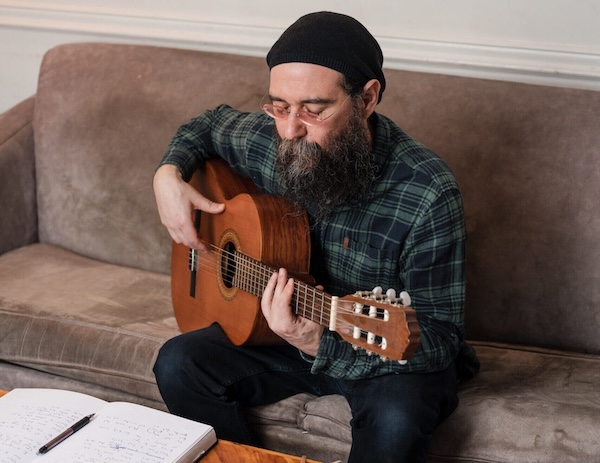
According to the Hostages and Missing Families Forum, “Ran had a passion for motorcycles, enjoyed gatherings with friends, cherished moments with his sister and brother, and relished playing the guitar while sipping lemon arak.”
Gil Zoharis a journalist and tour guide based in Jerusalem.
At rallies held across Canada after the Oct. 7, 2023, Hamas attack on Israel and during the Israel-Hamas war, there were protesters holding antisemitic signs and hollering antisemitic slogans. Bill C-9 would amend the Criminal Code to strengthen existing hate-related offences. (photo from Canadian Handbook on the IHRA Working Definition of Antisemitism)
Parliament resumed last month after its winter break and one of the bills on the agenda for the new session could have significant repercussions for Jewish Canadians.
While Jewish organizations welcome most components of the proposed legislation, the most important message that its passage would send is that political leaders take hate crimes seriously, according to Jewish organizational spokespeople who were interviewed by the Independent.
Bill C-9 would amend the Criminal Code to strengthen existing hate-related offences. But legal experts and advocacy agencies admit there is no quick fix for the explosion of antisemitic rhetoric and violence in Canada and around the world.
The proposed legislation, which is now in committee stage, would create new offences for intimidation and for intentional obstruction of access to religious or cultural institutions, schools, daycares, seniors residences and cemeteries. It would also create a new hate-crime offence tied to crimes motivated by “hatred,” add a definition of “hatred” and create an offence related to publicly displaying certain hate or terrorist symbols in ways that promote hatred. If passed, the law would remove the requirement of provincial attorneys general to approve police-laid charges and instead place that decision on Crown prosecutors.
In a rare joint statement in December, five national organizations – the Centre for Israel and Jewish Affairs, Friends of Simon Wiesenthal Centre, B’nai Brith Canada, the Alliance of Canadians Combatting Antisemitism, and Canadian Women Against Antisemitism – welcomed the bill. They also called for additional steps, including increased funding for community security and closing gaps in the country’s anti-terror laws. The statement further called for existing laws to be more vigorously and consistently enforced.
Despite the advocacy of community voices, and existing and proposed legislation, many Canadian Jews feel that antisemitic rhetoric and acts are getting worse, not better, and that few of the actions taken to stanch them are having the desired outcomes.
In British Columbia, for example, Vancouver police recommended charges against Charlotte Kates, a Vancouver resident who publicly called the Oct. 7, 2023, terror attacks “brave and heroic” and who led a rally in chants of “Long live October 7.” The recommendation has been on the desk of BC’s attorney general for more than 18 months. In an interview with the Independent late last year, Premier David Eby committed to providing an update on the case. Despite repeated follow-ups, the premier’s office has not yet responded with an explanation as to why no action has been forthcoming.
The Independent interviewed leaders in Jewish advocacy organizations, and a clear consensus emerged that expressions of political will may be as important as any particular piece of existing or new legislation.
While many people may feel things are on a downward trajectory, Dylan Hanley, senior vice-president, public affairs, for the Centre for Israel and Jewish Affairs, noted some areas of progress. For example, though the situation on Canadian university campuses is not perfect, he said, there have been improvements in terms of how administrations respond to problems.
Hanley also said credit should be given where due, and intelligence agencies and law enforcement have, crucially, prevented several potential disasters from happening in Canada. More must be done, however, including additional immigration screening around connections to terrorist groups, and maintaining vigilance around foreign interference in politics and civil society, he said.
Further investigation is required around possible foreign support for domestic agitators, said Hanley. Although there is no solid evidence, there has been much speculation about external funding of anti-Israel activities, especially given the apparent preparedness of domestic groups immediately after the 10/7 attacks, he said.
“Has anybody shown us the smoking gun?” Hanley asked. “No. Do we suspect at least that there are foreign funds going into some of these campaigns? Sure.”
Ensuring government support for community security is an ongoing issue, as funding is cyclical. But Hanley noted that, while this support is necessary, it is also a response to the problem, which requires leadership and action that gets at the root of the issue – radicalization combined with a major increase in antisemitism.
The proposed changes contained in Bill C-9 are largely a step in the right direction in his view, but Hanley says no single approach can eliminate the underlying problem of antisemitism and hatred.
“None of these things are silver bullets on their own,” he said. “And we don’t want to raise community expectations that there is a silver bullet here.”
The Jewish community is feeling very alone, he said, and is looking for someone to fix the problem. The consensus among all those interviewed for this story is that political leadership must set the tone.
“I think the biggest piece – and we deliver this message at every level of government in every interaction – is we need to see clear leadership on this,” Hanley said. “We need our leaders to come out and say, clearly, this isn’t OK. You can’t target communities in Canada because of anger or frustrations from conflicts going on overseas, and what starts with our community isn’t going to end with our community.”
Even before Oct. 7, 2023, antisemitism was an increasing problem in Canada – this photo comes from a Centre for Israel and Jewish Affairs’ post about Ontario’s 2022 election. A lack of political will at all levels of government is one reason the problem continues to worsen. (photo from cija.ca)
Jewish Canadians are frustrated with what appears like constant buck-passing, he said.
“The university says, ‘Well, actually, this is the police’s job.’ The police say, ‘Well, you know, we haven’t gotten any political cover from the city.’ The city says it’s the province. The province says it’s the feds,” Hanley explained. “And then you go around in the circle again and the feds say, ‘We don’t get involved in law enforcement in individual cases.’”
Aron Csaplaros, BC regional manager for B’nai Brith Canada, echoed several of Hanley’s comments and lauded the Bill C-9 provision that would create a law that most Canadians probably think already exists.
“In Canada, we do not right now have a freestanding hate crime offence,” he said. Instead, the Criminal Code prohibits wilful promotion of hatred and public incitement of hatred. At present, acts motivated by hate are usually prosecuted under general offences like mischief or assault, while bias or hate can be treated only as an aggravating factor at sentencing.
With Bill C-9, prosecutors would be able to lay a specific hate-crime charge that makes bias or hatred part of the offence itself. This means that prosecutions can centre explicitly on antisemitic or hateful motivation, and sentencing may be more severe because the hate element would be built into the crime rather than treated as secondary.
Bill C-9 would also create a prohibition against harassing people outside religious institutions.
“Everyone has the right to freedom of expression and protest,” said Csaplaros. “But, at the same time, those rights cannot come at the expense of the freedom of others.”
His views about the way things are handled – or not – are similar to Hanley’s.
“I think there’s a lot of passing the buck and finger-pointing going on between various levels of law enforcement and government,” said Csaplaros.
Like the other spokespeople the Independent interviewed, Csaplaros said he is not criticizing law enforcement.
“Law enforcement really needs to be empowered. They need to ensure that officers are using all of the resources available to them,” he said. “That means that all levels of government –federal, municipal, provincial – need to support law enforcement by ensuring clear directives and ensuring that they have the mandate.”
Officers on the frontline may need more awareness of the laws and the extent or limitations of those laws, he said. Crown prosecutors and the
judiciary might benefit from refreshers as well, he added.
Education is key, he said, not just for people at the frontline of law enforcement but for all Canadians. B’nai Brith is calling for a national digital literacy campaign so that all people, but especially young people, have the tools to be able to differentiate fact from fiction, disinformation from legitimate disagreement.
Jaime Kirzner-Roberts, senior director of policy and advocacy for Friends of Simon Wiesenthal Centre, said education is a core mandate of her organization. In this context, she has seen how the realities facing Jewish Canadians are questioned or discounted.
The centre educates a broad range of audiences, including law enforcement, government officials and civil society leaders. Almost invariably, she said, when trainers show statistics of antisemitic hate crimes, hands shoot up in the audience to contest the numbers, to question the methodologies or otherwise call into doubt the prevalence of attacks on Jews. Part of this, she believes, is due to the pervasiveness of the myth of the “powerful Jew.”
“This sort of racist understanding of the Jew has compromised the ability of the society to really understand that, in fact, we are the targets,” she said.
Even when people are not challenging the evidence, said Kirzner-Roberts, there seems to be a fundamental disconnect between approaches to antisemitism and reactions to other forms of racism.
“The response that we so often hear is, ‘Well, it’s a free country,’” she said. “This is not the kind of expression that you would get if the target were, in my opinion, anyone other than Jews.” This societal double standard is a challenge, she said.
Like the others interviewed, Kirzner-Roberts believes that leadership and political will are crucial to turning the tide. That includes legislation like Bill C-9 and also enforcement of existing laws. “There is a lot of legislation already that is being far underutilized,” she said.
Systemic issues, though, are addressed by leadership at the political level.
“We’re seeing a lack of political will across the board, and I’m talking here [about] cities, provinces and on the federal level,” said Kirzner-Roberts.
In addition to addressing the rise in hate-motivated crime and closing loopholes in existing laws, she said, Bill C-9 is important because it drives home the message of political will onto police and prosecutors.
Dr. Gloria Gutman thought interviewees would have refused to place themselves in situations where they might be targeted or victimized, like rallies or Jewish events, but that wasn’t the case. “People felt more comfortable and secure when they were actively part of the Jewish community,” she said. (internet photo)
There’s been lots in the media about Jewish students feeling intimidated, but we tend not to think about older people,” Dr. Gloria Gutman told the Jewish Independent about a recent study she conducted with Dr. Sharon Avidor on the experiences of older Canadians since the Oct. 7, 2023, Hamas terror attack on Israel. “We really want to raise awareness of older people among service providers and the general community, and let them know that the impact is really on all of our community.”
Gutman, a lifelong Vancouverite, is vice-president of the International Society for Gerontology, director emerita of the Gerontology Research Centre at Simon Fraser University and professor emerita of SFU’s department of gerontology. Wondering how older members of the Canadian Jewish community were coping in the aftermath of Oct. 7, she reached out to the local Jewish community in summer 2024 for help in recruiting participants for the study she conducted with Avidor, a psychologist in the faculty of social and community sciences at Israel’s Ruppin Academic Centre. Their findings were published in the Canadian Journal on Aging last fall, with the title, “I No Longer Can Say ‘Never Again.’”
Avidor and Gutman interviewed 15 older adults, including Holocaust survivors and Russian immigrants to Canada, and 11 service providers. Respondents were not just deeply affected by the Oct. 7 attack and the ensuing Israel-Hamas war, but experienced the public discourse as anti-Israel and at times antisemitic, upending their sense of safety and belonging.
The study found that Holocaust survivors and their offspring, older Russian emigres to Vancouver and LGBTQ+ Jewish seniors were more impacted. Almost everyone interviewed felt a deep connection with Israel, and personally affected by Oct. 7. Many felt isolated from non-Jews in their communities and were shocked at the lack of support they encountered outside of the Jewish community, as well as by the extent of misinformation proliferating about Israel. Given their experiences of antisemitism and discrimination, many were frustrated by the notion that Jews were considered a part of the white majority.
Interviewees were apprehensive about publicly displaying their Jewish identity and felt deeply offended by the anti-Israel vitriol expressed in pro-Palestinian demonstrations. They felt a strong need to connect with others in the Jewish community, as connecting with like-minded people provided solace at a time when their social circle was shrinking to almost exclusively Jewish friends.
Prior to the study, Gutman thought interviewees would have refused to place themselves in situations where they might be targeted or victimized, like rallies or Jewish events, but that wasn’t the case. “People felt more comfortable and secure when they were actively part of the Jewish community, and some who had not previously been involved came out of the woodwork after Oct. 7, getting comfort from engaging in community-based events,” she said.
Many of the LGBTQ+ respondents were in a somewhat different situation, alienated from LGBTQ+ groups because of “belligerent, negative, and even hateful comments about Israel, sometimes personally aimed towards them because of their Jewish backgrounds,” notes the study, while also not feeling comfortable attending events with an unequivocal pro-Israel view. Thus, Avidor and Gutman write, many in the LGBTQ+ community “were given to experiences of loneliness and isolation.”
Holocaust survivors said they were retraumatized by Oct. 7 and what has followed – the study’s title comes from a survivor who used to end her talks in schools with “never again,” but told Avidor and Gutman, “My recent talks are that I no longer can say never again.”
Emigres from the former Soviet Union felt especially vulnerable. One of the service providers for members of this group described why this was the case: “Because they came, you know, after Holocaust, after everything they’ve been through in Soviet Union, it was terrible. It was terrible. Antisemitism was terrible. And I know my parents went through all this too: wouldn’t be able to be accepted to a university or a good job because of their last name. So they all have these previous traumas and experiences.”
Some of the seniors had robust coping abilities because they had overcome immense struggles in the past. “We heard things like, ‘we’ve lived through this before and will live through it again,’” Gutman said.
Her hope is that this research will raise awareness of the impacts of Oct. 7 on Jewish older adults, particularly among service providers.
“Ours is one of the few studies, to our knowledge, to explore the effects of antisemitism among older adults, often a less vocal and less salient group in society,” she said. “The Oct. 7 attack, the Israel-Hamas war and perceived antisemitism and anti-Israeli rhetoric, have had profound effects on Jewish older adults living in Canada, and this must be recognized and given appropriate attention.”
Lauren Kramer, an award-winning writer and editor, lives in Richmond.
Danny’s Farm is a leading Israeli centre for holistic healing, offering animal-assisted trauma care, among other services. (photo from Danny Stirin)
After Canadian-Israeli media personality Shai DeLuca was critically wounded in 1996 during his service in the Israel Defence Forces, the instructions from his peers were as blunt as they were unhelpful: be a man, move on.
The injury – that left him with temporary loss of use of his legs –kept him in hospital and rehabilitation for nearly a year, in an era when post-traumatic stress was rarely named, let alone treated. “Back then, PTSD wasn’t understood the way it is today,” said DeLuca. “No one had language for it. No one recognized the symptoms.”
At the end of July 2025, DeLuca traveled to a ranch southeast of Rehovot, Israel, with a Canadian organization supporting IDF veterans with post-traumatic stress disorder, families of Oct. 7 victims and Israelis living with trauma caused by terror. What began as just a visit to Danny’s Farm, a unique therapeutic centre, turned into a revelation.
At the end of the tour, ranch owner and chief executive officer Danny Stirin sensed something about DeLuca and asked a pointed question – why had he not dealt with the mental after-effects of his injury?
“I felt like I didn’t even need to say a lot and he understood what I meant,” recalled DeLuca. “He said, ‘the moment you’re ready, just message me. I will be there with you every step of the way.’”
The visit was “life-changing” for DeLuca and returning to the farm later allowed him “to understand parts of my own story buried for years.”
DeLuca credits Stirin as “the person who freed me in a lot of ways from a lot of weight that I’ve been carrying for so many years.”
Danny Stirin, left, and Shai DeLuca in conversation. DeLuca credits Stirin as “the person who freed me in a lot of ways from a lot of weight that I’ve been carrying for so many years.” (photo from Shai DeLuca)
Since its inception in 2016, Danny’s Farm has become a refuge for Israelis grappling with trauma, be it from war or terror. At first glance it looks like a ranch – stables with dozens of horses and many small animals about – but amid the pastoral view is a clinic, recognized as a leading Israeli centre for holistic, animal-assisted trauma care. Treatment rooms for art, music, bodywork and complementary medicine sit alongside the barns, and a multidisciplinary staff of psychologists, social workers and emotional-therapy instructors anchors the work with patients. The farm treats some 1,500 people each week.
Even before Oct. 7, the farm was treating children with special needs, survivors of sexual violence, and adults with complex trauma, filling a gap in an under-resourced mental-health system. Since the Hamas attacks and ensuing war, it has become a safe zone for reserve soldiers, evacuees from the south and north, and families coping with loss, dislocation and rocket fire.
For Stirin, the farm grew out of his own brush with crisis and a decision about what kind of fulfilment he sought professionally. “It’s like there’s a point in your life when you’re looking for a purpose,” he said, adding that he wanted the farm to be a tangible example for his children: “so they can see that somebody is going with his heart, all the way.”
A deeper motivation, though, was to help other people with their pain. “I felt that I have to hold the hope for others having a crisis, as I did,” he said.
Stirin’s choice to place animals at the centre of this work came from his childhood. “Since I was a boy, I had a long attraction to animals. All my life I was near them,” he said.
Born in Argentina to a grandfather who worked as a “gaucho,” or cowboy, he grew up with horses and dogs and carried that bond into adulthood. “I realized in the best way, the very powerful way, I felt the energy of the healing, just being near the simplicity of these creatures,” said Stirin.
On the farm, that idea has been formalized into a program that pairs equine therapy with group and individual treatment, and specialized tracks for traumatized children and families. The model, developed in partnership with the resilience organization Tkuma and supported by various funders, is designed to give long-term structure to people who might otherwise never access, or have access to, sustained care.
If there is a single principle guiding Danny’s Farm, it is that trauma is both ubiquitous and intensely personal. “The human soul is very fragile, and very different from one to one,” Stirin said. “The trauma … it plays with you. It can come in all kinds of different ways, shapes.”
Because the nature of trauma depends on a person’s personality, history, physical and mental structure, he said, therapists must approach treatment with “a lot of flexibility.”
“Each one needs something else. That’s what I believe,” he said.
For veterans like DeLuca, who was told to tough it out, the encounter with this kind of care was “liberating.”
Coming back to the ranch last month to introduce visiting media to the farm, he said he found at the farm the space to see his injury “through a different lens,” as part of a story that “did not have to end in silence.”
He said, “With PTSD, the challenge is not closing the door, but opening it, and dealing with it. And what Danny did was [tell] me that I don’t have to keep that door closed.”
Dave Gordon is a Toronto-based freelance writer whose work has appeared in more than 100 publications around the world. His website is davegordonwrites.com. His trip to Israel was co-sponsored by the Or Ofir Foundation.
Violist Rivka Golani joins Turning Point Ensemble on Feb. 21 and 22 for Concerti Premiere, which features two works written especially for her. (photo by Peter Beal)
World-renowned violist Rivka Golani joins Turning Point Ensemble on Feb. 21 and 22 for Concerti Premiere, which features two works written especially for the Israeli musician, who currently calls London, England, home.
The four main works comprising the ensemble’s program are the world premiere of Concerto for Viola – Rivka by TPE artistic director Owen Underhill, featuring Golani as soloist; the North American premiere of Musical Offering No. 2 “Golani” by Canadian composer Michael Pepa, also with Golani as soloist; the world premiere of Morning Twilight by Taiwanese-American composer Chichun Chi-Sun Lee, showcasing TPE bassoonist Ingrid Chiang; and the world premiere of Sauntersludge by Vancouver composer Eldritch Priest.
“TPE had a fantastic opportunity to perform with Rivka Golani on our May 2023 European tour,” explained Underhill as to how he and Golani first connected.
Pepa had proposed composing a new work for Golani and TPE for the ensemble’s concerts in Zagreb and Belgrade. “We were not able to rehearse with Rivka … prior to arriving on tour, so it was very exciting to put Michael’s piece together in the couple days prior to our first concert,” said Underhill. “Rivka was very interactive with and impressed by the ensemble, so you could say we hit it off together. She heard at that time in our concert a work of mine and asked whether I might be interested in composing a new work for her and TPE in the future. So, this is how the idea of working together again came about and my new concerto for her in particular.”
Turning Point Ensemble artistic director Owen Underhill wrote Concerto for Viola – Rivka for violist Rivka Golani, who plays with the ensemble in concerts at the Annex Feb. 21 and 22. (photo from TPE)
Golani, who was born in Tel Aviv, studied under violist and composer Oedoen Partos and became a member of the Israel Philharmonic, while also appearing as a soloist with other orchestras. She lived in Canada for more than a decade, from 1974 to 1987, growing her solo career and teaching at the University of Toronto (where she also taught in the 1990s) and the Royal Conservatory of Music. She still teaches, in London.
Over the years, Golani has performed widely as a soloist and as a member of various ensembles, and she has recorded extensively. She is also a recognized visual artist, with her paintings having been exhibited in several countries.
It was during Golani’s time in Canada that Pepa met her, so the two have known each other for decades.
“As a result, his piece and the solo viola part are very much in her character – dramatic, powerful and expressive,” said Underhill. “Also, there are two other important connections which are interwoven in the piece – references to J.S. Bach’s Art of the Fugue, which appears in a variety of ways through quotes and collages in his music, and also a second movement dedicated to his Ukrainian friends, which is based on the Ukrainian folksong ‘Plyve Kacha Po Tysyni’ (‘The Duck Swims Down theTissina’) and a Serbian folk melody, ‘Kolika je Nočca.’”
As for his work featuring Golani, Underhill said, “It is always a wonderful thing for a composer to work closely with a performer for whom you are composing. It was also fundamental to Rivka’s process to make it a collaborative project. Therefore, beginning in the fall and over the several months I was composing the piece, I would send her instalments and we would meet over WhatsApp and she would play through the music, suggest detailed changes and improvements, and she also made a few gentle requests, including asking for a cadenza before I wrote the third movement.As a result, I feel that the piece bears her signature and that it is also a unique work of mine that I could not have created without her input.”
According to Golani’s website, more than 350 works have been composed for her, including more than 80 concertos – “a record matched by no other violist in history.” Underhill’s Concerto for Viola – Rivka is the largest-scale work that he has written for TPE and the piece will be recorded by the ensemble after the live performances.
Concerti Premiere is Turning Point Ensemble’s third concert in their 2025/26 season. Written with bassoonist Chiang in mind, the piece Morning Twilight traces the emergence of the sun through five sections and two interludes. “Beyond its astronomical imagery, the concerto reflects Chiang’s personal journey of resilience in overcoming cancer, as well as Taiwan’s collective passage from historical darkness toward renewed international visibility,” notes the press release. Sauntersludge, which was written for the ensemble as a whole, is the only piece in the concert without a soloist.
“While we dedicate ourselves to performing works from the early 20th century to the present day, it is unusual for Turning Point Ensemble to have a concert consisting solely of premieres,” said Underhill in the press release. “It is a joy to be unveiling all this new music here in Vancouver.”
The Feb. 21 concert at the Annex starts at 7:30 p.m.; the Feb. 22 one at 4:30 p.m. For tickets ($45/adult, $33/senior, $19/student), go to turningpointensemble.ca.
On Feb. 22, tune into Global BC from 1 to 5:30 p.m. for this year’s Variety Show of Hearts Telethon. Celebrating six decades of impact, it will also highlight Variety’s vision for the next 60 years.
The telethon will spotlight the children whose lives have been transformed by the generosity of Variety donors. It will also feature performances by Deborah Cox, William Prince, Johnny Reid and the Trews, among others, with appearances by Yannick Bisson, Patrick Chan, Kim Coates, KC Collins, Fefe Dobson, Jillian Harris, Andrew Phung, Maitreyi Ramakrishnan, Jennifer Robertson, Karen Robinson, Caterina Scorsone, Spencer West and others.
For 60 years, Variety BC has turned donations into life-changing support for children with disabilities and complex health needs. In 2025 alone, donors helped Variety provide direct access to essential services for 23,000 children – from medical and mobility equipment to specialized therapies, mental health services, vital private assessments, and specialized education and tutors. These grants help families avoid long wait times and give kids the chance to thrive.
“No child should face limits because of circumstance. Children deserve unlimited opportunities to explore, learn and grow to their full potential,” said Andrea Tang, chief executive officer of Variety BC. “More families across BC are reaching out for our help than ever before and, with the support of our donors giving to the Show of Hearts, we can be there for them when they need us most – opening doors, providing support and helping kids thrive.”
There are several ways to participate in the 60th Variety Show of Hearts Telethon: tune in on Feb. 22; make a one-time donation or become a monthly donor by visiting variety.bc.ca; donate by calling 310-KIDS (5437) toll-free; or text the word “KIDS” to 45678 to make an automatic $25 donation.
All donations made during the 60th Variety Show of Hearts will be matched dollar-for-dollar by a group of donors, doubling the impact for kids across the province.
To learn more about Variety Show of Hearts Telethon, visit variety.bc.ca.