Skip to content
  • Home
  • Subscribe / donate
  • Events calendar
  • Business Directory
  • FAQ
  • News
    • Local
    • National
    • Israel
    • World
    • עניין בחדשות
      A roundup of news in Canada and further afield, in Hebrew.
  • Opinion
    • From the JI
    • Op-Ed
  • Arts & Culture
    • Performing Arts
    • Music
    • Books
    • Visual Arts
    • TV & Film
  • Life
    • Celebrating the Holidays
    • Travel
    • The Daily Snooze
      Cartoons by Jacob Samuel
    • Mystery Photo
      Help the JI and JMABC fill in the gaps in our archives.
  • Community Links
    • Organizations, Etc.
    • Other News Sources & Blogs
  • JI Chai Celebration
  • JI@88! video

Recent Posts

  • Legal help for students
  • Revisiting myth of Lilith
  • Wrong person rebuked
  • Canada’s mixed messages
  • Questions for museum
  • Symposium on antizionism
  • Making soccer political
  • CJPAC lauds Pulver’s impact
  • City recognizes Vrba’s legacy  
  • Organ donation saves lives
  • Theodore’s March premiere
  • A healing Shabbaton
  • Supplying healthy food
  • A chime of metal tags
  • Yellowknife seder a first
  • Ishai energizes, unifies
  • A Lag b’Omer to remember
  • Expanding the healing
  • Hannah Senesh – a unique hero
  • Community milestones … May 2026
  • Sharing her testimony
  • Fall fight takes leap forward
  • The balancing of rights
  • Multiple Tony n’ Tina roles
  • Stories of trauma, resilience
  • Celebrate our culture
  • A responsibility to help
  • What wellness means at JCC
  • Together in mourning
  • Downhill after Trump?
  • Birth control even easier now
  • Eco-Sisters mentorship
  • Unexpected discoveries
  • Study’s results hopeful
  • Bad behaviour affects us all
  • Thankful for the police

Archives

Follow @JewishIndie
image - The CJN - Visit Us Banner - 300x600 - 101625

Images

Innovators now online

Innovators now online

JFS fundraiser takes guests on “plane ride” to a place above the clouds. (screenshot)

Jewish Family Services is doing something new with its Innovators Lunch. Normally a large in-person event, the annual fundraiser this year is an entirely digital experience that forgoes the usual format of lunch and speaker. And, for the first time, registration is free.

In lieu of a ticket, guests receive a “boarding pass” to click on, which will transport them to a virtual plane, rising above the clouds in what feels like a virtual gaming experience. An introductory message appears from Tanja Demajo, JFS chief executive officer. Once at their digital destination, attendees can navigate to learn about JFS services and the impact they have on the lives of clients.

An AI host greets guests, guiding them through the Gallery of Innovation to view stories focused on three different pillars of JFS services: food security, mental health, and wellness and senior care. There is an opportunity to donate and support the areas of greatest need.

“Even though we can’t physically connect with each other, we’re trying, through this experience, to engage people in this space with some imagination and playfulness, so they can see things in a different and inspiring way,” said Demajo. “As JFS’s major annual fundraiser, the funds raised are critical in giving us the assurance that the 3,000 clients who depend on us to feel secure and supported can continue to do so during the third wave of the pandemic.”

The Innovators event went live on May 4 and has been extended due to popular demand. Flights will continue to “take off” for another week. Visit jfsvancouver.ca for details.

– Courtesy JFS Vancouver


Format ImagePosted on May 7, 2021May 6, 2021Author JFS VancouverCategories LocalTags fundraiser, Innovators, Jewish Family Services, JFS
Louis Brier campaign starts

Louis Brier campaign starts

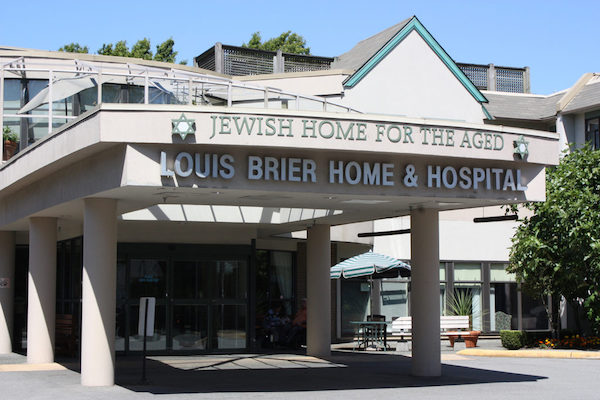
(photo from thelouisbrierfoundation.com)

This spring saw the launch of the This Year Like No Other, This Year More Than Ever 2021-2022 Louis Brier Jewish Aged Foundation campaign, which is raising funds to enhance care and innovate the program and service offerings for residents of the Louis Brier Home and Hospital.

Early in 2020, the foundation stepped up to assist the Louis Brier leadership in its exemplary response to the COVID-19 pandemic. By doubling the home’s funding, the foundation was able to support the home in keeping its seniors safe and engaged during one of the most challenging years of their life.

The biennial campaign, which started April 19, will run to May 28. With the community’s help, the goal is to raise $2.4 million. Campaign chairs are Harry Lipetz (board president) and Lee Simpson (immediate past president).

The $2.4 million amount is needed to keep up with the home and hospital’s funding needs, which doubled with the onset of COVID-19. While the foundation is well aware of the many challenges of the present time, we believe this year, like no other, and more than ever, we must collectively come together to care for, and give a well-deserved kavod, to the people who built our community for us in the first place. To contribute and create impact where it’s most needed after the extraordinary challenges of the year 2020. To be part of ensuring that the physical, mental and spiritual needs of the home’s Jewish seniors are met.

Louis Brier’s background

In 1945, 14 friends known as the Hebrew Men’s Cultural Club shared a vision to create a home for Jewish seniors in Vancouver. That home, initially built to accommodate 13 residents, was established in 1946. Over time, that modest facility grew, changed locations and expanded its services, eventually becoming the Louis Brier Home and Hospital, which has progressed in step with Vancouver’s Jewish community.

Today, Louis Brier is part of a continuum of care known as the Snider Campus, which also includes the Weinberg Residence, a boutique assisted living and multi-level care residence adjacent to Louis Brier.

The Louis Brier Jewish Aged Foundation provides and distributes funds to the Snider Campus towards maintaining and fostering the well-being of the Jewish aged of British Columbia, while supporting the enhancement of their quality of life based on Jewish traditions.

Some quick facts

  • The Louis Brier is a 215-bed long-term residential care home serving Vancouver’s Jewish community.
  • The home and hospital provide three levels of residency (intermediate care, extended care and special care).
  • Thirty-five residents of the current population at Louis Brier are Holocaust survivors.
  • Eighty percent of Louis Brier Home and Hospital’s residents are diagnosed with varying levels of dementia.
  • The Louis Brier has 436 employees – 195 full-time, 101 part-time and 140 casual.
  • The home and hospital residents range in age from 50 to 103, with the average age being 84.
  • The Louis Brier is an accredited institution with exemplary standing (2018). The Accreditation Canada survey team spent four days at the facility and reviewed a total of 19 required organizational practices (ROPs), 216 high priority criteria and 295 other criteria, for a total of 551 criteria. The surveyors determined that Louis Brier successfully met 100% of the 551 criteria evaluated.
  • The Louis Brier was awarded the 2020 Canadian Non-profit Employer of Choice Award.
  • The Louis Brier is the only facility in British Columbia with a companion program and has the largest recreation team in Western Canada.
  • The Louis Brier had a single COVID case among residents.

To donate to the campaign, click here. For more information, call 604-261-5550.

– Courtesy Louis Brier Jewish Aged Foundation

Format ImagePosted on May 7, 2021May 10, 2021Author Louis Brier Jewish Aged FoundationCategories LocalTags coronavirus, COVID-19, fundraising, health, Louis Brier Home and Hospital, seniors, Snider Campus of Care
Making a film during COVID

Making a film during COVID

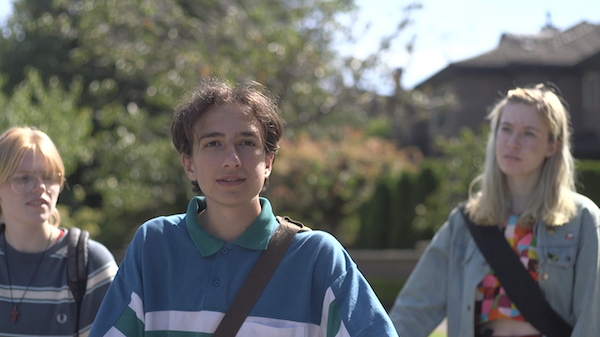
Kamil Whaley-Kalaora stars as the title character in Malka Martz-Oberlander’s David Michael Frankel Feinstein-Goldberg and the Unbarmitzvah. (screenshot)

It was a rainy day near the beginning of the pandemic. Sourdough was in the oven, Zoom was new and fun and spirits were higher. That’s when I found out I’d won the Earl Parker Award and I’d get to make my film for the Edmonton Jewish Film Festival. Little did I know I would have to go through months of hurdles, Plan B ideas and cast my entire family to get my film made.

A few months prior, my mom had passed me the Jewish Independent and showed me the notice for a film award at the Edmonton Jewish Film Festival. At the time, I was co-directing a musical, directing a film and finishing my applications for universities, so I didn’t think much of it. But, I am very glad I eventually picked up that notice and applied to the competition because it changed the course of my path.

image - The Community Calendar announcement in the Jewish Independent about the Edmonton Jewish Film Festival’s Earl Parker Award
The Community Calendar announcement in the Jewish Independent about the Edmonton Jewish Film Festival’s Earl Parker Award.

Last year was tough in a thousand ways. The pandemic hit everyone differently and, no doubt, we will all have lifelong effects because of it. When I originally pitched my film, David Michael Frankel Feinstein-Goldberg and the Unbarmitzvah, in 2020, I had a vision that could only have been actualized pre-pandemic. I adapted it and changed things to meet the constraints of the circumstances and I truly did my best to pull it off in a safe way for the entire cast and crew. One of the changes I had to make was to cast solely from within my bubble and community, which was not what I had originally planned to do.

screenshot - Malka Martz-Oberlander
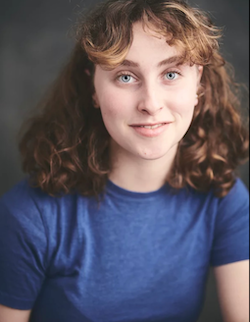
Malka Martz-Oberlander (screenshot)

I normally cast my films through Vancouver Actor’s Guide, UBC ACTRA and Facebook film & TV pages, but, instead, I ended up casting my parents as two of the main characters. As much as they are incredibly charismatic and intelligent people, they’re both doctors, not actors the stature of a Leonardo DiCaprio. So, performing was a big challenge for them and, vice versa, for me directing them. That being said, it was a fantastic experience for me to learn how to produce a film under circumstances that many filmmakers haven’t had to face.

In the early stages, I had a few moments when I felt selfish and embarrassed to want to make films during a literal plague. How could I have the chutzpah to be making dumb little comedy films while millions of people have died and more are dying? Why should I worry if my lenses are going to work for a scene while people are saying goodbye to their loved ones on iPads?

But then it dawned on me just how much we rely on art and story for our own sanity. We tell our children stories from the moment they are born, and we offer and receive stories to our last day on earth. We humans are, at our core, storytelling creatures. In moments of darkness we turn, time and time again, to art to save us. We are drawn to an astonishing multitude of fictions – on pages, on stages and on screens; stories of murder, love, war, conspiracies; stories fictional and true.

We are obsessed with story, but our obsession runs deeper than we think. We can walk away from our books and our screens, but story is like gravity: an inescapable force field that influences everything, but is so omnipresent that we hardly notice it. We’re social creatures and, with the added challenge of isolation, art has become a tool for staying connected with one another.

I’m now finishing up my first year at film school, in Capilano University’s Motion Picture Arts Program, where I have been learning invaluable skills and refining my knowledge and abilities in writing, directing and producing. With the vaccination rollout well underway and more knowledge and experience of how to safely work together in-person, I am ready to see what’s next for film and storytelling. I hope you are, too.

My film David Michael Frankel Feinstein-Goldberg and the Unbarmitzvah screened at the Edmonton Jewish Film Festival on May 2 and I will be speaking on a panel of past Earl Parker Award winners on May 9, 11 a.m., on Zoom (meeting ID 846 7697 0846). To view the film, visit jewishedmonton.org/festival-news; after the festival, it will be publicly available on Vimeo.

Malka Martz-Oberlander is a 19-year-old screenwriter, film and theatre director and actress, currently “squatting” at her parents’ house in Vancouver, the unceded territories of the Squamish, Tsleil-Waututh and Musqueam peoples. Her website is malkamo.wixsite.com/film. She thanks the Edmonton Jewish Film Festival and the Earl Parker Award for their kindness and generosity in making David Michael Frankel Feinstein-Goldberg and the Unbarmitzvah possible during such an unpredictable time for artists.

Format ImagePosted on May 7, 2021May 6, 2021Author Malka Martz-OberlanderCategories TV & FilmTags coronavirus, COVID-19, Earl Parker Award, Edmonton Jewish Film Festival, movies, short films
Ethical responsibilities in business

Ethical responsibilities in business

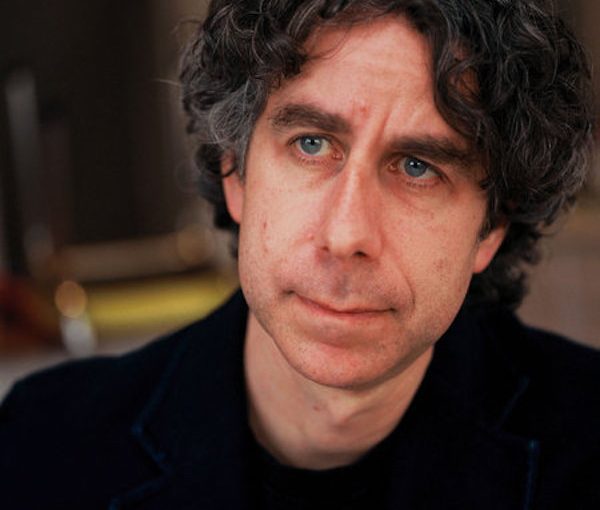
Writer and filmmaker Joel Bakan takes part in an online Canadian Hadassah-WIZO fundraising event May 30. (photo from Penguin Random House Canada)

The Canadian Hadassah-WIZO (CHW) Vancouver Book Club invites all CHW supporters, family and friends to an exclusive opportunity to be part of a conversation with Vancouver’s own Joel Bakan, an internationally recognized and award-winning author, producer, professor and legal scholar. Brunch with Bakan, which is a national CHW fundraising event, will take place May 30, at 11 a.m. PST.

Journalist and author Adam Elliott Segal will ask his own, as well as your questions, about Bakan’s hard-hitting book, The New Corporation: How “Good” Corporations are Bad for Democracy, which won the silver medal at the 2021 Axiom Business Book Awards in Business Ethics and is shortlisted for the B.C. and Yukon Book Prize for 2021. Segal’s roots are in Vancouver, though he now lives in Toronto, where he writes for the Globe and Mail, Toronto Star, Reader’s Digest and a host of other newspapers and magazines.

image - The New Corporation book coverThe New Corporation traces the consequences of a world close to losing its foundation of democracy. Bakan says the onus is on us to make the necessary connections and to actively be part of meaningful solutions if we want to leave our children and grandchildren a positive future. The Q&A with Segal will have a special focus on Jewish values, and ethical responsibility in business and corporate governance.

There are various ticket tiers for the Brunch with Bakan event, from $18 for the Zoom talk only to $118 for the talk, access to stream the film, a copy of the book (minimum two-week turnaround time for delivery) and name recognition. All ticket tiers include a tax receipt for the maximum allowable amount and the film, called The New Corporation: The Unfortunately Necessary Sequel, will be available May 25-28 for ticketholders to stream.

Over the last century, CHW has been involved in all aspects of Israeli life, supporting programs and services for children, women and healthcare in Israel and Canada. To tickets to the Brunch with Bakan fundraising event, visit chw.ca/thenewcorporation.

– Courtesy CHW Vancouver

Format ImagePosted on May 7, 2021May 6, 2021Author CHW VancouverCategories NationalTags books, Brunch with Bakan, business, CHW, corporations, ethics, film, fundraiser, Joel Bakan, Judaism
New exhibit at Uvic

New exhibit at Uvic

Dr. Helga Thorson of the University of Victoria. (photo from uvic.ca)

The University of Victoria unveiled its Stories of the Holocaust: Local Memory and Transmission exhibit – a project that was part of a combined undergraduate and graduate seminar on Holocaust and memory studies – during an online launch on April 15.

The exhibit is the result of a collaborative effort. Ten community members, comprising Holocaust survivors and descendants of survivors, from Vancouver, Victoria and Salt Spring Island, were paired with 10 UVic students to present wide-ranging and diverse stories from the Shoah in a context both personal and relevant to future Holocaust education.

“Students worked one-on-one with a community partner to figure out the best way to tell each story. This, as they discovered, was no easy task,” said UVic professor Dr. Helga Thorson, the course’s instructor. The students had to learn new technological skills, go over an extensive reading list and develop interpersonal skills, which included “relationship-building and the ethical dilemmas that come into play when telling somebody’s story that is not your own.”

“The engagement and involvement of the 10 students, who took the class assignment seriously, will go a long way in helping us remember the Shoah and the story passed on by their community partner,” said Thorson. “Remembering the past also helps us reflect on the present and what this means for us in today’s world as we continue to grapple with antisemitism, racism and other forms of violence, hatred and injustice.”

Ireland Good, one of the students involved in the project, thanked the Jewish community members for “their courage and their trust in us to tell their stories and to create this exhibit. I have thoroughly enjoyed this experience,” said Good, “even with its low moments, as I am sure it is with all the other students.”

The stories represent varied experiences, including having hid in order to survive and having been sent to a Soviet gulag. They come from Hinda Avery, Lillian Boraks-Nemetz, Rudolf Deman, Ilserl Fränkel, Julius Maslovat, Micha Menczer, Isa Milman, Fred Preuss, Claire Sicherman and Hester Waas.

Maslovat was the youngest prisoner ever at Buchenwald, and he is the subject of a recent film, Why Am I Here?: A Child’s Journey Through the Holocaust. The day of the launch, April 15, had a special significance for Maslovat, as it marked the 76th anniversary of his liberation from Bergen-Belsen. He was just under 3 years old at the time.

“My story did not come to me in a neat package. There were people who knew parts of it and contributed. Other parts I had to dig out of archives in Israel, Germany, Sweden, Britain, Poland, U.S. and Finland. I have tried to tell my story by putting together the pieces like a jigsaw puzzle. This time, I have included material I have not spoken about before,” said Maslovat, explaining his contribution to the archive.

“Despite what people may think about Holocaust survivors writing their memoir or speaking about their experience, we are not navel-gazing,” said writer Boraks-Nemetz, who escaped from the Warsaw Ghetto and lived in hiding. “We who have stared into the abyss of the atrocity that was the Shoah can never erase it from our memories. When I speak about my experience, I always think of the survivors and the victims, of the injustice wrought by a madman who destroyed lives – lives of children, of my little 5-year-old sister, who was brutally murdered for being a Jewish child … of the 1.5 million children who needlessly died.”

Boraks-Nemetz continues to explore the personal and broader impacts of the Holocaust through recent works, the novel Mouth of Truth and a collection of poetry, Out of the Dark.

Dr. Richard Kool is the son of Waas, who hid in the Netherlands during the war. He spoke of the importance of conveying the story to future generations. “I’ve really understood that, as Hester’s child and the oldest of my siblings, I have a responsibility as a carrier of a message that helps me keep looking forward towards recipients, towards recipients who have more life in front of them than behind, recipients who may not even be alive yet,” he said.

“We, the survivors and their children, must look forward and consider the powerful message for future individuals and generations,” he added. “Messages that say, ‘Don’t wallow in despair, worry and victimhood, but act, now, to do what you can with the tools at your disposal and the people around you to help co-create a fairer, healthier, more just, more peaceful community and society.’”

To view the exhibit, go to omekas.library.uvic.ca.

Sam Margolis has written for the Globe and Mail, the National Post, UPI and MSNBC.

Format ImagePosted on May 7, 2021May 6, 2021Author Sam MargolisCategories LocalTags education, Helga Thorson, Holocaust, Julius Maslovat, Lillian Boraks-Nemetz, Richard Kool, storytelling, survivors, University of Victoria, UVic
Torah class marks 10 years

Torah class marks 10 years

Rabbi Manis Friedman is the keynote speaker at Chabad Richmond’s celebration on June 1. (photo from Wikipedia)

On June 1, Chabad Richmond will mark 10 years of the weekly Torah studies class. A special event celebrating the past and launching the future will feature guest speaker Rabbi Manis Friedman, a renowned lecturer, counselor and author of several books and many articles. The topic is The Top 10 Reasons to Study Torah.

Starting in 2011 as a small group that met with Rabbi Yechiel Baitelman to discuss the weekly parashah (Torah portion), this assembly of retirees has grown to more than 20 people weekly.

“While not exclusively the domain of the retired, these weekly morning Torah classes mainly attract seniors,” said Baitelman. “Not only are local Richmond and Vancouver folks attending, but participants from Alberta and Quebec are joining virtually as well. During the pandemic, with more people working from home, we have some younger participants, too. Everyone is welcome.”

When the pandemic struck last year, Baitelman recognized the need for the continuity of Torah studies and immediately started offering classes via Zoom. These weekly classes have provided learning, but, more importantly, inspiration.

Richmond resident and longtime Chabad attendee Grace Jampolsky approached Baitelman back in 2011 and asked if he would offer a weekly Torah class. She gathered a few friends, and so began the 10-year tradition that is now a foundational part of the participants’ lives. The weekly class is a program of the Rohr Jewish Learning Institute of Richmond.

Acknowledging Chabad Richmond’s accomplishments to date, Baitelman said, “It’s all about celebrating our past learning and looking forward to growth and continued learning for the future. The continuity of weekly Torah study over 10 years is a real milestone. It represents thousands of hours spent studying the Torah portion of the week together, interactively, as a community of learners.”

As the participants attest, the classes have had a positive impact on expanding their Jewishness.

“If you were to ask me what the goals of the Torah classes are, I’d say it’s two-pronged goal – to increase class attendance and to share a love of Torah with our community,” said Baitelman.

Speaking with a few of the initial attendees, it became apparent that it’s not just the content of the classes that resonates with people, it’s Baitelman’s approach to teaching.

Ralph and Gina Blasbalg are two of the original members and, when asked how the classes have impacted their lives, Ralph Blasbalg said: “It’s always something to look forward to, especially when we’re cocooning during the pandemic. We don’t go out very much because we’re very vulnerable. The Torah lessons, the talks, the spirited wisdom of our rabbi – we are so lucky to have this rabbi in our community. Rabbi Baitelman is such a mensch, he’s just a wonderful human being.”

When asked how it’s enriched their lives, he added: “First of all, the knowledge that we are gaining, the knowledge about Torah, the knowledge about our community and the responsibilities that each one of us has to share and pay forward to the community. And the benefit that it gives to us, meaning that we have a sense of belonging, and we realize how our ancestors lived and how faith supported them through even worse times. We just have a pandemic – they had pogroms and illness and suppression and oppression … and, still, this faith, this Yiddishkeit, the manner of living by the Torah rules – the manual of life – is so important to us, for me, it’s definitely giving me that.”

Former participant Stevie Steiner said: “I was one of the first people in the group … and I attended for several years. I loved that class. It gave my life more meaning and purpose. If I went to the class tired, by the time it was over, I found myself so uplifted, or thoughtful. It made me look at things very differently, and very positively. Rabbi Baitelman always saw the glass half full, rather than half empty. It made quite a difference in my life actually. Rabbi Baitelman is a wonderful man and excellent teacher. He’s got a talent for getting the lesson across. The material was always very relevant. The rabbi was a very positive influence.”

Regular participant Maria Hughes said: “The weekly Torah classes have had a big effect on me. I’m from Russia, where there were no Torah classes, no nothing. I just knew I was Jewish because it was in my past, but I was discriminated against everywhere there. I went to live in Israel, but didn’t go to synagogue because I felt like an outsider and we didn’t know Hebrew. When I came to live in Richmond and started attending Chabad Richmond, I really started learning about Judaism and started feeling more and more proud of being Jewish…. It was like the puzzle came together. I started studying more and loving it. So I started talking to my daughter (who lives in Israel) about it a lot and we had different discussions. She was not religious at all … but, slowly, my daughter started keeping Shabbat and I think my influence was a big part of it. My talking about Judaism had a big effect on her. It affected not just me, but also my daughter and grandchildren. It affected a whole generation.”

Ezra Shanken, chief executive officer of the Jewish Federation of Greater Vancouver; Rabbi Efraim Mintz, executive director of the Rohr Jewish Learning Institute; and Sheldon Kuchinsky, board member of Chabad Richmond, will be present to offer greetings at the celebration of the class’s 10 years.

Guest speaker Friedman is the dean of Bais Chana Institute of Jewish Studies, the world’s first yeshiva exclusively for women. He hosts his own cable TV series, Torah Forum with Manis Friedman, which is syndicated throughout North America.

The event takes place at 7 p.m. on June 1 via Zoom at chabadrichmond.com/celebrate. Register online using the link, or call 604-277-6427. Everyone is welcome.

Shelley Civkin is a happily retired librarian and communications officer. For 17 years, she wrote a weekly book review column for the Richmond Review. She’s currently a freelance writer and volunteer, including at Chabad Richmond.

Format ImagePosted on May 7, 2021May 7, 2021Author Shelley CivkinCategories LocalTags Chabad Richmond, education, Grace Jampolsky, Manis Friedman, Maria Hughes, milestone, Ralph Blasbalg, Stevie Steiner, Torah, Yechiel Baitelman
Interactive history tour

Interactive history tour

To find out more about the history of Made in BC – Dance on Tour and its network of artists, visitors to madeinbc.org/history-project just have to hover over one of the images displayed and click on it. (screenshot)

It is easy, in Metro Vancouver, to take certain things for granted, such as access to live theatre, music and dance. But the pandemic, with its limits on social gatherings, has given urbanites an inkling of what smaller communities regularly experience. The relative scarcity of live performance in places like Prince George and Revelstoke is one reason that Made in BC – Dance on Tour was created in 2006. It is unfortunate, then, that Made in BC’s 15th anniversary falls in a time of travel and other restrictions. But that hasn’t stopped the organization from celebrating, and innovatively so.

Made in BC (MiBC) has collaborated with artist and graphic recorder Adriana Contreras to create an interactive online illustrated map “offering viewers the opportunity to take a visual and audio trip through the last 15 years of work, celebrating the numerous artists, presenters and community members that have been a part of this history.” Among these artists are Jewish community members Tara Cheyenne Friedenberg (Tara Cheyenne Performance), Amber Funk Barton (the.response), Naomi Brand (All Bodies Dance Project) and Vanessa Goodman (Action at a Distance).

“Especially in an art form that is so ephemeral, documentation is important not only for our personal memories, but for the history of the organizations and communities that we work with,” Brand told the Independent. “These kinds of records are really valuable for us to learn from what has happened before and to remember the accomplishments and discoveries that came before us. The map is a beautiful and creative way to write our history in the present while it is still relatively fresh in the bodies and memories of those who participated in it.

She added, “The field of contemporary dance in Canada is small enough that most of us are connected through a few degrees of separation that can be traced through our lineage of teachers, mentors and collaborators…. The map project represents all of that visually across the geography of this province.”

Cheyenne Friedenberg also spoke about the ephemeral, or temporary, nature of dance, making it hard to keep track of accomplishments.

“We spend much of our time and energy justifying and fighting for our art and art-making, it’s no wonder many of us don’t take time to reflect or celebrate the wake behind the boat,” she said. “It’s also very important to take note of what artists have brought to communities around the province and how these communities have influenced the art and the art makers. We are an ecosystem and it benefits all of us to appreciate how we have grown and developed as an artistic community. I know my work has been greatly influenced by my relationships across the province. I know folks who started making their own work after seeing a show or taking a workshop. I think part of the reason I’m still making work is because I feel part of this artistic ecosystem that is ever-evolving.”

Made in BC statistics show that, over the past 15 years, MiBC “has provided opportunities for over 50 dance companies incorporating over 200 dance artists to tour their work, reaching over 20,000 people around the province. And over 30,000 people have participated in and experienced the joy of other community-engaged dance activities, beyond the theatre.”

“MiBC as a network is about fostering relationships between artists, presenters, audiences and new communities,” said Brand. “As dance artists, we work with living, breathing, feeling people as our material (as opposed to clay, or an instrument, or paint brushes). This human-to-human, personal interaction is so important to what we do in the studio, as well as through emails and Zoom these days. We’re lucky to have an organization like MiBC that supports artists and has brought so many incredible experiences to communities across the province.”

Brand recalled one experience in particular. “In 2017,” she said, “my colleague Sarah Lapp and I did a residency through Made in BC at the Rotary Centre for the Arts (RCA) in Kelowna. It was our first experience touring with our company All Bodies Dance Project and bringing our artistic practice to a new community. We met such beautiful, courageous and lovely participants in the weeklong workshop and learned a lot about ourselves through sharing what we do with a new community. That residency had a huge impact on Sarah, who actually ended up relocating to Kelowna a year or so later, and beginning an integrated dance project in partnership with RCA with a collaborator that she met during that residency.”

Cheyenne Friedenberg first toured with MiBC in 2009, when the organization selected her first full-length solo work, bANGER, to tour along with Day Helesic’s piece Surge.

“I had toured a lot in the U.S., across Canada and Europe, but this was my first real experience taking my own work around the province,” said Cheyenne Friedenberg. “I was, and continue to be, very interested in connecting with the land and the people closer to home. Why have we as a culture believed touring Europe is more prestigious than touring the West Coast? It’s not. Since that first tour in 2009, I have toured, taught, created and learned around B.C. over half a dozen times and I can’t wait to get back out here!”

She said it was hard to pick just one MiBC experience that was especially impactful or memorable, so she offered two:

“1) Smithers, 2012: after seeing my solo Goggles, a couple (who are now my friends) were so taken by seeing me and my family (who I tour with) taking questions and, probably, breast-feeding after the show, that they decided to have a baby and continue to make art.

“2) Dolly Alfredson, a Wet’suwet’en language speaker and teacher shared many post-show thoughts with me, all in Wet’suwet’en. It felt very special. This was after my show I can’t remember the word for ‘ I can’t remember,’ in 2018.”

Contreras, who collaborated with MiBC in collecting and communicating these types of recollections from the dance artists, said her favourite part of the process was listening to all the stories, “getting a glimpse at a special moment in time from the many artists I had the pleasure to work with in part.”

It was Jane Gabriels, executive director of MiBC, who invited Contreras – in spring of 2020 – to be part of the 15th anniversary history project.

“I had just left my full-time job as director of programming and communications with New Performance Works Society to work as an independent graphic recorder, illustrator and designer,” Contreras told the Independent. “This was also around the time that COVID-19 was declared a pandemic and the province went on lockdown. Needless to say, this project was a bright light in a very uncertain moment.”

On the project, she worked closely with Gabriels, as well as Debora Gordon, MiBC manager of community dance connectors, statistics and promotions, and Zahra Shahab, a dance artist and choreographer who was the 2019 creative residency artist at MiBC.

“The process was one of collective discovery and experimentation,” said Contreras. “I knew that MiBC has a vast archive documenting the work of all the artists that have been part of its programs, but I wanted to go back to the essence, the aspect that makes MiBC so unique, the unifying element of supporting B.C.-based artists to present their work and connect with communities throughout the province; bring contemporary dance to audiences that don’t often get to experience it.

“During my time as an arts administrator supporting dance artists,” she continued, “I had heard many anecdotes and memorable stories that happened during MiBC tours. Many of these occurred in the theatre, others in the liminal space, on the road. Many others in everyday occurrences that nurtured community. We decided that these were the stories we wanted to highlight.

“MiBC reached out to artists and asked if they wanted to share their stories, which were audio-recorded to be featured on the website. We then chose an object to represent each of the stories, and those are the elements you see in the drawing, one for each artist or collective.”

She added, “Creating this work reminded me why I love the performing arts so much, and I can’t wait to sit in a theatre and experience live dance, theatre and music again.”

In the meantime, dance enthusiasts can take a virtual audiovisual trip through the province at madeinbc.org/history-project.


Format ImagePosted on May 7, 2021May 6, 2021Author Cynthia RamsayCategories Performing ArtsTags Adriana Contreras, British Columbia, dance, graphic art, MiBC, Naomi Brand, Tara Cheyenne Friedenberg.
A love of the school’s stories

A love of the school’s stories

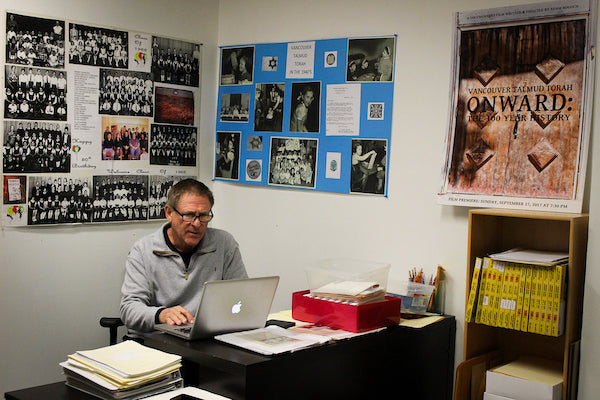
David Bogoch is keeper of the Vancouver Talmud Torah archives and chair of the school’s alumni fund. (photo from facebook.com/vttschool/photos)

David Bogoch is on the board of the Vancouver Talmud Torah Foundation. He is also the collector and keeper of the school’s archives. Previously, he was on the school’s board of directors for eight years – a position he took for a unique reason.

“At my dad’s shiva, the president of the board at that time, David Kauffman, tapped me on the shoulder and asked if I would be on the board at the school,” explained Bogoch about how he became involved. “At that time, with my father’s spirit in the room, I felt I had no choice but to say yes. Talk about timing.”

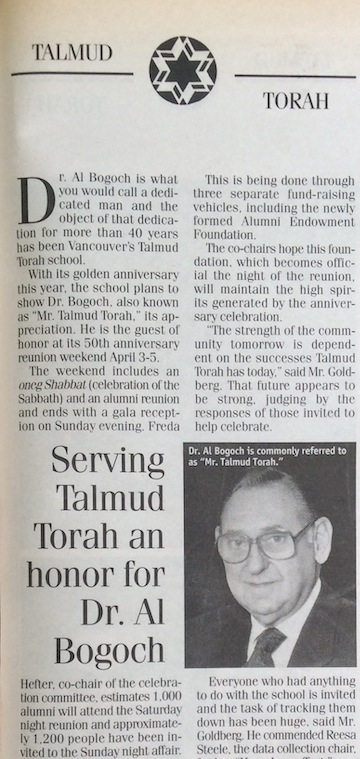
Dr. Al Bogoch was the guest of honour at Vancouver Talmud Torah’s 50th anniversary at its current location, in 1998. He was recognized for his more than 40 years of dedication to the school. He acted in many capacities over those years, including as president of the board of directors, as one of the founders of the VTT Foundation, which was established in 1974, and as a main driving force of four of the school’s expansions. On the occasion of the golden anniversary, the Alumni Endowment Foundation was launched.

In addition to his duties as archivist, David Bogoch is also chair of the school’s alumni fund.

“The board was portfolio driven, so I chose alumni,” he told the Independent. “I inherited the job from Carla van Messel. I figured it would be the least political and most fun. I knew at least 100 alum I could call and it all started from there.”

In going through the boxes in his father’s basement, Bogoch found tons of old Talmud Torah paperwork. “He had kept everything to do with his time on the board in the 1960s,” said Bogoch. “Other past presidents had given him their collections and, together, amassed a lot of what is in the archives today.

image - Vancouver Talmud Torah’s 50th anniversary, which honoured Dr. Al Bogoch, “Mr. Talmud Torah,” was the topic of this March 20, 1998, Jewish Western Bulletin article by Faith Bloomfield
Vancouver Talmud Torah’s 50th anniversary, which honoured Dr. Al Bogoch, “Mr. Talmud Torah,” was the topic of this March 20, 1998, Jewish Western Bulletin article by Faith Bloomfield.

“Today, the archive has thousands of photos and documents, from 1918 to the present,” he continued. “There are so many interesting stories which make up the 100-plus years of the school history. I looked up every issue in the library of the old Jewish Western Bulletin and the Jewish Independent to help tell the history of the school and the community of the times. Where would we be without the ability to search through the newspaper of old?”

While many stories have captured his interest, Bogoch said, “One story which caught my attention was in the board meeting minutes from 1944. The community wanted to build its own new Talmud Torah day school but were unable to because of lack of building supplies because of the world war. They also wanted to buy a school bus but couldn’t because of gas rations due to the war.

“Some people like jigsaw puzzles, others like bridge or golf,” he said. “My game of choice is the history of the school and all the people who either attended or were involved with the school. I love the good stories of friendship; I suffer when I hear the bad stories of tough times for students or parents or teachers. By knowing what has gone on in the past, I hope to impart those stories to the people of the present and the future, so we can try to avoid mistakes made before.”

Some of those stories are included in the one-hour documentary Vancouver Talmud Torah Onward: The 100-Year History. Written and directed by Bogoch’s son, filmmaker Adam Bogoch, the documentary was released in September 2017, as part of the school’s centenary celebrations. It can be viewed at youtube.com/ watch?v=ifoAqk3EKb0.

VTT obviously means a lot to David Bogoch, who also attended the school. “All of my lifelong friends came from Talmud Torah,” he said. “Most alum I come in contact with also share the same experience – our ties to the Jewish community stem from our shared experiences of school years. Between school, shul or camp, that is where we forge our community ties that bind.”

Bogoch is working toward making the VTT archives more widely accessible.

“The school,” he said, “is currently trying to put the photos and archival material on the school website so that everyone can search through and find the memories of their time, or of their family’s era.

Format ImagePosted on May 7, 2021May 7, 2021Author Cynthia RamsayCategories LocalTags Adam Bogoch, Al Bogoch, archives, David Bogoch, education, history, Vancouver Talmud Torah, VTT Onward
From a singular perspective

From a singular perspective

Barb Choit’s “Ravenous Appetite and Boundless Energy” features a chimney swift that can only be recognized as such from one vantage point. (photo from Barb Choit)

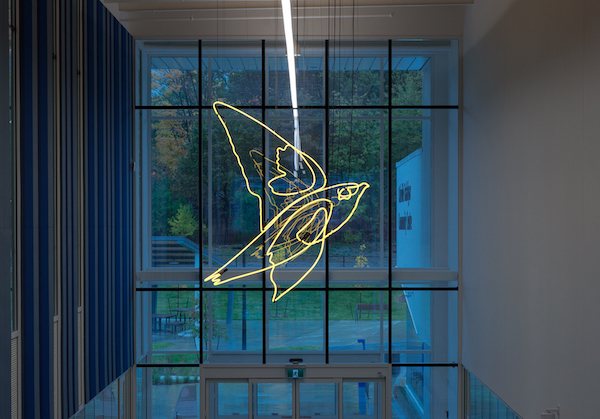
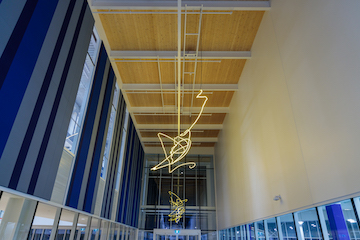
Last October, in a year that could be considered one of the worst in history for artists overall, Vancouver artist Barb Choit completed a large public art project in Oakville, Ont. “Ravenous Appetite and Boundless Energy” is the image of a bird, a chimney swift, created from hand-drawn, coloured, lead-glass tubing filled with neon. It is installed in the Oakville Trafalgar Community Centre.

“Most public art projects are by invitation only. However, for this one, I responded to an open call put out by the Town of Oakville,” Choit told the Independent in an email interview. “With this process, the first step is to send a letter of interest describing your qualifications and approach. From that, a public art jury selects a smaller group of artists to create a design for an artwork, which is called a ‘concept proposal.’ Each artist makes a presentation of their proposal and one is selected to create their proposed project.”

Winning the competition, it took her one-and-a-half years to convert her original idea into the final installation, a bird in flight, soaring just under the ceiling of the community centre.

The chimney swift has special significance for the Oakville community, said Choit. “The work responds to the transformation of the adjacent, abandoned Oakville High School into a habitat for a colony of chimney swifts, a threatened migratory bird. Every year, residents of all backgrounds come to watch birds roost in the chimneys of the former school. The community’s galvanization around birdwatching inspired me to represent the chimney swift as an ‘artifact’ of the culture and spirit of Oakville.”

In Choit’s installation, visitors to the centre can only see a bird in the design from a certain perspective. If they look at it from other positions, all they see is a wriggle, written in shining neon.

photo - The sculpture appears abstract to viewers moving through the space. Yet, from a specific vantage point, a representation of a bird appears
The sculpture appears abstract to viewers moving through the space. Yet, from a specific vantage point, a representation of a bird appears. (photo from Barb Choit)

“For ‘Ravenous,’” she explained, “I used a display strategy employed by science and nature museums to spark the viewers’ interest in the natural world – an optical illusion, anamorphosis. It is a visual illusion in which an object is distorted so that it can only be recognized from a specific vantage point. The sculpture appears abstract to viewers moving through the space. Yet, from a specific vantage point, a representation of a bird appears. Many people find optical illusions particularly engaging. Creating a visually striking piece was crucial to engaging a multi-generational community. And the glowing yellow form complemented the space for which I was designing the work.”

The word “illusion” suits the chimney swift as a species. According to Wikipedia, during flight, the birds often appear to beat their wings asynchronously, but photographic and stroboscopic studies have shown that they beat them in unison. The illusion that they do otherwise is heightened by their speedy and erratic flying, with many rapid changes of direction.

Choit’s choice of medium for this work necessitated collaboration with the manufacturers of the neon-filled tube.

“Different projects require a different balance between collaboration and delegation,” she said. “My recent project uses neon, which requires a type of industrial fabrication that includes hazardous materials and live electricity. It wouldn’t be practical or advisable for me to carry out this part of the fabrication myself. However, one needs a grasp of how materials work in order to create a feasible design and communicate with fabricators.”

She compared it to the architectural process. “In order to design and build a successful building, an architect does not show up at the building site with a hammer and nails,” she noted. “However, she must know how a building is constructed, as well as the properties and possibilities of the materials used.”

As she has done for other works, Choit did extensive research for this installation.

“People know me for my photographic work, but I have worked in most mediums at one point or another,” she said. “Within my work, I look at how communities and individuals imbue objects with meaning. Most of my major projects involve cultivating collections and working with archives. I explore this theme in a variety of media, such as photography, installation, performance and sculpture. Recently, I have had commissions for 2-D and 3-D public artworks.”

photo - Artist Barb Choit
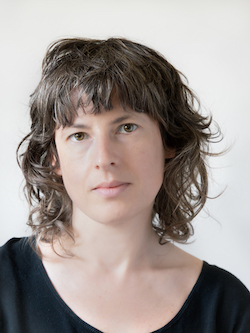
Artist Barb Choit (photo from Barb Choit)

Choit’s interest in collections is longstanding. She has a master of arts in critical and curatorial studies from Columbia University in New York. “At Columbia, I researched institutional frameworks for art,” she said. “I wrote my thesis on the history of collecting. This area of academic research still drives my work as an artist.”

Public art is a relatively new area for Choit and she is exploring the possibilities. “I primarily make works to be shown in galleries; it is only recently that I have moved into public art. I like public art because the projects can be much more ambitious than something that would be purchased by an individual. However, I still enjoy making smaller works that can be appreciated privately and I am open to larger site-specific commissions to be installed in privately owned buildings and outdoor spaces.”

She is planning to do more work in the public sector, despite the challenges. “Usually, public art projects are by invitation. There are also a few websites that list opportunities for artists to submit their qualifications, with the intention of being shortlisted to create a proposal for a specific project,” she said, noting the need to be wary of fraud.

“Artists need to be careful of websites that list art opportunities because there are dubious organizations out there to exploit them,” she said. “For example, some art ‘opportunities’ ask artists to pay a fee to be considered for a project. Artists should never pay a fee to have someone look at their work.

“Also, some organizations solicit full proposals from artists. Creating a proposal is an immense amount of work and a highly specialized skill. For legitimate public art calls, artists who are shortlisted to create a proposal are paid a fee for this work. I discourage any artist (or anyone, for that matter) from engaging professionally with an organization that expects unpaid work.”

Among Choit’s previous public works is the photographic project “Campaign,” a billboard series commissioned by the Capture Photography Festival in Vancouver in 2017. “It was a series of outdoor billboards based on my 2015 photography project where I remade Andy Warhol’s shoe Polaroids from the 1980s. I documented a collection of vintage women’s shoes using discontinued instant film and a vintage Polaroid camera from the era.”

Despite her extensive education, experience and obvious talent, Choit considers luck as one of the best ingredients for artistic success.

“Luck is crucial,” she said. “It is not necessarily about chance but infrastructure – family and community support, education, healthcare, even freedom of expression, can be just as crucial as talent and skill.”

Learn more at Choit’s website, barbchoit.com.

Olga Livshin is a Vancouver freelance writer. She can be reached at [email protected].

Format ImagePosted on May 7, 2021May 7, 2021Author Olga LivshinCategories Visual ArtsTags anamorphosis, art, Barb Choit, birds, chimney swift, Oakville Trafalgar Community Centre, sculpture
The magic behind kaytana

The magic behind kaytana

While Camp Miriam won’t be able to offer overnight camping sessions, it will once again be offering day camp experiences this summer. (photo from Camp Miriam)

I will never forget waking up in a puddle in the middle of the night, feeling water slowly dripping into my sleeping bag as I shivered and clenched my muscles, trying to maintain the tiniest shred of heat.

It was 2011, I was 14, and my kvutza (cabin group) was on a three-day hike that would take us through steep inclines and 30 kilometres of terrain. It poured every day and night, leaving us without a dry item of clothing by the first morning. We were wet, cold, blistered and exhausted. It was a miserable trip.

And we loved it.

On the final day, we emerged from the forest chanting a marching song and smiling with glee at what we had accomplished. To this day, I reminisce about this trip with that same giddy excitement.

And yet, I’ve always wondered, what allowed us to not only persevere, but to create a lifelong positive memory. Anyone who has spent time at Machaneh Miriam – the overnight Jewish summer camp on Gabriola Island – can attest to the magic each new summer conjures. The thing about magic is that we may not know how it works, but we know what it does. It’s what drove us forward, step by step through the mud with smiles and songs that summer. Everywhere you go at Miriam, you can feel the magic – from the building walls decorated with generations of camper art and poetry, to the dining hall filled with chanting and singing voices every lunch.

It’s the same magic that, last summer, propelled Miriam’s youth leadership to accomplish the seemingly impossible.

When the pandemic hit, these young leaders were several months into planning a six-week overnight summer camp on Gabriola. Not only did the pandemic erase months of hard work and preparation, it also posed a serious question: could camp’s magic exist outside of the island?

To most campers and staff, Miriam and Gabriola are inseparable. As the rosh (camp director), Marina Levy, said, “At Camp Miriam, we are connected to our community, to Gabriola and to our traditions.”

Envisioning a summer away from Gabriola was a daunting task. But, the tzevet (staff) rose to the occasion, creating not one, but three kaytanot (day camps) – one each in Vancouver, Victoria and Portland. By summer’s end, more than 200 campers, 60 staff and a whole bunch of parents resoundingly affirmed that camp’s magic can exist off of Gabriola.

To understand the importance of the kaytana, it is necessary to consider the context. At a time when campers had been confined to their homes and separated from their friends for months, the news that overnight camp was not happening came as a severe blow.

The immediate effect of the pandemic on kids’ mental health was profound. Research by SickKids hospital in Toronto showed that, in just the first three months of the lockdown, a majority of children showed a serious deterioration in their mental health.

According to Camp Miriam parents, the kaytana helped their kids overcome some of that stress. One parent said, “Last June, our daughter was really struggling with the impact of COVID on her life, it was significant. Camp Miriam’s summer camp in Vancouver brought her back to herself again. A combination of the social component, the programming and empowerment she felt, and the sense of purpose in her life helped her rediscover herself and revive herself.”

Another parent observed a change in her son after just one day. “I  almost cried hearing him talk about it,” she said. “I think it wouldn’t be too much of a stretch to say it was a transformative experience.”

Counselor Rakeea Gordis said that, during the weekly Shabbat tradition where campers sit together and reflect on their week, “At least one, but usually up to five kids would say that they were devastated that today, Friday, was the last day of the kaytana for the week.”

So, how did the staff manifest the magic of overnight camp in day camps far from the quiet comfort of Gabriola? A huge amount of credit goes to the youth leadership who worked long days and then late into the night throughout the summer creating kishutim (decorations) for special days, planning peulot (educational activities) and even burying items for a treasure hunt the following day.

Financially, none of this would have been possible without the support of the camp’s community and the Jewish Federation of Greater Vancouver, who stepped up at a time of extreme need, as well as the Grinspoon Foundation and the Heller Memorial Fund, who provided matching grants. It cost nearly three times as much to run the kaytana as to run the overnight camp.

So, perhaps, camp’s magic is not a complete mystery after all. As technical director Inbar Avrahami Saraf said, “[The kaytana] was an experiment, a proof of concept of the magic of machaneh, and how the magic is not in the physical space but in the chanichm [campers] and the tzevet and just the community that makes it so incredible.”

So, credit must be given to the force of will that the youth leaders and the wider Jewish community bring – the relentless push to build and dream; to create community and unforgettable experiences, whether they be on Gabriola Island, on a three-day hike in the pouring rain or in the midst of a pandemic.

“The magic of machaneh doesn’t just exist far away on an island, it exists where we choose to create it,” said Levy.

Unfortunately, once again Camp Miriam has had to cancel its overnight camp due to COVID-19, but, once again, the young staff are ready to create amazing kaytana experiences. To register for Miriam’s 2021 summer programs or to support the camp as it faces another challenging season, go to campmiriam.org.

Sasa Popovich is a writer and former Camp Miriam camper, counselor and technical director.

Format ImagePosted on May 7, 2021May 7, 2021Author Sasa PopovichCategories Op-EdTags Camp Miriam, children, coronavirus, COVID-19, Gabriola Island, health, summer camp

Posts pagination

Previous page Page 1 … Page 146 Page 147 Page 148 … Page 494 Next page
Proudly powered by WordPress