Skip to content
  • Home
  • Subscribe / donate
  • Events calendar
  • Business Directory
  • FAQ
  • News
    • Local
    • National
    • Israel
    • World
    • עניין בחדשות
      A roundup of news in Canada and further afield, in Hebrew.
  • Opinion
    • From the JI
    • Op-Ed
  • Arts & Culture
    • Performing Arts
    • Music
    • Books
    • Visual Arts
    • TV & Film
  • Life
    • Celebrating the Holidays
    • Travel
    • The Daily Snooze
      Cartoons by Jacob Samuel
    • Mystery Photo
      Help the JI and JMABC fill in the gaps in our archives.
  • Community Links
    • Organizations, Etc.
    • Other News Sources & Blogs
  • JI Chai Celebration
  • JI@88! video

Recent Posts

  • Federation now across BC
  • Israel fighting for its existence
  • Deal strengthens Iran
  • Patriotic belonging diminishes
  • A campaign to engage
  • Upstanders’ first live event
  • Responding to Carney
  • Having your own home
  • Music a family tradition
  • Musical to warm heart
  • Community milestones … June 2026
  • Sharing her passion for Israel
  • Or Shalom reopens its doors
  • JFS from past to future
  • Need holistic approach
  • Sharing stories, advice
  • Journalist shares fears
  • Skills to live together
  • Road to independence
  • Cutting grass with scissors
  • Zionism as a solution
  • Deceit, desire & the divine
  • Reclaiming sacredness
  • Creative project ideas
  • Summer squares and cobbler
  • Thou shalt … summer commandments
  • Legal help for students
  • Revisiting myth of Lilith
  • Wrong person rebuked
  • Canada’s mixed messages
  • Questions for museum
  • Symposium on antizionism
  • Making soccer political
  • CJPAC lauds Pulver’s impact
  • City recognizes Vrba’s legacy  
  • Organ donation saves lives

Archives

Follow @JewishIndie
image - The CJN - Visit Us Banner - 300x600 - 101625

Tag: theatre

Meet Barry at Havana

Meet Barry at Havana

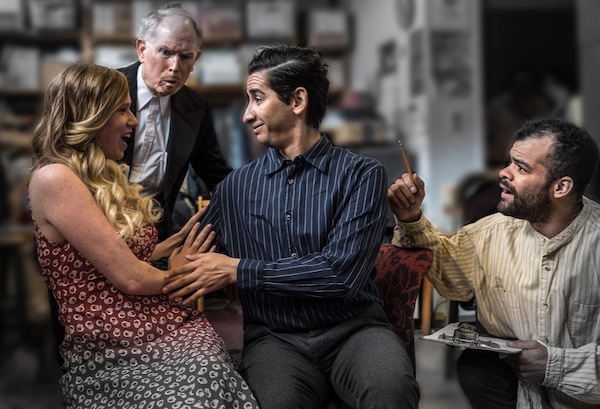
Did you know without goats, the coffee bean may have never been discovered? Are you able to recognize if the vinyl you hear coming from your neighbor’s apartment is a 78, 45 or 33? Do you type your university essays out on a typewriter? Barry knows, Barry can, Barry does, Barry will and Barry did. Introducing the next wave in AI customer service. Barry is the perfect fit for all your too-cool-for-school business needs.

In Jewish community member Ira Cooper’s Artisanal Intelligence, fellow community member Hannah Everett plays Jane, the entrepreneur and creative genius responsible for developing Barry, a fast-learning, curious and fashion-wise artificial intelligence customer service robot, played by Drew Carlson. Cooper describes his play as “not simply a form of absurdist, comedic, low-brow escapism as it may come across. It’s a conversation about identity, as most things are, and its tumultuous relationship with self versus societal box-fitting…. There are other dialogues, too; questions raised about creation versus intent versus audience response and who gets to create meaning. It’s also an affirmation of what love can be.” Artisanal Intelligence is at Havana Theatre July 5 and 7, 9:30 p.m. Tickets ($15) can be purchased at showpass.com.

Mature content (14+)

Format ImagePosted on June 28, 2019June 26, 2019Author Spec TheatreCategories Performing ArtsTags AI, artificial intelligence, Hannah Everett, Ira Cooper, technology, theatre
You can choose own family

You can choose own family

The cast of Arts Umbrella’s production of James and the Giant Peach includes Teilani Rasmussen (as Ladahlord), left, and Sophie Mercier (as James). (photo by Tim Matheson)

“Well, maybe it started that way. As a dream, but doesn’t everything. Those buildings. These lights. This whole city. Somebody had to dream about it first. And maybe that is what I did. I dreamed about coming here, but then I did it.”

Roald Dahl (1916-1990) wrote some of the most-known children’s books, including The Gremlins, Charlie and the Chocolate Factory, Fantastic Mr. Fox, Matilda and, published in 1961, James and the Giant Peach, from which the above quote comes. Still as relevant as ever, and adapted into a musical about a decade ago, James and the Giant Peach is “wildly entertaining,” director Erika Babins told the Jewish Independent in an interview about Arts Umbrella’s Expressions Theatre Festival, May 17–25. “The music is written by Benj Pasek and Justin Paul, who wrote the music for La La Land, The Greatest Showman and Dear Evan Hansen, to name a few. I find I always have at least one of their catchy songs stuck in my head. There’s also puppets!” she said.

James and the Giant Peach is one of four productions featured in the festival. The others are Peter Pan (by J.M. Barrie), Animal Farm (adapted by Nelson Bond from the novel by George Orwell) and Into the Woods (music and lyrics by Stephen Sondheim, book by James Lapine).

“Choosing the Expressions Theatre Festival shows is an involved process that starts at least a year in advance. We’re already choosing shows for our 2020 festival,” said Babins, who is a member of the Jewish community. “Each troupe director is responsible for choosing the show their troupe will perform.

photo - Director Erika Babins
Director Erika Babins (photo from Arts Umbrella)

“As directors, we keep in mind the strengths and areas of growth we see within our cast,” she said. “We want to ensure that the skills students develop throughout the year build upon or differ from those we explored in past years. For shows, we want to choose something that can challenge and engage our students throughout the rehearsal process. At the same time, we want to select shows that will appeal to our audience, which includes a large number of students who attend school matinées that run along with our public performances.”

The Arts Umbrella promotional material summarizes the plot of James and the Giant Peach: “When James is sent by his conniving aunts to chop down their old fruit tree, he discovers a magic potion that results in the growth of a tremendous peach … and launches a journey of enormous proportions. Suddenly, James finds himself in the centre of the gigantic peach, among human-sized insects with equally oversized personalities. After the peach falls from the tree and rolls into the ocean, the group faces hunger, sharks and plenty of disagreements. Thanks to James’ quick wit and creative thinking, the residents learn to live and work together as a family.”

“I chose James and the Giant Peach for myriad reasons,” Babins said. “Last year, the Junior Musical Theatre Troupe performed Guys and Dolls, a classic musical with a lot of realism. James and the Giant Peach is pretty much the opposite of that: it’s a contemporary show written with lots of theatricality and wonder. I also find the themes in the show particularly universal for the age range of 13-to-16-year-olds who perform in the show. In the musical, the theme of chosen family comes up a lot – the idea that you have the right to surround yourself with people who make you feel safe and happy, and that you’re allowed to distance yourself from those who make you feel bad or hurt you.”

Babins has been working at Arts Umbrella as the choreographer for the Senior Musical Theatre Troupe since 2012, and she began teaching in the general and yearlong theatre programs in 2014. “We started the Junior Musical Theatre Troupe just two years ago and the original director is taking a leave of absence, so I was asked to helm this production,” she said. “I was more than happy to take on the role.”

Playing the role of James in the Arts Umbrella production is 15-year-old Sophie Mercier. “She brings both a maturity and an emotional vulnerability to the role, which James needs to have in order for the audience to care about his journey,” said Babins.

When asked about the most fun aspect of this production, Babins said it was “playing into all the theatrical moments.”

“The show is a play within a play, with the narrator introducing us to all the characters and themes at the beginning of the show. We have a lot of fun breaking the fourth wall and bringing the audience in on the magic of theatre,” she explained.

As for the most challenging part, she pointed to the set changes. “We have some big and elaborate set pieces,” she said, “and I often ran out of hands to move them around the stage. But I think we have found some clever solutions to those challenges.”

The Expressions Theatre Festival opens and closes with Into the Woods (May 17 and May 25, 7 p.m.), which runs a few times during the festival. James and the Giant Peach will be performed twice: May 19, 4 p.m., and May 23, 7 p.m. For more information about the festival and the full performance schedule, visit artsumbrella.com/expressionstheatre. Tickets start at $12 and the shows take place at Waterfront Theatre on Granville Island.

Format ImagePosted on May 10, 2019May 9, 2019Author Cynthia RamsayCategories Performing ArtsTags Arts Umbrella, education, Erika Babins, musicals, theatre, youth
Three-generation comedy

Three-generation comedy

David Biltek and Susan Wilkes are part of the cast of Bema Productions’ presentation of We Are the Levinsons, by Wendy Kout. (photo from Bema Productions)

Bema Productions’ 2019 Mainstage presentation is the Canadian première of We Are the Levinsons, by Wendy Kout, an award-winning writer/producer of theatre, film, television and prose. Zelda Dean directs the Victoria production, which opened May 9 at Congregation Emanu-El’s Black Box Theatre.

The story details the phenomenon of the “sandwich generation” – adults caring for both children and aging parents – through the lens of one family’s momentous year. Rosie, a daughter with mother issues, surprises her parents with a trip home. And life surprises Rosie. Sanity, survival and humour are tested and love is deepened in this three-generation family, and chosen family, comedy.

We Are the Levinsons will be performed May 12, 3 p.m.; May 14-16, 7:30 p.m.; May 19, 3 p.m.; and May 23, 7:30 p.m., at Congregation Emanu-El, in Victoria. Tickets are $23 from Ticket Rocket, ticketrocket.co or 1050 Meares St.

Format ImagePosted on May 10, 2019May 9, 2019Author Bema ProductionsCategories Performing ArtsTags Emanu-El, theatre, Victoria, Wendy Kout, Zelda Dean
The time is right for comedy

The time is right for comedy

Adam Olgui, centre, stars in Theatre in the Raw’s production of Enter Laughing, which opens May 9 at Studio 16. (photo from Theatre in the Raw)

“The show has everything you could ask for: comedy, romance, great music and a great message at the heart of it, without taking itself too seriously,” actor Adam Olgui told the Independent about Theatre in the Raw’s latest production, Enter Laughing.

Enter Laughing opens May 9 at Studio 16. It is directed by Theatre in the Raw artistic director Jay Hamburger.

“It is time,” Hamburger told the Independent, “for this 25-year-old theatre company – that has toured parts of B.C., Alberta, Saskatchewan and Manitoba and resided primarily in Vancouver – to do a full-blown comedy: Enter Laughing by Joseph Stein of Fiddler on the Roof fame.

“We just finished producing the intense Incident at Vichy, dealing with the systematic arresting and putting away Jews for ‘processing’ in the occupied part of France during the Second World War, all part of the Holocaust,” explained Hamburger. (See jewishindependent.ca/miller-play-remains-relevant.) “The Stein two-act play is a positive challenge for an independent theatre company to spread its wings and take on a comedy with lots of fun, and universal and Jewish humour inherent in it. The characters are searching for love, relationships and something positive to do with their lives, and there are some wonderful, gentle yet funny, scenes that can melt the heart through very good acting, with the fine talent on board.”

Stein’s play is an adaptation of the 1958 semi-autobiographical novel Enter Laughing by actor, writer and comedian Carl Reiner, said Hamburger. “Reiner co-wrote and acted on Caesar’s Hour and Your Show of Shows, and formed the comedy duo with Mel Brooks for the 2,000-Year-Old Man. He has acted in numerous films, such as The Russians Are Coming, the Russians Are Coming. Reiner, at 97, is one of the oldest celebrities still active, and has been honoured countless times, including receiving the Mark Twain Prize for American Humour in 2000.”

Olgui won the lead role of David Kolowitz.

“During the audition process,” he said, “I read for a few different roles including David, Marvin and the Foreman. Auditioning for Jay is always fun because he doesn’t limit himself to ‘traditional casting’ and he approaches the audition process with an open mind. And the same can be said for the rehearsal process as well. Jay is an extremely humble and gracious director and he lets his actors bring their ideas to the table, which isn’t always the case in this industry.”

Olgui described David as “a young guy who dreams of being an actor but he’s caught between the desire to make his parents happy, while also wanting to pursue his passion. David has an eye for the ladies, but he’s got a heart of gold. He’s a storyteller with a bad habit of telling tall tales, but he’s also honest to a fault. All of which makes for some interesting situations along his journey.”

There are several aspects of David’s character and story to which Olgui can relate.

“We’re both young Jewish men pursuing acting careers despite the sticky situations it gets us into. And, while most of David’s situations are stickier than my own, I’ve been in a number of situations that have required a fair bit of explaining and negotiating on my part,” said Olgui. “Like David, I can relate to the late nights, the Jewish mother, the tough family conversations, the proverbial Jewish guilt – all this, and much more, firsthand. But, as wild as the situations sometimes get, at the heart of it, David’s story is that of a young man chasing after his dreams, and I think that’s something anyone and everyone can relate to.”

As a young actor, though, Olgui admitted that he wasn’t that familiar with Reiner’s work before taking on the role in Enter Laughing. “I had seen a few hilarious Sid Caesar skits…. But, being in this play and researching the man behind the character has really given me the opportunity to discover more of Carl Reiner’s works and the comedy legend that he truly is.”

Reiner was an associate of Stein, Brooks, Caesar, Dick Van Dyke and other well-known creative sorts out of New York and Hollywood, said Hamburger. “This play in particular was originally written in the early ’60s and then revised in the mid-’80s and I think it’s a good show to do at the moment,” he said. “It’s our first large comedy production in a long time and, at times, audiences need to laugh and have a bit of comic uplift.”

Hamburger added that Enter Laughing has special meaning for him, as “it was the first professional piece of theatre I did (as an apprentice) way back in the 1960s with the Cleveland Playhouse at their yearly Chautauqua, N.Y., festival. What a wild and crazy and fun play to break into the art performance form as an apprentice.”

As to its continued relevance for today’s audiences, Hamburger said, “With the play Enter Laughing, we get a chance to see a young man in the late 1930s of low income starting to follow a dream he has of becoming an actor. He has an inspiration that he wants to be an actor, though has little to no idea of what even being in a play entails. There are a number of trial and errors that he goes through on his journey to get on the stage with a role in hand, as well wanting to hold onto a girlfriend who has helped him reach beyond his low-income neighbourhood.

“Surely, in 2019, there is many a young person looking for a career or working on a hunch of what truly interests them, and moving forward with what it is they really might want to do. Surely, in 2019, there are young and old peoples who go for their dreams, having little idea of what it all might entail, or how it all might work in terms of the craft or job they seek to do. Yet they take the plunge, learn and enjoy what the craft or business is about and find solace, enjoyment and purpose with that choice(s) in life.”

In sum, Hamburger said Enter Laughing “is a fine story that gives faith and courage to those with dreams, seeking to make their inspirations and likes come true.”

Enter Laughing previews May 8, and runs from May 9 to 19. For tickets, visit theatreintheraw.ca.

Format ImagePosted on May 3, 2019May 1, 2019Author Cynthia RamsayCategories Performing ArtsTags Adam Olgui, Carl Reiner, comedy, Jay Hamburger, Studio 16, theatre
Complex, funny, beautiful

Complex, funny, beautiful

Dylan Floyde (Willy), left, and Stephen Aberle (Evens) rehearse for Slamming Door Artist Collective’s production of The Sea, which opened May 2 at Jericho Arts Centre. (photo by Michelle Morris)

“Published in 1973, The Sea is fiercely, presciently relevant. [Edward] Bond seems to anticipate David Icke’s mad, xenophobic alien conspiracy fantasies, flat earthers’ denial of gravity, ‘fake news,’ societal upheaval and the potential for devastation – and, through it all, glimmers of hope through stoic resilience, change and growth,” said Jewish community member Stephen Aberle, describing Bond’s play, The Sea.

Slamming Door Artist Collective presents The Sea at Jericho Arts Centre until May 19. It opened last night, May 2.

Director Tamara McCarthy told the Independent that she had seen a production of The Sea at the Shaw Festival in 2014 “and was deeply struck by the complex poetry and stitch-ripping humour, all playing out within a beautiful tragedy.

“There are many current resonances, from Trump to Brexit,” she said. “Interestingly, The Sea debuted in 1973, the same year Britain joined the European Union.”

On a more solemn note, she added, “Eventually, the sea will sweep us all away. Until then, we choose to live in hope or despair. Or both. This play intricately explores these themes.”

The synopsis reads: “A wild storm shakes a small East Anglian seaside village, and Willy is unable to save his friend from drowning. The raving coast guard is too drunk to do anything, Hatch the draper is passing by but he believes that hovering alien spaceships are slowly replacing people’s brains and he refuses to help, while the grande dame, Mrs. Rafi, bastion of respectability, amateur theatricals and velvet curtains from Birmingham, sets her face against the chaos.” The play is set in 1907.

“There are big time echoes of [Shakespeare’s] The Tempest, for sure,” said Aberle. “Storm, shipwreck, collision of worlds and societies, innocence blossoming into love, monsters and a kind of shimmering magic. I would say there’s a strong parallel with the Book of Jonah as well: shipwreck again, and the struggle to find meaning in an often apparently unkind and unfair world. Ecclesiastes, too: ‘the race is not to the swift, nor the battle to the strong, neither yet bread to the wise, nor yet riches to men of understanding, nor yet favour to men of skill; but time and chance happens to them all.’”

Aberle plays the character of Evens, who he described as “the grizzled, weathered, often drunken ‘wise fool.’ A bit of the Prospero type, if we want to look at The Tempest connections, with aspects of both Jonah and the big fish, as well. He has withdrawn from society and lives (and drinks, ‘to stay sane’) in a little hut on the beach. It’s said of him in the village that he ‘knows the water round here,’ though, as he points out, ‘… luck and chance come into it. It doesn’t matter how clear the main currents are, you have to live through the details. It’s always the details that make the tragedy….’ The young hero, Willy, comes to him, looking for answers. Whether he finds what he seeks is a question whose outcome you’ll have to watch for.”

“Slamming Door Artist Collective presents classic contemporary works that aren’t otherwise being produced in Vancouver,” said McCarthy. “We provide not only opportunities for our audience to see these plays, but for established and emerging actors and designers to play with us on material they likely wouldn’t have the chance to otherwise.”

Joining Aberle on stage will be Raes Calvert, Genevieve Fleming, Dylan Floyde, Jessica Hood, Elizabeth Kirkland, Cheyenne Mabberley, Michelle Morris, Melissa Oei and Mason Temple. The collective’s members “work professionally in film, television and theatre throughout the Lower Mainland.”

Aberle said he is “overjoyed to be introduced to this play and this playwright.”

“In my experience,” he said,

“Edward Bond is sadly unsung and underproduced – I’d never seen or read any of his work before and it’s delicious. My sense is that, when he came on the scene, he alienated the powers-that-be in British theatre. He’s from the working class and he writes about class alienation, struggle and societal transformation, with sometimes brutal clarity of vision. Apparently, there was nearly a riot when one of his early plays, Saved, was first performed – shouting from the audience and fisticuffs in the lobby.”

For tickets to The Sea, visit theatrewire.com.

Format ImagePosted on May 3, 2019May 1, 2019Author Cynthia RamsayCategories Performing ArtsTags Edward Bond, Jericho Arts Centre, politics, Stephen Aberle, Tamara McCarthy, theatre
Defending a neo-Nazi

Defending a neo-Nazi

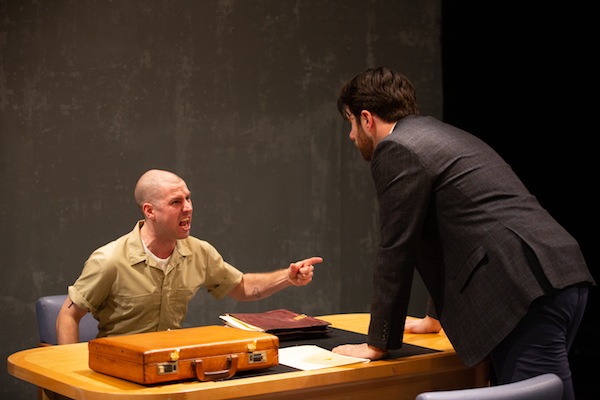
Kenton Klassen, left, and John Voth co-star in Pacific Theatre’s production of Cherry Docs. (photo by Dylan Hamm)

I often wonder, as a lawyer and the child of a Holocaust survivor, if I would be able to defend a skinhead charged with a racist crime. Can a person shut off their emotions and take on a case that is at odds with their moral compass?

This is the premise of Cherry Docs, a two-hander playing at the Pacific Theatre until April 28. Playwright David Gow penned the piece in 1998 as a response, in part, to the homophobic attack by a group of skinheads on his university friend and, in part, to his Jewish Belgian family’s Holocaust experiences.

“I wanted to explore and come to terms with my own anger at seeing young people dressed as Nazis and adopting Nazi thinking 50 years after the end of a war that killed so many millions,” Gow told the Jewish Independent. “Now, 70-odd years later, we seem to have more neo-Nazis than ever before. It looks far, far worse today than in 1998, when someone could (and did) say with a straight face, are you sure this is a problem? It was not good in 1998. Now, of course, it is a problem of epic, international proportions.”

Cherry Docs has been produced globally, including a long run in Germany, where, said Gow, “the critical reception … was extremely detailed, extremely well-written, unlike anything we see in North America, even from, say, the New York Times, in terms of depth and breadth of commentary and analysis. The play ran for something like seven years in rep in Berlin. Two distinct productions have been done in Tel Aviv over the years, and maybe two in Jerusalem.”

As well, he added, “productions in Poland ran for 13 years. One Polish production went to Beijing for an international theatre festival and, there, it played with Chinese subtitles, so, an English Canadian play in Polish and Chinese, in China.”

The success of the play and its international acclaim led Gow to adapt the story for the big screen. Its cinematic debut came in 2006, as Steel Toes. It won several awards on the film festival circuit.

In the two-actor play, which features John Voth as Danny Dunkelman and Kenton Klassen as Mike Downey in the Pacific Theatre production, Danny is a Jewish legal aid lawyer who has been assigned the task of defending Mike Downey, a 20ish, tattooed skinhead, who is charged with murder in the stomping death of a Pakistani fast food worker in a back alley in downtown Toronto. The play’s title represents Mike’s pride and joy, his steel-toed, cherry red Doc Marten combat boots, which he is wearing when he commits his hate-motivated crime. The rationale for Mike’s unprovoked, drunken attack is his perception of the decline and fall of white male supremacy as brought on by what he sees as unchecked immigration, reverse discrimination for employment opportunities and a ZOG (Zionist occupation government) conspiracy of the Jewish elite.

Mike has been indoctrinated into the white racist youth movement and recites antisemitic clichés with ease and conviction. He is a proud foot soldier for the Aryan resistance movement. He goads Danny on by saying, “In an ideal world, I would see you eliminated, but I need you. I know you will do a good job for me, as you are a Jewish liberal thinker, a humanist, who believes in checks and balances in the system.”

Mike insists that he be tried for his crime, which he admits – although he says he did not intend to kill the victim – as an individual. “Try me,” he says, “not the skinhead ideology.”

Danny aggressively challenges high school-dropout Mike to formulate a convincing defence strategy, taking him through “the eye of a needle” in an effort to make him stand up and be accountable for his actions.

photo - John Voth, left, and Kenton Klassen co-star in Pacific Theatre’s production of Cherry Docs
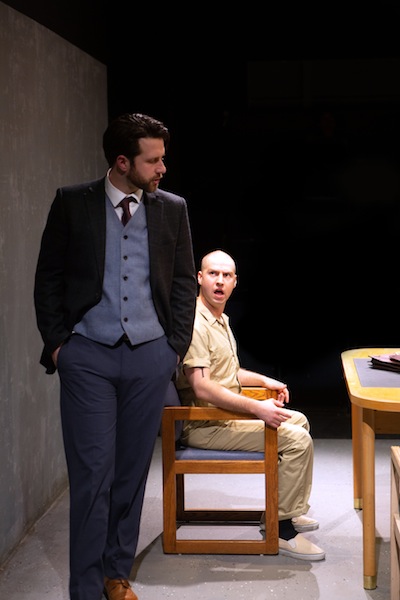
John Voth, left, and Kenton Klassen co-star in Pacific Theatre’s production of Cherry Docs. (photo by Dylan Hamm)

The two travel their own paths of discovery through the seven months of legal proceedings. Mike’s journey leads him to a path of redemption, while Danny struggles. Danny must confront not only his violent dislike for his client, but his own racism; in doing so, he explores his Judaism and its tenets of atonement and forgiveness.

The biblical names of the characters Daniel (in the lions’ den) and Michael (the archangel) suggest an allegory, “A battle from above played out here,” said Gow. As the story unfolds, we see the impact that two ideologically opposite humans can have on each other, and that Danny is no saint and Mike no devil.

All of the action takes place in the prison, where Mike is being held in administrative segregation. The style – alternating monologues from the protagonists followed by intense bouts of verbal sparring – and the sparse set (two chairs and a table) are appropriately stark for the subject matter and the intimate theatre space. The costumes also are uncomplicated – Mike’s prison jumpsuit and Danny’s business attire. Subtle lighting and sound cues complete the atmosphere.

Klassen is superb in his portrayal of Mike. At the opening night reception, he shared with the Independent that he had prepared for the role by talking to a reformed neo-Nazi skinhead, which gave him insight into his character. While Voth is solid as the defence attorney, he is not as engaging as Klassen.

Two particular scenes bear mention. In one, the two actors stand at opposite ends of the stage, just breathing and looking at each other with no words spoken – the silence is more powerful than any dialogue. In the second, Mike sits alone on the stage, repeatedly opening and closing a lighter, his face mirrored in the glow of the flame – again, the silence says it all. Kudos to director Richard Wolfe for bringing all the parts of this production together into a riveting whole.

As for another reason why audiences should come to see the play, Gow said, “It is highly entertaining, and that is why it has attracted tens of thousands of audience members. The best-known actor associated with the play has said, ‘It will recalibrate your soul.’ I am not sure about that, but certainly thought-provoking, I believe … not an average play, in any case.”

Cherry Docs is, indeed, a thought-provoking play, whose themes remain timely and relevant. It is difficult to perform and a brave choice for Cave Canem Productions and Pacific Theatre – it is both a visceral and intellectual experience, suitable for older teens and up, as it contains mature subject matter, violence and profanity. For tickets, call 604-731-5518 or visit pacifictheatre.org.

Tova Kornfeld is a Vancouver freelance writer and lawyer.

Format ImagePosted on April 19, 2019April 17, 2019Author Tova KornfeldCategories Performing ArtsTags antisemitism, Cherry Docs, David Gow, law, Pacific Theatre, racism, theatre
Using absurdity to illuminate

Using absurdity to illuminate

Left to right are GOLDRAUSCH actors Tebo Nzeku, Gray Clark, Karthik Kadam, Matthew Rhodes and Hannah Everett. (photo by Javier Sotres)

GOLDRAUSCH is described as “a comedy with music that journeys through film director Oskar’s efforts to make a film about the man who started the Gold Rush Fever of 1848: the ‘Emperor of California.’ Mixed with classic country and Mexican banda songs, GOLDRAUSCH is the story of rampant jealousy, greed and ambition run amok, as dueling actors fight for their close-ups in Oskar’s magnum opus.”

The University of British Columbia’s theatre and film department presents GOLDRAUSCH at Frederic Wood Theatre March 14-30.

“GOLDRAUSCH follows the story of director Oskar, creating a film on Johann Augustus Sutter, based on the book Gold by Blaise Cendrars,” explained Hannah Everett, who plays the role of Marlene in the UBC production. “Sutter was a German-born colonizer who came to America, set up a farm for himself and became rich – until the gold rush of the 1850s, which destroyed the land he had taken.

“The playwright, Guillermo Calderón, is commenting on how Blaise Cendrar’s Gold is an exaggerated and fictionalized version of Sutter’s life that glosses over his problematic character, and the history surrounding the land and people during this time,” she said. “The play begins months into the shoot when Oskar realizes his film has become boring, and lacking ‘soul.’ He decides to bring in two new actors and shoot a porn scene, much to the other actors’ surprise.”

Marlene is one of the new actors.

“Marlene has been hired by Oskar to perform a porn scene and body double the leading lady, Greta, on set,” said Everett. “Marlene represents Oskar’s ‘fresh start’ to the film, in order to make it more interesting. Throughout the play, we learn she contracted hepatitis from the porn industry and is incredibly poor. She needs this job to make money and survive, which sends Greta into a panic as she learns Marlene is her replacement.”

Appropriately for a play about a film, GOLDRAUSCH is a multimedia work.

“GOLDRAUSCH features real cameras and sound equipment that will project film scenes onto the stage,” said Everett. “We are calling it a ‘meta-theatrical comedy with music’ and, in a way that is somewhat Brechtian, the play often breaks into song and dance, with karaoke tracks projected onto screens. In a final scene, where Oskar and the four actors interview about their film, it becomes clear that these songs are included in the film soundtrack. The multimedia layers to this piece create an effect that continues to take the audiences out of these different worlds of the past and the present, and remind them that they are watching a performance – and that not everything is always as it seems.”

Calderón, a Chilean playwright, wrote GOLDRAUSCH in 2017, “in a continuing time of political upheaval and uncertainty, particularly in United States,” said Everett. “Johannes Augustus Sutter came to America in the 1800s, stole land and enslaved indigenous peoples. His story, Calderón highlights, is unfortunately still incredibly relevant.

“Calderón asks us to think about land ownership, freedom and immigration. He shows us how history repeats itself,” she said. “The play satirizes Cendrar’s book, Gold, demonstrating how we become numb and alienate ourselves from people and politics that attempt to take away basic human rights. This is seen in Oskar’s film, and the ego and greed between the four actors, all struggling for the spotlight…. Calderón has decided to illuminate these issues in a way that is absurd and entertaining, as a way to get audiences to think more actively than perhaps watching or reading a news story.”

photo - Hannah Everett plays the role of the model, Marlene, in UBC Theatre’s production of GOLDRAUSCH
Hannah Everett plays the role of the model, Marlene, in UBC Theatre’s production of GOLDRAUSCH. (photo from UBC)

Born in White Rock, Everett grew up in Tsawwassen. She got into acting through various avenues, including Gateway Theatre and high school productions. During a three-year internship with the Riotous Youth program at Bard on the Beach, she helped create A Shakesperience and Shakespeare Unhinged. She also participated in the InTune Young Company Intensive with Touchstone Theatre and with the Stratford Theatre Performance Intensive.

In the course of her university studies, Everett has performed in many theatre and some film productions at UBC, as well as in other theatre productions. In her fourth and final year of UBC’s bachelor of fine arts acting program, Everett graduates in May.

“I’m hoping to get a film agent and, ideally, work in both film and theatre,” she said of what comes next. “I am keen to explore more devised performance, Shakespeare and the contemporary Canadian theatre scene. What I love about this line of work is that it scares me and challenges me to always keep learning, whatever the future may hold.”

Everett’s love of theatre came from her maternal grandmother, Irene N. Watts, who most recently has published Seeking Refuge (2016), a graphic novel, with Kathryn E. Shoemaker, which is a sequel to the graphic novel version of Goodbye Marianne. (See jewishindependent.ca/meet-award-winning-artists.)

“Her most well-known trilogy includes the novel (adapted from the play) Goodbye Marianne, which draws from her experience as a child Holocaust survivor, arriving in England via the Kindertransport from Germany,” said Everett of her grandmother. “In England, she became a teacher and worked in drama education before coming over to Canada in 1968, where she continued working in children’s theatre, acting and directing.

“Her love for theatre trickled down to me, and I was incredibly fortunate to be taken to numerous productions over the years, and given seemingly endless supplies of plays and books. Our shared passion has created such a cherished and close relationship and, as Judaism has had such a deep effect on her life and storytelling, I am always eager to share and learn her stories. Coming from both Jewish and non-Jewish heritage on my father’s side, I have learned to appreciate and be open to different views of the world, especially when it comes to making art.”

Tickets for GOLDRAUSCH – which contains adult themes and language – can be purchased from ubctheatretickets.com or 604-822-2678.

Format ImagePosted on March 8, 2019March 6, 2019Author Cynthia RamsayCategories Performing ArtsTags Blaise Cendrars, cultural commentary, GOLDRAUSCH, Guillermo Calderón, Hannah Everett, history, music, theatre, UBC
Audiences share own stories

Audiences share own stories

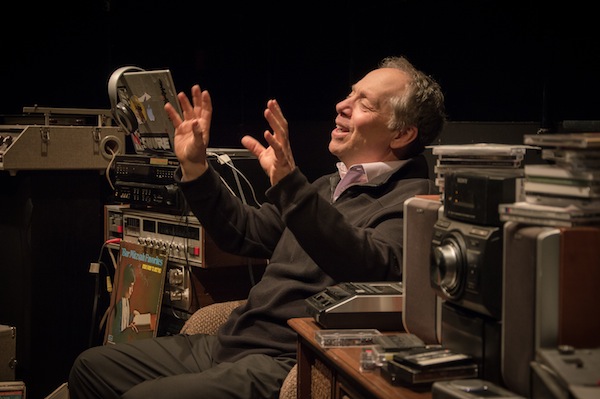
Brian Linds reminisces about his bar mitzvah in Reverberations, which is at Presentation House Theatre until March 17. (photo from Courtesy PHT)

“There are so many wonderful, heartfelt moments in the stories that are told,” Brian Linds told the Independent about Reverberations. “Some are sad. Some are funny. But these same moments have been shared by us all.”

Reverberations opened March 7 at Presentation House Theatre. Created by Linds, a sound designer and an actor, it is co-produced by the theatre and Reverberations Collective with Mortal Coil Performance. Based on Linds’ life, some of the moments he shares with the audience are “his parents’ love story, a childhood act of betrayal, his bar mitzvah, his mother’s Alzheimer’s diagnosis and a moment of lucidity his mother experienced while in the late stages of the disease.”

“The idea for Reverberations came to me after I had created a couple of 10-minute sound performance pieces for pre-events during the SPARK Festival at the Belfry Theatre in Victoria where I live,” said Linds. “I created stories using only sound. These sound performances would play in unusual spaces in and around the theatre.

“I was so pleased with the results that I created three more mini shows and I came up with the concept of Reverberations as a full 90-minute show, using five spaces and four actors who interact with the soundscapes. The production premièred in 2017 as a main stage production of the SPARK Festival.”

The audience, divided into smaller groups of 20, also moves through the five performance spaces. About the première, which took place at Belfry Theatre, Lind remarks in the Vancouver show’s press material that “audiences enjoyed the novelty of moving from space to space and loved the idea that each group’s journey was a unique unfolding of the story told. They were also inspired to share with the performers and audience members their own experiences of loss, betrayal and love. It was deeply touching for our team to experience.”

photo - The role of Brian Linds’ mother, who suffered from Alzheimer’s disease, is played by Nicola Lipman
The role of Brian Linds’ mother, who suffered from Alzheimer’s disease, is played by Nicola Lipman. (photo by Angela Henry)

It was the “immersive, personal and celebratory” experience that attracted Presentation House artistic director Kim Selody to Reverberations. “His creation honours the life of his mother, and what it feels like to lose someone to Alzheimer’s disease,” notes Selody. “Having lost my own mother in the same way, I was deeply touched by how Brian approached his experiences. His choice to end with a celebration is a touch of genius.”

During the writing process, Linds himself had revelations about aspects of his life.

“While I was creating a segment for Reverberations about my bar mitzvah,” he shared, “I found myself thinking about what it means for me to be Jewish. I discovered that who I am was formed and shaped because I was born Jewish. I like being Jewish. I’m a part of something pretty special. Come see the play and you will see.”

Some people will also want to come to the show for a touch of nostalgia, as Reverberations features a range of sound technology, from digital recordings to LPs and cassettes, reel-to-reel and 8-track tapes.

Linds came into sound design kind of by accident.

“I had been working as a professional actor for 25 years but, one day during a show, I was backstage with an actor who knew of my love of music and he asked me to design the sound for his play. It came very naturally to me and I haven’t stopped for 15 years,” he said.

“My favourite part of working on sound is that it gives me a chance to be on the other side of the footlights and work with directors in a completely different way. I love working with directors who collaborate and show me new ways to use my talent.”

The production at Presentation House Theatre is directed by Mindy Parfitt and is performed by Linds, Nicola Lipman, Victor Mariano and Jan Wood. Set and costume designer is Catherine Hahn, lighting designer John Webber and stage manager Heidi Quick.

Reverberations runs until March 17 and tickets start at $15. For more information, visit phtheatre.org/event/reverberations or call 604-990-3474.

Format ImagePosted on March 8, 2019March 6, 2019Author Cynthia RamsayCategories Performing ArtsTags Brian Linds, memoir, music, Presentation House, theatre
Monster brings back Jesus

Monster brings back Jesus

Ryan Gladstone is co-writer of Jesus Christ: The Lost Years, which opens at Havana Theatre March 13, 8 p.m. (photo from Monster Theatre)

Scholars have pondered the question of the unknown, or missing, years of Jesus. In the Christian Bible, he disappears from the narrative in his teens, only reappearing at age 30. What happened in that time? What was Jesus doing? Even if you haven’t wondered about this before, you should consider checking out the award-winning theatrical romp Jesus Christ: The Lost Years, which offers some unconventional theories that academics and theologians have possibly overlooked.

Written by Ryan Gladstone, Bruce Horak and Katherine Sanders, with an original score by Drew Jurecka, Jesus Christ: The Lost Years was first created in 2006. It toured until 2008, then also had its “lost years,” returning to the Fringe circuit only last summer; this time, with two women playing the male leads. Directed by Gladstone, the irreverent physical comedy opens at the Havana Theatre March 13.

“The script is pretty much the same, so the biggest change is what the two new performers bring to the table,” said Gladstone about how the current iteration of the play differs from the original. “Carly Pokoradi and Alex Gullason really have made the play their own, and that’s been a pleasure to watch. It’s also fun watching two talented and funny women being funny and talented on stage.”

Both actors take on multiple characters. In the play, notes the promotional material, “we see teenaged Jesus, wondering why he doesn’t fit in. Mary and Joseph finally come clean and tell him that Joseph isn’t his real father. Hurt and confused, Jesus heads off on the most epic father quest of all time. Along the way he meets Judas, Mary Magdalene, the Three Wise Men, lepers, Romans, he even has a battle with the spirit of Elvis!”

The idea for Jesus Christ: The Lost Years came up long before it was first produced in 2006.

“Katherine Sanders and I were roommates in Calgary in the late ’90s, and we came up with the idea of doing a play about a teenaged Jesus. But Monster Theatre was just on the cusp of being founded and it wasn’t the right time,” said Gladstone. “I remember calling her in 2005, saying, ‘It’s time.’ So, we started researching, and we got Bruce Horak on board, who we both greatly respected, and got to work. The writing process was pretty smooth for having three writers, though maybe some of us were more forceful with our ideas than others! (I’m talking about me, if it’s not clear.)”

As wild as the play gets, it is based on research, as are all Monster Theatre productions. Part of the company’s mission is to reimagine history or adapt “universal stories to make them relevant for our specific time.”

“I took a couple history classes in university but, funnily enough, my thirst for history came out of doing plays for Monster,” Gladstone told the Independent. “In 2001, we created our longest-running, most successful show, The Canada Show: The Complete History of Canada in One Hour, and the research portion of the project really fired my imagination. I loved the idea of taking amazing events that people have never heard of and exposing them to these great moments in our past, or events that people think they know and showing it from another angle. In 2003, Bruce Horak (and later my brother Jeff) and myself spent about seven months researching and writing the follow-up show, The Big Rock Show: The Complete History of the World. It was really this that gave me my love for history. Having that broad overview of everything has given me context for every other event I learn about.”

Perhaps also “funnily enough,” given his love of history, Gladstone only recently found out about his Jewish heritage. “A couple years ago,” he said, “my brothers and I got one of those DNA tests done for both our parents, and discovered that our dad has about 30% Jewish blood. We have some very close Jewish friends here in Vancouver that took us under their wings and guided us through everything they thought we needed to know.”

Born and raised in Calgary, Gladstone went to theatre school at the University of Calgary. “I had been caught up in the exciting whirlwind that was the Loose Moose Theatre Company, run by improv guru Keith Johnstone, who was also teaching in the theatre department at U of C,” explained Gladstone. “After I graduated, I moved to Toronto, because that’s where all my friends were, and I loved it. That was around the time that I founded Monster Theatre. In 2006, I moved to Vancouver. My (now) wife had come to Toronto from Vancouver and tried it out for a few years and we decided we would give Vancouver a shot for year or two. Well, that’s been 13 years now.”

Gladstone followed up his bachelor of fine arts in acting from U of C with a master of fine arts in directing from the University of British Columbia. He has written or co-written, produced, directed or acted in every Monster production.

“It’s a tough thing to tally, but I think it’s around 40 original plays, written or co-written,” Gladstone said of his literary output. “I occasionally write for other mediums; I’ve been co-writing a kids’ book for many years, and we have tried adapting our plays for film and web series.”

Gladstone founded Monster Theatre almost 20 years ago. “In 2000,” he said, “I wanted to tour the Fringe Festival circuit. I had some friends with a comedy troupe called the 3 Canadians who were very successful and were touring Australia and beyond every year, and I basically wanted to be like them. So, I filled out an application form for the Edmonton Fringe and, when it came down to ‘Company Name,’ I just wrote down Monster Theatre for the first time.

“The name is based on something Keith Johnstone said one day when I was in university. We were working on a scene from Othello and Keith was discussing Iago and the difference between demons and monsters. He said, ‘Demons are evil and twisted on the inside, but they are usually quite attractive on the outside, while monsters are strange, twisted and bizarre on the outside, but they always have a good heart.’ And I thought, that’s the kind of theatre I want to make! So, we try to create original plays that are odd, unique, unlike what everyone else is doing, but we are always focused on the heart of the play, making sure that it is rooted in something meaningful or profound. We often talk about our style as being at the intersection where high brow and low brow meet.”

Gladstone was still living in Calgary when he started Monster Theatre. “But, when I moved to Toronto, the company, such as it was, moved with me and, when I moved here in 2006, it moved again,” he said. “Since arriving in Vancouver, we have laid down roots and I don’t think there will be another relocation for Monster in the future. With that said, Monster is a very cross-national company – we have a fan base in a number of cities across the country. In fact, for a long time, Vancouverites witnessed fewer productions of ours than Toronto, Winnipeg, Calgary or Edmonton.”

Over the years, the societal norm of what is acceptable and offensive in word or deed has changed, but Gladstone said there aren’t really any “red lines” he won’t cross in his writing.

“I mean, in the old days, my writing was way more provocative,” he acknowledged. “We were trying to offend people. We often talked about trying to piss off everyone, then no one gets left out. But, these days, it’s a different atmosphere. I’m not afraid of offending people, but I think there needs to be a worthwhile reason, not just for the shock of it.”

Jesus Christ: The Lost Years is at Havana Theatre March 13-16 and 20-23, 8 p.m. For tickets ($20/$15), visit showpass.com/ticket-buyers.

Format ImagePosted on March 1, 2019February 27, 2019Author Cynthia RamsayCategories Performing ArtsTags comedy, Havana Theatre, history, Monster Theatre, Ryan Gladstone, theatre
Matchmaker embraces farce

Matchmaker embraces farce

Ric Reid and Nicola Lipman co-star in The Matchmaker, which is at the Stanley until Feb. 24. (photo by David Cooper)

If you are an aficionado of the absurd, an enthusiast of the exaggerated, a supporter of slapstick and an overall buffoonery buff, then set a date to see The Matchmaker.

Thornton Wilder’s work has taken over the Stanley Theatre with all the intensity and madness a play can muster and keeps farce fans delighted from opening curtain to final applause.

Matchmaker, which was first staged in 1955, is the retelling of Wilder’s original farce The Merchant of Yonkers and was a precursor to Hello Dolly!, one of the most popular Broadway plays of all time. It was made into a movie in 1969 starring Barbra Streisand in the title role of Dolly Levi.

Levi – played by Nicola Lipman in the Arts Club production – is the thread in the play that winds its way through four relationships of star-crossed lovers and would-be elopers. She’s a woman who “arranges things,” but is generally bored with life. The forceful matchmaker goes to Yonkers under the pretence of finding a wife for the crotchety Scrooge-like storeowner Horace Vandergelder (Ric Reid). Her real motive, however, is to snatch Vandergelder for herself.

Along the way, Levi tries to cement the relationships of Vandergelder’s niece, Ermengarde, and struggling artist Ambrose Kemper; milliner Irene Molloy and Vandergelder’s chief clerk, Cornelius Hackl; and Molloy’s assistant Minnie Fay and store clerk Barnaby Tucker. Quite a bit of work for one day, but Levi is ready to put in the effort if it will get her what she wants. She even goes so far as to make up an extensive story that she tells Vandergelder about a fictional 19-year-old potential spouse, just to keep him from marrying anyone else. And she tells Molloy that Hackl is a millionaire known in the best levels of society in order to ensure Molloy loses interest in Vandergelder. And that’s all just in the first act!

The second act brings all the characters together at the home of Flora Van Huysen, a friend of Ermengarde’s late mother, who Vandergelder hopes will keep Ermengarde and Kemper apart. But, it turns out the over-the-top opera-singing spinster is a romantic at heart and, despite a series of confused identities, manages to bring all the relevant couples together.

Now, it’s understood that a farce is comprised of ludicrous situations, improbable plot lines, absurd characters, exaggerated fashion and just about anything that falls under the categories of irony, satire and bad wit. Even so, I expect there to be some consistency within a person’s character, some personality traits that remain the same despite the nonsense of any given situation. I found that missing (or misdirected) in Molloy, one of the key characters, and an original love interest of Vandergelder.

Molloy is a hat-maker who admits to never having adventure in her life, and being very limited in her socializing. Yet, when she finally goes out to a restaurant, she acts like she goes out on the town every night, ordering the best food, telling people what to do, convincing the two clerks to sing in order to get a date.

Also, Molloy and Hackl supposedly fall in love at first sight. The feelings are clearly evident from Hackl’s actions, but it’s hard to get any sense of interest from Molloy.

It makes sense that Hackl, whose experience with women is so minimal, basically falls in love with the first one he meets and laments the fact that he has so little knowledge about the opposite sex.

“I’ll bet you could know a woman 100 years and never really know if she likes you or not,” he says, presenting an observation that many would say holds true.

Now, just in case you were wondering if this level of farce is your cup of tea, here are a couple of examples of the humour you’ll see. When Minnie Fay kisses store clerk Barnaby Tucker, he goes all “aw, shucks” and falls down. There’s a knee-slapper!

In another scene, they need some help from a cabbie, so they ask him, “Do you want to earn $5?” The cabman replies, “I don’t know; I’ve never tried.” (Cue the ba-dum-tshh post-groaner sound effect.)

If you enjoy these types of laughs, then Matchmaker should be right up your alley.

In a final note, kudos go out to set and costume designer Drew Facey for absolutely gorgeous visuals, and composer and sound designer (Jewish community member) Mishelle Cuttler for a score that complements the frenetic action on stage.

The Matchmaker runs at the Stanley Industrial Alliance Stage until Feb. 24. For tickets, visit artsclub.com.

Baila Lazarus is a Vancouver-based writer and principal media strategist at bailalazarus.com.

Format ImagePosted on February 8, 2019February 7, 2019Author Baila LazarusCategories Performing ArtsTags Arts Club, slapstick, theatre

Posts pagination

Previous page Page 1 … Page 9 Page 10 Page 11 … Page 13 Next page
Proudly powered by WordPress