Skip to content
  • Home
  • Subscribe / donate
  • Events calendar
  • Business Directory
  • FAQ
  • News
    • Local
    • National
    • Israel
    • World
    • עניין בחדשות
      A roundup of news in Canada and further afield, in Hebrew.
  • Opinion
    • From the JI
    • Op-Ed
  • Arts & Culture
    • Performing Arts
    • Music
    • Books
    • Visual Arts
    • TV & Film
  • Life
    • Celebrating the Holidays
    • Travel
    • The Daily Snooze
      Cartoons by Jacob Samuel
    • Mystery Photo
      Help the JI and JMABC fill in the gaps in our archives.
  • Community Links
    • Organizations, Etc.
    • Other News Sources & Blogs
  • JI Chai Celebration
  • JI@88! video

Recent Posts

  • SFU honours Gloria Gutman
  • Lifting people’s spirits
  • Wedding a ray of light
  • Indigeneity and Zionism
  • Rule of law broken: councilor
  • Football and its roles
  • The burden of defence
  • Fish Café returns after fire
  • All right in what goes wrong
  • Nuns & mermaids at TUTS
  • Camp offers holiday retreat
  • Students and mentors inspire
  • Once-in-a-lifetime trip
  • 100 dancers, one heart
  • Money for the sciences
  • What “Jewish food” means
  • Have a cookie, schnitzel too
  • Federation now across BC
  • Israel fighting for its existence
  • Deal strengthens Iran
  • Patriotic belonging diminishes
  • A campaign to engage
  • Upstanders’ first live event
  • Responding to Carney
  • Having your own home
  • Music a family tradition
  • Musical to warm heart
  • Community milestones … June 2026
  • Sharing her passion for Israel
  • Or Shalom reopens its doors
  • JFS from past to future
  • Need holistic approach
  • Sharing stories, advice
  • Journalist shares fears
  • Skills to live together
  • Road to independence

Archives

Follow @JewishIndie
image - CJN box ad Rockowers 2026

Tag: lifestyle

Reflections on parenting

So, I’m thinking about the times of our growing up, and who did what in the story of our lives. We never think much about it while it’s happening, during the years when we are coming to our senses. During those times, we are too busy trying to figure out what’s going on.

This process has always fascinated me, wondering what I was thinking. I can’t remember any details about how it was for me. Do you ever wonder how we ended up in the particular places we were, with the people with whom we were packaged? Do you ever wonder how it was that these particular people came to inhabit your life?

Didn’t we just take for granted what was happening all around us as we were growing up, and just went on from there? But, let’s face it, the operation of our lives didn’t just happen. Somebody was out there doing the heavy lifting for us while we just floated along with the tide. It may take us a lifetime to figure that out and to begin to appreciate how generous other people have been, with what may have been meagre resources, in the making of our lives. I remember I resented, for the longest time, never having had any choice about the particular place in which I found myself. I couldn’t wait to get out of that place into one of my own making. Are all of us that arrogant as to our imagined rights at that young age? Did you ever have similar disloyal thoughts?

I think about the roles I had in bringing up my own children. I get the feeling that I sleepwalked through that job, concentrated as I was on making the best of my career opportunities. How much of that was ego and how much of that was an inbred drive, an absorbed imperative to provide for my dependents? I always told myself that they were the ultimate beneficiaries of my misguided priorities. My dependents may have a different view.

How much time did I spend preparing them to cope with the demands of a sometimes hostile world? Did I spend enough time counseling them as to how they might overcome the challenges they were sure to face? Did I do enough beyond providing food, clothing and housing? Was it enough? Did I do a better job than my parents did, as I was convinced I could? Didn’t I have a greater capacity to do that, so that so much more was expected?

I’ve never talked to my kids much about these concerns. Now I am a little hesitant about broaching the subject. I fear the memories they might have would have them judging my behaviour as bordering on neglect. Horrors! Did I do enough of the heavy lifting that was required? Do you people out there ever think about this stuff? Don’t we all console ourselves with the thought that we always did our best under the circumstances? Do we dare ask our kids about that?

If we look at nature, at the way creatures go about raising their young, it is clear that, in most cases, mammals and birds will, like humans, protect and nourish their young during their vulnerable periods, even to the point of surrendering their lives if need be. For wild creatures, the pains they go to, making nests and burrows, hunting and gathering food, seem without limit, commandeered by instinct. And the young learn by following their parents’ example. For humans, that period of vulnerability is so much longer. And what our young have to learn is so much more complex.

I always thought I would do better when my turn came, only to realize on maturity how the many gifts I had been given by my parents would challenge my own capacities to match them with my own brood. We know what a difference parental attendance can make in an offspring’s future.

How many parents stick with a job they hate to put bread on the table? How many parents stay in a relationship they loath to keep a roof over the heads of their young? Most just keep on doing what they have to do, day after day, year after year. That’s heavy lifting!

How many parents abandon places where they know all the rules for the unknown, in the hope of ensuring their children will have a better chance at life? How many jump off into danger in the hope of finding a better life? We are hearing a lot about that these days at the Unites States’ southern border. And at many European borders for the last several years. Didn’t most of us have it a lot easier?

How do we define what we owe ourselves and what we owe to those we are responsible for bringing into this world? How many of those rules come from outside ourselves, absorbed from our parents, from our communities? (What a hierarchy of social imperatives I inherited just by being born Jewish! What was in your birth box?) Or, like other creatures, do we mostly act out of instinct? We see all kinds of behaviours. And we can’t help judging what we see, whatever our own performance has been, with whatever tatters of standards remain to us.

Now, no longer under the gun, and seeing things with a broader perspective, what do we do now? Do we think we have the right to butt in on our offspring with our own views about how things should go? How do you think we would feel if we were in their place? Isn’t it obvious? Do we have the wisdom to wait to be invited to comment? Will that invitation ever come?

For many of us, the heavy lifting is now in other hands.

Max Roytenberg is a Vancouver-based poet, writer and blogger. His book Hero in My Own Eyes: Tripping a Life Fantastic is available from Amazon and other online booksellers.

Posted on June 14, 2019June 12, 2019Author Max RoytenbergCategories Op-EdTags kids, lifestyle, parenting
Chocolate babka debacle

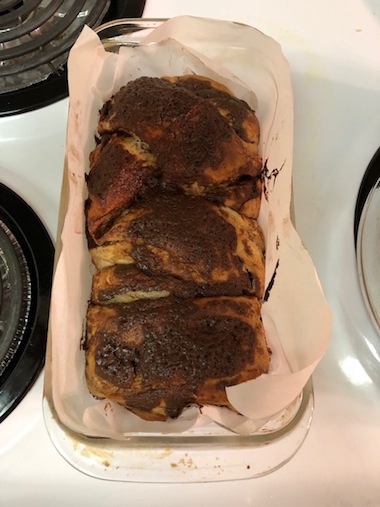
Chocolate babka debacle

Babka gone bad: The Accidental Balabusta’s first attempt at this Jewish treat was less than a stellar success. (photo by Shelley Civkin)

After I conquered challah and cholent, I felt it was time to tiptoe into the forbidden realm of babka. I say the word with a great deal of reverence, because, well, if you’ve ever eaten a spectacular babka, you know it’s something awe-inspiring. There are limitless variations of babka: chocolate, Nutella, boozy, apricot and cinnamon, pumpkin, butterscotch and more. I even found a recipe for babka ice cream sandwiches and babka bread pudding. This is not diet food. Never was. Never will be.

Babka is comprised of a basic challah dough or a butter challah dough. Every recipe is different and, sometimes, to achieve the perfect babka (which I am far from accomplishing) you need to do a bit of mixing and matching of recipes.

My first attempt at making chocolate babka was an unmitigated disaster. Not only was my dough so velvety soft that I couldn’t even roll it, but the filling was so thin that it smooshed out all over the place. Part of the problem was math. I have always been math challenged. In fact, I have a pair of socks that say: “The three things I hate most are math.” My brain shuts down when faced with mathematical conversions (yes, I know there are apps for that). Long story short, I mistakenly used a half-pound of butter instead of a half-cup of butter for my babka dough. Hence, the flaccid, unresponsive dough. Nobody likes flaccid dough. Most people don’t even like the word flaccid. Except sex therapists. Anyway….

My other challenge was not realizing that you have to refrigerate the dough for a bit before rolling it out and filling it. There are tons of YouTubes on how to make babka – I recommend viewing several of them before attempting this at home. Also, check out lots of Jewish cookbooks, too. I stress “Jewish” because we Jews know how to accentuate the caloric value of our food so that it tastes impossibly rich and irresistible. Jewish baking is famous for a reason. If a recipe calls for eight ounces of dark chocolate, what the hell, 12 ounces must be better. Half a cup of butter – why not half a pound? Don’t bother pointing it out. I see the error of my ways.

If my first attempt at babka was less than a stellar success, it’s not just because of the aforementioned infractions. My main excuse is my miniscule galley kitchen. I lay the blame squarely where it belongs: on the almost-nonexistent counter. Things are so squished in my kitchen that there’s very little room for food. Or utensils. Take, for example, my long, articulated spatula. It’s the perfect implement for shmearing the chocolate onto the dough before rolling it up. I digress.

Back to the babka. I started shmearing the chocolate and, part way though, I had to sneeze. So, I put the long spatula into the bowl with the melted chocolate sitting on my teeny, tiny counter. The sheer force of my sternutation – it was probably a 7.8 on the Richter scale – caused the chocolate-covered spatula to fly out of the bowl and splatter chocolate everywhere, and I mean everywhere. It ended up on the walls, the floor, me, the counter, the carpet and Harvey, who looked on in mute husbandly horror. It was like something out of a slasher movie. Except the splatter was 85% bittersweet cacao chocolate instead of blood. I could have been arrested for assault with a confectionery weapon. All that was missing was the yellow police tape.

As if that wasn’t enough, the excitement of it all caused me to knock the recipe into the sink, which was filled with dirty bowls and brown water. At that point, I almost cried. But I didn’t. Instead, I casually looked at my chocolate-covered hubby and said: “OK, no one died. I’m going to try again.” I was determined not to let this babka get the better of me. I was going to show it who was the boss.

After wiping chocolate off my face, the walls and the counter (I may have licked the counter), I rolled up the flaccid babka, shoved it into the fridge and poured myself a teeny, tiny single malt Scotch. Just to shore up my nerves. Once I’d consumed the liquid fortification, I took out the babka, sliced it down the middle lengthwise, which is kind of difficult when it’s not really a shape, and proceeded to twist it so that that the layers of dough and chocolate showed on the outside. Then, I carefully laid it to rest in a parchment-lined coffin. I mean loaf pan. Said Kaddish.

photo - Babka gone better: Subsequent babka attempts were more successful
Babka gone better: Subsequent babka attempts were more successful. (photo by Shelley Civkin)

Since I’d made enough dough for about 15 babkas (by mistake, of course … remember my math impairment?), I now had to figure out what to do with the rest of it. I was tempted to sell it on Craigslist, but how would I even describe it? “Blob of velvety soft dough for sale. Nearly house-trained. Enough to make several loaves of bread or a small border wall. If frozen. Pick-up only. $10 obo.” In all honesty, I would have paid someone to take it off my hands at that point.

Stuck with all that dough, I shmeared and shaped the rest of it into circles, rectangles and free-form sculptures, jammed them into every available pan I had, and shoved them into the oven to bake. The entire procedure took about 11 hours. My bone graft and tooth implant took less time. I think I started the whole process at around 9 a.m. and didn’t remove the final “babka” (I use that word loosely) until around 8 p.m. Of course, I’m also factoring in the time it took the restoration team to steam clean our entire apartment. Should have just moved.

By that time, there was no way I was making dinner. So, we ate three-quarters of one chocolate babka for dinner. Slathered in even more butter. I think I may have sent both of us into a slight sugar coma. Not sure. No paramedics were called, so it couldn’t have been that traumatic.

I put the rest of the evidence into the freezer, for when I want to scare some unsuspecting dinner guests. I promise, here and now, that my next foray into babka-making will start with single malt Scotch.

If I’m lucky, it may end there, too.

Shelley Civkin, aka the Accidental Balabusta, is a happily retired librarian and communications officer. For 17 years, she wrote a weekly book review column for the Richmond Review, and currently writes a bi-weekly column about retirement for the Richmond News.

Format ImagePosted on June 14, 2019April 2, 2020Author Shelley CivkinCategories LifeTags babka, baking, lifestyle

See the light inside everyone

Lately, I’ve been thinking about Elijah the Prophet, or Eliyahu Hanavi. He’s that guy who somehow travels worldwide, to drink all the wine at every Passover seder every year. (What a hangover he must have!) Elijah is also supposed to attend every Jewish boy’s circumcision (brit milah or bris). We sing about him during Havdalah, the short service that separates the Sabbath from the rest of the week. This guy’s all over the place!

Well, he’s both all over the place in Jewish tradition and shrouded in mystery. This is the quirky prophet that never actually died, but instead ascended to heaven. He’s got three separate roles in Jewish tradition.

1) He’s a zealous prophet, reminding people how to behave properly and to remember G-d.

2) He’s known to appear and help those in distress.

3) He’s supposed to announce the coming of the Messiah or the Messianic Age.

(There’s more to Elijah’s roles, depending on what text you study.)

I hadn’t thought much about Elijah as an adult. I’m not big into worrying over the coming of a man on a white donkey (from Babylonian Talmud, Sanhedrin 98a) or the Messianic Age. However, he makes an appearance in ways that capture my kids’ interest. There’s that mysterious cup on the seder plate, and the song that we sing hoping that this week will be the one where Eliyahu Hanavi shows up to bring about the Messiah’s coming. Even if a kid doesn’t attend a bris too often, he might ask questions about Elijah.

There are a lot of stories that retell rabbinic traditions about Elijah. The most powerful are ones I never forgot from childhood, and which may still be helpful today. The stories seem to align directly with those points above, that adults are already supposed to know.

From the Prophets, we know that Elijah reprimanded others, threatened them with scary stories and told them to shape up. It’s essentially “putting the fear of G-d” into them. Apparently, he was good at this role, as he was sent to do it multiple times. In Jewish folklore, Elijah is the stranger who appears and helps the poor and reminds the wealthy of their failings. It’s this combination of the stranger who appears when you least expect it and the coming of the Messianic Age that I think about most often. Why?

I was taught to try to treat everybody with respect and empathy – because that person might be Elijah. That Elijah could appear at any time, looking like an old lady or a child, a homeless person or an older person with dementia. How we treat people indicates how we’re doing on bringing about a better age, or a Messianic one. When this idea was introduced to me, I remember thinking it sounded weird.

As an adult, it makes more sense because, well, life is weird. Life offers us many opportunities to practise conscious kindness, to do mitzvot (commandments) that help make the world a better place. If we keep doing this “fixing the world” (tikkun olam), well, we might just hear from Elijah.

There was that time when we had a stranger knock at our door. My husband answered it and then told me what happened. It was an indigenous man who didn’t look well. He looked like he had been doing some traveling through back lanes, but he came to the door with our dog’s collar in his hand.

I was immediately anxious. Our dogs are never without their collars and ID tags. However, this man came along, saw the collar in the back lane, clearly beyond the fenced yard. He was worried for the dog. The good news? We called her, and our dog was happy and safe inside. She’d somehow managed to shed her collar and leave it in the back lane without anyone noticing. This kind act made me wonder: Was this Elijah, known for his affinity with dogs? In the Sefer HaAggadah, it’s said that, when dogs are happy for no reason, it’s because Elijah is in the neighbourhood.

Sometimes, one of my kids carefully saves the seat beside him at services for what appears to be an imaginary friend. We joke that he knows Elijah is coming. Instead, it ends up being the friend on her own who needs just one spot or maybe even a stranger, who we then get to welcome to synagogue.

It’s the extra granola bar in my “mom bag,” when I thought someone might need a snack – and, indeed, a hungry person turns up. He needs it to continue onwards. Who knows what that person’s potential will be? That stranger gets a granola bar because, well, he might be Elijah.

This is all mystery and whimsy, if you take a purely Western and scientific view of the world. Yet, most of us acknowledge that we can’t explain why we’re lucky or when misfortune befalls us. Is it because of our behaviour or our efforts to do good in the world? Is it because some people “deserve” misfortune? I think not.

There are amazing people, all around us, who have struggled. Some were homeless, were put in foster care as children, or had addictions. Perhaps they suffered through wars or trauma. This childhood lesson about Elijah has stood me in very good stead because, if you remember that every person has value, every soul is important, it doesn’t matter how the person’s body presents itself. Whatever their clothes or hair look like, that person could be Elijah. Better yet, every person is someone important. It’s up to us to see that light inside, the potential waiting there, and to acknowledge the “other,” as Martin Buber would say. Be ready to offer something, with love and hope, when needed. It could be welcoming someone and offering a seat, a kind word, a thank you for returning a lost item, or a granola bar. Anybody can do this. Remember, that person across from you may be Elijah. The rest? It’s up to you.

Joanne Seiff has written regularly for CBC Manitoba and various Jewish publications. She is the author of three books, including From the Outside In: Jewish Post Columns 2015-2016, a collection of essays available for digital download or as a paperback from Amazon. See more about her at joanneseiff.blogspot.com.

 

Posted on June 7, 2019June 5, 2019Author Joanne SeiffCategories Op-EdTags Elijah, Judaism, lifestyle, tikkun olam

Put down “the ducky” in shul

I chatted with a friend recently about what it was like in “the old days” when someone had to take a cellphone call during synagogue. This is when there were only big, clunky cellphones. I remember seeing a doctor on call pacing in the lobby. He – and it was usually a man – looked apologetic as he listened carefully. It was an emergency. It was a doctor who needed to attend to a patient, even though it was Shabbat and he was at services.

Given the circumstances, we recognized it was OK, because it was pikuach nefesh. He was helping save a life and that level of emergency is allowed, no matter how observant you are, on Shabbat. You put a person’s life above everything else.

The media has done many features where they reflect on research that shows how social media and being attached to a cellphone or other device has affected our health. It can keep us from interacting in the real world with other people, from sleeping or focusing properly. Social media increases our anxiety levels and, sometimes, it’s an addiction. Waiting to get that next update, from a friend or a news source, can sometimes seem more important than any actual person or event taking place in the same room.

My kids know the lesson from Sesame Street and the classic song, “Put down the ducky!” Ernie wants to play the saxophone, but Hoots the Owl tells him, “Put down the ducky if you want to play the saxophone!” It’s a lesson that we must break habits – like carrying a cellphone or the rubber ducky – to learn something new, make music and interact with others.

In the Jewish context, I see it everywhere. It’s at services, lectures, at the Passover seder or Shabbat table, at the kids’ events and play dates. It’s so pervasive that those doing it don’t even realize they are blocking out the world to engage with their electronics. It’s like a body part for those folks, while its noise means others can’t concentrate.

I was at a family service on Shabbat when we were interrupted with what sounded like a radio playing. It seemed to drift on and off and it was terribly distracting. Are we hyper-aware of such things? Absolutely. I am always tired and it makes me extra sensitive to noise and stimulation. There are some folks in my family who are also noise-sensitive. Too much noise and chaos often means we just have to leave. It’s too much.

Meanwhile, while the radio-like sound continued to compete with the prayers, adults in the back kept talking over it all. My husband, usually immune, looked bothered. I encouraged him to get up and ask someone to shut it off, since I sat with a kid on my lap. I thought it might be somewhere outside, but I was wrong. It was one of the talking adults, who failed to even notice that her phone was making the noise. Even when it was finally shut off, the adults continued to talk.

The interference was so pervasive and distracting that I couldn’t wait to leave. At Kiddush, at the end of the service, I heard someone say to a kid, “You can go ask the rabbi, he’s not praying now.”

That was it in a nutshell. I found myself wondering what the heck we were doing there. Are you coming to synagogue to play live-streaming radio and talk loudly? If you aren’t praying, or even sitting quietly, as a role model for kids, why bother coming to disrupt everyone else?

Some might say this is just an isolated incident, but it’s pervasive. On Yom Kippur, there was a grandfather who thought it was OK to hop up and snap photos with his phone during the service.

As I looked at the Torah portion, Behukotai, Leviticus 26:3-27:34, for the first week of June this year, I remembered this experience. It’s a portion that emphasizes all the amazing things offered by the Divine Presence “if you follow my laws and observe my commandments.” It’s a carrot-and-stick story, it clearly states the bad things that will happen to those who don’t follow the rules.

Our understanding of the laws and commandments may have changed, but social norms still exist. We live in a society with clear tension between individuality and the common good. If you judge someone else’s behaviour, you can be told that judgment is inappropriate – even when the individual isn’t behaving in a considerate or safe way for the community. If you feel uncomfortable with someone’s behaviour, we’re taught “we can only control ourselves and our response to it.”

You may not want to stop social media use on Shabbat or want to pray at services, and that’s your choice. However, it’s probably not your place to keep others distracted with your phone so they cannot concentrate on prayer. If you’re set on having it your way, and don’t want to think about others, why join a community Jewish event to do it?  Stay home to use your cellphone instead.

Winnipeg prides itself on being a friendly place, and inspired other places to adopt a United Way campaign day of “conscious kindness.” It might be time to live the slogan and think of others – if you can’t put down the phone for your own sake, please do it for ours.

Joanne Seiff has written regularly for CBC Manitoba and various Jewish publications. She is the author of three books, including From the Outside In: Jewish Post Columns 2015-2016, a collection of essays available for digital download or as a paperback from Amazon. See more about her at joanneseiff.blogspot.com.
Posted on May 31, 2019May 30, 2019Author Joanne SeiffCategories Op-EdTags cellphones, etiquette, Judaism, lifestyle, Sesame Street, synagogue, Torah

How we can live after death

It is the instinct of all living things to try to stay alive, humans among them. Most religious doctrines pay a great deal of attention to this issue. And many people, whether part of an organized religion or not, believe that a spirit leaves the body after death. Where viewpoints vary mainly is what happens then.

In many belief systems, we stay alive in some form or another even after death. Hindus, like Buddhists, believe that a departing spirit is reincarnated into some other life form. Buddhists believe there is no guarantee that the life form will be human; they believe that liberation from the cycle of life is the only desirable objective, a state they call nirvana.

The monotheistic religions all have some concept of an afterlife, with outcomes based on our behaviour during our life on earth. Indeed, both Christianity and Islam see the afterlife as the most desirable state, at least for the righteous, compared with our life on earth, the current one being a “a vale of tears.” Judaism also sees a reward for the righteous, with a resurrection when the Messiah arrives to usher in the “End of Days” and heaven on earth. But Jews, in contrast, are urged to live the fullest possible life while alive, every life being precious.

Without entering into discussions on this issue as to the merits of one position or another, I have drawn some conclusions as to their relevance on the question of staying alive. Empirical evidence from religious enthusiasts is meagre, relying on faith rather than hard facts, or reports of a life, or lives, after death from thousands of years ago. These form the basis for the promise underlying the religious thesis.

The realization of a positive outcome in the religious sphere depends on an unblemished life experience. I cannot count on being among those judged as sufficiently righteous and deserving. That leaves me with the task of doing the best I can to extend the life I know about, the one I am living now. Having past the four-score mark is evidence that I have done some things right, having already survived many of “the slings and arrows of outrageous fortune.” I must have good DNA.

Chance has favoured me in my encounters with accident, disease and body-systems breakdowns. I have survived my encounter with “the big C” up to this time. I have diabetes under apparent control, but one never knows, as it works its damage asymptomatically.

I take pills in abundance to ward off the evils of sugar, high blood pressure and stroke. I quit smoking in my early forties and drink alcohol sparingly. My food habits are not outrageous, without denying myself the favourites that make life worth living. I exercise religiously when not on holiday. I have given up driving on the promise it will increase my life expectancy. Best of all, I pass my life with the woman of my dreams. Life is grand.

The other night, I spent some time with family. We found ourselves talking about our experiences with forbearers who had gone before us. For a short while, it appeared to me almost as if those ancestors were there with us, alive and sharing our good times. Like a lightning bolt, it struck me that that was truly another way of staying alive. The people in our lives who are important to us, those who have marked us in our life experience, they continue to be alive for us as long as they remain in our memories. They never disappear for us as long as we live; they go on being a part of our lives.

So, that’s the secret. We must continue to be important in the lives of the people who surround us. As long as we do that, we will stay alive even after we are physically gone. We have to cherish those we care for while we have them, in part so they will continue to cherish us.

But this does not apply to family only. It is true for all the people in our lives to whom we reach out, to all those we touch and those who touch us. If we want to stay alive, we have to do the reaching out.

Moses and Jeremiah and Isaiah and Jesus can thus be alive for us as well, if they have touched us and touched our lives. Shakespeare and da Vinci are alive for me. Spinoza is alive for me. Danny Kaye and Sid Caesar are alive for me, as is Beethoven.

They are all alive for me because they are a part of who I am. All the people who have made me what I am are alive for me every day of my life. I am surrounded by a crowd. Sometimes, they speak through me. You can’t spend much time with me without getting to meet some of them.

If I write something and it touches another soul, then I may still be alive for them whether I am physically there or not. Even for the people who no longer remember my name, I may still be alive for them in some cranny of their consciousness. That’s not so bad. If we can believe in that, in our own minds we have a future beyond our temporal experience of life.

So, now you know the secret. Go out there and talk to the people around you. Phone them. Write an email. Hug or kiss them if you can get away with it. You may get to live forever if they tell their children about you. If you know what you have done, if you have faith in it, as I do, regardless of your other beliefs, this can be your “promised land.”

Max Roytenberg is a Vancouver-based poet, writer and blogger. His book Hero in My Own Eyes: Tripping a Life Fantastic is available from Amazon and other online booksellers.

Posted on May 17, 2019May 16, 2019Author Max RoytenbergCategories Op-EdTags health, lifestyle, philosophy, religion
Diversity in retirement

Diversity in retirement

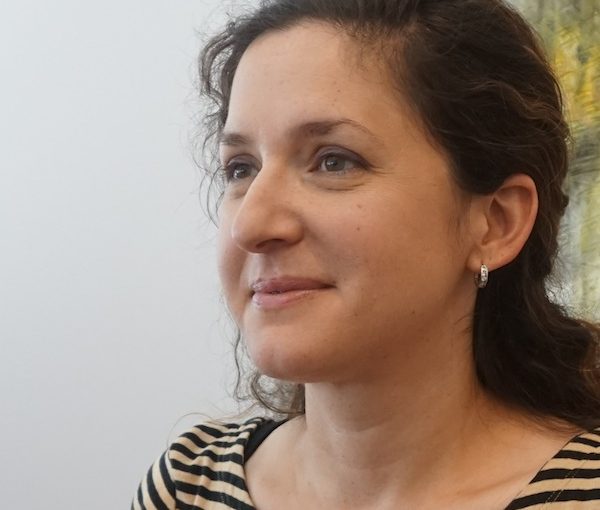
For Prof. Michelle Pannor Silver, author of Retirement and Its Discontents, an individual should be the one to decide when they start to work less. (photo from sociology.utoronto.ca)

Not long ago, it was a given that, when you reached the age of 65 or so, you would retire. But, that is no longer the case.

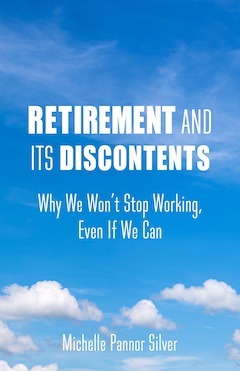
Michelle Pannor Silver, an assistant professor in the University of Toronto’s sociology department and its Interdisciplinary Centre for Health and Society, explores some of the reasons for this, as well as the difference between planning for retirement and the experience of it, in Retirement and Its Discontents: Why We Won’t Stop Working, Even If We Can (Columbia University Press, 2018).

Pannor Silver’s interest in the topic started when she was tasked with helping wind down her father’s office.

“My real initial motivation for studying retirement at all, and really for the book, was my dad’s experience,” Pannor Silver told the Independent. “I wrote about this in the book, that, when I was in my 20s, my dad developed dementia. It became really clear that he was not able to continue seeing his patients. And he was quite active in Jewish Big Brothers. That was something that was a big part of his work as a social worker. That’s the way he identified, as a social worker. He was a psychotherapist.”

This experience led Pannor Silver to the U.S. Health and Retirement Study, and she spent many hours and years examining people’s retirement trajectories. In her dissertation, she focused on, among other things, the relationship between the type of work people did and several different health measures, before and after they retired.

“After spending a lot of time looking at data points, I became really interested in talking to real people about what their retirement was like and, really, to discuss what retirement meant,” she said. In quantitative analysis, you make certain assumptions, she explained, “like how this person works this many hours and, therefore, they are fully employed, versus this person who works that many hours and then stopped … and, so, I’m going to code that one as retired.”

To verify or refute such assumptions, Pannor Silver interviewed people.

“I started really basic – just asking people what it means to them to be retired,” she said. “That helped me realize that, boy, this is a loaded term. It seems so simple, so straightforward, and the media gives us these clues about what it’s supposed to mean – you’ll see these commercials with these people who are retired, but are running on the beach, so retirement must mean running on the beach holding hands. Or, there are other ones that are about saving for retirement, so it must mean that it’s something you do when you stop working.”

A focus of Retirement and Its Discontents is ageism, and what it means to be told by society that it is time for you to stop doing the thing you have probably spent most of your adult life doing. The people she features found that life without work wasn’t all it was cracked up to be.

image - Retirement and Its Discontents book cover

“The people I interviewed, many talked about being pushed into retirement – being told it was time to make room for the next generation,” she said. “Some of them did it of their own volition. They weren’t really forced into it, but they assumed it was time for them to move over. They looked at how old their fathers had been when they retired, and decided that a certain age was going to be their benchmark. It’s really about the fathers who they looked at, and some of them saw their fathers retiring and dying the next year, or very shortly thereafter. And they thought they’d better retire then, too, so they could live a little before the end comes for them.”

The idea of when to retire is influenced by media messaging. Some of Pannor Silver’s Canadian study participants talked about “freedom 55,” the advertisements for it and how that has always been in their mind as the magic number at which to retire.

Pannor Silver’s study included international participants. And, while the magic age may differ, “the thing they shared – whether they were forced by existential pressures or because of their own internal ideas about when they ought to retire – first of all, they ended up living longer than their parents. All the [financial planning] models people generally have are wrong,” she said, “and that has, of course, implications for the public pension systems that are out of whack, too.

“But, my book really speaks to the experience of people facing the norms on a sort of anachronistic or out-of-date understanding of what retirement is and are disappointed by their experiences because of that – because of the expectations … that it should happen at this certain time and should be a certain way that would lighten and free them. Yet, they felt kind of burdened with life without work.”

Pannor Silver hopes that readers of her book will discard the idea that retirement should be associated with a chronological age. She would like to see them open themselves up to the idea that there are many different ways people can experience retirement.

“I think that, for many people, retirement is a bad word they don’t even want to use,” said Pannor Silver. “My point is to share the experiences of varied, different types of people who, for various reasons, retired in traditional ways … and had to find their own way around it … to sort of rewrite and create their own retirement experiences.

“For them, it was very surprising and, hopefully, others take some comfort in recognizing it’s a really challenging transition, a really important time of life. There’s so much attention paid to the early stages in life – finishing high school, getting into university or that initial career transition, and career mobility and trajectory, but very little attention is paid to later career transitioning. And that was my goal – to be able to say, ‘Here’s a set of people’s experiences.’ And, people tell me that these experiences have really resonated with them…. We can’t just assume that, because an employee is reaching a certain age, it means he or she should be passed up for promotion, cast aside or ignored. It ought to be up to the individual to say, ‘I have other things I want to do,’ or whatever the reason is – to make the decision on their own, that, now, they choose to make a transition to working less.”

While Pannor Silver’s target market is people approaching retirement, she is hoping that the book will also influence the employers, managers and others who are deciding – on the basis of incorrect assumptions or ignorance – to overlook certain parts of their workforce.

“I have Olympic athletes who I interviewed for the book, homemakers, doctors and CEOs … it’s a varied group of individuals,” said Pannor Silver. “But, their experiences are all people who were incredibly dedicated to their work. Their work was their life’s work, and the point is to contribute to an ongoing discussion about what retirement is now … what we can assume about it and what we should not assume.”

Pannor Silver’s next book will examine the importance of physical movement in the later stages of life.

Rebeca Kuropatwa is a Winnipeg freelance writer.

Format ImagePosted on May 17, 2019May 16, 2019Author Rebeca KuropatwaCategories BooksTags health, lifestyle, Michelle Pannor Silver, retirement

Staying calm amid bad news

Worn out by recent events? Me, too. For most of my work, I write things in advance to meet a deadline, but I can’t predict the future. Like Jewish balabustas (Yiddish for a woman who manages her household) throughout time, one way I cope is through working harder – by multitasking and planning ahead. I bake challah and meals in batches and freeze the extra. Why? So I can also work, take kids to medical appointments or even stop everything so I can sit down to help with math homework in those crucial moments before dinner.

Yet, we have a hard time calmly planning ahead when things feel out of control. Rising antisemitism, murders and crimes in the world affect us, as do natural disasters both locally and farther afield. These experiences can cause us to feel a sense of “trauma fatigue.” This can also be called “compassion fatigue,” and some say it particularly affects those in helping professions, like first responders, mental health and medical professionals, and social workers. However, it’s not limited to those people. Even bystanders to an event, who perhaps see footage on social media, on TV or in the newspaper, can be affected. Kids can be affected, too. We’re not immune to what this experience does.

Many react with a sort of post-traumatic stress syndrome. There may be an increased sense of panic or “fight or flight” feelings of adrenalin. Some people cannot sleep, or sleep too much. They have flashbacks to bad incidents that occurred, as well as physical symptoms. They may feel disassociated from themselves or others, and may feel less compassion for others in general. There are lots of symptoms associated with this. I’m not an expert.

However, I realized one morning as I walked my dogs that I felt weary and emotionally drained. It’s awful to hear about shootings of people at prayer, hate crimes and massive natural disasters like flooding. There are only so many times you can feel heartsick about these types of events before it takes a toll.

A recent New York Times editorial was an apology for an antisemitic cartoon that they printed. The editors acknowledged the creep of numbness and a lack of judgment when it printed this cartoon and when it came to recent anti-Jewish incidents. This numbness mirrored the New York Times’ and other newspapers’ historic failure to address the widespread rise in antisemitism in the 1930s and 1940s. The current editors pointed out the danger in this, apologized for one editor’s poor choices and the paper’s lack of oversight.

We’re all coping with a sort of numbness when it comes to the news cycles and increasingly frequent events. It’s hard to respond with equal amounts of compassion after every shooting or traumatic world disaster. What can we do to relieve this?

The following list is partial and includes both Jewish and general responses to stress.

  1. Shut off social media. Whether you’re Sabbath observant or not, find ways to silence your phone, newsfeed or other notifications for a few hours or days. Shut off the noise on occasion and step away from the news and alerts. It will calm your fight or flight instinct.
  2. Get outside. Take the ear buds out. Take a walk or run. Bring the dog, family, a friend or just your thoughts. Listen to the birds, squirrels, wind or the traffic. Give yourself a chance to exercise, be out in nature and smile at neighbours. See the world at a slower pace.
  3. Read a book. Escape fiction is not just for the beach. Find something engrossing to read and lose yourself in it for awhile. If fiction isn’t your thing, learn something new with non-fiction. Study Jewish texts, geography, geology or whatever interests you. Give yourself time for your mind to do something other than freak out.
  4. Practise deeds of loving kindness. Try every day to do something for others. It can be a thank you note, helping a friend or holding a door open for a stranger. Donate money or food to the food bank, volunteer or simply help clean up at home, work or synagogue. This is a Jewish way of keeping the world afloat.
  5. Prayer and meditation can help us remain calm and boost our health. Everyone differs on this topic. Some religious people feel prayer “protects” the faithful. Others are skeptical but hedge their bets. Even atheists can be aided with repetitive words or activities that help tune into this part of the brain. However you see this, it’s hard to refute the scientific evidence that being part of a religious community or meditating on your own can make a substantial difference to our health and well-being.
  6. Speak out. We can’t control much – not natural disasters or the actions of others. We can, however, work for what’s right. Judaism has a long history of social activism. While we may disagree in our opinions, we can still choose to advocate for what we believe. We feel less helpless when we talk with others who share our views and try to make positive change.
  7. Seek out support. It’s natural to feel anxious. This is a good time to seek out others at your congregation, community centre, workplace or school and talk about how you’ve been feeling. Talk to a therapist or a rabbi. Find time for friends, family and community members who care about you.

These are only some things that might help. It’s just a start, but, as the rabbis say, “The world stands on three things: Torah, prayer/service and deeds of loving kindness.” It’s true that life isn’t boring these days, but I’m wishing for a bit of boring. Here’s to enjoying some safe, quiet and calm, and peaceful, warm days ahead. Be well.

Joanne Seiff has written regularly for CBC Manitoba and various Jewish publications. She is the author of three books, including From the Outside In: Jewish Post Columns 2015-2016, a collection of essays available for digital download or as a paperback from Amazon. See more about her at joanneseiff.blogspot.com.
 

Posted on May 10, 2019May 9, 2019Author Joanne SeiffCategories Op-EdTags Judaism, lifestyle, mental health

A case for mothering

“Oh, I know that I owe what I am today to that dear little lady so old and grey / To that wonderful Yiddishe momme of mine.” (from the song “My Yiddishe Momme,” by Sophie Tucker, 1920s)

It was not until the early part of the 20th century that a day was created to honour and officially acknowledge the importance of mothers. Founded by American Anna Jarvis and first observed on May 10 in 1908, Mother’s Day will be celebrated this year on May 12.

But times change, and what may have applied in Jarvis’s time doesn’t go far enough in our present society. A distinction should be made between the mother and the act of mothering: one is a noun, the other a verb. Historically and biologically driven, the role of mothering has been primarily fulfilled by the biological mother. However, in the 21st century, this role is now often carried out by a variety of others, such as fathers, grandparents, adoptive parents, foster parents, step-parents or paid caregivers.

The explosion of neuroscience research over the past few decades has provided a meteoric rise in neurobiological literature with findings that support their predecessors’ observations and predictions in child development. Selma Fraiberg (1977) was farsighted when she wrote that mothering “is the nurturing of the human potential of every baby to love, to trust and to bind to human partnerships in a lifetime of love.” The evidence from various sources converges in the consensus that the human capacity to love is formed in infancy and this bond should not only be considered a gift of love to the baby, but a right – “a birthright for every child.”

Unfortunately, the recognition and awareness of the crucial role of mothering in a child’s healthy development and, consequently, to future generations, is gradually being eroded. It is often seen as a secondary role in the scheme of our busy lives. It was 42 years ago when Fraiberg wrote that we are seeing a devaluation of parental nurturing and commitment to babies and young children, which may affect the quality and stability of the child’s human attachments in ways that cannot yet be predicted. She warned that the deprivation of a mother or mother substitute will diminish a child’s capacity for life.

Fraiberg’s cautionary notice is eerily apparent in the growing numbers of young children and troubled youth as reflected in mental health issues and criminal behaviours. For example, Canadian Bullying Statistics (Canadian Institutes of Health Research, 2012) indicated that 47% of Canadian parents have had a child who has been a victim of bullying; Canada has the ninth-highest rate of bullying in the 13-year-old category in a survey of 35 countries; and at least one in three adolescents have reported being bullied.

The basic needs of children have not changed, but our priorities seem to have been rearranged, as advertisers increasingly shape our wants into needs. We did not invent childhood. We are only discovering what has likely existed since the beginning of time. Louis Cozolino, PhD, (2014) notes there is “a causal link between interpersonal experiences and biological growth.” These links are of particular interest in their impact on early caretaking relationships, when the neural infrastructure of the social brain is forming.

As Lloyd deMause notes in The History of Childhood, “That because psychic structure must always be passed from generation to generation through the narrow funnel of childhood, a society’s child-rearing practices are not just one item in a list of cultural traits. They are the very condition for the transmission and development of all other cultural elements, and place definite limits on what can be achieved in all other spheres of history.”

A world of mothers and mother substitutes has taken on the loving and arduous tasks of mothering, with all the pleasures and perils of parenting. To those who are fortunate to still have mothers in their lives – be thankful and let her know how much she is cherished. For those who don’t, treasure the memories that have become even more precious. And for those who are themselves mothers, you have undertaken the most difficult but important task of life with all its joys and sorrows. You have taken on the most valuable contribution to society and its future as well. So, to mothers and to those who mother, we honour you today and every day.

Libby Simon, MSW, worked in child welfare services prior to joining the Child Guidance Clinic in Winnipeg as a school social worker and parent educator for 20 years. Also a freelance writer, her writing has appeared in Canada, the United States, and internationally, in such outlets as Canadian Living, CBC, Winnipeg Free Press, PsychCentral and Cardus, a Canadian research and educational public policy think tank.

Posted on May 10, 2019May 9, 2019Author Libby SimonCategories Celebrating the HolidaysTags children, lifestyle, Mother’s Day, parenting, women
The power of resilience

The power of resilience

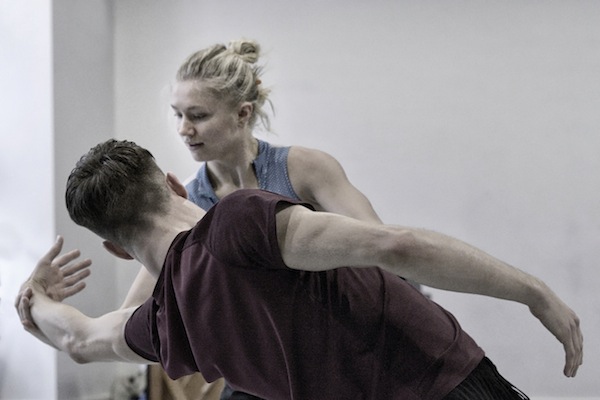
Ballet BC dancers Scott Fowler and Parker Finley in rehearsal for the company’s final program of the season, which features all Jewish community choreographers. (photo by Michael Slobodian)

Ballet BC concludes its season May 9-11 with Program 3, featuring all Jewish community choreographers: Israel’s Sharon Eyal and Gai Behar, Vancouver’s Serge Bennathan and Israel’s Ohad Naharin.

Program 3 begins with the North American première of Eyal and Behar’s Bedroom Folk and concludes with the return of Naharin’s Minus 16, a crowd-pleaser that Ballet BC presented in 2017. The middle piece, by Bennathan, is a world première, commissioned by Ballet BC.

“Emily Molnar invited me to create a work for the company,” Bennathan told the Independent in a phone interview. “That’s it. All the rest is for me to create what I want for them.”

Given that leeway by Molnar, Ballet BC’s artistic director, Bennathan said he wanted to create a work for all the dancers.

“I’m so in love with the company that I felt it will be wonderful to have them all, mostly for the kind of work I do,” he said.

“When I create work, whatever it is, for my company or another company, I always say I like to have the group of people that are strong individuals that make sense together,” he explained. “That is exactly what the company is right now. If you take Ballet BC now – individually, they are quite fantastic, each of their personalities, they’re fine, but they make so much sense together. That’s the beauty of it.”

Bennathan was born in France and came to Canada more than 30 years ago. Artistic director of Toronto’s Dancemakers from 1990 to 2006, he then came to Vancouver, where he founded Les Productions Figlio.

“My work, I would say, is quite physical, but my point of departure is to work from the energy. Not the energy being exuberant or something like that, but the energy that makes you move. So, you have to be present in the moment with your body and move from inside…. You have to find it in yourself to move.”

Bennathan has created many full-length works, both for his own companies and others, and he has a long history with Ballet BC.

“My first-ever commission was the first time I came to Vancouver. Reid Anderson was the artistic director,” he said. “I had just arrived in Canada. I was a young immigrant and I was doing work here in Vancouver and they saw my work and they invited me to create. The first-ever piece was a duet. And then, throughout the years, the invitations kept coming, so I created.”

Set to an original score by Montreal-based composer Bertrand Chénier, Bennathan shared a little about next month’s première, as well as his creative process.

“It’s [about] how do you find the form of resilience. How do you sustain that [thing] that keeps your head above water? That’s what it is,” he said of the work.

“Before I create the piece with dancers, I spend time [on my own] – I paint, I sew and I write and I explore these ideas that come to me through painting; not to paint movement … but to try to extract what it means in a poetic way. So, when I ‘write,’ in the studio with the dancers, what happens is, when I choreograph, I don’t think about the piece. I let my body talk because I believe that the mounds and mounds and mounds that I read – like, for this one, I read a lot of poetry, I painted, I wrote poetry – when I’m in the studio with them, I just let my body talk when I choreograph. And then they grab it. But this is only the beginning. After that, there is another period. I don’t want them to do exactly what I did. The movement can transform itself – what needs to stay true is the essence of why we did this movement at the beginning.”

For Bennathan, dance is more than an art form.

“I left my family quite early, I was 14 years old. Let’s say, my life was taking a direction that, deep inside me, I knew it was not the direction I wanted to take. I want to say [that] to people because, sometimes we see a lot of youth and we say, ‘Oh, you should get out of this, or you should do this …’ but the fact is, sometimes, mostly when you are young, you are taken into a spiral and you cannot get out. And, if you do not have the opportunity, or create yourself the opportunity, to lead you to someone that can tell you a word or a phrase that will change you or offer something you can open the door to, you are in a terrible situation, you cannot get out. I was able to have this in my life and … at 14, I said, ‘OK, I’m going to leave this, I’m going to Paris, I’m going to study dance, and that’s what I want to become, a dancer. This saved me, literally. I needed to do this to get out of a situation I didn’t want for me.”

Bennathan described dancers as “courageous, at all levels; not courageous just to apply themselves physically – because it’s there, they have the courage to abandon themselves into this art form – but, at the same time, to live as a dance artist. And, even more in our days, you have to be courageous, you have to have resilience.”

He said he can’t just invite talented dancers from other parts of the country to come work with him here because Vancouver has become so expensive. “Young artists or young families cannot come live here anymore. That’s the thing. And you have to be courageous to say, ‘OK, I’m going to come.’… These days, you don’t just say, ‘Oh, I’m going to live in Vancouver.’”

Bennathan believes in the power of dance, and art in general, to improve the world.

“A lot of people say ‘art can save the world,’ but why can you say that? It’s because we need the inspiration, we need poetry in our lives. Sometimes, poetry, these days, is dismissed. We so forget the importance of the inspiration of poetry in our day-to-day lives. There is a reason, not only in North America, but everywhere in the world right now … why cynicism is the most important thing…. It’s because we left all this – whether it’s writing poetry, written poetry or dance or music – we stop these art forms at the door instead of inviting them into our lives.” If we did invite them in, he said, “we would talk differently and we would start to see things differently.”

Program 3 is at Queen Elizabeth Theatre May 9-11, 8 p.m., and Ballet BC will celebrate 10 years with Emily Molnar as artistic director with a reception after the closing performance on May 11. For tickets to the performances, visit balletbc.com. Tickets for the reception are available via eventbrite.ca.

Format ImagePosted on April 19, 2019April 17, 2019Author Cynthia RamsayCategories Performing ArtsTags Ballet BC, dance, Emily Molnar, Gai Behar, lifestyle, Ohad Naharin, Serge Bennathan, Sharon Eyal
Stressed out by technology

Stressed out by technology

Elan Divon speaks at King David High School earlier this month. (photo from KDHS)

Elan Divon has found his passion and purpose in life – helping people to find their passion and to confidently fulfil a purpose that not only builds their own positive energy but also lets that energy spill out to improve the world in both small and potentially large ways.

On April 8, King David High School’s PAC hosted an evening that featured Divon, founder and chief executive officer of the Divon Academy, which, according to its website, “help[s] students and professionals stand out, and develop skills that are proven to boost their long-term success and well-being.”

He began by sharing the story of avoiding a deadly suicide bombing by sheer coincidence. Twenty years old, a soldier in the Israeli army, he had just returned home and was on a date at a café. The woman wanted ice cream instead, so they left; moments later, they heard three bombs go off, many people were killed, hundreds were injured, in the area they had just been. The experience jolted Divon onto a path of self-reflection and a search for spiritual meaning.

He went to study abroad, later quitting a Wall Street job and then studying archeology and anthropology at Brandeis University, followed by comparative religion at Harvard University.

“Since then,” reads his bio, he “has directed a peace camp for embattled Israeli and Palestinian teens; delivered countless personal development workshops to young professionals around the world, frequently presents before CEOs and business leaders; and, most recently, co-founded the Einstein Legacy Project to inspire the next generation of brilliant minds on the planet.”

Divon explained to the audience at KDHS that he feels he has found his purpose and can, therefore, live his purpose and make every moment count. He wants others to be able to do the same. He spoke about what he called a “stress epidemic” and identified five key aspects that inhibit personal growth and cause poor performance for students and adults alike.

The first factor is how much technology has invaded our ways of behaving and thinking. “Because of technology, people feel that everything needs to happen instantly,” he explained. With smartphones and constant access to the internet and apps, people find the answers they are looking for without really having to search, and they communicate with others without really having to interact.

“Our outer reality works very quickly but our inner reality takes time to develop,” he said about why this causes stress. Using the example of gestation, Divon explained how certain biological functions cannot be rushed – by technology or just because we shower them with attention. It takes time and experiences – both positive and negative – to build the necessary skills for human interaction and resilience, to be a well-rounded and confident person, he said.

The culture of comparison that dominates the internet is the second challenge. Before the advent of the internet, said Divon, a person might compare themselves to their sibling, a neighbour or the most impressive student at school. Today, we see carefully crafted virtual personae online from all over the world, and use those as a totally unrealistic benchmark for self-comparison, he said.

Next, Divon focused on the benefits that can be gained from discomfort. “Parents need to give their children space to solve their problems themselves,” he said, noting that, currently, teens can avoid uncomfortable situations by hiding behind their over-involved parents or their phones.

Social isolation – Divon’s fourth area of concern – can result from living a virtual life. Without direct personal contact, he said, people suffer all kinds of stress. Age-old ways of coping with painful situations or celebrating happy moments are eliminated by text communication. “Studies show that when good news is shared via text, it’s like it didn’t happen, even when the recipient of the text responds. Only through personal contact do people feel supported and connected,” explained Divon.

Finally, he said that overstimulation is damaging everyone. “We are drowning in information but starving for wisdom,” he said.

Divon outlined three ways to enhance happiness and purpose in life.

First, we need to have a proactive rather than a reactive mindset, he said. Using the establishment of the state of Israel as an example, Divon explained how the nascent state was able to turn a rocky beginning into a success. Rather than focus on the paucity of resources and abundance of hostile neighbours, those who established the modern state of Israel were optimistic and counted their blessings. “Being a victor over circumstances rather than a victim of circumstances is what sets people with a positive mindset apart from those with a negative one,” said Divon.

A positive mindset helps build the second key factor: relationships. A strong – real, not virtual – support group is a protection from stress, it helps most people find their jobs and determines and gives meaning to life, said Divon.

The third component to finding contentment and productivity is stress management. “Stress is resisting what is in a present moment,” Divon said. If stress is resistance and 95% of stress occurs in the mind, it is possible to eliminate or manage most of the stress we perceive in our lives, he explained. While the steps needed to manage stress are not easy, Divon said that, with practise, step-by-step, people of all ages can change their habits and develop more effective ways of coping.

Neuroplasticity is the ability of the brain to adapt and change. Divon explained that, although there are many stressors and that technology is often our foe instead of our friend, we can all develop new pathways in our brain. We can enhance the quality of energy we possess and make ourselves and those around us happier.

Michelle Dodek is a freelance writer living in Vancouver, and the mother of a 12- and a 13-year-old.

Format ImagePosted on April 19, 2019April 17, 2019Author Michelle DodekCategories LocalTags Elan Divon, KDHS, King David High School, lifestyle, parenting, technology

Posts pagination

Previous page Page 1 … Page 19 Page 20 Page 21 … Page 24 Next page
Proudly powered by WordPress