Skip to content
  • Home
  • Subscribe / donate
  • Events calendar
  • Business Directory
  • FAQ
  • News
    • Local
    • National
    • Israel
    • World
    • עניין בחדשות
      A roundup of news in Canada and further afield, in Hebrew.
  • Opinion
    • From the JI
    • Op-Ed
  • Arts & Culture
    • Performing Arts
    • Music
    • Books
    • Visual Arts
    • TV & Film
  • Life
    • Celebrating the Holidays
    • Travel
    • The Daily Snooze
      Cartoons by Jacob Samuel
    • Mystery Photo
      Help the JI and JMABC fill in the gaps in our archives.
  • Community Links
    • Organizations, Etc.
    • Other News Sources & Blogs
  • JI Chai Celebration
  • JI@88! video

Recent Posts

  • SFU honours Gloria Gutman
  • Lifting people’s spirits
  • Wedding a ray of light
  • Indigeneity and Zionism
  • Rule of law broken: councilor
  • Football and its roles
  • The burden of defence
  • Fish Café returns after fire
  • All right in what goes wrong
  • Nuns & mermaids at TUTS
  • Camp offers holiday retreat
  • Students and mentors inspire
  • Once-in-a-lifetime trip
  • 100 dancers, one heart
  • Money for the sciences
  • What “Jewish food” means
  • Have a cookie, schnitzel too
  • Federation now across BC
  • Israel fighting for its existence
  • Deal strengthens Iran
  • Patriotic belonging diminishes
  • A campaign to engage
  • Upstanders’ first live event
  • Responding to Carney
  • Having your own home
  • Music a family tradition
  • Musical to warm heart
  • Community milestones … June 2026
  • Sharing her passion for Israel
  • Or Shalom reopens its doors
  • JFS from past to future
  • Need holistic approach
  • Sharing stories, advice
  • Journalist shares fears
  • Skills to live together
  • Road to independence

Archives

Follow @JewishIndie
image - CJN box ad Rockowers 2026

Tag: lifestyle

Canada is not “broken”

An opinion poll released last week indicates that 52% of Canadians agree with the statement that our society is “broken” – a spike of 15 points over three years ago – while just 19% of respondents disagreed with the statement.

The poll, conducted by Ipsos and provided exclusively to Global News, also suggests that two-thirds of respondents believe the economy is rigged to benefit the rich, while 61% agreed with the statement that “traditional parties and politicians don’t care about people like me.” Commentary provoked by the poll has focused on the portent these results have for a surge of populist parties or ideas in the coming federal election.

It should not be a surprise, perhaps, that people think the economy benefits the rich or that politicians have at heart the best interests of people other than little-old-us. We have been complaining about our politicians since the profession was invented and probably every one of us, no matter where we fall on the income scale, thinks we’d be doing better economically if it weren’t for some systemic force or policy that prevents us from getting ahead.

The really provocative result in this poll is the perception apparently held by more than half of Canadians that our society is broken. Admittedly, the question is ill-formed. What does “broken” even mean in this context? Regardless, the idea that we live in a broken society probably says more about the individual respondents than it does about our society as a whole. Canadians are among the most privileged, advantaged, wealthiest, healthiest and least oppressed people in the world. With some grievous historical and contemporary exceptions, Canada is one of the most egalitarian societies on earth.

We may dislike our politicians or have misgivings about this or that development, but for a poll to suggest that half of Canadians think this is a broken society makes us wonder if we are a country of naïve and entitled people. It would be instructive for Canadians who feel this way to take an eye-opening trip almost anywhere else in the world.

This is not to dismiss the very real cases of injustice, inequality or other systemic problems our country faces, but this poll indicates that half of Canadians don’t have the faintest idea how fortunate most of us have it here.

It also creates the potential for some very concerning political consequences. If Canadians march into the polling booth next month certain that this is a broken society, it is anyone’s guess what kind of ideas they might be willing to support to “fix” it.

Posted on September 13, 2019September 10, 2019Author The Editorial BoardCategories From the JITags Canada, elections, lifestyle, politics, survey

Apple-picking and tzedakah

My family helped pick a neighbour’s apple tree on Labour Day weekend. It was heavy with fruit. I love this activity, as it connects us viscerally with the changing season. It also connects with the beginning of the Torah portion Ki Tavo (Deuteronomy 26:1-29:8). This portion instructs the Israelites to give some of their first fruits to the priests for the divine altar and, also, to give 10% of their harvest as a tithe, for those who are less fortunate.

Even though we make applesauce, apple chips, apple crisp and eat lots of fresh apples, we always pick more than we can use. It gives us a chance to interact with our neighbours and to help elders who need help cleaning up their yards. It also gives us a way to make a physical donation to those who might need it more than we do.

Each year, we choose places to donate the apples. This year, we made a visit to Chabad and dropped off apples. We know the Torah Tots preschoolers might like apple slices or applesauce. (My kids were once those preschoolers and remember snack very well!)

We also dropped off apples and visited a friend of ours. He works at the Welcome Home, a Ukrainian Catholic mission house in the North End of Winnipeg. Welcome Home works in part as a food pantry, offering weekly hampers and meals to the hungry. It also provides places for kids to play, people to gather and worship, and access other supports. It’s housed in a big old building that used to be a duplex. It was originally built as a rooming house for the new immigrants. The house was quiet on a weekday, only receiving occasional donations when we visited. However, you could almost hear the bustle of a weeknight dinner for the community, or the single immigrants or whole families who lived in these small rooms long ago when they first arrived in Canada.

I’m not mentioning this to boast of our tzedakah (charity) activities. I’m suggesting that, for many working families, donating 10% of their salaries doesn’t seem like a financially realistic goal. What about donating actual produce? That was something we could do. A few hours of apple picking and sorting seems like fun for my household, but the food is also meaningful. If we don’t pick it, in many yards, it’s left to fall and rot on the ground.

Community involvement is a way for us to show our gratitude when we feel blessed and lucky to be alive, but the involvement doesn’t have to be formal. We don’t all have to serve on a committee or make large, tax-deductible donations. It can be simpler than that. This past summer, my kids took swimming lessons at a lake and we often stopped for ice cream on the way home. The place where we bought ice cream had a tin on the counter. They collected change to support the food bank. So, each kid was handed change to donate. You get ice cream after a swimming class and you’re grateful. Give back.

This lesson can be extended further though. Part of the apple-picking exercise, the awkward part, might be knocking on your neighbour’s door. Yet, this is when you might learn your neighbour just had hand surgery, or was now too physically fragile to be able to pick up the fallen apples. It’s a chance to make informal and meaningful connections with others.

No matter how functional (or dysfunctional) our infrastructure is, government financial supports or provincial services don’t always manage to meet essential needs. This is when we can do more by reaching out to others who live nearby.

Rosh Hashanah, our new year, is an opportunity. We think about how we can do better and start anew. In many ways, this yearly “check-in” is our chance to reflect on how we can make more of a difference. Sometimes, if you’re lucky enough to have more than you need, it’s easy and very important to donate money. Perhaps you can sponsor a Jewish activity, a needed renovation in the Jewish community or support a project to increase the capacity of organizations that offer services to those in need.

For many of us, though, our commitment to helping others happens in a more modest way. It might be a dime dropped into the pushke (collection tin) or finding a way to feed others. It might be picking apples or donating an extra can of tuna to the food bank. It could be volunteering to help a new mom so she can take a shower while you watch the baby. It’s offering another working parent a play date so that he or she doesn’t have to pay for child care.

We can all invest more in helping others. Let’s be grateful for what we have by trying to give a bit more of ourselves and our labours to others who might need it this year. It’s the right thing to do.

My family and I wish you a very sweet new year, full of good health and lots of apples and honey.

Joanne Seiff has written regularly for CBC Manitoba and various Jewish publications. She is the author of three books, including From the Outside In: Jewish Post Columns 2015-2016, a collection of essays available for digital download or as a paperback from Amazon. See more about her at joanneseiff.blogspot.com.

Posted on September 13, 2019September 10, 2019Author Joanne SeiffCategories Op-EdTags charity, family, Judaism, lifestyle, tzedakah

Concern over what to share

For many of us, it’s the beginning of the year. Not the year that starts with Rosh Hashanah. I mean, the academic year. If you’re a student, a student’s parent or a teacher, professor or other education professional, the beginning of September can mean only one thing. It’s time to get back to the grind.

This is both exciting and a nerve-racking time. You want people to like you and appreciate your skills, talents and special gifts. You want to feel welcome and make others feel welcome, too. Seeking approval is an important part of life. We all do it, right?

As overachievers, my husband and I try to start early. He mentioned that some new colleagues were moving in down the street at the beginning of August. They were moving from another country, so we should try to help, we figured. The wait for one’s belongings to arrive and pass through customs can be awhile. (For us, it took 10 days.)

My husband was out of town when they arrived, so I sprang into action. We loaned them a picnic basket filled with dishes, silverware and cups, some patio chairs and, when they asked, even a broom and dustpan.

A few days later, my husband home, we enjoyed a Saturday together out in the sunshine. When we checked our email again, we found that our new neighbour had asked us to loan more items. We apologized, but explained we weren’t usually online on Saturdays. “Oh!” she replied, “Do you do a tech Sabbath?” I had to look this up, but this term was coined in 2010 by Tiffany Shlain, an internet pioneer, and her husband, Ken Goldberg, a robotics professor. It is based loosely on the notion of unplugging from technology on a traditional Sabbath.

I was flummoxed. There seemed to be no nice way to say, “Uh, no, I do real Shabbat.” So, I thought, OK, I will try to explain. I said something like: “In the safety of Canadian diversity, we observe real Shabbat, not just ‘tech Shabbat.’

“We are Jewish and try to take the day off from Friday night to Saturday night. So, we have a big family dinner on Friday nights, we go to synagogue on Saturdays many weeks and we spend the day together, sometimes with friends. However, if you need to reach us, you can always call the landline or walk over and knock on the door. We use the phone when necessary, drive, turn on lights, etc. We are not very strict in our observance; sometimes, we spend the day as a family outside, at a farm or doing an outing together. We just try to rest and not to work.

“We hope your belongings will arrive soon!”

Her response? I kid you not – she said, “Thanks for sharing.”

I felt completely uncomfortable and embarrassed. This was from a new neighbour, someone to whom we offered the loan of various items and tried to welcome. I left it there, I had nothing else to say. My partner was somewhat more hopeful, that perhaps they were just clueless. He tried to explain how hard it is sometimes to be a minority in this way.

In the end, I realized that this fit right into the “new school year, new school experience.” Many of us are seeking approval from peers, colleagues, family members and friends. We jostle and jockey for position. We want others to admire us or, at the least, accept who we are. Then, in an effort to bond or make connections we maybe overshare with people who couldn’t care less.

At the start of the new school year, I’m often keen to make new connections, but it would have been altogether possible for me to say nothing about who we were or why we weren’t online on Saturdays. We might even have saved ourselves the trouble by not offering to loan things in the first place. However, in the interest of being welcoming to strangers and reaching out to make friends, I ended up feeling embarrassed and self-conscious rather than proud. I didn’t like it.

Before I moved to Canada, I lived in the southern United States in a place where I had good reason to feel wary about revealing too much about my religious life. We knew it could be an issue; it wasn’t an especially tolerant place.

Based on recent news events – a swastika painted on a car in a Winnipeg neighbourhood, an election scheduled for Shemini Atzeret – I have to conclude that maybe it’s time to be more careful here.

Sadly, for the first time in 10 years in Canada, I’m wondering if I would have been better off to keep my Jewish practice to myself, and reveal less. Maybe if I were hip, I’d be considering a tech Sabbath, but no. I’m connected to something that’s perhaps less popular, but a lot deeper. Sometimes, sharing this is important, even if it isn’t always the cool answer.

Joanne Seiff has written regularly for CBC Manitoba and various Jewish publications. She is the author of three books, including From the Outside In: Jewish Post Columns 2015-2016, a collection of essays available for digital download or as a paperback from Amazon. See more about her at joanneseiff.blogspot.com.

Posted on September 6, 2019September 4, 2019Author Joanne SeiffCategories Op-EdTags antisemitism, Canada, Judaism, lifestyle
Belong at Bayit and beyond

Belong at Bayit and beyond

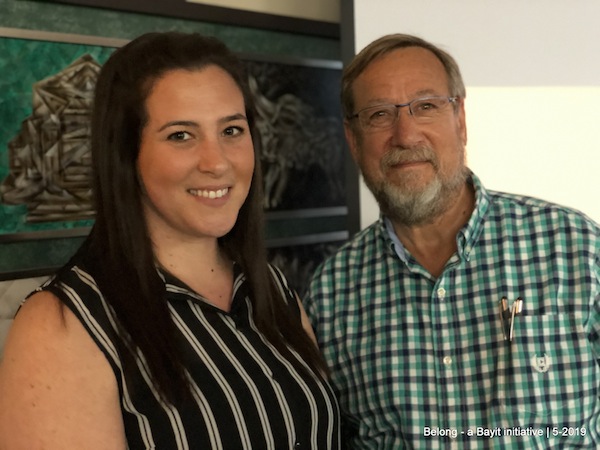
Shira Sachs and Dan Shmilovitch at the Bayit’s Belong launch May 12. (photo from facebook.com/thebayit)

Earlier this year, the Bayit in Richmond launched Belong. The goal of the program is “to create a community where belonging grows and isolation disappears.”

Belong was developed by a committee of six Bayit members: Mel Bauer, Matti Feigelstock, Shelley Goldberg, Shira Sachs, Dan Shmilovitch and Rabbi Levi Varnai.

“There are people that you know you should be connecting to, [or] they should be connecting to you as an organization, but, for whatever reason, they’re not. So, we started talking about how we could address that issue as the Bayit,” explained Shmilovitch, who has been active in the Jewish community for more than 30 years.

There is never just one reason why people feel isolated, he said. “People are isolated for a whole range of reasons – health issues, economic circumstances, mental health issues, maybe they are recently widowed or divorced.”

It is easy to assume that Jewish communities are inherently so strong as to make isolation impossible, but this is not the case. Shmilovitch spoke of the need for “deepening Jewish connections … because isolation is a huge problem in every community and it affects the Jewish community as well, for all age groups.”

There are challenges in combating isolation. “As a Jewish organization, as a synagogue, you’re always looking to invite people in,” he said. “But, when you have people who are isolated and really disconnected, your approach has to be different to get that connection because that’s not their mindset. At that moment in time, that’s not where they’re at.”

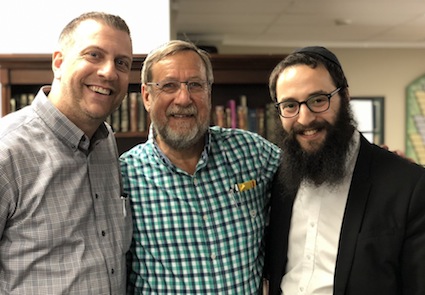
photo - Left to right: Mike Sachs, Dan Shmilovitch and Rabbi Levi Varnai at the Bayit’s Belong launch May 12
Left to right: Mike Sachs, Dan Shmilovitch and Rabbi Levi Varnai at the Bayit’s Belong launch May 12. (photo from facebook.com/thebayit)

The Belong committee started their planning by examining the obstacles that prevent people from making contact. There is more to being a community member than simply going to shul, explained Sachs, who is a teacher at Vancouver Talmud Torah.

She noted that people can still feel “uncomfortable or isolated” attending social gatherings outside regular services. She talked about how loneliness has a profound effect on a person’s health and can lead to depression. Using her own childhood story as an example, she described arriving in Canada when her mother, now deceased, was pregnant with twins; Sachs is the oldest of four.

“Community became so important to us,” she said. “We didn’t have the language and, within a couple of months, we went from a family of four to a family of six. My mom was a new mother in a new country, with twins.”

Going to shul helped the family make connections, learn about which schools the family wanted for the children. As a parent herself now, Sachs described how this ethos has shaped her own approach to family life. “When we came back from L.A., it was the number one thing to do – find a community and slowly grow with it. Now, how do we do that for others?”

The Belong committee determined multiple strategies for community development, the first of which was through Friday night dinners. The Belong team sought Bayit members who were willing to invite people to meals at home. They also reached out to Jewish Family Services for help locating people in Richmond who needed help.

“If you have a lady who is a single parent, you match them with another single parent,” said Sachs. “If you have a person who is passionate about literature, you sit them with someone who has the same passion. It was all assigned seating.” She added, “It’s comforting to know, ‘I don’t have to worry about that.’ Maybe that anxiety is why people haven’t come to a dinner.”

Belong is also working to offer food deliveries to families in need. “Food security is an issue in the Jewish community,” said Shmilovitch. The program has been running for awhile now but he hopes that deliveries will become more frequent in future.

“There are vulnerable people in the Jewish community – whether they don’t have enough food, feel isolated for a short time or in the longer term. Regardless, it’s hard to come out at the other end. That’s what drives us.”

In addition, Belong has created a support structure for new mothers. Inspired by and in partnership with Mamatefet, a support organization for Hebrew speakers in Vancouver, Mama Belong will work to diminish the feelings of isolation that often follow the birth of a baby. (See jewishindependent.ca/mothers-embrace-mamatefet.) Mama Belong started delivering baskets to Jewish mothers this summer.

The future of Belong came into focus at the May 12 launch. Current members of the Bayit were invited to learn about the new program. Guests were given a card with tear-off tabs that suggested a wide range of ways in which people could contribute, including hosting Friday night dinners, Russian language conversation groups and cash donations, among other ideas. Between 90 and 95% of the attendees folded over a tab.

From Mama Belong to food bank deliveries and Shabbat dinners, the program is striving to create a warm sense of community for those in need. “You never know what’s going to happen at what point in your life,” said Shmilovitch, but “something’s going to happen to connect you.”

Shula Klinger is an author and journalist living in North Vancouver. Find out more at shulaklinger.com.

Format ImagePosted on August 23, 2019August 22, 2019Author Shula KlingerCategories LocalTags Bayit, Dan Shmilovitch, Judaism, lifestyle, Shira Sachs, tikkun olam
Enter focaccia, stage right

Enter focaccia, stage right

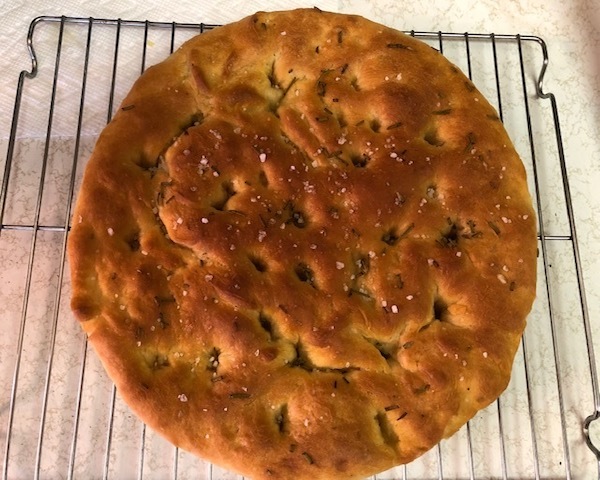
Focaccia straight from the oven. (photo by Shelley Civkin)

Ladies and gentlemen, start your engines, please. Or, in this case, your yeast. From zero to focaccia in one hour.

My unpremeditated transformation from water-burner to bread-baker is shocking even to me. Or especially to me. When hubby Harvey came home one day with a cast-iron pan, I got über excited, thinking I could now fry like my father used to. Though, when frying became a dirty word in the 1990s, he called it sautéeing. But, somehow, sautéeing seemed too prosaic for the mighty cast iron, so I started investigating what else I could do with the skillet.

Thanks to Google and Pinterest’s cookies, they now know that I like baking bread. I automatically get links to recipes for cast-iron bread-baking. Every. Five. Minutes. Enter focaccia, stage right. Or, if you’re Italian … entra nella scena della focaccia a destra.

I perused the myriad recipes and took a few of them on a test drive. Or test bake, as it were. The following recipe overtook the others by a mile, and won in the finest focaccia category. Here’s a link to the winning One-hour Rosemary Focaccia Bread I’ve come to love: flavorthemoments.com/one-hour-rosemary-focaccia-bread. (It actually takes an hour-and-a-half, if you include the time it takes to preheat your oven.)

It’s my go-to quick bread recipe. It’s truly no-fail. Feel free to ditch the garlic and Parmesan, or add more rosemary. You can’t screw up this bread. After my first try, I was hooked. I let the gorgeously golden focaccia cool, sliced it into small rectangles, like they do in Italian restaurants, and dipped it in EVOO (shorthand for extra virgin olive oil). Which made me wonder what an “extra virgin” is? Something to ponder another time. Never mind. Not relevant. Anyway, I’ve made this focaccia several times. Needless to say, I am not getting thinner. But my Italian is improving.

Now that I’ve pretty much nailed down challah and focaccia, I decided to branch out and try making a no-knead round crusty bread. You know, like sourdough. Minus the sour. The kind that requires you to have a Dutch oven. Google and Pinterest are way ahead of me, so they’ve been sending me nonstop recipes and pix of Dutch oven bread. All I had to do was think about crusty bread and they were on it.

I recently learned that not all Dutch ovens are created equal. They’re mostly made from cast iron covered in enamel, but not all of them can withstand the high heat you need to use. Thing is, for crusty bread, you have to heat the Dutch oven to about 450 degrees – empty. Then you put the dough in it. You don’t want to ruin a fancy shmancy Dutch oven over a loaf of bread. Even though my Dutch oven isn’t one of those $400 Le Creuset ones – it’s a $65 one from Costco, which works perfectly for pot roast, chicken and everything in between – I’m loathe to risk ruining it over bread. Sure, I could go buy one of the fancy Dutch ovens but, seriously, $400 for a crusty loaf? Not in this lifetime. I worked too hard to fritter my money away like that. And, like I always say, just because you can afford to buy something, doesn’t mean you should.

So, I improvised and used an ancient Magnalite aluminum-magnesium alloy Dutch oven that belonged to my friend’s late mother. I’m hoping I don’t get Alzheimer’s, what with the aluminum connection, but it’s not like I’m going to be making every single meal in it. Anyway, the bread was a marginal success. The outside looked gorgeously crusty but, once I cut into it, parts were doughy and uncooked. Bake and learn. I’ll try it a few more times, tweaking the temperature, increasing the rising time, etc., and hope for the best. If at first you don’t succeed, well, suck it up and try again.

I can hear some readers wondering why I would want to waste half a day baking bread from scratch, when I could just go out and buy a loaf. Well, there’s something indescribable about the smell of fresh baked bread wafting through my home. It’s a little like a comestible aphrodisiac. It makes me weak at the knees, thinking about the butter melting slowly over the hot bread, as I sniff it lovingly with anticipation. Wait, this is becoming a little X-rated. I need to get a grip. Sorry. Suffice to say that my husband and I adore fresh bread and appreciate the effort it takes to make it. And, since I’m a notorious multi-tasker, I busy myself with other things while the dough is rising, so there’s no wasted time. Like now, for instance. I’m writing this article while waiting for my rosemary and Kalamata olive bread dough to double in size.

Never having been one to let grass grow under my feet, my next culinary foray will be gravlax. Ever since tasting my friend Roxanne’s heavenly gravlax last Pesach, I’ve been itching to give it a go. Since salmon season is upon us, there’s no time like the present. Harvey’s on board too, but not as a cook as much as a taste-tester. From what I can tell, it’s a ridiculously easy thing to make, as long as you have truckloads of salt, sugar, dill and time. No, not thyme. Once I perfect the recipe, I’ll share it with you. But not until then.

You can try till you’re blue in the face to convince me that store-bought food is just as good as homemade, but I’m not buying it. Literally or figuratively. There’s just something about the laying on of hands, the investment of love and effort, and the satisfaction at the end of it all, that makes homemade food so very worth it.

I suspect I might have made a very dedicated homesteader. As long as I had an electric stove and oven, and a good refrigerator. Oh, and maybe somewhere close by where I could get a good decaf, low-foam, lactose-free latte while I was growing my own food, baking bread and churning butter. Am I country girl at heart? Hell, no! I am about as cityfied as they come. To wit, my idea of camping is a Motel 8. And outhouses? They should be outlawed.

Enough said.

Shelley Civkin, aka the Accidental Balabusta, is a happily retired librarian and communications officer. For 17 years, she wrote a weekly book review column for the Richmond Review, and currently writes a bi-weekly column about retirement for the Richmond News.

Format ImagePosted on August 23, 2019April 2, 2020Author Shelley CivkinCategories LifeTags Accidental Balabusta, baking, bread, challah, cooking, focaccia, lifestyle

Looking forward, back

Kierkegaard Kierkegaard Kierkegaard Kierkegaard Søren Kierkegaard once observed that we begin life by only looking forward, and end by looking back to understand it. The existentialists leave me cold with their nihilism and I find their approaches hard to digest, but I consider Kierkegaard’s comment very much an accurate description of life’s dynamic.

I can remember how my early thoughts were very much about what my future was going to look like. In my mind, all my presents were events that I would have to get through to get to the really important stuff. I knew we had to put up with living with the people we found ourselves tied to by the happenstance of birth. We had to follow the rules we learned from those around us to traverse this period, but our secret focus was on the future, on that time when we would be able to organize our world in a way it would better serve us.

Yes, we had to do what we were told. Yes, we sometimes formed attachments because it was expected, and even convenient. Yes, there were programmed behaviours that had to be followed faithfully. But we knew, didn’t we, that the real stuff would begin when we were in a position to be fully in charge. It sounds bloody-minded now, but those were really my thoughts. All I was living through at the time was just the price of admission, wasn’t it?

And the school years. Were we really going to need all this knowledge we were cramming? Everybody knew that this material was ancient history and that the real world was going to make it all irrelevant. Were any of the teachers people we could respect? I was cleaning out the shelves of the library with the books I was reading. That’s where my education came from, from the stories of real lives that people were leading, that people had led. I was finding my heroes there, and imagining the wonders I would realize when I finally broke free. Until then, I knew to play the game, do the work, pass the exams, collect the admission cards I was going to need. There was the brightly shining future ahead of me. I would accomplish wonders!

Then, there I was. Off on my own. Now I would remake the world. But I was a father, supporting a family. And the “membership cards” I had earned were the only things I had that were going to help pay the bills. I could see then that the stories I told myself and that I read in the library were just fairy tales – the parent who slogged away at work for many years to support us was the model I was going to have to follow. And the parent who took care of my creature comforts was the one who taught me I was valuable and that I could accomplish whatever I set my mind to. And the family members I took for granted were the only ones in the world who took me at face value, no questions asked.

Could I measure up to the hero I believed I was? Could I leave a mark, or marks, that would have the kind of impact I had always assumed I would realize in my life’s work? I am now looking back and trying to understand. I am looking back to appreciate what I have come to believe are the things that have value, and which may have escaped me when I was so focused on looking forward into the glare of a bright future.

I am evaluating what I offered, what I left for the generation I helped usher into the world. When they were able to free themselves from the burden of my stewardship, did they come away with anything that proved useful to them for their lives? I hope so. It was something I didn’t appreciate enough in my growing up.

I am evaluating what I offered, what I left to others, as I was serving to glorify my own image to myself. Am I satisfied that, while I was seeking to realize the potential I believed I had, some of the things I accomplished also helped others? I hope so. That was at the heart of the fairy tales I dreamed for myself when I fantasized about the future all those years ago.

What I now appreciate is how radically the looking-forward person I was has been altered by the living experience. The inexplicable arrogance and self-indulgence of the creature who was cast forward into the world is revealed and, looking back, he has learned to eat and relish humble pie.

Hopefully, we learn how much of what we earn for ourselves in life flows from the generosity of others, in the form of love, attention, time and materials. Hopefully, we learn that, if we are to be happy, we in turn have to be willing to share what we have to offer. Hopefully, we become eager to share, if only to taste the psychic rewards such actions yield.

Nowadays, I spend my time looking back, trying to understand my life more fully. Am I that much different from you?

Max Roytenberg is a Vancouver-based poet, writer and blogger. His book Hero in My Own Eyes: Tripping a Life Fantastic is available from Amazon and other online booksellers.


Posted on August 23, 2019August 22, 2019Author Max RoytenbergCategories Op-EdTags Kierkegaard, lifestyle, memory, philosophy

Exchange of missiles

It is May 4, 2019. I am at my desk. It’s early Saturday. I’m catching up on some work. Morning sound in the background. Israeli-style. Siren in the distance. Kind of a weird sound. The way chirping birds and wispy winds comprise morning sound elsewhere.

I didn’t really connect with the siren’s eeriness. Was too deep into Excel and emails. Then my daughter darted from her room. Smartphone in hand. (Do they sleep with these things?) “Don’t you hear it? There’s a siren. But my newsfeed says it’s elsewhere.”

“OK, let’s go to the protected room,” I said. Somewhat controlled. Somewhat alarmed.

We woke everyone up. My wife. My son and his girlfriend – banging on his bedroom door, “Move it!”

Last siren heard in Rehovot was during Protective Shield in 2014. My son just 16. And sleeping alone. So much has changed. And so much has stayed the same. This Gaza quagmire, to whit.

We congregated in our den-cum-protective room. Shut the re-enforced glass window – a heavy screech. Closed the too-heavy steel door – a loud bang. Turned on the TV – 90 missiles slamming into Israel’s south. Our hearts and mouths dropping. The bang of our Iron Dome hitting the missiles overhead. All clear. We can come out. Morning sound.

Singing about Bobby McGee, Janis Joplin crooned, “Freedom’s just another word for nothin’ left to lose.” And the Gazans have nothin’ to lose. They live in worse than miserable circumstances. Another war. Another round of missile exchanges. It really has no impact on their miserable living standards.

In Israel. We have too much to lose. The upcoming Eurovision – in two weeks – comes to mind. If we go to war now, or launch a massive retaliatory strike leading to counter-strikes, it risks the wonderful success of Israel hosting this international event. Ten thousand visitors. Ten million dollars in revenue. Excellent public relations. Fun. Lightness. Celebration. In Israel, it’s never a good time for war. Always something to lose.

But I think Janis was singing more about drugs, sex and rock ’n’ roll. Here in wonderful Israel the reality – like our morning sound – is a bit harsher.

Sunday, May 5

Morning

A restless night. Even for those lucky enough to live far from the Gaza periphery. Distance is so relative here in tiny Israel.

Woke up several times to check my smartphone – news updates. (Even we adults sleep with those things.) More than 300 missiles fired. One Israeli casualty after a missile struck his house.

Schools canceled within a 40-kilometre radius of Gaza. We live 45 kilometres away; missed the limit by five kilometres. Before Roni went to school, I grilled her on the basics of dodging missiles. She passed. Although there was some ambiguity about when to leave the protective room. “What if there’s no boom, Dad?” (i.e. The missile is shot out of the sky by the Iron Dome.) “Improvise, kid,” was my best answer.

Evening

Another 200 or so missiles fired at Israel today. They aimed for my place again. And missed. Bastards! Dor called me at work from our protected room. Roni texted me from school. Everyone OK. It’s hard being far away. Again, distance is relative.

A factory hit in Ashkelon. Two killed. WTF! And a moving car hit by an anti-tank missile. Driver killed. Again, WTF!

As I write this, lots of booms in the background. Wife and kids looking out the window. Watching the missiles. And the anti-missiles. A sound-and-light show. Happening in the neighbouring cities. Far away.

Some shock here. I must admit.

Monday, May 6

Ceasefire. Gaza has Ramadan. Israel has the Eurovision. A temporary respite for both sides.

We certainly wreaked havoc in Gaza. Two hundred and sixty high-value targets destroyed. But looking for something a bit more definite. Like victory in six days. Like a spectacular comeback. Like Entebbe. Like knocking through walls. Like encircling the Mukata. Of late, just too many broken ceasefires.

To paraphrase Golda Meir – until the Palestinian leadership loves their children more than they hate ours, only a decisive military victory will create peace and quiet. Or at least quiet.

Celebrating 71 on Thursday. Will raise our flag high and eat lots of hummus and kabab.

Regards from Israel, Bruce.

Bruce Brown, from Winnipeg, lives and works in Israel. His first Israeli home-front diary of life in times of national stress and war, “The draft: a dad reflects,” which was published in the Jewish Independent last year, placed first in the personal essay category of the 2019 American Jewish Press Association Simon Rockower Awards for excellence in Jewish journalism.

Posted on July 19, 2019July 18, 2019Author Bruce BrownCategories Op-EdTags Arab-Israeli conflct, Gaza, Israel, lifestyle, safety

Happiness thoughts

Summertime and the living is easy! Of all the seasons, probably summer is most closely associated with happiness. Vacation, camping, family time, celebrations, picnics: these are activities that we associate with happiness.

In Western culture, individual happiness is often considered the primary goal of life. What parent hasn’t begun a sentence with, “As long as you’re happy…”? In many other societies, happiness is subordinated to family needs, communal obligations or other less individualistic pursuits. But the pursuit of happiness has a long history in Western culture, codified most notably in the United States Declaration of Independence as an “unalienable right.”

Most of us probably enjoy our happiness without overthinking it. But an Israeli guru of happiness will be in Vancouver later this month and he has thought a great deal about the subject.

Prof. Yoram Yovell is a brain researcher, psychiatrist and psychoanalyst with a PhD in neurobiology. He is the author of bestselling books and is a regular face on Israeli TV.

The United Nations ranks countries on a scale of happiness, topped by the Scandinavian countries, Switzerland, the Netherlands, Canada, New Zealand, Australia – and then Israel.

For people who have not been to Israel or who lack an understanding of its culture, it may be a surprise to find that a country whose history has been so wrapped up in violence and conflict would produce a population that is collectively as happy as almost any society in the developed world. There is, however, an explanation.

Stability, basic freedoms and an economy that allows for individual financial comfort or success are among the baseline requirements for societal happiness, notes Yovell. Things like clean water, a social safety net and an effective, accessible healthcare system are also on the list. In many cases, it is also critical to have a sense of cohesion and shared purpose.

While Israelis may no longer be as united as they were in the days of the early chalutzim, the requirement of military or national service plays a factor in building social cohesion and making individuals feel part of a larger whole. For many, the ability to live in the world’s only Jewish state is another factor that leads to shared purpose and, indirectly, to happiness. (It is worth noting that, although Israeli Arabs report being less happy than Jewish Israelis, their happiness levels are higher than Arabs in neighbouring countries.)

Economic challenges in Israel – inflation, high cost of living and such – do not ultimately have a huge influence on happiness levels, Yovell maintains. Once the most basic needs are met, incremental differences in income or GDP have little impact.

We could all take some time this summer to reflect on the things that make us happy. In so many cases, the things that make us happy are precisely the things that make our society better – volunteerism, engagement and participation in our community, getting outside (especially if it’s sunny!), spending time with family and friends. These are things we could all do well to be more conscious of, be grateful for and try to consciously encourage in our lives.

Posted on July 12, 2019July 10, 2019Author The Editorial BoardCategories From the JITags happiness, Israel, lifestyle, science, Yoram Yovell
Maturation entails practice

Maturation entails practice

There’s a funny story from when my husband and I were first married. We were in graduate school, but I had returned to grad school after teaching in Washington, D.C., inner-city high schools. I discovered that my husband and his friend Lou, one of his school lab mates, were regularly going out to eat fast food. Worried for his health and our budget, I let my new husband and our friend know that he was absolutely “not allowed” to be doing this. It was bad for them! My high school teacher tone was threatening and both guys heard me loud and clear.

Lo and behold, later, they walked past the student centre’s Burger King. And guess what? As Lou describes it (to this day), “WHOA!… She shut down Burger King!” Both believed that perhaps I had this huge power. I had jokingly let them think that I could shut down Burger King, all on my own. Sometimes, for our own best interest, we need to be told what to do.

The Torah portion Chukat, Numbers 19:1-22:1, is full of practical advice about how to deal with challenges in life, including food, death and sacrifices. There’s information about how adults should clean themselves, change clothing and do other ritual routines, such as those around deaths, which could prevent the spread of disease. Yet, there are complainers who forget to be grateful even about food, as when, in Numbers 20:5, the Israelites say, “Why did you make us leave Egypt to bring us to this wretched place, a place with no grain or figs or vines or pomegranates? There is not even water to drink!”

Then, there are divine-inspired miracles, like when Moses struck the rock (twice) and the water appeared.

There is a medical term called “dysregulation.” It means something may not be “normal,” but it could be part of a metabolic physiological or psychological process. So, a person can be physically dysregulated (klutzy or clumsy) or emotionally dysregulated (unable to respond with socially appropriate emotions). Dysregulation doesn’t come from one thing. It’s a general term. It means, this is abnormal and maybe the person is impaired by it. It’s something to be aware of and to work on.

Those who struggle with dysregulation may mature or become stronger than average and successful because of how hard they work to function “normally.” An example might be adopting an older animal-shelter dog. When I’ve adopted these dogs, sometimes they are already adolescents but lack basic training or manners. Through consistent, daily practice, they become good at the few obedience commands and behaviours I expect. When both my dogs sit on command at a street corner, a bystander, perhaps with an unruly dog, might say, “Wow! That’s amazing! How did you do that?”

I smile. The answer is something like, “Well, I’ve been asking these dogs to sit at every street corner every morning for the last six to 12 years.” With a lot of practice, my older shelter dogs grow and learn. They are every bit as amazing as a pedigreed puppy someone bought. It’s a maturation process, and it comes with years of practice and the assumption of responsibility.

In this Torah portion, there is the strong narrative voice and actions of G-d, telling the people what is expected of them, and pointing out where they may have faltered or failed. In effect, the impairments faced by people who used to be slaves have to be overcome. The people have been in a state of imbalance because of their traumatic experiences. Overcoming that dysregulation means healing, finding maturity and a reliable path forward.

All of this doesn’t happen overnight. We can’t do it alone. I know about dysregulation through reading about it in medical reports. Yet, through consistent learning, maturation and hard work, humans (and animals like shelter dogs) can overcome many things. This is a process. It’s a “two steps forward, one step back” narrative.

I was reminded of this issue when I recently visited a newly renovated grocery store. While the layout looked complete, the cashier said there was a mountain of work still to be done in the warehouse. Even the employees, on close inspection, were out of sync. I watched a manager willing to give a locked cart to a shopper for free rather than make change. Meanwhile, another manager shooed away a person down on his luck who was asking for change or food. There was a huge amount of new and fancy food on display but the food bank bin was nearly empty.

The store boasts of being community-minded, but it was dysregulated. They’d lost their way. Just as in the Torah, nobody, not even Moses, is perfect – he shouldn’t have hit the rock twice. Nobody should complain about the lack of figs or pomegranates – but we’ve got shortcomings. We’re all in the process of becoming something more.

Growth comes through many paths. Sometimes, in order to cut back on the fast food, you need a scary commandment from your new spouse! On more important matters? There’s an important divine voice. It’s a series of small, ritual, self-regulated steps that shape us into being our best selves.

Joanne Seiff has written regularly for CBC Manitoba and various Jewish publications. She is the author of three books, including From the Outside In: Jewish Post Columns 2015-2016, a collection of essays available for digital download or as a paperback from Amazon. See more about her at joanneseiff.blogspot.com.

Format ImagePosted on July 5, 2019July 3, 2019Author Joanne SeiffCategories Op-EdTags Judaism, lifestyle, Torah

Being positive can be hard

My Southern friends and family often joke, “The Lord works in mysterious ways.” This morning, I wondered what I would write for this column. I was walking dogs in the sunshine and things were mostly going well.

Except, right after 8 a.m., as I set up the slow cooker for dinner, my husband returned to the back door. He’d just left for work, but announced, “Change of plans.” Why? He’d just discovered that my car had another window smashed. It was the second time in eight days.

This column could be a real downer. There’s plenty to write about the rise in vandalism and crime, the current meth and opioid addiction crisis, the lack of mental health supports and addiction counseling; there’s a lot to say. Since we’re commanded to care for the sick and the homeless, well, it’s all a Jewish topic. (Yes, Jews struggle with mental health issues, commit crimes and take drugs.)

However, I’m going to look at something else that happened instead. When the first window broke, we thought it might be from vandalism, but it was just as likely that the vibrations from nearby construction broke the glass. I tried to come up with a positive narrative.

Sad to say, the second broken window was clearly smashed by a person, who then scattered our (totally worthless) belongings around in the car. We came to the inevitable conclusion – this wasn’t just an accident. Someone was trying to steal but couldn’t find much in there of value.

It’s easy to get stuck in a negative feedback loop here. If you spend a lot of time complaining, focusing on the negative, and repeating what happened, it’s bound to get you down. Yet, it takes work to be positive sometimes.

My kids are the lucky recipients of PJ Library books each month. Every generation of Jewish kids is offered the folk story where someone comes to the rabbi to complain about his house. The rabbi usually tells the man to get a dog, then a chicken, a duck, then a goat, cow and horse … put them all in the house.

Of course, it’s a chaotic, messy, loud experience. The poor complainer comes back to the rabbi saying, “Rabbi, why did you suggest this?” And the rabbi tells the man to give away or sell all the animals. Suddenly, when his little house is empty and quiet again? It’s a palace.

I won’t lie, we all have many things to kvetch over. Things don’t go well, or things that we want that cost too much money, or seem beyond reach. The truth is that we’ve been struggling with this, as a people, for as long as we’ve been around. In the Torah portion Sh’lach L’cha (Numbers 13:1-15:41) which happens around this time of year, we read about how scouts were sent out to check out the Promised Land. How they describe it – good (who doesn’t like milk and honey?) but with significant downsides. It’s settled by giants! They will eat us!

As a result, aside from Caleb and Joshua, G-d doesn’t let anyone in who was enslaved in Egypt, essentially sending a new generation into the land of Israel. Some read this as punishment for all the negativity and things that went wrong. Others see it as something of a narrative “refresh” button. Want to get rid of the negative feedback loop? Start with people who see things in a positive light, and don’t let them focus on what is going badly.

Is it possible to cut out all negativity? In my opinion, I think that’s naïve. The world is a challenging place. There are going to be difficult experiences and bad days. However, we also need to consciously work to be grateful for what we have. Like the man with the livestock in his house, we may not realize how good we have it until things get much, much worse.

Recently someone commented that she was amazed to see me smiling and present when I was actually quite tired. (Plus, I was struggling with some bad stuff, but I kept it to myself. She didn’t even know about that.) Sometimes, we have to “fake it until we make it.” As a mom with grade school kids, I don’t get many breaks. There are times when a kid or dog is sick and wakes me up at night, when street construction is terribly loud or, heck, my car keeps getting vandalized. However, if I give in to the negative feelings and list all the complaints, I get stuck on that same problematic negative narrative, like the aforementioned Torah portion, when those folks in the desert got frightened and suggested they should go back to Egypt.

This portion also mentions a list of physical things we can do to remind ourselves of our positive connection to G-d and Judaism, such as wearing tzitzit and taking a portion of our baking as a gift to G-d. It was a good reminder. Today, I’m making a big batch of challah – and I said the blessing as I sectioned off a portion of the dough.

It takes a brave leap some days to be positive and seek out the things for which we are grateful. Yes, my windows were smashed. I’m hoping all will be repaired by the time you read this column. In the meanwhile, I focus on how good that challah will taste and – maybe? – how quiet it will be when the construction is over.

Seeing life’s challenges as the glass half-full rather than half-empty can be hard work. However, that work is a conscious (and a Jewish) choice.

Joanne Seiff has written regularly for CBC Manitoba and various Jewish publications. She is the author of three books, including From the Outside In: Jewish Post Columns 2015-2016, a collection of essays available for digital download or as a paperback from Amazon. See more about her at joanneseiff.blogspot.com.

Posted on June 21, 2019June 20, 2019Author Joanne SeiffCategories Op-EdTags happiness, Judaism, lifestyle

Posts pagination

Previous page Page 1 … Page 18 Page 19 Page 20 … Page 24 Next page
Proudly powered by WordPress