Our neighbourhood has narrow sidewalks lined by hedges. When my dog and I take our daily walks, we step to the side at a driveway or front walk so that another pedestrian can pass. My dog sits patiently, sometimes even when I don’t prompt her. Over the years, through the lives of several dogs, we (the dogs and I) have received compliments because of how well behaved the dogs are. I say thank you. The next question is, “How did you do it? I can’t get my dog to do that!” My response is always the same. We’ve been taking these walks every day for years. We practise! Usually, the passerby shakes their head, as if I am just not letting on my secret – but I have. Consistency is everything in reinforcing behaviour.
In the Babylonian Talmud, Tractate Bava Metzia 60a, the rabbis discuss sales practices. While Rabbi Yehudah disagrees, the rabbis conclude that a shopkeeper is allowed to offer children toasted grains and nuts for free. By doing so, he accustoms the children to see him for their shopping, rather than going to other shopkeepers. Also, the rabbis suggest, it is OK to offer things for sale at a “below market” price, that is, on sale, in order to attract customers. These are, in effect, ancient – and approved – business marketing guidelines that reinforce desired behaviours. In this text, there are also suggestions for what is notacceptable and why.
Festive holiday meals sometimes give us time to think about what’s acceptable in our homes, too. One invites friends and family over, or goes to other homes, and that’s when you can see all sorts of different families, with different guidelines about what’s acceptable. I find myself observing all this with interest. This is one way we learn about other ways of doing things. It’s also a chance to reevaluate how we run our homes. What could we do better? What isn’t acceptable in one home may be fair game in another.
As an adult, I observe all this but my children, just like those attracted by toasted nuts in Bava Metzia, react fast when they see things that are tempting or considered “out of bounds.” For instance, my kids love additional opportunities to eat treats. However, kids also notice when things go awry.
More than once, we’ve had a young holiday guest have a colossal meltdown. We all know that kids can lose it, especially during atypical situations, in others’ houses, later in the evening, etc. However, my kids feel strongly about times when the kid (or family) shows disrespect to us. After all, it’s our house. Having a child fall apart due to exhaustion or overstimulation happens. Having a kid yell at us is different, and my kids are rightfully upset when another child snaps or is rude when I express concern or want to keep them from getting hurt. My family pointed out that I, as a grown-up, amresponsible for everybody’s safety in my house – of course, I have to say something when a situation looks dangerous.
Earlier this year, our household was unsettled not only due to an extended outburst, but because no one apologized for it. Some parents apparently think that we, as holiday meal hosts, should tolerate and absorb a tantrum. For days afterwards, I fielded my kids’ comments as I stung with frustration. We spend many hours cleaning, setting the table and making multi-course celebratory meals. We take great care. Why go to all this effort for guests who don’t model basic respect for their kids in another person’s home?
By comparison, another set of family friends stayed over during a holiday. They were having breakfast in our kitchen with my kids when I came into the room. Their teenager had raspberries topping each finger (something I don’t allow my kids to do) but also, hadn’t washed their fruit. I rushed to wash the fruit, while the teenager said she was “immune” to whatever was on it. Her mom immediately jumped in. This mom insisted the teenager thank me for washing the fruit and correcting the possibly unsafe situation.
In this interaction, my kids saw the parent modeling an expected behaviour. They looked relieved. Those daily dog walks, often with kids, offer plenty of time to reflect on what we see. My twins, at the cusp of teenagerhood, now have firm ideas of how boundaries work, what respect and kindness mean, even in difficult situations. They know when parents correct things or when things go off the rails.
Watching the student encampments unfold at universities has been a chance to review those boundaries. When is it OK to protest? Why? It’s important to learn how one’s behaviours affect others and how they have lifelong ramifications. We’re seeing these issues play out in real time.
In our house, we’ve discovered new growth. Reinforcing consistent upright, respectful and kind interactions is annoying sometimes. Saying “careful!” every day because I worry about someone’s safety can be a drag. Yet, just like the dog sitting at the street corner, my household has reinforced certain behaviours. We say thank you when someone works hard to take care of us. We worry about others’ safety. We apologize when things go wrong.
Recognizing how we should behave with others is a crucial part of living in a functional community. Watching the university encampments from afar and their conflicting messages of hate towards the Jewish community and Israel makes me worry about how we will proceed in the future. The media coverage of these protests makes me question what the protesters’ parents modeled. What are these parents thinking now? The chants by some of the students make me wonder if their version of community considers Jews or Israelis eligible for membership.
I’m heartened to see when my hard work pays off as a parent, holiday meal host or dog owner. Yet, I’m worried about what it means when our boundaries or expectations aren’t respected, too. Being yelled at in my own home at a holiday meal wasn’t a good harbinger of the future. Our tradition sets some expectations for behaviour in the marketplace and at home. Even as we interpret these traditions differently, how we consistently model behaviour will determine our children’s and our society’s future. Consistently reminding one another of how to behave as responsible community members may result in a better, safer future for all of us.
Joanne Seiff has written regularly for the Winnipeg Free Press and various Jewish publications. She is the author of three books, including From the Outside In: Jewish Post Columns 2015-2016, a collection of essays available for digital download or as a paperback from Amazon. Check her out on Instagram @yrnspinner or at joanneseiff.blogspot.com.
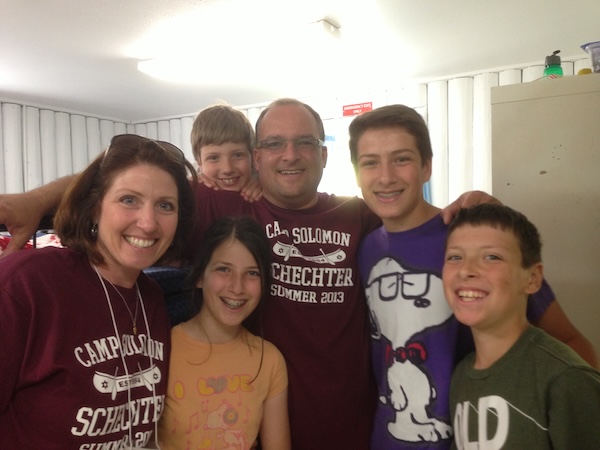
Lisa and Andrew Altow with their family on visitors day at Camp Solomon Schechter in 2013. (photo from the Altow family)
On May 5, Camp Solomon Schechter will honour four long-time relationships that were built at the camp. Part of its 70th-anniversary celebrations, there will be three separate events in three different cities – Portland, Seattle and Vancouver – on the same day. Those being honoured include Vancouverites Lisa and Andrew Altow, and Yvonne Rosenberg.
“One of the most special things about camp is the lifelong friendships that it creates and the geographic area that it spans,” Zach Duitch, executive director of Camp Solomon Schechter, told the Independent. “We say camp friends are forever friends and we know that having Jewish friendships throughout your life is one of the most significant and important relationships we have. This is what builds Jewish community.”
Of this year’s honourees, he said, “We have a friendship that has spanned three generations and two countries, from Portland to BC, Yvonne and Sharon [Stern] – they went to camp together, their children went to camp together, their grandchildren go to camp together. We have two relationships that are marriages from camp, the Korches [Melissa and Matt] and the Altows. And we have a beautiful friendship of four friends from four different communities who have stayed friends throughout their lifetime”: Eva Corets, Rochelle Huppin, Wendy Rosen and Karen Twain.
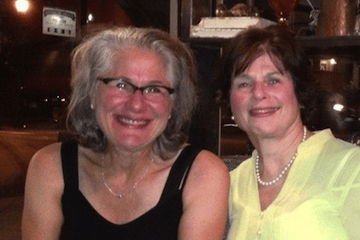
Sharon Stern, left, and Yvonne Rosenberg met in the early 1960s at Camp Solomon Schechter and have been friends ever since. (photo from CSS)
In previous years, Camp Solomon Schechter has awarded the Migdal Or Award to individuals who have provided a “spark of light that guides the way for others to follow.” The inspiration for the award and its first recipients, in 2020, were camp founders Rabbi Joshua and Goldie Stampfer (z”l). While an award won’t be given out this year, the 70th anniversary Schechter Spark will reflect the Stampfers’ “legacy, virtue and commitment to Jewish life and camping.”
Camp Solomon Schechter started in 1954, near Echo Lake, in Washington. The first year, 25 campers attended a one-week session; the next year, 40 campers attended a two-week session.
The camp moved to Whidbey Island in 1958 but outgrew that space within 10 years. With the help again of Seattle Rabbi Joseph Wagner, one of the camp’s founders, as well as Harry Sherman and Rabbi Zev Solomon from Vancouver, BC, a camp property in the Olympia area was found, and it was for sale.
“Rabbi Stampfer immediately called the number and spoke with the owner, Helen Shank,” reads the Our History page of the CSS website. “And, for $300,000, the 200-acre property could be owned by Camp Solomon Schechter. Each of the rabbis from the major cities (Portland, Seattle and Vancouver) committed to raising $100,000 from their communities, and they were able to accomplish the goal in time for summer 1969.”
CSS is still located at the site near Olympia, with some 600 campers and more than 100 staff attending annually, in addition to the Stampfer Retreat Centre and OSPREY Camp (an outdoor education program).
Seventy years is a special anniversary in Judaism.
“The number 70 is considered a lifetime, so much so that 13 years into the second lifetime, at the age of 83, many Jews will have a second bar or bat mitzvah,” explained Duitch. “Where does that number come from? A midrashic tale tells us that there was an old man planting a carob tree by the side of the road when a traveler walked by. The traveler asked the man, ‘Why are you planting that tree? It will never bear fruit in your lifetime.’ The man responded, ‘I’m doing it for the next generation.’ And so, the legend goes, it takes a carob tree 70 years from seed to fruit and that’s where we get that idea of a lifetime. So, this year, at Schechter Spark, we are celebrating our first lifetime and raising funds for our next lifetime.”
“We are looking forward to being at the event with many of our good friends and all our kids,” Andrew Altow told the Independent. He and Lisa attended CSS in the mid-to-late-1970s. “I was a camper,” he said. “Lisa was a camper and, later, a counselor.”
After their first year at CSS, Andrew said there were a couple of reasons for wanting to return for another summer. “First, all our Jewish friends from all the cities – Vancouver, Seattle, Portland, Spokane – that went every year. Second, the ruach [spirit], the amazing sense of Judaism and fun together.”
Looking back now some 50 years later, Andrew said, “CSS played a massive role for us. Because of our CSS lifelong camp friendships, we met in our 20s at a party in Bellevue [Washington] and fell in love and got married a few years later – Lisa was from Bellevue and I was from Vancouver. Because of CSS, we maintained a meaningful connection with camp and eventually each of our four kids attended CSS and have made their own lifelong friends.”
Andrew and Lisa have each, at one time or another, served on the CSS board or a board committee.
“CSS has been a Jewish string that has connected us to our Judaism and to Israel in a positive and meaningful way, for which we are extremely grateful,” said Andrew. “Mostly, it’s been the amazing people involved with CSS, whether they be staff or volunteers, each one amazing in their passion for CSS and their genuine love for this magical camp, its mission, its values.”
It was “incredibly important” that their kids also go to Camp Solomon Schechter, said Andrew. “Each child – Josh, Lynne, Joey and Ari – got something different out of camp but their experience reinforced their Judaism and their connection to Israel.
“One summer, it was very special to have all four kids and my nephew from Toronto to attend in the same summer session – five Altows at one session. We were so proud to see how close they all were and continue to be. We believe CSS was an incredible positive influence on all of them.”
Humbled to be one of the Schechter Spark 24 honourees, Andrew said, “In a world today full of hate, full of antisemitism, full of turmoil worldwide, CSS is an oasis of safety for Judaism to shine through our children and teach them the beautiful tenets of Judaism so our children, and future children, can continue to repair the world as our faith illustrates.”
To read about the other Schechter Spark 2024honourees and to RSVP for the (free) local May 5 event at Tap & Barrel in Olympic Village, go to campschechter.org/spark-24. Vancouver co-chairs are Elana Bick and Sheldon Franken, and the special guest will be camp director Manda Graziel.
Thanks to CSS’s 2024 Matchmakers, any new donation to the camp will be matched dollar-for-dollar, up to $218,000. Visit campschechter.com to donate.
Rabbi Carey Brown of Temple Sholom (photo from templesholom.ca)
Rabbi Carey Brown of Temple Sholom will be part of the next cohort of Shalom Hartman Institute’s Rabbinic Leadership Initiative (RLI).
The intensive three-year fellowship program immerses North American rabbis of all denominations in the highest levels of Jewish learning, equipping them to meet contemporary challenges with ever-increasing intellectual and moral sophistication. It is one of the few structured frameworks for ongoing rabbinic study, enrichment and intellectual leadership training. In addition to rigorous study, the program fosters a deep sense of community for diverse rabbis in an environment of open dialogue, collaboration, peer-learning and personal support. The next cohort begins next month.
Lindsey Tyne Johnson has a new show at the Zack Gallery: The Irish Mazzaroth & Hebrew Spelled Backwards. It comprises two separate parts.
Hebrew Spelled Backwards debuted at the Kamloops Art Gallery in 2023. It is a series of illustrations in which the artist explores her Jewish heritage.
“When the show finished in Kamloops, the Zack Gallery director contacted me,” Johnson told the Independent. “But the show had only seven pieces, and the Zack Gallery is large. It needed more art.”
At about the same time, Johnson decided to delve deeper into her ethnic roots. “My mother’s family were Irish Jews,” she said. “Not a usual combination. I went to Ireland in February 2024 to find out more.”
She was fascinated by what she discovered. “Jews appeared in Ireland in the 1500s,” she shared. “Later, antisemitism forced many of them to leave, but they came back again. Then, there was a wave of Jews who came to Ireland and Northern Ireland from Russia in the beginning of the 20th century – they were escaping pogroms. Someone tricked them, sold them tickets to New York, but delivered them to Ireland instead and kicked them off the ship there. Some persisted in traveling to America, but others settled in Ireland. And then, there were the Jewish children escaping the Holocaust in Europe, Ireland took them in.”
When Johnson visited the Irish Jewish Museum in Dublin, she found a number of her ancestors. “Their names were all written up in the Book of Irish Jewry there,” she explained. “The museum staff asked me if I wanted my name to be added to the new edition of the book. Of course, I said yes.”
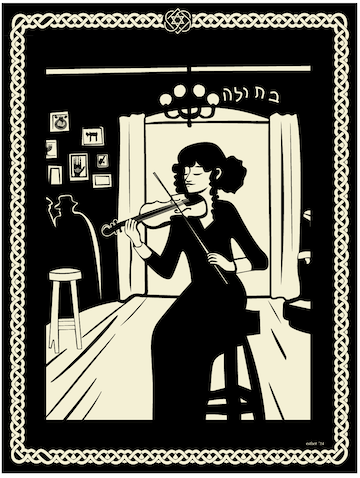
The second part of the show, Irish Mazzaroth, started taking shape in her mind while she was in Ireland. The 12 black and white illustrations on the gallery walls reflect Johnson’s take on the zodiac’s traditional imagery. Mazzaroth means constellations in Hebrew.
Both Jewish and Irish lore have a long record of zodiac interpretations, from Greco-Roman mythology to the Zodiac Wheel, the centrepiece of the sixth-century mosaic at Beit Alpha in Israel.
“Virgo” by Lindsey Tyne Johnson, part of Johnson’s solo exhibit at the Zack Gallery until May 9.
Johnson, a young Canadian artist, has succeeded in meshing seamlessly Celtic symbolism and Jewish mysticism into a series of computer illustrations that are uniquely hers.
“I started the first one in January. I finished the last one just before the show,” she said. “Each one is a well-known astrological sign, and each involves some aspects of both Jewish and Irish culture.”
Every illustration is a whimsical little story, a playful tale that connects all earth cultures to one another. The images are clean and austere, uncluttered by unnecessary details. The twin girls in Gemini smile at the viewer. In front of them are Shabbat candles and a challah. Behind them, a leafy tree rises in the Irish countryside. Their quiet joy is unmistakable.
On the other hand, the lone girl in Scorpio is solemnly considering the riches of ancient books in the famous Old Library in Trinity College in Dublin. She seems breathless with excitement at the abundance of choices in front of her, her braid curling up defiantly like a scorpion’s tail. The Jewish thirst for knowledge is given form in the context of the historical Irish library.
In another famous location in Dublin, the Temple Bar pub, Johnson features, in Virgo, an Irish Jewish woman playing a fiddle, merging lively Jewish klezmer and Celtic tunes.
“Leo” by Lindsey Tyne Johnson.
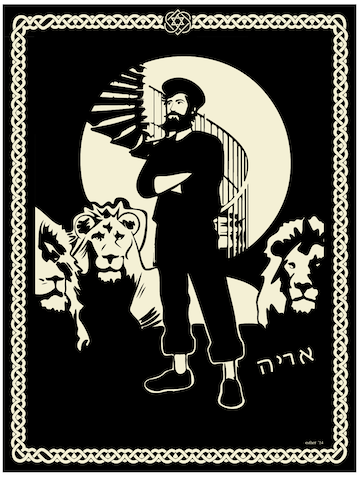
In Leo, the backdrop is grimmer. It depicts the Crumlin Road Gaol, hinting at the political strife in Ireland, while the man in front reminds us of the story of Daniel and the lions. “One of my distant relatives worked as a prison guard there,” Johnson said.
The frames of every illustration are identical: a rounded rectangle of Celtic knots, tied together at the top by a Magen David, which also emphasizes the affinity of two cultures.
The Irish Mazzaroth & Hebrew Spelled Backwards is on display at the Zack Gallery until May 9. To read more about Johnson and Hebrew Spelled Backwards, go to jewishindependent.ca/artfully-exploring-heritage.
Olga Livshinis a Vancouver freelance writer. She can be reached at olgagodim@gmail.com.
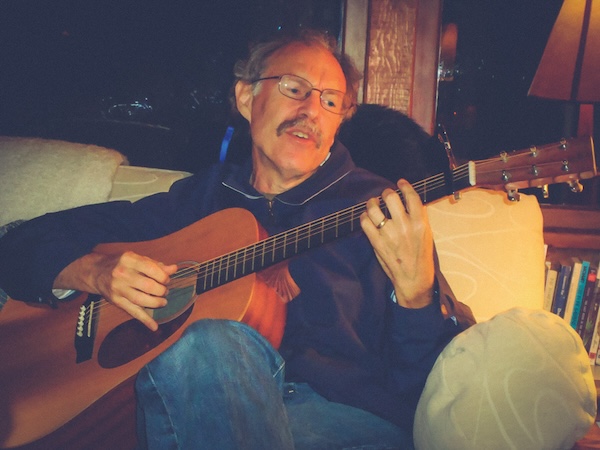
Harley Rothstein has just released a three-CD compilation of Jewish music and secular folk songs. (photo from harleyrothstein.ca)
A little over a year ago, my friend and musical colleague Harley Rothstein – cantor, songwriter, folk singer – shared with me his freshly minted three-CD compilation of both Jewish music and secular folk songs. The recordings, several years in the making, are Modim: Songs of Spirit and Gratitude; Songs of Love and Humanity: Folk Songs of Fifty Years, Volume I; and Songs of Love and Humanity: Folk Songs of Fifty Years, Volume II.
Before getting into more “nuts and bolts,” let me say something well understood by all hardworking creatives: the life of an artist is, in a very real sense, an act of service to the community in which they live. This contribution to the community is what stands the test of time, and Harley Rothstein is undoubtedly one such indefatigable contributor, an artist who has dedicated himself to serving the community in which he lives, and sharing his work unselfishly. The compilation under discussion here is only the most recent of the many invaluable gifts of music Harley has given us over the years.
As many readers may know, Harley is a scion of the philanthropic Rothstein family; indeed, his parents are the benefactors of the Norman and Annette Rothstein Theatre. So, he comes by “service to the community” quite honestly.
Harley Rothstein has been singing since the age of 6, and he learned to play the guitar at age 18. Since then, he has played and performed folk songs in many locales – from Vancouver’s Bunkhouse coffeehouse in 1965 to the Princeton Traditional Music Festival from 2016 to 2019, and numerous other venues and occasions in between. He was inspired by a trip to New York’s Greenwich Village coffeehouses in 1965 and to the Berkeley Folk Festival in 1966.
Harley also played in rock bands in the late 1960s, taught elementary music and university-level music education from 1975 to the early 1990s, and sang for 10 years in the 150-voice Vancouver Bach Choir. He studied Jewish liturgical music with several cantorial teachers and has led congregations in synagogue services for 40 years. Harley has led many sing-alongs at political and social gatherings.
Harley’s musical contributions to local Jewish life have included years of performing, teaching and mentoring others who wish to lead services. He regularly conducts services at Or Shalom and Beth Israel, and has recorded a seven-CD set of instructional recordings, which are on the Beth Israel website.
Now to the music at hand. On Modim: Songs of Spirit and Gratitude, Harley’s meticulous work makes accessible a raft of songs for the Jewish community, for prayer and for simple enjoyment. There is a variety of offerings – a klezmer song, two songs in Ladino, and two Israeli folk songs from the 1950s. The majority of the songs are prayers from the siddur, set to music composed by pioneer songwriters such as Shlomo Carlebach and Debbie Friedman, as well as contemporary songwriters including Hanna Tiferet Siegel, Myrna Rabinowitz, David Shneyer, Jeff Klepper and Dan Freedlander, plus five of Harley’s own compositions. Harley notes: “I focus on these because all of these writers have inspired a whole new repertoire of contemporary Jewish spiritual music.”
Indeed, the music of the synagogue has been transformed by contemporary songwriters, like Harley, who, over the past generation or so have introduced the melodic and harmonic sensibilities of North American folk song into congregational song. Harley’s compositions reflect this line of creative work, and are part of a revival, for many, of a Judaism that is closer to the people, enabling all attendees to participate in services in a meaningful way. This folk music thread serves as a common sinew running through the entire three-album project.
The Songs of Love and Humanity: Folk Songs of Fifty Years recordings are a unique compilation of folk music that, I hope and expect, will help a younger generation become aware of the significant thoughts and hopes of their forebears. This in itself, apart from being an authentic and loving look back upon the artist’s personal musical history, makes the project irreplaceable. I salute Harley for his singular dedication.
The two CDs of folk songs are comprised of numerous pieces, 32 in all, which cover a truly large sweep of folk music history. Being Harley’s contemporary, I recognized many of these songs, but there were some that I was not aware of, or only dimly so, such as those that make up the track “Union Medley,” for example, and the rare gem “Toy Gun,” a 1960s antiwar song. There are classics by Woody Guthrie (“Blowing Down the Road”; “Hard Travelin’”), Bob Dylan (“Don’t Think Twice It’s All Right”; “I Shall Be Released”) and Pete Seeger (“God’s Counting On Me God’s Counting On You”). And other heroes of folk music are well represented – Tom Paxton, Ian Tyson, Gordon Lightfoot and Stan Rogers, among others. It’s a heady mix of work and labour songs, spirituals, political songs from the 1960s and Canadian songs. Harley says, “the unifying theme was that each song has been important to me in my career of over 50 years. This is why I refer to the recordings as a ‘legacy project.’”
Regarding the production elements, I really loved the focus on voice as foreground, unfettered by excessive tech. The songs are thus presented as primary and the accompaniment is just that, in support. It is also evident that these songs have been loved by the artist for many years, and one can hear this in his renditions. On Modim: Songs of Spirit and Gratitude, check out Harley’s own settings of “Yosheiv B’seiter” (“Dwelling in the Shelter of the Most High”), “Luley He’emanti” (“Mine is the Faith”) and the titular piece “Modim” (“We Give Thanks to You”). On Songs of Love and Humanity, I was delighted by his renditions of “Pack Up Your Sorrows,” “Follow the Drinking Gourd” and “Blowing Down the Road,” among many others. Throughout the recordings, Harley’s lyric baritone voice is always a pleasure to listen to.
Included with each CD is an informative booklet, with texts and backgrounders for all the songs. To find out more about the recordings, how to purchase them digitally or in hard copy, visit harleyrothstein.ca.
Moshe Denburg is a Vancouver-based composer, bandleader of the Jewish music ensemble Tzimmes, and the founder of the Vancouver Inter-Cultural Orchestra (VICO).
CTeen Shabbaton Havdalah in Times Square this past February. (photo from Chabad Richmond)
Richmond teenager Miriam Kriche addressed a global audience at the CTeen (Chabad Teens) International Jewish Teen Summit in New York City during the group’s annual Shabbaton. She shared her story of overcoming adversity and emerging as a local leader, guided by Rabbi Yechiel Baitelman of Chabad Richmond. Kriche’s story highlights the resilience and strength of Jewish youth, particularly significant in the wake of the events since Oct. 7.
Active in CTeenU and the Richmond CTeen chapter – projects of Chabad Richmond and the Bayit – Kriche has made significant contributions through her volunteer work with the Hebrew school and support for Holocaust survivors. Her journey is marked by personal challenges and a transformative trip to Israel.
The summit, which took place in New York Feb. 22-25, brought together more than 3,000 participants from 58 countries. It provided a platform for Jewish teens to connect, share their stories, and reinforce their commitment to their heritage and values during challenging times.
Kriche’s speech, infused with personal anecdotes and reflections on Jewish identity, encouraged her peers to find their purpose and connect with their community. Her message, which centred on the belief that everyone has a place and a role within the Jewish tradition, underscored the summit’s aim to empower Jewish youth.
She shared her journey of facing bullying and alienation, which led her to question her identity and purpose. She spoke of a trip to Israel that rekindled her faith and connection to her Jewish roots, inspiring her to embrace her heritage and lead with conviction.
The CTeen Summit featured a series of workshops, leadership training sessions and a Havdalah ceremony in Times Square.
“In a world where our youth are bombarded with countless challenges to their faith and identity, teens like Miriam Kriche stand as living examples, empowering the teens to hold strong and be ambassadors of their faith back home,” said Rabbi Mendy Kotlarsky, vice-chair of CTeen International.
Kriche’s participation and the presence of the Richmond delegation at the summit demonstrate the impact of youth leadership in fostering strong Jewish identities.
“Our teens have returned invigorated, ready to lead and make a difference within our community and beyond,” said Baitelman. “This experience has not only deepened their connection to their Jewish identity but has also empowered them to be a source of strength and inspiration to their peers.”
CTeen Richmond, sponsored by Chabad Richmond and the Bayit and led by Rabbi Schneur and Tamara Feigelstock, is a part of CTeen, a network of Jewish teenagers encompassing more than 730 chapters, focused on empowering Jewish teenagers to become leaders in their communities through acts of kindness, community service and a strong commitment to their values.
For more information about CTeen Richmond and upcoming events, contact Rabbi Feigelstock at 604-716-2770.
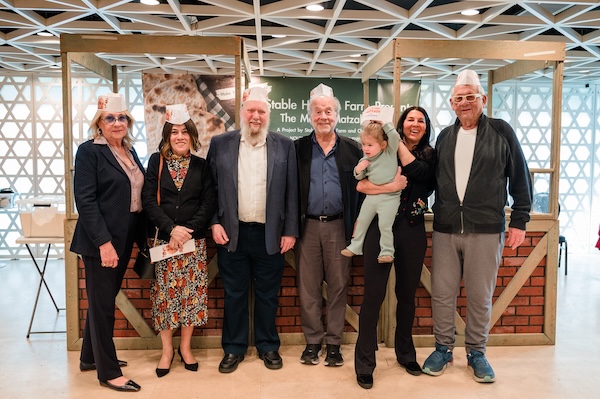
Left to right: Joanne Belzberg, Henia Wineberg, Rabbi Yitzchok Wineberg, Arnold Silber, Tammi Kerzner and Syd Belzberg. (photo by Yaletown Photography)
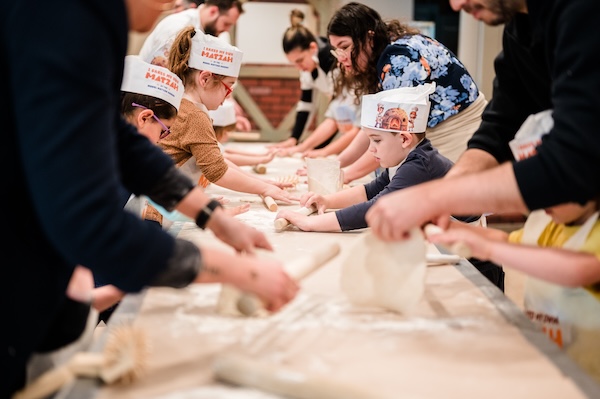
For more than three decades, the Model Matzah Bakery, organized by Chabad Lubavitch in British Columbia, has offered a unique and interactive Passover experience for thousands of participants. What started in the early 1990s has blossomed into an event anticipated by children, high school students, adults and seniors alike.
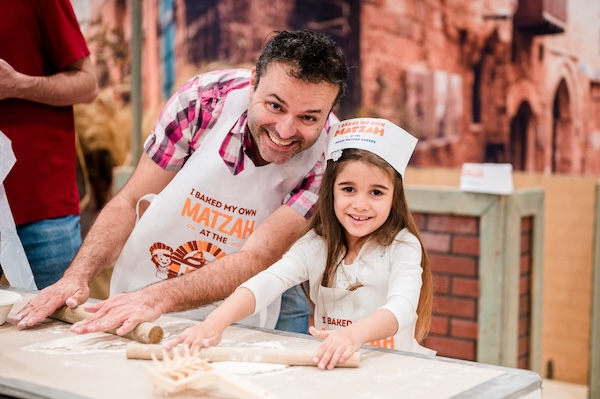
The hands-on program immerses participants in the ancient tradition of making matzah, a significant element of the Jewish holiday of Passover. From separating wheat kernels to baking the final product, attendees go through each step of the process, gaining a deeper understanding of the cultural, spiritual and historical significance behind this unleavened bread.
One of the highlights of the Model Matzah Bakery is its emphasis on participation. Everyone is invited to roll up their sleeves and get involved in every aspect of the process. We begin by separating wheat kernels from the chaff, a task that connects us with the agricultural roots of this ancient practice. Next, we grind the kernels into flour, followed by meticulous sifting to ensure the purity of the ingredients. As the flour mixes with water, laughter and excitement transform the process into a joyful communal experience. With expert guidance from volunteers, participants roll out the dough, making sure to create holes to prevent leavening. And all of this must be completed within a strict time limit of 18 minutes, after which the dough may begin rising, which will create chametz, leaven, which is not permitted during Passover.
When participants left the Model Matzah Bakery, “they took with them not just matzah, but a sense of belonging and pride in their heritage.” (photos by Yaletown Photography)
This year, the Matzah Bakery got an upgrade as it partnered with Stable Harvest Farms. Not only did participants get to make matzah for Passover using locally grown, organic wheat, Stable Harvest Farms is also offering the chance for children to experience the process from farm to seder table – literally. Two family days will be hosted at the farm, where families will plant and then harvest their own wheat, which they will then use to create matzah for next Passover. Save the dates: May 12, a special Mother’s Day celebration, where the wheat will be planted, and Sept. 8, a pre-Rosh Hashanah experience, including harvesting the wheat and setting aside for Passover 2025/5785.
“Chabad is known for their innovative approach to Jewish education,” said one educator from a local Jewish day school. “This kind of hands-on, start-to-finish project will guarantee that the children remember the joy and excitement of the holiday for years to come.”
While initially designed for children, the Model Matzah Bakery has evolved to welcome participants of all ages. High school students and educators find themselves drawn to the program as an engaging way to learn about Jewish traditions, while adults and seniors appreciate the opportunity to celebrate their cultural heritage. This year, for the first time, children with special needs had their own opportunity to visit the bakery.
“It’s not just about making matzah; it’s about connecting with our heritage in a tangible way,” said Rachel Cohen, a long-time attendee of the Model Matzah Bakery. “The experience of being part of something so ancient yet so relevant to our lives today was truly special.”
Rabbi Dovid Rosenfeld, director of Lubavitch BC, which organizes this project, emphasized the importance of preserving and passing on these traditions to future generations. “Our goal isn’t just to teach about matzah making, but to create lasting memories and connections to our shared history through positive Jewish experiences,” he explained. “When participants left here, they took with them not just matzah, but a sense of belonging and pride in their heritage.”
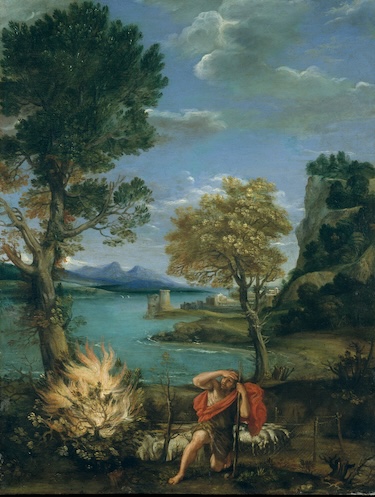
“Landscape with Moses and the Burning Bush,” by Domenichino (Italian, 1581-1641), painted sometime between 1610 and 1616. The Maggid, the storytelling portion of the Haggadah, is lengthy, yet it seems to dispense with the story of the Exodus in the barest of details. Where is Moses, or any of the other major characters? If telling the story of the Exodus is our essential task at the seder, it might seem that the Haggadah is more of an impediment than a facilitator. (image from Metropolitan Museum of Art)
* * *
Even if we were all sages, all wise, all learned in Torah, we would be obligated to tell the story of the Exodus. And anyone who tells the story of the Exodus in greater depth is to be praised. Once [five sages] sat together in Bnei Brak and went on telling the story of the Exodus from Egypt the entire night….
Retelling the grand drama of our departure from Egypt, discussing it and probing it, and looking for new ways to relate to it: almost every commentator writing about the seder begins by emphasizing that the central obligation of this night is to tell the story, ideally at great length. Whether through acting or analysis or making connections to our own experience, we look for ways to immerse ourselves in this story. These lines from the beginning of the Maggid section define the seder and drive home the point: there is no such thing as too much story. It is sometimes even a point of pride to announce how late into the night one’s seder lasted.
But the Haggadah, the seder’s ritual script, is strikingly ill-matched to the task of retelling. The Maggid, the storytelling portion of the Haggadah, is lengthy, yet it seems to dispense with the story of the Exodus in the barest of details and go on to other things. Where is Moses, or any of the other major characters? Where are the moments of high drama? If telling the story of the Exodus is our essential task at the seder, it might seem that the Haggadah is more of an impediment than a facilitator.
It might help to remember that the Haggadah is, like many liturgical texts, a composite that cannot be expected to flow in a simple, linear fashion. But I will argue that the main problem is that we are actually misunderstanding what it means to “tell the story” of the Exodus. We see this when we step back to think historically.
The Haggadah first developed around a guiding principle very different from our contemporary expectations, one that closely reflects earlier biblical and rabbinic sources. In short, the original task of the seder was not to tell our story but to tell God’s story; it was not to talk about how we were slaves but rather to appreciate and celebrate the fact that, by the grace of God, we are not and will not be slaves.
In the conceptual world of the Torah, this version of the story is not only the focus of the seder but also the linchpin of Jewish tradition; our entire commitment to serving God is an expression of our gratitude for God’s salvation. The critical task of the seder is to make that salvation personal by conveying to our children that not only our ancestors but we ourselves, in the present, owe our freedom and our very identity as a people to God’s kindness. As long as we are busy looking for a story that was never meant to be there, we risk overlooking this key theme at the heart of the Haggadah.
From haggadah to sipur
Rabbis throughout the medieval and modern periods consistently present the central mitzvah of the seder as lesaper, to retell or to recount the story of the Exodus. The term suggests a detailed narrative, a sense reinforced by the idea that the more we draw out or elaborate on the story the better. Maimonides, in the 12th century, for example, begins his discussion thus:
“It is a positive commandment of the Torah to recount [lesaper] the miracles and wonders wrought for our ancestors in Egypt on the night of the 15th of Nisan.… Whoever recounts at greater length [marbeh lesaper] the events which took place is worthy of praise.” (Hilkhot Hametz U’matzah, Laws of Hametz & Matzah 7:1)
Indeed, recounting the story of the Exodus is the only element other than eating matzah that Maimonides designates as essential.
The chasm between our expectations for seder storytelling and what our text has to offer opens up as soon as the Maggid begins. Right when we are settling in for a story to answer the four questions, the Haggadah offers these two sentences:
“We were slaves [avadim hayinu] to Pharaoh in Egypt, but Adonai our God brought us out from there with a mighty hand and an outstretched arm. And, had the Holy One not brought our ancestors out from Egypt, we, our children and our children’s children would still be slaves to Pharaoh in Egypt.”
This very, very short version of the Exodus story, a rephrasing of Deuteronomy 6:21, notes the Israelite enslavement but emphasizes God’s actions, in line with the commandment of lehaggid … for us – and our children, in particular – to celebrate Passover because God saved us from slavery.
Let’s put this in the context of the Mishnah’s guidelines for teaching children about the Exodus at the seder. The four questions we find in the Haggadah draw from Mishnah Pesachim 10:4, which provides detailed questions that the child may (or perhaps must) ask about the seder ritual. But for the parent’s response, the Mishnah provides only the following guidelines:
“According to the son’s knowledge, his father teaches him.
“He begins with genut [disgrace] and concludes with shevach [glory/praise].
“And he interprets [doresh] the passage: ‘My father was a wandering Aramean,’ until he concludes the entire section.”
The first line tells us that the response should be variable, tailored to the understanding of the particular child. The second sets the story’s basic framework: it should have a starting point, an end point and a narrative arc, leaving the rest to be filled in. The third line of the Mishnah identifies a passage from Deuteronomy 26 that briefly recapitulates the events of the Exodus and instructs us to interpret or study it closely in the manner of rabbinic midrash. Each of these is indeed a key part of the Maggid: the tradition of the four children expands on the idea of teaching each child according to her needs; two different proposals for texts that go from genut to shevach are included, “avadim hayinu” and a text from Joshua 24; and the longest section of the Maggid is a phrase-by-phrase interpretation of the passage, “My father was a wandering Aramean.”
“Avadim Hayinu” is intended to fulfil the second guideline. The words at the centre of that guideline, genut and shevach, suggest that the story we tell should trace the Israelites’ journey from disgrace to glory, from oppression to triumph. In Exodus 1-12, which traces the experience of Moses and the Israelites suffering from and then breaking free of Egyptian oppression, is indeed such a story.
But by this measure, the “avadim hayinu” passage in the Haggadah falls woefully short. It has the proper beginning and end, but that’s it. There is no middle and no elaboration to fill in what is missing. This has long been a major source of confusion for commentators. They posit that it is only intended as an opening, that it only indicates the starting point of the story rather than the whole story, or that it is a summary or abstract that precedes a fuller retelling. But these proposals merely highlight the simple fact that this is not the story we were led to expect. And none are at all convincing, since these two sentences clearly read as a self-contained unit, not as an introduction to something more expansive.
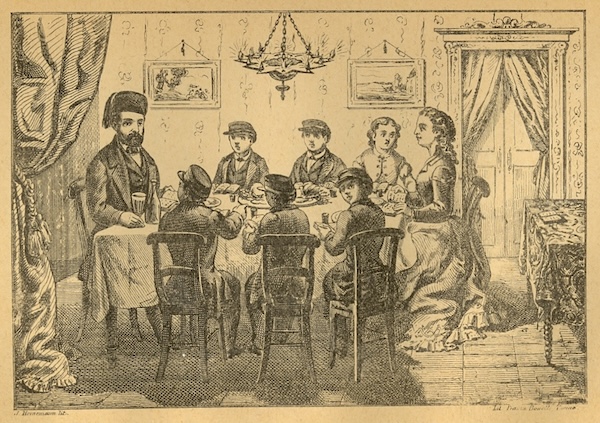
Detail from Seder Aravit ve-Haggadah, Corfu, 1877; engraved by A. Heinemann. When the Torah commands that we tell our children about the Exodus, it is referring specifically and exclusively to the wonders that God did on behalf of the Israelites. And the purpose of this commandment is to ensure that the next generation, recalling those acts, keeps an unshakeable faith in God’s love and a devotion to God’s mitzvot. (image from Library of Congress, Hebraic section)
Let’s take a step back and return to the Mishnah and, more specifically, its directive that parents teach their children a story that moves from genut to shevach. Although the word shevach can mean “glory” and, at first glance, seems to mean just that in the Mishnah, it is more typically used to signify “praise,” specifically praise of God. Understanding shevach as praise of God changes our understanding of the story the Mishnah wants us to tell. Rather than a story of Israel’s transformation from degradation to glory, we are to tell a narrative that begins with Israel’s degradation and concludes with a celebration of God’s might and love, as evidenced by the miracles of the Exodus. Looking back at “avadim hayinu” with this expectation, we can see that, indeed, it begins with the Israelites’ slavery and ends by describing the wonders God performed in the course of leading them to freedom. But we can go further, because these two elements are in fact the whole story. Perhaps, then, the directive is not “go from disgrace to glory” but only “mention disgrace and glory.”
In fact, the four times the Torah commands us to tell our children of the Exodus (Exodus 12:27, 13:8 and 14, Deuteronomy 6:21), it follows a similarly simple paradigm: (1) we were oppressed, but (2) we are no longer oppressed, thanks to God’s mighty and wondrous deeds. Degradation and praise are the only necessary points. Unlike later traditions, the goal of this telling is to instill in the children a sense of gratitude to God that will move them to join in the ritual and celebration, for which these two points suffice.
This affirms our sense that “avadim hayinu” was proposed as a complete fulfilment of the Mishnah’s mandate to tell a story that ends in praise of God. The Haggadah makes this clear in the next sentence, when it goes on to specify the moral of the “avadim hayinu” story: “Had the Holy One not brought our ancestors out from Egypt, we, our children and our children’s children would still be slaves to Pharaoh in Egypt.” This claim is implausible, living as we do, generations and centuries later, but it highlights the true purpose of lehaggid. It suggests that, had God not stepped in forcefully to alter their trajectory, the slaves would not have become a nation and the story of Israel would never have truly begun. This phrasing brings the story from the distant past closer to home. Real gratitude comes from the experience of having been personally saved. We need to understand and convey to our children that salvation is not a relic of the distant past, but that our own freedom is directly attributable to God’s wonders in Egypt. This reinforces the idea that the point is to teach about God’s actions, not the Israelites’ experience. Slavery serves only as the backdrop against which we learn to appreciate our freedom.
This message is, in fact, the foundation not only for one festival but for all of Torah: at Sinai, God’s identity as “the one who brought you out of Egypt” becomes the basis for God’s right to impose divine law. This connection is further expressed in the original setting from which “avadim hayinu” was taken, Deuteronomy 6. Here, the parent is commanded to teach about the Exodus in response to a child asking, “What are these rituals, statutes and laws that God commanded you?” This child is asking about the entire system of divine law, not the rituals of Passover, and yet the Exodus is still the answer. The message is the same: we were in need and God saved us with mighty deeds – and, it adds, led us to the Promised Land and gave us the law.
A wandering Aramean
Let’s turn now to the longest section of Maggid, an exegesis of Deuteronomy 26:5-8. This is the passage that begins with “arami oved avi,” “my father was a wandering Aramean,” in line with the third instruction we find in the Mishnah. The exegesis is written as a midrash, explicating phrase by phrase the biblical passage, which reads:
“My father was a wandering Aramean. He went down to Egypt with meagre numbers and sojourned there; but there he became a great and very populous nation. The Egyptians dealt harshly with us and oppressed us; they imposed heavy labour upon us. We cried to Adonai, the God of our ancestors, and Adonai heard our plea and saw our plight, our misery, and our oppression. Adonai freed us from Egypt with a mighty hand, with an outstretched arm and awesome power, and with signs and portents.”
This text does indeed begin at the beginning, with Jacob and family settling in Egypt and then being enslaved by the Egyptians; and it does end at the end, with God striking the Egyptians with “signs and portents.” What is conspicuously absent again is the middle, including everything that we would typically consider the drama of the narrative: the fear and bravery of Moses’s family; Moses’s crisis of identity and flight from Egypt; God giving him his mission at the Burning Bush; and Moses and Aaron’s confrontations with Pharaoh and their own people. Even the plagues, which in Exodus are a prolonged battle of wills and wits, are only briefly noted.
Many commentators, both traditional and modern, have struggled with the question of why this passage is chosen as the text for interpretation instead of a more robust summary from elsewhere in the Bible, or even portions of the original text of Exodus 1-12. Some propose quite implausible theories. Joshua Kulp offers refreshing clarity in the Schechter Haggadah with a simple and practical explanation:
“The passage was chosen because it is the briefest and yet still comprehensive passage in the Torah which tells the story of the descent to Egypt and the redemption. Such a short passage is prime material for midrash, a literary genre which focuses on individual words or phrases and connects them to other portions of the Torah. Exodus 12, or any other part of Exodus, is too long, digressive and not as comprehensive.”
In short, Kulp argues that the rabbis’ goal was to simply present a single, adequate review of the Exodus story for close reading. The limiting factor in the choice of text was that for the rabbis, close reading means midrash, a style of interpretation that works through a biblical text phrase by phrase, and, therefore, requires a fairly concise base text as its focus. These considerations made Deuteronomy 26 the obvious choice for the seder ritual. It would be impossible to read and interpret all of Exodus 1-12 within a single evening, while other summaries in the Bible are even briefer than the “arami oved avi” passage.
Kulp’s proposal is clearer and simpler than the alternatives, but it shares the basic assumption that this text is a less than ideal choice, that we should be telling a more complete version of these events, yet are saddled with one that leaves out key details. The distortions we find in how the story is told, with some elements described in detail and others passed over in silence, are an unavoidable but still unfortunate consequence.
I agree with Kulp’s assessment that other biblical reviews of the events of the Exodus (there are, depending how we count, at least 10 others) share the key features of the Deuteronomy passage. But I would argue that reading it in the context of these other passages actually reveals clearly what the Haggadah is doing and what it is not. It illustrates the distinction between recounting the Exodus as a story of the Israelites’ triumphant escape from slavery, and using it to enumerate praises of God – precisely the difference between lesaper and lehaggid.
These lists come in various forms, from songs of praise to speeches urging Israel to show gratitude, to confessions of Israel’s ingratitude. Psalm 136, known as the “Great Hallel,” is simply a list of God’s wonders across the full range of biblical history. It begins with the creation of the heavens, then describes God striking the Egyptian firstborn, bringing Israel out of Egypt and drowning Pharaoh’s army, followed by God defeating other kings in the desert and, ultimately, bringing Israel into the Promised Land. In Joshua 24, God speaks in the first person to highlight the wonders, including the Exodus, God did specifically on Israel’s behalf; while Psalm 106, a prayer of confession, emphasizes that God did these wonders despite Israel’s ingratitude and frequent rebellions. All of these focus on God’s actions, whether presenting them as evidence of God’s might, God’s kindness or God’s faithfulness.
“Arami oved avi” offers its own nuance on this theme. Originally a prayer of thanks to be said by Israelites bringing the first fruits of the Promised Land to the Temple, it describes in detail Israel’s descent, first to Egypt, then into oppression, and their cry for help. It describes Israel’s disgrace in order to frame God’s intervention as heroic, leading them up out of bondage, out of Egypt and back to the Promised Land, coming to their rescue in their hour of need, deepening the personal sense of appreciation and indebtedness. Even so, it is closely parallel to the other lists of God’s wonders. All of them recall the Exodus from Egypt specifically to present it as the preeminent example of God intervening in history, dramatically and publicly, on Israel’s behalf. The only relevant elements beyond the list of God’s acts are Israel’s need for them or response to them.
I want to emphasize how different this is from the original narrative in the book of Exodus. That text chronicles the human experience of slavery, following both the Israelites and the Egyptians, with a spotlight on Moses, Aaron and Pharaoh. God’s role is marginal until the final scenes. These other texts, by contrast, tell us only what God did, and notes human roles only to highlight God’s role.
The most illuminating example, though, is Psalm 78, which explicitly declares that it is the fulfilment of the mandate in Exodus to “tell your children.” Here are the key lines:
“We will tell the coming generation the praises of God and His might, and the wonders He performed. He established a decree in Jacob, ordained a teaching in Israel, charging our fathers to make them known to their children, that a future generation might know – children yet to be born – and in turn tell their children, that they might put their confidence in God, and not forget God’s great deeds, but observe His commandments.” (Psalms 78:4-7)
The psalmist is quite clear about both exactly what we must tell our children and why. When the Torah commands that we tell our children about the Exodus, it is referring specifically and exclusively to the wonders that God did on behalf of the Israelites in their time of need. And the purpose of this commandment, of repeatedly recalling those wonders, is to ensure that the next generation, recalling those acts, keeps an unshakeable faith in God’s love and a devotion to God’s mitzvot. The alternative, the psalm goes on to say, is also made clear in the Torah: the Israelites repeatedly lost that faith and rebelled during the desert journey, always with disastrous consequences.
And thus the picture comes into view in full clarity. It is true that “arami oved avi,” like the other reprises of the Exodus across the Bible, tells a very different story than Exodus 1-12. But that does not make any of these versions a deficient fulfilment of the Torah’s command, lehaggid. They are in fact fully in line with the lesson the Torah wants us to convey. Psalm 78 is literally the Bible’s prototype for how to properly fulfil it.
This is also the way almost the entire Haggadah approaches this command. It does not tell a tale that progresses from disgrace to praise, but one that includes only these two elements: we were in a place of disgrace and God redeemed us. And the point of this explanation is not the story itself but the lesson it teaches: God came for us in our time of need and did wondrous, astonishing, supernatural things on our behalf to bring us to freedom and make a place for us in the world. What we must do in the present is be thankful for those acts, acknowledging that they were done not just for our ancestors, but for us. Our devotion to God, which we show by performing the Passover ritual, celebrating the festival and observing all of God’s laws, flows directly from that awareness.
This framing opens up a whole new way to read the deeply evocative but enigmatic statement that concludes Maggid: “In every generation we must see ourselves as if we personally left Egypt.” Many explanations of this line take it to mean as if we had personally been enslaved, and this can be a springboard for cultivating empathy for all who are oppressed. But the Haggadah’s focus is not on slavery; it is on coming out of Egypt. Here, too, slavery recedes to the background and the Exodus is what matters. It is the Exodus, the exhilaration of being carried to safety in God’s hands, that always needs to feel like it just happened to us.
This is the real point of the seder ritual, for the Exodus to be happening in what we can call the Eternal Present. Like Moses’s paradoxical claim that all future generations stood/stand at Sinai, the seder is meant to make us feel for a moment that we are there on the banks of the sea, living that ecstatic moment of finally knowing that we are fully and irrevocably free. Look back and you will notice that the crucial claims in the Haggadah are in the present tense. If God hadn’t saved us, we today would still be slaves. In every era, including our own, there is an enemy pursuing us and, true to God’s promise, God saves us from their hand. Our freedom now is thanks to the Exodus; we are kept safe now because of God’s promise; and when we see that, when we really get it, we will be able to see ourselves as if we now are standing on the banks of that sea, that God’s salvation happened to us personally and thus makes a direct claim on each of us. We did not all experience slavery, but we have all been saved from it.
And the ritual prescribes that we respond to that awareness just as we did the first time, with an instinctive and unrestrained outpouring of song. This is the moment of transition in the seder: we go from the story of our disgrace to an intense song of praise filled with the intensity of those who have just escaped oppression. We, in this moment, know that we owe all we have to God’s salvation and, therefore, cannot help but begin pouring out songs of thanks. If we have done Maggid properly, Hallel will simply burst forth. This is where the night reaches its apex, when we are ready to relive the joy of salvation and to sing praise to God with the same intensity and gratitude as the Israelites who sang at the sea.
A time for singing
I have tried to demonstrate that the reason we often find it hard to engage meaningfully with the Haggadah is that the text is focused on a fundamentally different purpose than the one we typically bring to the table. Part of my goal has been to unlock the mystery in this familiar text, so we can see it anew and read it on its own terms; I have also tried to reclaim this earlier mission, which has been largely displaced by sipur. I would not wish to argue that storytelling should be removed, that we hold back from discussing slavery, from remembering Moses, Miriam and Aaron. Sipur enables us to include and engage children of all ages by filling in the missing narrative – playacting Moses’s showdown with Pharaoh, marching around like Israelites in the desert and making the plagues colourful and silly. In this way, our children are engaged and they come to know the story as their own. And the challenge of finding new layers of this story adds richness and creativity to the ritual.
But I also hope I have convinced you that the story is not an end in itself. A ritual’s sole function cannot be limited to retelling a familiar story, even if it is a great story. Even if it is our story. The goal of the seder ritual is for us to notice and to celebrate how far we have come; and to move us to joy, to gratitude and, ultimately, to hallel, to praising God.
So, the seder can be a time for telling wonderful stories or for reflecting on evils yet to be overcome. But don’t worry if you don’t get to the whole story. Don’t fret about its moral ambiguities. There is a time for self-critique, a time for feeling the weight of the world’s burdens. But not on this night. The seder is not the night to relive the suffering of being slaves. It is the night to relive the joy, the elation of that moment when we left slavery behind to embark on a new journey, full of promise and possibility. Looking at the open vistas around us, knowing that we were once slaves, how can we keep from singing?
Joshua Cahan compiled and edited the Yedid Nefesh Bencher and the Yedid Nefesh Haggadah. This article appears in the Spring 2023 issue of Sources: A Journal of Jewish Ideas, an award-winning print and digital journal (sourcesjournal.org) published by the Shalom Hartman Institute of North America (hartman.org.il) that promotes informed conversations and thoughtful disagreement about issues that matter to the Jewish community.
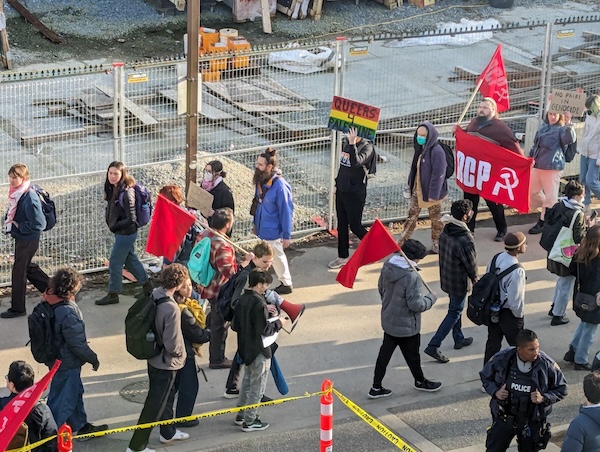
A couple of dozen loud and aggressive protesters accosted people arriving to an event at Hillel House at the University of British Columbia March 13. One masked woman raced up and screamed into the faces of those arriving. Another shoved her phone, presumably filming, into the faces of those trying to enter. Marchers, carrying communist banners and flags, screamed “You are on the wrong side of history!”
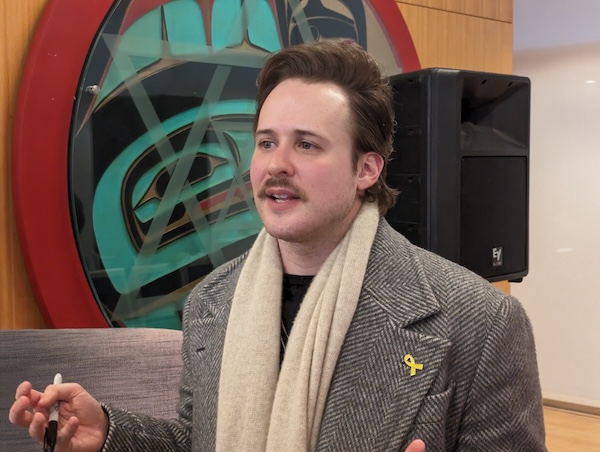
Inside, a packed audience listened to gay, Jewish, Scottish writer and activist Ben Freeman contextualize the state of world Jewry since Oct. 7. The author of Jewish Pride: Rebuilding a People and Reclaiming our Story: The Pursuit of Jewish Pride, in conversation with Vancouver media personality Shane Foxman, spoke while, throughout the entire presentation, the dull roar of protesters screaming provided background.
“We need to understand very, very clearly that we have done nothing to deserve that rabble outside,” Freeman said. “It is not our fault. This is their problem and not ours. Jew-hatred is a non-Jewish problem. We need our non-Jewish friends and allies to set up on the task of dismantling it. We have other work to do.”
Jews, of course, fight antisemitism, he said, but it is up to non-Jews to defeat it.
“This [protest] is not a commentary on Israel or Zionism,” he said. “This is an expression of Jew-hatred. We need to understand that.”
It is not only Jew-haters who try to separate diaspora Jews from Israel, said Freeman. Many Jews fall into the trap as well. The accusation of dual loyalty is a tool to dissuade Jews from expressing their natural connection to the land of Israel, he said.
“The canard of dual loyalty has led some Jews to say, ‘No, no, no, no, I’m not connected to Israel. I’m an American or I’m British or I’m Canadian’ or whatever the case may be,” Freeman said. “The reality is we are the diaspora. That word gives us a really incredible clue to the aspects of our identity. If we are in the diaspora, Israel is our home. You can be Canadian and Jewish, you don’t need to choose. That is what the non-Jewish world tries to make us do. They try to make us choose. Are you Canadian or are you Jewish? That’s the message that we get, you have to choose. But you don’t.”
He recounted a conversation with his dermatologist, a Briton of Pakistani descent, who said he was “going home” to Pakistan on vacation.
“I said, oh, wonderful, were you born there? And he said, no, I was born here,” recalled Freeman. “And I thought, yes! You get it. And he’s allowed [to visit what he calls home], but somehow we are told we are not allowed.”
Freeman argued succinctly that it’s time Jews stopped fearing accusations of divided loyalties.
“I do have dual loyalty,” he said. “Suck it.”
In addition to refusing to succumb to false accusations, Freeman argued that Jews need to set boundaries on personal and professional relationships.
“After Oct. 7, I spoke to Jewish friends who were in relationships with non-Jewish people and they said, oh, it’s hard, because my partner isn’t sure how they feel about Israel,” Freeman said. “My jaw kind of hit the floor. We have to have bottom lines. We have to have boundaries. There should be conversations we are willing to have and conversations we refuse to have. Each of us will make those ourselves but recognizing that Israel has a right to exist, Israel has a right to defend itself, that should be a bottom line. And I think I would encourage all Jews, whether it’s in romantic relationships, whether it’s in friendships, to be able to prioritize yourself, to be able to centre yourself and create those boundaries. We are not accepting half-assed empathy or friendship.”
Probably all Jews have had difficult conversations with friends and others in recent months, he said, and Freeman urges a little more resistance.
“I say to my friends in those situations – it’s a little bit arsey, to be honest, but I am so done with being a nice Jew – I say to them, let’s be really clear before we have a conversation about Israel: I know more about this than you do, so don’t come for me. Have some respect. Not only is this my work, but I’m a Jew. That should be respected. And then, I care more about this. My friends are people in the world who might see a headline, they might see a tweet by those bozos outside, and they get enraged and inflamed. They can’t point out which river or which sea. We care deeply, we think about it.”
As author Ben Freeman spoke at Hillel House at the University of British Columbia, the dull roar of protesters provided background. (photo by Pat Johnson)
Ignorance should be challenged and invitations to learn extended, he said. “But there will be those who are malicious,” he added. “There will be those who think that we are bad, evil Zionists, we’re colonizers, we’re white oppressors and we are murdering the Indigenous people, we are committing genocide. There are people who believe those things and, if they do, those people are not interested in a conversation, so we block them…. They’re not worth our time. They’re not worth our energy. We’re not dealing with those people.”
He admits, though, this can be easier said than done. All the hatred can get into one’s psyche.
“I’m the author of books about Jewish pride. I’m very proud to be Jewish. I love Israel,” said Freeman. “And there have been flickers of weakness in the past five months, when I have been weighed down by what is happening in the diaspora, what happened in Israel and what is said to me online and you do think, Are we the bad guys? What is happening? No. We are not. We have a right to be in that land. We have a right to defend ourselves. We need to make the world understand crystal clearly that you do not get to murder Jews and get away with it. Jewish blood is not cheap. We will defend ourselves and we have a country to do that. We lost our sovereignty.… We are not losing it again.”
Tight security ushered attendees out a back door and away from the still-chanting protesters circling the front of the building.
In a March 3 webinar, Rabbi Dr. Nachshon Siritsky reflected on understandings of the Divine and gender, exploring some of the ways that Judaism’s most ancient teachings can be relevant in current discussions. Their Zoom talk was part of this season’s L’dor V’dor: From Generation to Generation lecture series hosted by Victoria’s Kolot Mayim Reform Temple.
Rabbi Dr. Nachshon Siritsky spoke on March 13 as part Kolot Mayim Reform Temple’s L’dor V’dor lecture series. (photo from Kolot Mayim)
Siritsky discussed the kabbalistic understanding of creation and humanity, which, they said, describes a process of progressive emanation, revelation, incarnation and embodiment. Whereas the standard concept of history, in the Western mind, is as a straight line of evolution, Jewish time is circular and cyclical, Siritsky explained, returning to the same points again and again, whether they be holidays or the weekly Torah portion.
More deeply, this is manifested in restorative practices such as teshuvah, which can be seen as forgiveness or returning to oneself. In other words, God works with people in completing the work of creation, and this happens through how we channel that light and energy into this world. “I firmly believe that the more we can reconnect with our ancestral wisdom that is contained in kabbalah, Jewish mysticism and tradition, the more we can work to liberate ourselves and realign with the larger rhythms of the universe,” Siritsky said.
Kabbalah, they explained, describes how there are two different ways that God’s energy flows through humans. It can flow through masculine and feminine aspects and each of us contains elements of both. Thus, our goal is to be in alignment with all the different ways in which God flows through us.
“The reason we were put on this planet was to complete the work of creation. When we do that, then we build within ourselves. The act of building is holy, but God dwells inside of us, not inside of our buildings,” Siritsky said. “The goal of our traditions, according to the rabbis, is this notion of making a place within our bodies for God to be present and to be expressed and to able to be articulated and shine forth back into the universe.”
Siritsky spoke about the notion of gender fluidity in Judaic texts. According to the rabbi, the Talmud identifies eight genders. “All eight of these are just the ways in which humans exist on this planet,” said Siritsky. “So, anyone who says that non-binary, agender or intersex doesn’t exist or is not Jewish is not fully speaking from the ancestral traditions of the Talmud and of our rabbis through the generations.”
Citing other theologians, Siritsky said we are always evolving in our understanding of who we are and what we know, and that we must make space to acknowledge that our spiritual understandings are also on that same path.
“Each of us, as we grow into ourselves and this world, we are always having to discard beliefs or understand them in new ways in that cyclical way that promotes healing and God’s progressive emanation into the universe and into ourselves,” they said.
Siritsky next addressed the use of they/them pronouns, arguing that, since the Talmud states that God speaks in human language, then we have to be constantly reinterpreting, re-translating and re-understanding what that language is in each generation – what is true in one generation may not be true in another.
“Ultimately, it leads us to this: we are created in the divine image and, when we see God in one another, we will know God,” Siritsky said, adding that the topic of gender diversity is not a new one in Judaism or other spiritual practices, and that binary thinking is not a Jewish way of thinking.
Siritsky pointed out that our understanding of God and gender is continually evolving, reflecting the ever-changing landscape of society and culture. “By exploring this evolution, we can better appreciate the richness and complexity of Jewish spirituality,” they said.
Siritsky is spiritual leader of the Reform Jewish Community of Atlantic Canada, serving all four Maritime provinces. Ordained by Hebrew Union College-Jewish Institute of Religion, they are also a board-certified chaplain with Neshama: Association of Jewish Chaplains, a social worker with advanced training from the Postgraduate Centre of Mental Health, and a doctorate in ministry and pastoral counseling with a focus on burnout in healthcare workers.
The final talk in the 2023/24 L’dor V’dor series will take place April 7, 11 a.m., on Zoom. Cookbook author and food writer Bonnie Stern will, together with her daughter, Anna Rupert, present a talk titled Don’t Worry Just Cook: A Delicious Dialogue on Intergenerational Jewish Cuisine. Register for the free webinar at kolotmayimreformtemple.com.
For more information about Rabbi Siritsky, visit rabbinadia.com.
Sam Margolishas written for the Globe and Mail, the National Post, UPI and MSNBC.