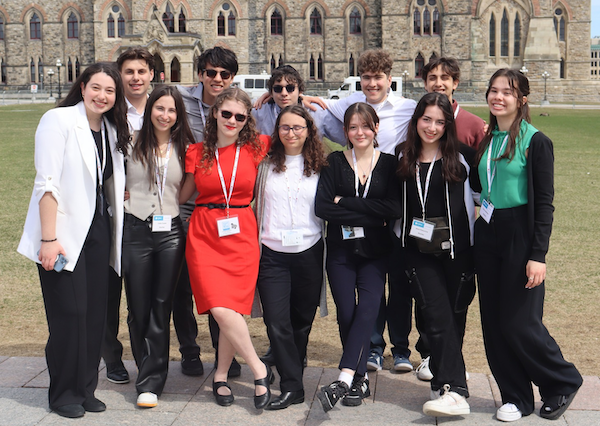
Students from CJPAC’s 2023/24 Generation: Student LeadersProgram cohort (photo from CJPAC)
It is Elul, the month before the Jewish new year. Traditionally, this is a time for cheshbon hanefesh, an accounting of one’s soul, before the reflection and repentance of Rosh Hashanah and Yom Kippur.
This year is not like years past. This year, our individual and community accounts are overdrawn. Instead of looking into how our souls spent 5784, instead of wondering what we could have done better, instead of cheshbon hanefesh, this year should be one of hashka’at hanefesh, investment in our souls.
As we move towards Rosh Hashanah, Jewish communities and individuals will blow the shofar and recite Psalm 27. This is a daily call to action and a recitation of a mantra that means so much more this year.
Of David: Hashem is my light and my salvation; whom should I fear?… Though an army may camp against me, my heart will not be afraid; though war rises against me, I will be confident…. Deliver me not to the will of my enemies, for false witnesses are risen against me and breathe out violence…. Look to Hashem; be strong and of good courage! Look to Hashem! (Psalm 27, excerpted)
The 14 verses of this psalm help us examine the past year and focus and inspire us for the coming one. Recited through the High Holy Days until Hoshannah Rabbah, it is a call to make that investment.
The year 5784 was a challenge. It was a year of pain. Through it, the worldwide Jewish community declared, “We will dance again.” Now, the shofar and the words of the psalm force us to confront metaphors made real. Though it seems like we are surrounded by enemies, these verses call upon us to act. If we do, our “head[s] will be lifted” and we will again “offer sacrifices of joy.” “We will dance again” will be realized when we stand up to say, “Hineini.”
Hineini – I am here. It is a word of intentional presence. When God approaches Avraham, Avraham answers, “Hineini.” When Moshe is called to lead, he responds, “Hineini.” Our leaders were not prepared. Nevertheless, when asked, they stepped up. This is the lesson of the High Holy Days. It is a call to action that begins with the individual and moves to the communal.
It is our time to answer that call. It is time for our community and our allies to stand up and step forward to make a difference and an impact. It is time to say, “Hineini. I am here, I am present.”
The Canadian Jewish Political Affairs Committee (CJPAC) is here and present to help Canadian Jews and their allies be seen and heard.
Now is the perfect time to get involved in politics, with the BC general election set for Oct. 19. You can make a real and tangible impact. CJPAC is here to guide you. In political campaigns, every single volunteer who steps up can be the deciding factor in a candidate’s success.
It is not the loud, angry voice that makes the lasting impact. The difference is made by people who show up and get the job done. Say “Hineini,” and sign up to volunteer for the candidate or party of your choice.
Sign up for CJPAC emails to stay informed about specialized training opportunities. From Politics 101 to the importance of running for a school board or campaign volunteering, CJPAC’s Advancing Campaign Training (ACT) program will help prepare and connect you.
In our tradition, what begins with the individual ultimately ends with the community. Sign up with friends for a CJPAC Day of Impact or create your own. By coming together, we inspire future generations. Volunteering with children not only teaches but empowers them to take action – and not just during difficult times.
If you have, or know, a teen in grades 10 to 12, be sure to check out CJPAC’s Generation: Student Leaders Program. Throughout the school year, teens engage in thoughtful discussions with peers, empowering them to participate in the democratic process.
CJPAC’s flagship Fellowship Program trains 50 of the top pro-Israel, politically engaged post-secondary students from across Canada to become the next generation of political leaders. Applications close on Sept. 18.
We make a difference when we show up. The more people who give of their time and efforts, the greater our impact. Connecting with the party or campaign of your choice through CJPAC offers you a tangible opportunity to support the community and build a better Canada.
Listen to the call this Elul. It is time for our community and our allies to stand up and step forward to make this difference.
Hineini – I am here.
Hineini – I am ready.
Hineini – Even if I am afraid, I will be an upstander. I will pray with my feet before and beyond the chaggim (holidays), acting for the future, the future of our children, and of our communities – both Jewish and more broadly Canadian.
Hineini.
Rabbi Jennifer Gormanis CJPAC national director of outreach & programming. To learn more about CJPAC or sign up to volunteer, visit cjpac.ca or contact Kara Mintzberg at kmintzberg@cjpac.ca.
My house smells like chicken soup. That is one of the surefire ways to tell that holidays are on the horizon. It’s a cooler summer day. I have two slow cookers “working” to make that all important broth for autumn days to come. Chicken soup is a little thing but it’s one of those small details that I do in advance to make our family holidays special.
I recently read an introduction to a page of Talmud on My Jewish Learning by Dr. Sara Ronis. It examines Bava Batra 60. This page of the Babylonian Talmud resonates with what many of us are wrestling with during this past year of war. To summarize, Rabbi Yehoshua comes upon Jewish people, who, after the destruction of the Second Temple, in 70 CE, chose to become ascetics. They give up eating meat and drinking wine, because these things could no longer be offered in sacrifice at the Temple in Jerusalem. The ascetics suggested that, given the loss of the Temple, life could no longer be as spiritually rich or as physically nourishing.
Rabbi Yehoshua tries to reason with them, asking if they should stop eating bread, since the meal offerings at the Temple have also stopped. The ascetics suggested they could subsist on produce.
Rabbi Yehoshua asked if they would give up eating the seven species of produce offered at the Temple. They said they could eat other produce.
So, Rabbi Yehoshua says, I’m paraphrasing here: “We’ll give up drinking water, since the water libation has ceased.” To that, the ascetics responded with silence – of course. You can’t give up drinking water and stay alive.
Rabbi Yehoshua encourages the people to make space for mourning but to avoid extremes; he suggests that choosing to be an extremist is dangerous. Making space in our life for other things like daily pleasures and regular foods is important. Devoting all our energies to mourning will rob us of life, too.
This story came to mind when I saw the celebratory photos of Noa Argamani, a rescued hostage. She wore a yellow bikini and danced with her father atop others’ shoulders at a party. In addition to having been a hostage, her mother had passed away from brain cancer, only three weeks after Noa’s rescue on June 8. The pure, almost ecstatic joy of the images clashed in a difficult way with the ongoing war, the hostages still in Gaza, and all those suffering in the conflict. Some immediately sought to criticize this behaviour. There are those who said, “if only Jewish women were more modest, the hostages would be returned.” On the other side, some said, “Look at these Israelis celebrating even while Gazans suffer.”
I remember being told at a long ago Simchat Torah celebration that mourners, after a death of a family, shouldn’t dance or sing. Yet, maybe 10 years ago, when my twin preschoolers asked a Moroccan Jewish family in mourning for their mother, to sing with them Mipi El (a Jewish acrostic song, a piyyot, with a traditional Sephardi tune loved by my sons), these older men held up my kids, danced and sang with the Torah. It was a meaningful moment. It was full of emotion. Maybe one can dance with the Torah and celebrate a little – even while mourning. I almost felt their mother, who I never knew, who raised them to be committed and involved Jewish adults, would approve.
Rabbi Yehoshua’s logical argument and suggestion that we hold onto joy even while mourning is important. Making space for all these feelings in our lives is both powerful and hard. Smelling the chicken broth aroma filling my house makes me anticipate the New Year and holidays to come. Also, like many others, I will never be able to celebrate Simchat Torah the same way again. Yet, nothing made me happier than seeing Noa Argamani and her father make the most of every moment they have together. They deserve every happiness.
In this past year, finding ways to be grateful, to anticipate rituals, holidays and joy has felt really heavy at times. Twice in recent weeks, my family has returned home from a fun summer outing to see antisemitic graffiti in our neighbourhood. There is nothing like having to take photographs of a hate crime, call the police to make a report, and send off the photos to B’nai Brith and CIJA as well to turn a sunny family adventure into a downer. I struggle with processing all this and going on with daily life.
So, when someone I follow on Instagram showed off her Instant Pot chicken soup process, I started up my serious chicken broth production. Here’s to getting new batches of chicken soup, that liquid gold, into the freezer, ready to make new positive memories and associations for the fall holidays to come.
Joanne Seiff has written regularly for the Winnipeg Free Press and various Jewish publications. She is the author of three books, including From the Outside In: Jewish Post Columns 2015-2016, a collection of essays available for digital download or as a paperback from Amazon. Check her out on Instagram @yrnspinner or at joanneseiff.blogspot.com.
Our short Canadian summer is full of wonder. We try to spend lots of time outdoors, finding things to marvel at on dog walks and even on errands. While we might not be out in the bush too often, we still can spot foxes, deer, woodpeckers, butterflies and moths, as well as magnificent gardens, in our neighbourhood in Winnipeg’s city core. As toddlers and preschoolers, children go through a “why?” phase. Everything is a question. Parents must come up with meaningful but short answers every time. However, as our tweens transition to teens, I have been pleasantly surprised to discover there are still a lot of “whys” being asked.
On a practical level, sometimes I end up saying “that’s a Google question” because I cannot remember every detail of European history. If our resident biology professor dad isn’t home, we’re trying to figure out flora and fauna on our own. (Hint: there’s an app for everything now.) Most of all, I am thrilled that intellectual curiosity is still a thing. Our household still finds space to wonder about how things work, what things are called and why events evolved in one way or another.
Just the other evening, I admonished our kid about being gracious about gifts. He didn’t know what I meant. We stopped to discuss the phrase “Don’t look a gift horse in the mouth” and take apart what it means. This kind of daily learning is an exciting part of life, and especially in summer, when we have hours at a stretch to talk and think about things, as well as seeing natural wonders, going to museums, meeting new people, reading and listening together. Pursuing this kind of informal learning makes a well-rounded education.
I continue to study Daf Yomi, a page of Talmud a day, and right now we’re studying the tractate of Bava Batra, one of the three Bavas (translated as “gates”) that deal in civil law. I find nuggets of wisdom in these tractates, even as some of them seem dry to other students. If you’re wondering, for instance, who pays for a fence, or making the decisions about erecting a fence across a shared courtyard? The beginning of Bava Batra will help you figure out whether this is possible, and how to get along with your neighbour in the process. Each issue is examined with a “why?” lens.
How does one decide where you’re from? If you’ve lived in many places (I have), this is a real question. Do you define home as where you were born? Where you lived the most years? Which kitchen or garden you liked best? This is examined on Bava Batra 11, which suggests that, if you’ve lived in a city for 12 months, you can be considered a resident. However, if you buy a house earlier than that, or even, according to Rabban Shimon ben Gamliel, land that would be suitable for building a house, you’re immediately considered a resident. This bit of ancient law discussion struck me as useful in an age where so many decisions are made based on where one lives: where one votes, gets health care, sends kids to school and other bureaucratic needs. Establishing residency is still often up for discussion.
There is an advantage to maintaining intellectual curiosity and nurturing critical thinking when it comes to negotiating the world. As recently as a year or two ago, I would have been upset to think that one should be getting news from social media or email newsletters. Now, however, I find access to multiple reports about the Israel-Gaza war in English and Hebrew, through Instagram and X (formerly Twitter). I then end up satiating my curiosity by clicking through to read from multiple other news sources, finding out about elections in Europe, antisemitism worldwide, or even locating (and avoiding) possibly violent protests in my own city. Asking “why? why? why?” becomes a daily necessity in trying to decipher both what’s happening and the political angle of those who write the articles, blogs or tweets.
A recent piece covering humanitarian aid distribution in Gaza on the CBC, for instance, used the word “Hamas” only once, when mentioning “Hamas-led militants” on Oct. 7. The word “Israel” could be found on the page 18 times. While 18 is a lucky number, in this case, it sounds like an uncritical reader could lay blame on one side simply through repetition. One might completely lose sight of why Gazans are in this mess in the first place. If, perhaps, Hamas chose to stop firing rockets into Israel? It might be easier to distribute supplies and return to normality. Also, the journalist mentioned Egypt only twice. Egypt also shares a border with Gaza. Egypt could choose to facilitate humanitarian aid. Whose responsibility is this? The article’s slant, and the journalist’s bio, made me suspect a bias. When examining the journalist’s X posts online, I saw only one side of this conflict emphasized. It didn’t reference anything about Oct. 7 or Israel’s experience.
It can be hard right now to maintain an even keel while facing the barrage of information about the Gaza war, Russia’s war on Ukraine, politics in Canada, the United States and Europe, and the famines and violent conflicts elsewhere in the world. Unplugging and getting out to see and do things with family, taking a vacation, exploring wild places, helps us recalibrate. It can also boost our “why?” skills so we can return refreshed, with energy to analyze all the new craziness as it erupts.
I’ve just begun Bava Batra, but one topic hit early on is where and how to donate charity to do the most good. Bava Batra 8b reminds us that money donated towards “saving captives” is a great mitzvah, the biggest commandment/good deed that one can do. Sometimes, an ancient text can remind us to readjust our priorities. Reading critically and asking “why?” are essential to Talmud and rabbinic discourse. It’s also essential for us. We must keep helping our children ask “why?” We ourselves must maintain the wonder that enables us to stay curiously critical thinkers.
Joanne Seiff has written regularly for the Winnipeg Free Press and various Jewish publications. She is the author of three books, including From the Outside In: Jewish Post Columns 2015-2016, a collection of essays available for digital download or as a paperback from Amazon. Check her out on Instagram @yrnspinner or at joanneseiff.blogspot.com.
Growing up in Vancouver during the 1960s and ’70s, I was the dancer, my brother was the guitarist and my sister was the writer, soon to blossom into a visual artist as well.
Devorah Stone, my sister, is one of the contributors to this year’s Calling All Artists exhibit, which opens at Victoria’s Congregation Emanu-El on Aug. 26. Since the early 2000s, the mostly annual event has celebrated artists of many kinds – sculpture, ceramics, textile, poetry, mixed media, fabric, music – who offer their interpretation of a rabbinical or biblical text that they’ve studied with the synagogue’s spiritual leader, Rabbi Harry Brechner.
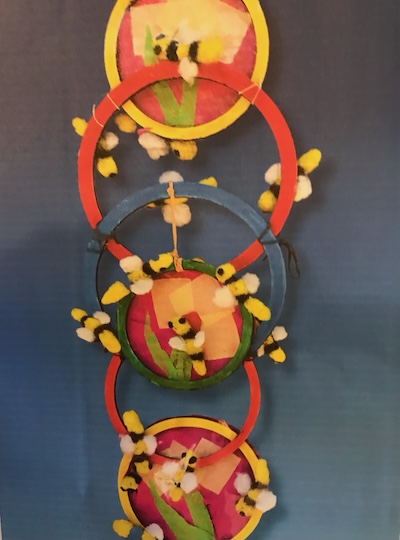
Devorah Stone created a honeybee circle for this year’s Calling All Artists exhibit, which opens at Congregation Emanu-El Aug. 26. (photo from Devorah Stone)
“This year’s theme is ‘animals’ and since my name means ‘Honeybee’ in Hebrew, I went with that,” Devorah told me. “The bees in my work are all hand-felted, a technique that involves pocking at wool and shaping the form. I decided to present the bees in circles because they are so crucial to the circle of life.”
The artists’ works are up for six months in the shul’s social hall. Devorah has been involved with the event for the last 10 years. Rabbi Brechner gives a lecture on the theme and how it pertains to Jewish traditions, sacred writings and thought once a month for five months before the celebration. This year, his teaching focused on the significant symbolic and ritual roles animals play in Jewish texts.
“I’ve learnt so much about both art and Judaism attending the rabbi’s lectures,” said Devorah. “Anyone can join … you don’t even need to be Jewish.”
The Calling All Artists project is run by self-proclaimed “den mother” Barbara Pelman. She said there is a chapbook written every year with an explanation of each artist’s creative process and a copy of that is given out to guests.
“In last year’s Calling All Artists, I did the kohain gadol’s (high priest’s) breastplate with references to all the various colour and gem stones as described in the Torah,” said Devorah. “The only difference was the mannequin I used was a woman’s so I pretended that there might have been female priests at the time of the Temple!
“I’ve also done a collage of a person wearing a tallit and the burning bush, a three-dimensional piece of the Rosh Hashanah dinner, and another collage on a wooden cradle of the story of Abraham and Isaac.”
Devorah has always been fascinated with art.
“As a child, there was nothing better than a box of crayons and endless paper,” she said. “I drew space ships, planets and alien worlds. I also drew castles and princesses. I loved it. My imagination had no limits.”
In her 20s, Devorah spent four years at the University of Victoria, earning a bachelor of fine arts. All the while, she felt inspired by Emily Carr and Indigenous art.
“I loved the way Carr personified nature and her magnificent trees,” she shared. “I marveled at the complexities, elegance and craftsmanship of the First Peoples of the land.”
Our parents also brought us up with a strong Jewish identity.
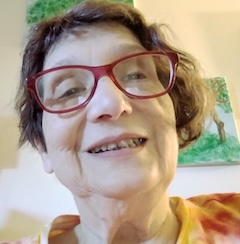
Devorah Stone (photo courtesy)
“Being Jewish, I was taken by the imaginative work of Chagall, his goats and houses and how everything seemed to be floating or suspended,” said my sister. “Later on, I began to be influenced by the school of Bauhaus design, especially Kandinsky, his calculated and yet whimsical designs.”
After Devorah moved to Victoria 20 years ago, she joined the Pandora Arts Collective Society. The group exhibits its works at the Little Fernwood Gallery twice a year and Devorah recently sold a painting there.
The collective is a community of people whose mandate is to facilitate and support mental health through the social and educational benefits of a free and welcoming creative arts space. The studio is open to everyone: professionals, students and beginners. The atmosphere is especially sensitive to people who are using art therapeutically. Devorah is on their board and has planned events for them in the past.
“We inspire and mentor each other,” she said. “I have learnt so much about art from that group. I’ve been introduced to many different kinds of art and artists, as well as being influenced by so many artists in our synagogue. The joke is that you can’t throw a rock without hitting an artist in Victoria!”
When she was living in and around Vancouver, Devorah brought up three children, two of whom live in the Lower Mainland. She visits all of us frequently and spends a lot of time on the ferry.
“I love doing fast sketches of the scenery as it goes by,” she said. “I also do fast sketches at outdoor concerts and festivals, which Victoria has so many of.”
Devorah uses pencil crayons, acrylic paint and watercolours, creates collages and sometimes three-dimensional art made out of whatever she can find.
“I love experimenting and I feel that all my art is influenced by being Jewish,” she said. “It all has a profoundly Jewish way of seeing nature and of being.”
The best way to view Devorah’s art is through Instagram @devlovesart.
Cassandra Freemanis a journalist and improviser who lives in East Vancouver.
Co-directors of Chabad of the Tri-Cities Rabbi Mottel and Nechama Gurevitz with their children. (photo from Tri-Cities Chabad)
Since he arrived just under two years ago, Rabbi Mordechai (Mottel) Gurevitz has had a very active and wide-ranging schedule. He’s been organizing programs and events and, most importantly, building community in the Tri-Cities (Coquitlam, Port Coquitlam and Port Moody).
Gurevitz, co-director of Chabad of the Tri-Cities, gave the Independent a few examples of the growth he has witnessed. This year’s Passover seder brought in nearly 50% more attendees compared to 2023. There was a similar increase in attendance for a Ten Commandments reading and ice cream in the park gathering during Shavuot.
For Lag b’Omer on May 26, the largest Jewish event in Tri-Cities history was held at Rocky Point Park. Hundreds of people came out in the rain for a day filled with music, featuring Vancouver band Tzimmes, dancing, art, a marketplace, a magic show, bouncy castles and, of course, mouthwatering food.
Gurevitz, a Brooklyn native, arrived in the Tri-Cities in November 2022 with his wife, Nechama, who hails from Portland, Ore. In a recent interview, he told the Independent that he adores the region and is very happy and amazed to see the interest in the Jewish community for Jewish activities – and, he added, he regularly has to replenish his supply of mezuzot.
“We feel grateful for where we live,” he said. “It is such a beautiful, growing community. Geographically, it is a beautiful place with beautiful people. I feel privileged to be in this position to lead. It is not something I take lightly. I am really happy that we are here.”
The goal of Chabad of the Tri-Cities programming is to raise the Jewish profile and increase the sense of Jewish community in the area, Gurevitz explained. He gets the most joy, he said, when he hears from community members about connections they have made through his efforts, such as two sets of parents arranging a play date for their children after meeting at a Chabad event.
“One of the challenges of the Tri-Cities is that it is geographically spread out. Organically, there is a challenge for a community to grow because people are all over. What we are finding is that, by creating infrastructure, it is blossoming,” he said.
The region’s population comprises people of all ages, and many young families. As a result, there are programs to meet the needs of various demographics, from teen activities to special groups for men and women, in addition to a Hebrew school, weekly Torah classes and Kabbalat Shabbat meals. The programs have been well received, Gurevitz said, and have created a space for people to come together.
“All of these are cogs in the machinery. Each of them is important on its own, but, in the greater picture, what is emerging is a vibrant Jewish community. Jews are hanging out with other Jewish people. There is a place to celebrate our traditions, connect and meet new friends,” Gurevitz said.
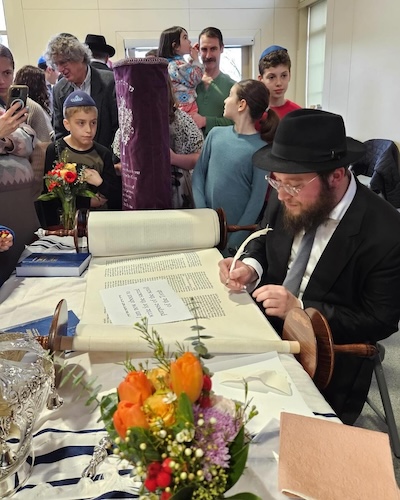
On March 10, Tri-Cities Chabad celebrated the milestone of completing a sefer Torah. Along the way, there was great excitement, as members of the community dedicated letters and chapters for the new scroll.
Rabbi Mottel Gurevitz writes the final letter of the Chabad of Tri-Cities community Torah. (photo from Tri-Cities Chabad)
“There is something very unifying about a community writing a Torah,” Gurevitz said. “The energy in the room that day was something so special, with the joy and the celebration and people of all ages kissing the Torah. That was a real monumental event this year.”
Gurevitz, who also teaches at Vancouver Hebrew Academy, jokes that he has two full-time jobs. A typical day might have him teaching in Vancouver in the morning and returning to the Tri-Cities in the early afternoon to have meetings, run programs, prepare for events and reach out to people.
“As a rabbi, I believe our first priority is our fellow Jews’ physical well-being, then we can care for their spiritual well-being. I am being there for people, helping however we can. The part I like most is meeting people and making those connections,” he said.
On July 2, at 7 p.m., Chabad of the Tri-Cities will put together an event to mark the 30th yahrzeit of the Lubavitcher Rebbe, Menachem Mendel Schneerson. Titled An Evening of Inspiration, the event will feature Rabbi Meir Kaplan, leader of Chabad of Vancouver Island.
“Our very existence in the Tri-Cities, a boy from Brooklyn walking around looking like a rabbi in Coquitlam, is to the Rebbe’s credit. We are gathering to pay tribute to the Rebbe. What was unique about him is that he made leaders and empoweredindividuals,” said Gurevitz, pointing to the 5,000 Chabad centres currently operating in more than 100 countries. “We will reflect on how the Rebbe’s legacy could inspire us to live a more meaningful and purposeful life.”
Brian Gleckman in front of his work, “The Judgment of Solomon (Psak Din: Judgment).” Psak din is a ruling given by a beit din, a Jewish court. (photo by Olga Livshin)
Brian Gleckman’s first show at the Zack Gallery, Abstracted Identity, opened on June 18.
The artist has loved art since childhood. “I grew up in Los Angeles,” he said in an interview with the Jewish Independent. “It is a vibrant city for visual arts. There are an endless number of art galleries and museums, and I was always there. And, of course, I always drew and painted.”
After getting his degree in visual art and history from California State University, Gleckman traveled extensively around Europe, before settling in Vancouver more than 30 years ago. But traveling has remained his passion and, during his travels, he invariably focuses on art and art history, museums and galleries.
“When I first visited Europe, I fell in love with Rococo and Baroque,” he said. Baroque and Rococo are both highly ornamental styles, which infused the art and architecture of post-Renaissance Europe.
Later, he drifted towards more contemporary styles, both as an art connoisseur and in his own work. “I suppose I can call my art abstract expressionism,” he said.
“Colour for me is a vehicle that allows me to play with shapes and space,” Gleckman explained. “Spatial relationships and composition of the images are of the utmost importance to me. I’m also concerned with depth and texture. I aim to create visual tension in my paintings. I think art shouldn’t be too easy or too comfortable. I want my viewers to engage, to ask questions. ‘What did he mean by that?’ ‘How does it make me feel?’ My viewers might not arrive at the same inner realization I conceived, but their explorations are more important than my answers. When people interact with my art, they become part of the creation process.”
With his current show, Gleckman seeks to “portray things that lie beyond the tangible – that is, beyond the figurative, beyond the readily recognized narrative. The paintings in this exhibit are expressions of the inspiration I derive from biblical stories, religious thought, as well as rudimentary ideas within kabbalah. Selected from the portfolios of my professional artwork, these paintings are reflections of how I personalize the intangibles of Judaism.… These paintings are abstractions of my Jewish identity, an identity that is the product not so much of formal religious practice but the summative effect of intellectual and emotional sensibilities of my Jewishness.”
Of course, the Jewish Community Centre of Greater Vancouver, which is home to the Sidney and Gertrude Zack Gallery, felt like the perfect venue for such a show, but there was an additional reason why Gleckman wanted to exhibit at the Zack.
“After Oct. 7, I wanted to do something that had meaning,” he said. “I wanted to share my pride in my Jewish identity. At the same time, I wanted to be part of the effort to help Israel, to make my own contribution. But I am an artist. I create art. I thought maybe my art could inspire someone to do something for Israel, to help in some way.”
He approached the gallery with the idea of a show and offered to donate any proceeds from the sales of his paintings.
“I’m going to donate whatever I get to two organizations: ASI-Canada (Association for the Soldiers of Israel), which supports active-duty IDF soldiers, and Magen David Adom, which is Israel’s emergency response service. To promote the sales, I’m also offering 30% discount off my website prices for all my paintings.”
The exhibit comprises 27 paintings from several of Gleckman’s established series. “For this exhibition, I have included paintings that are accompanied by titles … for fuller comprehension,” he said.
“The titles invite viewers to search for and reflect on the nuances of their own understanding of the selected stories, themes and ideas,” the artist explained. “I’m not trying to dictate my own interpretations to viewers. Instead, with the titles, I try to nudge viewers in the right direction. The titles are sort of guidelines for understanding the images, their conceptual representation.”
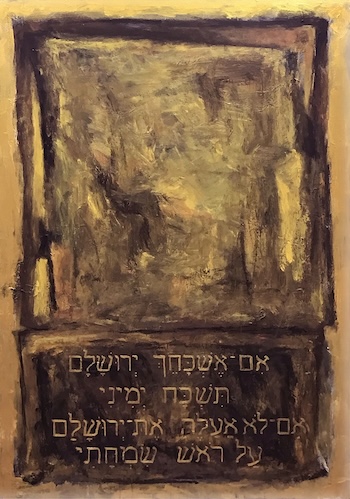
“Yerushalayim (Jerusalem)” by Brian Gleckman. The Hebrew words in the painting are from Psalm 137: “If I forget you, O Jerusalem, may my right hand forget … if I do not bring up Jerusalem at the beginning of my joy.”
Most of the titles are in Hebrew, spelled phonetically in the English alphabet. Some are in English, but they represent Jewish customs and stories. For example, the large painting “Tikkun Olam” is a field of life-affirming blue, while “Shiva” is bleak and dark, a painting of grief and despair, but both will generate different feelings for everyone.
A few other paintings are linked to grief and death, but many sport bright colors, like “Aytz Chaim” – blue and gold and triumphant – which proclaims the artist’s vision of the Tree of Life. The painting, tall and narrow, is framed by golden words.
Another tall and narrow painting, “Tefillah” (a prayer), contains this one word in Hebrew, as well as 10 bright gold stars dancing on the blue background below, representing a minyan, the quorum of 10 men (in Orthodox Judaism) or people needed for Jewish communal prayers.
Another painting with words and colours woven together is “Yerushalayim.” Its golden-brown palette is reminiscent of the ancient city of Jerusalem, its modernity and its millennia of history, including conflict.
Then there are calligraphed Hebrew letters, each magnified manifold on its own black and white canvas. “Their shapes are still recognizable,” said Gleckman, “but I wanted to explore the possibilities, the situation where something we know becomes something else, something to investigate and find a new meaning.” Each of these letter-paintings is like a road, curling capriciously according to the letter’s design, leading the viewers towards the unknown.
Abstracted Identity runs until July 18. To learn more, visit the artist’s website, briangleckman.com.
Olga Livshinis a Vancouver freelance writer. She can be reached at olgagodim@gmail.com.
Recently, I came across a LinkedIn post. It suggested that people could evaluate their work by asking if it “mademoney, saved money or saved time.” One of the responses suggested that nurses, for instance, would not fit into this model. Neither would teachers, therapists or social workers, for that matter. While education or therapy do eventually probably save money and time for society, their worth isn’t measured by these markers. As a writer, my work is also worthless in this evaluation, as it doesn’t earn lots of money or save time. But caring/thinking professions are still meaningful. I did a silent revision to the post. I added: Does your work create meaning? Is your work creating value? Meaning and value aren’t always measured in monetary terms.
I didn’t respond to this piece I read online. I don’t know who posted it originally, but priorities are different than mine. It isn’t a bad thing to save money, make money or save time, but I was left wondering – if these are a person’s top priorities, what will they do with the money or time saved? I wonder where “making meaning” comes into this person’s life.
My household is just recovering from our twins’ b’nai mitzvah. Out-of-town relatives and friends were here for several days before and after. I managed many details and events, multiple meals, a tent, chair and table rental, games and more. The synagogue service my children led was very meaningful, and looking out at the congregation was amazing. I felt so supported by family, friends and community.
For days afterwards, Jewish community members wished us mazal tov and non-Jewish neighbours and friends continued to congratulate us. My twins got gifts from places we didn’t expect. Both kids were truly flummoxed by the love and generosity showered on them.
I won’t lie: I’m exhausted after this lifecycle experience. I was the main organizer for everything other than services. Everything went smoothly, far better than I’d expected, especially given that our synagogue is under renovation.
When guests suggested a future as an event planner, I said no! I couldn’t wait to get back to my freelance writer/editor day job. Perhaps what I have learned is that, while I’m good at organizing and details, I don’t find meaning in doing those things. For me, it’s only the relationships and community that makes meaning.
A snippet of learning I did this week made that clear. I was studying the Babylonian Talmud tractate of Bava Metzia 109 when I read this story:
“Rav Yosef had a certain planter, a contractor whose job was to plant trees. He died and left behind five sons-in-law. Rav Yosef said: Until now I had to deal with only one person; now there are five. Until now, they did not rely on each other to plant the trees and did not cause me a loss, as the responsibility was their father-in-law’s, but, now that they are five, they will rely on each other to plant the trees and cause me a loss. Rav Yosef decided to discontinue the agreement with them. Rav Yosef said to them: If you take the value of your enhancement that you brought to the field and remove yourselves, all is well, but, if not, I will remove you without giving you the value of the enhancement.”
The rabbis then debate if Rav Yosef’s behaviour as a businessman was acceptable. Their conclusion is that canceling the agreement was acceptable, but sending the sons-in-law off his land without compensation wouldn’t be right. When I read Rav Yosef’s choices here, as a person in business, I saw why he made his choices. Rav Yosef had a business relationship with a contractor. When that ended due to death, he didn’t have the same agreement or support from the five sons-in-law, all of whom might have left the job to someone else. He wanted to pay them for what had been done and cut his losses.
I worried about the contractual commitments I’d made for our family event. Would the tent, tables, chairs, catering, servers, games, six-person bike, fancy vegan popsicle cart all arrive as scheduled? In the end, it all worked out. However, if I’d been faced with an issue like Rav Yosef’s – the death of someone I trusted and a time-sensitive need to get something done – I too might have wanted to pay for the work done so far and cut my losses.
Sometimes, we recognize that, without the original helper, chaos might erupt. Our synagogue caterer provided food for 75 people as take-out for us, but had no servers, due to the building closure and renovations. I worried about what to do. Luckily, through Jewish community connections, I found someone who used to work at the synagogue, and three others who worked at a different Jewish congregation. My brother (former manager of a fine-dining restaurant) stepped in to help. My neighbour volunteered her oven as a backup to warm up food, though we did not need it in the end.
This experience helped me realize that, although we moved to Canada in 2009, we had built community over time. People volunteered to support us and connections with businesspeople made the event happen. A “team” of loving people, both from far away and close by, pulled together to make meaning for us as a family.
Long before I had kids, I loved attending Shabbat services that celebrated a new baby, an upcoming wedding, a birthday or bar or bat mitzvah. Now I see that, as part of the extended community, I too created meaningful connections. The congratulations, singing “Simon Tov U’Mazel Tov,” and warm smiles matter. Being a witness and a celebrating participant are valuable.
For some, our twins’ b’nai mitzvah helped people make money. Months of work as the “organizer/Mom/event planner” saved money. If recent world events, or Rav Yosef’s contractor agreement, have taught anything, it’s that our lives could be short – time matters. It matters that we do straightforward, moral business with others. So many things can go wrong. There is absolutely nothing like a few days of love, support and meaningful interactions with people who care about us. We can also always use more love and community support.
Joanne Seiff has written regularly for the Winnipeg Free Press and various Jewish publications. She is the author of three books, including From the Outside In: Jewish Post Columns 2015-2016, a collection of essays available for digital download or as a paperback from Amazon. Check her out on Instagram @yrnspinner or at joanneseiff.blogspot.com.
Many community events, lessons and celebrations take place in the Jewish Community Centre of Greater Vancouver’s Wosk Auditorium. (photo from JCC)
A sense of family and community, somewhere to be physically active and mentally stimulated, a haven in which to socialize and relax, to have a nosh, a lifeline during the pandemic and a place to be with like-minded people after Oct. 7. The Jewish Community Centre of Greater Vancouver – “the J” – “is a warm and welcoming place for Jews and the community in general,” offered JCC executive director Eldad Goldfarb.
The Jewish Independent spoke with Goldfarb and others recently, to see how the centre has fared since the Hamas terror attacks on Israel, the Israel-Hamas war and the rise in antisemitism around the world, including in Metro Vancouver.
“The level of security has seen a noticeable increase,” said Goldfarb. “The initial shock had an effect on our entire community, which felt insecure and somewhat afraid to venture out and into Jewish community facilities. This fear quickly changed into a desire to congregate, be with fellow Jews in safe spaces, and the JCC is a place where everyone feels safe and welcome.”
He praised the Vancouver Police Department and its role in allowing the community to gather safely.
“The VPD is amazingly supportive of the Jewish community and the JCC,” he said. “They are doing above and beyond within their limited resources to provide both physical as well as emotional safety at this very difficult time for our community. The JCC staff team is very vigilant and pays close attention to anything out of the ordinary.”
Goldfarb has been the J’s executive director for 11 years, and was assistant executive director for the six years prior to that. He said the centre has “expanded its programs and services, providing substantially more scholarships and subsidies to families and individuals.” And he and the JCC board “have been involved in the conceptualization, visioning and creation of JWest, an exciting innovative community project for generations to come.”
“The JCC has been working diligently on expanding our capacity, we have made investments in recruiting top-notch staff, replacing and transforming our technology systems in order to improve customer experience, ease the registration process and create efficiencies in the organization,” said Goldfarb.
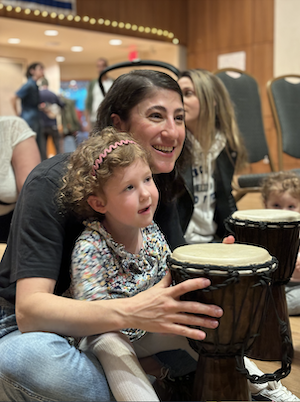
“We’re always trying out new programs,” Hila Olyan, senior director of programs, told the JI. “I’m especially excited about programming for new families, which ramps up this coming fall: pre- and post-natal yoga, baby sign and sing, stroller fitness, storytime in the library. We’re also trying out some new children’s programming over the summer. Music, Music for Littles and Music, Music for Babies will be offered on Sundays. I can say from personal experience that my toddler loves the program. He’s been taking it since April.”
The J’s many programs include ones to introduce toddlers and their families to the joys of music. (photo from JCC)
While the programming hasn’t changed much in response to Oct. 7, Olyan said “the interest in being part of programs has increased. I think, for many people, myself and my family included, the opportunity to participate in Jewish and non-Jewish programming, but in a safe space surrounded by like-minded people, is more important than we previously realized.
“We’ve also tried to be thoughtful as we plan and host our community events like the recent Festival of Israeli Culture. We are thinking about how we can honour the challenging times we are living in, but also celebrate the beautiful culture we all know and love.”
She pointed to significant participation in events such as seniors luncheons, the J’s annual Purim Party and other activities.
“The people of our community want to be around other community members and I think it’s a great thing,” said Olyan. “The atmosphere has shifted a few times. We’ve moved from shock and devastation to strength and resilience. I think it’s a real testament to the spirit of our community.”
“The JCC has and will always be a safe place for me and my family and the entire community,” said Michael Averbach, who has been going to the J since he was a kid himself. “Oct. 7 didn’t change my frequency of visits or how I feel about being at the JCC, nor should it for any current member, but my message to those considering joining – there’s no greater feeling of family than being at the J. It’s the only place where we can truly interact with all sectors of our community, from the non-observant, to the Reform, to the Orthodox and everyone in between. Furthermore, the JCC was built on the foundation where everyone is welcome, regardless of religion or race.”
In addition to being a J member, Averbach has chaired the centre’s main fundraising event, the RBC JCC Sports Dinner, for many years. Attesting to his family’s generations of involvement with the JCC, the welcome desk everyone passes on their way into the centre is called the Betty and Louis Averbach Membership Desk, named after Averbach’s grandparents. And the next generation is also involved.
“We’ve had our kids in day camp and swimming lessons over the years and, personally, I enjoy boxing sessions with Alexei to keep me sharp and on my toes and to complement my regular fitness routine,” said Averbach. “I also try and get to the J in the later evenings up three to four times a week to enjoy the sauna and steam in the men’s spa.”
Working out at the J. (photo from JCC)
When asked what keeps him coming back to the centre all these years, Averbach said, “The warm feeling and sense of community walking through the doors.”
This is an aspect that also appeals to J member Cathy Paperny and her family, who joined the JCC in 2006 when their children began the 2-year-old program.
“I appreciate being surrounded by a Jewish community,” she said. “I have a good relationship with Eldad and we often have good talks about various topics, including the war in the Middle East. During these challenging times, it’s especially important to be surrounded by like-minded people. I feel I have that at the JCC.”
The social aspect is one of Olyan’s favourite parts of her job.
“I like the combination of interacting with members, program participants and administration. I like thinking about how we can make our programming stronger and then having the opportunity to put plans into action and see the results. Every single day I meet and talk with interesting people who are all here at the J for their own unique reason – a workout, childcare drop-off, gymnastics, music lessons, a holiday or festival.”
For Paperny, that reason was the program for 2-year-olds. She said the J was the only place that offered it. “I liked that my children were attending with other Jewish children, some of whom became lifelong friends. It was close to VTT [Vancouver Talmud Torah] for afterschool programs and convenient for me when I was working at the Holocaust Centre,” she said.
Paperny worked at the Vancouver Holocaust Education Centre, which is on the lower level of the centre, until 2019, for about four years as the symposia coordinator and as a docent for more than 10 years.
In addition to the 2-year-old program, Paperny said, “Yaelle went to ballet classes when she was young and did Israeli dancing through Talmud Torah and then performed at the Festival Ha’Rikud events at the JCC until Grade 7. Both of my children attended Camp Shalom for a couple of years.One of my children did the leadership-in-training program at Camp Shalom. They also attended other sports camps, like soccer.
“I did personal training there for years and attended some of the fitness classes, including circuit training,” she continued. “Now, I swim, do private pilates with Camila, attend yoga twice a week and attend many fitness classes.”
She also attends Jewish Book Festival events and, often, Israeli dancing on Wednesday nights.
These types of activities are exactly what the JCC mission entails.
“For our Jewish community, we continue to be committed to our mission to provide programs to enhance positive identification with Jewish life and Israel,” said Goldfarb. “This can be seen in our children’s camps, early childhood education programs (daycare and out-of-school care) and with our Israeli dance classes – to name a few.”
Nava Creative Kosher Cuisine is also on site. A popular spot to have a coffee or lunch, it is hard not to run into fellow community members when you’re there: members of the J, people visiting the latest exhibit at the Zack Gallery or going up to the Waldman Library, staff from the various Jewish organizations housed in the centre, participants in different programs, parents picking up their kids, students from King David High School, which is located across the street from the centre, and others.
“The JCC, while not without its challenges, is a place of growth and potential,” said Averbach. “I am aware of the high staff turnover and the need for building upgrades and, together, we are actively working on raising the necessary funds to address these issues. If there’s one key area for improvement, it is staff training for those with special needs and neurodiversity. By properly implementing this training, we can ensure that all our children feel comfortable and welcome.”
And it seems that the J is committed to continually improving. For example, staff review its programming often.
“Every participant in a registered program receives an email link to a quick survey,” said Olyan. “We also look at our mission statement and consider how we can continue and better meet our mission and the needs of our community. Are we offering social, educational, recreational and cultural programs for every demographic? Finally, we consider what are the emerging trends and interests within and outside the Jewish community and is the JCC the right place for [such programs]. We really try to listen to our members and find out if there are particular programs they would like to see.”
As for her feedback, Paperny said, “During COVID, the J was a lifeline for me when virtual programs were available, and then when it opened up to in-person programs. My physical health is so integral to my emotional, mental and spiritual health. The J has always been there for me.”
The Beth Israel Mural Project goes beyond the synagogue’s parkade, with a website that features each artwork, as well as information about the holiday depicted, and more. (screenshot)
Windows into the synagogue, windows into Judaism. The Beth Israel Mural Project features 13 works of art, each based on a Jewish holiday. Adorning the shul’s parkade, they welcome visitors.
“During COVID, Sy Brown started the Good Times Club at the BI. The goal was to bring in new programming into the shul for the over-50 crowd,” explained project manager Reisa Schwartzman. “We have had blood drives, book clubs and walking clubs. I came up with the idea to do a mural in the garage.
“At first, the idea was to do one large mural. The challenge was that there are parking signs that could not be removed so it motivated us to think out of the box a bit. The smaller framed murals allowed it to have the effect of being windows into the shul.
Ramona Josephson was the lead artist on one of the two murals portraying Shabbat. (photo from Beth Israel Mural Project)
“The next steps were to call out to the congregation to see who would like to participate. At this time, all meetings were held on Zoom due to COVID. Once the committee had the members, we then went out to the congregation – we wanted the entire membership to feel included, to see what they wanted to see in the garage. The overwhelming feedback was the holidays.”
Volunteers were assigned a holiday and the committee helped with each image. “This is when the real work began,” said Schwartzman. “But, up to this point between COVID and summer holidays, it was two years.
“With Peter Sarganis, an amazing artist himself but also an art teacher, he guided us on the steps required to take our wonderful images through the multiple steps to get each image on the boards. Once the boards were ready to go, we met each Sunday afternoon for painting for several months. There were committed painters who would come in during the week to work as well. This was a labour of love! The energy in the room when we were painting was fabulous. Focused artists and painters working together to bring these works to fruition.”
Sarganis answered the callout to members because, he said, “As an artist, I thought it would be a creative way to combine my love of Judaism, the Beth Israel Synagogue, collaboration and painting.”
Sarganis became the project’s art director and a lead artist and designer of one of the two Shabbat works.
“I love Shabbat. From Friday evening family dinners; to Shabbat morning services; to the candles, wine, challah and artifacts used – I can simply say I love it,” Sarganis said of his choice of holiday to portray. “The Shabbat panel I designed and painted is an abstracted representation of our family’s candle holders, Kiddush cup and challah cover.”
About the project, he said, “We had a wide range of expertise, from those who don’t paint at all to those who paint a lot. The common thread that kept us going and made this a beautiful group to be a part of was everyone’s passion for the project.
“As a professional artist and someone who has taught at a fine arts school for the past 29 years, it seemed the role of me becoming art director happened organically, it was not something that was there at the start of the project,” he added. “This included helping the designers of the panels with their designs, bringing in tools and equipment to help facilitate the transferring of the designs onto the large panels, advising the groups of painters on the painting process and/or techniques, figuring out (with Reisa) the placement of the panels in the parkade.”
“I really believe that we can beautify the most simple areas to make them more impactful,” said Schwartzman. “Having these windows in the garage makes the experience of going to the BI start right from parking your car. But we didn’t stop there. Krystine McInnes came up with the idea that we should add QR codes to each image so that people could open their phones and learn more about each holiday, the customs and history. We hope we can use these to fight antisemitism as well, or just to help educate. We decided to paint on boards rather than the wall itself so, if needed, we could have them traveling.
“One thing different about our art is that none of the pieces are signed. This was with the commitment that the works were collective, designed and inspired by several artists and painted by the community we built. It is a community effort for our shul.”
While the lead artists aren’t indicated on the murals in the garage, they are credited on the project’s website, bethisraelartproject.com: Beryl Israel (Purim and Tu b’Shevat), Sheila Romalis (Hanukkah), Ramona Josephson (Rosh Hashanah, Sukkot and Shabbat), Debby Koffman (Simchat Torah), Janice Masur (Shavuot), Luca Carati (Yom Hashoah and Yom Yerushalayim), Nassa Selwyn (Pesach and Yom Kippur) and Adele Lewin (Simchat Torah). In addition to the QR code integration, McInnes designed the project website, which features information on the holidays, their history and customs from several sources, including work done by Jean Gerber and Jonathan Berkowitz and a dozen orso websites.
The paint was donated by Benjamin Moore Paint and the boards and framing by Burton Mouldings, said Esther Moses, Beth Israel executive director. Ralph (z’l) and Elaine Schwartzman donated to help make the project possible, she said.
“My parents believe in supporting our community and have always been supporters of several Jewish agencies here and abroad,” explained Schwartzman. “Once they heard about what I wanted to do, my mom called the shul and made a donation to make sure we could complete the project. Supporting the shul, the arts, community and engagement for people are all reasons they stepped forward.”
Beryl Israel was the lead artist on the Tu b’Shevat mural. (photo from Beth Israel Mural Project)
“I am so proud of Beth Israel and our members who worked on the murals. They are strikingly beautiful,” said Rabbi Jonathan Infeld, the synagogue’s senior spiritual leader. “They bring light to our congregation and are a great educational tool. They brought people together for an important common cause. The murals are another way that we help bring Jews closer to God, Torah and Israel at Beth Israel.”
While he helped, for example, with the Hebrew on one of the works, Infeld admitted, “I am involved in many different aspects and programs of the synagogue, this is one that I did not play a large role in though. Yes, I helped with some of the Jewish content. But anyone who knows my artistic abilities knows why I left this project to others to accomplish.”
The project – which took a total of three years from conception to installation – “was a great way to add colour to our parkade in a meaningful and Jewish way,” said the rabbi. “The murals are educational and exceptionally beautiful. But, most importantly, they created community amongst people of all ages.”
Overall, it has been a huge success, he said. “People love seeing [the murals] when they enter the parkade. They love looking at them and learning from them. I know that the participants loved making them.”
“This project was really a labour of love by all who participated,” agreed Schwartzman. “Peter was incredibly supportive with his knowledge and guidance. There were so many amazing artists that we all learned from each other, helped each other and celebrated together. We really hope that these images bring the shul much enjoyment and support them in any of their programming when possible.”
“This project took a lot of time and work – and was worth every moment,” said Sarganis. “I met some wonderful people, and got to know people I already knew even better. A beautiful community project.”
The late afternoon, right after school or summer camp, is go time for many parents. These are the moments where my twins have every kind of need, from taking off their outside gear and emptying lunch bags to signing permission forms, getting help on projects, and more. It is a period of chaos, usually with a desperate need for snacks as well as dinner preparation, all rolled up. There are days when things are calm, sure, but there are other times when I savour my last moments of quiet at 3:25 because from 3:35 until 6:30 or so, after dinner, I am a whirlwind doing Marathon Mom work.
Our public junior high this year presented us with Mega Options activities for the last few days of school. While the various options were hyped to students in advance, only whispers of this made it home. So, on an average Monday afternoon in June, my kids told me to be sure to open the special Mega email fast, as all the best activities would fill up. At 4:30 on the button, my inbox told me about the many Mega Options I would need to hurry to fill out to meet my twins’ expectations.
There were so many choices: Métis sash-weaving and historic cemetery trips, Inuit printmaking and Indigenous storytelling, Euro-style soccer tournaments, Pickleball, phone photography, kinesiology and nutrition lab field trips to a university, and more. There were bike treks, orienteering, the list went on. The selection was huge. Not every outing had a description or information. Some choices came with big fees. Others were free.
It was a huge rush to decide. We watched some activities fill up even as we tried to sign up – and, with twins, we had to sign up twice. In the end, my more social kid called one of his close friends. On the other end of the phone line, I heard his mom, a teacher I am friendly with, coaching him through. It was a great solace to know I was not alone in sorting through this!
Within moments, both my twins were signed up, with their friend, for one day of board games, outside games, and baking bannock and eating together. The other day was reserved for going to Assiniboine Park, Winnipeg’s version of New York City’s Central Park, and always a fan favourite. I emailed the other mom afterwards. “Sheesh!” she replied. “That was stressful – lol.” It was. She was completely right. The Mega Options format left me strung out and worried. Did we make the right choices? What does “A day at Assiniboine Park” mean? There was no description. What do we parents need to provide? Lunch? Money? Rides?
After the decisions were made and the activities secured, I was relieved. The fun warm weather choices our boys made were free, easy and uncomplicated. Sure, it wasn’t going to be a big learning experience, but the decisions were made. We no longer had to dwell on the choices themselves.
After stepping back, I realized that these late afternoon blitzes are so hard because they can be unpredictable and disorderly. There are multiple tasks thrown at parents at once, when we’re not necessarily at our best energy-wise. Both flexibility and preparedness are necessary. There’s no telling if today I’ll have to be a math whiz, an event planner, or a custodian, cleaning up after a kid is sick in the hallway. (Hey, it happens.)
The skills required to manage the late afternoon rush aren’t just relevant to kids. As adults, and as Jewish people, we are often offered “Mega Options” when it comes to making choices. We don’t have one specific menu item at restaurants, nor do we have a single kind of Jewish ritual, religious life or home observance. We face tons of choices every day. Further, while the pandemic narrowed some options, the post-pandemic world has vastly increased them. When our usual routines are disrupted, we’re forced to evaluate what we’ve done all along. Is streaming a religious service easiest?Are we healthy enough to attend in person? What is the COVID protocol (or non-protocol) these days, even as the virus still circulates? Sometimes, we crave situations where the decisions are just made for us, even as we know it would be better to make up our own minds instead.
This was our world before Oct. 7. Afterwards, the choices became even larger. Now, questions of safety and freedom from harassment also come into play. We choose whether to wear anything identifiably Jewish when out on the street. We question if we’ll feel safe attending this Jewish venue. Is attending this graduation/parade/campus/event going to force us to deal with protesters or hate speech? Then there’s: Are we still safe, wherever we live? Should we be considering a move to someplace safer? Is there somewhere safer?
We could pretend that all these choices are a part of the modern age, but we know from Torah study, the many debates of the Talmud and Jewish history that the act of making choices is an essential part of what it means to be Jewish. From the first, we were shown hard choices and real consequences: from Leviticus 10’s Nadav and Abihu, who chose to sacrifice “strange fire” and were struck down for it (a bad choice, apparently), to Deuteronomy 30:19, which summarizes a long list of choices we can make, concluding, “I have put before you life and death, blessing and curse. Choose life….”
The Mega Options presented to celebrate the end of school is nothing when compared to big decisions in life. One could just shrug it off as no big deal – but life is a series of little choices, one after another, that can affect everything. Survivors of major disasters often explain how they “just missed” the accident because they felt sick, woke up late or forgot to make their lunch. Historically, Jewish refugees described how they left at a moment’s notice, with only a suitcase, or just the clothes on their backs.
We don’t always know which choices are the big ones, or the good ones. Some of the best choices result in happy, long-lasting results, like meeting one’s life partner, discovering a passion or skill, or experiencing an amazing natural event like a meteor shower or the Northern Lights. Here’s to hoping our choices are easy and small ones, and that these options lead to all positive things. Here’s to celebrations, miracles and good deeds this summer – may we all have more “mega” pleasant choices ahead.
Joanne Seiff has written regularly for the Winnipeg Free Press and various Jewish publications. She is the author of three books, including From the Outside In: Jewish Post Columns 2015-2016, a collection of essays available for digital download or as a paperback from Amazon. Check her out on Instagram @yrnspinner or at joanneseiff.blogspot.com.