Skip to content
  • Home
  • Subscribe / donate
  • Events calendar
  • Business Directory
  • FAQ
  • News
    • Local
    • National
    • Israel
    • World
    • עניין בחדשות
      A roundup of news in Canada and further afield, in Hebrew.
  • Opinion
    • From the JI
    • Op-Ed
  • Arts & Culture
    • Performing Arts
    • Music
    • Books
    • Visual Arts
    • TV & Film
  • Life
    • Celebrating the Holidays
    • Travel
    • The Daily Snooze
      Cartoons by Jacob Samuel
    • Mystery Photo
      Help the JI and JMABC fill in the gaps in our archives.
  • Community Links
    • Organizations, Etc.
    • Other News Sources & Blogs
  • JI Chai Celebration
  • JI@88! video

Recent Posts

  • Federation now across BC
  • Israel fighting for its existence
  • Deal strengthens Iran
  • Patriotic belonging diminishes
  • A campaign to engage
  • Upstanders’ first live event
  • Responding to Carney
  • Having your own home
  • Music a family tradition
  • Musical to warm heart
  • Community milestones … June 2026
  • Sharing her passion for Israel
  • Or Shalom reopens its doors
  • JFS from past to future
  • Need holistic approach
  • Sharing stories, advice
  • Journalist shares fears
  • Skills to live together
  • Road to independence
  • Cutting grass with scissors
  • Zionism as a solution
  • Deceit, desire & the divine
  • Reclaiming sacredness
  • Creative project ideas
  • Summer squares and cobbler
  • Thou shalt … summer commandments
  • Legal help for students
  • Revisiting myth of Lilith
  • Wrong person rebuked
  • Canada’s mixed messages
  • Questions for museum
  • Symposium on antizionism
  • Making soccer political
  • CJPAC lauds Pulver’s impact
  • City recognizes Vrba’s legacy  
  • Organ donation saves lives

Archives

Follow @JewishIndie
image - CJN box ad Rockowers 2026

Tag: Israel

Fighting antisemitism

Fighting antisemitism

In Toronto, Yoseph Haddad, left, with Daniel Koren, founder and executive director of Allied Voices for Israel, which sponsored Haddad’s Canadian tour. (photo by Dave Gordon)

In recent years, Arab-Israeli activist Yoseph Haddad has become known for his efforts to fight antisemitism and present Israel’s perspective to international audiences, and he has taken up this mantle with much greater emphasis since Oct. 7, 2023. This month, Haddad’s Canadian tour, organized by Allied Voices for Israel, took him to Montreal, Calgary, Toronto and Vancouver.

At Toronto’s Shaarei Shomayim Synagogue, Haddad, who leads the Israeli nonprofit Together Vouch For Each Other, which works to bridge the gaps between Arabs and Jews in Israel, covered a few topics. He spoke about how his army service changed his life, how he protested anti-Israel agitators with pro-Israel Concordia students, and what he believes is Canada’s complacency towards antisemitism.

Though he was not obligated to serve in the Israel Defence Forces, Haddad voluntarily enlisted in the army in November 2003, more emboldened to do so after the terrorist bombing of Maxim restaurant in Haifa that left 21 dead and 60 injured. According to Haddad, Maxim was an establishment where the co-owners, employees and patrons were Arabs and Jews. It was an emblem of coexistence in Israel.

Haddad said it was the name of Israel’s army, the Israel Defence Forces, that helped him further understand that the force was defending all people in the country, not just Jews. During his service, he was a commander over Jewish soldiers, and he offered this as one of many examples that punctures the lie that Israel practises apartheid. 

He related a story about when he was accused at a public speech of being an “idiot,” of being used by the Jews, and that he would be eventually “thrown to the garbage.” He had an easy rejoinder, he said. 

While fighting in the 2006 Lebanon War, he suffered a life-threatening injury four days before the ceasefire, when a Hezbollah antitank missile exploded nearby and severed his leg. At risk to their own lives, his battalion carried him to safety. After treatment and extensive rehabilitation, he can even play soccer. He told the audience, if his unit wanted to throw him away, that would have been the time to do it.

Haddad warned of refugees and immigrants from the Middle East, some of whom, he said, bring extremism to Canada. 

“Instead of adopting Western values, instead of adopting Canada’s laws, they’re actually trying to change it to Sharia,” he said. “And that’s the biggest problem.”

Canadian authorities, he said, are “ostriches” who have their heads in the sand.

“When it comes to dealing with extremism and terrorism and terror supporters, zero tolerance [should be the response], and that’s what Canada should do,” said Haddad. 

It’s also a lesson for Israel, he added. In June 2023, he said, Hezbollah “infiltrated” Israel and set up in Israeli territory, a situation that Israel dealt with diplomatically. But this gave the terror group the sense that Israel didn’t care much for the land, didn’t care that an enemy had squatted on it, and that Israelis were “scared,” Haddad said. It contributed to Hezbollah’s perception on Oct. 8, 2023, when firing rockets, that “they thought that we are weak, because we presented ourselves as weak.” He said that, if he had been in charge, he would have flown F16s over the tents and bombed them. 

The United Nations and the International Criminal Court are “really obvious for bias,” in ignoring the crimes of North Korea, Venezuela, Iran, Cuba, Syria “and other countries who have zero human rights,” said Haddad. The UN “is adopting the narrative of a terrorist organization” when citing casualty numbers from the Hamas-run Gaza Ministry of Health, he added.

Haddad encouraged Israel advocates to speak out on social media: “If you see content which is anti-Israeli, report it. Leave a comment. Leave an Israeli flag. And if you see a pro-Israel comment, support it, share it, show it to other friends, take part in that, because we’re out there.”

Haddad is active on multiple platforms, including YouTube, and he posts content in Hebrew, English and Arabic, with nearly two million followers. 

Haddad said he remains optimistic. What uplifted him especially was having seen IDF soldiers in Gaza last summer who included “all the identities of the Israeli society.” They were, he said, united in two missions: find and free the hostages, and eliminate the terrorists. “And the only way that we can be supported,” he said, “is by being united, left and right, Jews and Arabs, secular and religious. And, I promise you, if society is united, there isn’t one single terrorist organization that can beat us.”

At the Toronto talk, journalist and activist Raheel Raza, a Pakistani-Canadian, was honoured for her decades-long allyship to the Jewish community. 

At the Vancouver event, which took place at Temple Sholom, speakers included Daniel Koren, founder and executive director of Allied Voices for Israel, and students Zara Nybo and Ben Morrison. Jaime Stein, whose uncle, Dr. Steve Stein, was title sponsor for the cross-Canada tour, also addressed the audience. Grand Chief Lynda Prince, AVI Allyship Award recipient, spoke of Jewish indigeneity and connections between Indigenous Canadians and Israel. David Bogdonov spoke on behalf of the Ronald S. Roadburg Foundation. 

Nybo, a University of British Columbia student, is the president of the Israel Club on her campus, though she herself is not Jewish.

“Israel is fighting a seven-front war. We, as students, are fighting on the eighth front of that war – on college and university campuses,” she said. “I am going to war with my peers, my professors, the administration and even the UBC president. I don my hostage pin and head out the door every day into an unknown battlefield of anti-Israel rhetoric, terrorist supporters, and antisemitism.” 

Nybo said students are “being brainwashed and fed purposeful disinformation about Israel and the history of the Middle East every single day” while a “prominent” history professor for Middle Eastern studies at UBC wears a keffiyeh on campus, joins pro-Palestine rallies “and encourages his students to do the same for extra credit.” 

She said, “I am standing here sounding the alarm about the bias ingrained in the university academic system.”

This “overwhelming systemic issue,” she said, can be confronted with education and by empowering students, as she was. Nybo had a campus media fellowship with AVI and HonestReporting Canada. This helped her hone her writing and editing skills, and her pro-Israel articles have been published in the National Post, Jewish Independent and Algemeiner. She was subsequently accused by a professor as being “employed by Zionist entities,” she said.

But challenges such as these can be faced when students are brought together, she said, “under the banner of allyship, building bridges and empowering students to speak out, all while providing community reinforcement.” 

Dave Gordon is a Toronto-based freelance writer whose work has appeared in more than 100 publications around the world. His website is davegordonwrites.com.

Format ImagePosted on December 20, 2024December 19, 2024Author Dave GordonCategories NationalTags Allied Voices for Israel, antisemitism, Diaspora, Israel, Yoseph Haddad, Zara Nybo
Help team get to Israel

Help team get to Israel

BC members of Team Canada U16 Junior Girls Volleyball sell donuts to raise funds to travel to Israel next summer. (photo from Maccabi Canada)

Young volleyball players and their families are calling on the community for assistance to send their team to Israel for the 2025 Maccabiah Games next July.

Team Canada U16 Junior Girls Volleyball includes 10 athletes, including four from Vancouver, five from Toronto and one from Winnipeg. The team is fundraising to cover the expenses, which amount to almost $10,000 per participant.

“These girls are devoting themselves to bringing their best game to the Maccabiah Games next summer,” said Roman Pereyaslavsky, the team manager. “It is not only a powerful goal for them, but the celebration of international athletic competition in Israel next year is also a huge message of solidarity with the people of Israel at this time of unprecedented challenge.”

The girls and their parents do not underestimate the hurdles they face in raising the funds to make the trip to Israel possible.

“Traveling to Israel and competing as Canadian representatives with Jewish girls from around the world is a massive dream,” said Liel Lichtmann, a Richmond Grade 10 student and member of the national volleyball team. “We are fundraising every way we know how and we are confident we can make this happen. We hope our community will make our dream a reality.”

Donations are welcomed and deeply appreciated at secure.maccabicanada.com/p2p/donate/388314/participant/5427623/en-CA. Further information is available by contacting [email protected]. 

– Courtesy Maccabi Canada

Format ImagePosted on December 20, 2024December 19, 2024Author Maccabi CanadaCategories LocalTags fundraising, Israel, Liel Lichtmann, Maccabiah Games, Roman Pereyaslavsky, sports, volleyball, women, youth

הסכנה הגדולה של ישראל היא הפילוג הפנימי

ישראל נמצאת כיום במצב בטחוני מסובך ביותר כולל חזיתות רבות. הצבא ומערכת הביטחון נקראים כל העת לפעול לביטחונה של המדינה ובמקביל להכות באיומים מכל הכיוונים

למרות זאת הסכנה הגדולה ביותר שמאיימת על קיומה היא הפילוג הפנימי הגדול שלא ניתן לאחותו עוד. ישראל מחולקת כיום בברור לשני מחנותשמתנגדים אחד לשני: מחנה המרכז-ליברלים-שמאל ומולו מחנה הימין-דתיים-משיחיים

ראש הממשלה הנצחי של ישראל בנימין נתניהו, הוא הנושא באחריות העיקרי ליצירת שני מחנות ניצים אלה. אחדשמתנגד לו ואחד שתומך בו. במדיניות הפרד ומשול נתניהו שולט ביד רמה בישראל, שהפכה לבובת הסמרטוטים שלו

שוחחתי עם אשתו של חבר ותיק שגר בירושלים והיא אמרה לי מפורשות כי הפילוג הפנימי היא הסכנה הגדולה ביותר המאיימת על קיומה של מדינת ישראל. או במילותיה: מדינת יהודה מול מדינת ישראל. לדבריה היום רבים הולכים ונוטים ימינה אך במקביל ההתנגדות לנתניהו ושלטונו גם היא צוברת תאוצה

כבר זמן מה שאני שומע ישראלים שמתבטאים בצורה דומה ורואים איך המדינה שלהם מחולקת כבר לשני חלקים: מדינת יהודה ומדינת ישראל. ולרבים רבים ברור כי כבר לא ניתן לחבר בין שני המחנות והשינאה ביניהם הולכת ומתגברת. נתניהו מעצימה כדי שיוכל להמשיך ולשבת על כיסא המלך, למרות שהוא ראש הממשלה פחות ממלכתי שישראל ידעה מעולם

מספיק לראות את התנהגותם של תומכי נתניהו ממדינת יהודה שלא בוחלים בשום דרך להביע את עמדתם הניצית, ומנסים לפגוע בכל דרך במתנגדים שלהם. הם אלו שרוצים בהפיכה המשפטית כדי למלט את נתניהו הנוכל מגזרות בית המשפט נגדו, ולאפשר לו לשלוט עוד שנים רבות, תוך שהוא הופך את קופת המדינה לכיסו הפרטי

זה מביש לראות את ממשלת נתניהו המושחתת שממשיכה לנהל את ענייניה כאילו לא התרחש אסון השבעה באוקטובר, כאשר בכיריה לא לוקחים אחריות על המחדל הגדול, מתפטרים ונעלמים מעין הציבור. אחד האפסים הגדול ביותר באופוזיציה לנתניהו, גדעון סער, שטען כי אסור לראש הממשלה הזה להמשיך בתפקידו, חזר על ארבע לממשלתו. זה מביש איך זה שטען שהוא בעל ערכים העדיף את ערך הכיסא על ערך האופוזיציה לראש הממשלה הגרוע בתולדות ישראל. סער ודומיו רק ממשיכים לחזק ולתדלק את נתניהו, שממשיך לצחוק כל הדרך לבנק

מבישה ביותר התנהגות פעילי הרחוב של נתניהו שמתקיפים פיזית את משפחות החטופים, יורקים עליהם, מרביצים להם מכות, מנסים לדרוס אותם ועוד. במדינת ישראל של פעם היו ערכים בסיסיים והכל נתנו כבוד למשפחות של חטופים וחללים, ואף אחד לא ניסה לפגוע בהם ולטעון שהם אנשי שמאל אשכנזים שמתנגדים לנתניהו. לא ראינו שנתניהו יוצא להגנת המשפחות של החטופים ומבקר את פעיליו שפוגעים בהם. כל עוד זה משרת את מטרתו להמשיך ולשלוט אז הם יכולים להמשיך ולבזות את המדינה וערכיה

נתניהו ומשפחתו ממשיכה להפעיל את מכונת הרעל הכוללת תעמולה שקרית, כדי להמשיך ולחזק את עמידתה בראש המדינה. לא נראה שאכפת למשפחת המלוכה החולנית הזו כי המדינה – שהם אחראים עליה – הולכת ומתפרקת מנכסיה. הם לא מבינים כי המשבר החברתי-פוליטי הגדול הזה ועוד בזמן של מתיחות ביטחונית נוראית, עוזר להחלשת המדינה והנצחת הפילוג. לא פלא שישראלים רבים נוטשים את המדינה ורבים אחרים נערכים לעשות זאת בעתיד הנראה לעין

אני מציע לישראלים שחושבים שהם חווים רק באיום בטחוני מהשכנים, וכי השבעה באוקטובר הוא עונש מאלוהים להתעורר ולקלוט שהעונש הוא נתניהו

Posted on December 17, 2024December 17, 2024Author Roni RachmaniCategories עניין בחדשותTags corruption, Israel, Netanyahu, Oct. 7, politics, security, ביטחונה, ישראל, נתניהו, פוליטיקה, שבעה באוקטובר, שחיתות

Small glimmer of hope

The tyrannical regime in Syria has collapsed, and Syrian leader Bashar al-Assad has fled to Russia. We can hope this represents the end of the catastrophic Syrian civil war that has cost perhaps 600,000 lives, maybe more, and displaced half the country’s population.

The only thing that seems certain, however, is that the Assad regime is over. What comes next is largely unknown.

The forces that undid Assad, whose family has ruled the country with an iron fist for five decades, are a mix of ideological and theological entities, including Hayat Tahrir al-Sham, a group that sprang from the Islamic State and has links to al-Qaeda, as well as Western-aligned Kurdish nationalists, deserters from the regime’s military, and forces aligned with a vast array of foreign actors, including Russia, Turkey, Saudi Arabia, the Gulf States and the United States. These are not likely to coalesce into a comfortable new government.

Regardless of what happens next, Israeli and American leaders were happy to take some credit for Assad’s fall.

Binyamin Netanyahu, Israel’s prime minister, said the outcome “is the direct result of our forceful action against Hezbollah and Iran, Assad’s main supporters.”

“For years,” said US President Joe Biden, “the main backers of Assad have been Iran, Hezbollah, and Russia. But, over the last week, their support collapsed – from all three of them – because all three of them are far weaker today than they were when I took office.”

Israel has created a buffer zone in the Golan Heights to protect its territory in the event of continued unrest.

Meanwhile, there were US airstrikes on Sunday against the Islamic State, which operates in parts of Syria, an act intended to hamper that extremist group’s ability to fill the vacuum left by Assad’s toppling. But the United States is now just weeks away from the transition to a new president – a president who was elected partly on the promise to avoid foreign military entanglements.

At the same time, Donald Trump’s approach on issues has tended to be unpredictable. In characteristic all caps, Trump posted about Syria on the weekend, “This is not our fight.” Just days earlier, he promised “all hell to pay” if the Israeli hostages held by Hamas are not released by the time he becomes president. Whether the new Trump regime is isolationist or belligerent may depend on the mood the president wakes up in or what cable news channel he last binged.

One thing that seems certain and hopeful is that the collapse of Assad is part of a broader series of setbacks to the Iranian-based web of international terror. Israel has massively undermined Hezbollah, killing many of its top leaders and destroying much of its capabilities. The war against Hamas in Gaza, protracted, horrific and with no apparent end in sight, is nonetheless on the trajectory it set out on, more than a year ago, to eliminate Hamas as a force.

Assad’s collapse, while leaving a vacuum, is unequivocally the end of something terrible. Whether it is the beginning of something better is a question.

In one of the most encouraging signs, some commentators are suggesting that the multi-front failure despite billions of dollars in Iranian funds funneled to its proxies could even endanger the fundamentalist regime in Iran itself.

This is no time to celebrate. It is always, however, worth seeking out reasons for hope. That is especially true for Jews in the season of Hanukkah.

The collapse of the Syrian regime, the immense weakening of Hezbollah and Hamas and, to some extent Iran, are glimmers of light in a place and time of much darkness. It would be profoundly naïve, however, to assume that what comes next for Syria (and, as a result, for the region) will be either quick or entirely positive.

For the sake of the Syrian people, we hope for something resembling stability, as well as human rights and social and economic reconstruction. For the larger region, we hope for stability and that multi-front conflicts resolve in ways that advance mutual well-being.

For the sake of Israelis, who have known far too much war and violence, and whose borders and neighbourhood have been notoriously dangerous for 76 years, may the latest developments prove, when history is written, a step toward lasting peace. 

Posted on December 13, 2024December 11, 2024Author The Editorial BoardCategories From the JITags Civil War, conflict, Israel, Middle East, politics, Syria, United States
Human rights, democracy

Human rights, democracy

Left to right: Haleema Sadia, Emily Schrader, Christine Douglass-Williams and Goldie Ghamari formed the panel of the Dec. 4 event in Toronto called The Head of the Snake, the Islamic Republic of Iran. (photo by Dave Gordon)

American-Israeli journalist Emily Schrader believes it took years for Canada to designate the Islamic Revolution Guard Corps a terror group, as it did in June, because of “moral cowardice.” 

She said other Western countries have “refuse[d] to stand up for moral values and their countries and civilizations” and that is “all the reason to vote for those who will protect democracies and freedoms in Canada.” 

Schrader spoke in Toronto at the Lodzer Centre on Dec. 4. She was part of a panel with cofounder of TAG TV Haleema Sadia, Iranian-born Ottawa-area Member of Provincial Parliament Goldie Ghamari, and journalist Christine Douglass-Williams, in a talk called The Head of the Snake, the Islamic Republic of Iran.

Schrader is an anchor on ILTV in Israel, co-hosts a panel show on Jewish News Syndicate, and is a contributor to ynetnews.com. In her opening remarks, she spoke of growing up “nominally pro-Israel” until her time at the University of Southern California as an undergrad student. “I didn’t realize how much people passionately hate Israel and Jews until I went to university,” she said. 

Her first time “really seeing this visceral, irrational obsession with the Jewish state, which really is an obsession with Jews,” was during an Israel Apartheid Week, held by Students for Justice in Palestine. She said she was “irritated” by the “lies they spread across campus.” She joined Students for Israel in response to “this obsessive hatred towards Israel.”

“I always joke that Students for Justice in Palestine – the best thing they ever did was make me the biggest Zionist in the world,” said Schrader. “I would not be Israeli today if it was not for Students for Justice in Palestine. So, I guess I have them to thank for that.”

It was only after making aliyah that Schrader became aware of the historical connection between Iranians and Jews, going back to Cyrus the Great (circa 590 – 529 BCE), who allowed the Jewish exiles to return to the Holy Land. Iranians and Israelis are “really fighting the same evil,” she said. 

photo - American-Israeli journalist Emily Schrader spoke in Toronto on Dec. 4
American-Israeli journalist Emily Schrader spoke in Toronto on Dec. 4. (photo by Dave Gordon)

In 2024, Schrader founded the Israeli Iranian Women’s Alliance (IIWA) to promote women’s advancement and democratic values. 

She said Iran’s human rights violations have gotten worse. “There are more restrictions and gender apartheid than we have ever seen before.” She added: “The world is not paying attention because of everything else that’s been going on.”

Ghamari said Canada has been “courting the Hamas votes,” meaning immigrants from countries with “fundamentally different values than Canada.”

Schrader added that “the left overestimates the values of these voters” and “they are against the West – whether it’s a right or left government – so courting them is a fundamental mistake.”

“One of the best ways to support Iranians is to support our king,” Ghamari said of exiled Crown Prince Reza Pahlavi – son of the late, deposed shah – who visited Israel in April 2023. “He is the one true voice of the Iranian people. He has 90% support,” she said. 

A way to battle the anti-Israel forces is to build connections with like-minded allies, said Douglass-Williams. “They want the outreach just as much as the Jewish community.” 

Ghamari seconded that: “All your support gave me the motivation to speak out and speak up.”

Sadia’s advice to win hearts and minds was to “multiply the voices” on social media. 

Douglass-Williams alerted the audience that Venezuela has now sold a million hectares of land to the Iranian regime. “The IDF says they are developing weapons there that could reach America and Israel,” she said. 

The Dec. 4 talk was organized by the Canadian Antisemitism Education Foundation, OneGlobalVoice, Allied Voices for Israel, Tafsik, and Canadians for Israel. 

In an exclusive interview with the Jewish Independent, Schrader said the new Trump administration will be “excellent” on cracking down on Iran. She believes that moral-minded countries need to “de-recognize” the Islamic regime and ramp up sanctions. “It’s going to be a tall order,” she said of countries who have economic ties.  

As for the wave of anti-Israel protests, they are primarily concerned with “support for terrorist organizations and an attempt to infiltrate and undermine Western values and the West,” Schrader told the JI.

If they cared about Palestinians, she said, they would protest the estimated 4,000 Palestinians killed in Syria by the Assad regime during that country’s civil war, she said. The Islamic regime’s “vast majority of the victims” are Arab and Muslim, but again, these protesters are silent. 

Law enforcement, she believes, is to blame for allowing “multiple antisemitic assaults and attacks,” because “there’s zero accountability for these crimes that are being committed with a racist, hateful, pro-terror agenda.”

“You have to deter it, or it will only grow,” said Schrader. “And we see that happening. It’s a year after Oct. 7 and, I would argue, that it’s worse.” 

Dave Gordon is a Toronto-based freelance writer whose work has appeared in more than 100 publications around the world. His website is davegordonwrites.com.

Format ImagePosted on December 13, 2024December 12, 2024Author Dave GordonCategories NationalTags antisemitism, Canada, Christine Douglass-Williams, Emily Schrader, Goldie Ghamari, Haleema Sadia, human rights, Iran, Islamic Revolution Guard Corps, Israel, law, oppression, protesters, terrorism, women

Celebrate, share light

Hanukkah is a holiday made joyous by its origins in the victory of the Jewish people over our oppressors and the liberation by the Maccabees of the Second Temple in Jerusalem. Now, thousands of years later, over eight nights, we light candles to honour our brave ancestors and to recognize the fortitude, across the millennia, of the Jewish people.  

The meaning of Hanukkah has acquired a new relevance: the bravery demonstrated by the people of Israel – especially since Oct. 7, 2023. 

It has been more than 15 months since, in the most shameful and grievous fashion imaginable, Hamas deliberately started a war, placing the people of Israel – and of Gaza and the entire region – in jeopardy. Israel continues to defend its residents and citizens from terror on multiple fronts, facing both assaults from Hamas and unprecedented attacks by hundreds of rockets from Iran-backed Hezbollah. Israelis and the global Jewish community continue to call for the release of 101 hostages who remain captive in Gaza. Families across Israel and the world continue to adjust to life without the 1,200 Israelis – and victims from 30 other nations – systematically murdered on Oct. 7. 

Yet, amid the chaos and terror of daily rocket attacks, the spirit and fortitude of the people of Israel remains as strong as ever. 

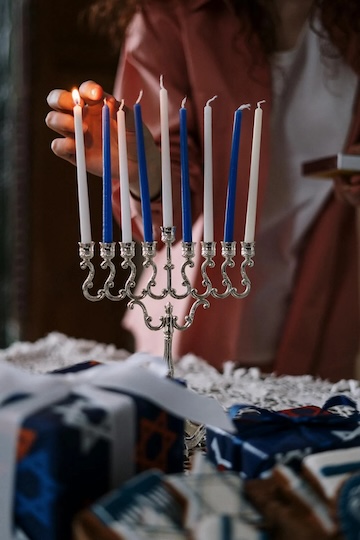
This year, as we light our candles over the eight nights of Hanukkah, we contemplate the history and symbolism of our Jewish traditions, and we have an opportunity to consider their meanings in our current reality. Just as we light our hanukkiyah with its eight, equally proportioned candles, we remember Jews have an admirable track record in fighting for social equality, and we consider where, today, there are inequalities to be addressed. 

photo - This year, as we light our Hanukkah candles, we contemplate the history and symbolism of our Jewish traditions, and we have an opportunity to consider their meanings in our current reality
This year, as we light our Hanukkah candles, we contemplate the history and symbolism of our Jewish traditions, and we have an opportunity to consider their meanings in our current reality. (photo from pexels.com)

As we add candlelight to our homes, we remember our age-old obligation to bring light to our families, friends and neighbours. We encourage well-rounded education, free from hate, for all children; we advocate for a safe and welcoming learning environment for our post-secondary students and faculty; and we support the most vulnerable among us. 

There is much to do – what will your focus be over the coming year? To what cause will your efforts be directed? 

Can we hope that Gaza will be freed from the terrorist influence of Hamas? Will Lebanon emerge from under the sway of Iran-backed Hezbollah? Will Israel’s adversaries stop their war against the Jewish state?

Will our focus be on our own family, our close friends, our community, a charitable cause? Will we share the Jewish values we cherish, the triumph of light over darkness, freedom over oppression, and the importance of upholding one’s identity and beliefs?

And can we help our fellow Canadians uphold the values we hold dearest? How much light can we share this Hanukkah season? 

Let’s find out. 

Chag sameach. 

Judy Zelikovitz is vice-president, university and local partner services, the Centre for Israel and Jewish Affairs (CIJA).

Posted on December 13, 2024December 11, 2024Author Judy ZelikovitzCategories Op-EdTags candlelighting, CIJA, Gaza, Hamas, Hanukkah, Hezbollah, Israel, mourning, Oct. 7, reflections, terrorism

Hope for best outcomes

Every election leaves a portion of the electorate thrilled and another group disappointed. The more polarized the electorate, the more intense these emotions. Two elections recently were certainly examples of this – and they were elections that could hardly have been closer.

The British Columbia provincial election returned the New Democrats under Premier David Eby to office – but just barely. A single seat assured a majority government but that is a most precarious victory. Eby will need to be vigilant to ensure not a single member of his caucus steps out of line on a confidence vote or becomes disgruntled enough to bolt the party. This is almost certainly part of the reason Eby gave every member of his caucus a special title (along with added pay for the responsibilities). 

Eby has a reputation for centralizing power in his office – to be fair, almost every leader in our parliamentary system does, but apparently Eby is a master at micromanaging – and this is a double-edged sword. He does not lack the skills to keep potentially wayward sheep in line, but excessive domination tends to incite rebellion. 

Jewish voters especially will be watching a few things. The new mandatory curriculum for Holocaust education is to be rolled out next year. Given behaviours of the BC Teachers Federation and the potential for individual instructors to go rogue, the possibility exists for this curriculum to be weaponized against Jewish people. There are already dispiriting anecdotes about anti-Israel activism among some teachers. The introduction of mandatory Holocaust education could open the door to reactionary activism among those who think the Holocaust should not be privileged over other human catastrophes, as well as conversations that could turn in inappropriate directions because they lack the language or support for context. We hope that the province’s curriculum experts have anticipated this potential and worry that it is a nearly impossible task to monitor. We should be looking for various types of evaluation to guide these educational programs.

The back-from-the-grave BC Conservative Party, now the official opposition, has promised to introduce adoption of the International Holocaust Remembrance Alliance definition of antisemitism among its first acts in the new Legislature. This will put the Jewish community and our issues in the centre of political drama immediately – not a welcome or comfortable situation for our minuscule demographic; the debate is sure to engender opposition and recriminations.

In the broader scope of 2024 history, though, our provincial election will be a footnote next to the election that took place a few days later. The reelection of once and now future US president Donald Trump will almost certainly have exponentially more dramatic effects.

The reelection of Trump turned out to be not as close as every poll suggested, but also not as commanding as some commentators say it was. He won the popular vote this time by about 2.5 million votes, which, in terms of the raw vote margin, is the fifth-lowest since 1960 – but, compared to having lost the popular vote by almost three million votes when first elected in 2016, the 2024 margin points to a swing in the electorate that cannot be ignored.

Trump’s recent election seems to have been met by opponents with a fatalistic sense of déjà vu. His choices of cabinet appointees suggest his second term will be no less a circus than his first and quite possibly more damaging in many ways.

According to exit polls, Jewish voters in the United States supported the Democrat, Vice-President Kamala Harris, over Trump by a margin of almost four-to-one. (Israeli voters, if they could have voted, would have backed Trump by almost mirror-image landslide margins, according to at least one poll, a disparity that deserves discussion some other time.)

Support for Trump’s stated pro-Israel positions is premised on the presumption that what he says is what he will do. This is true for all politicians of course, but it is especially true for an individual as volatile and unpredictable as this one. (Whether his positions are actually good for Israel and Jews is also a topic for further analysis and discussion.)

Whichever parties or candidates we support, all of us should hope for the best outcomes. Much depends on it, if in significantly different magnitudes – the government of BC does not, for example, have nuclear weapons – but polarized partisanship does not serve the majority well. 

As a Jewish prayer for elected officials says, “May they be guided with wisdom and understanding to serve all its inhabitants with justice and compassion. Strengthen their resolve to protect freedom and promote peace, so that harmony and tranquility prevail among all who dwell here.” 

Posted on November 29, 2024November 28, 2024Author The Editorial BoardCategories From the JITags antisemitism, British Columbia, David Eby, Donald Trump, elections, Holocaust education, Israel, politics, United States
Security through peace

Security through peace

Noa in conversation with Rabbi Dan Moskovitz at Temple Sholom Oct. 30. (screenshot)

Israeli singer/songwriter and peace activist Achinoam Nini (Noa) was in British Columbia recently to do a Vipassana meditation. While here, she stopped at Temple Sholom Oct. 30 for a conversation with Rabbi Dan Moskovitz (which is on YouTube) and at Congregation Emanu-El Nov. 4 for a talk with Rabbi Harry Brechner.

Noa was born in Israel in 1969. She’s the fifth generation of her family in Israel, their presence dating back to the mid-1800s. They immigrated from Yemen.

“They came because they were persecuted at the time and they came to the only place they knew, that their heart drew them to, and that was Jerusalem and the Kinneret,” she said. “That was the two places. They walked across the desert and took boats and were smuggled by Bedouins. It’s a very dramatic story, how the family made it to the Holy Land.”

Noa’s father got a scholarship to study at the University of Rochester, so she spent the first couple of years of her life in Rochester, NY.

“When I went into first grade, my family moved to the Bronx, NY. My dad was now doing his PhD in Columbia University. And my parents decided to send my brother and I to yeshivah…. I was the only dark-skinned kid in the school, the only Israeli kid in the school, the only family that didn’t live in something that looked like a mansion. 

“My way of dealing was in two ways,” said Noa. “First, fortunately, I was a gifted student, so I had a scholarship to school that helped my parents…. And music. I started writing songs at a very young age…. I was interested in physics and mathematics, I loved history. I wanted to go to Harvard and do a PhD in physics and history, but that didn’t happen, obviously. Music … chose me.”

At age 17, on a summer vacation in Israel, Noa met a soldier on leave.

“I went back home,” she said. “I told my parents, I’m making aliyah. I said, you raised me to be a Zionist. We love Israel. I want to live in Israel.”

To this day, Noa is married to that man (Asher Barak, now a medical specialist and entrepreneur), and they have three children, two of whom are in the Israel Defence Forces, one in service, the other in the reserves.

Noa did her army service in a military entertainment unit, then started her music career. While at the Rimon School of Music, she met Gil Dor, who was one of her teachers. “He’s an extraordinary and amazing, brilliant musician and we’ve been working together now for 34 years,” said Noa.

They caught the attention of guitarist Pat Metheny, who produced Noa’s first album and brought it to David Geffen, who then signed Noa at Geffen Records.

“I started performing abroad and foreign journalists started asking me my opinion about the Palestinian-Israeli conflict and I’m like, I’m an artist, I don’t speak about things like that, don’t ask me questions like that.”

But she didn’t feel good about not responding. “And so, I started learning more and reading more and I became more and more depressed,” she said. “And then came Yitzchak Rabin and he started talking about peace. And I was like, yes, this is great!”

A believer in the Oslo Accords, Noa was the only leading Israeli musician to agree to perform at the peace rally where Rabin was murdered.

“I saw Rabin and I hugged him … and I walked down the stairs. Ten minutes later, he walked down the stairs and was killed…. I remember the rush and the cry and everybody running, and panic, and myself running and pushing to see what had happened,” Noa shared. “It was a trauma. I haven’t recovered, absolutely not. I haven’t recovered – and neither has Israel.”

At that moment, said Noa, “I said, OK, well, if this guy just paid with his life for our future, the future of Israel, the future of my children, then I, too, can do something. And then, maybe, I’ll pay a price and that’ll be OK because it’s the right thing to do. And that’s when I started becoming an activist for peace.”

There were two other life-changing events for Noa in the 1990s. She was invited to sing at the Vatican for Pope John Paul II and she was asked to write the lyrics and sing the theme song of the film Life is Beautiful (La Vita e Bella), which won an Oscar.

Among her many achievements, Noa represented Israel in the Eurovision Song Contest in 2009. She did so with Palestinian-Israeli singer/songwriter Mira Awad. “I wrote a song called ‘There Must Be Another Way,’ and we sang it in English, Hebrew and Arabic,” said Noa. “It made a lot of waves around the world and I have to say that, until today, it is taught in schools around the world.”

She related a story about that experience. 

“Mira, her mother is from Bulgaria and her father is Palestinian. She’s quite fair-skinned, with green eyes. My family is from Yemen…. I’m an Arabic Jew. And so, when we sat in front of media, I remember there was one day where they had BBC Iran, they had Al Jazeera, they had all kinds of media…. All the Arab media immediately came up to me in Arabic and to her in English, [assuming] she’s the Jew. And so, I told them, you see, that is the role of art – our role is to shake you up a little. You think you understand everything. Maybe you don’t. Maybe there’s another way of looking at it…. You can’t think that you understand everything about everything. No, it’s not black and white. And that’s, of course, very relevant to where we are today.”

That said, there has been progress towards peace, she contended.

“There’s a huge polemic about whether there should be or there shouldn’t be a Palestinian state,” she admitted, “but there is a conversation being had about it…. In the past, it was not even talked about at all. It was underground.”

She also pointed to the many organizations that work with and/or are staffed by Arabs and Jews. Noa is on the boards of the Arava Institute and the Umm el-Fahem Museum of Art, for example. She’s also involved with the Parents Circle – Families Forum.

“The world in general is not a great place for people who believe in peace right now,” she acknowledged. “I think that we are under attack by forces, if you like, forces of darkness from everywhere. But, like I always say, that’s not reason enough not to continue raising the voice…. I believe in peace. I don’t see any other way to live. Has the peace camp changed? It has transformed in many ways.”

She gave the example of a WhatsApp group called Voices of Solidarity. She said a lot of young people are doing things – “it’s either art, it’s underground theatre, it’s alternative music.” She mentioned the organization Standing Together.

“Yitzhak Rabin, when he started talking to [Yasser] Arafat, the terrorist, everyone was like, what, no way, forget it. Seventy-five percent of the Israeli public were against any kind of interaction with Palestinians but then he came [along] with his charisma and his leadership and his integrity and his honesty and his track record, and he started saying, we’re going to be doing this and this is the right thing and this is for Israel’s future, for our children, we’ve made enough wars…. And then, it was like a month later, the entire public opinion, it shifted towards being positive about the chances for peace.”

That could happen again. A change in circumstances, a particular leader’s personality, the right timing, she said.

For Noa, Israel is in a worse situation now than immediately after Oct. 7.

“The hostage situation … is a nightmare beyond words. I go every week, sometimes I go twice a week, three times a week, to stand with them [the families and others calling for the hostages to be brought home]…. They’re desperate. I don’t know how they are still sane…. And the fact that that their children are still there [in Gaza], that they haven’t been brought back, that not everything has been done to bring them back, is not anything that Israel will ever recover from.”

She is appalled that the government is still in power.

“Not only did they not resign,” she said, “they then turned around to blame everybody that saved Israel, including Brothers and Sisters in Arms, including all the organizations that volunteered, [and] to blame the hostage families for daring to want their children back…. It’s beyond words.”

She advised diaspora Jews to distance themselves from the government: “separate the Israeli government from the Israeli people, it’s not the same thing,” she said.

“If you are going to look at a lot of consistent polls, you’ll see that people – even people that voted for the present government – feel betrayed by what the government has eventually done. They don’t understand how the government is not taking responsibility. They don’t understand how the dictatorship coup keeps moving forward when we’re in such a stressful situation. They don’t understand how our relationship with the entire world has come to a complete collapse under the auspices of this government. The Israeli government right now is the enemy of the Israeli people. And you can say that…. We support the Israeli people, we support the country of Israel, but we do not support the government of Israel.”

She warned of the dangers extremists pose in any country, and asked people to “strengthen the moderates in civil society in any way you can.”

She added, “Throughout history, countries have fallen into terrible situations of leadership. Italy, my favourite country in the world after Israel, became a fascist country at some point, with Mussolini, and there was Franco [in Spain] and there were other people, other countries that came into [similar] situations. Does that delegitimize the country? No. It means that a certain combination of events led to the fact that a country was now held hostage by leadership that did not work in her benefit. That is what is happening right now to Israel, and we have to work through it together with the help of our friends, and you are our friends.”

Noa doesn’t just fault the Israeli government. “In my opinion,” she said, “everybody in the region is to blame for the horrible situation we’re in. Nobody made the efforts. The leadership did not make efforts to make peace, not Israeli leadership, definitely not Palestinian leadership.”

She believes Israel had to defend itself after Oct. 7.

“What were we supposed to do? Sit around [twiddling our thumbs] while our kids were being massacred and our women were being raped? Yes, Israel needed to go in. The war was legitimate. But – it was legitimate to the extent that there was a plan. There needs to be a plan. Say, we have to fight, but now, let’s see, we’ve attacked, we’ve retaliated, we’ve done this, we’ve shown that, we’re there for our people. But we have to bring the hostages back…. Second, we have to see, who are our allies? We’re a small country, we’re nine million people – whoa, we want to attack the entire world? No. Who are our allies? Who are our friends? How can we start progressing towards a solution to this? Not endless warfare. Who are the people that want to talk to us? The UAE, the Saudis, the Americans, the Europeans, let’s reach out to them. This is what the Israeli government should have done immediately.”

While acknowledging that Israel needs a strong army, Noa said, “at the same time, parallel institutions need to come in and do their job, the diplomatic job, to reach out to our friends … and make sure that Israel is secure. Our security will come with peace, only with peace, and we have to look at this as an opportunity to make peace. And are there partners? There are.”

She said, “As a woman who lives in Israel, loves Israel and sends her kids to the army…. We need to be able to look forward to a time when we will not be sending our children to the army. Is it possible? Yes.” 

Format ImagePosted on November 29, 2024November 28, 2024Author Cynthia RamsayCategories LocalTags Achinoam Nini, Israel, Israel-Hamas war, music, Noa, Oct. 7, peace, politics, terrorism, two-state soloution
Mobilizing against Jew-hatred

Mobilizing against Jew-hatred

Ysabella Hazan said phrases such as “the West is next” imply “exactly what the enemies of Israel accuse us of – being a Western outpost in the Middle East, a settled body, which is not true.” (photo by Dave Gordon)

Rage Against the Hate in New York on Oct. 31 had the goal to “gather Jewish organizations, and to find ways to start fighting back, to retake the streets, to retake the campuses, to retake social media, to combat antisemitism in a way that we haven’t,” said Nitsana Darshan-Leitner, president of the Israeli nonprofit Shurat HaDin Law Centre, organizers of the full-day conference. 

photo - Nitsana Darshan-Leitner, president of Israeli nonprofit Shurat HaDin Law Centre, which organized the Rage Against the Hate conference in New York Oct. 31
Nitsana Darshan-Leitner, president of Israeli nonprofit Shurat HaDin Law Centre, which organized the Rage Against the Hate conference in New York Oct. 31. (photo by Dave Gordon)

More than 30 organizations were conference partners and keynote speakers included radio host/author Dennis Prager, attorney Alan Dershowitz, actor Michael Rapaport, activist Shabbos Kestenbaum and NGO Monitor’s Gerald Steinberg.

Dershowitz, 86, said that after speaking to Jewish high school students, he was “stunned by their lack of knowledge” about Israel. To fill the void, he will be giving away a million copies of his latest book, The 10 Big Anti-Israel Lies and How to Refute Them with Truth, to 1,000 universities and high schools across the United States. He lambasted what he called the “educational malpractice” pervasive on college campuses, where professors “give disguise” to Jew-hatred through diversity, equity and inclusion policies, and oppressor-versus- oppressed beliefs.

“I offered $1,000 to anybody who could find me a single protester in any of these protests on university campuses that has ever called for a two-state solution. Nobody has taken me up on it. No protester wants to see an Israeli state,” he said to the audience of 300.

He added that “we are in a fight for our lives. We are in a fight for the future,” because these students will become politicians, corporate executives, media influencers and other types of leaders, and they will have all “been brought up with this kind of knee-jerk anti-Zionism.” 

Darshan-Leitner characterized Students for Justice in Palestine as a “propaganda arm of Hamas.” She believes their activity is “actually providing material support to a terror organization” and, in doing so, contravenes the Anti-terrorism Act in the United States.

Kestenbaum – who, last January, became the lead plaintiff in a lawsuit against Harvard University, alleging systemic antisemitism, and has testified before Congress about antisemitism on college campuses – told the Jewish Independent: “Jewish students are fighting a really remarkable fight with limited resources, with limited help and limited funding. It’s the Jewish nonprofits, who raise billions of dollars each year, who could be in a position to do a lot more. And so, I would encourage the Jewish nonprofits not to say, ‘What can the students be doing?’ but to ask themselves, ‘What can I be doing?’ to help students.”

“It is imperative that larger organizations actively support grassroots initiatives that can manoeuvre and mobilize quickly and efficiently, whereby large organizations cannot,” said Amir Epstein, director of Tafsik, a Jewish civil rights group that fights Jew-hatred in Canada and more broadly.

“Hundreds of millions of dollars are donated to large organizations, so it isn’t unreasonable for them to contribute considerable monetary aid to empower these grassroots efforts, so we can create a united front to combat the degradation of our Jewish community’s safety, and address the unprecedented antisemitism we face in universities, K-12 schools, media, politics and the arts,” said Epstein.

Montrealer Ysabella Hazan, who started the movement called Decolonized Judean, said phrases such as “the West is next” and “Israel is the only democracy in the Middle East” do not resonate with the younger generation. “They do not speak about us, convey our story or address the accusations that we are facing on the world stage,” she said. “And they indirectly prove exactly what the enemies of Israel accuse us of – being a Western outpost in the Middle East, a settled body, which is not true.”

Columbia business professor Shai Davidai, who has earned renown for calling out Jew-hatred on campuses, told the audience that antisemites have “created the new normal” by making students feel uncomfortable being visibly Jewish.” He said, “If we don’t fight back in the court of public opinion and in the court of law, we’re not going to win this war.”

photo - At the Rage Against the Hate conference Oct. 31, Dennis Prager offered an idea of how to counter the delegitimization of Israel
At the Rage Against the Hate conference Oct. 31, Dennis Prager offered an idea of how to counter the delegitimization of Israel. (photo by Dave Gordon)

Prager, who did graduate work at the Middle East and Russian institutes of Columbia’s School of International Affairs, said, “I was basically taught by moral idiots, but they were giants compared to who’s teaching in Columbia today, or at Harvard or at Princeton.”

An argument he proposed to use against the delegitimization of Israel is to draw a parallel to the creation of Pakistan, born the same year as the modern Jewish state. “There were two Israels in history,” said Prager, “but there was no Pakistan in history. When it was created, it was wrenched out of India. Nobody ever challenges the right of Pakistan to exist.” 

Rapaport, known for his social media posts about Israel, advised: “Fight with your heart, fight with your prayers, fight with your genius, brilliant, Jewish, Zionist minds. Fight ferociously and do not take a step back,” he implored, while also encouraging Jewish education: “The more that I learn about our fantastic, magical history, the prouder I become.”

Journalist Douglas Murray, who is not Jewish, and Darshan-Leitner, shared a question-and-answer session.

Murray lamented how “very senior politicians” and “a generation of Americans” have bought into the “delusion that, if you were to solve the Israeli-Palestinian dispute, peace would break out, not just in the region, but around the world.” But a state of Palestine with Hamas leadership “will be another Iranian proxy state nearer to Israel,” he said, and it’s “an obscenity that more people don’t realize that.”

He also said this is “a great opportunity for alliance-building,” and reminded the audience “not to forget the Christian communities” and others “who have been so supportive of Israel.”

Winnipeg attorney Lawrence Pinsky told the Independent that the conference was “inspiring and helpful,” and he plans to create a community “situation room,” he said, “just so that we can have a multi-directional approach to any problem. These will be individuals who may or may not be parts of organizations, who actually want to do, and can do.” 

He said the conference helped him realize that activism should involve “no ego,” and that people should jump into action, not feeling they “have to reinvent the wheel.” 

Dave Gordon is a Toronto-based freelance writer whose work has appeared in more than 100 publications around the world. His website is davegordonwrites.com.

Format ImagePosted on November 29, 2024November 28, 2024Author Dave GordonCategories WorldTags activism, antisemitism, conferences, education, Israel, Nitsana Darshan-Leitner, Rage Against the Hate, Shurat HaDin
Israel’s war is unique

Israel’s war is unique

French writer, filmmaker and human rights activist Bernard-Henri Lévy was in Vancouver at Schara Tzedeck Synagogue Nov. 6, in conversation with the National Post’s Tristin Hopper. (photo by Pat Johnson)

Bernard-Henri Lévy, a public intellectual so well-known in France that he is generally referred to simply as BHL, has thrown his energies into an “emergency” effort to defend Israel in a moment of history when the world has turned against the Jewish state.

Lévy was in Vancouver at Schara Tzedeck Synagogue Nov. 6, in conversation with Tristin Hopper, a writer for the National Post.

Throughout his career as a reporter, commentator, filmmaker and activist, Lévy has written and spoken extensively about humanitarian crises in Bangladesh, Darfur, Rwanda, Bosnia and many other flashpoints. Now, he said, “I am pleading with all my energy for Israel and for the defence of Israel.”

His latest book – his 47th or 48th, he thinks – is Israel Alone.

Israel’s war is unique, he said, because it involves enemies who are not driven by ideas but by the nihilistic aim of destroying a nation and a people. The differentiation between antisemitism and anti-Zionism is irrelevant to Hamas and Hezbollah, said Lévy, noting that many of those killed on Oct. 7 were among Israel’s leading peace activists.

“Those crimes have nothing to do with seeking a political solution to the suffering of Palestinians,” he said. “They don’t care about peace. They don’t care about a two-state solution. They don’t care about the fate of the old people. They only care about killing Jews. [The victims] could have been right-wing Jews. It happens that they were left-wing Jews, but they just don’t care. For Hamas, there is not left-wing or right-wing Jews. There is just Jews who deserve to be hated, tortured and, if possible, killed.”

Lévy urges the world not to be misled into thinking that Hamas and Hezbollah are national liberation movements. “They are the proxies, the puppets, of a very powerful country, which is Iran,” he said.

Lévy is optimistic because Israel is winning the war.

“What makes me a little less optimistic, and even pessimistic, what sometimes discourages me, is the reaction of the world,” he said. “Instead of saying bravo to Israel, instead of saying thank you to Israel, instead of standing at the side of Israel, who is waging an existential war for [itself] but also a useful war for the rest of the world – instead of that, the rest of the world, sometimes the allies of Israel, mumble, object, groan, accuse and ask, demand, beg, require from Israel ceasefire, compromise, negotiation.

“When you think about it, I don’t see any precedent of a just war, a fair war, which is treated by the allies of the country that is waging it, with such strange behaviour,” said Lévy. “It is unique.”

The West is responding like cowards to the threat of Iranian-backed Islamist terror, he argued, which has formed an alliance with Vladimir Putin’s Russian regime. Part of this refusal to stand with the victims is an ingrained tendency in Western civilization, he said.

“There are a lot of people in the West who love Jews when they are victims, who love to support them and to shed tears on their face when they are beaten, wounded and sometimes killed,” he said, “but who don’t like to see them proud and strong and behaving with heads up.”

On the positive side, Lévy believes, most people in Europe and North America are not irreversibly antisemitic or anti-Israel but are influenced by biased commentary. His new book is a tool for these people and those who engage with them, he said. “Those [people] can be addressed with reasonable arguments, with historical facts, and … can be not only addressed but convinced, I’m sure of that. That is the aim of this book.”

Canada has been a safe haven for generations of Jews, he said. But now, Canadian Jews hear fellow citizens calling for their destruction.

“What is the future of the Jewish communities in France and in Canada?” he asked. “I will tell you one thing. I know very few Jews who do not have, somewhere in the back of their mind, the precise or vague or very vague idea that they could go one day to Israel. This is the state of Jewry since 1948. To be a Jew means to be a good Canadian citizen, a good French citizen, but to have somewhere, even remotely, in the mind, the idea that Israel could be an option.”

The global condemnation of Israel is a reincarnation of a long-familiar trend, Lévy said. “The new argument of antisemitism, the new form, the new phase, the new name of the virus is anti-Zionism,” he said.

The best and “only efficient way to be antisemitic today” is to be anti-Zionist, he argued. Blaming Jews for deicide or some of the other historical justifications for antisemitism is no longer effective, he said. “If you say that today, honestly, you will not meet with great success. If one wants to hate with efficiency the Jews, there is only one way left.”

Israel has few supporters among non-Jews, he said, even among ostensible allies, whose support he described as often coming with conditions.

Lévy called the former and future president of the United States, Donald Trump, “a true ally of Israel, for sure, no doubt on that.” But he also reminded the audience of an incident in the election campaign, during which Trump warned a Jewish audience that he would blame them for his loss if he were defeated.

“And if you are responsible for my defeat, within two years, Israel will disappear,” Lévy paraphrased Trump. “It was a slip of the tongue probably. [But it meant that, in Trump’s mind], the Jews deserve to be protected, but conditionally, if they supported [Trump], if they were good guys and good ladies, if they gave him victory.”

Schara Tzedeck’s Rabbi Andrew Rosenblatt welcomed the audience and acknowledged members of the Ukrainian, French and other communities in attendance. He also credited Robert Krell and Alain Guez for Lévy’s visit to Vancouver. 

Format ImagePosted on November 29, 2024November 28, 2024Author Pat JohnsonCategories LocalTags activism, antisemitism, Bernard-Henry Lévy, books, education, Israel, Israel-Hamas war, Oct. 7, Schara Tzedeck

Posts pagination

Previous page Page 1 … Page 11 Page 12 Page 13 … Page 111 Next page
Proudly powered by WordPress