Skip to content
  • Home
  • Subscribe / donate
  • Events calendar
  • Business Directory
  • FAQ
  • News
    • Local
    • National
    • Israel
    • World
    • עניין בחדשות
      A roundup of news in Canada and further afield, in Hebrew.
  • Opinion
    • From the JI
    • Op-Ed
  • Arts & Culture
    • Performing Arts
    • Music
    • Books
    • Visual Arts
    • TV & Film
  • Life
    • Celebrating the Holidays
    • Travel
    • The Daily Snooze
      Cartoons by Jacob Samuel
    • Mystery Photo
      Help the JI and JMABC fill in the gaps in our archives.
  • Community Links
    • Organizations, Etc.
    • Other News Sources & Blogs
  • JI Chai Celebration
  • JI@88! video

Recent Posts

  • Legal help for students
  • Revisiting myth of Lilith
  • Wrong person rebuked
  • Canada’s mixed messages
  • Questions for museum
  • Symposium on antizionism
  • Making soccer political
  • CJPAC lauds Pulver’s impact
  • City recognizes Vrba’s legacy  
  • Organ donation saves lives
  • Theodore’s March premiere
  • A healing Shabbaton
  • Supplying healthy food
  • A chime of metal tags
  • Yellowknife seder a first
  • Ishai energizes, unifies
  • A Lag b’Omer to remember
  • Expanding the healing
  • Hannah Senesh – a unique hero
  • Community milestones … May 2026
  • Sharing her testimony
  • Fall fight takes leap forward
  • The balancing of rights
  • Multiple Tony n’ Tina roles
  • Stories of trauma, resilience
  • Celebrate our culture
  • A responsibility to help
  • What wellness means at JCC
  • Together in mourning
  • Downhill after Trump?
  • Birth control even easier now
  • Eco-Sisters mentorship
  • Unexpected discoveries
  • Study’s results hopeful
  • Bad behaviour affects us all
  • Thankful for the police

Archives

Follow @JewishIndie
image - The CJN - Visit Us Banner - 300x600 - 101625

Tag: Holocaust

Shoah survivor offers a warning

Shoah survivor offers a warning

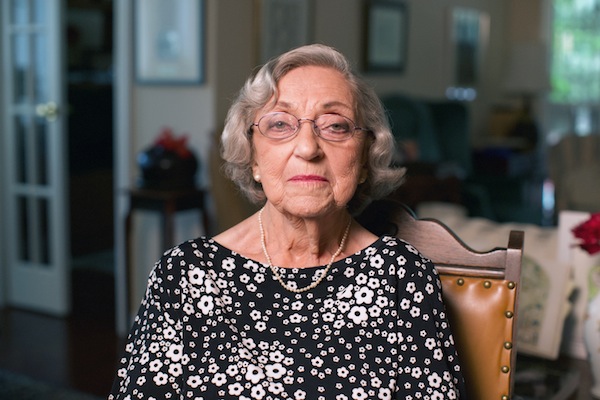
Judy Weissenberg Cohen, at the age of 92, recently published her memoir, Cry in Unison. (photo from Riddle Films)

On erev Yom Kippur, in a Nazi concentration camp, a group of Hungarian Jewish women and girls prevailed upon two comparatively sympathetic kapos to obtain a lone candle and a single siddur.

Judy Weissenberg Cohen, a Toronto woman who, at the age of 92, recently published her memoir, was one of those girls.

“In this place, where we felt that instead of asking for forgiveness from God, God should be asking for forgiveness from us, we all wanted to gather around the woman with the lit candle and siddur,” she said during a virtual book launch Sept. 14. “She began to recite the Kol Nidre very slowly so we could repeat the words if we wanted to, but we didn’t. Instead, all the women burst out in a cry in unison. Our prayer was the sound of this incredible cry of hundreds of women. I have never heard, before or since then, such a heart-rending sound. Something was happening to us. It was as if our hearts were bursting. Even though no one really believed the prayer would change our situation, that God would suddenly intervene – we weren’t that naïve – the opportunity to cry out and remember together reminded us of our former lives, alleviating utter misery even for the shortest while. In some inexplicable way, it seemed to give us comfort. Even today, many decades later, every time I go to Kol Nidre services, I can’t shake the memory of that sound. This is the Kol Nidre I always remember.”

Cohen’s book, Cry in Unison, was published by the Azrieli Foundation’s Holocaust Survivor Memoirs Program. Cohen’s is the 113th memoir published by the program. The books are offered to schools and universities across Canada at no cost, providing educators with an accessible entryway to teaching about the Holocaust by approaching history one story at a time.

Cohen was born in 1928, the youngest of seven children in the Weissenberg family.

In 1938, when she was 10 years old, her parents and other Hungarian Jews became increasingly alarmed by news from adjacent countries, including the Anschluss of Austria, followed a few months later by Kristallnacht.

When the mass transport of Jews from Hungary began, in 1944, Cohen spent days in a boxcar with 78 others, with two buckets – one for drinking water, the other for a toilet. On arrival in Auschwitz-Birkenau, as they disembarked from the cattle cars, a worker approached women with children and “very quietly in an urgent tone” told the young mothers to hand their children over to the grandmothers.

“At the time, we didn’t know what it meant,” Cohen recalled. “The fact was [the worker] asked the young mothers to give children over to the grandmothers because he knew that, within hours of our arrival, the grandmothers who looked 45 years or older and Jewish children 14 and younger immediately will be murdered in the gas chambers of Birkenau. He wanted to save the young mothers. If you didn’t carry a child, then you lived. If you carried a child, even if the child wasn’t yours, you went to the gas chamber with the child.”

Cohen and her sisters were showered, shaved and given dirty hand-me-down garments. Sent outside without towels to dry themselves, Cohen could not locate her sisters.

“Only when they started to talk … and all of a sudden we started to laugh in our painful way,” she recalled. “How drastically we changed within a few hours.”

Cohen was subsequently transported to Bergen-Belsen concentration camp and then to a forced labour facility that was a sub-camp of Buchenwald.

In the spring of 1945, on a death march through the German countryside, she was finally liberated. The realization came in a German man’s choice of language.

With other girls and women, Cohen was sleeping in a barn during the march. “In the morning, there was a loud knock on the barn door,” she said. “We woke up all of a sudden from our shallow sleep and there stood a guy in the doorway. I still remember, it was a beautiful sunny day, the sun was behind him and he stood there like a dark silhouette. And, in a nice, strong voice in German, he said, ‘Fräuleins!’”

The women were startled as much by the word as by the awakening.

“Did he really say Fräuleins? A German addressed us as Fräuleins?” they asked one another, “The war must be over. A German hasn’t addressed us in a civil tongue for ages.”

He immediately continued: “Fräuleins, you are free.”

The terms liberation and freedom may be equivocal given what Holocaust survivors experienced. In Cohen’s case, she returned to her hometown in Hungary, certain that if she, the youngest, had survived, then surely her elders, who were more capable of caring for themselves, would likewise be coming home.

“I don’t know why I dared to be logical about the Nazi genocide,” she said.

Instead, she was reunited with one brother, one sister and two cousins.

“So it was very traumatic,” she said. The trauma was accentuated by the fact that some of the returning villagers had been on work battalions and had not experienced the death camps, and in fact had no knowledge of them.

“I had to be the messenger to tell them that their wives and their little girls were murdered in the gas chambers in Birkenau,” she said. “They didn’t believe me. They actually [considered] me insane.”

She went to a displaced persons camp – constructed on the grounds of the razed Bergen-Belsen concentration camp – and lived there for two years, learning a trade. But, when the opportunity came to emigrate, it wasn’t as a dental technician that she was chosen.

The Canadian government was seeking 2,500 garment workers. Though she had no experience, Cohen faked it and came to Montreal ostensibly as seamstress. (She moved with her family to Toronto in 1961.)

“But, with all other difficulties that we overcame through the time, I finally learned, with kind helping people, how to put together a dress and made some kind of a living,” she said. “The contract was only for one year, but I stayed for three years.… During those three years, I also prepared myself to change skills, change profession. I learned French, I learned English, I took a course to become a bookkeeper with typing ability and switch to office work.”

There was no psychological support and the term post-traumatic stress disorder did not yet exist.

“I don’t think we realized that we were traumatized,” she said. “You went through difficult times but it didn’t have a name. It so happened that my sister and I, and my brother, we had self-help among ourselves…. The emotional baggage, as far as I’m concerned, and I can only speak for myself, that had to be put on the back burner. It no longer was a priority to talk about it. Furthermore, nobody wanted to listen to us…. We just went on living as new Canadians and establishing new lives basically on the ashes of the old, and even became happy Canadians, got married, had children. We became like all other Canadians, overcoming all emotional difficulties by not giving them eminence in our lives.”

Cohen became a public speaker, sharing her Holocaust experiences with schools and other audiences after she had a run-in with neo-Nazis in downtown Toronto. She also has become a researcher and author on the topic of the unique experiences of women in the Holocaust.

Above all, Cohen said, she wrote her memoir in the 10th decade of her life as a warning.

“Mainly, I would like you to understand that this generation and subsequent generations must learn from us while we are still alive that this kind of depravity, one human to another, was possible and did happen and, unfortunately, it could happen again,” she said. “We are writing it to you all as a warning, as a very serious warning of what can happen even in cultured, educated, civil societies.”

Format ImagePosted on October 30, 2020October 29, 2020Author Pat JohnsonCategories BooksTags Azrieli Foundation, Cry in Unison, Holocaust, Judy Weissenberg Cohen, memoir
Lubeck shul sees restoration

Lubeck shul sees restoration

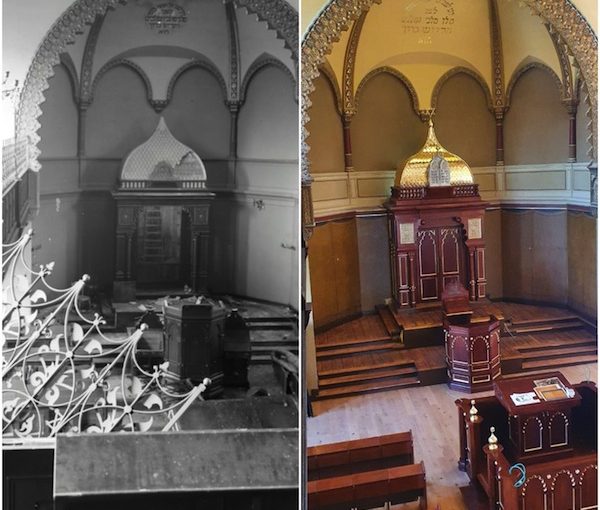
Israel’s Lavi furniture factory recreated Carlebach Synagogue’s original ark from three prewar black-and-white photos. (photo from IMP)

Viewing the restored Carlebach Synagogue in Lubeck, Germany, brings to mind the biblical prophecies of consolation, where the Jewish people are reassured that the day will come when not only will they be restored to their land, but their houses of worship will likewise be restored. Sadly, neither the shul’s rabbi nor any other of the original community members are alive today to revel in the synagogue’s reinstated glory; however, in an interesting twist, several of the rabbi’s grandchildren are the children of founding members of Kibbutz Lavi, whose furniture factory designed and built the synagogue’s ark and other holy articles.

Rabbi David Alexander Winter, rabbi of the Carlebach Synagogue, fled Lubeck in 1938, together with most of his community. Several months later, on Kristallnacht, when many of Germany’s synagogues were torched and burned to the ground, the Lubeck shul was damaged and looted, but not destroyed – the building had been sold to the municipality and the contract, signed by the rabbi, was inside the synagogue, in plain view.

For Winter’s grandchildren, seeing the restoration of their grandfather’s synagogue is especially moving. “It’s a feeling of coming full circle,” said Yehudit Menachem, who visited Lubeck last year, seeking to learn more about her family history. Dr. Ariel Romem, a pediatrician and one of the grandsons, remarked that the restoration is symbolic of the re-blossoming of the Winter family and of the Jewish people as a whole. “They may have ruined the shul, but they never succeeded in breaking us,” he said.

In the seven decades since the Holocaust, the once-stately synagogue, established in 1880, has suffered looting, a firebombing, squatters and general neglect. German architect Thomas Schröder-Berkentien began working on its restoration in 2010, but the project was stuck due to a lack of funding. In 2016, the federal government dedicated a sizable sum, with other funding arriving from the Schleswig-Holstein state, the Lubeck-based Possehl Foundation and UNESCO, which had declared the Old City of Lubeck a World Heritage Site. The total cost of the project amounted to almost $10 million.

Schröder-Berkentien was intent on finding the best craftspeople for the synagogue furniture, and also felt that it was only right that the furniture should come from Israel. He found the Lavi furniture factory online and, after several inquiries and a visit to the carpentry workshop along with his team, was assured that they had the necessary experience and expertise to perform the research and produce items of quality and beauty. Indeed, in its 60 years of operation, Lavi has designed and produced interiors for synagogues in more than 6,000 Jewish communities around the world, including for new and restored synagogues in Germany.

Motti Namdar, the factory’s chief planner, described the challenge, and ultimate satisfaction, of creating replicas of the original items. “We only had three prewar black-and-white photos to go by,” he explained. “The photos showed only one angle and even that was not very clear. It was difficult to make out a lot of the detailing or which metals were used, especially for the ark, which you can see from the photos is very unusual.”

Ultimately, much of Namdar’s work had to be done by deduction and a knowledge of the history of the period. “I traveled to Lubeck to see the synagogue and examine the parts that had not been damaged. Part of the ladies’ gallery was intact. The architect had hired restoration experts who carefully removed the layers of paint from the walls, exposing the original murals. The synagogue as a whole had been built in the Moorish style, and I proceeded in that direction.”

In one of the photos, it’s possible to make out the pointed roof-like structure at the top of the ark, which Namdar designed to include 1,500 “scales,” all coated in pure gold. Under Namdar’s direction, the Lavi factory completed all the articles by the deadline. “The hardest part wasn’t the tight schedule, but, rather, building everything such that it could be taken apart, packed and shipped, and then reassembled so that everything fit perfectly.”

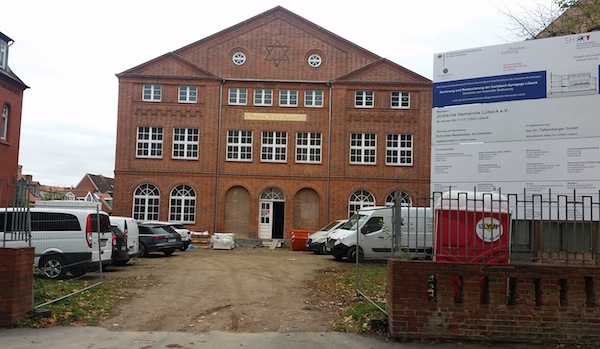
photo - Since its restoration, Carlebach Synagogue in Lubeck, Germany, has been serving as a spiritual hub for Lubeck’s 700-strong Jewish community
Since its restoration, Carlebach Synagogue in Lubeck, Germany, has been serving as a spiritual hub for Lubeck’s 700-strong Jewish community. (photo from IMP)

But while it was clear to the craftspeople at Lavi that they wanted to produce replicas that were as authentic as possible, the project’s architect, Schröder-Berkentien, was intent that the structure itself, which was restored to be a national monument, should serve as a testament and, in his words, “like a wound,” as a painful reminder of the events of 1938. This was the reasoning behind his decision not to redo the synagogue’s original ornate façade, which, together with the cupola and other elements, had been destroyed on Kristallnacht. “The plain red brick tells the story of what happened,” he said. “A rebuilt façade would ignore that part of history, failing to show the suffering of the era. This is what makes it such a unique monument among other German synagogues.”

When news of the coronavirus pandemic first broke in January, the factory began working overtime so that everything would be ready for the gala re-inauguration, which was to have been attended by high-ranking German officials, including Chancellor Angela Merkel, members of the restoration committee and local community figures, as well as Winter’s grandchildren from Kibbutz Lavi. However, when it was finally time for the assembly and installation of the furniture, the world was already in COVID-19 lockdown. As soon as it was possible, Lavi sent their own experts from England to complete the work. Now, the synagogue stands in all its resplendent glory, but the ceremony has been postponed indefinitely.

The important thing is that the synagogue is open and operating, serving as a spiritual hub for Lubeck’s 700-strong Jewish community. “This synagogue is not only a place of prayer, but a symbol of the revival of Jewish life in Lubeck, throughout Germany and around the world,” said the current spiritual leader of Lubeck, Rabbi Nathan Grinberg.

– Courtesy International Marketing and Promotion (IMP)

Format ImagePosted on September 25, 2020September 23, 2020Author Sharon Gelbach IMPCategories WorldTags Carlebach Synagogue, coronavirus, COVID-19, David Alexander Winter, Germany, history, Holocaust, Israel, Jewish life, Kibbutz Lavi, Lubeck, restoration
Autograph book resurfaces

Autograph book resurfaces

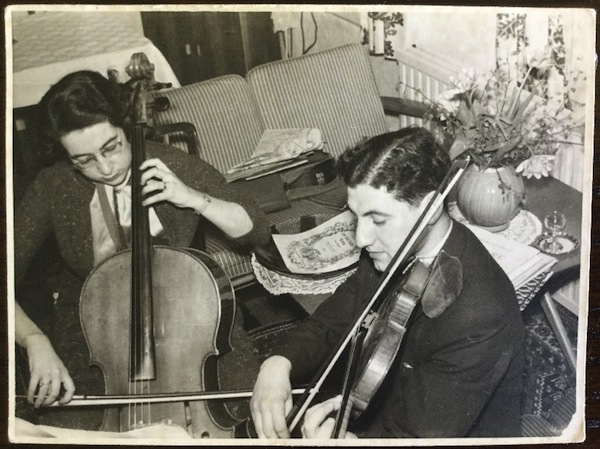
Susi and Mænni Ruben, Copenhagen, 1960s. Mænni Ruben’s autograph book, compiled in Theresienstadt, is the focus of a new online exhibit launched by the Victoria Shoah Project. (photo from Victoria Shoah Project)

The Victoria Shoah Project has launched a virtual exhibit of an autograph book compiled by Mænni Ruben, a Danish violinist and graphic artist held prisoner at Terezin (Theresienstadt) concentration camp outside of Prague.

The 1945 Theresienstadt Autograph Book Exhibit features panels and the 40-page book itself, which is replete with signatures, sketches and aphorisms from Ruben’s friends and acquaintances who were also incarcerated at Terezin.

The book records the closing period of the war as survivors were being liberated. It is a story not only of the horrors of Nazism, but of long-lasting friends, and the music and art that united them during dreadful times.

Ruben died in 1976 in Copenhagen. Though he never lived in or visited Canada, the book remained with his widow, Susi, who remarried after his death and settled in Victoria. Upon her passing, in 2018, the book came into the hands of Rabbi Harry Brechner of Victoria’s Congregation Emanu-El. He subsequently showed it to member Janna Ginsberg Bleviss, who became the coordinator of the exhibit project.

“When the rabbi showed the book to me last year, I could see right away that it was special and should go to a museum. It is in remarkable condition for being 75 years old and is a tremendous addition to Holocaust studies,” Ginsberg Bleviss said.

“I was fascinated by the book – who were these people and what happened to them? Reading the pages filled with optimistic greetings, illustrations and pieces of music was like finding a hidden treasure, waiting to be opened. I wanted to discover who these people were and hear their stories,” she added.

“This virtual launch [which took place Aug. 20] is meant to honour both Mænni and Susi, and the memory of those whose lives intersected in space and time in the Theresienstadt camp. None of the artists, musicians, composers or rabbis who wrote in the book are alive, but we can sense their lives through their traces here,” said Dr. Richard Kool, a member of the Victoria Shoah Project.

A number of panels show the powerful drawings of artist Hilda Zadikow, whose husband, sculptor Arnold Zadikow, died at Theresienstadt. One depicts the coat of arms of Terezin under a Magen David made of barbed wire. Another features three sad, grey sketches of the camp itself. In a third, there is a happier scene of colourful opera figures.

Her inscription in the autograph book reads, “Your old friend Hilda Zadikow wishes you all the best and delight in beauty.”

A poignant message comes from Rabbi Leo Baeck, an intellectual and leader of the German Jewish community and the international Reform movement, who wrote: “What you forget and what you don’t forget, that is what decides the course of your life will take.”

Pianist Alice Sommer Herz, the subject of the 2007 book A Garden of Eden in Hell and the 2013 Oscar-winning documentary The Lady in Number 6, was another prisoner at the camp. Sommer Herz, who died at age 110 in 2014, wrote in Ruben’s book: “In memory of music at Theresienstadt and in strong hopes of a better future.”

And a touching note comes from Miriam Pardies, someone Ruben seems to have known only in passing: “We know each other only from having greeted each other in a friendly way, but that too is a good memory,” she writes in the book.

“There is a huge educational value to these pieces for students learning about the Holocaust, or for researchers who want to continue exploring the stories of these most interesting people during an important time at the end of the Second World War,” remarked Brechner.

Ruben and his family were sent to Theresienstadt in 1943. A place where the Nazis kept prominent Jews, the camp housed musicians, intellectuals, artists, religious leaders and hundreds of children. In 1944, the inmates performed a concert for German visitors and the visiting International Red Cross – the performers were forced to act as though life at the camp was normal.

Losing his father at the camp, Ruben returned home after the war. A few years later, he met his wife. They married and both played in the Copenhagen Youth Orchestra – she on cello and he on violin. Mænni Ruben also worked as a graphic designer and Susi Ruben as a fashion designer; they were together for 24 years.

After her husband died, Susi Ruben’s company sent her to Israel, where she met Dr. Avi Deston. They married in 1978 and went to South Africa for 13 years, where Deston taught physics at the University of Transkei. On his retirement, they came to Victoria, in 1992.

The autograph book will be donated to the Canadian Museum for Human Rights in Winnipeg for their Holocaust gallery. To view the virtual exhibit, go to terezinautographbook1945.ca.

Sam Margolis has written for the Globe and Mail, the National Post, UPI and MSNBC.

Format ImagePosted on September 11, 2020September 10, 2020Author Sam MargolisCategories BooksTags Canadian Museum for Human Rights, Harry Brechner, history, Holocaust, Janna Ginsberg Bleviss, Mænni Ruben, preservation, Richard Kool, Susi Ruben, Terezin, Theresienstadt, Victoria Shoah Project

Two compelling reads from Simon & Schuster

Last year, I requested two books from Simon & Schuster Canada. Both contained strong female protagonists and stories that sounded compelling. While it took the pandemic slowdown before I had time to read them, I enjoyed both and would recommend them, albeit one with a caveat.

image - Woman on the Edge book coverLet’s start with the debut novel, the one I breezed through even though I found the premise tenuous. I wanted to know how Samantha M. Bailey’s thriller Woman on the Edge ended, even as I cursed aloud at the two main characters – Nicole Markham, founder and head of a widely successful athletic wear company, and Morgan Kincaid, a woman who has rebuilt her life after her husband was caught swindling people and then killed himself.

For reasons not revealed initially, Nicole hands her baby to Morgan at a subway stop, then jumps to her death, though video of the incident makes it seem like Morgan may have taken the baby then pushed Nicole onto the tracks. Alternating between Morgan’s attempt to clear her name and how Nicole came to give her baby to Morgan, the read is thrilling, even as it is too obviously contrived. At any point in time, a question or revelation from Nicole or Morgan could have shed light on their respective situations and cleared up critical matters. Yet, both women – unrealistically – keep their suspicions to themselves. The silences are necessary for the plot to work, so I chose to go where I was being led and relish the craziness of it all.

While there is no overt Jewish content in Woman on the Edge, Toronto-based writer and editor Bailey is Jewish. In her first novel, she shows a talent for creating dramatic tension, if not overall story structure. Despite its weaknesses, I found this novel a good escape read.

An absolute pleasure to read, and just as page-turning, is veteran author Alice Hoffman’s latest novel, The World That We Knew, set during the Holocaust. In it, there is magic. It is tangible – the golem Ava, created by Ettie, the precocious daughter of a respected rabbi, to protect Lea – and more abstract, in the loyalty of Ava to Lea and the beautiful friendship that develops between Ava and a blue heron along their journey.

image - The World That We Knew book coverAfter her husband is murdered and her daughter Lea is almost raped, Hanni knows she must get Lea to Paris, but she herself cannot leave Berlin. So, she turns to the rabbi for help, but making a golem is risky business and he won’t do it. Ettie, though, plans to escape with her younger sister, and Hanni’s payment will help her do that. Ettie has observed her father at work, and is able to bring Ava into being. As Ava becomes more seemingly human, however, and forms a bond with the blue heron, the main tension of the novel arises – will her appreciation for her own life and its possibilities outweigh her responsibility to Lea?

Many other tensions and relationships mingle with history, which is sometimes pedantically told but always interesting. The World That We Knew is a well-woven and moving story that offers an understanding not only of the past but of the emotions that motivate us and the connections we make with one another.

Posted on September 11, 2020September 10, 2020Author Cynthia RamsayCategories BooksTags Alice Hoffman, historical fiction, Holocaust, magical realism, Samantha M. Bailey, The World That We Knew, thrillers, Woman on the Edge
Survivor retained hope

Survivor retained hope

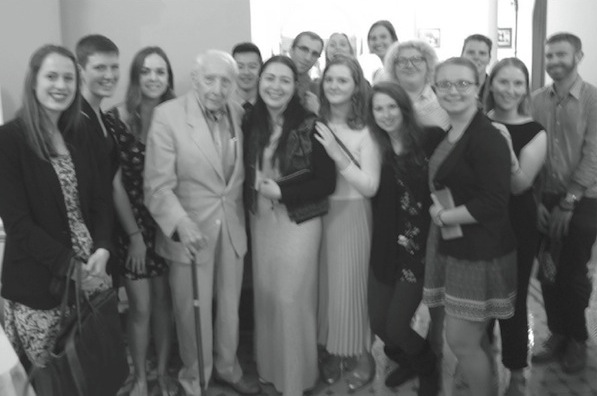
A photo of George Pal with the class of 2016 I-witness Field School, which can be found in his recently released memoir, Prisoners of Hope.

Shoah survivor George Pal introduced the printed and electronic versions of his memoir, Prisoners of Hope: Rising from the Ashes of the Holocaust, to a Zoom audience on June 30.

His eyewitness account describes life at Auschwitz, where Pal, now 94, was interned in 1944-45 as prisoner #42821. The book is the result of the warm response to his presentations given through the University of Victoria’s I-witness Field School, a program that explores “the ways in which the Holocaust is memorialized in Central Europe, to build an understanding of how the lessons of the Holocaust are relevant in today’s world.”

His story demonstrates how rapidly upheaval can occur in a person’s life. Pal’s hometown of Mukachevo, now in Ukraine, found itself, by turns, under the rule of Czechoslovakia, Hungary, Germany and Russia – all within the first half of the century. “At the age of 17, I already had lived in several different countries, without ever having left town!” Pal observes.

The memoir’s title conveys Pal’s steadfast spiritual resistance to the horrors and brutality that he endured. He believes that many of his fellow concentration camp inmates shared this resolve. Eventually, he was “liberated” by the Russian army, and traveled back to Mukachevo, where he was reunited with his mother and sister. His mother had been interned in a ghetto in Budapest, while his sister had survived a concentration camp.

Pal soon moved to Budapest. A decade later, that city was invaded by the Soviet Union. By then a married engineer with two children, Pal went to Austria. Ultimately, he found asylum in Canada, where he became the dean of engineering at Mohawk College in Hamilton, Ont. There, he learned English. He already spoke Czech, German, Hungarian, Hebrew and a smattering of Russian. In 2006, he moved to Victoria. His journey has been one of patience, perseverance, love and hope.

image - Prisoners of Hope book coverThe release of his memoir proves timely, as nations worldwide explode in public protests urging their governments and police to confront their histories of systemic racism. Pal’s heartfelt plea reiterates the famous refrain “never again.”

“Having survived one of the most monstrous events in human history, I believe that it is my duty to testify. This is crucial especially because Nazi sympathizers and followers continue to exist throughout the world,” he writes.

In May 2019, Pal began working with Vancouver editor Lisa Ferdman, whom he credits for “her consummate skill and insight.” Her recent work as editor includes The Nazi’s Granddaughter: How I Discovered My Grandfather Was a War Criminal by Silvia Foti, soon to be released by Regnery Publishing, in Washington, D.C.

“It was an honour to assist Pal in sharing his story with a wider audience,” Ferdman affirmed.

The book launch featured Prof. Helga Thorson of the University of Victoria’s department of Germanic and Slavic studies; Shoshana Litman of the Victoria Storytellers’ Society; and a video-recorded conversation with Pal.

“For the past 10 years, George has shared his story in my Holocaust studies courses at UVic. In this way, he has affected the lives of countless students, who now carry his story with them as they face their own experiences of a world still struggling with racism, antisemitism and genocide – 75 years after the Shoah,” Thorson said.

“George’s stories of resilience offer concise glimpses of experiences few of us have endured. His writing helps us begin to understand the tremendous perils of unchecked racism in a very personal way,” Litman, Canada’s first ordained maggidah (female Jewish storyteller), reflected.

In one of the later chapters, Pal states: “I have often been asked, ‘Do you hate the Germans?’ My emphatic answer is always, ‘No! If I were to blame the entire German people for everything that happened to me, my family and all those who did not survive, I would be making the same mistake that the Nazis made in blaming the Jews for all of Germany’s woes.’ Such generalizing, or demonizing, is dangerous.”

Sam Margolis has written for the Globe and Mail, the National Post, UPI and MSNBC.

Format ImagePosted on July 10, 2020July 9, 2020Author Sam MargolisCategories BooksTags George Pal, Holocaust, I-Witness Field School, memoir, Prisoners of Hope, Shoah, Victoria
Poet writes of world events

Poet writes of world events

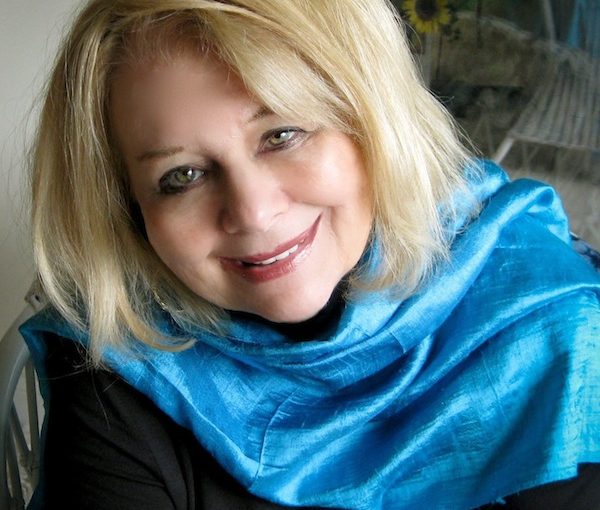
Lillian Boraks-Nemetz has a new poetry compilation, called Out of the Dark, which will be released by Ronsdale Press in the fall. (photo from Lillian Boraks-Nemetz)

The death in late May of George Floyd, while he was pinned down on the ground by a Minneapolis police officer, has sparked continuing protests throughout the United States and the world. The tragic incident struck a nerve with Vancouver author and poet Lillian Boraks-Nemetz, and she composed “The Arm,” a poem about racism, in Floyd’s honour.

The poem begins: “Today I am George Floyd / I am a Jew / so I know how it feels / To be stifled / By the arm of hate / That extends toward anyone / Who is different in colour / Culture or creed.”

“Before he died, George Floyd said, ‘I can’t breathe.’ When I think of the enormity of the Holocaust and its implications in my life, I can hardly breathe,” Boraks-Nemetz, a Shoah survivor, told the Independent in a recent interview from her home in Vancouver.

“There were moments during the Holocaust when fear froze my throat and I couldn’t breathe,” she said. “The first time, I stood at the Nazi checkpoint dividing the Warsaw Ghetto from the rest of the world, I had to let go of my father’s hand and walk alone through the checkpoint, hoping the German guard holding a rifle won’t shoot me. The second time I couldn’t breathe was when I found out that my little sister was murdered by a policeman during the war only because she was a Jew. Like poor George Floyd, my sister didn’t survive.”

When asked what she hopes people who read the poem will take from it, she replied: “There are people in our community who do not identify with the anti-racism goings on. I do.”

She explained, “They talk about the black injustice, the indigenous injustice. I am talking about the Jewish injustice and the rise of antisemitism around the world. It seems as if this topic has been completely omitted from all conversations on racism by both Jews and non-Jews. These incidents, like the killing of George Floyd, touch every survivor of trauma one way or another.”

“The Arm” ends: “As the world burns / From loss, guilt and disgust / May the good people of this Earth / Rise and open their arms / Far and wide to release / Love, kindness and justice for all / Because today each one of us / Is George Floyd.”

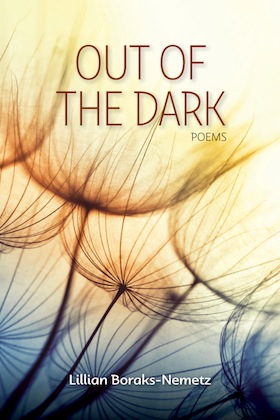
The poem comes ahead of the release of Boraks-Nemetz’s new poetry compilation, Out of the Dark, which will be released by Ronsdale Press in the fall.

image - Out of the Dark book coverThe 100-page collection offers a cycle of poems in three parts about the poet, who has had to live with the memories of the Holocaust all her life. The first section describes the evils of suffering and prejudice, of war and destruction, and the loss of loved ones, even the loss of self.

“This is a ghetto / where humans live in neglected cages / within a fire that burns sleep out of their eyes,” one verse proclaims.

The second section offers “flickers of light” in locating paths to a more fulfilling life, once the poet understands, “We must always seek / new ways / of reaching one another / though each of us / is a world unto itself.”

The third section pays homage to the creative minds who preceded us and who have bequeathed us their gifts. And it explores the ability to live and love: “I run toward you / carrying the glow of marigolds / lighting your path to my love.”

Boraks-Nemetz is well-known in British Columbian and Canadian literary circles. In 2017, she published Mouth of Truth, a novel that also addressed the power of speaking up for justice. In it, the protagonist must confront secrets from her family’s past in Warsaw during the Holocaust, issues of guilt and discrimination, and verbal, psychological and physical abuse.

Canadian poet John Robert Colombo called Mouth of Truth “a work of great insight and fine delicacy about the human condition.”

Previous works by Boraks-Nemetz – The Old Brown Suitcase, The Sunflower Diaries, The Lenski File and Tapestry of Hope – have garnered Canadian and international awards, as well as praise in literary publications.

Outside her literary endeavours, Boraks-Nemetz is a campaigner for Holocaust education. She speaks frequently at local schools and at international events about the Shoah and is deeply involved with the Janusz Korczak Association of Canada.

To read “The Arm” in its entirety, visit Boraks-Nemetz’s website, lillianboraks-nemetz.com/2020/06/04/the-arm/#more-647. To pre-order her upcoming book of poetry, visit ronsdalepress.com/all-books/out-of-the-dark.

Sam Margolis has written for the Globe and Mail, the National Post, UPI and MSNBC.

Format ImagePosted on June 26, 2020June 24, 2020Author Sam MargolisCategories BooksTags anti-racism, George Floyd, Holocaust, Lillian Boraks-Nemetz, poetry

Uprising observed

The Vancouver Holocaust Education Centre and the Jewish Community Centre of Greater Vancouver were among 125 partners presenting a global commemoration of the 77th anniversary of the Warsaw Ghetto Uprising recently.

Beginning and ending with stirring renditions of the “Partisans’ Hymn,” the online event, which also commemorated the end of the Second World War 75 years ago, featured a long list of singers and performers from Hollywood, Broadway and elsewhere, including Dr. Ruth Westheimer, Mayim Bialik, Whoopi Goldberg, Adrien Brody, Lauren Ambrose and dozens more.

We Are Here: A Celebration of Resilience, Resistance and Hope, which took place June 14, was produced by the Museum of Jewish Heritage: A Living Memorial to the Holocaust, Sing for Hope, the National Yiddish Theatre Folksbiene and the Lang Lang International Music Foundation.

“Zog Nit Keyn Mol” (“Never Say”) is generally called “The Partisans’ Song” or “The Partisans’ Hymn” in English and is an anthem of resilience amid catastrophe sung at Holocaust commemorative events. Written in the Vilna Ghetto by Hirsh Glik after he learned of the six-week uprising by Jews in the Warsaw Ghetto, its stirring concluding lines translate as, “So never say you now go on your last way / Though darkened skies may now conceal the blue of day / Because the hour for which we’ve hungered is so near / Beneath our feet the earth shall thunder, ‘We are here!’”

Other musical performances included a Yiddish rendition of Leonard Cohen’s “Hallelujah,” adapted and performed by pianist and singer Daniel Kahn; “Over the Rainbow,” from the 1939 film The Wizard of Oz, composed by Harold Arlen with lyrics by Yip Harburg, two friends from the Lower Eastside of Manhattan, against the spectre of a darkening Europe; and “Es Brent” (“In Flames”), a musical cri de coeur written in 1936 by Mordechai Gebirtig after what he viewed as the world’s indifference to a pogrom in the Polish town of Przycik.

Andrew Cuomo, governor of the state of New York, spoke of his father, the late former New York governor Mario Cuomo, who helped ensure the creation of the Museum of Jewish Heritage, the world’s third-largest Holocaust museum.

One of the other presenting partners, the National Yiddish Theatre Folksbiene, is the longest continuously producing Yiddish theatre company in the world, now in its 105th season. It was founded to entertain and enlighten the three million Jews who arrived in New York City between 1880 and 1920.

Sing for Hope, another partner, believes in the power of the arts to create a better world. Its mission is to “bring hope, healing and connection to millions of people worldwide in hospitals, schools, refugee camps and transit hubs.”

The Lang Lang International Music Foundation aims “to educate, inspire and motivate the next generation of classical music lovers and performers and to encourage music performance at all levels as a means of social development for youth, building self-confidence and a drive for excellence.”

The program, which runs approximately 90 minutes, is available for viewing at wearehere.live.

Posted on June 26, 2020June 24, 2020Author Pat JohnsonCategories WorldTags commemoration, Holocaust, JCCGV, Jewish Community Centre of Greater Vancouver, memorial, Museum of Jewish Heritage, performing arts, theatre, Vancouver Holocaust Education Centre, VHEC, Warsaw Ghetto, Yiddish
A virtual Yom Hashoah

A virtual Yom Hashoah

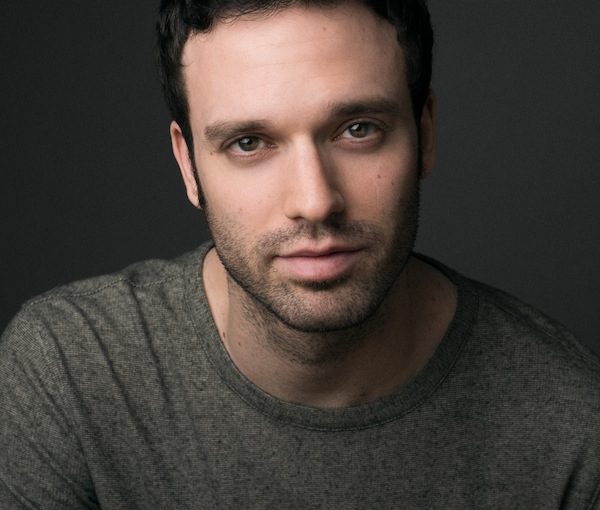
Toronto actor Jake Epstein hosted Canada’s online Yom Hashoah commemoration on April 20. (PR photo)

Days after many Canadian families celebrated Passover remotely using online platforms for virtual seders, Yom Hashoah was commemorated with a virtual ceremony that linked survivors and others across the country in an unprecedented, but deeply moving, program of remembrance and education.

The 27th of Nissan was set aside in 1951 by Israel’s parliament, the Knesset, as Holocaust and Heroism Remembrance Day. This year marked the 75th anniversary since the end of the Second World War and the end of the Holocaust.

Hosted live by Toronto actor Jake Epstein, the event, on April 20, featured prerecorded content from organizations across Canada and new footage broadcast live, including candlelighting from six locations across the country, among them the Vancouver home of Shoshana and Shawn Lewis and their children Charlie, Julian and Mattea.

In a recorded message, Prime Minister Justin Trudeau said Canada stands firm against antisemitism and with Israel and the Jewish people.

“The Shoah was undoubtedly one of the darkest periods in human history and these moments where we pause to remember matter, both to honour those who lived through these horrors but also to make sure these atrocities are never repeated,” Trudeau said. “Sadly, acts of antisemitic violence are more and more frequent today and Canada is not immune to this trend. For many Jewish Canadians, the rise in attacks is not only troubling, it’s downright scary. But, let me be clear, attacks against the Jewish community are attacks against us all. Let me be equally clear, Canada and Israel are partners, allies and close friends and we will continue to stand proudly with Israel. Attacks against Israel, including calls for BDS and attempts to single her out at the UN, will not be tolerated.… We will always condemn any movement that attacks Israel, Jewish Canadians and the values we share.”

The Yom Hashoah program also included recorded messages from Israeli diplomats in Canada and prerecorded musical components.

“During the war, music played an important role in lifting the spirits of ghetto inhabitants, camp inmates, as well as being used as a bargaining chip in negotiating small freedoms in the camps,” said Epstein.

Pieces were performed by the Toronto Jewish Chorus, participants in previous March of the Living programs and by shinshinim, young Israelis performing overseas duties after completing high school. Memorial prayers, El Maleh Rachamim and Kaddish, were offered by Cantor Pinchas Levinson of Ottawa.

Epstein, a grandson of Holocaust survivors, spoke of his family’s history, the good fortune of his grandparents’ survival and the resilience they showed in beginning a new life in a new land.

“Upon being liberated from the camps, survivors faced the inconceivable realization of the enormity of their loss,” Epstein said. “Recovery was a long road ahead. Survivors, like my grandparents, immediately searched for any other surviving family members, only to discover that they had lost everyone. And yet, somehow, they rebuilt their lives.

“My grandparents came to Canada through Pier 21 in Halifax before ultimately moving to Toronto. Even though they were free, the culture shock, the language, the difficulty in finding work, made life extremely hard. My grandfather, an architectural engineer in what was then Czechoslovakia, was lucky enough to find work as a bookkeeper for a lumberyard. My grandmother became a seamstress, working day and night, not only making clothing for customers, but making dresses for my mom as well. Somehow, they managed to connect with other survivors who became like family.…My grandparents’ story of resilience and adversity is a common one. They, like so many other survivors in Canada, raised families, found employment, learned new languages and contributed to Canadian society and Jewish communal life. Some even dedicated their lives, decades later, to speaking out against hate and injustice by sharing their Holocaust stories with students and the public.”

Survivors from across Canada, in video recordings, spoke of their liberation experiences and offered advice to successive generations.

Faigie Libman of Toronto recounted her moment of liberation.

“We saw a man on a horse, a Russian soldier, coming towards us,” she recounted. “He said he was a captain, that we are free. You cannot imagine the joy, you cannot imagine the exhilaration. I still see the picture in front of my eyes, women who could hardly walk, some were even crawling, pulled him down, they were kissing him, they were hugging him, and that day will always be in my mind – Jan. 21, 1945 – we were finally free.”

Sydney Zoltan of Montreal expressed concern about Holocaust awareness after the eyewitnesses pass.

“We, the youngest survivors, now stand in the frontline,” he said. “We often ask ourselves what memory of the Shoah will look like when we are gone. We depart with the hope that our fears are only imaginary.”

Another survivor asked younger generations to be vigilant.

“I want young people to remember, I want them to be politically aware, that their government should never preach hate,” said Elly Gotz of Toronto. “I want them to understand how damaging hate is to people.”

The commemoration, coordinated by the Sarah and Chaim Neuberger Holocaust Education Centre in Toronto, was presented in partnership with organizations across the country, including the Vancouver Holocaust Education Centre. Earlier the same day, a global Yom Hashoah memorial event took place from an eerily empty Yad Vashem in Jerusalem, again with video-recorded survivor testimony and messages from political, religious and civic figures.

Format ImagePosted on May 15, 2020May 14, 2020Author Pat JohnsonCategories NationalTags Holocaust, Jake Epstein, memorial, survivors, VHEC, Yom Hashoah

Using past to improve future

Without interpretation, the world’s greatest art is little more than a lot of pretty pictures. Similarly, absent interpretation and thoughtful reflection, history is not much more than a litany of names and dates.

This month, we are marking many anniversaries. The end of the Second World War in Europe. The liberation of the last Nazi concentration camps. The beginning of Soviet-versus-Western tensions and proxy wars that lasted decades.

In some ways, we cannot begin to comprehend the Holocaust, or the world’s reaction to it, without reflecting on a different anniversary we mark this month. It was 60 years ago this week – May 11, 1960 – that Mossad operatives captured Adolf Eichmann, a prime architect of the Holocaust. The astonishing operation, which amazes observers even today with its bizarre twists and chutzpah on an international scale, stands out as a turning point in the way the world – Jews especially – view Holocaust history.

Holocaust survivors themselves understood the particularity of the Holocaust, while much of the world perceived the millions of Jewish lives lost as a part of the larger war casualties, not qualitatively different from the deaths of citizens of Dresden or Coventry or Stalingrad. It should need not be said that every human life lost is a tragedy. But, from the perspective of historical meaning, the murder of Jews, Roma, people with disabilities, homosexuals and others targeted for identities unrelated to the national conflicts, must be understood apart from the tragic consequences of war.

This is the consensus position today – that the Holocaust paralleled the Second World War but was substantively and morally different from broader contemporary events. This consensus emerged to a great extent from the Eichmann capture and trial.

Eichmann was living in Argentina, so confident in his security that, in retrospect, his subterfuge was minimal. Once tipped off, the Mossad had little trouble locating him.

Eichmann’s legendary defence, that he was merely following orders, was dismissed by the Israeli court. Whatever moral or military defence that argument posited was defied by the facts. Eichmann, according to eyewitnesses and documentary evidence, did far more than follow orders. He enthusiastically fulfilled directives beyond the letter or spirit of the command.

When the trial began, in 1961, it was said that one could walk through Tel Aviv and hear the proceedings on radio through every open window. The implications of the Eichmann trial for the world’s understanding of this history, and for Israeli and Jewish consciousness, was revolutionary.

Even among families that included survivors, or who had lost entire branches of the family tree, the historical context of the Holocaust was nebulous until this time. The small amount of survivor testimony that had emerged immediately after the war had largely dissipated, in part because the public did not want to face the most grotesque evidence of human depravity and because, in many cases, the survivors chose to sublimate their experiences and attempt to rebuild and move on with their lives.

It was only in the minutiae of the evidence at trial, the mind-boggling precision, industrial-style execution of diabolical plans and indescribable sadism of the Nazi war against Jews that people began to understand both the quantitative and the qualitative nature of the Shoah.

In addition to gaining insights into what their parents or other survivors might have experienced, younger Jews and Israelis intuited from the evidence a larger realization about their people. According to some historians, an idea persisted in the years after 1945 that the Jews of Europe had gone silently – “like sheep,” in the dehumanizing terminology too often employed – to their deaths.

Gaining an understanding of the inescapable precision and indefatigable determination of the Nazis to identify and murder every single Jew in their realm, younger Jews and Israelis came to know that their lost civilization did not go willingly. Indeed, among the earliest memorializations of the Holocaust – including here in Vancouver – were commemorations of the bravery and resistance of the Warsaw Ghetto uprising. The nuances of the historical record were enriched by this knowledge, with implications for the self-identity of Jews everywhere. The extent of the cataclysm was a result of the homicidal tenacity of the Nazis and their collaborators, not of the responses of their victims.

The Eichmann trial opened a floodgate. The contemporary era of Holocaust history, including survivor memoirs and public discussion of that time, really began then. A decade later, this new understanding led to a backlash of Holocaust denial and revisionism which, in turn, inspired yet more survivors to speak out to correct and add to the record.

Today, we struggle to keep this history alive and to challenge its diminishment and misuse. Even among well-intentioned people who would never mean to belittle this history, there is a tendency to invoke it in situations that by no measure are comparable.

Additionally, especially in Europe, public opinion polls reveal that there is a fatigue around the subject. In many countries, pluralities or even majorities say that too much attention is paid to the Holocaust. Incongruously, the same polls indicate that it is in countries where ignorance of this history is most pronounced that citizens contend there is too much focus on it. Try to square those results.

We always view the past through the changing lens of the present. We have seen transformations in the understanding of and responses to Holocaust history for 75 years now. One of the challenges of our generation and successive ones is to be active in addressing these changing perceptions and interpretations. Our desire to continue to delve into this difficult experience and our people’s enduring trauma cannot depend on other people’s ignorance or assessment of what’s considered “too much” or “too in the past.” Our obligation, as carriers of this knowledge and witnesses to the survivors, is to glean the lessons of the past that improve the future and help strengthen our community and our societies. We will continue to do this work and to honour our ancestors. And we will continue to share what we know to be true, as we search for ways to make “Never again” a reality.

Posted on May 15, 2020May 14, 2020Author The Editorial BoardCategories From the JITags education antisemitism, Holocaust, remembrance, resistance, survivors

Yom Hashoah online

Like everything else in this time of pandemic, Yom Hashoah, which took place this week, was not normal.

On Monday, at 10 a.m. Pacific time, viewers worldwide, including here in British Columbia, tuned in online to watch the state ceremony marking the start of Holocaust Martyrs’ and Heroes’ Remembrance Day, taking place in Israel at Yad Vashem. Later that day, a cross-Canada commemoration took place, presented by a number of national bodies and with the Vancouver Holocaust Education Centre as a contributing organization.

The eerily vacant hall at Yad Vashem was interspersed with video recordings of remarks from Israel’s president, prime minister and chief rabbis, as well as six survivors, who shared their stories of loss and survival. The Canadian commemoration a few hours later was similarly moving, with video interspersed with thoughtful reflections from a member of the third generation who served as host and a message from the prime minister, stories of survivors, and candlelighting by families across the country. (See coverage next issue.)

No doubt the organizers of these events would have preferred to hold them in person. The proximity of family, friends and community strengthens survivors and the successive generations. Being in proximity provides crucial emotional, psychological and intellectual means of conveying the historical importance of that time and its lessons for social justice and human rights today.

The use of digital technology to mark Yom Hashoah was perhaps a little less startlingly odd, given that Jewish people worldwide recently experienced an unprecedented Passover, engaging in “zeders” – virtual seders on Zoom or other videoconferencing platforms – to get together with family over the holidays. The contortions some of our family members went through to make these celebrations happen was cause for some laughs, as well as some tsuris, and Passover 5780 will not be soon forgotten.

This was hardly an ideal way of celebrating – and many in the Orthodox community couldn’t even do this much – but it was necessary given the social isolation required of us during this pandemic.

Yet, while it is important to come together for happy occasions, this time is particularly difficult for those experiencing grief and loss. Having to up-end the ancient Jewish rituals that serve to sustain and strengthen mourners, those who have lost loved ones are left with minimal funeral attendees and shivahs conducted by telephone and computer; hugs only from those who share a household, none of the important reinforcement – and comfort – that comes from the physical proximity of a broader community. Even this sad situation fulfils a mitzvah, though. As painful as it is to be remote from our loved ones in times of grief, it is pikuach nefesh, an act of saving a life, the highest Jewish value and one that overrides almost every other law. During a pandemic, we remain apart from our loved ones because we love them.

Yom Hashoah commemorations often take a sombre tone and include some of the rituals we perform at a funeral, which made viewing the events in seclusion especially isolating. Yet, conversely, there was something uniquely appropriate about this alternative form of marking Yom Hashoah.

While we were fortunate to have survivors participate via video in these and other online commemorations of the day, the undeniable reality is that this was among the last such commemorative days where successive generations will be able to hear firsthand from the mouths of survivors their stories of loss, resistance and survival. Finding ways beyond first-person witness testimonies is the unavoidable way forward for Holocaust education and remembrance. Organizations dedicated to this mission have recognized this reality and have been developing impactful ways to augment and, eventually, replace in-person survivor testimony.

Remembering and, using that memory as motivation, ensuring that the promise of “Never again” is taken up by the next generations is also a Jewish value. It took an admirable mobilization of our local, national and international communal organizations to ensure that the pandemic did not cause us to ignore Yom Hashoah this year. It was precisely the sort of flexible, responsive action that will be required to meet the demands of Holocaust remembrance and education in the decades to come.

Necessity is the mother of invention and the unusual yet deeply moving commemorations this week should encourage us that, whatever challenges and changes the future holds, we remain determined to memorialize and educate about the Holocaust in ways appropriate to the times in which we live.


Posted on April 24, 2020April 24, 2020Author The Editorial BoardCategories From the JITags commemoration, Holocaust, memorial, Yom Hashoah

Posts pagination

Previous page Page 1 … Page 16 Page 17 Page 18 … Page 44 Next page
Proudly powered by WordPress