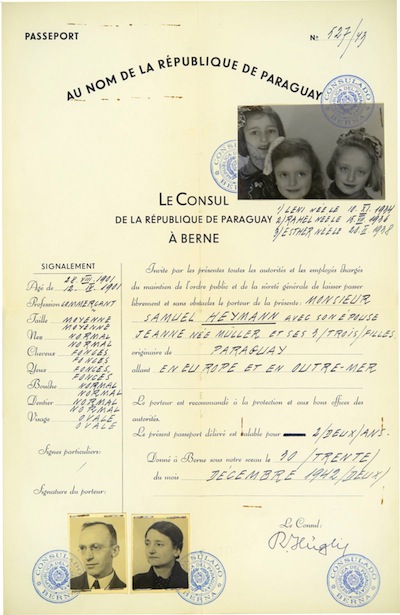
Andrzej Mańkowski, Poland’s consul-general in Vancouver, shared some reflections on his country’s history with the Jewish Independent, including about the Ładoś Group, which tried to help Jews escape the Nazis by the issuing of fake passports. (photo from Andrzej Mańkowski)
The wartime actions of Poland and its people provide a prime example of the human capacity for good and evil. Many Poles today proudly point out that there are more of their compatriots recognized in Yad Vashem’s Garden of the Righteous Among the Nations than there are heroes of any other nationality. By contrast, the work of Polish-Canadian historian Jan Grabowski and a team of researchers in Poland chronicles in great detail the collaboration by Polish officials and ordinary citizens in assisting the Nazis in the goal of executing the “Final Solution” in that country.
Poland’s government prefers to focus on the more positive fact. So sensitive and contentious is the history that, in 2018, Poland passed – then, in the face of international outrage, rescinded – a law that criminalized expressions of Polish complicity in the Holocaust. At the time, Israel’s President Reuven Rivlin acknowledged that many Poles had aided Jews during the war era, but also that “Poland and Poles had a hand in the extermination” of Jews during the Holocaust.
Poland’s consul-general in Vancouver spoke to the Jewish Independent last week and shared some personal reflections on his country’s history – including how his own grandfather was murdered in Auschwitz.
Andrzej Mańkowski wanted readers of the Independent to know of a recently discovered story of a group of Polish diplomats in Switzerland who provided faked passports to help Jews flee Europe.
Called the Ładoś Group, after Aleksander Ładoś, the Polish envoy in Bern from 1940 to 1945, the six individuals included four Polish diplomats, one of whom was Jewish, and two representatives of Jewish organizations that conspired with the officials. The RELICO Assistance Committee for the Jewish Victims of the War, established by the World Jewish Congress, and the Agudat Yisrael worked with Ładoś and his colleagues.
In addition to Ładoś himself, three other Polish diplomats were members of the group: Stefan Ryniewicz, Konstanty Rokicki and Juliusz Kühl. The two members of Jewish organizations in Switzerland who rounded out the group were Abraham Silberschein of RELICO and Chaim Eiss of Agudath Israel.
Beginning in 1941 (or possibly earlier) until the end of 1943, the six men illegally purchased passports and citizenship certificates from Latin American countries, primarily Paraguay. The documents were sent to Jews in nations under German occupation, where possessing them increased chances of survival.
“Many of those passports came too late to save people,” Mańkowski said. “The recipients or the holders of the passports ended up in Auschwitz in spite of already having the false passports in their hands.”
As many as 10,000 forged passports may have been obtained, but most reached their intended recipients – primarily German and Dutch Jews, as well as some Polish Jews – too late. Of about 3,200 passports issued to individuals whose names are known, it is estimated that about 800 individuals – approximately 25% – survived the war.
Mańkowski’s own family history is deeply impacted by the horrors of the Nazi era. His grandfather, Emeryk Mańkowski, fled Ukraine after the 1917 Bolshevik revolution and settled in central Poland, where his wife’s family owned land. Part of that land was forested and, during the German occupation, Nazi officials discovered a radio communications device in the forest on the property. Unable to identify the owner of the contraband device, they arrested 10 members of the local intelligentsia – including Emeryk Mańkowski – and sent them to Auschwitz as a warning to the rest of the population.
At the time, Polish inmates were permitted 100 zlotys per month from their family. During the second month of his incarceration, Mańkowski’s family had their monthly stipend returned, with a message telling them that the prisoner was no longer present in the camp.
“The German Nazi bureaucracy was so precise and honest to send back money after killing the victim,” said his grandson, the consul-general.
As many as 10,000 forged passports may have been obtained, but most reached their intended recipients too late. Of about 3,200 passports issued to individuals whose names are known, it is estimated that about 800 individuals survived the war. (image from Andrzej Mańkowski)
While Poles suffered at the hands of the Nazis, Mańkowski acknowledges the magnitude is incomparable. Three million Polish Jews died during the Holocaust and, during the same period, three million non-Jewish Poles also died, he said. This represented about 10% of the larger Polish population, but 90% of the Jewish population. After the war, he said, a Polish family of 10 would have a relative missing from their holiday table. A Polish Jew from a family of 10 would be alone.
The consul lamented that Poles and Jews have incompatible narratives.
“We have two separate histories,” he said, citing the visits by Israeli students to the memorial sites of the Shoah in Poland. “These groups of Jewish youths from Israel walk around in Warsaw and see only ghetto, only death all around. They never see us, living Poles. They are coming with bodyguards, they are insulated from Poles.”
The controversy around the now-rescinded law proscribing discussion of Polish complicity led to a major diplomatic eruption with Israel, and Polish Prime Minister Mateusz Morawiecki acknowledged that it was not any respect for civil liberties or historical veracity that led to the reversal, but international pressure.
“Those who say that Poland may be responsible for the crimes of World War II deserve jail terms,” Morawiecki said at the time. “But we operate in an international context and we take that into account.”
Chrystia Freeland, then Canada’s minister of foreign affairs, wrote on Twitter that Canada is “concerned by the potential impact on free speech” of the Polish law and urged that country to “ensure open discussion and education about the horrors of the Nazi death camps.”
The consul emphasized that the law didn’t apply to scientific publication, research or artistic activity, as these fields were excluded from the jurisdiction of this law.
World attention has focused on Poland in recent years not only because of concerns around free expression and inquiry into Holocaust-era history. Poland has been called the worst country in the European Union for gay rights. Expressions of hate speech are leveled against LGBTQ+ Poles by individuals at the highest levels of government. There is a lack of legal protections for sexual minorities and criminal charges have been laid against individuals exhibiting Pride flags. Dozens of Polish communities have declared themselves “LGBT-free zones.”
Mańkowski acknowledged that Poland is a conservative country. Last month, a new abortion law was promulgated, banning abortion in almost all cases.
“It’s a question of some conservative attitudes and opinions on the part of Polish society,” he said. “We are quite conservative, that’s true…. It’s a hot discussion within Polish society and, if you follow polls and opinion research, you will see the real judgment of Polish society and maybe the political system is not following the tendencies of the changing trends.”
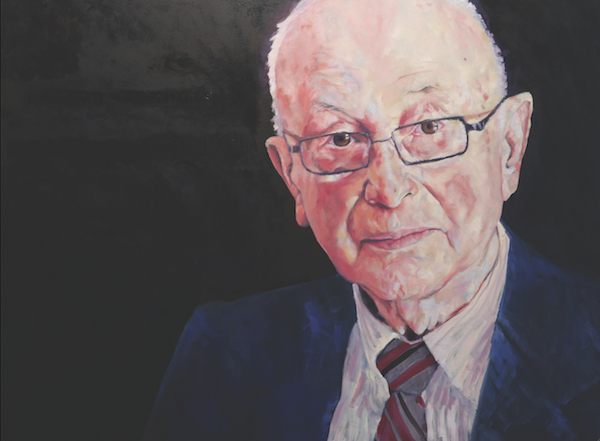
A portrait of Robbie Waisman, by artist Carol Wylie. Part of the exhibit They Didn’t Know We Were Seeds, at the Zack Gallery to Jan. 4.
Even via a wobbly Zoom-led tour, the impact of Saskatoon artist Carol Wylie’s portraits – nine of Holocaust suvivors and nine of residential school survivors – can be felt.
The title of the solo exhibit at the Zack Gallery until Jan. 4 is They Didn’t Know We Were Seeds. It is taken from the proverb: “They buried us … they didn’t know we were seeds.” And the choice of 18 portraits was deliberate.
“It was quite quick and early in the process I decided that 18 had to be the number,” said Wylie at the exhibit’s virtual opening Nov. 19, “because there’s so much darkness in the stories but there’s so much light and life in the survival… [T]here’s three of the Holocaust survivors who are involved with the March of the Living and to actually go back to the camps, to Auschwitz, and to make that walk when you were there; I can’t imagine the courage it takes. And they do it so that others are educated. That’s the rising above it and making something really powerful out of a black, dark experience.
“And I see the same thing with residential school survivors, like Gilbert [Kewistep] and like Eugene [Arcand], who spend so much of their time going around to schools and speaking in public about their experiences to make sure people are educated about that. And, again, reliving what they went through every time they tell it, I’m sure.
“So, the 18 and the connection to chai, to life, came really early in the process. It had to be 18, because that validation of life that these people represent … had to be present.”
The scale of the paintings was also chosen purposefully. “I want these portraits to take up space and to be very present and, for when you’re standing in front of them, to have them fill up your field of vision, so that you can’t wander past, uninterested and unengaged,” said Wylie.
The project started several years ago, she explained. “I saw Nate Leipciger speak at the Holocaust memorial service in Saskatoon and, it’s ridiculous, I’ve been [attending] for lots of years but, for some reason, that year, it hit me for the first time how elderly all these people are getting.”
The firsthand experience that is so powerful is soon to be lost, she said, and “I felt there was something that I had to do to help to preserve that.” And she would do it with the best tool she had, her passion and ability to create portraits.
“What I have learned over the years,” she said, “is that, when you capture the nuances of a person’s face, you really reflect who they are and much of their history and how they’re made up of that history. Even though it’s not like hearing a verbal story, it’s seeing a story in a different form.
“I started this idea to do a series of portraits of Holocaust survivors. And then, as I entered into it, little things started to pop up that were connecting the Jewish survival to the residential school experience. It started with a community seder at our local synagogue, where our rabbi, who is very forward-thinking, always has elements on the tables that recognize other groups … and, that particular year, he had made special mention of making sure that we understand – especially in Saskatchewan, where we have a really dark history of residential schools – the experience of the Indigenous people that we live with.
“And I started thinking, it’s not a parallel experience, but it’s an experience that is shared in terms of pain and suffering and then survival and rising above it…. And, because I live in Saskatchewan, this is part of the history of the land that I call home, that I’m a settler in, that this is a time of truth and reconciliation, it’s a time of trying to address these issues, so, as a personal step towards reconciliation, I can sit down, listen to the stories of some of these residential school survivors and bear witness to them and bring them in to be part of this project, so that they can converse through their portraits, as a group of survivors.”
It was only after making this decision that Wylie discovered that people like Vancouver’s Robbie Waisman – who is among those featured in the exhibit – were already meeting with residential school survivors to share ideas and experiences.
The project took about three-and-a-half years to complete. Waisman is the only Vancouver-based subject. “All the other Holocaust survivors were from Toronto, Edmonton and Saskatoon, and all the residential school survivors are from Saskatchewan,” said Wylie in an email interview with the Independent.
“I had to be really careful,” she noted at the exhibit opening. “There’s a very, very fraught history of non-Indigenous artists and non-Indigenous photographers representing Indigenous peoples and I knew I was stepping into this murky ground. All the way along, I had to keep asking myself questions about my own integrity around this, what are the reasons for why you’re doing this and does every single survivor that you talk to understand fully what this project is about and [are they] fully on board with it. At the end, I thought, if there are people who are criticizing it, that’s fine, but, I feel, after conversations I’ve had with many residential school survivors, that it’s more important that we raise this issue and more important that I make this step towards reconciliation than be fearful of doing something that maybe I shouldn’t be doing or that the art world might perceive that I shouldn’t be doing.”
When the work was completed, Arcand and Kewistep “smudged the work before it went off on its first exhibition. Then they gave me a smudge kit that I could use myself, if I wanted to, in the future. It was extremely meaningful to me; it was almost like they’d given it their stamp of approval, as well as imbuing it with these good graces and these good thoughts and this positive energy before the work went anywhere and anyone had a chance to see it.”
The exhibit has been shown in various places and will travel elsewhere after its time at the Zack.
Wylie’s general process in doing portraits is to speak with her subjects first.
“I think that, in order for the mask that we all wear in the world to protect ourselves, in order for that to drop, there needs to be time spent talking,” she said. “There’s this very strange artificial intimacy that happens when you’re sitting two feet – before COVID times – away from somebody that you’re drawing, and you’re talking and you’re looking intently at them…. So, I always wait until that couple of hours of conversation and visiting is over and then I pull out my camera.
“I need to work from photographs because I like to get a strong resemblance and I can’t have people coming back endlessly to sit for me…. But that’s when I take them, is after that time has been spent, that conversation has happened, and their mask has come down and they are open.”
The openness that is seen in the subject’s faces, stressed Wylie, “is not something that I put there, it’s something that they had. Seriously, I paint what I see… And that captures what they have, what they are, because it’s all within there, it’s all in their face.”
Given the caveat that there is something intangible about what makes a good portrait, Wylie said in an email, “I believe a portrait should bear resemblance to the subject. But, in addition, it should feel like the portrait is inhabited; like it contains the spirit of an individual. You often hear people comment about the eyes in a portrait following them. I think that’s the sensation of some element of the person, and not just their resemblance, being present. I also like to see evidence of the artist in the work in the form of brushstroke, colour choices, etc. This trace of the artist distinguishes a painted portrait from a photo.”
She described her need to create portraits as “a compulsion I’ve had since I was a child. Even then,” she said, “I drew people, made my own paper dolls. In my grad school investigations I discovered, I believe, that it’s because of a fascination I have with the mystery of consciousness, and the fact that we can never share another’s consciousness. We learn about ourselves through our interactions with others and these connections enrich our being.
“The face is a major part of how we communicate and is strongly connected to our identity,” she said. “Yet, we cannot see ourselves the way others see us, so there’s this mystery around faces. What do they hide? What do they reveal? How do you feel as ‘you’ wearing your face? How do I communicate as ‘me’ wearing my face? I am just never tired of painting a portrait, but am always excited when I begin a new one.”
The exhibit opening was hosted by gallery director Hope Forstenzer, who credited her predecessor, Linda Lando, for bringing this show in. The exhibit is open by appointment and via onlyatthej.com. A commemorative book, being prepared with Wylie’s help, is in the works, as well, said Forstenzer.
On Dec. 9, 6-8 p.m., the gallery is having a Zoom event with Waisman and Wylie, as well as Lise Kirchner from the Vancouver Holocaust Education Centre and Shelley Joseph from Reconciliation Canada. Readers interested in attending should email Forstenzer at gallery@jccgv.bc.ca.
Yad Vashem holds an almost sacred place in the Jewish world. The foremost repository of materials relating to the Holocaust, and Israel’s official memorial to the victims of Nazism, the centre is practically an obligatory destination for visiting diplomats and foreign dignitaries. It is a solemn place dedicated to the terrible past, but with an explicit vision for a future without hatred and genocide.
Yad Vashem is rightly focused on the Jewish particularity of the Shoah. We take for granted the logic of Yad Vashem being located in Jerusalem. The capital of Israel and, spiritually, of the Jewish people seems a logical place to remember this massive cataclysm in Jewish history. But it commemorates a history that took place thousands of kilometres away, in Europe. Its presence in the Jewish state is itself a statement about Jewish particularism. But this does not erase the universal lessons Yad Vashem advances.
Since its founding in 1953, it has been a model for the world in commemorating and educating about the worst chapters in human history. The events of the 20th century that necessitated the invention of the word “genocide” did not end with the Holocaust. Genocides have occurred since 1945 – and before. Educators and others who strive to preserve and transmit these histories and their lessons struggle over the balance between respecting the very specific characteristics of the Holocaust, for example, with the broader messages for all humanity. At a time when antisemitism is experiencing a resurgence, it is essential that the role of Jew-hatred be addressed and confronted, at least in part with the recent past as a warning for the dangers of complacency.
While the struggle between universality and particularism is challenging, all can probably agree that Yad Vashem stands as a monument to human rights and the dignity of all people – and as a lesson to those in societies where those values are compromised. At the same time, the existence and focus of Yad Vashem safeguards the particular and monumental horrors of the genocide against the Jews.
This is why there is rightful concern over the proposed appointment of former brigadier general Effi Eitam as head of Yad Vashem. His proponents – including Prime Minister Binyamin Netanyahu, who nominated him for the position – contend that Eitam’s career has been spent defending the Jewish state. And among the lessons many people take from the exhibits of Yad Vashem is the necessity of a Jewish state as a bulwark against a world that has yet to cure itself of antisemitism.
But Eitam’s military record is more than troubling, and this is the main reason for concerns about his appointment. During the First Intifada, he brutally instructed his troops to break the bones of a 21-year-old Palestinian prisoner, Ayyad Aqel. The soldiers beat the young man to death. Four of Eitam’s soldiers were court-martialed and the Military Advocate General reprimanded Eitam and recommended he never be promoted. (He was.) In addition to his military career, he served two terms in the Knesset representing various religious parties, and held several cabinet portfolios.
Beyond Eitam’s record of heinous action is a record of deeply concerning and racist ideas. He has referred to Arab Israelis as a “cancer” and promoted ethnic cleansing of West Bank Palestinians: “We’ll have to expel the overwhelming majority of West Bank Arabs from here and remove Israeli Arabs from political system,” he said in 2006.
Referring to human beings with terms like “cancer” is precisely the sort of dehumanization that can be a precondition to genocide. In any society – including one as open as Israel, where diverse views and expressions are the norm – these statements must preclude someone from a role like head of the world’s foremost research centre about, and memorial to, the Shoah. Eitam’s military service – he was part of the raid on Entebbe, among other things – can be seen as evidence that a strong Israel is the best defence for the Jewish people in a world capable of genocide. But Eitam’s statements cannot be justified from the mouth of one who seeks to advance the lessons, particular or universal, that Yad Vashem is expected to convey.
The nomination is threatening to create yet another schism in the government, as Netanyahu’s coalition partner Benny Gantz opposes Eitam’s appointment. Ideally, a more suitable leader will be found for this important role, one who stands as a defender of the sanctity of the Shoah and its lessons for humanity.
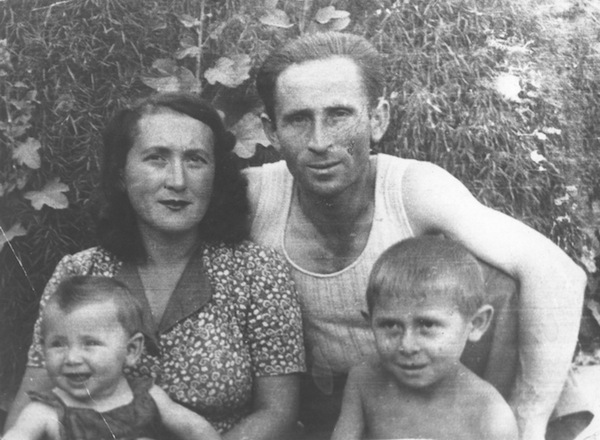
The author as an infant with her parents Sarah and Mechel, and brother Hy, in Kazakhstan, where she was born in 1944. (photo from Reva Kanner Dexter)
A year ago, I attended the 31st Annual World Federation of Jewish Child Survivors of the Holocaust and Descendants, hosted by our own Vancouver Holocaust Education Centre. I have kept the story of my own Holocaust experience suppressed because it never seemed as tragic nor as diabolical as others’. Furthermore, because I was an infant, born in 1944, I did not think that I had the right to call myself a child survivor. However, attending the conference changed that perception.
I claim the dubious distinction of being in the one percent of children born of Polish parents who survived. As three million Jews of Poland were murdered, I feel very privileged.
Of course, the circumstance of my miraculous survival is due to several factors. First, my parents escaped Poland in September of 1939. Second, they were living close to the Ukraine border. Third, they had the essential skills and resilience to overcome many hardships.
My mother Sarah (daughter of Pinchus and Chana) and my father Mechel (son of Israel and Esther) were born and grew up in small towns in southeastern Poland. Krasnystaw and Izbica were 12 kilometres apart. Close enough for biking and walking between the two towns along the Wieprz River.
Typical of small towns in that region and era, Sarah and Mechel grew up poor. Sarah’s father was a barber, who taught her his skills as soon as she could hold a razor blade. Mechel’s father was a tailor who had taught him the art of sewing, also at a young age.
Sarah and my father had moved to Chelm after their marriage, and Sarah was already six months pregnant when the German troops invaded.
Mechel was a member of a Zionist/socialist club, so he got the news early that the Nazis had taken over the town – 1,500 young men were rounded up and shot. Rumours of castration created panic. Mechel took off by bike with some of his pals, telling Sarah he would be returning.
Sarah’s birth mother lived in Rovno, Ukraine, so she made her way alone across the border with the help of a Yiddish-speaking Russian soldier. She had the prescience to bring her barbering tools. Little did she know that trains and train stations were going to dominate her life from that night forward for the next six years.
Sarah and Mechel gave birth to their first child, Chaim (Hy), who an aunt testified was born in Rovno, while an immigration document states that he was born in Novosibirsk, Siberia. Memories do seem to play tricks when the brain is violently assaulted.
The Russians saw and seized the opportunity of so many Jews fleeing Poland into Ukraine. They tricked Jews by telling them that eastern Poland was now under Soviet rule and that they would be given safe passage back home.
It was a lie, a big one. The Jews were shoved into open cattle cars and sent to forced labour camps all over the U.S.S.R. Workers were required to keep the country running under the murderous hand of Stalin.
My parents and baby brother survived the train ride from Rovno or Kiev, which finally stopped in a logging camp on the banks of the Ob River, in Siberia. They realized immediately that their lives were only worth what their labours could produce.
I recall stories of wolves howling in the night and rats “as big as kittens” stealing their meagre rations while they slaved in the tundra in the day and tried to sleep in the frozen barracks in the night.
My father organized a strike – after all, they were in a communist country weren’t they? The demands for better working conditions were answered rapidly by rounding up the leaders during the night and incarcerating them in the Gulag.
Sarah had to fend for herself again. Even though she was freezing, undernourished and exhausted, she had an ample amount of milk flowing from her body. This was noticed by the commandant, whose wife had just given birth and could not nurse their sickly baby. Sarah was promoted from lumberjack to nursemaid.
As the two women became friends, Sarah got news that Mechel and the other men were still alive.
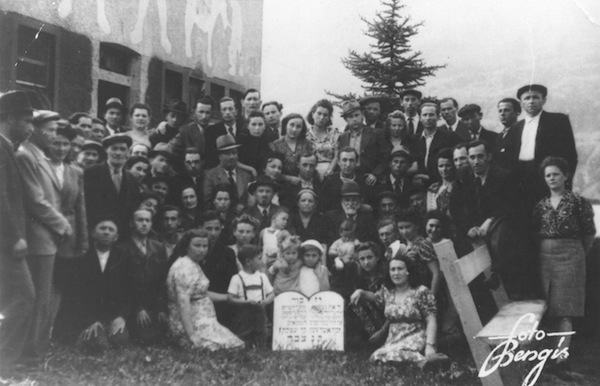
A photo taken at a displaced persons camp in Germany, 1947. The author and her older brother, Hy, are in the centre, with their arms draped over each other. (photo from Reva Kanner Dexter)
In June 1941, when the Nazis attacked Russia, the Soviets granted amnesty to the surviving Polish citizens. Poland and Russia became allies. The Jewish prisoners were released, only into a more dangerous predicament.
With Mechel’s leadership, the ragtag group of Jewish lumberjacks built rafts, trusting the river to lead them to safety. They navigated the Ob River by day, roping up by night.
During the night, the women would scramble up the banks, scavenging for food on adjacent farms. My mother told us that she dodged many bullets through the darkness. But the plan succeeded in getting them to a train station.
The next few years, they were underground, following trains, bartering at train stations, trying to regain health. Sarah would do pop-up barbering, thankful for her tools and endurance.
They finally made it to Czymkient, Kazakhstan, where Mechel got a job sewing uniforms for pilots at a pilot training academy. I was born in December 1944. Hope and optimism returned to our little family.
Of course, the story does not end here. Other chapters will emerge, as I continue to pull pieces of the survival puzzle together.
Thanks to the conference, I realize how important it is to keep searching for objects and recording memories, which return our beloved victims and survivors to us in spirit.
Reva (Rivka) Kanner Dexter has been a docent at the Vancouver Holocaust Education Centre since 2007.
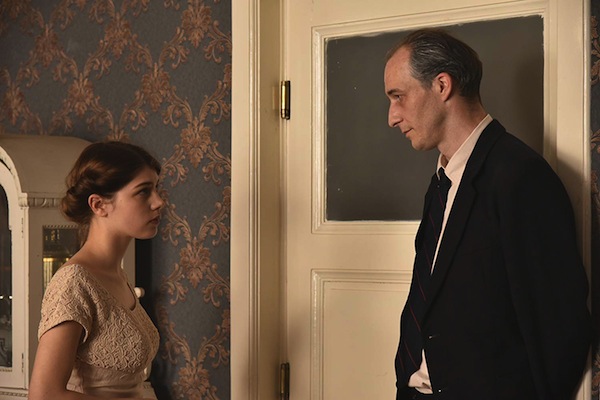
Abigél Szoke and Károly Hajduk in the film Those Who Remained. (photo from Menemsha Films)
The Hungarian movie Those Who Remained has been making the rounds at international film festivals, including, in recent weeks, the Victoria International Jewish Film Festival. And perhaps no other film at this year’s VIJFF, which contained six features and one short, generated as much discussion afterwards.
“In its purest form, Those Who Remained represents near-perfect film composition, entailing exceptional directing, editing, pacing, acting and cinematography. A film of this calibre only comes along every few years,” said Farley Cates, a committee and jury member of this year’s VIJFF.
“This film was selected for its ability to leave such a strong impression on the viewer, pondering its many layers and facets from a psychological and geopolitical perspective. This film is like a wondrous painting in which the longer you look at it, the more you see happening,” added Cates, who will serve as co-director of the festival in 2021.
The film takes place in Budapest during the period between the end of the Second World War and the 1956 Hungarian Revolution. While surviving Hungarian Jews did go to Israel and elsewhere, a large number stayed in their homeland. The Jewish population of Hungary today is estimated to be well over 100,000, the vast majority of whom live in Budapest.
The postwar period for Jews who remained in Hungary was difficult. An Orwellian state of affairs had commenced: people were questioned by the police in the middle of the night; colleagues reported on other colleagues. Amid this upheaval in Hungarian society, the two principal characters in the film – Aldo, a middle-aged doctor, and Klara, a teenage girl – deal with the trauma they experienced during the Holocaust.
Abigél Szoke, who plays Klara, was selected by Variety as one of the “10 Europeans to watch” in 2020. The magazine calls her a “revelation”: “She makes Klara’s energy, pain and smarts palpable, all the while being touchingly tuned to the emotional shadings of Aldo.”
The relationship between Aldo (played by Károly Hajduk) and Klara never develops into anything scandalous, though some of the peripheral characters in the film perceive it to be so. Despite Klara’s advances, Aldo does not allow the relationship to become sexual.
The film is a tale of survival, depicting two people’s attempts to get on with the normal, sometimes banal tasks of everyday life within the shadow of the unspeakable atrocities they witnessed and experienced only a very short time before.
Repressed emotions among survivors was a central theme to the VIJFF panel discussion after the film. Speakers included Budapest-born survivor Adrienne Carter, University of Victoria professor Charlotte Schallié, psychologist and member of the Victoria Shoah Project Robert Oppenheimer and music professor Dániel Péter Biró of the University of Bergen in Norway. Among other things, they discussed the common tendency of many survivors to refuse to talk about the events of the camps and the persecution afterwards, just as, in the film, Aldo refuses to say anything about the loss of his wife and children.
What is interesting, too, about this movie, the panelists noted, is that it was made in a Hungary led by Viktor Orban, a populist, nationalist and authoritarian leader who has presided over the country in an undemocratic fashion for the past 10 years. In fact, Hungary has produced a number of films set in the period around the war recently, including 1945 (2017) and Son of Saul, which was selected as the best foreign language film at the 2015 Academy Awards.
Orban has displayed a penchant for playing up the antisemitic caricature of Jews as the power brokers of the world stage. A popular target of his has been 90-year-old Hungarian-born financier George Soros, a regular figure of derision among right-wing groups in North America, as well. In 2017, Orban, who ironically received a scholarship from the Soros Foundation to study at Oxford in the late 1980s, plastered billboards across the country in an anti-migrant campaign featuring a smiling Soros that read “let’s not let Soros laugh in the end.”
Sam Margolishas written for the Globe and Mail, the National Post, UPI and MSNBC.
***
Note: This article has been amended to reflect the correct name of the film festival. It is the Victoria International Jewish Film Festival.
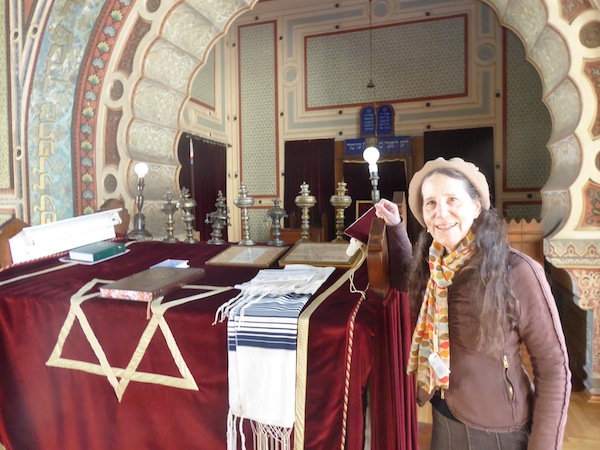
The author in the synagogue in Sarajevo, Bosnia-Herzegovina. (photo from Miri Garaway)
When I first started planning and researching our October 2017 trip to Slovenia, Croatia and Bosnia-Herzegovina, the foremost thing on my mind was learning about the Jewish history of the region. It was uncharted travel territory for me and I was curious to uncover the areas that were once vibrant Jewish communities.
Rather than being herded around by bus on a large organized tour and staying in North American-type hotels, which are far away from the pedestrian-only “Old Town” neighbourhoods of the cities, I wanted the challenge of researching centrally located, charming and historical bed and breakfasts and/or apartments and then finding private or small group Jewish heritage tours within each place. This proved to be an interesting process, whereby I delved into several possibilities. I left no stone unturned in designing this journey and it was such a feeling of exhilaration to put it all together and enjoy it.
Once I decided on accommodations in each city, I then had the task of transportation. To save time and energy, I hired a series of private drivers. This proved to be a wise decision, as 17 days does not allow for a slow pace. An added bonus was having our driver appear at the hotel, take our luggage and drop us off at our next destination, stopping to tour along the way, if we desired.
By pure chance, I had come across a U.K.-based company called mydaytrip.com – they responded promptly, were professional and easy to deal with and I had full confidence that I made the right choice. In addition to hiring a private driver, I also discovered a private tour company (based in Vancouver) called toursbylocals.com – their in-depth walking tours were excellent and I would highly recommend them.
Another option I used was Viator, a subsidiary of Tripadvisor. They offer a variety of small group (maximum eight people) tours all over the world and they liaise with local travel agencies, which provide the service. It is a great way to have various tour options at a reasonable cost.
Our first stop was Ljubljana, Slovenia, a charming university town of friendly people, exquisite Baroque architecture, a delightful cobblestoned Old Town and a vibrant café culture. Most notable is the Kaverna Zvezda, the best pastry café in town, featuring the traditional kremna rezina, also known as cremeschnitz, cream and custard between layers of puff pastry, which I had also tried in Israel. In short – divine. The gibanica (pronounced gabanitza), a delicious cake with poppy seeds, curd cheese, walnuts and apples, is another legendary cake in Slovenia and reminded me of a cake my Eastern European grandmother made. She was from Czernowitz, Austria-Hungary.
Pumpkin seed oil is “king” here and is used with the same frequency as olive oil is in Italy. Vegetarian pumpkin soup is on every menu, much to my delight. Were there any remnants of a Jewish community here? This seemed like Jewish comfort food to me.
Documents show that Jews settled in Ljubljana from the 13th century onward and worked as merchants, bankers, artisans and some as farmers. They had a synagogue, a school and a rabbinical court. In 1515, the Roman emperor Maximillian expelled the Jews and Ljubljana’s Jewish Quarter disappeared.
As I walked down the two narrow streets in the Old Town, that once housed a small Jewish community – Zidovska ulica and Zidovska steza, Jewish Street and Jewish Lane – the only sign of a Jewish presence was a vacant stone indentation on a building where a mezuzah had once stood.
Maribor, the second largest city in Slovenia, has a synagogue, but, unfortunately, it sits empty. Jews were also expelled from here, in 1496, though, eventually, both Ljubljana and Maribor regained their Jewish communities – until the Second World War. Then the Holocaust took its toll.
On a positive note, a synagogue did open in Ljubljana in 2003, but it is now part of the Jewish Cultural Centre. Ljubljana was previously the only European capital lacking a Jewish house of worship. The city does not have a rabbi, but the chief rabbi for Slovenia, Rabbi Ariel Haddad, resides in nearby Trieste, Italy.
* * *
Split, Croatia, once had a vibrant Jewish community, so, after visiting the Dalmatian coastal town of Zadar, we headed a little further south to Split, stopping first at the World UNESCO Heritage Site of Trogir.
In Split, I had arranged for a private guide, Lea Altarac, to meet us and give us a Jewish history tour as well as a general city walking tour. In 3.5 hours, we covered a lot. Lea is a teacher; extremely knowledgeable and proud of her city. Her mother is Bosnian and her father is Jewish; she has a Jewish soul, albeit one that does not practise Judaism. Nevertheless, she was eager to enlighten us with some of the Jewish history of the city.
We first toured Diocletian’s Palace in the Old Town and Lea pointed out the many Magen Davids etched into the stone. Once we had finished touring the extensive palace, we walked to the edge of the Old Town. There, we came across the small synagogue of Split, no exterior decoration to distinguish it, which is maintained as a museum by Lea’s father. As we climbed the stairs to the second floor of the old stone building, I tried to visualize it teeming with congregants, sadly no more.
One of the oldest European synagogues, it was created in the 16th century. The interior dates back to 1728. That was the first restoration of several, and when the mechitzah (partition between men and women in an Orthodox shul) was added. It is interesting to note that the ark was built into the western wall of the palace.
The synagogue was plundered by fascist fanatics in 1942 and, unfortunately, many valuable ritual books, archives and silver objects were burned or stolen.
In 1996, during another restoration, a commemoration plaque of local victims of the Holocaust was given to the synagogue as a gift from the Israeli ambassador.
There is no official rabbi for the synagogue in Split, but the rabbi from Zagreb, Croatia, comes about twice a year.
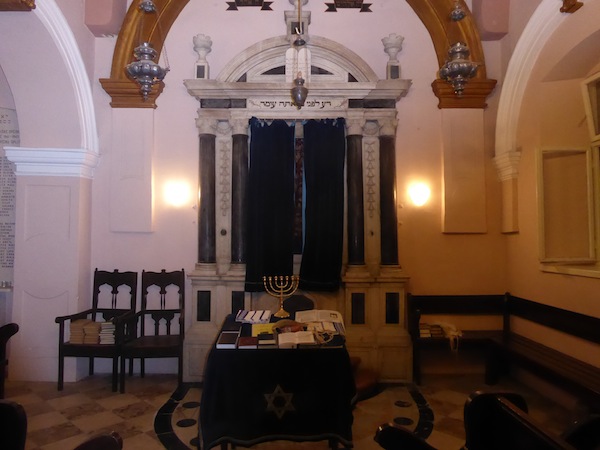
The synagogue in Split, Croatia. (photo from Miri Garaway)
During archeological excavations carried out in the area of the Roman city of Salona, the capital of the Roman province of Dalmatia and the parent city of Split, traces of an established Jewish community were found. When Salona was destroyed, in the early seventh century, the surviving Jewish members took refuge within the walls of Diocletian’s Palace. This settlement was the early beginning of the city of Split.
The term Zueca is used to describe the localities where Jewish tanners and dyers lived. This was a common trade for centuries. Other Jewish occupations included weaving, tailoring, the sale of cloth, the running of a bank, as well as the food business, which was not permitted to Jews elsewhere.
Via 16th-century documents, we learned that there were Spanish and Portuguese immigrants who settled in Split, which was a port for trade between the Republic of Venice, to which Split belonged to at that time, and the Ottoman Empire. Most notably, a Spanish Jew named Daniel Rodriga, short for Rodriguez, was responsible for promoting the development of trade between Europe and the countries in the east. Caravans were also used for the exchange of goods to Turkey and Asia, which Rodriga felt was safer. He conceived the idea of building a large quarantine area, a lazaretto, in the port of Split to house men and goods from the eastern countries, before ships took them to Venice and the rest of Europe.
There was no Jewish ghetto in Split, as the members of the Jewish community enjoyed civil liberty. It was not until the late 18th century, toward the end of Venetian rule, that a ghetto was formed, due to the influence of the clergy and the decline of the Venetian economy.
Our walking tour led us up a steep hill, Marjan Hill, where we were afforded a spectacular view of Split. Overlooking the city, in a forest-like setting, is the Jewish cemetery, one of the oldest Jewish cemeteries known. It was founded in 1573 and was used until 1946.
After the collapse of fascism in 1943 and before the occupation of Split by the German army, many of the younger Jews left Split and joined the resistance movement in partisan units. Jews who did not leave were rounded up by the Nazis and sent to forced labour and concentration camps. Only one-third of the community survived and returned to Split after the liberation; others emigrated to Israel.
* * *
Sarajevo was our next stop, with a visit to Mostar on the way. Mostar, in Bosnia-Herzegovina, is a picturesque city situated on the Neretva River, only a two-hour drive from Split. I arranged a walking tour for the morning and asked the tour guide if we could visit the proposed site of a new synagogue. The small patch of land was donated by Zoran Mandlbaum, head of Mostar’s 45-member Jewish community, in the hopes that a synagogue would be built there. His vision was a building made of glass, symbolizing trust between Jews, Muslims, Orthodox Christian Serbs and Roman-Catholic Croats, and bridging ethnic gaps. For now, the only distinguishing feature of this barren piece of land is a wrought-iron Magen David carved into the gate.
Mostar originally did have a synagogue, but it was damaged during the Second World War and the communists turned it into a puppet theatre in 1952. We visited that colourful building. Today, there are only a handful of Jews living in Mostar.
Walking through the charming Old Bazaar (Kujundziluk), we reached the famous Old Bridge, a curved structure, originally built of square stones and completed by a Turkish architect in 1556. Its arch spanned nearly 29 metres and stood 20 metres above the river. Although the famous bridge was destroyed during the war in 1993, it was rebuilt in 2004. The tradition of diving contests off the bridge has been maintained.
Of notable interest is the elegant Turkish-designed Muslibegovic House and courtyard/garden, now a hotel, which we were fortunate enough to tour.
In another couple of hours, we arrived in Sarajevo, a beautiful city, surrounded by mountains. The first Jews, Sephardim, arrived in Sarajevo as early as 1541. They were mainly artisans, merchants, pharmacists and doctors. Ashkenazi Jews began arriving in the 17th century, fleeing persecution in Europe. When the Austrians occupied Sarajevo in 1697, they burned and destroyed the Jewish Quarter, including the synagogue.
When the Ottomans regained control of Sarajevo, the lot of Jews improved. Sarajevo became known as “Little Jerusalem,” having the unique feature of a synagogue, a Roman Catholic church and a mosque all within 500 metres of one another.
Jewish life changed dramatically with the rise of Nazi Germany and the Holocaust – 85% of the Jewish population perished and those who survived emigrated to Israel in the late 1940s. Before 1941, there were 12,000 Jews living in Sarajevo and 15 synagogues. In 2017, 700 Jews lived there, out of a population of 400,000. There was no official rabbi, but a rabbi, originally from Sarajevo, came in from Israel to officiate for the High Holidays.
Our Jewish heritage tour was given by a young Muslim man, the owner of Meet Bosnia travel agency. He was very proud of the fact that he was licensed to give this tour. We began at the Old Synagogue, which was originally built in 1581, but burned down and was rebuilt a couple of times. The synagogue was converted into a museum in 1965. There are historical exhibits, ritual objects, Ladino books, photographs, religious traditions and depictions of life before the Holocaust. There is a replica of the famous 14th-century Sarajevo Haggadah; the original being in the National Museum. Unfortunately, that museum was closed for renovations.
Next to the synagogue is the building called Novi Hram, or New Synagogue, now an art gallery owned by the Jewish community of Sarajevo. There was also a large, ornate Sephardi synagogue, built in 1932, but the interior was destroyed by the Nazis in 1941.
Most impressive was the grand Ashkenazi synagogue, built in Moorish style and located across the Miljacka River that runs through Sarajevo. It also serves as the Jewish community centre. We were fortunate enough to be there during Sukkot, and went to their sukkah. The synagogue also holds Friday night services.
We visited the large hillside Jewish cemetery, among the oldest in Europe. It was founded by Sephardi Jews in 1630 and contains more than 3,500 uniquely shaped tombstones; some with inscriptions in Ladino. There are two Holocaust memorials: one Sephardi, one Ashkenazi. After 1959, it became a mixed cemetery and, in 1966, it closed. The cemetery was used as an artillery position by the Bosnian Serbs during the siege of Sarajevo and many of the tombstones were toppled.
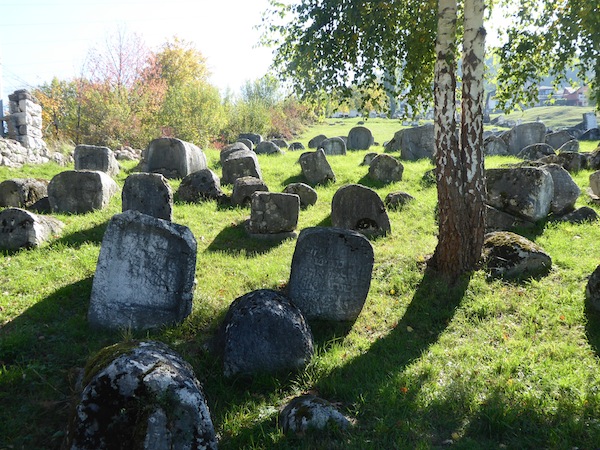
The cemetery in Sarajevo, Bosnia-Herzegovina. (photo from Miri Garaway)
One thing I noticed during our stay in Sarajevo was that everyone we met was proud of the multicultural aspect of their city. One woman, in a Judaica shop we were taken to, next to a cinema that once housed a Sephardi synagogue, proudly told us that her Muslim neighbour helped her and her family build their sukkah.
It was hard to leave this fascinating, exotic city that had weathered so much, but we drove on to Dubrovnik, via the country roads. In the Serbian parts of that countryside, we saw signs in Cyrillic and I felt like I was in Russia.
What a contrast to arrive in Dubrovnik, a city inundated with tourists, even in October. Our Jewish heritage tour, which also included a walking tour of the city, was led by a Catholic woman studying for her master’s degree in archeology. In the late 1400s, early 1500s, there was a Sephardi community in Dubrovnik, with about 300 members. In the 1800s, Ashkenazi Jews arrived. Before the Second World War, Jewish property was confiscated and Jews had to wear the yellow armband. Some community members were involved in the anti-fascist movement. After the war, Jews were still registered in Dubrovnik, but most of them had immigrated to New York City.
We visited the Sephardi synagogue, located in the Old Town in a three-storey stone Baroque building; it is one of the oldest in Europe. The synagogue and museum received a direct hit from a missile during the war in the 1990s, but the Museum Foundation, the Croatian Ministry of Cultural Heritage and UNESCO, as well as private donations, helped restore it. There are fascinating displays of ritual objects in the museum and a Judaica shop next door. Sadly, there are only about 50 Jews left in Dubrovnik, all residing outside the Old City walls.
Simon Fraser University’s Prof. Lauren Faulkner Rossi, left, interviews child survivor Marie Doduck in a Zoom presentation Nov. 5. (screenshot)
For some survivors of the Holocaust, the COVID pandemic has brought back the traumas of the past. Marie Doduck spoke recently at a virtual event, recounting her survival story and her life in Canada, including her response to the initial lockdown in the spring. It is a response, she said, that is paralleled by many others in Vancouver’s group of child survivors of the Shoah.
Born in Brussels, the youngest of 11 children, Doduck spent most of her childhood hiding in orphanages, convents and strangers’ homes. In 2020, she found herself opening her front and back doors, reminding herself that she was free to go for a walk, yet haunted by the long-ago memory of hiding.
“It brought back a terrible time for us at the beginning of COVID,” she said during an interview that was webcast as part of Witnesses to History, a series presented by the Simon Fraser University department of history in partnership with the Vancouver Holocaust Education Centre. “I know the other survivors feel the same way. I would say that was the hardest of all.”
When the war began, Doduck (then Mariette Rozen) was 4 years old. Her father died when she was a toddler and some of her older siblings were already married and had their own families. After the occupation of Belgium, those who remained at home set out on foot headed for Paris, where a sister lived, unaware that Paris, too, was under occupation. She remembers riding on the shoulders of her brother Henri and seeing what she thought was a magnificent sight.
“I saw this beautiful silver bird in the sky and I thought that was so beautiful,” Doduck recalled. It was surrounded by stars. “The next thing I know, I was flying into the ditch on the side of the road. Of course, the bird and those stars were planes diving and, even now, I can hear the whistle of the diving and the shooting. They were killing people on the road. That was my first contact with death and blood. It was all over the place.”
Soon, the family dispersed and Mariette began a years-long succession of shuttling between hiding places in various countries of northwestern Europe. A facility for languages began then and Doduck is now working on learning Mandarin, her 10th tongue.
In some homes where she was hidden, she would sit under the table while the family’s children did their homework. Then, after others had gone to bed, she scoured the homework to educate herself.
She also has something of a photographic memory and she realizes now that she served as a messenger, repeating what she had been told when asked by siblings who had joined the resistance and who could make occasional contact while she was in hiding.
As is the case with many survivors, Doduck has stories of almost-miraculous near-misses.
As is the case with many survivors, Doduck has stories of almost-miraculous near-misses.
While being hidden in a convent, she was exposed. The mother superior of the convent knew that Mariette was Jewish, but presumably most of the nuns did not. When one sister discovered her secret, she denounced the child to the Gestapo.
“Being a good nun, she went to the mother superior and told the mother superior what she had done,” Doduck recounted. “The mother superior had woken me up and taken me to the centre of the convent to the sewers and dumped me in the sewer. They came to the convent to search for me and they didn’t find me.”
In the sewer, filled with fetid water and rats, Mariette held her breath as she heard the boots of the Gestapo officers above her.
“I killed some rats to make a mountain so I didn’t have to stand in the cold water,” she said. “The mother superior saved me and that night I left and went to another place.”
Even more frighteningly, Mariette was rescued from a train almost certainly headed to catastrophe in the east.
“I was caught and I was put on a train,” she said. “I was the last one put on a cattle car and I was lucky because the cattle car had slats so I was able to breathe because they pushed us like sardines.… I remember the gate shouting and the clang, clang, clang, I can hear it now, and the lock.… Then the train stopped. I have no knowledge of places.”
The gate opened and Mariette saw a Gestapo officer.
“Black uniform, black hat, swastikas on his lapel, black boots, a leather strap with a revolver, a leather strap attached to a baton,” she recalled. “And, in German, he said, ‘What is my sister doing on this train?’ I looked left and I looked right. There was no other child but me.… This Gestapo that had probably killed hundreds of people, children as well probably, took me off the train, put me on his motorcycle and took me [away]. Years later, I found out that this Gestapo went to school with my brother Jean and used to come to my house on Friday to have dinner with us and he recognized me, that I was Jean’s sister.”
In the course of research for her memoir, Doduck recently discovered that her mother and one brother, Albert, were arrested and sent first to a transit camp and then on to Auschwitz. Her brother Jean, who was in the French resistance, was arrested elsewhere but was on the same train. Another brother, Simon, survived the war but died at Auschwitz in the weeks after liberation. Like thousands of others, he succumbed after well-intentioned Allied officials provided food to the starving inmates, whose stomachs could not assimilate it.
Including Doduck, eight siblings survived and somehow found one another after the war. One brother, Jule, chose to remain in Brussels with his family. Charles, who was also married before the war, moved to Brazil. Sister Sara went to the United States. Brother Bernard went to Palestine with Hashomer Hatzair, the socialist-Zionist youth movement.
Doduck, aged 12 at the time, and the three other siblings – Esther, Henri and Jack – were four of 1,123 Jewish child survivors of the Holocaust sponsored to come to Canada under the auspices of Canadian Jewish Congress in 1947.
Her recollections of arrival in her new homeland are not warm.
As the children disembarked the ship in Halifax, they found themselves in a compound surrounded by barbed wire, as though they would try to escape. From there, they were moved to a room with bars on the windows.
“I wasn’t called by my name,” she said. Each refugee had a number pinned to their chest. Hers was 73, she thinks, or possibly 74.
“Nobody talked to us,” she said. “Nobody really welcomed [us]. We were just a bunch of probably wild children. I can only describe that I had an adult’s mind in a child’s body. We survivors saw too much dirt, too much killing, too much that a child should ever see.
“We were treated like we were nothing at all,” she recalled.
She wanted to go to Vancouver. She had seen a map and knew that there were beaches there.
“I remember as a child we used to go to la plage, the beach, with the family,” she said. “That was happy times.
“And just like Brussels, it rains a lot too,” she added, laughing.
The four siblings were fostered by four different families in Vancouver. While not all the 1,123 children who were sponsored found loving homes, Doduck believes that she and her brother Jack were among the luckiest.
Doduck was taken in by a couple, Joseph and Minnie Satanov, who had no children and, weeks after Mariette arrived, celebrated their 30th wedding anniversary. The couple would become surrogate grandparents to Doduck’s three daughters and Doduck would care for them in their old age.
Still, the early months were difficult. The Satanovs spoke Yiddish, but it was a “highbrow” variation, Doduck said. Hers was “street Yiddish” and the initial communication was largely pointing and miming.
While her foster family was wonderful, Doduck, like some other survivor refugees, said their treatment by the broader Jewish community was inhospitable. Asked if the community welcomed her and her peers, she replied: “I hate to say it, they didn’t.”
As a child, she didn’t understand it. As an adult, especially now, as she plumbs her experiences in the process of writing her history, she thinks she understands and empathizes.
“The community did not accept us,” she said. “They were fearful. I understand this now. They were fearful of what we knew, of what we saw. As a child, I didn’t understand that. As an adult, I understand it today.”
Her process of assimilation is akin to a split personality, she explained. She encompasses both the child Mariette and the adult Marie.
“Survivors – this is a secret but I’ll tell the world today – survivors are two people. Mariette is the child who is still in me and is trying to come out, and Marie [is] the person I created to become a Canadian and to fit into our society here in Vancouver.”
“Mariette is a child from Europe. Marie is the name I took in Canada to hide who Mariette was,” said Doduck. “Survivors – this is a secret but I’ll tell the world today – survivors are two people. Mariette is the child who is still in me and is trying to come out, and Marie [is] the person I created to become a Canadian and to fit into our society here in Vancouver.”
That internal dichotomy is most evident when she speaks with school groups and others about her war-era experiences.
“When I do outreach speaking, I speak as Mariette,” she said. “When I leave the school, Mariette is put on a shelf and Marie takes over and becomes a Canadian. Marie cannot survive with the memories if I don’t put Mariette on the shelf…. I can’t live the memories. It takes a lot out of me to relive.”
The stories she has to share can be harrowing and there are still details that she is only now learning as she works on writing her memoirs. Lauren Faulkner Rossi, an assistant professor at SFU’s department of history interviewed her for the Nov. 5 event and is collaborating on the memoir.
While the pandemic may have jogged loose deep-seated memories, Doduck sees other alarming parallels in the world today that hearken to the dark past.
“We are again being persecuted, we are again being hated, we are again being hit, we are again being abused constantly,” she said of rising authoritarianism and antisemitism in parts of the world. “I see what I saw as a 4-year-old, 5-year-old. I’m seeing it around the world and nobody seems to see it, that the hate is coming again.”
Prof. Chris Friedrichs speaks at the annual Kristallnacht Community Commemoration, on Nov. 9. (screenshot)
Under the Nazi regime, almost all personal property and wealth owned by German Jews was either explicitly confiscated or, in the case of bank accounts, effectively frozen. Yet, while Jewish property was stolen without compunction, the Reich had scrupulous records and systems in place to ensure that no Aryan German who was owed money by those Jews was deprived of their due.
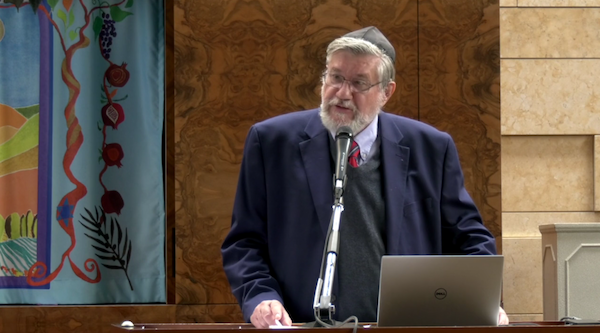
Chris Friedrichs, professor emeritus of history at the University of British Columbia and himself the son of a couple who fled Germany ahead of the Holocaust, delivered the lecture at the 2020 annual Kristallnacht Community Commemoration, Nov. 9. The event was recorded and presented virtually due to the pandemic. His lecture, How to Steal from Jews: A Story from Nazi Germany and What it Teaches Us, explored the history of the family of Friedrichs’ late wife, Rhoda (Lange) Friedrichs, as a microcosm of the sprawling bureaucracy the Reich put in place to manage the stolen property.
Rhoda Friedrichs’ grandparents, Carl and Thekla Rosenberg, lived comfortably in Berlin. Their two daughters grew up and migrated to the United States. By the time the Nazis came to power and the Rosenbergs might have been able to escape, Carl was already experiencing dementia.
Because there was no room in the Jewish nursing home in Berlin, he was moved to a facility in Koblenz, hundreds of kilometres away. Thekla was forced from their home and ordered into a sort of dormitory for older Jews, where she shared a single room with five or more other Jewish women. From there, she was assigned to forced labour in a factory.
Eventually, consistent with the plan for the “Final Solution,” almost all the Jews remaining in Germany were transported to Nazi-occupied Poland.
“Every time a Jew was put on a list to be deported to the east, he or she first had to fill out what was called a property declaration, a complete list of all his or her property, which would now become the property of the German Reich,” said Friedrichs.
In the spring of 1942, Carl Rosenberg and the other residents of the Koblenz care home were deported to a death camp in Poland.
In November 1942, Thekla and 997 other Berlin Jews were transferred to a train station and deported directly to Auschwitz.
“Who suffered most on these trains to Poland?” Friedrichs wondered. “Was it Carl Rosenberg, his mind clouded by confusion and dementia, suddenly removed from the caring place where he had lived for two years and put on a train for reasons no one could explain to him? Or was it his wife, her mind clear to the last, not knowing the exact destination but almost certainly able to guess what lay ahead for her? This, like much else, we will never know. But we do know that both of their lives ended in unspeakable misery in 1942.”
Their lives ended, Friedrichs noted, “but their victimization did not.”
The German Reich claimed to own whatever property the Rosenbergs still had at the time of their deportation. Like that of the other German Jews who were deported, the assets came under the authority of German finance offices in cities and towns across the country.
“One might think that this was an uncomplicated matter,” said Friedrichs. “Well, no. There was a problem. If a Jew owned a house or a piece of land, there might be a mortgage on it. The mortgage-holder might be a German, who expected his regular interest payments. If a Jew had any debts or obligations, they might be owed to some German, who expected those debts to be honoured and paid. If a Jew still owed some rent or had not yet paid the last gas bill or electric bill before being taken to the station, the landlord or utility company waited impatiently for that payment. You could steal every penny from a Jew, but you still had to be careful not to deprive even a single penny from a German who was entitled to it. So, all the local offices of the ministry of finance had to handle all these matters with scrupulous bureaucratic precision. Otherwise, they might be accused of cheating Germans of what was due to them.”
In files Friedrichs has copies of, the respective finance offices in Berlin and Koblenz had extensive back-and-forths about which office was responsible for settling outstanding obligations from the Rosenbergs’ estates.
The documentation of the officials was meticulous, something Friedrichs credits more to the nature of bureaucrats than to the Nazis specifically.
“Most of the thousands of people who worked for the German ministry of finance or the local finance offices were not hard-core Nazis,” he said. “The majority of them had been working in those offices for many years, usually starting long before the Nazis came to power.… As long as it was clear which ordinances or decrees were pertinent to the work at hand, they carried on as usual.”
Historians have found several instances of officials defying orders and returning stolen property to their Jewish owners, but this was exceedingly rare, said Friedrichs. “Did they ever wonder if they were in fact facilitating or cooperating with a process of mass murder?” he asked.
As the Nazis’ defeat approached, high-ranking officials circulated an order to the local finance offices in Germany, demanding that all records pertaining to the disposition of Jewish property be destroyed rather than fall into the hands of the invading Allied armies.
Again, behaving more like bureaucrats than Nazis, few offices complied. “The work of the finance offices would be carried on right to the bitter end,” said Friedrichs. “This is how bureaucrats reacted when they were taught what to do but not to think about why they were doing it.”
The care the German officials took with Jewish property juxtaposes bleakly with the fate of the Jewish people themselves.
“It teaches us something not just about the fate of two of the victims, but also about those who participated in the victimization,” said Friedrichs. “The Holocaust, in its fullest sense, was not only the murder of Jews. It was also a relentless project to take whatever the Jews had and make it the property of the German Reich or in some cases of their accomplices in other parts of Europe. After all, the Nazis valued everything the Jews owned, everything, that is, except their lives, which the Nazis regarded as worthless.”
As part of the Nov. 9 Kristallnacht commemoration, candles of remembrance were lit by Holocaust survivors in their homes. (screenshot)
Friedrichs’ lecture dovetailed with the theme of the exhibition currently ongoing at the Vancouver Holocaust Education Centre. Treasured Belongings: The Hahn Family & the Search for a Stolen Legacy tells the history of Max and Getrud Hahn, whose collection of Judaica and other artwork was stolen by the Nazis, and the efforts by their descendants, including their grandson Michael Hayden, a UBC professor, to locate and restitute some of the artifacts.
Friedrichs’ talk paid tribute not only to his wife’s grandparents, Thekla and Carl Rosenberg, but also to his wife Rhoda, who, he said, had hoped to pursue the research on this aspect of history and share it with the public herself, but who passed away due to cancer in 2014.
The lecture was presented by the VHEC and Congregation Beth Israel. It was made possible with support from the Robert and Marilyn Krell Endowment Fund at the VHEC and contributions to the Jewish Federation of Greater Vancouver annual campaign.
Beth Israel’s Rabbi Jonathan Infeld thanked Friedrichs and reflected on his words and their meaning. Nina Krieger, executive director of the VHEC, read a proclamation from the City of Vancouver on behalf of Mayor Kennedy Stewart.
Corrine Zimmerman, president of the board of directors of the VHEC, introduced the event, which took place on the 82nd anniversary of Kristallnacht, Nov. 9-10, 1938. That date is seen by many as the beginning in earnest of the Holocaust. The well-orchestrated pogrom, planned to appear like a spontaneous anti-Jewish uprising, saw violence across Germany and Austria that night. Rioters destroyed 267 synagogues, damaged or destroyed 7,000 Jewish businesses and 30,000 Jewish men were arrested and incarcerated.
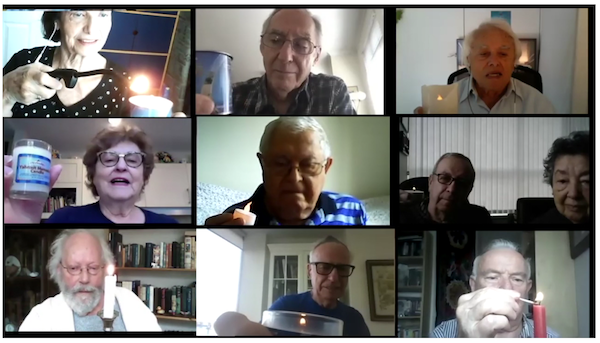
Candles of remembrance were lit by Holocaust survivors in their homes and incorporated via video into the commemorative program. Cantor Yaacov Orzech chanted El Moleh Rachamim.
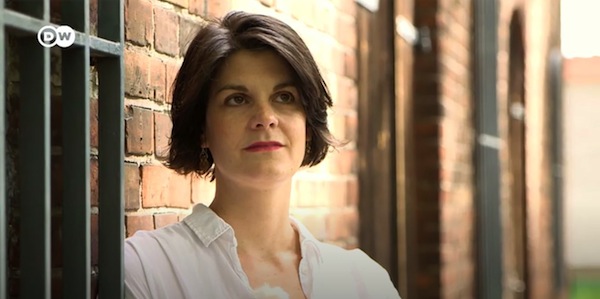
Writer and illustrator Nora Krug spoke with the Globe and Mail’s Marsha Lederman at a virtual event Oct. 27. (photo by DW Deutsche Welle)
The first time Nora Krug heard the word “Jew” was in elementary school during religion class, which was taught by the local priest. He told students that Jews killed Jesus.
Born in the German city of Karlsruhe, Krug is now associate professor of illustration at the Parsons School of Design in New York City, and author of the book Belonging: A German Reckons with History and Home. She spoke with Marsha Lederman at a virtual event Oct. 27 presented by the German Consulate General in Vancouver, the Vancouver Holocaust Education Centre, the University of British Columbia and the University of Victoria. Lederman is the Western arts correspondent for the Globe and Mail and her own book, Kiss the Red Stairs: Intergenerational Trauma, the Holocaust, and Me, is to be published in 2022.
“I came home from school that day and confronted my mother about it,” Krug recalled. “I said, ‘Are Jews evil?’ She got really angry because [it was] so obvious to her that this was something that nobody in Germany should ever think or say.”
A few years later, in her early teens, when she began learning about the Holocaust, she made a yellow star and intended to wear it as an act of solidarity with the Jewish people. Her mother, again, set her on a more appropriate path.
Krug explores her own struggles with her family’s past, as well as that of her country, in the book, a visual memoir that incorporates prose, graphics and photography. (See jewishindependent.ca/creative-engaging-memoir.)
The book was challenging on many fronts, Krug said, including her intention to tell one family’s story about the war era without downplaying German atrocities or doing anything that would appear to paint Germans as victims. While Germans did suffer during the war, it was ultimately a result of their own government’s actions.
“I’m not saying that Germans did not suffer during the war. I think they did,” she said. “But it was a self-imposed suffering.”
Like many aspects of researching a family’s or a country’s past, some things are unknowable and, at times, evidence can raise more questions than it answers. For instance, Krug had been told that her grandfather was a lifelong social democrat. But, when she dug through archives and found the military questionnaire that Germans in the American sector of occupied Germany were required to fill out to explain their war-era activities, he had acknowledged being a Nazi party member. Holding the document in her hands – not a facsimile, but the very document on which her grandfather had responded to more than 300 questions – was chilling, she said. The knowledge of her grandfather’s relationship with the Nazi party could only lead to speculation when she pieced two other facts together.
Krug had always known the location where her grandfather’s office had been in Karlsruhe. But only when she was researching the book did she discover that the Jewish centre and a synagogue were right across the street. Where was her grandfather when the synagogue was attacked on Kristallnacht and Jews were beaten in the streets? In the book, she posits four possibilities, from watching out his office window to laying home in bed sick to the most alarming possibility: that maybe he was among the mobs perpetrating the attacks.
Having lived for the past two decades in the United States – and being married to a Jewish man and having a 5-year-old daughter who is beginning to ask questions about history – all impacted her decision to write the book.
“I don’t think I would have done that had I not left Germany because I think, when I lived in Germany, I felt like I learned everything there is to learn about the war, what else is there to investigate?” she said. “That was my thinking. But, since I’ve been living in New York, I’m an individual and I am a German representing my country.”
Being away from her homeland also made her consider history more from an individual perspective.
“I think when you live as a German among Germans you accept the collective understanding of how we grew up learning about the war,” she said, crediting Germany with doing a good job addressing the topic as a nation. “But I think where we have to really still catch up is to do it on an individual basis, to really go back into our families, into the archives, into the cities where we grew up, what happened in our streets, in our houses, and investigate more deeply on an individual level.”
These are complex challenges and Krug sees a problem with the way Germans struggle with their national identity because of the terrible history of the 20th century.
“I think Germans really need to learn to love their culture,” she said. “I have a problem with it, too. I’m not saying I know how to do that. But I do think it’s a dangerous thing to only highlight our guilt. I think we need to learn, as Germans, to replace the word guilt or shame with the term responsibility.”
By struggling to express national pride, she said, Germans tend to abandon that to a fringe element.
“The problem is a lot of Germans who are willing and open to looking back at the past from a critical angle cannot express this love for their culture,” she said. “I think Germans should try to learn to do that because, otherwise, we leave it to the extreme right to do it for us and that’s a big problem.”
After Krug’s conversation with Lederman, a high school teacher submitted a question noting that some Canadian students are expressing fatigue at learning about Canada’s history of residential schools and asked whether German kids are getting tired of learning about the Holocaust. Krug acknowledged this might be the case and suggested ways of teaching that make the lessons more directly relevant for the present.
“If we had learned in Germany, for instance, more about the German resistance movement, we could have applied that knowledge to the present as well and asked ourselves, how can I help minorities that are harassed today or how can I make sure that we defend our democracy?” she said. “I think the more important question to ask is not what would I have done back then but what am I doing today on a daily basis to reflect on the issues that we have in our countries, no matter what country that is.”
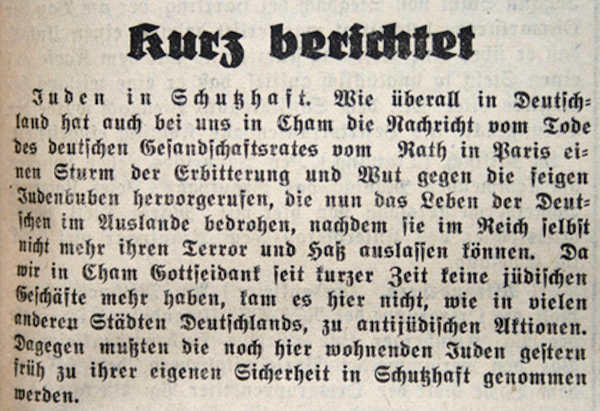
An item from the Nov. 10, 1938, newspaper in Helen Waldstein Wilkes’ mother’s hometown, Cham, Bavaria. It reads: “In Brief. Jews Taken into Protective Custody. As was the case everywhere in Germany, news of the death of the German Councilor von Rath in Paris unleashed a storm of bitterness and fury against the cowardly Jewboys who are now threatening the lives of Germans abroad because they can no longer unleash their terror and hatred within the Reich. Since, by the Grace of God, we no longer have any Jewish shops in Cham, anti-Jewish action did not take place as it did in so many other German cities. However, for their own safety, those Jews still living here had to be taken into custody yesterday morning.” (Translation by Waldstein Wilkes.)
As we have sat waiting to hear who will be president of the land that was once the beacon of hope for so many, we have asked ourselves, “What can I do? Are there meaningful avenues for action?”
Election day Nov. 3, Kristallnacht Nov. 9 and Remembrance Day Nov. 11 form a cluster. For Jews who became refugees or who lost family in the Holocaust and for all their descendants, Nov. 9 has particular resonance. Peter Gay was there. Here’s how he describes it:
“Synagogues were severely damaged or totally burnt out, sacred scrolls desecrated with the peculiar elation and ingenuity that the plunderers brought to their work. Businesses were destroyed, private houses and apartments were reduced to piles of rubble, with furniture, pictures, clothing and kitchen equipment thrown around so that they were barely recognizable. There was some looting…. But for the majority, the thrill lay in destruction for its own sake.
“The world watched, disapproved, and did almost nothing. In the United States, the public’s attention was still focusing on the midterm congressional elections of November 8, and the press was busy assessing the results.” (From Gay’s My German Question: Growing Up in Nazi Berlin, Yale University Press, 1998.)
For me, the parallels to today send shivers down my spine. The world must not be allowed to forget the depths to which humans can sink.
Awareness of the Holocaust is shrinking. In the United States, a 2018 survey showed that 66% of millennials could not identify what Auschwitz was. A recent survey revealed that about a third of 7,000 European respondents across seven countries knew “just a little or nothing at all” about the Holocaust.
Knowing about the Holocaust can provide a necessary understanding of how an entire population was bullied and manipulated by demagogues before succumbing to hate and fear-mongering. It can also serve as a blueprint for recognizing the dangers of demonization and incitement and help guard human rights and strengthen core democratic values.
Instead of endlessly fretting about social isolation and the threat of COVID-19, I’ve been seeking ways to make the gift of my days here on earth matter. I, a woman who calls herself “accidentally alive,” a woman who left her first home by horse and buggy, now count technology as among the miracles of my life. Recently, from out of the blue, the wife of a second cousin in New York, whom I’d met only once many years ago, decided to gather the extended family (all that’s left, thanks to Hitler and his efficient helpers) via Zoom. Welcoming me to this gathering of the mishpocha was a man in Israel claiming that his great-great-grandparent and mine had been siblings, and that he had read my book Letters from the Lost in connection with his volunteer work at a museum there. The museum used to be a kibbutz, founded by survivors from Theresienstadt, the concentration camp where both of my grandmothers perished and where most of my family suffered before being sent to their final destination, Auschwitz. Perhaps to distance itself from the German and to place upon it the stamp of renewal that Israel became for these lost souls, the kibbutz was named Beit Terezin.
Using artwork and graphics contributed by those early survivors in Beit Terezin, alongside the words of my beloved Uncle Arnold, who spent 17 months in Theresienstadt before enduring the hellfires of Auschwitz, we hope to create a book that will find a home in every Holocaust museum in the world. If finances permit, we will use technology to bring the contents to life in new ways so that those who cannot visit a Holocaust museum in person nonetheless can receive our reminder that it must not happen again. Never Again.
I urge you to visit our website. And if you’d like to do an additional mitzvah, please forward the link to contacts near and far whose family members may once have lived through the hell of Theresienstadt – or worse.
Born in a country that no longer exists at a time hopefully never to be repeated, Helen Waldstein Wilkes describes herself as “accidentally alive” because she, too, was marked for eradication. Now an energized octogenarian with a richly rewarding life, she is author of two award-winning books, The Aging of Aquarius, an uplifting book that encourages people to live their passion by striving to effect change for the better, and Letters from the Lost (also available in German and Spanish translation), a moving memoir of how a box of letters from prewar and postwar Europe changed everything.