
Skip to content
  • Home
  • Subscribe / donate
  • Events calendar
  • Business Directory
  • FAQ
  • News
    • Local
    • National
    • Israel
    • World
    • עניין בחדשות
      A roundup of news in Canada and further afield, in Hebrew.
  • Opinion
    • From the JI
    • Op-Ed
  • Arts & Culture
    • Performing Arts
    • Music
    • Books
    • Visual Arts
    • TV & Film
  • Life
    • Celebrating the Holidays
    • Travel
    • The Daily Snooze
      Cartoons by Jacob Samuel
    • Mystery Photo
      Help the JI and JMABC fill in the gaps in our archives.
  • Community Links
    • Organizations, Etc.
    • Other News Sources & Blogs
  • JI Chai Celebration
  • JI@88! video

Recent Posts

  • Or Shalom reopens its doors
  • JFS from past to future
  • Need holistic approach
  • Sharing stories, advice
  • Journalist shares fears
  • Skills to live together
  • Road to independence
  • Cutting grass with scissors
  • Zionism as a solution
  • Deceit, desire & the divine
  • Reclaiming sacredness
  • Creative project ideas
  • Summer squares and cobbler
  • Thou shalt … summer commandments
  • Legal help for students
  • Revisiting myth of Lilith
  • Wrong person rebuked
  • Canada’s mixed messages
  • Questions for museum
  • Symposium on antizionism
  • Making soccer political
  • CJPAC lauds Pulver’s impact
  • City recognizes Vrba’s legacy  
  • Organ donation saves lives
  • Theodore’s March premiere
  • A healing Shabbaton
  • Supplying healthy food
  • A chime of metal tags
  • Yellowknife seder a first
  • Ishai energizes, unifies
  • A Lag b’Omer to remember
  • Expanding the healing
  • Hannah Senesh – a unique hero
  • Community milestones … May 2026
  • Sharing her testimony
  • Fall fight takes leap forward

Archives

Follow @JewishIndie
image - The CJN - Visit Us Banner - 300x600 - 101625

Tag: Viktor Orban

Is it the end of an era?

The landslide defeat of Viktor Orbán and his Fidesz party in the recent Hungarian parliamentary elections could herald a seismic shift in European and global politics. Or not.

There were many issues at play in the election, obviously, including pocketbook economics and other domestic matters. Overseas observers have focused on Orbán’s “illiberal democracy” – his hacking away at free media and other institutions that tend to be measures of democratic health. It bears noting, to his credit, that as undemocratic as Orbán may have been in office, when he was defeated, he accepted the peaceful transition of power without apparent reservation.

The Hungarian election outcome is notable because of the era it could bring to a close. Orbán’s election in 2010 is viewed in retrospect as a major milestone in the advance of far-right politics in Europe.

Orbán did not invent European far-right politics, clearly. His election, though, was a major breakthrough and served as a model and inspiration for other movements, including those outside Europe, like figures in Latin America, as well as Donald Trump, who went so far as to send his vice-president to Hungary in an unashamed bid to shore up support for the Hungarian leader in the final hours of the campaign.

Something else Orbán may not have invented, but which he and his government exemplified and honed, was an ambiguous, somewhat cunning approach to Jews and the Jewish state. 

Jews, put mildly, have a history with European far-right politics. Even sensible non-Jews are conscious of this third rail. Neutralizing the echoes of that history – or at least casting its veracity in doubt – is essential to legitimizing contemporary far-right politics.

Being pro-Israel has been a calculated and expedient position for figures like Orbán. In the sense that support for Israel fits into a xenophobic European narrative that sees Israel as a bulwark of Western civilization, there is something more transactional going on. Far-right pro-Israel politicians are often militantly anti-Muslim, supporting Israel less because they endorse Jewish self-determination than because of the adage that the enemy of my enemy is my friend. Contemporary Israel is a model for them of defiant nationalism facing down (not coincidentally, Muslim) threats, which justifies some of their own domestic policies.

Support for Israel can also serve as a reputational shield. Supporting Israel in their foreign policy can deflect allegations of antisemitism – even in cases where leaders and grassroots supporters have deeply problematic records of antisemitic rhetoric. In many countries, Jews serve as a wedge in centre and left politics, pitting more vulnerable communities against one another as those in power deflect attention from charges of corruption or the results of bad policies and other inequalities that plague societies. 

Pro-Israel politicians who deny charges of antisemitism often engage in anti-Jewish dog whistles like conspiracy theories about “globalists,” “elites,” “the Epstein class” or George Soros, in which linguistic stand-ins for “Jews” allow just enough plausible deniability. Orbán perfected this strategy, using the Hungarian-born Jewish billionaire Soros as a scapegoat, with overtly antisemitic undertones.

In France, Marine Le Pen’s National Rally presents itself as pro-Israel and protective of French Jews. But many Jews and analysts question whether this is a tactical strategy to “mainstream” the party, which was founded on explicitly antisemitic premises by Le Pen’s father, Jean-Marie Le Pen.

The far-right Alternative for Germany (AfD) party routinely attacks the Holocaust memorialization culture in Germany and tolerates antisemitic rhetoric in its ranks, while its pro-Israel foreign policy puts a twist in its ideological pedigree. But the AfD’s commitment to Israel looks to many observers like a qualified alliance based on Jews fitting the party’s anti-Muslim civilizational story. 

Austria’s far-right Freedom Party, founded by former Nazis, has attempted to soften the hard edges of their anti-Muslim immigration policy with what some have termed a “charm offensive” toward Jews, especially relating to support for Israel.

The opacity of parties with problematic, antisemitic individuals taking actively pro-Israel stands has blurred conventional lines in politics and apparently created some confusion in the Jewish community. At a time when voices defending Israel are so rare, some Jews welcome anyone who expresses anything that can be construed as something like empathy.

Above all, foreign policy is a place where alliances are commonly as tactical as they are principled. Notably, the government of Israel plays this game, too. Last year, far-right European figures were invited to a conference on combating antisemitism. (Many mainstream Jewish leaders stayed away.)

Whether Orbán’s downfall is a Hungary-specific phenomenon or whether it might portend a waning of the European extreme right and those forces around the world will be known only over time. Either way, what will it mean for Jews and the Jewish state? That, too, remains an open question – one that Jewish communities need to keep trying to better understand and be more strategically positioned to respond to.

The only sure thing is that Jews and Israel will remain tools in the hands of self-interested politicians, one way or another. 
Posted on April 24, 2026April 23, 2026Author The Editorial BoardCategories From the JITags antisemitism, democracy, elections, Europe, far-right, geopolitics, politics, Viktor Orban
Returning after tragedy

Returning after tragedy

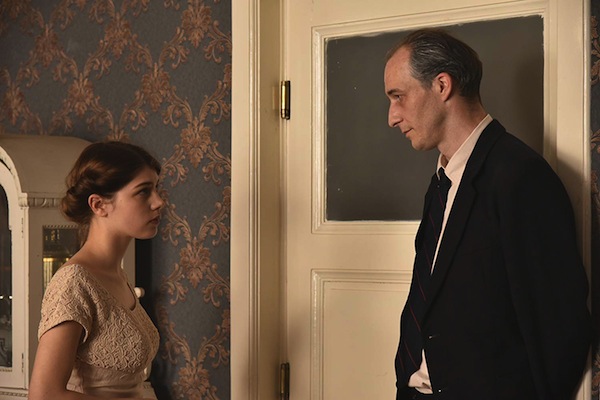
Abigél Szoke and Károly Hajduk in the film Those Who Remained. (photo from Menemsha Films)

The Hungarian movie Those Who Remained has been making the rounds at international film festivals, including, in recent weeks, the Victoria International Jewish Film Festival. And perhaps no other film at this year’s VIJFF, which contained six features and one short, generated as much discussion afterwards.

“In its purest form, Those Who Remained represents near-perfect film composition, entailing exceptional directing, editing, pacing, acting and cinematography. A film of this calibre only comes along every few years,” said Farley Cates, a committee and jury member of this year’s VIJFF.

“This film was selected for its ability to leave such a strong impression on the viewer, pondering its many layers and facets from a psychological and geopolitical perspective. This film is like a wondrous painting in which the longer you look at it, the more you see happening,” added Cates, who will serve as co-director of the festival in 2021.

The film takes place in Budapest during the period between the end of the Second World War and the 1956 Hungarian Revolution. While surviving Hungarian Jews did go to Israel and elsewhere, a large number stayed in their homeland. The Jewish population of Hungary today is estimated to be well over 100,000, the vast majority of whom live in Budapest.

The postwar period for Jews who remained in Hungary was difficult. An Orwellian state of affairs had commenced: people were questioned by the police in the middle of the night; colleagues reported on other colleagues. Amid this upheaval in Hungarian society, the two principal characters in the film – Aldo, a middle-aged doctor, and Klara, a teenage girl – deal with the trauma they experienced during the Holocaust.

Abigél Szoke, who plays Klara, was selected by Variety as one of the “10 Europeans to watch” in 2020. The magazine calls her a “revelation”: “She makes Klara’s energy, pain and smarts palpable, all the while being touchingly tuned to the emotional shadings of Aldo.”

The relationship between Aldo (played by Károly Hajduk) and Klara never develops into anything scandalous, though some of the peripheral characters in the film perceive it to be so. Despite Klara’s advances, Aldo does not allow the relationship to become sexual.

The film is a tale of survival, depicting two people’s attempts to get on with the normal, sometimes banal tasks of everyday life within the shadow of the unspeakable atrocities they witnessed and experienced only a very short time before.

Repressed emotions among survivors was a central theme to the VIJFF panel discussion after the film. Speakers included Budapest-born survivor Adrienne Carter, University of Victoria professor Charlotte Schallié, psychologist and member of the Victoria Shoah Project Robert Oppenheimer and music professor Dániel Péter Biró of the University of Bergen in Norway. Among other things, they discussed the common tendency of many survivors to refuse to talk about the events of the camps and the persecution afterwards, just as, in the film, Aldo refuses to say anything about the loss of his wife and children.

What is interesting, too, about this movie, the panelists noted, is that it was made in a Hungary led by Viktor Orban, a populist, nationalist and authoritarian leader who has presided over the country in an undemocratic fashion for the past 10 years. In fact, Hungary has produced a number of films set in the period around the war recently, including 1945 (2017) and Son of Saul, which was selected as the best foreign language film at the 2015 Academy Awards.

Orban has displayed a penchant for playing up the antisemitic caricature of Jews as the power brokers of the world stage. A popular target of his has been 90-year-old Hungarian-born financier George Soros, a regular figure of derision among right-wing groups in North America, as well. In 2017, Orban, who ironically received a scholarship from the Soros Foundation to study at Oxford in the late 1980s, plastered billboards across the country in an anti-migrant campaign featuring a smiling Soros that read “let’s not let Soros laugh in the end.”

Sam Margolis has written for the Globe and Mail, the National Post, UPI and MSNBC.

***

Note: This article has been amended to reflect the correct name of the film festival. It is the Victoria International Jewish Film Festival.

Format ImagePosted on December 4, 2020December 7, 2020Author Sam MargolisCategories TV & FilmTags Farley Cates, George Soros, Holocaust, Hungary, politics, populism, Those Who Remained, trauma, Vancouver Island Jewish Film Festival, VIJFF, Viktor Orban
Proudly powered by WordPress