Hurdles to become a doctor

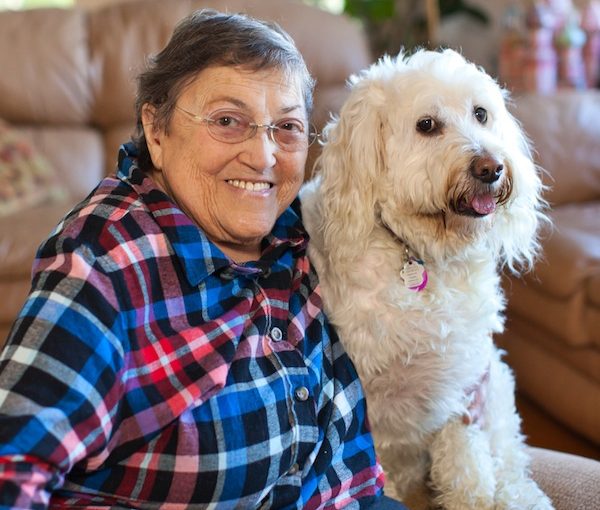
Ruth Simkin with her dog, Kelly. (photo by Chris Wilson)

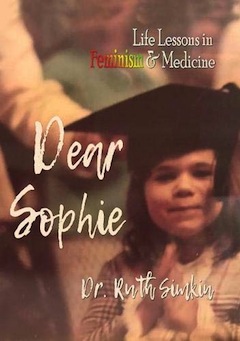
Feminism is really true equality between women and men; nothing more, and nothing less,” Ruth Simkin writes in her new book, Dear Sophie: Life Lessons in Feminism & Medicine, a memoir dedicated to her great-niece.

“There are many people who scoff at the word ‘feminism,’” Simkin adds. “But consider this – when I was in my first year of medical school, I, and any other woman, could not get a credit card in our own name. Until 1974, a husband’s signature was needed for women to have credit cards. At that time, I met women who were teachers who lost their jobs because they and their husbands wanted to start a family and they became pregnant – a no-no for working teachers until 1978. I could go on and on with examples like this to show why feminism was, and still is, such an important part of all our lives.”

Born in Winnipeg in 1944, Simkin has prevailed over many obstacles throughout her life and career. In Dear Sophie, readers join her as she struggles to get into medical school.

“There was stiff competition to get into an innovative medical program launched at the University of Calgary in the late 1960s,” she told the Independent from her home in Victoria. “I was one of 32 of roughly 1,200 applicants to be accepted.”

Admission to the program, however, would turn out to be an easier hurdle than those that were yet to come during her schooling and subsequent training. The length of her time in med school is replete with stories of sexual harassment and discrimination by both fellow classmates and senior members of the faculty.

“Male doctors, on more than one occasion, did all they could to get me expelled from med school, but I stood my ground,” Simkin said.

She managed to complete her residency, despite being blocked at almost every step, and clashing with the established medical community. But she prevailed. She was the first U of C med school graduate to open a practice – one that thrived – while also working as a professor and preceptor at the school.

image - Dear Sophie book coverIn the memoir, Simkin details her experiences from that time to the present and uses her account as a way to demonstrate to Sophie, and to other women, how to live a happy, feminist life. She hopes that Sophie, a pre-adolescent during the time Simkin was writing the book, will learn from her experiences before entering adulthood.

Simkin’s long and varied career has seen her undertake many ventures. In the 1980s, she learned acupuncture in Shanghai and, ultimately, became the first physician to be approved by the Alberta College of Physicians and Surgeons to incorporate acupuncture in a medical practice. Later that decade, she went to London, England, to study with Dr. Katharina Dalton, who brought premenstrual syndrome to the world’s attention and also coined the term.

Upon her return to Canada, Simkin opened the first PMS clinic in Western Canada. She also has opened Western Canada’s first hologram gallery, produced concerts, been involved in theatre projects and started the lesbian and gay political action group CLAGPAG.

In the 1990s, she moved to Salt Spring Island, where she became a farmer – growing “yuppie” veggies. A return to medicine saw her become the first fellow to study palliative care at the University of British Columbia. In 2014, she was honoured with a life membership from the College of Family Physicians of Canada.

Among her other published works, Simkin has written What Makes You Happy, a collection of short stories, both autobiographical and fictional; The Y Syndrome, a medical thriller set in 1990s Calgary; and Like an Orange on a Seder Plate, a feminist Haggadah. The Jagged Years of Ruthie J (2012) is an autobiographical account of her experiences in Winnipeg before medical school.

Over the years, she has written scores of medical papers and contributed to textbooks, as well as mixed media presentations. Having travelled extensively, she has an (as-yet) unpublished book, Come Away with Me, about her journeys through China.

Dear Sophie received the 2019 Rainbow Award in the LGBT biography/memoir category. In its review of the book, the prize committee said, “Dear Sophie is a flawless memoir that is not only a story of Dr. Ruth Simkin, but a story of feminism and women in Canada and the field of medicine, skilfully woven together with valuable life lessons.”


Sam Margolis has written for the Globe and Mail, the National Post, UPI and MSNBC.

When is never again?

Monday was International Holocaust Remembrance Day. Scrolling through social media, it was jarring to see the juxtaposition of images and ideas reflecting on that terrible history intermingled with the mundane and fantastical miscellany of everyday 21st-century life. This is the reality of our world: the grave realities of yesterday and today poking through the onslaught of witty memes, outrage over a vast range of real and imagined evils, cute kittens and the panorama of detritus and riches available to, and bombarding us, at every moment.

This is how it is. Even as we recommit ourselves to the promise of “never again,” still we carry on with our daily lives. Yet these realities are not, and should not be, disconnected from one another. The memory of the Holocaust and its victims, and the importance of listening to and learning from its survivors and its messages, are sacred obligations. But their lessons and meanings can and should be applied to the more commonplace events we experience. History is a prism through which we should view the present and the future.

Like the jarring extremes that can be found scrolling social media on Holocaust Remembrance Day, this collision of gravity and triviality is problematic. We recoil from inappropriate comparisons. Yet, in a world where legitimate causes struggle to be heard above the competing din, we often fall back on the most incendiary formulations, so every injustice becomes “fascism,” every leader we dislike a “Nazi.” This dilutes the seriousness of the history it invokes – and it also makes it more difficult to identify and draw attention to genuinely grave dangers, including literal fascism or fascist-adjacent ideas and actions emerging in Europe and closer to home.

The number of lessons to be drawn from the Holocaust are as innumerable as there are human behaviours. A relevant one for our time is the fragility of democracy and civil order. The actions of Raoul Wallenberg and Chiune Sugihara (click here to read story) are examples of a dystopic situation where good people are driven to break laws and norms promulgated by evil forces. In situations where democracy and social order are upended, goodness is criminalized and malevolence is institutionalized.

Democracy is under threat in much of the world right now. Human nature is such that we take for granted once-unimaginable wonders – gadgets in our pockets containing the breadth of human knowledge, the perceived right of every individual to live free from fear of tyranny – almost as soon as we access them. We forget that democracy is barely two centuries old and that it is not only imperfect but tenuous. With extraordinary ease, individuals of various stripes have managed to smother or at least severely disfigure nascent democracies in Russia, Poland, Hungary and elsewhere in Eastern Europe. A more established democracy in Turkey has been twisted away from its secularist, pluralist roots. The world’s largest democracy, India, is engaged in serious religious-based oppression.

In Israel, there are social forces and political parties pushing the extremes, as well. The Kahanist party, Otzma Yehudit, is aiming to again contest the March elections and has been rooting around the emerging electoral alliances for a slot. To his credit, Naftali Bennett, head of the New Right bloc and no raging moderate himself, rejects being in a tent with Otzma Yehudit and rightly warns other parties to steer clear.

And, in ways whose significance we may not yet be able to judge, the fabric of American democracy – checks and balances between branches of government – is being threatened. The president, indicted for attempting to extort our ally Ukraine to participate in political dirty tricks in exchange for desperately needed military funding to defend itself against the encroaching Russian military, seems destined to be exonerated by a Senate more concerned with party discipline than the rule of law, the constitution or human decency. If the probable outcome is realized, it will represent a blow to the grand ideals of the world’s oldest contemporary democracy.

Is raising this example itself a symptom of the problem we are discussing? Is it relevant and proper to discuss the American or Israeli situation in the same context as Russia, Poland or Hungary? Do we diminish the memory of the Holocaust by raising this topic in this perspective? Is it equally specious to assert that we won’t know, perhaps until it is too late, whether we should have been more or less vigilant when a man with little or no respect for norms of nicety or constitutionality ascended to the highest office in the democratic world?

This is the line we walk when we say “never again.” The magnitude of the history underpinning this promise is so enormous that we risk lessening it through invocation. Yet, if we isolate that history and its lessons, like good china saved only for the most special occasions, are we not conversely risking the very promise we undertake?

Mystery photo … Jan. 31/20

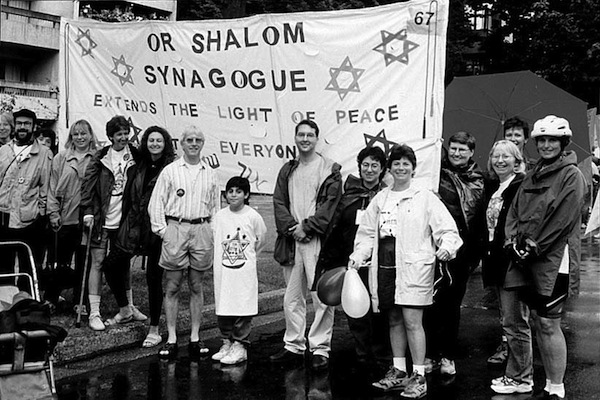
Congregation Or Shalom members and others at the 19th annual Pride Parade, 1996. (photo from JWB fonds, JMABC L.01103)

If you know someone in these photos, please help the JI fill the gaps of its predecessor’s (the Jewish Western Bulletin’s) collection at the Jewish Museum and Archives of B.C. by contacting archives@jewishmuseum.ca or 604-257-5199. To find out who has been identified in the photos, visit jewishmuseum.ca/blog.

Building of community

Originally, the only focus of Jewish camp was to offer Jewish children an opportunity to spend some time in a woodland environment. (photo from pxfuel.com)

Camping and camps may have been around forever. But Jewish camps, at least those in North America, have a contemporary history.

In 1893, a group called the Jewish Working Girls Vacation Society organized a camp for Jewish children in New York. These women sought to create a place to give their children a break from life in the industrialized city where they worked. The initial focus of Jewish camps was on the children of Eastern European immigrants, and there was a drive to use the camps to Americanize participants. Jews were not the only ones to take an interest in this vehicle for integration. By 1900, there were 100 camps of all kinds and, by 1915, there were more than 1,000.

Originally, the only focus was to offer Jewish children an opportunity to spend some time in a woodland environment, perhaps with access to water. Camps also offered children opportunities to interact with their peers from various backgrounds, without parental oversight, something they might not find in their home environment. Over time, Jewish camp programs expanded to include acculturation into things Jewish, along with athletics, social skills-building, the arts and related activities. Among the Jewish camps, there was the development of those that promoted a particular religious observance, or Zionism, Hebrew usage, socialism and the like. Zionist camps were given a special impetus with the worldwide effort to establish a Jewish state.

What Jewish organizers found over time was that camp experiences were crucial in binding young people to the Jewish community. The relationships forged among young people through camp have played an important role in this area. Anyone who has lived through the camping experience understands the powerful emotional connections this activity can carry with it, particularly when it occurs year after year. Many community leaders believe that sleep-away camps were (and are) an important element in the maintenance of a Jewish identity in the face of all the forces that encourage assimilation into the general population.

The summer camp has become a feature of Jewish life wherever the numbers are available to support this community service. In addition to private ventures, over time, Jewish communities have invested substantial resources into these programs and see them as an important part of Jewish communal activity. Some synagogues have camps as part of their program.

Interest in this aspect of Jewish camp has increased over time. For some parents, Jewish camps are an alternative to expensive primary schooling at Jewish educational institutions.

As a reflection of the growing appreciation of the importance of sleep-away camps in maintaining strong communities, philanthropic groups funded, in 2014, an organization in the United States to assist Jewish camps in carrying out their work. The Foundation for Jewish Camp now works with more than 180 Jewish summer camps, assisting in the training of personnel and providing other services and resources. Among other things, it assists Jewish camps in recruiting professionals, offers grants to first-time campers and helps fund upgrades for camps to accommodate participants with special needs.

An estimate published in January 2019 reported that there were 77,000 attendees at Jewish camps in the United States, and the foundation reports that there are 195 Jewish camps in North America. In Canada, there are Jewish camps in Ontario, British Columbia, Manitoba, Quebec and Nova Scotia.

Max Roytenberg is a Vancouver-based poet, writer and blogger. His book Hero in My Own Eyes: Tripping a Life Fantastic is available from Amazon and other online booksellers.

Victoria hosts Klondike

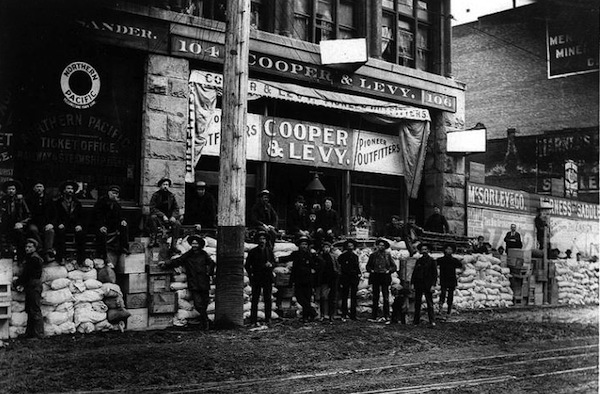
Cooper & Levy store, 104-106 1st Ave. S. near Yesler Way, Seattle, 1897. The store was one of the major outfitters of the Klondike Gold Rush. (photo from Asahel Curtis Collection, University of Washington UW 4770)

The archival images and newspaper headlines contained in the Gold Rush exhibit now on display at the Jewish Community Centre of Victoria (JCCV) evoke a sense of the hysteria that gripped the West Coast more than century ago, in spite of the risks involved in traveling to a severe and treacherous terrain. And Jews were not immune from the mania, as the three-panel display, entitled “The Jewish Presence During the Klondike Gold Rush 1897-1918,” distinctly demonstrates.

The exhibit will be at the JCCV through January. It brings with it a number of revisions from the one that toured Canada from 2016 to 2018 and included a stop in Vancouver.

“During its previous run, we received a lot of additional information from people who visited the exhibit, so much so that we couldn’t include it all in the current display. We are seriously thinking about doing a book starting later this year,” Rick Karp, president of the Jewish Cultural Society of Yukon (JCSY), told the Independent.

Once the previous display returned to Whitehorse, Karp followed up on the input he received and updated the three panels and the booklet accompanying the exhibit.

“As well, we revised the video that details the finding of the Jewish cemetery from the Gold Rush in Dawson, the cleaning and bringing it back to its original condition, and the rededication ceremony,” Karp said. “All the information about the cemetery in the accompanying booklet has been added, as well as the section entitled ‘The History of the Jews in the Klondike Gold Rush’ and the ‘Stories of the Gold Rush.’”

A significant addition to the Gold Rush stories is that of Joseph Barron, one of the first to open a mercantile store in Dawson. Barron came from Winnipeg and followed the stampede of 1898. He mushed into the Yukon via the White Pass route, bringing with him a stock of merchandise.

His beginnings in the north were not the most fortuitous. He lost his supplies on three occasions to fire between 1899 and 1901. Undeterred by adversity, he restocked and started over.

The Barrons would become a prominent Calgary family. Joseph’s son Abe founded the law firm Barron & Barron, which is still operated by the family today. His other son, Jacob (J.B.), was a leading businessman and theatre owner in the city, building Calgary’s first high-rise, the Barron Building, and breaking ground on its first Modern Orthodox synagogue, Shaarey Tzedec (which was demolished in 2013).

Joseph Barron’s wife and children did not come to Dawson until 1902. The younger Barrons only stayed for two years before they left to complete their education. The senior Barrons eventually left Dawson to join their children in Calgary in 1915.

Henry Isaacs was another entrepreneur who ventured north. He earned the moniker “the Butter King of the Klondike” upon learning about a technique using sea water to re-churn a shipment of what others had considered rancid butter into something edible.

Among the most enterprising adventurers was David Gross, a Russian immigrant and dropout trained as tailor, who, not yet 20 years of age when he made the journey north, found ways to make money selling groceries, stoves and other provisions, though his primary business was a clothing store. His ingenuity led him to see opportunities where others did not. For example, if butter had turned rancid and was unsalvageable for food purposes, he would sell it as axle grease for squeaky wheels. After learning that water can only penetrate an inch or two into flour, he would purchase large sacks of flour other merchants thought had been drenched and, therefore, ruined and then sell the flour that the water had not reached at a much higher price. Gross also became active in the nascent movie theatre business in Dawson City.

Yet the prize for the most daring Jewish seeker of fortune would have to go to Max Hirschberg. After losing his supplies en route and then finding, in 1890, that many of the good claims in Dawson had been staked, Hirschberg pushed on to Nome, where more gold was reported to be, on a bicycle!

Later in life, before his passing in 1964, he recounted the 11-week journey in which he made his way along a two-inch trail, confronting snow-blindness, exposure and exhaustion, nearly drowning in the Shaktoolik River and losing $1,500 in gold dust. When his bike chain broke, he made a sail from his coat and rigged it to his bicycle, then crossed the Norton Sound to Nome.

Interest in the Jewish community during the Gold Rush was ignited after the discovery of the aforementioned Jewish cemetery in Dawson City in 1995, and its ensuing restoration in 1997 and 1998. “The discovery of lives lost inevitably leads to questions about lives lived,” the exhibit booklet reads.

“The Jewish Community Centre of Victoria is excited to host the mobile exhibit. We would like to thank Rick for making it possible,” said Larry Gontovnick, president of the JCCV.

After it completes its current tour around Canada, the exhibit will be on permanent display at the Dawson City Museum in the Yukon. A duplicate copy will tour various communities in the United States.

Sam Margolis has written for the Globe and Mail, the National Post, UPI and MSNBC.

Mystery photos … Dec. 20/19

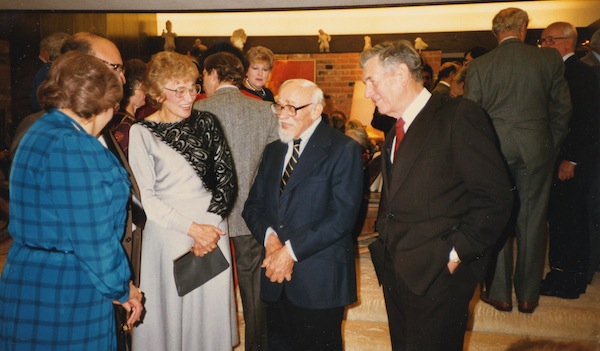
Photographs from an unidentified event in 1985, possibly a University of British Columbia event, likely in honour of Harry Adaskin, who is pictured centre-right in the above photo. (JWB fonds, JMABC L.13769)

photo - Photograph from an unidentified event in 1985, possibly a University of British Columbia event, likely in honour of Harry Adaskin
(JWB fonds, JMABC L.13755)

If you know someone in these photos, please help the JI fill the gaps of its predecessor’s (the Jewish Western Bulletin’s) collection at the Jewish Museum and Archives of B.C. by contacting archives@jewishmuseum.ca or 604-257-5199. To find out who has been identified in the photos, visit jewishmuseum.ca/blog.

Sketching historic shuls

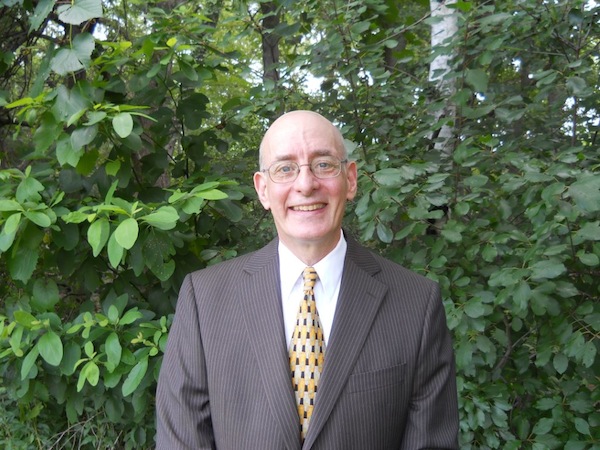
Ben and Carla Levinson (photo by Sam Margolis)

With the speed of a street-corner caricaturist yet the precision of someone who seemingly misses nothing, Ben Levinson has for decades been capturing the cityscapes of the many places to which he has traveled with his wife, Carla. No pencil, no erasing. Just a black ink pen and a small sketchbook.

“My architectural career taught me to sketch quickly and furiously, and I am able to see details that most would not see,” Levinson told the Independent in an interview earlier this fall.

During these adventures, Levinson has sketched everything of architectural interest to him: churches, cathedrals, mosques, pyramids and, of course, synagogues, while Carla would station herself at a café.

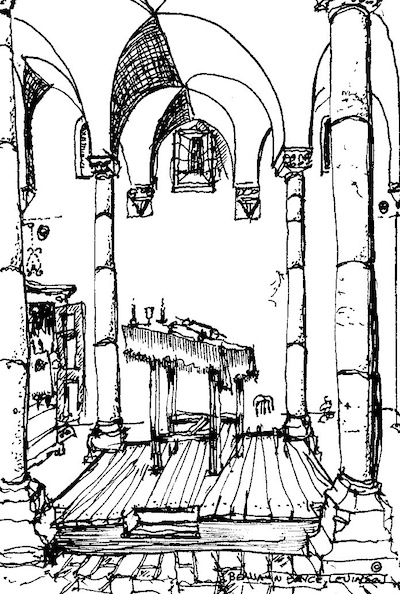
image - Synagogue at Tomar, Portugal. Sketch by Ben Levinson
Synagogue at Tomar, Portugal. Sketch by Ben Levinson.

By the time she was done with her coffee and croissant, Ben would have a complete rendering to show her. During the infrequent occasions she would finish first, incomplete drawings would be filled out when they reached their hotel.

The alacrity, accuracy and artistry of the sketches were at times the envy of those whom they encountered on their travels.

“We met artists whose wives and partners waited all too patiently and were ready to move on, whereas Ben was long done,” Carla said.

After looking through Ben’s sketchbooks one day, Carla suggested he do a show devoted to synagogues. Carla, who ran Victoria’s Gallery 1248, helped curate the selection of sketches that appeared at the Wings of Peace Gallery at Victoria’s Congregation Emanu-El from Sept. 4 through Yom Kippur. Now those sketches have been compiled into a book which is tentatively titled In Search of Identity: The Story of the Wandering Jew.

The book’s 49 sketches transport the viewer throughout the old and the new worlds. Many of the sketches are connected by the common experience of Jews moving on because of antisemitic treatment, despite centuries of coexistence in a community.

The figurative journey, which includes interiors and exteriors and is really the result of several holidays the Levinsons took over the span of two decades, sets off in Toledo, Spain, home to one of the few remaining synagogues left after the Spanish Inquisition scattered Jews throughout Europe and the Americas. Levinson’s exhibit and book spend a lot of time in Sephardi lands: a 14th-century Moorish-style synagogue in Cordoba; a tiny shul in Tomar, Portugal, the only pre-Renaissance temple in the country; larger houses of worship in Morocco, home to the largest Jewish population in the Arab world; and, finally, to the Portuguese Synagogue in Amsterdam, completed in 1675.

Poignant reminders of the once-thriving Jewish communities of Eastern Europe follow. Levinson leads the viewer through Berlin, Prague and Budapest, along with artistic reconstructions of the Terezin sleeping barracks and an ancient dig in Vienna.

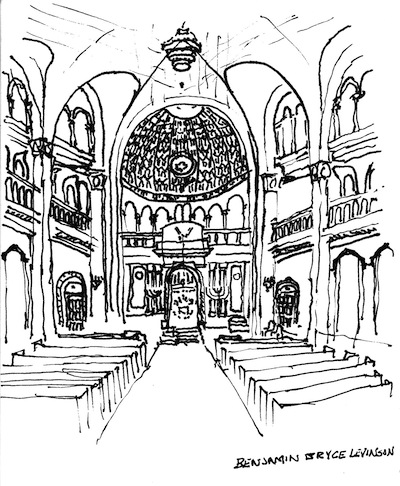
image - Templo Libertad in Buenos Aires, Argentina. Sketch by Ben Levinson
Templo Libertad in Buenos Aires, Argentina. Sketch by Ben Levinson.

The voyage shifts to France, Italy and Scandinavia, with the majestic Marais synagogue in Paris, the synagogue at the Museum of Jewish Life in Trieste and the Gothenburg Synagogue, the scene of a firebomb attack in 2017.

Levinson also presents active scenes of a crowd forming outside a Venice synagogue on a sunny Shabbat morning, passersby in front of an Antwerp temple and a sea of bicycles by the Great Synagogue of Copenhagen.

The visual trip wraps up with drawings from Mexico City and the Byzantine-style building of Libertad Synagogue in Buenos Aires.

Born in Medicine Hat, Alta., in 1942, Levinson graduated from the University of Manitoba’s architectural program. In 1966, he moved to Victoria and worked for various firms before starting his 30-year private practice as president of Benjamin Bryce Levinson Architects in 1980. In addition to leading his practice, he continued sketching and showing his work at various venues, including the Architectural Institute of British Columbia and the Jewish Community Centre of Greater Vancouver.

Levinson was instrumental in restoring Congregation Emanu-El in the early 1980s. When he arrived in town, he felt an initial disappointment upon seeing the synagogue with “its pink stucco, balcony balustrade pickets, missing fence and hidden dome ceiling.” He helped the synagogue’s leadership in obtaining grants and helped steer the building and fundraising committees to get the money necessary to revitalize the region’s most historic Jewish building.

Small Town Architect, the name of his first book, documents his 40-year career in architectural design and recounts his travels and artistic endeavours. His work can be found throughout Victoria and in numerous communities throughout the province; in elementary schools, municipal halls, grocery stores and restaurants, among other buildings.

Sam Margolis has written for the Globe and Mail, the National Post, UPI and MSNBC.

Teaching in new ways

Prof. Ira Robinson of Concordia University’s Institute for Canadian Jewish Studies teaches a wide range of students about the Holocaust and antisemitism. (photo from Ira Robinson)

Ira Robinson is the director of Concordia University’s Institute for Canadian Jewish Studies and a professor of Judaic studies in the department of religions and cultures. A strong believer that an educator shouldn’t teach the same course in the same way year after year, he is always looking for new ways to reach students of all ages.

Born in Boston, Mass., Robinson moved to Montreal with his wife, Sandra, 40 years ago.

“I came to Canada because Concordia offered me a job, and I landed in the right place at the right time,” he told the Independent. “Academics don’t always have a complete choice of where they are going to settle. I came to Montreal and Montreal has a large and interesting Jewish community and a tremendously interesting bilingual culture.”

Though Robinson had never envisioned writing a book about antisemitism or the Holocaust, he did so, publishing A History of Antisemitism in Canada in 2015.

Robinson was trained by students of the late Salo Baron, a Polish-American historian, who once said, “If you want to understand the totality of Jewish history, you have to take into consideration that the pogroms and the massacres take only an infinitesimal amount of time, even though they wreak great havoc.”

According to Robinson, “Ninety-nine percent of the time, we’re dealing with normal life…. Baron and his students decided to look at the Jews as they had lived and not as they had died. That was the lesson that I took.”

For Robinson, this meant he would have to determine his own take on the history of antisemitism in Canada and, hence, “I came out with the book.”

Robinson starts many of his courses by telling students that there is nothing he is going to teach them that is not completely denied by somebody, somewhere. With this message, he is stressing that what he is about to teach is his perspective on what took place.

In looking at the history of antisemitism in Canada, for example, Robinson tried to contextualize the reasons Jews were looked at as guests in the 1920 and 1930s in Canada.

“What I did in this book is create a continuous narrative on antisemitism in Canada from the 18th century through to the present,” he explained. “There have been many very good studies on various aspects of antisemitism in Canada, the most famous of which is [Irving] Abella’s and [Harold] Troper’s None is Too Many. This academic book uniquely made a difference in the political discourse of Canada. Now, whenever anyone debates a refugee issue in Canada, the phrase, ‘None is too many,’ is sure to come into the discourse or debate at some point. That was a great success, but the book only concentrates on the 1920s to the 1940s, and mainly focuses on the Canadian federal government.”

Since the research for Robinson’s book was completed in 2014, antisemitism has increased, he said. For that reason, he decided to find ways to teach about the problem to younger children, kids in grades 4 to 6.

“It presents a challenge, because I have to begin with who they [antisemites] are and where they are,” said Robinson. “And so, I started by talking with them [the kids] about bullying, because bullying, as you understand, is something that kids know about and people talk to them about it.

“If you see somebody bullying somebody else, what are you supposed to do? If you can intervene, you should intervene. If you need to call somebody in a position of authority, you call somebody…. So, I said, ‘imagine that there are kids and you can bully them and nobody is going to stop you. And imagine that, if somebody goes to a person of authority, they will just say, ‘Good for you!’”

Robinson took it a step further, creating a PowerPoint presentation focusing on the wearing of the yellow Jewish star that was imposed upon Jews.

“I showed first a picture of a girl’s dress with the yellow star shown on it – just the dress, nobody in it,” he said. “Then, the next thing I showed was a little girl in a dress with the yellow star. When I changed the slide from just the girl’s dress with the yellow star to the little girl in the dress with a yellow star, I could hear a slight gasp among the students. So, there are ways – you have to talk to the people you have in front of you.”

Robinson gave this presentation in a public school and, as far he knows, there were no Jewish students in the classroom. “I am used to talking to a wide range of people,” he said. “And, in my university classes, for instance, I do expect Jews to enrol, and they do. But, I also expect Muslims and Christians to enrol, and they do, and everybody else, too.”

In Robinson’s view, the challenge of finding ways to disseminate the information effectively is always a worthwhile exercise.

“There are lots of people involved in Holocaust education and I think a lot of them are spending a lot of effort introducing and assisting in educating about the Holocaust in public school systems. The problem, as always, is not lack of good will,” he said, “but that the schools are under great pressure from a whole bunch of different directions. What should our children study? And the mega trend, not merely in public schools, but also in universities, is moving away from the social sciences and humanities, and focusing on other subjects.”

As far as teaching methods regarding the Holocaust and antisemitism, Robinson said, “I think I am able to speak with more depth, because you can’t teach the same course in the same way for decades. You have to develop a scholarly understanding as the field develops and, so, my teaching is informed by my reading and my reading continues to inform me.

“And my power is that I am able to direct students to certain books, certain articles and certain films that I think will help them develop their sense of things. But, before I can even do that, before I can guide anybody, I have to find the things myself, first and foremost.”

Rebeca Kuropatwa is a Winnipeg freelance writer.

The real and imaginary mix

Norman Ravvin (photo by Allen McInnis/The Gazette)

For anyone interested in the history and landmarks of Vancouver, especially, but also cities in Poland, reading Norman Ravvin’s new novel, The Girl Who Stole Everything (Linda Leith Editions, 2019), will take longer than its 310 pages would suggest. You’ll want to allot time for side trips to the internet to see what the Army & Navy building on West Cordova Street looked like in the middle of the last century, for example, or Stan Douglas’s mural at the Woodward’s complex of the 1971 Gastown riot. Stalin’s Palace of Culture and Science in Warsaw? The main square in the town of Radzanów, Poland?

While The Girl Who Stole Everything is set in real places described in detailed accuracy by Ravvin, there is still much left to the imagination. The discovery of family secrets – in one case, which were literally buried; in the other, figuratively – leads to events that bring Vancouver dulcimer musician Nadia and bookseller-café owner Simon together and, eventually, take both to Poland. Nadia’s father never told her that her uncle, who owned a pawnshop on West Cordova, was murdered in 1962, beaten to death in a robbery gone wrong, and Simon’s father told him nothing of their prewar Polish heritage. Both a little lost in life before friends drop these revelations on them, Nadia and Simon find meaning and direction as they search out the truth of their histories.

The Jewish Independent interviewed Ravvin, who lives in Montreal, about his novel, which is available for purchase most anywhere. Ravvin said he will be in Vancouver for the Cherie Smith JCC Jewish Book Festival in February, for readers who would like the chance to speak with him themselves.

Jewish Independent: I was struck by your attention to detail in the history and geography of Vancouver, and I imagine the same with Warsaw and Radzanów, though I wouldn’t know that from personal experience. Have you lived in all these places? If not, from where did you gather your local knowledge?

Norman Ravvin: I came to know Vancouver as a child, traveling from Calgary with my family to visit my mother’s mother, who lived on Willow Street. Those trips and her presence in the city contributed to my coming back to study at UBC, where my dad went for a few years in the wartime before enlisting in the Navy. I did my undergrad degree and a one-year MA in the English department.

So, I lived in the city, altogether, only about six years. I lived at UBC, then on the West Side, then in the West End, which I came to think of as “my neighbourhood.” Having left in the mid-80s, with family still there, I continued to come back and never really let go of it as “home,” or maybe a “second home.” We tend to spend two or three weeks in the city in the summer each year. My background knowledge of the city then is also connected with my mom’s youth in the city, my dad’s time there in the wartime, and my grandmother’s life in the city.

Radzanów requires a longer answer. It is my ancestral place on my mother’s side. I first visited it in 1999. I have traveled to Poland seven or eight times since then, making three follow-up trips to Radzanów. I went with different guides in each case, so some of the visits were more revealing than others. In a few cases, standing in the village square, we ended up talking to locals and, in one case, sitting for a beer in a local kufelek, or little beer hall. Going with Poles is key: you cannot access the locals or understand the scene or get a feeling for things otherwise. I met people who remembered my family. I was shown the interior of the intact synagogue building.

More recently, I was back as part of an event organized through a high school class and teacher from a larger nearby place called Mława. The students and their teacher took part in a program that Polish schools follow, called To Bring Memory Back. In their case, they held an event to “open” the synagogue – which took place in the village community centre, since the synagogue is a hollow shell – hoping to raise interest and funds to have the building renewed in some way.

As you’d expect, I added great amounts of reading and research to these visits, in order to try to understand Radzanów from a contemporary as well as historical perspective. I did not want to make up things on this front. The scenes with a film crew are imagined, but a film on the wartime was in fact filmed in the Radzanów square, a kind of lucky coincidence for me. I looked at how that film looked. And research into the Germans’ activities in the area is quite developed, since there was an SS headquarters in the nearby town of Ciechanów. I have not had the guts or the opportunity to live in Radzanów. That aspect of the book is built from all the other related work and research and visits.

JI: In a similar vein, your references to music seem from an insider’s view. What instruments, if any, do you or have you played?

NR: I play the guitar. My son is a first-rate musician, which I am not. So, music is a very established fact in our home life. I am interested in things that overlap between Jewish and Polish identity and, certainly, along with food, music was an area of shared culture and knowledge before the war. Aspects of this inhabit the realm of cliché in contemporary “world music” culture. Klezmer, as it was played before the war, and its nearness to other Polish folk music, is really a kind of untapped source of possible nearness between the two groups. So my character, Nadia, almost inadvertently stumbles into this territory. She finds her way to Eastern European music and is drawn, without her meaning it to happen, to Poland.

JI: The Night Jew, Gentle Jew, Dulcimer Girl, Typewriter Girl … could you talk a bit about these “labels” that appear in the novel? Are they to evoke an archetype, a uniqueness or something else?

NR: This is a challenging query, which goes to the matter of how this book changed over time, through different drafts, and also points to other key aspects of the book.
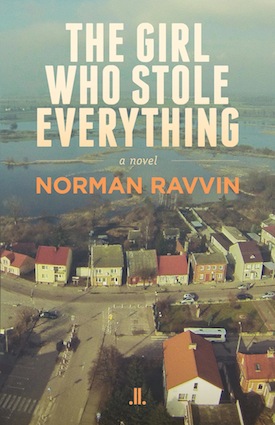
image - The Girl Who Stole Everything coverFor a long time it had the title The Dulcimer Girl, which is one of Nadia’s alter egos once she arrives in Poland. And the instrument itself, key to early klezmer, in its Polish guise, as a hammered instrument, was something I thought of as a talismanic object, which evoked the locale, the culture of Jews and Poles in another time.

The Typewriter Girl was also an early title that fell by the wayside, and relates to the other main female character, Ania. She is “the Typewriter Girl” by way of her work for a Polish government bureaucratic special office, which is tasked with investigating the files kept on people during the communist era. Understanding the typewriters used on each file is a way of verifying the files or revealing fraudulence.

The typewriter, like other technologies in the book – cars, books, recorded music – is evocative of a time when things worked in a way that they no longer do. So, the dulcimer and the typewriter, even hardcover books, are surely objects of nostalgic and loveable possibilities.

The Night Jew is central to the novel’s sense of Poland being haunted by the Jews murdered in the wartime. One can spend time in Poland and either look for these Night Jews or, as I sometimes feel, be one. There are plenty of real Jews in Poland today. But the Night Jew must be someone from another world altogether.

The Gentle Jew is in fact a particular nickname for a key figure in the narrative. He is an early ’60s denizen of West Cordova Street.

JI: There are many parallels in the lives of Simon and Nadia – a father’s secrets, their love of walking, etc. – and their lives do overlap, of course, but what inspired you to connect these disparate stories?

NR: Some of these parallels develop intentionally, but then others work themselves out as a book goes through drafts. Certainly, you’re right, walking is a returning motif. Nadia does seem to walk cities after the example of her father, as if she walks to be like him when she cannot know him.

The secrets of fathers: I guess, in this book, one of the premises is that ancestral stories, which go untold, can irrupt without warning. So, in the case of the younger characters in Canada, Simon and Nadia, they share this predicament, and their own lives are changed by the irruptions when they finally happen. It is satisfying when these kinds of patterns develop almost without meaning them to. This is where writing can be a bit like making music, where refrains, verse and chorus structure allow for such catchy and satisfying effects – a rhyming of sound and idea.

JI: If there is anything else you’d like to add, please do.

NR: I guess it’s important to say that I’ve returned to Vancouver in fiction for another try at it. My second novel, Lola by Night, was a Vancouver book. And, in The Girl Who Stole Everything, I felt strongly about doing things with the city that others hadn’t. I’m a walker in Vancouver, whenever I can be, so that element, which you ask about, is motivated by my own appreciation of what different parts of the city have to offer. When I walk, I do think of what’s changed since my last visit, so it may be that writing about a place can be well done from afar, as long as you keep it close enough and periodically in view. It’s interesting to have a Vancouver book come out in Montreal, where the West Coast is a kind of terra incognita.

A bleak take on our times

Bari Weiss, the New York Times columnist, grew up in Pittsburgh and so the shooting at the Tree of Life synagogue, in October 2017, hit even closer to home for her than for most Jewish North Americans. For many American Jews, she writes, it was the awakening after “a holiday from history.” It seems to have raised the question: Is the postwar reprieve from antisemitism coming to an end?

The majority of her tight, short book, How to Fight Anti-Semitism (Crown, 2019) is a litany of bleak, depressing anecdotes and statistics about the rise of antisemitic ideas and violence in North America and Europe. One imagines the title, which suggests action and optimism, being brainstormed by the publisher’s more upbeat marketing department over the alternative The Sky is Falling. But this is not to discount the value of the bleakness. It is a brief synopsis of rightful concerns around the political climate in the West in 2019.

The awakening, Weiss seems to acknowledge, was overdue. She recounts the 2006 kidnapping, weeks of torture and eventual murder of Ilan Halimi in Paris by a gang who assumed that, because Halimi was Jewish, he was also rich. As shocking as the ferocious crime, writes Weiss, was the response by the French authorities and the public, who largely chose to ignore the innately antisemitic nature of what had happened in order to retain a national self-perception that was challenged by the murder.

The consequences of what is happening, she warns, raise the stakes from the safety of Jews to the protection of the very idea of America.

“The object of our protection is not just the Jewish people. It is the health and future of a country that promised to be a New Jerusalem for all who sought it out,” she writes.

I am always disconcerted by the argument that, if we do not stand up for Jewish people when they are threatened, the enemies might eventually come for someone we actually give a damn about. But the evidence accumulates that this may be the best argument at hand.

Weiss summarizes the many antisemitisms – of left and right, of the Soviets and the fascists, of some Muslims and some African-Americans – even “Purim antisemitism” and “Chanukah antisemitism” (an interesting theory first advanced by the writer Dara Horn and it’s worth a Google). In brief, Weiss argues that the right of the spectrum considers Jews insufficiently white and not Christian, while the left contends that Jews are too white and overly privileged. Far-right antisemitism is more familiar, perhaps more clearly identifiable and is fought in partnership with what she calls Jewish people’s natural allies, liberals. Antisemitism on the left puts Jews in an especially challenging position.

She notes that the antisemitism and racism of Steve King, the far-right Republican congressman, is open to widespread criticism. “But criticize Women’s March leader Linda Sarsour for her repeated antisemitic outbursts? Criticize her and you are not just rendered racist and misogynist and an Islamophobe in league with Trump, you stand accused of putting her life at risk for trying to hold her accountable for promoting antisemitism.” (For her part, Sarsour two weeks ago declared that Weiss is “on the wrong side of history,” a statement so brazenly jaw-dropping that the publisher really should issue a revised edition of Weiss’s book just to include Sarsour’s latest.)

Weiss also walks into the lion’s den by making the equation between Muslim migration to Europe and increased antisemitic violence. And the stats she includes make challenging reading. A 2008 Pew poll indicated that 97% of respondents in Lebanon have negative view of Jews, followed by 96% in Jordan, 95% in Egypt and 76% in Turkey and Pakistan. She contrasts this with a 2015 Anti-Defamation League survey indicating that, in Germany, 56% of Muslims hold antisemitic views, compared with 16% of the general population. In France, it’s 49% to 17% and, in the United Kingdom, 54% to 12%.

When, at the end of the book, she actually gets to the nub of fighting antisemitism, Weiss outlines a number of strategies, few of which are novel but all of which are worthy.

“Resist hierarchical identity politics,” is one of her steps. “Corrupt identity politics on the right – the Olympics of Purity – tell the Jews that they can never be white or Christian enough. Corrupt identity politics on the left – the Olympics of Victimization – tell the Jews that they can never be oppressed enough.”

She calls on Jews to maintain liberalism for the sake of a healthy democracy, to support Israel, which includes demanding that Israel live up to its ideals, to “lean into Judaism” and “tell your story.”

She calls on Jews to “apply the kippah (or Magen David) test”: “If you would be uncomfortable wearing a kippah or a Magen David necklace in your neighbourhood, you should make a plan to improve your neighbourhood or make a plan to leave it.”

Most of her recommended ways to fight antisemitism presume that the reader is Jewish. This may be a fair assessment on the author’s part, but a non-Jewish person seeking to be an ally, who would find plenty of motivation in the first part of the book, will not find much actionable advice in the last short section. It should not, of course, be left only to Jews to fight antisemitism but, like the pragmatic decision to argue that the safety of Jews is a prerequisite to the safety of the entire society, it is probably a reasonable assumption at this point to accept that Jews are the most likely to do so. Which may simply underscore the problem her book is intended to confront.