Creation of now-iconic pant

Jeans bearing the Levi Strauss & Co. trademark.

Nothing quite compares to the essential staple that almost all of us have in our closets, with styles including flare, skinny, low-rise, high-rise, boyfriend, ripped, the list goes on. If you haven’t guessed already, I’m referring to jeans. They epitomize fashion versatility, taking us from a city stroll in a pair of sneakers to our favourite restaurant in the evening with a boot or dress shoes. There are few fashion houses, from couture to street wear, that haven’t designed their own style. But, for the original jean, we have to thank Levi Strauss & Co.

Loeb Strauss, born 1829 in Bavaria, was the youngest of seven children. At age 16, after his father’s death and with increasingly harsh restrictions and discrimination towards Jews, he decided – with his mother and two of his three sisters – to move to New York. There, two of his brothers welcomed him into their dry goods business.
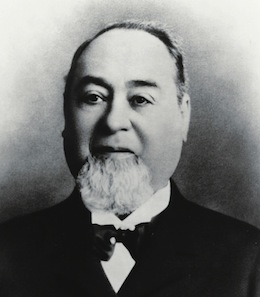
photo - Levi Strauss
Levi Strauss. (photo from Wikipedia)

In the 1850s, in the midst of the gold rush, Strauss saw potential opportunities to set up shop in the West and he did so, opening a branch of the family business in San Francisco, where he changed his name from Loeb to Levi.

Levi Strauss & Co. became a rapid success, selling merchandise to local customers as well as to those in neighbouring cities. Strauss became a respected figure among the Jewish community, known to have a sharp business mind and a kind demeanour. He was also known for giving back to community, donating to both Jewish and non-Jewish charities.

The nature of the business – and the course of fashion worldwide – changed when Strauss was approached by Jacob W. Davis, a regular customer and acquaintance, who came to collect an order of canvas for his tailoring business. Davis made durable work wear, or “waist overalls,” as he called them, from special fabric that was primarily used to make tents. Having developed a system to prevent the overalls from ripping at the pockets by adding copper rivets at the corners (allowing them more longevity), he knew he discovered something big but, in order to proceed, he needed financial backing, primarily for the patent fee. Strauss became his business partner in 1873.

Levi Strauss & Co.’s jeans were produced largely for the labour workforce. However, over the years, they became a choice piece of clothing for women and men in any profession, at least when not working. Levi’s entered the world of film in 1938 when John Wayne wore a pair of Levi’s 501 jeans, transforming them into the American cowboy’s leading attire.
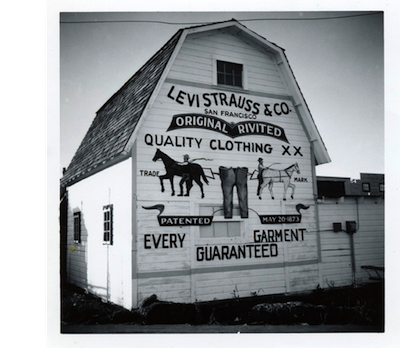
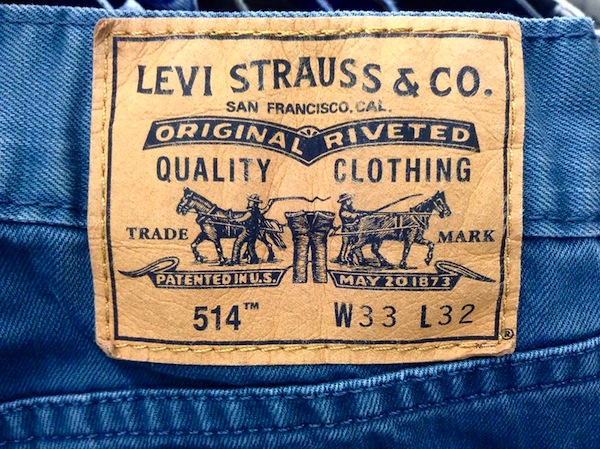
photo - According to the company’s website, the trademark depicting two horses attempting to pull apart a pair of Levi’s waist overalls, symbolizes “the strength of the clothing in the face of competition.” It was introduced in 1886
According to the company’s website, the trademark depicting two horses attempting to pull apart a pair of Levi’s waist overalls, symbolizes “the strength of the clothing in the face of competition.” It was introduced in 1886. (photo from levistrauss.com)

The financial success of Levi Strauss & Co. allowed Strauss to expand his business to many diverse industries, from banking to electricity. His philanthropy also expanded and he gave to many Jewish organizations, notably helping found and establish the Reform congregation Emanu-El in San Francisco.

While Strauss never married and had no children of his own, he had a strong relationship with his nephews. When he died, in 1902, Levi Strauss & Co. and most of his estate went to his four nephews and other family members; many charities were also beneficiaries named in his will.

Over six generations, Levi Strauss & Co. has remained a family-run business, manufacturing not only jeans but other casual wear, accessories and a children’s line. One of the largest brand apparel companies in history, the Levi Strauss name is universally recognized. Now run by the Haas family, decedents of Strauss, the family and business continue Strauss’s legacy in another important way – by being one of the most charitable families in the Bay Area.

Ariella Stein is a mother, wife and fashion maven. A Vancouverite, she has lived in both Turkey and Israel for the past 25 years.

God and America

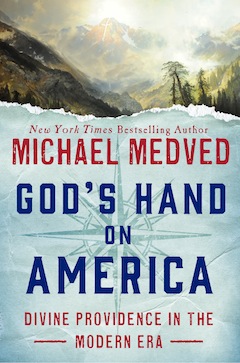
Michael Medved’s latest book is God’s Hand on America: Divine Providence in the Modern Era. (photo from Michael Medved)

Most of us would call them close calls or dumb luck – the many things in American history that could have gone terribly wrong, but didn’t. But Michael Medved firmly believes they weren’t merely happy accidents; rather, they were a direct result of God’s guidance.

Medved’s God’s Hand on America: Divine Providence in the Modern Era (Crown Forum) is a chronological sequel to 2016’s American Miracle (Crown Forum), a book that began with the pilgrims in 1620 and ends with Lincoln’s assassination, on April 14, 1865. They share a common theme, he said: “Divine intervention is extraordinarily obvious and important in tracing the course of American history.”

Story after story, Medved builds the case that there are solid “arguments for divine providence in the rise to power, and continued power and prosperity, of the United States.” President Theodore Roosevelt, for example, was shot in the chest but a folded speech in his jacket pocket took the bullet.

In another of many examples, a seemingly lucky moment came during the Battle of Midway, in June 1942. U.S. planes had gotten lost over the Pacific Ocean but, just in time, they suddenly found their way back, to dive bomb Japan’s fleet. History, said Medved, regarded this as a huge blow to the Japanese – at a time when the Americans and British had, up until that point, faced setback after setback, loss after loss, and were struggling to make advances in the Pacific.

“Fate, destiny, providence and the United States is a complicated process. It doesn’t mean America only wins, but it does mean that it’s safe to say that Lincoln, Washington, the Roosevelts, were right; Kennedy and Eisenhower were right; that America has been used as an instrument, or vehicle, for grand purposes by a Higher Power,” noted the Jewish syndicated radio host, whose daily program reaches more than five million listeners, across 300 stations. Medved is also author of 12 other books, including bestsellers The 10 Big Lies About America and Hollywood vs. America.

image - God’s Hand on America book coverHis thesis isn’t out of the blue, either – since the first landings, ordinary Americans and their leaders have believed that God helped in their nation’s successes, said Medved. For people of faith, it was the most reasonable explanation for the seemingly inexplicable. Their Bible-centred view carried over to an appreciation of Jews, he added, at a time when there were few Jews in the United State, i.e. until the 19th century.

They recognized, he said, “the special place the Jewish people had in America,” especially conscious of the verse in Genesis, which says that anyone who blessed the Jews would be blessed, and anyone who cursed the Jews would be cursed. These beliefs were exhibited in many ways, such as the Hebrew words on the seal at Yale, Urim and Thummim, elements of the ancient high priest’s breastplate, used for obtaining oracles; and the seal of Dartmouth College, which has El Shaddai (God) in Hebrew.

Early colonizers even identified themselves as being “like the Israelites who have crossed a perilous ocean to come to the land that was promised,” said Medved. “That identification of Puritans [goes] all the way back to the founding of New England in the 1630s.… They described themselves as ‘New Testament Hebrews.’ The identification with the Jewish people was very profound.”

While at Princeton, then-future president James Madison’s concentration of study was Hebrew, said Medved. Later in history, Harry Truman formally recognized Israel, minutes after it was declared a country. And then there was Richard Nixon’s military aid to Israel during the 1973 Yom Kippur War – quite unexpected, said Medved, given the recordings that surfaced of Nixon using insulting epithets against Jews. According to Medved, Nixon’s gesture of goodwill, though not mentioned in the book, saved the Jewish state from annihilation.

Dave Gordon is a Toronto-based freelance writer whose work has appeared in more than 100 publications around the world.

Words of praise for libraries

We have a lot of interesting Jewish educational opportunities in Winnipeg, where I live. If you made a big effort, you could be busy learning, attending lectures, events and classes much of the time. It might be possible to find something to do nearly every day of the week, but most of us don’t or can’t.

Maybe you can’t get out due to health issues or because you’re the caretaker for others. Perhaps it’s just too dark and cold right now, and you aren’t all that keen about going out after dinner. (I hear you!) There are many reasons to say no, we can’t manage something.

The last few weeks, I’ve found myself in this situation. Someone in my household got sick, or I did. The weather was just too cold. I wanted to hibernate. I wasn’t sure the car would start or the event cost too much or … you get the picture.

However, I found a solution that has really enriched this season. There were some books on Jewish topics that friends suggested online, and even a book written by someone I knew. I couldn’t afford to buy them all, nor did I know yet that I wanted to own them. This is where the public library is an amazing resource. I had all the books delivered to one library, where they sat on the holds shelf with my last name on them.

When I checked them out, I worried that I would not be able to finish them in time. Maybe I was being overambitious. Not to worry, it turns out. Most of the books were finished long before they were due – they were that good.

What were they? Well, now that I’ve read these books, I’m happy to make a couple recommendations! The first was Sacred Treasure – The Cairo Genizah: The Amazing Discoveries of Forgotten Jewish History in an Egyptian Synagogue Attic. Genizahs are where some Jewish communities stored their old (both holy and mundane) documents for many centuries. Written by Rabbi Mark Glickman, who I studied with at summer camp as a teenager, this book was the Jewish equivalent to an Indiana Jones story. I love reading about Jewish social history and, to be honest, it made Shabbat and several sick days absolutely a joy. I told all my friends I was geeking out on the genizah book!

The second book I loved was The Unorthodox Match by Naomi Ragen. Ragen is a beloved American-Israeli novelist, and this book didn’t let me down. It was both a love story and a realistic account of how some Chassidic and ultra-Orthodox communities operate. There’s a great divide. These groups both encourage ba’alei teshuvah (those who “return” to more traditional Judaism), but they also ostracize them, as not being the same as those who were raised from birth in these communities. The novel emphasizes the differences between what Judaism teaches about accepting converts and strangers and how communities actually act, sometimes alienating those who seek to be included.

After reading these books, I was struck by how I was able to enrich my Jewish learning simply by using the library and the couch when it was so cold out. Yet, if cities like mine cannot figure out their finances, it’s possible that some of our public libraries (along with wading pools, swimming pools, arenas, etc.) will soon be closed due to budget cuts.

We can choose to read at home and learn more about Jewish topics this way, but only if the public libraries remain open and they can afford to buy these books. We may complain about our taxes, but we are given a great gift when we can access these literary “riches” for free.

Canadian winters are long. I count myself lucky that, when I couldn’t go out, I was able to sit by the fire and read and learn this winter. If we want that learning option to be available, we all have to commit to doing our share to keep libraries (and all the other benefits of a tax-paying society) open and thriving.

Joanne Seiff has written regularly for CBC Manitoba and various Jewish publications. She is the author of three books, including From the Outside In: Jewish Post Columns 2015-2016, a collection of essays available for digital download or as a paperback from Amazon. Check her out on Instagram @yrnspinner or at joanneseiff.blogspot.com.

Why groggers on Purim?

(photo from ajudaica.com)

One of the most popular customs for Purim is to drown out the name of the villain, Haman, with a noisemaker. In Hebrew, it is called a ra’ashan; in Yiddish, it is a grogger, which comes from the Polish word for rattle.

The origin of this custom comes from the Book of Exodus 17:4: “For I will utterly blot out the remembrance of Amalek from under the Heavens.” Haman’s ancestors were Amalekites.

While the custom of using a noisemaker during the reading of the Megillah is more recent among Sephardi Jews, some form of grogger has been used primarily among Ashkenazi Jews since the Middle Ages.

There are records that children in ninth-century France and Germany used groggers on Purim. They took flat stones or wooden paddles on which Haman’s name was inscribed and beat them together when Haman’s name was mentioned in the reading of Megillat Ester. It was also popular to write Haman’s name on the soles of their shoes and then stamp their feet when his name was read, thus erasing his name.

Today, the traditional grogger looks like the Hebrew letter dalet, a horizontal piece made of wood or metal with a rotating cylinder or tongue attached to a vertical handle, which, when turned, makes noise.

One also finds groggers decorated with illustrations from the Book of Esther, plastic groggers with clapping hands, and designs in wood and metal. Schoolchildren often make their own containers of paper or metal and then fill them with beans, so that, when they are shaken, they make noise.

Whatever grogger you use for Purim, just make sure you do it loud and often, for, in each generation, a Haman has arisen to live among us!

Sybil Kaplan is a journalist, lecturer, book reviewer and food writer in Jerusalem. She created and leads the weekly English-language Shuk Walks in Machane Yehuda, she has compiled and edited nine kosher cookbooks, and is the author of Witness to History: Ten Years as a Woman Journalist in Israel.

From baseball player to spy

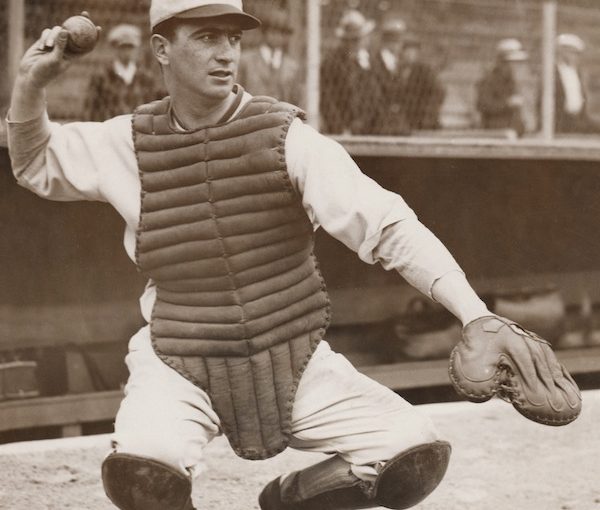
Moe Berg as a catcher during his time in Major League Baseball. (photo from Irwin Berg)

Near the end of John Ford’s essential 1962 western, The Man Who Shot Liberty Valance, a newspaper editor coins the credo, “When the legend becomes fact, print the legend.”

The fact, as we all know, is that Americans are all-star myth-makers and myth-lovers. Many American Jewish boys caught the bug via the improbable immigrant saga of Moe Berg, a paradoxically brilliant professional athlete who led a secret second life as a spy for the U.S. government. How much of Berg’s story is true, though, and how much was legend passed among kvelling kids in the schoolyard?

Aviva Kempner, who hit a home run with her 1998 documentary about another Jewish ballplayer, The Life and Times of Hank Greenberg, was the obvious, natural and best-equipped filmmaker to take on the mid-20th-century mysteries at the heart of Berg’s minor celebrity.

The Spy Behind Home Plate, which screens at the Vancouver Jewish Film Festival March 8 at the Rothstein Theatre, is a testament to Kempner’s determination and persistence. Chock full of dozens of contemporary and archival interviews, and packed with rare photos and even rarer film footage, The Spy Behind Home Plate is a definitive record of Berg’s achievements.

Although it’s an effective way to impart information, the dogged, dog-eared marriage of talking heads, vintage visuals and period music can’t fully evoke the shadowy stealth and deadly risks of Berg’s wartime activities. Hamstrung by her budget, Kempner wasn’t able to stage reenactments or employ other strategies to illustrate the unfilmed and unrecorded liaisons and conversations that Berg had in Europe in 1944 and 1945. The Spy Behind Home Plate, therefore, is like the steady everyday player who notches the occasional three-hit game but never achieves the transcendent grace and power of a superstar.

Morris (Moe) Berg, international man of mystery, was born in New York in 1902. His father had fled a Ukrainian shtetl for the Lower East Side, where he started a laundry before buying a drugstore in Newark.

The family moved to New Jersey when Moe was a boy, and he grew into an excellent student and a terrific baseball player. After a year at New York University, he transferred to Princeton, where he was a star shortstop (back when the Ivy League was the top, if not the only, sports conference) and graduated Phi Beta Kappa.

While his older brother Sam fulfilled Dad’s wishes and went to medical school, Moe signed a contract to play pro ball. He acceded to his father’s demands up to a point by attending Columbia Law School in the off-seasons, earning his degree and passing the New York bar in 1929.

It was a false bargain: Moe despised the idea of being a lawyer, while Bernard Berg never accepted a baseball career as a legitimate pursuit. In fact, the old man refused to go to the park and see his son play.

From an athletics standpoint, his dad wasn’t missing much. A knee injury early in Moe’s career, compounded by primitive diagnosis and treatment, severely slowed him. Over 15 years as a backup catcher, Berg notched exactly 441 hits in 663 games.

What set Moe apart was his charm, charisma and erudition. He studied Sanskrit at the Sorbonne one off-season, and read multiple newspapers every day. When he went to Japan on a barnstorming tour with Babe Ruth and other Major League stars, he learned Japanese.

Berg carried a camera everywhere on that trip, and made a point of checking out the roof of a tall Tokyo hotel in order to shoot a 360-degree panorama of the city. It’s not altogether clear if he was already working officially (albeit surreptitiously) for the U.S. government, but his film was of significant help when the United States went to war with Japan after Pearl Harbor.

In fact, in early 1942, Berg recorded a radio segment in Japanese that was broadcast in Japan and drew on the goodwill he’d accumulated over two prewar visits.

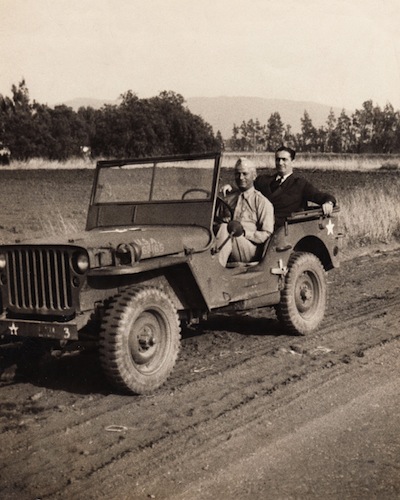
photo - Moe Berg in a military jeep in California with his brother Sam during the war, July 1942
Moe Berg in a military jeep in California with his brother Sam during the war, July 1942. (photo from Irwin Berg)

Berg had been sent on research missions to South America, but that was too far from the real action. It appears he found a home in 1943 in the newly created Office of Strategic Services (OSS), the intelligence branch that evolved into the Central Intelligence Agency after the war.

His primary and crucial assignment was to ascertain how close the Germans were to having a nuclear weapon, and to sway Italian scientists from the Axis to the Allies. To successfully carry off his cover story, Berg was briefed on the science and strategy of the Manhattan Project.

One biographer recounts, “The OSS had given the Manhattan Project its own spy, in effect, its own field agent to pursue questions of interest wherever he could in Europe. And that was Moe Berg.”

Kempner accords a great deal of screen time to this episode in Berg’s clandestine career as a professional spook. It’s a great story, in which the solidly built former catcher is assigned to attend a conference in Switzerland and determine – from the keynote speech by a visiting German scientist, Werner Heisenberg – if the Nazis are within reach of perfecting the bomb.

Berg carries a pistol to the symposium, with orders to use it on Heisenberg if he deems it necessary. It would be churlish of me to recount the outcome of Berg’s suicide mission except to say that the catcher-turned-spy who spoke seven languages lived unhappily ever after the war.

Kempner leaves us wanting to know more about Berg’s later years. By the weirdest of coincidences, Sam Berg headed a group of doctors sent to Nagasaki to study the effects of radiation poisoning. Incredibly, Moe and Sam never knew about each other’s exploits. This lone fact reveals that there’s still more to know about Moe Berg’s story.

The Vancouver Jewish Film Festival runs until March 8. For tickets and the movie schedule, visit vjff.org.

Michael Fox is a writer and film critic living in San Francisco.

Mystery photo … Feb. 28/20

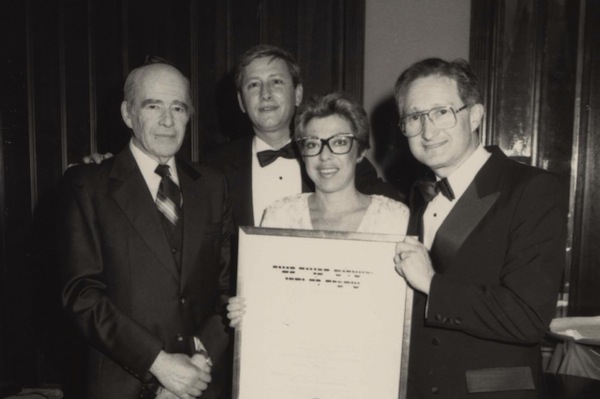
Two unidentified people on the left with Gail and Michael James on the right holding a certificate at a Jewish National Fund event. (photo from JWB fonds, JMABC L.12042)

If you know someone in these photos, please help the JI fill the gaps of its predecessor’s (the Jewish Western Bulletin’s) collection at the Jewish Museum and Archives of B.C. by contacting archives@jewishmuseum.ca or 604-257-5199. To find out who has been identified in the photos, visit jewishmuseum.ca/blog.

Ketubot have a long history

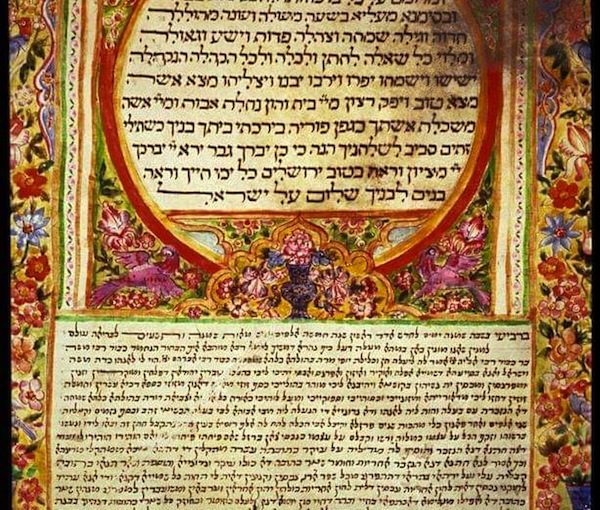
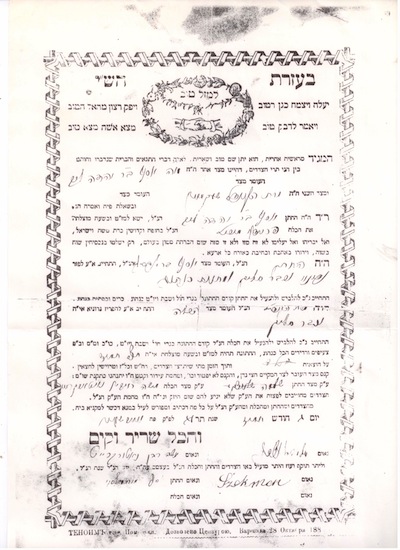
An illustrated ketubah from Mala, India, 1938. (image from Deborah Rubin Fields)

Mazal tov! So, you or someone you know is getting married. Today, Jewish weddings may be big or small, formal or informal, traditional or not. No matter the style, the ketubah, or Jewish marriage contract, is the common denominator.

The ketubah is a short, but ancient document. In his book The Ketuba: Jewish Marriage Contracts through the Ages, David Davidovitch writes: “It may be assumed that … the ketubah was first introduced at the time of the Babylonian exile.” The ketubah “testifies to the obligations undertaken by the husband towards his wife in their joint life together. The principal function of the ketuba is … to serve as a document that safeguards the position of the woman after she has entered the marital state.”

In a traditional ketubah, the groom obligates himself to pay a base amount, and perhaps additional sums that are then written into the contract. He vows to work, honour, feed and support the bride. In added phrasing, he specifically agrees to provide clothing, food (thus providing food is mentioned twice in a traditional Orthodox ketubah) and conjugal rights. The groom’s spelled-out duties are the key to the contract. The wife’s responsibilities are not spelled out, yet details of her dowry are given.

The ketubah was written in Aramaic, for many years considered the legal language of Jewish texts, records and reports, plus the lingua franca of the Middle East. Even today, many Orthodox couples continue to use the Aramaic version. As a legal document, the ketubah requires witnessing by two individuals.

image - The ketubah of the writer’s maternal grandparents, from Warsaw, Poland, 1913
The ketubah of the writer’s maternal grandparents, from Warsaw, Poland, 1913. (image from Deborah Rubin Fields)

That Jewish couples have used ketubot since ancient times does not mean, however, that all ketubot are the same. They have differed from place to place and from period to period. Probably the most blatant difference in ketubot is that some have been illustrated while some have not. According to Davidovitch, the Italian Jewish community produced the most beautiful documents. In illustrated ketubot, common motifs have included scenes from the Torah, cherubim, flowers, birds (sometimes exotic), fish (as signs of anticipated fertility), candelabra or menorot, gates, arches, columns and even emblems of particular countries. It is hard to say with certainty if, historically, unillustrated ketubot reflected the conservative nature of various Jewish communities or if only the rich could afford artists to decorate the contract.

Sometimes, these dissimilarities appeared within one country. For instance, between the 18th and 20th centuries, the ketubot of the Indian Jewish communities consisted of two distinct sections – the opening formula, or superscription, in the upper register and the contract itself beneath. The superscription was written in square Hebrew characters, whereas the contract itself was penned in a semi-cursive Hebrew script. The superscription began with an invocation to G-d, followed by blessings and good wishes to the newlyweds and ended with biblical verses relating to marriage and fertility. Yet, within various Indian communities, there were differences: for example, while a ketubah from Kolkata (Calcutta) was illustrated, a ketubah from Pune was not.

According to Prof. Shalom Sabar, “printed Jerusalem ketubot made their way to many countries in the east, and indirectly led to the decline of the tradition of written ketubot and hand-made illustrations. The printed ketubah (with or without decorations) slowly took the place of the hand-made ketubah throughout almost the entire Jewish world, and the ancient artistic tradition died…. During the 1970s, the decorated ketubah and motifs connected to Jerusalem [were] revived. In an era where many people were ‘searching for their roots’ and acquired a renewed interest in Jewish art in its various forms, many couples began ordering hand-decorated ketubot for their weddings.” (See the National Library of Israel, web.nli.org.il/sites/NLI/English/collections/jewish-collection/ketubbot/ketexhibit/Pages/Yemen-1925.aspx.)

Today, some couples opt to write their ketubah using egalitarian language. Their vows might reflect their responsibilities to each other, as well as responsibilities to the Jewish people and to the entire world. One example of this is the ketubah devised by Rabbi Prof. Rachel Adler. Her ketubah is called a Lovers’ Covenant. It contains biblical verses about covenant, calling marriage a covenant of distinction. Other couples focus on specific vows to be carried out in their shared life.

Other examples of changing times are ketubot for interfaith couples and for same-sex couples. Regarding same-sex couples, Lynda Fishman of Jessy Judaica Shop reports that “most couples choose a ketubah first and read through the text that is offered by the artist. Most couples prefer the same-sex text, although not all artist[s] offer a same-sex text … most do offer an egalitarian text, which can be gender-neutral.” Fishman always requests the couple “speak to their rabbi/officiant first before ordering. It’s very important for the officiant to approve the text first or to let us know if they would like any changes made.”

Masorti (Conservative) Rabbi Diana Villa and the late Rabbi Monique Susskind Goldberg worked extensively to try and prevent the problem of mesoravot get, Jewish women whose husbands have refused to grant a get, or Jewish writ of divorce; this situation occurs more in Israel than in other Jewish communities. In a detailed paper on the issue, they urged couples to sign a prenuptial agreement.

For those living in Israel, they further recommend using their Agreement for Mutual Respect. “The principle guiding financial agreement is that the husband guarantees at the time of the wedding to pay his wife a large sum of money in the future should she want a divorce and should he refuse to give her a get, even though their life together has ended. The purpose of the agreement is to have the husband give the get quickly in order to be rid of the heavy debt.”(See To Learn and to Teach [2007], the fourth booklet of a series published by the Schechter Institute of Jewish Studies).

While prenuptial agreements are less common in the Orthodox world, the Orthodox organization Chupa Pratit requires couples to sign a halachic (according to Jewish law) prenup stipulating financial sanctions if one partner refuses to consent to a divorce, to prevent incidents of “chained” women, or men. (See chuppot.org.il/en.)

The National Library of Israel has an online collection of more than 4,200 ketubot from collections all over the world. Whatever direction you decide to go in when choosing yours, good luck with your preparations. And may your shared life be as hearty and as long-lived as the ketubah itself.

Deborah Rubin Fields is an Israel-based features writer. She is also the author of Take a Peek Inside: A Child’s Guide to Radiology Exams, published in English, Hebrew and Arabic.

Question that won’t die

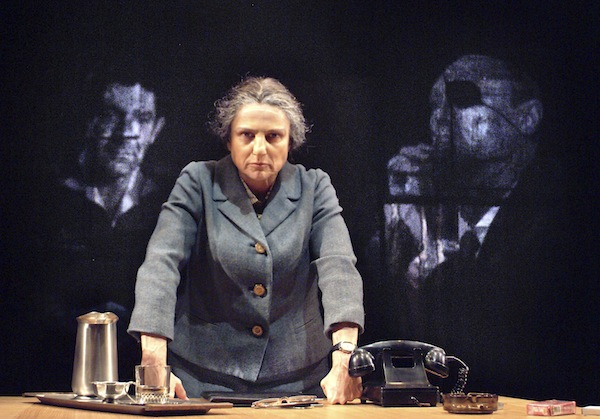
“How does a housewife decide between generals?” asks Golda Meir (played by Tovah Feldshuh) in Golda’s Balcony. In this instance, she must decide between the counsel of David (Dado) Elazar, her chief of staff, left, and Moshe Dayan, her minister of defence. (production still)

Tovah Feldshuh is incredible to watch in Golda’s Balcony, The Film. Not just in her passionate and sympathetic portrayal of Golda Meir, Israel’s prime minister from 1969 to 1974, but in her depiction of all 45 characters in William Gibson’s one-woman play. She’s Meir, David Ben-Gurion, David (Dado) Elazar, her husband Morris, Holocaust survivors and Israeli soldiers, among many others. She moves as easily between the personalities as a child raised in a multilingual household moves between languages. And with powerful effect.

Golda’s Balcony, The Film has two screenings at the Vancouver Jewish Film Festival – March 1, 1 p.m., and March 2, 3:30 p.m., at Fifth Avenue Cinemas. See it. You will have a more nuanced understanding of Meir, as well as of Israel, its origins and the struggles it has faced and will face. Gibson’s text is superb; it is engaging and insightful, with enough humour along the way that you’ll be able to breathe on occasion, as Meir deals with the existential crisis of the Yom Kippur War. Fluidly switching from wartime to other parts of her life, the play depicts, if nothing else, the stressful, heart-wrenching, thankless job that is being prime minister of a country that is constantly under threat.

The film is a recording of the play’s soldout Off-Broadway première on May 4, 2003, at the Manhattan Ensemble Theatre, presented by Issembert Productions. After a four-month soldout run at MET, the show moved to Broadway, and the Helen Hayes Theatre, where it ran for 15 months, making it, apparently, the longest-running one-woman show in Broadway history. It has won countless awards.

The set is relatively simple. A table with a couple of chairs on a tile floor. On the table, a dial telephone, a pitcher and water glass, an ashtray, cigarettes. Light shines on the table from the right, as if from a window. The backdrop is a wall of reddish stone or metal slabs of varying sizes that protrude outward. Images are projected onto the wall or chairs when relevant, giving the audience a visual of the person Meir is talking about, or that Feldshuh is portraying – though it is hard to see these images in the film version. To the side and a step down is a small piece of stage covered in dirt, with a few rocks, which acts as refugee camps in Cyprus, the kibbutz on which Meir lived for a time, Russia when Meir visits on a diplomatic tour, etc. The focal point for the entire production is Feldshuh.

The play begins in darkness, a man chants a prayer, the words “Golda’s Balcony” appear briefly on the wall. Thunder claps, lightning flashes, gunshots ring out, then darkness again, but the sound continues: guns firing, bombs exploding, planes overhead. A housecoat-garbed Golda, sitting at the head of the table, strikes a match and lights a cigarette; the lights rise a bit and calmer music prevails.

“I’m at the end of my story,” says Golda. “I’m old. I’m tired. I’m sick. Dying, the doctors tell me. The picture you have of me as Mamaleh Golde, who makes chicken soup for her soldiers, it’s a nice picture. And I do make chicken soup. But let’s empty it all out for keeps right now because, at the bottom of the pot, is blood. At the bottom of the pot is the question that won’t die. I can do without that music!” she yells. It stops. The lights come on more fully, as Golda then starts to relate the story of her first voyage to Palestine, with her husband, in 1921 – 52 years later, she would become prime minister.

“I remember, starting with a phone call, that woke me up at four o’clock in the morning. Saturday, Yom Kippur, 1973,” she says, as she closes her eyes, looking exhausted, her right arm holding up her head, the left one sliding off the table. The phone rings. Startled, she answers it, hearing the news that Egypt and Syria have attacked Israel. As she takes off the housecoat, Golda is in her familiar muted woolen skirt suit; energy, anger and fear all come to the surface as she relates her generals’ differing views as to what Israel needs to do. Dado: attack! Moshe Dayan: don’t be seen as the aggressor! “How does a housewife decide between generals?” she asks.

Of course, she does decide. But the agonizing and tension-filled process leads her – and Israel – down some very dark paths and the play masterfully depicts her sadness, anxiety and frustration; the sacrifices to her family, her health, as well as to others. Throughout the many narratives, it is the story of the Dimona nuclear facility to which she will get, the story that haunts her, that took her to hell; the story she needs to gather the strength to tell.

Thunder, lightning and gunfire divide the scenes in the whirlwind of action that Golda describes, her domestic life almost as tumultuous as her political life. We see her humanity, but also her toughness. Luckily, she never had to answer the question that “won’t die”: if Israeli forces hadn’t been able to cross the Suez Canal and if the United States had not come through with the needed military aid, would she have ordered the dropping of the nuclear bombs with which she had armed Israel’s planes?

Golda’s Balcony is a must-see in a festival with many excellent films. For the full schedule, visit vjff.org.

From Soviet to Nazi rule

Aileen Friesen has researched how Mennonites living the area of current-day Ukraine reacted to the Nazis. (photo from Aileen Friesen)

An event titled Jews, Mennonites and the Holocaust took place in Winnipeg at the Rady Jewish Community Centre a few months ago. Organized by the Jewish Heritage Centre of Western Canada, it featured Mennonite historians Aileen Friesen, executive director of the D.F. Plett Historical Research Foundation, and Hans Werner, a retired University of Winnipeg professor, who discussed Russian Mennonite reaction as the Nazis invaded Russia during the Second World War.

“I am from a Mennonite background,” said Friesen in a post-event interview with the Independent. “That is, on both sides of my family – one side came to Canada in the 1870s, with the migration of Mennonites from the Russian Empire during that time, and the other part of my family came to Canada in the 1920s, with the migration from the Soviet Union.”

The Nov. 5 discussion focused on the area that comprises current-day Ukraine, which, during the time of the Nazi invasion, was occupied by what was then the Soviet Union. Mennonites who were in the region at that time were not of German heritage, but they spoke German and were viewed by the Nazis as allies. As well, the Russians expected that these Mennonites would be sympathetic to Germany and did what they could to relocate them to eastern Russia prior to the Nazi invasion.

“The way we think of this nation’s state … is just not what it is in the 18th century,” said Friesen. “It’s a very multi-ethnic space in which we have a lot of German speakers, and we talk about the Polish-Lithuanian commonwealth as a very multi-ethnic territory.

“We don’t have the concentration camps – we have a lot of mass shootings that are going to take place in this territory. So, Mennonites are living in a space that becomes under Soviet control, and they live under Stalinism. And then, it will become occupied by German forces, and then they will be living under German occupation.”

As the Nazis invaded, they were looking for people from the local population with German affiliation to integrate into the administrative system, while targeting the Jewish population – to have them register, to wear the Star of David and to separate them from other sections of the population.

According to Friesen, many Mennonites looked at the Nazis as liberators from the Stalinist occupation, which oppressed the Mennonite community in the area and enforced an atheistic existence. The responses of other Mennonites to the Nazi treatment of Jews were mixed: some responded in horror, but most remained silent.

“Sometimes, they say in memoirs that they said something to the German occupying forces, that they can’t do this,” said Friesen. “But, this is a time when people have been demoralized by Stalinism and have learned to keep their mouths shut…. But you will see that some people are very upset about what’s happening to the Jewish population…. Where there is a mix of Mennonites and Jews, there is also some intermarriage, so there were people who felt a great affiliation with their Jewish neighbours and felt very upset about this.

“My topic, specifically, focuses on a segment of the Mennonite population that joined into the secret police (SS), the local police, and are, therefore, implicated in the massacres that took place, as the local police were participants in these massacres.” Friesen said there were “Ukrainians, Mennonites and other types of ethnic Germans in the Ukrainian local police.”

As the Nazis invaded, they ranked the population, placing the Mennonites higher than the Ukrainian/Russian population, as they were considered by the Nazis to be Volksdeutsche (German folk). This allowed Mennonites access to more resources and they were better treated.

Before the Nazis invaded, she said, Mennonites and Jews “occupied a space together.” For example, “in Chortitza, there was a synagogue and there was also a Russian Orthodox church, and a Mennonite church that was in operation before the Soviets took power. It’s a space in which people organized and interacted with each other and, yet, these forces that get imposed upon them, there’s a reaction from within the local community that, in the case of the Mennonites, I don’t think that was a response that served them … at least some people … bought into these ideas that the Germans brought into this territory. It dovetails with some of the ideas they had of their own suffering under the Soviet regime and they accepted the dehumanization and sometimes participated in the dehumanization of others, which is really a sad story.”

Friesen encouraged readers to watch the event video on YouTube.

“There were some interesting questions and responses from the audience,” said Friesen. “We had a good turn out, from both the Mennonite and the Jewish communities, discussing these very difficult issues. I think the lectures online will give you a much better background to this story than I’ve been able to share.”

Rebeca Kuropatwa is a Winnipeg freelance writer.

Help save local media

(photo from arkells.com)

In what seems like a random act of kindness, the Canadian rock band the Arkells has put out an offer to their fans. Subscribe to a community newspaper and get a swag T-shirt from the band.

Musicians are facing their own challenges these days, as streaming services are upending the traditional royalty and revenue streams of their industry. But they are perhaps not yet at the level of near-desperation the print media sector has been facing in recent years. The advent of the internet and other factors (but mostly the internet) have made people expect for free things we used to access primarily through purchasing.

Oddly, perhaps, many of us are prepared to pay for multiple subscription services for media – Spotify for music, Netflix, Crave, Disney and an ever-growing number of video services – but most people still react to paywalls on print media by finding a free (to them) alternative. As a result, print outlets from the New York Times and the Globe and Mail to, well, the Jewish Independent have struggled to find alternative sources of revenue and the means to compensate for the reality that readers are demanding (and getting) for free what they once paid for.

In keeping with the issue-driven approach to songwriting for which the Hamilton-based band is known, it was a pleasant and heartfelt message that the Arkells – whose lead singer, Max Kerman, is a member of the Jewish community – put out to their fans.

“If you’re an engaged member of your community, you’re probably thankful for the people who report the news. And even if you’re not, you’re probably still reassured to know that someone is keeping tabs,” they write.

“Good reporting not only keeps us in the loop, but also makes sure our big wigs are held accountable – to ensure there is no sneaky biz.

“Somewhere along the way, we took this for granted. We forgot that we have to pay for this vital service, and that reporting the news isn’t free. In our own city, we’ve seen our local newspaper continue to shrink, and we worry about its future and the future of other local newspapers.”

The band invites their fans to join them in investing in “the things that truly matter.”

“Let’s start,” they write, “by supporting your local paper or a daily publication you really admire. It’s been years in the making. No more running from that paywall.”

They are asking listeners to take out a year-long paid subscription to a print or online media platform (or gift one to a friend) and to let them – the Arkells – know. Then the specially designed band T-shirt will be on its way to you.

Obviously, a gesture like this is not going to save the industry. But it is sweet nonetheless, especially to see someone without a vested interest making this case. Then again, maybe their point is that every citizen does have a vested interest in the success, or at least survival, of local media.

For the Jewish community in British Columbia … that’s us! For 90 years now, the Independent and our previous incarnation the Jewish Western Bulletin have been printing the first draft of our community’s history. At the risk of sounding self-aggrandizing, there are times when we write stories as much for posterity as for this week’s readers. We know that the archives of this paper is often the first destination for people researching aspects of our community’s history. We believe that, decades hence, researchers will see in a visit to Vancouver by a renowned researcher or an act of tikkun olam or a project by local high school students as the germ of a movement, or a way-station in the progress of an idea, that is significant in its own right but also speaks to a larger trend in our community or society. Or maybe someone will just enjoy the read. In other words, we view our work as immediate and, ideally, enduring in some manner even we cannot foresee.

While in many cities across North America, the local paper is operated by the Jewish federation, here it has been run for well more than a half-century now by independent business operators taking a not insignificant risk for the community’s benefit. Operating a Jewish newspaper was never going to be the route to riches. The remarkably small number of people who have led this endeavour over the past nine decades knew this at the outset. But the challenges of the 21st century are particularly acute.

We thank you for your support and humbly ask you to recommit to our shared enterprise in this, our 90th, year. Perhaps a gift subscription to family or friends – especially younger generations, whose engagement is critical not only for the future of our newspaper but for our community. Or simply a gift to help sustain the paper, which would mean a great deal to the small team that puts this package together each week and, we believe, to the strength and future viability of our community. Plus, you could get a cool shirt for you, your kids or grandkids if you let the Arkells know about it!