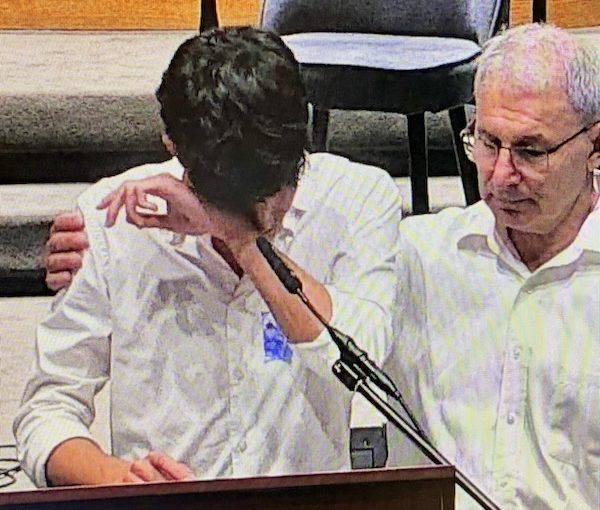
Geoffrey Druker, who leads the community’s annual memorial ceremony, consoles a young speaker on Yom Hazikaron. (photo from Geoffrey Druker)
Emotions were close to the surface April 20 at Vancouver’s annual Yom Hazikaron commemoration. The Jewish community gathered at Temple Sholom to mark Israel’s day of remembrance for fallen soldiers and victims of terrorism – an evening that bridged decades of loss with the raw immediacy of the present.
Geoffrey Druker, who has led the annual ceremony for many years, shared multiple stories spanning decades, reflecting the losses in Israel’s many wars and incessant terror attacks.
A photograph from 2005 showed four young commanders from the Golani Brigade. Within a year, two of them – Benji Hillman and Roi Klein – would be killed in the Second Lebanon War. Hillman died in battle and, six days later, Klein was killed after throwing himself on a grenade to save his soldiers.
Nearly two decades later, the tragedy continued.
On Oct. 7, 2023, the two surviving commanders in the photo – Roi Levy and Yizhack Ben Bassat – rushed from their homes to defend Israeli communities under attack. Levy was killed that day at Kibbutz Re’im. Two months later, Ben Bassat was killed during the war in Gaza.
Col. Yizhack Ben Bassat’s sister, Hamutal, is a member of the Vancouver community and lit a candle in his memory.
In the 40 days of Operation Roaring Lion, the initial war with Iran, Druker said more than 20 civilians and 13 soldiers were killed. Among the civilians killed was Ofer Moskovitz.
“He was better known in the region and throughout Israel as ‘Pushko,’” said Druker. He was a farmer in charge of the avocado orchard of Kibbutz Misgav Am, which is located right on the border with Lebanon, in Vancouver’s partnership region of the Upper Galilee.
“Veteran members of our Federation partnership committee met with him numerous times during visits to the region,” said Druker. “He was 60 years old.
“Tonight we remember them all,” Druker said, as the congregation rose for a moment of silence.
The ceremony moved between individual stories and collective grief, underscoring the scale of loss while emphasizing its personal nature.
The evening became intensely personal with the remembrance of Ben Mizrachi, the young Vancouver man killed at the Nova music festival.
“Ben did not run away to save himself when he had the chance,” his mother had said in a previous address that was recounted. “He showed tremendous courage … as he tried to save others.”
This year, the graduate of King David High School was remembered by his uncle, Mooshon Mizrachi.
Many other stories were read aloud and relatives and community members read Yizkor and lit candles, transforming the ceremony into a living bridge between Vancouver and Israel.
“These past years, Israel has been engaged in wars on five fronts,” Druker noted, referencing the sustained conflict that has affected every part of the country.
The story of brothers Amit and Yigal Vax, killed defending their community during the Oct. 7 attacks, was told as a recollection of that morning – sirens, explosions and the sudden realization that terrorists had entered their village. The account described fear giving way to terror, as residents hid in safe rooms as gunfire echoed outside.
“Amit … heard gunfire … grabbed his weapon … and was killed,” Druker recounted. His brother Yigal, armed only with a machete, was also killed trying to defend their home.
Sivan Keidar, a member of the extended Vax family, lit a candle in their memory.
Throughout the ceremony, music and ritual provided a framework for mourning. Songs such as “Ad Machar” (“Until Tomorrow”) and “Makom L’de’aga” (“A Place to Worry”) reflected the emotional landscape of grief.
Shinshinim, Israeli teenagers participating in a year-of-service program in Vancouver, spoke about the legacy they have inherited – one shaped by wars they did not experience directly, but which continue to define their lives.
Eliyahu Kaminsky of Congregation Schara Tzedeck synagogue recited the memorial prayer El Maleh Rachamim.
The following is the executive summary of the study The Canadian Museum for Human Rights and Its Nakba Exhibit: Bias and Animus in Process and Outcome and the Nature and Impact of the New Antisemitism in Canada, written by Dr. Bryan Schwartz, a professor of law at the University of Manitoba, and Rhonda Spivak, LLB, editor of the Winnipeg Jewish Review. It is reprinted with permission, edited for JI style and length. The exhibit is set to open in June. For a link to the full study, go to winnipegjewishreview.com.
The proposed Nakba exhibit at the Canadian Museum for Human Rights (CMHR), titled Palestine Uprooted: Nakba Past and Present, is not a balanced exploration of displacement. It is a partisan exercise in the demonization and delegitimization of Israel – driven from its inception by a process whose composition predetermined its outcome.
A publicly funded national museum exhibiting biased content that vilifies one national/ethnic group’s homeland constitutes a discriminatory denial of equitable human rights education.
The process and work product – to the extent it is already available – are not consistent with the CMHR’s statutory mandate under the Museums Act, the Canadian Human Rights Act (CHRA), the International Holocaust Remembrance Alliance (IHRA) definition of antisemitism adopted by both Canada and Manitoba, and the ethical codes of the Canadian Museums Association (CMA) and International Council of Museums (ICOM).
The bias is structural and traceable. The CMHR assembled a Palestinian Content Advisory Network whose membership was kept opaque – referenced once in the 2022/23 annual report and then deleted. Investigation reveals that its members hold views that are hostile to Israel and not sustainable on a fair-minded analysis of history and current realities.
Ramsey Zeid, president of the Canadian Palestinian Association of Manitoba and member of the advisory network, has publicly called Zionism a “disease that must be destroyed,” accused Israel of genocide, rationalized the Oct. 7 massacre as Palestinians “biting back,” and condoned violent intifada with language such as “intifada revolution … scorch the earth.” Other advisory network members have framed Israel as an apartheid settler-colonial state, endorsed the boycott, divestment and sanctions (BDS) movement, advocated one-state solutions that would deny the right of the Jewish people to their own state, have accused Israel of genocide at its founding and in Gaza, and compared Israel to the Nazis. The CMHR cannot credibly claim that work product shaped by this group is free of bias and animus rather than driven by it. By including persons with such views in an official advisory committee, it has extended official recognition and an aura of respectability to them.
The process excluded and marginalized the mainstream Jewish community at every stage. There was no public consultation of the kind that accompanied the Holocaust gallery. The Jewish Heritage Centre of Western Canada withdrew its partnership with the CMHR over the exhibit. The Centre for Israel and Jewish Affairs (CIJA) warned that the exhibit would deliver an incomplete and unbalanced narrative that would omit Jewish refugee experiences. The Abraham Global Peace Initiative (AGPI) wrote to the CMHR, the minister of Canadian Heritage and the prime minister requesting suspension.
Jewish organizations who supported the exhibit are fringe anti-Zionist groups, such as Independent Jewish Voices (constituting at maximum 0.2% of Canadian Jews, this report places them around 0.0025% of Canadian Jews), the United Jewish People’s Order (expelled by the Canadian Jewish Congress in 1951, and whose membership has never surpassed their 1950s numbers, placing it well below half a percent of Canadian Jews; it seems that their largest attended event in recent years was around 350 people total) and the Jewish Faculty Network (less than 0.05% of Canadian Jews). IJV and UJPO were involved with the organization that organized a Nov. 2, 2025, panel at which the exhibit’s director discussed her involvement in the exhibit.
The exhibit’s content is equally one-sided. The CMHR’s potted history, as per its website, attributes Palestinian displacement primarily to Jewish and Israeli armed forces while omitting critical context: Jewish acceptance of the 1947 UN Partition Plan, repeated Arab rejection of two-state solutions, the invasion by five Arab armies to destroy the nascent Jewish state, over a century of lethal anti-Jewish violence in Mandatory and Ottoman Palestine (documented from at least 1834), the ethnic cleansing of approximately 850,000 to 900,000 Jews from Arab countries after 1948, and the documented pattern of rejectionist violence against moderate Palestinians who favoured coexistence.
The very term “Nakba” – originally coined to describe the catastrophe of Arab armies’ failure to destroy Israel – has been recast to frame Israel’s founding as an illegitimate catastrophe, implicitly justifying campaigns to eliminate it. The CMHR exhibit instead insists that “Nakba” refers only to the displacement of Palestinians and avoids acknowledgement of Arab rejection of the two-state solution, of the right of Israel to exist as the Jewish homeland, and the armed invasion of Israel by the armies of five Arab states aimed at Israel’s destruction.
The museum’s diversity policies require representation of multiple perspectives, especially on contested histories, which in this case requires presenting sources that nonviolent Palestinian villages were allowed to stay, multiple Arab sources showing calls by Palestinian leadership and Arab states for evacuation of villages to further the Arab war effort, or leave rather than give the nascent state of Israel legitimacy…. Since Israel is an open society, multiple lines of scholarship diverge. That is not the case in Arab states, which have not opened their archives. Nor is it the case in the Palestinian Authority, where President [Mahmoud] Abbas made “Nakba denial” a crime subject to jail terms.
The exhibit, as Zeid’s own statements make plain, rests on a double game. The exhibit is presented as a collection of individual personal narratives – merely “telling stories” about the effects of displacement, yet it simultaneously advances “the story” that is supposedly the single overall historical truth. The audience is expected to accept these personal narratives as historical fact, even in the context of an advisory network whose documented members variously call Zionism a “disease” or a virus that must “be destroyed” and adopt other epithets that demonize and delegitimize the Jewish state.
It is known that oral histories can contain varying degrees of fact and can be coloured by “collective memory” – political perspectives on past events that are widely shared but may not reflect fairly or fully the actual events of individual lives in earlier generations. Judging from the composition of the Palestinian Content Advisory Network, we can expect these stories to be infused with negativity towards Israel and a lack of any historical context.
In practice, we can expect that many or all narratives in this exhibit may be an occasion to vilify Israel, from its foundation until the present. For example, it may speak of checkpoints without mentioning the suicide bombings that necessitated them, of displacement without mentioning Jewish acceptance of partition and Arab rejection of it, of suffering without acknowledging that it was Arab rejectionism and aggression that created the refugee crisis in the first place.
The “personal story” framing is a shield against accountability: it permits the museum to disseminate a partisan political narrative while disclaiming responsibility for its historical claims. This exhibit will contribute directly to the rising tide of antisemitism that has made Canada an increasingly dangerous place for its Jewish citizens, as documented in … this report.
This selective framing constitutes the “Three Ds” of antisemitism identified by Natan Sharansky and popularized in Canada by former justice minister Irwin Cotler: demonization, delegitimization and double standards applied to Israel. It occurs at a time when Jews face the highest per capita hate-crime targeting of any group in Canada (Statistics Canada). Many Jewish Canadians feel unsafe in their own country, even though both Prime Minister Justin Trudeau and Prime Minister Mark Carney publicly affirmed Zionism and Israel’s right to exist and prosper. Those are the rights that the advisory network has dismissed for this exhibit.
The CMHR, in the aftermath of the genocidal attack on Israel in 2023 and the ongoing brutalization of hostages, allowed an unauthorized pro-Palestinian “die-in” inside the museum. This “die-in” was allowed while refusing a request from supporters of Israel for a counter-demonstration, a disparity that exemplifies the institutional bias at work. [CMHR vice-president of exhibitions] Matthew Cutler’s public statements at the time made it unmistakable that the museum had already promised off the books, without public consultation from the Jewish community, to include an exhibit that focuses on the contested oppression of Palestinians by Israel.
Officials of the CMHR have, on the public record, favoured anti-Israel fringe groups while showing disrespect for the groups that represent the overwhelming majority of Jewish Canadians. The museum has not been transparent with the general public or the mainstream Jewish community. This invites the question of how transparent museum bureaucrats have been with the museum’s own board of trustees, who are responsible for fulfilling the museum’s mandate and maintaining its reputation.
The exhibit in its current form must be halted. The CMHR must commission an independent historical review by balanced, credentialed experts. It must require transparent public consultation, including meaningful engagement with mainstream Jewish Canadian organizations; ensure the exhibit includes parallel refugee stories, Arab rejectionism, the full context of the conflict; and conduct a governance audit of curatorial processes to prevent future partisan capture.
Proceeding instead risks CHRA complaints, further reputational damage and continued erosion of public trust in a taxpayer-funded national institution whose mandate is to promote universal human rights, not to serve as a vehicle for the delegitimization of the Jewish state.
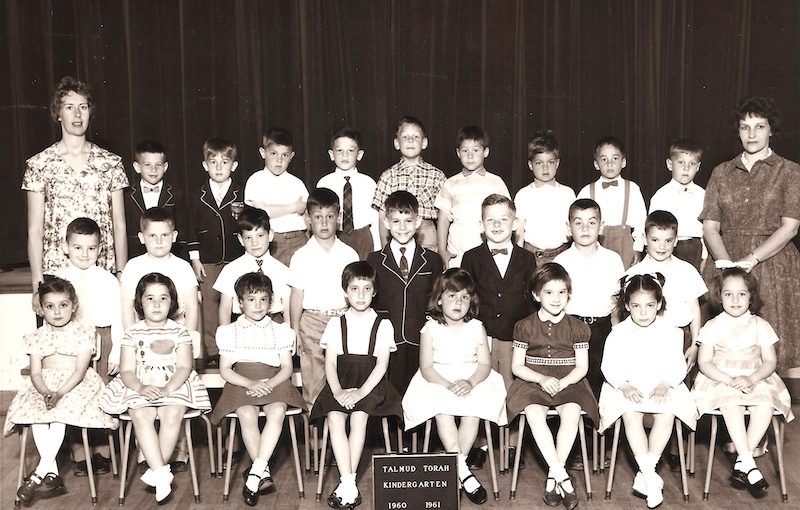
David Bogoch, second from the left in the second row, is one of three generations of his family to attend Vancouver Talmud Torah. (photo from David Bogoch)
“David has been so dedicated to VTT,” Vancouver Talmud Torah head of school Emily Greenberg told the JI about why the school is honouring David Bogoch at their May 14 gala.
“From his dedication to our archives and to his preserving our traditions and our history, to being really forward-focused and really understanding what the school needs to be successful,” she said.
“He’s also been very dedicated to our alumni and, as an elementary school, having an engaged alumni is a bit more challenging than a high school, just inherently, but he’s really been an advocate,” she added, noting that Bogoch has been a mentor to her.
“I came here seven years ago, and he was one of my very first meetings that I had,” she recalled. “He and I meet semi-regularly and he’s somebody I can pick up the phone and call at any time and say I need your advice on this…. And what I know is that he has no other agenda than VTT must be a successful place, and we must make sure we’re doing well to serve the community and to serve Vancouver’s Jewish future.”
Bogoch also connected VTT with Stable Harvest Farm. Syd Belzberg has a named space at the school, so was already a big supporter, but, in recent years, he has focused his philanthropic efforts on the nonprofit community farm. VTT’s partnership with Stable Harvest has been central to the school’s plant-based learning program and most of the students are out there at least once or twice a year, said Greenberg.
“We now have curriculum across all grades where our kids are integrating and learning through plants … not just the growing cycle but environmental technology, environmentalism, how to care for the land, the agrotechnology that’s coming out of Israel – drip irrigation, for example, it’s in our garden and it’s something that Syd uses…. The partnership with the farm and then our Jewish Community Garden … has been just an amazing marriage.”
Plant-based learning is one of the school’s hallmark programs, what differentiates VTT from other schools, said Greenberg. Funds raised from the gala will go towards it, as well as the school’s hallmark athletics, arts and other programs.
“Then, of course, there’s always tuition assistance – that’s a piece that we want to continue to support so that all families who want a Jewish education are able to attain it,” she said.
“This coming year, we’re introducing a universal lunch program, so all of our kids are going to be on a meal plan,” Greenberg said, which means the kitchen will need outfitting and the dining hall updating so that the school can “feed about 600 people a day a kosher, healthy lunch that will be tied into some of our plant-based learning…. That’s definitely a high undertaking of the school that we’re hoping to fund.”
For his part, Bogoch said, “I would love to see record amounts of money being raised – and I’d like to see record amounts of attendance and satisfaction.”
Bogoch’s father, Dr. Abraham (Al) Bogoch, was “Mr. Talmud Torah,” spearheading multiple building campaigns on behalf of the school, among many other things. And David Bogoch has followed in those footsteps. He’s been the keeper of VTT’s archive for more than 20 years and is responsible for the alumni portfolio.
“Why? Because it’s a good puzzle,” he told the Independent. “Trying to find every person that went to TT since 1918, trying to identify them, whether they’re living or dead, what’s their current email address and phone number, their mailing address.”
He noted that, every decade or two, the names one sees on various boards and in other community activities and volunteer positions change. For example, when more Israelis started coming, there were more Israeli names. “Same thing happened in the ’50s, when all the Hungarian kids showed up, so they had different names. When Soviet Jewry ended up leaving Russia and coming over…. When Yugoslavia broke up, there was an influx in kids at Talmud Torah with unusual last names.”
David Bogoch, curator of Vancouver Talmud Torah’s archive, will be honoured at the school’s May 14 gala. (photo by Jennifer Shecter)
It is from exploring the school’s archives that Bogoch sees such trends.
“Every time somebody adds something to the archives, whether it’s photos or documents, it’s always adding to the inventory, so now we’re well over 50,000 documents, photos, in the archives,” he said. “And it’s growing like crazy because we haven’t included [yet] a lot of the digital stuff that Jenn [Shecter] or the other people at the school are taking. And, each year, there are new alumni.”
The archives has benefited from past presidents keeping material from their time on the school’s board, said Bogoch. He also has gone through every Jewish Western Bulletin/Jewish Independent from 1925 to about 2010, copying every mention of Vancouver Talmud Torah.
“We got so much of the information about the history of the school through the Jewish Independent, through the Jewish Western Bulletin,” he said, listing off some of the many types of fundraisers the school has had over the years. “The most weird one,” he said, “was a Gentleman’s Smoke, where they got together, they drank some whiskey and they smoked, either cigarettes, cigars or pipes.”
Seeing how the community has evolved and how the city has changed are two of Bogoch’s favourite aspects of working with the archives, “finding out the early stories of Strathcona,” and stories from when most of the Jewish community moved “to False Creek, and then to Oakridge, and spreading all over the Lower Mainland.”
In preparation for the gala, he’s been going through material with his son, Adam, who knows the school’s history as well as his dad and grandfather, having not only attended VTT but also having written and directed the one-hour documentary Vancouver Talmud Torah Onward: The 100-Year History, which was released in 2017, as part of the school’s centenary celebrations.
While the most visible Bogoch link to VTT is via the paternal side, from father to son to grandson, David Bogoch’s mom, Margaret, was also involved – in the PTA and in fundraising – as well as with other Jewish organizations, such as Hadassah.
The gala event honouring Bogoch is aptly called The Roots We Share.
“There are families that have four generations who have gone to TT. That’s pretty amazing,” he said.
“Right now, the school is so strong, I could not see it failing. You never know what happens in the future, but I can almost guarantee that, if you have people in the background who are willing to step up and make sure it doesn’t fail, it’ll stay. That’s the way I look at my role – behind the scenes. I don’t like to be up front, that’s why this is so unusual, to be up front,” he said about being honoured.
He hopes that people will be inspired by what fellow community members have done to keep Jewish communal life going. He wants people to feel as excited about the school as he is.
At the May 14 event, guests will enter through a passageway of photos from throughout VTT’s history. Adam Bogoch also will create a video tribute to his dad, as well as a video for the night’s formal fundraising ask. He has been tasked with creating other event exhibits that highlight his dad’s archival work.
“Time capsules, in a sense,” said the younger Bogoch. “Guests will be transported into different decades of the school’s history, seeing themselves as children, their parents/grandparents and their old teachers/colleagues, visually experiencing where the school has been, where it is today, and hopefully how it will continue.
“The event is called The Roots We Share and, whether those are old roots or ones just taking shape, what will hopefully be realized is a continuum of values, experiences and purpose.”
“When we understand that we’re part of that history,” said Greenberg, “we understand the purpose of what we’re doing – and no one understands that more than David – that we are linked to our history, we’re linked arm and arm with it, and that’s what will help propel us into the future. We have to have that proper respect and honour for the past, and also the shoulders we stand on, and he really understands that…. He’s such a bridge in so many ways for the school.
“He’s a bridge between the past and the future, he was a bridge to Stable Harvest Farm, he’s been a personal bridge for me to this community and I’m just so grateful for his ongoing engagement in the school,” she said. “He obviously gets great joy from it and I always tell him, he’s not allowed to go anywhere.”
Michael Posner, author of Leonard Cohen, Untold Stories, was Kolot Mayim’s final speaker in this season’s Zoom lecture series. (photo from Michael Posner)
Kolot Mayim Reform Temple’s 2025/26 Zoom lecture series on Jewish music concluded April 12 with a talk by Michael Posner on Hallelujah and Beyond: Leonard Cohen’s Torah of Song.
Posner, a playwright, author and journalist living in Toronto, penned Leonard Cohen, Untold Stories, covering the musician’s life from his early years in Montreal to his death in Los Angeles in 2016. Posner drew on more than 500 interviews with Cohen’s family, friends and others to offer a complete portrait of the man and his art.
“It won’t surprise many of you to know that Leonard was a very complex character, a very complicated individual,” Posner said. “In fact, when I speak about the Jewish soul of Leonard Cohen, it’s necessary to attach what I would call an asterisk to that description. The asterisk is actually very appropriate to Leonard, and maybe essential, because he was a man of many moods and many masks, many manifestations and many contradictions.”
Cohen had a profoundly Jewish soul, according to Posner. Not only was he a kohanim (descendant of Jewish priests), but an ancestor was the unofficial chief rabbi of Montreal, his grandfather was a talmudic scholar and portraits of Cohen’s forefathers feature prominently on the walls of Congregation Shaar Hashomayim in Montreal.
“From the time that he starts writing, as a teenager in the early 1950s, Jewish themes and motifs, Jewish imagery and history infuse his art – they are a very essential part of the first four books of poetry that he wrote,” Posner said.
It is through his music, however, that Cohen achieved international fame, and many of his songs “cleverly exploit Jewish ideas and scripture,” said Posner.
In “Who by Fire,” for example, which echoes the Unetaneh Tokef prayer of the High Holy Days, Cohen is not rejecting faith, so much as trying to establish, in the wake of the Holocaust, the grounds of continuing faith, argues Posner.
“The metaphor here,” he said, “is a kind of corporate secretary fielding phone calls on behalf of humanity itself, some of whom will live and some of whom will die in the next year, according to the decree of the caller. But who, exactly, is the caller? Who is at the other end of the line? Dear God, it’s me, Leonard. Are you still there? Can you please identify yourself? This is a theme that Cohen mines continually.”
In “Hallelujah,” Posner spots irony in the line, “There was a time you let me know / What’s really going on below / But now you never show it to me, do you?”
The song is often perceived as a celebration of God, but, Posner said, “I don’t think people have paid close enough attention to the lyric, because the lyric is really saying, we want to believe in you, God, but it’s not that simple.”
Posner discussed Cohen’s struggles with established Judaism and his spiritual exploration that delved into other faiths, including Christianity, I Ching and Sufism; Cohen was devoted to Rinzai Zen Buddhism and ordained as a monk in 1996. Nonetheless, there were several aspects of Judaism that Cohen honoured.
“In the 1970s, he began to study with a Chabad rabbi in Montreal and routinely traveled when he was on tour with his tallis and tefillin bags,” Posner said. “In later life, he joined a synagogue in Los Angeles, whose rabbi, Mordecai Finley, was deeply steeped in kabbalah. And, later still, he studied online with Yakov Leib HaKohain, another rabbi who was immersed in the mystical aspects of Judaism.”
Cohen, in Posner’s view, touched upon everything that is human – magnificent, brilliant, humorous and generous, yet capable of being cynical, depressed, angry and jealous.
“I think that is really what I ultimately draw from this fantastic human being – that enormous complexity, an enormous soul that tried to reach beyond our everyday lives and look at the enduring qualities that make us human,” Posner said.
Kolot Mayim’s next series starts in November, with the theme of “Lech Lecha: Journeys of the Soul.”
Sam Margolishas written for the Globe and Mail, the National Post, UPI and MSNBC.
Jews are not a homogeneous group in ritual, beliefs, thought or experience. We are diverse, coming from many different places, speaking countless languages, putting our unique spins on food, music and other cultural aspects. We are both a religion and a nation. Yet, despite the differences, we are connected to one another in myriad ways, linked by shared ancestry and core values, as well as by external forces that, all too often, are hostile.
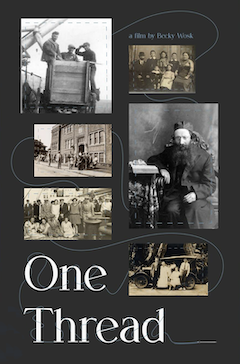
“The documentary you are about to watch highlights the resilience and unity of the Jewish people, surviving thousands of years of persecution, violence and dispersion while staying connected, hopeful and shining light in the darkest times,” narrates Becky Wosk at the beginning of her film One Thread, which screens May 3, 1 p.m., at Fifth Avenue Cinemas, as part of the Vancouver Jewish Film Festival.
Becky Wosk’s documentary One Thread, which highlights the BC Jewish community, screens May 3 as part of this year’s Vancouver Jewish Film Festival, which runs April 30-May 10. (screenshot from Instagram)
The documentary is a reminder that, while there are so many reasons to be proud of being Canadian, many (most?) immigrants to Canada, Jews included, have come here from somewhere else not so much by choice, but because of adverse conditions in their home country. We must also remember that Canada has not always been a welcoming place for newcomers or, of course, for the peoples who were here before any Europeans arrived. Sometimes, Canada has completely closed its doors, as in the case of Jews fleeing the Holocaust on the MS St. Louis in 1939.
In One Thread, Wosk interviews 15 members of the BC Jewish community. They share brief overviews of their family histories, how they ended up in British Columbia. Most of their ancestors were fleeing persecution or arrived as a survivor of it. Their families sometimes traveled via other countries or provinces before settling here.
Wosk asks interviewees what being Jewish means to them, what they wish non-Jews knew about Jews and Judaism, their favourite parts about being Jewish, and other questions. The answers are both similar and different. They offer a glimpse into the challenges and joys of being Jewish.
Wosk has done a masterful job at editing some nine hours of interview recordings into a 42-minute documentary that includes some wonderful archival footage and photographs. She lets viewers know that Jews are roughly 0.9% of the Canadian population (2021 data) and 0.2% of the global population (2023). She bookends the film with two quotes that reinforce her themes of resilience, unity and hope, and she highlights Canada’s message to Jews wanting to come here after the Holocaust: “None is too many.” But, mostly, she lets her interviewees tell the story.
“I was a student in the Langara film arts program (directing stream) and the head of the program, Jonas Quastel, sent me the application for the Earl Parker Award for Jewish Film via the Edmonton Jewish Film Festival,” Wosk told the Independent about the film’s origins. “I applied with the idea to document some of the history of the Vancouver Jewish community, as well as the commonalities of Jews in the diaspora. As someone who is a documentary lover, and a genuinely curious human, I really wanted to share local community members and their stories.”
She found those community members by putting a call out through local organizations and social media groups. She wanted people from a range of ages and genders. While everyone she spoke with lives in British Columbia, some of them are from other places originally, including Argentina, the United States and other provinces.
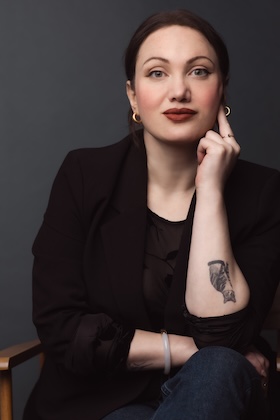
Becky Wosk, director of One Thread, which screens May 3 at Fifth Avenue Cinemas. (photo by Kristine Cofsky)
Her own family history illustrates the different places from which community members have come and the impacts they have had here.
“My paternal great-grandparents came to Canada from Ukraine in the early 1900s,” said Wosk. “That side of the family was actually documented in the book by Shirley Barnett, Don’t Break the Chain: The Nemetz Family Journey from Svatatroiske to Vancouver. My paternal great-grandfather, Abrasha Wosk, was a pioneer of the Vancouver Jewish community. He secured the building and funding for the original Schara Tzedeck and helped start the Hebrew Free Loan Association.”
Her paternal great-grandmother, Abrasha’s wife, Chava (Nemetz), was a community builder in her own right.
“My maternal great-grandmother, Rose Cohen (Beckerman), came from North Dakota; her family came over from Eastern Europe. My maternal great-grandfather, Maurice Cohen, was from Lithuania, the rest of his siblings went to South Africa. He came to Prince Rupert and opened a dry goods store called Director, Cohen & Co.”
Wosk’s grandparents were all born in Canada, she said, except for her paternal grandmother, who was from Manchester.
“It reinforced the feeling of being part of something bigger than oneself, something very deeply rooted in ancient spirituality,” said Wosk about making the film. “I loved being able to chat with the interviewees about our favourite foods and holidays. I just love witnessing the common thread in our existence, the ties to our ancestors, and the genuine desire to learn.”
As winner of the 2024 Earl Parker Award for Jewish Film, One Thread screened at the Edmonton Jewish Film Festival in 2025.
“It’s one thing to create something, but to get it in front of an audience is a whole other matter, so having these opportunities is invaluable,” Wosk told the Jewish Federation of Edmonton’s HaKol at the time.
She is very excited to have the film now screen at the Vancouver Jewish Film Festival. “I want our community to know that we are stronger together, and we need to lift each other up – especially in the face of adversity,” she told the Independent.
“As a people, we face a lot of hate, especially online” she said. “It’s easy to open up Instagram and just be bombarded by antisemitic individuals and just awful comments. I try to find peace and strength in the fact that we do have this incredible community of resilient, strong and compassionate people. We are part of an ancient quilt, and we can always tap into that communal comfort whenever we need to.”
Currently working as a freelance director and videographer, Wosk said she will soon be starting a feature screenplay that relates to her family history and, separate from that, she is hoping to start a new documentary film in the next year or two. Her band, Hollow Twin, will be releasing some new music later this year.
The Vancouver Jewish Film Festival runs April 30-May 8 at Fifth Avenue Cinemas, which is a 19+ venue, and May 10 at the Rothstein Theatre. For the full lineup of films and tickets, go to vjff.org.
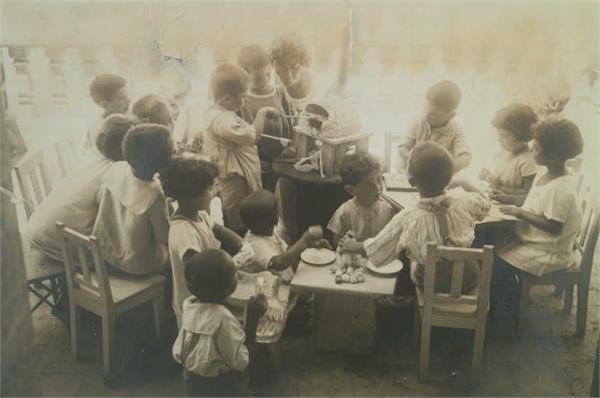
Kindergarten children preparing matzah, 1925.(photo by Joseph Schweigh, KKL-JNF Photo Archive)
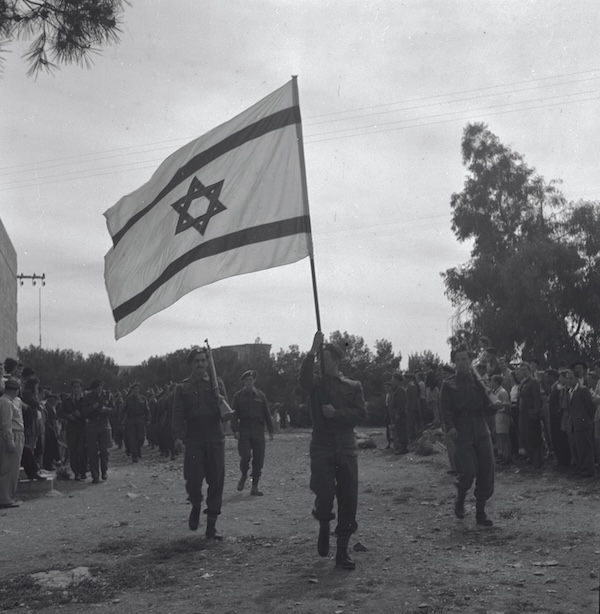
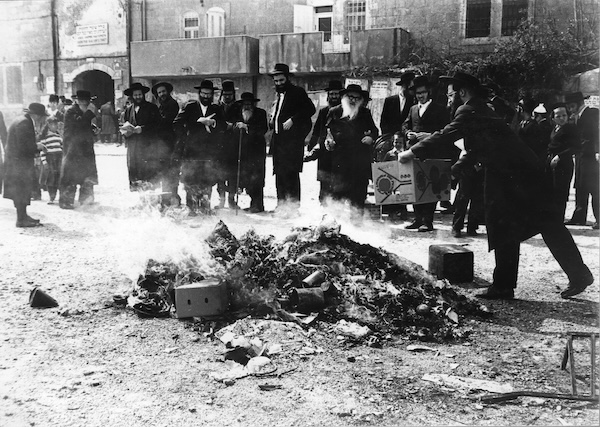
In uncertain times like these, as the war with Iran continues, attention often turns to the traditions and customs that have carried generations through both hardship and renewal. Against this backdrop, Keren Kayemeth LeIsrael–Jewish National Fund (KKL-JNF) has shared some rare images from its photo archive documenting Passover across the years. The images, dating from before the declaration of the state of Israel, reflect enduring elements of Jewish life, including tradition, education and communal practice.
A festive parade of Jewish soldiers during Passover in Jerusalem, 1948. (photo by Rudolf Jonas, KKL-JNF Photo Archive, KKL-JNF Photo Archive)
Among them are a photograph from the 1920s showing kindergarten children preparing matzah dough; documentation from a festive Passover parade for Israeli soldiers in 1948, the year of Israel’s independence; and families in Jerusalem’s Mea She’arim neighbourhood participating in the burning of chametz in 1983, a year marked by the effects of the Lebanon War. Though decades apart, the scenes show how holiday practices supported community connection and hope during periods of instability.
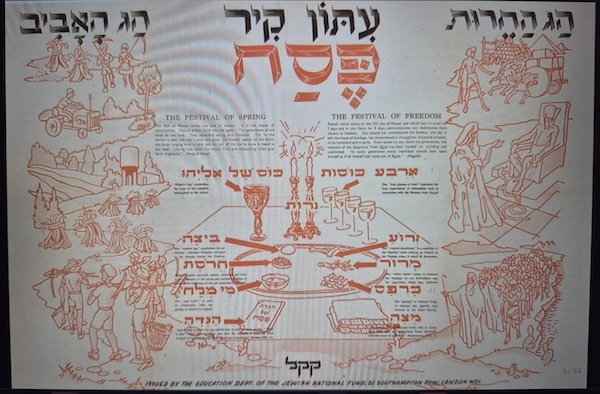
A wall newspaper produced in the 1950s and 1960s by Keren Kayemeth LeIsrael–Jewish National Fund’s education department, which was displayed in Jewish schools in England. (photo from KKL-JNF Banner collection displayed in the Central Zionist Archives in Jerusalem)
The archival materials also include a wall newspaper produced in the 1950s and 1960s by KKL-JNF’s education department, which was displayed in Jewish schools in England. The poster places the Exodus from Egypt alongside images of agricultural work, tree planting and communal life in the land of Israel, illustrating how Passover was given renewed meaning in the Zionist era as a bridge between a biblical narrative and a modern vision of national renewal.
The burning of chametz in the Mea She’arim neighbourhood in Jerusalem, 1983. (photo from KKL-JNF Photo Archive)
“These photographs show how people held onto tradition, community and hope during uncertain periods,” noted Efrat Sinai, director of archives at KKL-JNF. “Viewed today, they highlight both historical experience and the sources of resilience that continue to shape Jewish life. Passover appears here as a living educational framework, a connection between Jewish communities in Israel and abroad, and a reflection of the strength of these communities across generations.”
KKL-JNF’s photo archive, which contains tens of thousands of historical photographs, serves as a living chronicle of life in the land of Israel and beyond. Together, these materials are a reminder that the story of Israel has never been defined by hardship alone, but also by its ability to hold onto hope, tradition and the promise of brighter days ahead.
– Courtesy Keren Kayemeth LeIsrael-Jewish National Fund
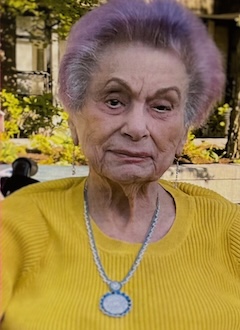
My Aunt Hazel is 98 years old. They call her “the Queen” at Louis Brier Home and Hospital because, when she enters a room, she commands attention. I visited her in February, and she told me about her life in India, Iraq, Canada and elsewhere.
Hazel Stevens, 98, has had quite the life. She still commands attention. (photo from Lisa Stevens)
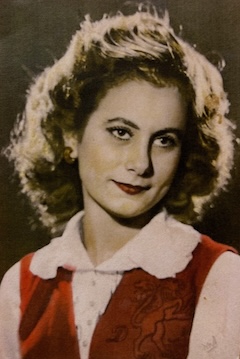
Hazel Stevens (née Moses) was born in Bangalore, India, in 1928. By the time she was 18, she had five brothers and five sisters. Her parents, my grandparents, were from Baghdad, Iraq.
Despite being one of maybe five Jewish families in the whole city, they kept kosher and made their own matzah. When Passover was over, their Hindu and Muslim friends would bring them bread.
Hazel’s mother and father ran a clothing store, so, to some degree, the six girls in the family, who were born first, were brought up by the servants. The five boys who came next were brought up by the girls.
What I noticed as a child growing up was that Hazel was clearly the funniest person in the family. When we all got together, she would chant slogans from Gandhi’s National Congress Party with incredible enthusiasm. Everyone would laugh. I think that part of my love for comedy came from her.
Hazel Stevens (née Moses) was born in Bangalore, India, in 1928. (photo from Lisa Stevens)
Hazel was also unequaled in her bravery. One day, a monkey grabbed her sister’s little girl, who was just a baby, and took her up onto the roof of the family’s home. Hazel climbed up to the roof to save her.
“I was frightened because the monkey could bite the baby or throw it off the roof,” Hazel told me. “I had to be very calm. I calmly patted myself and said, ‘Give me the baby.’ Finally, the monkey threw the baby at me.”
Luckily, no harm was done.
A few years later, in 1946, when Hazel turned 18, she visited Baghdad with her parents. It was a time of unrest, just after the Second World War. It isn’t well documented, but my aunt says that there was one week of “hysterical mobs” trying to kill their Jewish neighbours. The Jewish community had faced increasing insecurity for years, including the Farhud (pogrom) in June 1941, during which between 150 and 180 Jews were murdered, 600-plus injured and about 1,500 stores and homes looted, according to the US Holocaust Memorial Museum. In the 1940s, about 90,000 Jews lived in Baghdad, notes the museum, making up a significant portion of the population.
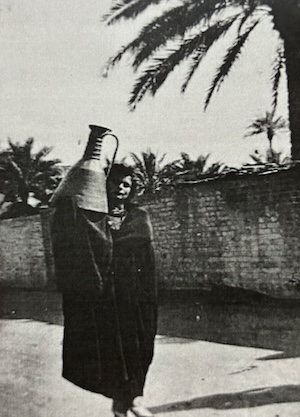
During this time, Hazel and others in the Jewish community were given hand grenades by the Baghdadi government. She fearlessly carried an urn full of them on her shoulder, as she went around the city, delivering grenades to Jewish households.
Hazel Stevens in Baghdad in 1946, with an urnful of hand grenades provided by the government, which she delivered to Jewish community members to use in defence against hostile neighbours. (photo from Lisa Stevens)
“When you are young you are not afraid … because you could run,” she told me.
One night, Hazel joined her family on the roof, throwing stones down at a malicious crowd, which eventually left. Miraculously, no one in Hazel’s immediate family was hurt during this period.
Before her stay in Baghdad, Hazel had begun dating a young British soldier named Desmond (Steve) Stevens. He lived by the YMCA where she played tennis and he would come over and tell her not to hit or throw the balls so far away because the young Indian men would have to run far to retrieve them.
Steve would visit Hazel when she worked in her parents’ store. This was dangerous because girls weren’t allowed to speak to boys in those days, she told me. Dangerous in the sense that she should have been chaperoned.
Hazel would say to Steve, “Quickly, buy something, my parents are coming.”
The pair fell in love, but Hazel’s parents did not approve, as Steve wasn’t Jewish.
When Hazel was in Baghdad, her grandmother set her up with a man she hoped Hazel would marry. But my aunt was as smart as she was daring. She says that, when she met the man, she made all kinds of faces and threw her arms about. It was a very long 30 minutes, said Hazel, but she succeeded in turning him off.
Her daughter Lisa said: “It was her act of insanity that proved to her parents that she loved my dad. She wired him after her parents acquiesced, and he came over to Baghdad to spend some time with her. She told me they took walks and held hands.”
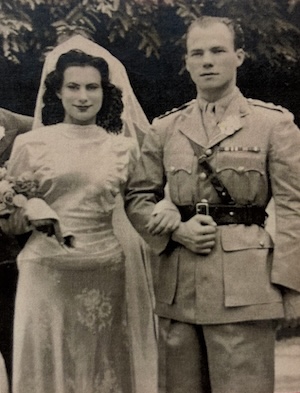
Hazel and Desmond (Steve) Stevens were married in Bombay (Mumbai) in 1947. (photo from Lisa Stevens)
Steve promised to convert to Judaism and he did. The two were married in one of the beautiful synagogues in Bombay (Mumbai) in 1947. I remember that Steve was very knowledgeable when it came to almost anything Jewish.
Most of our family left India when it looked like there was going to be a civil war in 1948. Hazel and Steve went to England. I’m not sure of the order of their travels, but Steve remained part of the British army and so he and my aunt lived in various places in Canada and Europe. During this time, their first two children – Anita and David – were born.
Hazel told me that she was a dancer and remembers winning a $50 prize in her 30s – she can still pull one leg over her head. At the parties she threw, she would dress up in a belly dancing costume that she made, turn on Middle Eastern music and perform for everyone throughout the house. All the kids at the parties would crawl behind her, picking the shiny gold beads that would fall off her dress.
Nineteen years after her first child, Hazel gave birth to Lisa in Vancouver and soon enrolled her in dance classes. Today, Lisa is a director and choreographer, based between New York and Toronto.
Steve was a communications engineer at BC Tel (now known as Telus). He worked with new technology and, unknown to the family until after he retired, he provided spy satellites for NORAD. He was responsible for much of the communication capabilities when NORAD was first built, says Lisa.
Hazel was the homemaker for Marpole Neighbourhood House, where she provided in-home care for seniors and for people with disabilities. She won Homemaker of the Year several times. She also spent a lot of time organizing charity events for Vancouver’s Jewish Community Centre and the Hadassah Bazaar.
Steve and Hazel spent much of their spare time in the spring and summer caring for the front and back gardens of their house on Oak Street. Lisa says they often saw people stop their cars in front of the house and take pictures of the abundance of colour and the foliage.
Hazel ran a bed and breakfast out of her home on Oak Street and continued that after Steve passed away about 26 years ago. She also provided a room for out-of-town families who came here to visit their loved ones at Vancouver General Hospital, as the house was on that bus route.
In her late 80s, Hazel moved into Legacy Senior Living, where she says she led the exercise class at least once when the fitness instructor was away.
In a wheelchair now, Hazel lives at the Louis Brier, where she told me all about her incredible life.
I have a tendency to create funny, bold and daring characters when I improvise onstage and I think that maybe, just maybe, I get that from my aunt.
Cassandra Freemanis a Vancouver storyteller and improviser. She wrote this article with files from the Moses family and from Hazel Stevens’ daughter, Lisa Stevens.
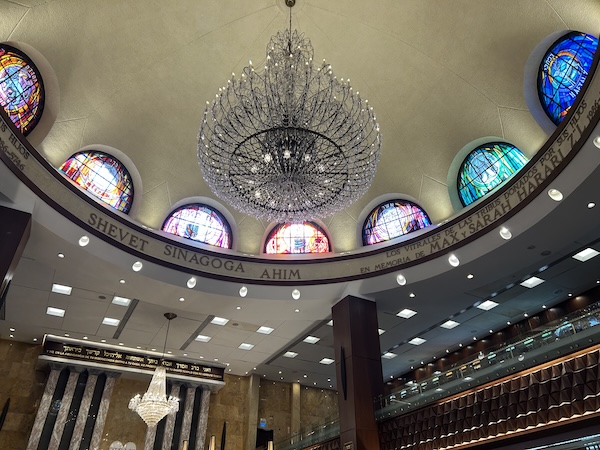
The ceiling of the Sephardic synagogue Shevet Ahim, which is located in the Bella Vista neighbourhood of Panama City. (photo by Janice Masur)
My solo trip to Panama City this past February had seemed so far away when I organized it, knowing I would require some respite from caregiving. I had a yen to experience the Miraflores and San Pedro shipping locks, but not on a cruise. I had listened to a talk from Qesher, a website about Jewish communities worldwide, highlighting Jewish life in Panama, so I gathered my courage to travel alone and booked my hotel and flights. And then my beloved husband died.
This changed my reason for going and started me thinking, What would I do there by myself? How would I manage to converse in Spanish and make myself understood? Could I give a talk about my Ugandan vanished Jewish community? (See jewishindependent.ca/honouring-community.) Despite my concerns, I made the journey.
Panama City was a great place to travel solo – and as a Jew. (photo by Janice Masur)
I had a half-day tour with an excellent Jewish guide, Patricia, to see all four of the Orthodox synagogues, each one more beautiful, all situated within a small area of Panama City.
There were all types of Jews staying in my hotel: a Dutch woman who only recently discovered her Jewish heritage, a fur-hatted Jewish man, and two Jewish Tunisian-born sisters, whose family history included having been ousted from their home in Tunis during the Second World War, their home commandeered to be a Nazi headquarters.
At Kol Shearith Reform synagogue, I struggled with the Spanish and Hebrew prayer book, spellbound by my surroundings. The Sephardic tunes of the prayers made only a handful of them familiar to my ear. The Oneg Shabbat was delicious: fish ceviche and crème caramel, a childhood favourite, as well as several dishes new to me. We stood around the loaded tables and talked.
Jews started arriving in Panama in the 15th century and there are about 17,000 Jews in Panama, with most living in Panama City. Apparently, Panama is a “Jewish bubble,” with basically no antisemitism. I was told that there are many families from Vancouver soon moving there. “Why?” you may ask. Imagine 40 kosher restaurants, two very large kosher stores, apartment buildings housing only Jewish families, a Jewish support system from birth to death, Sephardic Shevet Ahim in the Bella Vista neighbourhood with offshoots in Punta Paitilla, Ashkenazi Beth El Synagogue, two Chabad synagogues, and the oldest synagogue, Kol Shearith.
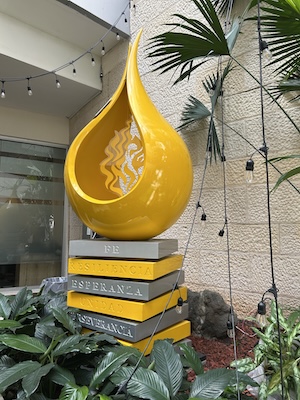
“The Eternal Flame,” an Oct. 7 memorial at Beth El Synagogue in Panama City. The artists were Ilanit Schwartz and Michael Ostroviack. The sculpture is composed of seven levels, each bearing a word: faith, resilience, hope, unity, perseverance, identity and strength. The flame is a reminder that there will always be light, even in the most difficult times. And, within the flame is the Shema Yisrael prayer. There is also the symbol of the “necklace of liberation,” associated not only with the promise to bring home the hostages, but the struggle for life and freedom for all human beings. (photo by Janice Masur)
Geographically, Panama City is situated on a narrow isthmus, making it an elongated city running east-west, mainly facing the Pacific Ocean. It is full of incredibly high and distinctive skyscrapers lining the long promenade.
The Old Town is being gentrified. Hotel La Compañía Casco Antiguo has a Spanish, French and American wing, each built in a different century. A large cathedral faces onto Plaza Herrera, and I saw my first modern-day monk. He was wearing a brown habit and many nuns were spilling out into the sunlit plaza. Brightly painted buildings and small shops catered to the tourists. The imposing Opera House faces the ocean.
I felt quite safe on my own and was touched by how a local family pointed out animals and kept an eye on me as we wandered around Metropolitan Natural Park, where I saw turtles, agoutis and my first ever armadillo.
I took myself to the botanical garden situated about 40 minutes outside the city. Along the route were American army barracks now being repurposed. At the garden, I enjoyed seeing flowers I had never seen before. A large red flower that only grows from a tree trunk; an orange flower whose seed pod is hard and round and slightly bigger than a tennis ball. The garden also showcased two- and three-toed sloths, plus several monkey species. In its far reaches, I saw a lone jaguar, who let out such sad, lonely notes with his rib cage working like an accordion that I could not bear to stay near his cage. I wondered about the information exhorting visitors to take care of the planet and not to shoot wild animals. Jaguars are on the at-risk list because of habitation loss and human interference.
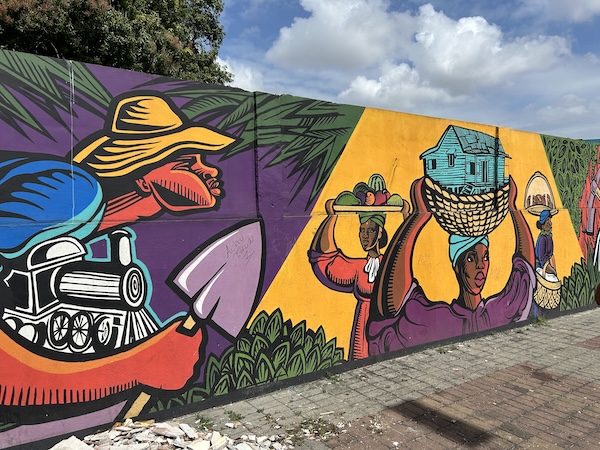
On the spur of the moment, I took a Black African walking tour of the old city. The young guide was very good. Highlights included some colourful historic wall paintings and an old church, which is now a Black African museum. We finished the tour at the San Felipe public market, where I had a large, freshly squeezed and most-welcome passion fruit drink in 32˚ C heat and then crashed on my bed for a nap.
A painted wall in Old Town, depicting Panamanian Black African history. (photo by Janice Masur)
The Biomuseo (biodiversity museum), designed by Frank Gehry, is well worth a visit, with a lovely seawall walk and an eco-friendly garden, where I rested and listened to the birds. I also took a private birding tour, which yielded some wonderful sightings. The couple of hours on my own watching close to 100 pelicans circling and diving for fish was spectacular.
And, of course, I took a tour on a small boat that passed through the Miraflores and San Pedro locks. It was fascinating to observe the speed with which large shipping vessels are lowered and raised through the original canal lock gates, which opened in 1914. Tugs and railway engines synchronize the adjustment of a ship in the lock with steel ropes to prevent it from damaging the canal walls – it’s a specialized job, and I was happy to learn there are some women pilots.
I was warmly welcomed in Panama City, and the Jewish hospitality was inclusive and friendly. It was a fun and easy holiday – it has given me the appetite for more solo adventures.
Janice Masur is a Vancouver author and speaker. Her book, Shalom Uganda: A Jewish Community on the Equator, tells her story of growing up in the bygone Ashkenazi Jewish community of Kampala from 1949 to 1961.
Years ago, I regularly walked with my two bird dogs on streets near my home, in Winnipeg. I had a setter-mix and a pointer, rescued from a Kentucky animal shelter as young dogs, before moving to Canada. I walked them once or twice a day. Our routines were solid. The dogs sat on street corners. They heeled while crossing streets. Strangers admired their obedience skills and called out praise. Others stopped to say hello. I said thank you, but the next question almost always was, “How did you do that? My dog doesn’t….”
The answer, every time, was the same. I walked these dogs for years. Every day, we waited at street corners for cars to pass, and I had my dogs sit. Every time we crossed in traffic, I aimed for two lively dogs who heeled at my side to make the street crossing safer. Now, I own a different dog (another setter mix from the pound) and have twins as well. My family gets complimented about those lovely teens with their good manners, and we all say thank you. How did we do it? The same way – with consistency and positive reinforcement.
Our Jewish lives are also full of ritual and routine. No matter your level of observance, some of those repetitions stick. Perhaps you say a blessing when you wash your hands or do blessings before eating. Others may light Shabbat candles, attend a family seder or use Yiddish phrases of endearment. Some hum Jewish music or embrace Jewish values. These visible and invisible parts of our identity are so ordinary that we may not think about them much.
I’ve heard rabbis express their congregants’ disinterest in the specifics of how to build the Mishkan, the Tabernacle, in the wilderness in Exodus when reading the Torah portion each year. Yet these details mattered enormously to the many people who used the information as “how-to” guides. These were people with great skills, those who spun the finest linen yarn or wove the curtains, dyed the textiles the right shades using natural materials, or who worked gold and silver to create ornamentation. Later in our history, the priests who made the sacrifices in the Temple in Jerusalem needed to know how to do those sacrifices properly. The rabbis debated and recorded these routine details, even though the Temple no longer existed. The information was precious. It was a guide for the Jewish people.
The details illustrate how meaningful it was to create this beautiful “home” for the Divine. Today, we may not understand the details of how spinners, goldsmiths or hand-dyers worked. However, our texts record their efforts, these gorgeous descriptions, for a reason.
Just as our body is the “container” for our soul, our homes and synagogues are now our mishkan, our sanctuary. How we create beauty and routine matters. A house that’s functional and attractive is one where we find rest and peace to escape the outside world.
Like the daily dog walk, other routines or “sacrifices” make our houses and gardens functional and humming. It’s a pain to clean up thoroughly, whether dusting, scrubbing or sweeping. Still, these small moments add up to a clean, healthy and safe place to live. Clinging to these rituals also orders our lives when we’re mourning or stressed.
Many have seen social media images of Israelis, family or friends, rushing to their shelters to stay safe during the war. Recently, I saw a clip of a mom who taught her small children that, when they heard a big boom in the shelter, they should say, “Olé!” She created a quirky, positive celebration of life to respond to missiles and the Iron Dome response. That routine helps create resilience during anxious moments. We can panic when we don’t know what to do. Solid routines (rituals) create order during difficult times.
About eight years ago, I crossed a busy street in front of my home with my (new to me) adolescent, large dog. We tripped over each other. I literally fell and rolled at an intersection full of fast-moving cars. Kind people asked if I was OK as I got up from the pavement, but some stopped their cars to yell at us instead. This further panicked an already bruised and disoriented young dog and owner. My long routines of dog walks helped me get up, calm the new dog and get across the street safely. The drivers, jostled by this upsetting event, lost their calm commute. While I was bruised, I had the tools to get up again. I could proceed without yelling rude things back.
Every dog walk is an opportunity for training and reassurance. Every meal is a chance to rejoice in good, tasty food with people we love. We make the ordinary something special. When we’re faced with upheavals, a bad tumble or even a war, we can find resilience in the rituals and beauty of each day as it comes. Jewish life offers repeat performances, if we choose to embrace them.
While I sometimes dread chores like weeding, our small choices each day, what we plant or weed, can become glorious garden landscapes later. Similarly, big Shabbat meal prep for family and friends can feel overwhelming. However, when I break it down into first steps and familiar routines, baking challah or turning out salads, I regain calm. And, with each gathering, the bonds with family and friends are deepened.
We can choose resilience and ritual, meaning and beauty as daily practice even during hard moments. We can find the joy in the everyday, if we look around and see what we’ve created through those routines. The minutiae in our lives, the how-to manuals of our days, can feel like too much. Even so, a calm child or dog, a well-planned meal or a garden filled with colour are all signs of someone’s daily efforts. These household routines aren’t ordinary, but magnificent, like the ways we built the Mishkan, our wilderness sanctuary. Perhaps what’s limiting is the unimaginative person who yells negatively, for that’s the person who cannot see the countless steps that go into making the mundane into something holy.
Joanne Seiff has written regularly for the Winnipeg Free Press and various Jewish publications. She is the author of three books, including From the Outside In: Jewish Post Columns 2015-2016, a collection of essays available for digital download or as a paperback from Amazon. Check her out on Instagram @yrnspinner or at joanneseiff.blogspot.com.