Skip to content
  • Home
  • Subscribe / donate
  • Events calendar
  • News
    • Local
    • National
    • Israel
    • World
    • עניין בחדשות
      A roundup of news in Canada and further afield, in Hebrew.
  • Opinion
    • From the JI
    • Op-Ed
  • Arts & Culture
    • Performing Arts
    • Music
    • Books
    • Visual Arts
    • TV & Film
  • Life
    • Celebrating the Holidays
    • Travel
    • The Daily Snooze
      Cartoons by Jacob Samuel
    • Mystery Photo
      Help the JI and JMABC fill in the gaps in our archives.
  • Community Links
    • Organizations, Etc.
    • Other News Sources & Blogs
    • Business Directory
  • FAQ
  • JI Chai Celebration
  • JI@88! video

Recent Posts

  • Sharing her testimony
  • Fall fight takes leap forward
  • The balancing of rights
  • Multiple Tony n’ Tina roles
  • Stories of trauma, resilience
  • Celebrate our culture
  • A responsibility to help
  • What wellness means at JCC
  • Together in mourning
  • Downhill after Trump?
  • Birth control even easier now
  • Eco-Sisters mentorship
  • Unexpected discoveries
  • Study’s results hopeful
  • Bad behaviour affects us all
  • Thankful for the police
  • UBC needs a wake-up call
  • Recalling a shining star
  • Sleep well …
  • BGU fosters startup culture
  • Photography and glass
  • Is it the end of an era?
  • Taking life a step at a time
  • Nakba exhibit biased
  • Film festival starts next week
  • Musical with heart and soul
  • Rabbi marks 13 years
  • Keeper of VTT’s history
  • Gala fêtes Infeld’s 20th
  • Building JWest together
  • Challah Mom comes to Vancouver
  • What to do about media bias
  • Education offers hope
  • Remembrance – a moral act
  • What makes us human
  • המלחמות של נתניהו וטראמפ

Archives

Follow @JewishIndie
image - The CJN - Visit Us Banner - 300x600 - 101625

Freedom and friendship

Freedom and friendship

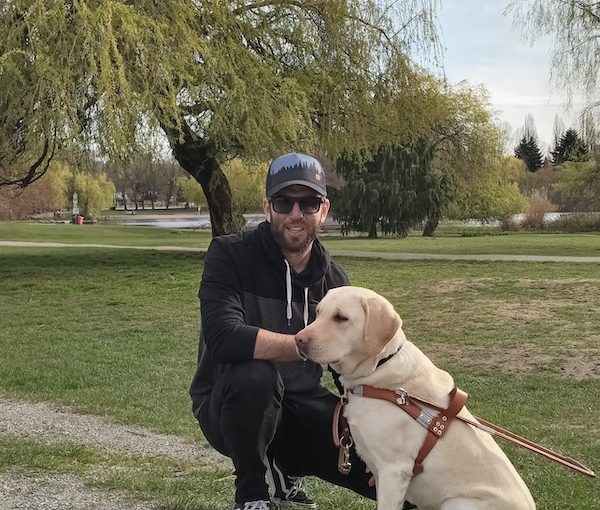
Achiya Klein and Joy at Trout Lake Park in Vancouver April 4. Klein and Joy were brought together by the Israel Guide Dog Centre for the Blind. (photo by Cynthia Ramsay)

“The Israel Guide Dog Centre is not just a centre,” said Achiya Klein. “It’s like a family.”

Klein and his assistance dog, Joy, came to Vancouver from Toronto earlier this month with Atarah Derrick, executive director of Canadian Friends of the Israel Guide Dog Centre for the Blind. The Independent met with them at Trout Lake Park April 4.

It was an educational experience to see Klein and Joy interact, like a unit. Even when Joy was off leash, clearly enjoying the freedom of running around on her own, meeting other dogs, she would respond to Klein’s occasional check-in whistles or calls. Being a Hebrew-speaking dog, one wonders what she had to say to her Canadian compatriots. Only once, enticed by the lake, did Joy hesitate to return to Klein, but she did – and before taking the plunge she so obviously wanted to take. On our walk, Derrick explained that all the 

Israeli guide dogs have English names so that the animals will know it’s them being called – imagine, she said, if a client called out a name like Yossi in an Israeli market, for example.

Klein has had Joy since the end of last October, since his first guide dog, Night, passed away at the age of 8.

“Having a guide dog is my way to get my independence again,” said the Israel Defence Forces veteran, who was injured in 2013. “I can do whatever with a guide dog because I can walk alone, with no fear, and being comfortable.”

Klein has serious visual impairment. “I have some sight,” he said, “but it’s minimal.”

A team commander in Yahalom, a special unit of the IDF that deals with the handling of dangerous ammunition and weapons, Klein was injured in a Gazan tunnel. “I was on a mission to demolish the terror tunnel that crossed into Israel,” he explained, “and, when we were walking in the tunnel … there was a booby-trap, and I got injured from that when it exploded.”

Klein moved to Canada with his wife, who is Canadian, in 2023. Noach Braun, the founder of the Israel Guide Dog Centre, personally brought Joy to Klein, where he worked with the pair for 10 days. The training period was shorter than usual because Klein had already had a guide dog. Normally, after matching a client with a dog, the pair train together for a few weeks at the centre, which then provides more training in the client’s home environment.

“It’s not like they just give you a dog and say, ‘OK, good luck,’” said Klein. “It’s more than that, and I think that one of the best examples is, after Night passed away, even though I was in Canada and I was supposed to go to Israel to receive a new dog, because of Oct. 7, I couldn’t make it to Israel, so Noach … came here during the war. He came here with Joy and I think that’s a beautiful story, to show what it means to be a part of the family.”

According to Derrick, who has been leading the Canadian Friends of the Israel Guide Dog Centre for the Blind since 2021, the centre has placed 796 guide dogs, 39 post-traumatic stress disorder (PTSD) dogs and 442 emotional support dogs, for a total of 1,277 since its founding in 1991. In 2023, there were 176 puppies being raised by centre volunteers, she said.

“The IGDCB (as it is known in Israel) serves Israel’s blind community by providing them with mobility, independence, self-confidence and companionship through the faithful assistance of guide dogs specially trained in Hebrew to meet Israel’s rigorous and challenging environment,” Derrick explained in an email. “We also breed and train service dogs for IDF veterans who have service-related PTSD and provide emotional support dogs for children on the autism spectrum.”

Canadian Friends of the Israel Guide Dog Centre for the Blind was established almost 20 years ago and Canada accounts for 6.6% of donations, according to its 2022 annual report. It is one of Derrick’s goals to increase that amount.

“I have always been passionate about community service and working in the charity sector, raising funds for vulnerable communities,” she said. “I’m a real dog person and, when the opportunity opened at Canadian Friends of the Israel Guide Dog Centre, it was the perfect match for my skills, interests and passions – helping people, Israel and dogs!”

Last year, Derrick and Braun visited Vancouver to visit donors and meet others interested in the centre’s work. “Everyone asked us to come back soon, preferably with a client and their dog, so they could see our work in action,” said Derrick, which was why she came this spring with Klein – who has become, she said, since being injured, “a Paralympic rower, a dedicated skier, a father and an asset to the IDF” – and Joy.

“We visited Vancouver Island first, with a meeting in Ladysmith to meet new friends there,” said Derrick. “We then headed south to Victoria, specifically Chabad of Vancouver Island. Then we moved east to Vancouver, where we met with Schara Tzedeck, the Kollel, and held a parlour meeting at the home of new friends. It was such a lovely visit, and we got to meet terrific people with whom our work really resonated.”

Initially, former Jewish National Fund shaliach (emissary) to Vancouver Mickey Goldwein, his wife Lili and her dog, Zita, were to accompany Derrick on the BC visit. Unfortunately, they couldn’t make the journey from Israel.

Lili Goldwein was partnered with Zita in 2018, explained Derrick, “because Lili’s vision had significantly deteriorated. Mickey joined the Israel Guide Dog Centre for the Blind’s board in 2022.”

The need for the centre and its services has increased since Oct. 7.

“Due to this war, we altered the criteria for receiving an emotional support dog to provide an immediate response to those injured or suffering due to the war,” said Derrick. “Since then, we have provided our emotional support dogs to children and adults with special needs whom the war has immensely impacted. Some of these people fought on Oct. 7 and were discharged immediately because of the trauma they endured. Some are widows of fallen soldiers. Some have been afraid to leave the house for months. 

“We are aware of some soldiers who have lost their vision in this conflict, and we need to be ready for them when they need us. This is in addition to the current clients on the waitlist,” she said.

The war also has disrupted the centre’s training, which may impact the number of guide dogs it can provide this year. “But we are doing our best to meet the challenge,” said Derrick.
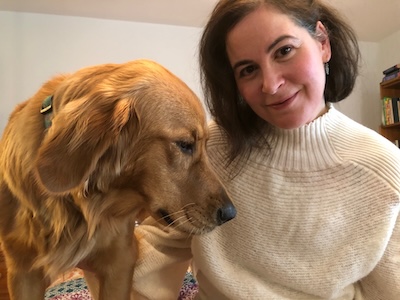
photo - Atarah Derrick, executive director of Canadian Friends of the Israel Guide Dog Centre for the Blind, with Cookie
Atarah Derrick, executive director of Canadian Friends of the Israel Guide Dog Centre for the Blind, with Cookie. (photo from Atarah Derrick)

And they are meeting the challenge while still feeling the effects of the pandemic.

“COVID had two major impacts on our training,” said Derrick. “The first was in the socialization of our puppies. In their first year, it’s crucial to expose them to as many environments as possible. The office or university, the mall and the train station are all places where our pups get to experience lots of people, noises and smells and become more comfortable navigating those environments. Because of the lockdowns, most were cut off from those experiences, and many were not ready to take on service work. So, our success rate through COVID dropped, and our clients had to wait longer periods for their dogs. This was the case worldwide. 

“The second was that we were not able to open our residences to clients in guide dog courses. When a person is partnered with a guide dog, they live in residence with us for two weeks while they train together with our professionals. This was impossible during COVID, so our trainers went to the clients and worked with them at home, one-on-one, to complete the course. We put a lot of mileage on our vans during those years.”

Now, it is hospital visits that account for some of the mileage being put on the centre’s vans, with puppies and guide-dogs-in-training traveling to offer comfort to injured soldiers and civilians across Israel. 

“As the war rages on, we’re committed to continuing this mission of love and compassion,” reads the centre’s latest blog. “Because no matter the circumstances, a little bit of puppy love can go a long way in healing hearts and bringing people together.”

Seeing Klein and Joy together at Trout Lake Park and getting a glimpse of what having a guide dog has meant to Klein, the importance of the IGDCB’s work seems clear.

“They provide you with one of the most basic tools that you use every day,” Klein said. “But it’s not just a tool, it’s also a friend.”

To learn more about the Israel Guide Dog Centre for the Blind, visit israelguidedog.ca. 
Format ImagePosted on April 26, 2024April 26, 2024Author Cynthia RamsayCategories Israel, LocalTags Achiya Klein, Atarah Derrick, COVID, dogs, health care, IDF, Israel Defence Forces, Israel Guide Dog Centre for the Blind, Israel-Hamas war, mental health, pandemic, terrorism, veterans

Don’t give up on the UN

A review released Monday about the United Nations Relief and Works Agency, the sprawling bureaucracy that for decades has played a central role in the lives of Palestinians, said Israel has not provided adequate evidence to demonstrate that UNRWA workers engaged in terrorism.

The review, headed by a former French foreign minister, dismissed Israel’s claims that UNRWA workers in Gaza were engaged in terrorist activities, including the Oct. 7 pogroms. It did, however, recommend several steps to ensure neutrality, transparency and third-party monitoring of UNRWA activities. 

Regardless of the specifics in this particular accusation, UNRWA is deeply problematic. Critics contend that its mission is to perpetuate Palestinian statelessness and discontent, rather than ameliorate these problems.

Many Jewish and pro-Israel voices have long pointed to UNRWA, as well as the annual procession of anti-Israel votes at the United Nations General Assembly, among other examples, as “proof” that the United Nations is hopelessly anti-Israel, if not antisemitic.

This may or may not be true. In any event, the answer is to fix the United Nations, not bury it.

Hyperbolic, disproportionate, often ludicrous attacks on Israel at the General Assembly and from countless UN bodies undeniably demonstrate a peculiar obsession with this one (Jewish) country to the detriment of other serious issues. However, this inappropriate and biased approach must not blind us to the irreplaceable value of the organization that was envisioned as a world parliament.

Coincidentally, a new poll of Canadians and Americans indicates massive dissatisfaction with the organization – and rightly so.

The Association for Canadian Studies and the Metropolis Institute engaged the pollster Leger to survey North Americans on their opinions toward the United Nations. The poll was conducted about four months after the Oct. 7 attacks, and indicates that just over one-third of Canadians and just under one-third of Americans trust the UN.

Jack Jedwab, president and chief executive officer of both of the survey’s sponsoring organizations, noted a particular incongruity in the results. While only around one-third of respondents “trust” the United Nations, much higher numbers of people hold a “net positive opinion” of the body. In both countries, a majority – 58% of Canadians and 54% of Americans – view the organization as more positive than negative.

This is encouraging, because it suggests that, while people have issues with the UN in practical terms, we are not ready to give up on the potential of the UN or the ideals upon which it was founded.

There are many reasons to criticize the United Nations, but the clearly biased anti-Israel resolutions and reports that grab headlines obscure a panoply of crucial, often lifesaving programs and services delivered by UN organizations like the World Health Organization, the World Food Program, UNICEF and UNESCO.

To put this in a context that perhaps makes sense on a more localized level, giving up on the UN would be like eliminating the sewer systems, traffic lights and schools in your hometown because you can’t stand the mayor. 

If we cannot muster idealism, let’s just be practical. Don’t take it from us, take it from Danny Danon, Israel’s former ambassador to the United Nations. Danon has a long history as a right-wing Israeli politician. In his 2022 book, In the Lion’s Den: Israel and the World, he reflects on his five years as ambassador, from 2015 to 2020.

He arrived, he admits, as a hawk and a hardliner, not expecting to fit into the world of diplomacy. Over his time there, he came to see the value of the UN, despite all the disappointments and wasted resources.

Even in the lion’s den at the head of the sprawling body, the General Assembly, Danon said it is possible for a seemingly unwelcome individual like Israel’s ambassador to “build bridges, forge friendships and create a space for understanding.”

The idea, expressed by some pro-Israel people, that Israel should simply walk away from the world body, would be to cut off our nose to spite our face. Why would we abandon the one small voice we have in that forum, surrendering it to the haranguing of Israel’s enemies without contest?

Likewise, if Canadians feel our government is not representing our values and ideals at the United Nations, we need to take that up with our elected representatives here and ensure that they do so. Throwing up our hands in surrender helps no one.

Is there a problem with UNRWA? Undeniably. Fix it. Is there a problem with the International Court of Justice? Many observers would say so. Fix it. Do numerous United Nations agencies obsess over Israel while millions around the world suffer in obscurity? Undoubtedly. Fix that too.

Is the United Nations perfect? It’s a ridiculous question. Nothing in human activity is perfect. But what is the role of Jews in the world, an obligation we reminded ourselves during our seders this week? Our obligation as Jews and as humans is to strive to make the world better – and, in that context, fixing the UN is central to that objective.

Is there a long way to go in this work? Yes. Are we free to abandon it? No. 

Posted on April 26, 2024April 26, 2024Author The Editorial BoardCategories From the JITags governance, Oct. 7, Passover, terrorism, tikkun olam, United Nations inquiry, UNWRA

What matters on a birthday?

As I stepped out my front door for an afternoon walk, I met an older dad taking a walk with a 15-month-old baby girl in a carrier on his chest. She was wiggly. The dad leaned over so the baby could pet my (sizeable) Gordon Setter mix dog. She babbled and waved and touched. She was in on all the action.

While my kids are now 12, I was transported immediately back to the days of naps and screaming tantrum wake-ups. I remembered the power of nature walks and time in a baby wrap, which often calmed both. To this dad, I just looked like an older woman with a big dog, but, by the end of the walk, he had the picture and we’d even figured out that our spouses worked at the same university.

Before this, I’d been concentrating on work, writing an opinion piece about a Winnipeg swimming pool that faces closure and potential demolition. Its name, Happyland, felt poignant and sad. To some, demolishing an aging outdoor facility that serves our winter city for only a couple months a year seems obvious, in terms of its financial worth. Yet, for us, or anyone who has had a chance to play in the shallow end with splashing kids, eager to try out their swimming skills on a sunny day, it’s a hard loss.

These random moments make up the stories of our families, our daily lives, and maybe our bigger communities. They are small and insignificant as they happen, but, at the same time, contain so much. As the dad in his 40s talked to me about being with his partner for 21 years before having a kid, and about “this magnificently overwhelming” experience, I imagined how spectacularly their lives had changed with the birth of this child.

My daily Jewish text study is not always something relatable, but things will pop back into mind at later times. Sometimes, I study my Daf Yomi, my page of Babylonian Talmud a day, and I struggle. Each day, I get an email, an essay, from My Jewish Learning that helps me stay on track and focused on one issue on a page. For Bava Metzia 46, there’s a discussion around how we define acquiring something. Does it happen when we exchange money for the physical object? Does it happen when we “pull,” or physically take, the object? The text goes further into what amounts to an ancient currency exchange counter. 

Imagine traveling from Country A to another country, Country B, and you needed some cash. Your money from Country A is no longer good in B. Does it have value? If you exchange it, are you technically buying B’s currency with invalid currency from A? Is the money invalid because it’s no longer in use as your empire disintegrates, or because Country B doesn’t recognize it? Can these currencies, if invalid, still be used privately? (Like cryptocurrency, perhaps?) These are complicated ideas, but the rabbis saw that governments – kingdoms, provinces, countries, etc. – come and go. What is meaningful in one place might be worthless in another.

I layered this on top of Bava Metzia 39, a page that just ripped me up as I studied it. It was about who can be in charge and how to manage the assets and property of a captive when they might still be alive, and how to reassess these practical matters if word arrives that the captives have died. The page explored the details: if minor children were involved, and how to supervise a woman’s property when her mother or sister died in captivity. It was heartbreaking to read this text, codified more than 1,500 years ago, with hostages still in Gaza.

As the date of Israel’s 76th Independence Day approaches, I’m left juggling two concepts. There’s the physical reality of the state – its currency, its government and its infrastructure. Then there’s the enormous emotional, up-and-down response many Jews around the world are experiencing as we struggle as a big extended family through the current war and the antisemitism worldwide. The only thing I can liken the emotions to is that of parenthood. That gut-wrenching, desperate crying from your baby, or the shrieks of joy from your tween as he splashes towards you in a pool. The emotion is overpowering, even while you juggle the practical notions of how governments behave. My parallel universe in Winnipeg: how much municipal money it costs to repair city infrastructure and whether your money (in whatever currency) is enough to pay for ice cream after the swim. The emotional joy of an ice cream after a good splash … that’s something to dream of doing again.

About 35 years ago, I was a teenager living on a kibbutz, splashing in an outdoor swimming pool on a sunny day. When I got out, I might share a slightly melted chocolate bar with my roommate as we changed for dinner. The truth is I have no idea if that kibbutz pool still exists. I haven’t been there since I was 17, but just like Happyland in Winnipeg, it isn’t the concrete that matters, it is those powerful memories of play with my friends.

I’m not sure if it’s possible to sort out all the actual infrastructure costs and damage that Israel, Gaza, the West Bank and Southern Lebanon face. The regional rebuild after this catastrophe will be enormous. The lives of people in the region are irrevocably changed. Meanwhile, if we can avoid numbness and hold onto powerful emotions like the clasping finger of a baby, and the laughter and that cool pool water on a hot day, maybe there’s the potential to regain our equilibrium.

I wish Israel good health on this birthday … good emotional and mental health even if, physically, things are still a hot mess. If Israel were a person? I’d be leaning in for a tearful hug over the cake, saying “You know I love you, right?” 

Joanne Seiff has written regularly for the Winnipeg Free Press and various Jewish publications. She is the author of three books, including From the Outside In: Jewish Post Columns 2015-2016, a collection of essays available for digital download or as a paperback from Amazon. Check her out on Instagram @yrnspinner or at joanneseiff.blogspot.com.

Posted on April 26, 2024April 26, 2024Author Joanne SeiffCategories Op-EdTags Israel, Talmud, Yom Ha'atzmaut
A long day in multiple ways

A long day in multiple ways

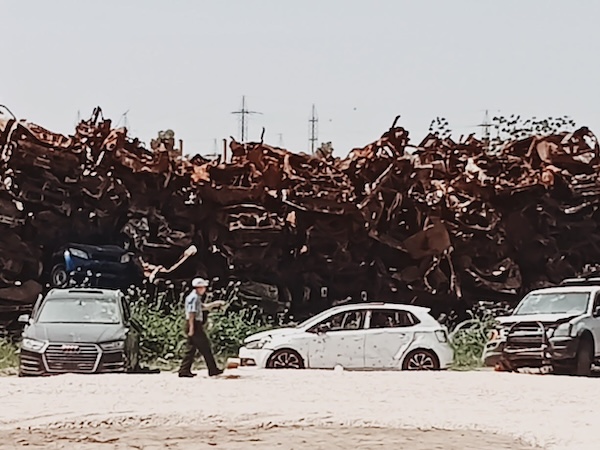
The car graveyard at Moshav Tekuma. The vehicles – recovered from along Highway 232 and the site of the Nova music festival – are being kept for at least a year, for investigators to scour them for further evidence. (photo by Adina Horwich)

At the beginning of April, I had a very long day, which is rare for me. I rose at 5:45 a.m. to visit the Gaza Envelope with 30 others. At 7:35, the bus left Jerusalem. Our guide boarded at Latrun. We proceeded toward the Re’im Junction, also known as Masmia, then headed south to Sderot.

At Sderot, we went to the site of the destroyed police station, where many police and staffers were killed on Oct. 7. The town is slowly returning to normal function, as many evacuees have returned and schools have reopened. A new police station has been built.

Despite being the closest community to Gaza, under nearly constant fire from Hamas for nearly 20 years, Sderot has become an attractive place for young families, joining the stalwart old-timers. I was there several times a dozen years ago, when my son was a student at Sapir College, and have always enjoyed spending time there. New neighbourhoods, including high rises, have sprung up.

From a lookout on the outskirts of the city, atop Kobi’s Hill, we could see the entire length of the Gaza Strip. The lookout was consecrated in memory of four soldiers who died in Operation Protective Edge in 2014. It was impressive, if that is the word, to see Gaza  from so close. Mere kilometres.

We visited the up-and-coming city of Netivot, which is nearby. There, too, we saw much real estate, which has attracted a mostly, though not exclusively, religious sector, with Baba Sali’s gravesite and shrine a major calling card. He was a beloved rabbi and sage, particularly dear to Jews of Moroccan background. We went inside a well-tended sanctuary, to have a look and offer prayers. The place was hopping. As it was Monday, a Torah reading day, it was a suitable time to celebrate bar mitzvahs, and we caught a festive first haircutting of twin 3-year-old boys.

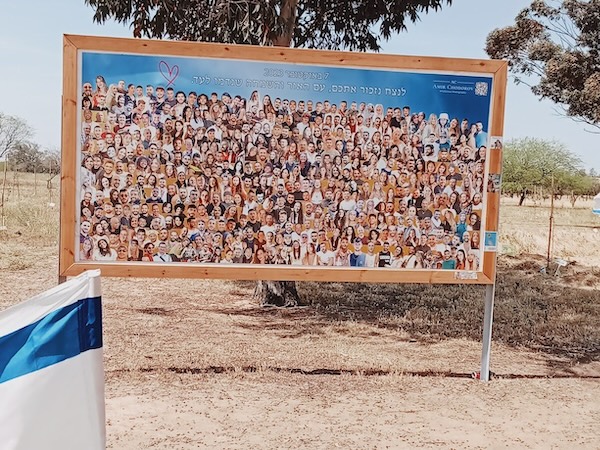
Afterwards, we headed to Moshav Tekuma. We did not expect to be allowed in, as there was heavy security and restricted access, but we were granted permission. Within the guarded gates, we saw what looked like a huge car junkyard – except that it is a graveyard. All the cars were recovered from along Highway 232 and the site of the Nova music festival at Re’im. They are being kept for at least a year, for investigators and forensic experts to scour them for further evidence. Many cars are smashed up, as if they had been in bad accidents, others are pockmarked, having been sprayed with bullets. Surrounding these is a huge pile of rusty scrap and charred rescue vehicles, as well as pickup trucks and motorcycles used by the terrorists to infiltrate the area.

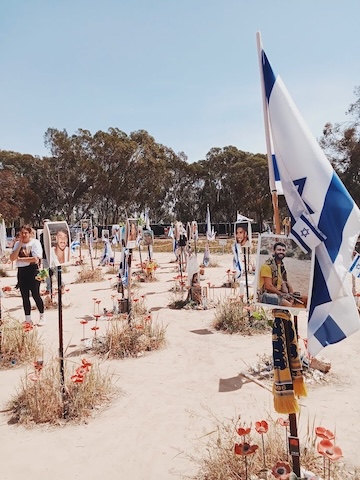
photo - Memorial to those who were murdered at the Nova music festival by Hamas terrorists on Oct. 7.
Memorial to those who were murdered at the Nova music festival by Hamas terrorists on Oct. 7. (photo by Adina Horwich)

We drove further along the road, past Kibbutz Sa’ad and Alumim, along Route 232, and stopped just outside Kibbut Be’eri (the public is not allowed in). We looked inside one of the roadside shelters, next to a bus stop, which normally accommodates roughly eight people. On Oct. 7, some 40 people stuffed themselves inside. It was into such structures that many fled from the Re’im festival, seeking refuge, but the terrorists hurled grenades inside. At one migunit, Aner Shapira managed to throw the grenades back at the terrorists, though, in the end, he was killed, along with other young people. Inside are memorial candles, stickers with the pictures and names of victims, letters and comforting wishes are written on the walls.

photo - Site of the Nova music festival
Site of the Nova music festival. (photo by Adina Horwich)

We traveled some more, reaching the city of Ofakim. That is where a very brave woman, Rachel Edri, appeased the five terrorists who barged into her home by offering them refreshments, including her now-famous cookies. She and her husband, David, both in their 60s, were able to manage the terrorists, engaging them in conversation, plying them with more food and singing songs, over 19 hours. Whenever she could, Rachel would go to the bathroom and signal from the window to the police outside, who had surrounded the house, gauging attempts to enter. The Edris’s son is in the police force and was instrumental in finally seizing back their home. Unfortunately, during the siege, the house suffered great damage and is a total wreck; only a shell remains. And, sadly, David Edri passed away about a month ago. Rachel has gone to live with her sister-in-law.

As we were looking around, another hero appeared in the small parking lot opposite. Shuki Yosef lives across the street with his wife. He invited us to come into their building’s shelter, where he recounted how he and some of the neighbours hid for several hours, all the while hearing gunshots and shouting outside. He secured a metal bicycle frame to keep the shelter’s door closed, holding it with his own hands for hours. Later, after the ordeal had ended, he designed and fashioned a wooden plank to better fit the door hinges, in the event of future need.

The bravery of these residents is remarkable. It is worth noting that their homes are not the closest ones to the highway – which one might think would have been attacked first – but the houses and people who took the brunt of the terrorist attack are tucked well within the city. The sheer gall and number of terrorists that infiltrated, going from house to house on a murderous rampage in Sderot, in Ofakim, in the kibbutzim, on the roadsides, gunning down so many, are mind-boggling. These communities all lie within minutes of each other in a pretty small area.

It was an unusually hot day for April 1, over 30 degrees Celsius. And it was an intense excursion. Visiting made the reality a lot more tangible, but still impossible to fully comprehend. It was moving to witness and I learned much. We left the Otef (Envelope/Wrapping), as it is called, and I arrived home just before 7 p.m.

More than six months have passed since Oct. 7 and we remain in the thick of things. It is taxing and draining, even on those of us who, fortunately, are not too closely involved. Everyone is touched by the terror attacks and the war. 

Adina Horwich was born in Israel to Canadian parents. In 1960, the family returned to Canada, first living in Halifax, then in a Montreal suburb. In 1975, at age 17, Horwich made aliyah, and has lived mostly in the Jerusalem area. She won a Rockower Award for journalistic excellence in covering Zionism, aliyah and Israel for her article “Immigration challenges” (jewishindependent.ca/immigration-challenges-2).

Format ImagePosted on April 26, 2024April 26, 2024Author Adina HorwichCategories IsraelTags Gaza Envelope, Israel, kibbutzim, Netivot, Oct. 7, Re’im, Sderot, terrorism
Thought-provoking speakers

Thought-provoking speakers

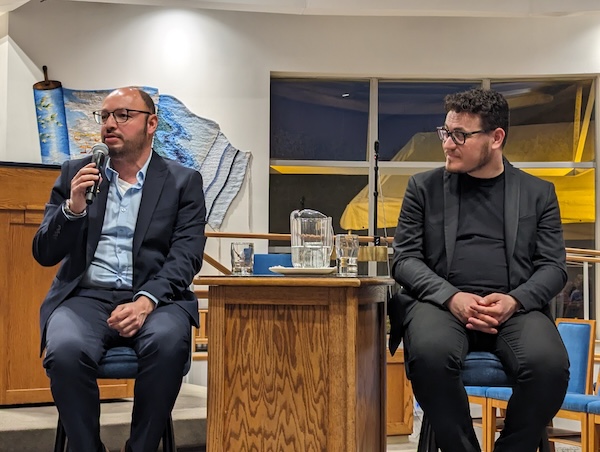
Dr. Gil Murciano of Mitvim, the Israeli Institute for Regional Foreign Policies, and Uri Weltmann of Standing Together, spoke April 17 at Temple Sholom. (photo by Pat Johnson)

For months, weekly rallies across Israel after Shabbat have demanded the return of the hostages from Gaza. These rallies have often coincided with separate protests, which have been going on much longer, against the government of Prime Minister Binyamin Netanyahu generally and its proposed judicial reforms specifically. These two streams of protesters have coalesced in recent weeks, according to an Israeli activist leader who spoke in Vancouver last week, because, he said, many Israelis are convinced that Netanyahu is not advancing freedom for the hostages, but hindering it, for his own political advantage.

Uri Weltmann, field organizer of Standing Together, made the claim April 17 during an event at Temple Sholom organized by New Israel Fund Canada. 

“What happened three weeks ago is that it stopped being two different protest movements,” said Weltmann. “They are basically changing their strategy. They are calling for early elections and for [Netanyahu’s] government to be removed and replaced with a different government. [Activists are] pointing their finger at him as the obstruction, as the obstacle toward advancing to a ceasefire agreement.”

Weltmann argues that Netanyahu is concerned not only for his political survival, but for his freedom.

“For Netanyahu, the protraction of this war, the continuation of this war, is in his political interest,” said Weltmann. “He knows that a temporary ceasefire might lead to a permanent ceasefire. A permanent ceasefire would mean an end to the war. An end to this war would bring an end to this coalition government because the extremists he huddled with have already said publicly that, if they will end the war before total victory, they will topple the government.”

The end of the current government and the ousting of Netanyahu, he said, would have more than just political ramifications for the prime minister, who opinion polls suggest would be soundly routed if an election were held now.

“New elections mean him losing the majority and him losing the majority is not only Netanyahu the politician being ousted from office. It’s also Netanyahu facing corruption charges, having his trial resume, [and he] might lose his personal liberty. For him, it’s intimately linked to the continuation of the war.”

The consensus among these activists is that Netanyahu is seeking to prolong the war and the captivity of the hostages to protect his political and personal interests, said Weltmann.

“It’s an incredibly important political development within Israel that a broad movement around the families and friends of the hostages have made this link,” he said.

Weltmann’s group, Standing Together (known in Hebrew and Arabic as Omdim Beyachad-Naqif Ma’an), was founded in 2015 and is one of the on-the-ground groups New Israel Fund supports.

Among the goals of the group is to build a grassroots movement for peace and progressive politics in Israel, including in rural and peripheral areas of the country. Making such a movement successful beyond the activist hub in Tel Aviv is the only way to advance Standing Together’s goals, Weltmann said. Even a more centrist or progressive government, if elected tomorrow, would not necessarily advance meaningful steps to peace and coexistence if there is not a broad popular movement in support of such a policy shift, he said.

Without a national movement for peace, he said, a new prime minister, however well-intentioned, would not feel the pressure to abandon the status quo and take steps for a changed future. 

“We must, as a strategic starting point in our process of progressive transformation of Israeli society, be present in the Negev, be present in the Galilee, be present in those parts of Israeli society that for too long have been the playing ground of the right-wing with left-wing actors completely non-present,” he said. “We must be there organizing local communities.”

Jewish citizens cannot do it by themselves, said Weltmann, and neither can Arab citizens. 

“We must have Jewish-Palestinian unity and cooperation within Israel for this change to be effective,” he said. An example of this strategy was a slogan adopted by a joint Jewish-Arab slate in Haifa during the recent municipal elections. The far-right Otzma Yehudit (Jewish Power) party of Itamar Ben-Gvir ran slates across the country trying to solidify the party’s roots at the civic level. The joint slate in Haifa played off Otzma Yehudit’s xenophobia with the slogan “Jewish Arab Power.”

“We are at a crossroads,” said Weltmann. “Every Israeli should choose which side am I on: the side that leads to a continuation of the status quo, a continuation of the state of affairs in which the Palestinians live in the occupied territories under military rule devoid of citizenship, devoid of rights, a situation that can lead to Oct. 7 one after another unless we put an end to it, or the reality of an Israeli-Palestinian peace that will guarantee both people safety, security and an imaginable, livable future?”

Weltmann spoke alongside Dr. Gil Murciano, an Iran expert and chief executive officer of the think-tank Mitvim, the Israeli Institute for Regional Foreign Policies, which one journalist has called “the diplomatic wing of the protest movement.”

Like Weltmann, Murciano longs for a “new majority” in Israel’s body politic. “A new majority that will allow us to advance toward a state where we live in peace, we live in dignity, we live in equality, without the occupation, without the injustices, throughout our society,” he said.

A fundamental shift in perspective is needed, argued Murciano.

“We used to speak about ‘wars of no choice’ in Israel,” he said. “We need to start thinking in terms of ‘peace of no choice.’”

On the one side, he said, the extreme right has a plan of annexation, with Bezalel Smotrich, Israel’s minister of finance and head of the far-right National Religious Party, calling for the government to “encourage” migration from Gaza to Egypt. On the other side, he said, since Oct. 7, people on the left have been motivated to seek an alternative to the status quo.

Dr. Maayan Kreitzman, a local food systems researcher and activist who moderated the event, challenged Murciano on this point. Rather than progressive voices calling for more coexistence, she said, she has heard the opposite. People that are “quite dovish” have had second thoughts about their worldview and transformed into a more hawkish, securitized attitude, she suggested.

Murciano acknowledged that all Israelis share one overriding priority. “For Israelis, it’s pretty clear,” he said. “The first, second and third priority of Israelis right now is security.”

That is a prerequisite to any advancement, he said.

Murciano proposes something he acknowledges to be “a little bit symbolic,” an international peace conference to kick off a new process between moderate Israelis and moderate Palestinians. This could be a first step to breaking an impasse that has existed in recent years, he said.

“Some people have described the last decade as the lost decade of Israeli diplomacy,” he said, a period where “conflict management” has been the priority; effectively, a maintenance of the status quo.

“I think that’s the right description, actually. It’s a strategy of not having a strategy,” said Murciano. “Coming to terms with the fact that there is no political way out and basically every couple of years we’re going to have a bit of violence.”

This approach sees Israelis forfeiting the initiative to Hezbollah and Hamas, he said, “Basically setting yourself in a situation where you only respond to a reality that is forced upon you.”

Oct. 7, he said, destroyed this conceptual framing.

Part of any future needs to include a multilateral project to “rebuild life-sustaining systems” in Gaza, he said, not a “peace-keeping force” but a “multinational force” that will be an on-the-ground part of a larger process toward peace and coexistence.

Ben Murane, executive director of New Israel Fund Canada, spoke of the emotional impacts of recent months.

“If you’re like me, what has been excruciating the past six months has been not just holding my pain, our Jewish pain, the pain of my Israeli coworkers, my family, my friends there, the pain of the Israeli people, but also, in my heart, holding the pain of the Palestinian people too,” he said.

Since the earliest days of the current war, Murane said, there have been countless glimmers of hope in the form of cross-cultural dialogue.

“In the first few months, we were astounded to see, across Israel, dozens of gatherings, conferences, events with hundreds of Jews and Palestinians standing together holding up those now-iconic purple signs saying ‘Jews and Arabs refuse to be enemies,’ ‘Jews and Arabs stand together’ or just simply ‘B’Yachad,’ together,” said Murane. “We were astounded to see Jewish citizens of Israel respond to the needs of the Palestinian citizens of Israel, Palestinian citizens of Israel making calls to families of the hostages, joint Jewish-Arab humanitarian aid missions to the south and to the north. As the war in Gaza accelerated, those Israeli voices also said, ‘We do have choices, even now. We have lots of choices with how we execute a just war justly.’”

Any long-term solution to the decades-long conflict must bring safety and dignity to both peoples, said Murane, “and anything else, anything short of fairness to both sides, will perpetuate this for another generation.”

New Israel Fund partners with and supports, according to its website, “organizations in Israel that fight for socioeconomic equality, religious freedom, civil and human rights, shared society and anti-racism, Palestinian citizens, and democracy itself.”

The April 17 event was hosted by Temple Sholom and co-sponsored by JSpaceCanada, which calls itself the advocacy voice of Liberal Zionism, Ameinu Canada, described as the voice of labour Zionism in Canada, and Canadian Friends of Peace Now, as well as the speakers’ organizations.

Rabbi Dan Moskovitz, senior rabbi at Temple Sholom, said he had received emails expressing concerns about hosting a perceived left-wing event. 

“I get the same emails when we host people to the right of centre,” he said. 

One of the purposes of a synagogue, he said, is to engage with ideas that “comfort the afflicted and afflict the comfortable.

“You may find your truth by agreeing with what you here tonight,” he said. “You may find your truth by disagreeing with what you hear tonight. The important part is to engage with it.”

Vancouver activist David Berson promoted the opportunity to listen to the Israeli guests as a chance to gain a perspective apart from the most common refrain he hears on social media and WhatsApp threads. 

“There’s another way you can look at what’s going on,” he told the Independent after the event. “Come out and hear a different perspective. I invited people to come tonight and listen to a different narrative.”

The 200 to 300 people at the event was about double what organizers had earlier expected, he said. 

Format ImagePosted on April 26, 2024April 26, 2024Author Pat JohnsonCategories Israel, LocalTags Gil Murciano, Israel, Israel-Hamas war, Mitvim, New Israel Fund of Canada, Oct. 7, peace, Standing Together, Temple Sholom, Uri Weltmann
A new refuge from violence

A new refuge from violence

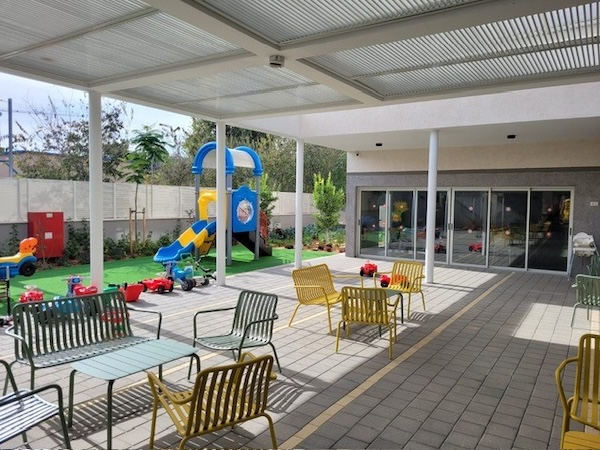
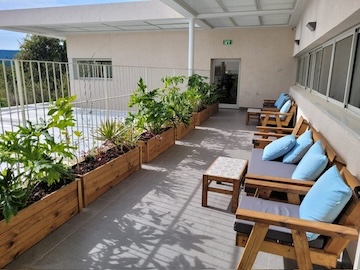
Western Canada House, a shelter for women and children escaping domestic violence, is now open in Rishon LeZion, near Tel Aviv. The project is a result of support from Jewish National Fund of Canada supporters in Vancouver and Winnipeg. (photo from JNF Pacific Region)

Western Canada House, a shelter for women and children escaping domestic violence, is now open in Rishon LeZion, near Tel Aviv. The project, a result of support from Jewish National Fund of Canada supporters in Vancouver and Winnipeg, provides a temporary home to families in crisis, as well as access to counseling services, programs for mothers to become self-supporting and assistance in finding permanent, secure housing.

The project was made possible by revenue from 2016 Negev Dinners in Vancouver and Winnipeg and was chosen by that year’s Vancouver dinner honouree, Shirley Barnett. The honouree of the Winnipeg dinner was Peter Leipsic. (An additional Vancouver connection is that Leipsic is the father of Dr. Jonathon Leipsic, who is, among many other things, a leader in the Jewish Federation of Greater Vancouver.)

Barnett said she was motivated to choose the project in part because it is a joint initiative with No2Violence, whose founder, Ruth Rasnic, Barnett had met previously. Rasnic, who was awarded the Israel Prize in 2009 for her life’s work, founded No2Violence in 1977, to enable women and children suffering from domestic violence to break away and start a new life – by providing them with shelter, professional help, vocational training and legal aid – as well as to raise awareness about domestic violence. The group now operates three shelters in Israel.

“When I was honoured by the JNF, they asked me what kind of a project I would like the proceeds to go to,” Barnett recalled. The agency provided a number of options and, based on her background in social work and her familiarity with Rasnic’s work, she chose this one.

“No2Violence is interesting,” Barnett said. “They are not a religious organization. There are other shelters in Israel that cater only to the Orthodox. No2Violence is nonsectarian and, in addition to that, it is open to women who are not Jewish. It is also open to women who do not have legal status in Israel, who have not been deported because their children have been born in Israel. So, their doors are open to women who have come from Sudan, women who have come from Russia, who have been trafficked into Israel by their Israeli boyfriends. That was also attractive to me.”

photo - Western Canada House, a shelter for women and children escaping domestic violence
Western Canada House, a shelter for women and children escaping domestic violence. (photo from JNF Pacific Region)

Rabbi David Bluman, director of youth engagement at Congregation Beth Israel, visited Western Canada House earlier this month as part of a joint mission to Israel by Beth Israel, JNF Canada and Congregation Har El.

“It’s a beautiful place,” Bluman said. “They have different areas for children to play. They have a communal kitchen where each family signs up at a different time to do the cooking for the group that’s there. It’s obvious that JNF Western Canada did a really good job, put a lot of money in to build that place. It’s beautiful.

“I don’t think anyone wants to be there, they need to be there,” said the rabbi. “JNF Canada has made it as welcoming as possible, making it so it’s like home for them while they are there.”

The shelter has capacity for 10 to 12 families, providing needed refuge in a country where, statistics indicate, as many as 70% of women and children experiencing domestic abuse cannot access alternative housing.

Michael Sachs, Pacific region executive director of JNF, visited the project last year to assess progress and is delighted that the shelter is now open and providing housing to families. There were delays in completion of the initiative, Sachs said, because of municipal bureaucracy. 

Format AsidePosted on April 26, 2024April 26, 2024Author Pat JohnsonCategories Israel, LocalTags David Bluman, Jewish National Fund, Jewish National Fund of Canada, JNF, Michael Sachs, Negev Dinner, Rishon LeZion, Shirley Barnett, Western Canada House
Face behind the weekly vigils

Face behind the weekly vigils

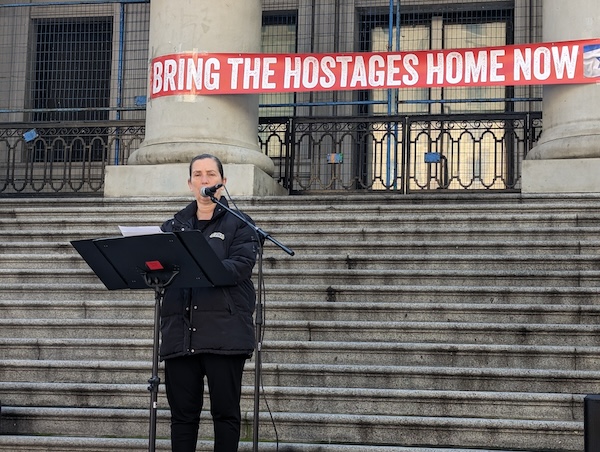
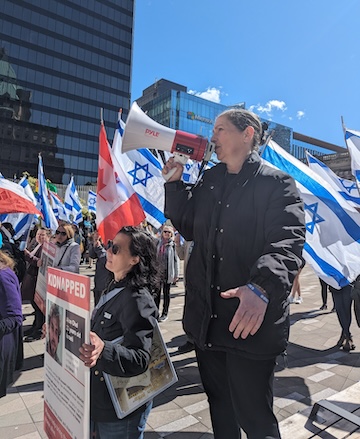
Daphna Kedem speaks at one of the weekly rallies she organizes to unite the local community and express solidarity with the Israeli hostages being held by Hamas (photo by Pat Johnson)

Until recently, Daphna Kedem was a single mom with two jobs, an Israeli-Canadian who came to Vancouver in 2011. Upset by political and social developments in her homeland, she mobilized a local branch of the global activist movement UnXeptable. Then, on Oct. 7, driven by grief and an inability to sit idly, she became the face of weekly vigils for Israel’s hostages, terror victims and families.

UnXeptable is, according to its website, “a grassroots movement launched by Israeli expats in support of a democratic Israel.” The group mobilized around the world against the “judicial reforms” of the current government, which critics say would fundamentally undermine the democratic nature of the state.

The Vancouver activists were meeting weekly and, in the hours after the Oct. 7 terror attacks, it was immediately evident that there was a need for people to come together. Community organizations, she said, were waiting until the close of Shabbat to announce a community response.

“I said, no, we can’t wait,” Kedem told the Independent. “In the Jewish tradition, a war or a crisis like this is beyond Shabbat. You can actually break Shabbat if it’s very important.”

In her capacity as an individual – not on behalf of UnXeptable or any other organization – Kedem brought the community together at the Vancouver Art Gallery on Oct. 9 and has continued, with a few exceptions, at that location every Sunday since. (Conflicting events have resulted in shifting locations a few times and there were no rallies on Dec. 24 or 31.)

Kedem doesn’t recall specifically making the decision to hold a weekly event, nor would she have imagined it would go on so long.

“I don’t know how it came about but I just said, let’s do this every Sunday at 2 p.m. until all the hostages are released and, unbelievably, we are here six months after,” she said.

Kedem works for a Vancouver company specializing in products for chiropractors, massage therapists and other medical professionals, and she is also an entrepreneur who bakes pies and sells them at farmer’s markets. The weekly rallies have become effectively a third job. On top of all this, she is also deeply committed to animal rights, being a local organizer for a California-based global animal movement called Direct Action Everywhere.

photo - At the weekly rally at the Vancouver Art Gallery April 21, Daphna Kedem leads the call to release the Israeli hostages
At the weekly rally at the Vancouver Art Gallery April 21, Daphna Kedem leads the call to release the Israeli hostages. (photo by Pat Johnson)

Kedem laments that attendance at the rallies has dropped off – it is challenging to keep audiences engaged week after week. She notes that she hears some people in the community talking worriedly about the size of anti-Israel rallies, but then does not see those faces at her Sunday gatherings.

“For me, it should not happen because it’s like saying we are giving up on the hostages,” she said of the declining numbers. “It’s like saying this is our new normal, and it shouldn’t be this way.”

Kedem, who was born and raised in Israel, lived in London, England, in her 20s. When she decided she and her daughter, who is now a student at Western University, in Ontario, needed a change, she considered Berlin, which has a large Israeli expat community, but decided an English-speaking city would be better. Her experience of London had been one of bigoted locals with unwelcoming attitudes toward “bloody foreigners” and she is not enamoured of the political climate in the United States. Australia and New Zealand seemed too far away.

“I had friends that were moving to Vancouver and I said, OK, I can get a tourist visa for a year and, if things don’t work out, we can always have an experience of a year in Canada,” she said. “That’s how it started.”

Bringing the community together on behalf of Israeli hostages, victims of terror and their families takes effort and volunteers, Kedem said, but it is also a vital source of empowerment and comfort for her and all who attend.

“It’s necessary that we unite in common as a community,” she said. “It is for the solidarity with the hostages but the other thing is just being together, the community in Vancouver. People need to feel a part of something and, for the past six months, it has been created. People find a safe space and a safe space can grow with more people coming out.”

Kedem has a lot on her plate. Rather than adding to her stress, though, the weekly rallies are a comfort. She said, “It’s helping me because I have to do something.” 

Format ImagePosted on April 26, 2024April 26, 2024Author Pat JohnsonCategories LocalTags Daphna Kedem, Gaza, Israel-Hamas war, Oct. 7 hostages
New role, familiar face

New role, familiar face

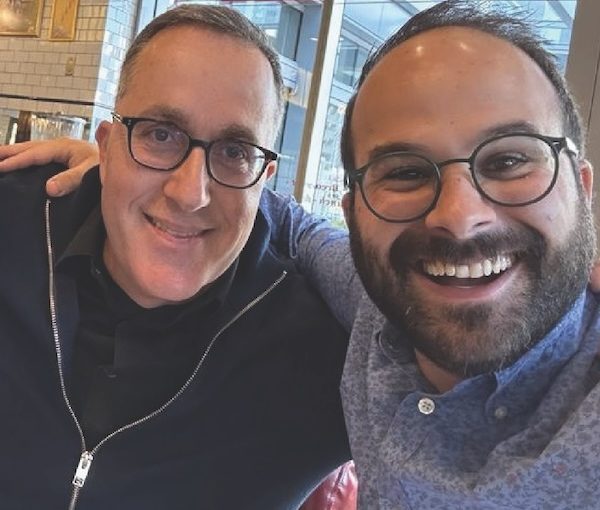
Ilan Pilo, left, and Rafi Yablonsky of the Canadian Shaare Zedek Hospital Foundation. (photo from CSZHF)

In Jerusalem, Yad Vashem stands as the foremost memorial centre to the Holocaust, dedicated to the millions of Jews murdered during the Shoah. Across the street, as if in defiant answer to the past, is one of the world’s busiest maternity centres, where 22,000 newborns meet the world every year, strengthening the future of the Jewish people. 

The maternity section is just one of Shaare Zedek Medical Centre’s many specialized departments, advancing health not only at the start of life but all through the lifespan of patients. Shaare Zedek is home to an emergency preparedness and disaster response centre. It offers a one-stop multidisciplinary and comprehensive diagnostic breast health centre. There are departments focusing on heart health, medical genetics, digestive diseases, oncology and an array of other specializations – more than 30 in-patient and 70 out-patient departments in all. The hospital sees a million patients annually and has 1,000 beds. Located in the centre of west Jerusalem, it is, among so much else, a teaching and research facility.

Western Canadians will likely be hearing more about this particular facility as the Canadian Shaare Zedek Hospital Foundation has just opened its first office in this part of the country. But, while the organization may be a newcomer as a physical presence in Vancouver’s Jewish community, it will be a familiar face sharing the Shaare Zedek story.

Ilan Pilo, who served as shaliach (emissary) and regional executive director of Jewish National Fund of Canada from 2013 to 2021, has returned from Israel as the Western Canada executive director for the Canadian Shaare Zedek Hospital Foundation.

“I was thrilled and honoured to be offered the opportunity to be the first to launch the Western office in Canada,” Pilo said.

During his time back in Israel, Pilo served as principal of a postsecondary trades and skills school and, most recently, ran the campaign for Yariv Fisher, who won an upset victory to become mayor of Herzliya, north of Tel Aviv. Municipal elections across Israel were delayed twice due to the war and, almost immediately after seeing his candidate elected, Pilo jumped on a plane and headed for Canada, spending 10 days in Toronto orienting to his new role before landing in Vancouver in March.

The hospital is 120 years old and was founded to ensure medical adherence to halachah (Jewish law), providing appropriate care for Orthodox Jews in the pre-state era. While it still provides everything religious Jews need, including minyanim, it is also, Pilo said, a “safe zone” for all people, regardless of ethnicity, nationality or religion. 

“When you look at the population in Jerusalem, you see that there are one million people – 300,000 of them are ultra-Orthodox, 400,000 are Arabs and the rest are, let’s say, secular Jews,” Pilo said. “It’s the most interesting and complex mix of people.”

That diversity is reflected not only in the patients but in the doctors and staff, Pilo said.

Right now, the hospital’s specialists in trauma are dealing with soldiers and civilians injured in the war. Since Oct. 7, Shaare Zedek has treated 300 wounded civilians and more than 700 Israel Defence Forces soldiers. In addition, hospitals in the north and the south of Israel have transferred 60 of their neonatal intensive care unit patients out of conflict regions to Shaare Zedek, where the NICU is housed in completely sheltered areas.

Rafi Yablonsky, national executive director of the Canadian Shaare Zedek Hospital Foundation, said he and the foundation’s board decided to expand operations across Western Canada because of the region’s philanthropic and Zionistic reputation. 

“We hope that more Canadians learn about the transformative and world-leading work of Shaare Zedek Medical Centre in Jerusalem,” he said. “Our goal is to grow our donor base and volunteer base with business and philanthropic leaders out West.”

This is not the first time Pilo and Yablonsky have worked together.

“Ilan and I were colleagues when we worked at JNF Canada together,” he said. “I witnessed firsthand how Ilan is highly skilled as a world-class fundraiser, also motivating groups of volunteers to do their part in our community.

“Shaare Zedek is a public hospital that is privately funded,” said Yablonsky, “and it receives very limited support from the Israeli government to upgrade equipment and technology, develop groundbreaking international research and ensure state-of-the-art medical training is available to staff. As such, the hospital relies heavily on the generosity of donors around the world to supplement $30 million needed annually.”

For more information, visit hospitalwithaheart.ca. 

Format ImagePosted on April 26, 2024April 26, 2024Author Pat JohnsonCategories Israel, LocalTags Canadian Shaare Zedek Hospital Foundation, fundraising, health care, Ilan Pilo, Israel, medical care, philanthropy, Rafi Yablonsky, Shaare Zedek
Eat well, while helping Leket

Eat well, while helping Leket

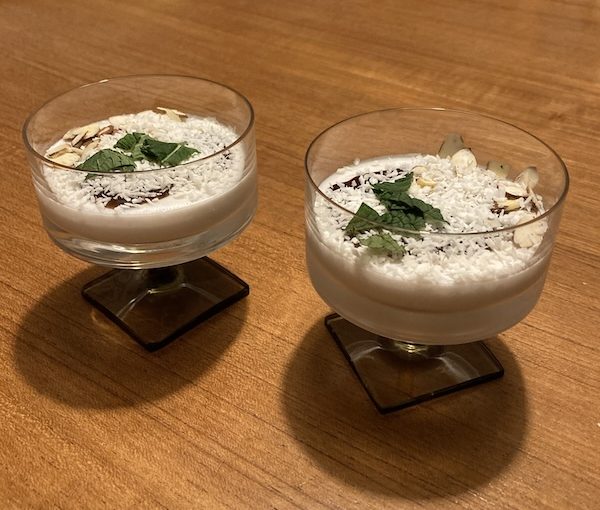
My new favourite dessert: Inbal Baum’s Coconut Cream Malabi. Baum is one of the contributors to June Hersh’s new digital cookbook, Cooking for a Cause. (photo by Ingrid Weisenbach)

I have a new favourite dessert: malabi. At least Inbal Baum’s Coconut Cream Malabi. Baum is one of more than 70 cooks, bloggers and others who have contributed to June Hersh’s new digital cookbook, Cooking for a Cause. All proceeds from the book’s sale support Leket Israel, whose focus is “rescuing healthy, surplus food and delivering it to those in need through partner nonprofit organizations.”

“By purchasing this digital cookbook,” notes Leket’s promotional material, “you will not only be supporting Leket Israel’s routine food rescue operations, distributing fresh, nutritious, surplus food to over 330,000 people in need each week, but you will also be part of Leket’s emergency relief campaign, providing much needed assistance to displaced Israelis throughout the country as well as to the Israeli farming community who has been significantly impacted by the ongoing war.”

Hersh has written several cookbooks “with a charitable flavour,” supporting various causes. She contributes to food blogs and magazines, appears on radio and TV, and gives talks on the importance of preserving Jewish food memory. Cooking for a Cause is a response to the Oct. 7 terror attacks, and Hersh and Leket Israel “reached out to everyone we could think of who has made an impact in the world of Jewish food,” writes Hersh in the introduction. “Additionally, we approached those incredibly outspoken Jewish and non-Jewish supporters who have taken a stand and used their moral compass to point the way. The response was overwhelming!”

image - Cooking for a Cause book coverThe result is a unique cookbook that is interesting both for its recipes and its stories – each entry tells users a bit about the contributor and/or the food being presented, and there are eye-catching colour photos throughout. The cookbook “is not arranged from starters to desserts and it is not consistent in its format,” writes Hersh. “I say this not as an apology but with pride, as this book is deliberately different. It reflects a cacophony of voices that have come together to support Leket and the people of Israel. Each contributor presents their connection to Jewish food and expresses it with a different perspective, writing style and point of view. You, the reader, benefit from diverse cooking techniques, interpretations of Jewish cuisine and fresh commentary with each recipe.”

Recipes that caught my eye as I skimmed through the book included Vegetarian Stuffed Cabbage Rolls (Holishkes) by writer Joe Baur; Pandora’s Chicken with Artichokes, Oregano, Olives and Sundried Tomatoes by Joan Nathan, “award-winning ‘godmother’ of Jewish food”; Aunt Rini’s Tahini Cookies by Elise Addlem, founder of Feminists Against Antisemitism; and Olio Egg Salad by Ben Poremba, who “infuses his Israeli-Moroccan heritage into all his restaurants.”

I have bookmarked these recipes for future cooking/baking sessions, and will certainly try others as well. Between the Jewish Independent’s Passover and Israel special issues, I only had time to try out three recipes. In addition to Coconut Cream Malabi, which Baum writes was inspired by “Our Chef Sevim [Zakuto], with her Turkish-Jewish roots, [who] shared the cherished recipe from her grandmother,” I made Rachel Simons’ Fennel and Herb Salad (Simons is a co-founder of the company Seed+Mill) and award-winning chef and restaurateur Jonathan Waxman’s Steelhead Trout with Vermouth, Baby Sorrel, Chanterelles and Fingerlings.

The salad was as big of a hit as the malabi, and I enjoyed the meal part of the trout recipe but wasn’t so keen on the sauce, which contained vermouth. Not being a lover of vermouth, I had put the sauce on the side, and I thought the food was better without it. When I make the fish again, I’ll try to halve the vermouth or reduce it on the stove to see if that makes it taste less sharp.

COCONUT CREAM MALABI
(by Inbal Baum)

1 can coconut cream (fat content should be greater than 14% for the best results)
3 tbsp sugar
3 tbsp cornstarch
1/3 cup of water
1 tsp of vanilla extract, or rose or orange blossom water
crushed (or chopped) nuts, to taste
desiccated coconut, for serving
pomegranate molasses and/or silan, for serving
optional toppings: chopped seasonal fruit (strawberries, apricots, mango)

In a small saucepan, combine the coconut milk and sugar. Bring to a gentle boil. Meanwhile, in a small bowl, mix the cornstarch and water until well combined. Slowly add the cornstarch to the saucepan, continuously stirring.

Over medium heat, continue stirring until the pudding thickens – this may take 3 to 5 minutes. If needed to thicken, add additional cornstarch in small amounts until the mixture begins to thicken.

Mix in the vanilla extract, orange blossom or rose water, then pour or ladle into four small bowls.

Allow to cool before serving (approximately one hour, but can be less).

When ready to serve, top with a layer of pomegranate molasses or silan (date honey), desiccated coconut and ground nuts.

FENNEL AND HERB SALAD
(by Rachel Simons; 4 servings; 30 minutes to prepare)

1 fennel bulb, very thinly sliced crosswise
juice of 1 lemon
1 cup cold water
1/2 cup fresh mint leaves, roughly chopped
1/2 cup fresh parsley leaves, roughly chopped
1 tbsp white wine vinegar
2 tbsp extra virgin olive oil
1 tsp flaky sea salt
1/8 tsp ground black pepper
1 cup parmesan cheese, thinly shaved (optional)

Place the sliced fennel into a bowl with the lemon juice and cold water. Let sit for about 10 to 15 minutes. Drain the fennel. 

In a large bowl, mix the fennel, mint leaves, parsley leaves, white wine vinegar, olive oil, salt, pepper and parmesan (if using). Mix to combine well. Serve the salad cold.

STEELHEAD TROUT WITH VERMOUTH, BABY SORREL, CHANTERELLES AND FINGERLINGS
(by Jonathan Waxman; serves 4)

4 x 4.5-ounce skin-on, boneless steelhead trout fillets
1/2 cup white vermouth
2 tbsp butter
2 tbsp olive oil
1 cup baby sorrel
1 cup cream
1 cup sliced raw fingerling potatoes
1 cup button chanterelle mushrooms

Season steelhead with sea salt and fresh ground white pepper.

Cook the potatoes in simmering salted water for 12 minutes. Set aside.

Wash mushrooms.

In a sauté pan, add 1 tbsp olive oil and 1 tbsp butter, heat to sizzling, add the trout, skin side down and sauté for 2 minutes.

When skin is crispy, turn over and add remaining olive oil and butter. Then add the potatoes and chanterelles to pan. Cook over medium heat for 5 to 8 minutes.

Remove steelhead to a warm platter. Ensure potatoes and chanterelles are cooked, add them to the fish platter.

Add the vermouth to pan and then add the cream. Turn off heat and add the sorrel leaves.

Taste sauce for seasoning and gently coat the potatoes and chanterelles with sauce. Serve hot.

* * *

To purchase Cooking for a Cause, go to chef.leket.org. For more on Leket Israel – including how you could join the organization’s approximately 54,000 annual volunteers “in gleaning, sorting and packaging rescued food for the Israelis in need” – visit leket.org. 

Format ImagePosted on April 26, 2024April 26, 2024Author Cynthia RamsayCategories Books, IsraelTags baking, cooking, Cooking for a Cause., fundraising, June Hersh, Leket Israel, recipes, tikkin olam
Camp celebrates a lifetime at 70

Camp celebrates a lifetime at 70

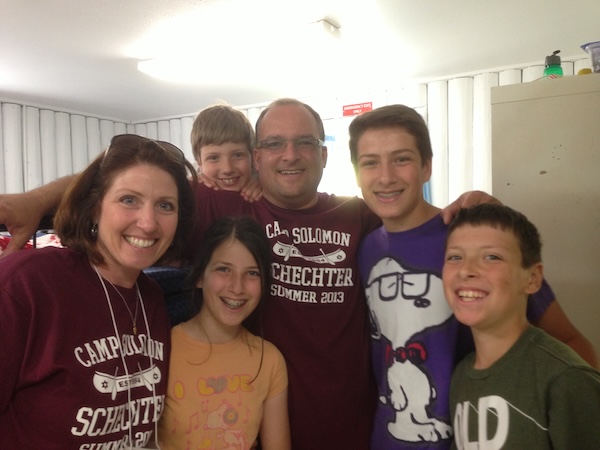
Lisa and Andrew Altow with their family on visitors day at Camp Solomon Schechter in 2013. (photo from the Altow family)

On May 5, Camp Solomon Schechter will honour four long-time relationships that were built at the camp. Part of its 70th-anniversary celebrations, there will be three separate events in three different cities – Portland, Seattle and Vancouver – on the same day. Those being honoured include Vancouverites Lisa and Andrew Altow, and Yvonne Rosenberg.

“One of the most special things about camp is the lifelong friendships that it creates and the geographic area that it spans,” Zach Duitch, executive director of Camp Solomon Schechter, told the Independent. “We say camp friends are forever friends and we know that having Jewish friendships throughout your life is one of the most significant and important relationships we have. This is what builds Jewish community.”

Of this year’s honourees, he said, “We have a friendship that has spanned three generations and two countries, from Portland to BC, Yvonne and Sharon [Stern] – they went to camp together, their children went to camp together, their grandchildren go to camp together. We have two relationships that are marriages from camp, the Korches [Melissa and Matt] and the Altows. And we have a beautiful friendship of four friends from four different communities who have stayed friends throughout their lifetime”: Eva Corets, Rochelle Huppin, Wendy Rosen and Karen Twain.

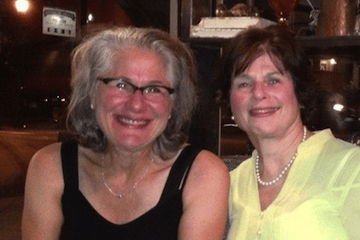
photo - Sharon Stern, left, and Yvonne Rosenberg met in the early 1960s at Camp Solomon Schechter and have been friends ever since
Sharon Stern, left, and Yvonne Rosenberg met in the early 1960s at Camp Solomon Schechter and have been friends ever since. (photo from CSS)

In previous years, Camp Solomon Schechter has awarded the Migdal Or Award to individuals who have provided a “spark of light that guides the way for others to follow.” The inspiration for the award and its first recipients, in 2020, were camp founders Rabbi Joshua and Goldie Stampfer (z”l). While an award won’t be given out this year, the 70th anniversary Schechter Spark will reflect the Stampfers’ “legacy, virtue and commitment to Jewish life and camping.”

Camp Solomon Schechter started in 1954, near Echo Lake, in Washington. The first year, 25 campers attended a one-week session; the next year, 40 campers attended a two-week session. 

The camp moved to Whidbey Island in 1958 but outgrew that space within 10 years. With the help again of Seattle Rabbi Joseph Wagner, one of the camp’s founders, as well as Harry Sherman and Rabbi Zev Solomon from Vancouver, BC, a camp property in the Olympia area was found, and it was for sale.

“Rabbi Stampfer immediately called the number and spoke with the owner, Helen Shank,” reads the Our History page of the CSS website. “And, for $300,000, the 200-acre property could be owned by Camp Solomon Schechter. Each of the rabbis from the major cities (Portland, Seattle and Vancouver) committed to raising $100,000 from their communities, and they were able to accomplish the goal in time for summer 1969.”

CSS is still located at the site near Olympia, with some 600 campers and more than 100 staff attending annually, in addition to the Stampfer Retreat Centre and OSPREY Camp (an outdoor education program).

Seventy years is a special anniversary in Judaism.

“The number 70 is considered a lifetime, so much so that 13 years into the second lifetime, at the age of 83, many Jews will have a second bar or bat mitzvah,” explained Duitch. “Where does that number come from? A midrashic tale tells us that there was an old man planting a carob tree by the side of the road when a traveler walked by. The traveler asked the man, ‘Why are you planting that tree? It will never bear fruit in your lifetime.’ The man responded, ‘I’m doing it for the next generation.’ And so, the legend goes, it takes a carob tree 70 years from seed to fruit and that’s where we get that idea of a lifetime. So, this year, at Schechter Spark, we are celebrating our first lifetime and raising funds for our next lifetime.”

“We are looking forward to being at the event with many of our good friends and all our kids,” Andrew Altow told the Independent. He and Lisa attended CSS in the mid-to-late-1970s. “I was a camper,” he said. “Lisa was a camper and, later, a counselor.”

After their first year at CSS, Andrew said there were a couple of reasons for wanting to return for another summer. “First, all our Jewish friends from all the cities – Vancouver, Seattle, Portland, Spokane – that went every year. Second, the ruach [spirit], the amazing sense of Judaism and fun together.”

Looking back now some 50 years later, Andrew said, “CSS played a massive role for us. Because of our CSS lifelong camp friendships, we met in our 20s at a party in Bellevue [Washington] and fell in love and got married a few years later – Lisa was from Bellevue and I was from Vancouver. Because of CSS, we maintained a meaningful connection with camp and eventually each of our four kids attended CSS and have made their own lifelong friends.”

Andrew and Lisa have each, at one time or another, served on the CSS board or a board committee.

“CSS has been a Jewish string that has connected us to our Judaism and to Israel in a positive and meaningful way, for which we are extremely grateful,” said Andrew. “Mostly, it’s been the amazing people involved with CSS, whether they be staff or volunteers, each one amazing in their passion for CSS and their genuine love for this magical camp, its mission, its values.”

It was “incredibly important” that their kids also go to Camp Solomon Schechter, said Andrew. “Each child – Josh, Lynne, Joey and Ari – got something different out of camp but their experience reinforced their Judaism and their connection to Israel.

“One summer, it was very special to have all four kids and my nephew from Toronto to attend in the same summer session – five Altows at one session. We were so proud to see how close they all were and continue to be. We believe CSS was an incredible positive influence on all of them.”

Humbled to be one of the Schechter Spark 24 honourees, Andrew said, “In a world today full of hate, full of antisemitism, full of turmoil worldwide, CSS is an oasis of safety for Judaism to shine through our children and teach them the beautiful tenets of Judaism so our children, and future children, can continue to repair the world as our faith illustrates.”

To read about the other Schechter Spark 2024 honourees and to RSVP for the (free) local May 5 event at Tap & Barrel in Olympic Village, go to campschechter.org/spark-24. Vancouver co-chairs are Elana Bick and Sheldon Franken, and the special guest will be camp director Manda Graziel. 

Thanks to CSS’s 2024 Matchmakers, any new donation to the camp will be matched dollar-for-dollar, up to $218,000. Visit campschechter.com to donate. 

Format ImagePosted on April 26, 2024April 26, 2024Author Cynthia RamsayCategories LocalTags Andrew Altow, anniversary, Camp Solomon Schechter, fundraising, Judaism, Lisa Altow, Schechter Spark, Vancouver, Yvonne Rosenberg, Zach Duitch

Posts pagination

Previous page Page 1 … Page 89 Page 90 Page 91 … Page 667 Next page
Proudly powered by WordPress