Skip to content
  • Home
  • Subscribe / donate
  • Events calendar
  • News
    • Local
    • National
    • Israel
    • World
    • עניין בחדשות
      A roundup of news in Canada and further afield, in Hebrew.
  • Opinion
    • From the JI
    • Op-Ed
  • Arts & Culture
    • Performing Arts
    • Music
    • Books
    • Visual Arts
    • TV & Film
  • Life
    • Celebrating the Holidays
    • Travel
    • The Daily Snooze
      Cartoons by Jacob Samuel
    • Mystery Photo
      Help the JI and JMABC fill in the gaps in our archives.
  • Community Links
    • Organizations, Etc.
    • Other News Sources & Blogs
    • Business Directory
  • FAQ
  • JI Chai Celebration
  • JI@88! video

Recent Posts

  • Story of Israel’s north
  • Sheltering in train stations
  • Teach critical thinking
  • Learning to bridge divides
  • Supporting Iranian community
  • Art dismantles systems
  • Beth Tikvah celebrates 50th
  • What is Jewish music?
  • Celebrate joy of music
  • Women share experiences 
  • Raising funds for Survivors
  • Call for digital literacy
  • The hidden hand of hate
  • Tarot as spiritual ritual
  • Students create fancy meal
  • Encouraging young voices
  • Rose’s Angels delivers
  • Living life to its fullest
  • Drawing on his roots
  • Panama City welcoming
  • Pesach cleaning
  • On the wings of griffon vultures
  • Vast recipe & story collection
  • A word, please …
  • מארק קרני לא ממתין לטראמפ
  • On war and antisemitism
  • Jews shine in Canucks colours
  • Moment of opportunity
  • Shooting response
  • BC budget fails seniors
  • Ritual is what makes life holy
  • Dogs help war veterans live again
  • Remain vital and outspoken
  • An urgent play to see
  • Pop-up exhibit popular
  • An invite to join JWest

Archives

Follow @JewishIndie
image - The CJN - Visit Us Banner - 300x600 - 101625

UN not hopeless, says Danon

UN not hopeless, says Danon

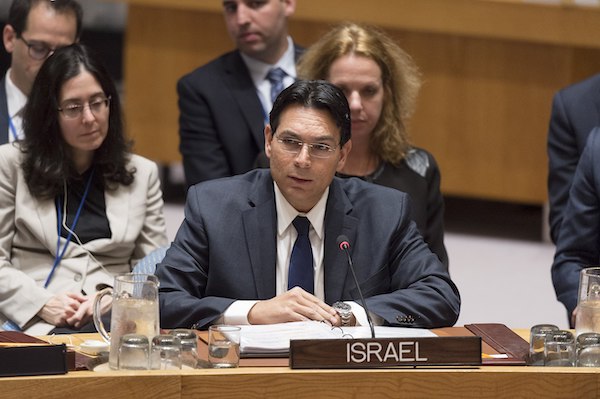
Danny Danon addresses a United Nations Security Council meeting in 2017, when he was Israel’s ambassador to the UN. (UN photo/Rick Bajornas via Wikimedia Commons)

Many Israelis and their overseas allies may see the United Nations as an assembly of antagonists, but a former top diplomat who spent five years there sees plenty of reason for optimism.

Danny Danon, who served as Israel’s ambassador to the UN from 2015 to 2020, spoke candidly during a livestreamed conversation Feb. 8 with Jonas Prince, chair and co-founder of Honest Reporting Canada, which hosted the event.

Danon was a Likud party member of the Knesset from 2009 to 2015 and served as minister of science, technology and space, as well as deputy minister of defence and deputy speaker. He is also an author and world chairman of the Likud party.

“I’m optimistic because we are starting to see change,” Danon said. “We are starting to convince countries to read the resolutions before they talk about them and we are able to see a few victories at the UN, including in the General Assembly.”

He cited two examples of victories during his time at the international body. Working with then-U.S. ambassador Nikki Haley, Danon proposed a resolution condemning the terrorist group Hamas. To pass, it required a two-thirds majority, which was not attained, but a plurality of the member-states supported the motion.

“For us, it was a victory,” he said. “People speak about disappointments but we have to also speak about achievements.”

One unequivocal achievement was when Danon was elected chairman of the legal committee of the UN.

“We got the support of 109 member-states who voted for me and only 44 voted against me,” said Danon. “I became the first Israeli ever to chair a UN committee.”

How did it happen? Secret ballots, he said. On resolutions where the votes of each country are publicly counted, Israel routinely experiences massively lopsided defeats. In secret ballots, the outcomes can be quite different. For example, there are 57 members of the Organization of Islamic Cooperation, which officially opposed Danon’s candidacy. Yet only 44 countries voted against him, he noted.

In his time at the UN, Danon also learned that ambassadors from the smallest countries are often the most persuadable. They do not have large foreign affairs apparatuses in their capitals and so they do not have bureaucrats overseeing their behaviour at the UN, giving them more freedom to vote as they wish.

One regret he has is that Israel did not run for a seat on the Security Council.

“I convinced the prime minister we should run because it’s a secret ballot,” he said. “Unfortunately, the diplomats in the ministry in Jerusalem convinced the prime minister that we don’t have the budget and the energy to run a successful campaign and we had to drop out at the early stage of the campaign, which for me was a big disappointment and I think it was a grave mistake.”

Over time, somewhere between 75% and 80% of country-specific condemnations at the UN have been directed at Israel.

“I call it diplomatic terrorism,” he said. “It has no connection to the reality. When you speak about human rights resolutions, you cannot ignore what’s happening in Syria, in Libya, in Yemen and blame Israel.”

Danon said the situation goes back to the very earliest era of the UN, when the Arab world rejected the Partition Resolution to create a Jewish and Arab state in the area of Palestine. To justify that rejection, and the rejection of every olive branch since, the Arab bloc has had to initiate resolutions against Israel, he said. This took off in earnest in the 1970s, with the infamous (since rescinded) “Zionism equals racism” resolution of 1975, he noted.

The UN General Assembly also engages in a sort of Groundhog Day every year, in which the same series of condemnatory resolutions against Israel is brought out and passed, year after year.

“I come from the Knesset, from the parliament,” he said. “Like every parliament in the world, once you pass a bill or a piece of legislation, you move on. That’s not the case at the UN. Every General Assembly takes the same resolutions you adopted last year and brings them back to the table.”

For all the energies expended against Israel at the UN, Danon argues little of it helps actual Palestinians.

“When you look at the outcome of those resolutions, we can agree that they are not helping the Palestinian cause,” he said. “On the contrary, it gives them empty victories so maybe they get a few headlines for a day or two and then what?… I call them feel-good resolutions, so maybe the Palestinians feel good for a day, but the Palestinian people don’t get anything.”

Danon said he also tried to raise awareness of Palestinian incitement to violence among his UN colleagues.

“Nelson Mandela once wrote that you are not born with hate, someone is teaching you to hate,” Danon said. “I focused on the Palestinian incitement, what they are teaching the kids in school, what they are showing them on Palestinian television, and I proved my case. I said, we can argue about a lot of things, but we cannot allow the Palestinians to continue with the education of hate propaganda against Jews. I showed them the textbooks of the Palestinians [and] what you can find on the internet telling Palestinian children how to stab a Jew, which knife to use and how to be effective.”

The former ambassador insisted he has nothing against humanitarian aid to Palestinians.

“On the contrary,” he said. “But make sure that the funds you are giving are not being used for terrorism and for incitement. Ask tough questions about … the results…. Instead of teaching the Palestinians and giving them the proper education, they did exactly the opposite.”

UN member-states should demand to see results from the billions of dollars poured into UNRWA, the United Nations Relief and Works Agency for Palestine Refugees in the Near East, which is a unique entity that acts as a quasi-governmental body for Palestinians. Rather than resolving the issue of refugees or other challenges facing Palestinians, Danon argues that UNRWA perpetuates the problems in order to justify and prolong its own existence.

The Palestinian refugee issue gets a great deal of international attention, he said, while the parallel number of Jewish exiles from that same era he calls “the forgotten Jewish refugees.”

“When my father’s family fled Alexandria, Egypt, in 1950, they left everything behind,” said Danon. “Nobody is coming and asking the Egyptian government to pay compensation, but at least it should be recognized and I think it’s a claim we shouldn’t abandon. We have to speak about it and make sure it will be brought up in future discussions as well.”

The Palestinian Authority’s President Mahmoud Abbas is 87 years old and Danon hesitates to predict whether the next leader will be a genuine partner for peace.

“I hope that, in the days after President Abbas, a leader will emerge that will care more about education, infrastructure, rather than coming to the UN and speaking against Israel,” he said.

Israel’s defensive actions, like those during the war with Hamas less than a year ago, can make the country unpopular, Danon admitted. While it would be nice to be liked by the world, Danon said some things are more important.

“I prefer the situation where we are today, where we are strong, independent and we have borders, we can protect our people rather than being a place where we beg for mercy from the international community,” he said.
Format ImagePosted on February 25, 2022February 23, 2022Author Pat JohnsonCategories IsraelTags Danny Danon, Honest Reporting, Israel, politics, UN, United Nations
Ominous Sounds premières

Ominous Sounds premières

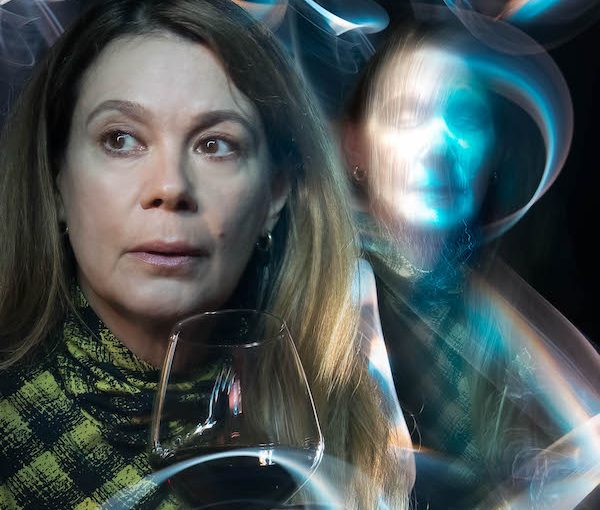
Kerry Sandomirsky co-stars in Ominous Sounds at the River Crossing by Jason Sherman, which has its world première at Performance Works March 6-13. (photo by David Cooper)

Who is permitted to tell stories? This is the main theme of Ominous Sounds at the River Crossing; or, Another F–king Dinner Party Play, playwright Jason Sherman told the Independent.

The world première of Ominous Sounds takes place March 6-13 at Performance Works on Granville Island. Not only is Sherman a member of the Jewish community, but so are cast members Alex Poch-Goldin and Kerry Sandomirsky and lighting designer Itai Erdal. The production is being staged by Touchstone Theatre, whose artistic director is Roy Surette.

Ominous Sounds is described as “a provocative and darkly comedic piece of metatheatre that dives into hot-button issues including the ethics of representation, climate responsibility, and social power in a reality marked by colossal cultural shifts and blurring meanings.”

“In exploring the central theme,” said Sherman, “characters in the play reject a number of storytelling approaches, old and new, notably the dinner party play, of which there are many fine examples, to be sure, but which one of our characters is desperate to escape from. The play keeps returning to various versions of a dinner party play, interspersing it with attempts at other forms of storytelling, before finding a synthesis in a new story.”

photo - Playwright Jason Sherman
Playwright Jason Sherman (PR photo)

The launching point of Ominous Sounds was a planned follow-up to Sherman’s play Patience, which Surette directed some 20 years ago. Patience is “a contemporary retelling of the story of Job; the new play was to pick up with news of the death of the earlier piece’s main character,” said Sherman. “But I found myself balking at returning to the earlier story – for reasons of both form and content – and instead incorporated some of its elements into what would become Ominous Sounds.”

Erdal described some of the considerations in lighting a play like Ominous Sounds. “In a naturalistic play,” he said, “the lighting usually wants to be invisible; it should move the story forward and set the mood and the tone for the scene but it should do all that without pulling any attention to itself…. In an abstract play, the lighting doesn’t have to be justified – it can be part of the architecture and the dramaturgy of the piece. This play is about making theatre, so it moves between the two approaches – sometimes the lighting is invisible and sometimes it can be very dramatic and noticeable.

“We have a brilliant projection designer,” he added, “and many of the locations will be done with video projection, so I will have to … work closely with the projection designer to determine which scenes will be done with lighting only and which scenes with lighting and projections. We are still very early in the process so a lot of those decisions are still being made.”

When Poch-Goldin spoke with the Independent, there had been only three days of Zoom rehearsals.

“It was a bit exhausting using that format, but very enlightening,” he said. “The writer, Jason, was part of our rehearsals and he was able to clarify things for us, which was very helpful.

“I hope people will come see the show now that things are opening up. While COVID is hovering in the background, I have to be optimistic. I want to share this play with people. I want to work with other actors without masks on and I want a sense of normalcy to prevail. I’m not nervous about having restrictions loosen and a full theatre appreciate the work.”

Sandomirsky echoed this last sentiment. “We have all been inside now for two years, many of us living on a diet of Netflix and Skip the Dishes,” she said. “This play does what theatre does best – engages in the cultural conversation of the moment in a provocative, entertaining way. It’s an opportunity to see theatre that you will keep discussing post-show. It’s an opportunity to leave your bubble and safely let a group of experienced actors delight and enrage you. You don’t need to go to New York. You can hear a script that has intelligence, humour and heart right here, on Granville Island.”

Both Poch-Goldin and Sandomirsky play more than one character.

Among Sandomirsky’s roles, she said, “is a 50-something actor trying to navigate the minefield of what stories she is and is not allowed to tell. Is her voice still relevant?”

“We start as numbered entities and then we start to play other characters in little plays along the way, but always return back to our numbered entity,” explained Poch-Goldin. “My character starts vulnerable and becomes quite strident and outspoken, longing for the good old days, when theatre was something he understood. As for the other characters I play, Peter is a bit of a wisecracking dad who is trying to be a better person and facing a lot of struggles. I also play the character of Ruben, who is someone who has passed away and comes back in a flashback to talk about his struggles, and to learn to accept himself and his failings. I love all the characters, they’re profound and reflect many things I feel about the changes in society.”

Poch-Goldin has been busy since the pandemic began. He moved to Winnipeg two years ago and has been doing a lot of TV and film, he said. For example, the première of the series The Porter started on CBC Feb. 21, and Poch-Goldin is in five of the eight episodes.

“I also just finished writing a new play called The Trial of William Shakespeare,” he said. “After three years of development, we’re finally starting to share the script after several workshops. I also have a play called The Great Shadow, about the first film studio in Canada in 1919. It’s going to première this summer at 4th Line Theatre, which is an outdoor theatre in Millbrook, Ont.”

For her part, Sandomirsky continued to teach acting for film and television at Langara’s Studio 58.

“I gathered a group of friends and directed A Midsummer Night’s Dream on Galiano Island in a field,” she said. “It was an opportunity to have experienced Bard on the Beach actors mix with local islanders and create a bit of magic on a few warm August nights.”

As well, she, her son Ben (who is in Los Angeles shooting The Mysterious Benedict Society) and her mom (who lives in Saskatchewan) “started doing nightly themed Zoom sessions to amuse ourselves and stay in contact. We’d choose a theme and then give ourselves half an hour to whump up costumes and props using only what we had at hand.” They shared photos with friends and “began to take thematic requests and covered everything from Bergman to Batman to Brueghel.”

Next for her is the play Courage Now at Firehall Theatre.  Written by Manami Hara, it’s a piece about Japanese consul Chiune Sugihara, who helped thousands of Lithuanian Jews flee Europe. “The director, Jane Heyman, is herself a descendant of a family saved by Sugihara’s actions,” said Sandomirsky.

For tickets to Ominous Sounds, visit ticketscene.ca/series/926.

Format ImagePosted on February 25, 2022February 23, 2022Author Cynthia RamsayCategories Performing ArtsTags Alex Poch-Goldin, Itai Erdal, Jason Sherman, Kerry Sandomirsky, Ominous Sounds, Performance Works, social issues, theatre, Touchstone Theatre

Ukraine in the balance

At our press time, the people of Ukraine were waiting, as they have for weeks, to see what fate has in store for them. Vladimir Putin, the Russian despot, has been threatening to invade the country – again. Under Putin, Russia has already illegally occupied the Crimean peninsula and two enclaves in eastern Ukraine. Pro-Russian extremists are also in control in Transnistria, a breakaway entity to the west of Ukraine that the world community recognizes as part of Moldova. In the Russian countryside surrounding the parts of Ukraine that Russia has not already occupied, an estimated 190,000 Russian troops are poised to attack.

Putin’s designs on Ukraine are ostensibly about his concerns over Ukraine potentially joining NATO, which some Russians view as a step too far in the incremental loss of Russian dominance over what was once the Soviet Union and, before that, the Russian Empire. He is also motivated by his own desire for power and expanding his influence. Along with other Russian nationalists, Putin views Ukraine as more than a neighbouring country but rather an integral part of a sacred Eurasian (Russian-dominated, of course) land.

Western powers have warned and cajoled Putin, who seems to revel in tormenting his adversaries. He is almost certainly aware that no one (save, perhaps, himself) wants war. The United States, having just catastrophically escaped a military debacle in Afghanistan, has no interest in continuing their role as the world’s policeman. The leaders of France, the United Kingdom, Germany and other Western powers have warned of serious consequences if Putin follows through on what appear to be unconcealed ambitions to invade, but none of those countries will risk the lives of their young people to defend Ukrainian sovereignty. It was precisely occasions like this for which the United Nations was envisioned, but the ideals of its founders have run aground on the rocks of realpolitik.

Genuine threats of reprisals are limited to economic sanctions. Here, too, Putin knows that embargoes and other economic penalties would be devastating not only for his country but for the economies of the West. Western Europe depends on Russian oil and anything – military instability or international sanctions – could send fuel and heating costs, which are already at record highs in many places, further through the ceiling. At a certain point, that could threaten the stability of some Western governments. More worrying is the fact that Ukraine has always been, and remains, the “breadbasket” of the region. Military or economic disruptions that harm Ukraine’s ability to get products to market could lead to food shortages. The possibilities are bleak.

Canada is home to one of the Ukrainian diaspora’s largest populations. More than 1.3 million Canadians are from, or descended from, the place. A significant proportion of North America’s Jewish population, too, is from that area and an even larger proportion departed to the new world through Ukraine’s Black Sea ports.

Ukraine has somewhere between 43,000 and 200,000 Jews. Definitions of “who is a Jew” are complicated by nearly a century of enforced atheism and centuries more of rampant antisemitism. The 200,000 estimate is the number who would qualify for Israeli citizenship under the Law of Return.

According to the New York Times, synagogues have hired Israeli security guards and hired buses for rapid evacuations. The Jewish Agency is said to have evacuation plans at the ready.

For all Ukrainians, the past 100 years have been a series of tumults. Jewish Ukrainians have been especially vulnerable during these times of upheaval – and the older Jews today, and those with any sense of history, may rightly understand they have more to fear than other potential victims of a Russian invasion.

Israeli government officials have been remarkably tight-lipped on the subject, other than to urge the 12,000 Israelis in Ukraine to come home as soon as possible – reportedly only 4,000 have so far done so.

It is easy, understandable even, to suggest the time has come for Jews in Ukraine and other places where life is especially difficult, to leave for Israel or elsewhere. Certainly, we are thankful that Jews with nowhere else to go have a Jewish state ready to take them in.

But Ukraine is their home. There are hundreds of Jewish organizations and institutions in Ukraine, a place where Jewish civilization goes back 1,200 years and where a vast amount of Jewish culture emerged in the past several centuries, including important streams of Hasidism and many noted authors and artists.

As the world waits on Putin, the latest in far too long a line of Russian tyrants, we watch with a sense of helplessness, knowing that people are afraid and suffering. And we hope that those in power pull back from the brink.

Posted on February 25, 2022February 23, 2022Author The Editorial BoardCategories From the JITags NATO, politics, Russia, Ukraine, war

We all have our limitations

This month, Jewish communities across North America take time to recognize and celebrate one of the world’s largest and often overlooked minorities: persons with disabilities. Jewish Disability Awareness and Inclusion Month (JDAIM) was launched by a Jewish educational consortium in February 2009. It’s no surprise that its call to action resonates loudly with Canadians – Canada is believed to be the only country in the world that has disability rights enshrined in its constitution.

As someone with disabilities, I can see why a cold and often blustery month was chosen to mark the need for better inclusion. February weather often comes with its own navigational challenges. For the more than 6.2 million Canadians who live with disabilities, icy streets, cold, rain, snow and dismal skies can be even greater impediments to independence.

As I discovered one winter, however, an inclusive community can also play a significant role in easing those challenges. In 2015, my husband and I were in Idaho caring for his mother when I received word that my mom was in the hospital. I needed to come back to Vancouver.

Returning home wasn’t an issue for me. I had traveled to Vancouver many times to visit and care for family members. Attending Shabbat services at my local synagogue had become a ritual each trip that helped provide balance and focus. The Isaac Waldman Jewish Public Library, which afforded me a place to write, had been my other essential refuge.

But this time there was a problem: I couldn’t make the trip alone. As is true with many people diagnosed with an autoimmune disease, my symptoms were multi-factorial and differed according to the time of year. In this case, my biggest adversary was the ups and downs of winter weather and their impact on my circulatory system. This year, the flares were worse. I knew Happy, my trained service dog, would be needed in order to make the trip. Weighing 50 kilograms and hip-high, my King shepherd was strong enough not only to provide support when I walked, but help me up when I fell.

Judaism has never been terribly comfortable with the idea of an animal stepping inside a synagogue, even a professionally trained service dog. In my grandparents’ time, such considerations would have been unheard of. The prospect of a guide dog inspired lengthy debates by 20th-century rabbis who held wildly differing views about the appropriate accommodation for community members with disabilities. As I picked up the phone to call the synagogue, I readied myself for the possibility that I wouldn’t be attending Shabbat services that trip.

There was an understandable pause on the other end of the line when I asked if I could bring my mobility service dog to services. I was told to hold on; she would ask the rabbi. The answer came almost instantaneously: the congregation would be pleased to welcome us to shul.

If there is anything that these last two years of COVID precautions have underscored, it’s the irreplaceable value of community. Sitting in synagogue and having access to the community resources I cherished during my times in Vancouver helped provide a sense of normalcy while I dealt with my mother’s illness. Happy’s stoic, quiet strength not only gave physical support when I needed it, but a heightened sense to unfamiliar territory. Research has found that service dogs can detect changes in heart rate with a range of medical challenges, including heart conditions and diabetes. More than once, Happy guided me back to a point of safety when he sensed my legs weren’t able to navigate the cold.

To educate the library’s many young visitors about its unusual working visitor, the head librarian at the time, Helen Pinsky, informed patrons of Happy’s visit. The Jewish Community Centre of Greater Vancouver did its part to make us feel welcome as well. Most surprising were the parents’ reactions. Many saw our presence as an opportunity to teach children about respecting the role of a service dog and the person at his side. One mother confided that her little boy, who struggled with his own physical disability, was uplifted when he met Happy.

This issue’s article on disability explores the many ways that Vancouver Jewish institutions are working to increase disability awareness and inclusion. (Click here to read.) The examples are paired against research that suggests that while U.S., Canadian and Israeli Jewish communities continue to make remarkable strides in this area, there’s more that can be done. Building a disability-inclusive community is most successful, the research found, when leadership reflects the society it leads. We spoke with one rabbi who is using his own medical challenges to uplift and inspire those with differing abilities in his community.

I have come to realize over the years that a truly inclusive community is one that sees no limitations in how it defines capacity. We all have our limitations, and our unique gifts. We all have our dis-abilities. By bolstering diversity and inclusion in the society in which we live, we not only lift up those beside us, we lift those who will follow after us.

Jan Lee is an award-winning editorial writer whose articles and op-eds have been published in B’nai B’rith Magazine, Voices of Conservative and Masorti Judaism and Baltimore Jewish Times, as well as a number of business, environmental and travel publications. Her blog can be found at multiculturaljew.polestarpassages.com.

Posted on February 25, 2022February 23, 2022Author Jan LeeCategories Op-EdTags disability awareness, inclusion, JDAIM

New lessons in everything

All over social media, we’re reminded to “Learn something new each day!” Even before the internet, I remember similar aphorisms – and then “Heck, if you’re lucky, learn two!” Attached to these reminders was the message that each experience and, yes, especially the awful ones, offered us learning opportunities.

While encountering this social media push for self-improvement, I happened to study, from the Babylonian Talmud, Chagigah 3a&b. This page of Talmud points out something that never occurred to me before. This message about lifelong learning is both a Jewish and ancient one. In the second century CE, in Peki’in, Rabbi Yohanan ben Beroka and Rabbi Elazar ben Hisma went to greet Rabbi Yohoshua. Rabbi Yehoshua asked them what new thing they’d learned that day in the study hall. They suggested they were his students and learned directly from him – how could they present him with something new?

Rabbi Yehoshua responded there couldn’t be a study hall without “novelty.” He went on to ask them who had lectured that week. Upon learning that Rabbi Elazar ben Azarya had taught them, he coaxed them for information. Then, he learned something new from the students.

This sounded just like when we greet our kids as they get off the school bus, or ask students (of any age) what they are learning from other teachers. Inevitably, there is something to learn. This bit of wisdom goes further. The Gemara (later commentators) add that the Torah is like a goad. It pushes us on to learn more. Like a sharp nail or cattle prod, it forces us to keep moving onward and learning from new and different circumstances. Torah, the rabbis conclude, doesn’t just have a single, immovable or simple answer for us.

OK then, I thought, what are some of the lessons we’re able to draw from the pandemic and the political upheaval around us? Many feel as though the pandemic is over, just because we’re tired of it but, practically, this virus will “be over” only when it’s ready to be. In an effort to get past this world-weary reaction, I thought about some of what we’ve learned so far.

1) Since Omicron’s arrival, we’ve realized, more than ever, that we must do our own cautious self-management of health. For awhile, in our North American culture, we expected a doctor to diagnose every illness; our workplaces required a doctor’s note. However, when the level of sickness around us is overwhelming, we’re required to examine and diagnose ourselves. This actually returns us to the world of the rabbis in some sense, where bloodletting, herbs and other cures were advised. Much like Ivermectin, some of these did more harm than good.

2) We should stay home when sick. We’ve all felt forced by the culture around us to work through illness even when it would be best to stay home. Yet, highly contagious illnesses mean we need to protect others to keep sickness from spreading. Again, we’ve lived in a “modern” bubble here for awhile. We’ve had fewer contagions and better vaccines and medical care that allowed us to circulate even when we were probably sick. For centuries, people have fought terrible illness by isolating. A quick example would be that of leprosy – we learn from the Torah and the Talmud that those afflicted must stay outside “the camp” and away from others. Self-isolating is the modern equivalent.

3) With the requirement to stay home came widespread acknowledgement of inequity. Many low-income people can’t afford to stay home. Their jobs don’t allow for it. Without paid sick leave, people can’t rest at home. Jewish tradition suggests we should visit or bring food for the sick. We should care for those less fortunate in our communities, such as widows and orphans. While our political advocacy may involve supporting food banks or homeless shelters, does our contemporary Jewish community focus on fixing inequity? We no longer have a Shmita year that forgives debt and evens the playing field. Is the Canadian answer something like universal basic income or the $10-a-day childcare plan?

4) Change isn’t always bad. Career changes, whether forced or chosen, can be positive. Our educational systems shifted enormously to deliver remote learning and accommodate COVID protocols. Our elder-care facilities are in dire need of improvement. Our hospitals need more capacity and redundancy, in both staff and space, so that even pandemics can be managed.

5) Scientists predicted that with climate change, pandemics may become more frequent. Planning to alleviate some of the effects of climate change has been a rocky path. So many governments get swept up in politics and make no policy adjustments. Our current COVID situation is a reminder that climate change, long predicted, is now here. Leaders must arm themselves with science rather than politics to save lives. Saving lives and caring for the earth are Jewish imperatives. This pandemic has been a frightening wake up call.

We can learn from every situation. The rabbis in the talmudic tractate of Chagigah at first assumed their mentors and leaders knew everything. This offered me a lesson too. Good leaders pursue lifelong learning because they are humble enough to know they will never know it all. Facing challenging experiences and learning from them can goad us so that we grow to be better people. The huge number of deaths, chronic illness and hospitalizations from COVID is devastating. If we try hard, we can find lessons here for a better future.

Joanne Seiff has written regularly for CBC Manitoba and various Jewish publications. She is the author of three books, including From the Outside In: Jewish Post Columns 2015-2016, a collection of essays available for digital download or as a paperback from Amazon. Check her out on Instagram @yrnspinner or at joanneseiff.blogspot.com.

Posted on February 25, 2022February 23, 2022Author Joanne SeiffCategories Op-EdTags COVID, education, lifestyle, pandemic, Talmud, Torah
Diverse and innovative films

Diverse and innovative films

A still from Amanda Kinsey’s documentary Jews of the Wild West, a series of vignettes that shines a light on a noteworthy and usually overlooked history.

The Wild West, Jews in Germany and a surprisingly vivacious Israeli seniors home feature among the diverse films at the Vancouver Jewish Film Festival this year.

Somehow, we tend not to associate Jews with the legends that have built up around the development of the American West, a serious oversight that is in the crosshairs of filmmaker Amanda Kinsey’s documentary Jews of the Wild West.

The mythology of the Wild West is perhaps as much an invention of Hollywood as of history, so it is notable that the 1903 film The Great Train Robbery, which introduced the genre of the cinematic Western, featured Gilbert “Broncho Billy” Anderson – né Max Aronson.

The myth of the West was no less inspiring to Jews than to other Americans and dreamers from around the world. Perhaps one of the most famous names in the lore was Wyatt Earp. The film introduces us to Josephine Marcus, who fled her family in San Francisco to become an actress and ended up being Earp’s wife. Earp himself is buried along with the Marcus family in a Jewish cemetery.

The gold rush drew Jewish peddlers and merchants to the West Coast in the late 19th century including, most famously, Levi Strauss, who left the Lower East Side and, via Panama, arrived in San Francisco. His brothers sent dry goods from New York and Levi sold them up and down the coast. When Jacob Davis, a tailor, was asked by a woman to construct pants that her husband wouldn’t burst out of, he imagined adding rivets. He took the idea to Strauss and the rest is American clothing history. As one historian notes, it was a Jew who invented “the most American of garments.”

The rapid industrialization in the mining sector is where the Guggenheim family got its start and so, while the name is now most associated with Fifth Avenue, the finest address in New York City, their start was in the gritty West of the 19th century.

We meet Ray Frank, the first woman said to have preached from a bimah. Called the “golden girl rabbi,” she was not ordained, but was apparently a phenomenon that drew crowds to her sermons.

Many people will know that Golda (Mabovitch/Meyerson) Meir spent formative years as an immigrant from Russia in Milwaukee and then Denver. This footnote to her history is often considered curious and interesting, but in this film it integrates the Jewish experience of the 20th century and its roots in the American West with the development of the Jewish state – the opening up of another frontier, one might say.

The Hebrew Immigrant Aid Society, seeing the poverty in the Lower East Side, actively encouraged migration to the West. The film introduces families who have worked the land for generations, some of whom have maintained their Jewish identity and at least one of whom was raised Methodist. But, it suggests, the thriving Jewish community of Denver owes much to the failed farmers of the West who made their way to the nearest metropolis to salvage their livelihoods.

The documentary is really a series of vignettes and at times the shift from one story to another is confusing but, as a whole, Jews of the Wild West successfully shines a light on a noteworthy and usually overlooked history.

* * *

The festival features two German films that complement each other in interesting ways.

In Masel Tov Cocktail, a short (about 30 minutes) film, high schooler Dima (Alexander Wertmann) welcomes viewers into his life just as he is suspended for a week as a result of punching a classmate in the face during an altercation in the washroom. The “victim,” Tobi (Mateo Wansing Lorrio), had taunted the Jewish Dima, graphically play-acting a victim in a gas chamber, a performance enhanced by the austere, sterile setting of the restroom’s porcelain-tiled walls. So begins an interplay of victim and perpetrator that is just one of several provocative themes weaving through this powerful short.

Dima’s family, it turns out, heralds from the former Soviet Union, like 90% of Jews in today’s Germany. After the fall of the Soviet Union and the reunification of Germany, the German government actively encouraged migration of Jews to revitalize Jewish life in the country. This fact, like other statistics and tidbits, is flashed across the screen.

Juxtapositions pack a punch, including Dima’s switching between a baseball cap and a kippa, perhaps reflecting his complex identities, as well as the schism in the identities of post-Holocaust Jews more broadly in a society that struggles to assimilate the idea of contemporary, living Jews in the context of the blood-soaked soil of their state. A shift from colour to black-and-white also evokes the stark break between the present and the past.

But the present and the past are themselves in conflict as Dima recounts how other Germans react when they learn he is Jewish. Why does he only meet Germans whose grandparents weren’t Nazis, he wonders. Statistic: a survey indicates that 29% of Germans think their ancestors helped Jews during the Holocaust, while the screen text helpfully informs us the number was more like 0.1%.

Dima’s teacher, who can’t utter the word Jew and struggles to get the word Shoah out of her mouth, wants Dima to share his family’s Holocaust story with the class. The film’s implication is that Dima’s family was largely spared the trauma of the Holocaust, but he decides to play along because, “There’s no business like Shoah business.”

Dima’s grandfather is taken in by the AfD, the neo-fascist Alternative for Germany party, convinced that their pro-Israel and anti-Muslim rhetoric means that they are defenders of the Jewish people. In a moment that confounds the AfD campaigner (and causes the viewer to reflect), Dima drags his grandfather away from the campaigner while yelling: “Don’t let foreigners take away your antisemitism.”

The film is kooky, funny and light, while also serious, dark and thoughtful throughout.

That description applies to the similarly named feature film Love and Mazel Tov, which features Anne, a non-Jewish bookstore owner who has Munich’s largest selection of Jewish titles and who herself is more than a little obsessed with all things Jewish – including potential romantic partners.

“Some are into fat. Some are into thin. Anne is into Jews,” a friend explains. This turns out to be more than a romantic or erotic attraction, perhaps a disordered response to national and family histories.

Thinking she has found not only a Jewish boyfriend but a doctor at that, Anna (Verena Altenberger) courts Daniel (Maxim Mehmet), who in typical cinematic fashion lets her believe what she wants to believe until the inevitable mix-up explodes in a farcical emotional explosion – though not before an excruciating family dinner.

Parts of the film exist on a spectrum between cringey and hilarious. The film features (at least) two fake Jews who don this identity for extremely different reasons, inviting reflections on passing, appropriation and the fine line between veneration and fetishization.

Both of these films use humour to excavate deeply troubling concepts of identity and addressing horrors of the past. They approach these challenging themes in truly innovative and entertaining ways.

* * *

Understated comedy is key to the success of Greener Pastures, an Israeli film in which Dov, a retired postal worker, has lost his home after a “pension fiasco” involving the privatization of the postal service.

He is a curmudgeonly old square when it comes to marijuana, which the government has decided should be available to anyone 75 and over, but he sees a moneymaking opportunity. Dov (Shlomo Bar-Aba) enlists a network of seniors to order medicinal cannabis and mail it to him so he can distribute it to his “connection,” who shops it around to younger consumers. This “kosher kush,” guaranteed “Grade A government-approved stuff” sold in tahini bottles, brings Dov into conflict with a two-bit drug kingpin in a wheelchair and, of course, a snooping police officer.

There is romance and suspense in this madcap caper, but there is also the theme of elder empowerment, along with the laughs.

The Vancouver Jewish Film Festival runs online only March 3-13. For the full festival lineup and tickets, visit vjff.org.

Format ImagePosted on February 25, 2022February 23, 2022Author Pat JohnsonCategories TV & FilmTags antisemitism, comedy, culture, drama, Germany, Gold Rush, Golda Meir, Guggenheim, history, Holocaust, Ray Frank, Vancouver Jewish Film Festival, VJFF, Wild West
Tree poses quandary

Tree poses quandary

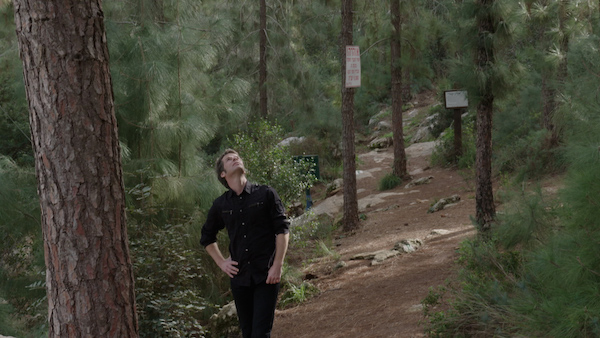
Jason Sherman wanders through an Israeli pine forest in search of his tree. (photo by John Minh Tran)

My Tree, a film by Jason Sherman on his moral dilemma over having had a tree planted in his name in a Jewish National Fund forest, screens at the Salt Spring Film Festival March 6, 7 p.m.

Sherman grew up in a Jewish home in Toronto. “Like my brothers before me, I had a bar mitzvah…. On that day of my becoming a man – at the age of 13 – I was given a number of presents,” writes Sherman in his director’s statement. “There were books of Jewish learning and culture; there was money; and there was a tree. Or rather, there was a certificate telling me that a tree had been planted in my name in Israel.”

He forgot about the certificate until about 40 years later, on his first trip to Israel.

“As I wandered the tourist sites, traipsing around religious Jerusalem, secular Tel Aviv and mystical Masada … I felt the pull of kinship and familiarity,” he writes. “But I also felt a kind of disconnect, wondering if my feelings for the place were genuine or imposed. I got to wondering what my real connection was to the land. It was then that I remembered the tree.”

After much research and metaphorical digging, he determines that the likeliest location of his tree is a conservation area called Canada Park.

“Here, I learn a disturbing new fact about my tree: it’s part of a massive forest that’s covering up the remains of an Arab village that was destroyed in 1967, its thousands of inhabitants sent on the road, never permitted to return.

“I also learn that this covering up of depopulated Arab villages is part of a pattern that stretches back to 1948, during the war that established Israeli statehood. These revelations lead me to ask a number of painful questions with people back in Canada. Did my parents know about the village beneath the forest when they donated a tree for me there? What is my responsibility for that tree?”

Sherman, who is an award-winning playwright, says his aim is not journalistic. “This is not a muckraking, finger-pointing documentary about the dark history of Israel’s tree planting program but rather a personal story … that asks its audience to confront uncomfortable historical truths, and to decide for themselves how to respond to those truths.

For tickets to My Tree, visit artspring.ca/event/salt-spring-film-festival-my-tree. For more about the film festival, which runs March 1-6, go to saltspringfilmfestival.com.

– Courtesy Salt Spring Film Festival

Posted on February 25, 2022February 23, 2022Author Salt Spring Film FestivalCategories TV & FilmTags Israeli-Arab conflict, Jason Sherman, JNF, Salt Spring Film Festival, SSFF, trees
Jewish history’s exciting bits

Jewish history’s exciting bits

Dr. Henry Abramson’s lecture series Jewish History, But Skipping the Boring Parts continues on March 9. (photo from Henry Abramson)

What do country music superstar Shania Twain and Orthodox academic Dr. Henry Abramson have in common? They both spent plenty of time in Timmins, Ont., before moving on to adventures in New Zealand and the United States.

While not as widely known as Twain, Abramson – the dean of arts and sciences at Tuoro’s Lander College in Flatbush, N.Y. – is popular in different circles. For example, during this interview, he mentioned an in-depth article about him in Der Veker, a Yiddish-language journal. He is known as a knowledgeable and entertaining lecturer – facts that the local community can check out for themselves in his five-part series Jewish History, But Skipping the Boring Parts, which began on Feb. 9. Sponsored by the estate of Sara Elias and hosted by Congregation Beth Israel, the series is open to the entire community.

The first lecture zipped through Jewish history touching on, as promised, the non-boring bits of history that are supported by archeological evidence. Many of the earliest artifacts are negative views or accounts of what we now call the Jewish people and Abramson was quick to point out, with humour, that these ancient people wrote nasty things about Jews but we’re the ones still around thousands of years later.

By the end of a well-polished 45-minute presentation, which included lots of images to break up the narrative, and a 15-minute Q & A, the 100-plus attendees were up to speed on the Maccabean revolt. One highlight was numerous examples of medieval depictions of a famous battle in which Judah Maccabee’s brother, Eleazar, kills an elephant. This story was popular with Christian medieval artists but their knowledge of elephants was clearly lacking.

About Abramson

Born in Iroquois Falls, Ont., Henry Abramson was the only Jewish boy in town. His grandparents had fled Lithuania in 1904 and found themselves in this town with a population of about 1,000. Abramson’s grandfather, and then his father, ran the town’s dry goods store. His parents’ commitment to ensure that he had a Jewish home life, education and sense of community are how he found himself in Timmins every Sunday as a child. His parents drove 100 kilometres each way, every week, to take him to learn with other Jewish children from the area. Abramson’s comment about Jews in tiny rural places was, “Break open a roll, out pops a Jew.”

Three years before his bar mitzvah, his parents went one major step further with his Jewish education. They found an apartment in Toronto and enrolled him, for a few years, in Eitz Chaim, a religious day school. His mother stayed with him during the week and his father took the train down on the weekend. Abramson said his father’s greatest talent in preserving the Jewish identity of his family was his ability to listen to the women in his family.

“My whiplash-like experience – going from being the only Jewish kid in town to the only northerner kid who knew what 40-below felt like – tempered my understanding of how Jews fit in the world as a whole,” he said.

After high school, Abramson enrolled at the University of Toronto, where he obtained a bachelor’s degree in philosophy. Disillusioned with his studies, he flew to New Zealand to become a ski instructor. There, he fell in love with another ski instructor. Having grown up skiing, Abramson was living the dream and had planned to continue traveling the world, but he was involved in a ski accident that severed his femoral artery. During the six-month recovery that followed, he rethought his future and focus. He and his then-soon-to-be wife Ilana returned to Toronto, where Abramson earned a master’s in history.

Although the pair was involved in a Conservative shul during the early years of their marriage, they became attracted by the BAYT (Beth Avraham Yoseph Shul) in Toronto and began moving towards Orthodox observance. To complete his doctorate, Abramson went to Jerusalem to work at Hebrew University. After earning his PhD, he spent a year learning at Ohr Somayach Yeshivah, cementing his life as an Orthodox Jew. He went on to complete post-doctoral work at universities including Harvard and Oxford, and has written seven books.

To join the lecture series and find out how well Abramson delivers only the most exciting parts of Jewish history, visit bethisrael.ca. The remaining lectures take place on Zoom March 9, April 6, May 11 and June 1, 7 p.m. Visit bethisrael.ca.

Michelle Dodek is a freelance writer living in Vancouver.

Format ImagePosted on February 25, 2022February 23, 2022Author Michelle DodekCategories LocalTags Beth Israel, Henry Abramson, history, Maccabees, Shania Twain
Artwork of belonging

Artwork of belonging

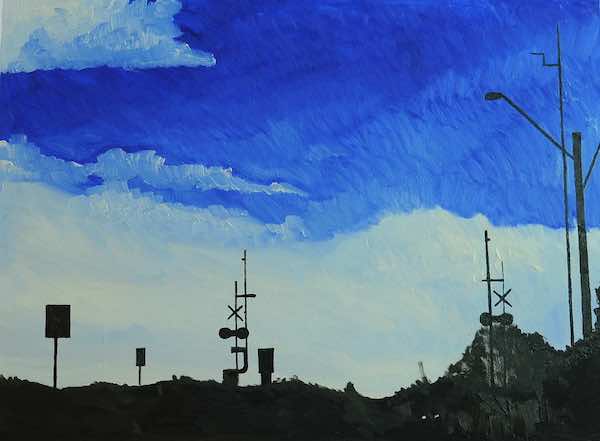
Mike Levin’s “Waiting for the Train.”

Community Longing and Belonging is a community art show in celebration of Jewish Disability Awareness and Inclusion Month. It opened at the Zack Gallery on Feb. 14.

Curated by Leamore Cohen, inclusion services coordinator at the Jewish Community Centre of Greater Vancouver, the fourth annual exhibit once again considers the questions, How do we make meaning of the concept of community, the real and the imagined spaces we inhabit? What does community longing look like and what are the possibilities for belonging in an ever-changing world?

Many of the pieces on display were made by artists from JCC Art Hive, a free and low-barrier program for artists with diverse needs. The collection comprises the work of diverse artists, with different levels of experience, perspective, faith and social location.

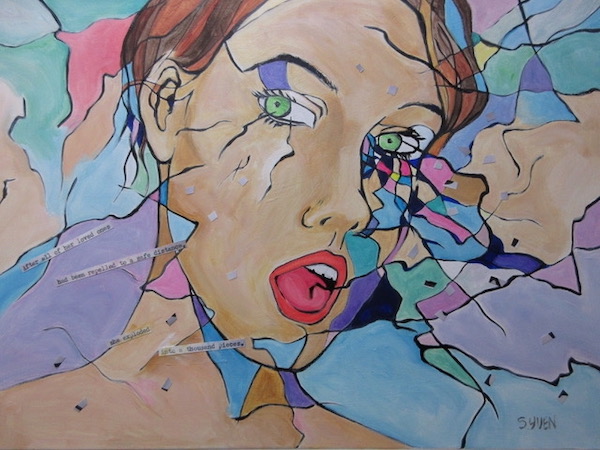
One of those featured is award-winning artist and writer Sandra Yuen, who is a member of Kickstart Disability Arts and Culture. Her piece, “Exploded,” is based on the prose of Derrick Bauman, an artist and writer, and influenced by pop art, Roy Lichtenstein, and graphic design. In her artist’s statement, Yuen writes, “As a person with schizophrenia, I wanted to express the fractured mind, the cut edges, the shattering of my life experience because of mental illness. However, this rendition is more a poetic image versus the cruel reality of living in madness, paranoia, hysteria and anger. The colours are sweet, the black lines clean and sharp, creating a mythological or romanticized view of insanity. I try to whitewash my life, sanitize the pain out of it, deny the diagnosis, but the illness remains, the weakness, the flaws, the humanity.”

photo - “Exploded” by Sandra Yuen
“Exploded” by Sandra Yuen

Mike Levin’s “Waiting for the Train” is about being shrouded in darkness, yet feeling the abundance of sunshine not far away. It is a metaphor for the continued longing for COVID to end so that we can get back to normal living.

Levin’s paintings are often abstractions of nature or city life that conform to structure of composition. They are amalgamations conjured from his imagination, photos he has taken and memories of his experience of exploring.

Growing up in Calgary, Levin has practised art from a young age, and also plays clarinet and saxophone. He attended the University of Calgary’s fine arts and urban studies programs and, after moving to Vancouver, completed his bachelor’s degree in fine arts at Emily Carr University of Art + Design in 2020.

For the past 20 years, Levin has lived with schizo-affective disorder, which he controls through medication and being active in the arts and mental health communities. He has taught drawing and painting at Vancouver General Hospital, the Art Studios, Gallery Gachet and privately within the community; he also works part-time in carpentry. His art has been sold in Canada and the United States to more than 70 private collectors.

Mark Li is a Vancouver-based visual artist whose narrative-focused work creates a whimsical world filled with colour and imagination, as his untitled work in this exhibit shows. Every painting is a tale of friendship and acts of kindness: a bear might be best friends with a cat; a T-Rex smiles with shy humour and sweetness at the viewer; a lady bug and a cat might go dancing in the sunlight; a simple walk in the park with a friend and his dog is a delightful adventure – anything could happen and they could meet anyone.

photo - “Untitled” by Mark Li
“Untitled” by Mark Li

Rickie Sugars’ “Like Minded” is an example of his unique style of painting in abstract cubism expressionism, using bold colours and black outlines.

A seasoned professional artist, Sugars had his first gallery showing, and sold his first painting, at the age of 17. Since then, he has displayed and sold his art in several galleries and art shows throughout British Columbia.

Sugars is a classical animation graduate from Vancouver Film School. He started creating animated characters well before graduation, resulting in a partnership in an animation company that went on for many years. Continuing his artistic path, he began tattooing in 2004 and has his own tattoo shop. He also designs sculptures created from broken toys.

A few years ago, during an attempt to assist a woman who was being attacked, Sugars received a traumatic brain injury. He had to re-learn everything, including how to talk – however, it did not stop his artistic endeavours. Today, you will find Sugars painting on canvass (or any surface, really), crafting stickers, postcards, wall murals, sand and wood sculptures, and interior/exterior commissioned graffiti.

“My artwork is influenced by media, fads, plus social, political and cultural issues,” he writes in his artist statement. He wants viewers “to look past the obvious, to treasure and celebrate the unique, the unconventional, the familiar: and to be nonjudgmental. Respect others and support them for who they are. Find the beauty in broken toys, an old door, a broken guitar – take time to look more carefully at things around you and you’ll discover beauty in unusual places.”

Another of the artists contributing to the Community Longing and Belonging exhibit is Adrianne Fitch.

Born in Kew Gardens, Queens, N.Y., Fitch studied English and writing at Pennsylvania State University and has traveled all over the world, including living and studying in Israel. She has lived in Vancouver since 2008 and pursues a number of other art forms. She is also a writer and desktop publisher.

“Having lived with a hearing disability and also struggled with depression all my life,” she writes, “I definitely know what it means to feel isolated. As hearing loss is invisible, people frequently make assumptions about me (e.g. they think I’m stupid, stoned or purposely ignoring them). As I did not begin learning ASL until adulthood, I occupy that grey area between the hearing and deaf worlds. I miss a great deal of communication, both spoken and signed, and have often felt as though I don’t belong anywhere.

“That’s why this art show’s theme, Community Longing and Belonging, is so significant and meaningful to me. Indeed, I have always longed for community and belonging. The Jewish community, with its wonderful heritage and incredible diversity, is very precious to me. In creating these three ceramic menorahs, I have tried to express this diversity, as well as my love for the Jewish people.”

Community Longing and Belonging is at the Zack Gallery until March 17. There is a virtual meet-and-greet with the artists on March 2. Visit jccgv.com/art-and-culture/gallery or email Cohen, [email protected], for more information.

– Courtesy Jewish Community Centre of Greater Vancouver

Format ImagePosted on February 25, 2022February 23, 2022Author Jewish Community Centre of Greater VancouverCategories Visual ArtsTags Adrianne Fitch, art, disability awareness, diversity, graphics, inclusion, JDAIM, Leamore Cohen, Mark Li, Mike Levin, painting, Rickie Sugars, Sandra Yuen, sculpture, Zack Gallery

Twice Blessed 2.0 survey

JQT Vancouver and JFS Vancouver are partners – with support from Jewish Federation of Greater Vancouver – on Twice Blessed 2.0: The Jewish LGBTQ2SIA+ Initiative.

The purpose of the initiative is to understand the current needs of the Jewish LGBTQ2SIA+ community. The agencies involved are committed to creating an inclusive community and survey feedback will inform the changes they need to implement. The self-identification survey is open to all members of the Jewish LGBTQ2SIA+ community and can be accessed at tinyurl.com/twiceblessed2.

In 2004, Jewish Family Services (then Jewish Family Services Agency) conducted Twice Blessed: The Jewish LGBT Project – Needs Assessment of the Jewish LGBT Community in the Greater Vancouver Area. For full transparency, this survey was conducted, but only resurfaced in 2021 during an interview for JQT’s B.C. Jewish Queer & Trans Oral History Project with Jacqueline Walters, who conducted the 2004 survey. (JQT, pronounced J-cutie, is a Jewish queer and trans nonprofit dedicated to “queering” Jewish spaces and “Jewifying” queer spaces to make them more inclusive.)

It has been nearly two decades since this 2004 assessment was conducted, and JQT and JFS apologize that its findings were not acted upon, and want to honour those who participated in that survey by amplifying their voices today.

JQT has been contracted by JFS to update the assessment, using the same or similar questions and adding new questions as language and needs have evolved, in order to compare data, compile, analyze, report and make recommendations on next steps for LGBTQ2SIA+ initiatives.

This new initiative began on Nov. 15, 2021, with a full day of JFS staff training, at which JQT presented on Jewish organizational LGBTQ+ inclusion information collected during the oral history project. JQT will present to the JFS board in early 2022, followed by a JQT-led JFS virtual townhall on April 10, 6-8 p.m., with the findings from the updated survey.

According to a 2020 Simon Fraser University survey of 4,000 Canadians, 10% of respondents identified themselves as part of the LGBTQ2SIA+ community. Further, Statistics Canada and United Jewish Federations of Canada estimate the population of Jewish people in British Columbia at 35,000 with 26,255 in Vancouver, meaning that approximately 2,626 Jewish queer and trans people live in the city. This number is likely higher, given many queer and trans Jews come from mixed families (multicultural, multiethnic, multifaith), patriarchal Jewish families (traditional Judaism follows matriarchal descent), are in diverse relationships, may be unaffiliated to the Jewish community and/or vary in how they identify Jewishly. Currently, JQT’s reach is approximately 1,000 in the Vancouver area, or 38% of the estimated total JQT community.

This latest survey is for people living in the Greater Vancouver Regional District and the online questionnaire is 100% anonymous, and optional, though JQT and JFS strongly encourage community members to participate. The higher the number of participants, the more confidently JQT and JFS can create strategies to affect real and necessary change.

JQT and JFS will not collect personal information such as your name, address or IP address, in order to protect your confidentiality. All information gathered will be securely stored by JQT, accessible only by JQT founder and executive director Carmel Tanaka and shared with JFS chief executive officer Tanja Demajo.

The survey is open for submissions until March 27, 2022. It has a total of 45 questions and will take 15 to 20 minutes to complete. The first question is required but the rest of the questions may be left blank – though JQT and JFS encourage people to complete the survey to the best of their ability. Please check all categories that apply, or specify in point form in the comments field. The examples listed are designed to illustrate some of the possible answers and are not intended to be exhaustive.

Language and terminology on ethnicity, race, religion, culture, gender, sexual orientation, and many more identities are constantly evolving. JQT has prepared a glossary resource for reference.

If you are a parent of LGBTQ2SIA+ Jewish youth, you may fill it out together with them (noting in the comments that it was jointly completed). If anyone requires assistance in filling out the form – needs to do it over the phone or have it translated, for example – email [email protected].

People should feel free to share this survey with their Metro Vancouver Jewish queer/trans friends, whether they be un/affiliated to the Jewish community, in newsletters and at places of work.

– Courtesy JQT Vancouver and JFS Vancouver


Posted on February 25, 2022February 23, 2022Author JQT Vancouver and JFS VancouverCategories LocalTags Jewish Federation, JFS Vancouver, JQT Vancouver, LGBTQ2SIA+, needs assessment, survey

Posts pagination

Previous page Page 1 … Page 180 Page 181 Page 182 … Page 662 Next page
Proudly powered by WordPress