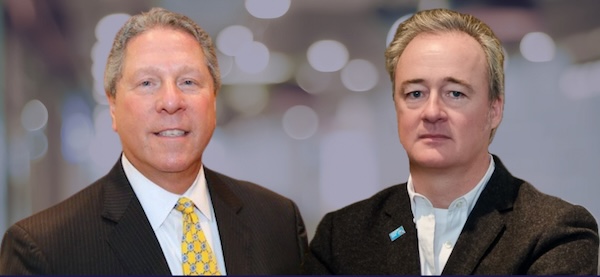
The inaugural board of the Jewish Medical Association of British Columbia. (photo from JMABC)
The newly incorporated Jewish Medical Association of British Columbia held a meeting at Schara Tzedeck Synagogue on May 29, with more than 70 physicians and allied healthcare professionals in attendance.
Rabbi Andrew Rosenblatt, spiritual leader of Congregation Schara Tzedeck, gave a lecture called How to Speak about Israel, detailing facts about the origins of the ancient Hebrews living in the biblical land, which is now Israel. Special guests were Dr. Gregg Gardner, a professor in the University of British Columbia’s department of Near Middle Eastern and religious studies, and Dr. Judith Paltin, a professor in UBC’s department of English language and literature – they have recently formed the Jewish Academic Alliance of British Columbia.
Prior to Rosenblatt speaking, the group engaged in table discussions on strategic planning and the priorities of the association. Many attendees were meeting for the first time in person. Clinical psychologist Dr. Rotem Regev commented, “It was such fantastic event. I left feeling elated and uplifted. Such a relief to be in a room with so many esteemed and like-minded individuals.”
The event was held just 24 hours prior to an arson attack on the synagogue. The Jewish Medical Association promptly put out a news statement and pleaded for UBC, health authorities and other institutions to take action to combat antisemitism and ensure safety for all.
Dr. Marla Gordon, physician in Vancouver, initially started a group for Jewish physicians as a support network post-Oct. 7. The group grew and, in January, became an incorporated organization under the co-leadership of Gordon and Dr. Larry Barzelai. The association has bylaws, an appointed inaugural board and almost 200 members. It has expanded to include all allied health workers and professionals who identify as Zionists, including non-Jewish allies. In addition to hosting social, educational and wellness events, the JMA is combating the rise of antisemitism on campuses and in healthcare spaces. The association is part of a larger network of recently formed medical associations across Canada, including Ontario, Quebec, Manitoba, Alberta and the Maritimes. To join the JMA, email [email protected].
– Courtesy Jewish Medical Association of British Columbia
Richard Heideman, left, and Warren Kinsella participated in a B’nai Brith Canada virtual fireside chat on May 30. (photo from B’nai Brith Canada)
The League for Human Rights of B’nai Brith Canada hosted a virtual fireside chat with Canadian lawyer and author Warren Kinsella and American attorney Richard Heideman on May 30. The conversation largely focused on growing antisemitism and political passivity in North America in the wake of the Oct. 7 Hamas attacks on Israel.
Kinsella began by talking about his experiences over the past three decades, writing about neo-Nazism and antisemitism and how they never fully disappear, no matter what region of Canada one observes. However, he said, the present state of anti-Jewish feeling in the country is the worst he has witnessed.
“I never dreamed in my worst nightmare that we would actually have in a single week two schools in separate provinces shot at because they teach Jews. I never thought I would see the attacks on Jewish businesses, individuals and community centres,” he said.
Kinsella castigated elected representatives in Canada for their inaction and lack of leadership in the face of hate speech directed at Jews and the rising numbers of attacks, citing an abundance of laws to handle the problem effectively.
In the international arena, Heideman added, the silence from prime ministers, presidents and ambassadors after the Hamas attacks last fall has been “deafening.” No Western democracy, he said, would tolerate the atrocities committed during the Oct. 7 attacks on their own soil.
“The United Nations and its world courts must be held accountable for singling out Israel for multiple decades and playing into the biased hands of countries like Iran, which only months ago directed hundreds of drones and rockets at the sovereign state of Israel,” said Heideman.
Both men praised Israel for its commitment to human rights and agreed that the present demonization of the strongest democracy in the Middle East, and the concurrent calls for economic and academic boycotts, must come to an end.
Heideman argued that the lessons of recent history, namely the banning of Jews from all facets of everyday life in Nazi Germany in the 1930s – which was followed by the Holocaust – have not been learned. What’s more, he said, there is presently a blame-the-victim mentality at the international diplomatic level which faults Israel for the present situation.
On the bright side, Kinsella noted that polling after Oct. 7 would suggest that the vast majority of North Americans are on Israel’s side and believe it has a right to defend itself. They also welcome Jewish people into their communities. The problem, according to Kinsella, is with the younger segment of the population, the group which has taken to the streets, created encampments, and said and done terrible things to Jews.
“Eighteen-to-40-year-olds in Canada, the United States and Europe are presently a lost generation. You will find no constituency or demographic that believes more in Holocaust denial, that thinks Hamas was right and that Israel should be wiped off the map,” Kinsella said.
“When we have millions of young people who have embraced hatred, division and terrorism, we have a big, big problem,” he continued. “I think we are looking at something that is going to take a decade or more to fix because it’s taken us more than a decade to get us to this dark place.”
To Kinsella, the internet – the primary medium through which people, particularly the young, obtain information – is largely at fault. Despite improving the world in many respects, he said, the World Wide Web has enabled those intent on propagating hate to do so immediately and at no expense. Further, both Kinsella and Heideman said bad state actors are determined to exploit the internet to spread misinformation and hate speech.
Heideman said there was no place for timidity in the present environment and advocated examining each situation and acting accordingly – in other words, not remaining silent.
“Being quiet does not do us any good,” he said. “Being quiet leads to Holocaust denial, distortion and people not caring. We have to take action in a way that is targeted, strategic and powerful – that means in federal courts, state courts and international courts.”
Kinsella is president of the Daisy Group and a former special assistant to former prime minister Jean Chrétien. He has advised numerous political campaigns and is the author of several books, in addition to being a newspaper columnist.
Heideman, senior counsel at Heideman, Nudelman and Kalik PC, and chair of the US Holocaust Memorial Museum Lawyers Committee, is a specialist in American and international litigation.
Sam Margolis has written for the Globe and Mail, the National Post, UPI and MSNBC.
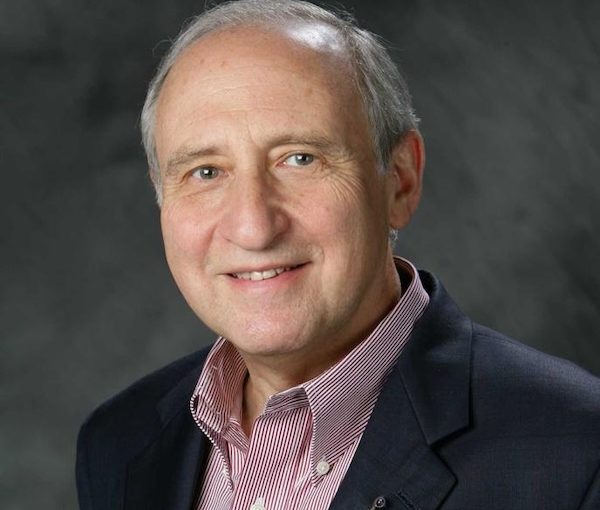
Ben Shneiderman was the featured speaker at Jewish Senior Alliance’s Spring Forum May 26. (photo from hai.stanford.edu)
On Sunday, May 26, the Jewish Seniors Alliance presented their annual Spring Forum. Featured speaker Ben Shneiderman spoke about his family’s influence on journalism, photojournalism and the development of human-computer interactions.
Shneiderman was introduced by Gyda Chud, a past president of JSA and chair of the program committee. He told those gathered at the Peretz Centre for Secular Jewish Culture about his family history, keeping the audience enthralled throughout.
Shneiderman is an emeritus distinguished professor of computer science at the University of Maryland. He has received six honorary doctorates in recognition of his pioneering contributions to human-computer interaction and information visualization. He has published more than 20 books, most recently, Human-Centered AI (Oxford University Press, 2022), which won the Association of American Publishers award in the computer and information sciences category.
However, Shneiderman did not begin with his own cultural contributions, but with those of his parents, Samuel and Eileen (née Szymin) Shneiderman. They began their journalistic partnership in Warsaw, writing for the many Yiddish publications that existed then. Their lives mirrored the turbulent events of those years. They moved from Warsaw to Paris, where they continued to contribute to Yiddish publications. They did major reporting from Spain during the Spanish Civil War. In 1938, Samuel published a collection of his work on the Spanish Civil War in Yiddish, titled Krig in Shpanyen: Hinterland. This coverage earned him the title of being “the first Yiddish war reporter.” This book was later published in Polish and then in Spanish. It will appear soon for the first time in English as Journey through the Spanish Civil War, translated by Deborah Green and published by the Yiddish Book Centre’s White Goat Press.
In 1940, with the help of the Yiddish press in New York, the family was able to immigrate to the United States and escape the war. Samuel worked with the Yiddish press and published many other books, including editing The Diary of Mary Berg, by an American woman who was incarcerated in the Warsaw Ghetto and described harrowing details of life there. Samuel wrote of the Kielce Pogrom in Between Fear and Hope. The Weitzman National Museum of American Jewish History has two virtual exhibits: one on Samuel and Eileen’s partnership, and the second on Ben Shneiderman’s computing contributions and the photojournalism of David Seymour, Eileen’s brother, who was known as Chim.
Chim’s humanistic style of reporting influenced modern visual storytelling. One of his photos, related to the war, may have inspired a painting by Picasso. Chim’s war photos were widely published in many magazines and journals, and he became known for his unique photographs of children who had become orphans during the conflict. He also took photos of many celebrities, such as Audrey Hepburn, Maria Callas, Ingrid Bergman, and many others. Some of these images were published in popular media such as Life magazine.
Chim took some interesting shots of life in the state of Israel in the early 1950s. Of note is a photo of a wedding taken outdoors, possibly in the Judaean Hills. The chuppah is torn in a few places and one side is being held up by a rifle and a pitchfork. Chim was killed while photographing the Suez Crisis for Newsweek in 1956. He was 45 years old.
Throughout the presentation, Shneiderman replied to questions and comments, Marilyn Berger, a past president of JSA, thanked him for his inspiring words.
The next JSA event is A Summer Afternoon of Music on June 24, featuring a live concert of classical music, showtunes and Jewish songs by Trio du Souvenir – Rudy Rozanski (piano), Yu Tsai (cello) and Arnold Kobiliansky (violin). Co-sponsored with the Kehila Society and Congregation Beth Tikvah, the concert and lunch take place at Beth Tikvah. To attend, RSVP by June 21 to Toby Rubin, [email protected] (lunch is $15).
Shanie Levinis a Jewish Seniors Alliance Life Governor. She is also on the editorial committee of Senior Line magazine.
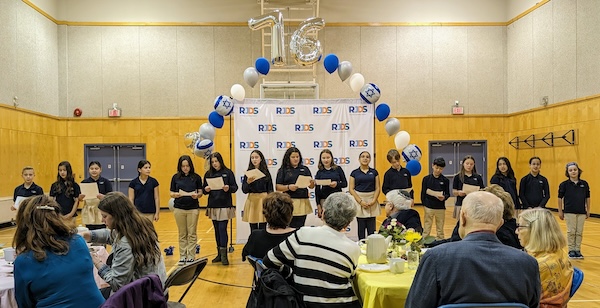
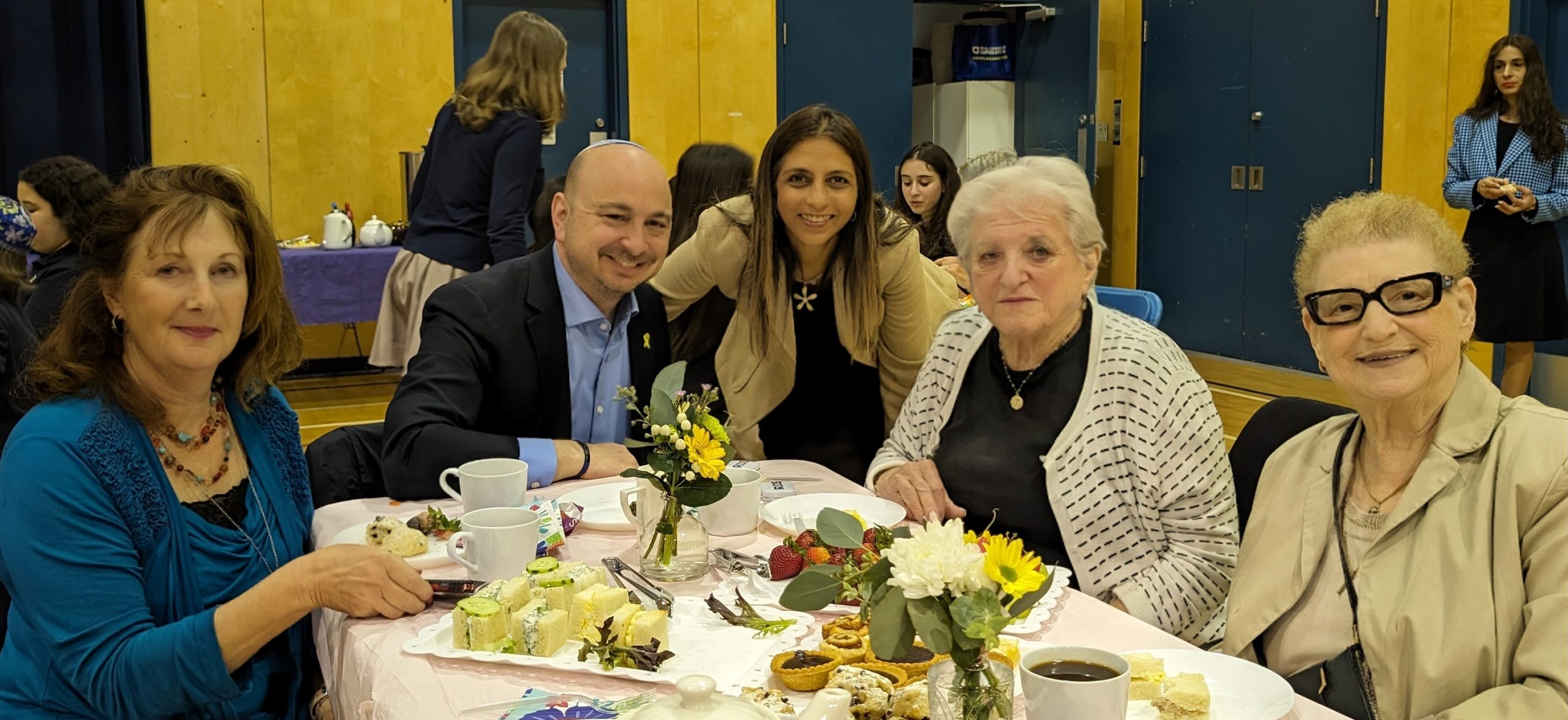
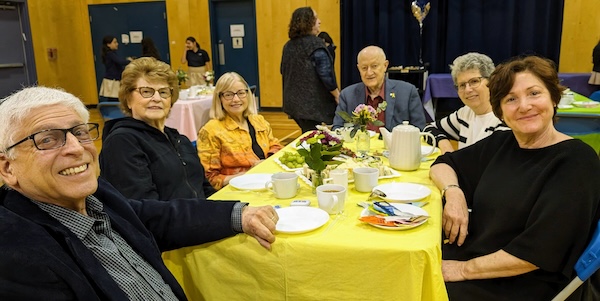
Richmond Jewish Day School students at the school’s annualGarden Tea Party, which took place May 22. (photo from RJDS)
On May 22, Richmond Jewish Day School (RJDS) welcomed community members to its annual Garden Tea Party.
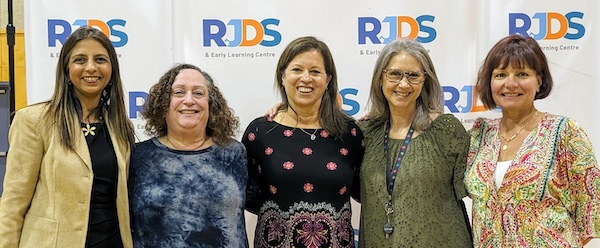
Sabrina Bhojani, Lynne Fader, Joanne Robinson, Reesa Pawer and Toby Rubin. (photo from RJDS)
The event began with a welcome from the head of school, Sabrina Bhojani, followed by a d’var Torah from one of the Grade 7 students. There was entertainment provided by other students. The school’s Israeli dancers took all their hard work from the performances at the community’s Yom Ha’atmazut celebration and Festival Ha’Rikud and performed a show-stopping dance!
Cindy Rozen, Ezra Shanken, Sabrina Bhojani, Lola Pawer and Andi Strausberg. (photo from RJDS)
The entire tea was hosted by RJDS’s senior students, as they led community members to their seats, and served the tea and treats. The Kehila Society of Richmond and Joanne and Gary Robinson sponsored the event.
Perry Seidelman, Marie Doduck, Phyllis Johnson, Dr. Peter Suedfeld, Shelley Seidelman and Marcie Flom. (photo from RJDS)
The tea was a testament to the rich tapestry of experiences, talents and perspectives within the Richmond community. RJDS acknowledges its interconnectedness with the community and recognizes community members’ invaluable contributions to the school’s vibrant environment. Amid sipping tea and engaging in conversation, the power of connection and intergenerational exchange was evident, as was a sense of unity and belonging.
Many community events, lessons and celebrations take place in the Jewish Community Centre of Greater Vancouver’s Wosk Auditorium. (photo from JCC)
A sense of family and community, somewhere to be physically active and mentally stimulated, a haven in which to socialize and relax, to have a nosh, a lifeline during the pandemic and a place to be with like-minded people after Oct. 7. The Jewish Community Centre of Greater Vancouver – “the J” – “is a warm and welcoming place for Jews and the community in general,” offered JCC executive director Eldad Goldfarb.
The Jewish Independent spoke with Goldfarb and others recently, to see how the centre has fared since the Hamas terror attacks on Israel, the Israel-Hamas war and the rise in antisemitism around the world, including in Metro Vancouver.
“The level of security has seen a noticeable increase,” said Goldfarb. “The initial shock had an effect on our entire community, which felt insecure and somewhat afraid to venture out and into Jewish community facilities. This fear quickly changed into a desire to congregate, be with fellow Jews in safe spaces, and the JCC is a place where everyone feels safe and welcome.”
He praised the Vancouver Police Department and its role in allowing the community to gather safely.
“The VPD is amazingly supportive of the Jewish community and the JCC,” he said. “They are doing above and beyond within their limited resources to provide both physical as well as emotional safety at this very difficult time for our community. The JCC staff team is very vigilant and pays close attention to anything out of the ordinary.”
Goldfarb has been the J’s executive director for 11 years, and was assistant executive director for the six years prior to that. He said the centre has “expanded its programs and services, providing substantially more scholarships and subsidies to families and individuals.” And he and the JCC board “have been involved in the conceptualization, visioning and creation of JWest, an exciting innovative community project for generations to come.”
“The JCC has been working diligently on expanding our capacity, we have made investments in recruiting top-notch staff, replacing and transforming our technology systems in order to improve customer experience, ease the registration process and create efficiencies in the organization,” said Goldfarb.
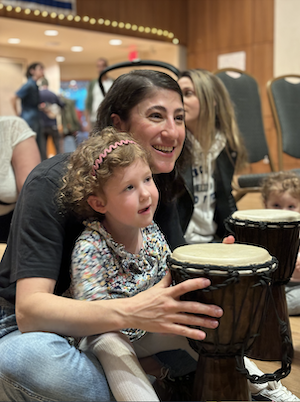
“We’re always trying out new programs,” Hila Olyan, senior director of programs, told the JI. “I’m especially excited about programming for new families, which ramps up this coming fall: pre- and post-natal yoga, baby sign and sing, stroller fitness, storytime in the library. We’re also trying out some new children’s programming over the summer. Music, Music for Littles and Music, Music for Babies will be offered on Sundays. I can say from personal experience that my toddler loves the program. He’s been taking it since April.”
The J’s many programs include ones to introduce toddlers and their families to the joys of music. (photo from JCC)
While the programming hasn’t changed much in response to Oct. 7, Olyan said “the interest in being part of programs has increased. I think, for many people, myself and my family included, the opportunity to participate in Jewish and non-Jewish programming, but in a safe space surrounded by like-minded people, is more important than we previously realized.
“We’ve also tried to be thoughtful as we plan and host our community events like the recent Festival of Israeli Culture. We are thinking about how we can honour the challenging times we are living in, but also celebrate the beautiful culture we all know and love.”
She pointed to significant participation in events such as seniors luncheons, the J’s annual Purim Party and other activities.
“The people of our community want to be around other community members and I think it’s a great thing,” said Olyan. “The atmosphere has shifted a few times. We’ve moved from shock and devastation to strength and resilience. I think it’s a real testament to the spirit of our community.”
“The JCC has and will always be a safe place for me and my family and the entire community,” said Michael Averbach, who has been going to the J since he was a kid himself. “Oct. 7 didn’t change my frequency of visits or how I feel about being at the JCC, nor should it for any current member, but my message to those considering joining – there’s no greater feeling of family than being at the J. It’s the only place where we can truly interact with all sectors of our community, from the non-observant, to the Reform, to the Orthodox and everyone in between. Furthermore, the JCC was built on the foundation where everyone is welcome, regardless of religion or race.”
In addition to being a J member, Averbach has chaired the centre’s main fundraising event, the RBC JCC Sports Dinner, for many years. Attesting to his family’s generations of involvement with the JCC, the welcome desk everyone passes on their way into the centre is called the Betty and Louis Averbach Membership Desk, named after Averbach’s grandparents. And the next generation is also involved.
“We’ve had our kids in day camp and swimming lessons over the years and, personally, I enjoy boxing sessions with Alexei to keep me sharp and on my toes and to complement my regular fitness routine,” said Averbach. “I also try and get to the J in the later evenings up three to four times a week to enjoy the sauna and steam in the men’s spa.”
Working out at the J. (photo from JCC)
When asked what keeps him coming back to the centre all these years, Averbach said, “The warm feeling and sense of community walking through the doors.”
This is an aspect that also appeals to J member Cathy Paperny and her family, who joined the JCC in 2006 when their children began the 2-year-old program.
“I appreciate being surrounded by a Jewish community,” she said. “I have a good relationship with Eldad and we often have good talks about various topics, including the war in the Middle East. During these challenging times, it’s especially important to be surrounded by like-minded people. I feel I have that at the JCC.”
The social aspect is one of Olyan’s favourite parts of her job.
“I like the combination of interacting with members, program participants and administration. I like thinking about how we can make our programming stronger and then having the opportunity to put plans into action and see the results. Every single day I meet and talk with interesting people who are all here at the J for their own unique reason – a workout, childcare drop-off, gymnastics, music lessons, a holiday or festival.”
For Paperny, that reason was the program for 2-year-olds. She said the J was the only place that offered it. “I liked that my children were attending with other Jewish children, some of whom became lifelong friends. It was close to VTT [Vancouver Talmud Torah] for afterschool programs and convenient for me when I was working at the Holocaust Centre,” she said.
Paperny worked at the Vancouver Holocaust Education Centre, which is on the lower level of the centre, until 2019, for about four years as the symposia coordinator and as a docent for more than 10 years.
In addition to the 2-year-old program, Paperny said, “Yaelle went to ballet classes when she was young and did Israeli dancing through Talmud Torah and then performed at the Festival Ha’Rikud events at the JCC until Grade 7. Both of my children attended Camp Shalom for a couple of years.One of my children did the leadership-in-training program at Camp Shalom. They also attended other sports camps, like soccer.
“I did personal training there for years and attended some of the fitness classes, including circuit training,” she continued. “Now, I swim, do private pilates with Camila, attend yoga twice a week and attend many fitness classes.”
She also attends Jewish Book Festival events and, often, Israeli dancing on Wednesday nights.
These types of activities are exactly what the JCC mission entails.
“For our Jewish community, we continue to be committed to our mission to provide programs to enhance positive identification with Jewish life and Israel,” said Goldfarb. “This can be seen in our children’s camps, early childhood education programs (daycare and out-of-school care) and with our Israeli dance classes – to name a few.”
Nava Creative Kosher Cuisine is also on site. A popular spot to have a coffee or lunch, it is hard not to run into fellow community members when you’re there: members of the J, people visiting the latest exhibit at the Zack Gallery or going up to the Waldman Library, staff from the various Jewish organizations housed in the centre, participants in different programs, parents picking up their kids, students from King David High School, which is located across the street from the centre, and others.
“The JCC, while not without its challenges, is a place of growth and potential,” said Averbach. “I am aware of the high staff turnover and the need for building upgrades and, together, we are actively working on raising the necessary funds to address these issues. If there’s one key area for improvement, it is staff training for those with special needs and neurodiversity. By properly implementing this training, we can ensure that all our children feel comfortable and welcome.”
And it seems that the J is committed to continually improving. For example, staff review its programming often.
“Every participant in a registered program receives an email link to a quick survey,” said Olyan. “We also look at our mission statement and consider how we can continue and better meet our mission and the needs of our community. Are we offering social, educational, recreational and cultural programs for every demographic? Finally, we consider what are the emerging trends and interests within and outside the Jewish community and is the JCC the right place for [such programs]. We really try to listen to our members and find out if there are particular programs they would like to see.”
As for her feedback, Paperny said, “During COVID, the J was a lifeline for me when virtual programs were available, and then when it opened up to in-person programs. My physical health is so integral to my emotional, mental and spiritual health. The J has always been there for me.”
Vancouver Jewish Community Garden coordinator Maggie Wilson took the photo that graces this year’s cover of the Jewish Independent Summer issue. According to the garden’s newsletter, “A few strawberry plants opted to try their luck in the gravel and managed to produce the season’s first strawberries!”
The garden was established in 2020 by Vancouver Talmud Torah, Congregation Beth Israel and Jewish Family Services. It was made possible by the Diamond Foundation, which secured a long-term lease of the land for future development and is allowing the land to be used on a temporary basis, and the Jewish Federation of Greater Vancouver, Jewish Community Foundation and Ronald S. Roadburg Foundation, who provided significant financial seed gifts.
The recent newsletter shared, “We have already harvested a crop of vibrant radishes, arugula, kale and herbs. Children and adults alike have enjoyed tasting nectar-laced kale flowers, and JFS’s chef used the fresh radishes in her Tuesday salad.
“The peas, seeded by VTT’s Grade 1 students, have started to ripen. The first small batch was harvested for JFS by VTT’s Green Thumb Club.”
Groups from JFS, VTT and BI “have spent time in the garden this spring, contributing their muscles, enthusiasm and appetites!
“JFS staff came to move wheelbarrows of compost into the garden beds to top-up and replenish the soil. They then enjoyed a picnic lunch in the garden.”
VTT students from grades 1 through 7 have come to help and learn in the garden, as have students from BI’s Hebrew school, and BI staff.
For community members looking to get involved in the garden, its website – jewishcommunitygarden.ca – is now live. Check it out for all things garden, including a continually updated slide show so you can follow along as the garden changes throughout the seasons. Upcoming volunteer opportunities will be posted, and information on how you can get involved. Everyone is welcome – there are tasks for all abilities and experience levels.
למלחמה בין ישראל והחמאס ברצועת עזה יש השלכות חמורות לגבי ביטחונם של הישראלים הגרים מחוץ למדינה. המראות הקשים של ההרוגים הרבים בעזה מסיבים נזק גדול לישראל. רבים בעולם כמעט ושכחו מה הביא לפעילות של ישראל בעזה – אירוע השבעה באוקטובר הנחשב לדבר בלתי נתפס. ולמרות זאת, בעולם מתעסקים כיום בעיקר בצד הפלסטיני הסובל מהרוגים ופצועים רבים, בו בזמן שרצועת עזה הולכת ונמחקת
הפגנות נגד ישראל, ישראלים, יהודים ומוסדות ישראלים ויהודים בעולם מתרחשות כל העת במקומות רבים. הכעס והשנאה המופנה כלפי ישראל כבר מזמן חצה את הקו האדום ולא זכורה תקופה כזו בעבר
בנוסף להפגנות יש גילוי שנאה ואלימות כלפי ישראלים ויהודים הגרים בערים שונות במערב. גם תיירים מישראל מרגישים כבר שלא בנוח לטייל במקומות שונים
המטה לביטחון לאומי פרסם לפני מספר שבועות היום את הערכת האיום לישראלים בחו”ל מצד גורמי טרור, במטרה להגביר את המודעות של הציבור הישראלי לאיומי הטרור במקומות שונים בעולם. במוקד: בקשה מהישראלים להימנע מהגעה למדינות שכנות של שיראל ובהן: לטורקיה, מרוקו, מצרים (כולל חצי האי סיני) וירדן. וכן מומלץ באופן כללי לא להחצין סממנים ישראליים או יהודים
בהודעה שפרסם המטה לביטחון לאומי נכתב כי בשנים האחרונות מזוהה מגמה מתמשכת של החמרה באיום כלפי ישראלים ויהודים בחו”ל, שהוחרפה מאז תחילת מלחמת חרבות ברזל (בחודש אוקטובר אשתקד), לאור עלייה במוטיבציה של גורמי טרור שונים בעולם לממש פיגועים. במסגרת זאת, בולט האיום האיראני שהתעצם ולצידו גם חמאס וגורמי ג’האד עולמי, המקדמים ביתר שאת פיגועים נגד ישראלים ויהודים מחוץ לישראל
עוד נכתב כי בחודשים האחרונים סוכלו עשרות פיגועים נגד יעדים ישראלים ברחבי העולם. לאור זאת, הדגישו במטה לביטחון לאומי כי פוטנציאל איומי הטרור כלפי ישראלים ויהודים כעבור למעלה משבעה מתחילת המלחמה – גבוה במיוחד
חודשים האחרונים התגברו הפרסומים של ארגונים אלו ותומכיהם, הקוראים ומעודדים לפגוע ביהודים וישראלים ברחבי העולם. במדינות המערב, האיום המרכזי הינו מצד מפגעים בודדים, אשר פועלים בהשראת הארגונים ועלולים לממש פיגועים כנגד ישראלים ויהודים, כפי שאירע למשל בשוויץ ששם נדקר אזרח מקומי יהודי בראשית חודש מרץ. זאת, ביתר שאת לאור אווירת המלחמה, האנטישמיות וההסתה חסרת התקדים נגד ישראל, ישראלים ויהודים ברחבי העולם
גורם המדיני ציין כי גם משחקי היורו שיתקיימו במהלך קיץ בגרמניה והאולימפיאדה שתתקיים בצרפת, שני אירועים שעשרות אלפי ישראלים צפויים לפקוד אותם, הם אירועי שיש לנקוט בהם זהירות מיוחדת. עיקר החשש הוא מגורמי ג’יהאד עולמי, כאשר גם ישראלים ויהודים על הכוונת, אמר הגורם הישראלי. בכל רגע נתון יש מאמצים חובקי עולם כדי לבצע פיגועים נגד ישראלים ויהודים, הוסיף אותו גורם. יחד עם גורמי ביטחון מקומיים, קהילת הביטחון של ישראל מבצעת אינספור פעולות על מנת לסכל. מפעם לפעם יש פרסומים על סיכולים, אך מה שמתפרסם הוא קצה הקרחון של מה שקורה באמת
אני עצמי חזרתי לאחרונה מנסיעה בת שבועיים בספרד כולל הערים ברצלונה ומדריד. לאור המצב המתואר לעיל נקטתי באמצעי זהירות מירביים. לא הסתובבתי ליד שום ארגון יהודי או ישראלי ולא דיברתי עברית בשום מקום. אני לא נושא שום סממנים ישראלים או יהודים בכל מקרה אך הפעם הקפדתי במיוחד. ולכן גם לא הבאתי עימי לטיול הפעם ספר בעברית. ראיתי בטיול לא מעט דגלים פלסטינים התלויים באזורים שונים בברצלונה וספרד וזה לא בדיוק נעים
Kineret Tamim Academy founders Dr. Elior and Leah Kinarthy. Kineret Tamim is Victoria’s first Jewish day school. (photo from Chabad)
Kineret Tamim Academy, just steps from the Chabad of Vancouver Island’s Centre for Jewish Life and Learning, is now officially an independent school.
Easily reaching the 10-student minimum before any classes could be taught, Kineret Tamim is looking forward to enrolling more students when it opens in September. The school will be kindergarten to Grade 2 at the start, but hopes to expand to more grades in the future.
For many local Jewish parents and grandparents, the need for a day school has been pressing. Victoria is the fastest-growing Jewish community in Canada, with a population of 4,385, according to the 2021 census (up from 2,630 a decade earlier).
“The fact that, for the first time in the 160 years of Jewish history in Victoria, the first Jewish day school is opening is a testimony to the growth of Jewish life on Vancouver Island,” said Rabbi Meir Kaplan, the director of Chabad of Vancouver Island.
“Victoria is now a destination for families who would like to raise their children in a community with robust Jewish education,” he said.
Chabad of Vancouver Island was established in September 2003 when Kaplan and his wife, Chani, arrived in Victoria. At first, the living room of their home was used as the shul and children’s play area. Their programs, and the interest they drew, expanded over the years and more space was needed to accommodate the community. On Aug. 24, 2016, the Verrier Family Chabad Centre for Jewish Life and Learning was opened.
“Rabbi Kaplan has been a mover and shaker, and his wife, Chani, has also been a major reason the school is happening,” said Leah Kinarthy, an active member of the local Jewish community and president of Jewish Family Services Vancouver Island. “The preschool she runs is incredible. Having a successful preschool is a major requirement for the Tamim Academies to support a new school opening.”
Kinarthy and her husband, Elior, were instrumental in enabling the school to become a reality and Leah Kinarthy will serve on the school’s board. Cathy Lowenstein, who was head of Vancouver Talmud Torah for 17 years, is now a professional advisor who helps launch private schools and works to establish them as certified independent schools in the province – she was also pivotal in bringing Kineret Tamim into being.
Principal Kristen Lundgren, who holds a bachelor’s of education specializing in French immersion and French second language instruction, has 27 years of experience in childhood education. Hebrew and Judaic studies will be taught by Viviana Finkelstein, who has taught elementary Hebrew for more than 30 years.
“The school has an incredible headteacher/principal and a Judaic/Hebrew teacher,” said Kinarthy. “It’s a community school that will be a unifying force for quality Jewish education for our children and grandchildren. Opening a Jewish day school was our lifelong dream; now is the time to make our legacy a reality.”
Kineret Tamim will offer secular education, with both French and Hebrew immersion, along with Judaic studies. The organizers of the school stress their objective is to facilitate the “unbounded potential” and “innate desire to learn” within every child.
Further, they aim to “prioritize long-term social-emotional and spiritual health in order to fulfil our mission of developing kindness, self-efficacy and purpose in each student.” This approach, they believe, will enable students to make their own positive imprint on the world.
Kineret Tamim Academy is run under the auspices of Chabad of Vancouver Island, which is led by Rabbi Meir and Chani Kaplan. (photo from Chabad)
The school will be inclusive. Every Jewish child, regardless of background, affiliation or level of observance, will be able to attend. No Jewish child, their website states, will be denied a Jewish education due to financial circumstances. All students must wear a uniform. Kineret Tamim has partnered with a security company to ensure the safety of children and staff.
The school is part of Tamim Academies, an international organization of schools, and is one of many located around the world. The name stems from Tomchei Temimim, the first formal yeshivah system of the Chabad-Lubavitch movement, which was founded in 1897 in Russia by Rabbi Sholom Dovber Schneerson. Each student was referred to as “tamim,” pure, perfect or complete – the assumption being that each child is inherently holy and good, with “wholeness” being the foundation of the education model.
For several years, Chabad of Vancouver Island has been operating CTots, a licensed early childcare centre, situated on the upper level of the Centre of Jewish Life and Learning on Glasgow Street. Kineret Tamim Academy will be located on Quadra Street.
The Chabad centre in Victoria is one of two on Vancouver Island. There is also Chabad Nanaimo and Central Vancouver Island, which launched in January 2015.
On Lag b’Omer (May 26) at 4:30 p.m., there will be a groundbreaking for Kineret Tamimn Academy, coinciding with a community barbecue. The event will take place at the CTots Adventure Park. Admission is $10 for adults and $5 for children. Sponsorship is $180.
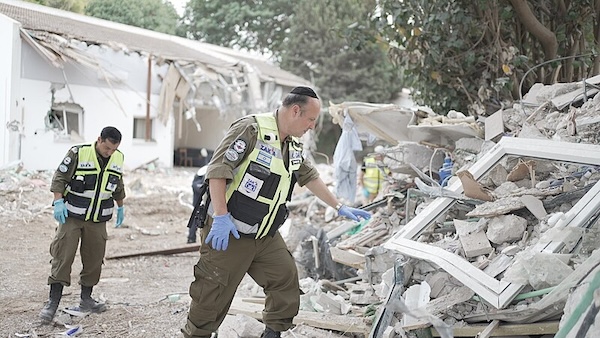
Members of ZAKA identification, extraction and rescue team search through the destruction in a Gaza Envelope community following the Oct. 7 attacks. (photo from ZAKA)
The annual Yom Hazikaron ceremony, marking Israel’s day of remembrance for fallen soldiers and victims of terrorism, took place May 12 at Temple Sholom. It was an unprecedentedly poignant ceremony, with hundreds of in-person attendees and hundreds more attending virtually, many of whom lost loved ones on Oct. 7 and in the war that began that day.
Dikla and Etsik Mizrachi, parents of Ben Mizrachi, the young Vancouver man murdered while heroically providing medical aid to others at the Nova music festival, both spoke.
“This Yom Hazikaron is different,” said Dikla Mizrachi. “This Yom Hazikaron, I can’t think of the many lives that we’ve lost. My heart can’t take the burden. The weight of my grief is too heavy to bear. This Yom Hazikaron, I can only think of one special boy, a boy who had big dreams, life ambitions.”
Ben grew up in Vancouver, she said, attended Vancouver Hebrew Academy and then King David High School.
“Ben was so proud of who he was,” his mother told the packed synagogue. “He was proud to be a Jew, he was proud to be Israeli. He had his mind set that, after high school, he would go to Israel and learn in a pre-army Mechina program to prepare him for the IDF. He couldn’t imagine himself doing anything else. And he didn’t. He did it all.”
Ben Mizrachi served three years in the parachute unit and completed a paramedic course.
“On Oct. 7, at the young age of 22, Ben was brutally taken from this world at the Nova festival in Re’im,” his mother said. “But he was not taken without a fight. His personality and moral core would not allow it. He did not run away to save himself when he had the chance. He showed tremendous courage and bravery as he tried to save others.
“We do not know everything about the last hours of Ben’s life. But we have been able to piece together some of them. What we know is that, from 6:30 a.m. to 8:10 a.m., Ben was under attack. We know that he and Itai Bausi, a friend from his kibbutz who went with him to Nova, made a choice to leave the safety of their car and their chance to flee. We know they made this choice in order to render aid to the injured,” she said.
Two brothers who survived the music festival attack have shared the story of how Ben used his medical skills to attend to the injuries of a young woman and then, with three other young men, transported her on a stretcher to the medical tent, holding her at hip level to avoid snipers.
“We know after they deposited the woman the boys then separated to run in different directions to escape their attackers,” said Dikla Mizrachi. “We know from the last voicemail message Itai’s girlfriend received from him that he was shot in his back and his leg. We know from both the phones that Itai called Ben multiple times but there was no response and we know that Ben died a hero, as did Itai.
“This past Oct. 7, our life as a family and our life as a Jewish nation changed forever,” she said. “Our collective hearts are completely shattered. Today, we are all in mourning. We all have soldiers in Gaza. We all have 132 hostages in Gaza. We all have evacuees from the north scattered all over the country. We are all suffering together.”
She told the audience that, at her son’s shiva, an army friend of Ben’s told her that he had lost a cousin in 2021, in Operation Guardian of the Walls.
“That year, on Yom Hazikaron, Ben had called him and said, ‘I know it’s your first Yom Hazikaron, so if you need or want to talk to someone, I’m here for you,’” she recounted. “This was Ben, thinking about others at every moment and being so sensitive.”
Addressing her late son, she said: “Ben, this is my first Yom Hazikaron and I need you.
“I need you to help our family choose life each day and give us strength. I know that you are still with us, but can you please send us a sign very soon, a sign that you are OK and in a good and peaceful place? Ben, we will do our best to live our lives according to your values, to be there for others, as you always were, and to cherish the things you loved. We love you. We think about you and we miss you every day a bit more.”
Later in the evening, Ben’s father, Etsik, said Kaddish for his son.
Geoffrey Druker, who has led the annual event for years, noted that this year was different.
“We have within our community families who lost loved ones in the past seven months, lost a son, a father, a brother, a sister, cousins, extended family, and friends,” he said. “Tonight, with our bereaved families here and worldwide, we remember our fallen in the establishment and the defence of the state of Israel, and all who have been murdered in terrorist attacks. We remember them all.”
Members of the BC Jewish community lit candles and spoke about those they have lost. A montage of photographs remembered friends and family of locals, from 1948 to recent months. Druker shared individual stories, a microcosm of the many stories of tragedy and heroism from Oct. 7 and the months since.
He told of the five members of the Kutz family of Kfar Aza – father Aviv, 54, mother Livnat, 49, and sons Rotem, 19, Yonatan, 17, and Yiftach, 15 – who were found hugging each other on a bed, father Aviv trying to provide a protective embrace.
In all, 64 members of Kfar Aza were murdered, and 13 soldiers killed in the battles on Kfar Aza. Among these residents was Mordechai Modi Amir.
“Modi was a creative person, always thinking outside the box,” Druker said. “So, when they built his secure room, he decided to add a small shower room, a room within a room, with its own door. At 6:30 a.m. on Oct. 7 – when the red alert siren went off, Modi, his two daughters and granddaughter entered the safe room.
“When they heard shots close by, and voices speaking Arabic, he told his daughters and granddaughter to enter the tiny shower room and to remain quiet as he closed the door behind them. He then stood waiting in front of the shower room door,” Druker said. “He most likely thought, when the terrorists enter the safe room, they will see a man standing by the wall, they will shoot him, and move on. A member of Kfar Aza later said: ‘Modi was shot several times and fell to the floor. He most likely, in his last seconds alive, saw the terrorist leave, knowing he saved his family.’ And,indeed, 13 hours later, his three family members left the tiny shower room alive, and survived.”
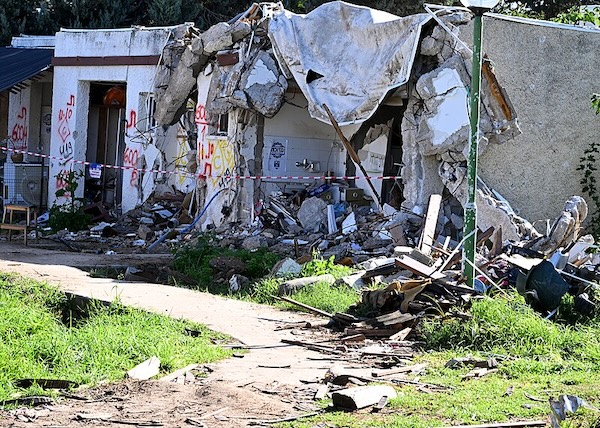
Destruction at Kibbutz Kfar Aza. (photo from US Embassy Jerusalem)
Vancouverite Amnon Kones and his family lived on Kfar Aza for 20 years and knew many of those killed. He lit a candle of remembrance, as did Sam Heller, who lived there during his military service as a lone soldier.
Adi Vital-Kaploun, an Israeli-Canadian who lived on Kibbutz Holit, was a relative of Vancouver residents Jason Rivers and Helen Heacock Rivers.
“Her husband was away that weekend,” Druker explained. “When Adi realized terrorists had infiltrated her kibbutz, she phoned her husband and asked how to operate his weapon, to defend her children.
“By some miracle, Adi persuaded the terrorists to allow her two young boys, Negev, 3-and-a-half, and Eshel, 6 months old, to be kept by her neighbour, Avital. Adi was shot and murdered in her home, and her body booby-trapped by the terrorists,” said Druker. “The Hamas terrorists then marched Adi’s neighbour, Avital, who was carrying Negev and Eshel, towards Gaza. At the Gaza border, for some unknown reason, they were released, and they survived, though 3-and-a-half-year-old Negev had been shot in the foot.”
Noam Caplan and Kessem Keidar, members of Habonim Dror Camp Miriam, lost family members and a friend on Oct. 7. Caplan spoke of his cousin, Maya Puder, 25, who was murdered at the Nova festival. Keidar remembered her cousin’s uncle, Amit Vax (Wachs), who was murdered in Netiv HaAsara.
“When he was killed, he was not aware that his brother Igal Vax was murdered earlier, while he too was fighting the terrorists on the other side of the moshav,” said Keidar.
The pair lit candles in memory of these victims, as well as Vivian Silver, another Canadian-Israeli, who lived on Kibbutz Be’eri.
It is estimated that about 120 people were murdered on Kibbutz Be’eri, among them Sylvia Ohayon. Dalia Ohayon lit a candle in memory of her sister.
Five members of the Bira family were murdered on the kibbutz: Oron Bira, 52, and his wife, Yasmin Laura Bira, 51, and their daughters Tahir, 22, and Tahel, 15, along with Oron’s elder brother, Tal, 62. Yahav, Oron and Yasmin’s son, was in another house, and is the sole survivor.
Navah Jacobs, a member of the extended Bira family, lit a candle in their memory.
Vancouverite Hofit Sabi recalled her cousin, Yinon Tamir, a 20-year-old paratrooper killed in action in the Gaza Strip in November, having earlier served among the first responders at Kibbutz Be’eri.
“Before going into Gaza, a few weeks after the battle of Be’eri, another comrade told of how Yinon comforted and guided him through his fears and anxieties to go into Gaza,” said Sabi. “Yinon promised that he would stay by his side and protect him, and he did, until his death. Yinon’s courage and leadership qualities shone through.”
Tamir had told his mother that he saw things at Be’eri that he could never unsee and that he felt a profound sense of privilege to serve and protect the right “to live as free people in our homeland.”
Itzhak Ben Bassat, a colonel nicknamed Benba, had just returned from vacation abroad at the end of a storied military career when he received a message to head for Be’eri on Oct. 7. He fought there for two days, securing the kibbutz, and survived. He died in battle two months later, age 44. His sister, Hamutal Ben Bassat, lit a candle in memory of her brother.
Nicky Wasserman Fried, whose uncle Aaron Fried died in the 1948 War of Independence, lit a candle in his memory and told the audience of casualties in Vancouver’s partnership region in northern Israel.
“Three IDF soldiers from our region were killed fighting Hamas as they infiltrated our communities surrounding Gaza on Oct. 7,” Fried said. “Since Oct. 7, an additional seven soldiers and three civilians have been killed.”
Cantor Yaacov Orzech chanted El Moleh Rachamim. The Clore & Roll Ensemble, who were the featured entertainers at the next evening’s Yom Ha’atzmaut event, performed, as did singers Mayan Molland, Shir Barzel and the Meitar Choir. Shir Barzel played piano.
The ceremony was presented by the Jewish Federation of Greater Vancouver, the Centre for Israel and Jewish Affairs, the Rabbinical Association of Vancouver and the Jewish Community Centre of Greater Vancouver.
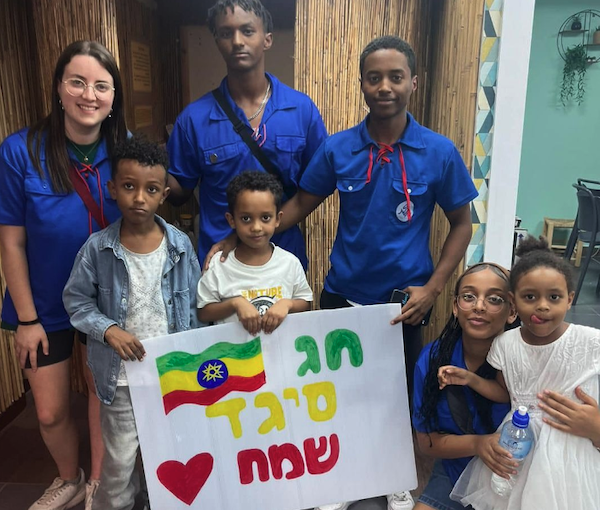
Last November, Dror Israel helped evacuees from northern Israel celebrate the holiday of Sigd. (photo from Dror Israel)
Noam Schlanger of Dror Israel is returning to British Columbia to discuss the group’s emergency response after the Oct. 7, 2023, Hamas terror attacks in Israel. He will speak at Congregation Emanu-El in Victoria on May 28, at 7 p.m., and at Congregation Beth Israel in Vancouver on June 2, at 5 p.m.
“We had been working with many of the affected communities for a long time before the attacks, so, when the war broke, we had the connections and the know-how to immediately set up educational frameworks for evacuated communities, with an emphasis on therapeutic and empowering platforms,” Schlanger the Independent.
“I will also be talking about our work with the tens of thousands of evacuees from the north, who still haven’t returned to their towns and homes. We have been providing day camps, leadership training courses and social-emotional support to many children and teens who have been living in cramped hotel rooms with their parents for seven months.”
Schlanger is an engagement director with Dror Israel, an Israeli organization that teaches leadership and responsibility for both individuals and community. Comprised of 1,300 trained educators in 16 communities on the social and economic periphery of the country, the organization promotes social activism to drive positive change. Educators live in the neighbourhoods they serve to bridge gaps and solve local problems. Through its youth movement, schools and programming in Israel, it helps an estimated 150,000 people a year.
Dror Israel educators have supported children traumatized by previous wars, the COVID lockdowns and the war in Ukraine. During the current war, the organization, in cooperation with local municipalities and the Israel Defences Forces Home Front Command, has established programs to help evacuees and residents who have been hardest hit.
Schlanger shared several stories of how Dror Israel has played a crucial role in allowing life and events in the country to continue as normally as possible under the circumstances. In November last year, they helped evacuees celebrate Sigd, a holiday celebrated by Ethiopian Jews that falls 50 days after Yom Kippur.
This past March, students from Dror Israel’s Tel Aviv high school used their skills in urban agriculture to create community gardens. The portable gardens were made at several evacuee centres for displaced communities and not only provide fresh produce but therapeutic spaces that give solace and connection.
In April, 400 children from the evacuated city of Kiryat Shmona were supplied structure and some fun through a Passover day camp. The children, from grades 1 to 6, who are presently housed in Tel Aviv hotels, went bowling, visited an amusement park and had a picnic near the Alexander River.
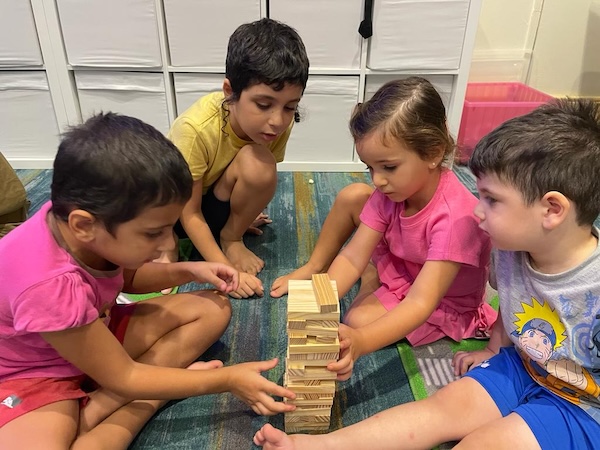
Dror Israel has been giving evacuees the chance to have some semblance of a normal life. (photos from Dror Israel)
Dror Israel works with animals as well. Following the Oct. 7 attacks, many dogs ran away or were leftbehind. With the help and care of students in the Dog Training Vocational Course at Dror Israel’s high school in Karmiel, dogs went from being fearful and hesitant to curious and loving, and many are now ready for adoption.
Besides being an engagement director, Schlanger’s involvement with Dror Israel has included leading a youth centre in Kafr Manda, an Arab town in Lower Galilee, and working at the community garden in Akko (northern Israel).
From Schlanger’s standpoint, the essence of Dror Israel is one of an inclusive vision of Zionism that yearns to create space for everyone, and the dream of a just and equal Israel. He believes it is a welcome message amid the polarized discourse that has been prevalent in the country for many years.
Schlanger last visited British Columbia in the summer of 2022 and has maintained a close relationship with both Congregation Emanu-El and Congregation Beth Israel. In October 2023, only a couple of weeks after the Hamas attacks, he wrote to his friends in Victoria, “We will do our best to better people’s lives during these terrible days. Our educators across the country are continuing to assess the safest and most necessary next steps in our communities.”
“The sense of connection goes deep into our community and we have people there, too,” said Susan Holtz, executive director of Emanu-El, about the synagogue’s ties with Dror Israel.
Rabbi Adam Stein of Congregation Beth Israel said, “We are very excited to have Noam come here. Dror Israel is a wonderful organization that has been doing great work for Israeli civil society, especially for those who were evacuated after Oct. 7.”
“I visited Dror Israel in Akko and was very impressed at the programs they offered and the process they undertook,” Beth Israel member Penny Gurstein added. “Their commitment to social justice and partnerships between Jews, Arabs, and all sectors of Israeli society is even more needed now.”
Dror Israel was started in 2006 by graduates of the Israeli Youth Movement, Hanoar Haoved Vehalomed, who served together in the IDF and shared a belief in the founding principles of Zionism.
After his talk in Vancouver, Schlanger will travel to Portland to speak at the annual federation meeting there. For more information about Dror Israel, visit drorisrael.org.
Sam Margolishas written for the Globe and Mail, the National Post, UPI and MSNBC.