Skip to content
  • Home
  • Subscribe / donate
  • Events calendar
  • News
    • Local
    • National
    • Israel
    • World
    • עניין בחדשות
      A roundup of news in Canada and further afield, in Hebrew.
  • Opinion
    • From the JI
    • Op-Ed
  • Arts & Culture
    • Performing Arts
    • Music
    • Books
    • Visual Arts
    • TV & Film
  • Life
    • Celebrating the Holidays
    • Travel
    • The Daily Snooze
      Cartoons by Jacob Samuel
    • Mystery Photo
      Help the JI and JMABC fill in the gaps in our archives.
  • Community Links
    • Organizations, Etc.
    • Other News Sources & Blogs
    • Business Directory
  • FAQ
  • JI Chai Celebration
  • JI@88! video

Recent Posts

  • עשרים ואחת שנים בוונקובר
  • Supporting the Iranian people
  • The power of photography
  • A good place to start
  • When boundaries have shifted
  • Guitar virtuosos play
  • Different concepts of home
  • Broadway’s Jewish storylines
  • Sesame’s breadth and depth
  • Dylan Akira Adler part of JFL festival
  • Mortality learning series
  • A new strategy to brighten up BC
  • Sharing latkes and light
  • Johnson awarded for human rights work
  • Cherished tradition ensured … Silber Family Agam Menorah
  • Nothing as lovely as a tree
  • Camp welcomes new director
  • Popular family camp expands
  • A life-changing experience
  • Benefits of being a counselor
  • Camper to counselor
  • האלימות בישראל מורגשת בהרבה מגזרים
  • טראמפ עוזר דווקא לנושא הפלסטיני
  • New rabbi settles into post
  • A light for the nations
  • Killed for being Jewish 
  • The complexities of identity
  • Jews in time of trauma
  • What should governments do?
  • Annie will warm your heart
  • Best of the film fest online
  • Guitar Night at Massey
  • Partners in the telling of stories
  • Four Peretz pillars honoured
  • History as a foundation
  • Music can comfort us

Archives

Follow @JewishIndie
image - The CJN - Visit Us Banner - 300x600 - 101625

Tag: Hamas-Israel war

Some miracles from tragedy

Some miracles from tragedy

Dr. Gil Troy spoke of being inspired by Ben Mizrachi and other young Jews, who he described as Zionist lions. (screenshot)

Vancouver’s Ben Mizrachi died a hero saving others at the Nova music festival on Oct. 7, 2023. On that terrible day, and since, a new generation of Zionist lions has emerged, exemplifying the heroism that Mizrachi and so many others epitomized.

This, according to the American-Canadian-Israeli academic and author Dr. Gil Troy, is one of many miracles that have risen from the tragedy.

Troy, an American presidential historian and McGill University professor who lives in Jerusalem, knew Mizrachi well. One of Troy’s sons participated in an Israeli program with the Vancouverite. 

“They became close, close friends,” said Troy. “He was one of those kids who walked into the door and straight into your heart. He was really part of our family.”

On Oct. 7, Mizrachi, who was a trained medic, and his friend Itai Bausi, went back into the festival site and saved the lives of others before being murdered themselves.

“What I learned from his heroism was, yes, the Israeli government failed that day,” Troy said. “Yes, the IDF failed that day. But Zionism was vindicated that day. Zionism raised a generation of lions. Zionism raised a generation of Bens and Itais, who fought back, and that was the real miracle of Oct. 7. What saved Israel was Israelis. What saved Israel was Zionism, which taught them to defend themselves, which taught us the value of defending ourselves, which taught us the language of defending ourselves, which sometimes is with words and sometimes is with arms and sometimes with our bare hands.”

Troy was speaking Feb. 2 at Schara Tzedeck Synagogue. As a professor used to daily interactions with North American college students, Troy has witnessed Jewish young people undergo an awakening on and after Oct. 7. People who had never been deeply invested either in Israel or in their own Jewish identity realized they were the object of the terrorists’ wrath.

“This is happening to me. I’m being targeted. This wasn’t just anti-Zionism. This was antisemitic anti-Zionism,” Troy said of how he characterizes the realization among Jewish students. “So many young Jews had an awakening, had their Herzl moment, had their ’67 moment, had their reawakening.”

Rather than hide from their Zionism, Troy said, Jewish young people are recognizing its centrality and resisting others’ attempts to separate their Jewishness from their Zionism. 

“At Columbia University, 600 Jewish students signed a statement saying Zionism is central to our identity,” said Troy. “Zionism is who we are.”

The signatories called out those who would define for Jews the acceptable parameters of their Jewishness and Zionism – and they called out anti-Zionist Jews in language deliberately formulated to stick it to their ideological heart, accusing them of being “colonized” by antisemitic forces.

“We’ve seen, from coast to coast in Canada … Jewish students stand up and say, this shall not stand. This is not acceptable,” Troy said. “We’re watching new chapters in Zionist history being written. And we’re seeing it in Israel too.”

This is not easy, he acknowledged. The challenges are enormous. Jews on campus and elsewhere are being betrayed by the very groups who should be counted on as allies, he said. 

“Too many of my women colleagues – not all, but too many feminists either decided that it didn’t happen or that we deserved it, or that rape is resistance,” said Troy. “I can’t make this stuff up. They showed at that moment that their hatred for Israel trumped, if I can use that verb, their commitment to fighting gendered violence. That’s how deep the hatred goes.”

Troy calls this the “triple double-cross.” Activists threw Jews under the bus, threw liberalism under the bus and threw their own core ideals under the bus, he said.

The fight of which Jewish students are at the vanguard is not just a fight for Jewish security, Troy contended. 

“Who waves the American and Canadian flags at rallies and who burns them?” he asked. “Who disrupted shopping malls and the Toronto mayor’s ice-skating party? Who showed a hatred for Canada, again and again and again? The fight against this academic intifada is not just a fight for Israel and Zionism and Judaism, which should be enough, but it’s also a fight for Americanism and Canadianism and liberalism and for academic values.” 

In the face of all the hatred seen in Canadian streets and on campuses in the past year-and-a-half, he said, it could be easy to spin into despair.

“But, you know who doesn’t allow me to despair? Our students,” Troy said. “We’ve seen such heroism. We’ve seen zeal on their part, a gleam in their eye, pride.”

The inspiring courage of young Canadian Jews is mirrored in a million ways, he said. Reserve soldiers living abroad or traveling around the world came to the rescue after Oct. 7.

“Two hundred thousand Israelis flew home,” he said. Many non-Israeli volunteers mobilized as well. “So many of you, since Oct. 7, instead of running away, came toward us – either physically or spiritually and financially, which was part of the language of love.

“There has been something mystical happening here,” he continued. “For all that high price we paid, Israel is now safer than it was Oct. 6 and the United States and Canada and the world is safer than it was on Oct. 6.”

Amid all the darkness, including the tragic loss of his son’s friend, Troy sees inspiring resilience and determination. 

“Every moment since that funeral I’ve had Ben on my shoulder, inspiring me and inspiring us to fight like lions and to save the state but also to make it better,” said Troy. “Because Zionism is about defending the state when necessary but building, rebuilding and being rebuilt by it always. That’s the power of the story. That’s our good fortune amid all our grief.” 
Format ImagePosted on February 14, 2025February 13, 2025Author Pat JohnsonCategories LocalTags Ben Mizrachi., Gil Troy, Hamas-Israel war, Oct. 7, Zionism
What happens after the war?

What happens after the war?

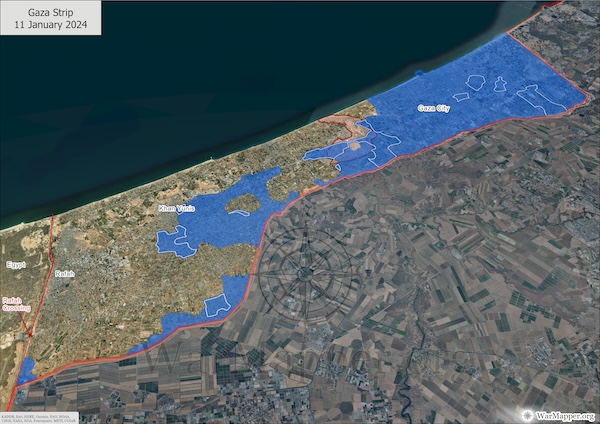
Area of Gaza controlled by the Israeli Defence Forces on Jan. 11, 2024.

While the war in the Gaza Strip continues between Hamas guerillas and the Israel Defence Forces (IDF) in the labyrinth of tunnels burrowed beneath Khan Yunis and in the alleys of the devastated city (population 205,000), another battle is being fought across Israel over the postwar fate of the coastal enclave.

Ultra-nationalist members of Knesset Bezalel Smotrich, leader of the National Religious Party, and Itamar Ben Gvir, head of Otzma Yehudit (Jewish Power), recently called for Gaza’s 2.2 million residents to be voluntarily resettled elsewhere. Congo was cited as a destination for the exodus. U.S. State Department spokesman Matthew Miller called the statements by Smotrich and Ben Gvir “inflammatory and irresponsible.”

Egypt is adamantly opposed to allowing the two million displaced Gazans to shelter in the Sinai Peninsula, lest Israel prevent the refugees from returning. Similarly, the Jewish state is no more likely to allow them to pass through its territory to fly out of Ben-Gurion Airport than it is to resettle those refugees who fled their nearby villages in the Arab-Israeli War of 1948.

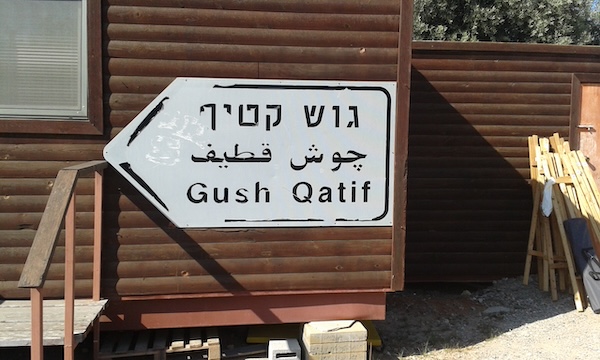
photo - One controversial postwar scenario is for Israel to rebuild some of the post-1967 Gaza Strip settlements from which it unilaterally  withdrew in August 2005
One controversial postwar scenario is for Israel to rebuild some of the post-1967 Gaza Strip settlements from which it unilaterally  withdrew in August 2005. (photo by Gil Zohar)

Further limiting the options, Israel’s high-tech Erez Crossing at the north end of the Gaza Strip – similar in scale to a massive airport terminal – was destroyed during Hamas’s Oct. 7 rampage in which some 1,200 Israelis and other nationals living in cities and kibbutzim near the Gaza frontier were massacred and 240 kidnapped.

Concurrently, the black market is burgeoning for fixers with links to Egyptian intelligence; they are making a fortune in “fees” extorted from Gazans desperate to exit through the Rafah Crossing at Gaza’s south end. The bribe for being placed at the head of the legal exit list for passage across the Rafah border into Egypt and on to Cairo International Airport has now soared to $10,000.

In the face of the vast human suffering, staggering damage to infrastructure and environmental catastrophe caused by the conflict, which marked its 100th day on Jan. 14, another controversial postwar scenario is for Israel to rebuild some of the post-1967 Gaza Strip settlements from which it unilaterally withdrew in August 2005. The forcible evacuation of 8,600 Jewish residents from Gush Katif (the Harvest Bloc) – a cluster of 17 villages in the southern Gaza Strip – set the stage for Hamas’s 2007 coup d’état when it seized power from Mahmoud Abbas’s Palestinian Authority, based in Ramallah in the West Bank.

On Dec. 22, 2023, a group of settlers held an organizational meeting at the agricultural village of Kfar Maimon near the Gaza Strip demarcation fence to launch their plan to create a beachfront community on the barren dunes at Gaza’s southern edge. The day was symbolic since Asarah b’Tevet (the 10th of the Hebrew month of Tevet) is a fast day in the Hebrew calendar, marking the date 26 centuries ago when Nebuchadnezzar II of Babylon began his six-month siege of Jerusalem, which resulted in the destruction of Solomon’s Temple and the downfall of the Kingdom of Judah.

Though Gaza was allocated to the Tribe of Judah in the Hebrew Bible, the ancient Israelites never vanquished their Philistine nemesis who dwelt there and in the cities of Ashkelon, Ashdod, Gat and Ekron. Jewish and Samaritan communities intermittently flourished in the territory of Gaza over many centuries. Shaken by the riots of 1929, however, the Gazan Jewish community ended in 1948. In Gaza City’s historic Zaytoun quarter, the Ottoman-style Hammam al-Sammara (the Samaritan bathhouse) bears witness to the ancient Samaritan community that was exiled in 1917 by the Turkish army during the battles of the First World War.

The group of would-be settlers – who staged a car rally just outside Gaza on Jan. 11 – are encouraged by the report that Israel’s Knesset will be hosting a conference Jan. 28 on rebuilding settlements in Gaza after the war, and will offer precise maps and plans. The news site mako.co.il says that Knesset members and other public figures are expected to speak, and thousands of Israelis have already applied to join the settlement nuclei in Gaza.

The organizers of the event stated, “We are working both on the political level and on the practical side towards the moment when they can get on the ground. There is a great demand in the public that the victory of the war includes within it Jewish settlement in the Gaza Strip.”

Meanwhile, senior ministers among Prime Minister Binyamin Netanyahu’s right-wing allies have criticized the IDF over its plans to probe Oct. 7 intelligence failures. And Israel’s future may be hurtling backward to the widespread protests over judicial reform that divided the country in the months that preceded Hamas’s devastating surprise attack. Such is public anger that calls for a spring election are becoming vociferous.

Were Netanyahu and Abbas to both step down, and Saudi Arabia and Israel to establish ties, a postwar scenario of regional integration – including high-speed trains whisking cargo from Haifa to Riyadh and Abu Dhabi – could emerge. The trauma of the Gaza War could give birth to Mideast peace.

More than 50,000 Israelis responded to the Ashkenazi and Sephardi chief rabbis’ call for a day of prayer at the Western Wall in Jerusalem to mark the new moon of Shevat.

In Judaism, the full moon of Shevat is celebrated as the New Year of the Trees. Besides the pink-white almond blossoms, which mark the beginning of spring, the blood-red anemones also carpet the fields of the western Negev by the Gaza Strip. Like the poppies in Flanders Fields, this year those wildflowers will symbolize the tragedy of war. 

Gil Zohar is a writer and tour guide in Jerusalem. A longer version of this article can be found at religionunplugged.com/gil-zohar.

Format ImagePosted on January 26, 2024January 24, 2024Author Gil ZoharCategories IsraelTags Gaza, Hamas-Israel war, postwar, settlements
Proudly powered by WordPress