Skip to content
  • Home
  • Subscribe / donate
  • Events calendar
  • News
    • Local
    • National
    • Israel
    • World
    • עניין בחדשות
      A roundup of news in Canada and further afield, in Hebrew.
  • Opinion
    • From the JI
    • Op-Ed
  • Arts & Culture
    • Performing Arts
    • Music
    • Books
    • Visual Arts
    • TV & Film
  • Life
    • Celebrating the Holidays
    • Travel
    • The Daily Snooze
      Cartoons by Jacob Samuel
    • Mystery Photo
      Help the JI and JMABC fill in the gaps in our archives.
  • Community Links
    • Organizations, Etc.
    • Other News Sources & Blogs
    • Business Directory
  • FAQ
  • JI Chai Celebration
  • JI@88! video

Recent Posts

  • Sharing her testimony
  • Fall fight takes leap forward
  • The balancing of rights
  • Multiple Tony n’ Tina roles
  • Stories of trauma, resilience
  • Celebrate our culture
  • A responsibility to help
  • What wellness means at JCC
  • Together in mourning
  • Downhill after Trump?
  • Birth control even easier now
  • Eco-Sisters mentorship
  • Unexpected discoveries
  • Study’s results hopeful
  • Bad behaviour affects us all
  • Thankful for the police
  • UBC needs a wake-up call
  • Recalling a shining star
  • Sleep well …
  • BGU fosters startup culture
  • Photography and glass
  • Is it the end of an era?
  • Taking life a step at a time
  • Nakba exhibit biased
  • Film festival starts next week
  • Musical with heart and soul
  • Rabbi marks 13 years
  • Keeper of VTT’s history
  • Gala fêtes Infeld’s 20th
  • Building JWest together
  • Challah Mom comes to Vancouver
  • What to do about media bias
  • Education offers hope
  • Remembrance – a moral act
  • What makes us human
  • המלחמות של נתניהו וטראמפ

Archives

Follow @JewishIndie
image - The CJN - Visit Us Banner - 300x600 - 101625

Category: News

Unity in tough times

Unity in tough times

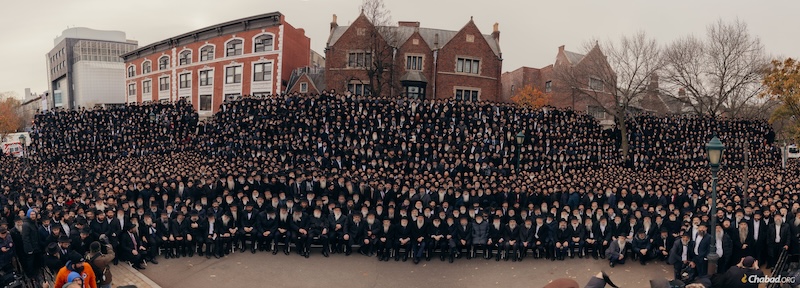
Thousands of rabbis pose for a group photo in front of Chabad-Lubavitch world headquarters in Brooklyn, NY, on Dec. 1. (photo by Shmulie Grossbaum/Chabad.org)

Some 6,500 Chabad rabbis and Jewish leaders from around the globe gathered Nov. 27-Dec. 1 in Brooklyn, NY, for the annual International Conference of Chabad-Lubavitch Emissaries, the largest rabbinic gathering in the world.

Attending from British Columbia were Rabbi Yechiel Baitelman (Chabad Richmond), Rabbi Binyomin Bitton (Chabad of Downtown Vancouver), Rabbi Mottel Gurevitz (Tri-Cities Chabad), Rabbi Shmuel Hecht (Okanagan Chabad House), Rabbi Meir Kaplan (Chabad of Vancouver Island), Rabbi Dovid Rosenfeld (BC Regional Hebrew Schools), Rabbi Bentzi Shemtov (Chabad Nanaimo and Central Vancouver Island) and Rabbi Yitzchok Wineberg (Lubavitch BC).

While the yearly conference has a celebratory feel, welcoming rabbinic leaders from Alaska to Zambia, the past year was a difficult one for the Jewish people, seeing tragedy in Israel, and elsewhere. For Jews around the globe and the family of emissaries in particular, the days just prior to the conference were especially difficult: on Nov. 25, Abu Dhabi-based Chabad Rabbi Zvi Kogan was buried in Israel, after being murdered by terrorists in Dubai at the age of 28.

Chabad-Lubavitch emissaries, known as shluchim, are husband-and-wife teams who dedicate their lives to strengthening Jewish life in communities worldwide, often in remote locations without established Jewish infrastructure. They aim to reach both affiliated and unaffiliated Jews, welcoming Jews from all walks of life.

The annual conference, also known as the Kinus Hashluchim, unites rabbis and lay leaders from all 50 US states and more than 100 countries and territories around the world for four days of workshops, networking and spiritual uplift. The conference concludes with a gala banquet, which brings all the Chabad rabbis and their guests together in a giant conference centre in New Jersey. 

The Thursday was a day of catch-ups between colleagues, as well as the first of a series of workshops on contemporary issues that ran over the weekend. Topics included disaster relief, combating hate, education, counseling and dealing with grief. Conference-goers who serve students on college campuses where Chabad has become part of Jewish life participated in a separate track, discussing issues specifically relevant to campus communities.

The Friday visit to the Ohel, in Queens, NY, the resting place of the Rebbe, Rabbi Menachem M. Schneerson, of righteous memory, marked the pinnacle of the conference. The emissaries came to pray for their families and communities, carrying with them countless prayer requests. Many came with handwritten letters from Jews in their hometowns and read them by the holy site. The Ohel visit culminated in the reading of the pan klali (“general letter”) that was signed by all emissaries and contained prayers for Israel, the Jewish people and humanity at large.
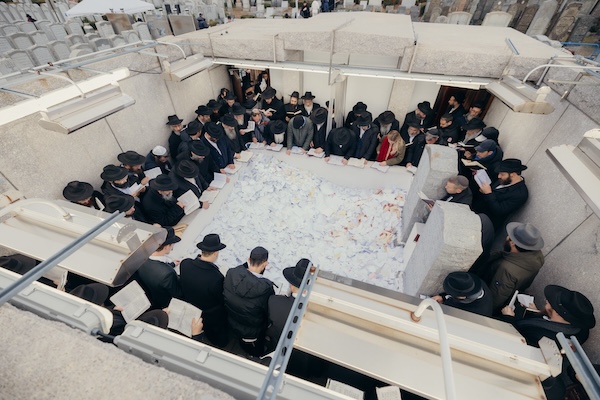
photo - Chabad-Lubavitch rabbis pray at the resting place of the Rebbe, Rabbi Menachem M. Schneerson, in Queens, NY, on Nov. 29
Chabad-Lubavitch rabbis pray at the resting place of the Rebbe, Rabbi Menachem M. Schneerson, in Queens, NY, on Nov. 29.  (photo by Shmulie Grossbaum/Chabad.org)

With the onset of Shabbat on Friday evening, the emissaries spent the Jewish day of rest in prayer and brotherly camaraderie, often in the company of family and friends. 

Sunday morning saw the snapping of the annual “class picture” under the iconic gables of 770 Eastern Parkway, the headquarters of the Chabad-Lubavitch movement, and perhaps the most recognizable Jewish building in the world. The photo, featuring thousands of black-hatted rabbis, represents not just an annual tradition but also the many faces of the Chabad rabbis who bring Judaism to the world, from wartorn Ukraine to the towns along Israel’s hostile borders, to anti-Israel-filled college campuses across North America, to sleepier towns in quieter places.

The capstone of the conference was the gala banquet, held at the New Jersey Convention and Expo Centre, a powerful moment of remembrance and resilience. Speakers honoured Kogan with emotional tributes that emphasized the importance of continuing their global mission. The conference linked by video with the home of Kogan’s parents in Jerusalem, where his family was sitting shiva, and all 6,500 gathered shared the traditional text of comfort with the family.

Rabbi Yehuda Krinsky, chair of Merkos L’Inyonei Chinuch – Chabad’s educational arm – greeted the audience, sharing words of consolation with Kogan’s family and the emissaries, his “extended family,” and sending prayers for the Israeli soldiers defending the Holy Land, as well as the hostages still held in Gaza.

A video tribute was made for Rabbi Moshe Kotlarksy, the vice-chair of Merkos L’Inyonei Chinuch, who passed away after a lengthy illness on June 4. Kotlarsky was well-known for his role in the annual Kinus Hashluchim, directing an army of planners, staff and volunteers to ensure every detail of the massive event was perfect.

Among the most inspiring presentations of the evening was that of Rabbi Yehoshua Soudakoff, director of Chabad for the Deaf Community in Israel, who spoke of his path to finding his Jewish self as a deaf Jew.

“The voice you hear is not mine, but the words definitely are,” he said through an interpreter. “It is hard for a deaf person to find a place within the community. Torah and mitzvah while deaf are difficult. That is why I established Chabad for the Deaf Community. There are deaf Jews and Jews with various disabilities throughout the world. Let us continue our holy work to reach out to every single one of them and inspire them, just as I was once inspired,” he said to applause.

The gathering culminated in a roll call of Chabad emissaries. The event featured multilingual welcomes from emissaries around the world, including a notable announcement that a new Chabad couple had been dispatched to Andorra, highlighting Chabad’s ongoing expansion.

The evening concluded with dancing, the assembled rabbis united in their determination to continue their mission of Jewish outreach and community building, regardless of the challenges they face. 
Format ImagePosted on December 13, 2024December 11, 2024Author Rabbi Moshe New CHABAD.ORGCategories WorldTags Chabad-Lubavitch, conference, education, Kinus Hashluchim, Lubavitcher Rebbe

Resilience of Portugal’s Jews

King Manuel I of Portugal (1495-1521) had a problem. To marry Princess Isabella of Spain, he consented to the request of her parents – Ferdinand and Isabella – to rid Portugal of its Jews. But Manuel wanted to keep the Jewish citizens close by, for their economic benefits (money and skills). His solution? In 1496-7, he forced Jews to convert. (He also expelled the country’s Muslims.)

Manuel believed that New Christians – this population is likewise referred to as conversos, anusim or Crypto-Jews; marranos is a derogatory term that should not be used – would continue to boost the country’s economy. It should be noted that Jews in Portugal already paid a special poll tax and a special property tax.

Even after they were forcibly converted, Portuguese Jews could not live wherever they wanted. They lived in separate quarters referred to as judiarias, what we might call ghettos. They worked as artisans and rural labourers, weavers, tailors, cobblers, carpenters, leather tanners, jewelers, and every branch of the metal industry, ranging from ordinary blacksmiths to armourers and goldsmiths.

Several Jews nonetheless reached prominence in medieval Portugal. Among them was Abraham Zacuto, originally from Spain. Portuguese King John II invited Zacuto to be the royal astronomer. The king wanted Zacuto to chart a sea route to India. Unlike most of his fellow religionists, Zacuto managed to flee Portugal after King Manuel imposed conversion on the country’s Jews.

There was also Isaac Abarbanel, who was King Afonso V’s treasurer. Yehuda Even Maneer was the richest Jew in the kingdom and, for that reason, was appointed Portugal’s finance minister. Master Nacim, a Jewish eye doctor, was accorded certain privileges because of his professional skills. 

Before King Manuel decreed the forced conversion, the Jewish community of Tomar built a synagogue, in spite of attacks orchestrated against them and other Jews in the country. Unfortunately, the building was used for its original purpose for only a short period, after which – for years and years after the forced conversion – it was used by the Church. The town itself became one of the sites of the Inquisition tribunal. Today, the synagogue has been renovated and is considered a national monument.

Crypto-Jews continued to covertly practise Judaism. In the town of Porto, for example, the Crypto-Jews secretly operated a synagogue, hiding it from the Inquisition. 

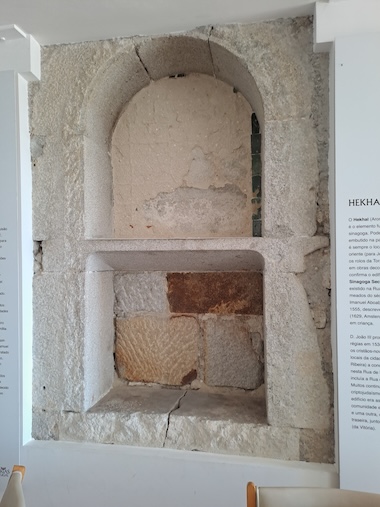
photo - In 2013, a renovation project at a facility for Portuguese senior citizens turned up a Torah ark, carved directly into the stonework separating the building from its neighbour
In 2013, a renovation project at a facility for Portuguese senior citizens turned up a Torah ark, carved directly into the stonework separating the building from its neighbour. (photo by Deborah Rubin Fields)

In 2013, a renovation project at a facility for Portuguese senior citizens turned up an amazing find. Hidden behind the eastern wall of the dining room was a Torah ark, or aron kodesh, carved directly into the stonework separating the building from its neighbour. There were two compartments, a square space topped by a slightly larger arched tablet-shaped opening, with space for approximately six small Torah scrolls. Besides this relatively recent discovery, we have the 16th-century testimony of Immanuel Aboab, a native of Porto. (The late Yom Tov Assis, who was a professor at Hebrew University, had likewise been trying to locate where such an aron kodesh was located in the area.)

It was common among Crypto-Jews to light one Shabbat candle in a secret cabinet. There was also an emergency tool for snuffing out Shabbat lights if it was suspected that a Christian neighbour was spying. To make Shabbat different from other days, these secret Jews ate no meat. Purim was marked by three days of fasting beforehand. Passover was celebrated two days late, so as to throw Christians off the track. Other secret Jews took the risk of undergoing circumcision.

Within limits, these Crypto-Jews read psalms and recited the Shema, didn’t work on Shabbat, didn’t eat pork and fasted on Yom Kippur. Manuel (Abraham) de Morales passed out manuscripts of what he thought were important points to know about Judaism. But most of the Jewish customs were orally transmitted from mother to children. 

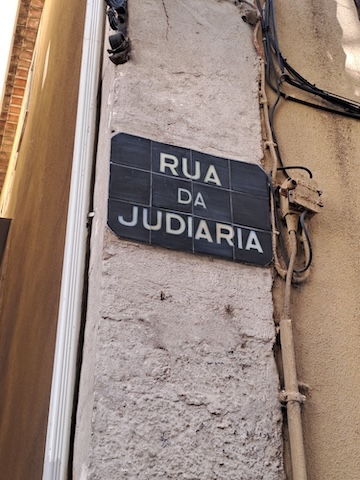
Not surprisingly, the period before the forced conversion was not totally free of tension between Jews and Christians: Franciscan and Dominican clergy walked through judiarias, ready to convert Jews. Moreover, Portugal’s new merchant class was apprehensive about the influence of the Jewish citizens and their capital. Under the reign of João I (1385-1443), new laws obliged Jews to wear an identifying sign on their clothes and imposed curfews on the judiarias. There were scattered outbreaks of violence, like the attack on the Lisbon judiaria in 1445, in which many died.

photo - Jew Street in Lisbon, Portugal
Jew Street in Lisbon, Portugal. (photo by Deborah Rubin Fields)

After the forced conversion, New Christians would be charged with being infidels, not heretics. These New Christians generally adopted Christian given names and Old Christian surnames. They probably did this to deflect attention. But harder times still followed for Portuguese Jews, with the massacre of 2,000 conversos in Lisbon in 1506 and the Portuguese Inquisition, which began in 1536. Inquisitors would come to a town and tell the gentile population that they were looking for secret Jews. They would present a list of suspicious behaviour to look for. 

In medieval Portugal, turning in New Christians became a profitable venture. Arrested conversos had their assets seized by members of the Inquisition. Occasionally, Church officials would accept bribes for temporary pardons.

Apparently, if a New Christian approached an inquisitor, he had a chance of redeeming himself by admitting that his family lit Shabbat candles or washed sheets for Shabbat. On the other hand, if an Old Christian accused a New Christian of still practising Jewish rituals and the latter denied the observances, he would face a worse outcome from his trial.  

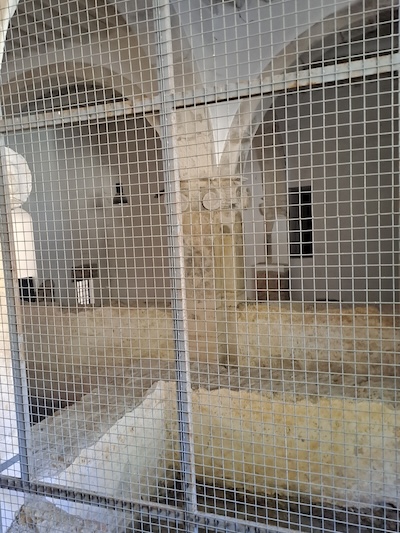
The number of Inquisition victims between 1540 and 1765 is estimated at 40,000. Punishment included being raised by a pulley with one’s hands behind one’s back. Convicted infidels were then burned at the stake. 

Cells where Crypto-Jews were held before their Portuguese Inquisition trials. (photo by Deborah Rubin Fields)

The cruel punishments passed down by the Portuguese Inquisition drew large crowds of spectators. The crowds were akin to those who would come to watch bullfights.

Trials ceased after about 250 years, although Portugal’s Inquisition was not officially abolished until 1821. 

Jewish informers should also be mentioned. These people, as can be imagined, found an open ear among Portugal’s prejudiced secular and religious leaders. If these traitors were discovered by the Jewish community, they might have had their eyes gouged out, their tongue removed or been put to death for putting the community at tremendous risk. So serious a crime was acting against one’s own people that even Maimonides condoned Jewish informers.

The impact of the forced conversion and the Inquisition continue to be felt. Take, for example, Belmonte, located in the northern part of Portugal. It has a small Jewish community that has retained the rituals of Judaism despite all the hardships and persecution. In the 1990s, when the idea of building a synagogue was raised, some Jewish community members were against it. Why? Because being a member of the anusim community was their cherished identity. Almost 200 years after the Portuguese Inquisition had been abolished, they couldn’t imagine living openly as Jews.

Estimates are that at least 20% of Portugal’s current population has anusim roots.

Deborah Rubin Fields is an Israel-based features writer. She is also the author of Take a Peek Inside: A Child’s Guide to Radiology Exams, published in English, Hebrew and Arabic.

Posted on December 13, 2024December 11, 2024Author Deborah Rubin FieldsCategories WorldTags antisemitism, forced conversion, history, Inquisition, King Manuel I, Portugal, travel
Children in the Shoah

Children in the Shoah

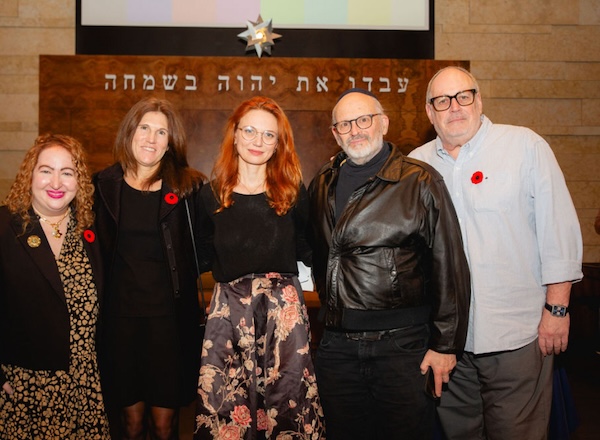
Left to right: Abby Wener Herlin, Lise Kirchner, Dr. Nataliia Ivchyk, Prof. Richard Menkis and Al Szajman at the community commemoration of Kristallnacht Nov. 7. (photo by Rhonda Dent)

The experiences of three Vancouver women who survived the Holocaust as children in Ukraine were highlighted at the community commemoration of Kristallnacht Nov. 7.

The event, which took place at and was co-presented by Congregation Beth Israel, marked both the 86th anniversary of the Kristallnacht pogrom and the 30th anniversary of the founding of the Vancouver Holocaust Education Centre (VHEC), which presents the annual commemoration. The Jewish Federation of Greater Vancouver and the Robert and Marilyn Krell Endowment at the VHEC were co-presenters.

The keynote address was by Dr. Nataliia Ivchyk, associate professor in the department of political science at Rivne State University for the Humanities, in Ukraine. Ivchyk is a visiting scholar at the University of British Columbia and has been studying the narratives of child survivors in the province.

About 1.5 million Ukrainian Jews were murdered in the Holocaust, while another million managed to flee before or near the beginning of the German-Soviet war, Ivchyk said.

“Genocide is ruthless, regardless of age or gender, and children are a special group of its victims,” she said. “Since children cannot fight back against their killers, they become a helpless and vulnerable group. The Holocaust claimed six million Jewish lives, 1.5 million of which were tragically children. Age became a vital marker of life or quick death for children during World War II and the Holocaust. Children were not seen as a separate group of victims, they were dependent on their parents, fathers, mothers and relatives, and so suffered and died with them too.”

Ivchyk quoted Malka Pischanitskaya, who was 10 years old when the Germans invaded her town of Romanov (now Romaniv), in Ukraine.

“I was brought into this world not by chance but I believe by destiny,” Pischanitskaya has said. “My destiny was to be born, to endure the sufferings that were yet to come.”

“During the genocide,” Ivchyk said, “Malka had no choice but to become an adult in order to survive.”

Another local survivor whose story Ivchyk told is Ilana, who asked that her last name not be shared. Ilana was born in 1938, just two years before Germany invaded the Soviet Union. Her father managed to evacuate the family, including Ilana, her sister, her mother and her maternal grandparents, to a Central Asian republic of the Soviet Union.

“Unfortunately, my father’s parents stayed in Kyiv and perished in Babyn Yar,” Ivchyk quoted Ilana, referring to the mass killing site that has become synonymous with the genocide in Ukraine. On Sept. 29 and 30, 1941, more than 33,000 Ukrainian Jews were killed, part of the genocide in eastern Europe known as the “Holocaust by bullets.”

Ilana has only fragmentary memories of the evacuation years. However, she remembered her sister, who cared for her, and her mother, who tirelessly worked to provide food, said Ivchyk. 

A third local woman who survived is Esfira Golgheri.

“Esfira does not recall the journey from one ghetto to another, but she remembers her mother feeding her, which was crucial for her survival as an infant,” Ivchyk said.

“There is something that the Holocaust could not take away: memory, personal memories and stories of relatives and friends and our collective memory [that] remind us by honouring the memory of those who are no longer with us. Those who lost their lives and those who fought to defend us, we keep them alive in our hearts,” Ivchyk said. “The stories of these women are stories of childhood, family and survival in the face of genocide and displacement. Each narrative is unique and personal, yet the memories of Esfira, Malka and Ilana … are like pieces of a puzzle that help reconstruct this tragedy. In addition to piecing together the events of the war in Ukraine during the Holocaust, we have the chance to understand the tragedy through the eyes of these adult child survivors. We can touch their memories and experience their truth for ourselves.”

At the commemoration, Taleeb Noormohamed, member of Parliament for Vancouver Granville, brought greetings from the federal government.

“The fight against antisemitism is not one for Jews alone,” said Noormohamed. “Quite the opposite. It is a fight that all of us have to take on together.”

Nina Krieger, until recently the executive director of the VHEC and elected as member of the BC Legislature on Oct. 19, brought greetings from the provincial government. 

“I know the premier of British Columbia and my colleagues in government join me in gratitude for the Vancouver Holocaust Education Centre and Congregation Beth Israel for presenting this evening’s program to mark the 86th anniversary of Kristallnacht,” Krieger said.

Vancouver Mayor Ken Sim, accompanied by Councilor Lenny Zhou, presented a proclamation from the city marking Kristallnacht Commemoration Day.

Sim spoke of how his home had been recently vandalized and how many people at that evening’s event had expressed sympathy. 

“The Jewish community sees this all the time and I should really be asking you how you are doing,” he said. “I obviously loved the community before, but you’ve captured my heart even more.”

He said his presence at Jewish community events is not about politics.

“If everyone was against us, we would still have your back. We are still here because we stand for what’s right,” Sim said.

Lise Kirchner, director of education at the Vancouver Holocaust Education Center, spoke on behalf of acting executive director Hannah Marazzi, who was out of the province, read greetings from Prime Minister Justin Trudeau and acknowledged elected officials from all levels of government, including incoming and outgoing members of the BC Legislature.

“As we come together this evening to commemorate the 86th anniversary of the Kristallnacht pogrom, we contemplate the dangers not only of state-instituted persecution and violence, but maybe more importantly the dangers of indifference,” said Kirchner. “We are reminded of the consequences of antisemitism which is not publicly condemned, especially at a time when we have seen the proliferation of this most pervasive and pernicious form of hatred around the world, across the country and in our own backyards.”

Prof. Richard Menkis, associate professor of Jewish history at the University of British Columbia, contextualized Kristallnacht as a turning point between the legislated antisemitism of the Nazi regime, notably the Nuremberg Laws of 1935, and the murderous violence of the Holocaust.

“The persecutions during and immediately after Kristallnacht resulted in the deaths of at least 90 Jews, the destruction of hundreds of synagogues, the vandalization of thousands of Jewish businesses and the imprisonment of over 30,000 Jewish men in concentration camps and elsewhere,” said Menkis.

Al Szajman, president of the Vancouver Holocaust Centre Society board, emceed the evening. Abby Wener Herlin, associate director of programs and community relations at the VHEC and granddaughter of survivors, introduced Ivchyk. Rabbi Jonathan Infeld thanked Ivchyk and reflected on her remarks. Cantor Yaacov Orzech chanted El Moleh Rachamim. Holocaust survivors lit candles at the beginning of the commemorative event.

Ivchyk spoke movingly of being welcomed into the community during her time in Vancouver.

“Coming from a wartorn country myself, you accepted me, understood me, opened the doors of your community and your homes, creating an incredibly warm and family-like environment that gave me a home away from home,” she said. “You have entrusted me with your history and the history of your families and your childhood experiences that you have kept in silence for many years. Every time you shared your stories, I could feel the sadness and pain in your eyes. You still feel for those who were taken by the Holocaust.” 

Format ImagePosted on November 29, 2024November 28, 2024Author Pat JohnsonCategories LocalTags Beth Israel, commemoration, history, Holocaust, Kristallnacht, memorial, Nataliia Ivchyk, Ukraine, Vancouver Holocaust Education Centre, VHEC

Looking for everyday heroes

The deadline to nominate someone for the 2025 Courage to Come Back Awards is Jan. 17. The awards, presented by Wheaton Precious Metals, pay tribute to everyday heroes who have overcome immense challenges and now give back to their community. They also raise funds so that Coast Mental Health can continue to provide community-based services for people living with mental illness in British Columbia.

“I really believe that having the opportunity to tell my story was something I had no idea I really needed,” said Rachel Goldman, who received a Courage to Come Back Award in the medical category last year. “It was the first time in my life that I had celebrated the part of myself that I always viewed as my greatest weakness. The ability to overcome challenges is always something to be celebrated. Courage is a superpower. I have no doubt that others would benefit from putting themselves or others forward, too. It is a gift that others should absolutely experience.”

photo - Rachel Goldman received a Courage to Come Back Award in 2023
Rachel Goldman received a Courage to Come Back Award in 2023. (photo from Coast Mental Health)

Goldman was born with CVID, common variable immune deficiency, which causes low levels of the proteins that help fight infections. Initially, she was uncomfortable about being nominated for the honour, as her illness was something she had only ever faced privately.

“That others would view this as both resilient and brave was not something I had really considered – that was just the way I chose to approach life,” she said. “The nomination showed me that resilience and bravery are something to be celebrated and that having the opportunity to shine a light on rare and invisible illnesses like mine is a privilege.”

Winning a Courage to Come Back Award has impacted Goldman’s life in a few ways.

“It opened the door to thoughtful conversation regarding my health and my life and allowed me the ability to really explain to those around me what it is like to live in my shoes,” she said. “It was not easy, but it began a healing journey to better understand my health needs. My hope is still to bring awareness to those that are suffering from diseases like mine and that research worldwide will continue towards helping those like me to live a more fulfilling and healthy life.”

The 2025 Courage to Come Back Awards are granted in four categories: addiction, medical, mental health and youth (ages 19-25). Recipients will be recognized in a celebration at the Vancouver Convention Centre on May 7. 

“As chair of the Courage to Come Back Awards, reading through the hundreds of nominations we receive every year is a moment I look forward to with great anticipation. All of them are true journeys of bravery, resilience and strength in the face of adversity. I am grateful to those that have the courage to share their stories with us,” said Lorne Segal, who is also president of Kingswood Properties Ltd.

To nominate someone and/or find out more about the process, visit couragetocomeback.ca/nominations. 

Posted on November 29, 2024November 28, 2024Author Cynthia RamsayCategories LocalTags Coast Mental Health, Courage to Come Back, fundraising, Lorne Segal, mental health, nominations, Rachel Goldman
Security through peace

Security through peace

Noa in conversation with Rabbi Dan Moskovitz at Temple Sholom Oct. 30. (screenshot)

Israeli singer/songwriter and peace activist Achinoam Nini (Noa) was in British Columbia recently to do a Vipassana meditation. While here, she stopped at Temple Sholom Oct. 30 for a conversation with Rabbi Dan Moskovitz (which is on YouTube) and at Congregation Emanu-El Nov. 4 for a talk with Rabbi Harry Brechner.

Noa was born in Israel in 1969. She’s the fifth generation of her family in Israel, their presence dating back to the mid-1800s. They immigrated from Yemen.

“They came because they were persecuted at the time and they came to the only place they knew, that their heart drew them to, and that was Jerusalem and the Kinneret,” she said. “That was the two places. They walked across the desert and took boats and were smuggled by Bedouins. It’s a very dramatic story, how the family made it to the Holy Land.”

Noa’s father got a scholarship to study at the University of Rochester, so she spent the first couple of years of her life in Rochester, NY.

“When I went into first grade, my family moved to the Bronx, NY. My dad was now doing his PhD in Columbia University. And my parents decided to send my brother and I to yeshivah…. I was the only dark-skinned kid in the school, the only Israeli kid in the school, the only family that didn’t live in something that looked like a mansion. 

“My way of dealing was in two ways,” said Noa. “First, fortunately, I was a gifted student, so I had a scholarship to school that helped my parents…. And music. I started writing songs at a very young age…. I was interested in physics and mathematics, I loved history. I wanted to go to Harvard and do a PhD in physics and history, but that didn’t happen, obviously. Music … chose me.”

At age 17, on a summer vacation in Israel, Noa met a soldier on leave.

“I went back home,” she said. “I told my parents, I’m making aliyah. I said, you raised me to be a Zionist. We love Israel. I want to live in Israel.”

To this day, Noa is married to that man (Asher Barak, now a medical specialist and entrepreneur), and they have three children, two of whom are in the Israel Defence Forces, one in service, the other in the reserves.

Noa did her army service in a military entertainment unit, then started her music career. While at the Rimon School of Music, she met Gil Dor, who was one of her teachers. “He’s an extraordinary and amazing, brilliant musician and we’ve been working together now for 34 years,” said Noa.

They caught the attention of guitarist Pat Metheny, who produced Noa’s first album and brought it to David Geffen, who then signed Noa at Geffen Records.

“I started performing abroad and foreign journalists started asking me my opinion about the Palestinian-Israeli conflict and I’m like, I’m an artist, I don’t speak about things like that, don’t ask me questions like that.”

But she didn’t feel good about not responding. “And so, I started learning more and reading more and I became more and more depressed,” she said. “And then came Yitzchak Rabin and he started talking about peace. And I was like, yes, this is great!”

A believer in the Oslo Accords, Noa was the only leading Israeli musician to agree to perform at the peace rally where Rabin was murdered.

“I saw Rabin and I hugged him … and I walked down the stairs. Ten minutes later, he walked down the stairs and was killed…. I remember the rush and the cry and everybody running, and panic, and myself running and pushing to see what had happened,” Noa shared. “It was a trauma. I haven’t recovered, absolutely not. I haven’t recovered – and neither has Israel.”

At that moment, said Noa, “I said, OK, well, if this guy just paid with his life for our future, the future of Israel, the future of my children, then I, too, can do something. And then, maybe, I’ll pay a price and that’ll be OK because it’s the right thing to do. And that’s when I started becoming an activist for peace.”

There were two other life-changing events for Noa in the 1990s. She was invited to sing at the Vatican for Pope John Paul II and she was asked to write the lyrics and sing the theme song of the film Life is Beautiful (La Vita e Bella), which won an Oscar.

Among her many achievements, Noa represented Israel in the Eurovision Song Contest in 2009. She did so with Palestinian-Israeli singer/songwriter Mira Awad. “I wrote a song called ‘There Must Be Another Way,’ and we sang it in English, Hebrew and Arabic,” said Noa. “It made a lot of waves around the world and I have to say that, until today, it is taught in schools around the world.”

She related a story about that experience. 

“Mira, her mother is from Bulgaria and her father is Palestinian. She’s quite fair-skinned, with green eyes. My family is from Yemen…. I’m an Arabic Jew. And so, when we sat in front of media, I remember there was one day where they had BBC Iran, they had Al Jazeera, they had all kinds of media…. All the Arab media immediately came up to me in Arabic and to her in English, [assuming] she’s the Jew. And so, I told them, you see, that is the role of art – our role is to shake you up a little. You think you understand everything. Maybe you don’t. Maybe there’s another way of looking at it…. You can’t think that you understand everything about everything. No, it’s not black and white. And that’s, of course, very relevant to where we are today.”

That said, there has been progress towards peace, she contended.

“There’s a huge polemic about whether there should be or there shouldn’t be a Palestinian state,” she admitted, “but there is a conversation being had about it…. In the past, it was not even talked about at all. It was underground.”

She also pointed to the many organizations that work with and/or are staffed by Arabs and Jews. Noa is on the boards of the Arava Institute and the Umm el-Fahem Museum of Art, for example. She’s also involved with the Parents Circle – Families Forum.

“The world in general is not a great place for people who believe in peace right now,” she acknowledged. “I think that we are under attack by forces, if you like, forces of darkness from everywhere. But, like I always say, that’s not reason enough not to continue raising the voice…. I believe in peace. I don’t see any other way to live. Has the peace camp changed? It has transformed in many ways.”

She gave the example of a WhatsApp group called Voices of Solidarity. She said a lot of young people are doing things – “it’s either art, it’s underground theatre, it’s alternative music.” She mentioned the organization Standing Together.

“Yitzhak Rabin, when he started talking to [Yasser] Arafat, the terrorist, everyone was like, what, no way, forget it. Seventy-five percent of the Israeli public were against any kind of interaction with Palestinians but then he came [along] with his charisma and his leadership and his integrity and his honesty and his track record, and he started saying, we’re going to be doing this and this is the right thing and this is for Israel’s future, for our children, we’ve made enough wars…. And then, it was like a month later, the entire public opinion, it shifted towards being positive about the chances for peace.”

That could happen again. A change in circumstances, a particular leader’s personality, the right timing, she said.

For Noa, Israel is in a worse situation now than immediately after Oct. 7.

“The hostage situation … is a nightmare beyond words. I go every week, sometimes I go twice a week, three times a week, to stand with them [the families and others calling for the hostages to be brought home]…. They’re desperate. I don’t know how they are still sane…. And the fact that that their children are still there [in Gaza], that they haven’t been brought back, that not everything has been done to bring them back, is not anything that Israel will ever recover from.”

She is appalled that the government is still in power.

“Not only did they not resign,” she said, “they then turned around to blame everybody that saved Israel, including Brothers and Sisters in Arms, including all the organizations that volunteered, [and] to blame the hostage families for daring to want their children back…. It’s beyond words.”

She advised diaspora Jews to distance themselves from the government: “separate the Israeli government from the Israeli people, it’s not the same thing,” she said.

“If you are going to look at a lot of consistent polls, you’ll see that people – even people that voted for the present government – feel betrayed by what the government has eventually done. They don’t understand how the government is not taking responsibility. They don’t understand how the dictatorship coup keeps moving forward when we’re in such a stressful situation. They don’t understand how our relationship with the entire world has come to a complete collapse under the auspices of this government. The Israeli government right now is the enemy of the Israeli people. And you can say that…. We support the Israeli people, we support the country of Israel, but we do not support the government of Israel.”

She warned of the dangers extremists pose in any country, and asked people to “strengthen the moderates in civil society in any way you can.”

She added, “Throughout history, countries have fallen into terrible situations of leadership. Italy, my favourite country in the world after Israel, became a fascist country at some point, with Mussolini, and there was Franco [in Spain] and there were other people, other countries that came into [similar] situations. Does that delegitimize the country? No. It means that a certain combination of events led to the fact that a country was now held hostage by leadership that did not work in her benefit. That is what is happening right now to Israel, and we have to work through it together with the help of our friends, and you are our friends.”

Noa doesn’t just fault the Israeli government. “In my opinion,” she said, “everybody in the region is to blame for the horrible situation we’re in. Nobody made the efforts. The leadership did not make efforts to make peace, not Israeli leadership, definitely not Palestinian leadership.”

She believes Israel had to defend itself after Oct. 7.

“What were we supposed to do? Sit around [twiddling our thumbs] while our kids were being massacred and our women were being raped? Yes, Israel needed to go in. The war was legitimate. But – it was legitimate to the extent that there was a plan. There needs to be a plan. Say, we have to fight, but now, let’s see, we’ve attacked, we’ve retaliated, we’ve done this, we’ve shown that, we’re there for our people. But we have to bring the hostages back…. Second, we have to see, who are our allies? We’re a small country, we’re nine million people – whoa, we want to attack the entire world? No. Who are our allies? Who are our friends? How can we start progressing towards a solution to this? Not endless warfare. Who are the people that want to talk to us? The UAE, the Saudis, the Americans, the Europeans, let’s reach out to them. This is what the Israeli government should have done immediately.”

While acknowledging that Israel needs a strong army, Noa said, “at the same time, parallel institutions need to come in and do their job, the diplomatic job, to reach out to our friends … and make sure that Israel is secure. Our security will come with peace, only with peace, and we have to look at this as an opportunity to make peace. And are there partners? There are.”

She said, “As a woman who lives in Israel, loves Israel and sends her kids to the army…. We need to be able to look forward to a time when we will not be sending our children to the army. Is it possible? Yes.” 

Format ImagePosted on November 29, 2024November 28, 2024Author Cynthia RamsayCategories LocalTags Achinoam Nini, Israel, Israel-Hamas war, music, Noa, Oct. 7, peace, politics, terrorism, two-state soloution
Mobilizing against Jew-hatred

Mobilizing against Jew-hatred

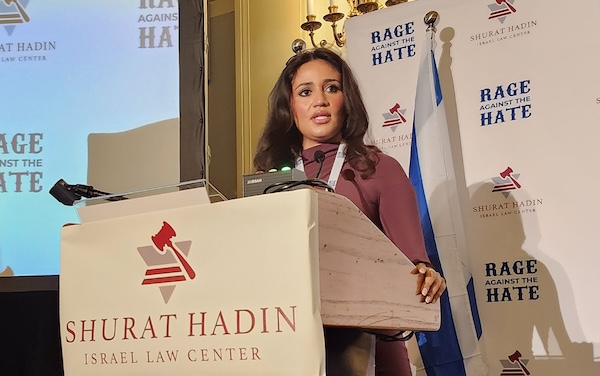
Ysabella Hazan said phrases such as “the West is next” imply “exactly what the enemies of Israel accuse us of – being a Western outpost in the Middle East, a settled body, which is not true.” (photo by Dave Gordon)

Rage Against the Hate in New York on Oct. 31 had the goal to “gather Jewish organizations, and to find ways to start fighting back, to retake the streets, to retake the campuses, to retake social media, to combat antisemitism in a way that we haven’t,” said Nitsana Darshan-Leitner, president of the Israeli nonprofit Shurat HaDin Law Centre, organizers of the full-day conference. 

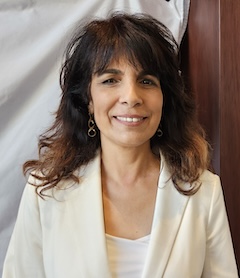
photo - Nitsana Darshan-Leitner, president of Israeli nonprofit Shurat HaDin Law Centre, which organized the Rage Against the Hate conference in New York Oct. 31
Nitsana Darshan-Leitner, president of Israeli nonprofit Shurat HaDin Law Centre, which organized the Rage Against the Hate conference in New York Oct. 31. (photo by Dave Gordon)

More than 30 organizations were conference partners and keynote speakers included radio host/author Dennis Prager, attorney Alan Dershowitz, actor Michael Rapaport, activist Shabbos Kestenbaum and NGO Monitor’s Gerald Steinberg.

Dershowitz, 86, said that after speaking to Jewish high school students, he was “stunned by their lack of knowledge” about Israel. To fill the void, he will be giving away a million copies of his latest book, The 10 Big Anti-Israel Lies and How to Refute Them with Truth, to 1,000 universities and high schools across the United States. He lambasted what he called the “educational malpractice” pervasive on college campuses, where professors “give disguise” to Jew-hatred through diversity, equity and inclusion policies, and oppressor-versus- oppressed beliefs.

“I offered $1,000 to anybody who could find me a single protester in any of these protests on university campuses that has ever called for a two-state solution. Nobody has taken me up on it. No protester wants to see an Israeli state,” he said to the audience of 300.

He added that “we are in a fight for our lives. We are in a fight for the future,” because these students will become politicians, corporate executives, media influencers and other types of leaders, and they will have all “been brought up with this kind of knee-jerk anti-Zionism.” 

Darshan-Leitner characterized Students for Justice in Palestine as a “propaganda arm of Hamas.” She believes their activity is “actually providing material support to a terror organization” and, in doing so, contravenes the Anti-terrorism Act in the United States.

Kestenbaum – who, last January, became the lead plaintiff in a lawsuit against Harvard University, alleging systemic antisemitism, and has testified before Congress about antisemitism on college campuses – told the Jewish Independent: “Jewish students are fighting a really remarkable fight with limited resources, with limited help and limited funding. It’s the Jewish nonprofits, who raise billions of dollars each year, who could be in a position to do a lot more. And so, I would encourage the Jewish nonprofits not to say, ‘What can the students be doing?’ but to ask themselves, ‘What can I be doing?’ to help students.”

“It is imperative that larger organizations actively support grassroots initiatives that can manoeuvre and mobilize quickly and efficiently, whereby large organizations cannot,” said Amir Epstein, director of Tafsik, a Jewish civil rights group that fights Jew-hatred in Canada and more broadly.

“Hundreds of millions of dollars are donated to large organizations, so it isn’t unreasonable for them to contribute considerable monetary aid to empower these grassroots efforts, so we can create a united front to combat the degradation of our Jewish community’s safety, and address the unprecedented antisemitism we face in universities, K-12 schools, media, politics and the arts,” said Epstein.

Montrealer Ysabella Hazan, who started the movement called Decolonized Judean, said phrases such as “the West is next” and “Israel is the only democracy in the Middle East” do not resonate with the younger generation. “They do not speak about us, convey our story or address the accusations that we are facing on the world stage,” she said. “And they indirectly prove exactly what the enemies of Israel accuse us of – being a Western outpost in the Middle East, a settled body, which is not true.”

Columbia business professor Shai Davidai, who has earned renown for calling out Jew-hatred on campuses, told the audience that antisemites have “created the new normal” by making students feel uncomfortable being visibly Jewish.” He said, “If we don’t fight back in the court of public opinion and in the court of law, we’re not going to win this war.”

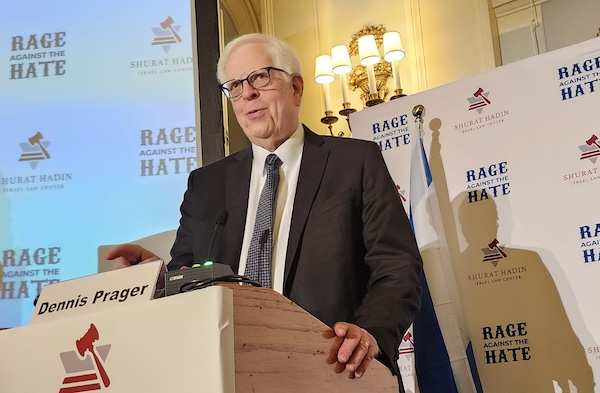
photo - At the Rage Against the Hate conference Oct. 31, Dennis Prager offered an idea of how to counter the delegitimization of Israel
At the Rage Against the Hate conference Oct. 31, Dennis Prager offered an idea of how to counter the delegitimization of Israel. (photo by Dave Gordon)

Prager, who did graduate work at the Middle East and Russian institutes of Columbia’s School of International Affairs, said, “I was basically taught by moral idiots, but they were giants compared to who’s teaching in Columbia today, or at Harvard or at Princeton.”

An argument he proposed to use against the delegitimization of Israel is to draw a parallel to the creation of Pakistan, born the same year as the modern Jewish state. “There were two Israels in history,” said Prager, “but there was no Pakistan in history. When it was created, it was wrenched out of India. Nobody ever challenges the right of Pakistan to exist.” 

Rapaport, known for his social media posts about Israel, advised: “Fight with your heart, fight with your prayers, fight with your genius, brilliant, Jewish, Zionist minds. Fight ferociously and do not take a step back,” he implored, while also encouraging Jewish education: “The more that I learn about our fantastic, magical history, the prouder I become.”

Journalist Douglas Murray, who is not Jewish, and Darshan-Leitner, shared a question-and-answer session.

Murray lamented how “very senior politicians” and “a generation of Americans” have bought into the “delusion that, if you were to solve the Israeli-Palestinian dispute, peace would break out, not just in the region, but around the world.” But a state of Palestine with Hamas leadership “will be another Iranian proxy state nearer to Israel,” he said, and it’s “an obscenity that more people don’t realize that.”

He also said this is “a great opportunity for alliance-building,” and reminded the audience “not to forget the Christian communities” and others “who have been so supportive of Israel.”

Winnipeg attorney Lawrence Pinsky told the Independent that the conference was “inspiring and helpful,” and he plans to create a community “situation room,” he said, “just so that we can have a multi-directional approach to any problem. These will be individuals who may or may not be parts of organizations, who actually want to do, and can do.” 

He said the conference helped him realize that activism should involve “no ego,” and that people should jump into action, not feeling they “have to reinvent the wheel.” 

Dave Gordon is a Toronto-based freelance writer whose work has appeared in more than 100 publications around the world. His website is davegordonwrites.com.

Format ImagePosted on November 29, 2024November 28, 2024Author Dave GordonCategories WorldTags activism, antisemitism, conferences, education, Israel, Nitsana Darshan-Leitner, Rage Against the Hate, Shurat HaDin
Israel’s war is unique

Israel’s war is unique

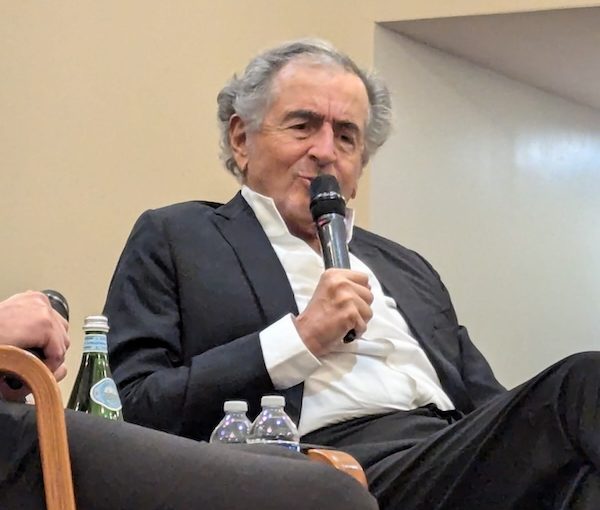
French writer, filmmaker and human rights activist Bernard-Henri Lévy was in Vancouver at Schara Tzedeck Synagogue Nov. 6, in conversation with the National Post’s Tristin Hopper. (photo by Pat Johnson)

Bernard-Henri Lévy, a public intellectual so well-known in France that he is generally referred to simply as BHL, has thrown his energies into an “emergency” effort to defend Israel in a moment of history when the world has turned against the Jewish state.

Lévy was in Vancouver at Schara Tzedeck Synagogue Nov. 6, in conversation with Tristin Hopper, a writer for the National Post.

Throughout his career as a reporter, commentator, filmmaker and activist, Lévy has written and spoken extensively about humanitarian crises in Bangladesh, Darfur, Rwanda, Bosnia and many other flashpoints. Now, he said, “I am pleading with all my energy for Israel and for the defence of Israel.”

His latest book – his 47th or 48th, he thinks – is Israel Alone.

Israel’s war is unique, he said, because it involves enemies who are not driven by ideas but by the nihilistic aim of destroying a nation and a people. The differentiation between antisemitism and anti-Zionism is irrelevant to Hamas and Hezbollah, said Lévy, noting that many of those killed on Oct. 7 were among Israel’s leading peace activists.

“Those crimes have nothing to do with seeking a political solution to the suffering of Palestinians,” he said. “They don’t care about peace. They don’t care about a two-state solution. They don’t care about the fate of the old people. They only care about killing Jews. [The victims] could have been right-wing Jews. It happens that they were left-wing Jews, but they just don’t care. For Hamas, there is not left-wing or right-wing Jews. There is just Jews who deserve to be hated, tortured and, if possible, killed.”

Lévy urges the world not to be misled into thinking that Hamas and Hezbollah are national liberation movements. “They are the proxies, the puppets, of a very powerful country, which is Iran,” he said.

Lévy is optimistic because Israel is winning the war.

“What makes me a little less optimistic, and even pessimistic, what sometimes discourages me, is the reaction of the world,” he said. “Instead of saying bravo to Israel, instead of saying thank you to Israel, instead of standing at the side of Israel, who is waging an existential war for [itself] but also a useful war for the rest of the world – instead of that, the rest of the world, sometimes the allies of Israel, mumble, object, groan, accuse and ask, demand, beg, require from Israel ceasefire, compromise, negotiation.

“When you think about it, I don’t see any precedent of a just war, a fair war, which is treated by the allies of the country that is waging it, with such strange behaviour,” said Lévy. “It is unique.”

The West is responding like cowards to the threat of Iranian-backed Islamist terror, he argued, which has formed an alliance with Vladimir Putin’s Russian regime. Part of this refusal to stand with the victims is an ingrained tendency in Western civilization, he said.

“There are a lot of people in the West who love Jews when they are victims, who love to support them and to shed tears on their face when they are beaten, wounded and sometimes killed,” he said, “but who don’t like to see them proud and strong and behaving with heads up.”

On the positive side, Lévy believes, most people in Europe and North America are not irreversibly antisemitic or anti-Israel but are influenced by biased commentary. His new book is a tool for these people and those who engage with them, he said. “Those [people] can be addressed with reasonable arguments, with historical facts, and … can be not only addressed but convinced, I’m sure of that. That is the aim of this book.”

Canada has been a safe haven for generations of Jews, he said. But now, Canadian Jews hear fellow citizens calling for their destruction.

“What is the future of the Jewish communities in France and in Canada?” he asked. “I will tell you one thing. I know very few Jews who do not have, somewhere in the back of their mind, the precise or vague or very vague idea that they could go one day to Israel. This is the state of Jewry since 1948. To be a Jew means to be a good Canadian citizen, a good French citizen, but to have somewhere, even remotely, in the mind, the idea that Israel could be an option.”

The global condemnation of Israel is a reincarnation of a long-familiar trend, Lévy said. “The new argument of antisemitism, the new form, the new phase, the new name of the virus is anti-Zionism,” he said.

The best and “only efficient way to be antisemitic today” is to be anti-Zionist, he argued. Blaming Jews for deicide or some of the other historical justifications for antisemitism is no longer effective, he said. “If you say that today, honestly, you will not meet with great success. If one wants to hate with efficiency the Jews, there is only one way left.”

Israel has few supporters among non-Jews, he said, even among ostensible allies, whose support he described as often coming with conditions.

Lévy called the former and future president of the United States, Donald Trump, “a true ally of Israel, for sure, no doubt on that.” But he also reminded the audience of an incident in the election campaign, during which Trump warned a Jewish audience that he would blame them for his loss if he were defeated.

“And if you are responsible for my defeat, within two years, Israel will disappear,” Lévy paraphrased Trump. “It was a slip of the tongue probably. [But it meant that, in Trump’s mind], the Jews deserve to be protected, but conditionally, if they supported [Trump], if they were good guys and good ladies, if they gave him victory.”

Schara Tzedeck’s Rabbi Andrew Rosenblatt welcomed the audience and acknowledged members of the Ukrainian, French and other communities in attendance. He also credited Robert Krell and Alain Guez for Lévy’s visit to Vancouver. 

Format ImagePosted on November 29, 2024November 28, 2024Author Pat JohnsonCategories LocalTags activism, antisemitism, Bernard-Henry Lévy, books, education, Israel, Israel-Hamas war, Oct. 7, Schara Tzedeck

Update on taskforce

Since Oct. 7, 2023, many members of the Jewish community have experienced antisemitism in some form or another. Jewish Federation of Greater Vancouver and the Centre for Israel and Jewish Affairs have been addressing these incidents, as well as progressing on a strategy to combat it.

A taskforce on antisemitism was appointed last November. Phase 1 was an emergency response in the months directly after Hamas’s attack on Israel. Phase 2, well underway, is about protecting the local community, strengthening relationships with allies, expanding education and raising awareness. This second phase includes an examination of how antisemitism is preventing community members from thriving, and research on how other communities have responded to similar challenges. It seeks to answer the questions, what can we learn from others and what are the best practices for combating antisemitism?

The taskforce is composed of volunteer professionals with different subject matter expertise from across the Jewish community. Between now and April 2025, they will examine manifestations of antisemitism in various sectors and how community members are responding to it. In April, they will deliver findings to the Federation board, with a formal presentation scheduled for the annual general meeting in June. The goal is to develop insights that will ensure the Jewish community can continue to thrive.

“We’re looking at different aspects of community life, including schools for children K-12, Hillel and campus life, the unions and the experiences of new Israelis coming to Vancouver,” said Mijal Ben Dori, vice-president, community planning, partnerships and innovation at Federation. “For example, new-to-Vancouver Israelis are having challenges finding jobs because they have to answer questions about whether they’ve served in the IDF and if they were in Israel after Oct. 7. Based on their answers to these questions, fewer Israelis are passing through the human resource departments of firms in BC.” 

Emet Davis, director of Community Organizing Against Antisemitism, at Federation, said the taskforce has identified key areas that are particularly egregious “In the K-12 school system, school boards and teachers unions are engaged in rewriting history or the erasure of the Jewish experience in curriculum and lesson planning,” said Davis. “At post-secondary institutions across BC, antisemitic tactics this year have been more vitriolic and widespread, posing safety threats to our Jewish students. These are areas where we really have to focus our attention.” 

The arts community is another concerning sector. “Groups like the BC Arts Council and Canada Council for the Arts are using DEI criteria to issue grants, which excludes Jews,” Davis said. “That’s not the only area where Jews are being excluded based on DEI criteria.”

This three-to-five year phase of Community Organizing Against Antisemitism will require a budget of $10 million, for staffing, fight-back advertising and a legal resiliency fund. The hope is that funding will come from private foundations, the Jewish and broader communities. 

Lauren Kramer, an award-winning writer and editor, lives in Richmond.

Posted on November 29, 2024November 28, 2024Author Lauren KramerCategories LocalTags antisemitism, CIJA, Community Organizing Against Antisemitism, Emet Davis, Jewish Federation, Mijal Ben Dori, Oct. 7
How hostages survive

How hostages survive

Dr. Ofer Merin, director general of Shaare Zedek Hospital, spoke at the event via video. He was expected to be in Vancouver in person but stayed in Jerusalem due to intelligence that Iran might strike Israel during the time he was scheduled to be away. (Adele Lewin Photography)

A top Mossad psychologist who has interviewed hostages released from captivity in Gaza explained to a Vancouver audience this month the traits that allow some people to survive and overcome unimaginable conditions.

Dr. Glenn Cohen, who made aliyah in 1982 after growing up in New York, served seven years in the Israeli Air Force as a pilot, then 25 years in the Mossad. His reserve duty has been in the hostage negotiation unit. He spoke at Schara Tzedeck Synagogue Nov. 10 as part of a national tour titled Voices of Resilience. The Vancouver event marked the inauguration of the Canadian Shaare Zedek Hospital Foundation Western region. The hospital’s director general, Dr. Ofer Merin, spoke via video from Jerusalem.

The first hostages to be released after Oct. 7 were vital to intelligence-gathering for Israel’s military, but Cohen quickly realized that the psychological well-being of the former hostages presented challenges to obtaining the information that could help locate and free others.

“We have two goals here,” said Cohen. “One is to get lifesaving, critical intelligence about the other hostages. But, at the same time, these people came out of captivity. We have to give them a soft landing and tender loving care.”

Cohen wrote a protocol to receive civilians from situations like these.

When more than 100 hostages were released through an agreement last November, Cohen and his team of 30 psychologists met each one and debriefed them. 

“The first thing we asked them was, who did you see?” Cohen said. “What condition physically, mentally? And,  with this information, we brought a sign of life for some people who had no idea if their loved one was alive or not.”

Some news was good, while other reports confirmed the worst fears of some families.

Cohen has trained soldiers for the potential of being held hostage and he was surprised that, without this sort of training, human instinct told some of the hostages how to respond.

A core trait among those who successfully survive such scenarios, he said, is hopeful certainty that they will be released. Too much optimism, though, can lead to crushing depression when hopes are not met. Those who are certain of imminent release or rescue may succumb to heartbreak and even give up on life as days and weeks tick by, he said.

It is necessary, Cohen said, to balance hope with realistic expectations.

A 16-year-old boy who was among the released hostages remembered the story of Gilad Shalit. The boy told himself: “How long was he in captivity? Five years. I’m in for five years. A day less is a bonus.”

“A 16-year-old kid,” said Cohen. “Wow. What type of resilience is that? He didn’t go through any POW training. He was just a 16-year-old Israeli boy and he’s got that in his DNA.”

Maintaining any sense of control or normalcy is a small victory. Some hostages counted the days and weeks by listening to the muezzin, the Muslim call to prayer, which is different on Fridays. A seven-year-old boy was given three dates to eat each day, and he kept the seeds to measure how many days he had been in captivity. Others made fun of their captors, secretly referring to them by disparaging names.

Generally speaking, Cohen explained, it is psychologically better for a hostage to be held with other captives, even if underground without natural light, than to be held above ground alone.

Also advantageous, Cohen said, is recognizing the captors as human beings.

“There is another person on the other side,” he said. “Even though we call Hamas animals or … monsters or whatever, the point is, they are human beings who can be influenced. When you realize that, that this is an interpersonal situation, that gives you power.”

Cohen shared one story of hostages who told their captors, “Put your gun down, you’re scaring the children,” and they did.

In another instance, a woman with a cardiac condition asked to get some exercise by walking down the tunnel she was held in. She came across two other hostages and asked why they couldn’t be brought together. They were.

“A lot of the hostages actually managed to bond with their captors and because of that bond they survived better,” said Cohen. 

News of such incidents has led to unfortunate events, he said.

“I heard not too long ago that hostages were cursed on the streets of Israel because they talked about their relationship with the hostages and didn’t call them animals,” Cohen said. “I feel like I have a mission now to educate people to realize that if people are speaking like that, as a hostage, it means it’s a healthy survival mechanism and God forbid we be critical of any of them.”

photo - Dr. Glenn Cohen speaks with an audience member at Schara Tzedeck Synagogue Nov. 10. He was in Vancouver as part of a national tour titled Voices of Resilience
Dr. Glenn Cohen speaks with an audience member at Schara Tzedeck Synagogue Nov. 10. He was in Vancouver as part of a national tour titled Voices of Resilience. (photo by Pat Johnson)

Merin, the director general of Shaare Zedek Hospital, was expected to be present in Vancouver but remained in Jerusalem due to intelligence that Iran might strike Israel during the time he was scheduled to be away. Merin also serves as head of the medical intelligence committee involved with the current hostage situation in Gaza.

“The day after the war started, we opened a designated emergency room just to treat the many, many hundreds of patients who came in the first week in need of mental health support,” he said, estimating that tens of thousands of Israelis will be diagnosed with some form of post-traumatic stress disorder in the coming months.

Amid the extreme physical and mental health demands, the hospital has also faced human resources challenges, with hundreds of staff members called up for duty and 15 experiencing the deaths of immediate family members during the war. The anxiety of having family on the frontlines adds to the stress for everyone, said Merin. The multicultural nature of the staff, which roughly mirrors the demographic makeup of Jerusalem, is also a factor. 

“How do we preserve the cohesion between these people?” he asked. “This is a major daily challenge in times of normal emotions among staff people, how to keep this amazing cohesion of people who are working for years, for decades, shoulder to shoulder together. How to keep it during times of war is a major challenge.”

Hinda Silber, national president, and Rafi Yablonsky, national executive director, of the Canadian Shaare Zedek Hospital Foundation, traveled from Toronto for the event, which was co-chaired by Dr. Marla Gordon and Dr. Arthur Dodek. The evening was presented by Canadian Shaare Zedek Hospital Foundation Western region, in partnership with Congregation Schara Tzedeck. The Jewish Medical Association of BC was the educational sponsor, with King David High School and Hillel BC participating in the program. Schara Tzedeck’s Rabbi Andrew Rosenblatt welcomed the audience. 

“Since Oct. 7, the mental health landscape in Israel has been profoundly affected,” said Ilan Pilo, Western region director of the organization. “The nation is navigating an unprecedented surge in psychological distress as individuals and communities cope with the aftermath of trauma and uncertainty.”

Proceeds from the evening will support a new mental health facility. 

Format ImagePosted on November 29, 2024November 28, 2024Author Pat JohnsonCategories LocalTags Canadian Shaare Zedek Hospital Foundation, fundraising, Gaza, Glenn Cohen, hostages, Israel, Israel-Hamas war, mental health, Oct. 7, Ofer Merin, Schara Tzedeck, Shaare Zedek Hospital
Diversity in health care

Diversity in health care

Left to right are Rabbi Jonathan Infeld, Dr. Salman Zarka, Dr. Tim Oberlander and Dr. Erik Swartz at Congregation Beth Israel, where Zarka gave a few talks Nov. 21-23. (photo from Beth Israel)

“Our professional ethics, as well as Israeli legislation, mandate that we provide life-saving medical care to anyone in need. We do so for all citizens in Israel without discrimination based on religion, origin, race or political beliefs. We provided this care for Syrians and previously treated Lebanese patients, until the border was closed in 2000,” Dr. Salman Zarka, director of Ziv Medical Centre, told the Independent.

Zarka was in Vancouver last week, speaking at Congregation Beth Israel on the ethics of triage, on treating Syrian patients in Israel, and about his community, the Druze.

“I am delighted to visit Canada and share with different audiences the amazing work we’ve been doing at Ziv Medical Centre this past year, dealing with both war and emergency situations,” Zarka told the Independent. “This visit is also a great chance to thank the supporters in Canada from the Jewish community, Beth Israel, the Federation and the Ronald S. Roadburg Foundation.

“The visit is a chance to share our ongoing efforts in treating the wounded, as well as past activities related to caring for Syrian casualties,” he said.

Caring for an “enemy”

“The humanitarian aid to Syrians lasted for around five years, from 2013 to 2018, until [Bashar al-]Assad took back control of southern Syria, closed the border, thereby stopping patients and wounded from Syria coming to Israel,” said Zarka, who led the establishment of the now-closed military field hospital that provided medical support to Syrians wounded in the country’s ongoing civil war. He and his colleagues at Ziv Medical Centre have also provided care to Syrians.

“It is indeed unusual and uncommon to extend a professional and human hand to your enemies during their time of need,” he said. “On the other hand, we have an ethical duty to treat every patient and every wounded person. This dilemma existed at the start of the process, when wounded Syrians arrived at the Israel-Syria border. We treated them and asked ourselves what we should do next. On one hand, the Syrians are one of our most severe enemies, yet our ethics and professional standards oblige us to save lives and provide aid to all in need. Moreover, Israel is known for its global humanitarian assistance. Ultimately, we chose to provide care, treating close to 4,600 Syrians, including children, women and men.”

Before he retired from the military, Zarka served in various capacities in the Israel Defence Forces, including many leadership roles, and is currently a colonel brigadier in the reserve force. He is an expert in public health and public health administration, as well as being a practising physician, among other things. He was Israel’s chief COVID officer during the pandemic. In 2014, he became the director at Ziv Medical Centre, in Tzfat, about 11 kilometres from Israel’s border with Lebanon.

“Ziv Medical Centre employs about 2,200 staff members who come from the unique multicultural background of the region,” said Zarka. “At Ziv, secular Jews work alongside ultra-Orthodox Jews, Muslims, Christians, Druze, Circassians and Bedouins,” he said. “The hospital atmosphere is familial, and everyone collaborates to achieve the noble goals of saving lives and bringing healing to those in need. Cultural differences influence how people perceive illness, and our multicultural staff enables us to offer culturally sensitive care for various health needs.”

After the Oct. 7, 2023, Hamas attacks on southern Israel, the northern part of the country faced increased threats from Hezbollah in Lebanon, leading to mass evacuations of the region.

“For over a year now, the north has faced a complex situation with rocket fire and evacuations,” said Zarka. “This state of conflict forces Ziv Medical Centre to operate from protected spaces and remain prepared for mass casualty incidents. The need for readiness and staying in protected areas limits our ability to treat patients comprehensively, but it is unethical to deny necessary medical treatment to our northern population, which depends on Ziv for their routine treatment.”

The challenges are numerous.

“Some of our patients left the area, preventing us from continuing their care, while others relocated nearby and continued their treatment,” Zarka said. “Both the evacuated population and those facing rocket fire, injury and loss require increased mental health support, leading to a rise in emergency room visits. Additionally, some of our staff had to evacuate from their homes, posing challenges for employees who continued to work at Ziv despite the distance.”

The security situation in the north requires the medical centre to reassess its reinforced spaces, while continuing to provide necessary medical care to patients, even during emergencies, said Zarka.

“The end of the war and the return of residents to their homes will pose significant mental health challenges for both adults and youth, as was seen following the COVID-19 pandemic,” he added. “Preparing to expand services in the region is essential. The north will require substantial investment not only for recovery but for growth, making it a beautiful and unique area, home to multicultural residents, many of whom are from lower socioeconomic backgrounds, who depend on Ziv Medical Centre for their health care.”

Israel’s Druze community

There are about 150,000 Israeli Druze. The Druze religion is monotheistic; it branched off from Shia Islam in the 11th century and has since incorporated elements of other religions. The Druze are ethnically and linguistically Arabic, mainly living in Syria, Lebanon, Jordan and Israel, notably, in northern Israel.

“The Druze community in Israel chose, even prior to the state’s establishment (back in the 1930s), to ally with the Jewish population, a minority at the time, possibly as a bond between minorities,” explained Zarka. “The Druze supported the Jews before the state was founded and fought in the War of Independence. Afterward, the Druze decided to enlist in the IDF as volunteers and requested mandatory enlistment for their men, which began in 1956. Druze men serve in the IDF like Jewish men, with high enlistment rates in combat units, continuing with a significant service, achieving senior ranks. I served in the IDF for over 25 years in key roles in the Medical Corps, commander of medical services in the Northern Command and head of medical services, retiring with the rank of colonel.”

A 2023 article in the National Post noted, “Aside from combat roles, the Druze have a presence in health care: in 2011, the Druze made up 16% of the IDF’s medics, despite making up only 1.6% of the force.”  The article gave Zarka as an example of a prominent Druze, having achieved success in both the military and in health care. 

There are challenges for the Druze community in Israel, however. 

“Much has been said about the ‘blood pact’ forged between the Druze and the Jews in Israel, which, unfortunately, translates into casualties in Israel’s various military conflicts,” Zarka told the Independent. “Alongside this connection, particularly strong in the IDF and security forces, there exists a civilian gap in the so-called ‘pact of life.’ The Nation-State Law [in 2018] did not address minorities in Israel, omitting the crucial term ‘equality,’ making the Druze feel relegated to a lesser status compared to their Jewish fellow citizens.

“Beyond the significance of this matter, which is not merely declarative, Druze towns (mainly villages) have long suffered from planning and land allocation issues, complicating construction and housing, even for discharged IDF soldiers. Addressing these two issues, namely equality and long-term planning, is central to the relationship between the Druze and the government.” 

Format ImagePosted on November 29, 2024December 2, 2024Author Cynthia RamsayCategories LocalTags Druze, health care, Hezbollah, Israel, medical ethics, medicine, Salman Zarka, Syria, war, Ziv Medical Centre

Posts pagination

Previous page Page 1 … Page 35 Page 36 Page 37 … Page 326 Next page
Proudly powered by WordPress