Actor Catherine O’Hara in a still from the four-minute video All of Us Shine by Jewish community member Hart Snider. (See jewishindependent.ca/revisiting-shop-class-misery.) For the 12th year, the NFB brought together acclaimed filmmakers to create short cinematic tributes to Canadian performing arts legends, as the Governor General’s Performing Arts Awards honoured laureates with two televised specials last month, one on CBC and one on Radio-Canada. All the short films are now available to watch (for free) at nfb.ca.
Also released early last month, marking Transgender Awareness Week, was the feature-length documentary Beauty by Christina Willings (jewishindependent.ca/liked-beauty-not-wall). It and more than 40 other related short and feature-length documentary and animated films can be accessed at nfb.ca/channels/lgbtq2.
Ande Axelrod has developed a partnership with artisans in the village of Sosote, Ecuador, as her source for tagua beads. (photo from Zack Gallery)
The current show at the Zack Gallery, Affordable, opened on Nov. 17. It delivers on its name’s promise. Every item on display is less than $250 and thus in the realm of affordability for many people, not just art connoisseurs.
“That’s what I wanted for the Zack Gallery from the beginning,” said gallery director Hope Forstenzer. “I wanted to deepen the involvement of the JCC community in the gallery, wanted the art within people’s reach.”
Accordingly, this show looks more like a holiday craft fair than a high art exhibition.
“I don’t believe in the separation of art versus craft,” said Forstenzer. “For me, craft is another word for art, but art that is functional and affordable, designed for enhancing your life and your home rather than a wall of a museum. I hope we can make such a show an annual event.”
To achieve the artisan market feel, Forstenzer invited 10 artists in different media to participate. “They are all local B.C. artists,” she said. “Some Jewish, some not. I wanted to cater to different tastes, to represent different artistic fields. I wanted the show to be fun.”
Ceramics by Hitomi McKenzie.
The atmosphere of the show is jazzy and welcoming. The giclée prints of well-known Vancouver artist Linda Frimer glow with greens and blues. The glass and jewelry twinkle. The ceramics by Hitomi McKenzie stand proud and bright. Mariana Frochtengarten’s colourful shawls in Shibori patterns add a touch of elegance.
Frochtengarten teaches textile art at the Jewish Community Centre of Greater Vancouver. “This is a great opportunity for me to show the community my personal work,” she said. “My work is based on the principles of Shibori – a Japanese manual tie-dye technique. I combine the ancient Japanese tradition with a contemporary approach.”
She works with natural fibres, mostly cotton and linen, and has been working as a textile artist for more than 25 years. “My way into textile art was a bit accidental,” she told the Independent. “I was born in Brazil. When I was in high school, I took a batik class for a hobby, but I fell in love with it.”
After graduating from high school, she studied at Fine Arts and Education University in Brazil and later completed her master’s in fine arts (textiles) at Nova Scotia College of Art and Design, in Halifax. “For 17 years, I worked with batik,” she said. “I had a business in Brazil and sold my works in stores, galleries, shows and fairs. I also experimented with some Shibori. I slowly moved on to my own form and interpretation of Japanese Shibori after moving to Canada in 2006. I love the elements of surprise involved in the process of Shibori and I am fascinated by the idea of creating different designs by blocking areas of the fabric before dyeing it.”
Another artist who works with an unusual material and technique is Ande Axelrod. Her company, Treats Designs, produces whimsical and sophisticated tagua jewelry: necklaces, earrings, pendants, and bracelets. Axelrod is very enthusiastic about her artistic creations. “Tagua is known as ‘vegetable ivory,’” she explained. “The tagua palms are native to the rainforests of Ecuador and other South American countries. The nuts grow and harden inside their seedpods. Some tagua nuts can grow up to six centimetres. Once the seedpods are ripe, they’re picked, and the seeds are dried in the sun, peeled and polished.”
The creamy white substance of the nuts is incredibly hard, similar to elephant ivory, hence the name. According to Wikipedia, a mature tagua palm can produce up to 20 pounds of vegetable ivory a year.
“Tagua nuts have been used as a substitute for ivory since the early 20th century,” Axelrod said. “The local masters carve the nuts into a variety of beads and buttons and dye them using bright natural colours.”
Mariana Frochtengarten shows of one of her colourful Shibori shawls.
She is thrilled to use tagua nuts as the base for her jewelry. “I worked as a graphic designer for more than 25 years. In 2011, a friend and I took some jewelry making classes and I explored a variety of media and techniques. The next year, I discovered tagua while traveling in South America. I was dazzled by the colours, and I loved how light and comfortable the pieces were. You could wear a bigger statement necklace or a pair of earrings and not have a sore neck or headache at the end of the day.”
The sustainability and eco-friendliness of tagua sealed the deal for her. “I wanted to save elephants and I was truly inspired by the vast creative potential of this versatile natural material. It also provides an economic incentive for the local communities to protect the rainforests,” she said.
Since then, Axelrod has developed a partnership with artisans in the village of Sosote, Ecuador, as her source for tagua beads. “Before COVID, I’d made annual visits to Ecuador each February. It gave me the opportunity to work with tagua throughout the process, from seed to bead. Of course, like everyone else, I’ve had to improvise these past two years. Zoom, WhatsApp, FedEx and Western Union have enabled me to stay in touch with my South American partners and get tagua here for me to create my jewelry.”
While Shibori scarves and tagua jewelry may more easily be thought of as unique artwork in the Vancouver context than photography perhaps, Michael Shevloff proves that he is an unquestionable master of the camera, producing his own singular creations. His images, both in colour and in black and white, are statements of his love for British Columbia: its forests, its mountains, its waterways, its streets.
“I do predominantly nature photography,” he said. “However, I also shoot street photography, portraits, and many other genres, both digital and film.”
For this show, Shevloff offers framed and matted photos and photo coasters. “In the past, I also produced books of my photos, collages, cushions and more. I even put one of my images on my phone cover. The choices are many, and there are online firms, as well as local places, that specialize in putting images on almost any surface.”
He has been taking photographs since he was a teenager. “That was a long time ago,” he joked. “I have albums filled with photographs from places I have worked and traveled throughout the years.”
For Shevloff, photography has always been a hobby, while he worked in information technology. It remains a hobby in his retirement, although he obviously has more time now to immerse in his artistic endeavours.
“Tropical Vancouver,” by Michael Shevloff.
“I have taken classes with professional photographers to hone my craft. And I belong to two photo clubs in Vancouver,” he said. “Vancouver PhotoClub is a well-organized group with monthly meetings and outings. I enjoy being a part of that club because they have assignments, which gives me a challenge and focus each month. They also organize exhibits, which gives me an opportunity to show my work.”
He belongs to the West End Photographic Society, as well. “That one is dedicated to film work and darkroom processing,” he explained. “They also organize exhibits. I enjoy the challenge of working with film and working with prints.”
The 10 artists of this show incorporate different art forms, different artistic philosophies, different ethnic roots and different price ranges. But one fact unites them all – every piece of art in the gallery for the next month is affordable.
The exhibit continues until Dec. 31.
Olga Livshinis a Vancouver freelance writer. She can be reached at [email protected].
Livona Ellis, left, and Rebecca Margolick, right, perform together Dec. 17 and 18 at Scotiabank Dance Centre. (photo by Faviola Perez)
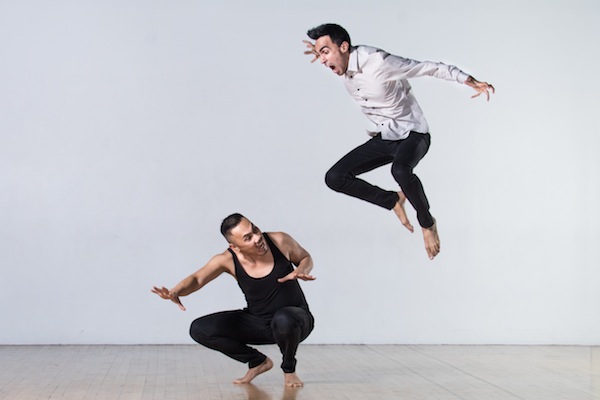
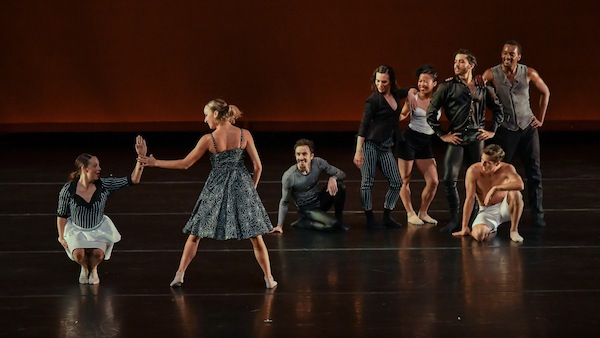
Next weekend, choreographers and dancers Livona Ellis and Rebecca Margolick will première their first collaboration, a duet called Fortress. The Dec. 17 and 18 performances at the Scotiabank Dance Centre also feature four solo works.
Ellis performs Unmoved, “a response to the idea of overcoming the limitations we place on ourselves,” and Margolick’s solo Bunker draws “on themes of memory and the shared history of previous generations of women.” The other two solo pieces were revived last season specifically for them: Peter Bingham’s Woman Walking (away) (1997), danced by Ellis, and Allen Kaeja’s Trace Elements (2000), performed by Margolick. (See jewishindependent.ca/albert-solos-reimagined.)
Both dancers have had the chance to perform for live audiences recently and both have been touring – New York-based Margolick internationally with her own work and locally based Ellis with Ballet BC, for audiences in Ottawa and Montreal.
“From these past two years of experiencing how quickly it can be taken away and experiencing how deeply I miss it when it’s gone, performing has a renewed sense of urgency and importance for me,” Margolick told the Independent. “I’m so excited to perform for a live audience here in Vancouver, especially because last year, when we were about to do this show for a live audience, on the day of the show, we had to switch to livestream only. A lot of energy has been built in this show over the past three years, and I’m looking forward to being able to share it live.”
While Margolick and Ellis have known each other for a long time, Fortress is their first duet together.
“Livona has always been one of the best dancers and performers I know. We trained at Arts Umbrella together all through high school, but, since then, we hadn’t danced together, until now. So much of collaboration happens outside of the studio and so, in a way, I feel like through our friendship and conversations over the past number of years, the work and ideas were already starting to form and it felt natural to transition to a studio together.
“At the time we decided to work together, I had been creating a solo titled Harbour, which was about my grandmother and my relationship to her both in life and death. One day, Livona and I had a conversation about it and she began talking about her grandmother. I was moved by this, and this conversation naturally spiraled into how we’ve started to see our mothers and grandmothers differently; how we see their influence on us; our desires to become mothers one day, being in our 30s now; how dance has changed for us, etc. The conversation was vibrant and honest and there’s a lot of history and love between us and I just asked if she wanted to create together, and she said yes.”
Ellis added, “One of the silver linings about the pandemic is that we both found ourselves in Vancouver at the same time…. I have always admired Rebecca’s work from afar but we’ve never been in the same place long enough to even begin to think about a collaboration. She was working on Harbour and we started speaking about our family and our grandmothers. This sparked the inspiration for Fortress. We were both doing a lot of reflecting during our various lockdowns and quarantines and found we were thinking a lot about who we are as artists and as women. How does our matriarchal lineage affect who we are today?
“We both feel like we are in a moment of change or transformation,” Ellis continued. “We can feel our experience settling in and grounding us in a way that allows us to move forward into the next chapter of our careers. This felt like the perfect jumping off point to create a duet.”
The pair started creating that work this past August 2021, with a residency hosted by the B.C. Movement Arts Society, rehearsing at the Athletic Hall in Sointula. “We are now working with composer Ivan Shopov from Bulgaria to develop the music, and Mimi Abrahams to develop the lighting,” said Margolick.
For Margolick, while both Bunker and Trace Elements haven’t seen any changes choreographically, “as time goes on, and as I evolve, they naturally do as well.”
“Especially for Trace Elements,” she explained, “it’s been a journey since I began working on it with Allen Kaeja. I started to learn more about Jewish history and specifically Jewish leftist and Jewish resistance history, both in the U.S. and Europe. Specifically, in Trace Elements, there is a spirit of resistance and remembrance in the work, countering the text we hear out loud, text of German propaganda and generational indifference to the history of the Holocaust. In that, I think about resistance fighters, countering the narrative that Jews went quietly towards death – they didn’t. That is a history we’re not often told of, and it’s been a part of my Jewish education to learn that history. The work is really spiritual for me and every time I perform it, I feel the spirit of those who fought and those who keep fighting and inspire me to as well.
“More recently,” she said, “I’ve been learning about Jewish women activists and fighters, especially women like Hannah Senesh, Faye Schulman, Bella Abzug, Emma Goldman, Anna Sokolow and others. I can’t really explain into words how this knowledge affects my performance, but I feel it, and it gives me a sense of grounding and inspiration.”
Margolick highlighted the Jewish Women’s Archive and Judy Batalion’s book The Light of Days: The Untold Story of Women Resistance Fighters in Hitler’s Ghettos as resources.
Bunker is also steeped in research. While she premièred the full-length version of the piece (titled Bunker + Vault, which runs 35 minutes) a few weeks ago in San José, Costa Rica, the December performances will include only the first 10 minutes of the work.
“A part of my research for this piece included looking through the archives of the Clara de Hirsch Home for Working Girls at the 92nd Street Y from the late-1800s to mid-1900s,” said Margolick. “The Clara de Hirsch Home was a place where young, poor, mostly Jewish immigrant women were housed and supported with educational resources as they found jobs and worked towards being able to support themselves. These archives were records kept by the staff, with observations and notes about the women who resided there. These observations gave me a window into the lives of the women who lived there, ranging from extreme hardship, repression, mental health issues, Jewish culture, camaraderie, acts of extreme kindness and on and on. Some of these women informed the movements, and spirit of resilience and care in the work.”
Fortress + Four Solos is presented by the Dance Centre and B.C. Movement Arts Dec. 17, 8 p.m., and Dec. 18, 1 p.m. and 8 p.m. For tickets, visit thedancecentre.ca.
Left to right, the Hot Mammas are Mary Ella Young, Julie Brown, Georgina Arntzen. (photo by Dee Lippingwell)
The Hot Mammas are busy this holiday season – and year round. With three albums to their credit, they perform at venues ranging from jazz clubs to shopping malls. Readers can next see them at Robson Square Skating Rink on Dec. 15, and then at Water Street Café Dec. 18.
One of the holiday songs the group performs is “Mamma Julie’s Hanukkah Song,” so dubbed by Georgina Arntzen and Mary Ella Young because the third member of the Hot Mammas, Julie Brown, wrote it, and “too many songs are called ‘The Hanukkah Song’ or ‘Festival of Lights.’” (A video of it can be found via facebook.com/thehotmammas.)
Brown’s Jewish heritage is Ashkenazi. “My maternal grandfather, who I’m named after (Julius Cohen), was a rabbi,” she told the Independent. “My father always followed our traditions. My mother was a phenomenal cook and it’s because of her I’m able to make latkes, matzo balls, knishes, chicken soup, etc. When she didn’t want me to understand something she and her sisters were talking about over the phone, she’d suddenly switch from English to Yiddish. That’s where and how I picked up some fun expressions, which I use to this day.”
Born and raised in Montreal, Brown said she has been performing music since she could walk.
“My older, late, great brother Martin Overland was the founding member of the Canadian folk group the Raftsmen,” she said. “Your readers may recall the song ‘Something to Sing About,’ which was one of their hits. Martin had perfect pitch and the voice of an angel. He was also a terrific guitarist and accordionist. Eleven years my senior, we would sing together in harmony when I was a very young child. I still recall performing ‘Buttons and Bows’ in front of a roomful of relatives and friends.
“When the opportunity arose as a 10-year-old to actually sing on camera, I jumped at the chance. The Montreal kids show was called Small Fry Frolics and there I was with my cousin Shirley singing the Everly Brothers’ ‘Bye Bye Love’! At 15, I joined a rock band, while singing lead as Carmen in high school.
“The singing/performing didn’t stop at teacher’s college either,” she added. “McGill’s Macdonald College offered a two-year teaching diploma program at the time and, much to my delight, also had yearly talent shows.”
During her teaching days, Brown brought her ukulele to class. “The kids were as crazy about the Beatles as I was and we sang our buttinsky’s off to start the day,” she said.
While at university, Brown performed in stage plays and film. She recalled working on a movie directed by John Huston, which featured Sophia Loren – “and I was fortunate enough to garner a wee speaking role when Ms. Loren walked over to a table of background performers of which I was one, and asked me a question. I wasn’t supposed to answer her as a silent on-camera person but spontaneously blurted out a comment because I didn’t want to be rude. (Out of my peripheral vision, I noticed John Huston smacking his forehead.) And that was how I got my first ACTRA permit! Even after moving out to Vancouver and doing radio full time, I still continued to audition for film, TV and did a lot of voice work. In fact, I was the Telus voice for nearly 15 years – ‘We’re sorry, the number you have dialed is not in order. Please hang up and try your call again. Thank you, from Telus.’ That was me and one of 40 or so prompts I did for them.”
Brown left Montreal after the Front de libération du Québec “raised its ugly head in Quebec” and the Parti Québécois was in power.
“My child came home in tears from school with a notice that all English-speaking children had to be educated in French the following year,” she explained. “French didn’t come easy to my son but it was more than that. We lived in Canada, or so I thought. Stop signs had Nazi slogans scrawled across them. Shop windows in the English and Jewish communities were smashed and vandalized. An elderly Jewish woman who couldn’t speak French and wanted to order flowers for a friend was disgustingly treated over the phone because she was trying to place her order in English. The clerk hung up on her.
“As a teaching friend once said to me, if you say, ‘ich bin a Yid,’ you get it from both sides. I still don’t think the rest of Canada realized just how dangerous and revolting that regime was. Well, I did…. We came out to Vancouver for a visit and, with tears in his eyes, my son asked if we could move. And we did just that in 1978.”
Within a week, Brown got a job as a news broadcaster at CFMI, the sister station to CKNW.
“Not long after that, the program director allowed me to develop an interview show as well. I had been doing interviews at the Montreal radio station, along with news, so this was a huge relief to me. I love people and am a naturally curious person, so interviewing was, and still is, a good fit. My radio career blossomed here in Vancouver. Eventually, I co-wrote, co-produced and co-hosted Vancouver at Noon on KISS-FM for 11 years.”
In her more than two decades as a broadcaster, Brown interviewed hundreds of people, including Bob Hope, Paul Newman, Shirley MacLaine, Johnny Depp, Leonard Cohen, Eartha Kitt, Sarah McLachlan, Neil Diamond, Buffy Sainte-Marie, François Truffaut, Jackie Collins, Jim Byrnes, Rick Hansen and Dee Lippingwell.
For Brown, singing in choirs has always fed her soul, and it was in one of those choirs she met Arntzen and in another that they met Young. The Hot Mammas have been together now for 11 years.
“They are both family to me – my sisters,” said Brown. “All three of us love performing because we give to our audiences and they give back. Something magical and marvelous happens, no matter where we are or how many or how few people are in that audience. Synergy. Energy. Love. Music heals. It is the ‘universal language.’
“We sing songs we love. That’s how we choose our repertoire. Jazz, pop, rock ’n’ roll, folk, show tunes, you name it. We don’t just cover groups. We also write originals. In fact, one of our tunes is called ‘The Hot Mammas’ Song,’ and it’s quite amusing – all about being mothers who love their kids but have ‘traded in their aprons for a microphone.’”
Vitaly Beckman will bring some of his best illusions yet to his Dec. 22 performance. (photo from eveningofwonders.com)
“I have been working very hard on some new illusions that I consider to be some of my best work yet,” Vitaly Beckman told the Independent. “I created a lot of my illusions during
no-show periods, a few of which I plan to include in the upcoming show.”
Vitaly: An Evening of Wonders returns to the stage on Dec. 22 at the Anvil Centre in New Westminster. While it is Beckman’s first live in-person performance in Canada since the pandemic started, he already has performed in theatres in the United States.
“It is certainly exciting to start doing live shows again – both performers and audiences could feel the void of live theatre during the past two years,” he said. “Life is really not the same without theatre.”
But there have been some benefits from the enforced hiatus.
“It is really helpful for the creative process to be able to focus on just one goal, and not be distracted by anything else for a period of time,” acknowledged Beckman. “So the lockdowns were helpful in that regard, as I managed to finish some really great illusions – one involves a sculpted bust, another involves an oil painting that comes to life and another, a matchbox. The latter I created while visiting my family in Israel. Actually, I’ve created a lot of my illusions in the past while vacationing there – it seems that the sunny place boosts my creativity.”
In addition to creating new material, Beckman has been busy in other ways, as well.
“It was certainly a long period to go without doing a single live show,” he said, “but I did a lot of magic for virtual performances and recorded an illusion for Penn & Teller’s Fool Us show, with a second appearance there.” (In that appearance, Beckman once again managed to fool the master illusionists.)
About returning to the stage, he said, “I was wondering if I would be ‘out of shape’ when performing again, however, from recent shows in the U.S., it was like riding a bike. I really enjoyed going back on stage and especially seeing how the audience left the theatre feeling uplifted and full of joy.”
For tickets to see Beckman on Dec. 22, at 7:30 p.m., click here.
Photographer Dina Goldstein and Myles Peterson, one of her model-collaborators, at Goldstein’s OG Punk exhibit, which is at the Polygon Gallery until Jan. 2. (photo by Dina Goldstein)
Walking past the Polygon Gallery in North Vancouver, it is hard not to be drawn to the photographs adorning the walls. The powerful portraits of self-described original – OG – punks were taken by Jewish community member Dina Goldstein, whose work is known for its thought-provoking social commentary.
The exhibit OG Punk is on display at the gallery until Jan. 2. Curated by Helga Pakassar, it comprises portraits of major figures from the punk rock scene in Vancouver and Victoria, which were taken by Goldstein over the past year. It is accompanied by an audio guide written by author Michael Turner.
Turner notes, “Goldstein gave her model-collaborators little instruction on what to bring to their shoot, apart from their ‘leathers.’ As for poses, these too were left to the model-collaborators, though it should be noted that the poses chosen for display, as portraits, were decided by Goldstein and exhibition curator Helga Pakasaar.”
“I met some of my model-collaborators by chance around my neighbourhood,” Goldstein told the Independent. “They are artists, musicians and punk devotees; most of them over 50, in punk regalia, hairdos, piercings and tattoos. I was excited by their stories and memories of their time as punks during the late ’70s, ’80s and into the ’90s. There was a vibrant punk scene in Vancouver and Victoria, with local bands, like DOA, incorporating activism and social commentary into their music.
“I have always been attracted to individualism – those who openly express themselves, are unconventional and live an authentic existence,” she said. “Some of the punks were ailing and not well. Some key figures had already passed. Most recently, the iconic Chi Pig, who passed a couple of years ago. I felt an urgency to document this generation of local punks. The project evolved into a series when I was able to collect a good amount of participants.”
Among the participants featured are Murray “The Cretin” Acton, Myles Peterson and wendythirteen. Goldstein sent out questionnaires to better understand the participants. Turner discusses some of the responses to the questions – such as “Has punk changed much since the 1980s?” and “Is punk here to stay?” – in the audio guide, the script of which can be found at mtwebsit.blogspot.com/2021/11/og-punk-2.html.
Though none of the model-collaborators to date are Jewish, Goldstein noted that she “will be continuing to photograph more people for this series in January.”
As for what punk means to her, Goldstein said, “I have always been rebellious. I am non-conventional and have a DIY mentality. My photography requires critical thinking and is a form of activism. My art has been described as satirical, irreverent and subversive.
“As one of my model-collaborators Lisa Jak said and I totally agree: ‘Anywhere and anytime that there is oppression, ignorance, intolerance and f–king stupidity – some punk will be there to question and fight it!’”
Lucas Gregory, left, and Daniel Cardoso, in Metro Theatre’s Snow White: The Panto, which runs until Jan. 3. (photo by Nicol Spinola)
“A lot of musical theatre is inherently silly and fun but it still doesn’t reach the level of a holiday panto,” said Daniel Cardoso, who plays the Prince in Metro Theatre’s Snow White: The Panto. An annual treat for more than 35 years, this year’s panto, which runs until Jan. 3, has added significance.
“The past year and a bit has been challenging, not only for the arts community, but for everyone,” said Cardoso. “I got to go to an opening night of a show last week and part of me had forgotten the energy of getting to be in an audience and the joy that it brings to people to get to go to live theatre. I hope that we can do something similar with the panto and that we can act as another step in a return to normalcy.”
“I love being back with the theatre community after so much time away,” said fellow Jewish community member Kat Palmer, who is stage manager of the production. “I think most of the team feels this way. So often actors would be finished working their scenes but would choose to stay a little longer to watch and support their fellow cast members rehearse. There is this sense of returning to what was and that’s been quite moving.”
Things aren’t completely back to normal, of course, as COVID is still is concern.
Metro Theatre requires proof of vaccination, said Palmer. “Usually, pantos have lots of kids and an ensemble – our show has a much smaller cast with no children,” she said. “Everyone – cast, crew and staff – is fully vaccinated. We have taken our inspiration from film sets and have rapid COVID tests on hand. Usually, kids in the audience get to come up on stage – we can’t do that this year. Luckily, there are still lots of opportunities to participate by booing and cheering our demon and good fairy.”
For Palmer, Snow White was “always a favourite growing up – I think mostly because she had black hair like me. But the traditional story is a little dated. Erik Gow, our writer, has done a great job breathing new life into this script. In our version, Snow White is spunky, independent and doesn’t need a prince. She takes charge of her own destiny.”
That said, the prince is still an important part of the story, and it was Palmer who suggested Cardoso try out for the role.
“I’ve known about the Metro Theatre since I was in university and have often gone to see shows there, but the panto this year is the first time I’ve gotten to work there,” he said. “I came to Snow White when Kat Palmer … reached out and asked me to audition for it. I hadn’t initially planned on it but it was an opportunity to work with Chris and Kat and Suzanne again, so I’m glad I did.”
Chris Adams is the director of the production, while Suzanne Ouellette is the choreographer.
Cardoso is a graduate of the musical theatre program at Capilano University and has been working in theatre around Vancouver since 2011. “I was also lucky enough to work on Disney Cruise Line for a few years,” he said. “In 2016, I went back to school to become a registered massage therapist and have been doing that in addition to theatre since 2018.”
While not raised attending shul, Cardoso said his mother and her family are Jewish, “so it is definitely a part of me that I am proud of and something that I think I will always want to learn more about and explore. I know it sounds cliché, especially for a theatre performer, but getting to do a production of Fiddler on the Roof (Gateway, 2012) was a special experience for me in that I got to play in that story and feel like I belonged there instead of just pretending like it.”
For tickets to see Cardoso as the Prince that Snow White (played by Scotia Browner) may or may not need to help her, visit metrotheatre.com. The panto promises to be a “zany and uproariously funny family pantomime,” but that’s not the only reason to check it out.
“The theatre community is hurting right now. We are trying to stay afloat,” said Palmer. “After almost two years of silence, we need your laughter – we need your applause. Please come out and support local theatre.”
Sky Lilah’s new exhibition, Quantum Sky, is at Art @Bentall this month. Quantum Sky is an exploration of consciousness and what that means to the artist. This self-study is done using various mindfulness techniques, then interpreted through visual art. One dominant theme is the use of chakras, with 21 separate works, three per chakra, dedicated specifically to interpreting the meanings held within. As such, the exhibition is an exploration of an aspect of themselves through her art and letting others into that process, with the intention of creating a space beyond time.
“A lot of it is just trusting the process, which is I guess why I paint in the first place, which I find funny because I’m so organized in life. And when it comes to artwork, I find I just need to start and figure it out as I go, as opposed to planning it all and then starting,” said Lilah.
Victoria artist Tanya Bub’s current exhibit at the Art @ Bentall Gallery features life-size works of animals that occupy land, sea and air. (photo from Tanya Bub)
“Working with driftwood has given me a great appreciation of the power and beauty of nature. The shape and colour of every stick of driftwood hints at its history. Maybe a root had to bend around a rock while it was growing, maybe sand and water smoothed its edges over a period of many years. Then,” said artist Tanya Bub, “I combine all of these diverse natural sculptures to create an animal or person that looks alive because it borrows from the evident life forces that shaped the wood. There is something almost magical about extending the life of once-living wood by turning it into art. I’ll keep making driftwood sculptures as long as I am able.”
Victoria-based Bub currently has a solo exhibition on display at the Art @ Bentall Gallery. Called Mind Games, Defying the Art Space, the exhibit – which runs to the end of the month – features life-size works of animals that occupy air, land and sea.
In addition to the Art @ Bentall show, Bub has two separate outdoor installations of her sculptures. A large driftwood cat can be found at Kits beach (at the corner of Whyte and Arbutus) and a driftwood “giant” lives between Wreck and Oasis beaches (at the corner of N.W. Marine and Agronomy).
Tanya Bub’s solo exhibit – Mind Games, Defying the Art Space – the runs to the end of the month. (photo from Tanya Bub)
Bub studied oil painting and ceramics at Emily Carr University of Art + Design, and did figurative work based on life drawings. She has a degree in fine arts from Emily Carr, as well as a degree in the philosophy of science from McGill University in Montreal. She worked as a computer programmer for a couple of decades and had her own website development company. The finding of a piece of driftwood during a walk on the beach was a game changer. Since 2019, she has been making her sculptures depicting various creatures, including the occasional human.
“I came to Victoria in 2003 with my husband and daughter to be near my mom,” Bub told the Independent. “I wanted a second child and realized I needed family and community nearby to raise a family with grace. I passionately loved art as a kid but shelved it as a young adult to pursue a more practical career in programming. Now that my kids are all grown up, I’m allowing myself a second childhood and spend about 12 hours a day creating art with absolute abandon!”
One of the many creatures sculpted by Tanya Bub, whose works on on display display at the Art @ Bentall Gallery. (photo from Tanya Bub)
Also on Bub’s CV are two physics books that she co-authored with her father. While perhaps not immediately evoking any connection with her artwork, Bub explained, “Both the relativity and quantum mechanics books begin with a simple premise and extend from there with small logical steps, building complexity bit by bit, to tell the tale of the universe. My sculptures also all begin simply, by combining one piece of wood with a second. Then another is added and another, eventually resulting in a complex unified form made up of a thousand different pieces, that tell a unified story.”
And part of Bub’s story is her Jewish heritage.
“I’ve always identified strongly with Judaism, which for me is more of an approach to life rather than strictly religious beliefs,” she said. “My grandfather, Percy, was the embodiment of Jewishness. He had an irrepressible curiosity and an almost childlike joyfulness, which allowed him to marvel at and appreciate the simplest things. That, combined with a deep respect for intellectual pursuits and, above all, the high value placed on family, was at the core of hisJudaism. These ideals inform my approach to art, physics, family and life in general.”
Maxine Lee Ewaschuk, in a still from the documentary Periphery, which premièred last month at the Prosserman Jewish Community Centre in North York, and is available to view online.
On Oct. 28, the Prosserman Jewish Community Centre in North York hosted a hybrid launch for Periphery, a newly produced documentary film and photo exhibit that explores the lives of multiracial and multiethnic Jews within the Greater Toronto Area.
The 27-minute film features interviews with several individuals who might be considered as existing on the fringes of a homogenous, stereotypical notion of the Jewish world – a world that, in reality, is multifaceted and ever-evolving.
“What Periphery does for us is bring together a diverse view of our community,” said Andrew Levy, one of the event’s organizers.
From the outset, the film asks, “What makes a Jew? What do you have to know to be a Jew?” Implicit in those questions is another question, how can the Jewish community extend its tent to include those who might feel left out of the broader mishpachah, family? Notably, those whose parents are not both Jewish.
“There becomes a question of, can I say I am Jewish? When can I say I am Jewish? Is it ever OK for me to say I am Jewish before I complete my conversion, even if I am functioning very Jewishly in my day-to-day life. Sometimes, I say I am a Jew-in-progress,” shared dancer Maxine Lee Ewaschuk.
“Maybe I don’t know everything about what it is to be Jewish, but I am fiercely, proudly Jewish. It’s my experience and my experience is valid,” said actor Nobu Adilman, whose heritage is Jewish and Japanese.
“I knew my Indian grandparents super well, but I never knew where my Jewish grandparents came from,” said author Devyani Saltzman, who recounted a trip to Russia with her father to look into the roots of the paternal side of her family.
Saltzman also remembered an observation she had as a child of looking at other classmates who came from solely Hindu or Jewish families and thinking, non-judgmentally, “that must be really nice to know one’s place and space so clearly.”
In the cases of both Adilman and Saltzman, their parents married out of a love that transcended religious, cultural and geographic barriers.
“My father put a lot of his energy into my mother’s culture. He didn’t talk a lot about his upbringing. He was proudly Jewish, but he didn’t want to impose it on us,” Adilman said.
Adilman, too, related a kinship he has with other Jewish people who have gone through the same sorts of questioning that he has.
Ariella Daniels, Daniel Sourani and Sarah Aklilu each spoke of connections to places far removed from the GTA.
Daniels, who descends from Bene Israel Jews of India, explained that, for her, being a Jew represents several layers of identity – cultural, religious and national – and that the perspective she has of the world comes through being Jewish.
Sourani, who identifies as a gay, Iraqi Jew, focused on the importance of family – and the gatherings around Shabbat, holidays and lifecycle events – to his Jewish experience.
Aklilu, meanwhile, sees herself as Jewish, Ethiopian and Canadian. She told of the many times her Jewish identity has been called into question and, as a result, she has questioned who she is. Ultimately, she asserted, “I know I am Jewish and I feel that I don’t need to explain to people that I am.”
Tema Smith, a Jewish community professional and daughter of a Black father and Jewish mother, outlined the odd experiences she has had because people often assume she has two European Jewish parents.
“People say things that they would never say if a Black person were in the room. I feel completely unseen in those moments,” Smith said. “I feel trapped in these weird moments of having to swallow what just happened.”
For Asha, a Black and Jewish woman, her connection to Judaism is one that she described as developing and expanding. “I think, if you look Black, like I do, then you go through life as a Black person,” she said. “I don’t know if you have to choose internally, but it is chosen for you in the wider world. So, people don’t look at me and think I am Jewish. I don’t think that’s ever going to happen. If it did, it would be weird.”
While the experiences in Jewish spaces of those interviewed were frequently frustrating and alienating, it was also pointed out in the documentary that there are positive aspects to having a multiracial background. There is richness and happiness in belonging to different cultures and this, in itself, can be invigorating.
The screening was followed by a conversation with director Sara Yacobi-Harris, cinematographer Marcus Armstrong and film participants. Periphery was produced by No Silence on Race, an organization that seeks to establish racial equity and inclusivity within Jewish spaces in Canada, in partnership with the Ontario Jewish Archives. To view the film, visit virtualjcc.com/watch/periphery.
Sam Margolishas written for the Globe and Mail, the National Post, UPI and MSNBC.