Skip to content
  • Home
  • Subscribe / donate
  • Events calendar
  • News
    • Local
    • National
    • Israel
    • World
    • עניין בחדשות
      A roundup of news in Canada and further afield, in Hebrew.
  • Opinion
    • From the JI
    • Op-Ed
  • Arts & Culture
    • Performing Arts
    • Music
    • Books
    • Visual Arts
    • TV & Film
  • Life
    • Celebrating the Holidays
    • Travel
    • The Daily Snooze
      Cartoons by Jacob Samuel
    • Mystery Photo
      Help the JI and JMABC fill in the gaps in our archives.
  • Community Links
    • Organizations, Etc.
    • Other News Sources & Blogs
    • Business Directory
  • FAQ
  • JI Chai Celebration
  • JI@88! video

Recent Posts

  • Story of Israel’s north
  • Sheltering in train stations
  • Teach critical thinking
  • Learning to bridge divides
  • Supporting Iranian community
  • Art dismantles systems
  • Beth Tikvah celebrates 50th
  • What is Jewish music?
  • Celebrate joy of music
  • Women share experiences 
  • Raising funds for Survivors
  • Call for digital literacy
  • The hidden hand of hate
  • Tarot as spiritual ritual
  • Students create fancy meal
  • Encouraging young voices
  • Rose’s Angels delivers
  • Living life to its fullest
  • Drawing on his roots
  • Panama City welcoming
  • Pesach cleaning
  • On the wings of griffon vultures
  • Vast recipe & story collection
  • A word, please …
  • מארק קרני לא ממתין לטראמפ
  • On war and antisemitism
  • Jews shine in Canucks colours
  • Moment of opportunity
  • Shooting response
  • BC budget fails seniors
  • Ritual is what makes life holy
  • Dogs help war veterans live again
  • Remain vital and outspoken
  • An urgent play to see
  • Pop-up exhibit popular
  • An invite to join JWest

Archives

Follow @JewishIndie
image - The CJN - Visit Us Banner - 300x600 - 101625

Byline: Cynthia Ramsay

Welcome to Cabaret!

Welcome to Cabaret!

Dylan Floyde as Cliff Bradshaw and Erin Palm as Sally Bowles in Cabaret, presented by Studio 58. (photo by David Cooper)

“I honestly couldn’t think of a more important show to do right now, with such a divided political climate. The past is as important as ever, we must not let it fade. We need stories like these,” Erin Palm told the Jewish Independent about Cabaret, which opened at Studio 58 (Langara College) last week and runs until Feb. 24.

The musical is set in Berlin in 1929, as the Nazis begin their ascent to power in Germany. Palm plays the role of Kit Kat Klub headliner Sally Bowles, the British singer with whom American writer Cliff Bradshaw falls in love.

“Sally is such a complex character. I’d say the most important thing as an actor is honouring her, and acknowledging that she and the other characters in Cabaret are based on the real experiences of Christopher Isherwood, back in Weimar Berlin,” said Palm. “The biggest challenge for me is to know her apathy. It’s painful and tragic.

“I have, hopefully, given her autonomy throughout her journey. I am not a fan of judging the characters I play so, to combat that, I focus on how she is brave, independent and whimsical. She uses humour and imagination as a tool to get through her own challenges and I think that’s where the fun comes in. Really, she’s searching for freedom, and I love playing with that as an actor.”

Palm is in her third and final year at Studio 58. “I became a student the summer after I finished playing Fruma Sarah in Fiddler on the Roof with RCMT [Royal City Musical Theatre] and traveling to Toronto to do the National Voice Intensive. It was a big decision to go back to school, but I know the legacy of Studio 58 is that it turns out fine actors. I wanted to give myself the best opportunity to grow and gain new tools.”

Fellow Jewish community member Josh Epstein makes his directing debut with this production. A multiple-award-winning actor and filmmaker, he was a student at Studio 58, where he played the role of Joey in Pal Joey. “I also met my creative partner, Kyle Rideout, while there and we named our company Motion 58 in honour of Studio 58,” said Epstein. (He and Rideout recently sold a feature film pitch to Paramount with the Transformers producers, di Bonaventura Pictures, said Epstein, “and we have a variety of film and TV projects at various stages of development.”)

About returning to Studio 58 for Cabaret, Epstein said, “I’ve been talking to Kathryn Shaw [Studio 58 artistic director] for a couple of years about returning to direct something, as I now felt ready, and Cabaret was my first and only choice.”

Epstein said he has a few favourite scenes, ones “that bring tears to my eyes, but none more than a late scene between Herr Schultz and Fraulein Schneider, the older couple that has sweetly fallen in love. None of the characters truly knows what’s coming. Herr Schultz still sees himself as a German and firmly believes he won’t lose anything. It’s heartbreaking.”

Another returning Jewish community member for this production is lighting designer Itai Erdal.

“Studio 58 is one of my favourite places to work,” he told the Independent. “I keep coming back because I love the staff and I love the energy of the young students and because I’ve done some of my best work there. I find it to be a great working environment, which often allows for some real magic to happen.”

Erdal is enjoying lighting Cabaret, which has much darkness in it story-wise, as well as being set in a nightclub.

“Lighting musicals is always tricky but it’s really wonderful to light a musical like Cabaret, just because of that darkness you refer to,” he said. “So many musicals are very lighthearted and it is so refreshing to do a musical about something that matters so much. It’s also some of the best music ever written for theatre, so it’s a joy to light these iconic songs and support these brilliant young actors as they tackle those songs.”

Given that Cabaret is such a well-known musical, Epstein said, “I’m definitely encouraging the team to tell the story that’s written, first and foremost, but any staging or performance that’s been done before, I’m not that interested in repeating. We’re creating something that is unique to Studio 58, their intimate space, and it will be aggressive, fun and stimulating.

“I’m very excited for the fresh performances of Sally and the Emcee in our production,” he added. “I think we’ve found a Sally (Erin Palm) that doesn’t feel sorry for herself, that has strength and power and makes active decisions rather than accepting her lot in life. Our Emcee is female and, after watching how Paige Fraser has done it so far, I would never want it any other way. For one, she dances and sings better than most of the men who have played the role before onstage.

“We’ve also played with the musical numbers,” he said. “‘Mein Herr’ is gonna rip the roof off the theatre and I think we’ve reinvented the pineapple song [‘It Couldn’t Please Me More’].”

Epstein recommends that audience members arrive early. “There’s a burlesque show you won’t want to miss,” he said.

The production’s promotional material, which advises that the show is suitable for ages 16+, comes with the warning, “Possible nudity, probable vulgarity and other behaviour your momma won’t approve of!”

For tickets, visit langara.ca/studio-58/current-season.

Format ImagePosted on February 8, 2019February 7, 2019Author Cynthia RamsayCategories Performing ArtsTags Cabaret, Erin Palm, Itai Erdal, Josh Epstein, musical theatre, Studio 58
Meet new or favourite writers

Meet new or favourite writers

The Cherie Smith JCC Jewish Book Festival starts this Saturday night (Feb. 9) with Joshua Cohen, author of Moving Kings and ATTENTION: Dispatches from a Land of Distraction. It continues for five literary-filled days at the Jewish Community Centre of Greater Vancouver, and here’s a sampling of books you might want to add to your reading list, and authors you might like to meet.

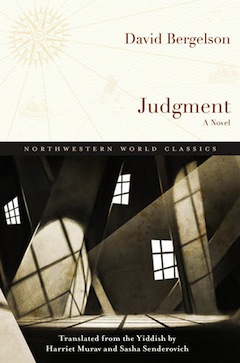
book cover - JudgmentSet in 1920, in the fictional shtetl of Golikhovke during the Russian civil war, Judgment, by David Bergelson (1884-1952), is a melancholic novel about humanity in a time of uncertainty, where different political factions are warring, each under their own ultimately meaningless banner; neighbours cannot trust one another, let alone strangers; and justice is meted out randomly by a cruel, indifferent force.

Stationed in an also fictitious abandoned monastery called Kamino-Balke, near Golikhovke, the sickly Bolshevik Filipov is in control of the area along the Ukraine-Poland border. There are smugglers who travel across the border for commercial reasons and Socialist Revolutionaries who travel across it in preparation for an uprising against the Bolsheviks. Jews and non-Jews live together in relative tolerance but political loyalties, ethnic ties and differing ideas of morality ensure a constant tension. All live in fear of being captured by one of Filipov’s agents, as guilt of a crime does not need to be proven for a person to be beaten, imprisoned and/or shot.

What makes this novel beautiful is Bergelson’s prose. Imaginative metaphors: “Large, invisible hands merrily picked up whole heaps of snow and just as merrily released them.” Animated objects: “… the coat lay there bent over, dejected, as if it had made a long, pointless, idiotic journey” and “The cannons’ muzzles – black, fat and eyeless – stared longingly in the direction of the forests around Moshne….” Humour: “Stone fences suited the inhabitants of Yanovo, for all of them were as stubborn as their stone fences: stone upon stone.” And empathy, in this case, for the undercover agent Yokhelzon, whose “eyes (which inspected everything, people said) had already taken in the horror of death – they winked joyfully, so that the horror would not show afterward.”

As should be obvious, Harriet Murav and Sasha Senderovich have done a masterful job of translating Judgment from Yiddish to English. They also provide a fascinating introduction to the novel, its historical context, the author and his other works (Bergelson was executed in 1952, on Stalin’s orders), the book’s title, form, themes and use of language.

Senderovich will be at the book festival on Feb. 10, 3:30 p.m.

***

book cover - Silence, je tombeMichèle Smolkin’s novel Silence, je tombe is a witty, philosophical novel that explores how people can become isolated from one another, including themselves. Told from the perspectives of a few protagonists, readers will likely relate to many of the feelings expressed.

The novel starts with a pregnant Tania, as she, her husband Paul and their toddler Margot are making the drive to their new home in “Manhattan, Kansas, The Little Apple,” from Vancouver. Tania’s disenchantment is obvious and she expresses her anger towards her husband – who, as a professor of philosophy, couldn’t find a job elsewhere – with vicious (and very funny) sarcasm, mostly in her thoughts, but aloud, as well. She had imagined a different life for herself – living in New York, the Big Apple, for one thing; and certainly not in the Bible Belt. As a Francophone Jew, she anticipates that fitting in might be a problem.

As the book progresses, we get to know Tania, Paul and a disturbed man named Kevin, plus a couple of other minor but important characters. Through them, we contemplate love, what attracts people to one another and what forces them apart, what happiness is, what actions might be unforgivable, how our childhoods influence our adulthoods, and, of course, the inadequacy of words for certain situations, and understanding why, sometimes, silence is the only possible response.

Smolkin’s talk – the book festival’s first-ever French-language event – will take place Feb. 10, 5 p.m. (Note: Festival program shows incorrect time.)

***

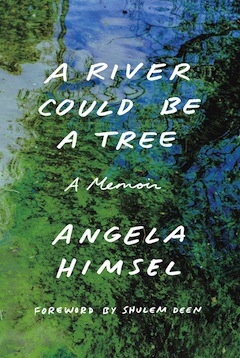
book cover - A River Could Be a TreeA River Could Be a Tree is, thankfully, not the memoir of a person who goes from believing fanatically in one religion to being swept away as unquestioningly into another, though it might seem like it would be, given some aspects of the press material. “How does a woman who grew up in rural Indiana in a fundamentalist Christian cult end up a practising Jew in New York?” asks part of the blurb on the book flap. Well, for starters, Angela Himsel seems to always have been an inquisitive person, and never an avid follower of Herbert Armstrong’s Worldwide Church of God. She was an obedient child, but is still struggling with understanding how her parents believed so much in the church doctrine that they didn’t give her sister the care that might have prevented her death at a young age.

A River Could Be a Tree is a measured, often humourous, always intelligent memoir. Himsel starts with a prologue that gives readers a very large hint as to what led her to ultimately convert to Judaism: she and her boyfriend Selig were, “just once … careless about birth control.”

But the journey to that point is long and more complicated, and Himsel takes readers through it with the benefit of hindsight, hard-won insights and a writing style that is serious, honest but unsentimental, and filled with initially unexpected levity. As but one example, a mere three paragraphs into Chapter 1, in which Himsel talks about her parents’ religious heritage, Roman Catholicism and Lutheranism, she writes about Martin Luther, that, at age 41, he “married a nun, a woman he had helped smuggle out of a convent in a herring barrel. While irrelevant to Luther’s religious beliefs, a nun in a herring barrel is always worth mentioning.”

And A River Could Be a Tree is well worth reading. Himsel will speak at the book festival on Feb. 11, 7:30 p.m.

***

book cover - Why You Eat What You EatThere is so much information in Why You Eat What You Eat: The Science Behind Our Relationship With Food by Rachel Herz. And a refreshing aspect of the book is that it’s not written from a dogmatic, all-knowing viewpoint. Herz acknowledges that sometimes studies come to different conclusions, sometimes scientific progress means that what was once thought true is disproven, and that different people will experience food, exercise and other things differently. Readers looking for certainty might be disappointed, but those wanting to learn will learn a lot. Who doesn’t want to know, for example, why tomato juice is one of the most popular drink orders on planes? Does sugar really help the medicine go down, so to speak, i.e. reduce the effects of pain? And why can buying ethically branded or organic products make us less charitable?

But Why You Eat What You Eat is more than an amalgamation of trivia. Herz has compiled a very readable and relatively comprehensive resource that will, as the title promises, help explain why we eat what we eat; how all of our senses – taste, smell, sight, touch and hearing – affect how we experience food. And knowing these things just might make us feel better about ourselves, and make choices that would serve us better.

Herz will be at the book festival on Feb. 13, 6 p.m.

Format ImagePosted on February 8, 2019February 7, 2019Author Cynthia RamsayCategories BooksTags Angela Himsel, Cherie Smith JCC Jewish Book Festival, David Bergelson, fiction, food, French, memoir, Michèle Smolkin, non-fiction, Rachel Herz, science, translation, Yiddish
World’s craze for sand

World’s craze for sand

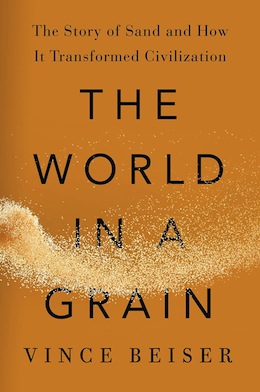
The World in a Grain: The Story of Sand and How It Transformed Civilization by Vince Beiser is a finalist for the 2019 PEN/E.O. Wilson Prize for Literary Science Writing. The award is given to a “book that exemplifies literary excellence on the subject of the physical or biological sciences and communicates complex scientific concepts to a lay audience.”

At the core of PEN America is the ideal of freedom of speech, “recognizing the power of the word to transform the world.” For his entire career, Beiser has been trying to change the world with his writing and, with The World in a Grain, he educates readers about the phenomenal importance of sand in making thousands of things, from concrete to glass to fibre-optic cables, and how dependent on it we are. So valuable is sand that people steal it and even kill for it, and our unbridled use of it, in concrete in particular, might just kill the planet.

To bring these harsh realities to light, Beiser adeptly and engagingly – sometimes with humour – mixes empirical evidence, scientific explanations, interviews with people directly connected to or affected by sand mining, profiles of relevant historical figures and his own commentary, as well as some factoids, which he calls “Interludes.” He comes to the not-surprising-but-disheartening conclusion that there’s only one solution: “human beings have to start using less sand. For that matter, we have to start using less of everything.”

Beiser dedicates the book to his wife, Kaile, and their children, Adara and Isaiah. While they live in Los Angeles, he grew up here. The Jewish Independent interviewed him about his upbringing, his career and, of course, his book.

JI: Could you tell me where you were born, how you ended up in Vancouver, and how your parents’ involvement in social causes influenced your choice of profession?

VB: I’m from a venerable Vancouver family, though I wasn’t born there. My grandfather’s family – the Landos – came over from England around the turn of the 20th century, first to Prince Rupert and then to Vancouver, where they worked in the fur business, of all things. My mother [Roberta] and her siblings were all born and raised in Vancouver – mostly in the same house where she still lives! My brothers and I were all born in the U.S. (myself in New York City), where my father [Morton] was working. We moved to Vancouver when I was 10, and I grew up there until I took off to college in California. I come back just about every summer.

My parents were always very engaged with the world, and the idea of trying to make it a better place – my father as a mental health researcher, and my mother mainly through her work with all kinds of arts and cultural organizations. We did a lot of traveling as well, which really opened my eyes to just how lucky we were and how much less so are so many other people. Meanwhile, I also had an uncle, Vancouver native Barry Lando, who was a highly decorated producer at 60 Minutes, so I grew up watching his shows and hearing about his adventures all over the world. I never consciously thought that I wanted to have a job like that, but it certainly made an impression.

JI: What role does Jewish culture and/or Judaism play in your life and work?

VB: I’m proud to be a Jew, and that heritage has definitely had an impact on my professional life. Knowing our long and brutal history of oppression helped sharpen my desire to work for social justice, to do what I can to help right, or at least bring attention to, wrongs wherever I find them. I started my career in Jerusalem, covering the First Intifada as a freelancer for both Israeli and Palestinian publications. Later, I wound up working for an Israeli magazine, The Jerusalem Report, first in Eastern Europe covering the wars in the former Yugoslavia, and later as their New York correspondent. I’ve probably written more about Jews and Jewish issues than anything else except sand!

JI: What took you from Vancouver and how did you establish yourself in Los Angeles?

VB: I went to college at the University of California at Berkeley – I really wanted to get to the States, which I thought was a much more exciting place than then-sleepy little Vancouver. From there, I spent years traveling and working all over the world, first as a hitchhiking backpacker, and later as a freelance journalist (there’s often not a lot of difference between the two lifestyles). I spent several years in the Middle East and then Eastern Europe, then came back to the U.S., where I bounced around from New York to San Francisco to Las Vegas (that’s right, I lived in Las Vegas). I was living in San Francisco when I met a delightful young woman living in L.A. I was doing a lot of work in L.A. at the time, writing for the L.A. Times Magazine and other places, so had an excuse to visit her often and, well, 17 years later we’re married, with two kids and a mortgage and the whole package.

JI: In an interview you did with David Simon, you talk about journalism, fiction and film, and Simon comments that no one reads anymore. What are your thoughts on that, on the state of journalism and your decision to write a book?

VB: These are dark days for the business of journalism, of course, with local newspapers dying off en masse and money drying up for those that are left, thanks to the internet. Most of my career has been spent writing for magazines, and a terrifying number of the ones that I’ve written for over the years have disappeared or been reduced to emaciated shadows of their former selves – The Village Voice, Spin, Rolling Stone, US News & World Report, and on and depressingly on.

book cover - The World in a Grain
The World in a Grain can be purchased on Amazon and at other bookstores.

But, contrary to what everyone expected with the advent of the internet and the Twitterization of discourse, people do still read, at length and in numbers. There are plenty of long, deep articles published online that attract hordes of eyeballs – the trick no one has cracked yet is figuring out how to make money off of them. Oddly, the book industry is still doing relatively well; most people still seem to prefer physical, paper books to reading something of that length on a screen. So, moving from magazines into book writing is not only something I’ve always wanted to do – it’s also a tactical move aimed at keeping me solvent. I’m branching into movies and TV for the same reason. If you’re going to survive as a freelance journalist in the 21st century, you’ve got to tell your stories and get paid every which way you can.

JI: Can you describe how the topic of sand first came to you, why it piqued your interest and about the path to the book’s publication?

VB: I’m a full-time freelancer, so I’m always hustling for stories, which involves trawling through a lot of obscure publications. One day in early 2015, I stumbled across a story on a little environmental website from which I learned two things. One, sand is the most-consumed natural resource on earth after air and water; that alone made me sit up and take notice. Two, that there is so much demand for the stuff that we are inflicting tremendous environmental damage all over the world to get it, stripping bare riverbeds and beaches and, in some places, people are even being murdered over sand. Like most people, I had never even thought about sand as a commodity, let alone one so important people might be killed over it.

I thought this all sounded crazy but, with a little research, I found it was true. The violence, I discovered, is by far the worst in India. So, I convinced Wired magazine to send me to India, where I reported a feature on the murderous ‘sand mafias’ that bedevil that country. The piece came out in spring of 2015 and got a great response from readers. I knew by then there was much, much more to the story – a book’s worth, I figured. That summer, I spent a few days alone on a tiny property we own on Gabriola Island pounding out a book proposal. My agent in New York sold it almost right away to the folks at Penguin Random House, and I was off to the races.

JI: How would you describe your level of optimism about the future?

VB: Really depends on the day, or hour. But I’ve got kids growing up in this world, so I don’t have much choice but to hope for the best!

Format ImagePosted on February 8, 2019February 7, 2019Author Cynthia RamsayCategories BooksTags environment, journalism, politics, sand, tikkun olam, Vince Beiser
Girls funny, open and smart

Girls funny, open and smart

Girls Gotta Eat co-hosts Rayna Greenberg, left, and Ashley Hesseltine have created careers they love. (photo from JFL NorthWest)

To say it’s a podcast about dating and relationships doesn’t begin to describe Girls Gotta Eat. Co-creators and co-hosts Rayna Greenberg and Ashley Hesseltine invite their guests to talk about pretty much anything, and pretty much as explicitly as they’d like. Recent topics include creating successful online businesses, avoiding toxic partners, managing depression, the health benefits of masturbation, and having sex with famous people – and that was on just one show.

Girls Gotta Eat celebrates its first anniversary this month, and Greenberg and Hesseltine will be in Vancouver for that milestone. The pair has two soldout performances at JFL NorthWest, which runs Feb. 14-23 (jflnorthwest.com). They were scheduled to do just one show initially, and the demand would have sold out a third, no doubt, and probably even a fourth. On Instagram, Girls Gotta Eat has garnered more than 69,900 followers in less than a year. (By the time you’re reading this article, that number will likely be more than 71,000, as the account gained 300-plus new followers in the space of two days last week.)

In addition to Girls Gotta Eat, Greenberg and Hesseltine each have other ventures on various platforms, including websites, Twitter and Facebook, but Instagram is where their celebrity status is most remarkable. At press time, Greenberg’s One Hungry Jew had more than 350,000 followers on Instagram; Hesseltine’s Bros Being Basic, more than 915,000, and her Fashion Dads, another 186,000. It is no wonder that a good chunk of time on the Girls Gotta Eat podcast is spent promoting advertisers’ products, mainly cosmetics and fashion. These women have worked hard to secure an enviable target market – their 30-something peers who have money to spend.

While Girls Gotta Eat generally focuses on one topic or guest, Greenberg and Hesseltine try to cover a range of topics and have different guests for the live version, as well as make the show an interactive experience for the audience.

“We typically try to have a guest that has already been on the podcast,” Greenberg told the Independent in a recent phone interview from Los Angeles, where she and Hesseltine were performing.

“It’s rare,” she said, “that we go to a new city and invite somebody we’ve never had on the show. Just because our audience is so invested in the show and they love it, it’s so exciting for them to be able to also see another person that was on the show.”

The weekly podcast now averages well over an hour. In its first several months, it was about 45 minutes, the approximate length of a commute to work, said Greenberg.

“As we had more and more guests, the show just became really fun. We want guests to feel like they can cover a range of topics and we don’t want to truncate the show, something that’s great,” she explained. “We don’t want to hold ourselves to 45 minutes if it’s great content, so it’s just gotten a little longer. There was no day where we woke up and said, let’s do an hour-and-a-half. So, it just depends on the guests; some episodes are going to be 45, some are going to be an hour-and-a-half, we’ll see when the guests come in.”

For Greenberg, the podcast was a huge departure from what she had been doing before.

“I’ve worked in restaurants, I went to culinary school and then I really worked in tech startups for a long time,” she said.

The Girls Gotta Eat podcast was Hesseltine’s idea initially.

“She is a comedian herself and she really wanted to do a show about dating and relationships, and wanted to find somebody that would be open and honest about their own lives and also could be funny,” said Greenberg. “She and I met on a press trip because we both have very large Instagram influencer accounts, and we just really hit it off. We had a great time with each other, we became friends over the course of a few months, and then she asked me if I’d be interested in doing this.”

As soon as the idea came up, said Greenberg, “I decided, and she decided with me, that it wasn’t going to be a hobby or a side project, this could be what we do. So, we focused on it as a business: we built a website, we had professional photos taken, we devised a way to market this. From Day 1, there was definitely a strategy of let’s make this a business, let’s expand it.”

Greenberg had already monetized her food blog, One Hungry Jew, by doing ads for brands. “For example, a company like American Express will come to me if they’re looking to attract a younger audience that has money and they’ll say, OK, we want to create a campaign that is designed to encourage people to use our AmEx Travel and they’ll give me an idea of what they’re looking for and, obviously, a budget, a price, and it can be something like, hey, we want to encourage people to sign locally, so go to a restaurant, take a photo of yourself at the restaurant, write a caption, and they pay me for something like that. It’s clearly an ad, it says ad. That’s how, personally, I make money through social media.”

One Hungry Jew started “as a silly hobby,” said Greenberg. “I would never purposely have named a business One Hungry Jew…. I’ve always enjoyed food, I’d always worked in food, and I was in the tech startup world and I didn’t have much of a creative outlet, so I started taking photos of food with my cellphone. It’s something I always spent money on anyways, it’s what I enjoyed, and I just put them on Instagram because I wanted somewhere to put the photos. It’s just as simple as that.

“There weren’t a lot of food blogs back then…. I was one of the earlier people that started posting continuously. I had really good content, and it was really ‘right place, right time.’ It was certainly a time in the world where marketing and PR were shifting heavily to social media…. And I started getting invited to all these places for free, for a free meal in exchange for a photo.”

Working at Amazon at the time, Greenberg said she was splitting her focus between her job and the social media account. “I was obviously doing a bad job of both of them and I had to make a decision, so I chose. I left my job two-and-a-half years ago to pursue this full time and I worked really hard. I reached out to every single PR and advertising agency in the United States. I introduced myself, I said this is what I do, this is what makes me unique, I’d love to find time to meet. So, just like the podcast, I tried to make it into a business as opposed to a silly hobby.”

While not religious, Greenberg said, “I am exactly who I am because I was brought up in a Jewish family, I was brought up in a big Jewish community. A lot of my social activities as a child revolved around that, so I had a really nice upbringing because I was brought up in this Jewish community.”

Though her parents divorced when she was 4 years old, she said, “I have an incredibly supportive family from both sides.”

She could always talk about sex with her parents, and said her mom is a psychologist, so “we’ve always explored my feelings.”

“My mom bought me a book about puberty when I was like 11,” said Greenberg. “She wanted me to understand my body and what was happening.”

Nonetheless, she admitted to being a little nervous when she and Hesseltine started the podcast, as the pair does talk openly about their sex lives.

“It was a real struggle and a real choice that I wrestled with, how much do I talk about myself and how open am I going to be? And we both, Ashley and I, made the decision that, if we’re going to put ourselves in a public light, then we have to be honest and open about things in our life, and we both really are. And I think that’s what makes our show really good, is that people really feel like they know us, they really feel like they understand our pitfalls and our successes.”

Over the course of the year, Greenberg and Hesseltine have interviewed a wide variety of people. “We’ve had the founder of Hinge, which is a dating app, on the show; we’ve had a sex therapist; we’ve had a psychotherapist; we’ve had matchmakers; we’ve had comedians, actors and artists and all these different people. And everybody brings such a different, unique view of their own life and other people’s lives, and I feel so lucky to have amassed this huge knowledge of dating and what other people go through,” said Greenberg.

The podcast, she said, has “helped me be more calm and not so emotional, not take everything personally all the time. It’s helped me to realize that people are people and they make mistakes…. And I think that lots of people are looking for love and, just because you’re not the person they fall in love with, it’s not insulting, it’s not personal.

“It’s helped me to relax a little bit and be happy with my own life and realize that I should do other things besides focus on dating, which is funny because I do a show about dating. But, the advice I always give girls is focus on your job, focus on hobbies and friends and family and all these other things that bring so much joy your life, and that can be really fulfilling. And love will come and dating will come. And, if you’re a more whole person, it allows you to let in love in a really beautiful way.”

Format ImagePosted on February 8, 2019February 7, 2019Author Cynthia RamsayCategories Performing ArtsTags comedy, dating, JFL NorthWest, lifestyle, podcasts, relationships
Saved by Dutch Resistance

Saved by Dutch Resistance

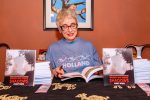
Janet Wees at a book signing for her novel When We Were Shadows, which she’ll be bringing to the Cherie Smith JCC Jewish Book Festival on Feb. 10. (photo by Jack Cohen)

Ze’ev Bar was 5 years old in 1937, when his family fled Germany to the Netherlands, where they lived in safety for a few years. But, in 1940, as the Nazis extended their hold on Europe, the family had to go into hiding, managing to survive the Holocaust with the help of members of the Dutch Resistance.

Calgary-based educator and writer Janet Wees tells Bar’s story of survival in the book When We Were Shadows. She will present the novel for younger readers (ages 9-13) on Feb. 10, 10 a.m., at the Jewish Community Centre of Greater Vancouver as part of the Cherie Smith JCC Jewish Book Festival, which runs Feb. 9-14. Wees and five other authors – Leo Burstyn, Miriam Clavir, Arnold Grossman, David Kirkpatrick and Helen Wilkes – will briefly introduce their works at the event A Literary Quickie.

“My reasons for writing this book were twofold,” Wees told the Independent. “One, to help relieve Ze’ev from having to repeat his story over and over to schoolchildren because it was so upsetting for him, yet he felt it needed to be told so they would know what happened during the Second World War in their country. Hopefully, having had the book translated into Dutch in Holland, that might be happening. I have had letters from mothers of children who are reading the book in Dutch for book reports.

“My other reason was to expose North American children to the plight of children during war, to the bravery of the people who helped save lives at risks to their own.”

Among the real-life members of the resistance featured in the novel are Opa Bakker, Tante Cor, and Edouard and Jacoba von Baumhauer, all of whom have been recognized as Righteous Among the Nations by Yad Vashem. Wees said, “I made a promise to von Baumhauer’s son that I would honour the people who risked their lives helping to build the Hidden Village [near Vierhouten] and hide, assist and feed the people who were fleeing the Nazis.”

Wees visited the memorial site of the Hidden Village in 2005, and again in 2007. She interviewed Bar in Amsterdam in 2008.

“We spent three to four days in his dining room, talking, crying, laughing; I taped and wrote,” she said. “Once home, I poured it all out on computer and began to sort and edit and change, and watched it take shape. Of course, life interfered, and sometimes it was so intense, hearing his wavering voice on tape, that I would have to take a break. By 2011, it felt ready for an editor. After that, I submitted it, naively giving myself 12 rejections – apparently J.K. Rowling had 12 rejections before Harry Potter was accepted – before I reconsidered my direction.”

A change in direction did occur. In 2014, Wees was accepted into a mentorship program and, with that guidance, realized that the novel “needed a boy’s voice and an empathetic setting, where children could identify with the protagonist.”

Over some four months, Wees said, “I essentially rewrote the book using a different format and incorporating a boy’s voice. At the end, there was a reading and the book was so enthusiastically received that I knew I was on the right track.

“It felt like I had kind of lost perspective, as I was so close to the story and, even though I would have times of ‘Wow! Did I write that?’ seeing it through others’ eyes really gave me a boost. I began submitting again and, this time, the 11th publisher contacted was the one!”

The book was accepted by Second Story Press in 2017.

“I always wanted Second Story Press to be my publisher because of their Holocaust Remembrance Series for Young Readers. I read other books in that series and felt this was a good fit,” said Wees.

While When We Were Shadows is Wees’ first book, she has published articles in educational journals and in news magazines. In addition to other literary projects, she has written drafts for two children’s books, she said, “based on something I did growing up in Saskatchewan, and one based on my pen pal’s granddaughter’s activity with her Oma in Holland.”

The 60-something Wees first started writing her pen pal when she was 12 years old.

“My pen pal Henk had to find a pen pal in an English-speaking country for his English class in school. He put an ad for a pen pal in the Regina Leader-Post and I saw it and responded,” she explained. “He told me, on my first visit, as we were looking over all my letters he’d saved, that my letter was the funniest so he chose me as his pen pal.

“We wrote constantly but lost contact for a few years during which we both got married and started families. I reconnected, in 1972 or thereabouts, and, knowing how families in Europe usually stay in their family homes, I wrote to the old address. Lo and behold! There they were! After that, it was letters with Henk’s wife because she was better at that point with written English, but we telephoned and, upon the onset of computers, we emailed and then FaceTimed.

“I went to visit them for the first time in 1991, and have been back 10 times since…. On one of the trips where I stayed one month on the island (Terschelling), Hennie (Henk’s nickname) and Loes took me to see the memorial site of the Hidden Village and the urge to learn more about this site was palpable.

“Two years later,” said Wees, “we went again, and I sat for longer in the replica huts and tried to imagine what went on. It smelled like our dirt basement in Togo, Sask., and just thinking about living in that basement for 18 months gave me a bit of an idea of the sense of being confined; the smells, the dark, the cold. And I decided that I had to write a book, if not for my former students who were now in university, for their children. Sadly, Hennie passed away this past April without seeing the published book, but I used his name (with his permission) for one of my characters, so he lives on through the book. If not for him, this book may never have existed.”

In their first discussions about the novel, Wees said she and Bar had “talked about making it an ‘adventure’ of a boy during wartime.” The original title was Boy of the Forest. “But,” she said, “as I was writing, I realized this was not an ‘adventure’ as we perceive adventure, and he concurred, so I changed my title to Whatever It Takes. My publisher chose the final title, When We Were Shadows, and I love it because it personifies the whole concept of living in the shadows – unseen, and unable to see.”

In revising the original manuscript to be from a young boy’s perspective, she said her focus was on “the emotional being of Walter [Ze’ev changed his name as an adult] and how he perceived what was happening, being sheltered and wanting desperately to know and to do something, and about the selflessness of others. I wanted it to be about the people in his world, what was happening inside his head and heart, more than what was happening outside.”

Wees said the character of Walter took over “and his voice flowed through so eloquently and so quickly that there were many days I never budged from my computer for hours, missing lunch and working until dark. I ‘heard’ him in my head. I could ‘see’ what was happening. Until I actually was writing, I always thought that was bunk when I heard other authors say that their characters take them on their own journey. But now I know it happens.

“I also discovered that what I’d taught my students about editing, I had to follow as well, so I did most of my editing by reading the book aloud. I found errors that way in facts, such as tents not having zippers in the 1940s but pegs instead. I was able to find correct weather for dates in the letters by searching online.”

This diligence no doubt contributed to When We Were Shadows being nominated for the Forest of Reading Red Maple non-fiction award of the Ontario Library Association, which describes the award program’s aim as getting young readers (ages 12 to 13) to engage “in conversation around the books and … to use critical thinking while reading.” The awards will be presented in May.

In the writing of When We Were Shadows, Wees said, “I have become friends with von Baumhauer’s grandson and wife. While writing this book, I also found out that my grandmother lost sisters-in-law to the death camps and her brother was killed on the Russian front. Until then, I had no idea how our family was affected by the Holocaust, as I was unaware of family still living overseas. I am now in touch with the great-granddaughter of one of those women.”

For the full book festival schedule and tickets, visit jewishbookfestival.ca.

Friendship interrupted

The Princess Dolls by Ellen Schwartz, with illustrations by Mariko Ando, takes place in Vancouver in 1942. Esther and Michiko are best friends. They dream that one day they will be princesses together; in games, Esther is Princess Elizabeth and Michi is Princess Margaret. When they spy dolls fashioned after the real-life princesses in the toy store window, the girls dare to hope that they’ll each get their favourite for their birthday, something else they shared, both having been born on the same day.

However, when Esther gets her royal doll as a gift, but Michi doesn’t, the girls’ friendship is strained. Before they have a chance to patch it up, Michi and her family – ultimately along with more than 21,000 other Japanese-Canadians – are forced to leave the West Coast, losing their home, business and possessions. Michi ends up in Kaslo, B.C.

A story thread throughout The Princess Dolls is Esther’s family’s worry over family members in Europe, as the Nazis round up Jews and send them to transit camps, about which Esther’s parents and grandmother know little.

The Princess Dolls is kind of a companion novel to Schwartz’s Heart of a Champion, in which 10-year-old Kenny Sakamoto dreams of being as good at baseball as his older brother, who is the Asahi team’s star player. Also set in Vancouver in 1942, the Sakamoto family’s neighbours and good friends, the Bernsteins, are Jewish. As she told the Independent when that book was released, “I wanted to point out that the treatment of Japanese-Canadians, although obviously not nearly as lethal or horrific, was comparable to that of Jews in Europe,” said Schwartz. “In both cases, a minority was being persecuted simply because of their religion or nationality. Giving Kenny a Jewish best friend would make both characters sympathetic about this issue.” (See jewishindependent.ca/uniquely-b-c-baseball-story.)

Schwartz will talk about The Princess Dolls on Feb. 10, 11 a.m., at Richmond Public Library, as well as at Vancouver Talmud Torah later that week as part of the Cherie Smith JCC Jewish Book Festival. For the festival schedule and tickets, visit jewishbookfestival.ca.

Format ImagePosted on February 1, 2019January 29, 2019Author Cynthia RamsayCategories BooksTags Cherie Smith JCC Jewish Book Festival, Ellen Schwartz, history, Holland, Holocaust, human rights, Janet Wees, Netherlands
Kindler in JFL’s lineup

Kindler in JFL’s lineup

Andy Kindler (photo ©Maljan)

Actor, writer and comedian Andy Kindler is one of several Jewish community members on the Just for Laughs NorthWest roster for Vancouver. He’ll host The Alternative Show at Yuk Yuk’s Feb. 21-23.

Kindler spoke with the Independent from Montreal, while on a shoot for the dark comedy feature film The Fiddling Horse, in which he co-stars as Barry Bitterman.

“I’m a bitter ex-jockey and it’s perfect for me,” said Kindler. “I’m five, five-and-a-half, so I almost look like an ex-jockey, I’m not too tall, and it’s just fun.”

Kindler has a ton of acting credits, including Bob’s Burgers, I’m Dying Up Here and Portlandia, as well as Everybody Loves Raymond, Maron and But I’m Chris Jericho! But standup came first, he said, “although I did acting in college and in summer camp – I played Elwood P. Dowd, the lead in Harvey, when I was 12. But, any acting that was filmed to be seen by others, that happened after standup. Standup, if you’re doing it right, is a good rehearsal for acting; it is just being yourself.”

Before standup, Kindler was a musician. It was his pursuit of a music career that took him to Los Angeles “many, many, many years ago,” but he “couldn’t make a living.”

“I was in my 20s,” he said. “I was very insecure, I kind of hated myself, like many kids that age, unless you have a tremendous amount of confidence. So, I just happened to stumble into standup comedy. A friend of mine – we were working at the same stereo store together – he said, you’re funny, let’s try it, so I actually was in a duo for a couple years and that was really a good way to start.”

Kindler played guitar. “I played classical violin when I was a kid, but I didn’t play very well … and I still took it for another 12 years, even hating it, because I had issues…. I started playing guitar in high school, which was the greatest. When I grew up, people wanted to be the Beatles. We didn’t want to be necessarily [comedian] Shecky Greene. Now I want to be Shecky Greene but, back then, all my heroes were musicians, except for Richard Pryor. But, I didn’t know much about comedy.”

While he learned to do comedy in Los Angeles, he said he wouldn’t recommend that people follow his example, “because it’s kind of a frightening thing. But I lived in L.A., so the only way I wouldn’t have been able to not start in L.A., I would have had to have moved out of town.

“I put my name in the hat, did all the open mic things, and that’s how I started and it just, I don’t want to say, took off, but I’ve been making a living since ’87.”

Despite his long career, Kindler has spoken in interviews about only recently becoming comfortable with doing standup.

“A lot of people, they see comedians and they say, how can you do it? Well, when you start comedy – unless you’re a person who really has no fear – you’re scared for a long time because you can be funny off-stage, but you still can’t do it under pressure or it’s not necessarily that you can produce it at anytime. That’s where the technique comes in,” he explained. “The technique basically for standup comes from doing it over and over and over again, until you either hate it or it becomes something you love. So, I felt like, after 10 years, oh, I’m really good at this but I wasn’t…. There are still nights I don’t feel comfortable, but it gets better.”

Kindler faces challenges that most comedians don’t: he has attention deficit hyperactivity disorder and obsessive compulsive disorder. When he was younger and just starting out, he said, “At that time, you didn’t hear a lot about OCD and so I thought I was losing my mind, because I never got help until a couple of years ago for it…. And when I was first starting comedy, it was like a whole year where I would say to myself onstage, I am holding the mic in my right hand, I am gesturing to the crowd with my left hand, I am walking two steps – I couldn’t get out of my head and I didn’t even know I was officially OCD.”

While knowing that he has OCD and ADHD hasn’t changed his act, which he describes as “so stream of consciousness,” it has helped him in other ways. “I feel better about myself now,” he said. “I’m more calm.” And he has learned ways of coping, he said, recommending the book Delivered from Distraction. “I don’t make any money on the sales of the book,” he said, “but they give you tools for dealing with OCD.”

Kindler has been to Vancouver often, including with JFL’s The Alternative Show.

“The Alternative Show started in Montreal at that festival,” explained Kindler, “and it started in the late ’90s when you actually needed to have a show called The Alternative Show. A lot of people probably don’t remember there was a big comedy boom, comedy got very generic and everybody was like, what’s the deal with this thing? It started to be very homogenized and so there was kind of a movement in L.A. and New York in the mid to late ’90s, or even earlier, for the core of alternative comedy. And now, the good news is, that comedy is better than it ever was, everybody is doing interesting things. So, I don’t really need to have a show because almost the whole festival you could call alternative, but one thing I do like to do is have people working on new stuff and hopefully taking chances, so it’s not like them doing their honed five minutes.”

Generally, Kindler brings five or six comedians onstage during the night. “It’s usually a combination of two things: other people in the festival and local people,” he said.

Kindler has been coming up to Canada in one form or another since the late 1980s. He worked Yuk Yuk’s in the west, he said. “So, I know a lot of the comedians and the comedians in Canada are hilarious. I think Canada has the best comedians per capita in the world. What I’m doing in my act, which is commenting culture, all Canadians do that naturally because you’re next to American culture, but you can comment on it and feel separate from it.”

Being Jewish is a large part of Kindler’s routine. While he sometimes thinks that, in his act, he’ll just do a few Jewish jokes and move on to other material, he said, “I just can’t stop it because I feel so Jewish. It’s so much a part of me. I used to make a joke about how Jewish people are funny even when they’re not trying to be funny. Like, when the Whitney Houston song ‘How Will I Know?’ came out, I was with this Jewish friend of mine, and she’s singing, ‘How will I know?’ and my friend yells at the radio, ‘You’ll know, Whitney, you’ll know. Believe me, you’ll know.’

“And this is just how all Jews are, even when they’re not trying to be funny. So, I feel very, very Jewish, but it also could be a member of any oppressed group that responds to being oppressed with humour and self-deprecation. I love to make fun of the fact that I’m Jewish.”

While he doesn’t have any topics that he won’t talk about in his act, Kindler does shy away from certain words and thinks about whether his material is unnecessarily offensive.

“I get very angry when comics say they never apologize, because everybody makes mistakes,” he said, giving the example of having used, early in his career, a joke that referenced the Holocaust. Two audience members approached him afterward, upset because they felt he was “gratuitously making fun of the Holocaust, and I decided that I wasn’t in that particular case, but also decided it’s important for comics to think about what they’re saying because, when you’re onstage, you can say something in the moment and then you have the right to not want to say it later. There’s no specific red lines, but I do think about why I’m doing the joke and whether it’s worth doing it and who’s the subject of the joke.”

Kindler said being a comic is a “kind of a miracle, or a magic thing” and “like a dream come true because I really, really, really love standup and a lot of people get sick of it after awhile. I just haven’t. That doesn’t mean I don’t get sick of it temporarily, but it’s still the thing I most love doing, it’s the thing I feel most natural about doing and it’s just I feel it is a dream come true.”

The Alternative Show is at Yuk Yuk’s Feb. 21, 10 p.m.; and Feb. 22 and 23, 11 p.m. For tickets and the full JFL NorthWest lineup, visit jflnorthwest.com.

Format ImagePosted on February 1, 2019January 29, 2019Author Cynthia RamsayCategories Performing ArtsTags Andy Kindler, comedy, JFL NorthWest
Transcribing Vancouver history

Transcribing Vancouver history

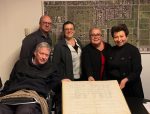
Left to right are Sam Sullivan, Glen Hodges, Cynthia Ramsay, Margaret Sutherland and Shirley Barnett with one of the Mountain View Cemetery ledgers. (photo by Lynn Zanatta)

“When we were restoring the Jewish cemetery at Mountain View, we spent two years going through City of Vancouver material trying to determine if the city actually had something in writing to prove the legitimacy of this Jewish section since 1892,” Shirley Barnett, who led the Jewish cemetery restoration project, told the Jewish Independent in an email. The committee couldn’t find anything in the city records.

While this lack of documented history lengthened the restoration agreement process significantly, it did not halt it. Barnett, as chair, opened the first meeting of the restoration advisory committee on Feb. 13, 2013, and the Jewish cemetery at Mountain View was officially rededicated on May 3, 2015. However, if the committee were to have started its work today, the information it sought would have been found, and the process would have moved much more quickly.

Sam Sullivan, member of the Legislative Assembly (Vancouver-False Creek) and former mayor of Vancouver, founded the Global Civic Society in 2010. As part of its mission to encourage “a knowledgeable and cosmopolitan citizenry to make strong connections to their community,” the society leads several initiatives, including Transcribimus, “a network of volunteers that is transcribing early city council minutes and other handwritten documents from early Vancouver, and making them freely available to students, researchers and the general public.”

Transcribimus project coordinator Margaret Sutherland has transcribed at least 155 sets of Vancouver City Council minutes. It was she who found what Barnett and her committee were looking for – in the council minutes of June 6, 1892. On page 32 of the minute book, it is recorded that correspondence had been received, “From D. Goldberg asking the council to set aside a portion of the public cemetery for the Jewish congregation,” and was “Referred to the Board of Health.”

Two weeks later, the minutes of June 20, 1892, note that the health committee had resolved, among other items, “[t]hat the piece of land selected by the Jewish people in the public cemetery be set aside for their purposes.”

photo - In addition to the transcribed council minutes, transcribimus.ca includes photos of the minute book pages. This image is of the June 20, 1892, minutes, which note that the health committee had resolved, among other items, “[t]hat the piece of land selected by the Jewish people in the public cemetery be set aside for their purposes.”
In addition to the transcribed council minutes, transcribimus.ca includes photos of the minute book pages. This image is of the June 20, 1892, minutes, which note that the health committee had resolved, among other items, “[t]hat the piece of land selected by the Jewish people in the public cemetery be set aside for their purposes.”

The cemetery first appears to have come up a few years earlier. In the July 29, 1889, council minutes, there is reference to a letter: “From L. Davies on behalf of the Jewish congregation of the city of Vancouver requesting council to set apart about one acre and a half in the public cemetery for members of the Hebrew confession. Referred to the Board of Works.”

In an email to Barnett, Sutherland wrote, “There doesn’t seem to be any indication from city council minutes that the Board of Works ever followed up on the above request. Although [Jewish community member and then-mayor] David Oppenheimer was on the Board of Works for that year, so was his opponent, Samuel Brighouse.”

On Dec. 7, 2018, the Jewish Independent met with Barnett, Sullivan, Sutherland, Lynn Zanatta (Global Civic Policy Society program manager) and Glen Hodges (Mountain View Cemetery manager) at Mountain View. In documents she brought to that meeting, Sutherland explains that Oppenheimer “declined to serve as mayor again at the end of 1891, citing poor health as his reason for retiring. Fred Cope was elected mayor in 1892 and served till the end of 1893.” So it was Cope who was mayor when the Jewish cemetery was established; Oppenheimer was Vancouver’s second mayor (1888-1891) and Malcolm Maclean its first (1886-1887).

The first interment at Mountain View Cemetery was Caradoc Evans, who died at nine months, 24 days, on Feb. 26, 1887. The first Jew interred in the cemetery is thought to be Simon Hirschberg, who “died of his own hand” on Jan. 29, 1887, and was, according the plaque erected by the cemetery in 2011 (the cemetery’s 125th year), “intended to be the first interment,” however, “rain, a broken carriage wheel on a bad road and his large size all contributed to him being buried just outside the cemetery property,” where he was “long thought to have been left near the intersection of 33rd and Fraser” until his body was moved into a grave on cemetery property. Oddly enough, the first Jew to be buried in the Jewish section was Otto Bond (Dec. 19, 1892), who also took his own life.

scan - This page from a Mountain View Cemetery ledger shows the entry for Otto Bond, the first Jew to be buried in the cemetery’s Jewish section
This page from a Mountain View Cemetery ledger shows the entry for Otto Bond, the first Jew to be buried in the cemetery’s Jewish section.

So far, since its inception in 2012, Transcribimus has seen more than 300 transcripts produced by almost 40 volunteers, although a handful of them are responsible for the lion’s share to date. Many people have donated their time, technical advice and, of course, funds to the project. Barnett sponsored the transcribing of the city council minutes for 1891, and fellow Jewish community member Arnold Silber sponsored the transcription of the 1890 minutes. A few other years have also been sponsored, including 1888, by the Oppenheimer Group.

About nine years’ worth of minutes have been transcribed (1886-1893 and 1900), leaving much more work to be done, as the city kept handwritten minutes until mid-1911. After that, minutes were typewritten and these documents can be scanned and read with OCR (optical character recognition), said Sutherland.

The Transcribimus website (transcribimus.ca) is one of the best-designed sites the Independent has come across. It is both visually appealing and incredibly easy to use. In addition to the transcribed council minutes, it includes photos of the minute book pages. As well, it features letters from Vancouver’s early years, historical photographs and a few videos, including a film by William Harbeck of a trolley ride through Victoria and Vancouver in 1907, which has had speed corrections and sound added by YouTuber Guy Jones. (Astute viewers will see that the trolley is driving on the lefthand side of the road. British Columbia didn’t switch to the right until 1921-22.)

In the material Sutherland brought to the December meeting at the cemetery office, she included the transcription of the short letter that city clerk Thomas McGuigan wrote on June 23, 1892, in response to Goldberg’s letter that was mentioned in the council minutes. In it, McGuigan confirms “the grant made by council to the people of the Jewish faith of a piece of land in the public cemetery,” but adds that “they will be unable to give you title for the same, as the land was set apart by an Order in Council of the provincial government for burial purposes and they refuse to give any other title.”

Sutherland hadn’t come across Goldberg’s letter, that of Davies or any response to Davies. It’s likely that these letters have been lost or destroyed, but they might turn up in another file, she said.

However, Sutherland did find a brief letter to the editor of the Vancouver Daily World newspaper, dated Nov. 1, 1898, from L. Rubinowitz, which she emailed to the Independent. Rubinowitz wanted the application for the Jewish cemetery by “a certain number of Jews of this city” to be refused. In his view, “all the Hebrews of this city are not combined as one body” and “To avoid trouble between them and for the sake of peace, as one party will claim that they have the sole right to it, the other party will claim that they have the sole right to it, therefore, as it is now under the control of the city, we are well satisfied to let it remain so, as in my opinion the city will have no objections for us to make any improvements if necessary.”

The old joke comes to mind of the Jewish man who, when stranded on a deserted island by himself, builds two synagogues – the one he’ll attend and the one he won’t set foot in. Community cohesiveness is a heady task; always has been, and definitely not just for the Jewish community.

As more council minutes, letters, photographs and other documents are found, transcribed and shared, the holes in our understanding of the past and how it has formed the present will be filled. To support or participate in Transcribimus or other Global Civic Society projects, visit globalcivic.org.

Format ImagePosted on January 18, 2019January 16, 2019Author Cynthia RamsayCategories LocalTags cemetery, Global Civic Society, history, Margaret Sutherland, Mountain View, Sam Sullivan, Shirley Barnett, Transcribimus, Vancouver
Sharing their stories

Sharing their stories

Makeda Zook, left, and Sadie Epstein-Fine, editors of Spawning Generations. (photo from Demeter Press)

Sadie Epstein-Fine and Makeda Zook will be in Vancouver for the Jan. 17 launch of Spawning Generations: Rants and Reflections on Growing Up with LGBTQ+ Parents (Demeter Press, 2018), which they co-edited.

“It is really important to us that this book was written and edited by queerspawn. So often our stories are told for and on behalf of us by researchers, journalists and academics,” Epstein-Fine told the Independent. “Our intimate, personal family lives have been under the microscope for our entire lives, proving to the world that we turned out all right. By curating stories from our community, including our own stories, Makeda and I ensured that we were not, as we like to call it, airbrushing our stories, but that we were allowing our contributors to tell the nitty gritty, the details of their stories that they have never been able to tell.”

In the book’s introduction, Epstein-Fine and Zook explain that the term queerspawn to describe someone who has one or more LGBTQ+ parents was coined by Stefan Lynch, the first director of COLAGE, an American “network dedicated to connecting and supporting queerspawn,” which has one chapter in Canada (in Toronto).

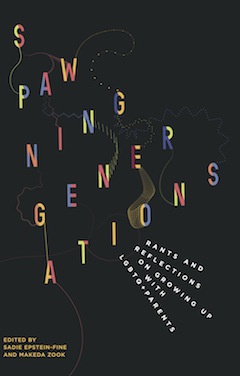
book cover - Spawning Generations

“By giving a name to our identities and experiences, he laid the foundation for connecting and politicizing queerspawn; Lynch gave us a term to organize around,” they write, acknowledging that the term “is not without controversy. Although some people feel empowered by reclaiming both words (‘queer’ and ‘spawn’), others do not like the association with ‘spawn of the devil.’” Another term, “gayby,” also has its proponents and its critics, those who “find it infantilizing and only representative of people whose parents identify as gay,” note Epstein-Fine and Zook.

Ultimately, the editors chose to use queerspawn for the anthology because it is “unapologetic and bold.” As well, it is “the word most often used in Canada and the United States and, as such, it helps us find each other; it is a common word we can rally around. We often feel highly visible in straight communities and invisible in queer ones. The term ‘queerspawn’ creates a space for us, and helps us to feel strength in numbers and a sense of belonging at times when we feel all too visible. When we feel invisible, naming ourselves as queerspawn tells the queer community that we are still here, even if we have grown up.”

Epstein-Fine was born in Toronto in 1992 to two moms, in an activist home, “surrounded by 11 other women.” She carries on her family’s activist tradition and describes herself as a queer(spawn)-political theatre maker.

According to her bio, Zook “was born in Vancouver in 1986 to her two lesbian feminist moms. She was raised in a mixed-race family surrounded by anti-oppression politics and her OWLs (older, wiser lesbians).” She works in sexual health promotion for a feminist nongovernmental organization.

Epstein-Fine shared with the Independent how she and Zook came to be the editors of Spawning Generations.

“Demeter Press approached Makeda and I to edit the anthology because they saw a gap in their literature,” she explained. “They mostly publish books about motherhood, through a feminist lens, and they realized that, while they had a lot of literature about queer parenthood, they didn’t have anything from the children. This is a trend in the majority of queer parenting literature – we hear a lot from the parents, but rarely from the kids raised in queer households.

“Yes, it’s true, Makeda’s and my primary focus is not editing. Previous to editing this anthology we were both writers, which is how we got connected to this book. Our (queerspawn) community is small and disparate, there is not a plethora of options available. When Demeter first approached me with this project, I tried to think of folks who could do this project, and there was no obvious answer.

“Makeda and I learned to be editors in trial by fire,” she admitted. “We always say that we didn’t just grow alongside this project, but that this project grew us. After three years of working on this project, we now feel confident in our editing skills, which we didn’t feel previously.”

And the pair has done a commendable job in keeping the essays on point. The editing is such that each contributor maintains their own voice, which adds to the book’s readability and interest. Contributors range in age, from 9 years old, to teenagers, to 20-somethings and older queerspawn. And the writers come from all over the world, from as far away as London, England, and as close as Victoria; one was born in Vancouver but seems not to live here anymore. While all the contributors have being the child of one or more LGBTQ+ parents in common and have shared some similar experiences, each story is unique.

“There was a call for writers, which we spread as far as we could,” Epstein-Fine explained about how the essays for the anthology were chosen. She said they asked COLAGE and several organizations and people they know in Canada to publicize the call, which went out in the winter of 2015, with a due date of May 1 that year.

“We received 25 submissions and we took every single one,” she said. “We thought that each person had an interesting story to tell and we were committed to helping them tell their story the way they wanted it to be told. We initially thought that we wanted to be more selective and, if we had received more submissions, we would have been forced to be. However, the wonderful result of us taking everyone is that our book is not just filled with works from professional writers, but we have contributors with a range of experiences – from people who have never written a personal essay to professional writers. It gives a real scope of our community.”

The Spawning Generations book launch takes place Jan. 17, 7 p.m., at Massy Books, 229 East Georgia St., in Vancouver. For more information, visit facebook.com/spawninggenerations.

Format ImagePosted on January 11, 2019January 9, 2019Author Cynthia RamsayCategories BooksTags identity, LGBTQ, memoir, queerspawn
A royal panto at Metro

A royal panto at Metro

Katherine Matlashewski plays Mopsy in Metro Theatre’s musical panto King Arthur’s Court. (photo by Tracy-Lynn Chernaske)

While Katherine Matlashewski has numerous acting, singing and choreographing credits on her resumé, the musical panto King Arthur’s Court, which opens tonight (Dec. 14) at Metro Theatre, will be her first pantomime.

“Unlike a traditional play, there is a lot of improv and audience participation,” she explained about a panto. “This can be a challenge because, as an actor, you never know what is going to happen.”

But it’s also part of the fun. “In any show,” she said, “everyone brings something unique to the table. In this wonderful cast [of 28], there is such a wide range in age and skill level.”

In contrast, King Arthur’s Court marks fellow Jewish community member Heather Webster’s third panto. Webster has been stage-managing at Metro for about five years now, but her connection to Metro – and pantos – goes further back.

“My first theatre experience came from my grandmother, Shirley Rose,” Webster told the Independent. “She took me to the Metro Theatre when I was 12 for my first panto. From there, I got into working backstage and learning stage craft in high school at Kitsilano from Julie Bond. In Grade 11, I began volunteering at the Metro Theatre, and have been ever since.”

Webster, who used to work as an on-call tech for the Rothstein Theatre at the Jewish Community Centre of Greater Vancouver, does stage-managing in her off-time. Her full-time job is with Purolator.

Matlashewski teaches at Arts Umbrella. “I love having the opportunity to share my love of visual and performing arts,” she said. “I believe it is so important for kids to have a creative outlet as part of their education.”

In addition, Matlashewski owns a small business, Sweetheart’s Baking, which can be found on Instagram and Facebook. “Like theatre,” she said, “my passion for baking started at a young age. This keeps me extremely busy when I am not in a show.”

At age 2, her mother enrolled her in her first dance class at Arts Umbrella. “In the years to follow,” Matlashewski said, “I continued my training in dance while also exploring theatre and visual arts. My love of musical theatre began at a very young age. Since then, I have not looked back. I feel extremely blessed to have had multiple opportunities to train with so many professionals in the industry. I am grateful to have taken part in programs such as the Arts Club’s Musical Theatre Intensive and the Pre-Professional Musical Theatre Troupe at Arts Umbrella.”

Among Matlashewski’s teachers and colleagues in the Jewish community have been Erika Babins, Perry Ehrlich and Wendy Bross Stuart, to name only a few.

“As a result,” said Matlashewski, who comes from a small family, “I have had many wonderful opportunities to connect with others in the community, create a positive support network, and learn more about my culture. I feel so blessed to be a part of such a warm and welcoming community.”

Matlashewski has also worked with the director of King Arthur’s Court before.

“Last year,” she said, “I worked with Chris Adams (our director) on RCMT’s [Royal City Musical Theatre’s] concert production of Into the Woods. He encouraged me to take part in this production.”

Adams was most recently featured in the Independentfor directing and co-producing Sweeney Todd: The Demon Barber of FleetStreet (jewishindependent.ca/experience-sweeneys-revenge). While this isMatlashewski’s first show with Metro, this will be Adams’ seventh show andthird panto with the theatre.

“I remember sitting in the audience, as a little kid, booing the demon and cheering the good fairy and then rushing to the stage after the show, just to get autographs from the cast,” he recalls on Metro’s website. “From that childhood time,” he says, “panto has kept a warm place in my heart.”

King Arthur’s Court will feature a demon and a fairy, too, along with a dragon and, of course, Arthur and the Knights of the Round Table. Chivalry and chicanery will run aplenty, and the audience will be encouraged to cheer and jeer.

Matlashewski plays Mopsy, the court jester. “My role requires me to do lots of singing, dancing and goofing around onstage,” she said. “I also talk directly to the audience at certain times.”

And, behind the scenes, Webster will be managing the chaos. For her, she said, “The best part is when I get to hear the kids talk to the actors during the meet-and-greets, and hearing their favourite parts of the show.”

For more information about and tickets to KingArthur’s Court, visit metrotheatre.com/currentshow. It runs until Jan. 5.

Format ImagePosted on December 14, 2018December 12, 2018Author Cynthia RamsayCategories Performing ArtsTags Metro, musical theatre, panto
Legendary pianist to perform

Legendary pianist to perform

Yefim Bronfman performs Johannes Brahms’s Piano Concerto No. 2 with the Vancouver Symphony Orchestra at the Orpheum Dec. 6 and 8. (photo from VSO)

“I don’t think it can be overstated, the significance of having an artist like Yefim Bronfman, like Yitzhak Perlman, who’s coming later in the season, as well. These are living legends in our field,” said Misha Aster, vice-president, artistic planning and production, at the Vancouver Symphony Orchestra, in a phone interview with the Independent.

“It’s a testament to the city and to the orchestra that artists of this stature take the time to visit with us,” he said. “But it’s also an occasion for us to celebrate their presence here because it’s unusual – it’s a rare opportunity to hear artists of this calibre and of this experience perform works that are landmarks of the repertoire.”

On Dec. 6 and 8 at the Orpheum, Bronfman and the orchestra will perform Johannes Brahms’s Piano Concerto No. 2. The concert also features Richard Strauss’s Don Juan and Franz Liszt’s Les preludes.

Initial discussions for the December performances took place about two-and-a-half years ago. That’s a long time, said Aster, “but, for an artist of his calibre, that’s generally what’s required to get a date fixed in his calendar.”

While Bronfman is in tremendous demand, Aster said, “He loves Vancouver, which helps. Every visit he has made here in the past, he has reiterated his affection for the city, and for the orchestra.”

The upcoming concerts are not just a musical highlight of the VSO season, said Aster, “but one of the flagship statements of our season.”

He added, “The program he’s coming with, as well – the Brahms Piano Concerto No. 2 – is considered one of the Everests of the repertoire. It’s not frequently performed. It’s a very large piece, a very demanding piece for the soloist and for the orchestra, as well; it has a major solo cello part.”

The choice of music for a program with a visiting artist is “a discussion,” said Aster. “It’s a dynamic process between soloist, conductor and orchestra. There’s a need for balance between those elements.”

Bronfman has performed the Brahms before. “The combination [of Bronfman] together with Jun Märkl, who is a much-beloved conductor here with the orchestra, made Brahms a possibility,” Aster said.

The other compositions in the December program – Strauss’s Don Juan and Liszt’s Les preludes – will be played by the orchestra on its own. “They all fit within a certain genre,” noted Aster of the works. “It’s not coincidental programming, by any means.”

Brahms and Liszt were contemporaries, he explained, “but at opposite poles of the spectrum when it came to musical development of the later 19th century and the debate over what was considered ‘program music,’ that was music meant to tell a story, that was reflective of a certain kind of dramatic narrative, as opposed to purely abstract music or symphonic music that had its roots in the more classical esthetic.”

The latter was Brahms’ approach, said Aster, whereas Liszt was a champion of “this new kind of programmatic approach to music.” And Strauss “was considered an heir to Liszt with respect to that, so both of those tone poems – Les preludes and Don Juan – are narrative works of program music, and they’re juxtaposed with this massive concerto by Brahms, which is Brahms’ reiteration of his musical principles.”

photo - Misha Aster is vice-president, artistic planning and production, at the Vancouver Symphony Orchestra
Misha Aster is vice-president, artistic planning and production, at the Vancouver Symphony Orchestra. (photo from VSO)

Aster arrived in Vancouver for his position at the VSO in mid-August. Born in Hamilton, Ont., he had been in Berlin almost 13 years. Prior to that, he was in Austria for a couple of years.

Aster trained as a violinist at the Royal Conservatory of Music in Toronto, and studied political science, history and dramaturgy at McGill University, the London School of Economics and Harvard University. In his career, he’s been based in Europe largely, but he has always kept in touch with Canada, he said, as his grandmother is in Toronto and his parents divide their time between Ontario and a base in Europe. Aster’s wife, Kinneret Sieradzki, is Israeli and the couple has a 2-year-old daughter, Laila.

In Germany, Aster was working as an executive producer at Deutsche Grammophon, the recording label Universal Music, and he maintains a role at the Gustavo Dudamel Foundation, where he was director of programs. His move to Vancouver marks the first time he has lived in Canada since he was a teenager.

“It’s a major orchestra in this country,” Aster said about what attracted him to the job with the VSO. “It’s a very important cultural player, certainly in Western Canada, and I remember, even growing up in Toronto, having a sense that important things were happening in musical life in Vancouver and that the VSO was a formidable force in Canadian music.”

Recently, the whole organization has undergone a significant transition, with longtime musical director Bramwell Tovey retiring. “It was the ending of an era and the beginning of something new,” said Aster. “I hadn’t met Otto Tausk, the new music director, before we began the process of discussing the possibility of my joining the team here but I was immediately impressed by him, by the integrity of his musicianship, by his vision for the orchestra.”

Aster also had a sense, he said, of Tausk “being very European in outlook, in disposition, in artistic values, in his connections and contacts.” This was a world with which Aster had been familiar for a long time, so he felt that “it would be an interesting opportunity” and that he “could be a helpful fit in that sense,” of being originally from Canada and having roots here, “but also, in a professional sense, of being very familiar with the environment from which Maestro Tausk comes. That chemistry was really the key.” Adding to that was the organization’s “ambition with respect to an artistic agenda but also what the orchestra intends to mean for the community.”

The VSO is “an incredibly busy organization,” said Aster. “We produce 150 concerts a year, which is a lot, in relative terms, compared to many other orchestras in the country. And it has to do with the fact that the orchestra has always had the mandate to address itself to a range of different communities and a range of different musical tastes in the city. Unlike many other major orchestras in the country, we perform in 15 different venues around Greater Vancouver through the season in various configurations, based out of our home in the Orpheum, where we have our major subscription series.”

Part of Aster’s job is to ensure that it’s “not just a functional run-out that we do to North Van or to Surrey with a program, but that what we’re trying to program for those communities and for venues in those communities reflects a point of access for them into the world of music that we represent.”

Tickets for Bronfman’s performance at the Orpheum range from $16.25 to $125 and can be purchased from vancouversymphony.ca.

Format ImagePosted on November 30, 2018November 28, 2018Author Cynthia RamsayCategories MusicTags Brahms, Misha Aster, piano, Vancouver Symphony Orchestra, VSO, Yefim Bronfman

Posts pagination

Previous page Page 1 … Page 50 Page 51 Page 52 … Page 84 Next page
Proudly powered by WordPress