Skip to content
  • Home
  • Subscribe / donate
  • Events calendar
  • News
    • Local
    • National
    • Israel
    • World
    • עניין בחדשות
      A roundup of news in Canada and further afield, in Hebrew.
  • Opinion
    • From the JI
    • Op-Ed
  • Arts & Culture
    • Performing Arts
    • Music
    • Books
    • Visual Arts
    • TV & Film
  • Life
    • Celebrating the Holidays
    • Travel
    • The Daily Snooze
      Cartoons by Jacob Samuel
    • Mystery Photo
      Help the JI and JMABC fill in the gaps in our archives.
  • Community Links
    • Organizations, Etc.
    • Other News Sources & Blogs
    • Business Directory
  • FAQ
  • JI Chai Celebration
  • JI@88! video

Recent Posts

  • Story of Israel’s north
  • Sheltering in train stations
  • Teach critical thinking
  • Learning to bridge divides
  • Supporting Iranian community
  • Art dismantles systems
  • Beth Tikvah celebrates 50th
  • What is Jewish music?
  • Celebrate joy of music
  • Women share experiences 
  • Raising funds for Survivors
  • Call for digital literacy
  • The hidden hand of hate
  • Tarot as spiritual ritual
  • Students create fancy meal
  • Encouraging young voices
  • Rose’s Angels delivers
  • Living life to its fullest
  • Drawing on his roots
  • Panama City welcoming
  • Pesach cleaning
  • On the wings of griffon vultures
  • Vast recipe & story collection
  • A word, please …
  • מארק קרני לא ממתין לטראמפ
  • On war and antisemitism
  • Jews shine in Canucks colours
  • Moment of opportunity
  • Shooting response
  • BC budget fails seniors
  • Ritual is what makes life holy
  • Dogs help war veterans live again
  • Remain vital and outspoken
  • An urgent play to see
  • Pop-up exhibit popular
  • An invite to join JWest

Archives

Follow @JewishIndie
image - The CJN - Visit Us Banner - 300x600 - 101625

Byline: Cynthia Ramsay

JNF gala features comic Gold

JNF gala features comic Gold

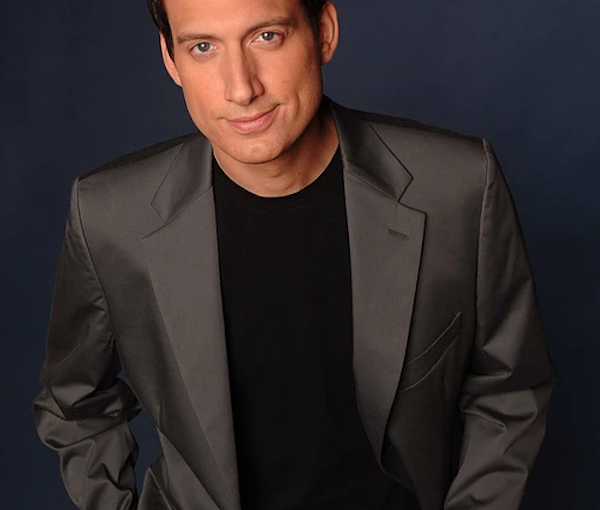
Elon Gold performs in Vancouver on April 14 at the JNF Negev Gala. (photo from elongold.com)

Comedian Elon Gold loves doing charity events, especially Jewish ones. The Independent caught him for a phone interview as he was on the road – with his family – to Las Vegas from Los Angeles to do gigs for the Adelson Education Campus and then the Israeli-American Coalition. On April 14, he will be in Vancouver to co-headline, with Ambassador Ron Prosor, the Jewish National Fund, Pacific Region, Negev Gala. The event raises funds for Sderot Animal-Assisted Therapy Centre.

“I feel like I’m doing a mitzvah by making my people laugh. And I’m also helping this cause that’s really important, and Israel is really important to me,” said Gold. “And we’re living in a highly antisemitic time, it’s dark out there, so anything I can do to bring light into our world and make my fellow Jew happy, I’m there for it.”

Gold’s resumé is impressive. He starred in the television series Stacked and In-Laws, had a recurring role on Bones and on The Dana Carvey Show. He guest starred just recently on HBO’s Crashing and, longer ago, on shows including Frasier and The Mentalist. He has appeared in films, his one-hour Netflix special, Elon Gold: Chosen and Taken, is available on Amazon and his show Elon Gold: Pro-Semite premièred at the Montreal Comedy Festival. He has made multiple appearances on The Tonight Show and his July 2018 segment on The Late Late Show With James Corden – how, like everyone else, Jews love sex, money and food, but just in a different order – has been watched and shared by countless people on the internet, as has his routine on why Jews shouldn’t have Christmas trees and so many others.

Despite all of his accomplishments and his years in the business, Gold still gets excited about his work, and he shared what he described as a “wow” moment, one of the best days of his life, almost immediately when talking with the JI.

“Yesterday,” he said, “I was filming a scene of Curb Your Enthusiasm with Larry David…. It was really, truly a dream come true.”

But Gold didn’t take his being hired by David as a sign that he had “made it.”

“The truth is, I have been a guy with lucky breaks and hard breaks for the last 20 years,” said Gold. “This is another achievement, and one that’s beyond anything I would dream of…. I’m gratified in the sense that I finally feel like I’m in a place, not where I’ve made it, but where I actually have fans, and my clips are viral and people are sharing my bits on Facebook, WhatsApp or whatever. I did the James Corden show and, again, that doesn’t mean I’ve arrived … but what’s cool to me is that I did that set and then everyone’s sharing it, especially Jews. My biggest fans are my people.”

It’s been a 25-year journey, said Gold of his career, “with all sorts of great highs, like yesterday, and huge lows, like having a sitcom that you pitched and created and started get canceled. There are so many lows, and then there is the daily rejection that is show business. And that’s why I’m so glad I’m a comedian and an actor. I get rejected all day in Hollywood at auditions, but then, at night, I’ll go to the Laugh Factory comedy club and I’ll have 300 people roaring, and that will validate [me] – I knew they were wrong! I knew I could do this. See, I’m funny. These people think so, at least.”

Gold said his resilience, his ability to keep trying, likely comes from stand-up. “Because stand-up is all about bombing and killing, and the killing is so worth it that even the terrible, dejected feeling of bombing [is manageable].”

As far as his career, he said, “I have no other choice. I don’t love doing anything else and I’m not good at anything else.”

Known for his impressions, he said, “I used to impersonate my teachers in eighth grade.” His goal wasn’t to ridicule people, he said, but to make even the teachers laugh.

He enjoyed making people laugh, and writing comedy. One of the first things he wrote, he said, was a Purim shpiel. “And I’ll never forget the feeling of having the entire high school laughing, and thinking, there has never been anything more gratifying than what I just did, I want to do this more. Everybody says it’s like a drug…. It’s so addictive. Once you get a taste of it, that’s it, you’re hooked. And very little can discourage a comedian [so much that they get] out of comedy; certainly not a bad set, because we all know that we all have them.”

A combination of things drives him.

“It’s probably disingenuous to say that I do this because I love to make others laugh,” he admitted. There is a selfish aspect to it, he said. While making people happy is a “key component” of why he does comedy, he said, “I also love everything about it… I love the process of having an observation and then writing it and tinkering with it and working on it. I love doing it and I love the fact that I have so much freedom in my days because I don’t have that nine-to-five job most people have…. I’m always working. At the same time, I’m always on vacation.”

Gold loves getting the laughs, and said that’s probably 70% of the reason he does comedy; the other 30% is making people happy.

“There is so much misery in the world,” he said, “to make people happy is a great thing, but it’s only a part of it.”

On the acting side, Gold said his favourite kind of acting is for sitcoms “with a live studio audience because you’re still getting the laugh but now you’re not looking at the audience and talking to them, you’re looking at your fellow actor … and, peripherally, you hear and see these people cracking up.”

Ultimately, he said, “I just love performing.”

The only “grueling part,” he said, is the memorizing “and the pressure of 200 people staring at you, saying, ‘You better know your lines, pal, because we’re all here and we all want to go home…. Acting is challenging, but it’s also just fun…. It’s fun to get into a character and just play.”

Gold, who is from the Bronx originally, recalled his first open-mic night at the Comic Strip Live in Manhattan; he was 16 years old. “Fortunately, I had beginner’s luck because I was doing impressions – my early act was all impressions – and impressions are like magic tricks, they just wow the audience.”

Despite being a touring comedian by university (he got a bachelor’s in economics at Boston U), it took years, he said, to develop his own voice, to figure out what he wanted to talk about and how to talk about it.

“I’m obsessed with Jewish stuff because I live such a Jewish life,” he said. “I’m an observant Jew, I keep Shabbos and all that stuff, keep kosher. So much of my life is in the Jewish world, I can’t help myself but to come up with observations about our traditions, our holidays, our rituals. A lot of what I talk about is what I live…. The other part of my life is being married, being a dad, so I talk about that.”

Gold and his wife, Sasha, have four kids, two sons and two daughters, ranging in age from 9 to 18. The couple is coming up to their 25th anniversary in June.

As he stopped to fill up his car with gas on the way to Vegas, he told the JI about why he likes performing at Jewish events, while simultaneously directing his kids to be quick about heading into the gas station, as they were running late.

“There are not a lot of comedians out there that will go that deep into the Jewish experience and, for me, there are not a lot of audiences I can share my Jewish experiences with,” he said. “I can’t do lulav and etrog jokes on James Corden…. At the same time, we’re raising money, we’re raising awareness for incredible organizations…. It’s all win-win for me – I’m raising money, I’m making money, I’m getting laughs, I’m getting to do material I don’t do anywhere else…. And I love Jewish audiences; I love connecting on more than just a human level…. We’re connecting about a shared experience that is almost indescribable to anyone else.”

For tickets to the JNF Pacific Region evening event on April 14, which will be held at Schara Tzedeck, call 604-257-5155.

Format ImagePosted on March 22, 2019March 20, 2019Author Cynthia RamsayCategories Performing ArtsTags animals, comedy, Elon Gold, fundraising, Israel, Jewish National Fund, JNF, Negev Gala, philanthropy, Sderot, tikkun olam
Grab a ferry, head to Buzzy’s

Grab a ferry, head to Buzzy’s

The Hungry Jew, one of the signature sandwiches at Buzzy’s Luncheonette. (photo by Adam Bogoch)

My friend, Adam Bogoch, pitched it as the “Smoked Meat Story.” Soon after that email, he would write his own review, for narcity.com, titled, “This smoked meat sandwich on Salt Spring Island in B.C. will actually change your life.” His friend and colleague, Howard Busgang, had opened a deli on the island, and not only did I need to meet Busgang, but I needed to get on a ferry and taste The Hungry Jew, one of the signature sandwiches at Buzzy’s Luncheonette.

Between the Independent’s annual summer publishing hiatus and the High Holidays, it was November before Adam and I headed to Salt Spring. The travel ran like clockwork and we were pulling up to 122-149 Fulford Ganges Rd. right in time for lunch. We shared a Hungry Jew – a Montreal smoked meat sandwich with homemade horseradish sauce, coleslaw and, I kid you not, two latkes – and the Rabinowitz, Buzzy’s take on a Reuben. They were both incredibly good, and the only reason I’ve waited this long to share the news is because I wanted to wait until better weather, when people would be more likely to take a day or weekend getaway.

photo - Howard Busgang serves customers rugelach on a sunny November afternoon
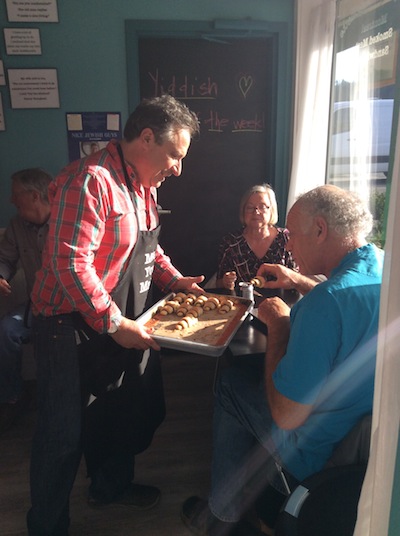
Howard Busgang serves customers rugelach on a sunny November afternoon. (photo by Cynthia Ramsay)

Even in winter, Buzzy’s was busy. Having arrived at prime feeding time, it was hard to get Busgang to sit down and, as we talked, he was constantly distracted – in a good way – by customers.

“Tell me, I’ll get you another sandwich before you go,” he said as he finally was able to join me at a table outside for the interview.

Born and raised in Montreal, stand-up comedy took Busgang first to Toronto and then to Los Angeles, where he met his wife, Melanie Weaver, and where he lived for 28 years, before returning to Canada.

“She’s Jewish-adjacent,” joked Busgang. “She was working for a rabbi when I met her.”

The two met on a blind date, he said, brought together by a Jewish comic who knew both of them.

When he started in comedy in the early 1980s, Busgang said, “There were not a lot of comics around. It wasn’t like today where every second person does stand-up, so it wasn’t that OK a profession,” as far as his parents were concerned. “It was kind of an oddity, like maybe he’ll grow out of this kind of thing.”

Busgang attended Jewish high school, then went to McGill University before heading to Toronto.

“You know where I started?” he said. “United Synagogue Youth, USY, that’s where I started. I was emceeing all their events and that led me to go professional.”

He recalled the first time he performed at amateur night in Toronto. “They packed the place with all these people from USY who knew me. It was packed, and it was great.”

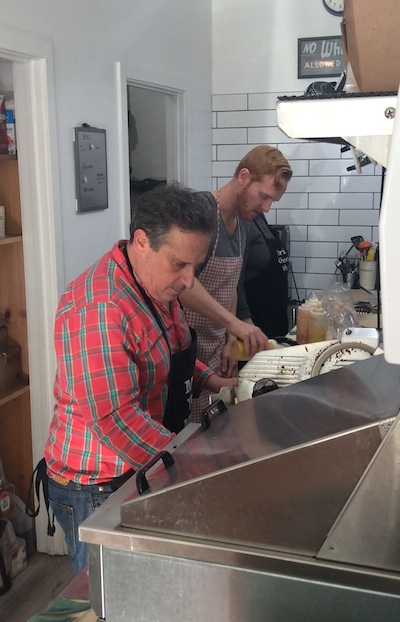
photo - Howard Busgang, left, and Adam Bogoch prepare sandwiches
Howard Busgang, left, and Adam Bogoch prepare sandwiches. (photo by Cynthia Ramsay)

So great, he said, that he was put into regular comedy shows right away, “which wasn’t so easy, by the way, because it wasn’t my friends anymore in the audience.”

When he was a stand-up comedian, Busgang did a lot of Jewish material. “I was a very Jewish comic,” he said.

In Los Angeles, he moved from stand-up to comedy writing. “I just was a little tired of the road,” he said, and performing caused him some anxiety.

“Listen, I had a respectable career, I did well, but I would constantly punish myself by asking, why am I doing this? But I think I do that with everything. I do that with this place [Buzzy’s], I do that as a writer.”

As Busgang was in the middle of saying he might just be a miserable guy, he was called back into the deli to help make a sandwich.

Weaver took his place. Her recollection was that a woman from the synagogue set up that first date.

“I was the only non-Jew in the whole place,” she said. However, Weaver was raised Jewishly, with her family observing some of the holidays, hosting seders, for example, and she taught at a Jewish camp. Born and raised in New York, she moved to Los Angeles some 30 years ago. She and Busgang have been married for about half that time.

“Howard had this property on Salt Spring our entire marriage,” she said. “And so, our entire marriage, I kept hearing ‘Salt Spring,’ ‘Salt Spring,’ and all I kept seeing was this property tax bill every month. I was, like, how good could it be? Then the elections and everything started to happen in the U.S. and it just got bad. We took a trip up here in September [2016], I fell in love and then we came in July [2017].”

A blended family, the couple has three daughters: Alexandra, 30, in Toronto; Emma, 20, in Seattle; and Hannah, 10, who was dividing her attention between helping in the deli and playing with a local dog while her mother was being interviewed.

Neither Busgang nor Weaver had any restaurant experience before opening Buzzy’s. “It’s funny,” she said. “The night before we were open, we had to learn the cash and I was almost in tears.”

The ignorance was a kind of blessing, she said. “I don’t think we knew what could go wrong, so ignorance was bliss, in this case.”

Their first day, there were lineups out the door.

“We got thrown into it, which was great,” she said. “I think if we had opened in the winter, when it was slow, it would have been a different experience.”

Busgang’s love of cooking seemed to have come out of nowhere, said Weaver. “And then he started to smoke his own meat. So, we had that in our back pocket.”

But the couple still wasn’t planning on opening a restaurant, until the location became available. “It was basherte,” she said.

In addition to Busgang’s meat-smoking skills, Weaver’s desire for a good tuna sandwich was a motivation. “So, again, why not open a deli? Not the brightest of ideas, but it worked out.”

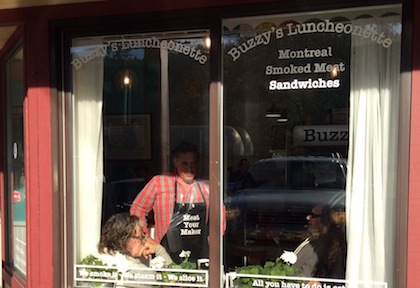
photo - Howard Busgang’s father called him Buzzy, hence the deli’s name
Howard Busgang’s father called him Buzzy, hence the deli’s name. (photo by Cynthia Ramsay)

And it’s hard work. There is only one staff member. Busgang smokes meat “around the clock,” said Weaver. “It’s like having a newborn. It’s a lot of work but the rewards – it’s a community, we’ve become part of a community and it means so much. My daughter gets to work the cash register. It’s crazy. We still can’t believe we have keys to this place.”

She said, “If we did anything right, it’s that we didn’t focus on the tourists, we focused on our people, and so we have a lot of loyalty here. I think people also come here [because] there’s a lot of cursing, a lot of bad behaviour, you can come here and just laugh, and that’s what we want. Come here, have a laugh, I’ll make you eat, you have to finish your plate or you go to your room. That was our business plan – make the community happy, hopefully make a few bucks.”

Since they opened, the menu has seen some additions; in particular, matzah ball soup and tomato soup. “We don’t want to get too big. We just want to stay like someone’s kitchen,” she said.

And the island has been very welcoming. “Someone knew that we want to make our own pickles, so they’re going to grow us cucumbers,” said Weaver as one example. “The love here,” she said, “it’s insane.”

Hannah, who had checked in a couple of times with her mother, joined the interview. In addition to sometimes working the cash, she delivers food to the Saturday market and to the bar a few doors down from the deli.

“That’s another thing,” said Weaver, “it’s a family joint.”

School runs four days a week and, while Hannah enjoys helping out, she was still getting used to living on the island. When she’s not working or at school, she’s probably at soccer or horseback riding; she had just received a paddleboard for her birthday. Though she has a couple of sandwiches named after her, her favourite is the grilled cheese.

“A lot of what we’re doing here has to do with taking the power back in our lives,” said Busgang, when he returned to the table. “It has to do with being in showbiz all those years and feeling like you had no control over anything and feeling like you’re handing over all the power to other people to validate you…. I was tired of it.”

Buzzy’s opened on June 22 last year. “Whereas, in show business, nobody wants to help you, in this business, I have so many people who want to help me.”

One of those people was William Kaminski, owner of Phat Deli in Vancouver, who Busgang described as a mentor.

“We’re not perfect but we’re figuring it out,” said Busgang.

The smoked meat he has got down to a science.

“We’re open till four o’clock and then I have to get my brisket ready for the next day, so I have to bathe the brisket,” he said. “We cure it for eight days – dry cure – and then I have to take the salt out, so we bathe it. I’m bathing a brisket right now and sometimes I sing to it. It’s very sweet. After I bathe it, then I put some rub on it and then I’ll take it home and we’ll smoke it for seven-and-a-half hours. And then it goes in the steamer for two, three hours.”

Finding rye bread was one of the early challenges.

“I knew I was in a special place,” he said, “because people would come by with bread and say, ‘Try this bread.’ They’d constantly come in and say, ‘What are you going to do about the bread?’ It became like a cause célèbre, the bread. It took me three months, and I got someone here on the island to make me an organic rye bread.”

Barb Slater makes the bread; Shigusa Saito, the knishes. Saito is now also “making a dark chocolate babka to die for,” wrote Busgang in a follow-up email. “If you’re not already dead, she’s also making us New York cheesecake, our soon-to-be-famous potato knishes, and rugelach.”

Meanwhile, Busgang – whose credits include having been a head Just for Laughs-gala writer, creating the award-winning sitcom The Tournament and writing for TV series Boy Meets World and Good Advice, among many others – is still writing, still pitching shows. Earlier that afternoon, he was slicing meat while plugged into his phone, listening to a meeting in which a producer was trying to put a deal together.

Weaver popped out to say that Busgang often has to go next door to finish his calls because the meat in the charger of his cellphone prevents his phone from charging. “There’s meat everywhere,” she said.

photo - The November sunset as seen from the ferry, en route home
The November sunset as seen from the ferry, en route home. (photo by Cynthia Ramsay)

A couple of relatively new customers stopped to say hello to Busgang and Weaver. They said they were slowly adding Buzzy’s to their list of usual places to eat.

And, said Busgang and Weaver, local Jews have discovered, by going to Buzzy’s and meeting fellow Jews, that there actually is a Jewish community on the island.

“We’re blessed to have this,” said Busgang.

As he explained the deli’s name – his father called him Buzzy – Hannah returned, offering him a taste of a new salad dressing she had created. “Daddy, just try it.”

“Interesting,” he said, “I like it.”

“It’s gross,” she corrected him.

Three generations seemed present in that moment.

As the interview came to an end, Busgang asked, “Do you want some rugelach? I gotta keep feeding you.”

Buzzy’s is open Monday to Saturday, 11 a.m.-4 p.m. Find them at facebook.com/buzzysluncheonette and then head to bcferries.com and start planning your trip.

Format ImagePosted on March 22, 2019March 24, 2019Author Cynthia RamsayCategories TravelTags Buzzy's, deli, entrepreneur, food, Howard Busgang, Melanie Weaver, restaurant, Salt Spring Island, smoked meat
Using absurdity to illuminate

Using absurdity to illuminate

Left to right are GOLDRAUSCH actors Tebo Nzeku, Gray Clark, Karthik Kadam, Matthew Rhodes and Hannah Everett. (photo by Javier Sotres)

GOLDRAUSCH is described as “a comedy with music that journeys through film director Oskar’s efforts to make a film about the man who started the Gold Rush Fever of 1848: the ‘Emperor of California.’ Mixed with classic country and Mexican banda songs, GOLDRAUSCH is the story of rampant jealousy, greed and ambition run amok, as dueling actors fight for their close-ups in Oskar’s magnum opus.”

The University of British Columbia’s theatre and film department presents GOLDRAUSCH at Frederic Wood Theatre March 14-30.

“GOLDRAUSCH follows the story of director Oskar, creating a film on Johann Augustus Sutter, based on the book Gold by Blaise Cendrars,” explained Hannah Everett, who plays the role of Marlene in the UBC production. “Sutter was a German-born colonizer who came to America, set up a farm for himself and became rich – until the gold rush of the 1850s, which destroyed the land he had taken.

“The playwright, Guillermo Calderón, is commenting on how Blaise Cendrar’s Gold is an exaggerated and fictionalized version of Sutter’s life that glosses over his problematic character, and the history surrounding the land and people during this time,” she said. “The play begins months into the shoot when Oskar realizes his film has become boring, and lacking ‘soul.’ He decides to bring in two new actors and shoot a porn scene, much to the other actors’ surprise.”

Marlene is one of the new actors.

“Marlene has been hired by Oskar to perform a porn scene and body double the leading lady, Greta, on set,” said Everett. “Marlene represents Oskar’s ‘fresh start’ to the film, in order to make it more interesting. Throughout the play, we learn she contracted hepatitis from the porn industry and is incredibly poor. She needs this job to make money and survive, which sends Greta into a panic as she learns Marlene is her replacement.”

Appropriately for a play about a film, GOLDRAUSCH is a multimedia work.

“GOLDRAUSCH features real cameras and sound equipment that will project film scenes onto the stage,” said Everett. “We are calling it a ‘meta-theatrical comedy with music’ and, in a way that is somewhat Brechtian, the play often breaks into song and dance, with karaoke tracks projected onto screens. In a final scene, where Oskar and the four actors interview about their film, it becomes clear that these songs are included in the film soundtrack. The multimedia layers to this piece create an effect that continues to take the audiences out of these different worlds of the past and the present, and remind them that they are watching a performance – and that not everything is always as it seems.”

Calderón, a Chilean playwright, wrote GOLDRAUSCH in 2017, “in a continuing time of political upheaval and uncertainty, particularly in United States,” said Everett. “Johannes Augustus Sutter came to America in the 1800s, stole land and enslaved indigenous peoples. His story, Calderón highlights, is unfortunately still incredibly relevant.

“Calderón asks us to think about land ownership, freedom and immigration. He shows us how history repeats itself,” she said. “The play satirizes Cendrar’s book, Gold, demonstrating how we become numb and alienate ourselves from people and politics that attempt to take away basic human rights. This is seen in Oskar’s film, and the ego and greed between the four actors, all struggling for the spotlight…. Calderón has decided to illuminate these issues in a way that is absurd and entertaining, as a way to get audiences to think more actively than perhaps watching or reading a news story.”

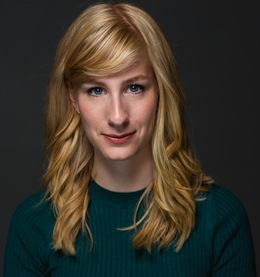
photo - Hannah Everett plays the role of the model, Marlene, in UBC Theatre’s production of GOLDRAUSCH
Hannah Everett plays the role of the model, Marlene, in UBC Theatre’s production of GOLDRAUSCH. (photo from UBC)

Born in White Rock, Everett grew up in Tsawwassen. She got into acting through various avenues, including Gateway Theatre and high school productions. During a three-year internship with the Riotous Youth program at Bard on the Beach, she helped create A Shakesperience and Shakespeare Unhinged. She also participated in the InTune Young Company Intensive with Touchstone Theatre and with the Stratford Theatre Performance Intensive.

In the course of her university studies, Everett has performed in many theatre and some film productions at UBC, as well as in other theatre productions. In her fourth and final year of UBC’s bachelor of fine arts acting program, Everett graduates in May.

“I’m hoping to get a film agent and, ideally, work in both film and theatre,” she said of what comes next. “I am keen to explore more devised performance, Shakespeare and the contemporary Canadian theatre scene. What I love about this line of work is that it scares me and challenges me to always keep learning, whatever the future may hold.”

Everett’s love of theatre came from her maternal grandmother, Irene N. Watts, who most recently has published Seeking Refuge (2016), a graphic novel, with Kathryn E. Shoemaker, which is a sequel to the graphic novel version of Goodbye Marianne. (See jewishindependent.ca/meet-award-winning-artists.)

“Her most well-known trilogy includes the novel (adapted from the play) Goodbye Marianne, which draws from her experience as a child Holocaust survivor, arriving in England via the Kindertransport from Germany,” said Everett of her grandmother. “In England, she became a teacher and worked in drama education before coming over to Canada in 1968, where she continued working in children’s theatre, acting and directing.

“Her love for theatre trickled down to me, and I was incredibly fortunate to be taken to numerous productions over the years, and given seemingly endless supplies of plays and books. Our shared passion has created such a cherished and close relationship and, as Judaism has had such a deep effect on her life and storytelling, I am always eager to share and learn her stories. Coming from both Jewish and non-Jewish heritage on my father’s side, I have learned to appreciate and be open to different views of the world, especially when it comes to making art.”

Tickets for GOLDRAUSCH – which contains adult themes and language – can be purchased from ubctheatretickets.com or 604-822-2678.

Format ImagePosted on March 8, 2019March 6, 2019Author Cynthia RamsayCategories Performing ArtsTags Blaise Cendrars, cultural commentary, GOLDRAUSCH, Guillermo Calderón, Hannah Everett, history, music, theatre, UBC
Audiences share own stories

Audiences share own stories

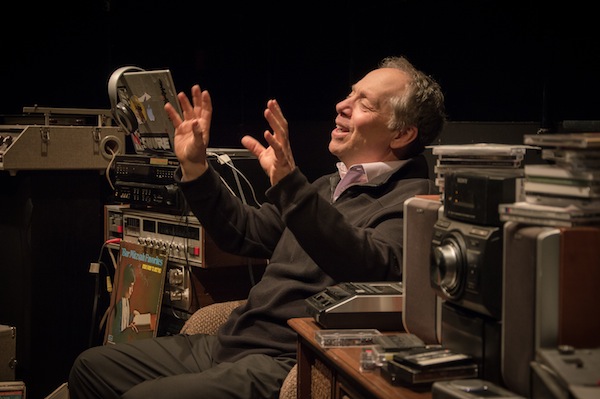
Brian Linds reminisces about his bar mitzvah in Reverberations, which is at Presentation House Theatre until March 17. (photo from Courtesy PHT)

“There are so many wonderful, heartfelt moments in the stories that are told,” Brian Linds told the Independent about Reverberations. “Some are sad. Some are funny. But these same moments have been shared by us all.”

Reverberations opened March 7 at Presentation House Theatre. Created by Linds, a sound designer and an actor, it is co-produced by the theatre and Reverberations Collective with Mortal Coil Performance. Based on Linds’ life, some of the moments he shares with the audience are “his parents’ love story, a childhood act of betrayal, his bar mitzvah, his mother’s Alzheimer’s diagnosis and a moment of lucidity his mother experienced while in the late stages of the disease.”

“The idea for Reverberations came to me after I had created a couple of 10-minute sound performance pieces for pre-events during the SPARK Festival at the Belfry Theatre in Victoria where I live,” said Linds. “I created stories using only sound. These sound performances would play in unusual spaces in and around the theatre.

“I was so pleased with the results that I created three more mini shows and I came up with the concept of Reverberations as a full 90-minute show, using five spaces and four actors who interact with the soundscapes. The production premièred in 2017 as a main stage production of the SPARK Festival.”

The audience, divided into smaller groups of 20, also moves through the five performance spaces. About the première, which took place at Belfry Theatre, Lind remarks in the Vancouver show’s press material that “audiences enjoyed the novelty of moving from space to space and loved the idea that each group’s journey was a unique unfolding of the story told. They were also inspired to share with the performers and audience members their own experiences of loss, betrayal and love. It was deeply touching for our team to experience.”

photo - The role of Brian Linds’ mother, who suffered from Alzheimer’s disease, is played by Nicola Lipman
The role of Brian Linds’ mother, who suffered from Alzheimer’s disease, is played by Nicola Lipman. (photo by Angela Henry)

It was the “immersive, personal and celebratory” experience that attracted Presentation House artistic director Kim Selody to Reverberations. “His creation honours the life of his mother, and what it feels like to lose someone to Alzheimer’s disease,” notes Selody. “Having lost my own mother in the same way, I was deeply touched by how Brian approached his experiences. His choice to end with a celebration is a touch of genius.”

During the writing process, Linds himself had revelations about aspects of his life.

“While I was creating a segment for Reverberations about my bar mitzvah,” he shared, “I found myself thinking about what it means for me to be Jewish. I discovered that who I am was formed and shaped because I was born Jewish. I like being Jewish. I’m a part of something pretty special. Come see the play and you will see.”

Some people will also want to come to the show for a touch of nostalgia, as Reverberations features a range of sound technology, from digital recordings to LPs and cassettes, reel-to-reel and 8-track tapes.

Linds came into sound design kind of by accident.

“I had been working as a professional actor for 25 years but, one day during a show, I was backstage with an actor who knew of my love of music and he asked me to design the sound for his play. It came very naturally to me and I haven’t stopped for 15 years,” he said.

“My favourite part of working on sound is that it gives me a chance to be on the other side of the footlights and work with directors in a completely different way. I love working with directors who collaborate and show me new ways to use my talent.”

The production at Presentation House Theatre is directed by Mindy Parfitt and is performed by Linds, Nicola Lipman, Victor Mariano and Jan Wood. Set and costume designer is Catherine Hahn, lighting designer John Webber and stage manager Heidi Quick.

Reverberations runs until March 17 and tickets start at $15. For more information, visit phtheatre.org/event/reverberations or call 604-990-3474.

Format ImagePosted on March 8, 2019March 6, 2019Author Cynthia RamsayCategories Performing ArtsTags Brian Linds, memoir, music, Presentation House, theatre
Helping Rose’s Angels

Helping Rose’s Angels

Some of the 70 volunteers who helped out at Rose’s Angels Feb. 17. Event founder Courtney Cohen is holding the bags and Kehila Society executive director Lynne Fader is standing in the front, with the long sweater. (photo by Lianne Cohen Photography)

For most people, getting out of the house and being somewhere by 9 a.m. might be no big deal. For me, especially on a weekend morning, it’s a challenge. But, at least once a year, it’s a challenge I enjoy.

As the owner and editor of the Jewish Independent, I’ve known of Rose’s Angels since it launched six years ago, but only first participated last year in the packing of the more than 1,000 care packages for Metro Vancouverites in need. Courtney Cohen, who created the annual event in honour of her grandmothers, Rose Lewin and Babs Cohen, with longtime friend Lynne Fader, was among the 18 Jewish community members under the age of 36 who were honoured by the Jewish Independent with a JI Chai Award in December 2017 for doing good. Having made the personal connection, I headed out to Richmond Jewish Day School a couple of months after the JI Chai Celebration to help out. It was such a fun experience that I went again this year.

The atmosphere at RJDS is like “Old Home Week.” This time around, I drove there with a friend – she brought the muffins and I made the coffee. As before, I ran into several people that I don’t see often. A well-organized venture, Rose’s Angels, which is run under the auspices of the Kehila Society of Richmond, provides coffee and pastry for those who can wait till they get to the school for their fix. Lists taped onto the wall tell volunteers at which station they’ll be working.

I must have done an OK job last year because I was once again assigned to putting together glove and sock bundles, wrapped in ribbon, colour-coded to indicate whether the bundle was for men, women or children. So absorbed was I in the work and conversation that I can’t say what others were doing, but there was much bustling about and, by noon, a big truck and several cars were stuffed with boxes to be delivered.

photo - Volunteers put together 1,200 care packages, which were distributed to those in need by various social services agencies and programs
Volunteers put together 1,200 care packages, which were distributed to those in need by various social services agencies and programs. (photo by Lianne Cohen Photography)

This year, said Cohen, 70 volunteers put together 1,200 packages, filled with necessities from toiletries to books to food to warm clothing, thanks to donations of items and money. The packages were distributed by a couple dozen organizations, including Turning Point Recovery Society, Heart of Richmond AIDS Society, Light of Shabbat program, Jewish Food Bank, Richmond Food Bank, United Way, Tikva Housing, Richmond Centre for Disability, Touchstone Family Services, St. Alban’s Drop-In Centre, Richmond Mental Health Society and Richmond Food Aid.

Scheduled to happen around Valentine’s Day, this year’s Rose’s Angels took place Feb. 17.

“Watching firsthand our community come together to give back on a long weekend, with family and friends is quite amazing,” Cohen told me when I asked her what was the most fun aspect of the day for her. “Seeing people of all ages working together to help package the care packages in such an organized manner is really something to behold.”

Fader, who is co-executive director of the Kehila Society, also enjoys the communal feel, as well as the diversity of the group that gathers to help. “It is always a fun, well-spirited, well-oiled machine that puts months of hard work gathering all the items together to produce a beautiful bundle of items,” she said.

In looking to the future, Fader would like to see the annual event become “bigger, better,” serving “more recipients in our community,” referring to Richmond as a whole, not only its Jewish community. “Although Rose’s Angels is an annual project,” she added, “the Kehila Society is daily working with our community agencies and partners to assist on a daily basis.”

“I see the success of Rose’s Angels growing from year to year with the involvement of the community partners and individuals,” said Cohen. “Personally, I already see the success and fulfilment that Rose’s Angels has given our community at large. Receiving thank you phone calls, emails and messages from the recipient agencies reminds me of the impact that Rose’s Angels is making to so many individuals.”

Format ImagePosted on March 8, 2019March 6, 2019Author Cynthia RamsayCategories LocalTags Courtney Cohen, Kehila Society, Lynne Fader, Rose’s Angels, tikkun olam
Dance explores our relationships

Dance explores our relationships

Noam Gagnon’s Vision Impure performs Pathways at the Roundhouse, as part of the Vancouver International Dance Festival, which runs March 4-30. (photo by Erik Zennström)

“It’s important that dance and art ask questions, even without necessarily explicitly spelling out the answers,” Noam Gagnon, artistic director of Vision Impure, told the Independent.

Vision Impure presents the world première of their latest contemporary dance work, Pathways, at the Roundhouse Performance Centre March 20-23, as part of the Vancouver International Dance Festival, which runs March 4-30.

“The works I create are not meant to be stories but rather are meant to be seen as a series of powerful images and states that hopefully anchor, engage and stimulate the audience to have their own powerful experience,” said Gagnon, who is a member of the Jewish community.

Pathways is described as a work that “illuminates the stories we share, exploring the intricate push and pull of relationships impacted by urban living. Simple moments lead to more complex ones, questioning our ability or inability to connect with one another and what makes us react more strongly to some than to others.” It was performed as a work-in-progress at last July’s Dancing on the Edge festival.

“Pathways has lengthened and developed considerably since Dancing on the Edge,” said Gagnon. “It is now a full-length work, approximately one hour long, presented in two parts with an intermission in between. The company has continued the research and investigation into Part 2, which informs what has already been seen, what else was potentially needed, and then added the alterations necessary to create better cohesion for Pathways as a full work.”

Gagnon is an award-winning choreographer and his work has been performed internationally. He is regularly commissioned by dance artists and companies, and is an associate dance artist of Canada’s National Arts Centre. He has collaborated often with other artists, and Pathways is no exception.

“The creation of Pathways has been a long process of research and accumulation in multiple cities involving multiple companies and dancers,” said Gagnon. “The initial concepts for Pathways started germinating in May 2012 during a choreographic laboratory under the mentorship of Davida Monk at Dancers Studio West (DSW) in Edmonton, where I was given the opportunity to develop the original concept on seven amazing dancers.

“In 2014, I was invited to create a dance work on 17 crazy, generous student dancers at L’Ecole de danse contemporaine de Montréal (EDCM). It was in Montreal where the first version of Pathways Part 1 came to life and was subsequently presented as part of the EDCM Professional Program spring presentation Danses de Mai, Opus 2014.”

Back in Vancouver, in 2017, Gagnon was invited to create a work for EDAM’s (Experimental Dance and Movement’s) Spring Choreographic Series and to develop additional material for the piece with a few other dancers. And, in the spring of 2018, he said, “I was invited by Lesley Telford to do research/creation at Arts Umbrella on nine of their very gifted PReP program emerging dance professionals, further expanding on some of the concepts of the previous works.”

The development of Pathways continued in 2018 with nine dancers at Simon Fraser University’s School for the Contemporary Arts and 27 dancers at Modus Operandi.

“The current cast of 10 incredible young dancers for the new full-length version of Pathways, to be presented at Vancouver International Dance Festival (VIDF), has been my heart, soul and brain,” said Gagnon.

In addition to the dancers involved, composers James Coomber (Vancouver) and Guillaume Cliche (Montreal) created Pathways’ sound design.

“My creative process always starts with images, which evoke various states in me initially and then evolve, arousing strong desires within my imagination that make me want to act upon them. Then the hard work and countless hours to bring a piece to the stage begin,” explained Gagnon.

“For the Pathways project,” he said, “I first came up with a series of questions, with answers coming from the responses of each of the dancers. I then started to generate a physical vocabulary, which would become my text. I immediately reshaped the movement vocabulary that was given to me in order to generate a more cohesive bank of movements and to ensure that all the artists involved were part of the same world. With this bank of movements, I then started gathering and creating worlds of moving physical landscapes in various states of action and transformation. Each movement phrase evolved over time to support the vision that first drove me initially.

“It is also extremely crucial for me to tailor the work perfectly for who is dancing it and to always create the strongest structure possible,” he added. “I then challenge or reshape the work with movement that creates strong intent and keeps these incredible dance artists alive and real in the world I have envisioned.”

Part of Vision Impure’s mission is to create “performances that explore the intricacies of human relationships and the dynamic tension that move us … [and to reflect] the intimate concerns, ideas and attitudes that shape our relationships to ourselves and each other.”

When asked what he has learned through his work and life experience about how we connect and isolate ourselves and others, Gagnon said, “Everything in life starts from within ourselves first, the choices we give ourselves, how we negotiate what comes our way, what we do with what we have and then being honest and real enough to accept the facts and be accountable for the choices we make. Action-reaction is real and undeniable to me. In relationships, I find communication to be the biggest challenge, seemingly constantly lost in translation.

“Recently,” he said, “I have begun to strongly believe that, as a species, we are hardwired for extinction. Despite our biggest strength being our ability to learn to adapt, it seems lately we as a whole are not able to learn from our experiences or the past experiences of others. We are living in an era of social amnesia. Our desires have become powerful weapons going in uncontrolled directions.”

The Vancouver International Dance Festival presents many artists during its run, including the Japan-based butoh ensemble Dairakudakan, Vancouver’s Raven Spirit Dance, Ottawa’s 10 Gates Dance, Montreal’s Daina Ashbee and Tjimur Dance Theatre from Taiwan. The festival features workshops, as well as many interactive dance activities at various venues throughout the city. For more information, visit vidf.ca.

Format ImagePosted on March 1, 2019February 27, 2019Author Cynthia RamsayCategories Performing ArtsTags dance, Noam Gagnon, Pathways, Roundhouse, VIDF
Monster brings back Jesus

Monster brings back Jesus

Ryan Gladstone is co-writer of Jesus Christ: The Lost Years, which opens at Havana Theatre March 13, 8 p.m. (photo from Monster Theatre)

Scholars have pondered the question of the unknown, or missing, years of Jesus. In the Christian Bible, he disappears from the narrative in his teens, only reappearing at age 30. What happened in that time? What was Jesus doing? Even if you haven’t wondered about this before, you should consider checking out the award-winning theatrical romp Jesus Christ: The Lost Years, which offers some unconventional theories that academics and theologians have possibly overlooked.

Written by Ryan Gladstone, Bruce Horak and Katherine Sanders, with an original score by Drew Jurecka, Jesus Christ: The Lost Years was first created in 2006. It toured until 2008, then also had its “lost years,” returning to the Fringe circuit only last summer; this time, with two women playing the male leads. Directed by Gladstone, the irreverent physical comedy opens at the Havana Theatre March 13.

“The script is pretty much the same, so the biggest change is what the two new performers bring to the table,” said Gladstone about how the current iteration of the play differs from the original. “Carly Pokoradi and Alex Gullason really have made the play their own, and that’s been a pleasure to watch. It’s also fun watching two talented and funny women being funny and talented on stage.”

Both actors take on multiple characters. In the play, notes the promotional material, “we see teenaged Jesus, wondering why he doesn’t fit in. Mary and Joseph finally come clean and tell him that Joseph isn’t his real father. Hurt and confused, Jesus heads off on the most epic father quest of all time. Along the way he meets Judas, Mary Magdalene, the Three Wise Men, lepers, Romans, he even has a battle with the spirit of Elvis!”

The idea for Jesus Christ: The Lost Years came up long before it was first produced in 2006.

“Katherine Sanders and I were roommates in Calgary in the late ’90s, and we came up with the idea of doing a play about a teenaged Jesus. But Monster Theatre was just on the cusp of being founded and it wasn’t the right time,” said Gladstone. “I remember calling her in 2005, saying, ‘It’s time.’ So, we started researching, and we got Bruce Horak on board, who we both greatly respected, and got to work. The writing process was pretty smooth for having three writers, though maybe some of us were more forceful with our ideas than others! (I’m talking about me, if it’s not clear.)”

As wild as the play gets, it is based on research, as are all Monster Theatre productions. Part of the company’s mission is to reimagine history or adapt “universal stories to make them relevant for our specific time.”

“I took a couple history classes in university but, funnily enough, my thirst for history came out of doing plays for Monster,” Gladstone told the Independent. “In 2001, we created our longest-running, most successful show, The Canada Show: The Complete History of Canada in One Hour, and the research portion of the project really fired my imagination. I loved the idea of taking amazing events that people have never heard of and exposing them to these great moments in our past, or events that people think they know and showing it from another angle. In 2003, Bruce Horak (and later my brother Jeff) and myself spent about seven months researching and writing the follow-up show, The Big Rock Show: The Complete History of the World. It was really this that gave me my love for history. Having that broad overview of everything has given me context for every other event I learn about.”

Perhaps also “funnily enough,” given his love of history, Gladstone only recently found out about his Jewish heritage. “A couple years ago,” he said, “my brothers and I got one of those DNA tests done for both our parents, and discovered that our dad has about 30% Jewish blood. We have some very close Jewish friends here in Vancouver that took us under their wings and guided us through everything they thought we needed to know.”

Born and raised in Calgary, Gladstone went to theatre school at the University of Calgary. “I had been caught up in the exciting whirlwind that was the Loose Moose Theatre Company, run by improv guru Keith Johnstone, who was also teaching in the theatre department at U of C,” explained Gladstone. “After I graduated, I moved to Toronto, because that’s where all my friends were, and I loved it. That was around the time that I founded Monster Theatre. In 2006, I moved to Vancouver. My (now) wife had come to Toronto from Vancouver and tried it out for a few years and we decided we would give Vancouver a shot for year or two. Well, that’s been 13 years now.”

Gladstone followed up his bachelor of fine arts in acting from U of C with a master of fine arts in directing from the University of British Columbia. He has written or co-written, produced, directed or acted in every Monster production.

“It’s a tough thing to tally, but I think it’s around 40 original plays, written or co-written,” Gladstone said of his literary output. “I occasionally write for other mediums; I’ve been co-writing a kids’ book for many years, and we have tried adapting our plays for film and web series.”

Gladstone founded Monster Theatre almost 20 years ago. “In 2000,” he said, “I wanted to tour the Fringe Festival circuit. I had some friends with a comedy troupe called the 3 Canadians who were very successful and were touring Australia and beyond every year, and I basically wanted to be like them. So, I filled out an application form for the Edmonton Fringe and, when it came down to ‘Company Name,’ I just wrote down Monster Theatre for the first time.

“The name is based on something Keith Johnstone said one day when I was in university. We were working on a scene from Othello and Keith was discussing Iago and the difference between demons and monsters. He said, ‘Demons are evil and twisted on the inside, but they are usually quite attractive on the outside, while monsters are strange, twisted and bizarre on the outside, but they always have a good heart.’ And I thought, that’s the kind of theatre I want to make! So, we try to create original plays that are odd, unique, unlike what everyone else is doing, but we are always focused on the heart of the play, making sure that it is rooted in something meaningful or profound. We often talk about our style as being at the intersection where high brow and low brow meet.”

Gladstone was still living in Calgary when he started Monster Theatre. “But, when I moved to Toronto, the company, such as it was, moved with me and, when I moved here in 2006, it moved again,” he said. “Since arriving in Vancouver, we have laid down roots and I don’t think there will be another relocation for Monster in the future. With that said, Monster is a very cross-national company – we have a fan base in a number of cities across the country. In fact, for a long time, Vancouverites witnessed fewer productions of ours than Toronto, Winnipeg, Calgary or Edmonton.”

Over the years, the societal norm of what is acceptable and offensive in word or deed has changed, but Gladstone said there aren’t really any “red lines” he won’t cross in his writing.

“I mean, in the old days, my writing was way more provocative,” he acknowledged. “We were trying to offend people. We often talked about trying to piss off everyone, then no one gets left out. But, these days, it’s a different atmosphere. I’m not afraid of offending people, but I think there needs to be a worthwhile reason, not just for the shock of it.”

Jesus Christ: The Lost Years is at Havana Theatre March 13-16 and 20-23, 8 p.m. For tickets ($20/$15), visit showpass.com/ticket-buyers.

Format ImagePosted on March 1, 2019February 27, 2019Author Cynthia RamsayCategories Performing ArtsTags comedy, Havana Theatre, history, Monster Theatre, Ryan Gladstone, theatre
Putting Hemingway to music

Putting Hemingway to music

Turning Point Ensemble performs The Old Man and the Sea, directed by Idan Cohen, March 9 and 10. (photo by Tim Matheson)

“There’s something that I really love about these kinds of projects and the agenda that Turning Point holds – creating an operatic experience that is contemporary and designed to communicate music in a truly creative way. I hope this will attract not just the core of new music and opera lovers, but also those of us who are passionate for the arts and want to experience something different. This is what opera is truly about,” said Idan Cohen about Turning Point Ensemble’s Words & Music, which is at the Annex March 9-10.

The collaborative endeavour features the theatrical mini-opera The Old Man and the Sea by Rita Ueda, and Bee Studies, created by poet Renée Sarojini Saklikar and composer and musician Owen Underhill. Choreographer and opera director Cohen is directing The Old Man and the Sea.

“This past summer, I was invited by Rita Ueda and Mark Armanini, who run the AU Ensemble, to stage their concert at the Podium Mozaiek in Amsterdam,” Cohen told the Independent about how he met Ueda. “I had a wonderful time working with the ensemble and found the work they do highly inspiring. Rita’s work is very immersive and, in her scores, the musicians play a significant role as characters, fully engaged and active on stage. We found a deep foundation of understanding, and so Rita introduced me to Turning Point. It’s an honour to be working on such a beautiful piece alongside such an exquisite group of artists and musicians.”

The Old Man and the Sea, composed by Ueda with a libretto by Rod Robertson, is based on the short novel by Ernest Hemingway. The story centres around Santiago, an aging fisherman, who battles with a marlin. In the concert, baritone Willy Miles-Grenzberg sings the part of the Old Man (Santiago) and Turning Point co-founder and trombone soloist Jeremy Berkman musically plays the marlin.

“Rita and the librettist Rod Robertson have created a highly poetic rendition of Hemingway’s novel,” explained Cohen. “It’s quite condensed and, at the same time, leaves a lot of room to reflect on its different topics and themes. It creates a rendition of the story that is almost abstract – I love this quality in opera, when the poetic aspects of a story are drawn out through the layered richness of the written word, music and live performance. I connected to it on a very deep level.”

photo - Choreographer and opera director Idan Cohen focuses “on body language and sensitivities that are dance-related” in The Old Man and the Sea
Choreographer and opera director Idan Cohen focuses “on body language and sensitivities that are dance-related” in The Old Man and the Sea. (photo by Or Druker)

The work is so expressive, said Cohen, “and focuses on the journey of Santiago … and his connection to the sea. There are beautiful moments that ‘paint’ that through the language of music. Unlike my other work, there won’t be any dance in this production, but I do focus on body language and sensitivities that are dance-related. Santiago is a humble man, full of wisdom, close to the end of his days, and Willy Miles Grenzberg, portraying him, embodies the part beautifully.”

Cohen hopes that this staged concert will appeal to a wide audience – “whether you’re a new music lover, a literature, theatre or poetry enthusiast, there’s going to be something there for each and every one of us,” he said.

This type of production can be somewhat complex to direct.

“My role is often to bring different elements together in order to create the operatic experience,” said Cohen. “By nature, music is abstract and, since the musicians are so valuable in this opera and play a significant role, I wanted to come up with creative ways to support this special vision. Drawing that vision from the mind of the composer and librettist to the experience of the viewers can be quite a challenge at times, but the musicians of Turning Point are truly exceptional, best in their field, and they do wonders.”

In addition to the power of the music, The Old Man and the Sea has many powerful – and universal – themes. Cohen described it as “a story about human determination, strength and faith but, most of all, it is about fragility and humbleness. It reflects on our connection to nature, and that is very valuable in our times, when there is so much denial and violence in the way the human race treats its surroundings. Robertson relates to this in a rich way and creates a very relevant testimony. The opera reflects on these important topics through the drama of the music, to expose an extreme human condition. It is powerful in a way that I find not just poetic, but also very emotional.”

Following the performance of The Old Man and the Sea is the première of Bee Studies, which includes texts from Sarojini Saklikar’s Listening to the Bees, a book of science and poetry, and features soprano Dorothea Hayley.

According to the press material for Words & Music, a “special bonus of the evening is a performance of some witty and rarely heard songs from the 1930s, Duet for Duck and Canary and Frogs by the great unheralded Mexican composer Silvestre Revueltas, plus his most-heralded work, Ocho por Radio.”

Tickets for Words & Music, March 9-10, 7:30 p.m., at the Annex are $33 ($20 for seniors and students) and can be purchased at turningpointensemble.ca.

Format ImagePosted on February 22, 2019February 21, 2019Author Cynthia RamsayCategories MusicTags Hemingway, Idan Cohen, opera, Turning Point Ensemble
Building an epic relationship

Building an epic relationship

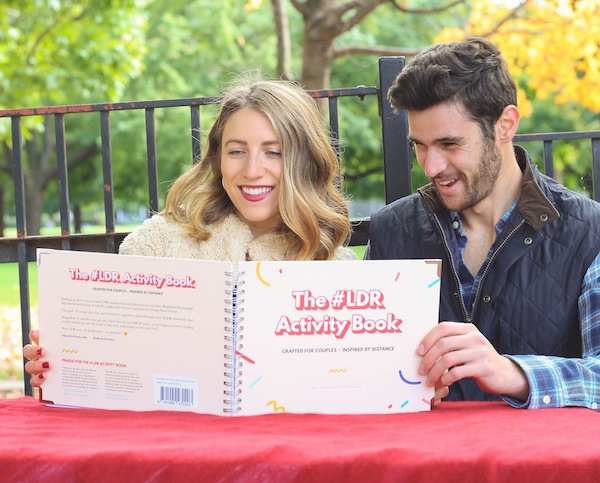
Sam Laliberte and Jared Schachter share what they’ve learned about long-distance relationships in The #LDR Activity Book. (photo by Ricky Pang / Sincerely Image)

The first quote in The #LDR Activity Book is from American writer Meghan Daum: “Distance is not for the fearful, it’s for the bold…. It’s for those knowing a good thing when they see it, even if they don’t see it enough.”

Sam Laliberte and Jared Schachter, co-writers of the activity book for people in, or contemplating, a long-distance relationship (LDR) knew a good thing when they saw it, and didn’t let Schachter’s move from Toronto to San Francisco get in the way.

“For two years,” they write in The #LDR, “we were long-distance loves, capturing our visits on Instagram and maxing out our data plans during weekly video calls. We picked up many lessons (most learned the hard way) and fun activities to keep our relationship strong AF despite living three time zones apart. It definitely took work, epic relationships don’t just happen, but we made it through and now we want to share our learnings with the world.”

In an email interview with the Independent, Laliberte and Schachter said they “always wanted the book to be interactive and fun for couples, since long, text-heavy books can be daunting and would be less conducive to creating positive interactions between couples.”

The #LDR Activity Book has eight chapters covering topics at the core of any relationship, even with yourself: understanding your personality, how you like to give and receive love, your values, what triggers you, envisioning the future, and more. Each chapter begins with an explanation of why the topic – expressing love, communication, IRL (in real life) visits, keeping the spark alive, values, trust, conflict resolution and planning – matters, followed by some “best practices”: assuming good intent, for example, giving “your partner the benefit of the doubt and operat[ing] under the impression that they’re trying their best.” Laliberte and Schachter then share a few tips of what worked best for them and, of course, there are several activities, some of which you complete on your own; others, with your partner.

Laliberte and Schachter wrote this book with Schachter’s mother, Beverley Kort, who is a registered psychologist in Vancouver, with more than 40 years’ experience counseling couples. They also interviewed dozens of other couples “who survived and thrived as long-distance lovers.”

“On top of all this,” they told the Independent, “we were also honest about the fact that our long-distance relationship didn’t work out. We too were scared of the associated stigma and didn’t have any resource to turn to, to help alleviate some of our concerns. The ability to create something for other couples [in a long-distance relationship] was really exciting for us.”

photo - pages of The #LDR Activity Book
The #LDR Activity Book takes couples through various activities.

Laliberte and Schachter are still together, though, just closer geographically.

“We’ve been in a relationship for almost three years now,” they said. “We spent one-and-a-half years in a full long-distance relationship (Toronto-San Francisco) and, now, because we have flexible jobs, we spend a majority, but definitely not all, of our time together. We were separated for two months at the end of 2018 but are now on an extended travel together in South America for four months.”

Feedback about the book – which Laliberte and Schachter encourage readers to share – has been very positive, they said, giving a couple of examples. Thessa (New York) and Anthony (Dublin) wrote about The #LDR, “Absolutely love it. The quality is great, the art and quotes in the book are gorgeous, and information in the book is spot on.” Sara (Los Angeles) and Charles (Toronto) emailed, “#LDR was a fun way to build our relationship after knowing each other for only a week! We met at a music festival and spent the next year living on different coasts and time zones, and used this book to provide a framework for exploring our new relationship.”

A longtime long-distance couple with whom the JI shared the book completed several sections, some that reinforced what they were already doing – daily rituals (regular texts and phone calls) and planning out IRL visits, for example – and some that either introduced new ideas or suggested activities they wanted to do more often, such as creating a joint vision board and talking about important moments during texts and calls, respectively.

To fund the publication of The #LDR Activity Book, Laliberte and Schachter ran a Kickstarter campaign. Seeking $6,000, they received contributions of more than $10,000 from almost 200 backers, with their initial funding goal being covered in less than 24 hours. The result is a smart-looking, durable, 63-page, full-colour, hardcover (with metal corners), spiral-bound “scrapbook.” More importantly, it is a book full of good advice and beneficial activities and exercises, if you (and your partner) are willing to be open and put in the time. And the learning continues online.

“We’ve also now partnered with a sexologist to create a bonus chapter on ‘Sex from a Distance,’ after a number of readers began asking more detailed questions about this area,” Laliberte and Schachter told the Independent. “It is available for free download if you signup for our email newsletter on our website.”

The #LDR Activity Book is for sale on ldractivities.com for $35 per copy, or $60 for a set of two. Laliberte and Schachter have created a special discount code for Jewish Independent readers: use JINDEPENDENT20 to receive 20% off.

***

On Feb. 17, Sam Laliberte and Jared Schachter were interviewed on the podcast From Long Distance to Marriage. The episode can be found on audioboom.com.

Format ImagePosted on February 22, 2019February 21, 2019Author Cynthia RamsayCategories BooksTags Beverley Kort, family, Jared Schachter, lifestyle, psychology, relationships, Sam Laliberte
Ballet BC creates with Salant

Ballet BC creates with Salant

Israeli choreographer Adi Salant will be at the Ballet BC première of her work Feb. 28-March 2 at Queen Elizabeth Theatre. (photo © Michael Slobodian)

“I could not let it go on without being there to see the outcome,” Adi Salant told the Independent in a phone interview from Israel about the new work she is creating with Ballet BC. The piece will have its première Feb. 28-March 2 at Queen Elizabeth Theatre.

Salant was in Vancouver last August to work with the company and she was scheduled to return here earlier this week to help prepare for the performances.

“The [creative] process was split into two periods,” she explained, “and I was there for three weeks [in the summer], building the major part of the piece. Now I’m coming, it’s more the last adjustments, refining, rethinking, being open to the suggestions that will happen, but most of it is ready and they are working on it now, preparing it for my arrival. I’m very excited to meet them and meet the piece again because it’s been awhile.”

Salant knows Ballet BC artistic director Emily Molnar from the world of dance in general, but the two really connected just over two years ago, when Salant was invited to be one of the choreographers taking part in the inaugural Creative Gesture, a residency program led by Molnar and program head Stephen Laks at the Banff Centre. For the program, Salant had to create a short piece for the young dancers, who attended the residency from several countries, “to see how it is to work professionally.”

“I really enjoyed the energy there and the way I worked with the dancers. And she [Molnar] believed in me and gave me the opportunity to come and work with her company.”

Creating something in two time periods is interesting, said Salant. “It gives you time to reflect and to visit it with videos, or in my mind or afterthoughts of what happened. Even though I’m not there [in Vancouver], it’s like I stayed with the dancers. I got to know them.”

The limited amount of time made the work more intense, she said, “because both the dancers and I know, OK, we have now three weeks. There’s engagement and we’re just going for it.”

The piece involves many dancers. “I knew I wanted a feeling of a big group,” said Salant. “I think there will be 17 people, if I’m not mistaken. I fell in love with all of them and we want to use everybody…. I enjoyed so much and appreciated so much the energy and open hearts, and diving in with me to the unknown.”

In considering the piece about to be performed, as well as her previous works, Salant said, “I am just so fascinated by life – the everyday kind of life and the demands of life and the struggles. Some people, they create from what they dream about; I’m more about what I’m experiencing every day, so that’s the energy [of the new piece]. It’s about how, in life, you can plan and plan, but you can meet someone … if it’s a job interview or, for our profession, if it’s an audition, so he chooses, yes you are in, no you are out, and how [that concept] applies to the rest of your life. Or where you’re born … if you’re born into this kind of society or this kind of place, it’s also affecting you…. You can aim, but, in the end, we divide: you go there, you go there, you yes, you no, you up, you stay there, you down.”

Salant has been dancing since she was a young girl. “I started to dance in Bat-Dor dance group in Tel Aviv when I was 6…. When I graduated high school, I went for an audition … and, lucky for me, I was the one that got the yes.”

After two years at Batsheva Dance Company, she was invited to join the main company, with which she danced for five years. “Then I left, but I stayed in a very close relationship professionally with Ohad Naharin [then-artistic director of Batsheva], staging his works all over the world … and setting his repertoire for different companies – this is actually where I met Stephen, who I mentioned before. He was dancing in Les Grands Ballets Canadiens. It’s very nice and very exciting for me to look back and to realize, on this journey, I have met so many people.”

Members of her generation of dancers are now leading companies, choreographing and teaching, she said. “It’s really nice to see, and I enjoy very good and close relationships with my colleagues and we continue to share our passion in that way.”

Salant returned to Batsheva in 2009, but, she said, “this time, Ohad invited me as the co-artistic director.” She held that position until October 2017, when she struck out on her own.

“It’s part of my journey – all the tools that I collected until now and the experiences, and having actually more time now that I’m not directing a very busy company and dealing with the schedule of the company,” she said. “Now I have my schedule, and [am] owning my time in a way. I put the focus on choreographing and teaching workshops around the globe.”

Salant said she has created a motto of sorts for work, “Adi – Life is Moving,” “because I really enjoy meeting with people and, [while] it’s true that I’m coming to teach dance to them, I really connect it to life, and their life and how their emotions and, again, like I said about my work, this piece, it’s the same when I’m teaching or when I’m working now with the dancers of Ballet BC. Yes, I’m giving them the movements but I’m all the time connecting it to life, to the everyday behaviour. That’s what I’m aiming for.”

Salant teaches in various places around the world. This April, for example, she will be in Los Angeles for a week. “It’s called the Gypsy Project…. It’s the second time that I am involved there,” she said. “I’m looking forward to go, and to share and to learn and to deepen my knowledge and understanding.”

Salant reiterated her appreciation for Molnar. “As I said, I left my job as the co-artistic director and it’s, of course, a demanding job and you’re recognized with this position and with this place…. When I left and wanted to now continue to choreograph, because I did choreograph before, but I put it on hold because it was too intensive with the company life and, of course, I have three kids, something had to wait … Emily really was the first to open her door and believe fully. It’s not something that you see so often, that you feel that someone believes in you and takes a chance and appreciates who you are, knows your strengths and believes in your strength, no matter your title.”

Salant has enjoyed working with Ballet BC. “I had an amazing meeting with the dancers,” she said. “They inspired me and moved me a lot, so I really can’t wait to come back on Monday [Feb. 11], even though I miss my family. I have to leave three kids behind, and that’s the hardest part, but I’m happy that we can share again our time together and bring it on stage and to the audience what we did.”

Salant and her husband, Jesper Thirup Hansen, have two daughters, 10 and 8, and a 5-and-a-half-year-old son. Thirup Hansen is a physiotherapist. “I met him in Batsheva, he was a dancer, he is Danish,” said Salant. “Actually, they joined me in the summer in Vancouver; the whole family came. They had such a great time. I came to their place from work, and they told me all the fabulous things they did that day.”

For tickets to Ballet BC’s Program 2, visit balletbc.com.

Format ImagePosted on February 15, 2019February 13, 2019Author Cynthia RamsayCategories Performing ArtsTags Adi Salant, ballet, Ballet BC, Batsheva, choreography, dance, Emily Molnar, Israel

Posts pagination

Previous page Page 1 … Page 49 Page 50 Page 51 … Page 84 Next page
Proudly powered by WordPress