Skip to content
  • Home
  • Subscribe / donate
  • Events calendar
  • News
    • Local
    • National
    • Israel
    • World
    • עניין בחדשות
      A roundup of news in Canada and further afield, in Hebrew.
  • Opinion
    • From the JI
    • Op-Ed
  • Arts & Culture
    • Performing Arts
    • Music
    • Books
    • Visual Arts
    • TV & Film
  • Life
    • Celebrating the Holidays
    • Travel
    • The Daily Snooze
      Cartoons by Jacob Samuel
    • Mystery Photo
      Help the JI and JMABC fill in the gaps in our archives.
  • Community Links
    • Organizations, Etc.
    • Other News Sources & Blogs
    • Business Directory
  • FAQ
  • JI Chai Celebration
  • JI@88! video

Recent Posts

  • Story of Israel’s north
  • Sheltering in train stations
  • Teach critical thinking
  • Learning to bridge divides
  • Supporting Iranian community
  • Art dismantles systems
  • Beth Tikvah celebrates 50th
  • What is Jewish music?
  • Celebrate joy of music
  • Women share experiences 
  • Raising funds for Survivors
  • Call for digital literacy
  • The hidden hand of hate
  • Tarot as spiritual ritual
  • Students create fancy meal
  • Encouraging young voices
  • Rose’s Angels delivers
  • Living life to its fullest
  • Drawing on his roots
  • Panama City welcoming
  • Pesach cleaning
  • On the wings of griffon vultures
  • Vast recipe & story collection
  • A word, please …
  • מארק קרני לא ממתין לטראמפ
  • On war and antisemitism
  • Jews shine in Canucks colours
  • Moment of opportunity
  • Shooting response
  • BC budget fails seniors
  • Ritual is what makes life holy
  • Dogs help war veterans live again
  • Remain vital and outspoken
  • An urgent play to see
  • Pop-up exhibit popular
  • An invite to join JWest

Archives

Follow @JewishIndie
image - The CJN - Visit Us Banner - 300x600 - 101625

Byline: Cynthia Ramsay

Persistence a common theme

Persistence a common theme

There is a bounty of books to read and review at the Jewish Independent. One of the many perks of my job is that I have so much culture literally at my fingertips. But, given the weekly deadlines and other demands of running a newspaper, I can’t always be au courant. So, hopefully I will be forgiven for reviewing four books published last year for this Passover issue: a memoir, a work of fiction (perhaps 😉 and two young adult novels. I’m excited to report that two of the books were written by people who have written for the JI and one was written by a local community member.

My favourite podcast is Wait Wait … Don’t Tell Me! And, even though I don’t run, one of my favourite magazines is Running Room. I’m not sure how I got onto their mailing list, but I always enjoy reading people’s inspirational stories of why they started running, I like the recipes and nutritional advice and the training tips, which are useful for other types of exercise. Anyway, all that to say I was excited when the host of Wait Wait, Peter Sagal, who is Jewish, came out with his new book, The Incomplete Book of Running (Simon & Schuster, 2018).
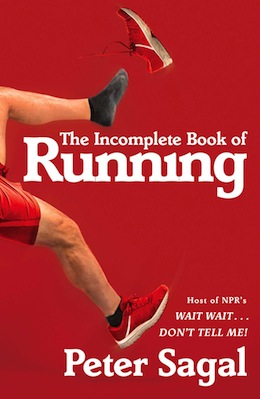
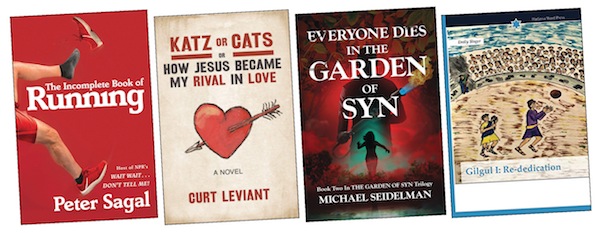
book cover - The Incomplete Book of RunningSagal shares personal stories about why he started running, some of the marathons in which he has participated and people he has met along the way, notably a couple of runners who were blind (or almost), for whom he acted as a guide. Scattered throughout, he offers various facts and figures about running; its health benefits, as well as its downsides (I did not know about, to put it delicately, the digestive issues long-distance runners can face). He speaks somewhat vaguely but openly about the dissolution of his first marriage and he is refreshingly honest about his struggle with depression.

Running has helped Sagal deal with difficult circumstances, and continues to not only be a form of exercise for him, but something that informs how he lives. Among other things, running has taught him persistence and has made him more courageous; it has contributed to his “faith in the possibility of positive change” and his realization of just how enduring is love.

I admit that, despite Sagal’s enthusiasm, reading about multiple marathon experiences, as a non-runner, got a little tiresome. And the book isn’t chronological, so I wasn’t always sure of what point we were at in Sagal’s life. But, those minor criticisms aside, I enjoyed the book a lot, especially Sagal’s conversational style of writing and his humour. Having listened to him almost every week for so many years, it felt, at times, that he was right there, telling me his story; that I was listening to him, rather than reading him.

* * *

There is no doubting that Curt Leviant is a talented writer, that he has a wicked sense of humour and a heightened sense of observation and awareness. Katz or Cats; Or, How Jesus Became My Rival in Love (Dzanc Books, 2018) is his most recent of many novels and fans will not be disappointed.

A book editor, John, and a writer, Katz, meet on the subway. On their commutes into New York, Katz shares what is ostensibly his brother’s love story, though it may be Katz’s. Part of the novel’s plot revolves around just how true, or fictional, is the story of Katz’s brother, who also goes just by his surname, Katz.
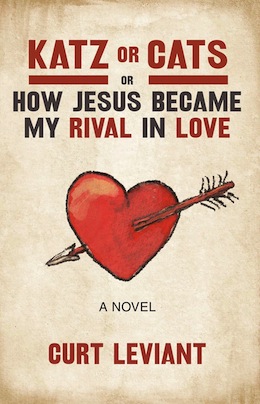
book cover - Katz or CatsAs the story goes, Katz (or Katz) meets a woman on a train. Maria is supposedly a devout Christian, but she has no trouble permitting a stranger to put his arm around her on first meeting, nor having sex pretty soon thereafter with said stranger, Katz, who she thinks might be married. Their relationship – and the novel – comprises much sex, a lot of talking about sex and many discussions about religion – Jesus, specifically, and Maria’s recurring feelings of guilt for not being what she thinks a good Christian should be.

As Katz relates the tale to John, the editor interjects every once in awhile to question apparent contradictions or errors in the telling. Some aspects – Katz’s marital status, for instance – remain unclear, and purposefully so.

Ironically, perhaps, given that the premise of the novel is a writer telling a story to an editor, Katz or Cats would have benefited from some tighter editing. More than one topic recurs and some points are made multiple times. While Katz’s wit and intelligence provide much to think about, I didn’t find him to be a sympathetic character, so “listening” to him became difficult. And, while I’m not a huge fan of political correctness, I found his treatment of Maria to be condescending and rude at times, and some of his quips to be on the edge of disrespectful towards other cultures. Though Katz refers to Maria more than once as smart, her waffling and some of her responses to Katz – and his reactions to her – don’t really support that notion.

Overall, while provocative in many ways, I found Katz or Cats to read like a book from another era. Many male writers, from Seneca to Henrik Ibsen to Thomas Mann to Leviant himself, come up in conversations in the novel, reinforcing my feeling that this book would be most appreciated by older, male readers. But I could be wrong. When I shared my views with Leviant – who regularly writes for the Jewish Independent’s holiday issues (see page 34 of this issue, for instance) – he shared that a similar novel of his, translated into French, got great reviews from young women critics.

* * *

Ever since reading No One Dies in the Garden of Syn in 2016, I have been waiting for the second book of local writer Michael Seidelman’s trilogy featuring teenage heroine Syn. And, late last year, my wait was over.
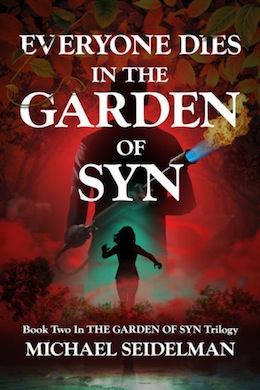
book cover - Everyone Dies in the Garden of SynEveryone Dies in the Garden of Syn (Chewed Pencil Press, 2018) starts with a violent prologue that both heralds what’s to come and starts to explain the “Creepers” – weird-looking creatures that seem to be combinations of two people or a person and an animal or insect – we met in the first novel.

In the introductory pages of Everyone Dies, Seidelman, in addition to moving the story along, reminds readers of what has come before. The action in this book centres around Syn’s need to rescue her sister, who has been kidnapped by Cole, a “boy” who befriended and then betrayed Syn – or, from his point of view, was befriended and betrayed by Syn.

Still missing as Everyone Dies starts are Syn’s parents, who disappeared when she was 5. Because of Syn’s actions in the first book, the garden, which once had healing powers – “no one dies” – has lost them, so now “everyone dies,” or can die, in the garden. Therefore, the situation is that much more dangerous now for Syn, who suffers from cystic fibrosis. Whereas she didn’t have to worry about her health in the first novel, it becomes another thing she has to battle in the second.

And there is many a battle in Everyone Dies, and lots of running and chasing. There were a few times I lost track of which universe (there are multiple) we were in, and, sometimes, who was fighting whom, but the action moves along and the tension builds. There’s a wonderfully satisfying twist at the end. And so begins the wait for Book 3.

To read more about Seidelman’s first Syn novel, visit jewishindependent.ca/first-book-of-trilogy-now-out.

* * *

“When my 13-year-old son devoured Bulfinch’s Mythology after reading Rick Riordan’s Percy Jackson, I realized we need an exciting, thought-provoking series based on Jewish history, something that will send our kids reaching for a Torah, a Talmud or a Book of the Apocrypha,” wrote Emily Singer to the Jewish Independent in an email about her new book, Gilgul I: Rededication (Hadassa Word Press, 2018).

Singer, who lives in Israel, is a writer and a high school teacher. When she and her family lived here, she taught at Vancouver Talmud Torah. She has written several articles for the Jewish Independent so, when she contacted the paper about Gilgul, I happily agreed to review it.
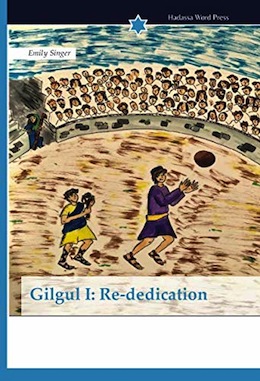
book cover - Gilgul INot surprisingly, knowing Singer’s skill as a writer, Gilgul is a compelling and radical take on the Chanukah story. While all the book’s hero David wanted to do was to play the game skyros with his friends, the game takes on a deadly seriousness for the 15-year-old when King Antiochus sacks the Temple and starts a war against the Jews.

David must be smart, brave, strong and compassionate to stay alive and save his family and his people. He must figure out who to trust, and the fact that it’s not always clear who the good guys and bad guys are adds tension and meaning to the novel. Even with the help of his equally heroic sister Leya, some unexpected courageous allies and a little magic, David has his work cut out for him. Gilgul will leave readers thinking anew about Chanukah, the rededication of the Second Temple, the Maccabees, the miracle of oil, and more.

Format ImagePosted on April 12, 2019April 17, 2019Author Cynthia RamsayCategories BooksTags Curt Leviant, Emily Singer, fiction, Gilgul, memoir, Michael Seidelman, Peter Sagal, Syn, writing, young adults
Learn from a cooking master

Learn from a cooking master

I don’t do it often, but I like cooking. Actually, I cook almost every day, but rarely cook with a capital C. My mother taught me the basics, and I appreciate not only good food, but the company that generally goes with it. When a close friend took a cooking class and shared some of the science behind what makes an excellent meal versus a mediocre one, I was fascinated.

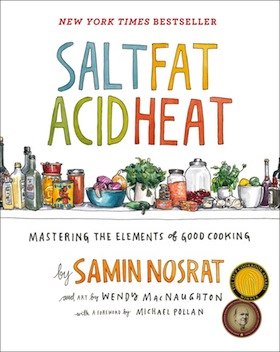
In looking for more in-depth information than is normally in a cookbook, I came across the bestseller and multiple-award-winner Salt Fat Acid Heat by Samin NosratSamin Nosrat, which was published by Simon & Schuster in 2017. The timing of my discovery was not coincidental. Nosrat’s Netflix series by the same name had recently premièred, in October 2018.

I knew there was a small Jewish connection to the book – author and food expert Michael Pollan had written the foreword. But then, the same friend who inspired my interest in the technical aspects of cooking told me she thought the illustrator might be Jewish. And, she was right! Wendy MacNaughton – whose clients include the New York Times, Wall Street Journal, Time Magazine, Bon Appetit, Gastronomica and many others, including Simon & Schuster – is Jewish. (With a name like Ramsay, I should have looked into it further right away; next time, I will.) With this added information, I could easily justify asking for a review copy from the publisher, and did.

book cover - Salt Fat Acid HeatSalt Fat Acid Heat is not a cookbook that you just pop open, pick a recipe and make it, though you could do that. There are plenty of recipes for salads, pasta, fish, chicken, meat, sweets and more. Shaved carrot salad with ginger and lime, garlicky green beans, beer-battered fish (which also contains vodka, apparently), and fresh ginger and molasses cake are top of my list to try. There are a couple hundred pages of recipes, plus some suggested menus, chefs and authors to look for online or in books, a four-page bibliography, an index and an illustrated list of kitchen and pantry essentials.

In this latter part of the cookbook, there is also a Cooking Lessons section based on the enormous amount of information Nosrat imparts in the first 200 pages about salt, fat, acid and heat. So, for example, to put what you learned about seasoning from within (salt), make spicy brined turkey breast; about emulsions (fat), pasta Alfredo; about layering acid, balsamic vinaigrette; and about preserving tenderness (heat), some scrambled eggs. Other lessons focus on timing, knife skills and improvising with leftovers.

What makes this cookbook a must-have for foodies and cooks of any level, is not only the detail into which Nosrat goes about the four elements that make for good cooking, but that, in discussing the details, she communicates and almost transfers her love of and excitement about food and cooking to the reader. It’s hard to read this book and not be tempted to head to the store to buy the umpteen types of salt that exist (who knew?) or a selection of olive oils to taste, to the market for the freshest of fruits and vegetables, or to the butcher for the best cuts of meat.

Nosrat is all about the experience of cooking – taste and taste again, and don’t be afraid to experiment. As Pollan writes in the foreword, “Even though it contains plenty of excellent recipes, this is a book concerned foremost with principles…. Master these principles, [Nosrat] promises, and you will be able to cook delicious food of any kind, in any tradition, whether a salad dressing or braise or a galette.”

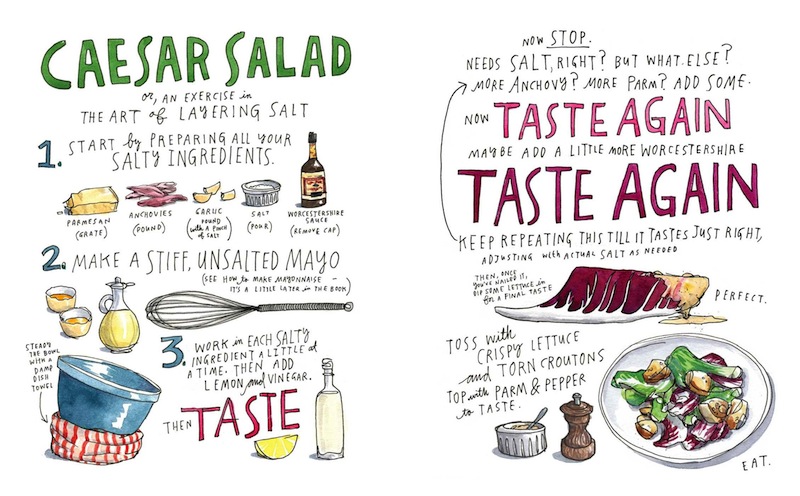
illustration - Salt Fat Acid Heat caesar salad made by Samin Nosrat, illustrated by Wendy MacNaughton
A Caesar salad, as made by Samin Nosrat and illustrated by Wendy MacNaughton in Nosrat’s Salt Fat Acid Heat.

The full-colour illustrations are critical to what makes Salt Fat Acid Heat such an incredible resource and enjoyable read. From drawings of things that don’t lend themselves easily to depiction, such as grains of salt, a chemical reaction and saffron, to making tables, charts, Venn diagrams, frying instructions, etc., more fun and easy to understand, MacNaughton helps Nosrat explain the art and science of cooking.

The size and weight of Salt Fat Acid Heat is daunting, until you open it. As Nosrat writes about how to use the book, “Pay attention to the techniques, the science and stories, but don’t worry too much about committing it all to memory. Come back again later to revisit the concepts that are relevant to you.” But, most importantly, she emphasizes, “Don’t forget to enjoy the pleasures, both small and large, implicit to cooking and eating with people you love!”

Format ImagePosted on April 12, 2019April 10, 2019Author Cynthia RamsayCategories BooksTags cooking, Samin Nosrat, Wendy MacNaughton
Young speakers deliver

Young speakers deliver

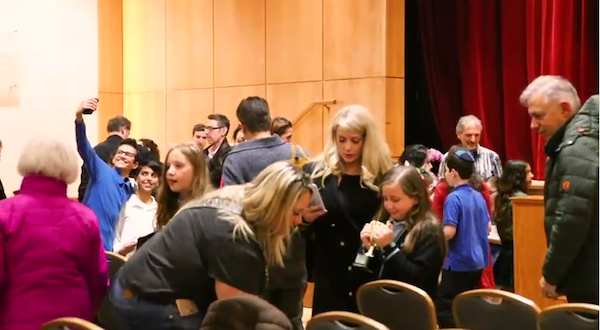
This screenshot from the 30th anniversary video of the Public Speaking Contest shows participants’ excitement. Larry Barzelai can be seen at the back of the crowd on the right.

On March 14, about 90 young participants and their families and friends, as well as volunteer judges and moderators and others from the Jewish community gathered for the annual Public Speaking Contest, presented by Jewish Federation of Greater Vancouver and State of Israel Bonds.

“This contest was established in memory of my father, Morris Black, who left money in his will to support such a contest,” Larry Barzelai told the Independent. “It has morphed from a Peterborough-based essay contest for famous people in Jewish history, to an Ontario-based essay contest, to a public speaking contest in Hamilton (run by my brother Rick) and the present public speaking contest in Vancouver. I give credit to my brother Rick, who originally came up with the idea of a public speaking contest in Hamilton, where he lives, and I started the contest in Vancouver a few years later.

“For my father, family, education and Judaism were the most important things in life,” Barzelai added. “This contest combines all three.”

This year’s Grade 4 through Grade 7 participants came from Gilpin Elementary School, Richmond Jewish Day School, Temple Sholom Religious School, Vancouver Talmud Torah, Vancouver Hebrew Academy and West Point Grey Academy. Some of the public school entrants may also attend a synagogue school.

Speeches had to run less than three minutes, but could cover any topic. Students were given a list of suggestions, such as the following: What is your favourite Jewish holiday and why? Describe a family member or someone from Jewish history and tell us why you admire them. Israel is often described as the “start-up nation” – name something invented in Israel and discuss how you think it has made a difference to people’s lives. Reduce, reuse, recycle are terms used to describe how people protect the environment – tell us about two Jewish values that you feel are connected to environmental protection. If you only had time to visit one city in Israel, which city would it be and why?

“To prepare a talk, students must conceive of a topic, organize information about that topic, and be prepared to deliver a speech to an audience of fellow students and strangers,” said Barzelai. “The preparation helps their ability to organize their thoughts in a coherent manner. Subsequently, they have to be prepared to present the information in a manner that is convincing to other people. These tasks require time and effort. After they give their speeches, they usually feel a well-deserved sense of accomplishment. What could be a better learning environment for the students and more positive experience for the families!”

Lissa Weinberger, manager of Jewish education and identity initiatives at Federation, is in charge of managing the literally hundreds of moving parts of the machine the contest has become. She provided the Independent with the list of winners for this year’s event, though the contest organizers rightfully stress that every participant is a winner for having participated and put in the work.

With the contest in its 31st year, Barzelai said, “It continues to be rewarding to watch the smiles on students’ and parents’ faces after they have given their speeches. This reflects the fact that the students have worked hard, have accomplished something valuable and are proud of themselves.”

He added, “It is also rewarding to see the children of parents who were in the contest themselves when they were in elementary school.”

Last year, to celebrate the contest’s 30th anniversary, Barzelai had a video created.

“It was hoped that the video would encourage future students to participate,” he said. “They would see that most participants seemed to enjoy their involvement in the contest, and viewed it as a positive learning experience.”

Written and directed by Adam Bogoch and edited by Thomas Affolter, the video gives a brief history of the contest, shows clips of the 2018 event and features interviews with the students, community leaders and volunteers, including Barzelai’s spouse, Rhona Gordon, who is an advisor on the project and is always on hand to help give out the awards on contest night.

This year’s awards went to, in Grade 4: Myelle Leung (1), Lia Golik (2) and Miri Grad (3) in Group 1; Miriam Ora Yeshayahu (1), Arlo Foxman (2) and Yanky Baitelman (3) in Group 2; and Naomi Bernal (1), Hannah Pressman Chikiar (2) and Jake Silver (3) in Group 3.

In Grade 5, the winners were Mira Hurwitz (1), Baila Shapiro (2) and Anne Cohen (3) in Group 1; Adina Ragetli (1), Sophie Rossman (2) and Jakob Murphy (3) in Group 2; and Sarah Malul (1), Hannah Setton (2) and Hannah Norden (3) in Group 3.

In Grade 6, winners were Chaya Malul (1), Eden Almog (2) and Tamir Gini (3) and, in Grade 7, they were Chasya Berger (1), Rivka Feigelstock (2) and Max Dodek (3).

For more about this year’s contest and to watch the 30th anniversary video, visit jewishvancouver.com/psc2019.

Format ImagePosted on April 12, 2019April 10, 2019Author Cynthia RamsayCategories LocalTags Larry Barzelai, public speaking, youth
Love starts with the self

Love starts with the self

Most of us are familiar with the concepts of “inherent worth” and “unconditional love.” But many fewer of us actually live by these precepts. Anne Andrew would like to help change that fact. She does this in her work, as well as in her new book, What They Don’t Teach in Prenatal Class: The Key to Raising Trouble-Free Kids and Teens, the launch of which takes place April 11, 2 p.m., at the Isaac Waldman Library at the Jewish Community Centre of Greater Vancouver.

In the introduction, Andrew shares, “My experience as a worried parent of a once-troubled teenager (now a well-functioning adult) and my wish to help other parents avoid the sleepless nights, debilitating fear, helplessness and despair, led me to write this book. Our family’s ordeal lasted more than six years and, during that time, we learned strategies that not only helped us survive but actually allowed us to thrive…. At the same time, I was working as a school principal and became aware of the mental health crisis that was starting to take hold in younger and younger students.” As examples, she notes that 77% of children report having been bullied at school and 80% of 10-year-old girls wish they were thinner.

Andrew was a school principal at Temple Sholom for 20 years. “It’s likely,” she writes, “that one or more of your children will face some kind of difficulty, whether it’s an eating disorder, bullying, drug addiction, depression or other mental health issue, and it is almost impossible to predict whose child that might be. You can’t always see it coming – we certainly didn’t!”

Based on what she was learning from her family’s therapist, Andrew “concluded that there is an absolute and fundamental concept that underpins healthy human life.” That concept – inherent worth – is the subject of the first section of What They Don’t Teach in Prenatal Class. Part 2 focuses on unconditional love, explaining “why it is so difficult for us to accept and own our inherent worth, then explain[ing] how this can be done and become part of your ‘way of being.’” The third part of the book discusses parenting priorities, “kindness versus grades,” and “teaches how to parent out of love – not fear.”

While targeted to parents, What They Don’t Teach in Prenatal Class is a valuable guide for anyone who has negative opinions about themselves, which, to hazard a guess, is the vast majority of us.

“Part of the reason that I named my book the way I did is that it would be ideal if parents did some of the self-work ahead of having children,” Andrew told the Independent. “That way, they’d be better prepared to face the challenges of parenting and they would have a deeper understanding of how their children pick up negative beliefs right from the beginning. They’d have a bit more time and space to think clearly about the bigger picture in terms of purpose and priorities before the baby arrives. Imagine if prenatal classes included a few sessions on this topic!”

One of the tools Andrew presents in her book is the Choose Again Six-Step Process, which was developed by Diederik Wolsak, founder and program director of Choose Again Attitudinal Healing Centre and author of Choose Again: Six Steps to Freedom. Wolsak wrote the foreword of What They Don’t Teach in Prenatal Class. In it, he notes that Andrew – who is a Choose Again facilitator – “has written a manual which draws directly from her own heroic and victorious battle with depression and her transformation of some crippling core beliefs. But, more to the point, it tells the story of two people, parents, coming to terms with what they needed to heal to become real parents. Real parents teach by demonstration. Real parents are transparent and not afraid of what they’ll encounter when they begin their own journey to removing all barriers to love.”

By healing a negative belief about ourselves, we can change our behaviour. “By following our familiar feelings, we can retrieve early childhood memories in which we can discover the genesis of our beliefs and we can begin to transform them,” writes Andrew. “You have to be in the feeling for it to work – it is a process that has to be felt, not an intellectual exercise.” In brief, when you’re upset, for example, acknowledge that you’re upset; take responsibility for the feeling – it is not your child’s fault, but rather “a negative belief that you made up in early childhood has been triggered”; focus on the feeling and identify it; remember the feeling and try to determine when you first ever felt it; once you have that memory, contemplate how you judged yourself in that moment and how you thought others judged you; and, lastly, try “to fix your mistaken belief by a process of forgiveness that replaces your mistaken belief with the truth of you – that you are inherently worthy, whole and complete.”

If loving ourselves isn’t hard enough, parenting out of love, and not fear, is as much or more of a challenge. Not blaming your children for your anger, not punishing them for acting out, etc., would seem to require infinite patience and constant self-awareness.

“If people read my book and are feeling overwhelmed, then I would say do one thing, and that is to have a gratitude practice,” said Andrew. “I have a section in the book on exactly how to do that and I know that it’ll make a huge difference. Begin with one thing and then perhaps add another.

“Awareness is half the battle, so simply being aware that young children are developing negative beliefs about themselves will be helpful in the ways you respond to your child’s behaviour. I’ve presented the concept of inherent worth as the antidote to all of these beliefs, so I have actually simplified parenting into one challenge – how to get across to our children that they are inherently worthy beings. They don’t have to establish their own worth by getting good grades or winning competitions. I’ve suggested several techniques, so parents just need to adopt the ones that will work for their family.

“Many of the things that I suggest are simple, such as remembering to smile at your children more often – put a smiley face sticker on your phone, on the fridge or on the bathroom mirror to remind you. Mindfulness can be practised at the dinner table or getting ready for bed by helping children focus on their senses in the here and now.

“Parenting is a marathon, not a sprint,” she continued, “and it is OK to take awhile to get into the stride, stumble and get back up. Parents tend to judge themselves rather harshly (we all do!) and that’s not helpful. Be gentle with yourself and know that it is impossible to make a mistake – we make healing opportunities for ourselves and our children!”

Andrew invites “parents to use the day-to-day parenting upsets as portals to self-healing so that parenting becomes a journey into self-awareness. This in turn benefits the kids enormously. When parents heal their own negative beliefs, they won’t worry about being judged by others, they won’t be drawn into competitiveness and will not need to over-program their children, so that makes life and parenting less stressful and more fun for the whole family.”

Andrew is a parenting coach, and she presents workshops in the United States, Canada and Europe. She said parents take what they can from her recommendations.

“Parents who have taken my workshops, on which my book is based, report that they have more patience, greater understanding of their children’s behaviour and their own, and the ability to communicate more effectively with their children as well,” she said. “I have been told that the methods are transformational and that was certainly my experience. One parent (Roanna Glickman) told me that she dived headfirst into self-healing using the Choose Again Six-Step Process and she has transformed her life and her kids are thriving as a result. She said, ‘It may seem like more work initially but, when you take away the power struggle, it’s way less work in the long run.’”

Andrew shared feedback from another parent, Pam Roy, who said, “Parenting isn’t about trying to do it right but about learning along the way, being authentic with your kids when we don’t get it right; making yourself better helps you be more present and aware with and for your kids.” While acknowledging that self-work is time-consuming and difficult, Roy said it is crucial and, if Andrew’s suggestions “feel overwhelming or time-consuming, that should trigger that there’s work to be done. Change aversion is there but, when these fears come up, it’s the more reason they should be looked at.”

One of the more surprising pieces of advice, perhaps, is to be careful with praise. “How many of us do what we do to win approval from our bosses, peers, spouse, other family members and even our children?” writes Andrew. “When that approval is not forthcoming we beat ourselves up wondering what we did wrong or reminding ourselves that once again we failed.”

As to how to reduce our dependency on external validations of our worth, Andrew told the Independent, “Firstly, I suggest you gradually phase out praise – it tends to be a habit so takes awhile to correct. Notice when you automatically use praise and then follow it up with a question that indicates your sincere interest in whatever it is that was praised. Praise-dependency tends to undermine the concept of inherent worth – it encourages kids to look outside themselves for their worth.

“As far as knowing how to handle praise and criticism, knowing one’s inherent worth is the way to handle praise and criticism. Neither praise nor criticism has an impact on one’s inherent worth, though it may have an impact on self-esteem. Criticism says more about the person doing the criticizing than it does about the one being criticized. Children can be taught to just say ‘thank you’ to anyone who offers them criticism (or praise for that matter). The criticism can be taken for what it is – a neutral fact to be examined or ignored – not an emotionally charged thing.”

If you can’t make the April 11 launch, What They Don’t Teach in Prenatal Class is available on Amazon, and Andrew is currently putting her workshops online so that parents can access them more easily. She said they should be available in May or June at anneandrew.com.

Format ImagePosted on April 5, 2019April 2, 2019Author Cynthia RamsayCategories BooksTags Anne Andrew, children, education, lifestyle, parenting
A further peek at Cohen’s Orfeo

A further peek at Cohen’s Orfeo

Dancers Jeremy O’Neill, Ted Littlemore and Kate Franklin. (photo by Idan Cohen)

Last May, Idan Cohen introduced local audiences to his reimagining of Christoph Willibald Gluck’s opera Orfeo ed Euridice. He will share more of this ongoing work in EDAM dance company’s Spring Choreographic Series, in which he is a guest artist, along with Jennifer McLeish-Lewis.

In six performances between April 10 and 20 at EDAM’s home at the Western Front on East 8th Avenue, Cohen and McLeish-Lewis will present new work, while EDAM, under artist director Peter Bingham, will present a directed improvisation.

“I was introduced to Peter and the EDAM family through Linda Blankstein, who I met through the DanceLab residency I took part in last May at the Dance Centre,” Cohen wrote the Independent in an email from London’s Heathrow Airport, as he waited for his flight back to Vancouver. “Among the many other roles through which Linda supports Vancouver’s arts community, she is on the board of EDAM, and was kind enough to introduce my work to Peter.

“The space and people at EDAM were very welcoming,” said Cohen, who is artistic director of Ne. Sans Opera and Dance. “Peter invited me and the performers to take his daily morning classes, and offered this wonderful opportunity for me, Ne. Sans and the artists collaborating on this piece – musicians/dancers Jeremy O’Neill, Ted Littlemore and Kate Franklin.”

The part of Orfeo ed Euridice that Cohen will showcase next week is called Trionfi Amore (in English, The Triumph of Love).

“In Greek mythology, Orpheus [Orfeo, in Greek] was a musician and a poet who had the ability to enchant all living creatures through his musical gift, and could even stop the waves of the ocean from rolling,” explained Cohen. “In an attempt to bring his newly married wife Eurydice back to life from the dead, Orfeo persuades the guardians of the underworld to allow him entry to their kingdom.

“Trionfi Amore deconstructs the key elements and motives of the story and puts it into a contemporary context. We integrate dance with a bit of live music in a piece that speaks of love, and of the power of music and art to move, entertain and touch us. We also look at the power of art to manipulate, exploring the ways in which different aspects of love can be transformed into the act of performance. I am focusing on the ‘love story’ part of the mythological tale, recreating its themes through the intimacy and fragility of the body.”

For more about Orfeo ed Euridice, see jewishindependent.ca/the-power-of-music-and-love. For tickets to one of the EDAM Spring Choreographic Series performances, visit edamdance.org.

Format ImagePosted on April 5, 2019April 2, 2019Author Cynthia RamsayCategories Performing ArtsTags choreography, dance, EDAM, Idan Cohen, Ne. Sans, opera, Orfeo ed Euridice
Story of love and second chances

Story of love and second chances

Judy McLellan as Lady Russell and Roger Monk as Sir Walter Elliot in Metro Theatre’s production of Persuasion. (photo by Tracy-Lynn Chernaske)

Who hasn’t wished for at least one do-over, a second chance? Who hasn’t made the mistake of following bad advice, even if it was well-intended?

In Jane Austen’s Persuasion, Anne Elliot falls in love with naval officer Captain Frederick Wentworth and they become engaged, but, based on the counsel of a family friend, Anne breaks off the engagement. Jewish community member Judy McLellan plays Lady Russell – the purveyor of that counsel – in Metro Theatre’s upcoming production of Persuasion, which runs until April 20.

“Lady Russell was a very close friend of Anne’s mother, who died, and she had taken the role of surrogate mother to Anne since that time,” explained McLellan. “She is very protective of Anne and felt that Anne was too young to get married, especially to a man who, at that time, had no money and no real position in society. This is why she now sees Mr. Elliot [Anne’s cousin] as a much more desirable match for Anne.”

Persuasion was adapted for the theatre by British playwright Timothy Luscombe. The Metro Theatre production is directed by Joan Bryans. McLellan, who was part of the cast of Metro’s Calendar Girls, which the Jewish Independent quite enjoyed (jewishindependent.ca/calendar-girls-now-at-metro), auditioned specifically for the role of Lady Russell. “Got a call back and then Joan offered me the role, which I was very excited to accept,” said McLellan.

Pride and Prejudice was McLellan’s “first venture into Jane Austen.”

“Loved it,” she said. “Went on to read the rest!”

About Persuasion, she said, “It’s a wonderful period piece of mid-19th century. The characters are diverse and interesting, and very reflective of society at that time. But, above all, it’s a love story, which, after all the trials and tribulations, comes to a delightful happy ending. Who wouldn’t enjoy that?!”

For tickets to Persuasion, visit metrotheatre.com.

To raise funds for building up-keep, Metro Theatre is holding a silent auction during the run of Persuasion for a painting by Tracy-Lynn Chernaske. “By tying together appropriate colours and soft textures, the painting reflects suggestions of [Jane] Austen’s historical multi-location story line, full of ships, seaside beaches, grand old manors and tidy cottages.” The opening bid is set at $300 and the winner will be announced on closing night. Bidding ballots, the artist’s bio and more information can be found at metrotheatre.com/show-persuasion-2019.

Format ImagePosted on April 5, 2019April 2, 2019Author Cynthia RamsayCategories Performing ArtsTags books, Jane Austen, Judy McLellan, Metro Theatre
Could the plague come back?

Could the plague come back?

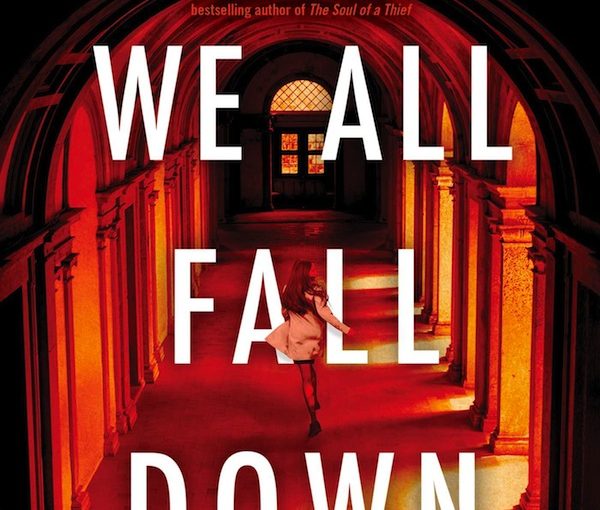
With his latest novel, We All Fall Down (Simon & Schuster, 2019), Vancouver writer and emergency-room physician Daniel Kalla covers both familiar and new territory. He once again postulates with scary enough realism what might happen if there were an outbreak of a deadly disease, but this time, it’s the plague – the same bacteria that caused the Black Death in the 14th century.

Kalla, who is head of emergency at St. Paul’s Hospital and a clinical associate professor at the University of British Columbia, will talk about his new book on April 17 at Incite: Riveting Crime Tales, presented by the Vancouver Writers Fest and Vancouver Public Library, in partnership with the Crime Writers of Canada. He will be joined by fellow Vancouverite Eve Lazarus, author of Murder by Milkshake: An Astonishing True Story of Adultery, Arsenic and a Charismatic Killer (Arsenal Pulp Press, 2018), about the murder of Esther Castellani by her husband Rene in 1965 in Vancouver, and Toronto-based Kim Moritsugu, whose latest book is The Showrunner (Dundurn, 2018), described as a “Hollywood-noir, darkly humourous suspense.”

We All Fall Down is set in Genoa, Italy. It alternates between current-day events – the site of an old monastery that has been demolished to make way for new condominiums seems to be ground zero for the reemergence of the plague – and the year 1348, when that monastery’s inhabitants are almost decimated by the Black Death, as is much of Europe. There is a link between the two outbreaks and North Atlantic Treaty Organization infectious diseases expert Alana Vaughn, called in from Belgium, is among those who must figure it out, along with a World Health Organization expert, Canadian epidemiologist Byron Menke, and Alana’s former lover, Dr. Nico Oliva, who sounded the alarm when a patient was brought into his hospital, coughing up blood and with a bubo (lump, swelling) in her armpit. The patient had been working on the construction site when she took ill and was dead soon thereafter.

The rapidity with which the plague takes a life drives the urgency to determine its sources and stop its spread. The most emotive chapters of We All Fall Down are short. Kalla briefly introduces readers to various people in the midst of tender or happy moments, who then suddenly feel chilled or choked by phlegm and blood. These scenes add meaning to the consistently provided death tolls, and personalize the suffering. Readers will empathize, and shiver.

As in his previous novels – Pandemic (Forge Books, 2005), about a fictional new flu, more deadly than SARS, and Resistance (Tor Books, 2006), about the outbreak of an antibiotic-resistant bacteria – the disease in We All Fall Down is deliberately being spread. Initially, Alana’s theory is that it is bioterrorism, but eventually the WHO-led team comes to another conclusion and the race is on to find the perpetrator.

In the mid-1300s, one-third to a half of the European population was killed within three years, a character in the novel notes – “The worst natural disaster in all of recorded history.” And the novel offers a glimpse into that horrific time via the diary of a barber-surgeon, Rafael Pasqua, who lost his wife to the plague. His story is graphic at times, and it is he who relates how Jews were attacked and persecuted, as the assumed cause of the devastation. Kalla juxtaposes this persecution and violence with that of Muslims in the modern-day instance of the outbreak, as it is first thought that Muslim terrorists might have developed the plague as a bioweapon. Despite hundreds of years of evolution, people’s fear and desperation still drive them to seek a scapegoat.

Less interesting in We All Fall Down are the romantic storylines: Alana and Nico dealing with their past relationship, Alana’s new relationship with Byron, and Rafael’s with Camilla, the daughter of a Jewish friend and fellow physician. At least the medieval love story adds some tension to the plot, as Jews become more and more at risk as the plague continues unabated. And, in truth, the relationships provide some respite from the death taking place all around the characters.

On the whole, We All Fall Down is a good read. Kalla, being an emergency physician who has researched and written about different pandemics, makes the possibility of the Great Plague resurfacing seem frighteningly possible. There are countless benefits of globalization, but it certainly makes containment of an epidemic that much harder. It is a sobering thought.

Incite events are free, but registration is required. To attend Riveting Crime Tales, which takes place in the Alice MacKay Room at the central branch of VPL downtown at 7:30 p.m. on April 17, fill out the form at writersfest.bc.ca/programs/incite/incite-form.

Format ImagePosted on April 5, 2019April 2, 2019Author Cynthia RamsayCategories BooksTags Crime Writers of Canada, Daniel Kalla, history, plague, Vancouver Public Library, Vancouver Writers Fest, VPL
Cohen dusts off tap shoes

Cohen dusts off tap shoes

Andrew Cohen takes on the lead role of Don Lockwood in Royal City Musical Theatre’s Singin’ in the Rain, which runs April 4-20. (photo by David Cooper)

“I’m excited for audiences to see Singin’ in the Rain. The film is a classic, and I hope we’re able to bring that same charm and excitement to the Massey Stage,” Michael Wilkinson told the Independent. “It is on the older side of the musical theatre canon, but I think our production – especially Andrew Cohen as Don Lockwood and Tessa Trach as Kathy Selden – do such a beautiful job at bringing these characters to life in 2019, while still keeping the familiarity and charm of the characters and story.”

Royal City Musical Theatre presents Singin’ in the Rain at the Massey Theatre in New Westminster April 4-20. For those unfamiliar with the story, Don Lockwood and Lina Lamont are silent film stars, dashing and beautiful, but their stars will fade unless they can make the transition to talkies, the new technology of the time. The studio decides to change the couple’s latest silent film into a musical but, the problem is, Lamont has a horrible voice – even listening to her talk is painful. The solution? Have her voice dubbed by aspiring actress Kathy Selden.

Filled with humour, eminently singable and memorable music – “Good Mornin’,” “Make ’em Laugh,” and, of course, “Singin’ in the Rain,” to name a few – and incredible choreography, Singin’ in the Rain is one of the most popular musicals of all time, while also being an insightful commentary on the film industry, the impacts of technology and the nature of fame.

Cohen said he was asked to audition for the role of Lockwood last fall, while he was away doing Fiddler on the Roof in Saskatchewan.

“Gene Kelly made this role, this music, famous. He is in every neuron of this show. But I am no Gene Kelly (though I sure do wish I had his moves),” Cohen told the Independent about making such a famous character his own. “I think any actor preparing to take on an iconic role like Don Lockwood needs to find where the character lives within themselves rather than trying to mimic the character’s originator.”

And Cohen has more than the chops necessary to step into Kelly’s shoes. Since the Jewish Independent featured Cohen and his wife, Anna Kuman, in 2017, when they premièred Circle Game: Reimagining the Music of Joni Mitchell – which they co-created and co-directed – the couple has been working on different projects around the world.

“We were on the mass choreography team for the Fifth Asian Indoor and Martial Arts Games opening ceremony in Ashgabat, Turkmenistan, that had us work with a cast of 8,000, not to mention aerialists, horses, dogs, camels,” said Cohen. “It was a crazy experience! I then joined the stage management teams for the Gold Coast Commonwealth Games and the Sydney Invictus Games opening and closing ceremonies, getting to work at the Sydney Opera House and along the stunning shores of the Gold Coast.”

Cohen also premièred the new musical Les Filles Du Roi, for which he had to sing in English, French and Kanienké:ha (Mohawk). “Last winter,” he said, “I reconnected to my ancestral roots in the shmatta trade by playing Motel Kamzoil the Tailor in Fiddler on the Roof at Persephone Theatre in Saskatoon. Also, being the show’s music director, this production boasted a cast full of actor/musicians and was extended four times due to popular demand.”

While he’s very excited to return home and “dust off” his tap shoes for Singin’ in the Rain, Cohen won’t be in town long. He’s “heading to Toronto, Tel Aviv and Europe this spring for a tour of the new Canadian show Charlotte: A Tri-Coloured Play with Music that chronicles the life of renowned Jewish painter Charlotte Salomon.”

Singin’ in the Rain marks Cohen’s debut with Royal City Musical Theatre.

“Both my wife and my brother have worked with them before,” he said, “but this is my first time with RCMT, so it’s lovely to get to join the club, especially since RCMT is a theatrical institution for large-scale classic musicals. Seldom do audiences (and actors alike) get to revel in the grandeur of the art form in this town than at the Massey Theatre every April.”

Cohen’s fellow Jewish community member, Wilkinson, certainly enjoys this annual tradition.

“It’s the community that keeps me coming back,” he said. “Obviously performing is very fun, but I’ve also made some great friendships through RCMT. It has become something to look forward to in April, and it’s the people that make it such a wonderful environment.”

Wilkinson is in his final year of studies at the University of British Columbia’s Institute for Gender, Race, Sexuality and Social Justice, so he’s not sure how long he’ll be able to continue performing with RCMT, but he feels “very fortunate to have been a part of five productions over the last few years.” As part of the ensemble in Singin’ in the Rain, he has more than one role.

“The Quartet,” he explained, “is a part of the number ‘Beautiful Girl,’ which is a big showgirl number that is the first ‘talkie’ by Monumental Pictures (the film production studio in the show). Typically, the number only has the tenor soloist and the female ensemble, but our director and choreographer, Valerie Easton, has added four of the male ensemble to create a quartet and have some fun partnering moments in the number. It’s really just a quick snippet of the show, and many of us in the ensemble jump around playing multiple parts. I’m also playing Rod, who is the head of the publicity department at Monumental Pictures, which has been a fun bit role.”

Wilkinson’s favourite scene, he said, “would have to be the number ‘Broadway Rhythm,’ which happens about halfway through Act 2. It’s around eight minutes long, and there is some amazing dancing and singing throughout the number. I think the audience will really enjoy it, especially once we have rehearsed it to perfection!”

For Cohen, the biggest challenge so far with the role of Lockwood has been “the sheer amount of material to learn. Don sings and dances a lot. In Act 1, he barely leaves the stage,” said Cohen. “Prepping for this show has been like training to do a marathon – every day a little further, more lines down, going over and over songs and dance breaks. That said, I grew up tap dancing but haven’t had the chance to tap professionally in a long time. It’s a real privilege getting to tap with some of the amazing tappers in this company.”

Cohen said, “It’s very exciting, seeing it all come together with the sets and the lights and the orchestra. How often do you get to sing with a real 18-piece orchestra?!”

For tickets to RCMT’s Singin’ in the Rain, visit ticketsnw.ca or call 604-521-5050.

Format ImagePosted on March 29, 2019March 27, 2019Author Cynthia RamsayCategories Performing ArtsTags Andrew Cohen, Michael Wilkinson, musical, RCMT, Royal City Musical Theatre
Hoffman’s new Crave special

Hoffman’s new Crave special

Comedian Robby Hoffman in action. (photo from Bell Media)

Onstage, her energy is barely contained. She delivers lines in a clipped, almost angry fashion, sporting a tight bun and dark clothes. From contemplating pizza’s puzzling popularity, to sharing how one customs officer saw the fire in her that she never knew she had, to musing about what it’s like to be the seventh of 10 children, the fashion choices of antisemites, her sexual prowess and the cost of duotangs, Robby Hoffman is very funny. It is no wonder that Robby Hoffman: I’m Nervous is among the new stand-up comedy specials Bell Media released last month on Crave.

Produced with Just for Laughs and Counterfeit Pictures, Robby Hoffman: I’m Nervous was filmed last September at Toronto’s Longboat Hall during the JFL42 comedy festival.

“It’s huge deal. It was always a dream of mine to have a special, to have a TV special specifically, and to do an hour,” L.A.-based Hoffman told the Independent in a phone interview from London, England, where she was doing gigs, and visiting her girlfriend, writer and director Ally Pankiw, who was there for work. In contrast to her stage persona, Hoffman was relaxed and chatty on the phone.

A lot of comedians self-produce amazing albums or routines in smaller increments of time, said Hoffman, but, “for me, in stand-up, it always felt like the pinnacle to have an hour…. It was a really great way to cap off all the work I’ve been doing since I started, and, to have an hour that was sharp, it felt like everything. And to do it with Just for Laughs, name of all names, it was everything and it was incredibly fun.”

Hoffman’s numerous writing credits include The Chris Gethard Show on TruTV, which just wrapped up last year, episodes of PBS’s Odd Squad (which has won an Emmy for writing), and CBC’s Workin’ Moms and Baroness von Sketch Show. Most recently, she wrote for eight episodes of the series Mind Fudge. The Crave special allowed her to jump back into stand-up full-time.

“To be doing stand-up night after night until this hour was great. And I had never recorded the hour all at once,” she said. “I was doing it in small increments of 10-minute spots, 15-minute spots, seven-minute spots, so when I recorded the hour, it was the first time I had done that hour. I had to nail it, working through all the themes … making sure it all cohesively worked, even though I only really worked on it in portions. So, agonizing over the different portions coming together and working on the transitions from different themes so that they flowed.”

And they do flow, somehow, despite the vast diversity of topics. She said that (apparent) randomness is a signature of hers. She uses it both to take audiences off guard, but also as part of the joke. As well, she uses it to prepare people for what’s coming. For example, she drops hints along the way to warn the audience well in advance that she will be talking about the Holocaust, so that, when she gets there, they will have been with her for some time. Then, she said, when “we’re really in the thick of it together … I’ll reward you with hand-job material or whatever.”

While Hoffman said she doesn’t have any red lines when it comes to comedy, she said, “I talk through my own experiences only. I’m never going to step into a territory that I don’t feel is mine to speak about. But, beyond that…. If it’s something within my realm of what I could talk about and you tell me not to talk about it, that’s what I want to talk about more. For instance, the Holocaust is taboo, and some people are really offended by [jokes about] it. I feel, as a Jew, I’m reclaiming it and, if you’re telling me not to talk about it, I’m going to.”

She said, “I think that Jewish people can talk about Jewish experience. I think black folk can talk about black experience. I don’t think there’s anything off limits within the Jewish community for me. I do think everything is off limits to me with regards to communities I’m not a part of or I don’t have a firsthand experience. My comedy is very firsthand – I’m not doing observational humour that are these one-liners that can relate to anyone. My comedy is unique, such that I’m the only person who could say my comedy…. You hear of big comedians having writers – I don’t feel like that would work for me simply because my comedy is so personal. I’m the only person who can write my own comedy.”

And Hoffman’s background is unique, indeed. Born in Brooklyn, she grew up in Montreal, where her mother raised her and her nine siblings as a single parent, having divorced Hoffman’s father and having left the Chassidic community. Hoffman came out as lesbian in her late teens, left home at 18 and kept kosher until about the same time. She started her working career as an accountant.

“I wanted to have a Plan B,” she explained, “and I knew that the arts was always something free, that if I wanted to do it, I could do it on my own, and I could find a way that wasn’t with the structure of school to do it. But a financial backup plan was not something as easily attained for me, so I went into accounting. I thought, well, I can always get a good job.”

With a laptop from her employer and a regular paycheque every two weeks, Hoffman said, “I felt like a billionaire. I can’t even explain what it was like…. It was just the best to be able to sleep at night. Being worried about money is not something a lot of my peers thought about. I felt very alone in that sort of stuff.”

Once she “felt safe and comfortable,” that’s when her “creative juices went wild,” she said, and that’s when she discovered stand-up.

“I didn’t grow up with it, I wasn’t somebody who had the albums and all this stuff, but, once I knew about it, I immediately thought, ‘Oh, I feel like I could do that.’ I don’t mean to say, ‘Oh, it looks easy.’ A lot of people think they could do it – I felt like it was me. I felt, ‘Oh, my God.’ It felt like me already. And I got started immediately.”

Thinking that all stand-ups wrote, she started writing. Noting that it was only later that she realized how little comedians also write, she said, “I wrote a pilot and, even though it never got made, it did get me rep and it got me writing on other shows and it started my writing career. But it’s amazing how many times I’ve been the only active stand-up and writer in a writers’ room, which I didn’t know.”

Hoffman is driven by her love of the work.

“What’s so incredible about doing what I do and making a living doing what I do is … I never imagined it possible. I didn’t know these careers as careers. I didn’t know writing was even a thing, let alone what you got paid for a script, nothing like that. But waking up and not dreading where I go to work every day is still something I don’t take for granted.”

She started as a writer’s assistant. “I was first one in, would get there early, have my coffee, enjoy. I was last one out. I was never more motivated – and it’s still to this day. I would have to be literally on death’s door not to go into work because I love it so much.

“I’m also really lucky in that the shows that I do work on, I choose to work on them for a certain reason. There’s something about them that either gives me growth or it gives me a challenge or I really just love it. And it’s a pleasure to work creatively all day, every day, and to be valued for it.”

As for what lies ahead, Hoffman said, “I have so many goals. Think of the biggest goal you can imagine, and that’s what I have for myself. Yes, my own show. Yes, who knows, my own studio. I don’t even know where it could go. I just want to try for the biggest, best thing. I want my life to be as much as I want it to be. There’s no limit on wanting that for yourself. There shouldn’t be a limit on dreaming. I never want to lose that.

“I almost, for a second, lost my childhood curiosity and dreaming and spirit, for a second, because, when you are poor and you want to be normal, and you want to make ends meet, you do give up a lot, and I was never somebody who was able to dream. We weren’t told to dream, we weren’t taught to dream, we weren’t taught we could be anything we wanted to be, almost nothing. There was not a lot of encouragement, so I gave that all to myself…. I always want to tell myself to reach for the biggest, best, whatever that is, and that changes for everyone. Within my career and within my capabilities, I want to continue growing forever.”

Format ImagePosted on March 29, 2019March 27, 2019Author Cynthia RamsayCategories TV & FilmTags comedy, Robby Hoffman, stand-up
Glory tour starts soon

Glory tour starts soon

The original cast of Glory. (photo by Barbara Zimonick)

I hope Glory inspires audience members to look up the Preston Rivulettes and learn how amazingly driven, committed, skilled and bad-ass these female hockey players were,” Advah Soudack told the Independent.

The Rivulettes were entered into the Canadian Hockey Hall of Fame in 1963. According to the website of the Rivulettes Junior Hockey Club, “The team played an estimated 350 games between 1930 and 1940, tying three and losing only two. In that 10-year span, the Rivulettes were 10 times the winners of the Bobbie Rosenfeld Trophy that was presented each year to the champions of Ontario. They were also six-time winners of the Eastern Canadian championship and the Elmer Doust Cup that went with it. They won the trophy each time they competed for it. The team’s crowning achievement was capturing the Lady Bessborough Trophy as Canadian champions no less than six times.”

“Their determination, their courage, their fight and their passion” were what inspired Tracey Power to write Glory, which starts its touring run March 29-30 at Kay Meek Arts Centre in West Vancouver.

Power was also interested in 1930s Canada, which “presented many personal challenges, a national depression, the growth of international hatred that would ultimately become the Second World War, and how those international relations greatly affected Canadian multicultural relations, antisemitism and sexism, to name just a few.

“Through hard times,” she said, “we often turn to sport or entertainment for escape, for community and for strength. For me, the women on this team and their coach represented not just a team of hockey players, but a country fighting to survive.”

Glory premièred last year, and the touring production brings with it some changes, including two new actors, Andrew Wheeler as the team’s coach, Herb Fach, and Soudack as the character Marm Schwartz.

photo - Tracey Power
Tracey Power (photo from Gateway)

“The choreography grows and strengthens with every run,” said Power of other changes. “I’m a huge believer in trying new ideas, and the more detailed we can be in our storytelling, the more exciting it will be for our audience. There may be some new text ideas that come out of rehearsal. I’m always open to a new play exploring new territory each time we go back into rehearsal.”

Kate Dion-Richard reprises her role as Helen Schwartz.

“Tracey reached out to me a couple of years ago to play the part of Helen in a workshop and reading for the show,” said Dion-Richard. “A few months after the workshop, I auditioned formally for the role. That included reading a couple of scenes, as well as taking part in a group dance call. The dance was a new style of ‘swing-skate’ that Tracey had created, which incorporated swing dance moves of the 1930s with hockey skills and plays.”

It is not an accident that Jewish community members have been cast as the real-life Jewish sisters.

“Marm struggles with being able to get the education she wants because of quotas universities had at the time; she fights back against antisemitism and must find ways to deal with her anger both on the ice and off. Helen is confident in her femininity and struggles to figure out how such an aggressive sport fits within the expected view of a woman of that time. It has always been important to me to have Jewish actors play these roles,” explained Power.

“During the development of the play,” she said, “the conversations we had were instrumental in bringing the characters’ truths to the stage. I am not Jewish, but it’s my duty as the playwright to understand the souls and bones of these women and what they went through. I’m extremely thankful to Kate Dion-Richard, Gili Roskies [who played Marm last year] and Advah Soudack for being so open and honest with me about their own Jewish history.

“Bobbie Rosenfeld was one of the most famous Canadian athletes of the 1920s/30s,” she added. “She was an Olympic gold medalist and, among many other sports, played hockey for the Toronto Pats. She inspired many women to follow their athletic dreams – including Hilda Ranscombe, who was the Hayley Wickenheiser of the Preston Rivulettes – and, much like Marm, she also fought against antisemitism in her sport and life.”

“The awareness of, frustration and personal experience with antisemitism are a big part of Marm’s storyline and journey in this show,” said Soudack. “I personally have not experienced the extent of antisemitism that Marm experiences in this story, however, my close family members have, and I can understand and imagine what it would be like. I feel that I bring my strong sense of Jewish identity to the role of Marm, with all its deep-rooted traditions and expectations. I also share and connect with the concern and, at times, discomfort Marm feels with being Jewish in a world where antisemitism lingers right around the corner.”

photo - Kate Dion-Richard
Kate Dion-Richard (photo from Gateway)

Dion-Richard, whose Jewish side of the family is from London, England, grew up hearing stories of living through the war from her grandparents. “Those stories stay with me and in many ways is why this role is so close to home,” she said. “Although Helen is Canadian, the antisemitism felt in Canada in the 1930s was strong and I am able to connect to that through my family’s experiences. Also, on a lighter note, I married a man who isn’t Jewish and so did my character, so that’s a nice similarity.”

And there are other connections for Dion-Richard, who was a hockey fan before taking on this show. “My large extended family of Richards are huge Montreal Canadiens fans due to our distant cousin Maurice Richard (‘The Rocket’),” she shared, “and I grew up on the West Coast, so the Canucks were frequently on the television at home. I have definitely become more of a fan since doing this show – especially of women’s hockey. The Canadian women’s team is incredible and I’d love to meet them and chat about their experiences as women in a traditionally male-dominated sport. I’d also love to know if they know about the Rivulettes!”

Soudack admitted to not having been much of a hockey fan before she started her research and work on Glory. “My husband is a big fan, so I always hear him talking about it, and get dragged onto his computer to watch videos of amazing plays and goals,” she said. However, since Glory, she has become more interested in the game. “I recently went to Thunderbird Stadium to watch the UBC Women’s Hockey playoffs,” she said. “Their commitment, drive and talent were inspiring. I was moved to tears as I sat there, thinking of Hilda, Nellie [Ranscombe], Marm and Helen, realizing and deeply understanding why they loved the game so much.”

photo - Advah Soudack
Advah Soudack (photo from Gateway)

About sports and the relevance of the Rivulettes’ experiences for today’s audiences, Soudack said, “It still feels the same, in regard to women not having the same opportunities and not really being seen as equals to men in athletic ability. I find it sad that young girls can fall in love with a sport and be exceptional at it, like Hilda Ranscombe; however, there is no future career they can look toward. Once the war was over, women’s opportunity to play sports vanished, whereas the men’s opportunities and careers took off.”

“Women not only had to fight for ice time – often having to play and practise in the very early hours or very late hours of the day; essentially when the men didn’t need the ice – but they also had to fight to be taken seriously,” said Dion-Richard. “Many of the reports of the women’s hockey games included remarks about the apparent lack of femininity within the game and some even questioned the sex of the players because of how aggressive the women were. Also, women were unable to be professional hockey players. The men were paid and the women weren’t. As a woman living in 2019, I still see the need to fight for equality with pay, representation and respect.”

Directed by James MacDonald, Glory has some minor profanity and is recommended for ages 9+. The Western Canada Theatre production – which includes Katie Ryerson as Hilda and Morgan Yamada as her sister, Nellie – heads to Gateway Theatre in Richmond April 4-13 after the March 29-30 Kay Meek shows, then to Capitol Theatre in Nelson April 16, Vernon’s art centre April 18 and Coquitlam’s Evergreen centre April 23-27. It also travels to Ontario, where it plays in several communities over the course of a few months.

“I’d love to add that this show has something for everyone,” said Dion-Richard. “The Canadian history is so important to know, as well as the fight for respect and equality that these women pushed for. They really paved the way for all of us and I hope we can show how grateful we are to them for that. This is a show that could be a link for people who don’t normally go to the theatre. It fuses sport and theatre with Canadian history, and the story is as relevant today as it was in the 1930s.”

Format ImagePosted on March 22, 2019March 20, 2019Author Cynthia RamsayCategories Performing ArtsTags Advah Soudack, cultural commentary, dance, history, Hockey, Kate Dion-Richard, Rivulettes, Tracey Power, women

Posts pagination

Previous page Page 1 … Page 48 Page 49 Page 50 … Page 84 Next page
Proudly powered by WordPress