Skip to content
  • Home
  • Subscribe / donate
  • Events calendar
  • News
    • Local
    • National
    • Israel
    • World
    • עניין בחדשות
      A roundup of news in Canada and further afield, in Hebrew.
  • Opinion
    • From the JI
    • Op-Ed
  • Arts & Culture
    • Performing Arts
    • Music
    • Books
    • Visual Arts
    • TV & Film
  • Life
    • Celebrating the Holidays
    • Travel
    • The Daily Snooze
      Cartoons by Jacob Samuel
    • Mystery Photo
      Help the JI and JMABC fill in the gaps in our archives.
  • Community Links
    • Organizations, Etc.
    • Other News Sources & Blogs
    • Business Directory
  • FAQ
  • JI Chai Celebration
  • JI@88! video

Recent Posts

  • Story of Israel’s north
  • Sheltering in train stations
  • Teach critical thinking
  • Learning to bridge divides
  • Supporting Iranian community
  • Art dismantles systems
  • Beth Tikvah celebrates 50th
  • What is Jewish music?
  • Celebrate joy of music
  • Women share experiences 
  • Raising funds for Survivors
  • Call for digital literacy
  • The hidden hand of hate
  • Tarot as spiritual ritual
  • Students create fancy meal
  • Encouraging young voices
  • Rose’s Angels delivers
  • Living life to its fullest
  • Drawing on his roots
  • Panama City welcoming
  • Pesach cleaning
  • On the wings of griffon vultures
  • Vast recipe & story collection
  • A word, please …
  • מארק קרני לא ממתין לטראמפ
  • On war and antisemitism
  • Jews shine in Canucks colours
  • Moment of opportunity
  • Shooting response
  • BC budget fails seniors
  • Ritual is what makes life holy
  • Dogs help war veterans live again
  • Remain vital and outspoken
  • An urgent play to see
  • Pop-up exhibit popular
  • An invite to join JWest

Archives

Follow @JewishIndie
image - The CJN - Visit Us Banner - 300x600 - 101625

Byline: Cynthia Ramsay

A wonder-full evening

A wonder-full evening

Illusionist Vitaly Beckman can seemingly change a driver’s licence photo. To witness the feat in person, check out his June 5 show at the River Rock Casino. (photo by Galina Sumaneeva)

“I rarely have a chance to perform in my own town, so it’s a privilege and I am really looking forward to it,” illusionist Vitaly Beckman told the Jewish Independent about his June 5 show, Vitaly: An Evening of Wonders, at the River Rock Casino, which is a fundraiser for Richmond’s Beth Tikvah Synagogue.

Beckman is constantly performing on the road. “My favourite trip was to Puerto Montt, in Chile – I got to perform in a beautiful theatre situated right over a lake and witness some breathtaking views,” he said. “Other recent highlights include doing an off-Broadway run last summer. I was performing eight shows a week for 16 weeks straight. It was surreal to see my own face appear on the Times Square buildings, and was a dream come true.”

Every show is unique, he said. And, in every show, “there are things that do not go according to plan, and I have to adjust and improvise. Especially when I invite audience members up on stage, you never know what to expect. It’s part of the fun and makes it more interesting and memorable.”

This is one of the reasons Beth Tikvah asked Beckman to perform.

“The synagogue wanted to try something unique and different from the usual,” board member Allan Seltzer told the Independent. “We wanted to be able to invite congregants, Jewish community members and the general public of all ages to an exciting ‘evening of wonders.’”

Magician Stephen Kaplan will also perform on June 5.

Noting both performers’ “great stage presence and showmanship,” Seltzer said, “Vitaly emigrated from the former Soviet Union as a boy and has been wowing audiences with his world-class show for over 15 years. Vitaly has appeared on television around the world and recently fooled Penn and Teller on their WB televised show.”

Beckman told the Independent he is always coming up with new illusions, but that he needs to section off parts of the year to actually work on them. “I find that I need no distractions in order to create new material, as the creative process requires an absolute focus and to think of nothing else,” he said. “Oftentimes, I take the summers off to do that, and sometimes find small breaks in between shows.”

As for Kaplan, Seltzer said he “has been performing and entertaining audiences across B.C. for over 25 years. His unique brand of illusions and comedy make him the ideal opening act for Vitaly.

“Both artists are Jewish and are proud to be assisting Beth Tikvah for this special evening,” he said.

Also participating in the evening’s entertainment will be emcee and fellow community member Howard Blank, who, said Seltzer, “is known throughout B.C. for his vast philanthropic work on stage at over 50 galas and events annually … [and] has been bestowed with the Sovereign’s Medal for Volunteers by the governor general in Ottawa. Howard celebrates his Jewish Vancouver roots by donating his time to numerous Jewish events, including the JCC Sports Dinner, Chabad, Talmud Torah and our Evening of Wonders.”

Funds raised from the River Rock show will be put toward Beth Tikvah programs and services, which include a preschool, religious school, social and educational youth programs, adult education, Jewish holiday programming, conversion classes, Israel programming, interfaith panels and lifecycle events, said Seltzer. He added about the youth activities that “many of our participants are Jewish children and youth who are in public schools, and their only exposure to Judaism and the Jewish community is through our youth and religious school program.”

VIP ticketholders will get a chance to meet Beckman after the show and sponsors will be recognized in the evening’s program, said Seltzer.

As for what the audience can expect, Beckman said, “They will witness art coming to life – photos will come to life, drawings come out of a page and even their face will disappear on their own driver’s licences. If they like, the photo on their ID will be replaced by another face, whoever’s they choose. It has never been done before by anyone else. There is also a new piece, dedicated to Salvador Dali, whose work also inspired some of the visuals in the show.”

For tickets to Vitaly: An Evening of Wonders, visit ticketmaster.ca or call Beth Tikvah at 604-271-6262.

Format ImagePosted on May 17, 2019May 16, 2019Author Cynthia RamsayCategories Performing ArtsTags Beth Tikvah, fundraiser, Howard Blank, magic, philanthropy, Stephen Kaplan, Vitaly Beckman
You can choose own family

You can choose own family

The cast of Arts Umbrella’s production of James and the Giant Peach includes Teilani Rasmussen (as Ladahlord), left, and Sophie Mercier (as James). (photo by Tim Matheson)

“Well, maybe it started that way. As a dream, but doesn’t everything. Those buildings. These lights. This whole city. Somebody had to dream about it first. And maybe that is what I did. I dreamed about coming here, but then I did it.”

Roald Dahl (1916-1990) wrote some of the most-known children’s books, including The Gremlins, Charlie and the Chocolate Factory, Fantastic Mr. Fox, Matilda and, published in 1961, James and the Giant Peach, from which the above quote comes. Still as relevant as ever, and adapted into a musical about a decade ago, James and the Giant Peach is “wildly entertaining,” director Erika Babins told the Jewish Independent in an interview about Arts Umbrella’s Expressions Theatre Festival, May 17–25. “The music is written by Benj Pasek and Justin Paul, who wrote the music for La La Land, The Greatest Showman and Dear Evan Hansen, to name a few. I find I always have at least one of their catchy songs stuck in my head. There’s also puppets!” she said.

James and the Giant Peach is one of four productions featured in the festival. The others are Peter Pan (by J.M. Barrie), Animal Farm (adapted by Nelson Bond from the novel by George Orwell) and Into the Woods (music and lyrics by Stephen Sondheim, book by James Lapine).

“Choosing the Expressions Theatre Festival shows is an involved process that starts at least a year in advance. We’re already choosing shows for our 2020 festival,” said Babins, who is a member of the Jewish community. “Each troupe director is responsible for choosing the show their troupe will perform.

photo - Director Erika Babins
Director Erika Babins (photo from Arts Umbrella)

“As directors, we keep in mind the strengths and areas of growth we see within our cast,” she said. “We want to ensure that the skills students develop throughout the year build upon or differ from those we explored in past years. For shows, we want to choose something that can challenge and engage our students throughout the rehearsal process. At the same time, we want to select shows that will appeal to our audience, which includes a large number of students who attend school matinées that run along with our public performances.”

The Arts Umbrella promotional material summarizes the plot of James and the Giant Peach: “When James is sent by his conniving aunts to chop down their old fruit tree, he discovers a magic potion that results in the growth of a tremendous peach … and launches a journey of enormous proportions. Suddenly, James finds himself in the centre of the gigantic peach, among human-sized insects with equally oversized personalities. After the peach falls from the tree and rolls into the ocean, the group faces hunger, sharks and plenty of disagreements. Thanks to James’ quick wit and creative thinking, the residents learn to live and work together as a family.”

“I chose James and the Giant Peach for myriad reasons,” Babins said. “Last year, the Junior Musical Theatre Troupe performed Guys and Dolls, a classic musical with a lot of realism. James and the Giant Peach is pretty much the opposite of that: it’s a contemporary show written with lots of theatricality and wonder. I also find the themes in the show particularly universal for the age range of 13-to-16-year-olds who perform in the show. In the musical, the theme of chosen family comes up a lot – the idea that you have the right to surround yourself with people who make you feel safe and happy, and that you’re allowed to distance yourself from those who make you feel bad or hurt you.”

Babins has been working at Arts Umbrella as the choreographer for the Senior Musical Theatre Troupe since 2012, and she began teaching in the general and yearlong theatre programs in 2014. “We started the Junior Musical Theatre Troupe just two years ago and the original director is taking a leave of absence, so I was asked to helm this production,” she said. “I was more than happy to take on the role.”

Playing the role of James in the Arts Umbrella production is 15-year-old Sophie Mercier. “She brings both a maturity and an emotional vulnerability to the role, which James needs to have in order for the audience to care about his journey,” said Babins.

When asked about the most fun aspect of this production, Babins said it was “playing into all the theatrical moments.”

“The show is a play within a play, with the narrator introducing us to all the characters and themes at the beginning of the show. We have a lot of fun breaking the fourth wall and bringing the audience in on the magic of theatre,” she explained.

As for the most challenging part, she pointed to the set changes. “We have some big and elaborate set pieces,” she said, “and I often ran out of hands to move them around the stage. But I think we have found some clever solutions to those challenges.”

The Expressions Theatre Festival opens and closes with Into the Woods (May 17 and May 25, 7 p.m.), which runs a few times during the festival. James and the Giant Peach will be performed twice: May 19, 4 p.m., and May 23, 7 p.m. For more information about the festival and the full performance schedule, visit artsumbrella.com/expressionstheatre. Tickets start at $12 and the shows take place at Waterfront Theatre on Granville Island.

Format ImagePosted on May 10, 2019May 9, 2019Author Cynthia RamsayCategories Performing ArtsTags Arts Umbrella, education, Erika Babins, musicals, theatre, youth
The time is right for comedy

The time is right for comedy

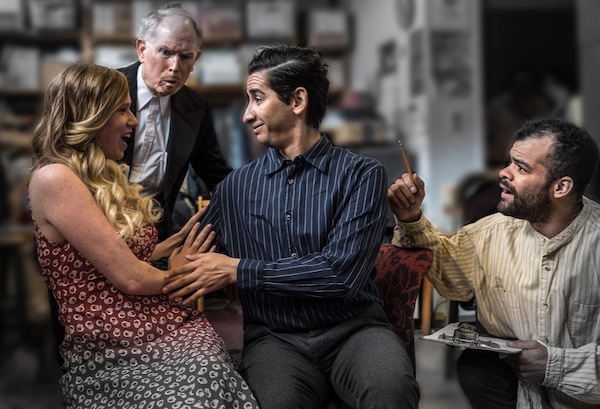
Adam Olgui, centre, stars in Theatre in the Raw’s production of Enter Laughing, which opens May 9 at Studio 16. (photo from Theatre in the Raw)

“The show has everything you could ask for: comedy, romance, great music and a great message at the heart of it, without taking itself too seriously,” actor Adam Olgui told the Independent about Theatre in the Raw’s latest production, Enter Laughing.

Enter Laughing opens May 9 at Studio 16. It is directed by Theatre in the Raw artistic director Jay Hamburger.

“It is time,” Hamburger told the Independent, “for this 25-year-old theatre company – that has toured parts of B.C., Alberta, Saskatchewan and Manitoba and resided primarily in Vancouver – to do a full-blown comedy: Enter Laughing by Joseph Stein of Fiddler on the Roof fame.

“We just finished producing the intense Incident at Vichy, dealing with the systematic arresting and putting away Jews for ‘processing’ in the occupied part of France during the Second World War, all part of the Holocaust,” explained Hamburger. (See jewishindependent.ca/miller-play-remains-relevant.) “The Stein two-act play is a positive challenge for an independent theatre company to spread its wings and take on a comedy with lots of fun, and universal and Jewish humour inherent in it. The characters are searching for love, relationships and something positive to do with their lives, and there are some wonderful, gentle yet funny, scenes that can melt the heart through very good acting, with the fine talent on board.”

Stein’s play is an adaptation of the 1958 semi-autobiographical novel Enter Laughing by actor, writer and comedian Carl Reiner, said Hamburger. “Reiner co-wrote and acted on Caesar’s Hour and Your Show of Shows, and formed the comedy duo with Mel Brooks for the 2,000-Year-Old Man. He has acted in numerous films, such as The Russians Are Coming, the Russians Are Coming. Reiner, at 97, is one of the oldest celebrities still active, and has been honoured countless times, including receiving the Mark Twain Prize for American Humour in 2000.”

Olgui won the lead role of David Kolowitz.

“During the audition process,” he said, “I read for a few different roles including David, Marvin and the Foreman. Auditioning for Jay is always fun because he doesn’t limit himself to ‘traditional casting’ and he approaches the audition process with an open mind. And the same can be said for the rehearsal process as well. Jay is an extremely humble and gracious director and he lets his actors bring their ideas to the table, which isn’t always the case in this industry.”

Olgui described David as “a young guy who dreams of being an actor but he’s caught between the desire to make his parents happy, while also wanting to pursue his passion. David has an eye for the ladies, but he’s got a heart of gold. He’s a storyteller with a bad habit of telling tall tales, but he’s also honest to a fault. All of which makes for some interesting situations along his journey.”

There are several aspects of David’s character and story to which Olgui can relate.

“We’re both young Jewish men pursuing acting careers despite the sticky situations it gets us into. And, while most of David’s situations are stickier than my own, I’ve been in a number of situations that have required a fair bit of explaining and negotiating on my part,” said Olgui. “Like David, I can relate to the late nights, the Jewish mother, the tough family conversations, the proverbial Jewish guilt – all this, and much more, firsthand. But, as wild as the situations sometimes get, at the heart of it, David’s story is that of a young man chasing after his dreams, and I think that’s something anyone and everyone can relate to.”

As a young actor, though, Olgui admitted that he wasn’t that familiar with Reiner’s work before taking on the role in Enter Laughing. “I had seen a few hilarious Sid Caesar skits…. But, being in this play and researching the man behind the character has really given me the opportunity to discover more of Carl Reiner’s works and the comedy legend that he truly is.”

Reiner was an associate of Stein, Brooks, Caesar, Dick Van Dyke and other well-known creative sorts out of New York and Hollywood, said Hamburger. “This play in particular was originally written in the early ’60s and then revised in the mid-’80s and I think it’s a good show to do at the moment,” he said. “It’s our first large comedy production in a long time and, at times, audiences need to laugh and have a bit of comic uplift.”

Hamburger added that Enter Laughing has special meaning for him, as “it was the first professional piece of theatre I did (as an apprentice) way back in the 1960s with the Cleveland Playhouse at their yearly Chautauqua, N.Y., festival. What a wild and crazy and fun play to break into the art performance form as an apprentice.”

As to its continued relevance for today’s audiences, Hamburger said, “With the play Enter Laughing, we get a chance to see a young man in the late 1930s of low income starting to follow a dream he has of becoming an actor. He has an inspiration that he wants to be an actor, though has little to no idea of what even being in a play entails. There are a number of trial and errors that he goes through on his journey to get on the stage with a role in hand, as well wanting to hold onto a girlfriend who has helped him reach beyond his low-income neighbourhood.

“Surely, in 2019, there is many a young person looking for a career or working on a hunch of what truly interests them, and moving forward with what it is they really might want to do. Surely, in 2019, there are young and old peoples who go for their dreams, having little idea of what it all might entail, or how it all might work in terms of the craft or job they seek to do. Yet they take the plunge, learn and enjoy what the craft or business is about and find solace, enjoyment and purpose with that choice(s) in life.”

In sum, Hamburger said Enter Laughing “is a fine story that gives faith and courage to those with dreams, seeking to make their inspirations and likes come true.”

Enter Laughing previews May 8, and runs from May 9 to 19. For tickets, visit theatreintheraw.ca.

Format ImagePosted on May 3, 2019May 1, 2019Author Cynthia RamsayCategories Performing ArtsTags Adam Olgui, Carl Reiner, comedy, Jay Hamburger, Studio 16, theatre
Creating pause and reflection

Creating pause and reflection

“Wink Wink – Whatcha Looking At?” by Shira Gold.

Shira Gold’s photographs seem to create a break in the space-time continuum. For a moment, the busyness and noise of the world fades away, and the viewer is standing on a beach watching the light and shadows of the clouds over the ocean, or in a snowy field, inhaling the crisp, cool air. A quiet contentment, a sombre joy.

Gold is one of some 30 artists joining the West of Main Art Walk for the first time this year. More than 60 artists will open their homes or studios to the public over the Mother’s Day weekend, May 11-12. Several other Jewish community members are also participating, including Michael Abelman, Olga Campbell, Pnina Granirer, Lauren Morris and Rae Maté, some of whom have been involved from the beginning in what used to be called Artists in Our Midst – Granirer co-founded the walk with Anne Adams in 1993.

“Crissy Arseneau and I were invited to join in by our All Together Collective partner painter Amy Stewart,” Gold told the Independent. “We are reuniting at Amy’s studio on Granville Island for the weekend of the walk. I chose to participate because showing locally is something that is important to me. The walk is a unique way to see the immense talent of creators that live in our city. The types of work being shown will be so diverse, crossing many mediums, and the artists vary from emerging to seasoned Vancouver talent. I also love the idea of being able to visit artists in the spaces they create their work in.”

While there is a preview exhibit and sale on May 9 at the Roundhouse Community Centre, with donated artwork being sold to raise money for Coast Mental Health’s art programs, some artists are raising money for other projects over the weekend. Granirer, for example, is offering her works at 50% off as a fundraiser for Stand Up for Mental Health, which was started by her son, David Granirer, to help reduce the stigma surrounding mental health, among other things. Gold will be selling her fabric-based prints May 11-12, with proceeds going to the Children’s Arts Umbrella Foundation in honour of her mother, Melanie, z’l, “paying tribute to her work in helping shape the school in its early years.”

Growing up, Gold took classes in various visual and performing arts at Arts Umbrella. “I was introduced to photography at Arts Umbrella in my early teens, when they began courses in film photography and darkroom,” she said. “As a child, words and pencils often failed me. Capturing and making images was a way for me to express my view of the world. Having a camera in hand changed the trajectory of my life.”

However, Gold said, “I pushed pause on photography for several years and turned my attention towards fashion design. I worked in design and manufacturing in Montreal, which ended abruptly when my mother was diagnosed with cancer. I took on the role as her caregiver for three years, until her passing. During that time, she and I began to recognize the immense need for patients and caregivers to learn how to engender support around their illnesses, learn advocating strategies and engage in mind/body medical tools to help support a positive mindset through health challenges. We began to develop offerings to meet these needs.

“My mom passed away before this was fully realized. Along with my husband, I gleaned the knowledge through personal experience, as well as course work at the Benson-Henry Institute for Mind Body Medicine at Harvard’s continuing medical classes … to write and complete a workbook/guidebook entitled Choosing Joy’s Empowerment Index. Not long after completing the book, I became pregnant with my first child. It was a time of great introspection. I began to recognize that the pursuit of Choosing Joy was a way for me to keep my mom’s memory alive and not a personal pursuit and decided to change paths. We chose to donate the books created to nonprofits that could share them with people in need.”

photo - “Longing” by Shira Gold
“Longing” by Shira Gold.

About her choice of a new path, Gold said, “Care-giving, grief, new motherhood – those collective experiences reshaped my outlook on how I chose to spend my days and I was ready to begin to deconstruct and share my experiences with others in the hopes of creative dialogue around common issues of struggle and transition. I started my first major body of work – ‘Reflect, Transform, Become’ – as I was preparing to welcome my second child.

“Shot over several years, taking a handful more to complete, the series of 18 women documents the trials and metamorphoses that come with new motherhood, as well as the challenges of experiencing new life without my mother in it,” she said. “This reclaiming of my visual voice shaped my identity as I settled into motherhood. The release of this work was a turning point in my life.”

“Reflect, Transform, Become” has been recognized with honourable mentions from the International Photography Awards and the Julia Margaret Cameron Awards. Her series “Good Grief,” which she describes as “a visual dissertation of my grief journey,” has had selections shown in Italy, Greece, the United States and here in Vancouver. Locals will recognize many of the places Gold has photographed.

“In fact,” she said, “the majority of my work is shot within 10 minutes from my children’s school. Some may perceive the limitations of time and spaces as prohibitive to their creative process, but I like to look at it as an advantage. My reality creates parameters which have enabled me to hone my eye and find moments that are meaningful to me, often minute and fleeting.”

As for the ways in which Judaism or Jewish community influence her approach, Gold said, “I think our culture, our religion, encourages reflection – personal reflection, reflection of our people and their struggles. There are built-in meditative moments in our prayers, in our holidays, in our services, to give us space to look inward. To learn and to digest our past and what has been is a large component of my work. As Jewish people, we actively choose in our times of joy to remember our hardships and, in our times of hardship, to find joy – I am mindful of this as I work and in life.”

In her artist’s statement, Gold writes, “I create portraits rich with emotion, conveying moments saturated by our struggles with grief, identity and change.” But what about the quiet joy that those portraits also convey?

“You are absolutely right,” she acknowledged, “there is pause (stillness) and calm in my imagery. It is intentional; as one who lives my days with a busy mind, there are few things that create pause and reflection. I also have found that, in my grief journey, my mind had made space for pause, for reflection and my world felt very desaturated and vacuous. Those moments were translated in my imagery through the various series documenting my pathways through this terribly difficult process of loss.

“I have been largely directed over the last decade by lyrics of a song by the band Frou Frou – ‘There’s Beauty in the Breakdown.’ Here is a little selection from the song: ‘So let go / And jump in / Oh well whatcha waiting for / It’s all right / ’Cause there’s beauty in the breakdown / (So let go) yeah let go / And just get in / Oh it’s so amazing here / It’s all right / ’Cause there’s beauty in the breakdown.’

“Sometimes, in the deep struggles and darkest moments, beauty abounds. It may shake us and break us down,” she said, “but, if open to it, there is an incredible opportunity to witness the heights of compassion, love, expectance, transformation, connectedness and joy.”

To see Gold’s work and to inquire about purchases and commissions, visit shiragold.com or @shiragoldphotography on Instagram. For the West of Main Art Walk schedule, a preview of this year’s artists and the studio map, go to artistsinourmidst.com.

Format ImagePosted on May 3, 2019May 1, 2019Author Cynthia RamsayCategories Visual ArtsTags Artists in Our Midst, photography, Shira Gold, West of Main Art Walk
Complex, funny, beautiful

Complex, funny, beautiful

Dylan Floyde (Willy), left, and Stephen Aberle (Evens) rehearse for Slamming Door Artist Collective’s production of The Sea, which opened May 2 at Jericho Arts Centre. (photo by Michelle Morris)

“Published in 1973, The Sea is fiercely, presciently relevant. [Edward] Bond seems to anticipate David Icke’s mad, xenophobic alien conspiracy fantasies, flat earthers’ denial of gravity, ‘fake news,’ societal upheaval and the potential for devastation – and, through it all, glimmers of hope through stoic resilience, change and growth,” said Jewish community member Stephen Aberle, describing Bond’s play, The Sea.

Slamming Door Artist Collective presents The Sea at Jericho Arts Centre until May 19. It opened last night, May 2.

Director Tamara McCarthy told the Independent that she had seen a production of The Sea at the Shaw Festival in 2014 “and was deeply struck by the complex poetry and stitch-ripping humour, all playing out within a beautiful tragedy.

“There are many current resonances, from Trump to Brexit,” she said. “Interestingly, The Sea debuted in 1973, the same year Britain joined the European Union.”

On a more solemn note, she added, “Eventually, the sea will sweep us all away. Until then, we choose to live in hope or despair. Or both. This play intricately explores these themes.”

The synopsis reads: “A wild storm shakes a small East Anglian seaside village, and Willy is unable to save his friend from drowning. The raving coast guard is too drunk to do anything, Hatch the draper is passing by but he believes that hovering alien spaceships are slowly replacing people’s brains and he refuses to help, while the grande dame, Mrs. Rafi, bastion of respectability, amateur theatricals and velvet curtains from Birmingham, sets her face against the chaos.” The play is set in 1907.

“There are big time echoes of [Shakespeare’s] The Tempest, for sure,” said Aberle. “Storm, shipwreck, collision of worlds and societies, innocence blossoming into love, monsters and a kind of shimmering magic. I would say there’s a strong parallel with the Book of Jonah as well: shipwreck again, and the struggle to find meaning in an often apparently unkind and unfair world. Ecclesiastes, too: ‘the race is not to the swift, nor the battle to the strong, neither yet bread to the wise, nor yet riches to men of understanding, nor yet favour to men of skill; but time and chance happens to them all.’”

Aberle plays the character of Evens, who he described as “the grizzled, weathered, often drunken ‘wise fool.’ A bit of the Prospero type, if we want to look at The Tempest connections, with aspects of both Jonah and the big fish, as well. He has withdrawn from society and lives (and drinks, ‘to stay sane’) in a little hut on the beach. It’s said of him in the village that he ‘knows the water round here,’ though, as he points out, ‘… luck and chance come into it. It doesn’t matter how clear the main currents are, you have to live through the details. It’s always the details that make the tragedy….’ The young hero, Willy, comes to him, looking for answers. Whether he finds what he seeks is a question whose outcome you’ll have to watch for.”

“Slamming Door Artist Collective presents classic contemporary works that aren’t otherwise being produced in Vancouver,” said McCarthy. “We provide not only opportunities for our audience to see these plays, but for established and emerging actors and designers to play with us on material they likely wouldn’t have the chance to otherwise.”

Joining Aberle on stage will be Raes Calvert, Genevieve Fleming, Dylan Floyde, Jessica Hood, Elizabeth Kirkland, Cheyenne Mabberley, Michelle Morris, Melissa Oei and Mason Temple. The collective’s members “work professionally in film, television and theatre throughout the Lower Mainland.”

Aberle said he is “overjoyed to be introduced to this play and this playwright.”

“In my experience,” he said,

“Edward Bond is sadly unsung and underproduced – I’d never seen or read any of his work before and it’s delicious. My sense is that, when he came on the scene, he alienated the powers-that-be in British theatre. He’s from the working class and he writes about class alienation, struggle and societal transformation, with sometimes brutal clarity of vision. Apparently, there was nearly a riot when one of his early plays, Saved, was first performed – shouting from the audience and fisticuffs in the lobby.”

For tickets to The Sea, visit theatrewire.com.

Format ImagePosted on May 3, 2019May 1, 2019Author Cynthia RamsayCategories Performing ArtsTags Edward Bond, Jericho Arts Centre, politics, Stephen Aberle, Tamara McCarthy, theatre
Propaganda is all around us

Propaganda is all around us

Ai Weiwei is among the artists featured in Propaganda: The Art of Selling Lies, a documentary by Larry Weinstein, which will screen twice during DOXA. (photo from DOXA)

This year’s DOXA Documentary Film Festival lineup includes Propaganda: The Art of Selling Lies, which “explores a diverse range of mediums, from well-recognized symbols of fascist movements, to more subtle forms in political satire and online slander.” Ahead of the festival, veteran filmmaker Larry Weinstein spoke with the Jewish Independent. Propaganda screens twice during the festival, on May 9 and 10.

JI: Can you share a bit about your background a few key moments on your path to being a documentary filmmaker?

LW: I’ve been directing for 35 years and have made close to 40 films in that time. But I actually started in high school and especially became interested in documentary (and propaganda) when I made a film about a slaughterhouse soon after I had become a vegetarian. It was the usual stuff – slow-mo shots of slit jugular veins and unborn calves being ripped from their slaughtered mothers all set to the music of Debussy.

After the film screened in my school, a good percentage of the students became vegetarian and I realized that, with this power to persuade, I wanted to make more documentaries. But, my first professional film 10 years later was quite different and a bit more subtle – Making Overtures: The Story of a Community Orchestra was a film which seemed like a home movie but it did very well, including an Oscar nomination. It set me on the road to a long series of music films, especially those about composers like Ravel, Schoenberg, Falla, Rodrigo, Weill, Beethoven and Mozart. It’s hard to refer to key moments. Each of the films is special to me. I’ve been very lucky.

JI: The topics you’ve covered are wide-ranging, from music and the performing arts to global politics to Dreaming of a Jewish Christmas and the documentary on Maya Farrell. How do you choose your subject matter?

LW: Originally, all my films were music based but, more recently, I’ve made three sports-based films. The latest, The Impossible Swim, is on three generations of marathon swimmers and was co-directed with my filmmaker daughter, Ali – something very special for me.

photo - Filmmaker Larry Weinstein
Filmmaker Larry Weinstein (photo from DOXA)

Our Man in Tehran is a documentary about the 1979 hostage crisis that corrects the inaccuracies of Argo; Inside Hana’s Suitcase is [a] Holocaust film. But, to tell you the truth, many of the music films also deal with history, with science, with politics, with culture and they are quite varied in form as well as content. Many of the films have come out my own dreams and interests. Many have been suggested by broadcasters and other sources, but those must also become internalized and feel like they come from me before I can really proceed with them.

JI: Propaganda has existed since humans appeared on earth. The DOXA blurb asks, “How do we know what we know?” But is it possible to not sell a specific perspective, if not a lie. Someone’s truth is another’s lie? What’s your diagnosis of the problem and do you have a suggested remedy? Or is propaganda a problem that can never be solved?

LW: Propaganda has indeed existed from the beginning. It was born along with the birth of art, of language, of spiritual thought. Orwell said that all art is propaganda. That’s debatable but probably accurate.

Propaganda is mind-control. It’s not necessarily sinister but I subtitled the film The Art of Selling Lies because I was in a bad mood, often reading Trump’s tweets first thing in the morning, fed up with his lies. Nothing he says is the truth; seeing that he was directly inspired by rhetoric of Stalin and by the speeches of Hitler. But propaganda is everywhere – it surrounds us and seems to be flung at us exponentially with social media – whether politically, socially, economically, religiously, too. We are fed lies and untruths from the moment we are born. Coke tastes good. You want a Barbie doll. You want a Corvette. This political party will save you; that one will destroy you. Religion is your salvation. There is an omnipotent, omniscient God who loves you but you’re [screwed] if he’s angry. All that stuff. Lies. Propaganda.

The remedy? Think about what you are being force-fed. Be rational about it. Propaganda feeds on emotion, on your fears, on your anxiety, on your superstitions. Resist and don’t accept crap just because somebody says it’s true, when it’s obviously questionable.

Propaganda screens May 9, 8:30 p.m., at SFU Goldcorp Centre for the Arts, and May 10, noon, at Vancity Theatre. The May 10 screening is part of Rated Y for Youth and includes a post-film discussion. Tickets to DOXA can only be purchased online: doxafestival.ca. For more information about the festival, which runs until May 12, call 604-646-3200.

Format ImagePosted on May 3, 2019May 1, 2019Author Cynthia RamsayCategories TV & FilmTags documentary, DOXA, Larry Weinstein, politics
Israeli music icon sings here

Israeli music icon sings here

Yoni Rechter will be in Vancouver to perform for Yom Hazikaron and Yom Ha’atzmaut. (photo from Jewish Federation of Greater Vancouver)

“I love to know the world through music, and music has brought me to many places …. When I come and play and then I also make connection with the place, I prefer it to being the usual tourist. So, I’m glad I have the opportunity to come back to Canada after so many years … especially to Vancouver, that I heard so much about it,” Yoni Rechter told the Jewish Independent in a phone interview.

Rechter headlines the community Yom Ha’atzmaut celebration May 8 at the Chan Centre for the Performing Arts. While he has toured around the world, he hasn’t ever performed outside of Israel on Israel’s Independence Day. So, why now?

“There are two artists,” he said, “who were previously in this concert – Nurit Galron [2013] and Shlomi Shaban [2018] – they are both friends of mine, I work with them. Each one of them told me how nice it was to be there at the Yom Ha’atzmaut event, so I got good recommendations.”

Since he wrote his first song more than 50 years ago, Rechter has become a virtual icon of Israeli music. The composer, pianist, singer and arranger has created music for solo performances, bands, theatre, film, symphony, dance and opera. He has more than a dozen albums and has collaborated with a large portion of the who’s who of the Israeli cultural arts scene. Yet, he remains humble.

“I worked with the right people. I mean, people that I had the opportunity to learn from them, from the beginning of my musical career,” he said of his success. “I was first in the group Kaveret – you know, Poogy? By the way, we performed in Canada in ’76. We were in Montreal and Toronto and Winnipeg, and I still remember the temperature in Winnipeg. I think it was in winter; it really was the lowest temperature I ever felt. Anyway, then I worked with Arik Einstein, then I worked with Yossi Banai … and then I had the opportunity to work with very important theatre directors, like Hanoch Levin, Nissim Aloni and Miki Gurevich, and, also in movies. Because this is a small country, if you are willing to work, you can do various musical activities…. I had a lot of people to learn from, and really great, great artists.”

He said Israel is different than the United States or Canada with regard to the concept of celebrity. In Israel, he said, “We grew up very simply, and I go every day to swim. It’s not that I live in a protected house and I have bodyguards. It’s not this type of culture in Israel, first of all, but still there are people in Israel who might use their publicity for power or this kind of thing, but my character, I feel that I’m a musician, it’s the music and not me…. I feel that I have what to say in my music, but I never speak about myself; nobody knows about my wife, about my children, my private life. I’m really not into doing something with it, and it’s many years like this, but, I must confess, that I’m also not required by people or by journalists to speak about my personal life. Really, people accept me as I am.”

Rechter almost didn’t become a musician. When he was about to go into the army, at age 18, his father had what was probably the biggest architecture firm in Israel at the time. Even though his parents separated when Rechter was very young and he didn’t live with his father, he said it was a big decision as to whether to follow in his father’s footsteps. But, also, he said, music came easily to him.

“You know, I was just sitting at the piano and I composed, everything flowed, so I thought maybe life should be more difficult, and I should go to places that are more requiring of effort,” he said. “And this feeling I had, I was sure I was going to be an architect, but, in the army, I played in a military group of the artillery … and, when I finished the army, I thought to go to study architecture but then I got a telephone call from the members of what was going to be Kaveret group (Poogy group), and they called me for an audition. I heard the music and I fell in love. In the end, it came out to be [that I became] pianist of this group and a member of this group that changed … my career…. I have a brother who continues my father’s legacy.”

As to music and the projects he takes on, Rechter said there are a couple of factors he considers, notably the seriousness of the request and whether he has something to contribute musically. He gave the example of the Israeli Opera, who asked him to create a work for them, which will play again next year. He based the opera, Schitz, on the play by Levin.

“To write an opera,” he said, “it’s a year of 12-hours-a-day work; it’s really very [intensive]. It was an 80-minute opera, symphonic – I made all the arrangements and orchestration and I worked with the singers; it’s a huge work. It takes one year to do it, so, the first condition is that I know the project is serious.

“I have to find the right text,” he added, “because I really connect it to lyrics, to text, and I feel I have something to say in this. It’s a process. So, I start to improvise on this and I see if I have something to say musically. And, when I feel it’s all connected, I start to work on it. For example, the other [opera] … it was by David Grossman. Itamar Pogesh Arnav, it’s called, Itamar Meets a Rabbit. It’s a for-children opera, we made it with the Israeli Philharmonic. Of course, David Grossman, I knew he’s a very interesting man and I can find a way to connect with him, to communicate.”

Rechter said it is hard to define “Israeli music.” From the state’s inception through the 1970s, he said, “before the great internet and … we became one global ‘forum’ … [Israel] developed its own voice, which was, I would say, influenced by Russian music, from the immigrants that came, and also by music from the east, from Sinai, from Jordan, from all our neighbours. I think I grew up with influences of this spirit – sometimes I liked it, sometimes I didn’t like it. It depends on the people; for example, there was Sasha Argov, who was a very famous composer, and I really liked his music, which was very rich harmonically. Today, I think, after this explosion of communication, I don’t think it’s different from other places.”

That said, Rechter singled out some Israeli jazz performers, like Avishai Cohen, who is now based in New York, and others. “So, there is something here,” he said. “I think that living under pressure all the time [has something to do with it] … your life, all the time, is in danger because you don’t know when the next missile will fall in Tel Aviv. In my life, it has happened already two or three times…. Last week, there was one missile or two that fell near Tel Aviv. So, our life is, all the time, not protected, in a way. I believe it influences in a positive way our art, because we make art – all the Israeli artists – like you must survive. It gives us some very different energy than Europe, that used to be very calm.” He said, “The good artists that are serious become very known in the world [outside of] Israel.”

Music is important, said Rechter, “because it, especially in this time, I think that music should be a messenger. It has a task, and the task is to bring people back to real feeling, to themselves, to touch their souls, their energy, their spirit. Music is a force of nature, something that comes out of real creativity, at its best. Sometimes, I go to a concert and I cry from the music, it touches me so deeply. And that’s what I want to make. I don’t want to be somebody who’s going there to make lots of money; it doesn’t interest me. I want to touch people and, when it happens, for me, it’s the best prize.”

Rechter is coming to Vancouver with a band, “all of them Israeli, who live in New York” – singer Tammy Scheffer, saxophonist and player of multiple woodwinds Eitan Goffman, guitarist Shahar Mintz, bassist Uri Kleinman and drummer Shay Wetzler. “I sent them all the notes and the recordings of what I plan to play in Vancouver,” he said. “They’ll practise and we’ll meet at the beginning of May for two rehearsals n Manhattan.”

The audience at the Chan Centre can expect some of their favourites, said Rechter.

“I started to write songs when I was like 14, because of the Beatles,” he said. “I fell in love with the Beatles…. The first songs [of mine] were written in this age. I think the most famous song was – there is a song called ‘Dma’ot Shel Mal’achim,’ ‘Angels’ Tears.’ It became a song of memorial, and I wrote it in high school … with my friend who was sitting near me, his name is Danny Minster, he wrote the lyrics and I wrote the music. I tell this to you because I will sing it in Vancouver at the Yom Hazikaron memorial.”

Rechter will perform just the one song at the memorial May 7, 7:30 p.m., at the Jewish Community Centre of Greater Vancouver. On Yom Ha’atzmaut, May 8, 7:30 p.m., at the Chan Centre, he will perform more than 20.

Presented by Jewish Federation of Greater Vancouver, Yom Ha’atzmaut is supported by 46 community partners, with the Jewish Independent as the media sponsor and Georgian Court Hotel as the hotel sponsor. For the first time, there will be a party after the concert, though there is limited space available and only guests who attend the Yom Ha’atzmaut celebration may purchase tickets to the party. Visit jewishvancouver.com/yh2019.

Format ImagePosted on April 19, 2019April 17, 2019Author Cynthia RamsayCategories MusicTags Israel, Jewish Federation, music, Yom Ha'atzmaut, Yoni Rechter
The power of resilience

The power of resilience

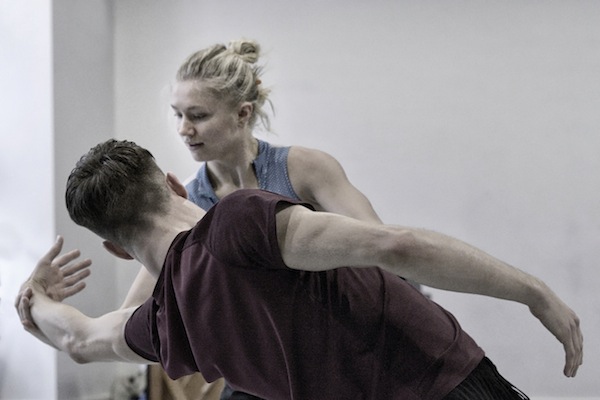
Ballet BC dancers Scott Fowler and Parker Finley in rehearsal for the company’s final program of the season, which features all Jewish community choreographers. (photo by Michael Slobodian)

Ballet BC concludes its season May 9-11 with Program 3, featuring all Jewish community choreographers: Israel’s Sharon Eyal and Gai Behar, Vancouver’s Serge Bennathan and Israel’s Ohad Naharin.

Program 3 begins with the North American première of Eyal and Behar’s Bedroom Folk and concludes with the return of Naharin’s Minus 16, a crowd-pleaser that Ballet BC presented in 2017. The middle piece, by Bennathan, is a world première, commissioned by Ballet BC.

“Emily Molnar invited me to create a work for the company,” Bennathan told the Independent in a phone interview. “That’s it. All the rest is for me to create what I want for them.”

Given that leeway by Molnar, Ballet BC’s artistic director, Bennathan said he wanted to create a work for all the dancers.

“I’m so in love with the company that I felt it will be wonderful to have them all, mostly for the kind of work I do,” he said.

“When I create work, whatever it is, for my company or another company, I always say I like to have the group of people that are strong individuals that make sense together,” he explained. “That is exactly what the company is right now. If you take Ballet BC now – individually, they are quite fantastic, each of their personalities, they’re fine, but they make so much sense together. That’s the beauty of it.”

Bennathan was born in France and came to Canada more than 30 years ago. Artistic director of Toronto’s Dancemakers from 1990 to 2006, he then came to Vancouver, where he founded Les Productions Figlio.

“My work, I would say, is quite physical, but my point of departure is to work from the energy. Not the energy being exuberant or something like that, but the energy that makes you move. So, you have to be present in the moment with your body and move from inside…. You have to find it in yourself to move.”

Bennathan has created many full-length works, both for his own companies and others, and he has a long history with Ballet BC.

“My first-ever commission was the first time I came to Vancouver. Reid Anderson was the artistic director,” he said. “I had just arrived in Canada. I was a young immigrant and I was doing work here in Vancouver and they saw my work and they invited me to create. The first-ever piece was a duet. And then, throughout the years, the invitations kept coming, so I created.”

Set to an original score by Montreal-based composer Bertrand Chénier, Bennathan shared a little about next month’s première, as well as his creative process.

“It’s [about] how do you find the form of resilience. How do you sustain that [thing] that keeps your head above water? That’s what it is,” he said of the work.

“Before I create the piece with dancers, I spend time [on my own] – I paint, I sew and I write and I explore these ideas that come to me through painting; not to paint movement … but to try to extract what it means in a poetic way. So, when I ‘write,’ in the studio with the dancers, what happens is, when I choreograph, I don’t think about the piece. I let my body talk because I believe that the mounds and mounds and mounds that I read – like, for this one, I read a lot of poetry, I painted, I wrote poetry – when I’m in the studio with them, I just let my body talk when I choreograph. And then they grab it. But this is only the beginning. After that, there is another period. I don’t want them to do exactly what I did. The movement can transform itself – what needs to stay true is the essence of why we did this movement at the beginning.”

For Bennathan, dance is more than an art form.

“I left my family quite early, I was 14 years old. Let’s say, my life was taking a direction that, deep inside me, I knew it was not the direction I wanted to take. I want to say [that] to people because, sometimes we see a lot of youth and we say, ‘Oh, you should get out of this, or you should do this …’ but the fact is, sometimes, mostly when you are young, you are taken into a spiral and you cannot get out. And, if you do not have the opportunity, or create yourself the opportunity, to lead you to someone that can tell you a word or a phrase that will change you or offer something you can open the door to, you are in a terrible situation, you cannot get out. I was able to have this in my life and … at 14, I said, ‘OK, I’m going to leave this, I’m going to Paris, I’m going to study dance, and that’s what I want to become, a dancer. This saved me, literally. I needed to do this to get out of a situation I didn’t want for me.”

Bennathan described dancers as “courageous, at all levels; not courageous just to apply themselves physically – because it’s there, they have the courage to abandon themselves into this art form – but, at the same time, to live as a dance artist. And, even more in our days, you have to be courageous, you have to have resilience.”

He said he can’t just invite talented dancers from other parts of the country to come work with him here because Vancouver has become so expensive. “Young artists or young families cannot come live here anymore. That’s the thing. And you have to be courageous to say, ‘OK, I’m going to come.’… These days, you don’t just say, ‘Oh, I’m going to live in Vancouver.’”

Bennathan believes in the power of dance, and art in general, to improve the world.

“A lot of people say ‘art can save the world,’ but why can you say that? It’s because we need the inspiration, we need poetry in our lives. Sometimes, poetry, these days, is dismissed. We so forget the importance of the inspiration of poetry in our day-to-day lives. There is a reason, not only in North America, but everywhere in the world right now … why cynicism is the most important thing…. It’s because we left all this – whether it’s writing poetry, written poetry or dance or music – we stop these art forms at the door instead of inviting them into our lives.” If we did invite them in, he said, “we would talk differently and we would start to see things differently.”

Program 3 is at Queen Elizabeth Theatre May 9-11, 8 p.m., and Ballet BC will celebrate 10 years with Emily Molnar as artistic director with a reception after the closing performance on May 11. For tickets to the performances, visit balletbc.com. Tickets for the reception are available via eventbrite.ca.

Format ImagePosted on April 19, 2019April 17, 2019Author Cynthia RamsayCategories Performing ArtsTags Ballet BC, dance, Emily Molnar, Gai Behar, lifestyle, Ohad Naharin, Serge Bennathan, Sharon Eyal
Connecting beyond art

Connecting beyond art

“Sydney Beach Cliff” (Australia) by Talin Wayrynen.

Art Vancouver’s dictum is “Connect. Inspire. Educate.” This year’s fair brings together almost 100 exhibitors from around the world to Vancouver Convention Centre East April 25-28, and features art classes, guided tours, speakers, panel discussions and a café art crawl. Both veteran and emerging artists participate, and the Jewish Independent spoke with a few artists in the Jewish community who are newcomers to the exhibition world: Matthew Weinstein, Talin Wayrynen and Tara Lupovici.

photo - Untitled #29 (2019) by Matthew Weinstein
Untitled #29 (2019) by Matthew Weinstein.

“I had a chance to volunteer at last year’s show,” Weinstein told the Independent. “Seeing the great professionalism demonstrated by the Wayrynen family inspired me to submit a formal application to this year’s exhibition.”

Art Vancouver was launched in 2015 by Lisa Wolfin Wayrynen. It has become somewhat of a family affair, with this year’s exhibitors including her daughters, Taisha Teal Wayrynen and Skyla Wayrynen; her son, Talin Wayrynen; and her sister, LeeAnn Wolfin.

“We just exhibited in Korea last November, and were invited to participate in another show in Seoul in June, and another show in Taiwan in December,” said Lisa Wolfin Wayrynen, referring to her and her children. “The family act is on the move!”

The 2019 Art Vancouver will be Talin Wayrynen’s second time exhibiting at the fair. An aerial photographer, among other things, he will be exhibiting photos from Australia and New Zealand, and possibly Indonesia. Last year, he said, he displayed photos of British Columbia and Mexico.

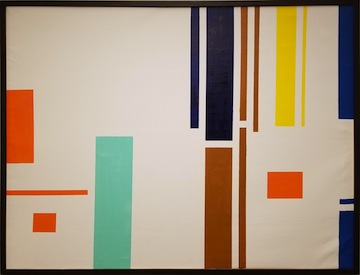
Weinstein said he will be bringing a select number of pieces to the show. Describing his art as “abstract and minimal in nature,” he said, “The purpose is to bring peace and tranquility to contemporary rooms…. My passion is to make large multi-coloured pieces that are not just pleasant to look at, but also provoke questioning and inspiration.”

About his creative process, Weinstein said, “The numbers and letters may appear as if they are there to provide meaning when in fact they are just as nonrepresentational as the rest of the shapes. One might ask, ‘Why did you add the number 7 at the bottom right corner of this piece?’ My answer would be, ‘There is no concrete reason behind that decision. It is as random as the rest of shapes, colours and signs you’re seeing. If you’re asking this question then I’ve accomplished my goal to generate interest and promote inspiration.’”

Lupovici, whose artist signature is LUPO, said, “My art is a psychedelic, abstract combination of organic and fluid lines with colour combinations that are inspired by the colours I feel.”

This year’s fair will be Lupovici’s first Art Vancouver, but she has a previous connection to the Wayrynen family. “I went to camp with Taisha and Skyla, Lisa’s daughters,” she said.

A graduate of Kwantlen Polytechnic University’s fashion marketing program, Lupovici said fashion was her main focus, and she has worked in various places, including with her father (Irwin Lupovici), at Bong Wear. “Then, one day,” she said, “I was making dinner and cut a red cabbage in half and boom! My passion for painting was back in my life.”

photo - Tara Lupovici with some of her work
Tara Lupovici with some of her work. (photo by Adrianna Hankins)

She has dedicated the last year or so to painting. “Eventually,” she said, “I will mesh my art and fashion design together and have my LUPO label.”

Half-Jewish and half-Chinese – she also speaks Cantonese – Lupovici said, “I definitely would not be the person I am without all the Jewish culture and community that I have been surrounded by. Jewish summer camp was one of the most memorable, loveliest times of my childhood and I am, to this day, close with many of the people I went to camp with. I would not say it has influenced me in design and art, but I do feel being Jewish and meeting other people in the community is inspiring in itself.”

Weinstein also said his being Jewish has had little influence on his work. However, he said, “Having grown up in a suburb of Tel Aviv, I feel connected to my Jewish identity…. The last time I visited Israel was in 2011 and I am very excited to visit again in May…. My upcoming trip is something I look forward to, as it provides a rare chance to explore my roots and reinforces my personal connection to Judaism.”

More travel is also in Wayrynen’s plans, having recently been to Korea, Taiwan, Indonesia, Australia and New Zealand.

“I started using drones just for fun in 2016 and then, in 2017, started using them for film and photography,” he said.

While he couldn’t describe the exact elements of a “perfect” shot, he said, “I like to have stuff that’s unique and can’t really be replicated – like a wave crashing, shots of wild animals or something along those lines.”

As an example, last summer, in Horseshoe Bay, he filmed a group of killer whales, which was later featured by CBC.

Not just anyone is allowed to use drones, of course, and Wayrynen said permission currently depends “on where and for what reason you fly, but it’s soon to be just a licence no matter what.”

In British Columbia, he said, “[I]t’s unlikely to get a permit to fly anywhere remotely populated and even some parks have issues with it. The states are pretty similar and, as for Mexico, I was working on a TV show that did all the paperwork for it, all I provided was the licence and insurance. We were able to film basically anywhere there during the few weeks our permits lasted.”

Weinstein summed up well the importance of venues like Art Vancouver. “If you’re reading this,” he said, “please feel free to come by my booth at the upcoming show and let me know what you think of my art. I enjoy listening to all criticism (both good and bad) and, if you have other suggestions, I’ll be happy to discuss in person.”

For more information on and tickets to Art Vancouver, visit artvancouver.net.

Format ImagePosted on April 12, 2019April 10, 2019Author Cynthia RamsayCategories Visual ArtsTags art, Matthew Weinstein, painting, photography, Talin Wayrynen, Tara Lupovici
A story told in art and poetry

A story told in art and poetry

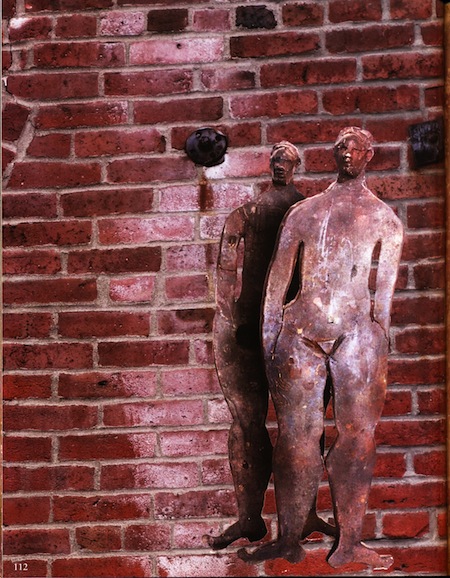
Olga Campbell’s acrylic painting “Remembering,” above, and bronze sculpture “Twins II” are just two of many artworks she includes in A Whisper Across Time.

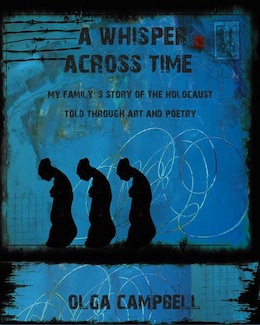
Grief is many-faceted. Sometimes, we’re not even aware for what we’re grieving. One of the most beautiful passages in Olga Campbell’s A Whisper Across Time: My Family’s Story of the Holocaust Told Through Art and Poetry (Jujabi Press, 2018) is the following poem:

“I was born with a very deep sadness / a sadness and an anger / as a child I didn’t question this / it was the way it was / when I got older my mother had cancer / she died when I was twenty-two / I thought that my sadness was caused by her death / I had no idea that it was caused by her life.”

book cover - A Whisper Across Time“A Whisper Across Time is a heart-warming, emotional journey that reminds us of the suffering and pain that war, intolerance and persecutions create, not only for those who had to endure atrocities but also for the children of the survivors,” notes Dr. David Lee Sheng Tin, author of two books on spiritual health and growth, in the foreword.

In A Whisper Across Time, Campbell gives clear voice to the whispers in her ear, “whispers across time.”

“This is the story of one family out of millions of families who went through the Holocaust,” writes the artist, whose mother lost all of her family during the Second World War. It is “the story of survival and death,” “of how trauma of such magnitude is passed from one generation to another to another….” It is also an ardent call for readers to remember Rwanda, Rohingya, Bosnia, Syria, Afghanistan, Sudan, Iraq, Cambodia…. “[O]ne of every 113 people on the planet is a refugee,” writes Campbell, noting, “by the end of 2016, there were 65.6 million refugees, asylum seekers and internally displaced people in the world” and that “racism, antisemitism and ultra-nationalism are on the rise.” She pleads, “eighty years ago, the world looked away / we must not look away now.”

In an interview with the Jewish Independent last November about the exhibit of the same name that helped launch the book, Campbell updated that statistic. “Our world is a chaotic place right now, somewhat reminiscent of the period before the war,” she told writer Olga Livshin. “There are over 68 million people around the world that are refugees or displaced. My book is not only about my family. It is a cautionary tale. It is about intergenerational trauma and its repercussions across time.” (See jewishindependent.ca/whisper-across-time.)

In 2005, Campbell mounted the exhibit Whispers Across Time. “This art show dealt with memories and losses,” she writes in the book. “Many of the pieces in the show were fragmented, partial in appearance, reflecting both a presence and an absence.”

image - “Twins II” by Olga Campbell
“Twins II” by Olga Campbell.

The exhibit featured masks, rusted metal figures, ceramic sculptures, photographs, mixed media and texts that, explains Campbell, “echoed the same theme of loss and regeneration – a life spirit which emerged from the devastation of the past.” Even reduced in size to fit on the pages of a book and taken out of a gallery setting, this artwork is powerful.

In A Whisper Across Time, Campbell shares some of what she has discovered about her mother, Tania, and father, Klimek Dekler, as well as about her maternal grandmother, Ola Akselrod, and her mother’s identical twin sister, Mania, and brother-in-law, who was also an identical twin, but Campbell hasn’t been able to determine which brother – Manasze or Efraim Seidenbeutel – her aunt married. Campbell recounts how her parents met, the atmosphere leading up to the war, and how her parents survived. Her father’s family also survived. There are no records, says Campbell, of what happened to her grandparents or her aunt during the Holocaust; the Seidenbeutel brothers were murdered at Stutthof concentration camp, a few days before it was liberated.

“My mother must have been completely traumatized by her experiences and her losses,” writes Campbell. “She lived and worked and loved, she still danced … sometimes. But the joy in her heart was not so big. The light inside was dim. And, at night, when she was alone in her room, she cried.”

In A Whisper Across Time, Campbell also talks about preparing for the 2005 exhibition, and some of the strange happenings that occurred, such as how multiple attempts to photograph the art failed – a broken camera, saved images that wouldn’t open on the computer. Her use of language, both in poetry and prose, is emotive without being overly sentimental. And her artwork evokes an emotional reaction, often involving some sadness and always demanding contemplation.

For more on Campbell and to purchase A Whisper Across Time, visit olgacampbell.com.

Format ImagePosted on April 12, 2019April 10, 2019Author Cynthia RamsayCategories Books, Visual ArtsTags art, Holocaust, memoir, Olga Campbell

Posts pagination

Previous page Page 1 … Page 47 Page 48 Page 49 … Page 84 Next page
Proudly powered by WordPress