Skip to content
  • Home
  • Subscribe / donate
  • Events calendar
  • News
    • Local
    • National
    • Israel
    • World
    • עניין בחדשות
      A roundup of news in Canada and further afield, in Hebrew.
  • Opinion
    • From the JI
    • Op-Ed
  • Arts & Culture
    • Performing Arts
    • Music
    • Books
    • Visual Arts
    • TV & Film
  • Life
    • Celebrating the Holidays
    • Travel
    • The Daily Snooze
      Cartoons by Jacob Samuel
    • Mystery Photo
      Help the JI and JMABC fill in the gaps in our archives.
  • Community Links
    • Organizations, Etc.
    • Other News Sources & Blogs
    • Business Directory
  • FAQ
  • JI Chai Celebration
  • JI@88! video

Recent Posts

  • Story of Israel’s north
  • Sheltering in train stations
  • Teach critical thinking
  • Learning to bridge divides
  • Supporting Iranian community
  • Art dismantles systems
  • Beth Tikvah celebrates 50th
  • What is Jewish music?
  • Celebrate joy of music
  • Women share experiences 
  • Raising funds for Survivors
  • Call for digital literacy
  • The hidden hand of hate
  • Tarot as spiritual ritual
  • Students create fancy meal
  • Encouraging young voices
  • Rose’s Angels delivers
  • Living life to its fullest
  • Drawing on his roots
  • Panama City welcoming
  • Pesach cleaning
  • On the wings of griffon vultures
  • Vast recipe & story collection
  • A word, please …
  • מארק קרני לא ממתין לטראמפ
  • On war and antisemitism
  • Jews shine in Canucks colours
  • Moment of opportunity
  • Shooting response
  • BC budget fails seniors
  • Ritual is what makes life holy
  • Dogs help war veterans live again
  • Remain vital and outspoken
  • An urgent play to see
  • Pop-up exhibit popular
  • An invite to join JWest

Archives

Follow @JewishIndie
image - The CJN - Visit Us Banner - 300x600 - 101625

Byline: Cynthia Ramsay

Music as a uniting force

Music as a uniting force

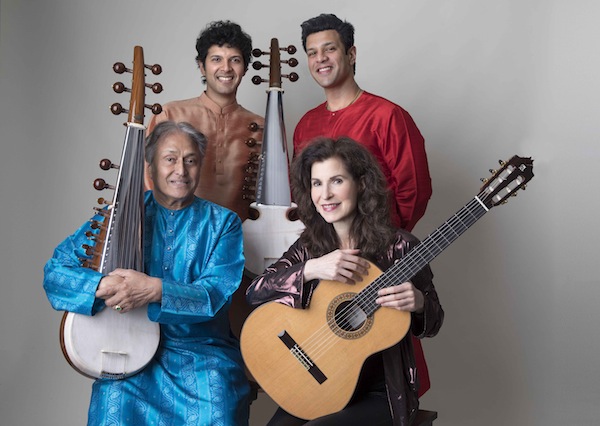
Clockwise from top left are Ayaan Ali Bangash, Amaan Ali Bangash, Sharon Isbin and Amjad Ali Khan. (photo © Suvo Das)

On July 12, Strings for Peace will have its world première at the Indian Summer Festival, which is described as “a multi-disciplinary arts festival ‘where worlds meet’ in Vancouver.”

Produced by the Indian Summer Arts Society, the festival’s mission “is to offer daring, multi-arts events that bring together diverse artists, audiences and artists in a spirit of global dialogue and citizenship.” Sharing a similar spirit, it is fitting that Strings for Peace – created and performed by sarod masters Amjad Ali Khan and his sons Ayaan and Amaan Ali Bangash, and guitarist Sharon Isbin – will be unveiled at the festival.

“The legendary sarod master Amjad Ali Khan emailed me 10 years ago to invite me to a concert of his in New York and to explore the idea of a collaboration,” said Isbin, a three-time Grammy Award winner whose repertoire includes Baroque, Spanish-Latin music and jazz fusion. “I had long admired Indian classical music, and was bowled over to hear his performances with his sons…. A warm friendship developed and, six years ago, he conceived the idea of composing ragas for us all to perform together. I received the music last December and loved it. They said that’s good because we have already booked a tour with you in India in February 2019! I had little time with my schedule, but was motivated because the music was exquisitely beautiful, as is their artistry. It was a magnificent experience to perform together in Kolkata, Mumbai and Delhi. I cherish our friendship and the opportunity this has given me to explore an inspiring new genre and collaboration.”

The four performers have made a recording for release in 2020, said Isbin, “and I am excited that Strings for Peace will be touring in the U.S. during summer and fall 2020.”

In an article earlier this year in the Hindustan Times, Isbin speaks about the difference between the Indian classical, mainly oral, tradition and the written Western classical music tradition. “Indian classical music has long pieces. You are taken on a journey,” she notes. “It is a very expansive state of consciousness, whereas a Bach or a Beethoven piece has a clear and defined sense of enclosure.”

“Performing together in India last February,” she told the Independent, “I was amazed to hear similarities between improvised embellishments in Indian classical music and melismatic nuances in Spanish, flamenco and Sephardic music.”

Born and raised in Minneapolis until age 18, Isbin lives in New York City. She is the founding director of the Juilliard School guitar department and director of the guitar department of the Aspen Music Festival. She performs around the world and has appeared as a soloist with almost 200 orchestras.

“When I was 9, my family moved to Italy for my father’s sabbatical year as a scientist and professor of chemical engineering,” she said of her beginnings as an artist. “My older brother Ira asked for guitar lessons, hoping to be the next Elvis. My parents found a great teacher who had studied with [Andrés] Segovia, but when my brother learned it was classical, he bowed out and I volunteered to take his place. I loved that an instrument was built for me, and that you held and caressed it to make music.”

Of the role, if any, Judaism or Jewish culture plays in her life, Isbin said, “My grandparents came to the U.S. as refugees from Russia and Poland to escape deadly pogroms, and I have many relatives who live in Israel. I have always felt a cultural connection to Judaism and to Israel. In fact, I was a teenager when the first work ever composed for me was a concerto by the late Israeli composer Ami Maayani, which I premièred with the Jerusalem Symphony and the Minnesota Orchestra. Since then, I’ve premièred more than 80 works written and arranged for me.”

Her experience with the Khans highlights how she views music’s potential to bring together different cultures. “There is only one human race, and we all need to appreciate and celebrate that commonality,” she said. “Music, because it transcends language, can be wonderfully uniting.”

Strings for Peace premières July 12, 8 p.m., at the Chan Centre for the Performing Arts. For tickets and the full schedule of the Indian Summer Festival, which opened July 4 and runs to July 14, visit indiansummerfest.ca.

Format ImagePosted on July 5, 2019July 3, 2019Author Cynthia RamsayCategories MusicTags Amaan Ali Bangash, Amjad Ali Khan, Ayaan Ali Bangash, guitar, Indian Summer Festival, sarod, Sharon Isbin, Strings for Peace
TUTS season is set to begin

TUTS season is set to begin

Left to right: Sheryl Wheaton as Rosie, Lori Ashton Zondag as Tanya and Caitriona Murphy as Donna in Mamma Mia! with Adam Charles as Jack, Caleb Lagayan as Race and Graeme Kitagawa as Mush in Disney’s Newsies. (photo by Lindsay Elliott)

Iconic Swedish pop music and a story that exemplifies America’s love of the underdog are coming to Stanley Park’s Malkin Bowl this summer. Theatre Under the Stars presents Mamma Mia! and Disney’s Newsies on alternate nights, starting with a preview of Mamma Mia! July 5.

Set in the Greek islands, Mamma Mia! features ABBA songs aplenty, as bride-to-be Sophie invites three of her mother’s former lovers to her wedding in order to figure out which one is her father. The TUTS production features two Jewish community members who are veterans of the stage: Wendy Bross Stuart as music director (and rock band pianist) and Stefan Winfield as Harry Bright, one of the possible fathers, a role that was played by Colin Firth in the film version of the musical.

About his preparation for the TUTS production, Winfield shared: “Main note to self: do not attempt to replicate Colin Firth’s performance! He is a great actor. His quintessentially understated, sensual and impossibly British charm that comes across so well on the screen is not something I’d ever be able to reproduce on the Malkin Bowl stage in a way that connects with anyone past the first row … so, I’m bringing what I can to the role, doing my best to fulfil the vision of the creative team.”

Winfield’s first TUTS show goes back to childhood. In 1976, he played Randolph in Bye Bye Birdie. “My next appearance on the Malkin Bowl stage was not until 1999,’ he said, “when I played an adult role (i.e., not a Jet or a Shark!) in West Side Story.”

Since then, he has been involved in several TUTS shows, including Jesus Christ Superstar, another mounting of Bye Bye Birdie and of West Side Story, and The Drowsy Chaperone. Among other things, he was also in Parfumerie at the Metro Theatre in 2014, directed by Disney’s Newsies musical director, Christopher King, and has been directed a few times by fellow Jewish community member Richard Berg, who is currently TUTS’s production manager.

photo - Stefan Winfield plays one of the prospective dads in Theatre Under the Star’s Mamma Mia!, which previews July 5
Stefan Winfield plays one of the prospective dads in Theatre Under the Star’s Mamma Mia!, which previews July 5. (photo from TUTS)

“It’s a pleasure to be working again with Shel Piercy,” Winfield added. “This is the fourth time I’ve performed under his direction on a theatre production, but the first time dates back to 1977! I played Kurt in a very local production of The Sound of Music for Marpole Community Theatre, directed by Shel, who, I believe, had only recently graduated from Eric Hamber. He’s a guy who’s been telling great stories for several decades, on stage and screen; I am very honoured to work with him.”

Another co-worker partially explains why Winfield likes being involved in TUTS. “The opportunity to work under the direction of and perform with outstanding theatre professionals, including my wife, choreographer Shelley Stewart Hunt – not to mention the crowd of extraordinarily talented and impressively trained up-and-coming young people who give themselves over to TUTS for the summer. And, for me personally, TUTS has really lived up to its mandate of creating a family atmosphere in allowing me to share the experience with my son Wesley, who was ‘en ventre sa mère’ during Bye Bye Birdie as Shelley was choreographing, then performed in featured bits in The Drowsy Chaperone at the age of 5, and is doing the same now in Mamma Mia! – this time actually executing choreography set by his mum! To watch it gives me joy … naches, if you will.”

And it’s a family scene that is among Winfield’s favourites in Mamma Mia!

“There are a lot of great moments,” he said, “but I’d say my favourite occurs during the scene when the dads meet Sophie for the first time. Harry is singing ‘Thank You for the Music,’ playing the guitar while lost in wistful reminiscence, when, to his surprise, in walks Sophie who joins in on the song. It’s a moment made all the more special by the lovely voice and energy of the young lady who’s playing Sophie in our production, Keira Jang.”

Also a TUTS veteran, Bross Stuart has worked with Piercy and Stewart Hunt before.

“Shel, Shelley and I have worked together on many shows; we go back a very long time,” said Stuart. “In fact, Shelley was actually my student when she was in Grade 8. And an excellent student at that! As a team, I have profound respect for Shel and Shelley. There is a wonderfully creative synergy between the two of them and between them and myself. They see possibilities which are almost magical.”

Bross Stuart’s first TUTS production was Fiddler on the Roof in 1997.

“In those days,” she said, “it had not occurred to people in Vancouver that it might be useful to have an actual Jewish person involved with a production of Fiddler on the Roof. TUTS was ahead of its time, realizing how important this would be! In those days, there was very little Jewish influence in this town, especially compared to where I had spent my childhood and young adult life – in New York City and Montreal.”

photo - With Mamma Mia! music director and pianist Wendy Bross Stuart has added ABBA’s music to her repertoire
With Mamma Mia! music director and pianist Wendy Bross Stuart has added ABBA’s music to her repertoire. (photo by Erin Palm)

Describing working at TUTS as “intoxicating,” Bross Stuart highlighted the beauty of Stanley Park and said about the feeling of “conducting/playing outdoors in front of a large, appreciative audience – absolutely second to none. A very special experience!”

As well, she noted that “each show has completely different demands because of the material we are using.” For Bross Stuart, ABBA’s music was a new challenge.

“ABBA was not in my repertoire at all,” she admitted. “During the ABBA period, I was busy living in Japan and studying traditional music for koto and shamisen, composed by Yatsuhashi Kengyo and Tsuruyama Kengyo. No pop music for me! However, I have learned so much about this style from working on Mamma Mia! Doing ABBA music has taken me to a new place in my musical life. Growing and learning is such an exciting venture.”

While music rehearsals officially started on April 24, Bross Stuart said she opened her home for early rehearsals to anyone who wanted a head start.

“The style of the music makes the approach much different from most shows,” she said. “Less on the micro details and more on the big picture. As a detail-oriented person, it is a great learning experience for me – and, I am playing keyboard in a rock ’n’ roll band (and conducting). Each of the four keyboards is hooked up to a computer with many sound patches. I love it!”

For tickets to Mamma Mia! and Disney’s Newsies – which may not have local Jewish community members in its creative team but has music by Alan Menken, lyrics by Jack Feldman and book by Harvey Fierstein – visit tuts.ca or call 604-631-2877.

Format ImagePosted on June 28, 2019June 26, 2019Author Cynthia RamsayCategories Performing ArtsTags Malkin Bowl, music, Stefan Winfield, Theatre Under the Stars, TUTS, Wendy Bross-Stuart
Exploring music, dance, self

Exploring music, dance, self

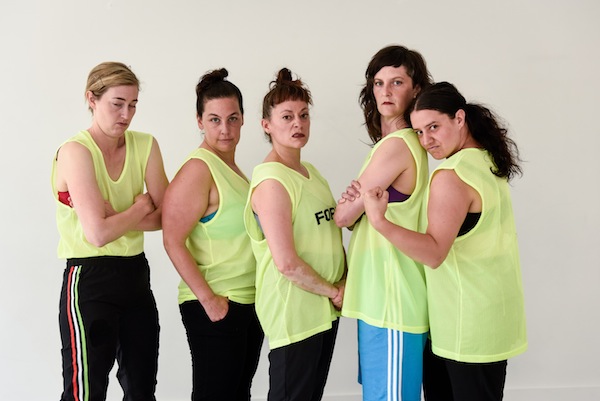
The cast of Tara Cheyenne Performance’s The Body Project. (photo by Wendy D. Photography)

Among the more than 20 choreographers and companies from across Canada, Brazil and Korea that are participating in this year’s Dancing on the Edge Festival are local Jewish community members Alexandra Clancy (Soleful Dance Company) and Tara Cheyenne Friedenberg (Tara Cheyenne Performance).

Soleful Dance Company’s Where the Music Begins will take place July 12, 8:15 p.m., in the Firehall Arts Centre courtyard, and Tara Cheyenne Performance’s The Body Project (working title) is part of Edge 5 July 11, 9 p.m., and July 13, 7 p.m., at the Firehall. DOTE runs July 4-13. Click here to watch the festival trailer on YouTube.

* * *

Where the Music Begins, created by Clancy and composer and musician Mike W.T. Allen, was commissioned by Dances for a Small Stage for its Summer Series.

“Mike and I had played music together but never officially constructed any works for stage,” Clancy told the Independent. “Throughout the rehearsal process, there would be a back and forth of ideas; sometimes I would have a rhythmical phrase of tap dance and Mike would then create a melody over top, and sometimes Mike would compose a phrase of the melody and I would choreograph specifically to that part of the tune. After some give and take between our prospective instruments and ideas, we solidified a melody and then decided upon the structure of the tune. Some of the tune is improvised, some is a conversation, and some is very set and predetermined. We both enjoyed the collaborative process and found a harmonious way to create music and dance together.”

Clancy grew up in Vancouver and has always been involved with the Jewish community. “I was raised Jewish; attending Hebrew school on Sundays, becoming bat mitzvah, and participating in holidays and traditions,” she said. “After going on Birthright a few summers ago, I was re-inspired by the beauty of the culture and have tried to stay more engaged in the community by attending Axis events and other social gatherings, as well as going to synagogue when I can. I am grateful for the support and familial kindness that I have received from the community, consistently reminding and encouraging me that I am capable of whatever I put my all into.”

And she has put her all into a lot, having trained in all genres of dance, studying at Danzmode and the Vancouver Tap Dance Society. She was a member of Tap Co., a pre-professional youth tap dance company, and has trained and performed across North America.

photo - Alexandra Clancy is one of the performers and choreographers whose work will be featured in this year’s Dancing on the Edge, which runs July 4-13
Alexandra Clancy is one of the performers and choreographers whose work will be featured in this year’s Dancing on the Edge, which runs July 4-13. (photo from DOTE)

“After graduating, I lived in Austin, Tex., and was a member of Tapestry Dance Company in its 25th season,” said Clancy. “I then moved back to Vancouver and have been performing and teaching ever since. This past year, I taught at the Arts Connection, Dance Co., and the Pulse, sharing my love and passion for tap dance and educating the next generation of talented dancers.

“As recital season comes to an end, I am currently in a creative residency with Dances for a Small Stage, where we are developing works for our Summer Series and exploring digital literacy in dance. As well as preparing for DOTE, I am also in the studio rehearsing and creating for our upcoming performance at Jacob’s Pillow later this summer. In the fall, I will be moving to Calgary to attend the training program at Decidedly Jazz Dance Company.

“My goal,” she said, “is to broaden my toolbox to assist in expressing myself and telling stories through dance. This upcoming year, I hope to continue to collaborate and create through Small Stage, develop more new works with Soleful Dance Co., film a concept video, and share dance through as much teaching and performing as possible.”

Jacob’s Pillow is located in western Massachusetts in the town of Becket. Clancy auditioned for and then attended the inaugural tap dance program at Jacob’s Pillow in 2010 and returned two years later (again with an audition) for a second summer of learning and dancing. “My time at the Pillow was the most influential training thus far in my life and it has always been a dream of mine to perform my own work at the Pillow,” she said.

That dream will become a reality this summer.

“Jeffrey Dawson and I co-choreographed a piece for an online competition Jacob’s Pillow was running this year, and we were lucky enough to be chosen as Top 6 and then voted Top 3, meaning we will get to perform our work live at the Inside/Out stage on Aug. 17,” said Clancy.

In addition to choreographing and teaching, Clancy established Soleful Dance last spring. She and some other dancers “felt we needed a name and a clear avenue to share the work we had started developing. Based in Vancouver, this company is a platform to express ourselves and tell stories through the music of tap and the movement of dance.

“Although under my direction,” she said, “Soleful Dance Company is rooted in collaboration. Our ultimate goal is to make audiences feel something. All of the members of the company’s primary focus is tap dance; however, everyone brings a versatile background to the creative process, spanning from contemporary dance, to acting, to playing music and more. We hope to continue to grow and create more works to share with audiences in the near future.”

Clancy described tap dance as “a magical art form that allows one to not only express through movement but connect and emote through sound.

“This traditional American art form has a rich and complex history that is intertwined deeply with jazz music and culture,” she explained. “There is a sense of community that I have always appreciated about tap dance, and I feel a great amount of respect and gratitude that I get to perform and participate in its culture. It just feels good to get to move your body and dance and then, on top of that, creating and connecting with music opens endless doors of expression.”

* * *

The Body Project is a new interdisciplinary performance created from interviews, symposiums and roundtables.

“I started research on and around the theme of ‘female body image’ about a year ago,” Friedenberg told the Independent. “Part of our research/creation process has been interviewing female-identifying and non-binary people (many dancers and actors). To date, 35 people have generously participated.

“In the studio, I have been mining my own complicated and unhealthy relationship with my body as a dancer in a female body with the help of my amazing collaborators/performers. The process so far has involved exploring how the forms of stand-up comedy and dance can express this difficult, and often absurd, story of struggling with body image that many of us share.”

The performers – Bevin Poole, Caroline Liffmann, Kate Franklin and Kim Stevenson – came into the process shortly after Friedenberg began her exploration of the topic.

“We are working very closely with intimate and difficult material so, although I am leading the process, it is essential that all the voices/bodies in the room are present in the work. For example, there is a section choreographed by Kim Stevenson – much of the gestural language has been created through our own gestures as we’ve spoken about our personal experiences with body image.”

About the creative process, Friedenberg said, “These are very busy people, so we have had times when we are all in the studio and other times when it’s just me and one collaborator. Making room for people’s lives and demands, including parenting and caring for parents, is an important part of our feminist practice.

“Justine A. Chambers is our dramaturge/outside eye and Michelle Olson will be involved in the project as a consultant and possibly a performer in the next phase of development.”

As professional dancers, the performers/creators have shared some common struggles and coping mechanisms regarding body image.

“The pressure to fit a very narrow ideal of the ‘dancer body’ has been difficult and complex for all of us,” said Friedenberg. “There’s the pressure to be very thin, small, more muscular, or less muscular. Pressure to fit an oppressive ideal of beauty. We each have found ways to navigate these limiting ideas. Sometimes we have had to remove ourselves from certain arenas in order to survive. Sometimes we have found power in defying the stereotypes of what a dancer should look like to the euro-centric patriarchal gaze. But I keep coming back to the effort and energy required to bare these expectations and what we can transform with that energy instead.”

She added, “It must be noted that the many voices, words, time and contributions from the people we have interviewed are alive in the work through our bodies and presence. Their names will be listed on our website. Although the work, at this early stage, is a version of my story, it is also very much a result of being together in conversation about body image, in a circle, speaking, listening, moving, supporting and sharing with many powerful female-identifying/non-binary people – ‘the personal is political.’”

* * *

The full DOTE schedule can be found at dancingontheedge.org. For tickets, call 604-689-0926 or visit tickets.firehallartscentre.ca.

Format ImagePosted on June 28, 2019July 1, 2019Author Cynthia RamsayCategories Performing ArtsTags Alexandra Clancy, choreography, dance, DOTE, identity, music, Tara Cheyenne Friedenberg., women
The search for a friend

The search for a friend

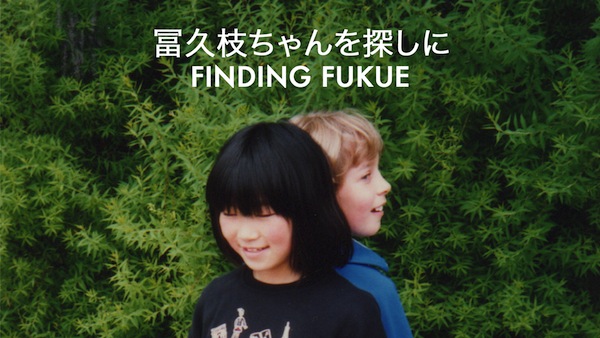
Finding Fukue follows Jessica Stuart’s journey to Japan to find her childhood friend.

screenshot - Finding Fukue follows Jessica Stuart’s journey to Japan to find her childhood friend
(screenshot)

To what lengths would you go to find a childhood friend whose letters stopped coming decades ago? When online searches proved fruitless, Vancouver-born, Toronto-based musician Jessica Stuart headed back to Japan, and her journey is recorded in the CBC Short Docs film Finding Fukue, which was produced with Real Stories. Since posted to YouTube last November, the charming and moving documentary has been viewed more than 3.6 million times to date.

“When I was 9 years old, my parents got English teaching jobs and moved us all to Japan for a year,” shares Stuart as the film starts. Among the images we see are clips of home movies from that year, 1988. “I was a blond kid, and that made me of interest to all the Japanese people because they had never really seen a blond-hair person before,” she says. “They would point at me or my sister, touch my hair, talk at me; I didn’t understand anything yet. The day after we arrived, I went to school for the first time and then that was crazy. I didn’t feel that anyone was interested in getting to know me, except for one person, and her name was Fukue, and we became best of friends.”

The Stuarts – Wendy, Ron and daughters Fiona and Jessica – settled in Saku, then a small rural village with no foreigners. Now, however, Stuart has to start looking for her friend Fukue in a city of 100,000 people. She visits the elementary school they attended and gets a yearbook, where she gets Fukue’s father’s name and an address from the year 2000, but this leads her to a new development, where she and her translator (for the more complex encounters) meet some women who remember her family but can’t help with finding Fukue.

At Saku City Hall, a press contingent meets Stuart and she gets the word out on television and in print. Finally, a clerk at City Hall manages to find a phone number for Fukue’s sister, who connects the two friends. The reunions – first by phone and then in person – are quite emotional. The two fall into a familiar comfort and get reacquainted. They have kept in touch since.

The approximately 21-minute film can be found at youtu.be/ZVlZMOB-Sq0.

Format ImagePosted on June 28, 2019June 26, 2019Author Cynthia RamsayCategories TV & FilmTags Canada, CBC, documentary, friendship, Fukue, Japan, Jessica Stuart
VICO festival explores Japan

VICO festival explores Japan

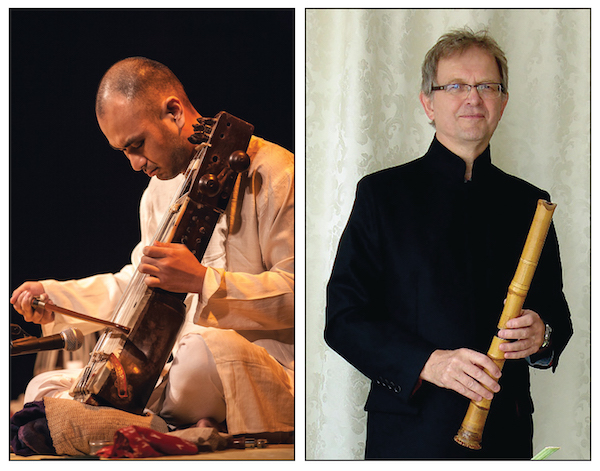
The June 12 performance of Moshe Denburg’s The Longing Sky features Yuji Nakagawa on sarangi, left, and Harrie Starreveld on shakuhachi. (photos from VICO) 

This year’s Vancouver Inter-Cultural Orchestra (VICO) Global Soundscapes Festival highlights the instruments and traditions of Japan. It features a concerto by Moshe Denburg, and percussionists Jonathan Bernard and Niel Golden, both members of the Jewish community, are among the performers.

“As an organization committed to bringing forward and collaborating with all cultures of the world, we have had a connection with Japanese musical culture since our inception in 2001,” explained Denburg, VICO founding artistic director, of the festival’s focus. “Our present artistic director, Mark Armanini, studied composition with the late Elliot Weisgarber, who was my mentor and friend as well, and was, in a real sense, a progenitor of interculturalism in Vancouver. His own studies and musical explorations took him to Japan and into Japanese music. This is one longstanding Japanese influence in our midst.

“The VICO has collaborated with Japanese musicians on many occasions in the past,” he continued. “The first major encounter was in 2010, at a concert production called Imagined Worlds: Japanese Interventions, at which concert we had two visiting Japanese musical virtuosos. In 2013, we produced a mini-festival, together with the Japanese consulate and the Japanese community here, called Chrysanthemums and Maple Leaves. One of the main soloists of this festival, Naomi Sato, has been with us for further iterations of this festival concept, in 2014 and again this year. She plays a traditional Japanese mouth organ called the sho. This year, in addition to Ms. Sato, we have Miyama McQueen-Tokita on koto and Harrie Starreveld on shakuhachi.”

The festival’s opening concert on June 5 at the Waterfront Theatre features Debris, a new mini-opera by Rita Ueda, “inspired by the 2011 tsunami and the debris that washed up along the West Coast of North America,” works by Weisgarber, as well as traditional Japanese music. Denburg’s The Longing Sky is part of Raga-tala-Malika! A Garland of Ragas and Talas with VICO and Friends, at the Rothstein Theatre on June 12.

About The Longing Sky, Denburg said, “After my tours of musical study in India and Japan, which took place in the mid-’80s, I returned to Canada to begin realizing some of my global fusion ideas. Around 1994, I sketched a work which brought together the two traditions I had previously been exposed to, and conceived of a double concerto for shakuhachi (Japanese bamboo flute) and sarangi (Indian bowed string), instruments that, in their own unique ways, spoke to me of longing.

“The Longing Sky originally came to me as part of a two-movement work that I conceived of then, called Between the Source and the Longing Sky. The source represents our life here on earth, while the longing sky represents the possibility of reaching out to a new life in space. This was and still is our global situation today: we have the means to explore other worlds, but the early promise of moving into space has hardly been realized. The sky is within each of us, and represents our longing for a better world, a larger creative palette, a future vast and free.”

The work premièred in November 2013, with featured soloists Dhruba Ghosh on sarangi and Starreveld on shakuhachi. “In 2017, at the young age of 59, Dhruba-ji passed away suddenly of a heart attack,” said Denburg. “This remount of The Longing Sky is a tribute to him, our dear colleague, mentor and friend. Appropriately enough, his student and disciple, Yuji Nakagawa, will be the featured sarangi player, and Harrie will reprise his role on shakuhachi. May Dhruba’s memory always be a blessing.”

Learning the techniques involved with playing an unfamiliar instrument, in order to compose for it, begins with one-on-one sessions with the performer, said Denburg.

“I did this with several shakuhachi performers over the years, studied many materials and listened to many recordings,” he said. “Regarding sarangi, I found, in the early ’90s, a very well-known Canadian ethnomusicologist, cellist and sarangi player, Regula Qureshi, who taught, until her recent retirement, at the University of Alberta. My first learning sessions were with her, and I supplemented these with certain materials that I found in ethnomusicological treatises. Of course, one can never really ‘know’ how to write for an instrument until one has tried to transmit the composition to a performer and listened to the result. In my case, I am still learning how to write for sarangi – actually, the process never ends.

“Another aspect of composing for such an instrument, and indeed for many instruments of the world, is that as they are part of the great ‘aural traditions’ of the world,” he added. “One prime example of this is the music of India – the composer needs to supplement written materials with aural aids; audio materials that are sung, or played on synthesizer or another instrument. But, most importantly, the composer has to sit down with the performer and work on the musical lines he has composed, and sincerely take advice from the performer as to what works and what does not work. This is one aspect of intercultural work that cannot be emphasized enough – the written composition is not the only way, nor even the best way to create great music. This is humble pie for most Western composers, and one might say an added benefit of intercultural exploration.”

On the topic of cultural appropriation, Denburg said, “We have been aware of these issues and, in fact, we may be convening, in 2020 or 2021, a cross-Canada series of discussions exploring best intercultural practices.

“One thing that we have done over the years,” he said of VICO, “which we believe has been acceptable practice, is that we have always emphasized the collaborative aspect of the work. We are not expressing someone else’s narrative, but rather our own, new intercultural narrative. And, when we present other cultures, this is precisely what we do – we present those cultures in performances by accepted exponents of them. So, in a VICO concert, you will often find some demonstration pieces of the collaborating cultures themselves. For example, in Raga-Tala-Malika, we will have a traditional raga presentation, probably featuring our guest sarangi player together with our guest tabla player; and a shakuhachi solo may also be presented. These are the undiluted presentations of ‘other’ cultures. Then, in pieces like The Longing Sky, and others on the program, a truly intercultural piece will be performed.”

Golden will be playing tabla on Denburg’s piece on June 12, and likely accompanying the sarangi player on tabla for a traditional Indian piece in that show. He is also scheduled to play with Starreveld and Nakagawa at the closing concert of the festival, June 13, at the Annex.

According to his bio, when Golden moved to Victoria from Toronto in 1986, “he helped form the world, folk fusion trio, New Earth. Their self-titled CD took them to Seville, Spain, where they represented Canada for six weeks at Expo ’92.… Blending African, Indian, Western and other world music, their first CD, Indiscretion, earned them a Juno nomination as best global recording of 1995.”

Throughout the years, Golden has continued to study tabla and has collaborated with many artists, including Denburg for the past 18 years – Golden is a member of the VICO. He is also a member of the new world music quartet Saffron, performs in the trio DNA, as well as the trio Three Worlds, which recently released a self-titled CD.

Bernard – principal percussionist with the Vancouver Island Symphony – will be playing in the Global Soundscapes Festival on June 8, in Zen and Now, and in Raga-Tala-Malika. His bio notes: “His interest in world music has led him to perform Chinese, Javanese, Balinese and Korean music and study traditional and contemporary Chinese percussion in Beijing, Arabic percussion in Cairo and Carnatic rhythm in South India.” He has premièred more than 70 chamber works with various ensembles, and has toured throughout Canada, the United States, Europe and Japan.

For Global Soundscapes concert tickets ($20-$35), more information on the artists and the full performance schedule, visit vi-co.org.

Format ImagePosted on May 31, 2019May 30, 2019Author Cynthia RamsayCategories MusicTags intercultural, Japan, Moshe Denburg, VICO
Plants’ hidden beauty

Plants’ hidden beauty

Yellow gazanias, by Pamela Fayerman. Eighteen of Fayerman’s macro photos form the exhibit Intimate Encounters, which is at VanDusen until June 27.

Well-known for her writing about medicine, science and health policy in the Vancouver Sun, award-winning journalist Pamela Fayerman has another area of expertise, perhaps somewhat lesser known: macro photography. Her first exhibit – Intimate Encounters: Botanical Closeups – opened at VanDusen Botanical Garden with a reception on April 6.

Born in Prince Albert, Sask., Fayerman grew up in Saskatoon. She moved to Toronto to attend Ryerson University School of Journalism, with the intention of becoming a photojournalist. While she changed her mind about that, she said the “photography courses at Ryerson taught me about important things like using light, subject composure and print developing. Even though everyone does digital photography these days, the foundations for those of us who learned on old SLR cameras are still pertinent.

“While I was at Ryerson, I got an incredible break with a story scoop that would be a defining career opportunity,” she said. “I sold the front-page story to the Globe and Mail and then I was invited to continue working there on a freelance basis. When I graduated from Ryerson, the company – then called FP Publications – offered me a job at their other newspaper: the Winnipeg Free Press.”

Fayerman worked at the Free Press for five years, mostly covering the law courts. During that time, she took a year break to study at Queen’s law school, focusing on the Charter of Rights and Freedoms.

“When I moved to Vancouver in the mid-1980s, the law beat was already taken,” she said, “so I had a variety of beats, including City Hall, before landing the medical beat in 1995. I think I’m probably the most experienced medical journalist in Western Canada and I’ve certainly had plenty of incredible professional development opportunities through American fellowships at places like Columbia University, MIT and the National Institutes of Health. It’s a highly challenging, satisfying beat for someone like me with insatiable curiosity. I cover health policy, which involves stories about the politics, economics and mechanics of the healthcare system; medical research; and clinical medicine. The latter often involves the mind-blowing ‘wow’ stories about lifesaving innovations.”

Fayerman became interested in botanical photography about a decade ago, she said, “because I’m obsessed with plants and gardening. It’s the only thing I do that could be described as mindfulness, and that’s important because journalists always take our work home with us. We never stop thinking about the stories we’ve just finished or the ones we’re working on.”

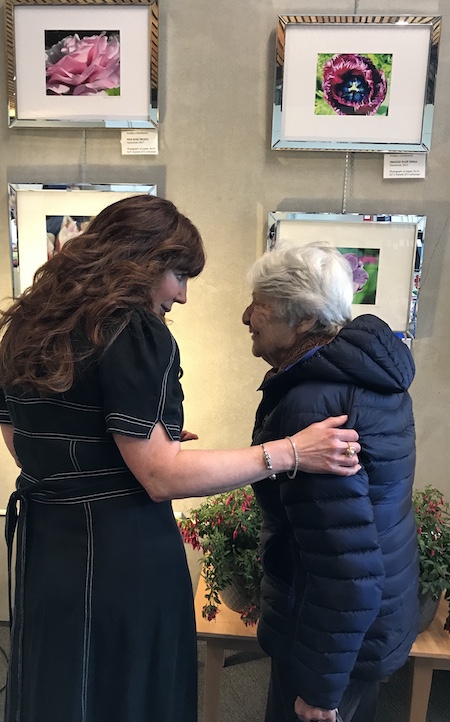
photo - Pamela Fayerman with landscape architect Cornelia Oberlander at the opening reception of Intimate Encounters: Botanical Closeups, featuring Fayerman’s photography
Pamela Fayerman with landscape architect Cornelia Oberlander at the opening reception of Intimate Encounters: Botanical Closeups, featuring Fayerman’s photography. (photo from Pamela Fayerman)

Fayerman said the best way to capture the biology and anatomy of plants in detail is with a macro lens.

“Flowers are so often extravagant and exotic and they are a naturally ideal subject for macro photography because of their sensual shapes, sublime colours and luscious textures,” she explained. “Plants always have hidden, intriguing beauty, often only revealed through macro photography. I use available light and get really close to the mysterious microstructures of plants.”

Her talent for photography has been recognized in various ways, including her being chosen as one of about 100 photographers across the country to participate in the Canada’s Golden Hour Photo project.

“The period right after sunrise and just before sunset is when you can achieve some magic in colour photos, especially blues and mauves,” she said. “In my exhibition, there’s a photograph of an echeveria succulent I shot in California that is a nice demonstration of how to exploit the golden hour before sunset.”

In addition to journalism and photography, Fayerman said, “For about 15 years, I’ve volunteered at the Louis Brier nursing home. In May, I put plants in the pots in the Shalom courtyard and then I tend to the plants weekly until November. My mother was a resident for a short time before her death and this was a project my family initiated in her memory. The residents and family members often express their appreciation because it beautifies the area, which is quite a serene oasis. Last year, one of the residents asked me weekly if I would plant some medical marijuana as well!”

Fayerman also volunteers as a board member for the Vancouver Botanical Garden Association.

“When I learned about the Yosef Wosk Library at VanDusen, that has a gallery inside it named for Roberta Mickelson, I was keen to get my first exhibition there,” said Fayerman, who has been selling her photos for several years via her website, pamelafayerman.com. “I’ve got 18 photographs on display – all of them for sale – including works on paper and on canvas. The retail store at VanDusen is also now carrying my matted prints.”

Intimate Encounters runs until June 27. For more information, visit vandusengarden.org/learn/library.

Format ImagePosted on May 31, 2019May 30, 2019Author Cynthia RamsayCategories Visual ArtsTags art, Pamela Fayerman, photography, VanDusen
Artistic telling of strike

Artistic telling of strike

The book 1919: A Graphic History of the Winnipeg General Strike by the Graphic History Collective and artist David Lester is not education for education’s sake, but rather a “useful organizing tool,” according to the preface. “This comic book revisits ‘the workers’ revolt’ in Winnipeg to highlight a number of important lessons that activists can lean on and learn from today as they fight for radical social change,” notes the collective.

Lester, a Vancouver-based illustrator, musician, and graphic designer and novelist, will give the talk Getting Graphic with Labour History on June 7, 7 p.m., at the B.C. Government and Service Employees’ Union Lower Mainland Area office. He will also give a presentation as part of the World Peace Forum Society event 100 Years After the Winnipeg General Strike, in which Jewish community member Gary Cristall (activist and grandson of a 1919 solidarity strike activist) and others will participate on June 8, 2:30 p.m., at SFU Harbour Centre, Room 7000. In addition, he and members of the collective are participating in a few panels at the Congress of the Humanities and Social Sciences (congress2019.ca), taking place at the University of British Columbia June 1-7, and are then heading to Cumberland, B.C., for a June 23 event during the Miners Memorial Weekend.

In the Acknowledgements section of 1919, the Graphic History Collective describes itself as “a not-for-profit arts collective. For us, solidarity is not just a winning strategy in class struggle. It is our artistic methodology. In taking seriously the idea that we can accomplish more by working together, we prioritize collaboration…. As GHC members, we volunteer and share our artistic vision and share our artistic, writing and administrative skills.” The collective recognizes the many people who “contributed knowledge, labour and funding to this project. Most importantly, we recognize that this comic book would not have been completed without David Lester’s incredible talent and artistic labour.” Other GHC members who contributed are Sean Carleton, Robin Folvik, Kara Sievewright and Julia Smith; Prof. James Naylor of Brandon University’s history department wrote the book’s introduction.

“In 1919, 35,000 workers in Winnipeg, Manitoba, staged a six-week general strike between 15 May and 26 June,” the narrative begins. Lester’s two-page depiction of the strikers gathering at Portage and Main gives an idea of the vastness of the protest and the small area within which it took place. It is easy to see how people would have had nowhere to run and the panic that would have ensued when the Royal Northwest Mounted Police and the “special constables,” violently broke up the strike on “Bloody Saturday,” June 21, 1919. The police were among those who had voted to strike but were given dispensation to work by the strike committee; however, the city dismissed the whole force on June 9. The mayor, the Citizens’ Committee of One Thousand (formed of business leaders and others) and the federal government opposed the strike and worked together to end it by various means, using fear of immigrants (aka racism) and eventually violence to do so.

1919 gives a history of the pivotal event from the perspective of the strike leaders, workers and their supporters. The textual narrative drops away, for the most part, in the telling of what happened on Bloody Saturday and the impact of Lester’s images builds as the day progresses, from 9:30 a.m. to 11, to 2:20 and so on. Just before 3:35 p.m., two strikers are shot, one dies on the spot, the other from gangrene. The violence continues. At 4 p.m., the special constables take control. By 6 p.m., Canadian Army Service Corps trucks – equipped with machine guns – are patroling Main Street. By the end of the day, in addition to the two strikers killed, many are wounded and 94 people are arrested. The book then describes some of what happened in the trials that followed, and the strike’s legacy.

Lester shares some of his artistic process and inspiration in the essay “The Art of Labour History,” especially the Bloody Saturday pages, and this is followed by a photo essay called “The Character of Class Struggle in Winnipeg.” The notes are useful in providing context for some of the images, and the bibliography shows the depth of research. Short bios of the contributors and a list of the Manitoba unions that supported the publication conclude the book.

“Art bears witness to the injustices of the world and, in reflecting on the pain and struggles of the past, offers hope in working together for a better present and future,” writes Lester. “Art can aid the momentum of progressive social change, and that is what keeps me going…. I am trying to capture and convey the inspiration and spirit of solidarity in class conflict. That is the art of labour history.”

Format ImagePosted on May 31, 2019May 30, 2019Author Cynthia RamsayCategories BooksTags David Lester, general strike, graphic novel, history, social justice, Winnipeg
BI to honour beloved couple

BI to honour beloved couple

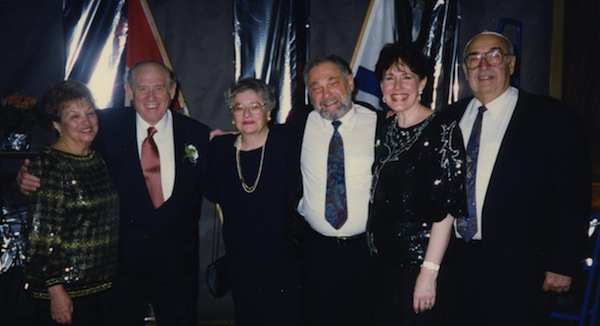
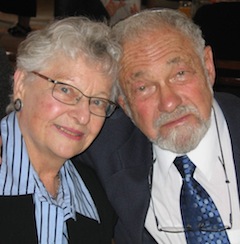
Phyllis and Rabbi Wilfred Solomon, centre, with Cantor Murray Nixon and his wife Dorothy, left, and Sharon and Irving Kates, at Beth Israel’s 60th anniversary gala in 1992. (photo from Congregation Beth Israel fonds, JMABC L.22263)

On June 17, Congregation Beth Israel will pay tribute to Rabbi Emeritus Wilfred (Zev) and Phyllis Solomon. The rabbi was spiritual leader of the synagogue from 1964 to 1997. During that time, gala co-chair Marcy Schwartzman told the Independent, he officiated at more than 4,000 lifecycle events, including about 500 brit milot and baby namings, 750 weddings, 800 b’nai mitzvah, 250 conversions, 900 funerals and 900 unveilings.

But the cause for celebration goes beyond numbers, of course.

photo - Phyllis and Wilfred Solomon are being honoured by Congregation Beth Israel on June 17
Phyllis and Wilfred Solomon are being honoured by Congregation Beth Israel on June 17. (photo from Beth Israel)

“Rabbi Zev and Phyllis Solomon were the heart and soul of Congregation Beth Israel for many years,” said board president Helen Pinksy. “Together, they gave our synagogue honour and status as a warm, caring, forward-thinking and progressive community of committed Jews in Vancouver. The role of emeritus for Rabbi Solomon indicates his distinguished service and was not awarded pro forma, but because he, together with his wife, accomplished much and were beloved by the people they served. It is a true pleasure to be honouring him in return with this gala.”

Pinksy and her family have been members of Beth Israel for about 25 years. Upon joining the synagogue, she said, “Almost immediately, I asked Rabbi Solomon to teach me Torah and Haftarah reading, because I wanted to have an adult bat mitzvah. Under his tutelage, it took place. After that, my oldest son Isaac was in Rabbi Solomon’s last bar mitzvah cohort, in 1997.”

Current spiritual leader of Beth Israel, Senior Rabbi Jonathan Infeld, met the Solomons at his installation 13 years ago.

“Rabbi Solomon was beloved because of his warmth, love and concern for the Jewish people, the Vancouver Jewish community and the members of our synagogue,” said Infeld. “He worked extremely hard to bring Torah and love to everyone in his realm. I always hope to emulate his examples.”

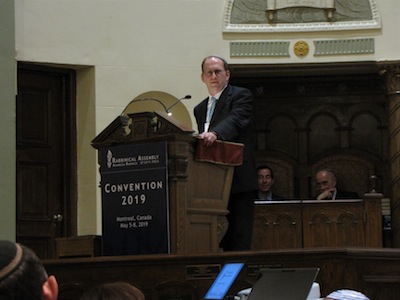
Both Infeld and Pinsky attended the Rabbinical Assembly, which took place this year in Montreal May 5-8. Solomon was one of six rabbis honoured by the Conservative movement organization on the first night of the convention.

“Conservative rabbis from across the world were in attendance,” said Infeld. “Unfortunately, Rabbi Solomon and Phyllis were not able to make it because they live in Jerusalem. Rabbi Lionel Moses organized and chaired the ceremony. I spoke about Rabbi Solomon and his wife, Phyllis. Liberal MP Anthony Housefather presented an award that Helen Pinsky received on Rabbi Solomon’s behalf.”

“As soon as I heard about the tribute ceremony for the Solomons, I wanted to be there,” said Pinsky. “It was an extreme honour to accept the certificate of merit and tribute on their behalf. The certificate is signed by Prime Minister [Justin] Trudeau, and the prime minister filmed a message of congratulations to the Rabbinical Assembly to welcome us there.

photo - Congregation Beth Israel Senior Rabbi Jonathan Infeld speaks about BI Rabbi Emeritus Wilfred Solomon at the Rabbinical Assembly in Montreal on May 5-8
Congregation Beth Israel Senior Rabbi Jonathan Infeld speaks about BI Rabbi Emeritus Wilfred Solomon at the Rabbinical Assembly in Montreal on May 5-8. (photo from Beth Israel)

“The greatest thrill,” she said, “was to hear Rabbi Infeld describe the accomplishments and the personal courage and integrity of the Solomons to the assembled rabbis and other guests at the assembly. It was easy for us to decide to attend, because we didn’t want this opportunity to honour the Solomons to go by without proper acknowledgement.”

The Solomons worked for the benefit of the synagogue and the larger community. “They became friends with many of their congregants and the families that made up the synagogue, grew up with the Solomon family,” said Pinsky. “Rabbi Solomon took a leading role in advocating for human rights and protecting human dignity within the Vancouver Jewish community and neither he nor Phyllis hesitated to stand up for what they believed to be fair. He was involved in demanding freedom of Soviet Jews, in the exodus of Ethiopian Jews, and he supported Martin Luther King and other leaders who fought for racial and social equality during the ’60s, ’70s and onwards. The Solomons also aided in the synagogue’s adaptation to include women as equals within the Conservative movement. Their impact was huge.”

The couple made aliyah right after Rabbi Solomon’s retirement in fall 1997, said Pinsky. “They have lived in Jerusalem ever since,” she said. “In around 2006, they attended and Rabbi Solomon officiated at my niece’s bat mitzvah at the Southern Wall, just below the Western Wall, and we socialized all weekend. The Solomons retained a warm and friendly relationship with my extended family, as they did with most of the families in the synagogue. They had known my parents since the ’70s, for example, and were quick to send us kids kind notes of sympathy on the passing of our father and then our mother. I know of many congregants who have lunched with the Solomons each time they visit Jerusalem, and still maintain that special relationship that one can have with ‘my rabbi.’”

“I see them every time that I am in Israel,” said Infeld. “We also talk on the phone and email.”

Infeld is joined in leading the congregation by Assistant Rabbi Adam Stein, Ba’alat Tefillah Debby Fenson and youth director Rabbi David Bluman. The synagogue has more than 640 member families, according to its website.

“Rabbi Solomon and Phyllis gave so much to Beth Israel and the entire Vancouver Jewish community. We are as we are today as a synagogue because of the two of them. They built so much. We should always be grateful to them,” said Infeld. “Our gala will be just one way to continue to show them our gratitude and appreciation.”

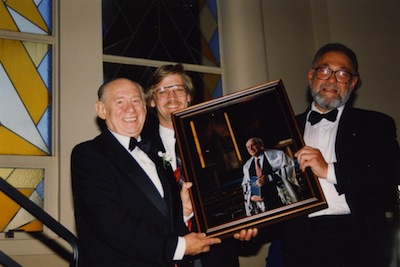
photo - Cantor Murray Nixon, left, and Rabbi Wilfred Solomon, right, hold a framed photo of Nixon taken by Don McGregor, middle, at Beth Israel, circa 1995
Cantor Murray Nixon, left, and Rabbi Wilfred Solomon, right, hold a framed photo of Nixon taken by Don McGregor, middle, at Beth Israel, circa 1995. (photo from Congregation Beth Israel fonds, JMABC L.22388)

For the last while, the gala committee, which Schwartzman co-chairs with Leatt Vinegar, has been asking the community to send in photographs of and stories about the Solomons. These photos will be shared throughout the event in different ways, said Schwartzman.

“It is going to be a lovely evening of celebrating our beloved Rabbi and Mrs. Solomon,” she said, “but it is also a celebration of our congregation and how it touches our lives at those lifecycle pivotal moments.”

In this vein, a new exhibit is being mounted.

“We are excited to officially open the museum cases in the synagogue once again,” said Schwartzman. “Jean Gerber and Lissa Weinberger have been working hard at bringing back these displays. Phyllis Solomon helped develop the original museum in the old building and she has been involved in helping to decide which pieces will be in this new display that officially opens at the gala.

“We will also be naming the street that leads down to our parking lot … and, if technology holds up, we will be trying a live link to the Solomons in Israel.”

A special book of messages is being designed to give to the Solomons as a keepsake, and a digital version will also be created, so that everyone can view it. To contribute to the book, contact Esther Moses-Wood at [email protected].

Proceeds from the gala and book will support the operation of the synagogue. For tickets ($180), call 604-731-4161 by June 1.

Format ImagePosted on May 24, 2019May 23, 2019Author Cynthia RamsayCategories LocalTags Beth Israel, Conservative movement, history, Solomons
Community day of learning

Community day of learning

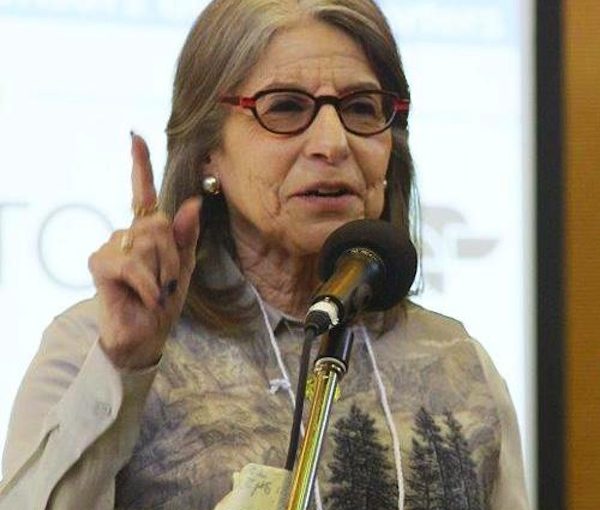
Prof. Norma Joseph (photo from Association for Canadian Jewish Studies)

On June 2, the Association for Canadian Jewish Studies is holding a day of lectures in the Jewish community that will be topped off with music from the Vancouver Jewish Folk Choir, the granting of the 2019 Louis Rosenberg Canadian Jewish Studies Distinguished Service Award to scholar and activist Norma Joseph and a talk by Franklin Bialystok on Canadian Jewish Congress.

“We offer a community day every year, and it’s always the opening day of the conference,” co-organizer Jesse Toufexis told the Independent.

“The motivations for the community day are plentiful,” said Toufexis. “Firstly, we receive great support in a number of ways from Jewish communities all over Canada, so this is an excellent way not only to thank them but to show them what the scholarly community is up to.

“Secondly, the Jewish community is interested in the topics we cover, from history to sociology to literature and art. So, coming from fields where we work on such minutely detailed projects, it’s fun to engage with a community that gets excited about the topics we ourselves find exciting.

“Thirdly, I think holding a community day is just part of a tradition that fosters togetherness. We aren’t scholars out in the ether, doing our own thing and keeping it to ourselves. I think of us more as a branch of a much larger Canadian Jewish community that includes all the various roles and aspects of Jewish life in this country, and I think it’s something of a duty to share what we’re constantly learning about our common past, present and future.”

Prof. Rebecca Margolis, ACJS president, praised Toufexis and co-organizer Prof. Richard Menkis on having “put together an amazing community day together in partnership with a team of local organizations that have gone above and beyond to make this day a success: Jewish Museum and Archives of B.C. and our host, the Peretz Centre for Secular Jewish Culture. As a member-run organization,” she said, “we value opportunities to collaborate with local organizations in order to produce exciting programming on the Jewish Canadian experience.”

The first panel session of the day is Jewish Space in Literature and Popular Culture, followed by Antisemitism and the Holocaust. At lunch, a panel discusses the topic Archives Matter. The two afternoon panels are Media Studies, and Challenging the Status Quo. Joseph’s talk in this last session is called No Longer Silent: Iraqi Jewish Immigrants and the CJC.

“I’ve been working on the Iraqi Jewish community in a bunch of different ways and my most recent publications are about their food and what we can learn about their cultural history and immigration patterns through studying their food,” Joseph told the Independent in a phone interview from her home in Montreal. “But I’ve also looked at, through the immigration pattern, the traumas they suffered by the expulsion from Iraq and the processes through which they had to escape from Iraq, as well as the ways in which they adapted to life in Montreal.”

It is only in the last decade or two, said Joseph, that Iraqi Jewish community members have “begun to present their memoirs and talk about how awful the experience from the Farhud in 1941 was. So, then I began to gather their stories.”

Joseph is particularly interested in the transition of the community from being unwilling to talk about their experiences to talking about them. “And also,” she said, “in the process of [preparing for] this year’s conference, which is celebrating 100 years of Canadian Jewish Congress, to figure out in what ways did Canadian Jewish Congress help or not help this community migrate or emigrate into Canada, which was, in fact, to Montreal. And that’s where I’m doing research right now. The Iraqi Jews themselves say, oh no, they didn’t help us … we came alone, we found our way on our own and nobody ever helped us. We didn’t ask for help. We weren’t refugees…. End of story.”

This perspective, as well as the larger Jewish community’s focus at the time on dealing with the impacts of the Holocaust, contributed to the silence, said Joseph.

“I wanted to go behind the scenes and say, OK, but in what ways that they [Iraqi Jews] might not have known was Congress working with the Government of Canada to open the doors, because we know that the doors of Canada were closed to Jewish immigration during World War Two but, afterwards, in the 1950s the doors open…. Did anyone in Congress help Middle Eastern Jews come? That’s my question. And that’s what I’m researching now at the archives, interviewing some people.”

Joseph’s interest in the Iraqi Jewish community comes in part from her and her husband Howard’s experiences.

“In 1970,” she said, “we came to Canada [from the United States]. He was invited to become the rabbi of the Spanish and Portuguese congregation. He was their rabbi for 40 years. And the congregation has many different communities – it has Iraqis, Lebanese, Moroccan, some Iranians, and we love the diversity of communities, the cultural diversity was so exciting.

“I never thought of studying the communities that we were friendly with and that my husband was the rabbi of, but, eventually, at some point, somebody said to me, why don’t you study Canadian Jews? And I looked around me at all these wonderful, diverse ethnic communities of Jews and I said, oh, this is a great idea, why not study the people I know so well?

“And I was interested in gender. I started asking a lot of questions and I especially focused on the women. And it came out that they were willing to talk to me, especially about food, and food was an entree into learning about their experiences, both in Baghdad and the transitions to Montreal and how hard those transitions were…. They couldn’t find the right foods and they didn’t know how to cook and there were no cookbooks and how were they going to cook and where were they going to find the spices? That was very symbolic of life, the difficulties of life in Montreal for this community that didn’t like gefilte fish.”

Joseph is being honoured by the ACJS for attaining the “highest standards of scholarship, creative and effective dissemination of research, and activism in a manner without rival in our field of Canadian Jewish studies, as well as being a respected voice in Jewish feminist studies more broadly.” Not only is she being recognized for “her mastery of both traditional rabbinic sources and anthropological methods,” but her teaching, her work in documentary and educational film, being a founding member of the Canadian Coalition of Jewish Women for the Get, as well as participating in the founding of the Institute for Canadian Jewish Studies at Concordia University, among many other accomplishments. For more than 15 years, she has written a regular column in the Canadian Jewish News. In one of these columns, in recent months, she recalled a time “when the phrase ‘liberal values’ was not a dirty word.”

“I was raised Orthodox,” she told the Independent. “My grandfather was a great Orthodox rabbi in Williamsburg…. But my parents worked very, very hard to send me to one of the great liberal Orthodox schools. It was called the Yeshivah of Flatbush, where boys and girls study together and we were taught that boys and girls could learn, and girls were included in that equation. It was one of the best schools because I learned fluent Hebrew, which was very rare, and it was a Zionist school, beginning in the ’50s.”

She added, “It wasn’t our liberal values in the 21st century, but it was mid-20th-century values. We learned to love Israel. We learned about justice, we learned about equality in some very interesting ways. We were patriotic Americans, my country right or wrong, which, after Vietnam, we had to rejig, but we were there before Vietnam…. I’ll tell you another thing that’s interesting about my upbringing – we didn’t learn about the Holocaust. At that age, in the ’50s and ’60s, parents didn’t want their children traumatized by stories of the Holocaust.”

Between her own studies of Jewish law and those of her husband, Joseph lauded the insight and flexibility that can be found in Judaism. “My husband always taught me that, if you are a legalist, are in charge of the law … the easiest answer is no, because it means you don’t have to examine and search the law. The hardest thing, but most creative thing, is to find a way to say yes…. We have thousands of years of law – surely in all that precedent you can find something.”

As but one example, Joseph has used Jewish law to argue for the rights (and obligations) of women, and has seen progress on the feminist front.

“For example,” she said, “let’s just take the world of bat mitzvah. In the 1950s, there weren’t bat mitzvahs, for the most part. Even the Conservative and Reform movements didn’t want bat mitzvahs…. Today, 2019, there isn’t a community that doesn’t offer some form of recognition of a girl’s 12th birthday,” including Chassidic communities.

“That’s a transformation because of feminist critique,” she said. “They will never admit it. They will say we always did it. But that’s a big change, on one hand. On the other hand, it’s silly, it’s narishkeit; it’s small, it’s nothing.”

But even incremental change leads to larger change, and Joseph spoke about the “incredible historical research coming out – women [always] had strong ritual lives, but what’s coming out now is the need for public ritual formats for women in all sectors of society.”

For the full schedule of and to register for the ACJS community day, visit eventbrite.ca.

Format ImagePosted on May 17, 2019May 16, 2019Author Cynthia RamsayCategories LocalTags education, history, Iraq, Jesse Toufexis, Norma Joseph, Peretz Centre, Rebecca Margolis, Richard Menkis
Dancers explore new territory

Dancers explore new territory

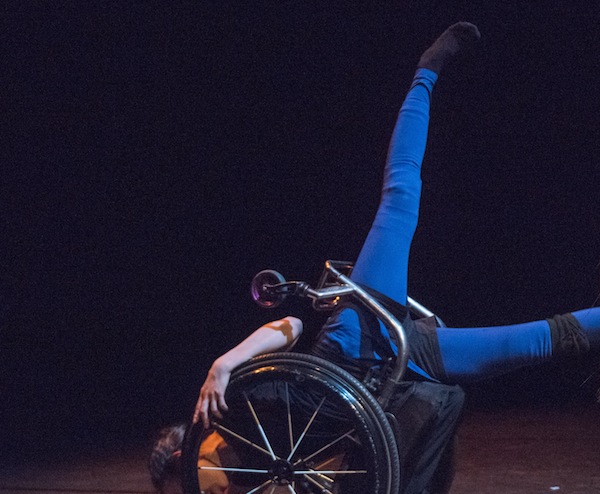
Magic & Remembering opens at Scotiabank Dance Centre on June 1, which is B.C. Access Awareness Day. (photo from All Bodies Dance Project)

The themes in this show range from home and belonging to our collective connection to self, city and architecture,” All Bodies Dance Project co-founder and facilitator Naomi Brand said about Magic & Remembering, a program of dances and films, featuring dancers with and without disabilities, that runs June 1-3 at Scotiabank Dance Centre.

“A lot of ABDP’s choreography highlights the relationship between different bodies moving in different ways,” said Brand, who is a member of the Jewish community. “We try and make work where our differences as dancers are celebrated and exploited for their choreographic potential. We’re always looking for new territory that challenges notions of the ‘typical’ dancer and the typical ways of making dance.”

A similar motivation sparked the idea for this show.

“Magic & Remembering was born out of the desires from artists in our company to lead their own choreographic processes, as well as an idea to explore new territory in dance filmmaking,” said Brand.

The program comprises three dances and three films. Most of the works are new for this production and created by longtime members of All Bodies Dance Project.

“ABDP works in a very organic way as a collective of artists who work through collaboration and improvisation to devise new choreography,” explained Brand. “Each of the pieces came about in a different way through a different creative process. My role has been to act as an ‘outside eye’ to support the choreographers, offer feedback and suggestions; sort of an editor to help clarify the pieces.”

Two of the three filmmakers are local, she said. Martin Borden – who is also a visual artist, woodcarver and educator, and has been documenting ABDP’s work for many years – collaborated with dancers/choreographers Rianne Svelnis and Harmanie Taylor on Sanctuary.

Gemma Crowe worked with Carolina Bergonzoni on Ho.Me. “Gemma is a dancer who has been working in video for a number of years,” said Brand. “As a dancer, she brings a keen understanding of how the camera moves almost as a partner in the dance.”

The third film is called Inclinations and it was created, said Brand, “by our friends and colleagues Danielle Peers (Edmonton) and Alice Sheppard (based in New York) and features a cast of four manual wheelchair users, including Harmanie Taylor from All Bodies Dance Project.”

Quoting from Sheppard’s website, Brand described the piece as one that “contrasts the playful connections when disability esthetics, disability community and a gorgeous ramp meet the institutional histories and discordant inclinations that can lurk just below the surface.”

“We are excited to include this beautiful film in our production,” said Brand, “as a way to connect and support disabled dance artists in our network from outside of Vancouver.”

The press material for the production notes that the films are “of dance works reimagined for the camera.” As to what that means, Brand explained that Sanctuary and Ho.Me were originally created as dances performed live: the former for the 2018 Vines Art Festival and the latter for last year’s Dancing on the Edge Festival.

“We’ve taken those dances,” she said, “and ‘reimagined’ them through the lens of the camera by using the same movement material, but reconfiguring it into a new piece. The camera allows for an intimacy and detailed insight into the dances that opens up whole new possibilities. For example, Carolina Bergonzoni’s Ho.Me, which consists of three personal solos, was shot in the dancers’ own apartments. We get to see these unique bodies and their movements in their private spaces, surrounded by objects of meaning to them.

“Sanctuary is shot in a busy urban location. The duet is accompanied by a soundscore created from the sounds of a typical Vancouver afternoon. Video allows us to take viewers into new worlds and to see the dancers and the dances in new ways.”

As for the dances in Magic & Remembering, Brand said they “use the dancers’ differences in unexpected and evocative ways. For example, Harmanie Taylor and Peggy Leung’s duet, Inflect, was born out of the simple choreographic question, what would happen if both seated and standing dancer used wheels? Peggy dances on a wooden wheelie board that facilitates all kinds of interesting and surprising ways of relating to Harmanie, who is a manual wheelchair user.

“Romham Gallacher’s trio, Re/integrate, delves into some deep and personal territory by exploring the process of bringing trauma-shattered pieces of oneself back together. The piece makes use of some intricate contact duet material between Adam Warren and Peggy Leung. Adam is a wheelchair user but dances the pieces without his chair.

“Cheyenne Seary’s Clove Hitch is a quintet based on themes of identity, individuality and belonging in a group,” she said. “The piece is set to music by Juno-nominated indigenous artist Cris Derksen.”

All Bodies Dance Project has many collaborators and partnerships that make its work possible, said Brand. “For this production,” she said, “we have partnered with the Roundhouse Community Art Centre and the Gathering Place, where we do most of our rehearsals, and are grateful to have received grant funding from the City of Vancouver.”

Magic & Remembering opens on B.C. Access Awareness Day, which is “a comprehensive campaign to raise awareness about disability, accessibility and inclusion,” said Brand.

In line with ABDP’s efforts to remove barriers, “all of the performances are scent-reduced with sliding scale ticket pricing – no one is turned away for lack of funds,” she said. “Our two performances on Monday, June 3, include ASL interpretation.”

For tickets ($10-$25) and more information, visit allbodiesdance.ca.

Format ImagePosted on May 17, 2019May 16, 2019Author Cynthia RamsayCategories Performing ArtsTags All Bodies Dance, dance, disability, film, Naomi Brand

Posts pagination

Previous page Page 1 … Page 46 Page 47 Page 48 … Page 84 Next page
Proudly powered by WordPress