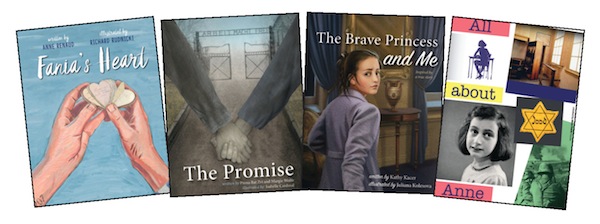
On the Jewish Independent’s bookshelf are four books recently published by Second Story Press. All are inspired by real women and girls, and all share lessons of bravery, solidarity and compassion, as well as of the Holocaust.
Fania’s Heart by Anne Renaud and illustrated by Richard Rudnicki, The Promise by Pnina Bat Zvi and Margie Wolfe and illustrated by Isabelle Cardinal, and The Brave Princess and Me by Kathy Kacer and illustrated by Juliana Kolesova are hard-covered picture books for readers ages 7-11. All About Anne, by Anne Frank House and illustrated by Huck Scarry (son of children’s authors Patricia Scarry and Richard Scarry), is a soft-cover encyclopedia of sorts for readers ages 9-13.
Fania’s Heart is based on the story of Fania Landau Fainer, from Bialystok, Poland, who survived Auschwitz. In the book, her daughter, Sorale (Sandy), who is “almost 10,” finds a heart-shaped book in her mother’s dresser, where she “was not supposed to rummage.” She takes it to her mom, who tells Sorale about the book’s origin – a 20th birthday present of unimaginable meaning, made by fellow prisoners, at great risk, with breadcrumbs and stolen or bartered thread, pencil, paper and other materials. It is a story told with minimal sentimentality and with illustrations in the 1950s-style of the time in which it would have taken place in real life. An author’s note explains the Holocaust very briefly and how the card, which unfolds “like an origami flower,” ended up at the Montreal Holocaust Museum.
In The Promise, cousins Bat Zvi and Wolfe tell the story of their mothers, Rachel and Toby, who survived Auschwitz. It starts two years after the sisters were separated forever from their parents, who gave Toby three gold coins to use “only if you have to” and advised, “above all, stay together.” When Rachel becomes ill and is taken from the barracks, the coins play a crucial part in Toby’s rescue attempt. In a four-sentence epilogue are photos of the real sisters, but no context other than that in the story itself, which mentions Nazis and Auschwitz but not the Holocaust. The artwork for the book is somewhat creepy – the disproportionally large heads are photo-like, and placed on more traditionally illustrated bodies.
Less emotionally powerful – in part because there is too much text – is The Brave Princess and Me, which relates how Princess Alice hid Jewish mother and daughter Rachel and Alice Cohen in her home. The Nazis invaded Greece in 1941, and The Brave Princess and Me starts in 1943. Princess Alice, the mother of Prince Philip, was born deaf and she uses her impairment to protect the Cohens. More about the princess, who was honoured as one of the Righteous Among Nations, is included after the story.
Rounding out the publications is All About Anne, a relatively comprehensive telling of Anne Frank’s story, which uses drawings, photographs and text from the Anne Frank House museum in Amsterdam. Its content is based on the questions most frequently asked by visitors to the museum. While it centres around Anne, her life and her diary, it includes broader information about the Second World War and the Holocaust. It is an excellent resource.
For more information on these and other books from Second Story Press, visit secondstorypress.ca.
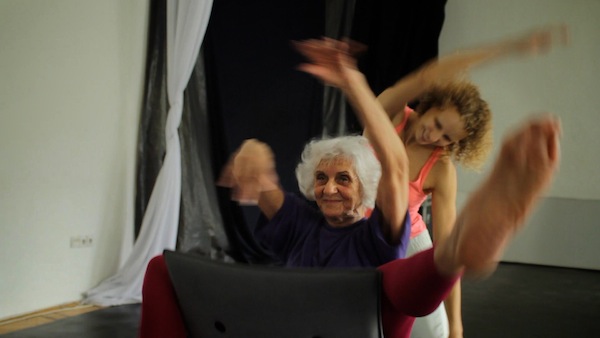
Éva Fahidi, in front, and Emese Cuhorka in a still from The Euphoria of Being, directed and written by Réka Szabó.
Éva Fahidi was 18 years old when she and her family were taken to Auschwitz. The men and women were separated. The women’s selection committee cut the line after Fahidi: “I went one way, and my whole family the other way. It was over. We are talking about a fraction of a moment, when one didn’t even have the faintest idea of what was really happening.” Forty-nine members of her family were murdered, including her mother, father and sister.
Fahidi tells this part of her story as dancer Emese Cuhorka, covered from head to toe in a black leotard, moves around her, expressing with her body some of what Fahidi is expressing verbally. This is but one of many moving scenes in The Euphoria of Being, written and directed by Réka Szabó. The Jewish Independent has chosen to sponsor the documentary’s screening at this year’s Vancouver International Film Festival, which runs Sept. 26-Oct. 11.
Szabó had heard Fahidi give a talk in Berlin, and she had read Fahidi’s memoir, The Soul of Things. She wrote to Fahidi about wanting to make a performance about her, with her it in. The almost-90-year-old Hungarian Holocaust survivor responded positively: “Every person should possess some form of healthy exhibitionism,” she says in the film. “I have more than is needed, so I don’t have any excuses.”
Cuhorka reminds Szabó of Fahidi. From this resemblance came the concept of a duet. At one of the first rehearsals, Fahidi shows Cuhorka what she’s able to do physically. “And, from the outside, it is like seeing an entire life at once,” says Szabó, as she watches them move together.
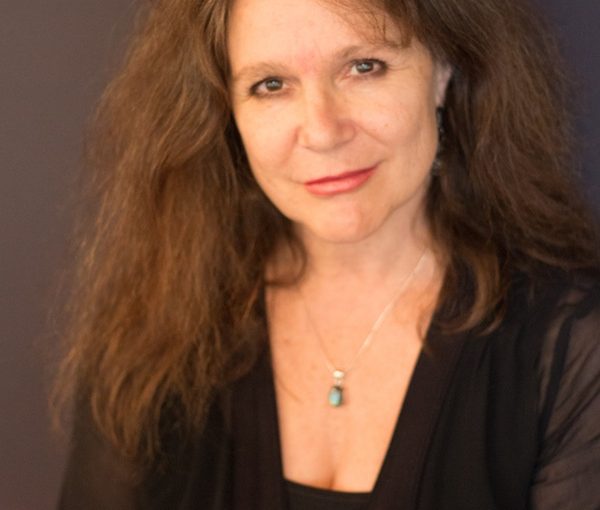
Réka Szabó (photo by Dusa Gábor)
The documentary covers the three-month period prior to the October première of what would become Sea Lavender. The work is the collaborative creation of the three women and, while what we are shown of the final result is powerful, it is the process and the bonds formed by the women that have the most impact, and give the film its inspirational quality.
Fahidi is remarkable. She is smart, spirited, well-spoken and endearing. When she talks about her Holocaust experiences, it is as if she is reliving them; her eyes look unfocused, her body appears heavier, her anger remains. She says her family should have left Hungary in 1935. “But my poor father, he couldn’t see beyond his nose,” she says. So proud was he of what he had built, he couldn’t leave it behind and only go with the clothes on his back. “This is the eternal tragedy,” she says, “that you don’t see things for what they are when you see them. Absolute idiocy.”
The film then cuts to a photo of the family – her parents, sister and her – as Fahidi describes the way in which she imagines them being gassed. She talks about a documentary she saw on Zyklon B, how it was first tried on geese. Such factual expositions lay raw the depth of her grief.
Yet, when Szabó asks Fahidi to list some of the things that helped her survive, Fahidi remarks that you have to appreciate and value the fact that you’re alive. “The fact that you exist, in itself, is euphoric,” she says. Hence, the name of the documentary and of the choice of “the flying chair duet” as the final scene of the performance. In discussing the nature of tragedy, Fahidi concludes that it’s no use thinking about it because you always end up in the same sad place. “Meanwhile,” she says, “you live happily.”
Seeing Cuhorka and Fahidi work and perform together is delightful – the two really do bear similarities, and their mutual respect is evident. The closing text of the film notes, “At the age of 93, Éva is still performing regularly. So far, we have staged 77 performances of Sea Lavender in numerous cities, such as Berlin, Budapest and Vienna.” While it is too much to hope that the show will come to North America, it is satisfying to know of the project’s life-changing effect on Fahidi, who, apparently, “can’t imagine being alive and not performing the piece anymore.”
The Euphoria of Being screens Sept. 27, 12:30 p.m., at International Village 8, and Oct. 3, 7 p.m., and Oct. 4, 10 a.m., at Vancity Theatre. For tickets, visit viff.org.
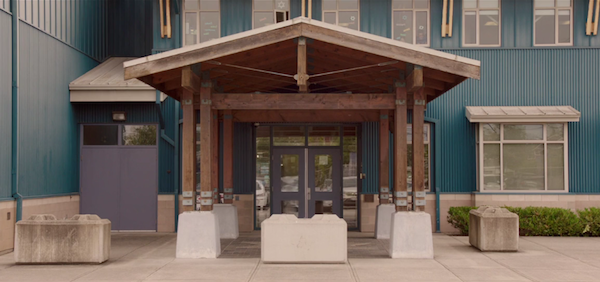
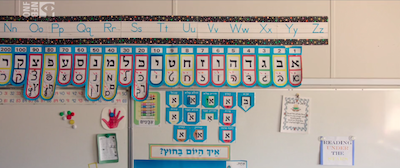
Stills from the NFB’s Highway to Heaven: A Mosaic in One Mile. Richmond Jewish Day School is one of the institutions featured in the short film, which screens at this year’s Vancouver International Film Festival.
The National Film Board short Highway to Heaven: A Mosaic in One Mile, written and directed by Sandra Ignagni, is visually striking. For the most part, it lets the images do the talking, communicating more about cultural diversity than words could.
Part of this year’s Vancouver International Film Festival, Highway to Heaven introduces viewers to the multiple faith groups and institutions along a mile-long section of No. 5 Road in Richmond, which includes Richmond Jewish Day School. In the 17-minute documentary, this strip of road – which has been called “Highway to Heaven” – appears both full of colour and action, as well as remote and removed, not just geographically but with chain link fencing and other security measures.
“We share a world grappling with ethnic and racial tensions, religious xenophobia and violence,” writes Ignagni in her director’s notes. “Such realities are not limited to the world’s conflict zones – they are a part of everyday life, even in the most advanced democracies such as Canada. It was in this context that I was drawn to the peculiar landscape of No. 5 Road … where multiple cultural and religious groups share a short stretch of suburban road. I was curious about how groups pitted against each other in so many corners of the world appeared to be living relatively peacefully with one another, and in very close proximity, in an ordinary Canadian suburb.”
In showing the beauty of the area – both in landscape and in cultural acceptance – Ignagni also captures some of the tensions that exist. The camera jumps from a lush orchard to a mansion mid-construction to a for-sale sign in front of what seems to be part of a forest. In one scene, which looks like it was filmed at RJDS, police in full gear – bulletproof vest and holstered weapons – address RJDS and Az-Zahraa Islamic Academy students, introducing themselves so that the kids should feel comfortable going to the police if they have a problem. The police then referee the kids in a game of ball hockey – boys against the boys, girls against the girls – throwing in questions about boundaries and other issues for the kids to consider.
Referring to the police presence on the road, Ignagni writes that it could “be variously interpreted as bridge-building, protection or surveillance. I learned that, for more than one decade, the Richmond Jewish Day School did not have an exterior sign for fear of antisemitic attacks against its schoolchildren. And, in recent years, the secular residential community that surrounds No. 5 Road launched a major campaign opposing the proposed expansion of a Pure Land Buddhist temple, using the pejorative moniker ‘Buddha Disneyland’ to describe the proposed building in local media and public debates. The mere fact that zoning by-laws have ordered these communities – the majority of which play a critical role in new immigrant and refugee resettlement – to the fringe of suburban land is also ripe for reflection.”
The minimal use of narration or interviews in the film was a deliberate choice. To do otherwise, Ignagni notes, “would be an exercise in public relations, reducing complex issues to soundbites and polemics. Instead, I wanted to make a film that would at once capture the remarkable – because it is truly remarkable – diversity on No. 5 Road, as it actually exists, while gesturing to some of the unresolved issues that underlie Canadian multiculturalism. The film is, therefore, constructed as a ‘mosaic’ – defined by writer and activist Terry Williams as ‘a conversation between what is broken.’”
While she doesn’t rely on words to tell this story, sound plays an integral role in the film: calls to prayer, monks chanting, different languages being spoken (and not translated), kids playing, school bells ringing.
“My film invites audiences to sit with what is unknown, different, raw or only partially visible,” says Ignagni. “To me, a mosaic captures perfectly the subtle tensions one finds on No. 5 Road, where custom and ritual, language and cultural diversity are practised under surveillance cameras and behind locked doors and gates. In making this film, I am asking audiences to look with open eyes and hearts – with a spirit of curiosity – at themselves and their neighbours, and simply reflect on multiculturalism as an unfinished project in need of attention in Canada and around the world.”
In addition to RJDS and Az-Zahraa, the list of participating neighbours includes the Evangelical Formosan Church of Greater Vancouver, India Cultural Centre of Canada/Gurdwara Nanak Niwas, Kingswood Pub, Lingyen Mountain Temple, Mylora Executive Golf Course, Royal Canadian Mounted Police (Richmond detachment), Thrangu Tibetan Buddhist Monastery, Trinity Pacific Church, and Vedic Centre.
At VIFF, Ignagni will participate in one of a series of panel discussions presented by Storyhive on Totally Indie Day, Sept. 28, at Vancity Theatre. She will be on the hour-long panel called Not Short on Talent: The Rise of the Short Form Documentary, which starts at 3:45 p.m. For the full film festival lineup, including, eventually, the not-yet-listed screening time of Highway to Heaven – which was an Official Selection at this year’s Toronto International Film Festival – visit viff.org.
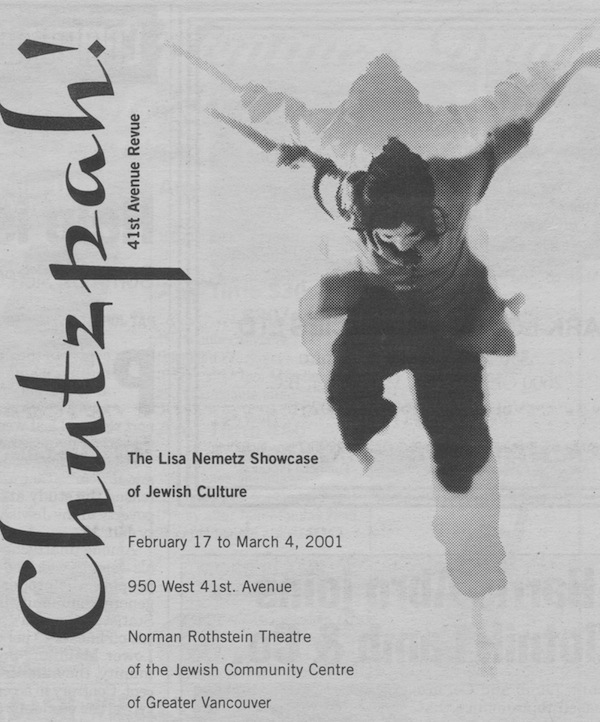
Mary-Louise Albert was not only a dancer in the first-ever Chutzpah! Festival, but its poster model (see image below).
As the 19th annual Chutzpah! Festival approaches, ready to embrace its new season – no longer a spring festival but a fall one – it will have to loosen its embrace on its artistic managing director, Mary-Louise Albert. After 15 years heading Chutzpah!, this is her last. Albert is moving on to the next part of her creative and personal journey, and the Jewish Independent spoke to her about the festival, its legacy and what might lie ahead for her.
JI: What do you think the main impact of the Chutzpah! Festival has been for the Jewish and general communities and the relationship between the two?
MA: Presenting and facilitating the growth of professional performing arts is an exciting and multi-layered approach to uniting communities. I am very proud that we have brought the festival to a point of national and international recognition, as well as being one of the flagship Jewish festivals in North America.
Through the insistence of high standards and by supporting new work, the festival has increased an understanding and appreciation of programming that embraces an eclectic range that is Jewish arts and culture, in particular from a Canadian perspective. Expanding on this programming, Jewish and non-Jewish artists share our stages, increasing our ability to bring many Canadian and North American premières to Lower Mainland audiences. Seeing, over the past 15 years, audiences from all walks of life and backgrounds embracing the festival is particularly rewarding.
JI: Have you accomplished what you set out to do when you took over the festival 15 years ago?
MA: Yes, which feels very satisfying to be able to say. I wanted the festival to not only survive but thrive in a very competitive local and national performing arts scene, which is tricky given a cultural umbrella. This meant attaining an international standard – not just a couple of high-profile shows, but across the board. It also meant the dance and music programming had to expand, which has in particular allowed for funding opportunities and artist growth.
An area I’m very proud of is connecting urban and rural communities through creation residencies. Many B.C.-based Chutzpah! artists have had creation residencies in both the North Island region and in the Norman and Annette Rothstein Theatre, resulting in world premières, with these productions going on to tour nationally and internationally. For example, this year, Geoff Berner, T.J. Dawe, Toby Berner, Tallulah Winkelman and Jack Garten will be Chutzpah! artists-in-residence for a week in Sointula, Malcolm Island, where they will perform as well. Chutzpah! will be sending UNA dance company from New York City to perform in Sointula, Port McNeil and in Alert Bay with the N’amgis nation directly before their Vancouver performances, which is a rare and meaningful opportunity for all involved. Sharing artistic wealth with underserved regions of B.C. is and has been an important aspect of the festival for the past few years. It is also in keeping with the times.
JI: In a couple of interviews I’ve read, you speak about how your training and working as a dancer was helpful to you in running Chutzpah! Could you speak a bit to that?
MA: I was trained in ballet and contemporary, danced professionally for 20 years and, within this time period, became a mother of two children. I was 45 when I stopped performing and, through support from the Dancers Transition Resource Centre, embarked on a new adventure of being the oldest “kid” in the class for a few years at Capilano U and BCIT’s Business School.
I was then hired by Gerry Zipursky [then-executive director of the Jewish Community Centre of Greater Vancouver, which is home to the Rothstein Theatre] and an inquisitive hiring committee (who I will always be grateful to) … and embarked on this job where I needed to come in running and move things forward. All this took stamina, tunnel vision, a somewhat sharp brain (and elbows), nerviness, flexibility and passion – things that a combination of dance training and a professional dance career prepares you for.
JI: In relation to Chutzpah!, what are one or two of your “I’m most proud of” moments?
MA: There are so many that I am proud of, but I would have to say the festival has been a trailblazer in presenting Israeli artists – and often in their first Canadian or North American appearances. Artists such as the Idan Raichel Project, Kibbutz Contemporary Dance Company, Batsheva Dance Company, Balkan Beat Box, Yemen Blues, Idan Sharabi, Roy Assaf, Avishai Cohen Quartet, Itamar Borochov Quartet, Dudu Tassa, Diwan Saz, Maria Kong, Baladino, Victoria Hana, David Broza and Mira Awad, A-WA and many more. And continuing this year with AvevA, Yemen Blues, Guy Mintus Trio, and Rami Kleinstein.
As well, I’m very proud of the growth of the dance and music programming and how this growth has affected positively and in a multi-faceted way the artistic development of many artists.
JI: What’s next for you?
MA: I live in both Burnaby and in Sointula on Malcolm Island. Development of contemporary dance, rural B.C. and social causes are beckoning. At 64, I still have a bit of “oomph” left to pursue.
JI: If there is anything else you’d like to add, please do.
MA: I’m honoured and thankful to have worked with so many excellent professional colleagues in the arts world and at the JCC in accomplishing the festival’s achievements, as well as working with some wonderful volunteers. However, there are two volunteers in particular who I want to give a special thank you to. People with integrity and grace who have stuck by me and the festival from the very beginning – Harriet Wolfe and Lloyd Baron.”
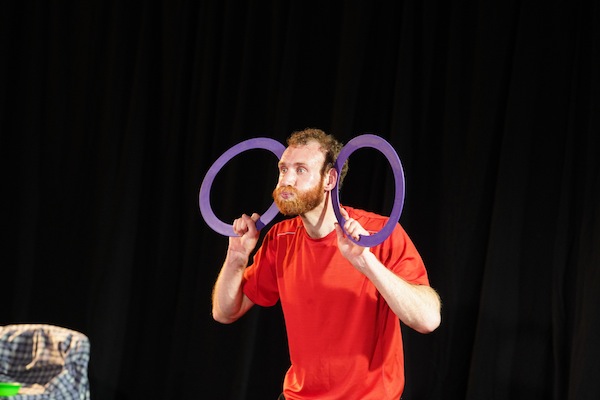
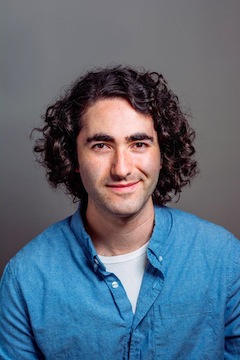
Janoah Bailin in SpinS. (photo from Janoah Bailin)
In anticipation of this year’s Vancouver Fringe Festival, which runs Sept. 5-15 at various locations throughout the city, the Jewish Independent interviewed some of the Jewish community members participating in the festival – Janoah Bailin, Erika Babins, Jed Weiss, Zach Wolfman, Melanie Gall, Susan Freedman and Shane Adamczak. They hail from as far away as Australia and their shows are vastly different, but they all have the same goal: to draw you into their world, perhaps allowing you new insights into yours.
* * *
SpinsS, at the Nest:“A wildly dizzying whirl of juggling, giggling, magic and movement, puppetry, PJs, circus and socks, totally tangled together! A unicyclist careens on stage, unpacking a quirky world of clothespin towers, erratic toothbrushes and gargantuan grins. Objects swirl into chaotic creation as Janoah constructs a performing-partner puppet from piles of props!”
Clothespins are “a recurring object in the performance,” Janoah Bailin told the JI. And so are, from the looks of it, some dangerous manoeuvres. But looks are intentionally deceiving, in order to entertain.
“I’ve actually never been seriously injured doing my work!” said Bailin. “Some stubbed toes and scraped elbows, sore wrists from catching myself, but nothing major. The worst is taking a pedal to your shin. When you learn unicycle, you learn falling. It just happens, you develop an innate sense of what you can and can’t comfortably do. I know how to fall and it happens all the time and I get up, shake it off, try again.
“This show plays with limits and bringing the skills to their limits – I expand or contract juggling patterns until I physically can’t hold them anymore and there’s a spin I do on the unicycle that spirals in on itself until I fall. So, falling is inherent in the show and I need to know how to do it well.
“I think I forget that audiences don’t know this,” he said about his being safe during his act. “So they are a lot more scared for me than I am, which is part of the magic of circus: faking instability, making something seem more chaotic than it is. The most dangerous stuff is long-term: keeping your body healthy through the strain of performing every day, the bipolar energy of performance – being totally on for an hour, all your energy focused on that one thing. The solutions to this are getting really good at physical self-care: know how and when to rest and stretch. The hardest work is taking care of my body in the long run.”
Bailin understands the use of the word “escapism” to describe his show, but said his goal is to bring audiences into his world for an hour, and “that seems like incredible presence, not escaping.”
Playful is another common description of SpinS.
“One of the aspects of my show that I’m incredibly proud of is that even fellow performers find the show playful,” said Bailin. “A lot of circus can start to look similar in the tricks and how they’re presented and, in certain ways, I aim to break those forms and I think I’m successful.
“Play is so important, and I mean play in the sense of creating space, pushing boundaries, trying things out. In my opinion, getting locked in routines is quite dangerous and play is a solution to this. Circus can seem quite playful, but it’s incredibly repetitive, the tricks are so hard they take an incredible amount of practice, so, by learning them, we make ourselves routine. I try to counterbalance this by choreographing at the edge of my ability – I can’t comfortably do all the things I do on stage, so they remain alive because I need to concentrate and there’s a very real danger that they won’t work and then I need to find a different solution – and also by choreographing through games, playing games on stage – how can I unpack a suitcase without getting off the unicycle?”
Bailin started juggling when he was 10, so he’s been at this for some 20 years now.
“I’m at the point in juggling and unicycling where I’ve mastered the basics and get to develop my own style,” he said. “So, I’m watching and feeling myself do the skills and how I can integrate my personality into them…. Also, I am continually excited about the challenge of piecing together shows, taking all the bits and fitting them together into something cohesive through all the disciplines I work with: circus, dance, puppetry, storytelling, magic.”
* * *
Lift, at Firehall Arts Centre:“Lift is a contemporary musical set in London’s Covent Garden Tube Station. The elevator ride takes one minute, but the journey inside takes us through eight lifetimes, allowing the characters to see and say things that might not otherwise … come up.”
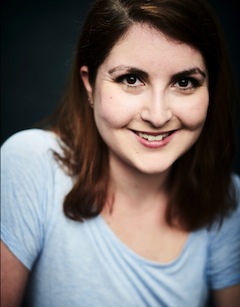
“As a company, Awkward Stage is always looking to tell stories that haven’t been heard yet and, like many of our productions, Lift will have its Canadian première with us at the Fringe,” choreographer and Awkward Stage Productions artistic associate Erika Babins told the JI.
Erika Babins (photo from Awkward Stage)
“I think what drew us all into this story was the way that it was told. It intrigued us, the way the play bends reality and imagination. Our setting never changes but changes constantly, the characters are all rich relationships yet are strangers. We are constantly playing with those dichotomies in rehearsal.
“The script leaves a lot of room for interpretation and we’re so lucky to be working with a cast of brave and intelligent actors who are making discoveries with us as we build this show. Plus, the music is beautiful; it’s been stuck in my head for months.”
Choreography is integral to the show. It helps delineate the imagined settings to which the elevator riders take us. “The jostling of a train, warming up at a ballet studio, being at a strip club. It also helps to blend the lines between reality and the imaginings in the Busker’s mind,” said Babins. “The choreography in this show is quite integrated into the storytelling – there aren’t any ‘dance sequences’ per se, the movement weaves itself into the text and music.”
Jed Weiss plays the Busker, who he describes as “the quintessential introspective artist.”
Jed Weiss (photo from Awkward Stage)
“This leaves him both capable of deep insight as well as myopic self-centredness,” explained Weiss. “His arc is largely around learning and accepting that he has to be more considerate of the needs and lives of the people around him, leading him to a profound personal growth that his self-centred introspection could not achieve. This connects with the theme of the piece as a whole, highlighting the need to be brave in the face of vulnerable social interaction, to make meaningful connections with those that are important to you.”
The character, he added, “shines light on the shortcomings of the artistic male archetype we so often see in rom-coms and other media. Instead of following the stereotypical path of a tortured artist pining after a muse until she falls for him, it shows that real growth comes instead from practising sympathy towards the needs of others, not a commitment to romantic obsession.”
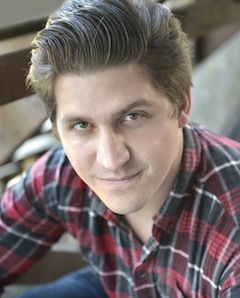
“I am playing Tall Dark and Handsome (TDH), a psychiatrist, and an American tourist,” said Zach Wolfman. “TDH is the dating avatar for Bright Young Thing (BYT) and represents BYT’s online persona. The American tourist is lost and looking for directions in London, hoping to bump into the Queen and visit Buckingham Palace.”
Zach Wolfman (photo from Awkward Stage)
For Wolfman, the character he plays allows him “to explore the dissonance between the face we show online versus how we act in real life. Getting to embody that daily interaction we all engage in online is fun for me.
“The play as a whole is very dynamic,” he said, “and I really enjoy the fast pace and shifts we make between different settings. One minute, we’re in a lift; the next, we’re in a club or a chat room. Lift definitely highlights the different masks we wear at work, online and in our relationships. How vulnerable are we and how willing are we to open ourselves up to those who are close to us, or simply strangers in a lift?”
“I hope the audience leaves the theatre with a little wonder,” said Babins. “I hope they wonder about what happens to the characters after the moments we meet them in, but I also hope they wonder about themselves, and the connections and disconnections they have every day.”
* * *
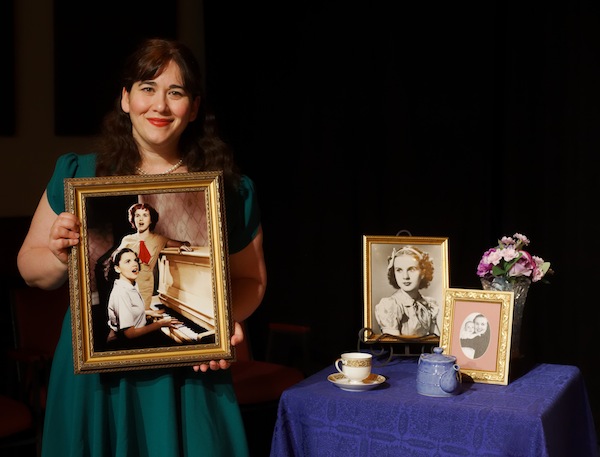
Melanie Gall brings Ingenue: Deanna Durbin, Judy Garland and the Golden Age of Hollywood to Vancouver. (photo from Melanie Gall)
Ingenue: Deanna Durbin, Judy Garland and the Golden Age of Hollywood, at Firehall Arts Centre: “Judy is an icon – loved as Dorothy in The Wizard of Oz. But, in the 1930s, Deanna Durbin was a far bigger star. A favourite of Roosevelt, Churchill, even Mussolini, her first kiss was front-page news. At 27, she disappeared to a life of obscurity in France. The true tale of the lifelong friendship and rivalry of two great stars of Old Hollywood.”
“I’ve always loved Deanna’s music and her movies. We have similar voices and look vaguely the same. Also, Deanna is a Canadian movie star who has almost completely been forgotten,” said Melanie Gall. “Her legacy is one well worth saving, and I hope that my show will help preserve her memory for old fans, and will introduce her and her music to a new generation.”
Always fascinated with history and with historic music, Gall has written and performed shows about Vera Lynn, Edith Piaf, Jacques Brel, George Gershwin, and First and Second World War knitting songs. In creating a new work, she said, “First off, I think about the music. What are the songs I’d like to sing, and which songs will stay interesting and relevant to me after over a year of touring?
“I then look at marketability and if a topic I’m considering will have commercial appeal. I then ensure that it has not been done before, or that it has not been done in a similar way to how I plan to present the topic.
“I also try to find a topic I feel passionate about and that I’d like to share through a theatrical piece.
“Finally, I try to judge if I’m the best person to present the topic. Do I sing in the correct style? Can I do the topic justice?”
For Ingenue, said Gall, “I was performing another show of mine, Opera Mouse, Off-Broadway in New York. After performing each day, I went to the New York Performing Arts Library and dug through historic clippings, notes and scrapbooks. I spent days combing through crumbling articles and building a comprehensive biography of Deanna Durbin. Researching Deanna’s mannerisms and speech involved tracking down and watching all of her movies, most of which are actually very hard to find.
“Researching the music involved listening to and playing through dozens of songs to choose the tunes for the show. Then, with the help of pianist and recording engineer Bennett Paster, I arranged and recorded the backtracks, maintaining historic integrity, while creating original arrangements. Much of the script is taken directly from interviews and articles about her life, and several sentences are accurate historic quotes. So, it’s a lot of work, but it’s work I love doing.”
Preserving history is a passion. “So much wonderful music and stories are in danger of being lost or forgotten, and I have devoted my life to preserving them. Although Deanna Durbin wasn’t Jewish, the producer and director who made her a star, Joe Pasternak and Henry Koster, were Jewish – they arrived in Hollywood after years of working in the Berlin Universal studio, fleeing in 1933 when Hitler came to power. Also, the composers of most of Deanna Durbin’s songs were Jewish. So, there is a strong connection.”
* * *
Old-ish, at the Havana Theatre:“It’s about aging and death only WAY funnier! Susan’s fifth one-woman comedy travels the hilarious, rocky road from denial to grudging acceptance of getting older.”
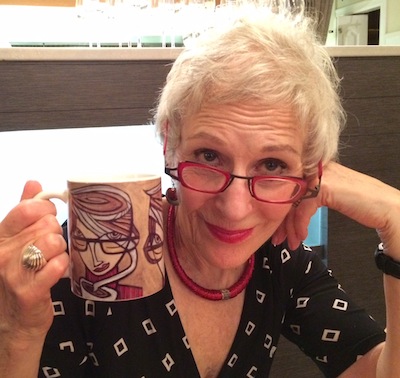
“I guess I’ve been ‘collecting data’ for this show for a long time,” said Susan Freedman, 77. “For about the last five years, whenever I hear news about my contemporaries, it is mostly not happy! The realization finally dawned that people do get really sick at my age and, yup, they die at my age too. I always write about issues and events that are important in my life and I always hope that my stories will resonate with audiences who may be experiencing similar events and feelings.”
Old-ish is Susan Freedman’s fifth one-woman comedy. (photo by Alan Silverman)
The show is structured around events in Freedman’s life that lead into one another thematically and more or less chronologically.
“I have had so much fun working with my son (Alan Silverman) on this show,” she said. “This is the first time he has directed me, though he is an experienced film director. He is smart, he’s a great writer and he has a terrific sense of humour. Do I sound like I’m his mother?
“I have worked with my husband (Bill Galloway) on all five of my shows. He is stage manager – calling the lights and music – on this show and he has been stage manager or slide projectionist on the others. He’s a huge help and support for me and, as I travel across the country with my shows, I get to have him as a roommate on the road! We have a great time traveling together.”
This Fringe marks Freedman’s 20th year of writing, producing and performing solo Fringe shows. When she did her first show, in 1999, she said, “my mother was still alive and I was sure she would live forever, so I certainly didn’t think of myself as old. I am frankly shocked that I’m the age I am. Like most of my friends, I have no idea how the years could have raced by so fast! There are lots of changes as we age, but there are still so many things we can do and enjoy and so much that makes life worthwhile. I am enjoying the good luck of being healthy, although I’m aware that can change on a dime.”
Admitting that she was nervous “about doing a show on aging and death,” she said, “but we are all aging and, if we’re lucky, we will get old. Critics are saying the show is uplifting. So, even though getting old can certainly present us with plenty of problems, it’s always good to laugh – right?”
* * *
Zack Adams: Love Songs for Future Girl, at Revue Stage:“… love, loss, heartbreak, growing bad ginger beards and everything in between. Think of it as a cross between a rock concert and group therapy.”
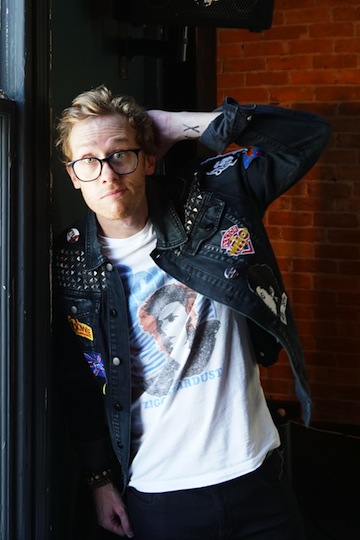
Shane Adamczak shares his heartbreak in Zack Adams. (photo from Shane Adamczak)
Shane Adamczak actually has two shows in this year’s Fringe. “Zack Adams got through because I won the lottery and The Ballad of Frank Allen is a one-off performance that the Fringe asked us to do as part of their Pick Plus season, where they bring back popular shows from previous years,” he explained.
The Ballad of Frank Allen, which is on one night only, at Performance Works, is “about a janitor named Frank who is accidentally shrunk in a science lab and ends up living in another man’s beard,” said Adamczak. “Yes, that is really what it’s about. It’s an exploration of masculinity in these modern times and what it means to be a ‘good man.’”
Adamczak uses music to tell his stories.
“I find it is such an accessible medium for people,” he said of that choice. “You’re so hard-pressed to find someone who doesn’t love some music at least. It’s also a way for me to live a rock star wannabe fantasy out on stage but using music as a theatrical device to tell stories.”
Both of these shows, he said, “are labours of love and very close to my heart for different reasons. If you love music, good storytelling and to laugh your ass off, please do come along.”
Erica Dee curated the show Weaving Voices, which takes place Aug. 9 at CRAB Park at Portside. (photo from Vines Art Festival)
Weaving Voices features Jewish community member Erica Dee, Tonye, Miss Christie Lee, Janelle Reid and Sara Cadeau, with instrumentalists Sean Mitchell and Jonny Tobin. The performance at this year’s Vines Art Festival on Aug. 9 is based on Dee’s singing workshop, Sing for the Soul.
Dee has been offering the group singing classes over the past two years. “This has been one of my favourite projects I have ever created and it has inspired me to write a whole new album and live performance,” Dee told the Independent. “Sometime in 2020, I will release this new project with a new name and it is very different from anything I have performed. It will be a live, multi-sensory experience that is meant for listening rooms and theatres, or parks. And I will activate the spaces with my singing workshop prior to the show and then include the participants in my live performance. I won’t share the name yet, but it does include my family’s name in it.”
Dee’s cultural heritage includes Jewish and Italian roots, and jazz on both sides of the family. Her paternal grandparents are Evelyn Stieglitz (z’l) and Murray Landsberg, who she described as “the sweetest Jewish couple, who met in the Bronx in the 1930s. They were 13 and 15 and they were together until my grandmother past away a couple years ago. My father, Paul Landsberg, is a prolific jazz guitarist, who started his career teaching at Berklee College of Music in Boston, Mass. My mother, Rita Marie, was born to Rita Shirley Dallesandro and Jim Smith. Rita Shirley’s brothers, Frankie and Arthur, started a jazz big band in the ’50s called the Dellasandro’s, where they played saxophone and clarinet.”
Born Erica Dee Landsberg in Boston, Mass., Dee goes by only her first and middles names. She grew up “in the mountains of the Sinixt Territory (Nelson, B.C.). My mother, father, sister and I moved to the Kootenays in 1989 because my father helped start Selkirk College’s music program.”
Expressing her gratitude at being a Canadian citizen, Dee said she first moved to Vancouver in 2005, a couple months after graduating high school. “I followed my passion,” she said, “as I had already been performing and writing and I was ready to move to the big city to expand my artistry. I also followed my heart here, after falling deeply in love with a female DJ and producer who was running Vancouver’s only lesbian bar at the time.”
Dee is a vocalist, DJ, writer and producer. She released her first recording, Golden Mixtape, a combination of remixes and original work, in 2011. Her debut album, New Skies, came out in 2016.
“I am firstly a singer,” she said, “which means I get to connect to my instrument (aka my body) in such a deep and intimate way. I usually have some burst of inspiration come to me, whether it’s a hook, or a bass line, or a drum beat. Then I spend time developing the tone, feeling and resonance. Words usually come after, as I find when I add words to my art, it brings it into the mind and I like to stay in the body for as long as possible.
“As far as production goes, I have been producing music for over 10 years and have yet to release something that is completely self-produced. I use production as another way to get my ideas out, using drum pads, keys and programs like Logic and Ableton, and then eventually collaborate with other musicians and producers to complete the creation.
“Recently,” she added, “I have been creating on a loop pedal, which has taken my artistry to a completely new level. I started DJing when I was 20, when I realized that I could be my own band mate, and started touring a performance where I would sing and MC over top of my DJ sets, fusing together the music that I love and moves me with my originals and remixes.”
Dee collaborates a lot, both in performances and in the creation of new work. Her bio notes that she has “supported and toured with artists such as Lil’ Kim, Mos Def, Quest Love, A Tribe Called Red and Bad Bad Not Good.” Past guest artists have included Snotty Nose Rez Kids and Desiree Dawson.
“I love the magic that happens when artists share space together,” she explained. “Each person is unique, with their own experience, tone, voice, stories and inspirations. It activates every part of my soul to witness artists coming together in this way, harmonizing, improvising, and the dynamics of different voices coming in and out of the music. I always say, sometimes just having another person in the room is enough, without a word shared. I can feel every piece of music they have absorbed since their creation lighting up the space. It is truly is my favourite part about being an artist.”
For the Vines Art Festival show, Dee said, “I have brought together a group of such powerful artists…. Each of these artists shares their stories and truth in such a real and accessible way.”
Dee said she is honoured to be part of the festival, as she really connects to its core values. Part of the festival’s mission is to offer “platforms for local artists and performers to create with and on the land, steering their creative impulses toward work that focuses on the environment – whether a deep love of nature, sustainability, or climate justice.”
“Growing up, I spent a lot of time outside and I find a lot of my inspiration in nature,” said Dee. “I attended Waldorf School as a kid, where I learned how to use my hands to connect and create with the natural world in a sustainable way.
“Since then, I have always had a very strong connection and appreciation for the land I occupy. Wherever I travel, I always take the time to educate myself on whose land I am on and acknowledge that within my show. I use my platform to share information about the social and environmental issues that I feel are important – I actually got fired from a festival in Calgary for speaking about the pipeline and how much harm it will cause to indigenous communities.”
For the performance at Vines, Dee shared that there is going to be “an extra special element.”
Of that element, she said, “I have never done this before and I am so excited. During the first time I sat down with Heather [Lamoureux, the festival’s artistic director], I had a vision and I am really looking forward to bringing it to life!”
Weaving Voices on Aug. 9 takes place at CRAB Park at Portside, at 7 p.m. Other Jewish performers in the festival include mia susan amir, Ariel Martz-Oberlander and Rabbit Richards, and it features more than 80 artists overall, performing at parks throughout the city. Every event is free admission and more information can be found at vinesartfestival.com.
Michael Germant, left, Sarah Boes and Drew Henderson co-star in Island Production’s The Understudy, Aug. 1-10 at PAL Studio Theatre. (photo by Jayme Cowley)
Oftentimes, in cultural endeavours, there is a tension between artistic vision and profit margins; that is, if there is any money to be made. This is one of the themes of The Understudy by Theresa Rebeck, which is being presented by Island Productions next month at PAL Studio Theatre.
The show co-stars Sarah Boes as Roxanne, the stage manager, who also is a frustrated actor; Drew Henderson as Jake, the good-looking action-hero star trying to be taken seriously as an actor; and Jewish community member Michael Germant as Harry, the understudy, who happens to be Roxanne’s ex-fiancé. Despite the personal drama, “a stoned lightboard operator, an omnipresent intercom system [and] the producers threatening to shutter the show,” Roxanne must try to run the understudy rehearsal for the Broadway première of a recently discovered Franz Kafka masterpiece.
Existentialism, explains director Mel Tuck in his online notes for the production, “denotes the inexplicable nature of human existence and emphasizes man’s freedom of choice and responsibility for the consequences of his acts.”
“What I like about The Understudy and what I think is funny,” Germant told the Independent, “is that, just when you think the characters have got things under control, everything falls apart. I also love how Rebeck makes the events of the play intertwine with the events of Kafka’s ‘undiscovered’ play-within-the-play thematically.”
Echoing Tuck’s comments, Germant added, “The existential aspects in Kafka’s play lead to the final choice that our three protagonists make at the end, both within and ‘without’ Kafka’s play.”
About those protagonists and what they symbolize, Tuck writes, “There are actors that have substantial careers because they are attractive, and then there are actors who have chameleon-like skill at hiding themselves within the role they are playing. Both have their place and purpose. The battle between art and business is forever being played out before our very eyes. There are many arguments for art as opposed to business. We artists believe in the value of entertainment and intelligent growth for ourselves and our public. We are exploring polarities and the implications of internal versus external thoughts; how we are affected by our conditioning and how that manifests in our social lives and activities. In the theatre, as in movies and TV, one prime issue has taken precedence: money. Money is a defining and deciding factor in avenues of artistic endeavour. What is the best possible way to make a play, movie or TV show successful? The sad reality is usually money takes precedence. And often funny means money. This is a very funny play.”
The Independent has interviewed Germant a few times, all for serious dramas, but he has done comedy before.
“Good dramas have humour written into them,” he said. “It’s the spoonful of comedy that makes the drama go down. And vice versa – good comedies like The Understudy have drama at their core.
“We’ve actually done another comedy, called Seminar, by Theresa Rebeck…. A drama we did – John Patrick Shanley’s The Dreamer Examines his Pillow – has a lot of humour, and a comedic ending. Both of those plays were also at the PAL Studio Theatre and both in 2014,” said the actor, for whom this play marks his seventh for Island Productions.
“On screen,” he added, “I was in a pilot called High Moon, where my character was the comic relief, and I did a short dark comedy, which was really well-received at film festivals this year called Caught in the Spokes.”
About the ways in which comedic and dramatic roles differ, Germant said, “Comedy is heightened pace and energy. In drama, you can set your own pace – you can pause or take a break or a breath wherever you want. But comedy is structured very specifically and timing is the golden rule. In that way, it’s more disciplined and difficult than drama.”
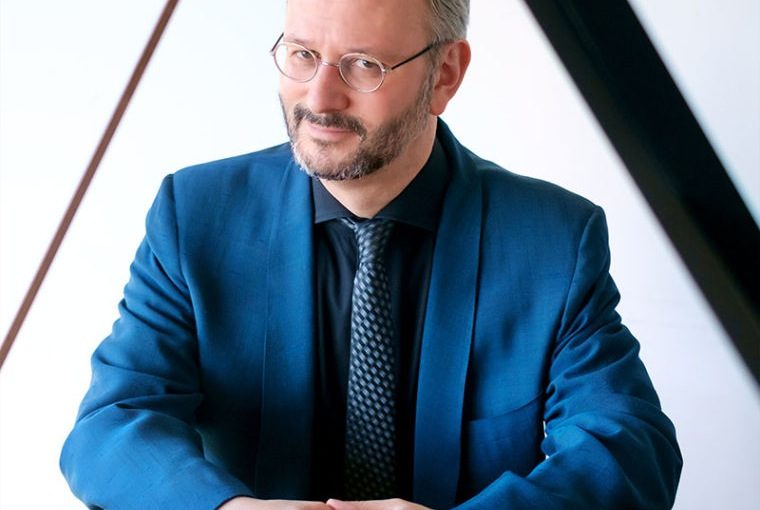
Byron Schenkman performs in the concert called Chopin Preludes on Aug. 1 at Christ Church Cathedral. (photo from Byron Schenkman)
“I think Chopin was an exceptionally sensitive pianist and composer – more of a poet than most. Sometimes his music is almost painfully beautiful. And, these days, I think we need all the poetry and beauty and sensitivity we can find!” Byron Schenkman told the Independent.
Schenkman returns to the Vancouver Bach Festival this year. Presented by Early Music Vancouver, they will perform preludes by Frédéric Chopin on Early Music’s 19th-century Broadwood fortepiano on Aug. 1, 1 p.m., with a pre-concert talk at 12:15 p.m., at Christ Church Cathedral.
The concert is a collaboration with the Vancouver Chopin Society. Describing Chopin as “a central figure of 19th-century Romanticism,” the program summary notes that “his connections to Bach are clear in his own preludes, which were directly inspired by Bach’s The Well-Tempered Clavier.” To place “Chopin’s music in the context of Romantic composers who influenced his work,” Schenkman’s performance will include pieces by Maria Szymanowska, Robert Schumann, Clara Schumann and Johannes Brahms.
Of playing Chopin, Schenkman said, “I think the biggest challenge – and the greatest joy – is honouring the delicacy of Chopin’s music even when it is intellectually complex and emotionally very deep. Compared with performing most other composers’ work, it’s like creating art out of glass instead of marble or bronze.”
Schenkman performs on piano, harpsichord and fortepiano, which is, simply, a piano made in the 18th and early 19th century. They also have contributed to more than 40 CDs, including some on which they have played on historical instruments from the National Music Museum, in Vermillion, S.D., and from the Museum of Fine Arts, in Boston. The award-winning musician is a founding member of several ensembles, and teaches music history at Seattle University, as well as being a guest lecturer on the harpsichord and fortepiano at other institutions. In 2013, they launched Byron Schenkman & Friends, a Baroque and classical chamber music series in Seattle.
A graduate of the New England Conservatory and Indiana University, Schenkman said, “I grew up in a home with lots of music. I often heard one of my older sisters practising the piano and it is still a very comforting sound for me, especially the repertoire that she practised most: Mozart, Beethoven, Schubert and Chopin.”
In past Bach Festivals, Schenkman has performed Bach, Ludwig van Beethoven, Johannes Brahms, Felix Mendelssohn and Ignaz Moscheles.
“I am really happy to be returning to Vancouver, one of my favourite cities,” they said. “And I am honoured to be part of the wonderful Vancouver Bach Festival along with so many inspiring colleagues.”
This year’s 14-concert festival, which runs July 30 to Aug. 9, begins with EMV’s ensemble-in-residence, Les Boréades, in a performance over two nights – July 30 and 31 at the Chan Centre for the Performing Arts – of Bach’s Complete Brandenburg Concertos. It also closes at the Chan Centre – with Henry Purcell’s Hail Bright Cecilia – but the other concerts take place at Christ Church. For tickets and more information, visit earlymusic.bc.ca or call 604-822-2697.
Gabriel Paquin-Buki, far right, founded the band Oktopus, which started performing in 2010. (photo by Rémi Hermoso)
Among the Jewish performers at this year’s Mission Folk Music Festival, July 26-28 at Fraser River Heritage Park, are Vancouver’s Jesse Waldman and Montreal’s Gabriel Paquin-Buki. For both musicians, family has been a key inspiration.
Waldman is a guitarist, singer-songwriter, studio producer, sound designer, and film and TV composer. Originally from Thornhill, Ont., just north of Toronto, his bio describes a cassette of his grandmother singing the Yiddish folk song Papirosen to his mother as one of his “most cherished possessions.”
“That recording was from the late ’50s, most likely 1957,” Waldman told the Independent. “My family had one of the first consumer-level tape recorders, they also had one of the first eight-millimetre film cameras, too. They always loved documenting the family, taking time capsule-like snapshots to cherish and enjoy later on in life.
“The recording of that particular song – which is about a young girl selling cigarettes on a street corner – has a beautifully haunting melody. I believe my grandmother learned it from her mother, my great-grandmother. At some point, it was transferred onto a stereo cassette recorder and a few copies were made. The same tape also contains interviews with my mother, a toddler at the time, and other family members, since passed away.”
A guitar he found in his parents’ basement also played a part in the start of his musical career.
“The guitar was an old beat-up nylon-string classical guitar that belonged to my Aunt Sherri,” said Waldman. “Actually, I suspect it belonged to one of her ex-boyfriends. I figured out how to play ‘Smoke on the Water’ on one string and was hooked for life! That was back in 1989.”
Waldman made his way to Vancouver in 1995 “on a whim,” he said. “I wanted to go somewhere where no one knew me and reinvent myself. From the moment I saw the mountains and smelled the ocean, I instantly felt at home. Then, after meeting the people and getting a feel for the laidback vibe of the West Coast, I was sold on Vancouver.”
For Paquin-Buki, whose group Oktopus began performing in 2010, it was his father who introduced him to klezmer.
“My father was born into a Polish Jewish family and has carried klezmer music with him all his life. His transmission to me of this cultural legacy occurred quite naturally. The cassettes he would play in the family car, the klezmer recordings during parties at our home, the live bands at family weddings and those rare times he would play songs on the piano were enough for me to access the roots of this musical tradition,” said Paquin-Buki.
“As it is for many children, I believe it was the rhythm of this music that excited me. The recordings we listened to were mostly of fast songs and, for me, were synonymous with joy. My love for this music today has so many facets! When we listen to klezmer, we can somehow feel the richness of the Jewish people’s millennial history and hear their encounters with musicians from all over the planet and across centuries. Also, major-minor ambivalence in the main klezmer scale (the freygish) embodies the dichotomy between laughter and tears so characteristic of Jewish culture. And it’s always fun music to play.”
Waldman has similar views. “I’ve always enjoyed klezmer music,” he said. “The mile-a-minute dance numbers, the sorrowful ballads and the cheeky vocals. Many klezmer compositions use melodies based on the harmonic minor scale, which includes a minor third and a major seven, which makes it sound particularly haunting and mournful to me. In terms of culture, all of my band mates in my early days were Jewish. I definitely cut my teeth with fellow Jews who know the delights of Shabbos dinner and a good bagel with lox and cream cheese!”
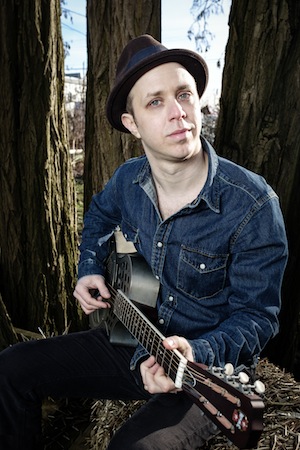
Jesse Waldman (photo by Jodie Ponto)
While he enjoys klezmer, Waldman’s music is predominantly folk and blues. “I love the sound, the rawness and heavy emotional weight of those styles,” he explained. “I also love the storytelling aspect of it, specific life experiences, places and relationships. Real folk and blues is unique to each artist but also has a tradition of carrying classic songs through the generations. I also love how blues has a way of transforming deep pain into something beautiful.”
Waldman’s debut album, Mansion Full of Ghosts, which was released in 2017, is described as “an exploration of the city’s vast duality, a backdrop of beauty mirrored by a fierce underbelly and a need to keep a light on in the dark.” It includes songs about his neighbourhood, the Downtown Eastside, and, in talking about what drives him to make socially conscious music, he said, “I think mostly my compassion for other people, particularly those less fortunate than myself. I also yearn to connect with people on a deeper level and music and honest lyrics are a good way to achieve that.”
Among the talent featured on that album is his partner, Megan Alford. Currently, the two are working on a recording of her music, Field Guide to Wildflowers, scheduled for an early 2020 release. “My role is producer and guitar player,” said Waldman. “She is an outstanding songwriter with a great voice and poignant and deeply personal lyrics. We’ve been working together for a couple years now and the songs have really come to life.”
As can blues music, klezmer holds space for both happiness and sadness. In addition to being a musician, Paquin-Buki holds a master’s degree in comparative literature. In his first semester, he took two courses that focused on literature from the concentration camps. Le Verfügbar aux enfers (The Lowest-Class Worker Goes to Hell), written by Germaine Tillion, a prisoner at Ravensbrück, particularly caught his attention. “This work has a substantial musical dimension and contains a lot of humour…. I was very keen on exploring this taboo subject of laughter and the Holocaust and especially on trying to understand what its benefits were and what shapes it could subsequently take…. For the time being, there is no direct connection between this topic and Oktopus’s music but, in performance, it allows me to flesh out historical intros between pieces. It also adds a new dimension to these tears that are halfway between laughter and sorrow, since klezmer music – and particularly the clarinet – reproduces vocal inflections that convey laughter and sorrow.
“I would very much like to compose a piece based on one of the works I used in my thesis, ‘La danse de Gengis Cohn.’ I also have a mind to add a work from KZ Muzik, a vast box set recording that traces and publishes many works composed in concentration camps. But, overall, the fact remains that my own academic project on such a profound and terrifying topic has changed my general view of the world and impacts everything I do.”
Gabriel Paquin-Buki (photo by Julien Patrice)
Paquin-Buki is the driving force behind Oktopus’s mission to perpetuate klezmer. “By striving to perpetuate this musical tradition, I am keeping the culture of my ancestors alive and this is of special significance to me,” he said. “Nevertheless, since klezmer carries universal values, our approach also makes substantial room for the musical traditions of Quebec.”
Indeed, Oktopus combines elements of different cultures.
“The klezmer repertoire is so vast that we cannot possibly cover it all in our lifetimes,” said Paquin-Buki. “But we have also chosen to incorporate classical melodies – we are all classically trained and so we necessarily view klezmer through the lens of classical music, in the way our ears have been trained to hear it – as well as Quebec chansons [folk songs] and, sometimes, songs from other cultures around the world.
“Trying to somehow recreate these songs as they were played decades or even centuries ago is not really in line with our view of tradition, which is not a static concept for us. Tradition is something that evolves and so, in certain respects, we try to imagine what the klezmorim repertoire might have been like if they had settled in Montreal. They would have necessarily incorporated Québécois and Canadian songs and styles. Historically, klezmer absorbs the different cultures it encounters along its way, while staying true to its deep roots, which colour everything it touches. The important thing is to remain connected to those roots.”
One challenge in maintaining that connection for Paquin-Buki has been that his “classical training got in the way in some respects because klezmer is largely an oral tradition.” He couldn’t find any scores for a klezmer ensemble and, he said, “In the environment in which I functioned as a musician, nothing was possible without written-down notes. But, to make a long story short, I finally decided to write out the arrangements myself. They turned out very badly at the beginning, but with help and a lot of work, they evolved into something presentable.
“The group’s configuration,” he said of Oktopus, “is loosely based on what I heard on recordings of the Klezmer Conservatory Band: clarinet, violin, flute, trombone, tuba (now bass trombone), piano and drums. Back in 2009, I was not acquainted with that many musicians, so I recruited a few friends and other promising students from the faculty of music. The group began playing in 2010 – three pieces performed in a chamber music concert at the Université de Montréal. The following year, we were offered our first professional engagements.” Oktopus has two albums – Lever l’encre (2014) and Hapax (2017) – both of which were nominated for Juno and Canadian Folk Music awards.
Michael Scholar Jr. co-directs the political comedy Born Yesterday, which opens July 13 at the Jericho Arts Centre. (photo from ETC)
Garson Kanin’s comedy Born Yesterday opened on Broadway on Feb. 4, 1946, and was a hit. It has been made into a film (1950), returned to Broadway twice (1989 and 2011) and seen countless productions. About political corruption, it has a timeless quality.
“This play seems to have been written for this exact moment, when populism, corruption and bullying are an omnipresent part of our political and personal lives,” co-director Michael Scholar Jr. told the Independent.
Scholar co-directs the Ensemble Theatre Company (ETC) production with Shelby Bushell. Part of the company’s Annual Summer Repertory Festival, Born Yesterday opens July 13 at the Jericho Arts Centre.
“Kanin wrote the piece while in Europe,” said Scholar. “While he was serving in the army to defeat fascism abroad, he seemed more concerned about those same tendencies within our own democracy back home. This play and one of its central figures, Harry Brock, the bullying millionaire who tries to buy his way into power, are sadly all too familiar 80 years on.”
In Born Yesterday, junkman Harry has come to Washington, D.C., to use his money to influence legislation. Despite his own uncouthness, Harry is concerned that his girlfriend, Billie, a former showgirl, will make him look bad, so he hires a reporter, Paul, to educate her. As her newly released intelligence begins to surface, she could prove Harry’s undoing.
The Independent last spoke with Jewish community member Scholar about The Enemy, another political play, which was at the Firehall Arts Centre late last year.
“Since The Enemy, a lot has changed for me,” he said. “I spent a semester teaching acting and directing at Arizona State University in Phoenix. And now, on my summer break, I’m co-directing Born Yesterday for ETC and, a day after opening, I fly to New York to direct A Midsummer Night’s Dream for Colonial Theatre of Rhode Island, which I get to work on with my 6-year-old daughter, Alice.”
About how he came to co-direct Born Yesterday, Scholar said, “I was talking with artistic director Tariq Leslie while on a movie set here in Vancouver, and we got to talking about how ETC was hitting above its weight class and doing some powerful work in town. He had seen my production of As You Like It at Studio 58 and enjoyed my work. And so a match was made.”
Scholar described having a co-director as “a real blessing.”
“It means that we can tag team on rehearsals, and I actually get to have a day with my family each week,” he said of working with Bushell. “Also, having her perspective in the room has meant that we are covering more ground and that, together, we have fewer blind spots. This play is about a woman who is perceived to be a ditz, but whose sense of civic duty is awoken through education and intellectual stimulation. This play, written in the ’40s by Garson Kanin, is surprisingly relevant to our current political climate, but it also has some potentially problematic elements [so it is] worth having two sets of eyes looking at this material.”
One of those elements is the depiction of women.
“Brock is a bully and, without giving away too much of the plot, he is a violent character towards both men and women in his entourage,” explained Scholar. “The play deals with toxic masculinity, misogyny and stereotypes, but, in its time, it was working to subvert those ideas. So, we’ve reworked parts of the piece to highlight this intention and to not reinforce gender stereotypes, which has been another great reason to have Shelby as a collaborator on this project.”
Ensemble Theatre’s website highlights a quote from the play: “A world full of ignorant people is too dangerous to live in.” It notes, “By turns uproarious and sobering, and packed with a cast of vibrant characters throughout, Kanin’s play reminds us that a healthy democracy depends on its inhabitants to stay healthy, and that abuse of power cannot be stemmed without an informed and engaged citizenry.”
Scholar stressed that, despite the weighty issues tackled, the play is primarily a comedy. “It has a fast-pace banter and physical precision that is almost farcical,” he said. “It uses comedy as a way of dealing with challenging ideas, disarming us with laughter so that we can reflect on our situation with not just our heads, but our hearts, too. I’m sure audiences will have much to discuss afterwards, but they will also be entertained while on this poignant journey.”
ETC’s summer festival runs to Aug. 16. In addition to Born Yesterday, it features Michael Healey’s The Drawer Boy, which opened July 12, and Tracy Letts’s Superior Donuts, which opens July 19. For tickets, visit ensembletheatrecompany.ca.

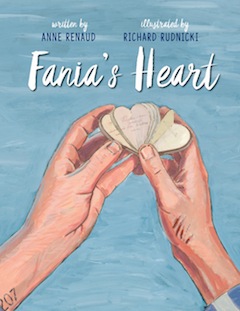 Fania’s Heart is based on the story of Fania Landau Fainer, from Bialystok, Poland, who survived Auschwitz. In the book, her daughter, Sorale (Sandy), who is “almost 10,” finds a heart-shaped book in her mother’s dresser, where she “was not supposed to rummage.” She takes it to her mom, who tells Sorale about the book’s origin – a 20th birthday present of unimaginable meaning, made by fellow prisoners, at great risk, with breadcrumbs and stolen or bartered thread, pencil, paper and other materials. It is a story told with minimal sentimentality and with illustrations in the 1950s-style of the time in which it would have taken place in real life. An author’s note explains the Holocaust very briefly and how the card, which unfolds “like an origami flower,” ended up at the Montreal Holocaust Museum.
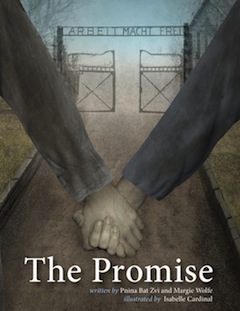 In The Promise, cousins Bat Zvi and Wolfe tell the story of their mothers, Rachel and Toby, who survived Auschwitz. It starts two years after the sisters were separated forever from their parents, who gave Toby three gold coins to use “only if you have to” and advised, “above all, stay together.” When Rachel becomes ill and is taken from the barracks, the coins play a crucial part in Toby’s rescue attempt. In a four-sentence epilogue are photos of the real sisters, but no context other than that in the story itself, which mentions Nazis and Auschwitz but not the Holocaust. The artwork for the book is somewhat creepy – the disproportionally large heads are photo-like, and placed on more traditionally illustrated bodies.
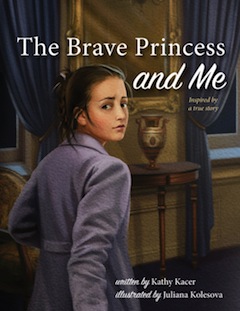 Less emotionally powerful – in part because there is too much text – is The Brave Princess and Me, which relates how Princess Alice hid Jewish mother and daughter Rachel and Alice Cohen in her home. The Nazis invaded Greece in 1941, and The Brave Princess and Me starts in 1943. Princess Alice, the mother of Prince Philip, was born deaf and she uses her impairment to protect the Cohens. More about the princess, who was honoured as one of the Righteous Among Nations, is included after the story.
 Rounding out the publications is All About Anne, a relatively comprehensive telling of Anne Frank’s story, which uses drawings, photographs and text from the Anne Frank House museum in Amsterdam. Its content is based on the questions most frequently asked by visitors to the museum. While it centres around Anne, her life and her diary, it includes broader information about the Second World War and the Holocaust. It is an excellent resource.