Skip to content
  • Home
  • Subscribe / donate
  • Events calendar
  • News
    • Local
    • National
    • Israel
    • World
    • עניין בחדשות
      A roundup of news in Canada and further afield, in Hebrew.
  • Opinion
    • From the JI
    • Op-Ed
  • Arts & Culture
    • Performing Arts
    • Music
    • Books
    • Visual Arts
    • TV & Film
  • Life
    • Celebrating the Holidays
    • Travel
    • The Daily Snooze
      Cartoons by Jacob Samuel
    • Mystery Photo
      Help the JI and JMABC fill in the gaps in our archives.
  • Community Links
    • Organizations, Etc.
    • Other News Sources & Blogs
    • Business Directory
  • FAQ
  • JI Chai Celebration
  • JI@88! video

Recent Posts

  • Story of Israel’s north
  • Sheltering in train stations
  • Teach critical thinking
  • Learning to bridge divides
  • Supporting Iranian community
  • Art dismantles systems
  • Beth Tikvah celebrates 50th
  • What is Jewish music?
  • Celebrate joy of music
  • Women share experiences 
  • Raising funds for Survivors
  • Call for digital literacy
  • The hidden hand of hate
  • Tarot as spiritual ritual
  • Students create fancy meal
  • Encouraging young voices
  • Rose’s Angels delivers
  • Living life to its fullest
  • Drawing on his roots
  • Panama City welcoming
  • Pesach cleaning
  • On the wings of griffon vultures
  • Vast recipe & story collection
  • A word, please …
  • מארק קרני לא ממתין לטראמפ
  • On war and antisemitism
  • Jews shine in Canucks colours
  • Moment of opportunity
  • Shooting response
  • BC budget fails seniors
  • Ritual is what makes life holy
  • Dogs help war veterans live again
  • Remain vital and outspoken
  • An urgent play to see
  • Pop-up exhibit popular
  • An invite to join JWest

Archives

Follow @JewishIndie
image - The CJN - Visit Us Banner - 300x600 - 101625

Byline: Cynthia Ramsay

A duty to play with language

A duty to play with language

(image by Jim Andrews)

Almost half of Adeena Karasick’s latest volume of poetry, Checking In (Talonbooks, 2018), is comprised of whimsical Facebook status updates, most of which have deeper meaning on second and third thought. Together, they speak, as the book’s description notes, “to our seemingly insatiable desire for information, while acknowledging how fraught that information can be.”

“It was a totally compulsive exercise over four years, where literally everything I read or watched or where I went or what I heard was fodder for the text,” Karasick told the Independent about the faux updates’ origins. “And, I must admit, I threw away as many lines as I kept.

“Sometimes, it was just that I couldn’t get a song out of my head and then would just riff on it,” she said, giving as examples, “Ulysses is listening to Siren Song on Spotify”; “Gustave Klimt is listening to KISS”; and “Salvador Dali is doing the Time Warp. Again.”

Sometimes, she said, it was linguistically driven, such as, “E & G are saying F off” and “Bold italics are refusing to move into an upright position.” Or, “it was just pure, silly fun” to create updates like “William Wordsworth is wandering lonely on iCloud,” “Edvard Munch is watching Scream 3,” “Google is mapping the territory” and “Narcissus is using his selfie stick.”

“It was so obsessive,” said Karasick, “that even now that the book’s been published, my brain is so wired to creating those one-liners, I walk around the streets reading every sign and riff on them: ‘Thin Lizzy is watching her carbs,’ ‘Fatwa is doing a cleanse,’ ‘The Pre-Pesach Jew is clearing her cookies,’ ‘The Long, Long Sleeper is Woke.’”

Karasick’s sense of play is evident throughout Checking In. Even when describing heartbreak, confusion and other emotionally charged states, the joy she derives from words, from language and from constructing layers of meaning, is obvious.

“I think I’ve always had a really dark sense of humour,” she said, “and there’s something about taking that which is frightening or deeply disturbing and disempowering it – by not so much making fun of it, but ironically or parodically making it strange, decontextualizing it, hyberbolically defamiliarizing it.

“A lot of my work takes hard-hitting political issues, whether that be the Holocaust in Genrecide (Talonbooks, 1994) and superimposing it with the policing and massacring of language, or dealing with 9/11 in The House That Hijack Built (Talonbooks, 2004).… ‘There was a Big Building that Swallowed a Plane … How Insane to Swallow a Plane….’ A sense of jouissance (pleasure, play) really permeates all that I do. There’s nothing more exhilarating for me than playing inside language, finding unexpected liaisons, connections, sound clusters. It’s a type of erotics of the text that is for me very jewy; that jouissance, a jewy essence: all diasporic, nomadic, exilic, ex-static.

“I see this ‘play’ as operating with an ‘assimilationist’ brand of Jewish humour,” she explained, “not of bombastic neurosis, but one that threatens to unleash chaos, creates unsocialized anarchy, embodies unpredictability – impassioned, engaged, shticky, outrageous and earnest all at the same time – in a post-Woody Allen/Jon Stewart/ Sarah Silverman/Sandra Bernhardish kind of way. And, sometimes, it’s audacious, subversive, provocative and, in the true definition of ‘irony,’ explodes ontologically and cuts into the fabric of things; the smooth functioning of the quiet comfortability or the ‘homeyness’ of our world. That is the role of art.”
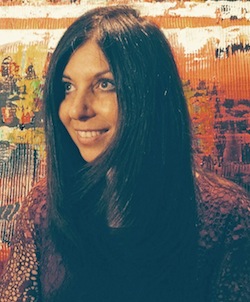
photo - Adeena Karasick
Adeena Karasick’s newest collection of poetry is Checking In. (photo by Safia Karasick Southey/talonbooks.com)

And one cannot separate Karasick’s art from her Jewish heritage – it’s “part of my DNA,” she said – and from her study of Jewish texts. With a PhD in kabbalah and deconstruction, it is not surprising that, in speaking about the concept of play, she pointed to 13th-century kabbalistic mystic Avraham Abulafia’s Science of the Combination of Letters, in which, she said, “we are instructed to play inside the language, using ancient practices of recombinatoric alchemy, gematriatic (numerological) substitution, combination, and, through lettristic ‘skips’ and ‘jumps’ slippage, meaning is infinitely re-circulated.

“According to kabbalistic thinking,” she said, “we are commanded to permute and combine the letters; focus on them and their configurations, permutations; combine consonants into a swift motion, which heats up your thinking and increases your joy and desire so much, that you don’t crave food or sleep and all other desires are annihilated. And nothing exists except the letters through which the world is being recreated, through a continual process of constructing and reconstructing borders, orders, laws, mirrors, screens, walls…. And, in accordance with the strictures of Abulafian play, to properly play is to travel inside the words within words, traces, affects, projections, sliding and slipping between the forces and intensities distributed through the texts’ syntactic economy. And this very play speaks both to how everything is infinitely interconnected – reverberant with our social, consumerist, communicative patterns – generating a contiguous infolding of meaning.”

She connected this type of play to “the actual conversation habits of Yiddish.”

“According to etymologist Michael Wex – in his Just Say Nu (Harper: New York, 2007) – Yiddish itself is inscribed in derailment, evasion, avoidance, where the norm is not to be ‘clear’ but to ‘seduce and lead astray,’ to say the reverse of whatever’s been said. For example, as we know, to say, ‘Hi, how are you,’ ‘Shalom aleichem,’ the answer is ‘Aleichem shalom.’ Answers are answered with a question, repetition, reversals, circumlocutions, interruptions, insertions (ptoo, ptoo, ptoo). Compliments are avoided in favour of their opposite. Or, like how you should never say what you mean because naming something (such as cancer, leprosy, pig) could bring it into existence.”

As for her own existence, Karasick said, “All my life, I’ve been fiercely drawn to all that seems enigmatic or paradoxical, and get great pleasure in connecting the unconnectable; drawing from different genres, lexicons or mediums and reveling in ways they inform each other in radical and innovative ways, inviting us to see the world anew.”

While she has spent years teaching philosophic and critical theory, and media and pop culture at various universities, as well as attending lectures on media ecology and ontology, she also watches “a lot of trashy TV,” she said. “I like classical jazz and MTV videos. I read [Louis] Zukofsky, [Slovoj] Zizek and Vogue magazine. And my favourite thing to do is to mash these language systems together into a kind of linguistic tzimmes; each flavour, taste, texture informing the other, expanding the palette.

“It’s especially exciting for me to break down that binary between high and low culture; draw from the music hall and the circus, erotics and spirituality; and play with ways all of this information erupts as a palimpsestic web of both sacred and secular echo-poetic referents.”

Karasick writes “on the road, on buses, trains, subways, boats; in motion,” she said. “I write best amid the bustle of life and, oddly, when I’m really busy is when I’m most inspired. I’m always hunting and gathering, drawing on the world around me. Though, I must say, when drenched in aching nostalgia, frustrated by contemporary politics or steeped in throbbing desire is when the work especially flows.”

Approaching the poetry

“Contour XLV: With Asura,” “Lorem Ipsum” and “In Cold Hollers” are all “homophonic translations, and so they all fall under the same rubric,” said Karasick of three of the poems in Checking In during a brief poetry lesson over the phone.

She explained, “Each of these [works] take the same sounds of an original poem by somebody else and I’ve translated them. I’ve done an avant-garde, post-modern translation by using the same sounds and rhythms of the original poems but changing all the words, so that if one read it simultaneously with the original poem, it would sound like the same poem, but it’s completely different. It’s a way of commenting on the previous piece; it’s translating it, moving through and across different modes.”

“In Cold Hollers” is a translation of Charles Olson’s 1953 poem “In Cold Hell, In Thicket”; “Contour XLV: With Asura” is based on “Canto 45 with Usura,” a poem by Ezra Pound, which Karasick described as a “famously antisemitic, women-hating, Jews and women are pigs kind of poem”; and “Lorem Ipsum,” which is in English, but plays on the sounds of the Latin of Cicero’s “De finibus bonorum et malorum” (“On the Ends of Goods and Evils”). “Lorem ipsum is the standard placeholder text used to demonstrate the graphic elements of a document or visual presentation,” writes Karasick elsewhere. “I am interested in exploring how the notion of ‘place holding’ gets reworked through an impossible relationship both in love and in language.”
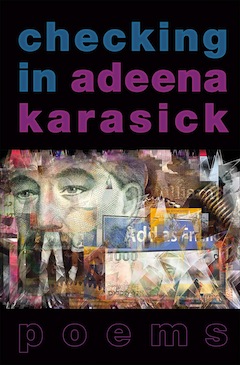
image - Checking In book coverAs to how to approach a poem that you’ve never read before, Karasick said, “On one level, it depends on how deeply one wants to penetrate the text. The way I like to read is to not worry about what everything means per se, but rather … in reading, I think the most important thing is to feel the text, to go inside and feel its rhythms, its textures…. I work a lot with sound, so I’m really interested how sound itself communicates meaning and so, therefore, a lot of this type of work is about moving with the rhythms and the textures and some of that crazed emotion, how that bleeds through, just through the way that it sounds and feels in your mouth.”

Turning to the poem “Lorem Ipsum,” she said the words mean “pain itself.” She has translated Cicero’s treatise on the theory of ethics into a “passionate love poem” about the “difficulties and grueling angst that one traverses through that. Just like love itself, or pain itself, isn’t something that’s easily definable, so it is with the poem itself, which takes us through this journey of multiple ways that are easily comprehensible and other parts that are strangely defamiliarized and confusing because these very strong emotions are fiercely that…. Just like in life, you come across things that are completely foreign and impenetrable, so, similarly, the poem interweaves through the familiar and the defamiliar, the expected and that which completely takes you into new arenas of wonder and confusion.”

Karasick similarly takes Pound’s “Canto 45” and, playing with the Yiddish word asura, which means forbidden, and the English word usury, creates a new work that’s both a scathing commentary on Pound’s, as well its own poem, with its own meanings.

About “In Cold Hollers,” Karasick said she used the word “hollers” because it’s “homophonically related to hell, but it’s hollering in, calling back into Charles Olson’s original ’53 piece; and his original title, ‘In Cold Hell, In Thicket,’ refers to the opening of Dante’s ‘Inferno.’ What seems simple, it just has layers and layers and layers of history, literary history, philosophical history, as well.”

The title of Olson’s poem refers particularly to “selva oscura,” she said, “which is the dark wood that Dante wanders into in the middle of his life … so Olson’s poem, which riffs on that, is a similar excursion into a visionary experience, where he struggles to come up with a new understanding … from his own midlife … putting a voice to his own time. It is a personal drama of experience, conflict; it really speaks to the wrenching process of living and loving that, by turns, is grueling and funny and dramatic and trivial. My translation of that is dealing with all of those things and, in a way, it’s like, do you remember that old Gwen Stefani song, ‘I Ain’t No Hollaback Girl’? – I am a hollaback girl. I am hollering back, in cold hollers, to this cold hell, and basically calling into that history of both Dante and Olson, the history of post-modernism, 65 years later.”

In talking about Olson’s work and hers, Karasick said, “I sometimes like thinking of translation as trans-elation because you can never really translate anything because of culture and all the different references – in my piece, in my trans-elation, the attention is focused on a world of connected life, the personal, the political, the poetic as a system of relations. And, lastly … highlighting how the words themselves are imaginative participants; the words themselves are creating and recreating the sense of connecting the personal, the political, the poetic.”

And it’s not just the words, but how they are placed on a page that matters in poetry. So, for example, Karasick’s “In Cold Hollers” not only plays on the sound and meaning of Olson’s poem, but also mirrors its typography. “I wanted to keep it very much as he had it,” she said of where the lines break and other aspects of the formatting.

“The notion of the physicality and the materiality of where the words are placed on the page has just as much meaning as what they are communicating. We’re so often used to looking at the left margin … but I want the phrases to be moving and fluid, and that sense of how the white space between the words is equally as important as the words themselves. We can go back to kabbalah and the black fire on white fire, that the whole page becomes a series of fiery energy.”
Format ImagePosted on November 30, 2018November 28, 2018Author Cynthia RamsayCategories BooksTags Adeena Karasick, culture, Judaism, kabbalah, language, mysticism, poetry, social media, Yiddish
The Enemy: a fight for truth

The Enemy: a fight for truth

Jenn Griffin and Paul Herbert in Firehall Arts Centre’s production, The Enemy, which runs to Dec. 1. (photo by Pedro Meza)

A doctor in a small B.C. town discovers that the main tourist draw, the springs, are polluted. As she tries to raise the alarm, she runs into harsh resistance – after all, the town’s economic well-being is completely dependent on the tourism the springs, spa and waterpark attract. Among other things, her findings are discredited, the truth is characterized as “fake news,” and she ends up regarded as a pariah instead of a saviour.

This very current-day scenario is actually based on Henrik Ibsen’s 1882 play An Enemy of the People, the themes of which are as relevant as ever. Firehall Arts Centre artistic producer Donna Spencer has adapted Ibsen’s drama, not only bringing the spa to British Columbia, but making the character of Dr. Stockman a woman in her version, called The Enemy, which runs at the Firehall until Dec. 1.

Spencer, who also directs the production, said in a press release, “Recently, we witnessed a decision south of the border that many of that country’s constituents did not support for good reasons. But the majority of those who had the power to vote supported the choice, angering thousands and potentially impacting hard-earned freedoms and rights. With the Firehall’s presentation of The Enemy, I have adapted Henrik Ibsen’s drama – which asks the question, is the majority always right? – and applied it to a contemporary issue not unlike the one faced by Ibsen’s version of Dr. Stockman. In this contemporary context of The Enemy, the role of Dr. Stockman is written as a female and illustrates the challenges that women face when confronting and disputing the ‘powers-that-be’ or, as some would say, ‘the old boys’ club.’”

photo - Michael Scholar Jr
Michael Scholar Jr. (photo from Firehall)

Jenn Griffin plays the role of Dr. Stockman in The Enemy. Jewish community member Michael Scholar Jr., is also part of the cast.

“I play the role of David Horseman (after Captain Horster in the Ibsen), who is a pilot who charters flights to remote fishing and hunting locations across B.C.,” Scholar told the Jewish Independent. “He’s someone who used to work for oil companies, but is now his own boss, trying to keep a low profile, and stay out of political frays. David is a friend of Dr. Stockman, who tries to help her when she is censored and vilified. Throughout the story, we find the otherwise complacent David find his political voice, when he sees a restriction on freedoms of expression come to his small town.”

The Enemy explores the role of the media, the mob mentality, political extremism, corruption, elitism, the environment.

“Theatre is a very powerful medium,” said Scholar, who is also the founding artistic producer of November Theatre. “The way in which ideas are communicated in theatre are through emotion, images and even moral ambiguities. There have been scientific studies done on what happens to theatre audiences when they experience a play live, showing that, when a play is effective, the mirror neurons are firing on all cylinders, creating an emotional, engaging experience that can lead to feelings of empathy and, therefore, understanding.

“The poetic form of theatre, with its use of imagery and physicality, allow for abstract thought and even an awakening of the mind and spirit that is unlike any other form,” he explained. “The ancient Greeks presented dramas to allow their people to wrestle with moral issues communally. It was an important form of public discourse. And The Enemy and other socially conscious theatre are carrying on that tradition.”

Scholar said he is excited to be working with Spencer.

“I’ve known Donna for years, and am thrilled to be working with her and this amazing cast,” he said. “Some great friends of mine are in this show, like my old U of A school chum Daniel Arnold, Green Lake cast mate Donna Soares, and clown extraordinaire Peter Anderson. And I’m getting to know some other incredible talents, like Sharon Crandall, who I saw at Bard [on the Beach] this summer; Paul Herbert, who I’ve seen act since living in Edmonton; Agnes Tong, who was great in Les Belles Soeurs; Braiden Houle, who just did Kill Me Now at the Firehall; and our leading lady, Jenn Griffin, who I know as a playwright and is doing incredible work as Dr. Stockman.”

One of the many intriguing aspects of the play – both Ibsen’s original and Spencer’s adaptation – is how the hero, Dr. Stockman, is portrayed. The doctor is not a sympathetic character, in ways that liberals and progressives especially should note. Dr. Stockman considers herself superior to her critics and those who believe them. A recent article in the New York Times – about why Ibsen’s play is seeing so many remounts in the United States these days – compares some of Stockman’s language to that of Hillary Clinton’s “basket of deplorables” statement, “or other comments that people – perhaps audience members themselves – have made that imply that those they disagree with are inferior.”

There is an excellent article in a 2010 issue of Public Health Ethics that can be found online. In it, Terrance McConnell uses Ibsen’s play to examine the competing responsibilities of a physician: to their own ideals, to their family, to their fellow citizens and to public health.

“One message of the play is that those with vested interests will try to silence the idealist,” writes McConnell.

“A second message in the play concerns how the idealist is portrayed by others,” he adds, giving examples of how Dr. Stockman’s opponents succeed in branding the doctor as crazy.

“In this age of divisive rhetoric,” said Scholar, “this play wrestles with the concept of speaking truth to power even at great personal cost. Ibsen’s story is sadly still relevant today, and Donna’s adaptation puts it in the here and now. I think this production will elicit much discussion, and I look forward to being a part of that.”

The Enemy runs at various times Tuesdays through Sundays at the Firehall Arts Centre, with post-show talkbacks Nov. 22 and 29. Tickets start at $20 and can be purchased from firehallartscentre.ca or 604-689-0926.

Format ImagePosted on November 16, 2018November 15, 2018Author Cynthia RamsayCategories Performing ArtsTags Donna Spencer, Firehall Arts Centre, Henrik Ibsen, Michael Scholar Jr, theatre
Shapiro covers myriad topics

Shapiro covers myriad topics

American political commentator and writer Ben Shapiro addressed more than 900 people at the Faigen Family Lecture, which was held at Congregation Schara Tzedeck on Oct. 30. (photo by Jocelyne Hallé)

More than 900 people came out to hear conservative commentator and writer Ben Shapiro give this year’s Faigen Family Lecture, which took place at Congregation Schara Tzedeck on Oct. 30.

Saul Kahn began the evening by reading the names of the 11 Jews murdered at Tree of Life synagogue in Pittsburgh a few days earlier. After a moment of silence, Vancouver Hebrew Academy head of school, Rabbi Don Pacht, recited a prayer for those who were killed. The security presence at Schara Tzedeck was notable, from every attendee being checked at the entrance to several guards within the sanctuary.

In introducing the lecture, Kahn explained, “Almost a decade ago, Dr. Morris Faigen, of blessed memory, created the Faigen Family Lecture Series in partnership with Rabbi Pacht and the Vancouver Hebrew Academy. This endeavour arose from their mutual love of Israel, a shared concern for the mindset of the modern Jew in North America and a desire to help influence the next generation.”

Kahn thanked VHA’s Teagan Horowitz and office staff, Rochelle Garfinkel and the Schara Tzedeck staff, Dr. Jeffrey Blicker, “for his instrumental role in bringing this event to fruition,” the Jewish Federation of Greater Vancouver for help with the additional security and “Gina Faigen and the Faigen family for their appreciation of how very vital it is to have a program such as this that supports an open and meaningful exchange of ideas.”

Pacht linked the lecture’s importance to Jewish tradition, noting how the word cherubs (in Hebrew) appears only twice in the Torah. In Exodus, it appears when God is explaining to Moses how the Mishkan (Tabernacle) is to be constructed: the cherubs (“angels with childlike faces”) are set above the holy ark. However, in the beginning of Genesis, when Adam and Eve are expelled from the Garden of Eden, God places cherubs to guard the entrance. “Interestingly,” said Pacht, “here the word is translated differently. It’s translated, by Rashi, as ‘angels of destruction.’” One explanation – from Rabbi Moshe Mordechai Epstein, who was head of the talmudic academy in Slabodka, Lithuania – is that, “as parents, as educators, we have a responsibility to take the next generation, to cultivate within them, the ideas and the ideals that we hold most dear. If we are successful in our endeavour, they are cherubic, they are the angels with childlike faces. Unfortunately, if we’re not successful, there’s an entire different pathway that may lay before them.”

Among the values that need to be imparted, said Pacht, are the centrality of Israel and the moral values as laid out by the Torah. Free speech and open debate, he continued, are “most dear to us.” He put them among the ideals we have “from our parents and our grandparents, and we want to see that passed on from generation to generation.”

This generational aspect was picked up on by Gina Faigen with humour in her welcoming remarks. She said she sometimes wonders, “because I’m a lot more liberal than my late father was, if he didn’t create this event in part so that, on at least one day a year, I would have to listen to somebody who shared his views. It’s definitely something I have come to appreciate more as the years go by. My father was passionate about ideas, about intelligent discourse on Israel, and he created this lecture series to ensure a space in Vancouver for a conservative and pro-Israel perspective. I know he would be really excited by tonight’s speaker, Ben Shapiro.

“For those of you who share these views, we hope to continue to provide a place for you here,” she continued. “And, for those of you who may not share all of the speaker’s views, it’s great that you’re here open-minded and part of this conversation.”

Blicker – who suggested Shapiro as a potential speaker after he and his family heard him at a Passover event in Henderson, Nev., more than three years ago – introduced Shapiro. Among other things, Shapiro is a lawyer, editor-in-chief of DailyWire.com, host of the podcast The Ben Shapiro Show, and author of seven books.

Shapiro addressed his critics right off, admitting that he does “sometimes phrase things in an intemperate fashion or spoken too hastily or out of anger or even, on occasion, over the course of a 17-year career of writing things, I’ve written stuff that I disagree with and that I think is immoral. It’s my job to hear those critiques, it’s my job to respond to those critiques in good will and in the spirit of self-betterment, and I’ve tried to do so repeatedly in different places and I look forward to doing so in the future, as well as tonight, that is my job. It’s also the job of my critics to keep an open-mind and not to mistake a political viewpoint for objective righteousness or to slanderously mislabel people like me bigoted or racist – that is unjustified, unjustifiable and hypocritical.”

Given what had happened in Pittsburgh, Shapiro decided to speak about his planned topic – the future of the state of Israel – in connection to global antisemitism. He described three general types of antisemitism.

• Right-wing antisemitism – “in this view, the presence of an independent Jewish community is a threat to national identity.”

• Left-wing antisemitism is “based on hierarchies of power.” Therefore, “when you see an imbalance in life and inequality in life, that is inherently due to inequity, so, if you see two people in a room and one guy has five bucks and one guy has one buck, that means the guy with five bucks somehow screwed the guy with one dollar. Left-wing antisemites, in terms of group politics, see the Jews as the people with five dollars. The Jews are simply too powerful and, thus, they must have participated in exploitation and egregious human rights violations.”

Shapiro offered his take on how intersectional theory would rank the groups whose “opinions should be taken most seriously because they have been most victimized by American society: LGBT folks are at the top, then it usually goes black folks, then Hispanic folks, then women, then Asians, then Jews, then, at the very bottom, white males.” In this framework, since Jews and Israel are relatively successful, they must have done something terrible, “be responsible for the ills.”

• Radical Islamic antisemitism “is the most traditional form of antisemitism – not Islamic, but religious antisemitism.” This is the belief, said Shapiro, “that the religion of Judaism itself is to blame for the problems in Western society. The history of religious antisemitism obviously, goes back thousands of years and it spans a wide variety of religions.”

Today, he said, “Islamic antisemitism has been combined with a sort of Nazi-esque racial antisemitism, which is why you see textbooks in the Palestinian Authority referring to Jews as the sons of pigs and monkeys, and it’s also been combined with a sort of intersectional antisemitism … Jews are successful because they are somehow damaging other people and, also, they happen to be a terrible religion.”

For Jews in the United States and, to a lesser extent, in Canada, Shapiro said right-wing antisemitism is probably the biggest threat, “as we saw in Pittsburgh. There has been a spate of such violence that has been consistent throughout my lifetime.” He said, “The thing that folks don’t understand if they don’t live in the Jewish community is that every single person in the Jewish community is one degree removed from some sort of tragedy of this kind.”

However, he said, for Jews worldwide, radical Islamic antisemitism is the biggest threat. “Whether it is Jews who are living under the possibility of an Iranian nuclear [regime], whether it is … Jews living under the threat of Hezbollah rockets, whether it’s Jews living under the possibility of kidnapping along the Gaza border or whether it is Jews living under the possibility of being murdered while walking the streets in France, whether it is Jews being threatened with the possibility of murder in Malmö, Sweden, whether it is Jews being threatened with murder in London. Islamic antisemitism and the rise of that antisemitism throughout Europe is deeply dangerous to Jews across the world.”

“The thing that folks don’t understand if they don’t live in the Jewish community is that every single person in the Jewish community is one degree removed from some sort of tragedy of this kind.”

There are two main perspectives on antisemitism, said Shapiro. One is that antisemitism is not another form of racism, but is unique – that it comes from a “conspiratorial mentality that the Jews are behind everything bad and, therefore, the Jews must be annihilated.” The second view is that “antisemitism is not unique, it’s not an age-old virus, it’s no different really than anti-black racism or anti-Native American racism or sexism or homophobia…. That means we have to treat the death of a Jew in Efrat at the hands of a terrorist differently than we treat the death of a Jew in Pittsburgh at the hand of a white supremacist because these two Jews scan in different areas of this intersectional pyramid,” said Shapiro. “These two Jews are not equivalent. They are not being killed for the same reasons. The Jew being killed in Pittsburgh is being killed because that Jew is a victim. The Jew being killed in Israel may or may not be being killed because of victimology. It’s possible that that Jew was being killed because of Israeli settlements or some such [reason].

“The second view, as you might imagine, I believe to be deeply troubling, counterproductive and helpful to antisemitism.”

In Shapiro’s opinion, this latter, more troubling view is mainstream on the political left in the United States and in Europe. When a Jew is murdered in certain areas of Israel, he said, “we are supposed to take into account the territorial claims of Palestinians as though that justifies the murder of a civilian who happens to be living in Efrat. We’re supposed to pretend that the dispute is merely territorial and not a symptom of a broader underlying antisemitic disease. When a Jew is murdered in Pittsburgh, then we’re allowed to talk about antisemitism.” This is why, he said, Jews can be excluded from women’s marches and antisemitism can be tolerated, if the Jews in question rank lower than the antisemite in the intersectional hierarchy.

While Israel holds a high position in the world, it is under threat from forces that we refuse to call antisemitism, he continued, citing several examples, such as the numerous votes against Israel at the United Nations. Criticism of Israel is legitimate, he said, but holding the country to a higher standard than any other nation is antisemitic, “and that has been the standard to which the world has held Israel.”

He called wanting to boycott, divest from and sanction Israel “antisemitic in the extreme…. The stated goal by many of those pressing BDS is to destroy the state of Israel…. Not a single person pushing BDS has ever condemned the Palestinian Authority for insisting on a fully judenrein state, a state completely free from every single Jew. Israel allows – and should allow – millions of Arabs to live within its borders, millions of Muslims to live within its borders, that is a good thing. Israel is a multicultural, multi-ethnic democracy. The same is not true of any of the nations facing down Israel, and yet Israel is facing down boycott, divestment and sanctions for saying that we can build an extra bathroom in East Jerusalem. No other nation would tolerate this sort of nonsense. This is targeted hatred and nothing less.”

So, what is our mission, given these realities? “Well, number one, to stand up to antisemitism wherever we see it, on left and on right,” said Shapiro, whether it is coming from our allies or our enemies. “This is not a partisan issue nor should it be. And, our other mission is also the same as it ever was, which is to spread light. What we’re watching right now in American politics and, I think, Western politics more broadly, is a fragmentation of certain eternal and true values that used to undergird a civilization. Those basic values of faith and family and those values of tolerance and openness within the bounds of recognition of certain central individual rights, that’s all fragmented. And whenever society fragments, antisemitism starts to seep through the cracks. As the Tree of Life synagogue name attests, the only way to fight back against all of this is to cling to that Tree of Life, is to cling to the Torah.”

The attack on the Tree of Life synagogue was not just an attack on Jews but on civilization, said Shapiro, “because Judaism, Jews, we stand at the heart of Western civilization…. The only proper response is the same response Jews have given throughout time: to fight back, to fight darkness with light, to fight untruth with truth and fight death with life.”

photo - Ben Shapiro responded to 22 questions at the Faigen Family Lecture on Oct. 30
Ben Shapiro responded to 22 questions at the Faigen Family Lecture on Oct. 30. (photo by Jocelyne Hallé)

After a standing ovation for his remarks, Shapiro responded both to questions submitted in advance by event sponsors and then to questions from an open mic. In total, he responded to 22 questions, which ranged from the political to the cultural, from economics to education, tort law to religion. Several of the questioners identified themselves as being Christian, many as fans.

One of the first questions was the language Shapiro uses around transgender issues. “When I’m talking about transgenderism,” he said, “the contention of folks in the political realm is that transgenderism is not, in fact, a mental illness; that, in fact, gender identity disorder or gender dysphoria, whichever DSM [Diagnostic and Statistical Manual of Mental Disorders] you choose to use, 4 or 5, that that particular disorder is no longer a disorder, it’s actually just an expression of gender identity that has no bearing whatsoever on mental health. That’s a lie, and it’s a damaging lie. And, when a society blinds itself to the realities that gender and sex exist, it is less likely to pursue policies that alleviate the pain of a lot of folks and it’s also less likely to pursue policies that have any realities extant on the ground.”

In a few responses, Shapiro differentiated between his use of language in dealing with people one-and-one versus in the political arena or on social media, noting in particular that Twitter is meant to be a more fun space, where you don’t have to be nice. He also talked about his general wariness of government intervention and offered pretty standard conservative views on immigration, economic migration, free speech and abortion.

When asked by the mother of a 14-year-old boy who brought Shapiro’s views into their liberal household about Shapiro’s portrayal at times of the left as monolithic (and unprincipled) and whether it was “part of the game, like [you do] on Twitter?” he responded, “No, it’s political shorthand.”

However, he added, he does try to distinguish between the left and liberals. For example, “when it comes to free speech, I think the left wants to crack down on free speech and I don’t think liberals do. I think liberals are happy to have open and honest debates; they just disagree with me on the level of government necessity in public life. Listen, every individual has different political viewpoints and people self-describe in different ways … but, as a generalized worldview, if I’m hitting the target, when I say the left, 85% of the time, that’s good enough for ditch work. In politics, you’ve got to cover too much ground to break down every single constituent of a particular group. Now, is it an over-generalization? Of course. But politics operates on generalizations, so do our everyday conversations.”

Format ImagePosted on November 9, 2018November 7, 2018Author Cynthia RamsayCategories LocalTags antisemitism, Ben Shapiro, civil discourse, Don Pacht, Faigen Family Lecture Series, free speech, Gina Faigen, politics, Vancouver Hebrew Academy, VHA
Spotlight on Israeli culture

Spotlight on Israeli culture

Shira Geffen shares how she met her husband, Etgar Keret, in the film Etgar Keret: Based on a True Story, which screens Nov. 14. (photo from facebook.com/etgarkeretfilm)

“I want to write stories so the readers will like mankind a little bit more,” says Israeli writer Etgar Keret in the documentary Etgar Keret: Based on a True Story. Similarly, as depicted in another film, the Israel Museum aims to uplift and educate visitors with its artistic, cultural and historical displays, and The Museum offers a glimpse into the breadth of its collections and the diversity (and quirkiness) of its employees. Both of these award-winning films screen during the Vancouver Jewish Film Festival, which started this week.

Danish filmmakers Stephane Kaas (director) and Rutger Lemm (writer) do an excellent job of introducing viewers to what makes Keret tick. They do so using a creative mix of interviews with Keret and his family, friends and colleagues; reenactments of sorts of a few key points in Keret’s life; and a few of Keret’s stories, the portrayal of which is mainly done in animation. Not surprisingly for anyone who has read Keret’s short stories, there are several laugh-out-loud moments in Etgar Keret: Based on a True Story, but there are also sombre elements, as we learn about how Keret has been impacted by tragedy, including the suicide of one of his best friends.

One of the funniest scenes is when Keret shares his first story with his brother, Rodi (Nimrod). Rodi brings his dog along for the walk and, after he finishes reading Keret’s story and praises it, he asks whether the typed copy he’s holding is the only copy. When Keret says no, Rodi uses the paper to pick up his dog’s poo. Perhaps a lesson in humility, Keret explains that it was at this moment he realized that a story is not in the piece of paper on which it has been written or typed – once a story has been read, it is in the mind of the reader. Keret calls this ability of a writer to transfer their ideas to another person a “super power.”

While many of Keret’s stories have gloomy aspects to them, the stories as a whole generally leave readers feeling good. He describes his stories as “an advertisement for life,” saying that he writes to answer the question of why he wants to live.

“I think the need to tell stories is, basically, the need to put a structure to the reality around you. And I feel that the more chaotic and the less sense it makes, the stronger the need I have to tell a story about it,” he explains in the film.

Etgar Keret: Based on a True Story screens Nov. 14, 8:45 p.m., at Fifth Avenue Cinemas (19+), following the 22-minute short Large Soldier, directed by Noa Guskov. “It’s 1973 and all that Sherry, a 15-year-old Israeli girl, wants is a boyfriend,” reads the synopsis of the film, which is in Hebrew with English subtitles. “A letter exchange with an unknown soldier makes her believe that it’s going to be her first love. But what will happen when the imaginary soldier becomes real?”

* * *

photo - A scene from The Museum, which screens Nov. 17
A scene from The Museum, which screens Nov. 17. (photo from goelevent.com)

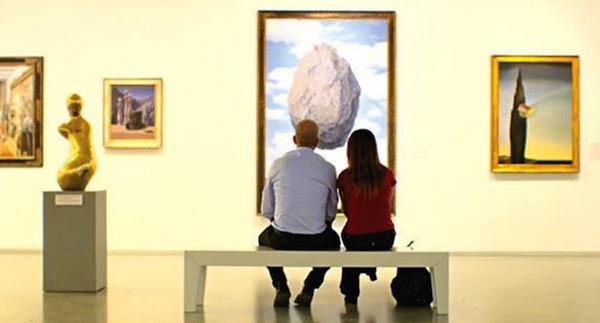
The opening of Ran Tal’s documentary The Museum grabs viewers’ attention: a black screen, the sound of footsteps, some shuffling about, then a woman asks a man, “What do we have?” “That’s a huge painting,” he begins. When the scene is revealed, we see the man and woman sitting on a bench, looking at the painting, but the woman seeing it only through his eyes, as she is blind. Later in the film, this woman is part of a group of blind people visiting the museum – she and others touch various sculptures, feeling how the works are made.

The Museum makes clear the enormous responsibility and privilege of caring for, handling and presenting art and artifacts. Over a period of one-and-a-half years, Tal interviewed several museum staff – including a security guard who is also a cantor; the institution’s kashrut inspector, who notes that “a museum doesn’t replace spirituality”; and the then-museum director, who sadly had to miss his mother’s funeral because it took place on the day the museum reopened after an extensive renovation. Tal also films visitor interactions over that time, and highlights a 50th anniversary event (in 2015) featuring Prime Minister Binyamin Netanyahu and members of his government. Netanyahu remarks that the museum shows three things: “One is our bond to this land in a very dramatic display, and one of humanity’s most significant archeological finds, the Dead Sea Scrolls. Another is the great cultural treasure of the Jewish people in Israel and the world over, which symbolizes our contribution to humanity.”

Admittedly, The Museum only touches upon more serious concerns – there is a scene where a group of museum staff discusses a collection of traditional Palestinian clothing that is in storage, and the potential impacts of displaying (and not displaying) them – but it at least does bring up such issues, which will hopefully open the door for more in-depth discussion.

The Museum screens on Nov. 17, 6:45 p.m., at the Rothstein Theatre. For the full festival schedule and tickets, visit vjff.org.

Format ImagePosted on November 9, 2018November 7, 2018Author Cynthia RamsayCategories TV & FilmTags arts, culture, Etgar Keret, Israel, Israel Museum, short stories, Vancouver Jewish Film Festival, VJFF, writing
Cairo geniza treasure

Cairo geniza treasure

Filmmaker Michelle Paymar. (photo from D-Facto Filmstudio)

In the 19th century, the hunt for ancient manuscripts was in vogue, and a tip from two Scottish Presbyterian identical twin sisters – Agnes Smith Lewis and Margaret Dunlop Gibson – led talmudic scholar Solomon Schechter of Cambridge University to one of the most incredible discoveries. In 1896, he headed to Egypt, to Ben Ezra Synagogue in Cairo, where he climbed through an opening high in a wall of the synagogue and found himself standing on countless documents that have “revolutionized our understanding of Jewish history.”

The documentary From Cairo to the Cloud, produced, directed and filmed by Vancouver-based filmmaker Michelle Paymar, chronicles the history of the search for the Cairo geniza, or storeroom, which contained more than 900 years’ worth of material – more than half a million fragments. There were religious texts, personal letters, bills, bureaucratic

reports, a child’s practise of the alphabet, artwork, prescriptions, what someone had for lunch and even handwritten drafts penned by 12th-century rabbi and physician Moses Maimonides. The geniza contained a written record of almost every aspect of Jewish life, in multiple languages: Hebrew, Arabic, Aramaic, Judeo-Greek, Judeo-Spanish, Judeo-Persian and Yiddish.

From Cairo to the Cloud sees its North American première at the Vancouver Jewish Film Festival on Nov. 12, 3:30 p.m., at Fifth Avenue Cinemas. It had its world première at the Cambridge Film Festival earlier this week.

“Many years ago, I learned about the existence of an archive that was essentially a time capsule of Jewish life in medieval Egypt,” Paymar told the Independent. “Then, in 2011, two books about the Cairo geniza appeared – one by Adina Hoffman and Peter Cole called Sacred Trash and one by Mark Glickman entitled Sacred Treasure.

“I was captivated by the immediacy of the voices from the geniza, the richness of Judeo-Arabic culture, and the sophistication of their milieu. When I learned that Cambridge was in the process of digitizing its final geniza documents for the Friedberg Genizah Project, I called Ben Outhwaite, the head of the geniza collection at the Cambridge University Library, to find out if any film crews would be documenting this momentous event. No one was planning to film the digitization of the last documents, so I grabbed my camera and my gear and went to Cambridge to film it myself.”

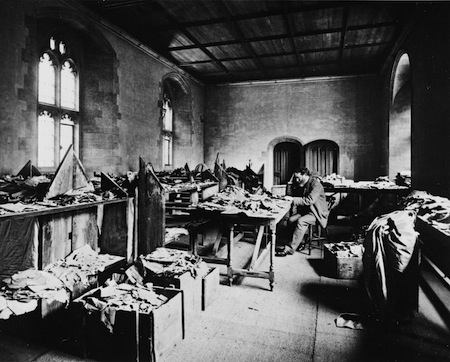
photo - Solomon Schechter at work in the old Cambridge University Library, with the crates of material from the Cairo geniza around him
Solomon Schechter at work in the old Cambridge University Library, with the crates of material from the Cairo geniza around him. (photo from Cambridge University Library via D-Facto Filmstudio)

Using narrations of various texts (translated into English), archival images, animation, visual effects and lots and lots of interviews, From Cairo to the Cloud does indeed take viewers from Cairo to the Cloud, or the internet. Thanks to the Friedberg Genizah Project, all the geniza fragments are now accessible by researchers around the world. With the physical manuscript pieces stored in different institutions, it used to be that, to study one document, a researcher might have to go to several cities just to puzzle together part of a page. Not only is that travel no longer necessary but, because every scribe writes in a unique way, computer programs have been able to match texts using a technology like that which is used in facial recognition, making it possible to join hundreds of pieces of a document within a couple of months.

Wherever you have a Jewish community, you must have a geniza, explains Prof. Hassan Khalilieh (University of Haifa) in the film. Rabbi and author Mark Glickman then explains that a geniza is a place to store damaged Jewish religious texts and documents. Geniza is a Hebrew word for hide, adds Prof. Yaacov Choueka (Friedberg Genizah Project). In Jewish law, he explains, you are not allowed to destroy or deal disrespectfully with written material with God’s name on it.

So, continues Prof. Janet Soskice (University of Cambridge), that document has to be treated with the reverence you would accord to a human body. Once a home’s or synagogue’s geniza is full, the stored material gets taken to the cemetery and buried. But, what author Dara Horn notes is that the Jews of medieval Cairo had a different method – they not only saved documents with God’s name in it but any document written in Hebrew letters, and they didn’t empty their geniza for more than 900 years.

Quick snippets of information from academics, librarians, writers and other experts keep From Cairo to the Cloud moving at a good pace, while not losing its educational aspect.

“I started with a few names and those names begat more names,” said Paymar. “I soon discovered that these ‘geniziologists’ were wonderful storytellers and passionate about the geniza. I ended up interviewing about 40 people representing a wide range of interests and three generations of geniza scholarship. The oldest – Mordechai Friedman, Avraham Udovitch and Mark Cohen – studied with [ethnographer] S.D. Goitein himself. Then there are the students of Goitein’s students, like Marina Rustow, and her student, Arnold Franklin.

“I have about 60 hours of interview material. Once I started piecing together the story, it became more or less clear which selections to use from each of the interviews.”

And what a story it is, between how the geniza was found – meeting people like the sisters Smith Lewis and Dunlop Gibson, who were academics in all but name, knowing 14 languages between them and taking multi-continent excursions, often in search of ancient manuscripts – and the documents from the geniza itself. The material in the storeroom roughly covers the period 1000 to 1250 in Fustat, which started as a separate city than Cairo, and was a major hub for trade.

“Gaining permission to film in the Ben Ezra Synagogue in Cairo,” explains Paymar in her director’s notes, “required nearly seven years, three Egyptian governments, gaining the support of representatives from the Jewish community of Cairo, the assistance of the Canadian consulate in Cairo, approval by the Egyptian ministries of the interior and antiquities, the Egyptian state police, the Egyptian tourist police, the Egyptian Press Office and the Jewish community of Cairo. I was the first filmmaker in decades to be allowed to film inside the synagogue.”

Because of Paymar’s efforts, the rest of us can see inside the Cairo geniza’s treasures much more easily. We should take the opportunity to do so. It is a fascinating journey.

For the full Vancouver Jewish Film Festival lineup, visit vjff.org.

Format ImagePosted on November 2, 2018November 1, 2018Author Cynthia RamsayCategories TV & FilmTags Cairo, Cambridge University, geniza, history, Solomon Schechter, Vancouver Jewish Film Festival, VJFF
Life lessons of an uncle

Life lessons of an uncle

Still from If You’re Hungry, Sing. If You Ache, Laugh.

When Vancouver freelance director and writer Michèle Smolkin interviewed her uncle, Sam Rechtman, he was 103 years old. Born on July 7, 1914, he has experienced two world wars, pogroms, poverty, hard manual labour, military service, loss, love and so much more, and yet he still approaches life with energy and cheer. Si tu as faim, chante. Si tu as mal, ris (If You’re Hungry, Sing. If You Ache, Laugh) is the perfect name for the documentary Smolkin has made on him.

The adage is an old saying from Chelm, explains the film, which happens to be the village in which Rechtman was born. At the time of his birth, Chelm was part of the Russian Empire. He was the second of four siblings.

We are merely introduced to Rechtman in this documentary, which runs just under an hour. With delightful, simply drawn animated sequences, along with music, archival film footage, old family photos and, of course, the interview with her uncle, Smolkin has created an inspiring reminder of just how much our attitude affects our lives.

In a brief interview for the DOXA Documentary Film Festival this past May, Smolkin explains that the film is “more than just a portrait of a man’s life and time, it’s also the portrait of a century in Europe. My uncle went through so much ordeal and such a dramatic life and is still this happy, simple, fun person who enjoys life and is not bitter or complaining. We are so privileged, that we should sometimes think, oh yeah, we could also enjoy life. That’s a life lesson.”

If You’re Hungry, Sing. If You Ache, Laugh screens on Nov. 11, 1 p.m., at Fifth Avenue Cinemas, as part of the Vancouver Jewish Film Festival, vjff.org.


Format ImagePosted on November 2, 2018November 1, 2018Author Cynthia RamsayCategories TV & FilmTags history, Michèle Smolkin, Sam Rechtman, Vancouver Jewish Film Festival, VJFF
Disagreeing respectfully

Disagreeing respectfully

Left to right: Nico Slobinsky (CIJA Pacific Region), Rabbi Adam Stein (Beth Israel), Rabbi Andrew Rosenblatt (Schara Tzedeck), speakers J.J. Goldberg and Jonathan S. Tobin, Cynthia Ramsay (Jewish Independent), Rabbi Hannah Dresner (Or Shalom and RAV) and Rabbi Dan Moskovitz (Temple Sholom). (photo by Glen Bullard)

“We have lost the ability to listen to each other. We have lost the ability to credit each other with good intentions when we disagree…. What we must do is somehow regain a sense of community.”

In his response to the last audience question at Left vs. Right: The Battle for Israel’s Soul, Jonathan S. Tobin, editor-in-chief of JNS.org and a contributing writer for National Review, among other publications, went on to say what he hoped the audience would take away from his 90-minute debate with J.J. Goldberg, editor-at-large and senior commentator at the Jewish Daily Forward.

“You have to open yourself up to both sides,” said Tobin. “You have to relearn the ability to listen, to be open. If you agreed with J.J., maybe you should read some of the things that I write… If you agreed with me, read J.J. at the Forward and his column…. It’s not what we’re used to anymore because we live in these social media silos…. It’s what we have to model for our kids. It’s what we have to model for ourselves because, when we listen, when we open ourselves up to ideas that are different from our own, that don’t just confirm what we already thought, we are reminded of something that is always true but we often forget…. That which unites us is still stronger than that which divides us.”

Ten community organizations united to host the Oct. 23 event in the Wosk Auditorium at the Jewish Community Centre of Greater Vancouver: the Jewish Federation of Greater Vancouver, the Centre for Israel and Jewish Affairs, the JCCGV, the Jewish Independent, Ameinu, Or Shalom, Congregation Schara Tzedeck, Congregation Beth Israel, Temple Sholom and the Rabbinical Association of Vancouver (RAV).

In his response to the last question of the night – on how young people could have similar respectful dialogues on Israel, which the speakers broadened to include all community members – Goldberg stressed the importance of having self-doubt. “If you believe the other side is saying something that could bring about the end of the world, the death of the Jewish people, you’re not going to be tolerant. And, as Jonathan says, if you listen, look for the grain of truth, because then you can allow yourself not to shout and scream when you hear something you don’t like, because it’s not the end of the world.”

Rabbi Hannah Dresner, spiritual leader of Or Shalom and head of the RAV, welcomed the approximately 100 people who came to hear Goldberg and Tobin engage in a formal debate on four prepared questions, and then on a handful of questions from the audience. “Our guests hold differing points of view and speak to one another with respect and we would like all to follow their examples,” she said. While there was some audible discomfort from listeners in a couple of instances, it was a model event, made easier by the fact that it featured two journalists who may disagree on the details, but who both agree that Israel has a right to exist and that Israel has a right to defend itself. As well, neither speaker is an ardent supporter of U.S. President Donald Trump – although Tobin gave the president credit for moving the U.S. embassy to Jerusalem and reinstating sanctions against Iran to delay its attainment of nuclear weapons, he criticized Trump’s relationship with Russia. One has to separate Trump the man and his Twitter account from the policies the administration has implemented, said Tobin. “It’s clear,” he said, “that Israel can count on the United States, certainly it can count on this administration to have its back.”

Tobin made these comments in response to the first question of the night, which was about Trump and whether Israel could rely on an “unstable United States as a shield in an unstable Middle East.” Goldberg was more concerned than Tobin, saying that character counts. “Having a president who is lacking in elementary characteristics of personal ethics and grace is a problem,” he said. “It is a problem that this is a president who has no respect or loyalty for America’s allies; and says he’s in love with the dictator in North Korea, who, by the way, does have nuclear bombs; and who can’t say a bad word about the dictator of Russia…. If Canada can’t rely on the United States, and France and Germany and Sweden can’t rely on the United States, how long can Israel rely on the United States?”

Goldberg and Tobin also had opposing views as to the continued relevance of a two-state Israeli-Palestinian peace agreement and whether the construction of settlements is an obstacle to peace.

Goldberg pointed to the 2002 Arab League declaration, which outlined the terms under which they would recognize Israel and normalize relations with it; the declaration has been renewed since then and, last year, “Iran voted yes.” He said we believed the Arab countries when, in the 1970s, they were talking about “driving Israel into the sea,” and we should believe them now when they say they would accept Israel. He argued that peace negotiations have not failed but been continually interrupted, giving several examples, including the assassination of Yitzhak Rabin and Ehud Olmert’s having to step down as prime minister when he was indicted on corruption charges.

While a two-state solution is the most rational, said Tobin, he argued that Israelis have made several attempts at peace and have shown their willingness to trade land for peace, but they are rightfully not willing to trade land for terror, which is what Israel got after the withdrawal from Gaza.

On the question of how much world opinion should matter to Israel, both Tobin and Goldberg said it does. Tobin gave examples – such as diplomatic trips to Africa by Prime Minister Binyamin Netanyahu – of how Israel is not isolated, despite an increase in the world of antisemitism disguised as anti-Israel sentiment. The boycott, divestment and sanction (BDS) movement, he said, won’t hurt Israel, but us. “Their target is us – Jews, Jews here,” he said. “We are their target. That’s why resistance against BDS, fighting back against it is, I think, the issue that should unite us, if anything could. It’s not a liberal issue, it’s not a conservative issue, it’s a Jewish issue.”

Goldberg said Israel “pretty much controls events on the ground” – noting that cooperation between Israeli and Palestinian security forces has decreased the number of deaths caused by terrorism significantly – but that the Palestinians “have the advantage in international opinion: they’re the underdogs, they’re the Third World, they’re the people of colour” and they use this advantage “as a way of fighting back against Israel.”

That said, Goldberg contended that Islam aspires to rule the world and there are Muslims who believe that to the extent that they will use violence. However, he added, no matter how right Israel is to defend itself, the optics of a tank shooting at a kid throwing rocks can never “look good on television” and “antisemitism increases, in part, because people are mad at Israel.” Since Diaspora Jews are one with Israel, then they become a target: “An Arab who’s willing to blow up a bus full of children in Haifa, who had nothing to do with this, is certainly willing to blow up a Federation building in Seattle.” World opinion is a problem “because there’s a war going on and it hasn’t ended yet,” he said. “If and when Israel enters into negotiations with the Arab League … one of the things Israel can and must demand is that Saudi Arabia stop teaching the hatred of Jews that it teaches in schools and mosques around the world.”

In response to the question about how Jews should position themselves in “this polarized and hyper-partisan political culture,” Goldberg said, “If we are attached to Israel at a time when our traditional allies on the left, in the liberal world, are souring on Israel, we don’t have to accept that. If the right is becoming more extreme … there are reasons we have our social values and we don’t need to give them up to be friends with the pro-Israel forces on the right.”

Goldberg noted that we often consider antisemitism, but overlook the respect the world holds towards Jews – as evidenced by the number of Nobel Prize winners, and three Jews out of nine justices on the U.S. Supreme Court. He said we must use this respect “not only to advance our own particular interests in defending our brothers and sisters in Israel, but in also defending the things that we believe in and the things that we believe make a better world.”

Tobin, on the other hand, said, “As Jews, we have an issue that should unite us – the survival of the Jewish people, the survival of the Jewish state. That should be a priority. We are probably more divided on it than we are on abortion, as my friend [J.J.] likes to say, but that is still our first obligation. And when we put that aside and instead favour partisanship, our partisan loyalties over that, I think we’re doing a disservice to our community….”

By the end of the night, Goldberg and Tobin fielded nine questions, responding to audience members’ concerns about such issues as the health of Israel’s democracy – Tobin thinks it is not declining, while Goldberg observed that the way in which governments are elected means that a democratically elected government does not always reflect the will of the majority population. They also responded to questions about the lack of leadership on the Israeli left, the impact of the ultra-Orthodox on Israeli society in the long-term, Trump’s popularity in Israel and how we can enable young people to have such discussions as took place that night.

Format ImagePosted on November 2, 2018November 1, 2018Author Cynthia RamsayCategories LocalTags antisemitism, BDS, boycott, civil discourse, Israel, J.J. Goldberg, Jonathan S. Tobin, peace, politics, Trump
Women at centre stage

Women at centre stage

Gili Roskies co-stars in Red Birds, which opens Nov. 2. (photo from Gili Roskies)

Jewish community member Gili Roskies co-stars in the world première of Red Birds, written by Aaron Bushkowsky. Presented by Solo Collective Theatre and Western Gold Theatre, the play opens Nov. 2.

Described as a “bittersweet comedy,” Red Birds centres around “three generations of dirt-poor women whose lives are thrown into chaos when a birth mother is revealed. She is both incredibly wealthy and ready to marry a charming gold-digger.”

“I play Ashley in Red Birds,” Roskies told the Independent. “She is Carol’s daughter and helps her mother navigate through difficult decisions and new relationships. Despite being the youngest character in the play and dealing with her own hardships (that most 30-year-old women experience), she is the voice of reason in the play.

“I love the female relationships in this story,” Roskies said, “and, also, I’m more and more appreciative of seeing and starring in shows that have more women on stage than men. It’s rare and shouldn’t be. This show deals with a woman diving into some sort of unknown and the support the other women in her life provide her with. That is timeless.”

According to the production’s promotional material, Red Birds is a sister piece to Bushkowsky’s The Big Blue Bird, which had “a workshop reading by Western Gold more than 12 years ago. The Big Blue Bird looked at the sad but poignant relationship between three generations of men: a grandfather, father and son. It was subsequently nominated for a Jessie Richardson Award for outstanding original script.”

Red Birds will be Roskies’ first show with Western Gold Theatre, but her third with Solo Collective Theatre.

“I’ve been fortunate enough to work with Solo Collective on two other occasions. I was in a really fun musical called Cool Beans that was written by Anton Lipovetsky and directed by Rachel Peake in 2013. That show, I think, will always remain high on my favourites list. It was so hip and new. The music was catchy and fun, the story was relatable and relevant.

“I also was in Dressing for a Wedding, written by Aaron Bushkowsky and directed by Sarah Rodgers, in 2015. In both cases, I had the chance to assist in the creation of a new show, which is always an exciting process.

“I find Solo Collective really supports its playwrights, giving them time and space to better their pieces,” she said about what keeps her coming back to the troupe. “It’s an ensemble environment, which I consider myself lucky to get to be a part of. Aaron was my writing teacher at Studio 58 and has (thankfully) continued to allow me opportunities to learn about theatre-making.”

This summer, Roskies starred as Girl in Arts Club Theatre’s Once, which “was a blast,” she said.

Roskies was also in what she called “an incredible new show this past year called Glory. Tracey Power masterfully wrote and choreographed an important show about the Preston Rivulettes, a women’s hockey team from the 1930s. Steve Charles created the most intricate music for our insane hockey games/dances. James MacDonald directed a real winning show. It’s a must-see and will be on next year at the Richmond Gateway Theatre April 4-13. We were welcomed and loved debuting the show in Kamloops and performing in Calgary. We have a tour in the summer through B.C. and Ontario. Though I sadly won’t be able to be a part of this remount, I highly suggest going.”

As for future roles, she said she doesn’t have anything big coming up. “At least not to my knowledge!” she qualified. “‘I audition all the time,’ as my character Ashley states so aptly. I’ve been happy tinkering around with some music-making lately, that might take up some of my focus this year. Hard to say.”

Directed by Scott Bellis, Red Birds also stars Anna Hagan, Christina Jastrzembska, Gerry Mackay and France Perras. The set is by Stephanie Wong, lighting by John Webber, sound design by Ben Elliott, and costumes and props by Alaia Hamer.

Red Birds is at PAL Studio Theatre, 581 Cardero St., Nov. 2-18, with shows Tuesday to Saturday. Tickets ($27/$32) are available from redbirds.brownpapertickets.com or 604-363-5734.

Format ImagePosted on October 26, 2018October 25, 2018Author Cynthia RamsayCategories Performing ArtsTags Bushkowsky, Gili Roskies, Solo Collective, theatre, Western Gold
A different kind of resistance

A different kind of resistance

A scene from Who Will Write Our History, about the secret Warsaw Ghetto archives that were hidden from the Nazis. The film screens Nov. 1 at the Rothstein Theatre. (photo by Anna Wloch / Katahdin Productions)

One of the better known documents of the Oyneg Shabes Archive is written by David Graber, who was 19 at the time. In his will, he wrote: “What we were unable to cry and shriek out to the world, we buried in the ground…. I would love to see the moment in which the great treasure will be dug up and scream the truth at the world…. May history attest for us.” While Graber did not survive Holocaust, his words did. As did the words and tens of thousands of pages of material collected by historian Emanuel Ringelblum and the 60 Oyneg Shabes members in Warsaw from 1940 to 1943.

The documentary Who Will Write Our History, written, produced and directed by Roberta Grossman, highlights the story of the archive and some of the Oyneg Shabes members, only three of whom survived. It will be screened by the Vancouver Jewish Film Centre on Nov. 1, 7 p.m., at the Rothstein Theatre and Grossman, along with executive producer Nancy Spielberg, will be in attendance.

The film is based on the book of the same name by Samuel D. Kassow.

“When I read Sam’s book, I was just absolutely shocked that I didn’t know the story because I’ve done a lot of work and been very engaged in learning about this period of time my entire life and, to me, it seemed like a travesty that it was so little known outside of academic circles and it seemed that it really should be known,” Grossman told the Independent. “To my mind, it is the most important unknown story of the Holocaust.”

Being a filmmaker, Grossman said, “I felt that the best way to help Ringelblum and the other members of the Oyneg Shabes achieve what they wanted, which was to tell the story of the war from the Jewish point of view and to be remembered as individuals,” was through film, that the “medium is the best way to tell stories that will reach a lot of people and not just scholarly circles.”

Grossman optioned Kassow’s book in 2012.

photo - Roberta Grossman, writer, producer and director of Who Will Write Our History
Roberta Grossman, writer, producer and director of Who Will Write Our History. (photo from Katahdin Productions)

From that time to the finished film, she said, “The goal and the vision for the film stayed the same, it just took a long time to figure out how to achieve that because you need to set the story of the Oyneg Shabes Archive in the historical context. You need to know what’s going on between the wars [and] during the war; you need to know the story of the Warsaw Ghetto; you need to know the story of the Oyneg Shabes and how they operated; and then you need to know the individual story arcs of the people that we chose to highlight…. It’s a lot to pack in, so the challenge was in figuring out the pieces of that puzzle.”

Of the three caches of material hidden by the Oyneg Shabes, two have been found, in 1946 and 1950. They contained more than 35,000 pages of material, including letters, artwork, photographs, circulars, posters and so many other documents, which are housed at the Jewish Historical Institute in Warsaw. In 2008, the Vancouver Holocaust Education Centre mounted the exhibit Scream the Truth at the World: Emanuel Ringelblum and the Hidden Archive of the Warsaw Ghetto, which presented parts of that extensive collection to Vancouver. But the exhibit must have been a relative rarity because Spielberg also hadn’t heard of Ringelblum – who was among those murdered by the Nazis (in 1944) – and the archive.

“We worked together on Above and Beyond,” Spielberg told the Independent about how she came to work with Grossman on the documentary. “I came to Vancouver with that film and showed it in the [2014 Jewish] film festival there…. She had just bought the rights to Who Will Write Our History? and she left the project to come on board to direct Above and Beyond. We were spending time together, we were in the car, we were driving to locations, [and] I’m listening to her on the phone talking about this other project, and then she started telling me the story, and I knew nothing about this.”

Grossman eventually asked Spielberg if she’d be interested in joining the project and, having worked with Grossman before, Spielberg said, “We’re a wonderful balance and I loved this story. And we did [the film] with the idea that someone could come out of their immediate misery and sit down and do something with eyes to the future when it looks like there’s no tomorrow for you.”

“We know about people who, against all odds, rose up to the best of their ability militarily against the Nazis,” said Grossman, “but we haven’t spent a lot of time necessarily paying attention to and giving honours to people who resisted in other ways and, to me, this is an incredible example of spiritual resistance. They saw themselves as being literally engaged in a battle of humanity versus barbarism and I think that, especially now, the idea of or the question, who writes our history, and what is true and what is false, and what is propaganda and what is truth, and who controls the narrative is as important today as it’s ever been.

“In an era,” she continued, “where truth is not particularly valued in some of the most powerful corners of our world and a lot of lies and hateful propaganda is being propagated, especially vilifying the other, whether they be immigrants or Muslims or whoever ‘the other’ of the moment is, we know from history, if we pay attention, that’s an extremely dangerous – very powerful and, therefore, dangerous – way to operate. It’s important for people who are victimized or marginalized to tell their own story.”

The upcoming screening here of Who Will Write Our History is part of a tour of the film. Both Grossman and Spielberg have been attending various screenings, sometimes together, sometimes not.

“I think that the most common reaction is twofold,” said Spielberg. “One is of gratitude that the story was told. That may come in many ways, first of all, from people who are hungry for more knowledge and didn’t know anything about this … and also, of course, from survivors and their children; keeping these stories alive and honouring these people so that their lives would not have been in vain.

“And the other response is ‘I didn’t know that, how come I didn’t know that?’… Then you know you’ve unearthed a gem, that you were able to teach somebody another aspect of the Holocaust, just when we thought we’ve heard it all. Getting this out to the general populace will be really, really important, Jewish and non-Jewish.”

“I feel very proud to have fulfilled in some small way the wishes of the members of the Oyneg Shabes to tell the story from the Jewish point of view and to be remembered as individuals,” said Grossman. “I get the feeling, when I watch the film with audiences, that there is a way in which people sitting in the audience feel as if they’re honouring those people just by watching the film, and that’s really exciting.”

Tickets to the Vancouver screening of Who Will Write Our History are $72 and can be purchased via vjff.org.

Format ImagePosted on October 19, 2018October 18, 2018Author Cynthia RamsayCategories TV & FilmTags Emanuel Ringelblum, history, Holocaust, Kassow, Nancy Spielberg, Oyneg Shabes, Roberta Grossman
Shapiro to give lecture

Shapiro to give lecture

American political commentator Ben Shapiro will give the Faigen Family Lecture on Oct. 30. (photo by Gage Skidmore)

“We live in a world where opinions are formed, far too often, based on preconceived notions and emotion. A hallmark of the critical thinking that we impart in schools today is the ability to hear differing viewpoints and draw informed conclusions. We need to be able to engage, debate and discuss. We may ‘agree to disagree,’ but there needs to be an avenue for dialogue,” Rabbi Don Pacht, Vancouver Hebrew Academy’s head of school, told the Independent about the importance of the Faigen Family Lecture Series.

The series has featured five speakers to date: Israeli journalist Caroline Glick, American activist David Horowitz, American radio talk show host Michael Medved, British journalist Melanie Phillips and American political commentator Daniel Pipes. On Oct. 30, 7:30 p.m., at Congregation Schara Tzedeck, Ben Shapiro will join that list. The next day, he will speak to a sold-out event at the Chan Centre for Performing Arts, hosted by the University of British Columbia Free Speech Club.

Among other things, Shapiro is editor-in-chief of DailyWire.com, host of The Ben Shapiro Show and author of seven books.

“We were in touch with him almost two years ago,” said Pacht. “It took months and months to find a date that worked for him and did not conflict with other events in our community.

“He was certainly a household name when we first approached him, but it is not an exaggeration to say that he has grown considerably in his craft and has become quite the celebrity in recent years. We have already sold more tickets to this event than to any of our past lectures – including a packed house for Caroline Glick [in 2011] – and we anticipate that we will have another sell-out on our hands.”

The Faigen Family Lecture Series “began as a friendship between myself and Dr. Morris Faigen (of blessed memory). We would speak at length about politics and Israel and we often saw eye to eye on issues,” explained Pacht. “Many Jews often feel as though Israel gets a raw deal when Middle East politics are reported in the news. Dr. Faigen wanted to create a vehicle to spread a more balanced – and decidedly more pro-Israel – view.”

The process of selecting speakers was set in place by Faigen, who passed away in 2012. “His daughter, Gina [Faigen], leads a committee who meet to discuss various possibilities,” said Pacht. “The committee has a mandate – based on Dr. Faigen’s wishes and stated goals – and they will shortlist possible speakers based on these criteria.”

Pacht said the selection of Shapiro reflects the values of open debate and respectful dialogue.

“When my board chair, Glenn Bullard, and I spoke with Ben recently, we asked him directly whether he thought he was maintaining Jewish standards of respectful speech. He acknowledged it was a challenge, but he said, ‘If people want to cherry-pick something I’ve said on Twitter, all I can say is, you don’t look to Twitter for meaningful conversation.’ He hoped instead that people concerned about his tone would look at his work on many issues over many years.

“In the past,” said the rabbi, “we have had people who disagree with a point expressed by our speaker. That is your right. Our expectation is that conversations will focus on the corroboration of evidence and, as always, maintain the highest standards of menschlichkeit.”

With regards to the school’s mission, the lecture series gives VHA an opportunity “to step outside of our ‘zone’ and provide a service to the community,” said Pacht. “Obviously, our primary mission is that of Jewish education. This lecture series is a way that we can reach – and benefit – many within our community who will never see the inside of one of our classrooms.

“It fits well with our value of Israel as central to the life of every Jew and as the ancestral homeland of our people,” he added. “While our lectures are not geared towards elementary school children – we are more likely to see parents and grandparents in the audience – the message is one that is supported by the philosophy of the school.”

As for the physical future of the school, Pacht said VHA “has secured an eight-year lease with the Vancouver School Board. That gives us the security that we have been lacking for years. We know that we have room to grow in our current location.”

To support that growth, aging portables will be replaced with one large modular building. “We are currently on schedule for this renovation to be carried out in the summer of 2019,” said Pacht. “We are also thrilled to report that we are over 90% towards our fundraising goal for this project.”

Encouraged by “the generous response of our community,” he said, “We have no doubt that we will be able to make up the difference and reach our goal.”

The campaign will resume after the Jewish Federation of Greater Vancouver’s annual campaign has closed. “Meanwhile,” said Pacht, “we are moving forward with the process itself and our permit application has been submitted to the City of Vancouver.”

For more information on VHA, visit hebrewacademy.com. To purchase tickets ($45) to hear Shapiro, email [email protected] or call 604-266-1245.

Format ImagePosted on October 19, 2018October 18, 2018Author Cynthia RamsayCategories LocalTags Ben Shapiro, civil discourse, Don Pacht, Faigen Family Lecture Series, free speech, Vancouver Hebrew Academy, VHA

Posts pagination

Previous page Page 1 … Page 51 Page 52 Page 53 … Page 84 Next page
Proudly powered by WordPress