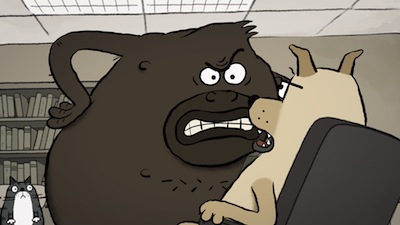
Hart Snider has followed up his award-winning animated short The Basketball Game with Shop Class, one of four National Film Board of Canada shorts selected for the 2018 Spark Animation Festival, which runs Oct. 25-28.
“I wrote and developed Shop Class while editing the TV series Yukon Gold, Klondike Trappers and Ice Pilots – documentary/reality series driven by ‘manly men’ who would run into big problems in remote locations, but then they’d break out some tools, rock music would start playing, there’d be a montage, and the guys would ‘man up’ to fix the problem,” Snider told the Independent. “While they were very successful shows, it made me laugh to be a not very macho guy telling these stories. It reminded me about being 14 and wanting to take home ec, but instead being forced to take industrial arts class, where my teacher tried to scare us into becoming men. I was inspired to write the story, which, yes, felt very cathartic – especially when I shared it with friends who also had him for a teacher.”
Not only does young Hart have to endure the bullying of his shop teacher, but he and his friends are targets for their bullying classmates. In one scene, Hart and his buddies are hanging out at a convenience store, when the friend checking out the latest Supermensch comic receives a punch in the stomach.
“The comic is not just a reference to being Jewish,” said Snider, “but to my first film. Shop Class is actually a sequel of sorts, to my 2011 National Film Board of Canada animation The Basketball Game, another autobiographical story. It’s about being 9 years old and at Jewish summer camp for the first time, when ex-students of notorious Holocaust denier/high school teacher Jim Keegstra come to our camp in Pine Lake, Alta., for a ‘day of fun and fellowship.’ Early in the film, my character is reading a Supermensch comic (which is there mostly because of the unnamed villain in Supermensch, seen fighting on the cover, that ends up inspiring a nightmarish transformation later in the story).
“Shop Class has a documentary-type scene that takes place in a convenience store, so I added a teenager reading Supermensch, issue #18, the same comic, to show that both the stories actually exist in the same cinematic universe.”
Every single character in Shop Class is voiced by Corner Gas and Dan for Mayor star Fred Ewanuick.
“Fred went from listening to me imitating my old teacher’s way of talking,” said Snider, “to stepping into the recording booth and totally bringing that character to life – and he did it just by saying, ‘Sit down, Turkeys,’ over and over until he totally nailed it.”
As for the other characters in the film, Snider said, “I’m still friends to this day with people I met in kindergarten at Talmud Torah in Edmonton, and I included a couple of them in both of my films. The love interest is totally inspired by my wife, Galit Mastai.”
The couple lives in Vancouver and, according to his bio, Snider “can usually be found either in an edit suite or at the park with his wife Galit, daughter Leora and dog Wolfie.”
In addition to writing and directing Shop Class and The Basketball Game, Snider also wrote and directed the animation segments for I Am Sam Kinison, a feature-length documentary about the late comedian that aired on Spike television. “I’ve edited animated short films as well,” he said, “including Lisa Jackson’s The Visit and Elisa Chee’s Lucy. Most recently (outside of animation), I’ve written and edited the theatrical documentary features I Am Heath Ledger and Botero, which will be released next year.”
On the NFB media site for Shop Class – on which he reveals his plan to create a third short “in this trilogy of animated films about growing up in Edmonton in the 1980s” – Snider traces his love of animation “back to being a little kid on Saturday mornings, glued to the TV. I have loved animation ever since,” he says, “but it took attending a screening of adult animation shorts (which included the film Lupo the Butcher by Danny Antonucci) when I was in high school to make me realize I really wanted to write and direct animated films. After interning at Nelvana animation in university, I thought I was on my way, until a job in post-production on a doc series about Cirque du Soleil back in 2001 led me on a totally different path as a documentary editor and writer.”
So, while he still loves animation, he doesn’t do the art for his films. “I just love telling stories using the medium,” he told the Independent, “and I’ve gotten to work with some brilliant artists – Sean Covernton animated The Basketball Game and the team at Jesters Animation, led by animation supervisor Brad Gibson, brought Shop Class to life.”
Shop Class screens Oct. 26, 11 p.m., at Vancity Theatre (19+). The NFB’s Animal Behaviour, by Jewish community member David Fine and Alison Snowden (jewishindependent.ca/animated-therapy-session), screens Oct. 25, 7 p.m., at Scotiabank Theatre. For the full festival lineup and tickets, visit sparkfx.ca.
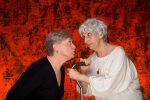
Judith Chertkow-Levy, left, and Karen Kelm co-star in the musical Like a Fly in Amber, which will be at Sheraton Vancouver Wall Centre Hotel Oct. 19. (photo by Victor Dezso Foto)
The Canadian Association on Gerontology Annual Scientific and Educational Meeting (ASEM) is the highlight of the year for those of us who work, conduct research or have an interest in the field of aging,” said Dr. Gloria Gutman, event co-chair. And, as far as she is aware, “this is the first time in the 47 years that the Canadian Association on Gerontology has been organizing ASEMs that it has included a social or cultural event quite like Like a Fly in Amber. When the organizing committee became aware of it, they got excited. It’s just so topical, given population aging; professional, funny and poignant.
“In today’s world,” she added, “many of us, especially women, can expect to be caregivers of frail elderly parents and/or, if we married partners older than ourselves, of a spouse whose physical and/or mental capabilities may become compromised. It’s the new norm.”
Like a Fly in Amber is a two-person musical about aging written by Karen Kelm, and co-starring Kelm and Judith Chertkow-Levy. It sees its Vancouver première at the CAG meeting on Oct. 19. Both the show and the conference are open to the public.
Among other things, Gutman is past president of CAG and professor and director emerita of the department of gerontology and Gerontology Research Centre at Simon Fraser University.
The ASEM, she said, is “where we learn about and present new ideas on how to improve the quality of life of our elderly population. While other organizations may be concerned with a particular age-related disease, CAG is a multidisciplinary organization that is concerned with the health and well-being of the whole person in the context in which they are living.”
Since CAG is a national organization, said Gutman, “the ASEM is held in different parts of the country as a way to build capacity as well as take advantage of what the different venues have to offer in the way of natural beauty, unique scientific and educational offerings, and culture.”
The conference program includes national and international keynote speakers, she said, noting that, this year, there are two from the United Kingdom, one from the United States and one from Vancouver. Preconference events, she explained, allow for more detailed study of particular topics, such as Reducing Seniors’ Social Isolation Through Collective Impact, which is funded in part by the Government of Canada’s New Horizons for Seniors Program. More than 600 abstracts “have been accepted for presentation within the eight streams of the scientific program which correspond to CAG’s professional membership: behavioural sciences; biological sciences; clinical practice; health sciences; humanities; policy and programs; social sciences; teaching and learning in gerontology.”
Like a Fly in Amber was part of the 2016 Toronto Fringe Festival. “The play revolves around Iris’s writing of a eulogy for her mother while sitting in the attic of the house in which she grew up,” wrote Dr. Carol Herbert, former dean of the school of medicine and dentistry at Western University who now lives in Vancouver, in a review of that production for the Jewish Independent. “She struggles to evoke memories of the person her mother was and to put her personhood into words. The resulting tribute is beautiful.” (See jewishindependent.ca/moving-musical.)
According to the synopsis, Iris returns to the family home the night before her mother’s funeral and “discovers that fiercely independent Grace may have hastened her own demise – accidentally, through stubborn, irrational decisions. Iris reviews the final chapter of their relationship, to make sense of Grace’s kooky self-sufficiency, and find closure.”
Kelm plays Iris, while Chertkow-Levy plays Grace. The two performers met doing Fiddler on the Roof at Theatre Under the Stars in 1975.
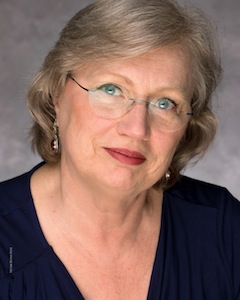
Karen Kelm (photo by Victor Dezso Foto)
“Over 40 years later,” Kelm told the Independent, “we are both enjoying being back onstage together – although I don’t think either of us could have imagined back when she portrayed Tzeitel and I was in the ensemble that she would play my mother one day!”
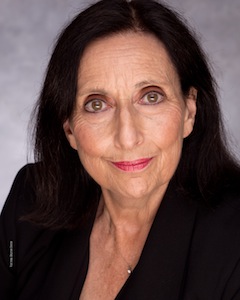
The two have been close friends since Fiddler. “She would join my family for Jewish holidays and Shabbat dinners and I would sing with her on Christmas Eve at her family gathering,” said Chertkow-Levy. “Although we moved to Toronto and shared an apartment and both pursued music careers, we did not have the opportunity to perform together until 2016. Karen is a gifted songwriter and, when she proposed the idea of doing this show in Toronto, I was thrilled to participate even though I was in San Diego and she was in Victoria.”
In preparation for the 2016 Fringe shows, Chertkow-Levy – who is one of Herbert and Gutman’s sisters – came to Vancouver around Passover for a few days of rehearsal. “Karen joined us for seder at my sister Carol’s home and, at the urging of my sisters, we sang a few bars of one of the songs. The theme of aging resonated with my sister Gloria professionally and with all of us emotionally and she had the idea of doing it sometime at a future convention. The seed of that idea grew and, as this CAG convention was being planned, Gloria felt the show was a good fit.”
Judith Chertkow-Levy (photo by Victor Dezso Foto)
While Kelm and Chertkow-Levy haven’t publicly performed the show since its debut in Toronto, they have continued to work with the material and improve it, said Kelm. “For example, the songs are mostly the same but, in the previous production, we performed to recorded tracks. In this production, we will perform with a live pianist.
“The script for the Fringe production emerged from swapping anecdotes with friends about their mothers,” she explained. “I knew Judy and Gloria’s mother (she ladled a lot of chicken soup down my throat over the years) and we laughed till we cried, remembering some of her best moments and priceless sayings. Judy also knows my mother, who, by the way, tells me it’s OK to poke a bit of fun at seniors because ‘we old folks are funny.’ Whew – she may come to the show this time. But, essentially, the first version of the show aimed to present a series of vignettes with songs attached.
“Of course, some of my mother’s idiosyncrasies show up in the script, but my experience performing for seniors in independent living facilities has taught me that many of the things we thought were unique to our moms are absolutely universal. So, after our first production, I took to heart some of the insightful observations of a couple of reviewers and began to write a more compelling script. The result is tighter, clearer dialogue and stronger dramatic structure surrounding the songs, now beautifully supported by a new score.
“I have always had a clear picture of Grace (the mother) because she is such a wonderful composite character, representing many mother figures whom I loved,” said Kelm. “Iris (the daughter) gave me more trouble, both as a writer and a performer, because, at first, I didn’t want to get too autobiographical. In this version of the script, Iris much more closely represents me than Grace does my mother.”
“As Grace,” said Chertkow-Levy, “I find myself drawing on the memories of wonderful mothers in my life who are no longer with us: my mother and grandmother and Karen’s wonderful Grandma Matthews and Aunt Peggy. And, I picture Karen’s mother and my mother-in-law who are modern ‘little old ladies’ who have embraced technology and surf the Net and are only old by virtue of their age in years. All are and were strong, resilient women who loved life and took aging with a grain of salt – accepted it but didn’t give in to it. I feel honoured to be able to draw on them as inspiration and keep them with me in memory. I hope that my portrayal lives up to that memory.”
Tickets for Like a Fly in Amber can be purchased from cag2018.eventbrite.ca. The price is $40 for the show only and $65 for the show plus flatbread and a beverage. It plays Oct. 19, 7 p.m., in the Grand Ballroom at Sheraton Vancouver Wall Centre Hotel, 1088 Burrard St. For details about the CAG meeting, visit cag2018.ca. There are one-day as well as student and senior reduced registration fees available.
Geoff Berner will help open this year’s Downtown Eastside Heart of the City Festival on Oct. 24. (photo by Genevieve Buechner)
Recently back from Ontario, where he joined Orkestar Kriminal for a few shows, singer-songwriter and accordionist Geoff Berner will help launch the 15th annual Downtown Eastside Heart of the City Festival on Oct. 24.
Berner will be part of Songs of Justice, Songs of Hope, an evening of activist songs, led by musician, composer and conductor Earle Peach and featuring Solidarity Notes Labour Choir, among others. Berner will perform a solo set, but, he told the Independent, “I’m open to some collaboration with the choir, if that’s something they’d like to do.”
Berner has worked with Peach before.
“We’ve both lived in Vancouver for decades. We’ve both been active in left-wing politics and stuff in Vancouver for a long time,” said Berner. “I’ve played events with the Solidarity Notes Choir over the years. We have a lot of ideas in common.”
Heart of the City comprises more than 100 events at 40-plus locations around the Downtown Eastside over 12 days. Presented by Vancouver Moving Theatre with Carnegie Community Centre, the Association of United Ukrainian Canadians and many community partners, this year’s theme is “Seeds of Justice, Seeds of Hope,” celebrating the community’s “history of advocacy for human rights and social justice.” The website notes there will be “music, stories, songs, poetry, cultural celebrations, films, theatre, dance, spoken word, workshops, discussions, gallery exhibitions, mixed media, art talks, history talks and history walks.”
About his decision to participate in festivals like Heart of the City, Berner said, “You can feel it when an event or a music venue is not about money, but about building community and getting strength from music and culture. This is one of those.”
Berner has had a busy year. In September 2017, he released a new album, Canadiana Grotesquica, and his second novel, The Fiddler is a Good Woman, came out in October 2017. In addition to performances throughout British Columbia and elsewhere in Canada, a European tour took him to many cities over several months. This coming November, he’s headed to Seattle and Los Angeles, with other dates no doubt in the planning.
In the latest news post on his website (Sept. 14), Berner welcomes everyone back to the September routine, “whether it’s a New Year for you, or not.”
While he makes “resolutions all the time, not only at Rosh Hashanah,” Berner said, “My routine is that I write songs, make an album about once every two years, and then tour around North America and Europe trying to spread the album as far and wide as I can. Then I do it all again. It’s a good job.”
True to form, Berner will head into the studio in January to get a new album ready for October 2019. It will be produced by Josh Dolgin, aka Socalled, with whom Berner has worked since 2010.
“He is a valuable editor and idea generator,” said Berner of Dolgin. “He knows more about the recording studio, more about musical arrangement and more about Jewish music, especially klezmer music, than I do. So that all comes in pretty handy. And if he tells me, ‘no, you shouldn’t do that,’ he’s almost always right.”
People curious about what the album might sound like should mark their calendars for the Heart of the City opening. “There will be some brand new material from me at this festival,” Berner told the Independent. “See you at the show, I hope!”
The free Oct. 24 launch event takes place at Carnegie Theatre, 401 Main St., at 7 p.m.
Also participating in the festival is Vetta Chamber Music, with Seasons of the Sea, which melds contemporary classical music by local composer Jeffrey Ryan with a narrative written by Rosemary Georgeson. The original work, performed by Vetta Chamber Music and Georgeson, “describes the seasons on and by the sea, and is inspired by the 13 moon season of the Coast Salish peoples who used the tides and seasons of the sea as their calendar.” The show takes place Oct. 28, 3 p.m., at Dr. Sun Yat-Sen Classical Chinese Garden, 578 Carrall St., and is admission by donation to the garden.
Most Heart of the City Festival events are free or by donation. For more information, visit heartofthecityfestival.com.
Vancouver Opera’s production of The Merry Widow opens Oct. 20. (photo by John Grigaitis)
“I am thrilled that The Merry Widow will open our 58th season,” Kim Gaynor told the Independent. “The Merry Widow has only been produced twice before in the history of Vancouver Opera. We have a terrific cast, and director Kelly Robinson also directed our smash-hit Evita in 2016.”
Gaynor, a member of the Jewish community, is general director of Vancouver Opera.
“Franz Lehár, the composer of The Merry Widow, always used Jewish librettists for his operas – in this case, Viktor Léon and Leo Stein – although he was Roman Catholic,” she noted. “The cultural milieu in early 20th-century Vienna was made up of a significant Jewish contingent. And Lehár’s wife, Sophie (née Paschkis), was Jewish before her conversion to Catholicism upon marriage, which was a common practice at the time in the case of a ‘mixed’ marriage.”
Lehár’s The Merry Widow (Die Lustige Witwe), a comedic operetta, is set in Paris at the turn of the last century. In the Vancouver Opera production, soprano Lucia Cesaroni will be making her role debut with the VO as the wealthy widow, Hanna Glawari, who tries to win the heart of Count Danilo, played by tenor John Cudia.
In the past year, notes the show’s promotional material, Cesaroni “also debuted with acclaim in both soprano roles of La Bohème, as Mimi with Pacific Opera Victoria and Musetta with l’Opéra de Montreal.” She last performed with the VO in West Side Story in 2011.
Cudia has performed in two recent VO productions: as Cassio in Verdi’s Otello (2017) and Juan Peron in Evita (2016). Among his credits, he is the first and only actor to have performed both as the Phantom in Phantom of the Opera and Jean Valjean in Les Misérables on Broadway.
The VO production of The Merry Widow plays Oct. 20, 25 and 27, 7:30 p.m., and Oct. 28, 2 p.m., at Queen Elizabeth Theatre. Tickets range in price from $50 to $175 and are available from the VO at 604-683-0222 or vancouveropera.ca.
Colleen Winton as Mrs. Lovett and Warren Kimmel as Sweeney Todd in Snapshots Collective’s production of Sweeney Todd: The Demon Barber of Fleet Street, which runs Oct. 10-31. (photo by Nicol Spinola)
“To seek revenge may lead to hell, but everyone does it, if seldom as well as Sweeney,” said Stephen Aberle, quoting from the finale of Sweeney Todd: The Demon Barber of Fleet Street. Aberle plays Judge Turpin in the Snapshots Collective production of the musical, which will take place at Mrs. Lovett’s Pie Shop, or at least a facsimile of it, at 348 Water St., in Gastown, Oct. 10-31. Most shows are already sold out.
“Part of the power of the piece,” explained Aberle, whose character sets Sweeney on his murderous path, “is that we can identify with all of the characters, see their strengths and their flaws, and observe how much we share with them. That’s what makes it troubling, that irresistible doubt: would I do anything differently?”
Let’s hope most people would, as Sweeney Todd slits quite a few throats in his barber’s chair – providing the main ingredient for Mrs. Lovett’s pies – before getting to the object of his revenge, Judge Turpin, who abused Sweeney’s wife and exiled Sweeney for a crime Sweeney didn’t commit.
“When we decided on doing Sweeney Todd,” director Chris Adams and choreographer Nicol Spinola told the Independent in an email interview, “we knew we wanted Warren Kimmel as Sweeney, so we approached him first to see if he would be interested in playing the title character. He was on board almost immediately and we started moving forward to cast the rest of the show. We next approached Colleen Winton for the role of Mrs. Lovett and held auditions for the rest of the cast. We weren’t shy in letting auditioning actors know that our show was going to be different and that seemed to excite them. We were thrilled with the turnout and were able to cast the show exactly how we saw it.”
And the intimate audience – theatre capacity is about 56 – will be right in the midst of it all.
“The show is staged around the entire venue with some seats being directly in the action,” said Adams and Spinola, who are also co-producers of the show, with Ron Stuart, Wendy Bross Stuart and Kat Palmer. “There will be interactive moments between the actors and the audience, although there is no audience participation required. Sometimes the action will take place right in front of you and other times the action will be across the room.”
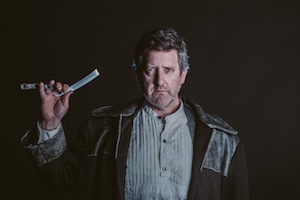
Kimmel looks absolutely terrifying in the production’s 44-second teaser.
“It’s always more fun, interesting, to play dark or evil characters than good ones and, for the most part, I am cast as good guys rather than bad guys so this is fun from that point of view,” said Kimmel of playing the title character in the musical, composed by Stephen Sondheim, with book by Hugh Wheeler. “Also, Sweeney Todd is probably one of the most challenging pieces in the musical canon to perform, so that makes it a stimulating and scary experience as well, which is, I suppose, fun in a twisted fashion.”
“I think this is a tremendously important story for our time,” said Aberle, “a time when the power structures that reinforce men’s privilege and women’s presumed subservience (as well as racialized, class-based and other power imbalances) are being challenged by some; desperately defended by others. We read about Judge Turpin analogues just about every day in the news. I think it’s particularly important for those of us who possess power to check in with a story like this and consider our own exercise of that power. To what extent am I being a self-serving brute in this situation? Are there ways I might reduce that extent? The play, it seems to me, asks questions like those pretty insistently.”
About how he has chosen to portray Judge Turpin, Aberle said, “I’m looking for him the way I generally look for a character: by trying to figure out what he wants in the context of the given circumstances. That context, for a judge in mid-19th-century England, was power, privilege and prestige.
“One of the things that makes Judge Turpin interesting, to me, is that he’s not merely a psychopath or even a simple, spoiled narcissist: he tries to do ‘the right thing’ according to social convention and struggles with his desires (though more because of deeply ingrained inner shame than because he really understands his own power to harm, or empathizes with his victims). There are some questions about the man that I’m interested in exploring. What was his blue-sky vision of the perfect outcome when he set this engine of vengeance rolling, 15 years before the play begins? Why, especially given the power of his urges, has he gone through life so far without marrying? Why did he adopt a year-old infant as his ward? There are several plausible answers – and plausible combinations of multiple answers – for each of these, and I’m enjoying playing with them.”
Echoing Kimmel’s assessment of the music, Aberle added, “And, really, let’s face it. This is Sondheim at just about his Sondheimiest. If I can sing the material more or less in time and on pitch, I’ll be pretty happy.”
“The music plays a central role in telling this story,” Bross Stuart, the show’s musical director, told the Independent, “and there is no one more brilliant than Stephen Sondheim to do this for us. Central to the core of this music is the Gregorian chant, ‘Dies Irae’ (‘Day of Wrath,’ ‘Day of Judgment’) theme, heard throughout this work. We hear fragments of this musical motif hidden everywhere. Extended, shortened, pulled out of shape, but it’s there. We know it is the underpinning of Sweeney Todd’s motivation. It helps us understand Mr. Todd’s state of mind; and how revenge morphs into mental illness. When we are in the asylum, in Act 2, some of the ‘patients’ sing a demented version of ‘Dies Irae.’
“Another example is Sondheim’s use of a repeated note for more than 100 bars. Why does he do this? It is Mr. Todd’s obsession with murdering Judge Turpin. Even while the men are having a seemingly ‘friendly’ conversation, Todd is thinking along more sinister lines.”
“Sweeney Todd, as far as we can tell, is a normal man with a wife he adores and a new young daughter,” said Kimmel. “Without spoiling the plot altogether, life deals him a hand that most would find impossible to survive, let alone overcome, and so we have a perfect vehicle to allow us to ask what we would do in his position and, if we are honest with ourselves and had the courage to follow through, we could easily imagine doing the same things he does.”
Warren Kimmel looks terrifying in the production’s promotional material. (photo by Nicol Spinola)
But, he added, “In the end, I think it is a very moral story and the final destination is morally inevitable – although we feel for him and want to see him get his revenge, and although he and Mrs. Lovett almost get away with what they have done, it cannot be…. The world is set to rights at the end of the piece.
“You could say that this is just a Victorian melodrama, a deliciously dark tale underlining all the Christian moral virtue of the period,” he continued. “However, like all great drama, I think the rules of the game are timeless – first dramatized in Greek times or even biblical times. You cannot fool God; you cannot escape the price that must be paid for transgressing His rules. There is a fashion now to believe that we have moved past these religious moral strictures and that religion has less to offer a modern society but, in the end, this is a morality tale that resonates with very deep archetypal themes. No matter how justified it may seem, revenge will lead nowhere good.
“From a performance point of view, it is always a gift to be able to play someone truly morally compromised and, in a broader sense, I think that is what the theatre is really for: to allow us to watch this story and go through all that life is able to throw at us, to imagine, to understand and even to justify truly extraordinary behaviour, and yet to laugh and cry and cringe and know that, at the end, the moral compass of the world is back on true north.”
An emotional connection to the show is one of the reasons that the Stuarts wanted to be involved in this production. “We saw the original Broadway production in New York City in 1979, with Angela Lansbury and Len Cariou,” said Ron Stuart. “It was brilliant and riveting and unique in the genre – like West Side Story was 20 years before or Showboat before that.
“Our co-producers had the concept of an immersive version of the show at a Gastown venue around Halloween, and we thought it was an interesting way to present the work.”
In addition to funding, he said, “with projects of this scale, we are also very hands-on. Our director, choreographer, music director and assistant director are also producers. We readily share our contacts in a variety of specialities, such as costumes, set design, lighting, instrument rental, legal issues, marketing, etc. Moreover, we are a collective under Equity rules, so we all have ‘skin in the game.’”
This is Palmer’s first experience as a producer. “It has been nice to learn from professionals who have been through this journey from beginning to end,” she told the Independent.
Knowing that they wanted this show to be immersive, the venue not only had to work from a mechanical perspective, “but add to the experience,” said Palmer, who is also in the ensemble.
“It’s been a fun challenge,” she said, “to be switching between my assistant stage managing hat and my performer hat – ‘this prop will need to be pre-set here, oh no, this is the lyric, this person has a quick change.’”
Palmer described the show as being very difficult technically, “there is not just Stage Left and Stage Right to worry about, there is a whole building.”
This is part of the attraction for Bross Stuart.
“We, the musicians, are very close to the audience and to the actors,” she explained. “Communication, page-turning, singing as you play – could be problematic. And the action is very immediate and very gripping. Very exciting!”
“My favourite number in the show,” said Palmer, “has to be our opening number, ‘The Ballad of Sweeney Todd.’ Our amazing choreographer, Nicol Spinola, has created something so eerie, unique and unsettling. It immediately brings the audience right into this dark and thrilling world of 1840s London. Not only does it sound fantastic to have our entire cast of 17 singing Sondheim’s challenging music, but it also sets the mood for the entire show. I get chills performing it and I am very confident the audience will have never experienced anything like it before.”
For more information and tickets to Sweeney Todd, visit sweeneytoddthemusical.ca. And plan to have dinner at the venue before the show – pies, of course.
“Our pies come fresh each day from the Pie Hole located on Fraser Street in Vancouver,” said Adams and Spinola. “We are offering a traditional steak-and-stout meat pie, an aromatic Moroccan chickpea vegetarian pie and a delicious Thai coconut curry vegan pie. Pies can be added on when you are purchasing your tickets.”
Among the writers being featured at this year’s Word Vancouver, which runs Sept. 26-30, is Victoria-based poet Barbara Pelman.
Pelman’s latest collection, narrow bridge (Ronsdale Press, 2017), is her third book of poetry. Its title comes from Rabbi Nachman of Breslov’s famous advice (at least in Jewish circles): “All the world is a narrow bridge – the important thing is not to be afraid at all.” Other than in one poem, however, called “Öresund,” where she tells herself, “I will not fear,” Pelman doesn’t come across in her writing as fearful.
“I’m delighted that I don’t come across as fearful,” Pelman told the Independent, “as I am full of fear, and certainly before each visit to my family in Sweden, I imagined everything that could go wrong and how incompetent I am. And was amazed that I survived intact.
“Generally, I tend to be a worrier (‘a misuse of the imagination’) but fight this negativity all the time. The tension, which I hope comes across, is between a general optimism and belief that, ‘in the long run’ … things sort themselves out. So, I tend to take on things that might terrify me, like art classes or solo trips to Berlin or train rides through Europe, and sign up, so there’s no going back. Not, however, bungee jumping or skydiving.
“When I have to deal with adversity – a separation and divorce, primarily – I talk and I write,” she said. “Both are clarifying agents. The poems in this book put forward a lot of my difficulty in being in the present, without wishing to be elsewhere. As in the first poem, ‘Gentle Reader’ – the desire to desire only what you have, and not what is somewhere else.”
On the family front, at least, Pelman’s journeys have become shorter since the book was published. Her daughter, who had been living in Sweden for three years, moved to Vancouver this summer, meaning that Pelman’s grandson is also now that much closer. He features in more than one poem – “Still Life with a Small Boy” is especially poignant. In it, he and his bubby, Pelman, are out having a hot chocolate and croissant. “Heads together, bending into each other. / They are a world. Outside, the world breaks. / She cannot read the news while she is with him, / tries to be calm, listen while he tells her / his new red bike helmet makes him safe.”
The collection is divided into three sections and includes some poems that Pelman has published before. Her previous books of poetry are One Stone (Ekstasis Editions, 2005) and Borrowed Rooms (Ronsdale Press, 2008), and she also has produced a chapbook, Aubade Amalfi: The Marcello Poems (Rubicon Press, 2016).
“This book had three iterations, each time being sent back by the publisher with suggestions – too much of Marcello and the adorable grandson, for example,” she said of the decision-making process for what would make it into narrow bridge. “So, I rejigged the poems, took out a lot of them, put in more recent ones, and relied on Russell [Thorburn] to put them in order. He sees an organic pattern of the poems, sometimes based on image or theme. I trust his choices, only changed a few.”
The poems in narrow bridge include many with Jewish themes.
“Most of my childhood centred around the synagogue, not in a hugely observant fashion, but, as my father was choir leader at the Beth Israel, I often went to services with him,” Pelman said about the place of Judaism and Jewish culture in guiding her work or approach to life. “Now, as a member of Congregation Emanu-El [in Victoria] and ‘den mother’ for the Calling All Artists project, I am interested and involved in learning Hebrew, chanting Haftorah, and generally intrigued by the culture and traditions of an ancient people.
“Moreover, and this is what I think is really wonderful, poetry and study of Torah have many similarities. Hebrew is a language that I think is embedded in metaphor, and studying Torah is the kind of layering analysis that I am used to in studying poetry. Layer upon layer of meaning and ambiguity. Rabbi Harry Brechner considers art as ‘mishnah’: another way to interpret, to find meaning that is relevant to us personally and globally.”
In narrow bridge, Pelman explores kabbalistic ideas, her own family history and relationships, as well as biblical ones (the poem “Isaac” is powerfully evocative). In at least two poems, she explores the concept of “thisness” – notably in the poem of that name, where, she writes, “Happiness, fed from detail: the thisness of things, / resting in the eye of the beetle, the creak of the board / she leans against, the cold air pricking her ears.” And several poems have to do with the spaces or pauses between, for example, a heartbeat or a pendulum’s swing; those moments that happen all the time but that we rarely acknowledge or even notice.
Aging features prominently, as well. And, while some poems are wistful – such as “Suitcase in the Closet,” where recollections of past travel suffice – others are almost calls to arms. “A woman over seventy should open her travel account, / run her fingers over the globe, and choose / She should trade her sensible shoes for sandals, / her Gucci bag for backpack, her datebook for weather reports,” begins the poem “Go,” a favourite in this collection, though this reader is still a couple of decades shy of 70.
As for how her style or subject matter has changed since her first collection, Pelman said, “I have continued to work with various poets in workshops and retreats, and continue to learn a great deal from poet friends and reading. I think my poems have become shorter, a bit more compressed. I am aware of the musicality of the poem – the cadence, the pacing, the rhythm. But the struggles are still there: how to get started, how to edit, how to know when a poem is done. I have a huge file on my computer, called ‘Working On.’
“And my subject matter has changed as my life has changed,” she said. “The first book dealt with the divorce and finding a new identity; the second book included the death of my father; this book is about travel, and daughters, and grandsons, and the new life of retirement. About balance. But there are still hummingbirds in the hawthorn tree. Jasmine and tulips. Old lovers and mothers.”
Pelman is at Word Vancouver on Sept. 30, 1:20 p.m., in the Suspension Bridge tent at Library Square Conference Centre, one of three poets participating in “Another Taste of Poetry.” She also joins two other poets in Ronsdale’s Fall Poetry Showcase at Dunbar Public Library on Nov. 7, 6:30 p.m.
For more about Word Vancouver – where Jewish community members Mark Winston and Claire Sicherman will also share their work, at 1:20 p.m. and 2:30 p.m., respectively on Sept. 30 in the Alma VanDusen Room at Library Square – visit wordvancouver.ca. The interim manager of the festival this year is community member Bonnie Nish.
Mélanie Thierry delivers a strong performance as Marguerite Duras in Memoir of War. (photo from VIFF)
The Vancouver International Film Festival starts next week. Among the myriad offerings are many films that might be of particular interest to the Jewish community. Here, we review four: In My Room, Memoir of War, The Reports on Sarah and Saleem and Working Woman.
Not to be confused with In My Room (Germany), about a man who wakes up one day to find that everyone else in the world has apparently disappeared, which is also playing at VIFF, In My Room (Israel) introduces viewers to six teens who are, in my view – and likely that of anyone over 40 – way too eager to share on social media. In an effort to become marginally famous, perhaps, or, at best, to find or give support to others, they expose their insecurities, their challenges and changes, and more. Both compelling and hard to watch at times, one thing the documentary makes very clear – growing up these days isn’t easy.
In My Room is part of VIFF’s Impact stream, nine films that the festival considers “uncompromising” and “insightful discussions that spark action and change the way we see the world.” Among the awards being offered in this category is the VIFF Impact Award, a $5,000 prize presented by Leonard Schein to one of the stream’s documentaries. In My Room certainly shines an uncompromising light on the personal information that is being shared on the internet by kids, the publicizing of which may come back to haunt them.
While a large part of me cringes at the teens’ apparent lack of boundaries or concern for their safety, they are also incredibly brave (or maybe just incredibly ignorant of the possible consequences). I hope that only a small percentage of young people are going through what they are, which ranges from heartbreak over an ended relationship, to pregnancy to not being comfortable in the gender they were born, to an eating disorder.
In My Room is in English and Hebrew (with English subtitles). It is rated PG for coarse and sexual language, and screens Sept. 29 and Oct. 1.
* * *
Memoir of War (France/Belgium) sees its Canadian première at VIFF. A little on the slow side pacing-wise, it is a seemingly realistic portrayal of what it might have been like living in Paris during its occupation by the Nazis. It is based on Marguerite Duras’s wartime memoir La Douleur (Pain).
The film takes place in 1944. Duras’s husband, Robert, part of the resistance, has been captured by the Nazis and she is so desperate to find out what has happened to him, and to possibly free him, that she dangles the hope of a relationship as bait to get information from a man named Rabier, an open Gestapo collaborator. Rabier not only desires Duras, but, even more, entry into her literary world.
When the Allies’ impending victory becomes apparent, Rabier flees. As liberation takes hold and survivors begin to return, but not Richard, Duras becomes ill, feverish, and reality and dreams blur.
The acting is superb, in particular Mélanie Thierry as Duras, and director Emmanuel Finkiel and cinematographer Alexis Kavyrchine deftly capture her moments of fear, exhaustion and confusion symbolically in a powerful use of imagery and visual effects, which dialogue alone could not have communicated.
Memoir of War is in French with English subtitles. It screens Oct. 6 and 8.
* * *
Though inspired by true events, The Reports on Sarah and Saleem is a little hard to believe. Not the reaction of a husband to his wife’s infidelity. Not the fact that an Israeli or a Palestinian would have an affair with the supposed enemy. But that a nice, educated and industrious woman would risk her marriage and business to be with such a grumpy, pushy and uninspiring man.
Sarah, an Israeli wife, mother and café owner, is having an affair with married, soon-to-be-a-father Saleem, a Palestinian deliveryman for a bakery, and then for his relative’s unsavoury friends. The appeal of great sex is understandable but the scenes in the back of the delivery van don’t succeed in making it seem life-riskingly great.
Despite the cognitive dissonance, the pace and tensions build up, and the second half of the film, which features less driving around and some gun-toting drama, is quite engaging. When things go south, will Sarah tell the truth, and risk losing everything she holds dear, or stay quiet, and let her lover go to prison for a crime he didn’t commit?
The Reports on Sarah and Saleem is in Arabic, Hebrew and English, with English subtitles. It screens Oct. 7 and 11.
* * *
In Working Woman, it initially seems that Benny (Menashe Noy) genuinely wants to help Orna (Liron Ben Shlush) succeed. (photo from VIFF)
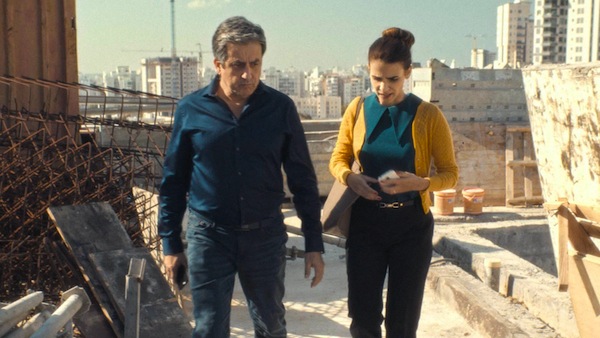
I can’t even look at the stills of actor Menashe Noy, who plays Benny in Working Woman, without feeling disgusted, so well did he play the lecherous boss of Orna (Liron Ben Shlush), a smart, married, mother-of-three, who Benny hires as his assistant.
At first, Benny is the good guy, the man who sees great potential in the inexperienced Orna. Her former commander in the army, he hires her at his development firm, and Orna excels as a salesperson. This is part of what attracts Benny to her – her intelligence and natural ability. But he can’t control his desire and he tries to take what he wants. Orna must figure out how to extricate herself from the untenable situation without ruining her career opportunities.
For some reason, I was expecting a dramatic thriller, where Orna exacts some horrible but deserving punishment on her harasser, but Working Woman is less dramatic than that. Orna uses her brains to get what she needs to move on, both workwise and psychologically. While it would have been refreshing if the character of Orna’s husband had been written as one more sympathetic to her plight, the film is probably more realistic as it is.
Left to right: Yitzhak Rabin, Yasser Arafat and Shimon Peres after the three received the Nobel Peace Prize in Oslo in 1994. (photo by Saar Yaacov via VIFF)
It’s almost painful to be reminded of how close Israelis and Palestinians were to achieving peace 25 years ago with the Oslo Accords. Yet, Mor Loushy, co-director of The Oslo Diaries with partner Daniel Sivan, hopes that the documentary inspires audiences to believe that peace is possible. After all, the impossible almost happened in the 1990s, so why not in the future?
The Oslo Diaries screens as part of the Vancouver International Film Festival, which runs Sept. 27-Oct. 12. The film is based on the personal diaries of the Israeli and Palestinian negotiators in the initially secret peace talks that unofficially began in 1992 in Oslo, Norway, after the late-1991 Madrid Conference – at that time, it was illegal for the two sides to communicate. Those meetings, which eventually became public and official, led to the signing of the Oslo Accords in Washington, D.C., in 1993.
The narrative of The Oslo Diaries comprises archival footage, reenactments and interviews, including the last interview former prime minister and president of Israel, Shimon Peres – who was foreign minister during Oslo and a signatory of the accords – gave in his life. It takes viewers through an abridged version of the negotiations and offers insight into the leadership and compromise that was needed to reach an agreement.
That leadership and the prospects for peace took a literally fatal blow when Israeli prime minister Yitzhak Rabin was assassinated on Nov. 4, 1995. Binyamin Netanyahu, who, the documentary shows, was fierce in his opposition to the peace accords – passionately addressing rallies at which supporters held signs calling for Rabin’s death – was elected prime minister in 1996. The documentary ends with the start of his victory speech: “Dear supporters, friends, the state of Israel is embarking on a new path today.”
The Oslo Diaries is the third film Loushy and Sivan have worked on together; Censored Voices and Israel Ltd. being the other two. The couple is based in Santa Monica, Calif., for a year, after which they and their two children, ages 3 and 6, will return to Tel Aviv. Loushy was born and raised in Tel Aviv and Sivan, born in Haifa, moved to Tel Aviv when he was 18. The Jewish Independent spoke to Loushy by phone recently, in advance of her arrival in Vancouver to participate in VIFF.
While The Oslo Diaries does an admirable job of attempting to present the material without commentary, the filmmakers’ political perspective does come through, in particular with Netanyahu being depicted as the bad guy, so to speak.
“First of all, we never hide our opinion,” said Loushy. “We’re from the left-wing, or part of it. We stand behind our views and, if someone from the right-wing would have made that specific film, it would have been a completely different one. But, what ‘film’ is about, I don’t think that there is an objective film. Every cut that I make in the film, it’s a decision. But, I think that it’s really more important for us to keep it balanced, and we fought a lot about it, we had a lot of discussions about it.”
Given the reactions she has received, Loushy said, “I think that this film is completely not right- and left-wing – this is a film about peace. And I do feel, from the screenings around the world, that it’s past this boundary of camps, on the one hand. On the other hand, in Israel, the situation is difficult: we are divided, there are camps … and our government is the most right-wing government that we ever knew. Every day, there is a new anti-democratic law that passes, and it’s frightening.”
About making the documentary, she said, “We’ve hit such a rock bottom that someone needs to stop for a moment, and it’s part of my duty as a civilian and as a filmmaker to say, OK, let’s talk…. We’ve forgotten about Oslo, and most of the people don’t even know the story behind the code name ‘Oslo.’ Let’s talk for a moment, let’s really see what happened there and what really was there – not from the news or from secondary sources, but from the first sources, the people that were there. Listen for a moment. What exactly happened there? What went wrong?”
She said people have forgotten about the negotiations and that reminding people about them will help. “It gives hope for the future,” she said. “We were that close, we can do it again, it’s not impossible. You just have to stop for a moment and think, what kind of future do we want to leave our children? Do we want the same, as in the present, a future of wars … so many people that are being killed every day, that’s what we want for ourselves? Or do we need a reminder for a second of the place we could have gone to, for the places we can get to? We just need a strong leader that’s going to take us there. And I think that this film does an incredible job of putting this discourse again on the table because, in the past three or four rounds of elections, the word ‘peace’ … [and the prospect of] ‘negotiation’ is no longer on the table, and this is such a crazy thing.”
When asked how much blame she attributes to Netanyahu for the breakdown of the peace process, Loushy said, “It’s a very complex answer because it’s not one answer. I think that he had a lot to do with the peace breakdown but he was not the only one. The people voted for him and, when people voted for him, they knew what they were voting for – it was obvious he was not going to continue with the peace process. So, I think it was the people and I think that, yes, he had an essential part, saying, ‘I believe in the holy grail,’ [in Greater Israel]. This is his belief, and I think he succeeded in that,” she said, citing figures indicating that the number of settlers has quadrupled since 1993.
Loushy said Netanyahu has claimed that “the West Bank is just a part of Israel, and [he] wants more and more settlements, [so] that also the left-wing people right now are saying, OK, how can we resolve it? That there is an unresolved situation because of the settlers.”
Both fanaticism and fear are contributing to the situation, she said, “although I do believe that most of the people want peace, believe in peace, [and] are just too scared to give it a chance.
“And that’s where this film comes in, saying, listen: first of all, the whole Palestinian leadership was interviewed for this film. I was a guest in Ramallah in all of the high places in the Palestinian leadership – there is a partner. He [Palestinian Prime Minister Mahmoud Abbas (Abu Mazen), who was also one of the signatories of the Oslo Accords, for the Palestinian Liberation Organization] wants to talk to us. He wants a solution. I believe it in all of my heart that the Abu Mazen government wants peace.
“So, there is the Palestinian leadership that was interviewed for this film, and I do believe there is a chance, but that people are just too scared and [the film’s purpose is to help people] to remember exactly what happened.”
While the filmmakers interviewed several Israelis who were involved, they could not get access to Netanyahu. “We wanted to [interview him],” said Loushy, “but Netanyahu doesn’t give any interviews to the press…. You see Yitzhak Rabin – in all of the archives, Yitzhak Rabin is giving interviews every other day… [Netanyahu] is connecting through Twitter, and that’s it. He doesn’t give interviews to the press.”
The Oslo Diaries premièred at the Jerusalem Film Festival and there have been screenings all over Israel, said Loushy, who noted the diversity of audiences, which have included secular and observant Jews. “This is amazing,” she said, to have people from both sides sitting together in the theatre. “People want the discourse, want to talk about it again. Of course, every screening, [when there’s] someone shouting at me, I know I did my job…. I made somebody think about something he hasn’t thought [about] before.”
The Jewish Independent is VIFF’s media partner for the Vancouver screenings of The Oslo Diaries, which take place Sept. 28 and 29, and Oct. 12. The documentary is a Canadian co-production, co-produced by Ina Fichman (Intuitive Pictures); Radio-Canada is also listed as one of the film’s sponsors. All of the post-production was done in Montreal, said Loushy, “and we loved it.”
For the full VIFF schedule and tickets, visit viff.org.
Alexa Mardon is part of the creative team of Never Still, which is at the Firehall Sept. 26-29. (photo by Ben Didier)
It is fitting that Firehall Arts Centre is launching its 36th (double chai) season with a new work by Jewish community member Vanessa Goodman, artistic director of Action at a Distance Dance Society.
Never Still is described as “a highly physically piece that dives into the distinctions and overlap between three different systems of circulation: global water cycles, communication technology and fluids within the body.”
“The initial ideas for Never Still really began to emerge in 2013, when I made two separate works inspired by similar themes. Both dealt with our relationship to water, either in our environment or our bodies,” Goodman told the Independent. “On a very basic level, we are all between 50% to 70% water, depending on our age, and the earth’s surface is covered by roughly 70% water. There is some nice symmetry and, the deeper I dug into these themes, the more they revealed. Social, political, personal, environmental – no matter where I went with these themes, it checked all the boxes of what inspires my work.
“For me, it was just a matter of time before I began to focus on these ideas as a full-length. But it wasn’t until 2015, when I met Scott Morgan (Loscil) through Small Stage, where we first collaborated together, that I could imagine this work growing into what it is today. Each project requires the right collaborators to bring it to life.”
Goodman’s research began in 2016 during a creative residency in New Brunswick hosted by Connection Dance Works. “Loscil and I also made Floating Upstream that same year, a shorter piece that explored these ideas and worked out some staging concepts,” said Goodman. “In 2017, I continued the research through a local choreographic residency at EDAM.
“I always knew I wanted this to be a group piece and, in the spring of last year, I finally had the whole performing team together: Shion Skye Carter, Stéphanie Cyr, Bynh Ho, Alexa Mardon and Lexi Vadja. The work would also not be complete without my longtime collaborator, lighting designer James Proudfoot, who is a master of painting space with light.”
Sound and projection design for Never Still is by Loscil, with costumes by Lloyd clothing. EDAM’s Peter Bingham is listed as the piece’s creative mentor.
While the work has evolved since conception, Goodman said, “There’s not necessarily one element I can point to that’s different. When I began working on this piece, it was just me alone in the studio imagining all the elements, so being able to work with five incredible dance artists, lighting, sound and projections definitely pushes everything forward quite rapidly.
“It is always exciting how a work takes shape in each unique venue, too. Ideas that you may have thought would work sometimes don’t and other new elements reveal themselves, so it’s important to stay flexible. The work is constantly evolving, even through the final performances. That is one of the many exciting parts of live art: it is constantly being transformed by those who inhabit it.”
This idea ties in perfectly with the themes explored in Never Still.
“On a molecular level, liquid water is never truly still, which acts as a beautiful metaphor for dance. It offers myriad avenues to explore anatomically and thematically,” said Goodman.
About Never Still, she said, “I feel like it’s very easy in a developed urban setting to take water for granted and overlook its true value, so, if anything, parsing so many different aspects of water with this piece has helped me appreciate it that much more.”
The work also considers the “inherent conflict or dichotomy of water.” By way of explanation, Goodman said, “The most obvious textural example is water’s often-violent reaction to shifts in temperature, from the crack of ice to the vapour rising from a roiling boil. On a larger scale, the effects of flooding and drought, which, on one hand, represent polar opposites, often share conflict and devastation.”
Echoing these concepts, Firehall artistic producer Donna Spencer said in the release for Never Still, “We are living in an increasingly polarized culture. And it is our role as artistic creators to encourage audiences to consider, through what they are seeing on stage, how inextricably linked we all are in finding our way through these challenging times.”
Firehall’s programming this season, she added, “is about choices – the ones we make, the ones we think we should make but don’t, and the influences around us that colour that decision-making. Live performance allows us to experience a unique and powerful collective sharing of emotions and information that resonates through our day-to-day lives long after we have left the theatre, and indeed may influence the choices we make in the future.”
Never Still runs Sept. 26-29, 8 p.m., at the Firehall, with a talkback after the Sept. 27 show. For tickets (from $20), visit firehallartscentre.ca.
David Fine and Alison Snowden wrote, directed and animated the National Film Board of Canada animated short Animal Therapy. (photo by John Bolton)
They’re baaaack! And with another funny – and thought-provoking – National Film Board of Canada animated short. Jewish community member David Fine and wife Alison Snowden, who co-created the NFB’s Oscar-winning Bob’s Birthday 25 years ago, have returned to the genre with Animal Behaviour.
Animal Behaviour, which screened at the Toronto International Film Festival earlier this week, will be part of the Vancouver International Film Festival’s True North Shorts program, The Curtain Calls, on Oct. 1 and 8. There are further screenings scheduled for other festivals across Canada.
The 14-minute short, produced by Michael Fukushima, executive producer of the NFB’s animation studio, is written, directed and animated by Fine and Snowden, who are currently based in Vancouver. In addition to countless other projects, the pair also created, and contributed in many capacities to, the adult animated series Bob and Margaret, which was based on Bob’s Birthday.
“We had worked in series and missed making a personal film and doing the animation ourselves, directly,” Fine told the Independent about what motivated Snowden and him to make another animated short. “We really thought it would be nice to get back to the type of filmmaking we started our career with and our producer, Michael, had suggested that he would be keen to see any ideas from us and we happened to have one, so we thought, why not have a go. It’s very different to make a personal film like this than a series.”
The couple humorously tackled some of the issues of being middle age in Bob’s Birthday. In Animal Behaviour, they explore – also with much humour – some of the pros and cons of following our natural instincts versus doing what is socially acceptable. They do so using the vehicle of a weekly group therapy session led by Dr. Leonard Clement, a Labrador retriever.
Lorraine, the leech, has attachment issues and experiences panic attacks; Todd, the pig, has an eating disorder and suffers from insecurity; Cheryl, the mantis, hasn’t had a lasting relationship, and the fact that she has 1,000 kids is the lesser of her two main problems; Linda, the Tabby cat, has obsessive compulsive disorder and doesn’t ever feel clean enough, despite constantly licking herself; and Jeffrey, the blue jay, has some serious guilt issues as a result of something he did when he was a very young bird. The members of the group seem to know one another well and there is a rhythm to their session. Then walks in Victor, the ape, with his anger issues, who believes that everyone else is an idiot and that people in therapy are navel-gazers who just need to get on with their lives.
In Animal Therapy, Victor aggressively takes issue with Dr. Clement’s approach to therapy. (photo from NFB)
“The notion of going to therapy to change seems like a tall order, so we thought it would be fun to look at therapy and have a character who comes in and questions its validity,” explains Fine in an NFB interview online. “At the same time, we’re careful not to go for the low-hanging fruit or make fun of the process. We don’t want to answer the question (‘Is therapy valid?’), we want to pose the question and start the discussion.”
“It was quite a difficult script to write,” says Snowden in the NFB interview. “We thought it would be easy, because it’s in one room, there’s one conversation, but there are so many possibilities with all the animals, and if we did it wrong it would get boring.
“At first, there were a lot of characters, but you couldn’t get attached to any of them, so we honed it down. Really, it’s about the ape and Dr. Clement – that’s the showdown. Then they all came together. The others are in the room, they’re observers, and they’re there for comedy. But the key characters are those two and their drama.”
“From idea to final film was probably about five years,” Fine told the Independent, “but there was a development period, which was sporadic and took time to get to the green light. Once in production, it took about 2.5 years to make, in terms of pure working time.”
About working in animation, Fine said, “We like controlling every frame and effectively being both directors and actors, because we pose and make the characters act. We also love working with voice actors and then being able to edit the track in a way you can’t really do in live action. It’s really about all the nuance and control, which is so much fun.”
The creative process starts with the writing, he said, “with the idea and the script,” which they “work to refine…. After that, the voice record was key. We interviewed about 300 voices to cast this group. All the actors are Vancouver-based, which we are very proud of.”
Among the credits, thanks are given to the animation programs at Capilano and Emily Carr universities, and the film is dedicated “to the wonderful doctors, nurses and staff at Vancouver General Hospital.”
“During the production, near the end, Alison was struck with a very sudden, serious health crisis and was in intensive care and recovery for five months,” explained Fine. “VGH saved her life, so, when we were finally able to finish the film together, it was very important to us to make that dedication to show our appreciation.”
For tickets to The Curtain Calls and the full film festival schedule, visit viff.org.


 “The comic is not just a reference to being Jewish,” said Snider, “but to my first film. Shop Class is actually a sequel of sorts, to my 2011 National Film Board of Canada animation The Basketball Game, another autobiographical story. It’s about being 9 years old and at Jewish summer camp for the first time, when ex-students of notorious Holocaust denier/high school teacher Jim Keegstra come to our camp in Pine Lake, Alta., for a ‘day of fun and fellowship.’ Early in the film, my character is reading a Supermensch comic (which is there mostly because of the unnamed villain in Supermensch, seen fighting on the cover, that ends up inspiring a nightmarish transformation later in the story).