Skip to content
  • Home
  • Subscribe / donate
  • Events calendar
  • Business Directory
  • FAQ
  • News
    • Local
    • National
    • Israel
    • World
    • עניין בחדשות
      A roundup of news in Canada and further afield, in Hebrew.
  • Opinion
    • From the JI
    • Op-Ed
  • Arts & Culture
    • Performing Arts
    • Music
    • Books
    • Visual Arts
    • TV & Film
  • Life
    • Celebrating the Holidays
    • Travel
    • The Daily Snooze
      Cartoons by Jacob Samuel
    • Mystery Photo
      Help the JI and JMABC fill in the gaps in our archives.
  • Community Links
    • Organizations, Etc.
    • Other News Sources & Blogs
  • JI Chai Celebration
  • JI@88! video

Recent Posts

  • Or Shalom reopens its doors
  • JFS from past to future
  • Need holistic approach
  • Sharing stories, advice
  • Journalist shares fears
  • Skills to live together
  • Road to independence
  • Cutting grass with scissors
  • Zionism as a solution
  • Deceit, desire & the divine
  • Reclaiming sacredness
  • Creative project ideas
  • Summer squares and cobbler
  • Thou shalt … summer commandments
  • Legal help for students
  • Revisiting myth of Lilith
  • Wrong person rebuked
  • Canada’s mixed messages
  • Questions for museum
  • Symposium on antizionism
  • Making soccer political
  • CJPAC lauds Pulver’s impact
  • City recognizes Vrba’s legacy  
  • Organ donation saves lives
  • Theodore’s March premiere
  • A healing Shabbaton
  • Supplying healthy food
  • A chime of metal tags
  • Yellowknife seder a first
  • Ishai energizes, unifies
  • A Lag b’Omer to remember
  • Expanding the healing
  • Hannah Senesh – a unique hero
  • Community milestones … May 2026
  • Деньги до зарплаты на карту Займ до зп онлайн за 5 минут 2026
  • Микрокредит онлайн в Казахстане Микрозайм в Акшамат

Archives

Follow @JewishIndie
image - The CJN - Visit Us Banner - 300x600 - 101625

Author: Community members/organizations

Lighting up Lower Mainland

Lighting up Lower Mainland

The lighting of the Silber Family Agam Menorah at Vancouver Art Gallery also featured some clowning around. (photos by Glenn S. Berlow)
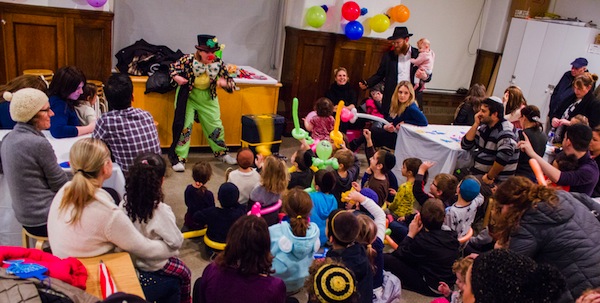
photo - The lighting of the Silber Family Agam Menorah also featured some clowning around

Among the many community celebrations of Chanukah this year were, from the first to fourth night of the holiday, gatherings in Vancouver, Richmond, Surrey and the North Shore.

More than 300 people gathered at Vancouver Art Gallery on the first night of Chanukah, Dec. 6, for the lighting of the tallest menorah in Canada, the Silber Family Agam Menorah. The children enjoyed crafts and entertainment inside the gallery and then everyone went outside (in the pouring rain!) for doughnuts and cocoa. The annual event, which is sponsored by the Silber family in memory of Fred Silber z”l, featured greetings from the dignitaries and politicians who were present, live Chanukah music by Dr. Anders Nerman and the menorah lighting led by members of the Silber family.

***

photo - Gary Averbach, left, and Richmond Mayor Malcolm Brodie light the menorah in Richmond

photos - Gary Averbach, left, and Richmond Mayor Malcolm Brodie light the menorah in Richmond, where there was also live music
Gary Averbach, left, and Richmond Mayor Malcolm Brodie light the menorah in Richmond, where there was also live music by Anders Nerman. (photos from Richmond Public Library)

Approximately 300 adults and kids celebrated the second night of Chanukah with the lighting of a giant menorah, live music by Nerman, magic by Yeeri the Magician, and traditional potato latkes and sufganiyot at the Richmond Library and Cultural Centre.

“Sharing the Jewish Festival of Light with so many people was an incredible community celebration that really expanded cultural awareness,” said Shelley Civkin, library communications officer. Three generations of the Averbach family joined Richmond Mayor Malcolm Brodie in lighting the menorah.

The event was held in partnership with the City of Richmond, Vancouver Kollel, the Richmond Public Library and the Ebco group of companies. “The evening started off with Yeeri the Magician performing his magic for families, then singer and guitarist Anders Nerman played music while the menorah was being lit,” said Civkin. “It was a lively event and there was even a Chanukah miracle – no rain!”

***
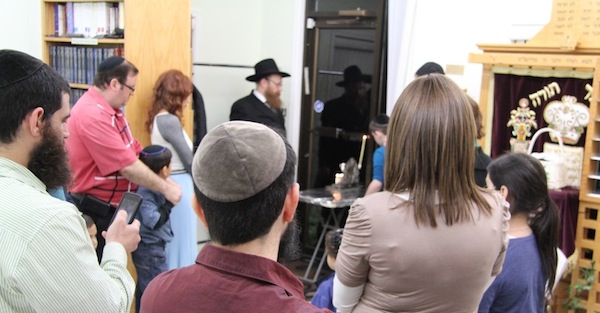
photo - Menorah lighting at Centre for Judaism

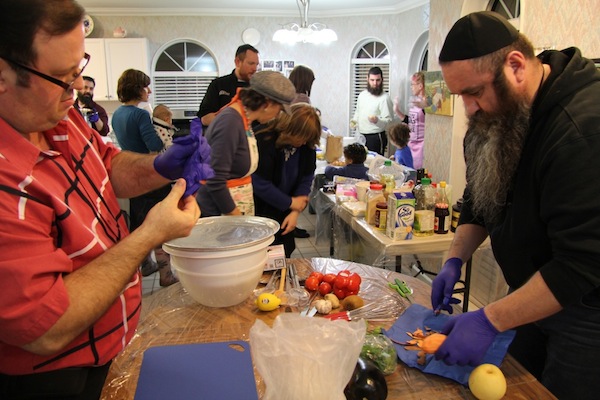
photo - After the menorah lighting, the Iron Chef Chanukah competition began in Surrey
After the menorah lighting, the Iron Chef Chanukah competition began in Surrey. (photos from Centre for Judaism)

On the third night of Chanukah in Surrey, after the menorah lighting led by Rabbi Falik Schtroks, and a dairy and latke dinner, those who attended the event at the Centre for Judaism, Chabad in White Rock/Surrey, participated in the third Iron Chef Chanukah. Iron chef Marat Dreyshner was helped by sous chefs Ella Dreyshner, Rabbi Nuta Yisroel Shurack and Debbie Cossever. Competing for this year’s title was award-winning pizza chef Aaron Gehrman and culinary expert Rae Friedlander Sank, who worked with sous chefs Nissim Gluck and Avraham Nissan Zabylichinski. Host and director of Iron Chef Chanukah, Rebbetzin Simie Schtroks, said that, although this year was the fiercest competition yet, there was an energetic and fun atmosphere in the Iron Chef kitchen. Many in the audience tried to assist the teams with small tasks or by keeping them entertained with Chanukah songs. Ethan Dreyshner helped the rebbetzin as second emcee and interviewer. Mariasha Schtroks created the rating sheets for the judges. While prizes were earned by all participants, the winning team and their friends will be treated to a five-course gourmet dinner catered by Simie Schtroks. Scores were so close that you will have to attend next year’s Iron Chef to find out which team won.

***
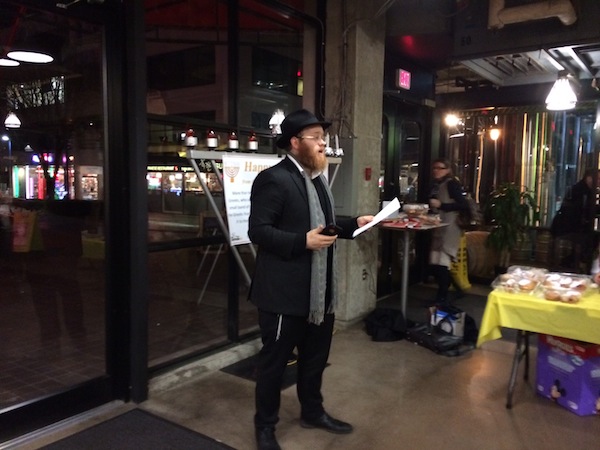
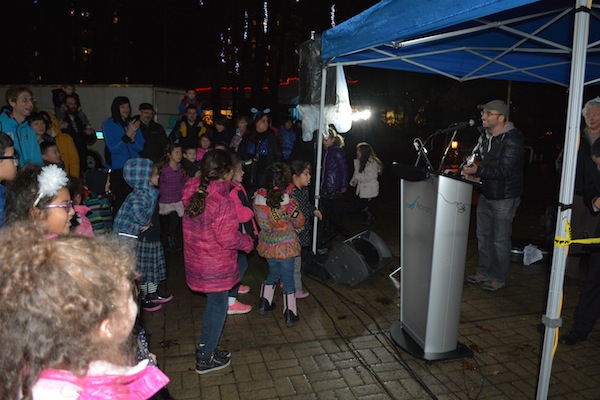
photo - Chabad of North Shore Rabbi Mendy Mochkin speaks at the first-ever menorah lighting at Lonsdale Quay
Chabad of North Shore Rabbi Mendy Mochkin speaks at the first-ever menorah lighting at Lonsdale Quay. (photo by Shula Klinger)

The evening of Dec. 9 saw the first-ever menorah lighting at Lonsdale Quay in North Vancouver. Set against the backdrop of downtown Vancouver, the event was hosted by Chabad of North Shore Rabbi Mendy and Rebbetzin Miki Mochkin and their family.

Rabbi Mochkin opened the occasion with a few words about the meaning of Chanukah. He stressed the importance of standing one’s ground in the face of adversity, and the value of picking oneself up, no matter how hard one has fallen. The menorah was lit by Rabbi Yitzchak Wineberg, executive director of Chabad Lubavitch BC.

Doughnuts were enjoyed by everyone and the kids had a grand time at the impromptu Dreidel Station.

***
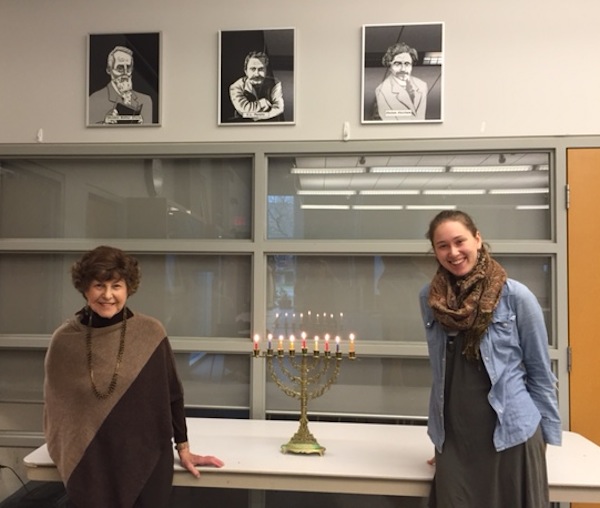
photo - Flora Field, left, and Emily Glass, students learning Yiddish with Haya Newman at the Peretz Centre for Secular Jewish Culture, take time out for Chanukah
Flora Field, left, and Emily Glass, students learning Yiddish with Haya Newman at the Peretz Centre for Secular Jewish Culture, take time out for Chanukah. (photo by Haya Newman)
Format ImagePosted on December 18, 2015December 16, 2015Author Community members/organizationsCategories Celebrating the HolidaysTags Averbach, Centre for Judaism, Chabad of North Shore, Chanukah, Haya Newman, Iron Chef, Mochkin, Peretz Centre, Richmond Public Library, Shula Klinger, Silber, Wineberg, Yiddish
Mystery photo … Dec. 18/15

Mystery photo … Dec. 18/15

United Synagogue Youth Cycle-athon, Vancouver, 1971. (photo from JWB fonds, JMABC L.09839)

If you know someone in this photo, please help the JI fill the gaps of its predecessor’s (the Jewish Western Bulletin’s) collection at the Jewish Museum and Archives of B.C. by contacting [email protected] or 604-257-5199. To find out who has been identified in the photos, visit jewishmuseum.ca/blog.

Format ImagePosted on December 18, 2015December 16, 2015Author JI and JMABCCategories Mystery PhotoTags JMABC, USY

Engaged through camp

Since 2006, Foundation for Jewish Camp has partnered with communities across North America on the One Happy Camper (OHC) program to grow enrolment and increase awareness. Tens of thousands of campers have experienced Jewish overnight camp as a result of OHC, which offers grants of up to $1,000 to first-time overnight Jewish campers who will attend a nonprofit Jewish overnight camp. The latest study evaluating the program’s impact looks at 2013 data.

The 2013 OHC program was implemented by 65 partner organizations (local Jewish federations, foundations and camps) throughout North America. That summer, 7,300 children received first-time OHC grants.

The analysis of the year’s program was based on survey research among 3,457 recipient families, or 62% of invited OHC recipients. The research was once again supplemented, where appropriate, with data from the 2013 Camper Satisfaction Insights study (CSI), which included a total of 8,180 families from 64 North American Jewish camps and 2012 JData camp research. The CSI study was also conducted by outside evaluators at Summation Research Group, Inc.

The findings indicate that OHC has been highly successful in (1) bringing thousands of children to overnight Jewish camp, (2) creating engagement and connections between camp families and sponsoring organizations and (3) generating a “trial” first-time Jewish overnight camp experience, creating “happy campers” who are highly satisfied, which is leading to high levels of retention.

Based on the 2010 study by the Foundation for Jewish Camp, Camp Works: The Long Term Impact of Jewish Overnight Camp, there is compelling evidence that overnight Jewish camp is a proven means of building Jewish identity, community and leadership. For example, adults who attended overnight Jewish camp are 30% more likely to donate to a Jewish federation, 37% more likely to light candles regularly for Shabbat, 45% more likely to attend synagogue at least once per month and 55% more likely to feel very emotionally attached to Israel. Moreover, CSI research among current campers’ families since 2006 has shown high levels of satisfaction with, and endorsement of, the Jewish camp experience.

In 2013, 7,300 children attended camp for the first time using an OHC incentive. However, some families would have sent their child to camp with or without the incentive. To account for this, recipients were segmented into three groups based on their reported likelihood of sending their child to camp had OHC been unavailable. Based on this segmentation, it is believed that 50% (or 3,650) of recipients may not otherwise have attended overnight Jewish camp. And, for many, OHC incentives helped influence their decision to provide their child with a Jewish summer experience: the research showed that, from an array of summertime alternatives, 60% of all OHC recipients were considering only secular, non-Jewish activities or programs, including 30% who would have simply stayed home. Twenty-six percent of all OHC recipients were the first in their family (parent and/or sibling) to ever attend an overnight Jewish summer camp.

For many campers, year-round connections are being made where none may have previously existed. And, for many families, OHC incentives provide sponsoring organizations with an opportunity to engage them programmatically, philanthropically and emotionally. Whereas 60% of OHC recipients are not currently members and/or donors of their sponsoring organizations, 64% of OHC recipients believed the incentive “very positively” affected their family’s connection to the sponsoring organization, 62% believed the incentive “very positively” affected their family’s connection to the overall Jewish community and 73% of OHC recipients were more likely to support the sponsoring organization.

Finally, CSI results show no meaningful differences between OHC and non-OHC families with respect to overall satisfaction and camp advocacy. While there are a few individual camp exceptions, the findings in all regions are, and have been, consistently outstanding, with 95% of campers satisfied with their experience. As well, the vast majority of parents of OHC and non-OHC campers believe that camp, overall, creates ambiance and atmosphere where their child is proud to be Jewish, and increases awareness of their child’s Jewish identity and/or their activity/participation in synagogue or in their local Jewish community.

For additional findings, visit jewishcamp.org/research.

Format ImagePosted on December 18, 2015December 16, 2015Author Foundation for Jewish CampCategories WorldTags identity issues, OHC, One Happy Camper, overnight camp
Meet at camp, get married?

Meet at camp, get married?

Dan and Jen Silber met at Camp Moshava. (photo from Silber family via jns.org)

Eighteen-year-old Bernie Kozlovsky spent from sundown to sunrise on a boat with 16-year-old Sonia Rosenbaum in the summer of 1972.

“We talked until dawn,” Kozlovsky recalls about that summer at the Orthodox Jewish NCSY overnight camp in northeastern Maryland. Kozlovsky worked in the camp kitchen. Rosenbaum was a camper. From that summer forward, neither dated another individual. Forty-three years later – including 39 years of marriage, six children and seven grandchildren – Kozlovsky attributes his successful relationship to the spark that formed during his summertime experience.

Not much has changed.

Today, the (camp) fire is still burning at Jewish summer camp. Dating and marriage are byproducts of summers spent banging on the table during Birkat Hamazon (Grace after Meals), engaging in loud and intense games of color war, and celebrating Jewish culture with Hebrew plays and folk-music campfire sing-alongs.

No one is pushed to date at Jewish summer camp, said Lauren Ben-Shoshan, who met her Israeli husband, Alon, as a counselor at URJ (Union for Reform Judaism) Camp Harlam in Kunkletown, Penn., in 2004. The couple now lives in Israel.

“Camp is a positive place for Jewish learning, physical activity and connecting with the outdoors. No one wants campers to feel bad because they didn’t find their spouse when they were 15, 19 or 22. But there is a covert understanding that [marriage is] a nice byproduct of Jewish summer camp, when it happens,” said Ben-Shoshan, who is also a Jewish educator.

It occurs more often than many realize. According to Camp Works, a report released in 2012 by Foundation for Jewish Camp, Jewish adults who attend Jewish overnight camp are on average 10% more likely to marry within the Jewish faith than their peers. The 2000-01 National Jewish Population Study found that number to be higher, with 78% of individuals who attended Jewish summer camp in-married, as opposed to 62% of their non-camper peers.

What’s the secret sauce? Is it that romantic Shabbat at sunset by the lake or in the secluded woods? That’s part of it, but it is more likely a result of the “intensity” of the camp experience, Ben-Shoshan believes.

“The days last forever, but camp feels like it only lasts a minute, so even if camp is only two months, these are two very intense months,” she said. “You see the campers and counselors in stressful situations, how they interact with peers and with the kids, the meals, how they interact with co-workers. It is all these things that happen in life, that could take several months in the ‘real world,’ you see within a week at camp.”

Jewish summer camp focuses heavily on community-building, noted Aaron Bogage, who attended the BBYO International Leadership Training Conference for several summers and now works at the overnight BBYO Chapter LTC. He said there are always “quite a few couples per session,” explaining that these relationships form because everyone is “extremely open” with each other and open to meeting new people. “Everyone is genuinely excited to get to know the rest of the teens.… There is a sense of community that comes from camp,” he said.

One can start to pinpoint new couples, according to Bogage, by looking at who sits where during meals and what campers do during free time. Bogage has not met his significant other through camp, but his good friend met a girl last summer from another state. They are still together despite the physical distance between them.

Jen Silber, executive director of Habonim Dror Camp Moshava in Street, Md., said there is a focus at camp on building healthy peer relationships. “We want [campers] to learn about communication, how to express their needs in relationships, feel confident being themselves and develop trust,” she said.

Silber, who met her own husband as a camper and then staffer at Moshava, argues that friendships and romantic relationships that people form at summer camp tend to be “deeper” and more authentic than those forged at school or in other environments. Campers and counselors feel accepted for who they are, she said.

Read more at jns.org.

Maayan Jaffe is former editor-in-chief of the Baltimore Jewish Times and a Kansas-based freelance writer. Reach her at [email protected] or follow her on Twitter, @MaayanJaffe.


Format ImagePosted on December 18, 2015December 16, 2015Author Maayan Jaffe JNS.ORGCategories WorldTags BBYO, Bogage, Camp Harlam, Camp Moshav, Habonim Dror, Jewish camp, Kozlovsky, URJ
אייר קנדה ממשיכה לגדול

אייר קנדה ממשיכה לגדול

אייר קנדה שחגגה בחודש יוני עשרים שנות פעילות בישראל, עומדת להפעיל את מטוס הדרימליינר החדש שלה בטיסות העמוסות של הקו בין טורונטו לתל אביב. (צילום: Raimond Spekking© via Wikimedia)

אייר קנדה ממשיכה לגדול: החברה רשמה גידול בהיקף הנוסעים בנובמבר בשיעור של כ-11 אחוז לעומת אשתקד

חברת התעופה הלאומית של קנדה אייר קנדה ממשיכה לגדול ולהרחיב את פעילותה ברחבי העולם. אייר קנדה מדווחת על גידול בהיקף הנוסעים בחודש נובמבר האחרון בשיעור של 10.8 אחוז, לעומת החודש המקביל אשתקד. הגידול בהיקף הנוסעים נובע בעיקר בקווים הבינלאומיים של החברה בהם הטיסות בין קנדה לישראל, וכן בקווים בין קנדה לארצות הברית.

בסך בחודש נובמבר השנה נרשמו אחוזי תפוסה גבוהים באייר קנדה שעמדו על 78.6 אחוז, לעומת 77.7 אחוז אשתקד. מדובר על גידול בשיעור של 9.5 אחוזים. לדברי נשיא ומנכ”ל אייר קנדה, קיילין רובינסקו, הגידול באחוזי התפוסה נובע מהתייעלות החברה, פריסה נכונה של הרשת הגלובלית שלה תוך הרחבת הקווים הבינלאומיים, וכן לאור פעילות חברת-בת של טיסות מוזלות ליעדי נופש אייר קנדה רוז’.

אייר קנדה נחשבת לאחת מעשרים חברות התעופה הגדולות בעולם (מועסקים בה כ-28 אלף עובדים) והיא טסה ליותר ממאתיים יעדים ברחבי העולם. החברה מקיימת טיסות סדירות לשישים ושלושה שדות תעופה בקנדה, חמישים ושניים שדות תעופה בארה”ב ועוד שמונים ושישה שדות תעופה בשאר רחבי העולם. חברת-הבת אייר קנדה רוז’ (שפועלת מאז יולי 2013) טסה לשישים ושישה יעדים בקנדה וברחבי העולם. אשתקד קבוצת אייר קנדה הטיסה למעלה משלושים ושמונה מיליון נוסעים.

אייר קנדה שחגגה בחודש יוני עשרים שנות פעילות בישראל, עומדת להפעיל את מטוס הדרימליינר החדש שלה בטיסות העמוסות של הקו בין טורונטו לתל אביב. החל מיוני שנה הבאה יפעל בקו הדרימליינר החדש מסוג בואינג 787-9 שיחליף את הדרימליינר מסוג בואינג 787-8. במטוס החדש 21 מושבים במחלקה הראשונה, שלושים מושבים במחלקת העסקים ו-247 מושבים במחלקת התיירים. הדרימליינר החדש ארוך בשישה מטר יותר מהדגם הקודם, והוא מצויד במערכות תאורה ובידור משוכללות ביותר.

לדברי אנליסטים אייר קנדה הצליחה להציג רווחים קלים במאזנים ברבעון הקודם השנה, לאור הירידה החדה במחירי הדלק שנרשמה השנה. האנליסטים מציינים כי למרות ההאטה בשוק המקומי אייר קנדה הגדילה את הקיבולת שלה שלא נוצלה במלואה. חברה העדיפה להחנות מטוסים ריקים במקום להחזיר אותם בחזרה למשכירים. האנליסטים מוספים עוד כי אם הכלכלה הקנדית לא תקח תפנית לטובה במהירות, מגזר התעופה המקומי צפוי עוד להמשיך ולהיפגע.

למי שייך בקבוק מ-1890: צולל מצא את החפץ העתיק וממשלת נובה סקוטיה טוענת כי הוא שייך לה

ג’ון קראוס מהעיר הליפקס שבמזרח היה מאושר בימים האחרונים. זאת כיוון שבצלילה האחרונה שלו הוא מצא על ריצפת האוקיינוס האטלנטי, בקבוק בירה חצי מלא שנראה עתיק במיוחד. לאחר שהבקבוק והפקק נבדקו, התברר שהבירה נוצרה על ידי יצרנית הבירה הקנדית מהוותיקות ביותר בצפון אמריקה – אלכנסדר קית’, שפועלת בהפליקס מאז 1820. באלכסנדר קית’ אישרו כי אכן מדובר בבקבוק בירה עתיק מלפני למעלה מ-125 שנים, כיוון שהזכוכית של הבקבוק יוצרה באנגליה בין שנים 1872-1890. מכל מקום בחברה לא המליצו לקראוס לשתות את הבירה העתיקה.

למנגינת ליבו של קראוס שמחתו לא החזיקה מעמד, כיוון שממשלת מחוז נובה סקוטיה הודיעה לו חד משמעית כי בקבוק הבירה שייך לה. זאת כיוון שמדובר בחפץ ארכיאולוגי בעל ערך היסטורי. קראוס מצידו לא מעוניין לפתוח במאבק משפטי נגד הממשלה, אך הוא היה רוצה שבקבוק הבירה יוצג באחד המוזיאונים המקומיים, כדי גם שהציבור הרחב יהנה ממנו. עדיין לא ברור מה הממשלה מתכוונת לעשות עם הבקבוק שקראוס מצא במעמקי הים.

Format ImagePosted on December 16, 2015December 16, 2015Author Roni RachmaniCategories עניין בחדשותTags Air Canada, Alexander Keith, beer bottle, Calin Rovinescu, Jon Crouse, Nova Scotia, אייר קנדה, אלכסנדר קית', בקבוק הבירה, ג'ון קראוס, נובה סקוטיה, קיילין רובינסקו
Ready to welcome refugees

Ready to welcome refugees

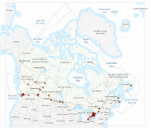
As of Nov. 24, the Government of Canada was processing 4,511 applications for privately sponsored Syrian refugees (not including Quebec, which has its own procedure). The map shows communities where private sponsors have submitted an application. (image from cic.gc.ca/english/refugees/welcome)

Vancouver’s Jewish community is mobilizing to welcome refugees from Syria. The federal government has announced that 25,000 Syrian refugees will come to Canada before the end of February. While most of those will be government-sponsored, groups of Canadians, including many in the Jewish community, are leaping at the opportunity to be a part of the resettlement project.

The Jewish Federation of Greater Vancouver has signed a memorandum of understanding with the Anglican church to streamline the process. The federal government has a number of sponsorship agreement holders, which are established, experienced groups that are engaged in aiding refugees on an ongoing basis. To expedite the process, the Jewish community is primarily working through the partnership with the Anglican Church of Canada so that synagogues and other Jewish groups that may want to sponsor can do so efficiently.

“The Anglican diocese, rather than setting up a separate relationship with each of the synagogues, proposed that there be one memorandum of understanding with the Jewish community,” said Shelley Rivkin, Federation’s vice-president for planning, allocations and community affairs. “We will be the holder of the memorandum of understanding so the synagogues will raise the funds and issue a tax receipt. The funds will then come to us and be in a restricted account and, as those funds are distributed, they will go directly through us so that the diocese is not having to deal with multiple parties.”

Or Shalom Synagogue has already raised two-thirds of the funds necessary to sponsor three families. Natalie Grunberg, a member of the Or Shalom Syrian Refugees Initiative, said they are expecting their sponsored refugees as early as January. The group has launched a series of events, including a concert of Syrian music, to raise awareness and money for the project. The federal government estimates the cost of sponsoring a refugee family for a year to be about $30,000, but Vancouverites involved in the process are working on an assumption of about $40,000, based on housing costs here.

Or Shalom is working through existing partnerships they have built over the years. Rather than going through the Anglican church, they are working with the United Church of Canada. Grunberg acknowledged that some in the Jewish community have differences with the United Church’s stand toward Israel, but the priority was to expedite the refugee sponsorship process and they believed working through existing relationships would be most effective.

Grunberg is noticeably proud of her congregation’s efforts so far.

“We’re a very small synagogue and we’re sponsoring three families,” she said.

Through existing relationships with the Syrian community here, Or Shalom will focus their sponsorship efforts on reunifying families that already have some members in Metro Vancouver and also on members of the LGBT community.

Temple Sholom is also rallying for refugees. Almost immediately after announcing the idea during the High Holidays, the synagogue raised enough money to sponsor one family.

“We’ve now decided to sponsor a second family,” said Rabbi Dan Moskovitz.

He acknowledges that there have been some anxieties among his congregation about bringing Syrian refugees here.

“I met with every person that voiced that concern to me,” he said. “I met with them personally. We talked about it. We talked about the people that we are bringing in – they were concerned about terrorists coming across – we talked about the difference between private sponsorship, as we are doing, and what we’ve been seeing in Europe with refugees flooding across borders … that we were sponsoring families with young children, that our sponsorships were family reunification, so they would have real roots here in B.C., particularly in Vancouver. We acknowledge the fears but at the same time we also recognize that this is a crisis and that the Jewish tradition teaches us quite clearly to love the stranger. Israel is doing things for refugees on the Syrian border right now with their hospitals and we had to do our part.”

Moskovitz cites Torah as the basis for his enthusiasm.

“Thirty-six times in the Torah, in the Bible, it says to love the stranger because you were once strangers in the land,” he said. “The Jews were once refugees ourselves and this goes all the way back to the land of Egypt and the slavery of the Israelites under Pharaoh, where we were running for our lives; in that case from the famine, according to the biblical story, and the Egyptian people welcomed the Jewish people, welcomed us in and gave us food and shelter and we lived there for 435 years, according to the Bible. From that and so many other times in the Bible, the most often-repeated commandment in all of Jewish tradition is to love the stranger, to love the immigrant; love the stranger, because that was you once.”

More modern Jewish history is also a factor, he added.

“We are largely still here even though throughout our history people have tried to destroy us because at critical times in our history some people took us in,” said Moskovitz. “We like to think we did it all by ourselves and there is no doubt that there is a tremendous resiliency of the Jewish people but, at the same time, we have been the beneficiary of others sheltering us at times of mortal danger.”

Congregation Beth Israel has created a task force to look into possibly sponsoring a Kurdish Syrian refugee family. Executive director Shannon Etkin said the group will analyze the resources available within the congregation community to provide for a family beyond the minimum requirements set out by the federal government.

Other synagogues, organizations and individuals who may not have the resources to directly sponsor a refugee or family are being encouraged to support on-the-ground efforts by the Joint Distribution Committee, which is aiding refugees in Turkey and Hungary. This support is being organized by the Jewish Federation of Greater Vancouver.

“They’re doing a lot of direct aid for women and children and also doing some work with frontline responders,” Rivkin said.

Format ImagePosted on December 11, 2015December 9, 2015Author Pat JohnsonCategories LocalTags Anglican Church, Beth Israel, Dan Moskovitz, Jewish Federation of Greater Vancouver, Natalie Grunberg, Or Shalom, refugees, Shannon Etkin, Shelley Rivkin, Syria, Temple Sholom, United Church of Canada
New Chabad houses

New Chabad houses

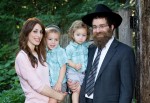
Chabad Nanaimo Rebbetzin Blumie and Rabbi Bentzion Shemtov with their children. (photo from Chabad Lubavitch BC)

All around the world, Chabad houses welcome Jews of all ages and stages to participate in a variety of activities from social Jewish identity gatherings to serious Torah study. According to chabad.org, “4,000 full-time Chabad emissary families direct more than 3,300 institutions.” Traveling in China and yearning for a Shabbat dinner? Nine cities have Chabad houses. Thailand has four, Sweden has three and even Armenia has a chief rabbi in the capital city, Yerevan.

This fall, two new areas locally are being served by Chabad because the organization saw a need. In early September, just in time for the High Holy Days, Rabbi Mendel Mochkin, his wife Miki and their three young children arrived in West Vancouver to begin their outreach work on the North Shore, as well as in Squamish and Whistler. The rabbi had spent time in Vancouver in 2008 and again in 2011 so, when he was asked to return by Rabbi Yitzchak Wineberg, executive director of Chabad Lubavitch BC, Mochkin jumped at the chance to start his own Chabad House in British Columbia.

photo - Chabad of North Shore Rabbi Mendel and Rebbetzin Miki Mochkin
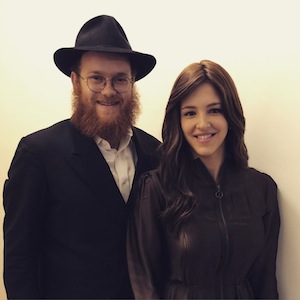
Chabad of North Shore Rabbi Mendel and Rebbetzin Miki Mochkin. (photo from Chabad Lubavitch BC)

“I love it here. I feel very privileged to have moved here and to raise my family here,” said Mochkin about his new home. “I love every day, meeting new people, starting new programs.” He said his wife is also working hard to start programming for women. Miki Mochkin hosts, for example, Chabad’s Loaves for Love, which is a women’s circle; participants meet in her home and make challah as a group. The couple also hosts people every week for Shabbat meals, which is not an easy task, considering their own children are ages 3, 2 and 1.

The programming is not only out of their home. With a wide geographical area spanning the Sea-to-Sky corridor, Rabbi Mochkin said they have big plans for the winter. On the North Shore, they had a menorah lighting and festive food at Lonsdale Quay on Dec. 9 and they have a weekend planned at the Pan Pacific hotel in Whistler Dec. 11-12 to celebrate Chanukah, as well.

Even more freshly arrived in the province is Rabbi Bentzion (Bentzi) Shemtov and his wife, Blumie. They and their 3-and-a-half- and 2-year-old children are still adjusting to life in Nanaimo. They arrived in Victoria on Oct. 20, where they stayed briefly with her brother, Rabbi Meir Kaplan, who is the Chabad rabbi in that city. On Nov. 10, they moved fully into their house and they hosted their first Shabbat meal with guests just over a week later. Shemtov spoke with the Jewish Independent as he was driving to meet Nanaimo’s mayor to confirm plans for a Chanukah party at city hall along with a menorah lighting scheduled for Dec. 8.

“In the past, my brother-in-law has driven up to Nanaimo to light the menorah. He was there for half an hour and then he’d take it down and move on. This year, it will be a real Chanukah party, with hot latkes inside city hall,” said Shemtov.

Although he’s been in town just a few weeks, he has already met quite a few people who are Jewish.

“Every time I walk into a grocery store, someone new approaches me and tells me that they’re also Jewish and that there are no other Jews in Nanaimo,” Shemtov said. He estimated that, in the central Vancouver Island area, which is his new turf and includes Parksville and Qualicum Beach, there are between 1,000 and 1,500 Jewish residents. There are Jews but no Jewish community.

As they plan programs in Nanaimo and the surrounding area, the Shemtovs will serve as the only full-time, functioning Jewish presence. “We were worried that, at first, there wouldn’t be enough to do but the response has been so amazing, far beyond what we had imagined,” said the rabbi. “There is a need and a thirst for a Jewish connection.”

As did Miki Mochkin, Blumie Shemtov started a Jewish women’s circle in her home. The first session, called The Miracle of Oil, was on Dec. 1 and it was filled to over-capacity. Her husband explained that his wife had “bought supplies for 15 to be safe but she had over 20 women register.”

While neither new Chabad family know each other, they have a great deal in common. All four adults grew up in homes that were Chabad houses. They also all have siblings who are running Chabad houses around the world. Once married, members of Chabad are eligible to go out and fill a need for a Jewish presence. The Mochkins have siblings in places as far apart as St. Petersburg, San Francisco and St. Denis, just north of Paris, the neighborhood from which the recent Paris attacks were organized. For the Shemtovs, there are siblings in Pu Dung, China, and, notably, Malmo, Sweden. “My brother-in-law just received the unfortunate title of most persecuted Jew,” explained Bentzi Shemtov. “He lives in Malmo, Sweden, and he has reported over 600 hate crimes against him, but there are Jews who need him there so he stays.”

For more information on either North Shore or Nanaimo Chabad, visit their websites: chabadnorthshore.com and jewishnanaimo.com, respectively.

Michelle Dodek is a freelance writer living in Vancouver.


Format ImagePosted on December 11, 2015December 9, 2015Author Michelle DodekCategories LocalTags Chabad, Mochkin, Shemtov
Going from brokenness to wholeness

Going from brokenness to wholeness

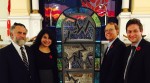
From left to right, Julius Maslovat, Carmel Tanaka, MP Murray Rankin and MLA Rob Fleming at the Victoria Holocaust Remembrance and Education Society’s annual Kristallnacht Commemoration on Nov 9. (photo from Victoria Hillel)

The following remarks have been slightly modified from the original welcoming and closing addresses given at the Victoria Holocaust Remembrance and Education Society’s annual Kristallnacht Commemoration, which took place at Congregation Emanu-El on Nov 9.

Shalom and welcome. Thank you all for coming to share in this evening of remembrance and resiliency. It is a dark Monday night in November, but you have chosen to be here. That is a statement in itself, and we thank you for taking part in tonight’s program.

We are remembering Nov. 9, 1938, a tragic night of destruction that carried on into the next day and was a portent of things to come. Remembering events such as these, as painful as they are, is vital. We don’t need to dwell on them so much as we need to draw on them for the lessons they can offer us.

Rabbi Harry Brechner of Congregation Emanu-El reminded me recently that one of our congregants, Steffi Porzecanski, may her memory be forever blessed, was a witness to the Night of Broken Glass. She lived in Berlin at the time. She would talk about how you couldn’t walk on the streets afterwards without feeling and hearing pieces of glass crunching under your feet. By the end of the destruction, some 1,000 synagogues had been burned, windows smashed, Jewish property damaged, ritual objects and cemeteries desecrated and some 30,000 Jews sent to concentration camps.

Sometimes, words are not sufficient in the face of epic horrors. Rabbi Leo Baeck, who also lived in Germany during this period, and who was eventually sent to Theresienstadt concentration camp in 1942 but did ultimately survive, wrote a prayer some years before for Jews to read at Yom Kippur. This prayer was eventually banned by the Nazis. Near the end of the prayer, he says: “We are filled with sorrow and pain. In silence, will we give expression to all that which is in our hearts in moments of silence before our G-d. This silent worship will be more emphatic than any words could be.”

photo - Elisheva Gray, left, and Micha Menczer
Elisheva Gray, left, and Micha Menczer. (photo from Victoria Hillel)

This is where we would like to begin tonight – allowing the silence to speak. I ask you to join me in just looking around our sanctuary and at our windows. All of the colors and nuances of our magnificently crafted windows can’t be fully appreciated at night, but they are, nevertheless, beautiful windows. At our early morning service on Thursdays, those of us who come are often treated to an extraordinary light show, as the soft, morning light gently begins touching on the blue glass.

We have all experienced the sound of breaking glass. Can we even begin to imagine the quiet and tranquility being shattered by the sound of window glass suddenly crashing to the ground and breaking into a thousand pieces, as happened in synagogues throughout Germany and Austria, beginning on that November night in 1938. The only reason? Because we were Jews. How would we feel if we witnessed that happening here, in our sanctuary, in our community, to these very windows?

As a symbol of our desire to work together in unity, to respect one another’s differences and to strive for a community that has tolerance and respect at its centre we will rebuild a window together tonight, a window resembling one of our very own windows.

While we are blessed to live somewhere where we haven’t had to witness an event like Kristallnacht, we also must be realistic of the need to remain vigilant and caring for one another in a world where such events have taken place and could, potentially, take place again. The more fractured and fragmented our world becomes, the more vital it is for us to come together, to put our differences aside and see each other on that most human level, stripped of labels and roles and categories. We may all pick our fruit from different trees, but we all share the same garden.

Tonight, as we commemorate the tragic events of that fateful November night and all that followed in its wake, we also recognize the strength and resilience of our people, the courage of the survivors, and we look towards the future with hope for a world where no group is targeted for attack, as the Jews were on the Night of Broken Glass and in the years that followed.

We are truly honored to have Holocaust survivors with us tonight, as well second- and third-generation descendants, representatives of political leadership, law enforcement agencies, faith groups and persons targeted for their sexual orientation, religious or political beliefs, participating in this symbolic reconstruction and in our candlelighting ceremony.

Our candlelighters will light seven candles. Six of them represent the six million lives lost in the Shoah. The seventh candle represents the many other persecuted victims of the Shoah. It is also our candle of hope.

Closing remarks

I’d like to thank our wonderful planning committee, our readers, volunteers and musicians for their hard work and dedication. Thank you, as well, to Rabbi Harry for his help and for his words. We are, again, especially honored and deeply grateful to our survivors, descendants of survivors and everyone who helped us with our candlelighting and our window building, especially Julius Maslovat (child Holocaust survivor), the b’nai mitzvah children from Congregation Emanu-El, local grandchildren of Holocaust survivors, MP Murray Rankin, Rabbi Harry of Congregation Emanu-El, Very Rev. Ansley Tucker, Constable Rae Robirtis from Victoria Police Department and Carmel Tanaka (Victoria Hillel director, granddaughter of Holocaust survivors and interned Japanese-Canadians).

The many problems out there in the world sometimes seem too big and too overwhelming for us to solve. Rebuilding our window here tonight may seem small in comparison to the challenges that face us in the wider world. But tonight, as we gathered to remember a difficult chapter from our past, it is our hope that, together, we injected a little more shalom into the world.

In Hebrew, every word has a three-letter root from which other words are formed. From the same root for the word shalom, peace, comes the word shalem, whole, and shlemut, wholeness. Each time we inject more shalom into the world, we are, in essence, diminishing brokenness and creating more wholeness. A little shalom goes a long, long way.

Our window may be fragile, but it is full of possibility. The cracks are a necessary reminder of our vulnerability. They are the scars that must be there, reminding us of our past, reminding us of the Night of Broken Glass.

A window allows us to look in – in this case, looking into the past, back to Nov. 9, 1938. And a window allows us to look out. What is that world that we, as individuals and as a community, want to see when we look out? A window also shows us our reflection. Who do we see looking back at us? Who do we want to see?

Elisheva Gray is a member of the Victoria Holocaust Remembrance and Education Society and is on the planning committee for the Kristallnacht Commemoration in Victoria.

Format ImagePosted on December 11, 2015December 9, 2015Author Elisheva GrayCategories LocalTags Emanu-El, Hillel, Holocaust, Kristallnacht

Denkmal

This is not about Dachau, although
these things happened there.

When my son and I visited the Denkmal,
as the Germans refer to Dachau,
it was late afternoon,
and it was deserted.
The weather was rainy and cool.
Vancouver weather: warm for
December in Bavaria,
I was told.

We walked around, peering
curiously into the barracks
where the living dead stared with eyes
like those of African night mammals
at the stunned American cameramen,

and then we stepped into the “Duschbad,”
and then into the crematorium
and then back outside into
the drizzle –

Finally, I stopped to look at the bronze memorial
to the “Unknown Prisoner”: a stooped, skeletal
Muselmann
in rags, ashy and green from the wet Bavarian winters;

leaving a pebble on the pedestal, as I had been taught,
I turned to leave.

My son had lingered behind.

Fifteen, tough and big;
standing quietly in front of the pitted bronze,
his black football jacket dripping rain,
sloppy, untied Adidas hightops
and blue/white acid-dyed jeans soaking through –

he slowly reached up
to his soggy old Detroit Tigers
baseball cap,
and politely

between wet thumb and forefinger,

tipped the brim.

Graham Forst, PhD, taught literature and philosophy at Capilano University until his retirement and now teaches in the continuing education departments at Simon Fraser University, University of British Columbia and Banff School of Fine Arts. From 1975 to 2010, he co-chaired the symposium committee of the Vancouver Holocaust Education Centre.

Posted on December 11, 2015December 9, 2015Author Graham ForstCategories Op-EdTags Dachau, Denkmal, Holocaust

Ludicrous standards

Sweden’s Foreign Minister Margot Wallström has accused Israel of “extrajudicial executions” of Palestinian terrorists. The minister said, in the country’s parliament, that Israel has a right to defend its citizens, but went on to clarify that such defence should not include “extrajudicial execution” and accused Israel of a “disproportionate” response.

It is a familiar refrain from the European community, a place where Israeli products are being labeled as part of a boycott strategy, sometimes by vigilantes in makeshift uniforms patrolling shops and applying stickers to Israeli goods. Israel has a right to defend itself, in the world’s eyes, up to and until it actually begins to defend itself.

The issue is confused by some outside observers. It is true that Israel is a democratic state that respects the rule of law. But it is also a country at war with radical Islamist terrorism. There are, certainly, laws and judicial recourse for crimes, but when a murderous act is in the process of unfolding, the first objective of security forces is to end the situation. Certainly, the next objective should be ensuring that judicial process takes precedence by, for instance, shooting in the leg or otherwise disabling the attacker through non-lethal means. From half a world away, it is hard to judge the actions of frontline security personnel (or, at least, it should be more difficult than it seems to be) but we would hope that response is balanced with preservation of life and the addressing of crime through Israel’s admirable system of judicial oversight.

At the same time, we should be cognizant of double standards.

Remember just over a year ago, in October 2014, a terrorist murdered Cpl. Nathan Cirillo at the National War Memorial and then proceeded to Canada’s Parliament Buildings, where he was taken down, fatally, by the sergeant-at-arms, Kevin Vickers.

Vickers became a national hero. He was not condemned by the government of Sweden or anyone else. The Canadian government was not pilloried for “disproportionate” force or “extrajudicial execution.”

No, there are two sets of rules in this world. One set for Israel which, despite all the threats and existential challenges it faces, is expected to maintain the world’s highest standards – actually, ludicrous standards – of engagement, while everyone else gets a pass, including the tyrants whose governments currently sit on august bodies like the United Nations Human Rights Council.

Predictably and correctly, Israel’s foreign ministry lambasted the Swedish politician’s comments, dismissing them as “scandalous, delusional, rude, and detached from reality.”

“The [Swedish] foreign minister suggests that Israeli citizens simply give their necks to the murderers trying to stab them with knives,” the Israeli foreign ministry said in a statement. “The citizens of Israel and its security forces have the right to defend themselves. In Israel, every person who commits a crime is brought in front of a judge, including terrorists. The citizens of Israel have to deal with terrorism that receives support from irresponsible and false statements like that.”

The Swede’s comments are not unusual, although they are particularly flagrant. They are of a type we have seen repeatedly when Israel faces an upsurge in terrorism. The attitude it depicts reflects more concern for the murderers than it does for their victims. Rare is the word of support or empathy for Israel’s untenable position facing down individual terrorists incited by their government and society to stab, drive over or otherwise murder Jews.

The Swedish foreign minister’s words really speak volumes about where Europe’s sympathies lie these days.

Posted on December 11, 2015December 9, 2015Author The Editorial BoardCategories From the JITags antisemitism, Israel, Margot Wallström, Sweden, terrorism

Posts pagination

Previous page Page 1 … Page 544 Page 545 Page 546 … Page 670 Next page
Proudly powered by WordPress