
Skip to content

  • Home
  • Subscribe / donate
  • Events calendar
  • News
    • Local
    • National
    • Israel
    • World
    • עניין בחדשות
      A roundup of news in Canada and further afield, in Hebrew.
  • Opinion
    • From the JI
    • Op-Ed
  • Arts & Culture
    • Performing Arts
    • Music
    • Books
    • Visual Arts
    • TV & Film
  • Life
    • Celebrating the Holidays
    • Travel
    • The Daily Snooze
      Cartoons by Jacob Samuel
    • Mystery Photo
      Help the JI and JMABC fill in the gaps in our archives.
  • Community Links
    • Organizations, Etc.
    • Other News Sources & Blogs
    • Business Directory
  • FAQ
  • JI Chai Celebration
  • JI@88! video
image - Weizmann Canada Physics Tournament 2025
image - The CJN - Visit Us Banner - 300x600 - 101625

Recent Posts

  • היהירות היא אחד האויבים הגדולים ביותר של ישראל
  • Vrba monument is unveiled
  • Music to build bridges
  • A better future possible
  • Anne Frank exhibit on now
  • Human rights in sport
  • Telling the story of an icon
  • Crawl bigger than ever
  • JCC Maccabi in Toronto
  • A way to meet fellow Jews
  • Time to include
  • Add Jewish joy to the mix
  • Reminder of humanity’s light
  • From the archives … editorials
  • Year-round holiday recipes
  • מדוע עזבתי את ישראל ואינני חושב לחזור ארצה
  • OJC hosts Oct. 7 memorial
  • A journey beyond self
  • Antisemitism a problem
  • Young man is missed
  • Orr action sparks complaint
  • Prison sentence for hate
  • Etgar Keret comes to Vancouver
  • New fall lecture series
  • Series explores music
  • Doc on Zapiro screens Nov. 6
  • Joy of shared existence
  • Community milestones … October 2025
  • MAID vs Jewish values
  • Cheshvan a great month, too
  • Bull, bear or bubble?
  • From the archives … a coin, etc.
  • מדוע האנטישמיות הולכת וגואה בעולם
  • New bio gives Vrba his due
  • Joy brighter than ever
  • When approaches differ

Archives

Follow @JewishIndie

Tag: Sweden

Reminder of humanity’s light

The passage across the Øresund, the body of water that separates the Danish peninsula from Sweden, is, at its narrowest, about the same distance as Horseshoe Bay to Bowen Island. But the waters can be treacherous – especially when it’s 1943 and the waters are swarming with Gestapo Kriegsmarine boats. Yet, for two weeks at the beginning of October 1943, 7,000 Danish Jews – about 95% of Danish Jewry (including the wonderful Victor Borge) – were safely transported across the Øresund in small fishing boats to the “sacred soil” of neutral Sweden.

In his new book, A Light in the Northern Sea: Denmark’s Incredible Rescue of Their Jewish Citizens During WWII, Tim Brady, author of the popular story of the Dutch Resistance Three Ordinary Girls, uses his excellent narrative skills to outline in detail how Danish Jews were warned about Nazi deportation plans, how they escaped and how they were treated when they arrived in Sweden. 

image - A Light in the Northern Sea book coverBrady has described himself as a storyteller, rather than as a professional historian, but he has done his research and he tells this story in great detail. As he did with Three Ordinary Girls, Brady brings history alive with the telling of stories through the eyes of participants, rather than simply cold facts. The eyes here are, for the most part, those of the remarkable Dutch resistance fighter Jurgen Kieler, whose recently published memoirs (encouraged by Elie Wiesel) would not have been available to earlier rescue historians.

Readers might be surprised that the “light in the northern sea” of the title refers to welcoming Sweden, not, as you might expect, given the book’s subtitle, Denmark. But, as Brady is quick to point out, the Swedish “light” was not always bright – before, and early in the war, Sweden had demanded that Germany mark the passports of Jewish emigrés with a “J” so they could be more easily refused, and Sweden refused potential Jewish immigrants who were not financially independent. 

However, as Brady notes, largely due to the enormously influential intercession of the great Danish Nobelist Niels Bohr (a dedicated Nazi-hater) with the Swedish government, Sweden’s position regarding the Jewish immigrants changed radically by October 1943, when it decided to admit all 7,200 Jews fleeing the recently occupying Nazis in Denmark. 

Swedes almost universally opened their homes to the Danish Jews. The refugees were also made to feel comfortable in churches, community centres, hotels and schools, as welfare agencies constructed camps, provided clothing and household items, and helped them find employment. Also, as Brady notes, during the post-rescue months of the Danish resistance, Sweden provided a 25 million kroner (about $70 million in today’s dollars) credit to help Denmark train and organize the Danish Brigade revolutionary group. 

Interestingly, the “rescue of Denmark’s Jewish citizens” referred to in the book’s subtitle has a double reference for Brady. On the one hand, there is the escape across the Øresund. But there is a second “rescue” described in the ending chapters of the book. These chapters deal with the 1943-45 undertakings of the Danish resistance, including detailed accounts of both their successful and non-successful sabotage activities. However, most of these Danish fighters were ultimately captured, and Brady carefully narrates their terrible experiences in German concentration camps. But, once again, the Danish Jews were “rescued.” Thanks to a coordinated effort of the Swedish Red Cross and the Danish government, most of the Danish concentration camp prisoners were returned to Denmark in the remarkable “White Bus Rescue” that was made possible in March 1945 by negotiations instigated between the Swedish diplomat Folke Bernadotte and Heinrich Himmler, which Brady describes at the end of his book. 

When put into historical perspective, as Brady is careful to do, the rescue of 95% of Danish Jewry, while utterly unique in Europe, was not completely surprising. At no time had Danish Jews been required to wear a yellow star. Moreover, King Christian X, while greeting his Danish subjects, would never salute the occupying Nazis, and would habitually visit Denmark’s Great Synagogue on Rosh Hashanah. (King Christian, in contradiction to popular myth, never wore the yellow star – but he would later be placed under house arrest.) As well, Jews lived comfortably in Copenhagen; for 100 years, they had enjoyed full human rights and become very active in arts, politics and philanthropy. For these reasons, as Brady explains, and also because the Danish population was, in his words, “peculiarly democratic,” Germany hesitated to “twist the arms of Denmark regarding its Jewish problem” (no less was Denmark anxious to “poke the Third Reich bear,” as Brady puts it).

But how did the Danish Jews know about the Nazis’ plans to deport them? To answer this question, Brady emphasizes the courageous actions of Nazi diplomat Georg Duckwitz, whom history should celebrate as a kind of Raoul Wallenberg- or Oskar Schindler-type figure. With his life on the line, Duckwitz tipped off Danish authorities when, in September 1943, the Nazis decided to solve the Danish “Jewish problem” in the way history shows they “solved” other problems. Duckwitz also, after tipping off Danish authorities, courageously traveled to Stockholm to tell Sweden’s prime minister about the impending roundup of Danish Jews.

As a result of Duckwitz’s actions, Danes were warned in time of the impending roundup and, when the Gestapo came calling, there was no one home. Almost all (except the very ill and disabled who did end up deported) were in neighbours’ homes or schools, churches, hospitals or safe houses, preparing for their trip to Sweden. 

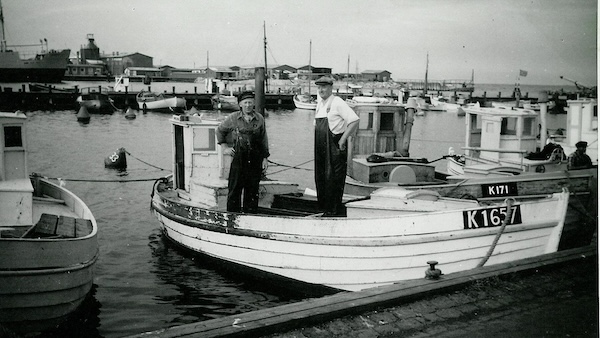
Once the fishing boats were assembled, the flight to Sweden began in earnest. The boats were usually crammed; children and babies were usually sedated; and the passage was often rough, as high winds would often raise waves four to six metres high. 

As an aside, in 1989, the annual Holocaust Symposium at the University of British Columbia arranged by the Vancouver Holocaust Education Centre focused on the Danish rescue. The speakers were a Danish Jewish woman who was rescued and a Danish fisherman who was among the rescuers. In the Q&A portion of their presentation, the fisherman admitted that he and the other rescuers charged as much as 1,000 kroner ($5,000 in today’s Canadian money) per “Jewish ticket.” Brady notes this, but finds it “understandable,” since the fishermen’s livelihood was at stake in crossing the Gestapo-infested Øresund.

All in all, the Danish rescue, as Brady presents it, is truly a remarkable story – and a welcome reminder that, even in the roughest seas and at the darkest times, the basic light of humanity can shine brightly. 

Graham Forst, PhD, taught literature and philosophy at Capilano University until his retirement and now teaches in the continuing education department at Simon Fraser University. From 1975 to 2010, he co-chaired the symposium committee of the Vancouver Holocaust Education Centre.
Posted on November 7, 2025November 6, 2025Author Graham ForstCategories BooksTags A Light in the Northern Sea, Denmark, Georg Duckwitz, history, Holocaust, Sweden, Tim Brady
Celebration of courage

Celebration of courage

A still from the documentary Passage to Sweden, which will screen as part of the annual Raoul Wallenberg Day for Civil Courage event on Jan. 21.

This year’s annual Raoul Wallenberg Day for Civil Courage gathering, on Sunday, Jan. 21, held at Congregation Beth Israel, will explore and honour civil courage in Scandinavia during the Second World War.

Just over 80 years ago, in late 1943, Danes, Norwegians and Swedes had to confront moral choices, when Denmark and Norway dealt with military occupation by Nazi Germany. Many people defied Nazi policies that threatened the human rights and lives of their fellow citizens and residents.

In Denmark, thousands of Christian Danes risked their own lives, cooperating in the dramatic, swift and secret rescue operation. The Jews, who faced deportation and certain death at the hands of the Nazis, were ferried to safety in neutral Sweden. Their homes and properties were safeguarded until their return after the war. Sweden welcomed and aided the Danish Jews, risking its own status as a neutral nation. 

In Norway, the site of significant armed attacks by Nazi Germany, hundreds of Norwegian police officers refused the orders of Nazi occupiers, a collective action that led to their imprisonment at Stutthof concentration camp in Nazi-controlled Poland. There, the Norwegian police maintained their solidarity as they acted to reduce the suffering of their fellow prisoners, including many Jews, such as the late Jennie Lifschitz, who settled in Vancouver in the early 1950s.

Finland and the Baltic nations (Estonia, Latvia and Lithuania) were also engulfed in the war, victims of the Soviet Union’s military occupation and, in the case of the Baltics, annexation and mass civilian deportations. 

While Nordic peoples, like most Europeans, were not completely free of hostility toward Jews and other minorities, they offer a good example of civil courage, based on the belief that Jewish citizens and residents were their equals.

This year, at the local Wallenberg Day event, Vancouver Holocaust educator Norman Gladstone will speak about the remarkable rescue of Denmark’s Jewish population. Local researcher and author Tore Jørgensen will speak about the hundreds of Norwegian policemen, including his father, who refused to collaborate with the Nazi occupiers. Historian Gene Homel will introduce the Wallenberg-Sugihara Civil Courage Society and the City of Vancouver proclamation of Wallenberg Day.

As well, the documentary Passage to Sweden will be screened. The film covers the wartime courage of Scandinavians, including Sweden’s Raoul Wallenberg, who acted courageously to protect civilians in Hungary, and was taken into custody by the Soviet army. His fate is unknown to this day. 

The 19th annual Wallenberg Day on Jan. 21 at Congregation Beth Israel will be held at 1:30 p.m. Admission is free and donations will be gratefully accepted.

For more about the Wallenberg-Sugihara Civil Courage Society, which organizes the annual event, visit wsccs.ca. 

– Courtesy Wallenberg-Sugihara Civil Courage Society

Format ImagePosted on January 12, 2024January 11, 2024Author Wallenberg-Sugihara Civil Courage SocietyCategories LocalTags courage, Denmark, hero, history, Holocaust, Sweden, Wallenberg Day, Wallenberg-Sugihara Civil Courage Society

Ludicrous standards

Sweden’s Foreign Minister Margot Wallström has accused Israel of “extrajudicial executions” of Palestinian terrorists. The minister said, in the country’s parliament, that Israel has a right to defend its citizens, but went on to clarify that such defence should not include “extrajudicial execution” and accused Israel of a “disproportionate” response.

It is a familiar refrain from the European community, a place where Israeli products are being labeled as part of a boycott strategy, sometimes by vigilantes in makeshift uniforms patrolling shops and applying stickers to Israeli goods. Israel has a right to defend itself, in the world’s eyes, up to and until it actually begins to defend itself.

The issue is confused by some outside observers. It is true that Israel is a democratic state that respects the rule of law. But it is also a country at war with radical Islamist terrorism. There are, certainly, laws and judicial recourse for crimes, but when a murderous act is in the process of unfolding, the first objective of security forces is to end the situation. Certainly, the next objective should be ensuring that judicial process takes precedence by, for instance, shooting in the leg or otherwise disabling the attacker through non-lethal means. From half a world away, it is hard to judge the actions of frontline security personnel (or, at least, it should be more difficult than it seems to be) but we would hope that response is balanced with preservation of life and the addressing of crime through Israel’s admirable system of judicial oversight.

At the same time, we should be cognizant of double standards.

Remember just over a year ago, in October 2014, a terrorist murdered Cpl. Nathan Cirillo at the National War Memorial and then proceeded to Canada’s Parliament Buildings, where he was taken down, fatally, by the sergeant-at-arms, Kevin Vickers.

Vickers became a national hero. He was not condemned by the government of Sweden or anyone else. The Canadian government was not pilloried for “disproportionate” force or “extrajudicial execution.”

No, there are two sets of rules in this world. One set for Israel which, despite all the threats and existential challenges it faces, is expected to maintain the world’s highest standards – actually, ludicrous standards – of engagement, while everyone else gets a pass, including the tyrants whose governments currently sit on august bodies like the United Nations Human Rights Council.

Predictably and correctly, Israel’s foreign ministry lambasted the Swedish politician’s comments, dismissing them as “scandalous, delusional, rude, and detached from reality.”

“The [Swedish] foreign minister suggests that Israeli citizens simply give their necks to the murderers trying to stab them with knives,” the Israeli foreign ministry said in a statement. “The citizens of Israel and its security forces have the right to defend themselves. In Israel, every person who commits a crime is brought in front of a judge, including terrorists. The citizens of Israel have to deal with terrorism that receives support from irresponsible and false statements like that.”

The Swede’s comments are not unusual, although they are particularly flagrant. They are of a type we have seen repeatedly when Israel faces an upsurge in terrorism. The attitude it depicts reflects more concern for the murderers than it does for their victims. Rare is the word of support or empathy for Israel’s untenable position facing down individual terrorists incited by their government and society to stab, drive over or otherwise murder Jews.

The Swedish foreign minister’s words really speak volumes about where Europe’s sympathies lie these days.

Posted on December 11, 2015December 9, 2015Author The Editorial BoardCategories From the JITags antisemitism, Israel, Margot Wallström, Sweden, terrorism
Proudly powered by WordPress