Skip to content
  • Home
  • Subscribe / donate
  • Events calendar
  • News
    • Local
    • National
    • Israel
    • World
    • עניין בחדשות
      A roundup of news in Canada and further afield, in Hebrew.
  • Opinion
    • From the JI
    • Op-Ed
  • Arts & Culture
    • Performing Arts
    • Music
    • Books
    • Visual Arts
    • TV & Film
  • Life
    • Celebrating the Holidays
    • Travel
    • The Daily Snooze
      Cartoons by Jacob Samuel
    • Mystery Photo
      Help the JI and JMABC fill in the gaps in our archives.
  • Community Links
    • Organizations, Etc.
    • Other News Sources & Blogs
    • Business Directory
  • FAQ
  • JI Chai Celebration
  • JI@88! video

Recent Posts

  • New rabbi settles into post
  • A light for the nations
  • Killed for being Jewish 
  • The complexities of identity
  • Jews in time of trauma
  • What should governments do?
  • Annie will warm your heart
  • Best of the film fest online
  • Guitar Night at Massey
  • Partners in the telling of stories
  • Four Peretz pillars honoured
  • History as a foundation
  • Music can comfort us
  • New chapter for JFS
  • The value(s) of Jewish camp
  • Chance led to great decision
  • From the JI archives … camp
  • עשרים ואחת שנים להגעתי לונקובר
  • Eby touts government record
  • Keep lighting candles
  • Facing a complex situation
  • Unique interview show a hit
  • See Annie at Gateway
  • Explorations of light
  • Help with the legal aspects
  • Stories create impact
  • Different faiths gather
  • Advocating for girls’ rights
  • An oral song tradition
  • Genealogy tools and tips
  • Jew-hatred is centuries old
  • Aiding medical research
  • Connecting Jews to Judaism
  • Beacon of light in heart of city
  • Drag & Dreidel: A Queer Jewish Hanukkah Celebration
  • An emotional reunion

Archives

Follow @JewishIndie
image - The CJN - Visit Us Banner - 300x600 - 101625

Author: Simces & Rabkin Family Dialogue on Human Rights

Rights in the digital age

Rights in the digital age

Taylor Owen, one of Canada’s leading experts on digital media ethics, is the featured speaker at this year’s Simces & Rabkin Family Dialogue on Human Rights event Nov. 9. (photo from cigionline.org)

On Nov. 9, the Simces & Rabkin Family Dialogue on Human Rights, in partnership with the Canadian Museum for Human Rights, hosts the online program Is Facebook a Threat to Democracy? A Conversation About Rights in the Digital Age.

Platforms like Facebook, which collect and share huge amounts of information, are being accused of putting profit above democracy and the public good. Can government regulation protect us and our children from online harm and misinformation – or is “Big Tech” ungovernable? How can Canadians balance freedom of expression and protection from harm on social media?

These questions and many others will be discussed by Taylor Owen in conversation with Jessica Johnson.

Owen is the Beaverbrook Chair in Media, Ethics and Communications, the founding director of the Centre for Media, Technology and Democracy, and an associate professor in the Max Bell School of Public Policy at McGill University. He is the host of the Centre for International Governance Innovation’s Big Tech podcast, and is also a senior fellow of CIGI. His work focuses on the intersection of media, technology and public policy.

Johnson is editor-in-chief at The Walrus magazine. A former editor at the Globe & Mail and National Post newspapers, she is an award-winning journalist who has contributed essays, features and criticism to a wide range of North American publications. She was the co-creator, with Maclean’s journalist Anne Kingston, of #MeToo and the Media, an inaugural course in the University of Toronto’s Book and Media Studies program.

The Simces & Rabkin Family Dialogue on Human Rights will be on Zoom on Nov. 9 from noon to 1:30 p.m. PST. It will include an audience Q&A session opportunity. Register to attend the event via humanrights.ca/is-facebook-a-threat-to-democracy. Once registered, you will receive a confirmation email and, later, a reminder for the event.

– Courtesy Simces & Rabkin Family Dialogue on Human Rights

Format ImagePosted on November 5, 2021November 4, 2021Author Simces & Rabkin Family Dialogue on Human RightsCategories LocalTags dialogue, Facebook, human rights, internet, Jessica Johnson, Simon Rabkin, Taylor Owen, technology, Zena Simces
How to achieve justice

How to achieve justice

Dr. Cindy Blackstock gives this year’s Dean’s Distinguished Lecture., on Nov. 15. (photo from ulethbridge.ca)

The University of British Columbia’s faculty of education is once again partnering with the Janusz Korczak Association of Canada (JKA)  in presenting the Dean’s Distinguished Lecture on Nov. 15. This year’s featured speaker is Dr. Cindy Blackstock.

The lecture series highlights the ongoing work of those who seek to advance children’s rights in Canada and is presented in partnership with the JKA as a way of continuing the legacy of Janusz Korczak, a Polish-Jewish doctor and educator, who in 1942 perished in Treblinka along with nearly 200 orphans in his care.

Blackstock is a member of the Gitksan First Nation, with more than 25 years of social work experience in child protection and Indigenous children’s rights. Her research interests are Indigenous theory and the identification and remediation of structural inequalities affecting Indigenous children, youth and families.

An author of more than 50 publications, Blackstock has collaborated with other Indigenous leaders to assist the United Nations Committee on the Rights of the Child in the development and adoption of a General Comment on the Rights of Indigenous Children. Recently, she also worked with Indigenous youth, UNICEF and the United Nations Permanent Forum on Indigenous Issues to produce a youth-friendly version of the United Nations Declaration on the Rights of the Child. Her promotion of culturally-based and evidence-informed solutions has been recognized by the Nobel Women’s Initiative, the Aboriginal Achievement Foundation, Frontline Defenders and many others.

Colonialism-entrenched inequality is a lived reality for many Indigenous peoples around the world and Blackstock’s presentation, called Reconciling History, talks about what colonialism is, how it birthed multi-generational inequality and what can be done, including academically, to achieve justice in change resistant environments.

Blackstock is the 2017 recipient of the Janusz Korczak Medal. Following her lecture, directors of the JKA will present the Janusz Korczak Scholarship in Children’s Rights and Indigenous Education, Janusz Korczak Association of Canada Statuette, and Janusz Korczak Association of Canada Medal.

The event will be hosted by Dr. Jan Hare, dean pro tem, UBC faculty of education, and includes Janet Austin, lieutenant governor of British Columbia; Steven Lewis Point, chancellor of UBC; Lillian Boraks Nemetz, board member, JKA; Dr. Anton Grunfeld, board member, JKA; Jerry Nussbaum, president, JKA; Dr. Jennifer Charlesworth, representative for children and youth, British Columbia; and Dr. Chris Loock, board member, JKA.

To register for the Nov. 15 event, which will take place 5:30-7:15 p.m., visit educ.ubc.ca/deans-distinguished-lecture-reconciling-history.

– Courtesy University of British Columbia faculty of education

Format ImagePosted on November 5, 2021November 4, 2021Author UBC faculty of educationCategories LocalTags children's rights, Cindy Blackstock, colonialism, equality, Indigenous children, Janusz Korczak Association, JKA, UBC, University of British Columbia
Remembrance Day Revue

Remembrance Day Revue

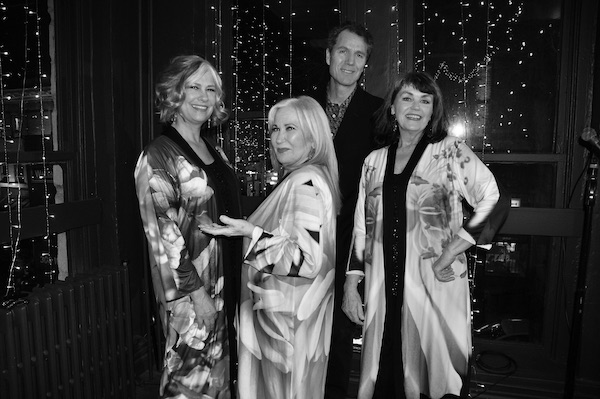
The Hot Mammas – left to right, Mary Ella Young, Julie Brown and Georgina Arntzen – with Tom Arntzen. (photo by Dee Lippingwell)

The Hot Mammas – Mary Ella Young, Julie Brown and Georgina Arntzen – with Tom Arntzen perform a Remembrance Day Revue on Nov. 10 and 11 at the Corner Stone Bistro in North Vancouver. With careers spanning decades, they have done it all, from folk to jazz, radio to musical theatre, Vancouver to New York; these women know how to work a room. Long-time friends Arntzen, Brown (who is a member of the Jewish community) and Young formed the Hot Mammas in 2004 and they entertain audiences with the kinds of stories and harmonies that can only come from such a friendship. For reservations, call 604-990-3602 or visit thehotmammas.com.


Format ImagePosted on November 5, 2021November 4, 2021Author The Hot MammasCategories MusicTags Corner Stone Bistro, music, Remembrance Day, women
A happy family holiday

A happy family holiday

Mini poems that rhyme and colourful  illustrations combine for a family-filled, fun-filled and food-filled holiday book for younger revelers. Hanukkah, Here I Come! (Grosset & Dunlap) by writer D.J. Steinberg and illustrator Sara Palacios is an energetic account that touches upon all the many things a kid might look forward to on Chanukah.

Starting with the setting up of the candles and the stacking of the presents, the meal prep also begins. The children help out their parents.

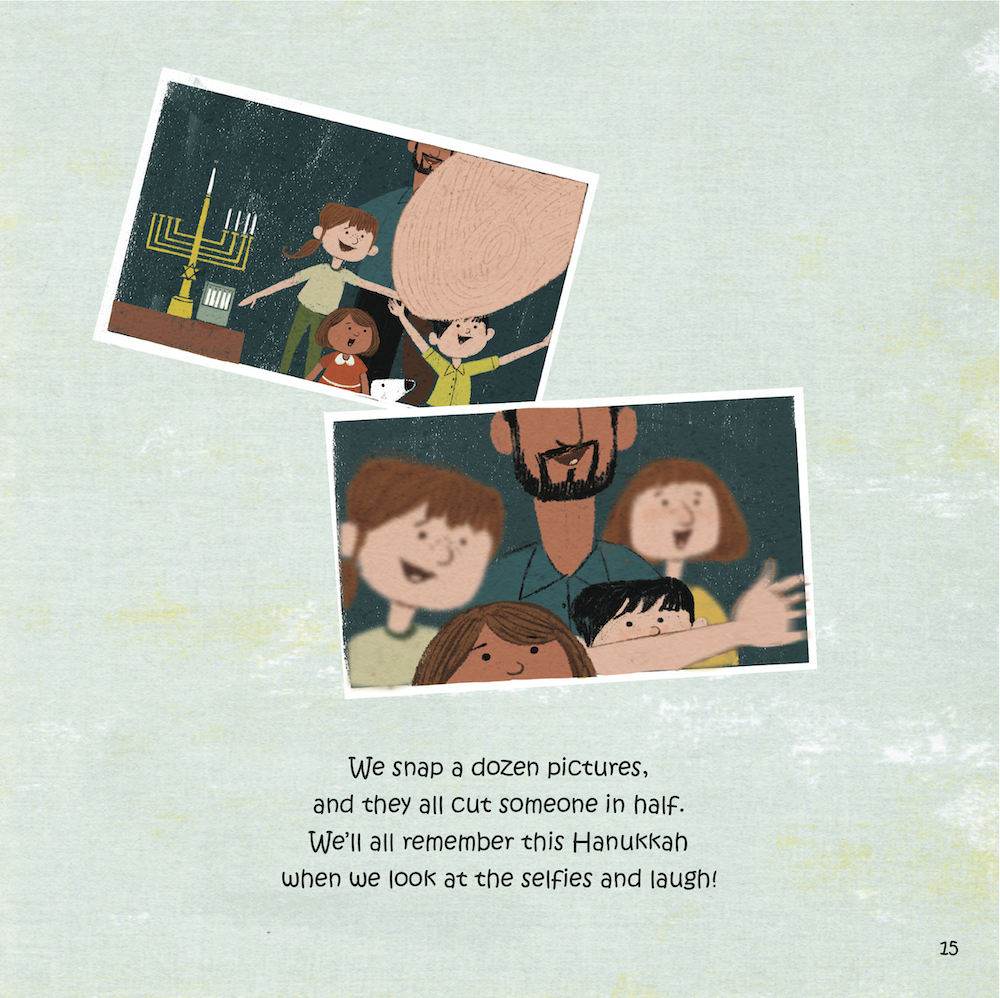
We briefly learn about the brave Judah Maccabee, “Macca-BAM! Macca-BOOM!” and how he and his brothers made history and the Jews took back their Temple. We light the candles, sharing in the joy with the neighbours across the street, who can be seen from their apartment windows. First gifts are unwrapped and selfies are taken – these illustrations are particularly delightful, as we see and read: “Click! That one cut off my sister.

“Click! Where’s my mother’s head?

“Click! That one’s dark and blurry.

“Click! That’s Mom’s finger instead.”

image - A page from Hanukkah, Here I Come! (Grosset & Dunlap) by writer D.J. Steinberg and illustrator Sara Palacios
A page from Hanukkah, Here I Come! (Grosset & Dunlap) by writer D.J. Steinberg and illustrator Sara Palacios.

There is chocolate gelt, a lesson on how to play dreidel and a visit to Bubbe and Grandpa’s (implying a mixed family perhaps, that the grandfather is not Zayde). Latkes and apple sauce – or are you on Team Sour Cream, instead? – follow. The happy noise of the family celebrating together mounts and dinner is served, with a warning that your jelly doughnut dessert might just explode all over your face.

The last night of Chanukah arrives all too soon.

Editor’s Note: Unfortunately, because of supply chain issues, the publication of Hanukkah, Here I Come! has been postponed to fall 2022.

Format ImagePosted on November 5, 2021November 9, 2021Author Cynthia RamsayCategories Books, Celebrating the HolidaysTags Chanukah, children's books, D.J. Steinberg, Sara Palacios

משמיצים את ונקובר כדי לקדם הוצאת ספר

עדי ברוקס שגרה בוונקובר במשך שמונה שנים (מאלפיים ושש), הוציאה ספר קומיקס המתאר את מעלותיה הקשים בוונקובר. ואיך מקדמים את הספר? מפרסמים ריאיון ארוך בעיתון “לאישה” שמלכלך על ונקובר, ללא תגובה של אף אחד מאלה שבחרו לגור כאן. הריאיון אגב מלא מידע לא נכון בלשון של המעטה. ברוקס משליכה את בעיותיה האישיות והמקצועיות שלה ושל בעלה על ונקובר, ומאשימה בעצם את העיר במה שקרה לה. כישראלית מצויה היא בוודאי לא תיקח אחריות ותמצא אחרים כולל ונקובר להאשים אותם. פשוט מביש.

ברוקס מתחילה בהשמצות דווקא על קנדה וטוענת כי “המשבר הכי גרוע שמספרים עליו בעיתונות שלהם הוא שחתול נתקע על העץ. אין שום תרבות של ביקורת. זו מדינה גדולה מאוד, אבל חיים בה רק שלושים מיליון איש, זה נורא ריק, ויש אווירה של ריקנות, כי התרבות ריקה”. קודם כל הלוואי ובקנדה היו כותבים רק על חתולים. לצערנו כותבים כאן על לא מעט בעיות של תעסוקה, דיור יקר, נושא הילידים, האקלים ועוד. דברי ההבל של ברוקס מוכיחים שיש בה שנאה לא מובנת לקנדה, שאגב גרים בה רק שלושים ושמונה מיליון איש ולא כפי שהוא טוענת. אווירה של ריקנות? כנראה שחייה של ברוקס היו ריקנים כאן וזו בעיה פרטית שלה. אני גר בוונקובר מזה כשבעה עשרה שנה וחיי כאן לא היו ריקנים ולו יום אחד.

ברוקס ממשיכה וטוענת כי ברגע שהיא ובעלה שינו את הטון והחליטו משום מה? והחלו העביר ביקורת או שהתחילו להרגיש פחות טוב והביעו עצבות או כעס, הם הרגישו שהם חורגים מהכללים. “זו מדינה סוציאל דמוקרטית רק בקטע הכלכלי, אין שום לכידות חברתית. אם את בדיכאון, טפלי בעצמך, אל תחפשי כתף תומכת”. שוב דברי הבל ושטות של ברוקס. כשיש לי דברי ביקורת על מה שקורה כאן יש שמוכנים לשמוע ויש שלא, כמו בכל מקום נורמלי. לא שמעתי מעולם כי ביקורת על מה שקורה כאן “חורגת מהכללים”. זו פשוט המצאה פרי דמיונה של הישראלית הזאת. והיא עוד מדברת על שאין כאן “שום לכידות חברתית”? כאילו שבישראל יש. בישראל של היום כולם אוכלים אחד את השני והשנאה בין הישראלים הוא נוראית וקשה. אין בכלל מה להשוות זאת עם מה שקורה בקנדה. לגבי הטענה שאם למישהו יש כאן דכאון עליו לטפל בו בעצמו – גם זה לא נכון. יש לא מעט ארגונים מקצועיים שמטפלים במי שיש לו בעיות נפשיות. בכל מקום עבודה שהייתי בו יש כל הזמן פרסומים למי לפנות ברגע שיש בעיה נפשית וזה אפילו לא עולה כסף כמדומני. לי יש גם לא מעט חברים כאן שחלקם הגדול יעזור במקרה הצורך. אם לברוקס לא היו כאלה זו שוב בעיה פרטית שלה. חבל שהיא מאשימה את קנדה בכלל וונקובר בפרט בכל בעיותיה האישיות.

Posted on October 27, 2021October 27, 2021Author Roni RachmaniCategories עניין בחדשותTags "לאישה", Adi Brooks, comic book, interview, L’Isha, Vancouver, ונקובר, ספר קומיקס, עדי ברוקס, ריאיון
Choices’ women inspire

Choices’ women inspire

Jill Zarin is the keynote speaker at Choices on Nov. 7. (photo from Twitter)

Philanthropist and entrepreneur Jill Zarin – most recognized for having been on the reality TV show The Real Housewives of New York City – is the featured guest at this year’s Choices, which will be held virtually on Nov. 7.

Zarin is also the author – together with her mother, Gloria Kamen, and sister, Lisa Wexler – of Secrets of a Jewish Mother, a 2010 book full of recipes, advice and parenting tips. She will join Vancouver-area speakers to talk about how they were able to support community during the pandemic.

The Jewish Federation of Greater Vancouver’s Choices is the largest women’s event within the community. This is the 17th annual gathering and the Independent interviewed 2021 co-chairs Sherri Wise, Leanne Hazon and Courtney Cohen by email about what to expect.

“Jill Zarin is an amazing speaker!” they said. “Attendees will also hear from so many inspiring women in our own community who give of themselves to keep our community strong and connected.

“Although Jill Zarin is most well known for being a television personality, she is in fact an extremely philanthropic person,” they added. “After almost two years of COVID, the committee wanted to have a program filled with humour and uplifting stories and Jill was a perfect match.

“As co-chairs, we have always found we learn something from the women who speak, which inspires us to continue supporting our wonderful community.”

The pandemic has impacted everyone around the world in many ways, said the co-chairs, and so many people have stepped up to try to help their communities navigate this very challenging time. Zarin is but one of the many “who have pitched in their time and tzedakah and ideas to help our Jewish community stay strong,” said the Choices co-chairs.

Ideally, the organizers had wanted to be together in person for Choices 2021. Yet with the uncertainties and changing regulations around COVID, they have once again decided to hold the event virtually, while trying to provide the experience in a way that is still meaningful to people.

Given the ongoing reality of the pandemic, the women said they are “really happy and really lucky” that Choices can be offered online. One of the benefits of a virtual event, they pointed out, is making it more accessible to women province-wide.

Choices is a celebration of the impact of women’s philanthropy.  Rather than fundraising, the goal is to get more women involved in the community through giving to the campaign and volunteering. The organizers stress that there are many ways of being involved in philanthropy and making a difference, such as connecting with Jewish Federation or one of its many partner agencies.

The 2021 Federation annual campaign is focusing on the theme of being strengthened by what we as a community have been through in the past year-and-a-half and inspired by where we can go together. This year, Choices is recognizing specifically how women in the community came through the pandemic and made the community stronger with their time and donations.

In a non-pandemic year, Choices would have 500 people in attendance. Past speakers have included musicologist Judy Feld Carr, the Canadian responsible for bringing thousands of Jews from Syria to freedom; Talia Leman, the founder of RandomKid, an organization that empowers youth to do good deeds; Talia Levanon, the director of the Israel Trauma Coalition; and Jeannie Smith, who shared the story of her mother, Irene Gut Opdyke, who rescued Jews during the Holocaust.

The Choices 2021 co-chairs lauded the efforts of Sue Hector and Shawna Merkur, the co-chairs of women’s philanthropy at Federation.  They also noted the contributions of Ricki Thal (campaign manager), Kate Webster (campaign director) and the Jewish Federation staff for their invaluable support.

To attend Choices, a person must give to the Federation’s annual campaign or make a donation by purchasing a ticket of the suggested amount. There is a suggested minimum donation of $154 to support the campaign and a suggested minimum donation of $36 for first-time attendees.

To register for the Nov. 7, 5 p.m., event, visit jewishvancouver.com/ choices2021.

Sam Margolis has written for the Globe and Mail, the National Post, UPI and MSNBC.

Format ImagePosted on October 22, 2021October 21, 2021Author Sam MargolisCategories LocalTags Choices, coronavirus, Courtney Cohen, COVID-19, fundraising, Jewish Federation, JFGV, Jill Zarin, Leanne Hazon, philanthropy, Sherri Wise, women
Government to target hate

Government to target hate

Irwin Cotler spoke Sunday at a virtual event convened by National Council of Jewish Women of Canada. (photo from raoulwallenbergcentre.org)

Canada is set to make a number of significant commitments to combat antisemitism, as are other countries that participated in a summit on the issue last week in the Swedish city of Malmö.

Irwin Cotler, Canada’s special envoy on preserving Holocaust remembrance and fighting antisemitism, spoke Oct. 17 at a virtual event convened by National Council of Jewish Women of Canada. The human rights lawyer and former federal justice minister, who is also international chair of the Raoul Wallenberg Centre for Human Rights, said that, in the aftermath of the conference, the Canadian government would announce a number of pledges.

These will include enhanced teaching and learning about the Holocaust across generational lines, combating the increasing Holocaust denial and distortion, and battling hatred on social media. Reducing an alarming rise in hate crimes will also be among the pledges Prime Minister Justin Trudeau is set to make, according to Cotler.

“Twenty-twenty was the year for the highest rise in hate crimes targeting Jews ever,” he said. “But, by May 2021, we had reached the level then of all the hate crimes in all of 2020.”

The government will recommit itself to protecting the security of Jewish institutions, he said.

“Here, the government recently made commitments in financial terms for this purpose,” said Cotler.

Zero tolerance for antisemitism in the political discourse is also an objective, he added.

“That means not just calling out antisemitism in the other’s political party but calling out antisemitism in our own,” Cotler said. “In other words, not weaponizing antisemitism or politicizing it, but holding each of us, respectively, our own political parties, accountable.”

In addition to Trudeau, Israeli President Isaac Herzog, French President Emmanuel Macron and U.S. Secretary of State Antony Blinken were among the leaders who addressed the conference. The Malmö International Forum on Holocaust Remembrance and Combating Antisemitism was hosted by Sweden’s Prime Minister Stefan Löfven. Trudeau announced at the conference that Cotler’s role of special envoy would be made permanent.

Cotler contextualized the Malmö forum in a two-decade era of what he calls “demonological antisemitism,” which began at the 2001 Durban conference against racism that devolved into an antisemitic carnival.

“What happened at Durban was truly Orwellian,” said Cotler. “A world conference against racism and hate turned into a conference of racism and hate against Israel and the Jewish people. A conference that was to commemorate the dismantling of apartheid in South Africa turned into a conference calling for the dismantling of the ‘apartheid state’ Israel.

“Those of us who personally witnessed this Durban festival of hate have been forever transformed by the pamphlets and posters of hatred and antisemitism, by the cartoons and the leaflets portraying not only the Jews as Nazis, but the classical antisemitic tropes of Jews with hooked noses, with fangs, with fingers dipped in blood from the killing of children. Where we were accosted with pamphlets of the Protocols of the Elders of Zion. Where we witnessed demonstrators with signs – incredibly for a human rights conference or for any conference – signs which said, ‘Too bad Hitler didn’t finish the job.’ Where we witnessed Jewish students – and I witnessed this personally – being physically assaulted and being told, ‘You don’t belong to the human race,’” said Cotler.

Durban was the first tipping point and the global surge of antisemitism during last spring’s conflict between Hamas and Israel was a second, he said.

“Jews were targeted and threatened in their own neighbourhoods and on their own streets,” said Cotler. During and after that conflict, Cotler said, Jewish memorials were defaced, synagogues were torched, cemeteries were vandalized, Jewish institutions found themselves under assault and incendiary hate speech – such as 17,000 tweets that “Hitler was right” – exploded.

The COVID-19 pandemic has exacerbated antisemitism, or at least has been exploited by antisemites, who have “instrumentalized one of the more ancient tropes of the Jews as the poisoners of wells,” said Cotler. The health crisis has also seen conspiracies of Jews profiting from vaccines and anti-vaxxers posing “as if they were victims of Nazi persecution,” he added.

Cotler lamented what he calls “the mainstreaming, the normalization – in effect, the legitimization of antisemitism in the political culture.” During the conflict last spring, convoys of vehicles in London, U.K., drove through Jewish neighbourhoods screaming, “F–k the Jews, rape their daughters!” This was a convoy and a message that was replicated in Toronto days later and which resulted in, Cotler said, an “utter absence of outrage.”

The legalist also spoke of the International Holocaust Remembrance Alliance Working Definition of Antisemitism.

“If you can’t define it, you can’t combat it,” he said. The IHRA definition was adopted after 15 years of discussion and debate by intergovernmental bodies, governments, parliaments, scholars and civil society leaders, he said.

The task of fighting antisemitism must not fall only to Jews, Cotler  stressed.

“As we’ve learned only too painfully, and have repeated too often, that, while it begins with Jews, it doesn’t end with Jews,” he said. “Therefore, we need this collective global constituency of conscience to combat it.”

Format ImagePosted on October 22, 2021October 21, 2021Author Pat JohnsonCategories NationalTags Academic Advisory Council, antisemitism, Canada, Durban, government, Holocaust, Irwin Cotler, Malmö International Forum, National Council of Jewish Women of Canada, politics

Zoom into the future?

We have now finished our second consecutive cycle of High Holidays under the cloud of the COVID-19 pandemic. This year, unlike last, plenty of grandparents were able to hug their grandkids, thanks to vaccines. In-person gatherings were possible in different forms, including synagogue services.

The overarching crisis represented by the pandemic coincidentally occurs at a time when Jewish communal leaders are expressing growing concerns about declining levels of affiliation, especially among younger Jews. Polls (criticized by some for their methods) suggest a steep drop-off in support for Israel among American Jews. And there are worries, expressed by Israel’s President Isaac Herzog, among others, of increasing estrangement between Israeli and Diaspora Jews.

Yet, there is almost not a single person involved in Jewish life who will not acknowledge some silver linings in this terrible time. It is human nature to almost instantly take for granted what we have. The sudden omnipresence of platforms like Zoom would have been a sci-fi dream 25 years ago. Educators, rabbis and Jewish organizations made an almost instantaneous shift to virtual events at the start of the pandemic. This, it turned out, served not only existing “audiences” (students, congregants, members) but entirely new faces. People who, due to geography, had no access to Hebrew classes

are studying virtually. British Columbians are scanning options and joining lectures, recitals, panel discussions and standup comedy routines, and more, streaming from New York, London, Cape Town and Tel Aviv. Services and programs generally offered to the Vancouver community are welcoming new attendees, unlimited by geography.

Early on, behavioural scientists predicted a phenomenon of being “Zoomed out.” But a Canadian opinion poll suggested just the opposite. We love Zoom. It allows us to attend a one-hour lecture without the 40-minute commute, the parking and the umbrella-shaking. Of course, it is not the same. We miss the kibitzing and other niceties of an in-person event, but it is pretty darn fantastic under the circumstances.

Jews produce a vast amount of what is now dryly called “content” … the written word, visual and performing arts, music, science, intellectual pursuits. And it is available in almost every language on the planet – to anyone with a device and access to the internet. The potential this holds to bring together Jews (or, of course, any people) in ways that were not previously imaginable opens entire new worlds of connection.

As we return incrementally to a life more like the before times, we should not cast off the necessities that became welcome additions. Rather than revert to in-person-only gatherings, many groups and events are already adopting hybrid approaches. Those who enjoy the in-person form can participate, but so can those far away or who are strapped for time.

If we now have moments to reflect on the lessons of the past year-and-a-half, we should consider the power of the technologies that have become so common. How can the unifying power of these tools be mobilized to address the problems of division we face as a community? Can a concerted effort to bring together Israelis and Diaspora Jews in remote dialogue help build bridges? Could a centralized schedule of Jewish educational and cultural offerings from around the world expose Jews everywhere to a wider range of opportunities to engage in ways that are meaningful to them? Could a renaissance of Jewish ideas and discussion spring forth thanks to the technology we have become used to during this troubled time?

Can Zoom save the Jews? Well, there are many challenges facing our communities in Israel, Canada and around the world. A simple fix is never going to resolve all the concerns about falling engagement, estrangement between parts of Am Yisrael or the host of issues that our communal leaders have been focused on for decades. But neither should we underestimate the powerful force for good that a simple tool like Zoom has to bring together people who might never otherwise meet.

As a tradition, Judaism has thrived by adapting, while holding fast to customs and ritual. Zoom is now a part of this mix. While it is not perfect – it is not suitable for all denominations to stream on Shabbat or holidays, for example – it holds the potential to continue to connect us even when we are no longer constrained by health restrictions from getting together in person.

Posted on October 22, 2021October 21, 2021Author The Editorial BoardCategories From the JITags COVID-19, High Holidays, Judaism, technology, Zoom

Fight Jew-hatred – and lies

The U.S. Congressional committee investigating the Jan. 6 insurrection is limping along in the face of a near-total absence of cooperation from the Republicans who make up almost half of Congress and of the American voting public. Despite reams of video evidence, there is legitimate worry that justice will not be served in the case of an attempted coup at the heart of American government.

Those who tried to overthrow the will of the people and who even called for the murder of the vice-president of their own party are venerated by their supporters as patriots, while those who seek justice for those events are vilified as traitors.

The very people who tried to subvert the democratic decision of the American people last November – those who are trying to steal the election from President Joe Biden – chant “Stop the steal!” apparently without a hint of irony or self-awareness.

But the fight over Jan. 6 is a small puzzle piece in a larger social disorder. We are seeing verifiable truths dismissed as lies and what should be summarily debunked as lies revered as gospel. Listening to some of these voices, it is difficult to tell whether they are trying to create a reality based on what they wish were true – Trump won, Democrats eat babies, whatever – or whether they truly believe these falsehoods. It’s probably some of both.

Are we approaching a tipping point where a healthy society that has at least a modicum of shared consensus on what is true and what is false slides into a moral terrain that has no agreed-upon truth or lies, right or wrong, good or evil?

The pandemic has brought this problem into clear relief. Doctors say that they are treating people who, on their deathbed, continue to insist there is no such thing as COVID. There is a spectrum, from outright denial of the existence of the virus to conspiracies that it was invented for nefarious purposes to the idea that the virus itself is legitimate but is being exploited by governments (or other disreputable entities) to take away some amorphous “freedoms.”

Recently, parents opposed to mask mandates chased fellow parents (and their kids) at a school in California, screaming that the kids could not breathe through the masks. When some parents responded with what, by any fair measure, is common sense, one protester screamed back: “You were propagandized.… You are not being told the truth!”

To put a fine point on it, people who have been propagandized and who are convinced of a lie are shouting at others that they have been propagandized and do not know the truth.

Recently, South Carolina Senator Lindsey Graham, speaking to a Republican crowd that should have been in his back pocket, said, “If you haven’t had the vaccine, you ought to think about getting it because if you’re my age –” At this point, he was drowned out by screaming and booing. When he was able to speak again, he told the Republican crowd, “Ninety-two percent of the people in the hospitals in South Carolina are unvaccinated.” To this, some audience members began screaming “Lies!”

The New York Times Magazine’s ethics columnist, Kwame Anthony Appiah, wrote recently of the “strange mirror game” being played by conspiracy theorists and hucksters. “They peddle hoaxes that warn of hoaxes, scams that warn of scams. They dupe their victims by cautioning them not to be duped.”

Lies have been around forever. But it seems we are in another realm now. When Kellyanne Conway, a counselor to Trump, defended then-White House press secretary Sean Spicer’s false claims that attendance numbers at Trump’s 2016 presidential inauguration were the largest in history, Conway asserted that there were facts and then there were

“alternative facts.” This was not the genesis of a culture of gaslighting, but it did represent, along with Spicer’s lies, a turning point. The Trump administration operated in a world that rational observers would view as existing in an alternative universe of alternative facts.

Jews and supporters of Israel who forgive Trump’s many affronts because they deem him to be on “our side” on one issue suffer from something that might be equated to the difference between the weather and the climate.

Trump may indeed have taken steps that people view as being to Israel’s advantage. But, in nearly everything else Trump and his supporters have done, they have assaulted truth, facts and rationality. They call black white and up down. Legitimate media are “fake news” and darkweb rantings are trustworthy sources.

In a story in the last issue of the Independent, the commentator Bret Stephens said: “We now have come to a place where, increasingly, we are a nation that can bring ourselves to believe anything and a nation that can bring itself to believe anything … sooner or later, is going to have no problem believing the worst about Jews.”

Trump, Spicer, Conway and their crowd did not invent the situation where lies are gospel and truth is rejected, but they did their best to perfect it.

It should not need saying that such people should not be trusted, since their loyalty and sincerity are worthless. Republicans who, on a dime, turn into an angry mob screaming “Hang Mike Pence!” should not be trusted when it comes to something as sacred as the security and the fate of Israel and its people.

More gravely still, there is a reason why Jews are often referred to (as dehumanizing as the term is) as “canaries in a coalmine.” When antisemitism emerges, it is a sign of broader societal disorder. It is no surprise that the spike in antisemitism we are witnessing coincides with a phenomenon where verifiable facts are regarded as debatable assertions and the most ludicrous assertions are not only accepted as truth but defended with fanaticism and violence.

In the late 20th century, Canadian Jewish Congress and other groups adopted an approach premised on the idea that the best way to ensure the safety of Jewish people was to advance an ideal that protects allminorities. There might always be people with antisemitic motivations, but, if we can inculcate in society a transcendent commitment to equality for all, we may create a firewall against the worst antisemitism.

As CJC and others did several decades ago, it may be time for Jewish people and others who care about fighting antisemitism to rededicate ourselves to strengthening the most fundamental principles of our democratic societies, the very foundations that we too often have taken for granted, even after Jan. 6. This includes not only ensuring basic things like civil and voting rights and protecting the institutions of democratic government, but it calls on us to contest outright lies and to defend basic truth. If, in the process, we manage to yank our democratic societies back from the abyss of lies and the frightening places they lead, we will have made things better not only for the Jewish future, but for everyone’s.

Posted on October 22, 2021October 21, 2021Author Pat JohnsonCategories Op-EdTags antisemitism, Canadian Jewish Congress, civil rights, democracy, racism, Trump, voting rights

A time for diversity training

We’re in the month of Heshvan on the Jewish calendar. Some people call it Mar-Heshvan or Marcheshvan. (Since this is transliteration, it can be spelled either “ch” or “h.”)  It’s called mar, or bitter, because, aside from Shabbat, there are no Jewish holidays during this month.

Of course, as Canadians, we had Thanksgiving in there. However, after a long stretch of Jewish holidays, many Jewish people, myself included, quite like the idea of a month off from them. Finally, I have time to start another big project. A relatively quiet Jewish month leaves more time to do “regular” work, learning and making changes.

As a kid, I was very active in my Reform congregation. I learned to lead services and read Torah and Haftarah, and did it without hesitation after becoming a bat mitzvah. Unfortunately, though, at that time, we didn’t chant in my parents’ congregation, so I never learned how to do it. I married into a family with slightly more traditional practice among some of its members and, therefore, have been attending services with chanting now for more than 20 years.

Yet, learning to chant is a tricky business as an adult. On one occasion, I asked a rabbi if I might learn and he said of course, the congregation ran a special group class for adult b’not mitzvah. (Mostly it was women who never were able to participate in a bat mitzvah service as a child.) I said no, I’d been there and done that – complete with leading the service, a reception with custom-made omelettes, and a special dress. I just wanted to learn to chant. He had no space in his imagination for someone who just wanted to learn this skill without the lifecycle event.

I also learned that there are different kinds of trope. Chanting comes along with symbols in the text of the Torah, Haftarah, Eicha and Megillat Esther. The symbols were introduced by the rabbis as a way to mark and understand the text better. It’s like punctuation. However, as an oral tradition, chanting melodies differ according to where one lives and one’s background. There are actually many different styles of chanting trope, including smaller regional differences, as well.

The trope I’ve begun learning is an Ashkenazi one, which is perhaps appropriate to my family background. (I haven’t done a DNA test, though, so I’m going by family lore.) However, parts of my family are Western European and others have been in the United States for a long time. It’s even possible that I’m learning the “wrong” trope for my background. I’ve found that several Sephardi and Mizrahi chanting styles sound clearer and make more sense to me, perhaps because I’ve learned Modern Hebrew and I lived in Israel as a teenager. It’s actually not as simple as “Learn trope!” “Chant Torah!” although it seems this way if you’ve only lived in one specific Jewish ethnic community with unified customs and traditions.

The more you know, the more complicated things seem. The best metaphor I’ve come up with springs from an odd social media interaction I had. Someone I know only online described her harvest supper menu as including “Jewish-style brisket.”  I jokingly responded, “WHAT?! There’s only one kind? What about the many varieties I’ve had over the years? Could it be that I’ve never eaten the only ‘official’ Jewish brisket recipe?”

I said maybe this was an Eastern European/Ashkenazi recipe, or her family recipe. After all, brisket is a relatively cheap cut of meat, cooked low and slow, which is perfect to make on Shabbat, when some families do not adjust oven temperatures or turn the oven on or off.

The person insisted that this was indeed the Jewish-style brisket her family made, mostly, and that, if you Google it, this exact recipe pops up. (Hint, lots of things pop up online that don’t hold up under scrutiny.) Eventually, I suggested that perhaps this was best called a family recipe or a specific geographic recipe, and wished her bon appétit.

Geography matters in cooking meat – for instance, in a Southern barbeque recipe. That is, brisket in Texas doesn’t taste like brisket made in eastern Carolina. Nothing could be more different! The same is true for Jewish trope or chanting. They don’t sound the same because, although Jews originated, long ago, in what is now called Israel, we’re now a diverse people, from all over the world. Just as Jews don’t all look the same, we all don’t eat the same foods on holidays, or sing the same melodies for Lecha Dodi, Adon Olam or myriad other prayers.

So, I begin, with baby steps, to learn one chanting/trope tradition while acknowledging there are many others out there. Like the many brisket recipes and holiday traditions out there, knowing about diversity and traveling deepens our appreciation for what we know and enjoy, and for learning more.

In the meanwhile, I joked with a non-Jewish friend I know in “real life” that, if there is really only one Jewish-style brisket recipe, we might be in trouble. “Oh no!” she replied. “I have to figure out ‘the’ Christian brisket recipe! How have I missed it after all this time?!” We snorted together with laughter. Next, I might call a Muslim friend to ask if there just one Muslim meatball – after all, the kibbe and kofte I’ve shared over many years might not be the official kind?

The best learning for Heshvan? There might not be a single “official” version of anything. That, in itself, is a lesson in diversity that might be worth learning like trope … over and over.

Joanne Seiff has written regularly for CBC Manitoba and various Jewish publications. She is the author of three books, including From the Outside In: Jewish Post Columns 2015-2016, a collection of essays available for digital download or as a paperback from Amazon. Check her out on Instagram @yrnspinner or at joanneseiff.blogspot.com.


Posted on October 22, 2021October 21, 2021Author Joanne SeiffCategories Op-EdTags brisket, cooking, diversity, education, Judaism, lifestyle, Torah

Posts pagination

Previous page Page 1 … Page 185 Page 186 Page 187 … Page 650 Next page
Proudly powered by WordPress