Skip to content
  • Home
  • Subscribe / donate
  • Events calendar
  • News
    • Local
    • National
    • Israel
    • World
    • עניין בחדשות
      A roundup of news in Canada and further afield, in Hebrew.
  • Opinion
    • From the JI
    • Op-Ed
  • Arts & Culture
    • Performing Arts
    • Music
    • Books
    • Visual Arts
    • TV & Film
  • Life
    • Celebrating the Holidays
    • Travel
    • The Daily Snooze
      Cartoons by Jacob Samuel
    • Mystery Photo
      Help the JI and JMABC fill in the gaps in our archives.
  • Community Links
    • Organizations, Etc.
    • Other News Sources & Blogs
    • Business Directory
  • FAQ
  • JI Chai Celebration
  • JI@88! video

Recent Posts

  • Sharing her testimony
  • Fall fight takes leap forward
  • The balancing of rights
  • Multiple Tony n’ Tina roles
  • Stories of trauma, resilience
  • Celebrate our culture
  • A responsibility to help
  • What wellness means at JCC
  • Together in mourning
  • Downhill after Trump?
  • Birth control even easier now
  • Eco-Sisters mentorship
  • Unexpected discoveries
  • Study’s results hopeful
  • Bad behaviour affects us all
  • Thankful for the police
  • UBC needs a wake-up call
  • Recalling a shining star
  • Sleep well …
  • BGU fosters startup culture
  • Photography and glass
  • Is it the end of an era?
  • Taking life a step at a time
  • Nakba exhibit biased
  • Film festival starts next week
  • Musical with heart and soul
  • Rabbi marks 13 years
  • Keeper of VTT’s history
  • Gala fêtes Infeld’s 20th
  • Building JWest together
  • Challah Mom comes to Vancouver
  • What to do about media bias
  • Education offers hope
  • Remembrance – a moral act
  • What makes us human
  • המלחמות של נתניהו וטראמפ

Archives

Follow @JewishIndie
image - The CJN - Visit Us Banner - 300x600 - 101625

Author: Sam Margolis

Ukraine’s complex past

Ukraine’s complex past

Elissa Bemporad (photo from Elissa Bemporad)

During a Dec. 4 Zoom lecture organized by Kolot Mayim Reform Temple in Victoria, historian Elissa Bemporad offered a nuanced look at the Jewish experience in Ukraine, as well as perspective on the Russian invasion of Ukraine

“It was a history marked significantly more by coexistence between Jews and non-Jews than it was by violence,” said Bemporad, a professor at Queens College and CUNY Graduate Centre in New York City. “I am saying this not only in response to the genocidal war that Russia has launched in Ukraine, justifying it by manipulating the past and demonizing Ukrainians as quintessentially violent. We should resist the view of the Jewish experience in the region, as tragic as it might have been, as if it was doomed from the very beginning and enveloped in perpetual violence.”

The current war, she underscored, has brought about the worst refugee crisis in Europe since the Second World War, with cities destroyed and civilian populations terrorized. “The aim of this war seems to be putting an end to Ukrainian sovereignty and identity,” she said. “As a historian, one of the most painful moments was reading about how the Russian occupiers were seizing and destroying books. As Jewish historians, we know all too well what happens when a society destroys books.”

Showing images of the destruction of Jewish buildings in Ukraine, such as a synagogue in Mariupol and the Hillel building in Kharkhiv, Bemporad spoke to the irony of one of Russia’s stated goals of the conflict: to rid the country of Nazis. Most of the Jews in these bombed-out cities have left, she said, and there is uncertainty as to whether they will return; many have either fled to Israel or settled in the West.

Bemporad discussed the pre-Second World War period, when 1.5 million Jews lived in what is today Ukraine, the largest community being in Kyiv, where 226,000 Jews resided, or one-third of the city’s population. Addressing the anti-Jewish violence in the region, she spoke about – among other uprisings, dating back to the 17th century – the Russian Civil War (1918-21) and the resulting atrocities committed against the Jewish population by both military units and the civilian population. Many of the pogroms took place in Ukraine and tens of thousands of Jews were killed.

“Jews were thought of as interlopers in the national body and imagined as forces connected to Bolshevism that would tear apart the nation’s fabric,” Bemporad said. “The fact that Trotsky was the leader of the Red Army did not play in favour of the Jews.”

But Bemporad highlighted a history of coexistence as well, stories in which some Ukrainians heroically stepped in to save the life of Jews, notably the writer Rakhel Feygenberg, who, along with her infant son, was hidden by non-Jews during a 1919 pogrom.

About the post-First World War era, she noted the ambivalent attitude the Soviet state had toward antisemitism. “While the state condemned antisemitism on paper, it was often eager to ignore antisemitism or to weaponize it in its best interest,” she said. “With regard to the pogroms, the Soviets shifted between acknowledging and downplaying the anti-Jewish violence. They were ambiguous in their treatment of the Jews, and they were the ambiguous in their treatment of the perpetrators, creating a state-controlled memory. However, when the discussion of the pogroms was perceived as at odds with the regime’s interests and priorities of building socialism based on the brotherhood of peoples, then the memory of anti-Jewish violence was silenced and the Soviets preferred not to investigate and punish the perpetrators.”

In other examples, she said the Soviets would use antisemitism among Ukrainians as a means to demonstrate they were prone to nationalism. And both Ukraine and Russia have provided recent examples of reviving the memories of and glorifying national heroes who were responsible for carrying out pogroms.

In a final slide, Bemporad displayed the results of a Pew Research Centre survey on antisemitism in Europe. Despite Russia’s attempts to portray Ukraine as a hotbed of antisemitism, more Russians had an unfavourable opinion of Jews than Ukrainians. And, in Bemporad’s view, Ukraine, despite its corruption, has become the most democratic of the post-Soviet states, excluding the Baltic countries. Further, as has often been mentioned in referring to the present situation of Jews in Ukraine, the country elected a Jewish president, Volodymyr Zelensky, with more than 73% of the vote.

“Siding with Ukraine today does not entail dismissing or forgetting the dark pages of anti-Jewish violence in the region,” Bemporad said. “It is rather a reminder that we can start turning those pages and writing new ones in the book of the Jews of Ukraine.”

Bemporad, a two-time winner of the National Jewish Book Award, is the author of Becoming Soviet Jews: The Bolshevik Experiment in Minsk and Legacy of Blood: Jews, Pogroms and Ritual Murder in the Lands of the Soviets. She is the co-editor of two volumes: Women and Genocide: Survivors, Victims, Perpetrators and Pogroms: A Documentary History.

The next speaker in Kolot Mayim’s Building Bridges series will be Sari Shernofsky, a retired community chaplain from the Calgary Jewish community, on Stories from the Narrow Bridge: Meeting People in Their Time of Need. She will speak on Jan. 8, 11 a.m. Visit kolotmayimreformtemple.com.

Sam Margolis has written for the Globe and Mail, the National Post, UPI and MSNBC.
Format ImagePosted on December 23, 2022December 22, 2022Author Sam MargolisCategories LocalTags antisemitism, atheism, Elissa Bemporad, history, Kolot Mayim, religion, Russia, Ukraine, war
Research in community living

Research in community living

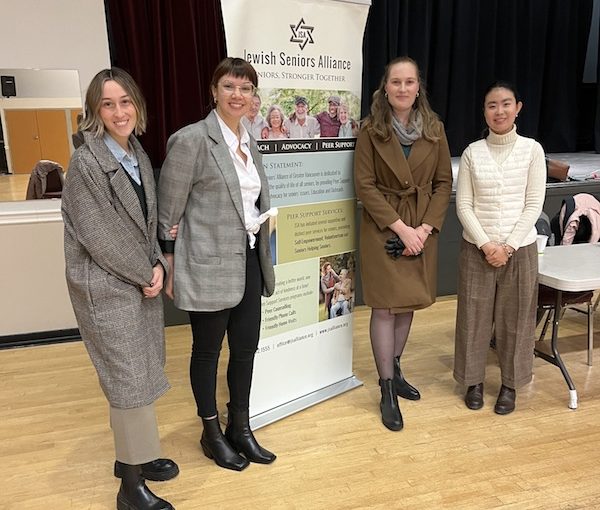
Left to right: Rachelle Patille, Cari Randa, Eireann O’Dea (Jewish Seniors Alliance board member and event moderator) and Boah Kim. (Courtesy JSA)

On Dec. 4, Jewish Seniors Alliance presented their fall symposium: Aging in Place: Gerontology Research in Community Living. The speakers – Rachelle Patille, Cari Randa and Boah Kim – and the moderator, Eireann O’Dea, are all graduate students in gerontology from Simon Fraser University and they shared their research on intergenerational connections, dementia-friendly communities and the role of informal caregivers for older adults.

The event took place at the Peretz Centre but was also available by Zoom. Aside from the JSA annual general meeting, this gathering was the first event presented in a dual format since the outbreak of COVID. Fifty participants joined online and about 20 were present in person.

Tammi Belfer, president of JSA, explained that the JSA’s fall symposium focuses on an educational theme and offers a more serious discussion than other programs. She said JSA wishes to provide outreach, advocacy and education services for all seniors, with the goal being “Seniors Stronger Together.” She then introduced the speakers and turned over the mic to O’Dea, who is a PhD candidate in gerontology at SFU. O’Dea’s interests are in social participation among older adults, particularly in volunteering and intergenerational activities; experiences among ethnocultural minority groups; and generativity. She has been a board member of JSA for three years.

The first speaker, Patille, conducts research focused on “intergenerational opportunities in bridging the gap between generations in Metro Vancouver.” She said she grew up having a lot of contact with her grandmother, and she believes that this fact led to her interest is this field. She defined intergenerational contact as a social benefit that facilitates mutual interaction and exchange between generations, and she discussed factors in society that have impeded such contact; for example, age segregation and geographic divisions among generations that lead to ageism.

Older adults living alone is the number one risk factor for isolation and loneliness, she said. These factors underline the need for connections through programming that will bring older adults into contact with other people, including other older adults. This can be accomplished through such things as home sharing, community programs, tutoring and art projects. These projects allow older adults to be part of the community through participation and mentoring, increasing the person’s feeling of self-worth. For some young people, this may be their first contact with older adults and can lead to reciprocity of social networks.

Patille spoke about generativity, which is the passing down and transfer of knowledge and information 

between generations. She will also be looking at “voluntary kin”; that is, having younger members of society replace missing family for older adults.

The next speaker, Kim, focuses her research interests on integrated care, formal and informal caregiving, continuity of care and healthy aging. One of the difficulties for older adults is navigating complex community and healthcare systems. Two-thirds of older adults have health limitations and thus need a close connection with the healthcare system, she said. A geriatric care manager could be helpful in bridging gaps in services and helping to predict difficulties, she added. Many factors such as age, background or health issues, cannot be changed, but a care manager and caregivers could help with these situations.

The third speaker, Randa, is the project manager of the Public Health Agency of Canada-funded research project titled Dementia-Inclusive Streets and Community Access, Participation and Engagement (DEMSCAPE). The focus is on inclusion of those living with dementia in the 

general community, as 70% live in their own homes. Planned inclusion in neighbourhood design is paramount in creating areas of accessibility, especially outdoor spaces, she said. Randa will be interviewing participants mostly in an outdoor setting to learn their feelings about public spaces with regard to safety and comfort. She is planning a documentary about these issues and the tools available to help, and DEMSCAPE is developing a design and planning guide to aid dementia patients in the community.

In the discussion that followed the presentations, someone noted that many countries are further ahead of Canada in a number of these areas raised. One of these is the availability of affordable home care, which would further facilitate aging in place. Jackie Weiler, a member of the JSA board and also a member of the Senior Advisory Committee for the City of Vancouver, mentioned the idea of a senior planner to promote accessibility. 

Gyda Chud, chair of the program committee, brought the afternoon to a close with a quote from her 99-year-old mother, Gallia, expressing a hope for world peace, diversity, inclusion and social justice for all.

Shanie Levin is a Jewish Seniors Alliance Life Governor. She is also on the editorial committee of Senior Line magazine.

Format ImagePosted on December 23, 2022December 22, 2022Author Shanie LevinCategories LocalTags aging, Boah Kim, Cari Randa, community living, Eireann O’Dea, gerontology, Jewish Seniors Alliance, JSA, Rachelle Patille, science, seniors

Emotional support vital

On Nov. 30, as part of the Fraser Health Virtual Geriatric Educational Session entitled The Importance of Emotional Support for Seniors, Grace Hann, Jewish Seniors Alliance peer support services supervisor and trainer of volunteers, made a presentation that featured recorded remarks from JSA president emeritus Serge Haber.

Haber pointed out in his remarks how life changes for many older seniors once they retire. They often cease to be valued and become invisible, he said. The JSA’s Peer Support Services (PSS) program has trained seniors to provide emotional support to other seniors – active and reflective listening, encouraging the senior to talk about their issues and finding solutions on their own, but with support.

When Haber took the training course, he learned how crucial the PSS program is for the well-being of seniors. The support provided helps them deal with tremendous changes in their lives, such as loss of family, loss of position in society and health issues. Haber argued that these needs are not usually recognized. The gains made by the clients of PSS, he said, are phenomenal.

Hann pointed out that the training and volunteering also helps the seniors who become volunteers.

The second half of the presentation consisted of an explanation by Hann of the training process and a description of the PSS program, as well as other JSA activities, including education and advocacy. Charles Leibovitch, PSS coordinator and the social worker for the program, spoke about Haber’s passion for the work they are doing and how his passion has inspired many of the staff and the volunteers.

Older seniors can remain alone at home longer, if they would like to, as a result of the government’s Better at Home program. However, there is little in emotional support offered; it is not just a gap in this area, but a chasm.

Alvarez thanked everyone and mentioned the summit Fraser Health is planning in June for further discussion of these topics.

Shanie Levin is a Jewish Seniors Alliance Life Governor. She is also on the editorial committee of Senior Line magazine.

Posted on December 23, 2022December 22, 2022Author Shanie LevinCategories LocalTags Charles Leibovitch, Grace Hann, Jewish Seniors Alliance, JSA, mental health, peer support, seniors, Serge Haber
Reflecting on life of creativity

Reflecting on life of creativity

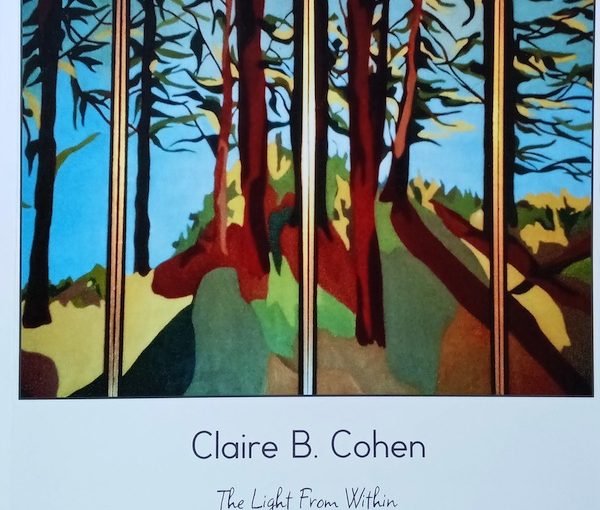
Earlier this year, Claire B. Cohen published a book of her 30-plus years as an artist. She made it for family and friends, as a record of her artistic legacy.

“Art is a powerful and a creative force of self-expression. To create art is to develop an ability to communicate visually what cannot be expressed in words.

“By creating the process of art, we change the way we see the world,” Claire B. Cohen told the Independent. “In understanding ourselves, we find areas where we feel limited. In understanding ourselves, we stand up for ourselves and can present ourselves authentically to others. An artist’s creation is unique and original to their work.”

Earlier this year, Cohen published a slim volume, mainly with images that burst from the pages, outlining her 30-plus years creating art. We glimpse the range of her work – landscapes, portraits, semi-abstracts, flowers, multimedia collages and a compartmental series, in which colourful abstract canvases were “connected sequentially in a zigzag for using piano hinges.” Flow and fun describe this series, her portraits – both colour and black and white – capture the personalities of her subjects, her landscapes and collages are bold and full of movement but also balance. The book touches on her work as an art therapist.

Originally from Israel, Cohen came to Canada in 1964. She studied fine arts at York University in Toronto and the University of Ottawa, and later earned her master’s in art therapy and counseling from U of O in 1987. She had many solo exhibits and group shows in Ottawa, and elsewhere, over the years. The book takes readers to 2006, with an exhibit list to 2009. She moved to Vancouver in 2012.

“I continued to paint after moving to Ottawa, but my move to Vancouver changed my focus, since joining my family had taken much of my time, being richly involved with newborn grandchildren,” said Cohen. “However, I still continued painting and showing new work in Vancouver galleries, as well as donating paintings to different organizations in Vancouver, such as hospitals, Louis Brier [Home and Hospital], friends, and creating more collages and multimedia-based work. I participated in group art shows and sold some to the public.”

Cohen said her reason for producing the book “was to create a place to keep all of my art as a legacy to leave to my family in remembrance of my story. COVID times were affecting my spirit, my mood was down and … the idea came about to focus on creating the book for my family and friends.”

During the pandemic, Cohen said she started to lose her connection to creativity. 

“Friends cut off from each other, as much as children and family,” she said. “I slowly lost my energy and interest, as well as the need I once had to be close to my easel. The paints, the brushes, the colours all lost their meaning and the need I had to paint slowly deteriorated.”

She began to look back at her past, which, she said, “led me to wake up from my dormancy and questions such as ‘what is my meaning of life?’ I discovered my paintings in storage and wanted to create a book.

“I reflected further on my body of work and questioned: why did I dedicate my years to painting? Was there any purpose to it? The answer eventually arrived – yes. There are many purposes to be alive, and work as an artist, investing my life in art. In my case, most of it was to leave a memory to my next generation.”

Cohen’s most recent exhibit and sale was at Britannia Community Centre in 2021. Art can be cathartic, whether one is making it or experiencing it.

“The process of creating art has a great intensity and full force of emotions that lead to a freedom and release when the piece is complete,” she explained. “Looking at these pieces that I created many years ago leads to a sense of nostalgia and a softening of that intensity. These pieces have followed me through many moves and lives, and have a story of their own that has evolved with the emotions that once created them. The language of art cannot be explained in words, the language of these emotions is form, line, colour and brush strokes.”

This language can help heal, as Cohen well knows from her art therapy practice.

“The more we know about ourselves, the more we learn to grow and develop our abilities to stand our ground,” she said.

Describing art as “a powerful and unique way to explore our creative forces,” she explained that people who participate in art therapy use the “materials to express the self and communicate visually,” composing stories. In a group setting, they “collaborate and share with others … connect and integrate parts of his/her inner self, gain confidence and reduce stress in a supportive environment, with the aid of the instructor.”

It was both a dream and a need for Cohen to do art therapy and counseling.

“I realized that art is not just for selling and decorating homes, rather it was a way to find myself, to grow and see who I am, and to help others with their healing.”

To see Cohen’s body of work, go to clairebcohen.wixsite.com/portfolio/home.

Format ImagePosted on December 23, 2022December 22, 2022Author Cynthia RamsayCategories Books, Visual ArtsTags art, art therapy, Claire Cohen, family, health, memoir, painting
Lights shine united at RJDS

Lights shine united at RJDS

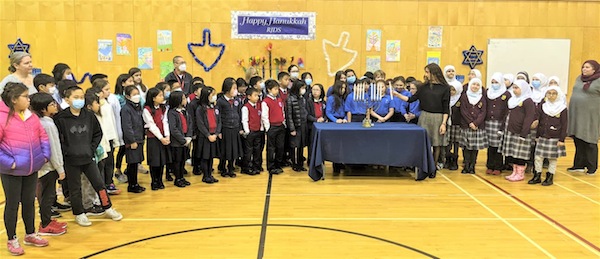
On Dec. 12, Richmond Jewish Day School hosted Cornerstone Christian Academy, Richmond Christian School and Az-Zahraa Islamic Academy. (photo from RJDS)

For the second year in a row, Richmond Jewish Day School hosted a holiday celebration at the school to promote community care, empathy and understanding.

On the morning of Dec. 12, the Shine a Light project saw three schools joining RJDS to share their winter traditions. The posting on RJDS’s Facebook page reads: “Cornerstone Christian Academy made 3-D stars to signify the star of Bethlehem, Az-Zahraa Islamic Academy made lanterns to represent light in Islam, Richmond Christian School made a stained-glass craft and talked about the advent season and, finally, our school taught the others how to play the dreidel game! We all have a role to play. Today, we dispel the darkness on antisemitism and hatred.” 

“Last year, we did an evening event during Hanukkah called A Celebration of Light and invited members of the Highway to Heaven community,” RJDS principal Sabrina Bhojani told the JI.

The No. 5 Road area in Richmond, which is home to RJDS, is also home to some 20 different religious and/or cultural institutions, hence the moniker “Highway to Heaven.” Richmond Mayor Malcom Brodie and Ezra Shanken, chief executive officer of Jewish Federation of Greater Vancouver, were among the attendees last year – and this year – along with several city councilors and others.

“This year, we changed the name and format to create a more kid-friendly celebration, and invited various schools to attend,” said Bhojani. “Activities of the students included those that showcased their personal winter-themed traditions and included singing and arts and crafts.”

photo - This year's Hanukkah celebration featured several activities for the kids
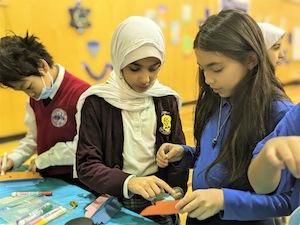
This year’s Hanukkah celebration featured several activities for the kids. (photo from RJDS)

The Shine a Light program was made possible by a grant from the Jewish Federations of North America, said Bhojani.

In addition to her land acknowledgement on Dec. 12, Bhojani said, “We also acknowledge the Elders, the keepers of traditional knowledge, wisdom and Indigenous ways of knowing. We have much to learn about resilience and responsibility. We commit to asking questions, being open to learning from others and acknowledging that that which we do not know.

“We also commit to make the community we share with you a more peaceful, loving and safe place through the First Peoples’ principles of learning.”

photo - kids doing arts and crafts
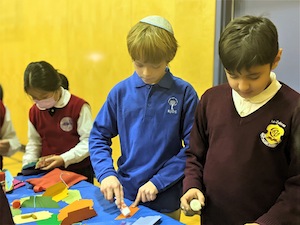
(photo from RJDS)

With regard to the day’s program, she said, it was “designed to help each of us develop our understanding and respect for one another’s faith and culture while growing in appreciation, understanding and commitment to our own faith traditions and their meanings. We hope that, through education and events like this one, we will collaboratively encourage people to work together, sharing the responsibility for addressing stereotyping, prejudice, racism, discrimination, antisemitism and social exclusion.”

She noted, “Today, as we gather together, we celebrate the unity and the unique religious coexistence of where we live. I hope you are reminded that is up to each and every one of us to be a ‘Shine a Light’ in the darkness of racism and discrimination.”

One parent who saw the event photos on Facebook wrote Bhojani an email. Having experienced antisemitism, they wrote: “What RJDS is teaching, its values, and [the] education the children are receiving, it’s world changing. It’s hope. It’s proof of a better future.”

Format ImagePosted on December 23, 2022December 22, 2022Author Cynthia RamsayCategories Celebrating the Holidays, LocalTags diversity, Hanukkah, Highway to Heaven, interfaith, RJDS, Shine a Light
Measure of a community

Measure of a community

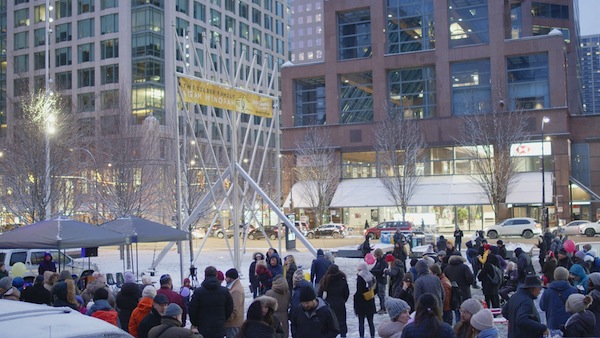
Several hundred people came to the Vancouver Art Gallery Plaza to participate in the annual lighting of the Silber Family Agam Menorah. (photo by Lior Noyman Productions)

In some places in the world, the sun shines on Hanukkah. It’s warm and inviting, and people gather at the lighting of a public menorah. But the real measure of a community is when hundreds turn out despite the cold and snow, to celebrate Hanukkah in a spirit of camaraderie and festivity. Such was on the first night of Hanukkah in Vancouver, when several hundred people came to the Vancouver Art Gallery Plaza to participate in the annual lighting of the Silber Family Agam Menorah.

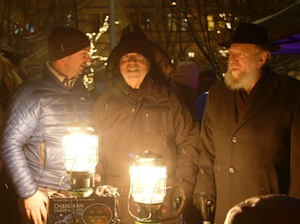
photo - Left to right: Ezra Shanken, Arnold Silber and Rabbi Yitzchak Wineberg try to keep warm at the lighting of the Silber Family Agam Menorah Dec. 18
Left to right: Ezra Shanken, Arnold Silber and Rabbi Yitzchak Wineberg try to keep warm at the lighting of the Silber Family Agam Menorah Dec. 18. (photo by Lior Noyman Productions)

Members of Parliament, of the legislature and of city council brought greetings from their respective governments. The current patriarch of the Silber family, Arnold Silber, delayed his vacation to warmer climes in order to be at the ceremony. His son, Steven Silber, spoke on behalf of the family, and noted that this year marked exactly 95 years since the family’s former patriarch, the late Fred Silber, landed in Canada from his native Poland, with almost nothing to his name. He built a beautiful family and a legacy to the Jewish and wider community.

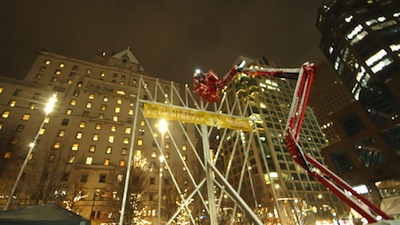
photo - Lighting of the Silber Family Agam Menorah Dec. 18
Lighting of the Silber Family Agam Menorah Dec. 18. (photo by Lior Noyman Productions)

Rabbi Yitzchak Wineberg, executive director of Chabad Lubavitch of British Columbia, noted in his short address that the lesson of Hanukkah did not lose its impact on Fred Silber. The Maccabees were very small in number, against a mighty army of the Assyrian Greeks, who were well versed in the art of war. Hanukkah teaches us never to be deterred by challenges. Fred Silber may have arrived here with little but he left this world having left much for future generations.

Rabbi Dovid Rosenfeld read a letter from the Lubavitch Rebbe (Menachem Mendel Schneerson) z”l that explains the importance and value of public menorah displays, and the attendees enjoyed a choir performed by students of the B.C. Regional Hebrew Schools, of which Rosenfeld is a co-director with his wife, Chaya Rosenfeld.

Chabad Lubavitch BC gratefully acknowledged the support of Arnold Silber in making this event possible.

– Courtesy Lubavitch BC

Format ImagePosted on December 23, 2022December 22, 2022Author Lubavitch BCCategories Celebrating the Holidays, LocalTags Arnold Silber, Dovid Rosenfeld, Hanukkah, Lubavitch BC, Silber Family Agam Menorah, Steven Silber, Vancouver Art Gallery, Yitzchak Wineberg
Celebrating together

Celebrating together

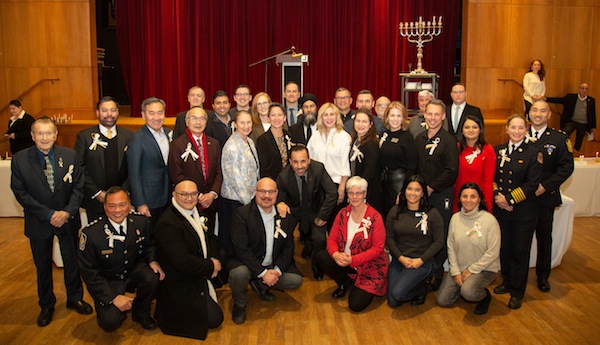
CJPAC and CIJA Dreidels and Drinks reception Dec. 19. (photo by Rhonda Dent Photography)

British Columbia’s Jewish community welcomed elected officials, community partners and volunteer leaders to celebrate the second night of Hanukkah at the Jewish Community Centre of Greater Vancouver for the CJPAC and CIJA Dreidels and Drinks reception.

The Canadian Jewish Political Affairs Committee is a national, independent, multi-partisan nonprofit. Its mandate is to engage Jewish and pro-Israel Canadians in the democratic process and to foster active political participation. It is dedicated to helping community members build relationships within the Canadian political arena. 

The Centre for Israel and Jewish Affairs is the advocacy agent of Jewish federations across Canada. CIJA represents the diverse perspectives and concerns of more than 150,000 Jewish Canadians affiliated with their local Jewish federation. As the Canadian affiliate of the World Jewish Congress, representative to the Claims Conference and to the World Jewish Restitution Organization, CIJA is also connected to the larger organized Jewish community. 

The annual CJPAC-CIJA Hanukkah soiree drew a diverse crowd of attendees, including multi-partisan representation across federal, provincial and municipal governments, members of the diplomatic corps, Vancouver Police Department, Vancouver Fire Rescue Services, and guests from civil society, who lit their own menorah at the front of the room while Rabbi Philip Bregman, interfaith liaison for the Jewish Federation of Greater Vancouver and the Rabbinical Association of Vancouver, officiated the candlelighting ceremony. 

PJ Library books were sent home with elected officials, along with a menorah, candles and chocolate gelt for their home/office. 

With the help of various community members and partners, the event highlighted how CJPAC and CIJA work together to create meaningful experiences for the Jewish community. To see photos from the celebration, visit CJPAC and CIJA’s social media pages or contact [email protected] or [email protected] anytime for more information. 

– Courtesy CJPAC & CIJA

Format ImagePosted on December 23, 2022December 22, 2022Author CJPAC & CIJACategories Celebrating the Holidays, LocalTags Canadian Jewish Political Affairs Committee, Centre for Israel and Jewish Affairs, CIJA, CJPAC, Hanukkah

Community milestones … Daysons, Diamonds, Keils & Altman

On Dec. 14, JWest announced a $5 million gift from the Dayhu Group of Companies in association with the Ben and Esther Dayson Charitable Foundation. The visionary gift is part of a match that was initiated by the Diamond Foundation’s historic $25 million gift to support the development of the new Jewish Community Centre of Greater Vancouver site.

The Daysons have a long and significant history within Vancouver’s Jewish community. Ben and Esther Dayson both immigrated to Canada from Russia in the 1920s. In 1936, the couple was married in the original Jewish Community Centre in Vancouver, located on Oak and 11th. First settling in Saskatchewan, they moved with two small children to Vancouver in 1949. After a short time running a “15 cent store” in Marpole, Ben Dayson founded Dayhu Investments, which later became a leading real estate investment, development and property management company. The generations that followed Ben and Esther (née Nemetz) have carried on their parents’ and grandparents’ legacies, becoming successful in their own rights and continuing to give back to the community.

Shirley Barnett (née Dayson) and her brother, Philip Dayson, have fond memories of attending the JCC. As teenagers, they attended high school dances, went to youth group meetings, and learned the importance of volunteerism and giving back, all through spending time at the JCC. 

“Fundamentally, we believe that the Jewish Community Centre plays an integral role in an inclusive and healthy Jewish community, and it will provide a welcoming social, cultural, recreational and educational asset for all to enjoy,” said Barnett. “Our family has long appreciated the celebratory and community aspects of the Jewish Community Centre. The JWest project is the most important undertaking in the history of this region, and we hope that our gift inspires others to contribute to this space that will be a critical resource for thousands of people of all ages and from all walks of life.”

JWest is a partnership between Jewish Federation of Greater Vancouver, the Jewish Community Centre of Greater Vancouver and King David High School. The project will deliver a community centre with expanded space for the Vancouver Holocaust Education Centre, a new theatre and, in the second construction phase, a relocated high school and two residential towers that will provide mixed-use rental housing.

“It was the desire of our parents to support those both within the Jewish community and those in the wider community,” said Philip Dayson. “The Jewish Community Centre is not only the heartbeat of Jewish life in Vancouver, but it also continues to have an inclusive atmosphere that welcomes all. We are particularly thrilled that this project will bring much-needed social housing along with vital programs and services. We’re privileged to be able to support this community and this transformative project.”

“The Dayson family have been pillars in Vancouver’s Jewish community for more than three generations and, through this generous gift, they have demonstrated their continued commitment to Jewish life in Vancouver,” said Alex Cristall, JWest capital campaign chair. “We gratefully acknowledge the support this project has received from the Government of British Columbia, the Government of Canada and community members for this once-in-a-lifetime project.”

For more information about JWest, visit jwestnow.com/about.

***

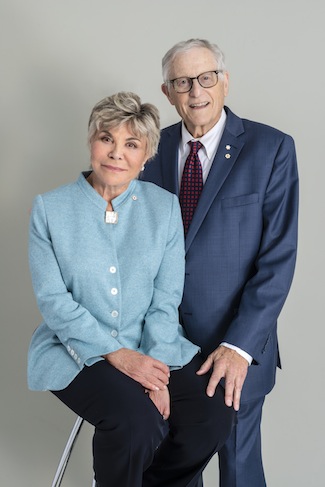
photo - Leslie and Gordon Diamond
Leslie and Gordon Diamond (photo from Jewish Federation)

Gordon and Leslie Diamond will receive the 2023 Yakir Keren Hayesod Award in recognition of their committed leadership and unwavering devotion to Israel and to Keren Hayesod through their generosity and leadership with the Jewish Federation of Greater Vancouver.

The Yakir Award – Keren Hayesod’s highest honour – is bestowed upon individuals whose sense of mission, dedication and perseverance on behalf of their homeland and their nation have made an outstanding, long-term contribution to the state of Israel, the Jewish people and Keren Hayesod. The Hebrew word yakir means beloved, notable, worthy and, accordingly, the Yakir Award reflects the ultimate devotion and clarity of vision that a community leader can show. 

Jewish Federation nominated the Diamonds for the honour and this is the first time in two decades that a Western Canadian leader has been selected for it. The official ceremony will take place in Israel on the country’s 75th anniversary of independence.

***

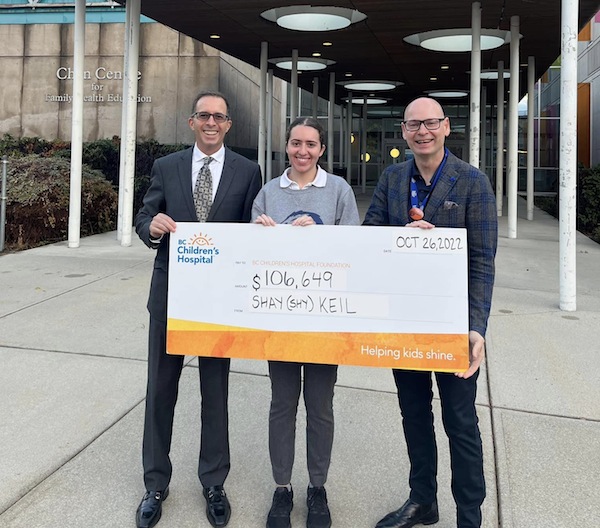
photo - Shay Keil and his daughter Tali Keil presented a $106,649 cheque to B.C. Children’s Hospital Foundation chief executive officer Malcolm Berry in late October
(photo from Facebook)

Shay Keil and his daughter Tali Keil presented a $106,649 cheque to B.C. Children’s Hospital Foundation chief executive officer Malcolm Berry in late October. It was Keil’s second annual 30/30/30 campaign, marking his 30-plus years with Scotiabank and the goal of raising more than $30,000 by Sept. 30. He thanked other donors and the Keil Investment Group team: Angela Wadsworth, Vilma Castellani, Claire Brinkworth and Lydia Leung. In November, Keil was chosen by the Globe and Mail Report on Business as one of the 2022 Canada’s Top Wealth Advisors: Best in Province.

***

The national board of directors for Ben-Gurion University Canada (BGU Canada) has announced that

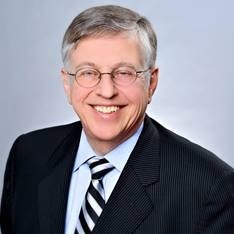
photo - Jack Altman
Jack Altman (photo from BGU Canada)

 is the new national president. He brings a wealth of volunteer leadership experience to his new role, plus a deep passion for philanthropy in the Canadian Jewish community.

Altman is the immediate past president of the Montreal chapter of BGU Canada, where he served for four years. He currently sits on the board of governors of Ben-Gurion University of the Negev and is the vice-president of La Société pour les Artistes en Milieux de Santé. He has been involved with many other organizations over the years.

Altman practised as a CPA for 50 years. He retired from his role as partner at Crowe BGK, where he remains as a consultant, and is the president of J. Altman Investments Inc.

BGU Canada thanks Mitchell Oelbaum, immediate past president, for his passionate service and unwavering commitment to the university.

Posted on December 23, 2022December 22, 2022Author Community members/organizationsCategories Local, NationalTags awards, B.C. Children’s Hospital Foundation, Ben Dayson, Ben-Gurion University Canada, BGU, development, Esther Dayson, Gordon Diamond, Jack Altman, Jewish Federation of Greater Vancouver, JWest, leadership, Leslie Diamond, philanthropy, Philip Dayson, Shay Keil, Shirley Barnett, Tali Keil

Charges are withdrawn

A criminal charge against the Canadian arm of an Israel-based organization that provides volunteers for the Israel Defence Forces (IDF) has been withdrawn because there was no reasonable chance for a conviction.

On Dec. 12, the Public Prosecution Service of Canada (PPSC), which assumed carriage of the case, withdrew a charge that Sar-El Canada violated the Foreign Enlistment Act, which prohibits Canadians from enlisting in or accepting any “commission or engagement” in the armed forces of a foreign country. The charge was withdrawn because there was “no reasonable prospect of conviction,” Sar-El Canada’s lawyer, John Rosen, told the CJN. “The case is now completed.”

The charge was approved in September by a justice of the peace in a private prosecution initiated by David Mivasair, a Hamilton, Ont.-based rabbi with a long history of activism targeting Israel, and Rehab Nazzal, a Palestinian-born, Toronto-based artist who was shot in the leg in Bethlehem in 2015 while photographing an IDF crowd control weapon. They alleged that Toronto-based Sar-El Canada broke the law because it recruited or induced individuals to volunteer for Israel’s armed forces. They further alleged that, once in Israel, volunteers reside on military bases, wear military uniforms and complete tasks that would otherwise be assigned to soldiers; those allegedly included packing food rations and medical kits, cleaning tanks, painting helmets, radio repairs and gas mask refurbishment.

In a statement, they said the “recruitment” in Canada of volunteers “to assist the Israeli military ought to be a concern of all Canadians.” They began a private prosecution after they said police and the federal government failed to act on a complaint.

Sar-El Canada sends 100 to150 volunteers a year from this country to Israel, the group’s national president, Jeff Sarfin, told the CJN when the matter began.

In a statement to the CJN, Sarfin said Sar-El Canada is “very pleased” that the charge was withdrawn. He said the “attempt by anti-Israel activists to intimidate us and the Jewish community has failed. We are also grateful to the support we have received from the Jewish community as we deepen and strengthen the connection between our community and Israel.”

Rosen echoed the sentiment. The complaint “was merely another failed attack on Israel and those who support it, this time by attempting to hijack Canada’s legal system,” he said. He said the charge should never have been authorized and agreed with the prosecution that there was never a reasonable prospect of conviction.

“More importantly,” Rosen added, “the prosecution of this baseless complaint would also have been against the public interest, given Canada’s implicit approval of similar activities that directly support Ukraine’s defence against Russia.”

Ukraine has openly called for soldiers from around the world to join the fight against Russia. Ukraine’s consul general in Toronto was recently quoted as saying that “hundreds” of Canadians got in touch to offer assistance.

Sar-El Canada’s parent organization in Israel was established 40 years ago. It operates in more than 30 countries and has to date sent some 160,000 volunteers to Israel to provide “broad logistical support to the IDF,” its website says. Volunteering takes place on IDF bases throughout the country.

Programs offer volunteers “an opportunity to live and work beside Israeli soldiers and gain an insider view of Israel.” Working alongside soldiers and base employees, the “non-combat civilian support duties” encompass packing medical supplies, repairing machinery and equipment, and cleaning, painting and maintaining the base. The Sar-El program “is a morale booster and motivator for the soldiers,” the group’s website states.

In a hearing in September before the justice of the peace who approved the charge against Sar-El Canada, Mivasair testified that, to the best of his understanding, the Foreign Enlistment Act prohibits recruiting people for “non-combatant engagements” with foreign armies.

Asked for a comment and whether an appeal is being considered, Shane Martinez, a lawyer for Mivasair and Nazzal, told the CJN: “We disagree with the decision of the Federal Crown and are exploring all available options.”

Two years ago, a campaign launched by progressive groups and 170 prominent Canadians alleged that illegal recruiting for the IDF of non-Israeli citizens was taking place in this country. Justice Minister David Lametti was asked to investigate. He referred the matter to the RCMP.

– For more national Jewish news, visit thecjn.ca. 

Posted on December 23, 2022December 22, 2022Author Ron Csillag The CJNCategories NationalTags David Mivasair, IDF, Israel Defence Forces, Jeff Sarfin, John Rosen, law, Rehab Nazzal, Sar-El Canada

Claims of speech suppression

Independent Jewish Voices Canada recently released the report Unveiling the Chilly Climate: The Suppression of Speech on Palestine. It was compiled by Dr. Sheryl Nestel and Rowan Gaudet for IJV Canada.

Nestel is a retired sociology professor from OISE (Ontario Institute for Studies in Education), University of Toronto, and Gaudet is a master’s student at the University of Bologna in the global cultures program; he has done research for IJV in the past. The text below is from their report’s executive summary.

Focused on the Canadian context, the report seeks to shed light on the wave of suppression of speech regarding Palestine that is sweeping North America and parts of Europe. It documents the impact of reprisals, harassment and intimidation faced by Canadian activists, faculty, students and organizations in relation to scholarship and activism in solidarity with the struggle for Palestinian human rights. There is a connection to be made here between these attacks and efforts by pro-Israel advocacy groups to market the International Holocaust Remembrance Alliance Working Definition of Antisemitism (IHRA), a document that has come under vigorous attack by defenders of academic freedom and Palestinian human rights. While its proponents argue that this definition will not threaten freedom of expression or inhibit criticism of Israeli policies, the findings of this report demonstrate that these basic rights are already under threat and could be further imperiled if the IHRA were to be widely adopted.

The contribution of this report is two-fold: 1) the amount and quality of information gathered here is unprecedented and speaks to the worrisome prevalence of harassment and suppression of speech on Palestine on campuses and in Canadian civil society and 2) it surpasses a simple documentation of instances of repression by employing an ethnographic methodology to analyze the so-called “chilling effect” and its impact on governmental, institutional and individual decision-making. This research project situates itself firmly within the realm of critical qualitative inquiry, which seeks to employ qualitative research for social justice purposes, including making such research available for public education, social policy formulation and the transformation of public discourse. The inquiry is also shaped by decolonizing methodologies of social science research, which seek to challenge institutions, academic and otherwise, which prioritize colonial forms of knowledge production and maintain institutional commitments that impede indigenous self-determination. Finally, Nestel and Gaudet follow the directives proposed by queer, feminist and antiracist research methodologies, which entreat people to consider how their positions in social hierarchies of race, class, sexuality and citizenship mediate their experiences.

In all, the researchers collected 77 testimonies from 40 faculty members, 23 students, seven activists and seven representatives of organizations. Testimonies were collected from participants in Ontario, Manitoba, British Columbia, Saskatchewan, Nova Scotia, Quebec and Alberta. Among the academics responding were representatives of 11 disciplines from 21 Canadian universities.

Interviewees recounted that their experiences included political intervention into hiring; attempts to prevent access to event venues; and the attempted cancellation of public events on Palestine, as well as targeting and doxing, including the inclusion of 128 Canadian academics and activists on the website of Canary Mission, an organization that purports to document “individuals and organizations that promote hatred of the U.S., Israel and Jews on North American college campuses.” Threats of violence and genuine acts of violence were experienced by student activists and these often contained racial and sexual slurs including threats of sexual violence. Students were subject to warnings and disciplinary measures by university administrators whom respondents often described as being hostile to Palestine solidarity activism on campus. Faculty respondents reported restrictions on academic freedom, self-censoring of expression on Palestinian human rights, discriminatory treatment by academic publishing platforms, harassment by pro-Israel advocacy groups and media outlets, attacks from colleagues, political interference by university administration, classroom surveillance by pro-Israel student groups, and anti-Palestinian and anti-Arab racism. Indeed, the suppression of speech on Palestine has significant consequences in academia, where it threatens principles of academic freedom and encourages surveillance of critical intellectuals and activists and of the oppositional knowledge that they produce. 

As the research by Nestel and Gaudet reveals, the precarious employment conditions of more than half of Canada’s university teachers mean that, because of the “chilly climate” around speech on Palestine, untenured or pre-tenure faculty are reluctant to pursue academic or activist work in this area for fear of endangering contract renewals or future career prospects including access to publishing platforms so central to the academic tenure and promotion process. 

Unsubstantiated allegations of antisemitic intent and support for terrorism are commonly leveled against pro-Palestine academics and activists. Significantly, Palestinians, Muslims and non-Arab racialized participants appear to have borne the brunt of direct attacks on their scholarship and activism. The emotional impact of harassment and suppression was felt most acutely by Palestinian students and faculty interviewed. Jewish activists were not immune to attack and were often characterized by opponents as “kapos” or “self-hating Jews.” 

The report also documents how both on- and off-campus Israel-advocacy organizations have been at the forefront of efforts to suppress speech and activism on Palestine. As University of Pennsylvania political scientist Ian Lustick has argued, the pro-Israel organizations have constituted a “vigilante” force, which has made it “increasingly difficult to criticize Israel without fear of lawsuits, accusations of antisemitism, demands for political balance in staging of events, blacklisting of participants, or other forms of personal or institutional harassment.”

This report signals that an atmosphere of repression and recrimination related to discourse and activism around Israel/Palestine is ubiquitous and insidious and should be unacceptable in a democratic society.

To download a copy of the full report, visit ijvcanada.org/unveilingthechillyclimate.

– Courtesy Independent Jewish Voices Vancouver

Posted on December 23, 2022December 22, 2022Author Independent Jewish Voices VancouverCategories NationalTags free speech, Israeli-Palestinian conflict, survey

Posts pagination

Previous page Page 1 … Page 150 Page 151 Page 152 … Page 667 Next page
Proudly powered by WordPress