Vancouver Police last week arrested a woman for praising the Oct. 7 terrorist attacks. The woman, who multiple reports say is Charlotte Kates, a leader in a group called Samidoun Palestinian Prisoner Solidarity Network, was later released as police develop their case to present to the Crown for possible charges.
News of the arrest was met with a level of satisfaction among Jewish community organizations. Kates and Samidoun have been sources of outrage and concern for years. The group is routinely described as having “direct ties to the Popular Front for the Liberation of Palestine (PFLP),” which is designated as a terrorist entity under the Criminal Code of Canada. Canadian Jewish organizations have called for Samidoun to receive a similar censure – as it has in Germany, where it is a banned organization, and in Israel, where it is designated as a terrorist entity.
Kates, a British Columbia woman who is married to Khaled Barakat, a senior member of the PFLP, was arrested in relation to recorded statements made outside the Vancouver Art Gallery last month. There, she referred to several terrorist organizations as heroes and described the Oct. 7 attacks as “the beautiful, brave and heroic resistance of the Palestinian people.” She led a crowd of hundreds in chants of “long live Oct. 7.”
Emergence of the video led to absolute condemnation from BC Premier David Eby.
“Celebrating the murder, the rape of innocent people attending a music festival, it’s awful,” said the premier. “It’s reprehensible, and it shouldn’t take place in British Columbia. There is clearly an element of some individuals using an international tragedy to promote hate that’s completely unacceptable.”
Kates is banned from participating in public protests for five months, according to a statement released by Samidoun. An investigation is underway and it will be up to Crown prosecutors to determine whether charges are laid and the case goes to trial.
In announcing the arrest, Vancouver police spokesperson Sgt. Steve Addison explained the line police walk.
“We defend everyone’s right to gather and express their opinions, even when those opinions are unpopular or controversial,” said Addison. “We also have a responsibility to ensure public comments don’t promote or incite hatred, encourage violence, or make people feel unsafe. We will continue to thoroughly investigate every hate incident and will pursue criminal charges whenever there is evidence of a hate crime.”
The arrest comes as the federal government begins a process of reviewing Canada’s approach to hate-motivated expression. New legislation beginning its way through the wending process of Parliament is focused especially on “online harms” and involves a multi-pronged approach that would see amendments to the Criminal Code, the Canadian Human Rights Act and new laws addressing cyber-bullying, “revenge porn,” encouragement of self-harm and other actions.
The bill (click here for story) is part of an ongoing effort to address the social and technological challenges of hate-motivated crimes, as well as the range of dangers presented to children and others by online predators, bullies and extortionists.
The federal government’s efforts, long delayed and inevitably controversial, are part of an age-old effort to walk a line between the right to free expression, on the one hand, and the right, on the other hand, for people to be free from harassment and threats based on personal identity or other factors. Any discussion of balancing these contending rights – which is anything but an exact science – is destined to disappoint or anger people on both sides.
The next steps in the current legal investigation – whether it proceeds to criminal charges and, if so, how the case proceeds and concludes – will also not satisfy everyone, if anyone. Indeed, it is a factor of this sort of case almost exclusively where many argue the challenging position that, in the words of Voltaire, “I disapprove of what you say, but I will defend to the death your right to say it.”
Few today would defend to the death the right of anyone to glorify Oct. 7 (or anything else, probably), but the point is that the right of free expression is considered by many to be sacrosanct. This has always been a core differentiator between our society and that to which we so often compare ourselves, the United States, whose constitution prioritizes precisely this sort of freedom.
An absolutist position is much easier for courts to adjudicate. Drawing lines in moral conundrums is a much more challenging undertaking.
As we watch this one case proceed locally, we will also be carefully observing the broader, legalistic and philosophical disputations occurring in Parliament as Bill C-63 proceeds through the creation process. The outcome, in both instances, will be necessarily imperfect. The hope is that they should be as just as human endeavours can be.
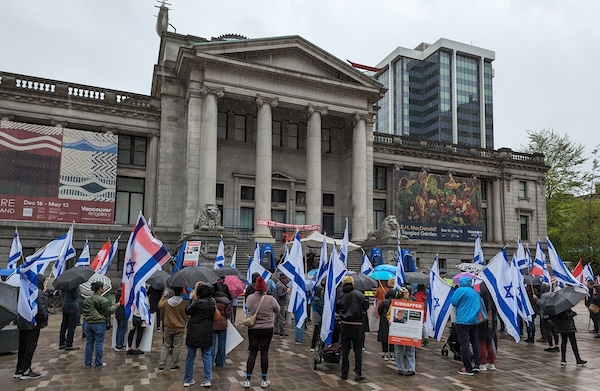
The rally for the hostages at the Vancouver Art Gallery on May 5. (photo by Pat Johnson)
The weekly rally for the hostages at the Vancouver Art Gallery carried added resonance Sunday, May 5, hours before the world marked Yom Hashoah. Myer Grinshpan, a survivor of the Holocaust, spoke, as did his son, Roy Grinshpan. Anna Mae Wiesenthal, a scholar of the Holocaust, and Stephen Lowy, whose father, Leo Lowy, was a “Mengele twin,” also spoke. Rabbi Yitzchok Wineberg, Vancouver’s longest-serving rabbi, shared reflections on the Holocaust and current events and recited the Mourner’s Kaddish.
A federal bill to address online harassment, bullying and hate has aspects to admire and others to cause concern. What happens in the committee process will determine the success of the proposed law.
That is the take of two experts – including one who had a hand in drafting the legislation. The devil, as always, is in the details of balancing free expression with the right to be free from threats and harassment.
Dr. Michael Geist, the Canada Research Chair in Internet and E-commerce Law at the University of Ottawa, who also serves on the advisory board of the Electronic Frontier Foundation, was joined in a recent online panel by Dr. Emily Laidlaw, Canada Research Chair in Cybersecurity Law and associate professor in the faculty of law at the University of Calgary. Her recent work includes projects on online harms, misinformation and disinformation, and she co-chaired the expert group that advised the federal government on the development of the Online Harms Bill, which is known as Bill C-63. The virtual panel, on April 17, was presented by the Centre for Israel and Jewish Affairs and moderated by Richard Marceau, CIJA’s vice-president, external affairs, and general counsel. More than 850 people registered for the event, indicating what CIJA board chair Gail Adelson-Marcovitz indicated is a depth of interest, and perhaps concern, about the bill.
Geist explained that the new bill is a result of years of work, following the federal government’s withdrawal of an earlier attempt at addressing the problem of online harms.
Bill C-63 is really three separate concepts rolled into one. It would amend the Canadian Human Rights Act and the Criminal Code, as well as introduce a new Online Harms Bill. Together, the components would codify currently inconsistent approaches to the problems.
The bill would redefine “hatred” in the Criminal Code and define a new crime of “offence motivated by hatred.” That offence, as well as advocating or promoting genocide, could lead to life imprisonment.
Amendments to the Canadian Human Rights Act would add the “communication of hate speech” via the internet or other telecommunication technology as a discriminatory practice. Individuals would be empowered to bring a complaint before the Canadian Human Rights Commission, which could penalize offenders up to $50,000. The law, if passed, would affect public communications, like social media posts, not private messaging or emails.
Separate components of the bill would make it easier and quicker to address specific offensive content, such as “revenge porn” and posts that could harm children, encourage suicide or bullying or otherwise endanger young people.
A digital safety commissioner and ombudsperson would help guide individuals through the process of dealing with bullying or other issues related to the law.
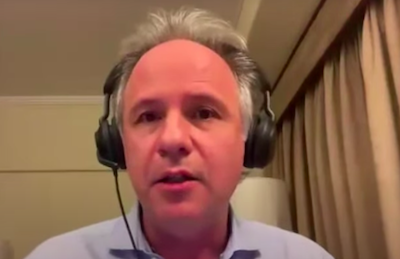
On April 17, Dr. Michael Geist of the University of Ottawa spoke as part of a CIJA panel discussion on the Online Harms Bill. (screenshot)
Geist said many legal experts who seek to balance freedom of speech with freedom from abuse “breathed a sigh of relief” after the federal government abandoned earlier efforts and relied for the new bill on expert advice.
“It’s a pretty good starting point,” Geist said. “We know the broad brushstrokes of what that might include but there is a lot of uncertainty still, so it’s easy to like it when we don’t know the specifics.”
Geist and Laidlaw agreed on most points but had some differences around oversight. Geist said the bill appears to grant enormous powers to a new digital safety commissioner. The idea of life imprisonment for an online comment, he added, may be a sticking point. “I find that hard to justify,” he said.
Laidlaw said the new office of ombudsperson is an important step in helping individuals navigate online hate and harassment. The ombudsperson would be able to pass specific information on to the digital safety commission, whose mandate includes education and research supported by a digital safety office.
The bill would also place new obligations on corporations that run online platforms, like social media companies. At present, Laidlaw said, some companies, notably X (Twitter), are not taking the problem very seriously.
While Jewish advocacy organizations have long advocated for legal responses to hate speech, Geist warned of a double-edge sword.
“Could somebody who is supportive of Israel will be accused of promoting genocide?” he asked.
Geist upended the binary assumption of harassment and free expression, noting that the idea that limits on hate speech could chill expression ignores the existing, difficult-to-measure effects of online (as well as offline) harassment and bullying.
“There is already a chilling effect for anyone in our community and, frankly, in a number of communities, that speaks out on these issues,” he said. “The backlash that you invariably face causes, I think, many people to [reconsider] whether they want to step out and comment, and it’s not just online. There’s a chilling effect offline as well. These issues are very real and many of them will not be solved by legislation no matter what the legislation says.”
He fears a barrage of complaints, many vexatious, from all sides of many contentious issues.
While there is a needle-in-a-haystack challenge in addressing online harms, Geist said, addressing the problematic major players could have a broad impact, though no one believes online hate and bullying can be completely eradicated.
“The legislation talks about mitigating these harms, it doesn’t talk about eliminating them,” he said. Social media platforms, he believes, are looking for guidance on these issues and will be amenable to adhering to legislation. Moreover, he said, Canada’s proposals are somewhat belated responses that would put us roughly in line with the European Union, Australia, the United Kingdom and other jurisdictions.
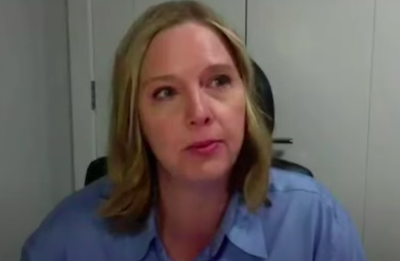
Dr. Emily Laidlaw of the University of Calgary, who joined the CIJA panel discussion on April 17. (screenshot)
The inability to erase hate and harassment is not an excuse to do nothing, Laidlaw said.
“Enforcement has always been an issue,” she said. “But I don’t think it’s a reason not to pass laws.”
Laidlaw took exception to criticism that the new bill would represent government censorship. The proposed digital safety commissioner would be an independent body comparable with the existing privacy commissioner.
“Where there is some risk is in the fact that, in the end, government appoints the individuals,” she said. Still, the appointees would need to be approved by Parliament, not just the government in office.
“And remember,” she added, the commissioner’s “oversight is of companies, not of individuals. They’re not making individual content decisions or holding individuals accountable here.”
The commission would not be subject to legal rules of evidence, making it possible to immediately take down things such as child porn, encouraging suicide or other especially egregious posts.
Geist said this significant power demands that the government spell out more clearly the limitations of the commission.
“At a minimum, it seems to me that it is incumbent on the government to flesh out in far more detail where the limits, where the guardrails, are around the commission, so that we aren’t basically adopting a ‘trust us’ approach with respect to the commission,” said Geist.
Parliament is expected to take up consideration of the bill in committee soon and Laidlaw argued that some aspects deserve speedy passage while others require far more sober consideration.
“The Online Harms Bill could be passed with minor tinkering,” she said. The Criminal Code provisions, she said, give her serious concerns and deserve major revisions or complete scrapping. She also struggles with changing the Canadian Human Rights Act.
Geist agreed on taking the bill apart.
“I would separate out the bill,” he said. Criminal Code and Human Rights Act amendments deserve much deeper consideration, he said. The online harms piece, he said, could be tidied up and passed with tweaks.
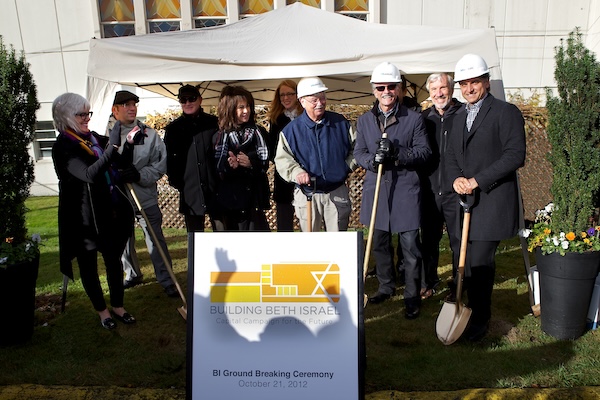
At the 2012 groundbreaking, left to right: Catherine Epstein, Rabbi Jonathan Infeld, Stuart Gales, Sylvia Cristall, Michelle Gerber, Gary Averbach, Sam Hanson, Shannon Etkin and Alfonso Ergas. Obscured from view is Elliot Glassman. (Robert Albanese Photography)
On June 9, Congregation Beth Israel will celebrate the 10th anniversary of its new building at the sold-out Gerry and Ruby Gales Be the Light Gala. The event will honour the synagogue’s visionary leaders – the Lutsky, Gales, Averbach, Cristall, Glassman and Porte families – and the capital campaign’s co-chairs, Gary Averbach, the late Lorne Cristall and the late Hershey Porte, as well as building chair Alfonso Ergas, Burn-the-Mortgage chair Lee Simpson and former BI executive director Shannon Etkin.
“This new building will be built as a place for our synagogue community to grow and thrive,” Lorne Cristall told the Independent in a 2010 interview, as the capital campaign was starting up.
The new building, designed by Acton Ostry Architects Inc., would give the synagogue an east-facing sanctuary (towards Jerusalem), where it used to face north, and allow the congregation to host High Holiday services under one roof. The plan was to raise enough money that there would be little or no mortgage.
“The campaign began for $10 to $12 million plus about $2 to $3 million for an available piece of land on the southeast corner of the property that Shaughnessy Hospital had expressed a strong interest in purchasing,” Gary Averbach told the Independent in an interview earlier this week. “Even then, while running the numbers, it became quite difficult to see how … we could reach the $10 million mark, let alone the $12 million one.”
That became even more concerning, he said, once the designs were costed out, and the final tally was going to be closer to $18 million.
But the visionary donors being honoured, and many others, gave “unexpectedly generous gifts,” said Averbach, thanking Simpson and Bette-Jane Israels for their help raising the funds, and to Etkin, “who took over after we got the initial pledge.”
Averbach said, “Although we had been incredibly successful in our fundraising, having reached close to $20 million on the day we opened, the final price tag looked to be just over $25 million, and the lot had still not been sold.”
Etkin had found a potential buyer, but, when that deal looked as if it would collapse, Averbach called Gordon Diamond, who had earlier expressed interest in buying the land for possible Vancouver Talmud Torah expansion. It was a long process, said Averbach, “but, finally, thanks to Gordon and Leslie Diamond’s insisting that they find a way, the deal was done.
“There was a final Burn the Mortgage campaign with Lee, Bette-Jane and me. And, under Shannon’s leadership, we were able to pay off all but a little over a million dollars of the final cost of just over $25 million. I believe all that debt has been paid off now.
“An important note is that, of the almost $22 million raised, only two donations, totaling $118,000, came from non-members – and both those had a family history at the BI,” added Averbach.
“I suppose I could talk about all the important roles the Beth Israel synagogue, our shul, my shul, plays in our community, in our personal lives and in our spiritual lives,” Gerry Gales told the Independent about why he and his wife Ruby stepped up. “The answer is not complicated. There was a need. I was asked. I said yes. There was never a second thought in my mind. I do believe we are all here to help one another, to do what we can with what we have.”
He said, “Ruby and I find great comfort in being in our house of worship, our shul…. We know that we are a part of a great tradition, with roots that were planted thousands of years ago. It’s a tradition that will continue long after we are gone. When I think of all the people who have gathered together under this roof, I feel that I am but a small part of something so much larger than me and I feel that I am never alone.
“Then there is the practical role the shul plays in the unfolding of our lives,” he added. “The shul is a place where we come for prayers and to pray, the shul is the place where we can send our children to learn all our traditions and to be educated, the shul is a place where we come to celebrate, where we come to mourn, where we launch our children into adulthood.”
Simpson agrees. “I believe all synagogues play an important part in our Jewish lives. They are a place to gather, pray, gain spiritual renewal, comfort and peace. All so important to our mental and, therefore, physical being – even more important in our world today,” she said. “Plus, they give a sense of community. Seeing familiar faces, sharing a lunch or meal after services, all so important. They are also a place of learning and expanding our knowledge, answer our questions, gain wisdom from others.”
She said it was an honour for her and her husband Bernie to support Beth Israel.
“Beth Israel has been our synagogue for all of our married life – we were married there by Rabbi [Wilfred] Solomon,” she said. “Our children were named there, bat and bar mitzvahs were there and our grandchildren were also named and our grandson’s bar mitzvah has been there, and more to come. I was twice chair of the board of directors and involved in the building campaign.”
As for her involvement in the campaign, Simpson said, “For me, the final straw was at my son’s aufruf [being called to the Torah the Shabbat prior to the wedding]. The auditorium filled with family and friends was also filled with buckets to catch the rain coming in from the roof and windows. We needed more than Band-Aids.”
At the new building’s groundbreaking in 2012, Etkin cited a report from 1988 about a renovation being one of the shul’s “very important priorities.” He spoke about several efforts to move redevelopment forward, with the one that resulted in the new building starting eight years before construction was completed in 2014.
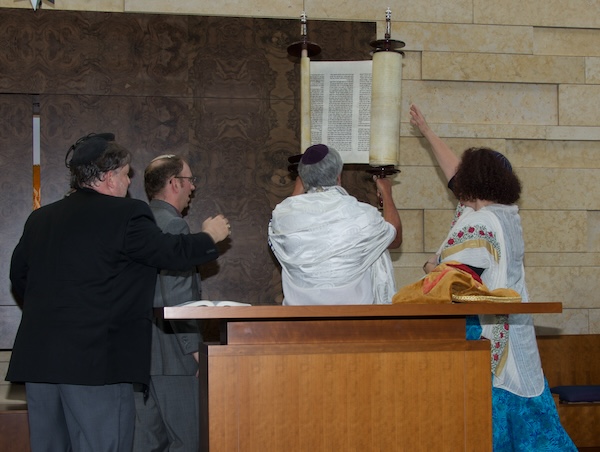
Then Beth Israel executive director Shannon Etkin lifts the Torah during the dedication of the new building in 2014. (Adele Lewin Photography)
Acknowledging that he stood on the shoulders of Cristall and Porte, who “had been involved as co-chairs in various incarnations of the rebuilding of the Beth Israel Synagogue since at least the early 1990s,” Averbach said, “I had always taken an interest in the project, but it wasn’t until I joined the board around 2008 that I started to take an active interest. My interest was based on the fact that the existing building, besides being arguably halachically incorrect, was also in very sad disrepair.”
Cristall and Porte took Averbach out to lunch and asked him to deal with donors under the age of 55.
“After a few days, I agreed, and a couple of weeks later, Hershey passed away, and the ‘triumvirate,’ with me as junior partner became Lorne and me as co-chairs,” said Averbach. “Given Lorne’s serious illness, I knew my job had expanded many times.”
With the help and work of many people, and with the commitment of the congregation, the redevelopment finally happened.
“Since we opened our doors to our new and very beautiful building 10 years ago, we have seen significant increases in every aspect of synagogue life. Our membership is growing, and our program participant numbers have increased,” BI Senior Rabbi Jonathan Infeld, told the Independent. The clergy now includes Assistant Rabbi Adam Stein, Ba’alat Tefillah Debby Fenson and youth director Rabbi David Bluman.
“Since our new building project was completed, it has literally opened many doors for our congregation,” said Infeld. “We have had the blessing of hosting many large community events including this year’s Yom Ha’atzmaut celebration. We have had the flexibility to do many great programs that utilize all our spaces and meet the needs of many different age groups. The High Holidays are a perfect example of when we use almost every inch of the building. We have nearly 2,000 people come to our various High Holiday services each year and the space is a true blessing for all of us.” It also allows for more varied services and programs on Shabbat, said the rabbi.
“We are really looking forward to our sold-out gala this year, which will celebrate a decade of success because of the hard work and dedication of the people who helped make the dream of a new building possible,” he said. “I am so happy that there will be so many people present to say thank you to our visionaries and builders. Jacci Sandler and the gala committee have done a fabulous job already.”
The gala committee is Jennifer Apple, Kerry Benson, Samara Bordan, Chana Charach, Shannon Ezekiel, Shannon Gorski, Carol Konkin, Samantha Levin, Juliette Sandler, Paige Swartz and Leatt Vinegar. Sandler, head of development at Beth Israel and the creator of the Be the Light Gala, spoke with the Independent about this year’s event, which will feature, among others things, a concert by American-Israeli rapper/singer Nissim Black and a menu created by Israeli Chef Yaniv Cohen, owner of restaurant Jaffa Miami, and the Perfect Bite. Howard Blank will be the auctioneer and Sandler’s husband, Brett, will be master of ceremonies – he has a long history of fundraising in the community and chaired the JCC Sports Dinner twice.
For the main act, Jacci Sandler wanted an internationally known Israeli artist. Black fit the bill, and more.
“Not only are Nissim’s songs all about Judaism but they are filled with messages of spirituality, about hope, victory, friendship, belief, admiration, being lifted and much more,” said Sandler. “At the time we are in now, the Jewish community wants to be lifted and, at the Be the Light Gala, Nissim, with his beautiful words, will do just that. I received approval of this concept by my outstanding gala committee and executive director Esther Moses.
“With the occurrences in Israel this year, we wanted to celebrate the 10th year with an Israeli meal,” Sandler continued. “But we wanted a concept out of the box from the traditional options in Vancouver. Ricci Smith teamed up with Yaniv Cohen to do a Miami-style version of our Israeli meal… Our meal will be incorporating seven Israeli spices that represent kindness, strength, beauty, perseverance, splendour, foundation and royalty.”
Shannon Chung, with whom Sandler has worked before, will perform at the donor reception, which will be hosted at the house of Mark James.
“Beth Israel Synagogue is an essential part of who we are,” said Gerry Gales. “It serves the spiritual and human needs of us, the congregants. It is a focus for our Jewish community that allows us to come together and share our lives, for better or for worse, with each other. And our synagogue plays a role in making us a visible part of our larger community, the Vancouver community.
“In these stressful times, with war in our homeland and revival of old evils and antisemitism around us, we need a place where we can come together, where we can stand together. This is that place. The synagogue needs funding to be what we need it to be, and it needs our participation. If we do not fund it, if we do not make it work, who will?”
Averbach had a message for BI’s future generations.
“Just as I and many others worked long and hard at the renovation of the JCC between 1988 and 1995 and, just over 20 years later, we need to rebuild, so it will be with the BI,” he said. “Maybe it’ll be 30 years, but just remember – never underestimate the generosity of Greater Vancouver’s Jewish community!”
David Wallace, J.D. Dueckman, Matt Ramer and Rachel Craft in Metro Theatre’s Moonlight & Magnolias, which runs to May 18. (photo by Emma Chan)
Gone With the Wind (GWTW) is my all-time favourite movie and, if adjusted for inflation, the highest ranking movie of all time. To think that the screenplay for Margaret Mitchell’s 1037-page tome was hashed out in a five-day marathon by two Jews and a WASP holed up in producer David O. Selznick’s Hollywood office beggars belief. And yet, that is what happened – and Moonlight and Magnolias, currently playing at Metro Theatre, is Ron Hutchinson’s hilarious take on what went on in that office.
It is 1939, Selznick is producing both GWTW and The Wizard of Oz (TWO). He has just sacked director George Cukor three weeks into production (due to a run-in with Clark Gable) and pulled Victor Fleming off the set of TWO (he allegedly slapped Judy Garland) to direct. There are only five days until production resumes. Selznick’s reputation with his father-in-law, studio head Louis B. Mayer, is at stake. He needs a hit. Enter Ben Hecht, a successful Hollywood screenwriter, to the rescue. However, Hecht has not read the book and is not crazy about the job – as he says, “No Civil War movie has ever made a dime.” But he succumbs to Selznick’s relentless pressure, sacrificing his artistic standards for financial security.
Selznick gives strict instructions to his assistant, Miss Poppenghul, to hold all calls and let no one in or out of his office. He orders up a diet of peanuts and bananas (apparently brain food) for the triumvirate’s sustenance.
As Hecht pecks away at his typewriter, Selznick and Fleming reenact various scenes from the book in zany physical comedy fashion, giving life to the iconic characters Scarlett O’Hara, Rhett Butler, Melanie and Ashley Wilkes and even Prissy, the maid.
In Metro’s production, J.D. Dueckman is sublime as the neurotic Selznick. Kudos to him for mastering his dialogue-intense role and for his parodies of various GWTW cast. From his first approach to Fleming, played by Matt Ramer – “How do you feel about being locked up in a room with two crazy Jews?” – to his eureka moment for Clark Gable’s famous last line where yes, my dear, he frankly did give a damn, you can feel the passion behind the independent producer’s quest for his holy grail.
In counterpoint, David Wallace as Ben Hecht plays his role in a much more subdued manner. The audience gets that he is torn between writing the screenplay as Selznick envisions it and his own activist leanings to not glorify the Antebellum South but, rather, “make America look its ugly mug in the face” – its racism and antisemitism (sound familiar?). He astutely points out to Selznick that, no matter what his successes are, he will never be allowed to join the country clubs of the WASP elite or buy a house in certain parts of Beverly Hills and that the handful of Jews who created Hollywood are always worried about being shipped back to a Polish shtetl.
Ramer captures Fleming’s broody persona and does a wonderful job portraying Melanie during her childbirth scene. All three men have great chemistry together.
Rachel Craft brings a feminine presence to the testosterone-fueled stage as the ever-suffering and sleep-deprived Selznick assistant.
As the writing marathon continues, the order of the office disintegrates into paper- and peanut-shell-strewn chaos as the three amigos stumble around the office in a disheveled and bleary-eyed stupor. As they finish the project, the men realize that, indeed, “tomorrow is another day.” Cue the melodramatic theme song to close out the show.
Francesca Albertazzi’s set is what you would expect of a Hollywood mogul’s office – a polished mahogany desk, a crushed velvet couch, leather-bound armchairs and elegant light sconces. In a subtle nod to detail, the office window is framed in the iconic green velvet drop curtains fringed with gold tassels (that Scarlett used to fashion the gown she wore to visit Rhett in jail to ask for money to save her beloved Tara). The glorious reds, oranges and golds of the film are reproduced throughout the play by lighting director Les Erskine.
Director Catherine Morrison has ably helmed the production with her talented crew in this hidden gem of a funky theatre. You don’t have to be a GWTW fan to appreciate the show. Just go and see it. It will give you a nice escape from these troubled times.
Tickets can be purchased at metrotheatre.com or from the box office, 604-266-7191.
Tova Kornfeld is a Vancouver freelance writer and lawyer.
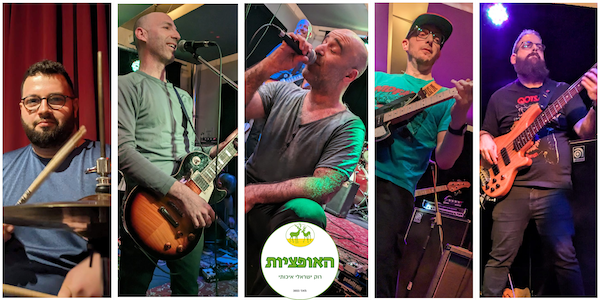
The Options Israeli music cover band closes the Festival of Israeli Culture on May 26. (photo from the JCC)
This year’s Festival of Israeli Culture takes place May 21-26, with the main event at the Jewish Community Centre of Greater Vancouver the afternoon of Lag b’Omer, May 26.
Falling on the 33rd day of the counting of the Omer, between the second night of Passover and Shavuot 49 days later, Lag b’Omer is a celebration amid tragedy. It commemorates the end of a plague that is said to have killed 24,000 of Rabbi Akiva ben Yosef’s students during the Bar Kochba rebellion against the Roman Empire in the second century. Only five students survived, one of whom was Rabbi Shimon bar Yochai, the sage who wrote the Zohar, among other things. Jewish tradition states that, after Rabbi Shimon offered his last kabbalist teaching, he died, on Lag b’Omer, having requested that his death not be mourned. For Rabbi Shimon, death means a soul has taken its place with God.
Among the traditions of Lag b’Omer are bonfires (perhaps in remembrance of fires the Bar Kochba rebels lit to relay messages), weddings, a boy’s first haircut, singing and dancing.
“I felt that it is so sensitive to be celebrating when there is such a complex and sad situation going on in Israel,” Nomi Zysblat, organizer of the annual JCC festival this year, told the Independent. “But, after researching the meaning of Lag b’Omer, I really see it as our community coming together with our individual sparks of light, a way of staying together, of communicating, a collective medura [bonfire or campfire] of strength and warmth.”
This year’s festival will be on the quieter side.
“We thought about this a lot,” said Zysblat. “Is it OK to ‘celebrate’? Is it safe? After many conversations, we decided that we need a gathering, we need to feel safe, we need to remember and we also need to be proud. We aren’t having a huge event, it’s going to be slightly more intimate … more gatherings and community enjoyment rather than huge events, both for the general feeling and also for security reasons. We aren’t flaunting but are also still wanting to enjoy being together.”
On May 21, there will be a dance party, kibbutz-style, at the Anza Club (tickets, $15). The night will be hosted by DJ Guy Hajaj, who will showcase modern and alternative Israeli music.
“He’s had a show for 10 years on Israeli radio and also a popular music blog, among other things,” explained Zysblat. “He DJs at events in Israel throughout the year but has been based in Vancouver for six years.”
On May 23, Moshe Bonen performs a sing-along-style show with festival organizer Nomi Zysblat. (photo from the JCC)
On the afternoon of May 22, the JCC parking lot will become an arts space where kids/teens can participate in a collaborative mural project led by Zohar Hagbi, a local Israeli artist. And, on the evening of May 23, the JCC atrium will come alive with music in a sing-along-style show led by musician and former Israeli radio broadcaster Moshe Bonen with Zysblat (tickets, $10, include a glass of wine).
“I have a music degree from Berklee College of Music in Boston and used to write and perform my own folk/rock music back in the day,” said Zysblat. “But, my favourite thing in the world to do when I was living in New York was to go up to the Bronx to Moshe’s loft and sing while he played his grand piano. He is an amazing player and accompanist.”
Zysblat’s professional background is both in music management and in the food industry. She started her own company 12 years ago – Paletas, which makes and sells natural popsicles. She got the idea while living in New York, discovering the icy Mexican treat at a grocery store.
“After she brought the idea to the restaurant where she worked as a cook in Brooklyn and created unique desserts for the restaurant’s menu, she realized that it could be a lot of fun to make them in Israel,” it says on the company’s website. “Naomi went on a trip to Mexico to learn from local paleteros, their method and tradition, and get inspiration for special and different flavours, then came back and opened her small business here in Tel Aviv.”
“I was born in Jerusalem to Canadian-born parents – my dad was from Calgary and my mom is from Vancouver,” Zysblat told the Independent. “We grew up visiting our grandparents and aunts and uncles and cousins every summer in Canada so it’s like a second home to me. I even spent a few sabbatical years my parents took here in Vancouver, and attended school here. I knew this was an experience I wanted for my kids as well and, after Oct. 7, realized there’s no better time to come here. My husband Adi always loved BC because he was a mountain biker and beer brewer, so it was a win-win.”
It’s not surprising then that a nature walk is also part of this year’s festival. On the morning of May 25 at Central Park in Burnaby, there will be a walk led by young community madrichim (leaders). The terrain is suitable for all ages and abilities. There will be songs, stories, snacks.
At the festival’s main event at the JCC on May 26, there will be food trucks (Planted and Meet2Eat), a marketplace (jewelry, glass work, flower arrangements, photography, home decor, Israeli popsicles and jachnun, a Yemenite Jewish pastry), DJ’ed Israeli music, Israeli dance shows (troops from across Metro Vancouver, including Or Atid youth dancers), a drum circle, wine-tasting, arts and crafts, a gaga pit, face-painting, and dance, art and hummus workshops. In the Zack Gallery, the Tikun Olam Community Art Installation is already on display. The day closes with a performance by the Options, a group of local Israelis who cover Israeli rock and other songs.
The annual Jewish Family Services (JFS) Innovators event has evolved from the traditional luncheon format into an evening cocktail reception. The decision comes as the organization prepares to celebrate the 18th (chai) anniversary of the event, reflecting on nearly two decades of innovative initiatives and community impact.
Naomi Gropper Steiner z”l, Hildy Barnett z”l and Kristina Berman founded the first Innovators and this year’s gathering will reflect on JFS’s journey over the past 18 years. From its Home Support Program and Thriving Seniors to strategic partnerships and poverty alleviation initiatives, JFS remains committed to meeting the changing needs of the community and is dedicated to creating lasting impacts and fostering a more resilient and inclusive society.
Join new Innovators
Chaired by Candice and Todd Thal, this year’s Innovators is set against the backdrop of the Vancouver skyline. Taking place May 28, 6-9 p.m., the event will unfold at the D6 Bar and Lounge, within the JW Marriott Parq Vancouver. The culinary offerings will include kosher options.
The night’s program will spotlight various JFS’s initiatives. Other highlights will include Fund-a-Need, to support JFS’s programs, hosted by Vancouver’s “man about town,” Fred Lee. Master of ceremonies will be actress Christina Chang, who has appeared in several television shows and movies, and is currently playing the role of Dr. Audrey Lim on the ABC show The Good Doctor, which has shot in Vancouver over the past seven years.
Tickets for Innovators 2024 are available through the event’s website: trellis.org/jfsinnovators2024. For more information about the event or JFS, contact 604-637-3306 or development@jfsvancouver.ca.
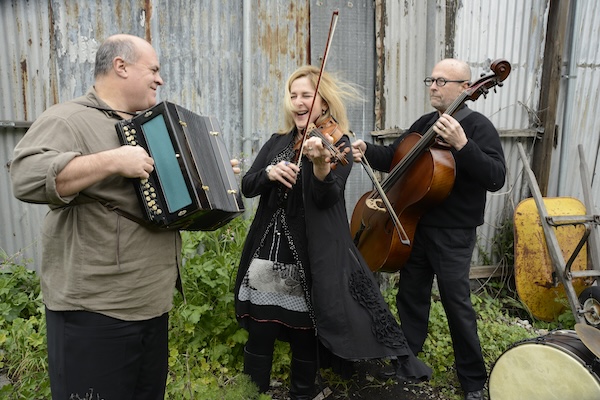
Veretski Pass – Joshua Horowitz, left, Cookie Segelstein and Stuart Brotman – will be joined by clarinetist Joel Rubin to present the world première of music from their new album, Makonovetsky’s Scion. (photo from Klezcadia)
Victoria will host Klezcadia, a hybrid klezmer and Yiddish culture festival showcasing a West Coast lineup of musical mastery and mavenry. Running June 4-9 in-person and online, there is no charge to attend.
According to festival director Laura Rosenberg, Klezcadia intends to position Victoria as a focal point for klezmer and Yiddish cultural tourism. In conjunction with the music, the six-day event will present classes, workshops, lectures, demonstrations and open rehearsals conducted by artists, language faculty and other guests.
“Klezcadia’s audiences can expect cutting-edge performances – including three world premières – by some of the world’s leading klezmer artists. Additionally, participants at any level of experience will have opportunities to attend classes, workshops and presentations by these same artists and their Yiddish-language colleagues,” Rosenberg told the Independent.
“Our guiding principle is to make the safe in-person attendance experience and the virtual attendance experience as equivalent and rich as current technology allows, as well as to give the same level of respect to all attendees,” she said.
Some of the featured artists will be Veretski Pass, a Bay Area trio that will perform with clarinetist Joel Rubin; Vancouver musician Geoff Berner; and Jeanette Lewicki in her new show as Pepi Litman, an early 20th-century Yiddish theatre drag star.
Comprised of Cookie Segelstein (violin), Joshua Horowitz (19th-century button accordion) and Stuart Brotman (bass), Veretski Pass offers a wide mix of East European influences. Reuniting with Rubin, they will present the world première of music from Makonovetsky’s Scion, their new album for the Borscht Beat label.
Berner, a singer, songwriter, accordionist, novelist and political activist, will stage the première of Second Fleet, the Yiddish song cycle he recently co-wrote with Canadian writer Michael Wex, author of the bestseller Born to Kvetch, a humorous and scholarly look at the Yiddish language.
Lewicki will transmit the spirit of Litman, the original “drag king” of Yiddish theatre, in another première. The Pepi Litman Project will examine the time when a groundbreaking performer literally “wore the pants,” led her own touring troupe, turned taverns into theatres, and tested societal boundaries with her satire. Litman toured Europe and reportedly North America, too, singing, in male garb, at spas, inns and private homes in small towns and large cities alike.
Some of the talks and workshops on offer at the festival are The Barry Sisters: America’s Yiddish Swingsters, with Andy Muchin, the host of the Sounds Jewish radio show on PRX; Yiddish Through Song Lyrics, with Seattle-based Marianne Tatom, a Yiddish teacher and klezmer musician; and Yiddish Through Conversation, with Sasha Berenstein, a multi-instrument musician and fellow with the Yiddish Book Centre’s Yiddish Pedagogy Program.
On June 5, Christina Crowder of the Klezmer Institute will speak about the Kiselgof-Makonovetsky Digital Manuscript Project, an international endeavour connecting participants with the work of important klezmer musicians from the late-19th and early-20th centuries.
The festival will take a walk on the vilde side on June 8 with what organizers describe as “musical mash-ups, klezmer-adjacent adventures, song parodies, unusual instruments” and offering the forecast “you never know what will pop up in this clearing in the klezmer/Yiddish jungle.” The evening will feature Seattle neo-vaudevillian Mai Li Pittard, as well as local klezmer bands Kvells Angels and the Klezbians. A new klezmer ensemble, Kvells Angels, gave a concert last fall at the University of Victoria in which they performed works previously unavailable to musicians. The Klezbians, meanwhile, are a well-known band of “chutzpah-licious” musicians, and the group goes back many a year.
Victoria’s Congregation Emanu-El, under whose auspices Klezcadia is being produced, will host the finale concert at the Cameron Bandshell, located in Beacon Hill Park. The closing concert will be a gift to the city in celebration of the congregation’s 160th anniversary.
Festival organizers have made a concentrated effort to ensure that all participants enjoy a safe experience. The hybrid environment, they stress, will prioritize the well-being of immunocompromised and high-risk participants, for both those onstage and in the audience. Indoor activities will include protective protocols, such as supplemental air purification, required masking and daily onsite COVID testing.
“Klezcadia was inspired by deep listening to an online meeting of immunocompromised and high-risk musicians and Yiddish-language enthusiasts in early 2023,” Rosenberg said. “During the first two years of the pandemic, they had finally felt included in the klezmer/Yiddish community, since everyone’s only option was to gather online.”
The same groups felt marginalized again when most festivals returned to unmasked, in-person formats. Through dialogue with these groups, Rosenberg realized, Victoria had a chance “to become a host community for an inclusive form of cultural tourism.”
Rosenberg said her 45-year arts administration career came in handy when building a music festival from the ground up; she had already done so with two other festivals. It has been a year’s worth of full-time work to plan the format, bring in the artists and teachers, scout venues, initiate community engagement and, importantly, raise the money.
Locals seem eager for the festival to start. “I am optimistic based on expressions of pride I have heard from Victoria residents, on how quickly Klezcadia’s in-person registration reached capacity and on the eagerness of local tourism-sector businesses to be included in our visitors’ guide,” Rosenberg said.
People from more than a dozen countries have signed up to view events streamed online.
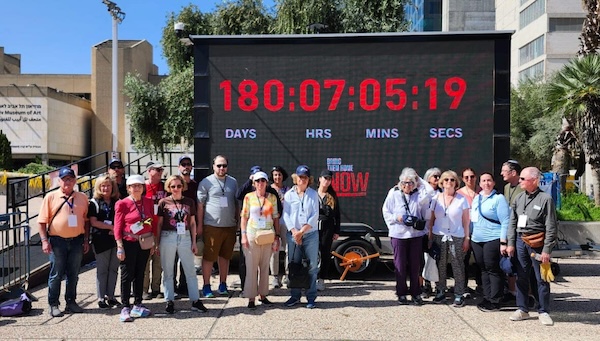
JNF Canada, Har El and Beth Israel mission participants in Hostages Square in Tel Aviv. (photo from Lorraine Katzin)
About 20 volunteers – from Vancouver, Edmonton and Toronto – went on the JNF Canada Bearing Witness Mission to Israel April 1-8. Organized by Jewish National Fund Canada, Congregation Har El and Congregation Beth Israel, the trip was led by BI’s Rabbi David Bluman and JNF Edmonton executive director Jay Cairns. On his Facebook page, Cairns thanks JNF Pacific executive director Michael Sachs, BI Senior Rabbi Jonathan Infeld and Bluman “for spearheading this important mission.” Among the volunteers were Har El members Lorraine Katzin and Karen Shalansky, who shared some of what they experienced with the Jewish Independent.
Some first impressions (Lorraine Katzin)
Stepping onto the El Al plane from Los Angeles to Tel Aviv reminded me of the olden days of flying – a blanket, pillow, headphones and a bag with a toothbrush, toothpaste and eye mask. Two meals were served and, during the flight, you could help yourself to snacks, sandwiches and drinks.
Walking through Ben Gurion International Airport, you see photos of the hostages still in captivity. When we went through the foreign passport area, it was chilling – we were literally the only people passing through passport control. There were no tourists. Our hotel was quiet as well.
Walking on the promenade in Tel Aviv to Jaffa on our arrival, it felt as if there were no war – people were out on the beach, swimming, playing beach bats, foot volleyball, and jogging.
Tuesday, April 2, was our first full day of touring. We started at Kibbutz Kissufim in the south. We heard stories of the murders and saw the devastation made by the Hamas terrorists. One of the stories that haunts me is that of the chief fireman whose only child, his daughter, and her husband were shot to death in their safe house, then their home was burnt down. Searchers only knew by finding a nose ring and bracelet in the ashes that the bodies had been burnt.
We were very close to Gaza and could hear artillery every now and again, which was scary. At the site of the Nova music festival, there was a memorial of photographs: 364 people were killed there by Hamas, 44 hostages were taken.
On Wednesday, we toured Adi Negev-Nahalat Eran, which is a village for children with disabilities, which JNF supports. Karen and I volunteered at the therapeutic farm, cleaning the goat pen and washing the tortoises. That day we were also taken to the car cemetery, where you see two burnt ambulances, as well as burnt and bullet-holed cars numbering more than 1,000. In Sderot, we saw where the police station used to be – the building was taken over by Hamas terrorists and then an Israeli tank destroyed the building, killing the terrorists inside.
A burnt-out Magen David Adom ambulance in the car cemetery near the Gazan border, where burnt and bullet-holed vehicles numbering more than 1,000 are being kept for further investigation. (photo from Lorraine Katzin)
The first few days of the mission, I found it difficult to sleep, the images and stories kept going through my head.
On Thursday, we picked lemons and went to Rachashei Lev Israel Children Cancer Centre, another JNF project. We also visited Hostages Square.
Friday included a visit to Western Canada House, a No2Violence shelter for women and children fleeing domestic violence, the building of which was funded by JNF Canada supporters in Vancouver and Winnipeg. [For more on Western Canada House, see jewishindependent.ca/a-new-refuge-from-violence.] We also went to the ANU Museum of the Jewish People, which had on display models of different shuls in Europe and the United States, a replica of the Codex Sassoon and an Oct. 7 exhibit. After stopping at the Carmel Market, we went back to Hostages Square for Kabbalat Shabbat, which was very moving.
Saturday, we went to the beach in the morning and walked around Tel Aviv in the afternoon. That night, we had a survivor come speak to us and it happened to be Shalev Biton, who had come to speak at Har El and elsewhere in Vancouver a few weeks prior. Amazingly, he remembered me!
On another night, we heard from Jacqui and Yaron Vital, parents of Adi Vital-Kaploun, who was murdered on Oct. 7. Jacqui, who is a Canadian, was in Ottawa visiting family when the Oct. 7 Hamas terror attacks happened. Adi, her husband and two children lived on Kibbutz Holit in the south and Yaron had come to visit; he was put up in a room in a vacant house opposite his daughter’s. Adi texted her husband, who had gone on a hike, warning him not to return home. Adi was killed, and her two children and a neighbour were kidnapped but let go at the Gaza border, by some miracle. Yaron survived, as the terrorists had determined which homes had how many people and who had dogs, which were shot first, but the room Yaron was in was usually vacant, so went unchecked by the terrorists.
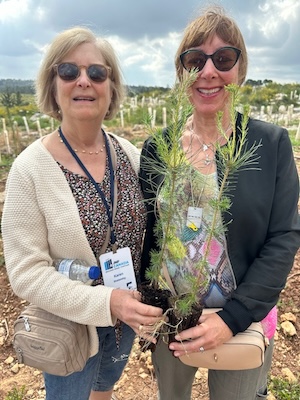
Karen Shalansky, left, and Lorraine Katzin tree planting. (photo from Lorraine Katzin)
On Sunday, April 7, we went JNF tree planting. We visited the Black Arrow Memorial, where, from the lookout, you can see Gaza. There, we were given a briefing by retired colonel Kobi Marom, whose opinion was that the Palestinian Authority should be enlisted to run Gaza. We then traveled to the Israel Defence Forces base at Nahal Oz for lunch with the soldiers – these 19-, 20- and 21-year-olds going into Gaza are truly amazing! The soldier I sat with, his name was Daniel and he was from Eritrea. We were so close to Gaza that we could see convoys of food trucks going through the Rafah Border Crossing.
Monday, our last day, we went to Jerusalem to two places that JNF supports: the Jerusalem Hills Therapeutic Centres, which provides services for at-risk children, and the Glassman PTSD and health centre at Herzog Hospital. We then visited the market and went for a walk down Ben Yehuda Street, the Kotel and the tunnels, and had dinner at Piccolino restaurant before heading to the airport. We were joined by Jewish Federation of Greater Vancouver executive director Ezra Shanken and Rabbi Jonathan Infeld from Congregation Beth Israel.
Israel trip highlights (Karen Shalansky)
I went to Israel to show my support in its time of need, as well as to hear the views of Israelis and their feelings toward the war. Through our many experiences, I felt I accomplished my mission.
Listening to the diverse perspectives of our guide, the young soldiers and guards on our bus, my 31-year-old cousin who made aliyah right after high school and is now fighting in the reserves, Lorraine’s Israeli friends, a retired colonel and others, I heard varying opinions on many topics. For example, should Israel invade Rafah, should there be a ceasefire, should the release of the Israeli hostages be the No. 1 priority, should there be an election, who should oversee Gaza after the war? While there was always more than one answer to every question, there were consistent feelings among everyone we met of resilience, strength and perseverance – that this war is another of many, and that Israel will carry on. As well, everyone we met was both amazed that we came during war and so happy that we had made the effort. That happiness alone made Lorraine and I feel that this trip was worthwhile.
Some highlights of the trip for me were:
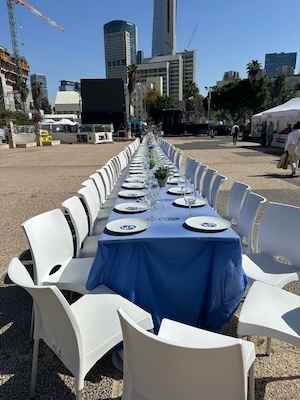
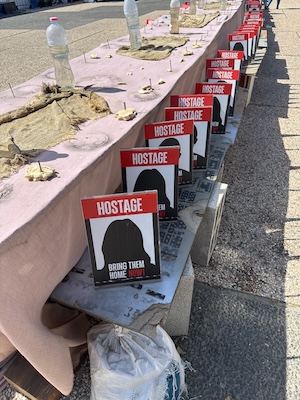
1) Visiting Hostages Square in Tel Aviv for Kabbalat Shabbat. This is a square that has Shabbat tables set up for both the released hostages (with blue tablecloth and wine glasses) and for the hostages still being held (with dirty water and stale pita). There was a wonderful band playing, with a singer, and, at one point, there was a chance for people to stand up and say something. Lorraine was our spokesperson and announced that we were on a trip from Canada to support Israel. Several Israelis came up to us afterwards to shake our hands and welcome us. When the band sang Lecha Dodi, a few people got up to dance the hora, including Lorraine and me.
In Hostages Square, there are two tables set up: one for the hostages who have been released (left) and one for those still being held in Gaza (right). (photos from Lorraine Katzin)
2) Visit to Shlomit settlement in the southern Negev. This was a religious settlement that JNF helped build. As an aside, JNF has been very active in rebuilding bomb shelters and kibbutzim that were destroyed on Oct 7. At Shlomit, we heard from Dana, a mother of six children, about how her husband and four other men went to a neighbouring kibbutz to fight the terrorists. While the men were successful in killing all five terrorists, her husband, unfortunately, was shot dead. Dana said she wanted her children to remember her husband as a hero, and to foster a sense of hope, not hate. In this inspirational talk, she kept emphasizing that we can’t live with hate, only with love and hope.
3) A talk from a trauma psychologist at the Glassman centre. While post-traumatic stress has risen substantially in Israel, this psychologist told us a story of an army unit that recently returned from a three-month stint in Gaza. Prior to going home, the unit visited one of the soldier’s grandmothers, who was a Holocaust survivor. The attacks by Hamas on southern Israel have been equated to a second holocaust, but, upon asking the grandmother’s views, she said “no,” the attacks were nothing like the Holocaust. We have a country and a people that will fight for us now, whereas in 1940 we had nobody, she said. She concluded: we are never alone again, as long as there is an Israel.
Our neighbourhood has narrow sidewalks lined by hedges. When my dog and I take our daily walks, we step to the side at a driveway or front walk so that another pedestrian can pass. My dog sits patiently, sometimes even when I don’t prompt her. Over the years, through the lives of several dogs, we (the dogs and I) have received compliments because of how well behaved the dogs are. I say thank you. The next question is, “How did you do it? I can’t get my dog to do that!” My response is always the same. We’ve been taking these walks every day for years. We practise! Usually, the passerby shakes their head, as if I am just not letting on my secret – but I have. Consistency is everything in reinforcing behaviour.
In the Babylonian Talmud, Tractate Bava Metzia 60a, the rabbis discuss sales practices. While Rabbi Yehudah disagrees, the rabbis conclude that a shopkeeper is allowed to offer children toasted grains and nuts for free. By doing so, he accustoms the children to see him for their shopping, rather than going to other shopkeepers. Also, the rabbis suggest, it is OK to offer things for sale at a “below market” price, that is, on sale, in order to attract customers. These are, in effect, ancient – and approved – business marketing guidelines that reinforce desired behaviours. In this text, there are also suggestions for what is notacceptable and why.
Festive holiday meals sometimes give us time to think about what’s acceptable in our homes, too. One invites friends and family over, or goes to other homes, and that’s when you can see all sorts of different families, with different guidelines about what’s acceptable. I find myself observing all this with interest. This is one way we learn about other ways of doing things. It’s also a chance to reevaluate how we run our homes. What could we do better? What isn’t acceptable in one home may be fair game in another.
As an adult, I observe all this but my children, just like those attracted by toasted nuts in Bava Metzia, react fast when they see things that are tempting or considered “out of bounds.” For instance, my kids love additional opportunities to eat treats. However, kids also notice when things go awry.
More than once, we’ve had a young holiday guest have a colossal meltdown. We all know that kids can lose it, especially during atypical situations, in others’ houses, later in the evening, etc. However, my kids feel strongly about times when the kid (or family) shows disrespect to us. After all, it’s our house. Having a child fall apart due to exhaustion or overstimulation happens. Having a kid yell at us is different, and my kids are rightfully upset when another child snaps or is rude when I express concern or want to keep them from getting hurt. My family pointed out that I, as a grown-up, amresponsible for everybody’s safety in my house – of course, I have to say something when a situation looks dangerous.
Earlier this year, our household was unsettled not only due to an extended outburst, but because no one apologized for it. Some parents apparently think that we, as holiday meal hosts, should tolerate and absorb a tantrum. For days afterwards, I fielded my kids’ comments as I stung with frustration. We spend many hours cleaning, setting the table and making multi-course celebratory meals. We take great care. Why go to all this effort for guests who don’t model basic respect for their kids in another person’s home?
By comparison, another set of family friends stayed over during a holiday. They were having breakfast in our kitchen with my kids when I came into the room. Their teenager had raspberries topping each finger (something I don’t allow my kids to do) but also, hadn’t washed their fruit. I rushed to wash the fruit, while the teenager said she was “immune” to whatever was on it. Her mom immediately jumped in. This mom insisted the teenager thank me for washing the fruit and correcting the possibly unsafe situation.
In this interaction, my kids saw the parent modeling an expected behaviour. They looked relieved. Those daily dog walks, often with kids, offer plenty of time to reflect on what we see. My twins, at the cusp of teenagerhood, now have firm ideas of how boundaries work, what respect and kindness mean, even in difficult situations. They know when parents correct things or when things go off the rails.
Watching the student encampments unfold at universities has been a chance to review those boundaries. When is it OK to protest? Why? It’s important to learn how one’s behaviours affect others and how they have lifelong ramifications. We’re seeing these issues play out in real time.
In our house, we’ve discovered new growth. Reinforcing consistent upright, respectful and kind interactions is annoying sometimes. Saying “careful!” every day because I worry about someone’s safety can be a drag. Yet, just like the dog sitting at the street corner, my household has reinforced certain behaviours. We say thank you when someone works hard to take care of us. We worry about others’ safety. We apologize when things go wrong.
Recognizing how we should behave with others is a crucial part of living in a functional community. Watching the university encampments from afar and their conflicting messages of hate towards the Jewish community and Israel makes me worry about how we will proceed in the future. The media coverage of these protests makes me question what the protesters’ parents modeled. What are these parents thinking now? The chants by some of the students make me wonder if their version of community considers Jews or Israelis eligible for membership.
I’m heartened to see when my hard work pays off as a parent, holiday meal host or dog owner. Yet, I’m worried about what it means when our boundaries or expectations aren’t respected, too. Being yelled at in my own home at a holiday meal wasn’t a good harbinger of the future. Our tradition sets some expectations for behaviour in the marketplace and at home. Even as we interpret these traditions differently, how we consistently model behaviour will determine our children’s and our society’s future. Consistently reminding one another of how to behave as responsible community members may result in a better, safer future for all of us.
Joanne Seiff has written regularly for the Winnipeg Free Press and various Jewish publications. She is the author of three books, including From the Outside In: Jewish Post Columns 2015-2016, a collection of essays available for digital download or as a paperback from Amazon. Check her out on Instagram @yrnspinner or at joanneseiff.blogspot.com.