התחנה תאפשר לאסטרונאוטים לאסוף סלעים מהירח, כמו הדוגמיות שהובאו בתכנית “אפולו”, ולמיין ולנתח אותן בתחנה, לפני החזרתן לכדור הארץ – נאס”א
תחנת החלל הבינלאומית המקיפה את כדור הארץ מאז 1998 ומאוישת דרך קבע מאז שנת 2000, מתקרבת לימי קיצה. שתי השותפות העיקריות בתחנה, סוכנות החלל האמריקנית נאס”א וסוכנות החלל הרוסית רוסקוסמוס, מתכננות להפסיק לתקצב את המבנה היקר ביותר בהיסטוריה – שבנייתו נמשכת כל הזמן עד ל-2024.
מה תוכנן להמשך הדרך בחלל? נאס”א מעוניינת לבנות את תחנת החלל הבינלאומית הבאה סמוך ירח. התחנה תשמש את המדינות החברות בה כפלטפורמה למשימות מאוישות לירח, וכן גם עבור המשימה המאוישת הראשונה המתוכננת למאדים. לאחרונה החליטה ממשלת קנדה להצטרף רשמית למאמצים, עם התחייבות של ראש הממשלה, ג’סטין טרודו, להשקיע מיליארד וחצי דולר בבניית זרוע רובוטית חכמה, שתשמש לתיקונים ולתחזוקת התחנה, בדומה לזרוע שיוצרה על ידי קנדה וממשמשת כיום את תחנת החלל הבינלאומית.
קנדה מבטיחה עוד לבנות זרוע רובוטית קטנה ורגישה יותר, בדומה לרובוט הפועל בתחנת החלל הבינלאומית הנוכחית. הזרוע הרובוטית החכמה המיועדת לתחנת החלל החדשה, שלא כמו זו של התחנה הקיימת, תהיה אוטונומית לחלוטין. למה כוונה בעצם? לפי התכניות תחנת החלל שתמוקם לייד הירח, תהיה מבצעית בכל מצב וגם כשלא יהיו אסטרונאוטים על סיפונה.
כחלק מההתחייבות בת העשרים וארבע השנים, קנדה מתכוונת להקצות משאבים גם לעידוד עסקים קנדיים קטנים ובינוניים לפיתוח טכנולוגיות למשימות מאוישות לירח. זאת בדומה למכרזים שפרסמה לאחרונה נאס”א לפיתוח מערכת נחיתה מאוישת לירח.
בשנת 2017 חתם נשיא ארה”ב, דונלד טראמפ, על צו נשיאותי המורה לנאס”א לחזור ולנחות על הירח. לכן ייתכן שכבר בשנים הקרובות נראה אסטרונאוטים אמריקניים על הירח, עוד לפני השלמת התחנה הסמוכה לו. קנדה היא המדינה הראשונה שמצטרפת לארה”ב בהתחייבות כספית לבניית תחנת החלל החדשה.
לפי התכנית החלק הראשון של התחנה שיכלול את מערכות ההנעה והחשמל, ישוגר בשנת 2022. מעבורת החלל המאוישת הראשונה שתהיה אמריקנית, תצטרף אליו כבר בשנת 2024. התחנה תקיף את הירח במסלול אליפטי מאוד סביב נקודת לגראנז’ 2, נקודה יציבה יחסית בין מסות הארץ והירח (כשהוא נע במשך שישה ימים במרחק של בין 70,000 ק”מ ל-1,500 ק”מ מפני השטח של הירח). משימות מאוישות ובלתי-מאוישות יעגנו בדרכן לירח, למאדים וליעדים רחוקים יותר, כאשר בשנות ה-30 של המאה ה-21 צפויה המשימה המאוישת הראשונה למאדים להשתגר מהתחנה. לתחנת החלל סמוך לירח יכולים להיות יתרונות גדולים ומשמעותיים על פני שיגורים ישירים מהארץ לירח או מהארץ למאדים. כך למשל התחנה תאפשר לאסטרונאוטים לאסוף סלעים מהירח, כמו הדוגמיות שהובאו בתכנית “אפולו”, ולמיין ולנתח אותן בתחנה, לפני החזרתן לכדור הארץ. בנוסף כפי שיודע כל מי שצפה בסרט האימה המדע הבדיוני “לייף”, את הדוגמיות הראשונות ממאדים רצוי לנתח בתחנת חלל לפני שמנחיתים אותן על כדור הארץ. זאת בשל החשש לזיהום ביולוגי כאן.
אבל אולי היתרון הגדול ביותר של התכנית, לדעת התומכים הרבים שלה, נעוץ באפשרות לבנות מחדש ובביטחה יחסית את יכולות האסטרונאוטים וסוכנויות החלל בחלל העמוק. יש לזכור שמאז סיום תוכנית מעבורת החלל בשנת 2011, הנוכחות האנושית בחלל הוגבלה לשיגורים של חלליות רוסיות מסוג “סויוז” לתחנת החלל הבינלאומית, שמקיפה את כדור הארץ במסלול לווייני נמוך מאוד של כ-400 ק”מ מפני הים. התחנה תאפשר לבדוק את הכלים החדשים, כמו מעבורת החלל “אוריו” בחלל העמוק, ומבלי לסכן את אנשי הצוות במשימה ישירה לירח. בוודאי גם לא לסכנם במשימה בת שנה ויותר למאדים.
Congregation Beth Hamidrash is celebrating its 50th year with a gala dinner to raise funds to better serve the congregation’s increasing number of young families. (photo from Beth Hamidrash)
“I want this to go on and on,” Albert Melul told the Independent about Congregation Beth Hamidrash. The longtime member said, “We have something precious. I don’t want it to be lost.”
Beth Hamidrash celebrates its 50th anniversary this year with a gala dinner March 31. Melul, who hails originally from Tangier, Morocco, has been involved with the congregation from the beginning. In the early 1960s, when he worked as program director at the Vancouver Jewish Community Centre, he was approached by some other members of the Sephardi community, who were looking for a space at the JCC for services. Melul helped the fledgling congregation get started.
In recent years, the synagogue has seen an increase in the number of young families attending services, with an average of 25 children present on Shabbat. In September 2018, the congregation hired Shira Puterman to lead their children and youth programming. The upcoming 50th jubilee celebration will raise money for the building of an expanded multi-purpose room to better serve these, and other, families.
The fundraising dinner, which will offer a door prize of two tickets to Israel, will include the induction of Beth Hamidrash’s new spiritual leader, Rabbi Shlomo Gabay, by the chief rabbi of the United Kingdom, Rabbi Ephraim Mirvis. Gabay, who most recently worked as a high school teacher in the Sephardi community of Gibraltar, came into his position in the community following the departure of Rabbi Ilan Acoca in the summer of 2016. (See jewishindependent.ca/looking-to-the-future.)
“This is a huge honour and privilege. Frankly, to have such a distinguished personality visit us is incredible,” Gabay told the Independent.
Induction is common in the United Kingdom but may not be familiar to Canadians. “It’s when a senior rabbi officially welcomes a newer rabbi into a leadership position,” said Gabay. “The joke around the synagogue is that I’m going to be knighted.”
Mirvis, formerly the chief rabbi of Ireland, is known for his close connection to the British Royal Family – he took Prince Charles on a trip to Israel last year – as well as for his interfaith work, and he has a reputation for moderation and diplomacy. When a scandal broke out in the United Kingdom last year after an Orthodox day school censored all mention of homosexual victims of the Holocaust in its textbooks, Mirvis supported an initiative to introduce LGBTQ+ education into Jewish schools in the United Kingdom. In 2012, he appointed Lauren Levin as Britain’s first Orthodox female halachic (Jewish law) adviser at Finchley Synagogue in London.
In addition to Mirvis, several prominent local politicians are expected to be in attendance at the 50th jubilee, including Janet Austin, the lieutenant governor of British Columbia.
Rabbi Shlomo Gabay will be inducted as part of Beth Hamidrash’s 50th anniversary celebrations on March 31. (photo from Beth Hamidrash)
Beth Hamidrash is Vancouver’s only Sephardi synagogue, keeping alive the Jewish traditions of the Sephardim, the Jewish community whose roots go back to the expulsion of Jews from Spain in 1492. The Sephardim (from the Hebrew word for Spain, Sefarad) immigrated to North Africa, the Ottoman Empire and other parts of Europe, where they sustained their unique liturgies, customs and musical culture for centuries. Beth Hamidrash carries on these traditions, passing them onto each new generation.
The first meeting of the Sephardi community of Greater Vancouver was held in the late 1960s, followed by the first organized Sephardi prayer service. In 1973, the Sephardic Congregation was incorporated as a society in British Columbia, with the goal of establishing a synagogue. In the late 1960s and early 1970s, High Holiday services were held in the kindergarten classroom of the previous building of the JCC at 41st Avenue and Oak Street, and in the Vancouver Talmud Torah gymnasium. During the 1970s, the congregation began holding regular services at 3231 Heather St., in what was then a dilapidated former synagogue, which the congregation renovated and made into the beautiful congregational space there today.
The synagogue website notes that Beth Hamidrash congregants hail from Iraq, Morocco, Algeria, Libya, Egypt, Syria, Lebanon, Yemen, Israel, India, France, China, Japan, the United Kingdom, South Africa, Zimbabwe, Russia, and many other parts of Canada and the world.
“What we have here is very special,” said Melul. “When you walk in the door here, you are a somebody. Our community is very warm, and we share each other’s sorrows and joys. When you visit this shul, someone will welcome you, someone will give you a siddur, someone will tell you when is Kiddish, someone will want to get to know you.”
“I landed in a spectacular community,” added Gabay. “The people are so kind and generous and forthcoming – they want to grow and they want to do. I really feel blessed to be here.”
To RSVP for the March 31 afternoon induction ceremony, email events@bethhamidrash.com. For tickets to the dinner gala, call the synagogue office at 604-872-4222 or email jubilee@bethhamidrash.com.
Matthew Gindinis a freelance journalist, writer and lecturer. He is Pacific correspondent for the CJN, writes regularly for the Forward, Tricycle and the Wisdom Daily, and has been published in Sojourners, Religion Dispatches and elsewhere. He can be found on Medium and Twitter.
Alpha Epsilon Pi chapter members with the fraternity’s “sweetheart,” Rachel Meadow. A “sweetheart” is elected every year at the chapter’s formal. (photo from AEPi)
The Vancouver chapter of Alpha Epsilon Pi, the traditionally Jewish fraternity, is 20 years old this year. So is Benny Stanislawski, the chapter’s president, who will help oversee the anniversary celebrations next month.
AEPi, as it is commonly known, was not the first Jewish fraternity at the University of British Columbia. Another frat operated on campus in years past but eventually disbanded. In the summer of 1999, the former longtime international executive director of the fraternity contacted Jeff Waldman, a student at UBC, suggesting he consider founding a chapter. A group of eight “founding fathers” came together and Adam Propp, a high school friend of Waldman, also a UBC student, was chosen as the first president, or “brother master,” as the role is called internally.
Hillel has been on the UBC campus since 1947 and provided an avenue for Jewish fellowship and involvement for many students. But the founders of the fraternity saw advantages in creating the male-only society.
“I think all of us had different reasons,” Propp recalled. “For me, to be able to have an impact on the university experience for young Jewish men like myself was important. When I look back at it, Hillel appealed to many, but not all. [The fraternity] just appealed to a different set of people who might not have been attracted to Hillel right away. It was a way to get more people more active and involved in a Jewish experience on campus, especially since UBC is such a commuter school.”
Propp became philosophical reflecting on the chapter’s founding two decades ago, noting that, in the next few years, some sons of the original brothers will likely be pledging to the fraternity. In recent days, Propp has been reconnecting with many of the original brothers, as they plan to gather for the 20th-anniversary celebration with a series of events over the weekend of April 5-7.
Benny Stanislawski, president of the Vancouver chapter of Alpha Epsilon Pi. (photo from AEPi)
The relationship between AEPi and Hillel differs from campus to campus and, at UBC, it has generally been extremely strong, sometimes highly symbiotic.
Gabe Meranda, who was executive director of the Vancouver Hillel Foundation at the time the chapter formed, admits he had some trepidation about a Jewish fraternity, not having had any experience with what is called “the Greek system.”
“I was skeptical at first, since I was cautious about fraternities. But these first few guys were so excited about launching the chapter in B.C. that I decided I must get behind it,” Meranda recalled. “I remember the night of their first party at Hillel. I didn’t know what to expect, but all seems to have gone well and it’s taken off from there.”
The chapter made Meranda an honorary brother and he still proudly has the pin, he said.
While fraternities have a reputation for certain excesses, Canadian campuses tend to be a little more low-key, in part because the lower drinking age in Canada means access to booze is not a motivator to joining a frat. What is less obvious to the general public are programs of leadership development, philanthropic ventures and, in the case of AEPi, Jewish cultural activities and, to varying extents, Israel programming or education.
Stanislawski stressed that AEPi has no political or religious orientation. Jewish young men, as well as non-Jewish ones who want to pledge – of which there are usually a few each year – are welcome without concern for their religious affiliation (or lack of affiliation) or their approach to Zionism.
The chapter’s main annual philanthropic event is Hoops 4 Health, an all-day, three-on-three basketball tournament that takes place this year on March 31 at War Memorial Gym. The chapter’s charity beneficiary used to be different health causes, but the Heart and Stroke Foundation has a special meaning to the brothers. A couple of years ago, an AEPi member, Nitai Weinberg, suffered a stroke at the age of 18. Now fully recovered, he and his brothers raised $8,000 for the cause last year, and this year have significantly upped their goal to $25,000.
As an example of the range of programs, the chapter recently hosted a presentation on sexual assault awareness, led by the UBC Mental Health Network. They also host “Greek Shabbats” at Hillel House, where members of all the university’s fraternities are invited.
Fraternities, in general, are a place to nurture leadership.
AEPi has an added mission, noted Stanislawski: “Developing leaders for the Jewish community.”
Founded in 1913, the fraternity now serves 190 campuses in seven countries; it claims 90,000 living alumni. The UBC branch, officially called the Beta Chi chapter, welcomes students from Langara, Simon Fraser, Emily Carr, Capilano and all post-secondary institutions in the region. The chapter usually has 40-plus brothers in any given year, peaking last year at 49.
“I’d love to see the organization get into the 70s,” said Stanislawski. But, given the limited number of Jewish students on campus, slow, steady growth is the realistic goal.
Samuel Heller, the current executive director of Hillel at UBC, congratulated the fraternity and thanked them for their contributions.
“Both the Hillel community and wider campus community are enriched by this brotherhood of young men who exemplify leadership and champion Jewish values,” said Heller. “Brothers of AEPi are a positive force on campus … by creating a group of young leaders who are changing the face of UBC and who, in turn, will change the world.”
Pat Johnson is an honorary brother of Alpha Epsilon Pi Beta Chi chapter.
Last week, U.S. President Donald Trump said the Democratic party in that country has become an “anti-Jewish” and an “anti-Israel” party.
The president was criticizing Democrats based on stands taken by Rep. Ilhan Omar, who has made impolitic comments, including accusing pro-Israel politicians of forgetting what country they represent. Omar, along with fellow freshmen congresswomen Alexandria Ocasio-Cortez and Rashida Tlaib, have made their presence known on the national scene faster and more effectively than almost any political newcomers in years. They bring a fresh, radical approach to politics, whether one agrees with their positions or not. They have the potential to be a left-wing version of the Tea Party, which upended the Republican party beginning a decade ago. The parallels are several: fresh faces with radical views and little respect for business-as-usual or party leadership hierarchies.
The Tea Party and the new Democrats, who dub themselves “The Squad,” are both causes and symptoms of a widening polarity in American politics. The centre is not holding – a reality that many Democrats are fearing as they enter the most unpredictable presidential nominating process in their history, with a score of credible candidates having entered the race. Progressives think another centrist like Hillary Clinton can’t win, while party leaders fear that nominating an avowed socialist or other seemingly far-lefty will give Trump another term.
That divisiveness is exactly what Trump wants. His only criterion for supporting an issue is whether it has short-term rating benefits for his reality-TV presidency. He may not have a sound, thought-out strategy, but if a tweet or a comment from him can monopolize the talking heads for a news cycle, this is what he views as a presidential triumph.
So, to stick a knife in the entire Democratic party based on a few (admittedly crude and arguably antisemitic) statements by a couple of new politicians is just the sort of infotainment that Trump relishes. The problem is, it isn’t the Democrats who will suffer most if Trump’s latest gambit succeeds. It’s Jews.
Trump has a compulsive need to poke sticks at people, but weapons can sometimes miss their mark. He has painted himself as a Judeophile, touting his Jewish grandchildren, but he also traffics in overt stereotypes of Jews, such as when he noted before a group of Jewish Republican that he is “a deal-maker, like you folks.” This is to say nothing of his unconcealed cavorting with white supremacists and neo-Nazis.
But the line about Democrats being an anti-Jewish and anti-Israel party is a step too far. It’s not a problem in the sense that it is entirely false – we have seen the Labour party in the United Kingdom degenerate into a movement irreparably saturated with prejudice toward Jews and an attitude toward Israel that in many cases borders on psychosis. The Democratic party could follow a similar path if the trajectory from a sliver of the party’s progressive wing is not put in check.
The reason Trump’s comments are despicable is that he takes joy in the possibility that his opposition could become a genuinely anti-Zionist and anti-Jewish party. Jews be damned, it could help Trump get reelected, so he exploits it as much as he can.
Whatever the likelihood might be of the Dems actually becoming an anti-Jewish, anti-Israel party, like U.K. Labour, Trump has politicized Israel and Jews in a way that can only harm Jewish Americans and the American-Israeli relationship.
Support for Israel based on moral, military, economic and historical foundations has been an unshakeable plank in the platform of Democrats and Republicans for decades. By refusing to turn that bilateral relationship into a partisan slapfest, both parties have managed to ensure that, barring bratty interpersonal spats like the Obama-Netanyahu tantrums, the relationship between the two allies remains strong and seemingly unbreakable.
The Democrats are finding ways to accommodate new ideas. Some of them will be good ideas, some less so. The vast majority of elected Democrats stand as firmly with Israel as ever, and they could take some lessons from the newcomers about how to get their messages across in a dynamic, engaging way.
We have had this discussion in Canada when political figures have tried to make support for Israel a partisan wedge. True friends don’t do that, because they know that their political advantages will flow and ebb, while Jewish and Zionist Canadians will have to live with whatever consequences result from short-term political schemes.
A sitting U.S. president who foments tectonic political discord around an issue like this is no friend to Jewish Americans or Israel. No matter how much he professes love for his grandchildren and Jewish deal-making skills.
There’s something extraordinary about Jewish texts. What is it? You may have heard of Hillel and Shammai, or any of the many famous rabbinic voices recorded in the Talmud and Midrash. Our foundational religious texts record and evaluate both the “winning” voice, the rabbi whose opinion became mainstream in our traditions, and minority views.
Sometimes, communities or people follow a viewpoint that was originally the minority voice. I’ve heard people say that they chose a less popular rabbi’s ruling, based on their study of the relevant texts. I’ve been at a Talmud study session where learner pairs presented summaries on why they sided with the minority in a debate.
Analysis and debate remain at the core of our Jewish identities. We’ve all heard the joke, “Two Jews, three opinions!” Sandwiched in that is the idea that we learned and thought deeply about it. There’s another angle to this joke though – the assumption that, if we’ve come to this point, we’ve heard differing opinions. We learned enough to make a judgment. We’re also committed to a civil discourse to get there, because, if every study session or discussion meant people fought violently, we’d never have survived for thousands of years.
Jews are traditionally committed to behaving appropriately – derech eretz, literally “the way of the land,” means “how we behave” – promoting peace and avoiding embarrassing others unnecessarily. We value a good argument but, in the end, agreeing to disagree – with civility – is key.
I recently read a piece written by historian Henry Abramson. It was published by online newsfeed JTA (Jewish Telegraphic Agency) about the Bergen-Belsen marriage contracts (ketubot) produced after the Second World War. After the war, this concentration camp became a displaced persons camp. There was a marriage and baby boom, seen as a way to repopulate the many lives lost there. However, the “standard” ketubah issued there did something very different. These marriage contracts acknowledged that many people didn’t know what had happened to their prewar spouses and families. It took years to find this out, and the contract stated that, if their first families reappeared, the people who signed this contract must take the situation to a beit din (a Jewish court) to figure out what to do. Jewish law was flexible and resilient enough in this terrible situation to find recourse in civility and law.
Unfortunately, the effort to accept difficult, diverse situations and opinions is being lost to the larger culture’s problems with incivility. Recently, the Charedi Orthodox deputy mayor of Jerusalem, Eliezer Rauchberger, was the keynote speaker at a national convention for Israel’s Real Estate Appraisers Association. He canceled at the last moment when he saw the event was being held in facility owned by the Conservative movement. He took the opportunity to condemn those who affiliate with the Reform and Conservative movements, calling them heretical. He sought to embarrass and shame others rather than be inclusive. (Hint: That’s not in line with the commandments.)
These are “distant” stories, but, closer to home, we’ve just demonstrated both sides of this civility debate in Winnipeg. Limmud supports the wide diversity of Jewish opinion and, as such, organizers of the learning event in Winnipeg invited Lex Rofeberg, a rabbinical student, educator and activist to speak. Rofeberg’s Limmud and Shabbat dinner topics weren’t controversial. His lecture subject was Digital Judaism, a topic that’s long overdue. (Parts of Winnipeg’s Jewish community look like they still use the abacus compared to other communities when it comes to this topic.)
Some people, however, disagree with Rofeberg’s Israel activism. Instead of respecting the right of others to hold a different opinion, they use their social media bullhorns to protest. These voices were loud in this case. It seems they had the attention of those with deep pockets who donate to support Jewish events. But, being loud, bullying others and manipulating funders doesn’t mean they were right.
Jewish tradition teaches us that minority voices deserve to be heard. It teaches us to respect others’ right to an opinion and to behave appropriately. These aren’t just Jewish values, they are our country’s democratic values. We should be flexible and resilient in our responses, not quick to condemn others.
Canceling Rofeberg’s Shabbat Across Winnipeg lecture (even though Rofeberg wasn’t going to make any comments about Israel or politics) was described as an action that would maintain shalom b’bayit, peace in the home. That’s another aspect of derech eretz many of us invoke as we try to hush shouting children. Limmud Winnipeg, by contrast, continued to support Rofeberg’s appearance at its event.
I missed this real-time drama. My kids go to bed early, so we eat Shabbat dinner at home. I’m not on Facebook. I didn’t get to Limmud this year. However, based on what I’ve read and heard, I’m saddened that some Jewish institutions bowed down before the social media bullies and donor dollars, and withdrew their support for the event.
Can we learn from people with whom we disagree? Of course. Does shaming others whose opinions differ with yours have a place in Jewish discourse? No.
North American Jews emphasize education. With that learning comes the ability to do analysis and think critically. We’re lucky to live in a country that allows us to voice those differing opinions. Shame on us, Winnipeggers, for bowing down to bullies who would silence that discourse – all for a little peace on Shabbat. We should know better. We should support healthy debate about things that matter to us. As adults, we should be able to behave appropriately and peacefully on Shabbat regardless.
We lost an opportunity to be our best selves – thinking, discussing and disagreeing while we break bread together. That said, I believe our community will have many opportunities to do this better in the future. The research indicates that younger Jewish community members may have different views – including those on Israel’s politics – than their grandparents do. It’s time to listen respectfully to one another.
Joanne Seiffhas written regularly for CBC Manitoba and various Jewish publications. She is the author of three books, including From the Outside In: Jewish Post Columns 2015-2016, a collection of essays available for digital download or as a paperback from Amazon. See more about her at joanneseiff.blogspot.com.
An image of drones filling the sky from Reva Stone’s Falling. (photo from Reva Stone)
Multi-awarding-winning Winnipeg artist Reva Stone researched drones for three years and then began creating art to share some of what she had learned about how the technology affects our lives. The exhibit erasure, which comes from that research, features three works – Falling, Atomic Bomb and Erase. It is on display at the University of Manitoba’s School of Art Gallery until April 26.
“I’m very much an observer of what’s going on with new technologies, so when I saw the impact that UAVs [unmanned aerial vehicles] were starting to have – especially with war and changing the nature of war – I applied for and got a Canada Council [for the Arts] grant to do a lot of research and reading about what actually is happening,” Stone told the Independent.
She went so far as to get two quadcopters, to understand what they really sounded like, and hoping to use them in her art, which she has.
“I was working on this, and then I started thinking about our skies filling up with these commercial and militarized drones and how they were basically machines … that could fall out of the sky … that could crash into each other, that could bring down an aircraft. We were filling up our skies,” she said. “And then, about two years ago, I was reading and realized that we were now targeting not other countries, but targeting humans.”
Artist Reva Stone’s exhibit erasure warns about the use of drones in our society. (photo from Reva Stone)
Stone ended up making five or six individual pieces that deal with different aspects of the use of drones, but relate to one another. Depending on the exhibition venue, she decides which ones will work best together in a particular space.
Originally, drones were developed for spying purposes for the military. Later versions were outfitted with weapons for protection and assault. More recently, commercial drones have been developed. Now, anyone can buy a drone for as little as $20. This easy accessibility is challenging our society, contends Stone, causing hazards to planes in airports, affecting people at parks and disrupting the peace.
“Drones are becoming these things that fly in the air that have no human controllers … that are almost autonomous,” she said.
Stone often uses computers, movies, motors and speakers to help fully immerse visitors in her art pieces.
The work Falling, she said, “is an animated video that I made that has to do with what I see as a very new future, wherein UAVs are ubiquitous, because of civilian, military, commercial and private use.
“It’s almost slow motion or balletic on a massive screen,” she said. “There’s constant falling out of the skies, sometimes flipping as they fall. Sometimes, there’s a drone that has exploded in the sky … sometimes, small and far away and, sometimes, they’re so big when they fall through the sky that they look almost life-size and you’ll have to back away from the screen … that will be the feeling you get. Then, sometimes, there are these little windows that open up and you look through, into another world, and that world is more about what we’re fighting about – the fact that we are actually using these to make war. Other than that, some of them are commercial, some are cute, some are scary looking … and it’s like a continuous rain coming down.”
Atomic Bomb is also a film.
“I started with an early atomic bomb explosion,” said Stone. “It was a 30-second film and I made it into an almost 20-minute video. I really slowed it down and altered the time to give the impression that the person in the exhibition space is looking at a still image caught in time. I show this video together with texts that I found speak to the history of the use of radio-controlled airplanes and UAVs, and to longheld ideas about collateral damage – the relationship between … the use of atomic bombs and the use of drones and collateral damage, which, to me, is a huge issue with the use of drones as military.”
A single frame from Reva Stone’s Atomic Bomb video piece. (photo from Reva Stone)
The first text is from Harry Truman, the American president who made the decision in the Second World War to use the bomb, and it reads: “The world will note that the first atomic bomb was dropped on Hiroshima, a military base. That was because we wished, in this first attack, to avoid, insofar as possible, the killing of civilians.”
The next one is from John Brennan, Central Intelligence Agency director from 2013 to 2017: “There hasn’t been a single collateral death because of the exceptional proficiency, precision of the capabilities we’ve been able to develop.”
According to Stone, “This is just bullshit. But this is part of the cleaning up of the media presentation of all these ideas and all these things I’ve been researching, that I’ve been noticing going on over time. And, it has actually made me change the name of the work. I was going to call all three of them a totally different name. Recently, maybe a month ago, I changed it to erasure because of the erasure of people, the erasure of a lot of critical dialogue that’s been happening since I started researching in 2015 … how we are mediated, what we are presented with as a culture. The info is so mediated by how it’s reported, and if it’s reported.”
Stone wants “her audience to consider how the capabilities of such technology may be turned against citizens and how governments might, and do, get away with employing them in the name of patriotism in ways that ultimately test the ethical and moral values of its citizenry,” notes the exhibit description. “With news cycles moving so rapidly, the reports of deadly events quickly fall from memory, seemingly erased from public consciousness.”
The third piece, Erase, is interactive. Stone said it is based on what, in her view, the Obama administration practised – the targeting of individuals based on algorithms, mostly guilt by association.
“With this one, I’m actually replicating the procedure,” she said. “I have my two quadcopters that are doing the surveillance and capturing people in the exhibition space, unbeknownst to them. Then, they get captured and saved.
“Then, it’s a process that goes on, that they get played back. And you begin to realize that you’re under surveillance, the people in the space. And, every so often, a target comes up over one of them, one of the captured images. It’s really intense and an explosion occurs, and that person actually comes out of my captured list. That person will never show again. They’ve been erased.”
The exhibit erasure opened Feb. 7. For more information about Stone and her work, visit revastone.ca.
Camera in model, from 306 Hollywood. (photo from El Tigre Productions)
Annette Ontell, the New Jersey grandmother at the centre of the glorified home movie 306 Hollywood, lived an ordinary middle-class Jewish existence for six decades at that Newark address.
She didn’t come close to the achievements of RBG heroine Ruth Bader Ginsburg, nor the fame (and heartache) of Love, Gilda star Gilda Radner. Nor did Ontell have the tabloid TV highs and lows of the separated brothers in Three Identical Strangers, yet another documentary with Jewish protagonists that made waves at the box office last year.
Of course, one needn’t get her name in the paper or his face on a screen to live a productive, satisfying life. More to the point, plenty of wonderful and profound documentaries have been made about the small-scale triumphs and travails of everyday people. 306 Hollywood, which received a brief theatrical release in 2018 and airs on PBS’s POV series in the coming weeks, is not one of them.
Siblings Elan and Jonathan Bogarin affect an imaginative and stylized “dig” into their dear grandmother’s objects and possessions to the accompaniment of a kinda whimsical, kinda wistful indie-film score. Their strategy yields a parade of eye-catching images and bizarre set pieces that, individually and collectively, provide no insight into this, or any, American life.
The upshot is that 306 Hollywood combines the lacquered sheen and pastel palette of long-form television with the naiveté-masquerading-as-perceptiveness of a film-school project.
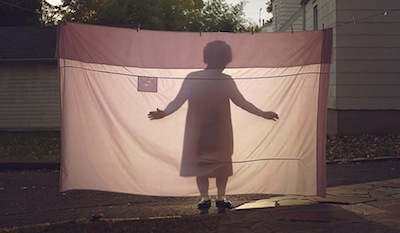
The directors’ grandmother’s silhouette, from their film 306 Hollywood. (photo from El Tigre Productions)
To be sure, the filmmakers’ goals, in addition to crafting a work of commercial art, are worthwhile: to uncover and grasp the meaning in a person’s life, and to honour and preserve the memory of a beloved relative whom they visited (with their mother) almost every Sunday for 30 years.
The Bogarins opt to catalogue and focus on the massive detritus – from radios and vacuum cleaners to rubber bands and fashion magazine clippings – that Ontell amassed over the 63 years she resided in the house, most of it spent with her husband. (Her brother lived with them, but he died in his late 40s.)
Ontell had a career as a dress designer and dressmaker, but the creative person she once was doesn’t emerge in the prosaic interviews that her grandchildren filmed with her over the last decade of her life. Instead, to conjure a person (and a personality) from her inanimate objects, the filmmakers enlist a “fashion conservator.” To invoke the metaphysical resonances of time and memory, they turn to physicist and author Alan Lightman.
Perhaps in a nod to Ontell’s artistic impulses, the Bogarins stage a fashion show with her original evening dresses in the yard at 306 Hollywood, and a ballet of young women modeling mid-20th-century lingerie. These sequences are visually impressive but self-indulgent. They aren’t as misguided, however, as the excruciatingly long home-movie scene of the filmmakers’ mother cajoling Ontell (her mother) into disrobing and donning one of her vintage dresses from the 1950s.
The pained presence of an older woman prodded into revisiting the past through her garments does have one benefit: it frees 306 Hollywood from the bonds of hagiography. But none of this gets us any closer to appreciating Ontell, or any emblematic Jewish mother, or to gleaning significance from the connection that human beings have to their possessions. The filmmakers’ choices are so showily ineffective, in fact, that we only rarely reflect on the emotions triggered by the absence and memories of our own forebears.
The most gifted documentary filmmaker I know at transforming the personal into the universal and the banal into the profound is Alan Berliner. The Jewish New Yorker’s masterful family portraits Intimate Stranger (1991) and Nobody’s Business (1996) can be streamed for free through Kanopy, accessible with many public library cards.
306 Hollywood airs March 30, 11 p.m., on KCTS 9 and on WTVS April 4 (check local listings for the time).
Michael Fox is a writer and film critic living in San Francisco.
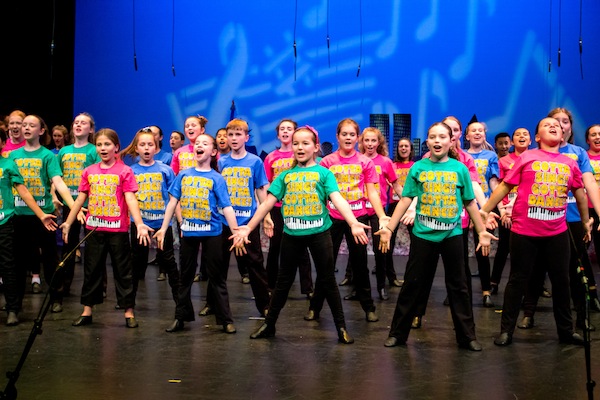
For the past 24 summers, Gotta Sing! Gotta Dance! has attracted hundreds of enthusiastic and talented participants from throughout Canada, the United States and Israel, many of whom have gone on to successful careers in the performing arts. The deadline is April 1 to apply for this summer’s sessions, which take place at the Jewish Community Centre of Greater Vancouver July 2-25 and Aug. 6-29.
The director and creator of Gotta Sing! Gotta Dance! is Perry Ehrlich, who received an Ovation Award and the Canadian Bar Association’s Community Service Award (acknowledging his dedication to working with children and musical theatre). A composer, pianist, teacher, arranger, producer, adjudicator, writer and talent coordinator, Ehrlich also directs ShowStoppers performance troupe (theimpresario.ca).
Gotta Sing! Gotta Dance! is taught by a faculty of professional instructors, each working in his or her respective field, including musical directors Wendy Bross Stuart and Diane Speirs; director Chris McGregor; choreographers Anna Kuman, Jason Franco, Keri Minty and Meghan Anderssen; acting coach Amanda Testini; and Mariana Munoz and Charlie Weaver, set construction and costume co-ordination.
Peter Birnie, former theatre critic for the Vancouver Sun, commented that the faculty members “are all teaching in a carefully choreographed nesting of studies that takes place all over the JCC and culminates in a big, brassy show. I try to attend every year, and always come away just as thrilled as the parents and families with the level of talent on display. It is about the joy that comes from singing your lungs out and dancing your hooves off.”
This year’s final production in each session – called Shamilton – will take place in the Rothstein Theatre and feature an original script and a broad repertoire of music from Broadway and movie musicals.
The Finishing School will again be offered for serious musical theatre students attending Gotta Sing! Gotta Dance! and it will feature approximately 10 sessions from 3:15 to 5:15 p.m., after the regular program, which will run 9 a.m. to 3 p.m. Finishing School students will receive instruction in audition technique, presentation of songs and scene work, and will participate in intensive dance workshops and meet with well-known professionals in the theatre community.
The Boot Camp Dance – for those either new to dance or wanting to refine their skills – will also be offered.
The cost to attend Gotta Sing! Gotta Dance! is $750 for JCCGV members and $850 for non-members. Scholarships are available through the Babe Oreck Memorial Fund, the Phyliss and Irving Snider Foundation, and others for those with financial need.
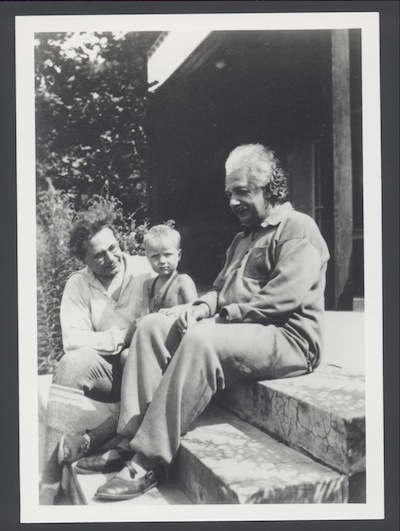
A newly acquired photograph of Albert Einstein, left, with his lifelong friend Michele Besso. (HU photo courtesy Ashernet)
Albert Einstein, right, with his grandson Bernhard, centre, and son, Hans Albert. (HU photo courtesy Ashernet)
One hundred and ten pages of Albert Einstein’s handwritten notes and other documents and photos have been added to the Albert Einstein Archives at the Hebrew University in Jerusalem. This latest material (dating mainly from 1944 to 1948) was acquired by the university thanks to a donation by the Crown-Goodman Foundation, which bought it for an undisclosed sum from Gary Berger, a North Carolina doctor. After Einstein’s death in 1955, most of his more than 80,000 scientific and personal papers were left to the Hebrew University. Einstein, who was one of the founders of the university and a great supporter of the Jewish state, was invited to become president of Israel, but declined the offer, implying that he did not feel worthy of such honour.
What is the origin of wearing costumes on Purim? One theory relates to the fact that the Jews in the Purim story live in the galut (“exile,” outside of Israel). Haman says to the king: “There is a certain people scattered abroad and dispersed among the peoples in all the provinces of thy kingdom and their laws are diverse from those of every people; neither they keep the king’s laws.” One might say, these Jews in Shushan are the minority in a Christian country who disguise themselves or mask their identity by trying to dress like the majority and blend in.
Probably the closest explanation as to why we wear costumes is because Esther masqueraded as a non-Jew and dressed up as a queen. Esther also hid her assertiveness and her strength – and her Jewish identity – until she had no other choice. One source has said wearing costumes is to imitate the costume parties of the court mentioned in the story.
Another source says traditional Jews believe that G-d is hidden behind all the events of the Megillah. Although there is no mention of G-d in the Book of Esther, we believe he had a hand in the saving of the people. In a sense, he was masked or disguised and rabbis referred to G-d’s role as “hester panim,” or “hiding of the face,” which is also said to be a play on the words Megillat Hester, rather than the Hebrew name for the Book of Esther, Megillat Esther.
Philosophers and scriptural commentators believe that G-d’s name is omitted to emphasize the very point that G-d remained hidden throughout the story, but was nonetheless present and played a large role in its outcome. Megillat Esther may show that, although G-d may not be conspicuously present at times, he nevertheless plays an important role in everyone’s lives and that of the Jewish nation. In remembrance of how G-d remained hidden throughout the Purim miracle, Jews dress up on the holiday and many hide their faces.
Another explanation is in the Book of Esther’s eighth chapter, verse 17: “And many from among the peoples of the land became Jews, for the fear of the Jews was fallen upon them.” Non-Jews converted or perhaps pretended or disguised themselves as Jews for fear of Haman’s fate befalling them.
We do know for sure that the Book of Esther and the Talmud never discuss Purim costumes.
One source says the costumes and masks originated at the end of the 15th century among Italian Jews, influenced by the country’s carnivals. From there, the custom spread across Europe and to other countries where Jews lived, except perhaps the Far East.
Another source contends the custom could have originated in the medieval period in Germany and was an imitation of Christian carnivals, which took place around the same season.
Judah ben Eliezer ha-Levi Minz was a Venetian codifier of the 15th century, known as the “Mahari Minz”; he died in Padua, Italy, in 1508. In his responsa No. 17, quoted by Moses Isserles, the 16th-century rabbi and talmudist, in his book Orach Chayim (696:8), the Mahari Minz expresses the opinion that, since the purpose of the masquerade is only merrymaking, it should not be considered a transgression of the biblical law regarding dress, but he does not provide the origin of wearing Purim costumes. Furthermore, he permitted men and women to wear clothing of the opposite gender, even though this violates the biblical prohibition of cross-dressing (Deuteronomy 22:5). Some have speculated that it commemorates when Mordechai was dressed in regal clothing and escorted by Haman (Esther 6:11), a clear turning point in the plot of the story.
Although some authorities issued prohibitions against the custom of dressing up in costumes, people did not heed them and the more lenient view prevailed. Jews of the Middle East, however, did not start this custom until the 19th century.
Whatever its origins, dressing in costumes has been a tradition for many a Purim now, for adults and children alike. Purim sameach!
Sybil Kaplanis a journalist, lecturer, book reviewer and food writer in Jerusalem. She created and leads the weekly English-language Shuk Walks in Machane Yehuda, she has compiled and edited nine kosher cookbooks, and is the author of Witness to History: Ten Years as a Woman Journalist in Israel.