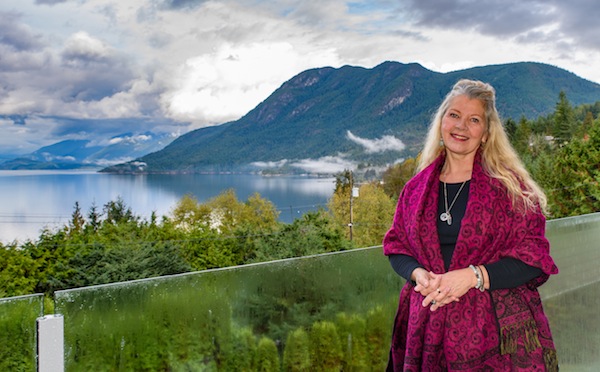
The mass murder of Muslims in two New Zealand mosques last week is a tragedy that transcends words. But, of course, humans being what we are, we need to struggle to try to understand this sort of evil. As a natural consequence, billions of words have been shared, some thoughtful and empathetic, others attempting to score political points off the misery.
No amount of words can turn back time and prevent the horror. Our only way forward is to share our deepest condolences with Muslims in our communities and worldwide, while striving for a better world.
Empathy should be a natural response to Jewish communities in North America, as we can so easily put ourselves in the positions of our Muslim neighbours. In some ways, Muslim British Columbians must be feeling something similar to those feelings experienced by Jewish people after the murder of six people in a Pittsburgh synagogue less than five months ago.
Again, there is no way to turn back time and change history. Lives taken cannot be brought back. But, when faced with an act of such grievous hatred and violence, from which it seems nothing good could ever emerge, there are things we can do to ease the grief and remind survivors and others affected that the world is not defined by the acts of one, or a few, terrible people.
After that act of terror in Pittsburgh in October, many of us experienced feelings of isolation, the sorrowful kinship of being part of a targeted community, the comprehension of how interchangeable we may be with the victims in the eyes of murderous haters. These feelings were eased in small but meaningful ways by acts of understanding and sympathy. Synagogues, day schools, Jewish community centres and Jewish individuals all over the world received notes and other gestures of solidarity and sympathy. A “solidarity Shabbat” that took place the following week saw congregations throughout North America swell with non-Jewish friends who were moved to demonstrate support and friendship.
Likewise, members of the Jewish community and many diverse members of the broader British Columbia community came together at a number of vigils and events in recent days, trying to alleviate the isolation and feelings of being targeted that our Muslim neighbours must be experiencing.
Part of the shock of the attack, which killed 50 people, is that it happened in a place so unaccustomed to hatred and violence of this magnitude. For many Canadians, the murders brought back memories not only of the Pittsburgh attack, which is so fresh in our minds, but also of the Quebec City terror attack of two years ago, when six Muslims were murdered and 19 others injured during a similarly motivated hate crime. Whatever self-image Canadians have as a peaceable people was challenged by that act. Likewise, New Zealanders, who, despite being a world away from us, share much of our colonial and post-colonial history and a common parliamentary foundation, must be coming to terms with the reality that they are not at a remove from the world’s worst ideas and people.
In an era when everyone’s reactions to every event, however monumental or insignificant, can be broadcast to the world through social media, we have seen responses that are beautiful and others that are inappropriate. An Australian senator famously blamed the victims.
Each of us can make a small difference by sending a message to our Muslim neighbours – whether we know them or not. Google “Vancouver (or Richmond or Surrey or wherever you live) mosque” and send kind thoughts to the congregation. Reach out to Muslim friends and let them know that the feelings they are having are understandable.
But there is one other thing. As noted, this is not a time for politicizing. So try to accept this suggestion as it is intended, as a humanitarian, rather than a political, statement: when a community of people is attacked, people of goodwill need to stand with that particular community and, for a moment or whatever length of time seems respectful, avoid universalizing the tragedy.
When elected officials or other well-intentioned people declare that “an attack on Group X is an attack on all of us,” it diminishes the experiences of the targeted group. When Jews were murdered in Pittsburgh, people needed to express (and Jewish people needed to hear) condemnations of antisemitism and words of support. Today, we need to face Islamophobia and white supremacy. We need to express (and Muslim people need to hear) words of support and condemnations of anti-Muslim violence.
There is a time for universal messages of solidarity and unity. In the aftermath of a catastrophe specifically targeting an identifiable group, we need to deal in specifics.
When we hear the word addiction, it often conjures up negative images or stereotypes. We might think someone has made poor choices, is down and out, or weak-willed; we might think that it’s a problem confined to the Downtown Eastside. Rarely do we think of the word disease or think of addiction as a mental health issue.
Jewish Addiction Community Services (JACS) is committed to providing opportunities for the community to learn together and, on April 4, JACS and the Jewish Community Centre of Greater Vancouver youth department are presenting a community forum called The Fentanyl Crisis: How It Affects Our Teens. This free event, geared to parents, teens and youth workers, is designed to help build awareness of illicit drugs, specifically fentanyl, and to teach how these drugs affect the teenage brain, and how to talk to teens about drugs.
According to a B.C. Coroners Services report, which was published last month, 86% of fatal illicit drug overdoses in 2018 occurred inside (i.e. not on the street) – 58% in private residences. The majority of these deaths were men between the ages of 19 and 59.
While the problem of addiction in British Columbia is well known, what is less well known or acknowledged is how our Jewish community is affected. In fact, denial that the problem exists is more the reality. Rabbi Shais Taub, a specialist in addiction and spirituality, who visited Metro Vancouver in 2012, said one in 10 people are touched by addiction – whether directly or through a close family member. It makes sense that those statistics are similar in our community.
Compare the reaction of when you hear about a friend who has recently been diagnosed with cancer, or another debilitating disease. While we may not know how to help, when a loved one is affected with a life-altering illness, we are usually motivated to offer assistance, whether it is making meals, visiting or giving money to a cause. In sharp contrast, addiction tends to push us away and we tend to blame the person who has a substance use disorder, instead of wanting to rally around and help them.
Why does a family feel shame and the need to shield others from knowing their loved one is affected by the disease of addiction? Why does the person themselves feel the need to hide? Clearly, the answers are complex. In a recent visit to an emergency department, a patient pleaded with a nurse that “no one in my community must know I am here.” That person was a member of our Jewish community. Not only are people struggling with an illness, but they often can’t reach out for help or don’t know where to turn.
We must and can work to reduce the stigma of addiction so that both families and people with addiction are supported. It begins with awareness of resources and education, with fostering a culture of being less judgmental, of being curious and open, and being willing to talk about how someone may have found themselves suffering from addiction. We also need to remind ourselves of the Jewish values of teshuvah (repentance), tikkun olam (repair of the world), community and chesed (loving kindness). People knowing that there are resources available, when they are ready, is key to recovery.
The April 4 community forum includes panelists Dr. Alana Hirsh, a physician working in the Downtown Eastside; Lee Gangbar, a registered nurse who works both at St. Paul’s Hospital’s emergency department and as an outreach healthcare nurse; and Anne Andrew, a parenting coach and author. To attend the forum, RSVP at eventbrite.ca (Fentanyl Crisis). For more information on the program or JACS, email shelley@jacsvancouver.com.
Shelley Karrel is the manager of counseling and community education with JACS. She has her master’s in clinical counseling, is a registered clinical counselor and also has a private counseling practice. She can be reached at shelley@jacsvancouver.com.
In Rachel Kadish’s book The Weight of Ink (Mariner Books, 2017), the fictional Rabbi Moseh HaCoen Mendes, living in London, England, in the year 1657, writes a letter to Rabbi Manasseh ben Israel in Amsterdam (who was a real person), using the phrase “we lift our feet.”
In the time the novel was set, the Inquisition in Spain and Portugal was still raging but Holland had opened its doors to refugees. Ben Israel traveled to England to try and persuade Oliver Cromwell to allow Jews back into the country, from which they had been expelled in 1290. His argument was that Jews had to be present in every country if the Messiah was to arrive in 1666. While he didn’t manage to open up England to Jewish immigration, Cromwell did permit the 20 Jewish families then living in London in hiding, pretending to be Christians, to live openly as Jews. It proved in the end to be the thin edge of the wedge.
In this letter of consolation to ben Israel, Kadish has Mendes write the following passage: “Our life is a walk in the night, we know not how great the distance to the dawn that awaits us. And the path is strewn with stumbling blocks and our bodies are grown tyrannous with weeping, yet we lift our feet. We lift our feet.”
I was struck by the fatalism of Kadish’s rabbi. He was expressing a common outlook of religious people in the era – that our lives on earth are lived in a vale of tears, and that our hopes must centre on the beyond. And yet, the Jewish philosophy of life has always been that we must live the life we have here on earth to the fullest. Different from some other views, we deny that our lives should be lived solely in the hope of some future reward.
It is true that, come what may, our role is to “lift our feet” and keep on going. This is a staple of Jewish thinking. We keep on going. We keep on trying. We are the nation of try. If we surrender to the obstacles we face, we are beaten before we start. There is so much around all of us, whatever our background, that can be discouraging, but we can’t allow it to get us down.
Persistence in the pursuit of the goals we seek is a hallmark of Jewish life, and of successful people of every persuasion. We are not easily deterred. Our parents, like many others of immigrant origins, worked their whole lives to try and ensure that their children would get an education and a better start in their lives than was the case for them. Many Jews have gravitated to the research fields, where years of effort are required to achieve results.
Many large enterprises that mark the commercial landscape were once small businesses initiated by Jewish entrepreneurs. From banking, to groceries, from the shmatte (rag) business, to high fashion, it is difficult to find an area of economic activity where Jews have not shown their hand. Remember Bugsy Siegel and Murder Inc.?
Our seeming job in this life is to keep on keeping on. But many of us continue to search for a rationale for human existence. We know that the struggle for survival is in the nature of all living things. That is nature’s imperative. As thinking humans, though, many of us seek other reasons for our being, explanations beyond mere survival. We do not know how long our trip will be before we see the “dawn,” but, in the meantime, many of us are not satisfied that just reproducing ourselves is enough to justify the existence of the universe we are experiencing.
For Jews, the business of survival over the years has been an interminable task accompanied by incalculable losses. But, though few in number, we have survived and, where we have had the tools of defence, we have prevailed. Our religious say we are here to celebrate the glory of G-d, in whose image we have been created. Oh yes, and we are also supposed to provide a model so that all peoples will come to recognize His Oneness and supremacy. It has been a painful task, and not many of us are ready to own up to that particular role.
In these days, when religious speculation about life’s purposes is far from the central issue of our time, it is still important in the lives of millions of people. Even for those of us who are not among them, many of us would like to believe there is some purpose in our lives beyond mere existence.
Many people devote a good part of their thinking and their actions to improving the lives of others beyond their immediate circle, and they draw some sustenance and psychic reward from those efforts. Some people believe that certain issues are more important than even their own lives and, indeed, they stand ready to lay down their lives, if need be, in defence of these ideas.
Helping others and a willingness to die for our beliefs both point to things that we value beyond mere existence. Yes, we go on “lifting our feet,” but with principles that guide us until we reach the “dawn.”
Max Roytenberg is a Vancouver-based poet, writer and blogger. His book Hero in My Own Eyes: Tripping a Life Fantastic is available from Amazon and other online booksellers.
Editor’s Note: This article has been edited to make clear that Rabbi Moseh HaCoen Mendes is a fictional character.
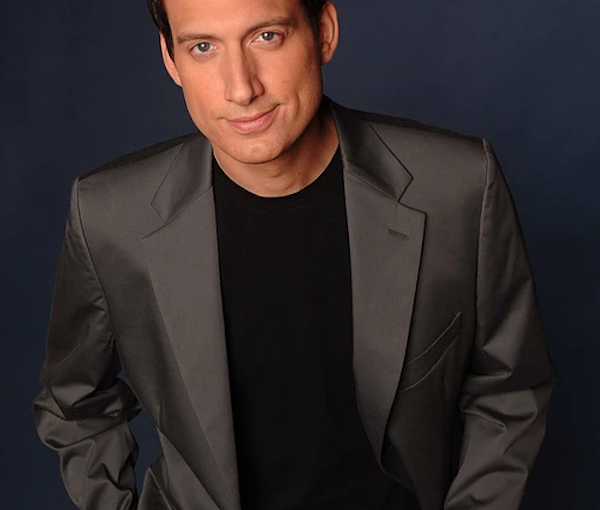
Elon Gold performs in Vancouver on April 14 at the JNF Negev Gala. (photo from elongold.com)
Comedian Elon Gold loves doing charity events, especially Jewish ones. The Independent caught him for a phone interview as he was on the road – with his family – to Las Vegas from Los Angeles to do gigs for the Adelson Education Campus and then the Israeli-American Coalition. On April 14, he will be in Vancouver to co-headline, with Ambassador Ron Prosor, the Jewish National Fund, Pacific Region, Negev Gala. The event raises funds for Sderot Animal-Assisted Therapy Centre.
“I feel like I’m doing a mitzvah by making my people laugh. And I’m also helping this cause that’s really important, and Israel is really important to me,” said Gold. “And we’re living in a highly antisemitic time, it’s dark out there, so anything I can do to bring light into our world and make my fellow Jew happy, I’m there for it.”
Gold’s resumé is impressive. He starred in the television series Stacked and In-Laws, had a recurring role on Bones and on The Dana Carvey Show. He guest starred just recently on HBO’s Crashing and, longer ago, on shows including Frasier and The Mentalist. He has appeared in films, his one-hour Netflix special, Elon Gold: Chosen and Taken, is available on Amazon and his show Elon Gold: Pro-Semite premièred at the Montreal Comedy Festival. He has made multiple appearances on The Tonight Show and his July 2018 segment on The Late Late Show With James Corden – how, like everyone else, Jews love sex, money and food, but just in a different order – has been watched and shared by countless people on the internet, as has his routine on why Jews shouldn’t have Christmas trees and so many others.
Despite all of his accomplishments and his years in the business, Gold still gets excited about his work, and he shared what he described as a “wow” moment, one of the best days of his life, almost immediately when talking with the JI.
“Yesterday,” he said, “I was filming a scene of Curb Your Enthusiasm with Larry David…. It was really, truly a dream come true.”
But Gold didn’t take his being hired by David as a sign that he had “made it.”
“The truth is, I have been a guy with lucky breaks and hard breaks for the last 20 years,” said Gold. “This is another achievement, and one that’s beyond anything I would dream of…. I’m gratified in the sense that I finally feel like I’m in a place, not where I’ve made it, but where I actually have fans, and my clips are viral and people are sharing my bits on Facebook, WhatsApp or whatever. I did the James Corden show and, again, that doesn’t mean I’ve arrived … but what’s cool to me is that I did that set and then everyone’s sharing it, especially Jews. My biggest fans are my people.”
It’s been a 25-year journey, said Gold of his career, “with all sorts of great highs, like yesterday, and huge lows, like having a sitcom that you pitched and created and started get canceled. There are so many lows, and then there is the daily rejection that is show business. And that’s why I’m so glad I’m a comedian and an actor. I get rejected all day in Hollywood at auditions, but then, at night, I’ll go to the Laugh Factory comedy club and I’ll have 300 people roaring, and that will validate [me] – I knew they were wrong! I knew I could do this. See, I’m funny. These people think so, at least.”
Gold said his resilience, his ability to keep trying, likely comes from stand-up. “Because stand-up is all about bombing and killing, and the killing is so worth it that even the terrible, dejected feeling of bombing [is manageable].”
As far as his career, he said, “I have no other choice. I don’t love doing anything else and I’m not good at anything else.”
Known for his impressions, he said, “I used to impersonate my teachers in eighth grade.” His goal wasn’t to ridicule people, he said, but to make even the teachers laugh.
He enjoyed making people laugh, and writing comedy. One of the first things he wrote, he said, was a Purim shpiel. “And I’ll never forget the feeling of having the entire high school laughing, and thinking, there has never been anything more gratifying than what I just did, I want to do this more. Everybody says it’s like a drug…. It’s so addictive. Once you get a taste of it, that’s it, you’re hooked. And very little can discourage a comedian [so much that they get] out of comedy; certainly not a bad set, because we all know that we all have them.”
A combination of things drives him.
“It’s probably disingenuous to say that I do this because I love to make others laugh,” he admitted. There is a selfish aspect to it, he said. While making people happy is a “key component” of why he does comedy, he said, “I also love everything about it… I love the process of having an observation and then writing it and tinkering with it and working on it. I love doing it and I love the fact that I have so much freedom in my days because I don’t have that nine-to-five job most people have…. I’m always working. At the same time, I’m always on vacation.”
Gold loves getting the laughs, and said that’s probably 70% of the reason he does comedy; the other 30% is making people happy.
“There is so much misery in the world,” he said, “to make people happy is a great thing, but it’s only a part of it.”
On the acting side, Gold said his favourite kind of acting is for sitcoms “with a live studio audience because you’re still getting the laugh but now you’re not looking at the audience and talking to them, you’re looking at your fellow actor … and, peripherally, you hear and see these people cracking up.”
Ultimately, he said, “I just love performing.”
The only “grueling part,” he said, is the memorizing “and the pressure of 200 people staring at you, saying, ‘You better know your lines, pal, because we’re all here and we all want to go home…. Acting is challenging, but it’s also just fun…. It’s fun to get into a character and just play.”
Gold, who is from the Bronx originally, recalled his first open-mic night at the Comic Strip Live in Manhattan; he was 16 years old. “Fortunately, I had beginner’s luck because I was doing impressions – my early act was all impressions – and impressions are like magic tricks, they just wow the audience.”
Despite being a touring comedian by university (he got a bachelor’s in economics at Boston U), it took years, he said, to develop his own voice, to figure out what he wanted to talk about and how to talk about it.
“I’m obsessed with Jewish stuff because I live such a Jewish life,” he said. “I’m an observant Jew, I keep Shabbos and all that stuff, keep kosher. So much of my life is in the Jewish world, I can’t help myself but to come up with observations about our traditions, our holidays, our rituals. A lot of what I talk about is what I live…. The other part of my life is being married, being a dad, so I talk about that.”
Gold and his wife, Sasha, have four kids, two sons and two daughters, ranging in age from 9 to 18. The couple is coming up to their 25th anniversary in June.
As he stopped to fill up his car with gas on the way to Vegas, he told the JI about why he likes performing at Jewish events, while simultaneously directing his kids to be quick about heading into the gas station, as they were running late.
“There are not a lot of comedians out there that will go that deep into the Jewish experience and, for me, there are not a lot of audiences I can share my Jewish experiences with,” he said. “I can’t do lulav and etrog jokes on James Corden…. At the same time, we’re raising money, we’re raising awareness for incredible organizations…. It’s all win-win for me – I’m raising money, I’m making money, I’m getting laughs, I’m getting to do material I don’t do anywhere else…. And I love Jewish audiences; I love connecting on more than just a human level…. We’re connecting about a shared experience that is almost indescribable to anyone else.”
For tickets to the JNF Pacific Region evening event on April 14, which will be held at Schara Tzedeck, call 604-257-5155.
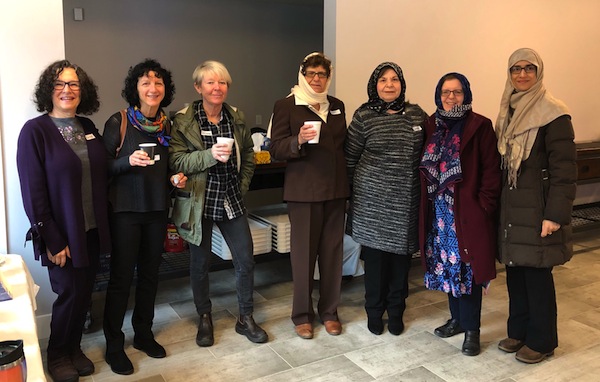
Women from the Okanagan Jewish and Muslim communities at a Feb. 9 event, which is the first of hopefully many bringing the communities together. (photo by Steven Finkleman)
The Jewish and Muslim communities of Kelowna and its surrounding areas have started celebrating their similarities with neighbourly get-togethers.
Coming from a mixed religious background, Okanagan Jewish Community member Philippe Richer-Lafleche knows well how upsetting it can be to be labeled or misunderstood. Yet, he has consciously chosen to look beyond his negative experiences.
“I feel that we’re not called to religion. God doesn’t call us to religion. He calls us to relationships,” said Richer-Lafleche. “We talk about the covenant as a relationship. We have communities, and out of communities come tradition, and out of tradition and culture comes religion. When you get hung up on the religious thing and the symbolism, and forget about the relationship, that’s when we get into trouble…. For me, what’s important is how I relate to myself, the world around me and the people I live with.”
Last summer, OJC president Steven Finkleman asked Richer-Lafleche if he would consider being part of the board and Richer-Lafleche agreed. A few months later, Finkleman and Richer-Lafleche began talking about connecting with the growing Muslim community in hopes it would provide a blueprint for connecting with the other local communities, including First Nation, Sikh, Christian, Hindu, Buddhist and others.
“We began by approaching the mosque,” Richer-Lafleche told the Independent. “Steven knew somebody who’s on their council, got in touch, and we had a meeting. We thought that the two of us would go to the mosque and meet with one or two people. We met with the entire board for the mosque – about eight people, three women, five men, I think. They said they’ve wanted to do this, too, and had been talking about how.”
The Muslim community appointed Rehan Sadiq as their lead in the initiative, and Richer-Lafleche and Sadiq began meeting at the local Tim Hortons almost every weekend for coffee and conversation, becoming friends in the process.
The first event bringing together the communities took place Feb. 9 at the Kelowna Islamic Centre, and the next one is being planned for this spring at Kelowna’s Beth Shalom Congregation.
“The concern I had was just how many people at the synagogue would be interested,” said Richer-Lafleche. “But, it worked out very well, with about two dozen people from both sides, open to families and people of all ages.
“It started with a 10-minute talk – somebody from the mosque, somebody from the synagogue, talking about the community, how the community in Kelowna or in the Okanagan developed, where the Jews or Muslims here came from … some of the challenges in the community…. There was a little bit of talk about some of the shared values, and I think a lot of the people from the synagogue were astounded that there weren’t a lot of differences, that a lot of the values were the same.”
Once the formal part of the event took place, participants had lunch together and mingled, then took a tour of the newly built mosque, which included a call to prayer.
“There was a young fellow who calls to prayer, beautiful voices in Arabic, from my perspective it was absolutely beautiful, moving,” said Richer-Lafleche. “People from both sides said this was the beginning of a relationship between the two communities, but also core for interfaith connection with other communities.”
Both Richer-Lafleche and Sadiq are working on other ways for their communities to connect with, learn about and support each other.
“I know, in the Islamic world, Jews living in the Islamic world throughout our history, there was this interchange between Muslims and Jews, with science, literature, philosophy, and even spirituality,” said Richer-Lafleche. “It’s unfortunate that, in the 20th century, it seems to have broken down. Maybe, in a small way, in a small part of the world, with a very small group of people, we can start to do something like that … and maybe peace in the world.
“I know there may be a few people at the synagogue that may be very uncomfortable with the fact that there’s this connection with Muslims … and that’s just simply fear,” he added. “We’re stepping outside that comfort zone and you progress slowly.”
“We had a very small Jewish community,” said Sadiq, referring to Pakistan, where he was born. “When I came here [in 2008], there was a very small mosque, housed in an old church. We recently built a large mosque and wanted to find ways to connect with the Jewish community.
“My children go to public school and have friends of all different faiths. I don’t want my kids to be biased. I want them to explore and appreciate. I want them to get to know our neighbours.
“I’m glad that our story is newsworthy and very important. One-on-one interaction is the best way to move forward, instead of relying on what we hear in the news.”
“There’s a saying,” added Richer-Lafleche. “‘When you look into the face of another human being, it’s wonderful when you realize you’re actually looking into yourself.’ And it’s that connection that we need in this world. I think that’s what’s important.”
For more information about the OJC, call 250-862-2305 or visit ojcc.ca.
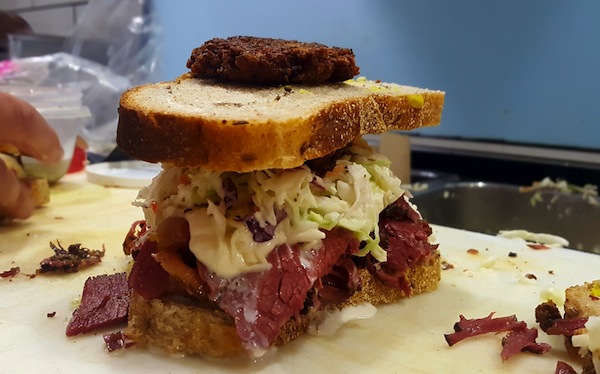
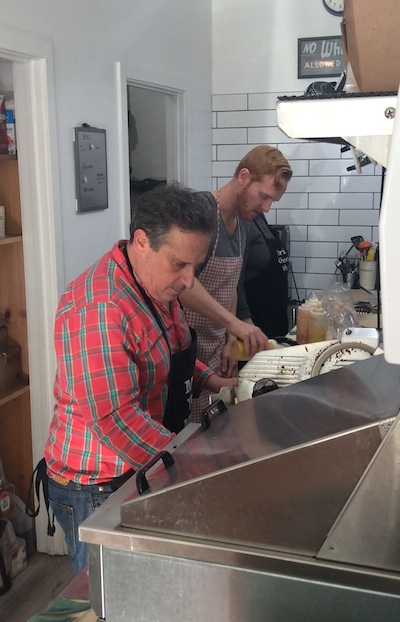
The Hungry Jew, one of the signature sandwiches at Buzzy’s Luncheonette. (photo by Adam Bogoch)
My friend, Adam Bogoch, pitched it as the “Smoked Meat Story.” Soon after that email, he would write his own review, for narcity.com, titled, “This smoked meat sandwich on Salt Spring Island in B.C. will actually change your life.” His friend and colleague, Howard Busgang, had opened a deli on the island, and not only did I need to meet Busgang, but I needed to get on a ferry and taste The Hungry Jew, one of the signature sandwiches at Buzzy’s Luncheonette.
Between the Independent’s annual summer publishing hiatus and the High Holidays, it was November before Adam and I headed to Salt Spring. The travel ran like clockwork and we were pulling up to 122-149 Fulford Ganges Rd. right in time for lunch. We shared a Hungry Jew – a Montreal smoked meat sandwich with homemade horseradish sauce, coleslaw and, I kid you not, two latkes – and the Rabinowitz, Buzzy’s take on a Reuben. They were both incredibly good, and the only reason I’ve waited this long to share the news is because I wanted to wait until better weather, when people would be more likely to take a day or weekend getaway.
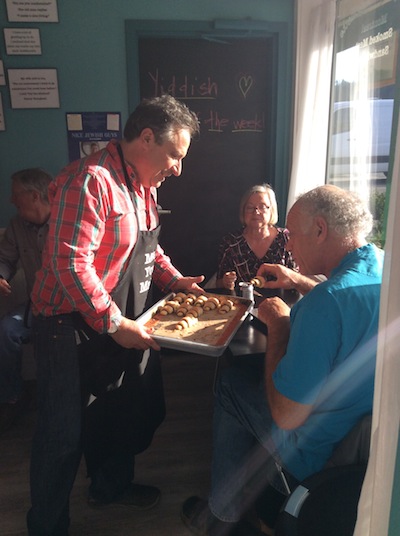
Howard Busgang serves customers rugelach on a sunny November afternoon. (photo by Cynthia Ramsay)
Even in winter, Buzzy’s was busy. Having arrived at prime feeding time, it was hard to get Busgang to sit down and, as we talked, he was constantly distracted – in a good way – by customers.
“Tell me, I’ll get you another sandwich before you go,” he said as he finally was able to join me at a table outside for the interview.
Born and raised in Montreal, stand-up comedy took Busgang first to Toronto and then to Los Angeles, where he met his wife, Melanie Weaver, and where he lived for 28 years, before returning to Canada.
“She’s Jewish-adjacent,” joked Busgang. “She was working for a rabbi when I met her.”
The two met on a blind date, he said, brought together by a Jewish comic who knew both of them.
When he started in comedy in the early 1980s, Busgang said, “There were not a lot of comics around. It wasn’t like today where every second person does stand-up, so it wasn’t that OK a profession,” as far as his parents were concerned. “It was kind of an oddity, like maybe he’ll grow out of this kind of thing.”
Busgang attended Jewish high school, then went to McGill University before heading to Toronto.
“You know where I started?” he said. “United Synagogue Youth, USY, that’s where I started. I was emceeing all their events and that led me to go professional.”
He recalled the first time he performed at amateur night in Toronto. “They packed the place with all these people from USY who knew me. It was packed, and it was great.”
Howard Busgang, left, and Adam Bogoch prepare sandwiches. (photo by Cynthia Ramsay)
So great, he said, that he was put into regular comedy shows right away, “which wasn’t so easy, by the way, because it wasn’t my friends anymore in the audience.”
When he was a stand-up comedian, Busgang did a lot of Jewish material. “I was a very Jewish comic,” he said.
In Los Angeles, he moved from stand-up to comedy writing. “I just was a little tired of the road,” he said, and performing caused him some anxiety.
“Listen, I had a respectable career, I did well, but I would constantly punish myself by asking, why am I doing this? But I think I do that with everything. I do that with this place [Buzzy’s], I do that as a writer.”
As Busgang was in the middle of saying he might just be a miserable guy, he was called back into the deli to help make a sandwich.
Weaver took his place. Her recollection was that a woman from the synagogue set up that first date.
“I was the only non-Jew in the whole place,” she said. However, Weaver was raised Jewishly, with her family observing some of the holidays, hosting seders, for example, and she taught at a Jewish camp. Born and raised in New York, she moved to Los Angeles some 30 years ago. She and Busgang have been married for about half that time.
“Howard had this property on Salt Spring our entire marriage,” she said. “And so, our entire marriage, I kept hearing ‘Salt Spring,’ ‘Salt Spring,’ and all I kept seeing was this property tax bill every month. I was, like, how good could it be? Then the elections and everything started to happen in the U.S. and it just got bad. We took a trip up here in September [2016], I fell in love and then we came in July [2017].”
A blended family, the couple has three daughters: Alexandra, 30, in Toronto; Emma, 20, in Seattle; and Hannah, 10, who was dividing her attention between helping in the deli and playing with a local dog while her mother was being interviewed.
Neither Busgang nor Weaver had any restaurant experience before opening Buzzy’s. “It’s funny,” she said. “The night before we were open, we had to learn the cash and I was almost in tears.”
The ignorance was a kind of blessing, she said. “I don’t think we knew what could go wrong, so ignorance was bliss, in this case.”
Their first day, there were lineups out the door.
“We got thrown into it, which was great,” she said. “I think if we had opened in the winter, when it was slow, it would have been a different experience.”
Busgang’s love of cooking seemed to have come out of nowhere, said Weaver. “And then he started to smoke his own meat. So, we had that in our back pocket.”
But the couple still wasn’t planning on opening a restaurant, until the location became available. “It was basherte,” she said.
In addition to Busgang’s meat-smoking skills, Weaver’s desire for a good tuna sandwich was a motivation. “So, again, why not open a deli? Not the brightest of ideas, but it worked out.”
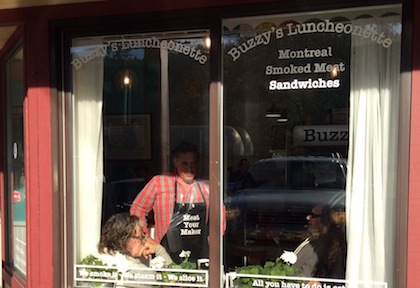
Howard Busgang’s father called him Buzzy, hence the deli’s name. (photo by Cynthia Ramsay)
And it’s hard work. There is only one staff member. Busgang smokes meat “around the clock,” said Weaver. “It’s like having a newborn. It’s a lot of work but the rewards – it’s a community, we’ve become part of a community and it means so much. My daughter gets to work the cash register. It’s crazy. We still can’t believe we have keys to this place.”
She said, “If we did anything right, it’s that we didn’t focus on the tourists, we focused on our people, and so we have a lot of loyalty here. I think people also come here [because] there’s a lot of cursing, a lot of bad behaviour, you can come here and just laugh, and that’s what we want. Come here, have a laugh, I’ll make you eat, you have to finish your plate or you go to your room. That was our business plan – make the community happy, hopefully make a few bucks.”
Since they opened, the menu has seen some additions; in particular, matzah ball soup and tomato soup. “We don’t want to get too big. We just want to stay like someone’s kitchen,” she said.
And the island has been very welcoming. “Someone knew that we want to make our own pickles, so they’re going to grow us cucumbers,” said Weaver as one example. “The love here,” she said, “it’s insane.”
Hannah, who had checked in a couple of times with her mother, joined the interview. In addition to sometimes working the cash, she delivers food to the Saturday market and to the bar a few doors down from the deli.
“That’s another thing,” said Weaver, “it’s a family joint.”
School runs four days a week and, while Hannah enjoys helping out, she was still getting used to living on the island. When she’s not working or at school, she’s probably at soccer or horseback riding; she had just received a paddleboard for her birthday. Though she has a couple of sandwiches named after her, her favourite is the grilled cheese.
“A lot of what we’re doing here has to do with taking the power back in our lives,” said Busgang, when he returned to the table. “It has to do with being in showbiz all those years and feeling like you had no control over anything and feeling like you’re handing over all the power to other people to validate you…. I was tired of it.”
Buzzy’s opened on June 22 last year. “Whereas, in show business, nobody wants to help you, in this business, I have so many people who want to help me.”
One of those people was William Kaminski, owner of Phat Deli in Vancouver, who Busgang described as a mentor.
“We’re not perfect but we’re figuring it out,” said Busgang.
The smoked meat he has got down to a science.
“We’re open till four o’clock and then I have to get my brisket ready for the next day, so I have to bathe the brisket,” he said. “We cure it for eight days – dry cure – and then I have to take the salt out, so we bathe it. I’m bathing a brisket right now and sometimes I sing to it. It’s very sweet. After I bathe it, then I put some rub on it and then I’ll take it home and we’ll smoke it for seven-and-a-half hours. And then it goes in the steamer for two, three hours.”
Finding rye bread was one of the early challenges.
“I knew I was in a special place,” he said, “because people would come by with bread and say, ‘Try this bread.’ They’d constantly come in and say, ‘What are you going to do about the bread?’ It became like a cause célèbre, the bread. It took me three months, and I got someone here on the island to make me an organic rye bread.”
Barb Slater makes the bread; Shigusa Saito, the knishes. Saito is now also “making a dark chocolate babka to die for,” wrote Busgang in a follow-up email. “If you’re not already dead, she’s also making us New York cheesecake, our soon-to-be-famous potato knishes, and rugelach.”
Meanwhile, Busgang – whose credits include having been a head Just for Laughs-gala writer, creating the award-winning sitcom The Tournament and writing for TV series Boy Meets World and Good Advice, among many others – is still writing, still pitching shows. Earlier that afternoon, he was slicing meat while plugged into his phone, listening to a meeting in which a producer was trying to put a deal together.
Weaver popped out to say that Busgang often has to go next door to finish his calls because the meat in the charger of his cellphone prevents his phone from charging. “There’s meat everywhere,” she said.
The November sunset as seen from the ferry, en route home. (photo by Cynthia Ramsay)
A couple of relatively new customers stopped to say hello to Busgang and Weaver. They said they were slowly adding Buzzy’s to their list of usual places to eat.
And, said Busgang and Weaver, local Jews have discovered, by going to Buzzy’s and meeting fellow Jews, that there actually is a Jewish community on the island.
“We’re blessed to have this,” said Busgang.
As he explained the deli’s name – his father called him Buzzy – Hannah returned, offering him a taste of a new salad dressing she had created. “Daddy, just try it.”
“Interesting,” he said, “I like it.”
“It’s gross,” she corrected him.
Three generations seemed present in that moment.
As the interview came to an end, Busgang asked, “Do you want some rugelach? I gotta keep feeding you.”
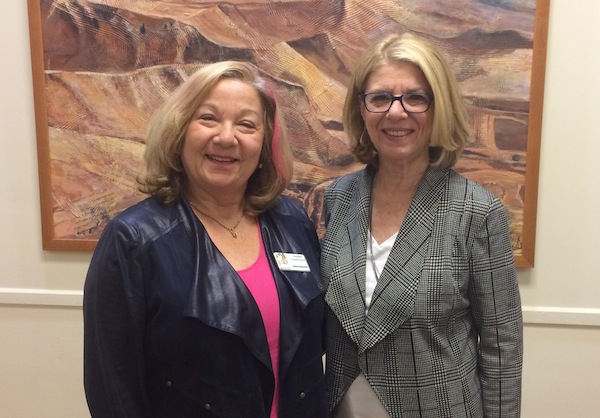
Organizer Debbie Rootman, left, and guest speaker Janice Porter at Temple Sholom Sisterhood’s networking event Feb. 28. (photo by Baila Lazarus)
If you’re a decision-maker in business, and especially if you’re a small-business owner or entrepreneur or are looking for a job, LinkedIn should be one of the main tools in your arsenal.
That was the message from LinkedIn trainer Janice Porter, who spoke at a business networking event sponsored by Temple Sholom Sisterhood on Feb. 28.
“LinkedIn is about relationships,” Porter told the group. “It starts with having a fully optimized profile that will have more people see it. But it’s about building connections. Even a good profile won’t be seen if you don’t have any connections.”
Porter said the first step, however, is to determine if the platform is right for you.
“It’s not for everybody,” she said. “If you’re looking for a job, you should be on LinkedIn. But, if you’re in business, if you’re promoting something, you have to know whether your target audience is on LinkedIn.”
LinkedIn, a professional networking platform, was launched in 2003. It has 590 million members in 200 countries. Users create profiles and then reach out to other users to connect online and possibly take the business relationship into the “real” world. Such relationships can lead to direct sales, referral partners, strategic alliances and, if you’re on the job hunt, interviews.
At the Temple Sholom event, Porter outlined five steps that would help users get the most out of the social media platform.
Have an authentic profile. Having a well-done, completed profile allows a user to be seen as an authority. As well, Porter pointed out, if you have a strong LinkedIn profile, it will come up high on Google search results. Be sure to include a good photo. People are 14 times more likely to look at profiles that have a photo.
Create an optimized headline. This is the first line people see when they are searching. The headline should include a benefit positioning statement – what you do and what the result is. For example, Porter’s headline says, “LinkedIn trainer, relationship marketing specialist, networking coach, increasing qualified leads online & nurturing them into sales offline.”
“Most people just say ‘my job at my company,’ which focuses on the company rather than the person,” Porter explained. “Usually people search for the type of job that you do, so putting your company name in is wasting space. So rather than say, ‘Mortgage broker at …,’ say ‘Mortgage broker with specialty in.…”
Be visible. Having a profile is not enough, said Porter. Users need to be active by writing and sharing new content, and commenting on other members’ posts. “The more you engage with other people, the more people will want to connect with you,” she said.
Be personal. When reaching out to connect with other members, customize the connection request. Put in a sentence explaining why you are reaching out to this person.
Make new connections. Porter recommends that users connect with five new people daily.
When asked if it’s worth it to buy a premium account on LinkedIn, Porter suggested starting with a free account because there are enough people you can connect to without the upgrade. However, if you really need to connect directly with certain C-suite employees or you feel a need to follow up on everyone who has looked at your profile, a premium account would make that easier. A third level – Sales Navigator – is particularly useful for those whose focus is selling products or services.
You can try the paid versions on a 30-day free trial, but Porter cautioned that, if you’re not interested in continuing, cancel the trial early. After 30 days, you get a bill for a year, not a month, she said.
Karalee Greer, an independent market partner with Monat Global, attended the event because she wants to be more active on LinkedIn. “Having a more complete and updated professional profile will help people find me on the site,” she said. “Also, by being regularly active and connecting with my target market potential, Linkedin will help me find people more suited for me to build relationships with. I feel my time will be better spent on this platform.”
Mortgage planner Deborah Burnstein said she attended the event not just for the guest speaker but for the networking opportunities. She was already familiar with LinkedIn before attending the event. “Now it’s about finding content to post,” she said.
Baila Lazarus is a Vancouver-based writer and principal media strategist at bailalazarus.com.
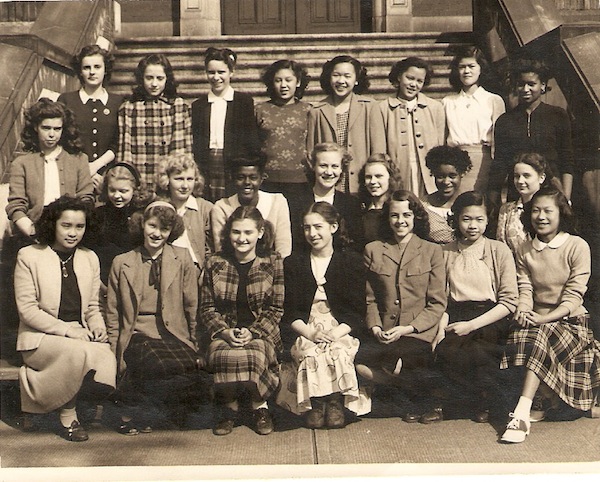
Grade 8 monitors, Lord Strathcona Elementary School, 1948. The new Cross Cultural Strathcona Walking Tours start at the school and then take visitors through Hogan’s Alley, Jewish Strathcona, Japantown (Powell Street) and Chinatown. (photo from Bev Nann)
The Cross Cultural Strathcona Walking Tour celebrates the history of Vancouver’s Downtown Eastside neighbourhoods Hogan’s Alley, Jewish Strathcona, Japantown (Powell Street) and Chinatown. The guided walking tour builds awareness of the contributions of early immigrant communities then and now, in celebration of Vancouver Asian Heritage Month and Canada’s Jewish Heritage Month, both of which fall during the month of May.
The walking tour theme is education, and each tour starts at the oldest elementary school in Vancouver, Lord Strathcona Elementary School, at 592 East Pender St. Referred to as the “League of Nations” for its multicultural make-up, this school brought and continues to bring many communities together.
Tours will feature community experts and wind their way through the streets of Vancouver’s Eastside pioneer neighbourhoods, concluding at the Vancouver Japanese Language School (475 Alexander St.), where participants can enjoy complimentary “after-school” snacks from the featured communities.
“Last summer, I had the privilege of going on a number of walking tours, where it dawned on me that we were walking the same streets and even talking about the same homes, just through different community lens,” said Carmel Tanaka, co-founder of the Cross Cultural Strathcona Walking Tour. “A lightbulb moment was to bring all these experts into one room and create one inclusive walking tour highlighting all our voices together!”
The tours will take place on the traditional, ancestral and unceded territories of the Musqueam, Squamish and Tsleil-Waututh peoples, with the support of the Grant family, who offer greetings from the Musqueam Nation. The Cross Cultural Strathcona Walking Tour project is a coordinated effort by the following participating organizations: Association of United Ukrainian Canadians; Benny Foods Italian Market; Dr. Sun Yat-Sen Classical Chinese Garden; Musqueam elder Larry Grant; Greater Vancouver Japanese Canadian Citizens Association; Heritage Vancouver Society; Hogan’s Alley Society; Jewish Independent; Jewish Museum and Archives of British Columbia; Nikkei National Museum and Cultural Centre; Pacific Canada Heritage Centre Museum of Migration; Vancouver Asian Heritage Month Society’s explorASIAN; Vancouver Heritage Foundation; Vancouver Japanese Language School and Japanese Hall; Vancouver School Board; Vancouver School Board Archives and Heritage Committee; Wongs’ Benevolent Association; and Youth Collaborative for Chinatown.
Tours will run Sunday, May 5, 12, 19 and 26, 11 a.m. and 1:30 p.m., rain or shine. Each tour will last just over two hours and cost $15/person (free for children and moms on Mother’s Day). For tickets, visit strathconawalkingtour.eventbrite.com.
Owner Cynthia Miller in front of Sechelt Inlet at the Pacific Peace Retreat. (photo by Efraim Gavrilovich)
Travel can be one of the most stressful activities there is. The challenges of packing “light” so you don’t have to pay for a carry-on; getting to flights at ridiculously early times of the day; not to mention dealing with foreign currency, travel insurance, airport lineups, lost luggage, strange food and the fear of contracting some exotic illness while away.
When was the last time you took a trip that not only caused minimal anxiety but actually resulted in you coming home more relaxed and truly blissful? And, more than that, with the knowledge of how to maintain that calm once you’re back at home and the stress threatens to build again? Thankfully, we live in an area of the world where such vacations are an easy option within a day’s drive of the Lower Mainland.
Along the Sunshine Coast, less than two hours’ drive from Langdale, is the Pacific Peace Retreat, where owner Cynthia Miller enables visitors to learn how to shift their mindset by being mindful and aware in the moment.
“I help them see the bigger picture instead of focusing on the problem,” she explained. “Too many people talk about the problem without really seeing the deeper aspect of what’s holding them stagnant.”
Miller provides transformation and relaxation through hypnotherapy, reiki, yoga, aromatherapy, creative arts and mindset coaching.
“I believe that we inherently want to move forward and feel a sense of growth,” she said. “And, when you step back and see your life or past from a different viewpoint, you begin to open up to something new, and that’s when growth takes place. Being mindful of the energy you want to put into every situation – that’s what we practise here.”
Miller cautions that mindfulness does take repetition. “As you practise, it becomes automatic,” she said. “I think that’s why people come here.”
At Hollyhock Leadership Learning Centre on Cortes Island, guests can take one of 90 courses offered on everything from discovering your life’s purpose to mindful self-compassion. They range from several days to several weeks.
Hollyhock Garden (photo by Darshan Alexander)
“It’s learning about yourself and how you operate in the world,” said Loretta Laurin, Hollyhock’s communications manager. “We play a part in making the world better through our own development.”
Although many of the courses are geared toward people who are in a leadership or change-maker role, there are also courses that focus on health and wellness, such as cooking courses that help boost the immune system, pilates, qi gong, and self-expression with sound, as well as excursions such as sea-kayaking and nature walks. Everyone is welcome to attend, said Laurin.
Calling itself a “centre for transformative learning,” the Haven on Gabriola Island helps bring balance to people’s lives through coursework, meditation and yoga.
“There’s a real shift in energy level and transformation,” said Jo-Ann Kevala, a Haven faculty member. “People feel more connected to others.”
Even simple activities like walking can be very mindful and meditative and a way to relax into the present, said Kevala.
The Haven offers courses for women or men, couples or singles, those with high stress and those with addictions. Its signature five-day Come Alive program is an “opportunity to revitalize your life, discover and activate your resources and realize your full potential.”
Quantum Leaps Lodge in Golden offers a variety of practices that will get visitors in touch with their calmer selves. (photo from Quantum Leaps)
A little further afield, in Golden, visitors can participate in shamanic drumming, Buddhist philosophies and First Nations activities, such as sweat lodges or vision quests, at Quantum Leaps Retreats.
Owners Brian Olynek and Annette Boelman have accumulated a wide variety of self-discovery practices.
One of the more popular activities is the transformational labyrinth, with several spots to sit and think about specific ideas or create something, according to instructions at each spot. The concepts for the labyrinth are based on those of Buddhist monk and world spiritual leader Thich Nhat Hanh, known for his writings on mindfulness and peace. People are encouraged to walk the labyrinth as often as they want and not worry about time.
While much of the world encourages stress and materialism, at Quantum Leaps, said Olynek, “people step out of fear and stress and tap into their own happiness and joyfulness.”
Baila Lazarusis a Vancouver-based writer and principal media strategist at bailalazarus.com.
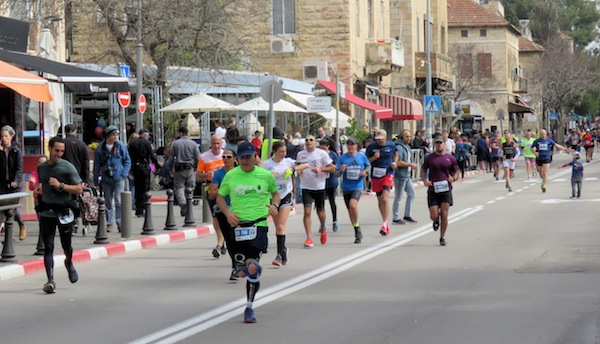
Running has become one of the most popular sports in Israel, with both the Tel Aviv and Jerusalem marathons attracting thousands of competitors. The Jerusalem Marathon on March 15 attracted some 40,000 runners, including 4,600 athletes from more than 80 different countries. Six different runs were offered, one of which was designed for competitors with special needs. The main event was won by Kenyan runner Ronald Kimeli, 33, who ran the 42.2 kilometres in two hours, 18 minutes and 47 seconds.