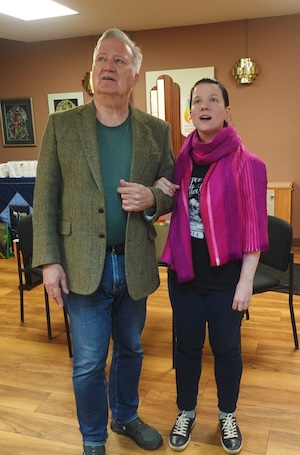
Michael Posner, author of Leonard Cohen, Untold Stories, was Kolot Mayim’s final speaker in this season’s Zoom lecture series. (photo from Michael Posner)
Kolot Mayim Reform Temple’s 2025/26 Zoom lecture series on Jewish music concluded April 12 with a talk by Michael Posner on Hallelujah and Beyond: Leonard Cohen’s Torah of Song.
Posner, a playwright, author and journalist living in Toronto, penned Leonard Cohen, Untold Stories, covering the musician’s life from his early years in Montreal to his death in Los Angeles in 2016. Posner drew on more than 500 interviews with Cohen’s family, friends and others to offer a complete portrait of the man and his art.
“It won’t surprise many of you to know that Leonard was a very complex character, a very complicated individual,” Posner said. “In fact, when I speak about the Jewish soul of Leonard Cohen, it’s necessary to attach what I would call an asterisk to that description. The asterisk is actually very appropriate to Leonard, and maybe essential, because he was a man of many moods and many masks, many manifestations and many contradictions.”
Cohen had a profoundly Jewish soul, according to Posner. Not only was he a kohanim (descendant of Jewish priests), but an ancestor was the unofficial chief rabbi of Montreal, his grandfather was a talmudic scholar and portraits of Cohen’s forefathers feature prominently on the walls of Congregation Shaar Hashomayim in Montreal.
“From the time that he starts writing, as a teenager in the early 1950s, Jewish themes and motifs, Jewish imagery and history infuse his art – they are a very essential part of the first four books of poetry that he wrote,” Posner said.
It is through his music, however, that Cohen achieved international fame, and many of his songs “cleverly exploit Jewish ideas and scripture,” said Posner.
In “Who by Fire,” for example, which echoes the Unetaneh Tokef prayer of the High Holy Days, Cohen is not rejecting faith, so much as trying to establish, in the wake of the Holocaust, the grounds of continuing faith, argues Posner.
“The metaphor here,” he said, “is a kind of corporate secretary fielding phone calls on behalf of humanity itself, some of whom will live and some of whom will die in the next year, according to the decree of the caller. But who, exactly, is the caller? Who is at the other end of the line? Dear God, it’s me, Leonard. Are you still there? Can you please identify yourself? This is a theme that Cohen mines continually.”
In “Hallelujah,” Posner spots irony in the line, “There was a time you let me know / What’s really going on below / But now you never show it to me, do you?”
The song is often perceived as a celebration of God, but, Posner said, “I don’t think people have paid close enough attention to the lyric, because the lyric is really saying, we want to believe in you, God, but it’s not that simple.”
Posner discussed Cohen’s struggles with established Judaism and his spiritual exploration that delved into other faiths, including Christianity, I Ching and Sufism; Cohen was devoted to Rinzai Zen Buddhism and ordained as a monk in 1996. Nonetheless, there were several aspects of Judaism that Cohen honoured.
“In the 1970s, he began to study with a Chabad rabbi in Montreal and routinely traveled when he was on tour with his tallis and tefillin bags,” Posner said. “In later life, he joined a synagogue in Los Angeles, whose rabbi, Mordecai Finley, was deeply steeped in kabbalah. And, later still, he studied online with Yakov Leib HaKohain, another rabbi who was immersed in the mystical aspects of Judaism.”
Cohen, in Posner’s view, touched upon everything that is human – magnificent, brilliant, humorous and generous, yet capable of being cynical, depressed, angry and jealous.
“I think that is really what I ultimately draw from this fantastic human being – that enormous complexity, an enormous soul that tried to reach beyond our everyday lives and look at the enduring qualities that make us human,” Posner said.
Kolot Mayim’s next series starts in November, with the theme of “Lech Lecha: Journeys of the Soul.”
Sam Margolishas written for the Globe and Mail, the National Post, UPI and MSNBC.
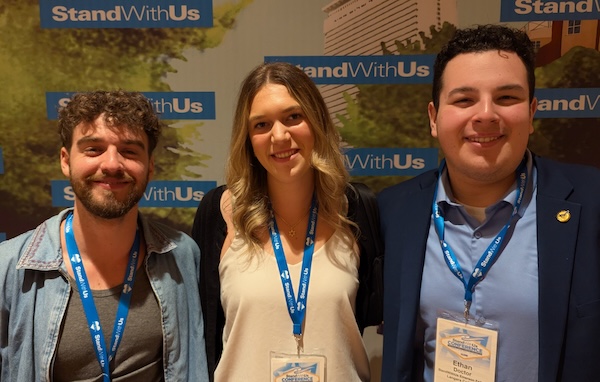
BC students at the StandWithUs conference in Las Vegas March 15-18 included, left to right, Adar Latak, Alexis Moscovitz and Ethan Doctor. (photo by Pat Johnson)
What happens in Las Vegas doesn’t stay in Vegas. That was the defiant message from Roz Rothstein, the chief executive officer and co-founder of StandWithUs, as she welcomed about 1,000 Jewish and pro-Israel high school and college students, alumni, activists and assorted allies to the organization’s conference in the Nevada city, March 15 to 18. They assembled to become more informed and empowered, to return to their campuses and communities to advance the fight against antisemitism and antizionism.
Among the delegates were about 100 Canadians, including 15 BC students, as well as Vancouverite Zara Nybo, StandWithUs Canada’s campus and high school manager for Western Canada.
StandWithUs, a pro-Israel advocacy and education organization, provides leadership training and educational programs to students at hundreds of schools, as well as operating many other initiatives, including legal supports for Jewish and pro-Israel individuals and groups.
Among the BC students were four Leventhal high school interns and 10 Emerson fellows, who are part of the organization’s college and university track, Nybo said.
Students are selected based on demonstrated leadership in pro-Israel activism. They attend two immersive educational international conferences like the Vegas meeting during their year of service and are required to initiate several Israel-related programs in their communities or on campus.
Delegates heard from a roster of noted speakers in plenary sessions and more intimate, often hands-on breakout sessions.
The intensive morning to late-night schedule included speakers like New York Times columnist Bret Stephens; singer, dancer and online influencer Montana Tucker; sociologist David Hirsh, who is head of the London Centre for the Study of Contemporary Antisemitism; Loay Alshareef, a Saudi-born activist who advocates for normalization with Israel; Luai Ahmed, a Yemeni-Swedish journalist; Oct. 7 survivors, including Omer Shem Tov, who was held hostage for 505 days; and scores of others.
New York Times columnist Bret Stephens (photo by Pat Johnson)
Stephens, the New York Times columnist, spoke of the revolutionary impact the potential fall of the Iranian regime could have on regional and global affairs but also warned of unintended consequences.
“Regime change is not at all easy,” he said. “There are all kinds of imponderables.”
The state could spiral into chaos and even more bloody and brutal repression than the government has already brought down on anti-regime protesters, he said.
“I do think there is, in fact, quite a plausible scenario [of regime change] – not now, not during this war, but in six months or a year – if [it’s] a militarily crippled and humiliated regime that is still under sanctions, still cannot pay its bills, cannot pay its civil servants, cannot pay its soldiers,” said Stephens.
Iranian street activists, he said, need to “kick this regime when it’s down.”
“If anyone can do it, 90 million Iranians, 88% of whom, at least, despise the regime and had the courage to come out and cheer when the late ayatollah was killed … I think that that creates conditions in which I can see it happen,” he said.
Ahmed spoke of his ideological and physical journey from being an antisemitic young man in Yemen to a new life in Sweden advancing coexistence with Jews.
“It is our duty as reformist Arab Muslims to stand with our Israeli and Iranian brothers and sisters to reject radical Islam, to fight radical Islam,” he said. “It is our duty to fight the terrorists who occupied my country, who believe that firing ballistic missiles at Jews is more important than feeding the starving population of Yemen.
“Radical Islam occupied Iran, Yemen, Lebanon, Gaza,” he said. “Radical Islam married my mother off at the age of 8. Radical Islam is our problem and, today, I stand here as a Yemeni who was taught to hate Jews. And I’m telling you something that radical Islamists fear the most: Jews and Israel are not our enemies.”
Alshareef shared a similar transformation.
“I used to be hardcore antizionist,” he said. “I used to be deeply antisemitic. In my local mosque, I repeated after my imams, ‘Death to Israel, death to Jews, death to Zionists,’ without ever having met a Jew or a Zionist before. Today, thank God, I no longer believe in that cancerous ideology that not only impacts the Jewish community, but it also impacts my community as well.… A society that learns to hate Jews more than loving our own children is not a healthy society.”
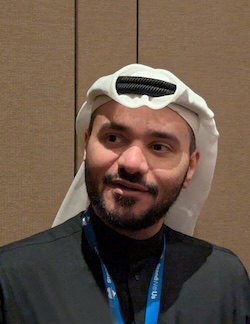
Loay Alshareef, a Saudi-born activist who advocates for normalization with Israel. (photo by Pat Johnson)
After Oct. 7, 2023, Alshareef decided to visit Israel.
“I learned that the Jewish community and Israelis were desperate for peace, that the vast majority of Jews and Israelis do not want war with us,” he said. “They want peace, and they are very desperate for this peace. That is something that no one had ever told me until I went to Israel myself to see the truth. I then took it upon myself to try to hammer this newfound truth to my friends and family members. And, since then, I’ve been creating content, sharing the hidden truths about Israelis and Jews that my society either dismisses or is completely unaware of.”
Students shared their experiences with antisemitism and bias from teachers, administrators and fellow students. A high school student explained how he helped get an ahistoric and antisemitic handout removed from his school’s curriculum – it had gone unchallenged since 1998. In plenaries and breakouts, individuals shared personal experiences of harassment, discrimination and loss of friendships.
StandWithUs does not only educate but also uses the law to seek fair outcomes in cases of discrimination.
The conference heard from Yael Lerman, founding director of Saidoff Law, a legal arm of StandWithUs, which includes a team of attorneys backed by a network of hundreds of pro bono lawyers and law firms.
“Imagine being a Jewish student in a high school where there are very few other Jewish kids,” Lerman said. “Day after day, classmates taunt you. They call you ‘dirty Jew’ and ‘Zio,’ they send antisemitic messages. Sometimes, they shove you or punch you. You never know when the next message or the next attack is coming. The school knows about it. Nothing changes. Then you reach out to StandWithUs Saidoff Law. Our attorneys step in. We represent you, we fight for you, and we win. We secure a transfer to a new school, and the original school must pay for it for the rest of your time in high school.”
No student should ever face antisemitism alone, Lerman said.
“Since Oct. 7, we’ve seen a dramatic rise in legal complaints, not only on campuses, but across everyday community spaces,” she continued.
“Recently, one man went to pick up a clothing order at a store where he had been a loyal customer for several years. The clerk looked at his kippa and muttered, ‘You Jews think you can get everything you want.’
“Later that day, he received an email telling him he was banned from the store and the entire chain. So, he reported the incident to StandWithUs. Our lawyer filed a complaint with the appropriate government agency and negotiated a settlement. The store had to lift the ban and compensate him. That is what accountability looks like,” said Lerman.
The conference heard diverse emotional testimonies.
Shem Tov shared the harrowing story of dancing at the Nova festival and, minutes later, being thrown in the back of a pickup truck and transported across the border into Gaza, beginning a nightmarish ordeal of 505 days of being shuttled between locations and then confined in underground labyrinths. For 50 consecutive days, at one point, he was held in complete darkness in a cell where he could not stand up.
“They used to abuse me physically and mentally,” he said of his captors. “There wasn’t any human interaction, I would say.”
Shem Tov was held in near-starvation even as he saw piled boxes of United Nations-supplied rations.
His captors once took him to a house above a tunnel that had been rigged with explosives and told him he would be forced to trigger an explosive blast when Israeli soldiers entered the boobytrapped structure. When they threatened to kill him if he refused, Shem Tov told them they could shoot him, but he would not do it.
After Shem Tov’s presentation, hundreds of students rushed to the front of the hall, surrounding the former hostage and dancing ecstatically as music blared and massive screens declared: “We are dancing again.”
The executive director of StandWithUs Australia, Michael Gencher, led a memorial for the 15 victims murdered during a Hanukkah celebration at Bondi Beach last Dec. 14.
Sami Steigmann, a child survivor of the Holocaust, spoke of the series of flukes and strokes of luck that saved his life.
In addition to Canada and all regions of the United States, student delegations came from Europe, Latin America and Australia. Due to war-related airspace closures, only two delegates were able to travel from Israel for the event.
BC delegates spoke to the Independent about their experiences.
Adar Latak, a University of Victoria psychology student in his final year, said he gained confidence at the conference and made important connections.
“You’re meeting Jews from around the world, and that’s beautiful,” he said. “It’s easy to get brought down by everything, and coming here really lifts your spirits. You’re with other Jews, you’re all facing the same thing, and you’re all talking about it, and you’re giving each other advice and tips, and it is really just a beautiful thing.”
Alexis Moscovitz, a second-year physical and health education student, also at the University of Victoria, echoed Latak’s sense of community.
“Obviously, everybody has different experiences, but it’s all basically the same,” she said. “We’re all fighting antisemitism on our campuses and so, having a support system, amazing staff here, it’s just amazing to be able to be with people that you know are experiencing the same things.”
Vancouverite Ethan Doctor, a Langara College student, has faced threats on campus, including being followed and intimidated by a group of masked and keffiyeh-clad activists. His experience as an Emerson Fellow helped him navigate the college bureaucracy, seeking appropriate security and prevention steps.
“If it wasn’t for organizations like StandWithUs, I wouldn’t know how to properly deal with it and wouldn’t know the proper steps to take,” said Doctor. “I am just eternally grateful to organizations like this.”
Michael Dickson, executive director of StandWithUs Israel, left, speaks with Omer Shem Tov, who was held hostage in Gaza for 505 days. (photo by Pat Johnson)
Jesse Primerano, executive director of StandWithUs Canada, told the Independent his group’s role is to help young pro-Israel activists, but also people of all ages, find their voices.
“In many cases, they don’t feel comfortable with the facts, to engage with people who are coming at them very aggressively,” he said. “So, our job is to help them understand the facts and how to communicate them to people who disagree.”
Earlier, Primerano briefed the convention on the state of affairs in Canada.
“We look back on times [of] the Holocaust, and I think what we said for many generations was that, as long as our government didn’t turn on us, we would be safe in the countries that we live,” he said. “And, you know, since Oct. 7, antisemitism has become emboldened in a way in Canada that it feels like our politicians know the only way to stay in office is to take an anti-Israel position.
“So, we’ve seen our mayor of Toronto be unwilling to come to an Oct. 7 vigil, unwilling to come to an Israeli flag-raising,” Primerano continued. “Our prime minister in Canada said that he would arrest Bibi [Israel’s Prime Minister Binyamin Netanyahu] should he come to Canada. He put an arms embargo on Israel and, most importantly, as I’m sure many of you are aware, he rewarded Hamas with support for the establishment of a Palestinian state.
“That type of rhetoric and action from our government has spilled into the streets because it has emboldened those who are willing to take shots at the Jewish community. And I mean that both literally and figuratively. Just [days earlier] in Toronto, we had three synagogues that were shot overnight in four days,” he said.
StandWithUs partners with many different groups, Primerano said, but because they work extensively with university students, some people might wonder how they fit with agencies like Hillel.
“Hillel is, in many ways, the voice on campus,” he said. “They are the coordinators of Jewish life. Their goal and their work and their ultimate obligation is to bring Jewish students and their allies together. Our job is, once those students are together, to help supplement the work that Hillel is doing with Israel education, with helping awareness towards antisemitism. Hillel has a wide array of responsibilities that go far beyond just advocacy. Our job is to supplement their work, to work with them as a partner and bring our resources into their space while they bring the students here to meet our resources.”
At the Vegas conference, StandWithUs unveiled SWUBOT, a free, downloadable artificial intelligence tool providing at-the-fingertips information on Israel, antisemitism and activism.
StandWithUs was marking 25 years since Rothstein founded the group with her husband, Jerry Rothstein, who is the organization’s chief operating officer, and Esther Renzer, who is the president.
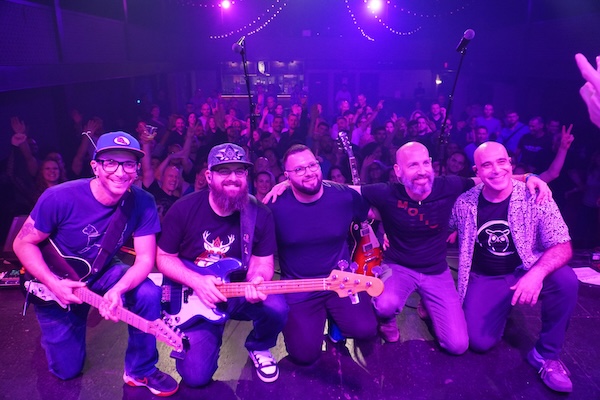
Local Israeli cover band HaOpziot will get people dancing at this year’s Yom Ha’atzmaut celebrations on April 21. (photo from JFGV)
“As we hold Israel close to our hearts, we are reminded that our connection transcends oceans,” wrote Ezra Shanken, chief executive officer of the Jewish Federation of Greater Vancouver, in a recent enewsletter. “We have the power to bring Israel closer, to feel it and to celebrate it together right here at home through our community’s signature Yom Ha’atzmaut event.”
On Yom Ha’atzmaut, April 21, 7:30 p.m., Israeli musician and producer Ben Golan will headline our local celebration of Israel’s 78th Independence Day. (See jewishindependent.ca/story-of-israels-north.)
Golan came onto Federation’s radar when Shanken saw him perform during a 2024 visit to our community’s partnership region in Israel, the Upper Galilee. Golan is from Kiryat Shmona, where he also runs a recording studio.
In addition to his own performance, Golan will join local Israeli cover band HaOpziot for a couple of songs during their set.
HaOpziot is comprised of Goor Cohen (vocals, guitar), Kobi Gabay (vocals, guitar), Yotam Ronen (bass guitar), Avishai Weissberg (lead guitar) and Omer Yehi Shalom (drums). The group was founded by Ronen and the band’s former drummer, Maoz Kaufmann, in 2022. The pair posted a call-out on Facebook looking for musicians.
“The rest of us responded, we clicked instantly, and the Optziot were born,” said Cohen.
The band performs a few times a year, at clubs around Vancouver, as well as at the Jewish Community Centre of Greater Vancouver. To find out where and when they’re playing, people can follow the band on social media: Instagram, Facebook and/or YouTube.
When asked how to describe their musical sound or style, Cohen said, “In short: high-energy, loud and often fast.
“Our sound is a fusion of hard rock, punk and heavy metal, with subtle touches of Mizrahi influences, creating a style that strongly resonates with Israeli musical taste and culture,” he elaborated.
Each band member brings their different influences to the music, said Cohen, “ranging from mainstream to underground, old-school to contemporary, and classic to anarchistic. That diversity is a big part of what shapes our unique sound.”
Federation’s website page promoting the Yom Ha’atzmaut celebration highlights some of the songwriters whose music HaOpziot performs, including artists like Mashina, Eifo Hayeled, Berry Sakharof and Monica Sex.
The band’s popularity in the local Israeli community is how they came to Federation’s attention, their sound suiting the vibe that Federation would like the event to have, with the night ending in a dance party.
“This will be the biggest crowd we’ve played for so far,” Cohen told the Independent, “and we’re really excited to have more members of the community come see us in action.”
Unfortunately, Gabay won’t be able to make the Yom Ha’atzmaut concert. But no worries.
“For this show,” said Cohen, “we’ve asked Noga Veiman, our unofficial band manager, to join us on stage and take part as a band member – so, together, we’ll deliver the high-energy show we’ve been planning.”
The night, of course, will begin in a more sombre fashion, with the conclusion of Yom Hazikaron, the day of remembrance for Israel’s fallen soldiers and civilians who lost their lives in war and terror attacks. In Vancouver, the community’s memorial service will take place on April 20, 7:30 p.m., both in person and online. To attend or watch, register at jewishvancouver.com/zikaron.
For tickets ($36/adult, $12/youth, $75/family pack) to the Yom Ha’atzmaut celebrations on April 21, go to jewishvancouver.com/yh2026.
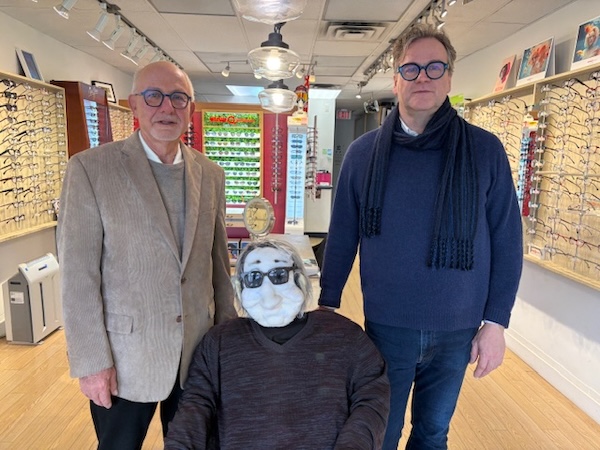
Leo Franken, left, with Manny (the mannequin) and David Downing. The community is invited to join the 25th anniversary open house at the store on April 15. (photo from Spectacle Shoppe)
On April 15, the Spectacle Shoppe will host an open house in celebration of Leo Franken’s 25 years as owner.
Franken, an optician, bought the Kerrisdale store in 2001. The location has been an optical shop since the 1960s, its name changing from Western Optical to the Spectacle Shoppe in 1999.
Born in Amsterdam, Holland, he moved to Montreal with his family when he was 4 years old. His father was an optician as well and his mother helped in their store a few days a week, eventually getting her optician’s licence. His older brother was in the teaching profession, working within the Orthodox Jewish community in Toronto.
“My dad was an optician, and the idea was that I would take over the business,” he told the Independent. “I enjoyed the field and, when he passed away in 1970, I was put in a position of keeping the practice afloat.”
Franken moved to Vancouver in 1978, because of the political instability in Quebec. At the time, the threat of the province separating from Canada was a real possibility.
In Vancouver, he became a member of Congregation Schara Tzedeck and the Jewish Community Centre of Greater Vancouver, and he worked at various places before the Spectacle Shoppe came up for sale.
“It resembled the kind of store that my dad had and in a community that was similar to where I grew up in Montreal,” he explained of why he seized the opportunity to buy it.
“It took a long time,” he said of learning the commercial side of owning a shop. “I still think it is my greatest weakness,” he admitted, “but I just love the business and that is what keeps it going.”
And that love is what keeps him going, as well. Now officially semi-retired, he said he’s working on retirement, but, “it turns out, as long as I am healthy, I will be in the store at least one to two days a week.”
His wife, Marlene, has made the transition into retirement, after a career as an occupational therapist specializing in the psychiatric field. The couple has two sons, Sheldon and Josh, but each of them decided on a different career path.
(photo by Cynthia Ramsay)
David Downing is the primary optician at the Spectacle Shoppe. He has more than 20 years’ experience in the industry, and is also the store’s eyewear-fitting specialist. Visitors to the open house will want to say hi to him and Franken, as well as the rest of the staff, Denisa and Gabriele.
They can learn more about the many types of frames the shop carries, including Ray-Ban Meta smart glasses, which “blend technology with everyday style,” said Franken, noting that the “glasses discreetly integrate features that allow you to capture moments and stay connected, without compromising on design.” The frames are available in a range of women’s, men’s and unisex styles.
From April 15 to 18, the shop will feature the complete lines of frame brands LA Eyeworks (“high-quality and design from Japan”), Etnia Barcelona(“colourful and youthful look from Spain”) and Lool (“lightweight metal and plastic models for a softer look,” also from Spain).
“It is a business that makes people happy,” he said when asked his main thought about his 25-year milestone. “If the client is happy, they refer more people. To see my clients keep coming back while their family grows, I share in the joy of continuing growth all around.”
He is grateful for all the support he has received, including from the Jewish community.
“It has been our privilege serving Kerrisdale and beyond,” he said. “We thank you for your trust and support throughout the years. We are grateful for the many customers who have ‘grown up’ with us over the past quarter-century. We look forward to many more years of being an integral part of Kerrisdale and its community.”
The April 15 open house will take place from noon to 8 p.m. at the store, which is located at 5683 West Blvd.
At Richmond Public Library’s Human Library® event April 12, people will be able to choose from about a dozen “books,” people who will share their personal stories. (photo from RPL)
Join the conversation at Richmond Public Library’s fourth annual Human Library® event. Taking place on April12, from 1 to 4 p.m.,there will be approximately a dozen “book” topics to check out.
The Human Library® is a nonprofit organization that began with its first event in Denmark in 2000. It has established itself as a global learning platform with an initiative to create safe spaces for dialogue between human “books” and their “readers.” The conversations between books and readers can help challenge prejudices and stereotypes, and can contribute more broadly to greater cohesion across social, ethnic and religious divisions.
During a Human Library® event, readers will see a variety of available book titles and be able to select one to “borrow” for a 20-minute reading slot. Readers and books will then have a one-on-one conversation, where books will introduce themselves and readers will have the opportunity to ask questions. At previous Human Library® events held at RPL, books have shared stories of their struggles with such things as mental illness, homelessness, and integrating to life in Canada as a newcomer.
This is a drop-in event, so no pre-registration is required. It is also free to attend. Participants will be invited to borrow books on a first-come, first-served basis until “last call” at 3:30 p.m. The event is appropriate for a teen, adult or senior audience. To find out more, go to yourlibrary.bibliocommons.com/events.
Alix West Lefler plays Frida in The Fast Runner. (photo from thefastrunnerfilm.com)
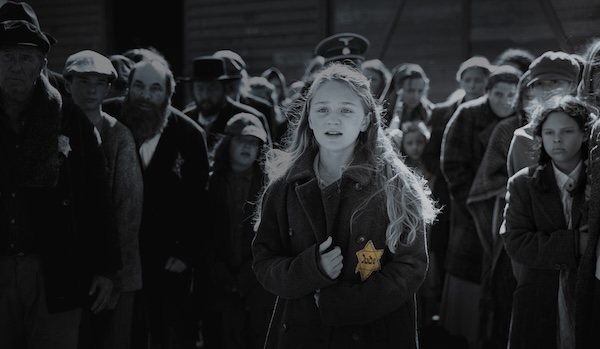
The Fast Runner, a 15-minute short from director David Bercovici-Artieda is about a young girl’s courage during the Holocaust. (See jewishindependent.ca/balancing-education-and-art.) The film screens April 19, 7 p.m., at the Rothstein Theatre, as part of the event Out of the Shadows: Reclaiming Jewish Stories.
The screening will be followed by a discussion with the filmmaker, Bercovici-Artieda, playwright Mark Leiren-Young and Simon Fraser University professor Dr. Lilach Marom; author and Globe & Mail columnist Marsha Lederman is moderator. The event is co-presented by Chutzpah! Plus and Pacific Legal Education & Outreach Society, with partial proceeds supporting the Antisemitism Legal Hotline (antisemitismlegalhelp.org). For tickets ($18/$36/$54), go to chutzpahfestival.com/out-of-shadows.
Co-stars Evan Roberts, left, Jerry Callaghan, centre, and Carl Powell in rehearsal for Bema Productions’ presentation of Perseverance, April 22 to May 3. (photo by Becca Elliot)
Jerry Callaghan and Andrea Eggenberger (photo by Becca Elliot)
Bema Productions in Victoria presents Perseverance, by L.E. McCullough, from April 22 to May 3. The play is adapted from the 2019 memoir One Holocaust Survivor’s Journey from Poland to America, written by Melvin Goldman and his daughter, Lee Goldman Kikel. It brings to the stage a timely story of healing and renewal.
Few visitors to the G&S Jewelry Store in Pittsburgh’s Squirrel Hill neighbourhood during the 1960s and 1970s were aware that the cheerful proprietor, Melvin (né Mieczyslaw) Goldman, had spent his teens enduring the horrors of Auschwitz before arriving in postwar America as a penniless refugee intent on reclaiming his life and reshaping his family’s destiny. The play depicts Goldman’s irrepressible spirituality and unflagging love for humanity as he worked to replace darkness with light, one piece of handcrafted jewelry at a time.
Angela Henry and Jerry Callaghan (photo by Becca Elliot)
Bema Productions’ mounting of Perseverance stars Jerry Callaghan, Andrea Eggenberger, Carl Powell, Angela Henry and Evan Roberts. All performances take place in Bema’s Black Box Theatre at Congregation Emanu-El. For tickets ($25), go to ticketowl.io/bemaproductions.
The Bellas family, left to right: Oksana, Aliza, Yaakov, Maya and Matthew. (photo from Camp Solomon Schechter)
When Camp Solomon Schechter (CSS) hosts their annual Spark fundraiser event at Beth Israel Synagogue May 3, it might be a more emotional gathering than it has been in past years.
That’s because the honouree, Matthew Bellas, z”l, who passed away last year at age 49 from health complications, left a powerful mark on both the Vancouver and CSS community.
“It means everything,” said Bellas’s daughter, Maya, of her aba (dad) being the focus of the local event. “You can’t put into words the impact he had just walking into a room with his positivity, his passion and his light, and how that inspired others.”
Honouring him, she said, “means that those opportunities for him to continue teaching and passing on his ethics and his education are not lost, and we can continue to pass that spark on to more people.”
Maya said her dad had a special relationship with CSS as a child.
“Camp was where he could express most sides of himself in the silliest way possible,” she recalled. “At camp, he was able to be playful, be an athlete, be artistic and do different visual arts, and sing and dance, while also expressing his religious side.”
She recalled her dad saying that he found his calling to be a rabbi while he was leading prayers (tefillot) as an 8-year-old. “Getting to practice Judaism and [Jewish] traditions was key to who he would become. He had lots of nostalgia and gratitude [to CSS] for that,” she said.
Rabbi Bellas grew up in the Vancouver Jewish community, attending CSS as a camper and participating in Oded, the junior counselor program. He became bar mitzvah and got married to his wife, Oksana, at Beth Israel. The couple raised three children here – Maya, Yaakov and Aliza – before moving to Olney, Md., in 2014.
While studying to become a rabbi at the Jewish Theological Seminary, Bellas returned to camp in 2001 and 2002 as “Rabbi Matt,” writing curriculum and making other contributions. After receiving ordination in 2004, he continued to build a distinguished career in Jewish education, serving as school rabbi at Brandeis School in Lawrence, NY, and at Vancouver Talmud Torah. He spent the last decade of his life as a principal at Charles E. Smith Jewish Day School in Rockville, Md., where he apparently coined the daily reminder: “Ask a good question, learn something new, and be kind to everyone.”
Camp Solomon Schechter’s annual Spark event celebrates the camp’s legacy, community and future, with simultaneous events in Vancouver, Portland and Seattle, bringing together alumni, supporters and friends from across the region. This year’s theme – Body, Mind and Spirit – reflects the camp’s commitment to nurturing the whole person through meaningful experiences, relationships and Jewish values.
Matthew Bellas with his son Yaakov at Camp Solomon Schechter. (photo from Camp Solomon Schechter)
Bellas is being recognized for the Spirit element of the event.
“He was so passionate about Jewish continuity,” Maya said of the spirit her dad brought to his work, including his time at CSS. “He wanted to create that experience for other youth and families. He knew that the continuation of our traditions and people relies on joyful, immersive and strong Jewish communities, and that Judaism is a community and family-based activity.
“At Schechter, along with the Judaics team, he created an experience that was fun, engaging and hands on,” she said. “Creating the Jewish memories for the campers that he had as a kid.”
Maya and Yaakov also both attended CSS as campers, while Maya continued her staffing journey there as a young Jewish leader, serving as the director of Oded the past two summers.
“When we started going to camp, being part of this lineage of going to camp, we got to talk about how it evolved over time,” she said. “We are a part of this history and story of camp, and it’s something that connected us, and that’s something that he appreciated, too.”
Maya said witnessing her dad’s legacy has led her to seriously consider her own impact and the work she did at CSS.
“To see the mark he’s left on the world and on the people he’s come across, at my age, it definitely makes me start to think about what I’m going to leave behind me,” she said. “I just hope it’s a warmer, safer, connected place and I hope this event helps camp [provide] that for many more kids.”
For the Vancouver event co-chairs, Lisa Boroditsky and Sandy Hazan, Bellas’s aunt, honouring Rabbi Matt is extra special.
“First and foremost, it is a true honour to be connected to Matthew Bellas, z”l, as part of our extended mishpachah [family] through the Switzer family clan,” said Boroditsky. “To have the opportunity to carry on what was so truly important to Matt is a meaningful way for me to honour his legacy.
“I also strongly believe in the profound impact that Jewish summer camp has on young people,” she said. “It helps shape identity, build community and instil a lasting love for Jewish life and tradition. Being part of an event that both honours Matthew’s legacy and supports something that was so important to him and our shared beliefs is incredibly meaningful.”
Hazan said her nephew taught them all what it means to be proud of being Jewish and loving our traditions.
“His impact in fostering love of Judaism and showing Jewish pride was felt in every aspect of his professional and personal life,” she said. “He also loved bringing people together and Schechter Spark is an opportunity for the Vancouver Jewish community to gather and celebrate Matthew’s spirit and the Jewish values we all hold so dear. These past years have shown us all that we are stronger together.”
Boroditsky made a point of noting Bellas’s impact on those around him, and how that made him an especially appropriate honouree for this year’s event.
“He touched hundreds of lives through his teachings, kindness, leadership and unwavering spirit,” she said. “By honouring him at the Spark event this year, the community comes together not only to remember him, but to celebrate the legacy he leaves behind.”
The Schechter Spark events this year will also recognize Debbi and Alan Montrose in Portland, Ore., as the Body honourees, and Cindy and Bob Strauss in Seattle, Wash., as the Mind honourees.
“As we celebrate another year of impact, Spark is a time to honour our past, celebrate our present and invest in our future,” said Zach Duitch, executive director of Camp Solomon Schechter. “We are especially grateful to honour Rabbi Bellas’s memory and the spiritual legacy he leaves within our community.”
For more than 70 years, CSS has been a cornerstone of Jewish life in the Pacific Northwest and Canada. Spark reflects the soul of camp, bringing people together in gratitude, remembrance and hope. Registration and sponsorship opportunities are still available. For more information, visit campschechter.org/spark or contact Leah Conley at [email protected].
Kyle Berger is Jewish Community Centre of Greater Vancouver sports coordinator, and a freelance writer living in Richmond.
On May 7, in Vancouver, Dr. Noya Shilo, director of Sheba Medical Centre’s Back to Life Clinic, will share firsthand insights into the journey from trauma to healing. (photo from Sheba Medical Centre)
Following the success of last September’s event featuring Sheba Medical Centre’s Prof. Amitai Ziv, Canadian Friends of Sheba are returning to Vancouver with the Sheba Promise Journey: From Trauma to Recovery, taking place May 7.
The special evening in support of Sheba Medical Centre will feature Dr. Noya Shilo, director of the centre’s Back to Life Clinic and a global leader in trauma recovery. Having led the care of returned hostages – work recognized internationally, including at the White House – Shilo will share rare, firsthand insights into the journey from trauma to healing, and how Sheba’s care extends far beyond the bedside. Additional voices from Sheba will also contribute to the evening’s conversation.
At a time when the need for mental health support is greater than ever, Sheba is leading critical initiatives, including the establishment of a clinic for children in northern Israel who are suffering post-traumatic stress disorder. Proceeds from the May 7 event will support these efforts, as well as the Bibas Healing Gardens – therapeutic environments inspired by Yarden Bibas, a survivor of the Oct. 7, 2023, Hamas attacks on Israel. Bibas was held hostage for 484 days, separated from his wife and two young children, who were murdered by Hamas during their captivity.
The Bibas Healing Gardens will support women and children through counseling, emotional care and nature-based healing. These restorative spaces will serve hundreds of families each year as part of their long-term rehabilitation journey.
The Sheba Promise Journey event will begin with an exclusive VIP reception and meet-and-greet, followed by a curated theatre-style program designed to inspire, inform and connect. Sponsorship opportunities and tickets are available, and everyone is invited to join the event and/or support the initiatives. The Sheba Promise Journey also takes place in Toronto (May 4) and Montreal (May 5).
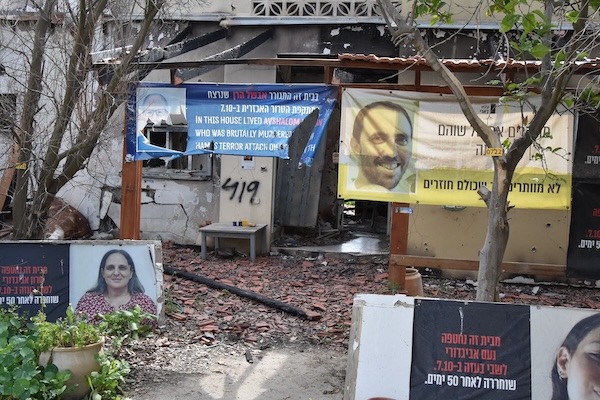
Hundreds of terrorists entered Kibbutz Be’eri. Of the 1,000-plus residents, 101 kibbutz members were killed, 30 people were abducted and one-third of the houses were severely damaged or destroyed. (photo by Larry Barzelai)
My wife and I frequently travel to Israel to visit our three grandchildren. Our interest in Be’eri comes from its special connection with Kibbutz Hatzerim, the birthplace of our daughter-in-law. I feel that the story of Be’eri is a paradigm for the story of the Jewish people, the story of building something magnificent, experiencing a great
destruction and rebuilding afterwards to create something even better. It also illustrates how, when people work together, they can accomplish greater things.
Through a mutual friend, I arranged to meet Yaron, a lifelong member of Kibbutz Be’eri and one who had survived the Oct. 7 massacre. He graciously took me on a tour of the kibbutz as he described the events of that day. Much of what follows are descriptions of the events in his own words. He’s given me permission to share them with you.
On the evening of Oct. 6, Yaron and other kibbutzniks were celebrating the anniversary of the founding of Kibbutz Be’eri. Sharing drinks later with some of his closest friends, they started planning a summer hiking trip in the French Alps.
At 6:30 in the morning of Oct. 7, Yaron heard unusual noises, as he slept with his wife and two young children – both under 5 years old. It sounded like shelling and bombing. When the red alert siren went off, they ran to join their kids in their home’smamad (reinforced security room), which is also the kids’ bedroom.
Initially, Yaron wasn’t too concerned, even after receiving a text that the kibbutz may have been infiltrated by enemies. “OK, I guess we’ll be cooped up in here for a couple of hours,” he thought.
“Messages in the different kibbutz WhatsApp groups start reporting about terrorists walking inside Be’eri,” he writes. “It is close to 8 a.m. Someone writes a message that she hears gunshots.”
Shortly after that, someone reports hearing “terrible screams from the apartment above her, then silence.” Another says that one of the houses in the kibbutz is burning.
Yaron tries to stay calm. The power goes off. Their dog, who is not inside the room, is unusually silent. They hear that someone is in their house.
“They get to the room and try to open the door. I fight over the handle, heart pounding,” writes Yaron. “They don’t succeed! Every time they try, I swing the door handle back to the upright, ‘Safe’ position.”
Eventually, the terrorists give up on opening the mamad. Yaron ignores the calls in Arabic and English to come out of the room. He and his family listen, as the terrorists sing, while wrecking the house. First, there is the smell of gasoline, then smoke enters the room.
A neighbour advises them, via Yaron’s phone, that they should close the gap under the door with wet clothes.
“I take the sheet from my daughter’s bed, pour the bucket of urine on it and jam it under the door,” Yaron writes. “Outside the room, the fire grows fierce, it consumes five years of our lives in minutes…. We are in a closed room, we have no electricity, the children are coughing. I realize that the fire in our home is probably so crazy that even those inhumane monsters can’t still be waiting outside the door. I let go of the handle and I take a deep breath and feel some oxygen flow to my brain. So far, it was the pressure and fear of the terrorists that was suffocating me, but now the smoke is becoming the main problem.”
Yaron’s wife continues to text with neighbours, calling emergency team members repeatedly.
“All of our children’s books are burning outside,” Yaron shares. “Amidst all the terror we hear one of our favourites, a sound book of Arik Einstein songs, catching fire. The fire makes it play, chillingly, one of the happiest songs we know: ‘It’s Saturday morning, a beautiful day….’”
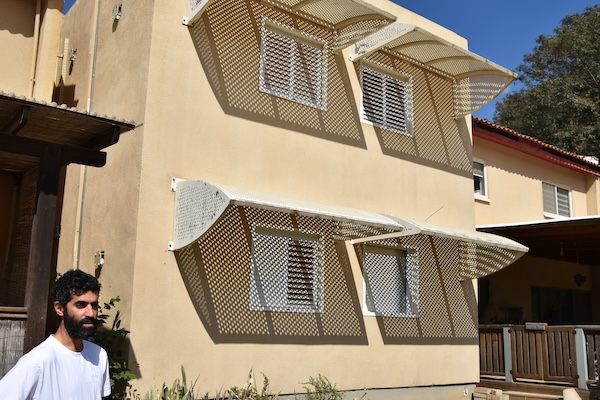
Suffocating on the smoke, the family has no choice but to open a window of their second-floor apartment. Despite the fear of what awaits them outside, the smoke is too much and they climb out onto the metal awning below.
“The four of us are sitting on the metal. We can breathe but we are exposed 2.5 metres (eight feet) above the ground. OK, now what?” Yaron recalls.
They can’t reach the emergency team, so they jump to the ground and hide in a nearby shed. Yaron jumps first, his wife hands him the kids, then follows.
A house identical to Yaron’s, which has been demolished, that gives an idea of the window of the family’s safe room and the challenge of jumping to the ground from the second storey. (photo by Larry Barzelai)
“Another neighbour reaches out, ‘Come to my place.’ I call him. I ask him to risk his life, leave his mamad and open his house for us. He does this while we’re on the phone. We are hesitant to come outside, we are debating with our eyes, and can’t decide if we should stay hidden in an unsafe shed or try to reach a safer place but risk exposure. I ask him to risk his life even more, to take a look outside and verify there are no terrorists in sight. He bravely obliges and says it’s clear. We were in the shed for maybe five, maybe 10 minutes, maybe it was two years, who knows. The kids are silent…. My heart is racing, I open the shed door and we sprint to the neighbour’s house.”
The fire has consumed their own home, and their beloved dog. Temporarily safe at the neighbours’, Yaron sees that the fire might cross over to where they are hiding. “We decide we need to evacuate,” he writes. “At a distance, we spot a few IDF soldiers. A small company or a team…. They escort us to a nearby building where my brother lives. We contact him and he let us in together with two more kibbutz members who had gotten stuck in a similar situation.”
Around 11 p.m., soldiers returned to Yaron’s brother’s place. “They helped us out, they asked us to cover our children’s eyes to shield them from the horrors on the kibbutz lanes and they escorted us to the yellow gate.”
“We made it out,” he writes. “We made it out.”
Most of Yaron’s extended family survived the massacre, except for an aunt who was murdered. In total, hundreds of terrorists entered the kibbutz. Of the 1,000-plus residents, 101 kibbutz members were killed, 30 people were abducted and one-third of the houses were severely damaged or destroyed.
Another victim of the massacre was Winnipeg-born Vivian Silver, who had, prior to Oct. 7, driven patients from the Erez border crossing to hospitals in Israel. She learned Arabic so that she could better communicate with her Bedouin neighbours. She truly believed in a peaceful future between the residents of Israel and the Palestinians of Gaza. Sadly, she was killed on Oct. 7. Her remains were so badly burned that it took weeks to identify her by DNA analysis.
Eli Sharabi, another resident of Be’eri, was kidnapped and taken to Gaza. In his book Hostage, he describes 491 tortuous days in Hamas captivity. He was looking forward to reuniting with his family once he was freed. Instead, upon his release, he discovered that his wife and daughters had been killed on Oct. 7. He cried at their gravesites for two hours, before making the decision that he had to move forward.
Immediately after Oct. 7, Yaron and his family spent many months living in an apartment in the Dead Sea area. They were alive and they were safe, relatively free from missile attacks, but life was far from normal. To say nothing of the trauma they were dealing with, reestablishing a kibbutz lifestyle, while living in a crowded hotel with none of the amenities that glue kibbutzniks together, was challenging.
The family has since relocated to a temporary custom-built village adjacent to Kibbutz Hatzerim. Be’eri and Hatzerim are sister kibbutzim, both founded in 1946. Be’eriwas named for Berl Katznelson, a founding father of Labour Zionism, whose nickname was Be’eri; Hatzerim, after a verse in Deuteronomy (2:23) that mentions hatzerim (farms/enclosures) “as far as Gaza.”
Be’eri and Hatzerim are both traditional socialist kibbutzim, populated mainly by people on the left of the political spectrum. Thus, it was natural for Kibbutz Hatzerim to offer to build a temporary kibbutz adjacent to them for people from Be’eri to live until their kibbutz was rebuilt over a two-year period.
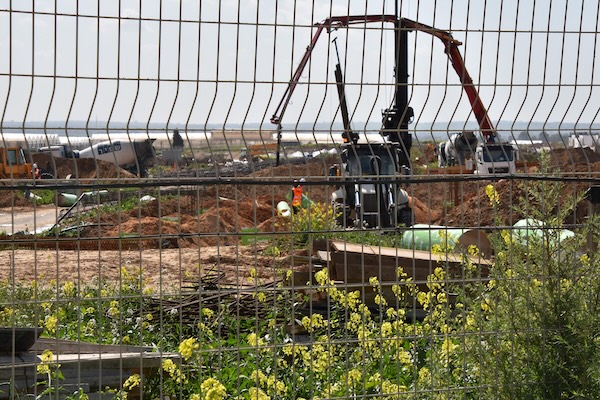
The new neighbourhood on Kibbutz Be’eri, where Yaron and his family are planning on living. The rebuilding of the kibbutz is expected to take two years. (photo by Larry Barzelai)
Most former residents of Be’eri are now living in the temporary kibbutz. Some facilities, such as medical clinics and administrative offices, are shared by the two kibbutzim. Otherwise, the temporary Be’eri has its own houses, schools and offices. Hatzerim expanded its dental clinic, seniors lounge and grocery store to accommodate the increased needs of the larger population. In typical kibbutz fashion, members of both communities met many times to jointly plan this project.
Every day, Yaron leaves his family on the temporary Kibbutz Be’eri to commute 45 minutes to the original. About 60 kibbutz members are living there now, while it’s being rebuilt, and the plan is for most members to return by the start of the school year this September. A printing factory and agriculture are the two sustaining industries on Be’eri.
Yaron’s home, along with 140 others, was destroyed on Oct. 7. Recently, members of Kibbutz Be’eri made a collective decision to tear down all the damaged buildings. They want to try and wipe away the terrible memories of Oct. 7 and build anew. As one part of the construction work, the kibbutz is building a new subdivision, where Yaron and his family are planning to live.
But Yaron isn’t sure that he wants to return. He was born on Be’eri and has lived most of his life there. However, the memory of the trauma of Oct. 7 is very strong. He’s not sure he wants to move back to this place, where so much death and destruction happened. He confided that he may want to live outside of Israel, somewhere he can anticipate a more peaceful future for his children.
Larry Barzelai is a Vancouver family physician, specializing in care of the elderly, who travels to Israel frequently to visit his three grandchildren there. He is presently co-chair of the Jewish Medical Association of British Columbia.