The Jewpanese Project Archives was launched online earlier this month.
I grew up in a mixed Jewish and Japanese Canadian family. My Jewish grandparents were Holocaust survivors from Poland and what is now Belarus, and my Japanese Canadian grandparents were survivors of the New Denver internment camp here in British Columbia.
Earlier this month – which is Asian Heritage Month and Jewish Heritage Month – I launched on my website the Jewpanese Project Archives, which highlights a selection of 35 US-based interviews, which were collected between May 2022 and April 2025. (See carmeltanaka.ca/jewpanese-project-archives.)
The collection phase of the interviews was funded by my year-long fellowship with the Anti-Defamation League – the Collaborative for Change Fellowship – and the aggregation of data from the US-based interviews was funded by a Jews of Colour Initiative research grant.
Each profile in the Jewpanese Project Archives contains the name of the interviewee and a photo of them; the place and date of their interview; their Jewpanese connection and birthplace; a link to a short video and a written paragraph on being Jewpanese; a link to the full audio and written interview; a link to the Instagram writeup with pictures; and archive notes.
The Jewpanese Project evolved organically. In my early 30s, I started to learn about what happened to my families (as I didn’t know much) and, then, the opportunity fell into my lap to find and interview fellow Jewpanese in Canada, the United States, Japan and Israel. Originally intended to be a 20-interview endeavour, it turned into an 85-plus interview community archive.
The project also has grown into a comic about a kimono heirloom in my Jewish family, an animated film about my journey to Białystok, and a play about being Jewpanese, for which I received an artist grant from the Japanese Canadian Legacies Society (JCLS). I also received an intergenerational wellness grant from JCLS to record the forgotten Japanese Canadian history of the Okanagan Landing Station House in Vernon, BC, which is also available on my website, carmeltanaka.ca.
Growing up, I thought it was just my sister and me who had Japanese and Jewish heritage. Never in my wildest dreams did I think I would be connected to 230-plus Jewpanese community members worldwide. And there must be more, which is an exciting thought. Many of us in North America hadn’t met another Jewpanese person – other than our siblings – until this project, which was birthed out of our monthly community Zoom calls during the pandemic.
While you peruse the archives, I welcome you to listen and read through the interviews and Instagram highlights to learn about the experiences of being mixed in Japanese and Jewish communities in the United States, which are comparable to those in Canada. Whether it’s language, culture, rituals, identity or traditions, Jewpanese people have a wide spectrum of lived experiences, but one thing is pretty constant – our love of food. We have a number of Jewpanese fusion recipes!
One of the questions I ask in the interviews is whether or not participants have done “roots trips,” going to their ancestral homelands. Many of us haven’t, and many of our parents (including mine) haven’t either, especially here in North America. My first trip to Japan was last year, at the age of 37, as part of this project, and it was life-changing. Even though the collection phase funding has ended, I have used my Avion points to go to Europe to retrace the steps of my Jewish family – and that’s where I am now. I experienced firsthand how healing my Japan trip was for me and for my dad, whom I dragged along virtually, as his health is declining, so I am doing the same for my mom, whose health is also deteriorating.
My journey to Japan inspired a number of Jewpanese and Nikkei people to seek out family members there through a process to obtain one’s koseki (family register document), and I hope that my journey to Poland also will motivate my Jewpanese and Jewish communities to do the same. It can be inspiring to know our history and where we come from.
Many Jewpanese families are asking when the rest of the interviews (all the non-US-based interviews) will be processed, and my answer is “when I get funding.” I never expected this project to blossom as it has. It’s been the project of a lifetime and deeply personal. If you are in a position to support it, please do reach out. It would be wonderful to have the Canadian, Israeli and Japanese interviews processed for the archives, as well.
If you are a Jewpanese person, couple or family and would like to participate in this project, I am still accepting written interviews. Please contact me for an interview package.
Todarigato! (Toda + arigato, “thank you” in Hebrew and Japanese!)
Carmel Tanakais the founder and executive director of JQT Vancouver, and curator of the B.C. Jewish Queer & Trans Oral History Project (jqtvancouver.ca/jqt-oral-history-bc) and the Jewpanese Oral History Project (Instagram: @JewpaneseProject). A version of this article was published in the Victoria Nikkei Forum.
The JWest capital campaign’s goal of raising $161 million is only possible with the generous spirit and foresight of community members who rally to this generationally important project. Daniella Givon and Bernard Pinsky’s gift is an example of bringing the future JWest campus closer to reality.
Bernard Pinsky and Daniella Givon’s gift is an example of bringing the future JWest campus closer to reality. (photo from Bernard Pinsky and Daniella Givon)
Both joined the Jewish Community Centre of Greater Vancouver (JCC) immediately after settling in Vancouver in 1979. Givon, who grew up in Israel, found friendship and community by joining Israeli folk dancing and becoming involved with Canadian Hadassah-WIZO. Pinsky, a lawyer who grew up in Winnipeg, got to know the JCC by working out in its gym. He noticed how JCC activities and just being around the JCC brought community members together in meaningful ways that sparked and fostered increased community participation.
“I realized that the JCC is a critical connector and gateway to deeper involvement in the Jewish community,” he said.
Pinsky began his local volunteer work with the Canadian Jewish Congress in 1981 and, over the ensuing 44 years, served in leadership roles for many Jewish organizations, including the Jewish Federation of Greater Vancouver, the Centre for Israel and Jewish Affairs’ national board and Beth Israel Synagogue. Today, he is board chair and director of the Ronald S. Roadburg Foundation, one of the lead donors to JWest.
Givon served as Vancouver regional president for Canadian Hadassah-WIZO and took leadership roles in the Jewish Museum & Archives of British Columbia and the Cherie Smith JCC Jewish Book Festival.
Pinsky and Givon, children of Holocaust survivors, continue a legacy of community involvement in their respective families. Givon was inspired by her mother’s many years of leadership in the parent-teacher association of her Israeli school and her grandfather’s participation as a board chair of his moshav’s governing council. Pinsky recalled how his grandfather headed the Zionist Federation of Manitoba, among other leadership positions.
“It’s inconceivable to me to imagine our community without a JCC, and our building is tired,” Givon noted. “A tired, crowded building attracts a limited number of people.”
Pinsky agreed that the JCC is in need of replacement.
“Right now, things are squeezed into pre-set spaces that restrain increased participation,” he noted. “The new JWest will have more space for Jewish organizations, flex spaces for more programming and an expanded daycare. We’ll be able to offer more programs that attract young families, which is a crucial way to build for the future.
“And it’s not just the Jewish community that uses and will continue to use this important facility,” he said. “Former BC premier Christie Clark sent her son to the JCC daycare. I became friends with Terry Yung, who is a current MLA, and his wife, Sarah Kirby-Yung, a city councilor, because we met at the JCC. They’ve been very connected to and helpful for the Jewish community.”
With just $19 million left to raise to achieve the $161 million target, JWest is poised to break ground in early 2026.
JWest recently submitted its development permit application with a new JCC as pictured here. In line with the guiding principle of responsibly using community funds, the design maximizes efficiency, with an increased number of multi-purpose spaces. For example, the JCC auditorium and theatre have been combined and will feature a state-of-the-art, automated, retractable seating system. Operating as a campus, the JCC and King David High School will be more integrated, with greater cross-sharing of spaces.
Visit JWestnow.com to learn more and share the link to get others excited about the project. The newly updated site includes a detailed look at the project and construction timeline, fresh renderings of the JCC, a list of the donors to date, news articles and information on the project team.
Margaux Wosk, left, receives a Community Award from BC Lt.-Gov. Wendy Cocchia (photo from BC Achievement Foundation / Don Craig, photographer)
On May 1, Premier David Eby and Walter Pela, chair of the BC Achievement Foundation, named the recipients of the 22nd annual Community Award. The program, presented by BC Achievement – an independent foundation that honours excellence and inspires achievement throughout the province – recognizes extraordinary British Columbians who build better, stronger and more engaged communities. This year’s recipients included Jewish community member Margaux Wosk.
Wosk is an advocate, artist, designer and entrepreneur who champions disability justice and neurodivergent inclusion.
As president of BC People First, they provide leadership to elevate disabled voices and advocate for meaningful change across the province. Their work breaks down barriers, fosters pride and amplifies underrepresented perspectives through creativity, advocacy and education.
Through their business, Retrophiliac, Wosk designs communication tools and products by and for disabled, LGBTQIA2+ and neurodivergent individuals – empowering others to express themselves, reduce stigma and build community. They also founded the We Belong market, which highlighted neurodivergent and disabled entrepreneurs, and were featured on AMI’s Our Community episode for their advocacy and small business endeavours.
An emerging leader, Wosk spoke on Parliament Hill at the Disability Without Poverty rally and has collaborated with People First of Canada, McMaster University and Curiko on accessibility and small business development. Their artwork – featured in York University’s Mental Health Literacy Guide for Autism, to which they also contributed – reflects their commitment to advocacy through creativity. Several of their products are available from the Museum of Vancouver on their open MOV platform.
“The recipients of this year’s Community Award remind us that the strength of British Columbia lies in the compassion, creativity and commitment of its people,” said Eby. “Whether they’re leading grassroots initiatives or mentoring future changemakers, these individuals exemplify the power of community and the impact of selfless service. Their efforts uplift us all and set a powerful example for what we can achieve together.”
“This year’s program shines a spotlight on emerging leaders alongside long-standing changemakers,” said Pela. “Each recipient demonstrates what’s possible when individuals step up with purpose and heart. Their contributions strengthen our communities and remind us that leadership isn’t defined by title or age – it’s defined by impact, generosity and vision.”
The Community Award recipients are selected by an independent jury panel, whose 2025 members include Mayor Suzan Hewat of Kaslo, Mayor Sarrah Storey of Fraser Lake, and past recipients Herman Ho of Vancouver, Meeka Morgan of Ashcroft and Upkar Singh Tatlay of Surrey.
This year’s award recipients were recognized in a formal presentation ceremony held in Victoria on May 7 in the presence of BC Lt.-Gov. Wendy Cocchia.
Each awardee will receive a medallion designed by Robert Davidson. They will also be celebrated through the online campaign #shinethelightbc, to commemorate their inspirational achievements positively impacting British Columbians.
For more information about the BC Achievement Foundation or Community Award program, visit bcachievement.com.
* * *
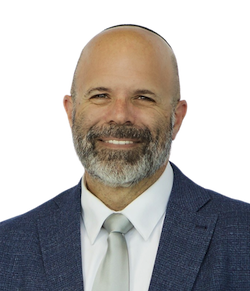
Rabbi Dan Moskovitz
Rabbi Dan Moskovitz was honoured with the doctor of Jewish nonprofit management, honoris causa, from Hebrew Union College at its 2025 Graduation Ceremony in Los Angeles.
Moskovitz has served as senior rabbi of Temple Sholom since July 2013. Before joining Temple Sholom, he was associate rabbi at Temple Judea in Los Angeles for 13 years. He is also a past chair of the Reform Rabbis of Canada and was on the steering committee for Canadian Reform Judaism. Moskovitz is the author of numerous articles and publications, including The Men’s Seder (MRJ Press), an experiential journey through the Passover seder for Jewish men.
“As we continue our celebration of both emerging and established leaders through thisseason of ordination and graduation, we take special pride in awarding honorarydegrees to graduates whose professional journeys exemplify our mission and values,” said Dr. Andrew Rehfeld, president of Hebrew Union College. “Through their vision, service and enduring impact, they define how bold leadership can shape a vibrant Jewish future.”
* * *
The fifth edition of the Western Canada Jewish Book Awards, presented by the Cherie Smith JCC Jewish Book Festival in Vancouver, took place May 13 at the Jewish Community Centre of Greater Vancouver. There were winners in six awards categories.
Helen Pinsky presented the Nancy Richler Memorial Prize for Fiction to Dave Margoshes for his novel A Simple Carpenter. Set in Middle Eastern “Holy Land” in the early 1980s, against the backdrop of the civil war in neighbouring Lebanon, the protagonist is a Christ-like character trying to live a low-key life in Israel/Palestine. Part biblical fable, part magic realism and part thriller, A Simple Carpenter is a meditation on memory and identity, religious faith and doubt, the yearning for a messiah, and the perennially tangled, fraught state of Arab-Israeli relations.
Bernard Pinsky presented Prof. Richard Menkis with the Pinsky Givon Family Prize for In a “Land of Hope”: Documents on the Canadian Jewish Experience, 1627-1923, which Menkis edited with Prof. Pierre Anctil. The collection prioritizes diverse Jewish voices that express the multiple realities of the Canadian Jewish experience. Organized chronologically, from the arrival of the first Jewish migrants to New France, to Jewish Canadian experiences during and shortly after the First World War, this volume includes sources never before published.
Robert Matas presented the Cindy Roadburg Memorial Prize for memoir/biography to former federal cabinet minister and senator Jack Austin who wrote, with Edie Austin, Unlikely Insider: A West Coast Advocate in Ottawa. The memoir is a reminder of the value of public service as a force for economic progress, social justice and nation-building. As a British Columbian, Austin worked to ensure that BC’s perspectives and interests mattered in Ottawa; as someone who came from a disadvantaged background, he is sensitive to the need to make the country a place of fairness and opportunity for all.
The Diamond Foundation Prize for writing for children and youth was presented by Daniella Abramowich to Ellen Schwartz for Schwartz’s Friends to the Rescue, illustrated by Alison Mutton. Inspired by a true story, and told in two different time periods, the book takes place in Fossa, Italy, a small mountain village that offered refuge to Jews during the Holocaust. When the village suffers a devastating earthquake 65 years later, the Jewish refugees whom the town had helped travel to Fossa to return the favour.
Rhea Tregebov received the Betty Averbach Foundation Prize for poetry from Leanne Averbach for the book Talking to Strangers. In it, Tregebov mourns, praises, prays, regrets, summons, celebrates and bears witness with artistry and tenderness. Talking to Strangers was also awarded the Canadian Jewish Literary Award for poetry in 2024.
The Kahn Foundation Prize for writing on the Holocaust was presented by Saul Kahn to Marie Doduck for her memoir A Childhood Unspoken. Mariette was only 5 years old when the Nazis invaded her hometown of Brussels, Belgium, in 1940. She and her siblings were scattered across the city and countryside, hiding with non-Jews and in convents and orphanages or working for the resistance. Mariette emerged from the war quick-thinking, independent and ready to start a new life in Canada. As she navigated to a new identity as Marie – an industrious and resourceful community member, mother and advocate for children’s rights – Mariette, the silent child, found her voice.
Jurors for the 2025 Western Canada Jewish Book Awards were Miranda Burgess, Susanna Egan, Elisabeth Kushner, Roger Nash, Norman Ravvin and Harriet Zaidman.
Daniella Givon, chair of the awards committee, introduced the evening and Dana Camil Hewitt, director of the JCC Jewish Book Festival, concluded the awards celebration.
* * *
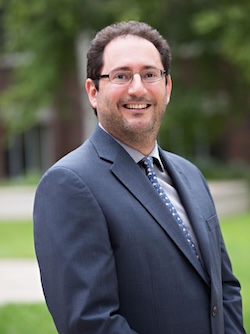
Jessica Kronis
Jessica Kronis is the new director of the Jewish Community Foundation. She brings a wealth of experience from Toronto’s philanthropic sector and a deep commitment to mission-driven work. From her leadership at ACCESS Community Capital Fund to her role with Hillel at Florida International University and helping launch the Nova Exhibition in Toronto, Kronis has consistently built strong programs and meaningful connections.
The Jewish Community Foundation plays a vital role in building a strong, sustainable future for our community. Through endowments, legacy gifts and other forms of planned giving, it helps ensure support for community institutions and responds to emerging needs. The foundation closed the fiscal year with $108 million in assets, surpassing the $100 million milestone. This achievement reflects both the trust our fundholders place in the foundation and the oversight of its investment committee, whose guidance has kept the investment strategy focused, effective and responsibly managed.
* * *
Dr. Siamak Boroomand
Dr. Siamak Boroomand has been appointed as King David High School’s new deputy head of school. He will be taking over the position from Alex Monchamp, KDHS’s deputy head of school for the past 24 years, who is moving on to new ventures.
Boroomand brings more than 20 years of experience as an educator and leader in Canadian Accredited Independent Schools (CAIS) institutions across Canada. A proud British Columbian, he graduated from St. George’s School and earned his teaching certification from Simon Fraser University. He began his career teaching chemistry and math at Southridge and Meadowridge schools before relocating to Ontario.
For the past 15 years, Boroomand has been a leader at Branksome Hall, an all-girls International Baccalaureate school in Toronto. There, he served as a science and math teacher before moving into administrative roles, including assistant head of middle school, assistant head of operations and, most recently, assistant head of grades 9-10, where he supported 220 students and their families.
Boroomand will be moving back to Vancouver with his wife, Bonnee, son Aaron and daughter Kayla. He steps into his role at KDHS in August.
* * *
The Ronald S. Roadburg Foundation has awarded a $350,000 multi-year grant to support the new USY (United Synagogue Youth) Lower Mainland Community Director initiative. This funding will subsidize the program’s growth through 2029 and aims to foster deep Jewish engagement for teens through enriching programming, mentorship and community involvement.
The initiative is a collaborative effort between multiple synagogues in a geographic area to serve teens. In the Lower Mainland, the three main participating Conservative congregations are Congregation Beth Israel (Vancouver), Congregation Har El (West Vancouver) and Beth Tikvah Congregation (Richmond). Launched in September 2024 with the hiring of Shayla Brewer as the Lower Mainland’s first community director, the program has already seen growth in local and international USY participation by teens.
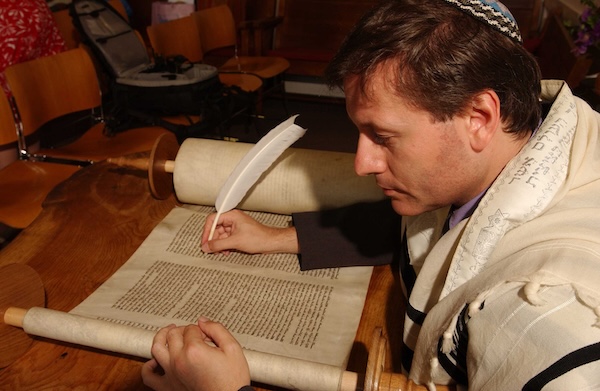
Scribe Marc Michaels concluded Kolot Mayim Reform Temple’s 2024/25 Kvell at the Well series with the talk Torah Tales: Adventures in Scribal Art. (photo from Marc Michaels)
On April 6, Marc Michaels spoke about his experiences as a Jewish scribe (sofer, in Hebrew) in the final webinar of the 2024/25 Kvell at the Well series. Titled Torah Tales: Adventures in Scribal Art, the event was organized by Victoria’s Kolot Mayim Reform Temple.
Based in London, Michaels has been writing Torah scrolls, Megillat Esther, ketubot and the scrolls inside mezuzot and tefillin for more 30 years. He is a Cambridge scholar, earning a PhD in Jewish manuscripts from University of Cambridge’s faculty of Asian and Middle Eastern studies.
A Jewish scribe writes and restores holy works using quills, parchment and special inks, all the while following a strict set of rules, explained Michaels. Indeed, there are many, many rules, which Michaels came back to through the course of the talk.
The scribal art, he said, goes far beyond calligraphy and requires a detailed knowledge of Jewish law and a relatively high level of religious observance.
Michaels provided a recipe for the special ink a scribe might use, which includes gum arabic, gallnuts (from oak trees), iron sulfate and water. The gallnuts are crushed to form tannic acid, mixed with the other ingredients and cooked on an open flame until a residue is left. The larger lumps of gallnuts are strained out and the mixture is left for six months to turn black and be used as ink.
For quills, Michaels believes that a swan’s quill is too soft and a goose quill too hard and prefers a turkey quill. “As Goldilocks would say, it is just right,” he said.
Quills, Michaels warned, must be adjusted in such a way to limit the risk of a scribe sneezing because, if that happens on parchment, it is impossible to remove. Scribes shifted to quills on the move to Europe, he said. Beforehand, they used reeds – which were used to write the Dead Sea Scrolls.
“We switched to quills because that’s what the Christians were using and they were getting a much finer, nicer point on their calligraphy,” he said.
A large part of a scribe’s job is repairing scrolls. Returning again to the rules, he said, “It only takes one letter to be wrong, and that means maybe the ink has come off or it’s broken or whatever, for the whole scroll to be pasul (invalid).”
If a scroll is deemed pasul, Michaels told the audience, then it must be placed in the ark with an indicator to show it’s invalid, such as arranging its belt outside of its mantel. Jewish law states that it must be repaired within 30 days, but, he said, it may take much longer.
Among the Torah scroll repair horrors presented by Michaels were gauze that joined seams together, stains from tape that had to be scraped out, and a patch that was sewn onto the scroll.
Typical repairs, he said, are not so extreme and mostly involve fading and broken letters, which require much overwriting. On occasion, whole columns no longer exist, having been completely rubbed away by time. Sometimes, members of a congregation might mark the scrolls with a pencil or ballpoint pen. In one slide Michaels displayed, someone had drawn a flower onto the scroll.
In his career, Michaels has also encountered incorrect spellings, deletions and Hebrew characters that were mistakenly joined together. Missing words, mixed-up letters and omitted characters from various Torah scrolls were shown to the Zoom crowd as well.
“And then you get wear and tear, dirt, holes, rips and things like that. You have to be very careful. You can patch a Torah, but you’re not allowed to do half patches,” he said.
What’s more, accidents can happen, especially when lifting the Torah during times when one side is much heavier than the other, ie., at the start and at the end of the yearly reading cycle. In one example, a Torah was torn through columns, thus the columns had to be removed and rewritten in the style of the original scribe.
Perhaps topping the list of Torah misadventures is the case Michaels came across of a young person studying for her bat mitzvah and the family dog chewed through a section of the Torah.
“It was literally the best excuse for not learning a bat mitzvah portion – the dog ate my portion,” Michaels joked.
“I had to do an emergency fix because there wasn’t enough time. I repaired it in the style of the original scroll, but only part of it, which you’re not normally supposed to do except in the case of an emergency – and this was a massive emergency. Because the parchment was much older than the shiny new parchment, I coated it with Yorkshire Tea. And it worked.”
A prolific author, designer and presenter, Michaels designed the prayer book for the Movement for Reform Judaism and has written numerous books and articles on scrolls, the Bible and art; he wrote the children’s book The Dot on the Ot. Michaels is currently working with Kolot Mayim to restore a Torah scroll.
Sam Margolishas written for the Globe and Mail, the National Post, UPI and MSNBC.
Shifra Sharfstein and her husband, Shlomo, run Georgia Tech Chabad House with the help of their children. (photo from Shifra Sharfstein)
My parents invited countless people into their home over the decades and fed them on Shabbat and Passover. Little did we know that their acts of kindness would inspire one of their grandchildren to bring Shabbat dinners to hundreds of Jewish students at Georgia Tech in Atlanta each year.
Shifra Sharfstein grew up in Vancouver until she was in Grade 7, going to school at the local Chabad House and also learning about Judaism with her parents, Tzvi and Nomi Freeman, and grandparents, Joyce and Bernie Freeman.
“We went every Wednesday night for a special dinner,” Shifra recalled. “Grandma would spoil us with our favourites each week. She would read us a book and chat with us. She would listen to us talk and let us help make desserts in the kitchen. It was a space that was just all love, pure unconditional love.”
Shifra also gives credit to her grandfather, who supported my mom’s efforts to bring what seemed like the entire Jewish community into our house to feed them.
My mother grew up in India and her parents were from Iraq. Shifra remembers the Sephardi tomato soup with potatoes and meatballs, which took Mom a whole day to make.
“My cousin Ariella and me would talk all night about how much we loved that soup!” she said.
When Mom passed away, Shifra compiled a recipe book for family and friends called With Love from Joyce.
She remembers Mom’s international food.
“Baked Alaska coming out of the oven with cold ice cream inside always seemed like magic,” she said. (And then there was the cherry pie, which I can still taste.)
She remembers gathering together with her cousins before every Jewish holiday, making hundreds of hamantashen.
“I do the same with our college students, today,” she said.
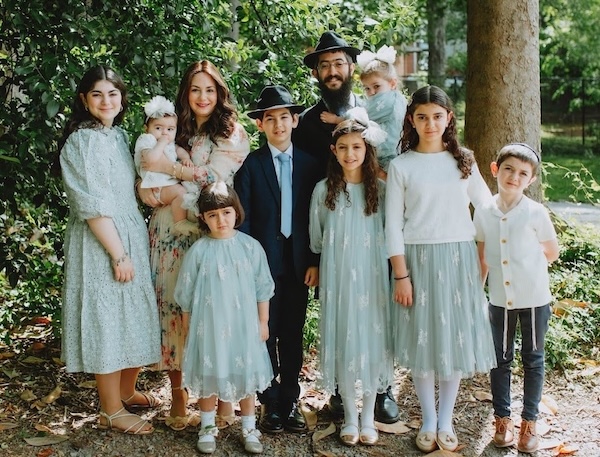
Shifra runs Georgia Tech Chabad House with her husband Shlomo, and with the help of their eight children.
“I could go on forever talking about how much my grandmother and grandfather inspire me,” she said. “Whenever I’m in the kitchen for awhile, especially the week before Pesach, which is grandma’s yahrzeit, I feel her there with me. Sometimes, the powerful work we do is overwhelming, especially when we’re helping students deal with tragedy, and I close my eyes and see Grandma’s smile and feel the beautiful love she had channeled through me, her granddaughter.”
Recently, the couple threw a dinner for 500 Jewish students and dedicated it to the memory of Shifra’s grandparents. It was the first time so many people had dined there.
“Thank G-d we have lots of help and an amazing community of beautiful Georgia Tech students!” she said. “But we keep it all homemade at Chabad and I always incorporate Grandma’s flavours in it.”
Shifra said she also was inspired by the way her grandparents had so many guests who were welcomed like family.
“Grandma always said that what mattered was that we all got along,” Shifra explained. “She told us stories of Jews from different backgrounds and how what was most important is that we all came together, no matter our differences, with love … she truly loved every Jew with zero judgment. I think I absorbed that from her. She looked past the outside and saw that each person has a beautiful soul. She taught me how to do the same and I truly try to make that my focus every time I meet someone new.”
Shifra considers herself a feminist, running the Chabad House they live in and taking care of her children side by side with her husband. She is an accomplished speaker, as well.
“Knowledge is power,” she said. “I grew up being taught to always ask questions. My father and mother spent time learning with me as a young girl in Vancouver and the more I learnt and [the more] I asked, the more I realized how much I could accomplish.”
She added that she is inspired by the late Lubavitcher Rebbe’s teachings about women.
“As a Chabad leader, I know my Rebbe taught me that Jewish women in leadership have a unique power as nurturers who can change the world with love,” she said. “It’s the same message [now] and I intend to take it with me and change my part of the world with that feminine loving touch.”
Chabad Georgia Tech has seven Jewish classes each week, a weekly BBQ, social events, events where they counsel students and, of course, the highlight of their week is Shabbat, with anywhere between 80 and 130 students who come and then stay, chatting late into the night after dinner.
All this activity has had an impact. For example, there have been three weddings in the last 14 years and, right now, another couple is engaged to be married.
Shifra says their success is due, as well, to their dedicated team of students, who run many of the events. There are about 1,000 Jewish students on campus.
Cassandra Freeman is a freelance journalist and improv comedy performer living in Vancouver.
In times of rising antisemitism and violence, fear is valid. When the world feels like it’s unraveling, anchoring yourself in a deeper sense of purpose can be healing. (screenshot)
Fear is not a weakness. It’s a deeply human response to a real or perceived threat. In times of rising antisemitism and violence, fear is valid. But we must not let it be the only voice in the room.
By acknowledging the fear – whether of violence, isolation or helplessness – we reduce its power. At the same time, we also make space for other emotions, such as courage, care and resilience, to emerge.
There are many things we can do to help us overcome the foreboding atmosphere of negativity and fear that is knocking at our door. Focusing on what we can do, gives us a sense of agency when we might otherwise feel helpless and alone.
There is the physical aspect of fear. It is important to be aware of what is happening as you notice you are feeling anxious, by staying present and being grounded. The brain often races into the future during fear: What if this happens to my community? My family? Me? This kind of “catastrophic thinking” pulls us out of the moment and floods our bodies with stress hormones.
It is important to know how to manage physical symptoms as they come up. Have you ever practised mindful breathing or meditation? Going to the beach and being aware of the beauty of our surroundings is a way to relax the constant noise that comes with stressful thinking. It is important to stay informed, but we often tend to keep scrolling for more information when there might not be anything else available. Learn how to say “dayeinu,” it is enough for today.
Build connection, not isolation
Fear thrives in silence. One of the most powerful antidotes to fear is community; connecting with people who understand your pain and can help hold it with you. It is important to build community to fight isolation. Ask yourself:
• Who in my life can I be vulnerable with?
• Is there a synagogue, support group or mental health resource I can lean on?
• Can I be that presence for someone else?
There is strength in the simple act of saying, “You’re not alone.” It may be that your reaching out to ask for help will in fact help someone else.
Not everyone will be on the front lines of activism – and that’s OK. But each of us has a role to play in healing the world, even in small ways:
• Check in on someone who may be afraid or isolated.
• Wear your Jewish identity with pride – a Magen David, a kippah – if it feels right to you.
• Educate others, kindly and clearly, when misinformation spreads.
• Support Jewish organizations and security efforts.
Courage doesn’t always roar. Sometimes, it whispers, “I will keep showing up.”
When the world feels like it’s unraveling, anchoring yourself in a deeper sense of purpose can be healing. Ask yourself where you can make an impact. Do you have a particular skill that may make a difference to individuals or an organization? Judaism has a rich tradition of resilience, moral clarity and hope. Pirkei Avot 2:5 reminds us that, “In a place where there are no leaders, strive to be that leader.” In other words, act with integrity, even when others do not. This is real courage and takes strength and commitment.
Judaism teaches us to choose hope
Our tradition teaches us to choose hope, again and again. Hope isn’t naïve. It’s an act of spiritual resistance. It’s choosing to believe, even with trembling hands, that goodness still exists and that we are its agents. When you are with friends and family, celebrate moments of kindness. Remind one another of stories, not only of loss, but of survival and joy.
Living Jewishly, publicly and proudly, in today’s world takes immense strength. You are not alone in your fear – nor in your resolve. Fear may visit, but it doesn’t get to move in and take over. Our world needs as many of us to be positive ambassadors as we need those fighting antisemitism on the front lines. As Mahatma Gandhi once expressed it, “be the change you wish to see in the world.”
Shelley Karrel is a registered clinical counsellor in Vancouver; you can reach her at karrelcounselling.com.
Semi-Vegan Mini Fake Marry Me Cheesecakes, adapted from joyfoodsunshine.com. (photo by Shelley Civkin)
It seems that smashing food is having a moment. And I don’t mean smashing as in the British term for fabulous. I mean literally smashing. Like smashed baby potatoes, which are, in fact, smashing.
The fun thing about smashing various foods is that it’s a way of cooking that’s eminently forgiving. You can incorporate all kinds of spices or marinades and it’s pretty much bulletproof. Full disclosure: I’ve been eating way too many starchy foods lately, and not nearly enough Canada’s Food Guide choices. Enter yummy broccoli, stage right. This particular recipe is taken from Kalejunkie (Nicole Modic). I tweaked it a bit and plan on tweaking it even more next time. I might substitute summer savoury herbs for garlic, or add a bit of sesame oil. Whatever you try, I’m sure you (and your guests) will love it.
LEMON PARMESAN SMASHED BROCCOLI (adapted from Kalejunkie)
1 large crown of broccoli 1/3 cup grated Parmesan cheese 1/4 cup olive oil 1 lemon juiced 1 tsp garlic powder 1 tsp coarse kosher salt 1/2 tsp ground black pepper
• Preheat oven to 425˚ F.
• Wash broccoli and cut it up into small florets, including part of the stems. Put into microwave-safe bowl, add a bit of water and microwave until soft but not mushy. Drain the water off and let the broccoli dry on a paper towel.
• Prepare the lemon vinaigrette by whisking the ingredients together in a small bowl. Set it aside.
• Line a baking sheet with parchment paper, and spread the broccoli florets evenly across parchment. Then, using the bottom of a solid drinking glass, smash the broccoli down until it’s as flat as possible. Repeat with each floret.
• Once the florets are smashed, brush the lemon vinaigrette evenly across all the florets. Then add a generous sprinkle of the grated Parmesan cheese on top of each floret.
• Bake the broccoli in the oven for approximately 20-25 minutes, until the edges of the broccoli are crispy and the cheese has melted. The time will depend on your oven, so keep an eye on them.
Lemon Parmesan Smashed Broccoli, adapted from Kalejunkie. (photo by Shelley Civkin)
The recipe says that leftovers can be stored in an airtight container in the fridge for up to one week, but I guarantee you there won’t be any leftovers. Not a chance. These are so good that I’ve passed them off as appetizers, midday snacks and side dishes. My husband and I polished off an entire head of smashed broccoli before dinner the other night. I never knew healthy food could be this good. This coming from the Queen of Junk Food.
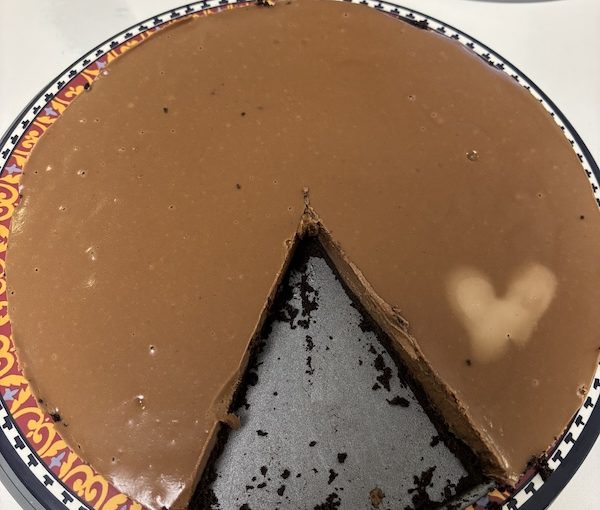
Once you feel all high and mighty for having just consumed a full head of smashed broccoli, feel free to blow it all by sampling some mini no-bake chocolate cheesecakes – or fake cheesecakes, as I call them. Any way you parse it, there is no cheese in these, yet they’re not fully vegan either.
Called mini because they’re made in mini-muffin pans, you can actually make these in a regular six-to-eight-inch springform pan if you so choose. It won’t come out like a two- or three-inch New York-style cheesecake, but I never promised you a rose garden, either.
I didn’t try making them in a mini-muffin pan because I didn’t know if I’d be able to get them out of the liners easily. Plus, I only have one mini-muffin pan. Maybe next time. Like pretty much everything I cook and bake, these are easy to make and require few, if any, exotic ingredients. I found this recipe online at joyfoodsunshine.com by Laura.
SEMI-VEGAN MINI FAKE MARRY ME CHEESECAKES (adapted from joyfoodsunshine.com)
2 cups Oreo cookie crumbs (about 27 cookies, crushed) 1/4 cup butter, melted 1/2 cup coconut cream 6 tbsp maple syrup 1 cup roasted unsalted cashews, soaked in boiling water 1/4 cup butter, melted 1/2 cup semi-sweet chocolate chips (or unsweetened chocolate), melted 1 tsp vanilla extract 1/4 tsp sea salt
• First, boil 2 cups of water. Place the cashews in a glass container and pour boiling water over them until they are completely covered. Let soak for at least one hour.
• Line and grease a mini-muffin pan or grease a 6”-8” springform pan. Set aside.
• Using a food processor or blender, crush the cookies until they become fine crumbs. Mix melted butter and cookie crumbs together until well combined.
• Drop 1 tablespoon portions of the cookie crumb mixture into each well of the mini-muffin pan. Use your fingers to press the crumbs evenly around the bottom of each well. Repeat with each until all the cookie crumb mixture has been used. Put the mini-muffin pan in the freezer so the crust can harden.
• Drain the cashews. Put all the ingredients – in the order listed – into a high-powered blender. Turn on low, gradually increasing to high speed. Blend until all ingredients are combined and the mixture is smooth (about 1 minute).
• Remove mini-muffin pan from freezer and make sure crumb crust is hardened. Add 2 tablespoons of chocolate filling to each muffin well. Smooth with your fingers and press the air out of each well. Refrigerate for at least 4 hours or, better yet, overnight. Top with extra melted chocolate chips, if desired.
If you use a 6”-8” springform pan instead of mini-muffin pans, your cheesecake will still turn out fine, except it won’t have the height of a regular cheesecake. It will only be about an inch-and-a-half high.
In hindsight, I should never have told my husband I was making cheesecake because, the moment he took that first bite, his nose crinkled up, his eyes narrowed and he declared (with no small measure of distaste): “Wait, this isn’t cheesecake!”
I proceeded to (accidentally) call it vegan cheesecake, which really revved up his wrath. Then I corrected myself, because neither chocolate chips nor Oreo cookies are vegan – when you track their lineage, their ancestors have both a face and parents. Fine. Guilty as charged.
I also fed him this bogus cheesecake after chilling it for only three-and-a-half hours, when I should have waited until the next day, so the filling had time to firm up. Make no mistake, this was no kind of version of thick New York cheesecake. But neither was it pudding. That’s why I went with calling it fake cheesecake, following the recent trend of fake news.
Update: Within 24 hours, my husband had willingly helped me scarf down the remaining fake cheesecakes with no further resistance. I’ll let you do the math.
Shelley Civkin, aka the Accidental Balabusta, is a happily retired librarian and communications officer. For 17 years, she wrote a weekly book review column for the Richmond Review. She’s currently a freelance writer and volunteer.
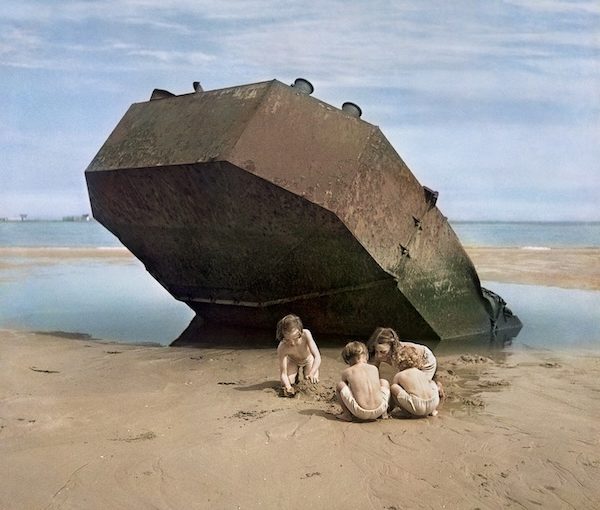
A photograph by David Seymour (Chim) of children in Normandy, in 1947. Part of the exhibit Chim’s Photojournalism: From War to Hope, at the Zack Gallery until June 15. (photo from Ben Shneiderman)
The new show at the Zack Gallery, Chim’s Photojournalism: From War to Hope, features one of the most influential photographers of the 20th century – David Seymour (known as Chim). Chim was killed in 1956, a few days before his 45th birthday, while photographing the Suez Crisis in Egypt, but his legacy lives on even now, almost 70 years after his tragic death.
Gallery manager Sarah Dobbs told the Independent that Ben Shneiderman, Chim’s nephew and the manager of his estate, approached her about the show.
“I was immediately intrigued,” she said. “I met with him and asked if we could host the exhibition. I recognized its importance to the community at the JCC and also to the city of Vancouver. It is a rare opportunity to showcase such an amazing photojournalist. It made sense to host it during the Festival of Jewish Culture in May. I met with the art committee here, and they agreed.… This is the first time these works will be shown together in Canada.”
According to Dobbs, the exhibit was initiated by Cynthia Young, a curator at the New York International Centre of Photography, using vintage prints in their collection.
“Then, the Illinois Holocaust Museum & Education Centre produced the 51 modern prints for their showing,” Dobbs said. “Later, they were presented in Portland, Ore., at their Jewish museum and Holocaust education centre. I flew down to Portland to see the exhibition while it was there and chatted with the curators.”
To package and ship the display to Vancouver, Dobbs needed funds. “I applied for grants and approached individuals,” she said. “In addition to the shipping cost, we also had a special wall built inside the gallery. It will serve us for other exhibitions, moving forward.”
The show preview on April 22 was a joyful event, presided by Shneiderman, who shared with guests his intimate knowledge of his uncle’s work and life.
David Seymour was born in 1911 in Warsaw. His father, Benjamin Szymin, was a respected publisher of Yiddish and Hebrew books. As a young man, Seymour studied printing in Leipzig and, later, chemistry and science in Paris. He wanted to become a scientist. Meanwhile, photography fascinated him. He started taking photographs and selling them to support himself financially, and unexpectedly found a passion for humanitarian photojournalism. His first credited photographs appeared in the French magazine Regards in 1934.
Interested in social issues, Seymour photographed labourers and political rallies, famous actors and street scenes. At that time, he adopted his professional name, Chim, a simplification of his last name, Szymin.
Between 1936 and 1938, as a photojournalist, Chim documented the Spanish Civil War and other international political events. Twenty-five of his Spanish stories were published in Regards. Several of those photos are included in the Zack show. One of them, a close-up of a nursing mother looking up, obviously troubled (1936), is well known. Shneiderman said several history scholars studied this photograph and concluded that it was one of the inspirations of Picasso’s 1937 masterpiece, “Guernica.” Chim’s photo of Picasso in front of “Guernica” positions the painting’s detail of a woman looking up at the falling bombs, right behind the artist.
In 1939, Chim escaped the unfolding war in Europe for Mexico and, later, the United States. As a multilingual and Sorbonne-educated journalist, he served in the US military intelligence as a photo-interpreter. After the war, he resumed his photojournalism career.
In 1947, he and a group of his friends, like-minded photographers, founded Magnum Photos, a cooperative run by photographers. Chim served as Magnum president from 1954 until his death.
Chim’s postwar photographic stories are a blend of anguish and hope. Many of the images are on display at the Zack, divided into several distinct sections. The biggest section is “The Children of Europe.”
In 1948, Chim took a UNESCO assignment to report on the plight of the 11 million European children displaced by the war. He visited Italy, Greece, Hungary, Austria and other European countries. He photographed children who were maimed and orphaned, children playing beside ruins or working in print shops or begging in the streets.
“When LIFE magazine published a spread of those pictures,” Shneiderman said, “together with a list of organizations that accepted donations on behalf of those children, the pouring in of donations was unprecedented.”
Another series of photographs focused on postwar Germany. One of the most poignant ones in this series shows a section of a beach divided by barbed wire – the border between West and East Germany. A couple of boys lounge on the sand. A young woman in a swimming suit runs towards the water. In the foreground, a border guard in uniform stands grim and watchful with his guard dog and his rifle. Tension thrums through the image, underlined by questions and uncertainties.
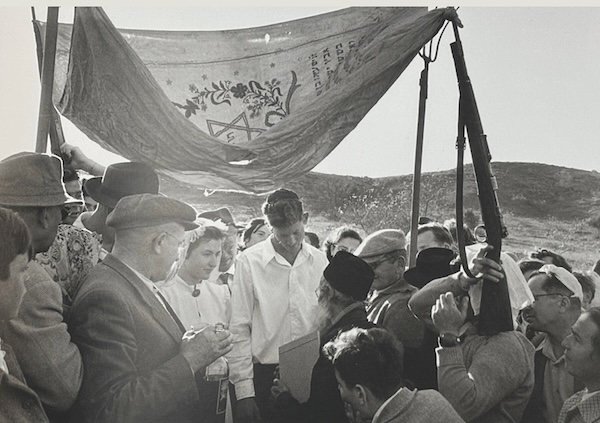
On the other hand, Chim’s Israeli photographs of the early 1950s are infused with hope. A man lifts his baby to the sky in elation – the first baby born in his village. A wedding is celebrated under the chuppah, its makeshift poles including a gun and a pitchfork. An Independence Day parade rolls through Tel Aviv. A team of fishers proudly display their catch of the day to the photographer.
A photograph by David Seymour (Chim) of a wedding in Israel, in 1952. (photo from Ben Shneiderman)
In all his visual stories, Chim is always there with his subjects. They are his co-authors.
“It is that emotional connection that made many celebrities willing to pose for him,” said Shneiderman.
Chim photographed Ingrid Bergman and Audrey Hepburn, Sophia Loren and Picasso, and many others. These photographs are not included in the show, but, together with those that are included, they portray their creator as a man of courage, integrity and vision, one of the best photographic artists of the 20th century.
“Is photojournalism art?” Dobbs mused. “Yes, I think so. Photojournalists capture a moment, an interaction at a specific time. Contemporary art is a mirror of our times. It reflects the societal changes, cultural shifts and significant events that shape our world. It is what the best photojournalists, like Chim, do.”
Dobbs is certain that Chim’s work is still relevant.
“It continues to inspire and draw attention. It teaches photographers to get close to their subjects,” she said. “His images remind us of the past, of the destruction of war, but also of the humanity that transcends it, and of peoples’ resilience.”
Chim’s Photojournalism: From War to Hope is on display until June 15. It is sponsored by the Averbach Foundation, Esther Chetner, the Yosef Wosk Family Foundation and the Government of Canada, in partnership with Shneiderman, Magnum Photos, the International Centre of Photography in New York, the Jewish Community Centre of Greater Vancouver and the Jewish Federation of Greater Vancouver.
For more information and to see a selection of photos, visit davidseymour.com.
Olga Livshinis a Vancouver freelance writer. She can be reached at [email protected].
Tamara Kronis was elected in the Vancouver Island riding of Nanaimo-Ladysmith. (photo from rossmcbride.com)
Conservative candidate Tamara Kronis was elected in the Vancouver Island riding of Nanaimo-Ladysmith, making her one of a small number of Jewish members of the new Parliament following the April 28 federal election.
With just over 35% of the vote on her second try for the riding, Kronis defeated second-place Liberal Michelle Corfield by about 5,500 votes. Incumbent New Democrat Lisa Marie Barron came third, ahead of Green party candidate and former MP Paul Manly, who Barron defeated in 2021. It was a rare – possibly unique – four-way rematch.
The Kronis campaign did not make the candidate available to the Independent during the campaign, saying she was focused on local voters and, by press time for this issue, had not responded to a request for an interview.
In Richmond East-Steveston, community member and Conservative candidate Zach Segal lost narrowly to Liberal incumbent Parm Bains.
In Vancouver Centre, the high profile of New Democrat Avi Lewis did not translate into victory as he took less than 13% of the votes while Liberal Hedy Fry won her 11th consecutive victory in the downtown riding.
In Vancouver Quadra, a district with a comparatively sizeable Jewish community, Liberal Wade Grant swept into office with 63% of the vote over second-place Conservative Ken Charko.
Across the country, several Jewish incumbents were returned to office. In Manitoba, Liberal Ben Carr, in Winnipeg South Centre, took more than 63% of votes cast there.
New Democrat Leah Gazan, in Winnipeg Centre, won with about 40% of the vote, holding her party’s only remaining seat in the province – and one of only seven ridings for the NDP in the country. The Canadian Jewish News reports that Gazan is the daughter of a Dutch Holocaust survivor and a Chinese and Indigenous mother.
Also in Manitoba, Conservative incumbent Marty Morantz, who spoke out about antisemitism on the campaign, lost his bid for reelection in Winnipeg West.
In Ontario, the Conservative party’s deputy leader Melissa Lantsman swept the riding of Thornhill with 66% of the votes.
Anthony Housefather, the incumbent Liberal MP for the Quebec riding of Mount Royal, who had publicly considered abandoning the party over the government’s position toward Israel, won just over half the votes in the traditional Liberal stronghold after a concerted effort by the Conservatives to topple him.
Survivor Miriam Dattel, right, with the Vancouver Holocaust Education Centre’s Ellie Lawson at the Yom Hashoah commemoration April 23. (screenshot)
Miriam Dattel was born Branka Friedman, in September 1940, in the Croatian city of Zagreb, then part of Yugoslavia. She was about six months old when the Nazis invaded and her family began a life in hiding. Fleeing ahead of the Nazis and their collaborators, the family survived together through a series of close calls, lifesaving tips from compassionate officials, luck, determination and exhausting treks through the wilderness in search of refuge.
Dattel shared her family’s story at the annual Yom Hashoah commemoration at Temple Sholom on April 23.
Upon invading Yugoslavia in April 1941, the Nazis, aided by their Croatian fascist Ustaše collaborators, immediately instituted the Nuremberg Laws and set up the first concentration camps in Yugoslavia. Dattel’s father and uncle were thrown out of the university and all Jews were forced to don the yellow star – including on young Branka/Miriam’s baby carriage.
The family was set to flee to Budapest, where they believed they would find refuge with family. When the day came, the baby Branka was ill, so her grandmother, Irma Stern, was sent on ahead. It was the last time the family saw her.
In her haste, the grandmother left behind her prayer book, which was her ubiquitous companion. Branka’s mother viewed the holy book as a fortuitous omen that all would be well in the end. At the commemoration last month, Dattel held the prayer book, now more than a century old and suffering the inevitable evidence of time.
Eventually, the family fled – but not to Hungary. Branca/Miriam, her parents, Andor and Margita Friedman, and her aunt and uncle, Lili and Fritz, were transported with the help of a friend of her uncle’s southwest to the Croatian city of Split on the Adriatic coast. Sections of the city were controlled by the Italian fascists and others by the Croatian regime.
One day, her father was tipped off by a high-ranking Italian officer that the Croatians were preparing to deport Jews from the areas of Split they controlled. He returned home in the middle of the night and evacuated the family to the Italian side. Eventually, the family’s race against fate continued, with a journey under false identities by ship to northern Italy.
“In 1943, when eventually Mussolini was finished, the Germans took over,” Dattel said in a video at the ceremony. Again, her father was tipped off by an Italian official, who warned him to disappear.
“From then on, from what I saw in my father’s diary, we went through 18 different hiding places,” she said, noting assistance from underground operatives.
As a child forced to race from one place to another, few distinct memories remain. However, in various barns where they took refuge, people would roast chestnuts and that remains an evocative taste-memory for her.
Ovaltine is another. And it is a flavour from the very moment that may have saved the life of Miriam and her family.
The group – now six with the addition of her newborn cousin Gerardo – had made their way through northern Italy, around Lake Como and toward the Swiss border. After walking for hours, crossing under fences and trudging through difficult terrain, they came to the frontier of Switzerland.
“There were two Swiss border guards there,” said Dattel. “They said the border is closed. And my father said, impossible, you are not going to let two kids be killed. My recollection is this Swiss soldier [with] a German Shepherd coming towards me, lifting me up and carrying me to the station, to the border house.”
There, the guard gave her Ovaltine and, while she has tried to recreate the flavour, it has never tasted the same.
The family members were placed in refugee camps, Miriam separated from her parents. In Switzerland, the family lived out the war, returning to Zagreb afterward before Miriam and her parents made their way to Israel.
About 1.5 million Jewish children were murdered in the Holocaust. Miriam was one of an estimated six to 11% who survived. In addition to the video screened at the event, Dattel spoke on stage with Ellie Lawson, the Vancouver Holocaust Education Centre’s education manager.
Claire Sicherman, a granddaughter of survivors, was the third-generation descendent speaker. She spoke of being consumed by grief in early life and growing up in a family filled with silences. (Sicherman shared her story of trauma and recoveryearlier this year. See jewishindependent.ca/healing-trauma-possible.)
Hannah Marazzi, acting executive director of the VHEC, noted that this year marks the 82nd anniversary of the Warsaw Ghetto Uprising, a symbol of defiance in the face of annihilation. In addition to remembering the millions of lives lost and the resilience of survivors, she said, “We remember the young Jewish fighters who rose up against the Nazis and whose courage continues to inspire us to stand against oppression in all of its forms.”
Rabbi Carey Brown, associate rabbi of Temple Sholom, welcomed attendees to the synagogue and reflected on the past’s lessons for the present.
Dr. Abby Wener Herlin, associate director of programs and community relations for the VHEC and a member of the third generation, introduced survivors, who lit candles of remembrance.
Cantor Shani Cohen chanted El Moleh Rachamim, the memorial prayer for the martyrs.
Wendy Bross Stuart was responsible for musical direction and arrangement, and played piano. Eric Wilson played cello. Cantor Michael Zoosman, Erin Aberle-Palm, Matthew Mintsis and Lorenzo Tesler-Mabe sang.
As is traditional, the annual ceremony ended with the singing of “Zog Nit Keynmol,” “The Partisan Song.”