Hastings Mill Store was part of this year’s Heritage Discovery Day. (photo by Cynthia Ramsay)
This year’s Heritage Discovery Day – which has been hosted by Vancouver Heritage Foundation since 2003 – featured nine sites in Kitsilano, highlighting, but not confined to, the Craftsman style of house, which, according to the self-guided tour book, “is characterized by decorative brackets, exposed rafter ends, mock trusses in the gable ends, expansive low-pitched gable roofs and a rich variety of finishing materials and textures.” Saturday, June 7, was an ideal day for the event and this year’s Summer cover features photos taken throughout the neighbourhood, while going house to house. Driving home along Cornwall Avenue, the number of people enjoying Kits Beach was incredible. When it’s sunny here, the people emerge!
City Farmer Garden’s Cob shed, made with clay from Haida artist Bill Reid. (photo by Cynthia Ramsay)One of the heritage homes on the tour. (photo by Cynthia Ramsay)Kits Beach on June 7. (photo by Cynthia Ramsay)
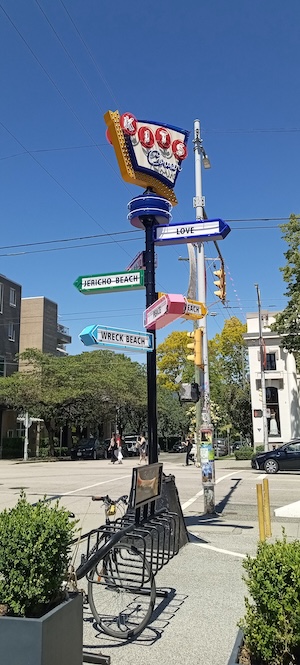
Kits directional post. (photo by Cynthia Ramsay)
A cyclist amid the flowers. (photo by Cynthia Ramsay)
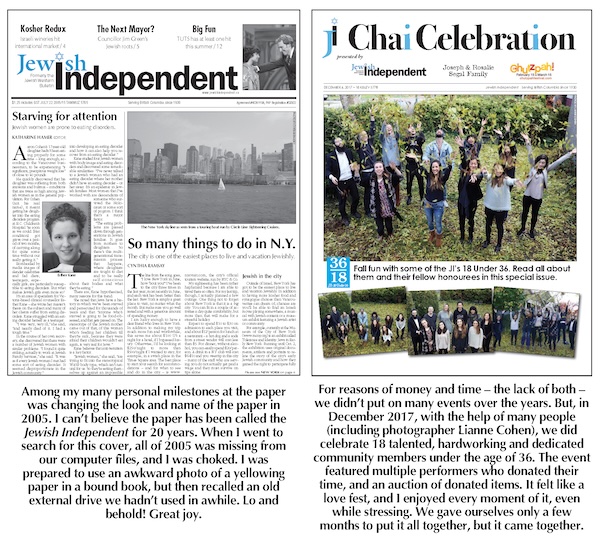
In putting together the Jewish Independent’s special 95th Anniversary issue last month, I came across so many articles of interest. Too many, of course, to include in one issue or series of issues. But I figured it’d be fun to have some random glimpses back into our community’s history. This is the first “Flipping through JI archives” column that will appear through to the end of the year. I hope you enjoy it as much as I will.
July 27, 2001: This clipping isn’t so random. It’s the first Summer issue we put together. Pictured are Pat Johnson (reading), Kyle Berger (fishing and backpacking) and me (playing tennis and baseball). The late Baila Lazarus, who took the photo, is cheering the city’s nightlife.
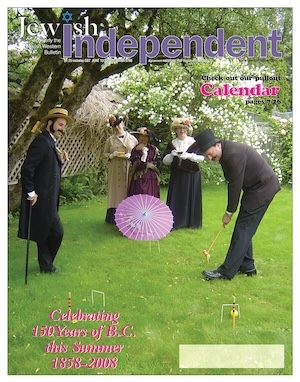
June 13, 2008: Baila Lazarus, z”l, took most of our staff-filled Jewish Independent Summer covers, and she took this Rockower Award-winning one, which I absolutely love. With the help of Sue Cohene of Kol Halev Performance Society, we – left to right, Ron Friedman, Leanne Jacobsen, Josie Tonio McCarthy, me and Steve Freedman – donned period clothing to play a round of croquet in Cohene’s backyard.
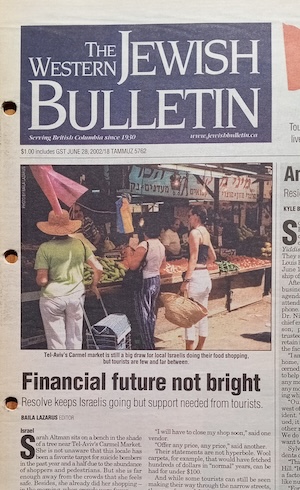
June 28, 2002: Spot colour has been used in the paper since the 1940s, albeit sparingly. In the 1960s, bright red print or text frames would highlight stories the paper’s publishers thought urgent. Less dramatically, the Jewish Western Bulletin and Jewish Independent logos would be in spot colour. It looks like holiday issue covers have been printed in full colour since 1999, but this photo seems like the first we ran as part of an article. Too bad it wasn’t for a happier story!
March 26, 1992: Israel Bonds has long advertised in these pages. This article notes the organization’s inaugural Canadian dollar investments.
May 17, 1934: Safeway was a regular advertiser in the paper’s early years. Imagine berries from Aylmer in tins! Those two cans for 15 cents translates into about $3.36 in today’s dollars and, according to its website, Safeway has a deal on about the same amount of fresh strawberries for $3.99 (down from $6.99). The 59-cent cost of a three-pound tin of Crisco (with a free pie plate!) translates into $13.21, but you’d have to pay slightly more today, $14.29. And, there is no size equivalent to the pound of coffee on Safeway’s website, but based on the price per 100 grams it lists, it’d cost you $13.35 today, but 35 cents in today’s dollars is only $7.83.
Pelicans and cranes gather at Hula Lake in Israel. (photo from commons.wikimedia.org)
Beginning with the Book of Genesis, we read about the raven and especially about the dove: “After 40 days, Noah opened a window he had made in the ark and sent out a raven, and it kept flying back and forth until the water had dried up from the earth. Then, he sent out a dove to see if the water had receded from the surface of the ground. But the dove could find nowhere to perch because there was water all over the surface of the earth; so, it returned to Noah in the ark. He reached out his hand and took the dove and brought it back to himself in the ark.
“He waited seven more days and again sent out the dove from the ark. When the dove returned to him in the evening, there, in its beak, was a freshly plucked olive leaf! Then Noah knew that the water had receded from the earth. He waited seven more days and sent the dove out again, but this time it did not return to him.”
In Deuteronomy 32, we read that God Himself is compared to a bird: “Like an eagle who rouses its nestlings / Gliding down to its young / So did [God] spread wings and take them / Bear them along on pinions.”
Eagles are so important to our culture that Israel’s 1949/50 rescue of 46,000 Yemenite Jews was named Operation on the Wings of Eagles.
Jews had lived in Yemen for millennia, experiencing both relatively good and more oppressive times. In the 20th century, especially following the United Nations Partition Plan of 1947, conditions worsened. Arab rioters in Aden – then a British protectorate on the southern tip of Yemen – killed at least 82 Jews and, in early 1948, accusations that Jews murdered two Muslim Yemeni girls led to further violence and looting of Jewish homes and businesses.
When news of the young state of Israel’s planned evacuation reached Yemeni Jews, they walked and walked, some from hundreds of miles away, to a refugee camp in Aden. Few of them had seen an airplane before and, to convince them to go aboard, someone painted an eagle with outstretched wings over the door of each craft, reflecting Isaiah’s prophesy: “They shall mount up with wings as eagles.”
Despite the attempt to keep the evacuation secret, the planes going from Yemen to Israel were routinely fired on by Egyptian forces. Pilots were warned that, if they were forced to land in enemy territory, the passengers and perhaps the crew risked being executed. Luckily, this never happened.
Di goldene pave, or the golden peacock, refers to a mythical bird that is a common symbol in Yiddish poetry. For Itzik Manger, the golden peacock symbolized Jewish resilience and optimism, and Israeli singer Chava Alberstein sings a song about the golden peacock, which you can listen to on YouTube.
There is a legend that King Solomon gave the hoopoe – Israel’s national bird – a gold crown, after the bird spreads its wings to protect the king from the sun’s rays. But then people began hunting the hoopoe for its crown. When the bird told this to the king, the king replaced the crown with a crest of feathers.
Although there are several negative comments about the raven and the ostrich in Jewish texts, there are also some positive statements made about them. For instance, the raven brought Elijah bread and meat in the morning and bread and meat in the evening. (I Kings 17:7)
In his prophecy, Micah (1:8) uses the ostrich to show what will become of the faithless. But, while the ostrich generally receives a “bum rap” in Scripture, there is no mention in any sacred Jewish writing of ostriches hiding their heads in the sand. When a threat does appear, the ostrich flattens itself on the ground. With its colouring, it is often able to camouflage itself. Furthermore, when an ostrich senses the danger is too close, it can rapidly run away.
A section of the Bird Mosaic, a large mosaic floor that was apparently part of a Byzantine villa. (photo from commons.wikimedia.org)
Storks are mentioned in Psalms 104:16-17 and in Jeremiah 8:7 for their beauty, grace and devoted parenting: “Storks in the sky know their seasons; swallows and cranes their migration times; but my people do not know the rulings of Adonai!”
Further, the stork appears on decorative Torah wimpels, long strips of fabric used to bind the scroll when it’s not in use. Once, they were made from the swaddling clothes of a newborn baby. (This custom began in the second half of the 16th century and lasted for a few hundred years.) After the circumcision ceremony, the fabric was cut into segments that were sewn together to form a long sash, which was embellished with painted or embroidered inscriptions and images and donated to the synagogue.
Most storks use Israel just as a stopping off point on their way to and from Europe to Africa. Sadly, according to Israeli wildlife veterinarian Dr. Rona Nadler Valency, many migrating storks are killed or injured along their journey. She blames Israeli electric and wind turbine companies, which, she claims, do not invest in measures to protect the birds.
Although the type of bird is not mentioned, it is said that birds guided the Jewish people and kept watch over their crossing during the splitting of the Reed Sea.
Psalms 84 mentions the sparrow and the swallow: “Even the sparrow has found a home / and the swallow a nest for herself / where she may have her young….”
According to Uzi Paz, author of The Birds of Israel, there are about 470 bird species in Israel today. There are three main reasons for why Israel is a haven for birds. First, for European and West Asian birds, Israel is located on a main migration route to and from Africa; these birds stay in Africa during the European winter and return to Europe when spring comes in Europe. Second, Israel provides a range of habitats. And, third, Israel stands at the crossroads of three continents and assorted climate zones.
When you visit Israel, stop near Caesarea to see the remains of a large mosaic floor that was apparently part of a Byzantine villa. It is called the Bird Mosaic because the centre part of the floor features 120 medallions, each of which contains a bird.
Deborah Rubin Fieldsis an Israel-based features writer. She is also the author of Take a Peek Inside: A Child’s Guide to Radiology Exams, published in English, Hebrew and Arabic.
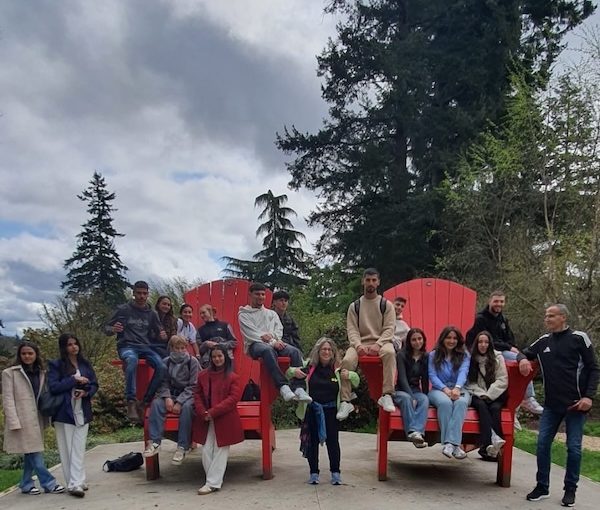
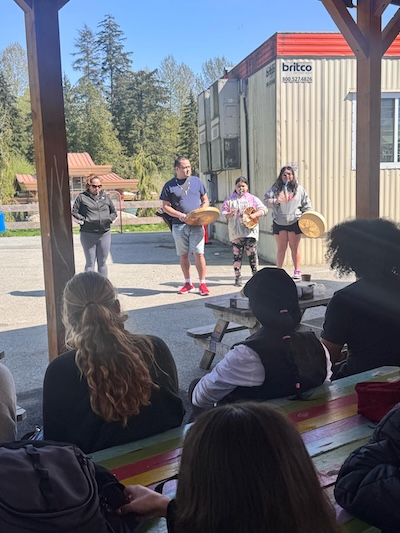
Last month, 16 students from three different high schools in the Galilee visited Vancouver, where they participated in several activities. (photo by Kristin McIlhenney)
“It is nearly impossible to put into words the profound experience we had in Vancouver,” Dr. Rachel Ravid, co-director of Galilee Dreamers, told the Independent. “For the first time, host families welcomed us directly at the airport – a moment of emotion I will never forget. The level of care and thought given to our visit was evident even before our arrival, through a preliminary Zoom meeting during which we shared about the Galilee Dreamers program and the backgrounds of the students they would be hosting. From afar, we could already feel the warmth that awaited us.”
Galilee Dreamers is a program of Oranim College of Education, in Israel. Established nearly a decade ago, it “brings together Jewish and Arab high school students from northern Israel, cultivating dialogue, empathy and mutual respect, while helping participants explore their personal and collective identities,” Ravid said.
A key aspect of the program is connecting these Israeli students with peers abroad and Galilee Dreamers groups have traveled to cities in several countries, including Canada, where Toronto has participated in previous years. Last month, 16 students from three different high schools in the Galilee came to Vancouver, where they were hosted by 12 local families, visited a few schools and participated in several activities. The delegation then headed to Seattle.
There were six students from Akhva-brotherhood High School in Yarka, a Druze school; five students from Jewish schools Einot Yarden and Misgav Regional High School; and five students from Atid Bir al-Maksur, a Muslim school representing a Bedouin way of life, said Ravid. “The students ranged in age from 16 to 18 and were selected for their leadership potential and their capacity to develop leadership skills.”
The co-director of Galilee Dreamers, Dr. Malek Hujeirat, who is deputy principle at Atid, led the group from there, and Diana Mulla, a Druze English teacher, led the delegation from the Druze school. “I was responsible for accompanying the Jewish students and overseeing the delegation,” said Ravid.
While the process of planning the April 18-25 trip was challenging, Ravid said “the spirit of volunteerism and support from community members in Vancouver was truly remarkable. Marion Rom led the planning team with vision and dedication, alongside Dalia Margalit, who offered support from both near and afar.
Galilee Dreamers participants at Tsleil-Waututh Nation siʔáḿθət School. (photo by Kristin McIlhenney)
“The intention was to create as many opportunities as possible for interaction with different parts of the Vancouver community, in order to better understand the local realities and challenges,” said Ravid. “In parallel, we aimed to connect the visiting students with the natural environment, the region’s history and its diverse cultures.
“Alongside school visits with Jewish students – where we discussed the core values of the Galilee Dreamers and universal values such as solidarity, listening, compassion and empathy – our students also learned what daily life looks like for peers their own age in a different society.
“A key element of the itinerary was community volunteering,” said Ravid, and, at the Jewish Community Garden, the group spent some time working and learning.
The host families also “initiated activities rooted in their own strengths and passions, allowing each student to experience something unique within each household,” added Ravid.
One of those families – Tal and Avital Jarus Hakak, who had two Jewish students stay at their home – “hosted a dinner that included another host family of two Druze students and a hike afterwards. One of us also helped with a tour of UBC,” the couple said.
“The positive impact of this trip on the students’ attitudes towards their peers and teachers from different communities and cultures was heartwarming. We felt like these impacts have a great importance for the future,” said the couple, who were motivated to take part because, they said, “The idea of a youth program for facilitating dialogue between Jewish, Arab and Druze sounded very appealing and interesting, particularly in this time of local and global conflicts.”
Kristin McIlhenney found out about the visit from a friend.
“Knowing I had previously hosted international students, she encouraged me to consider it,” said McIlhenney, who hosted a student from the Bedouin school and teacher Hujeirat, “who also serves as the principal overseeing multiple schools in his village.”
“As an educator, I deeply believe in the transformative power of travel and intercultural exchange to build empathy and global awareness,” she said. “That belief, combined with my background, made me genuinely enthusiastic about supporting the Galilee Dreamers by becoming a host.”
Beyond providing room, board and transportation for her guests, McIlhenney said “the experience organically evolved into something much richer. Groups often gathered in the evenings, leading to shared dinners and deeper connections, both in our home and in others’. It was incredibly moving to hear three languages spoken under our roof, and to learn everything from simple cultural details – like the high price of sushi where they live – to complex and personal perspectives on life in a conflict-affected region.”
For McIlhenney, there were two particularly special benefits of being a host. “First,” she said, “my two elementary-aged sons formed a strong bond with the student who stayed with us. A gifted soccer player, he spent hours playing with them and they even accompanied him to a match where they watched [Lionel] Messi play against the Whitecaps – a memory they’ll cherish for years. Second, as a former educator, I deeply appreciated the profound conversations I had with the principal. Whether while preparing meals, driving or winding down in the evening, our discussions gave me a rare and meaningful glimpse into his reality – and helped me reflect more critically on my own.”
Both McIlhenney and the Jarus Hakaks would “absolutely” host again. And trip co-organizer Rom would “definitely help bring those kids in the northern Galilee next year if they want to come back.”
Rom, Margalit’s brother and Galilee Dreamers co-founder Dr. Desmond Kaplan all went to high school together in South Africa, explained Rom of the local connection to the program and how the Vancouver stop came to be.
Rom and Margalit found the host families, and Margalit, who was out of town when the visit took place, “gave this program ‘legs’ in the early stages of planning,” said Rom.
“I wanted to help because I believe that dialogue and interaction of the Jewish, Bedouin and Druze high school youth in the northern Galilee is one of the most impressive paths to peace in that region,” said Rom.
“The most moving part,” she added, “was when the youth and host families all met together one evening to talk about life in northern Israel since Oct. 7, 2023, and what this program means to them.”
“For my part,” said Margalit, “I agreed to assist in arranging the visit when I heard that the group would be made up of students from the Bedouin, Druze and Jewish communities. At this time of tensions between Israel and Palestine, I felt this was a particularly important aspect of the visit, and of daily life in Israel, that would be very important for the Vancouver Jewish community to hear about.”
“As the region faces heightened tensions and conflict, the lack of mutual understanding and shared vision between Arab and Jewish communities threatens the very fabric of society,” said Ravid. “These divisions are compounded by systemic separations: Jewish and Arab teenagers grow up in separate neighbourhoods and towns, attend schools where different languages are spoken, and rarely – if ever – encounter one another in meaningful ways that could challenge stereotypes and foster understanding. Frameworks that nurture mutual respect, empathy and collaboration are critically absent.
“This reality not only affects the people of Israel,” she said, “but also perpetuates a global lack of awareness about the rich and diverse voices that make up Israeli society. Around the world, young people often have little understanding of the complexities of life in Israel and few models for overcoming divisions to build shared futures.”
Galilee Dreamers “creates safe and meaningful spaces where young people from different backgrounds – who might otherwise remain strangers – build real relationships based on trust, empathy and common purpose,” said Ravid.
“Equally important is the program’s impact on the communities that host us – whether in Israel or abroad,” she continued. “By sharing their personal stories and experiences of living in a complex, multicultural society, Galilee Dreamers offer host communities a window into what grassroots peacebuilding can look like. These encounters inspire interfaith dialogue, foster global solidarity and leave lasting impressions on local families, educators and youth who engage with the group. The mutual learning is profound, and many host communities describe the visit as hopeful, eye-opening and deeply moving.”
While some communities and institutions in Israel and the diaspora “have become more cautious about engaging with programs like Galilee Dreamers” since Oct. 7, “the program continues to operate, with participants expressing a renewed commitment to dialogue and understanding,” Ravid said.
Galilee Dreamers students visited Jewish and other institutions, including Peace Mennonite Church, while they were in Vancouver. (photo by Kristin McIlhenney)
The students who participated in the delegation that came to Vancouver shared with Ravid “that they had never experienced such a meaningful and warm form of hospitality. They spoke about the deep love and care shown to them, and how much the host families prioritized their personal well-being,” she said. “They expressed sincere gratitude for the time and attention their hosts gave to hearing their personal stories – and the stories of their families. The connection was so strong that many of the students affectionately referred to their hosts as their ‘second parents.’
“In addition to the emotional connection, the students also appreciated the opportunity to take part in activities they had never experienced in Israel: from ice hockey games and bike rides, to hiking in nature, riding a ferry, and taking a cable car up a snow-covered mountain. Perhaps most enthusiastically, they spoke about the unique food experiences, especially the sheer number of donuts they joyfully consumed without pause!”
For Ravid, “One of the most emotional moments of the trip was the community gathering toward the end of our stay,” she said. “Each of us shared reflections and feelings from the journey. I was particularly moved by the words of Ezra Shanken, chief executive officer of the Jewish Federation of Greater Vancouver, who said that the Galilee Dreamers’ visit brought out the strengths of the local Jewish community and its ability to mobilize around a meaningful initiative. His emphasis on solidarity was incredibly powerful and deeply relevant – especially in these days, when personal and collective security in Israel and around the world feels fragile.”
Both the Jewish Community Centre of Greater Vancouver and the Jewish Federation contributed to the local visit, the latter helping with the planning as well as funding. There were many other organizations and people that Rom, Margalit and Ravid thanked.
“On the day of departure,” said Ravid, “I saw many tears and heartfelt hugs – testament to the meaningful connections and impact this journey had on both the students and the families.”
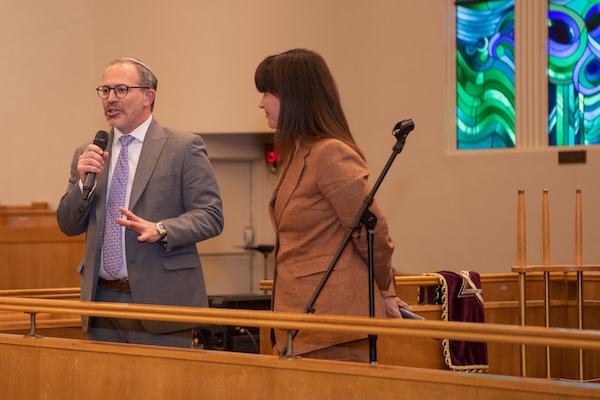
Rabbi Andrew Rosenblatt speaks with Einat Wilf, Israeli author and thinker, who shared her views on the ongoing Israeli-Palestinian conflict. (photo by AdeleLewin)
Israel and its region are in a moment of danger and opportunity, according to Einat Wilf, who spoke in Vancouver April 25.
The Israeli author, commentator and former Labour Party member of the Knesset, said Israel and those who wish to destroy it have been locked in a repetitive series of disasters for almost 80 years. The current moment could alter – or enforce – that dynamic.
“This is a moment when, if we do not do the right things, we will remain stuck in a loop,” she said at Schara Tzedeck Synagogue.
The cycle of conflict has dragged on because of a scenario in which, she said, “the Jews are never allowed to win, the Arabs are never allowed to lose – or at least are never allowed to acknowledge defeat.”
Wilf calls this the “tragedy of ceasefires.”
The Arab world tried to prevent the creation of a Jewish state and then, since 1948, has attempted to undo the existence of that state. This is the core of the conflict, she argued.
“When it becomes clear that they are about to fail, what people call for is a ceasefire,” she said. “But what would actually help us is not a ceasefire. What would help us is to bring back the great ideas of victory and defeat, because those are actually necessary for us to get to peace.”
Instead, the world demands that the parties go back to the negotiating table, as if nothing had happened, she said.
“People talk about the conflict constantly going on, as if it’s by some bizarre coincidence,” she said. “It’s not. It’s because the Arab side for decades has been constantly told, try again, try again. If you haven’t succeeded this time, try again.”
One of the ruptures in the dialogue, Wilf said, is the idea that the only thing standing between
Israelis and peace is the establishment of a Palestinian state. This has been the driving force in decades of peace efforts, “only to realize that this is not what the Palestinians had ever wanted.”
The problem, she said, is that many Jews and others refuse to take the plainly stated Palestinian and Arab message at face value. Many Jews on her social media feed disagree with her, she said. Many Arabs, by contrast, are up-front.
“The Arabs on my feed would write this: ‘You are settler-colonialist, white Europeans. Get out.’ I love that,” she said. “They’re saying there shouldn’t be a Jewish state.” And yet, the Jews who comment, she said, keep coming back to settlements, the occupation and other issues that ignore that the root of the problem is a Palestinian and larger Arab refusal to accept the existence of a Jewish state in any part of the region, said Wilf.
Two Israeli prime ministers, Ehud Barack in 2000 and Ehud Olmert in 2008, tried to negotiate a resolution, only to find that two different Palestinian leaders, Yasser Arafat in 2000 and Mahmoud Abbas in 2008, walked away and reverted to violence, she said. Between those two administrations, a different prime minister, Ariel Sharon, decided that, if the Palestinians would not sign an agreement, he would just give them land.
“He gets out of the Gaza Strip to the last square inch, and we know what they did with that control of the territory,” said Wilf.
The devastation experienced by Gaza and its people in the current war is a tragic moment, but also a possible turning point.
“Moments of ruin and destruction, both in personal as in collective lives, can be moments of growth and transformation,” she said. “But only if you acknowledge the possibility.”
Wilf admits that people say she speaks harshly.
“I do,” she agreed. “Because we have not benefited from people who soften the message. We try to cut corners, we don’t go to touch the molten lava that is at the core of our conflict.”
For years, long before Oct. 7, European capitals have been sending money to Palestinian regimes to feel good about themselves, she said. “But it does no good. It just extends the conflict.”
She tells European audiences to change their approach. “You want to do good?” she asks. “You need to tell the Palestinians, given that your goal in the last century was to prevent and then to undo the existence of a Jewish state: you lost, and it’s over. You can find a dignified life next to a Jewish state but not instead of it.”
Hard truths are difficult to dislodge, said Wilf, and they can be perpetuated at the highest levels. When Joe Biden, then the US president, visited Israel after Oct. 7, Wilf said, he went out of his way to argue that Hamas does not represent ordinary Palestinians.
“It’s a lie that we often tell to comfort ourselves,” argued Wilf. “Hamas is merely the most brutal and successful executor of the ideology that we’ve come to call Palestinianism.”
The ideology, she said, does not hide its goal of eradicating the existence of Israel “from the river to the sea.”
Terms like “right of return” hold equally brutal meanings.
“You look at Palestinian Arab texts from the ’50s, the ’60s, they are very clear about the term,” she said. “They talk about ‘We will tear their hearts out of their bodies, their fingernails from their limbs.’ That’s why you have euphoria on Oct. 7 – euphoria across the people of Gaza, euphoria across the people of the West Bank, Palestinians and their collaborators around the world. The euphoria was not [because Palestinians were] breaking out of some open-air prison…. The euphoria was that they finally saw the moment that they had been groomed for, for decades.… Hamas executed Oct. 7 on behalf of Palestinianism, on behalf of the Palestinian people – for them and of them.”
That is the only way to understand what happened, she argued, or to understand how billions of dollars in international aid have resulted not in social progress but in a militarized terror regime with hundreds of kilometres of tunnels under schools, mosques, homes and kindergartens.
“You can only do something like that among a supportive population, when you are intent on carrying out the vision of that population,” she said. “So, the enemy is not just Hamas. That’s too easy. The enemy is Palestinianism. And that ideology has to die so that Jews and Arabs can finally live.”
An ideology can indeed be killed, she argued. “In fact, it happens all the time. We all live in a world where ideologies are constantly killed and dying and replaced by others.”
A first step, Wilf contended, is rejecting what she calls “trauma determinism” – the idea that people who are collectively traumatized can only respond with violence and stubborn resistance. This manifests in the idea that Israel’s actions will only further radicalize Palestinians. “I don’t know that there is much further to radicalize,” she noted.
Trauma determinism is not real, she said – or, at least, it need not be. “Exhibit A: the Jewish people,” she said. But she also raised the examples of Nazi Germany and imperial Japan. “They suffered violence. The issue is not the violence,” she said. “The issue is what is the story that gets told. That’s why this moment is so important. Because, just like nothing succeeds like success, nothing fails like failure. People begin to run away from failure.”
To move on and embrace peace, she said, Palestinians, like Germans and Japanese before them, have to acknowledge defeat.
“Embracing defeat is not necessarily a bad thing,” she said. “And that process needs to happen. I’m not denying that there is ruin and devastation in Gaza. The question is, how is that ruin and devastation understood? Because, if the story is big, bad evil Israel did that to you and you are just innocent Gazan victims of Israel’s evil nature, then nothing will change. What needs to happen is something that has never happened in the last century of the conflict, which is a connection between cause and effect, action and consequences.”
Palestinians, the broader Arab polity and the world need to understand that the ruin and devastation inflicted upon Gaza is the outcome of their ideology. Some other peoples in the region have awakened to this idea and begun to give up their fruitless hostility to Israel, Wilf said.
“It is always the mark of failed societies in crisis, looking to scapegoat, looking to find someone to blame, looking to divert attention from their failures,” she said. “It’s not a coincidence, therefore, that those countries in the Arab world who are trying to forge a modern vision, a forward-looking vision of what it means to be an Arab and Muslim, are the ones that are letting go of anti-Zionism and normalizing relations with Israel. This is the only vision forward. And I’m under no illusions. It remains a minority view in the Arab and Islamic world. But, for the first time ever, it exists, vocally.”
Israeli commentator and former member of the Knesset Einat Wilf, right, was thanked after her presentation by Tracy Ames. (photo by Adele Lewin)
While they might not embrace the term themselves, Wilf suggests these parties are exhibiting what she calls “Arab Zionism” – the simple acknowledgement that Israel exists and has a right to do so.
It is voices in the West who are most resistant to change, she said.
“The tragedy of this moment is that some in the Arab world are waking up from decades of anti-Zionism as a waste and a ruin, and seeking to have a different vision,” said Wilf. “You have so many here in the West rushing to fill the void and to essentially keep fueling the conflict so that the erasure of Israel can finally be achieved. That is the tragedy. It is also, of course, remarkably dangerous. Because what’s happening now in the West, as much as it pretends to be about the conflict, it’s not.”
It’s about something more insidious, she contended. What is portrayed as anti-Zionism has historically shown itself to be something baser.
“What happens to Jews when societies allow anti-Zionism to become institutionalized?” she asked. Everywhere that anti-Zionism rises to the level of being institutionalized or legislated, the environment turns hostile to Jewish life, she said.
“In the Arab world, how did they get rid of their Jews in the two decades when anti-Zionism was at its height? They never legislated against the Jews. They legislated against Zionists. Iraq, Egypt – the legislation was against Zionists,” she said. “But the way it works is that the Jews are charged with Zionism and no Jew – I know some really try hard but no Jew – will ever be able to disavow Zionism because, heaven forbid, they just celebrated Passover and said, ‘Next year in Jerusalem.’ And that’s how it works.” If such actions are not stopped, she said, “ultimately, no Jews are left.”
“This is what happened in the Arab world, in Iran, in the history of Europe, in the Soviet Union, in Venezuela and it’s happening on American campuses as we speak,” she contended.
Now, efforts are underway in Canada and elsewhere to codify “anti-Palestinian racism,” which Wilf dismisses as a prohibition against Zionism.
On the other hand, there is, she clarified, genuine anti-Palestinian racism. “It is the racism of refusing to listen to Palestinians and take them at their word,” she said. “There is a refusal to really acknowledge them as agents in history who know what they are doing and who actually have their own rational vision of no Jewish state.”
The future depends on how Palestinians and the world interpret the destruction that has taken place in Gaza.
“We are facing a moment that has at once great peril but also great hope,” said Wilf. “Amazingly, so much rides on whether we will ensure that the ruin and destruction in Gaza will finally be associated as the consequence, the outcome, the effect of the Palestinian choice to pursue the always-destructive vision of no Jewish state, because, if they can finally be made to embrace defeat, and to begin the slow process [toward peace] then, at the end of the day, I can assure you that, if they become Arab Zionists, it would be better for everyone.”
Rabbi Andrew Rosenblatt welcomed the audience and thanked the Hayes Family Israel Initiative for funding Wilf’s visit, in memory of Dr. Arthur and Arlene Hayes z”l.
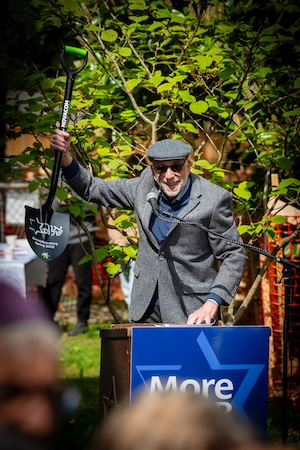
Or Shalom held a groundbreaking ceremony on April 27, launching the MoreOR project. (photo from Or Shalom)
On Sunday, April 27, Or Shalom Synagogue marked a major milestone with a groundbreaking ceremony, launching the MoreOR project – a long-anticipated renovation and expansion that will transform the synagogue on East 10th Avenue into a more sustainable, accessible and welcoming community hub for generations to come.
John Fuerst, lead for Or Shalom’s housing task force, at the April 27 groundbreaking. (photo from Or Shalom)
The ceremony began with a niggun, a wordless melody, and a moment of silence in remembrance of the victims of the tragic events at the Lapu Lapu Day festival, grounding the day in both reflection and hope.
Several special guests joined the community to mark the occasion, including David Bogdonov of the Ronald S. Roadburg Foundation and Quelamia Sparrow, who offered a meaningful land acknowledgement. Sparrow’s words reminded those gathered of the importance of community, and the deep history and ongoing responsibilities connected to the land on which Or Shalom stands.
Synagogue board member Mira Oreck and project lead John Fuerst shared the story of the MoreOR project. Reflections from Bogdonov and board member Jodie Eaton emphasized the importance of building spaces that will serve future generations.
Rabbi Arik Labowitz highlighted that MoreOR is far more than a construction project – it’s a bold investment in the spirit of Or Shalom, a commitment to nurturing Jewish life in Vancouver.
The shul’s Rabbi Arik Labowitz was one of the speakers. (photo from Or Shalom)
The groundbreaking ceremony included a ritual inspired by Jewish tradition: the breaking of a glass. Commonly seen at Jewish weddings, this act served as a poignant reminder that, even in moments of profound joy, we remain mindful of the brokenness in the world – a symbol of resilience, responsibility and hope, as Or Shalom embarks on this next chapter.
The MoreOR project takes advantage of the current synagogue building’s solid foundation and central location. It will add new classrooms, expand the kitchen, renovate the social hall, improve accessibility with the addition of an elevator and create a zero-carbon, environmentally sustainable facility.
“We are deeply grateful to all of our donors and community members, whose vision, commitment and generosity have brought us to this milestone,” said Oreck. “This project is about more than just bricks and mortar – it’s about building a future rooted in sustainability, inclusivity and connection.”
To learn more about the MoreOR project or to contribute, visit orshalom.ca/moreor.
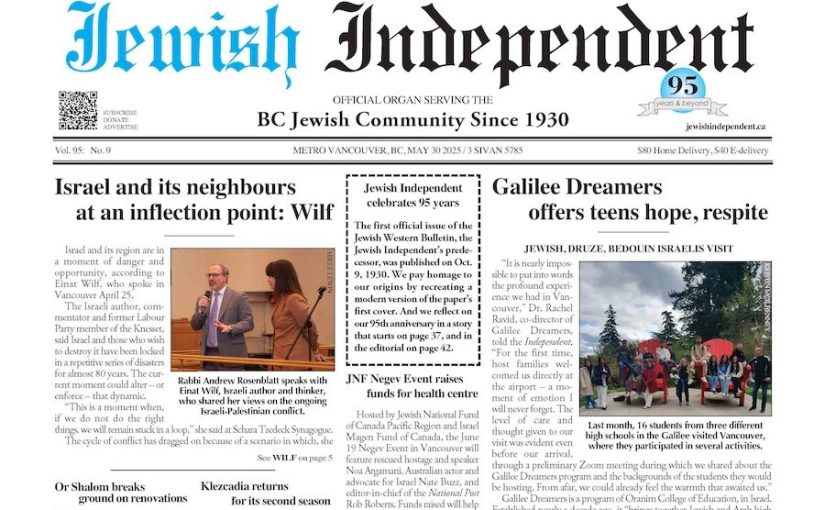
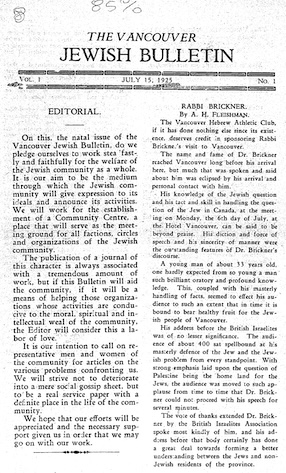
When does something begin? I’ve been thinking about that as I go through 95 years’ worth of Jewish Independents. Well, 20 years of JIs and 75 years of its predecessor, the Jewish Western Bulletin. The JWB also had its predecessors – mimeos and letter-sized versions. The paper’s founders started counting on Oct. 9, 1930, the official first tabloid edition, when they could have started July 15, 1925, “the natal issue of the Vancouver Jewish Bulletin.” Or maybe earlier. Who knows when the idea that brought into existence what would become, through thousands of issues, the paper you today hold in your hands or read on your computer.
Making the cover of this special issue, where six stories jump to the inside and the rest of the stories are blurbs that direct readers to pages on the inside, was an organizational challenge. There was no way I could replicate the brevity of the 1930s articles, but I could mimic the style.
I know I’ve mentioned this fact in previous anniversary issues, that the JI could be considered five years older than the age we have deemed it to be. In looking through so many beginnings – and endings – throughout the years, it struck me again. So many organizations have multiple possibilities for the equivalent of their first edition. For example, the Louis Brier Home and Hospital was organized in 1945, but the idea for it probably came even earlier and the home didn’t open until 1946.
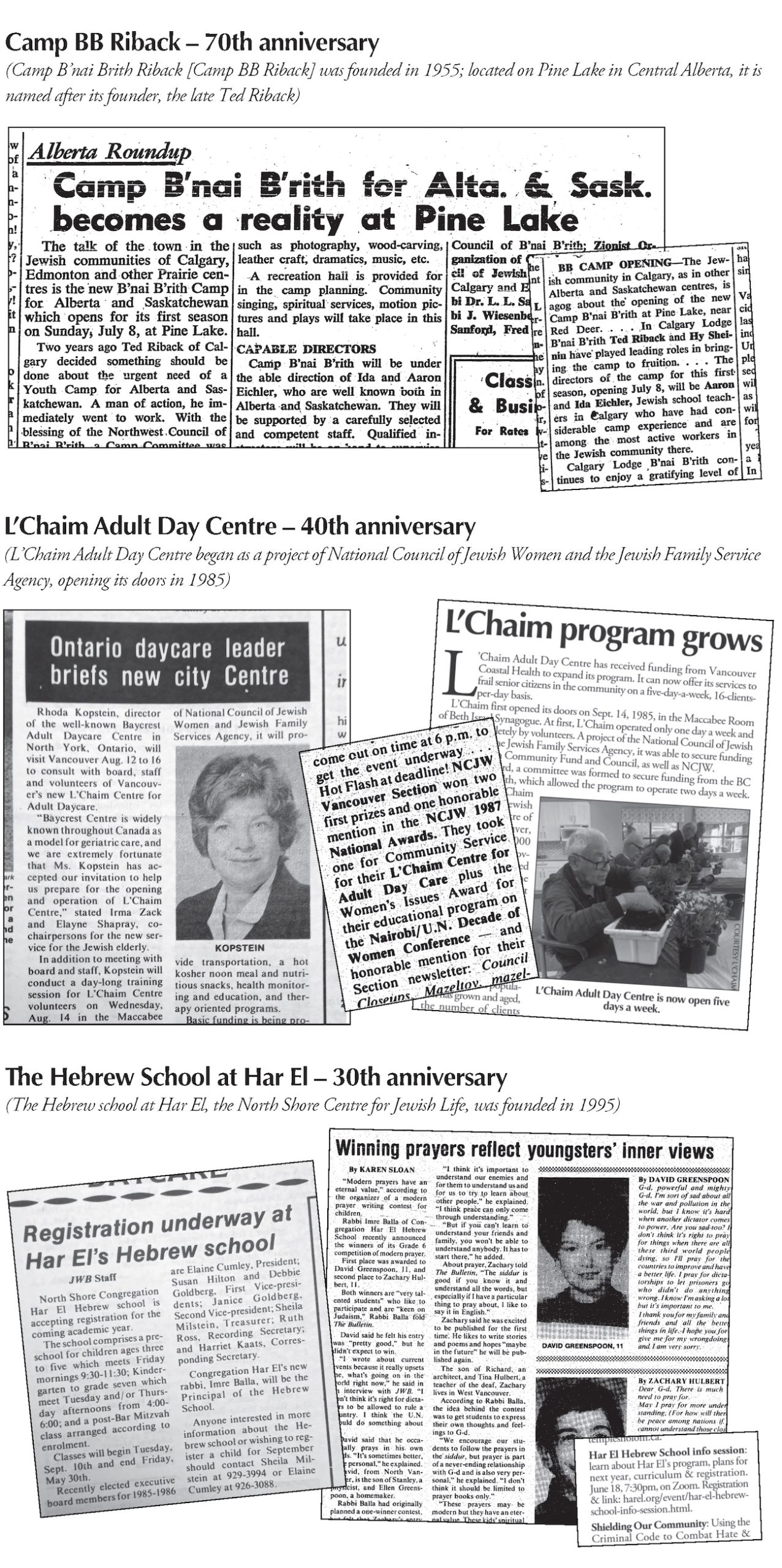
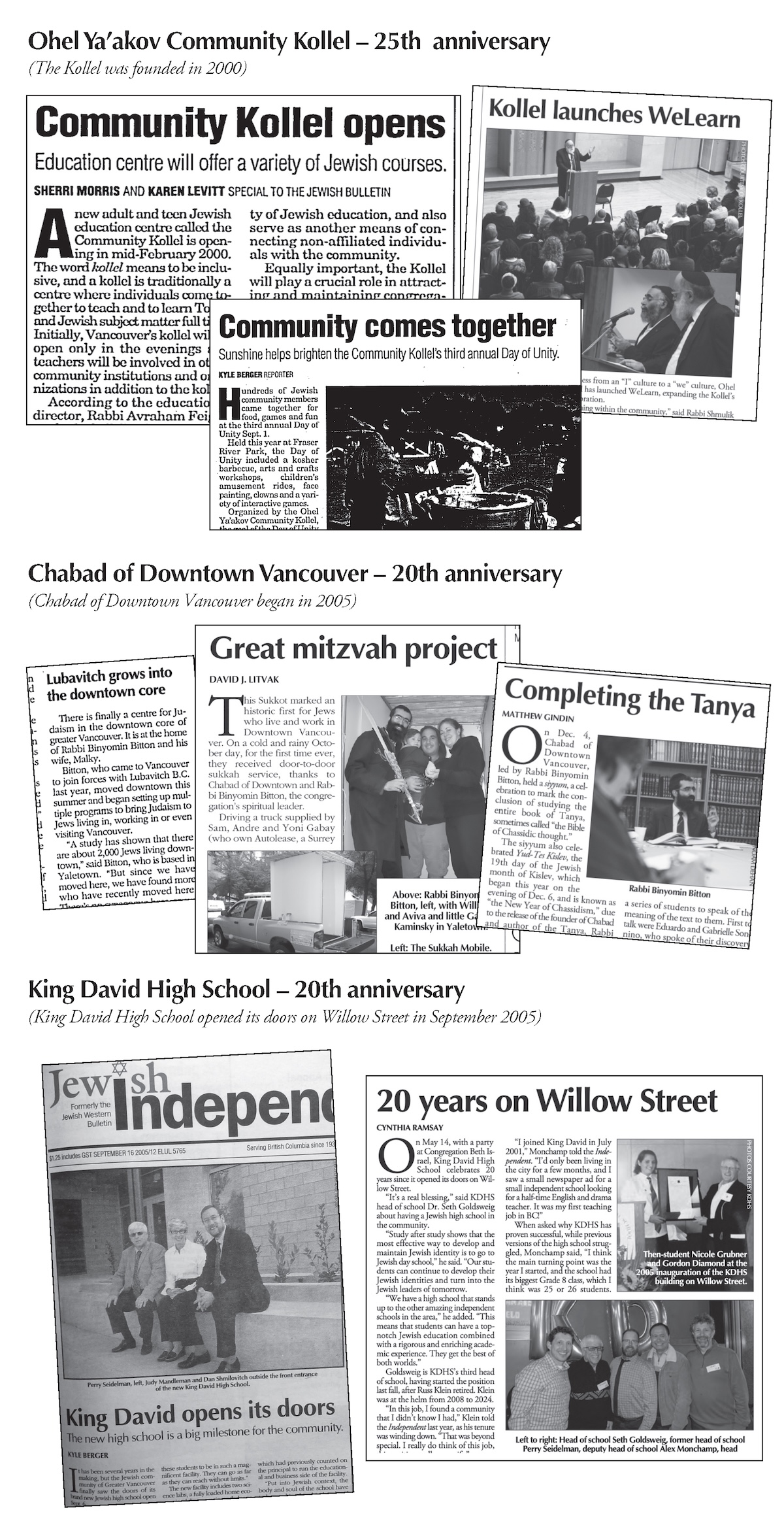
I share this as a caveat because, as I went through the paper’s archives, looking for other community organizations that are celebrating a significant anniversary this year, I no doubt have missed some. But my intent was good – I wanted to share the JI’s “special day” with others.
Unfortunately, I was hampered in my goal because the search function of the online Jewish Western Bulletin archives (newspapers.lib.sfu.ca/jwb-collection) is basically dysfunctional. If I had a 95th birthday wish, it would be to have the funding to have all the newspapers back to 1925 re-digitized and re-indexed, so that this priceless resource could be more accessible. In the meantime, I hope readers can embrace the random smattering of “clippings” that represent my attempt to show how the newspaper has grown with the community – our success being directly attributable to our collective success.
I continue to wish that the founders of the newspaper had started counting in 1925, when the “natal issue of the Vancouver Jewish Bulletin” was published.
Going through the pages of the newspaper over 95 years is both an inspiring experience and a sobering one. Countless people, organizations, businesses and events no longer exist, but there are always new people coming into the world, coming into the community; new groups being created, new businesses popping up, new ideas being discussed, new events being organized. If the size of the Community Calendar is any indication, there is more happening in the community today than there has ever been.
During my 26 years as publisher – or, one of my other beginnings, 27 years since I was hired by the paper – there have been recessions, wars, a global pandemic, and seemingly inexhaustible antisemitism, which has increased greatly since Hamas’s terror attacks on Israel on Oct. 7, 2023. I am still processing that massacre, the ensuing war and all the other violent conflicts happening in the world, the hate and the anger that threaten to overwhelm. It never ceases to amaze and sadden me, humanity’s ability to be as destructive and cruel as we can be creative and compassionate. I won’t dwell on the negative here.
In running the newspaper, I have tried to maintain a middle ground, to be inclusive but also respect my own boundaries. I think there are concerns that should be played out in public, and others that should be dealt with privately. The JI is not a gossip rag, it is not sensationalist or alarmist. That is a decision I have made, and that our editorial board (Pat Johnson, Basya Laye and me) considers every issue.
While not ignoring the hurtful, the divisions, the controversies in our community or the larger universe, we try to cover stories in a way that doesn’t depress and paralyze action, but rather opens the door for solutions or at least positive attempts at change. We don’t want readers to put down the newspaper in despair, but rather to think about what they can do to contribute to a better world, whatever that means to them. One ad in this paper heralds the JI for being the bearer of good news – it makes me happy that people think that, even as we report the news that’s not so good.
The Jewish Independent has survived so long because of one thing: community support.
In 95 years, there has been much to mourn, that is true, but there also has been so much to celebrate. Personally, during my tenure as publisher, I have benefited from many kindnesses, from generous landlords and donors to loyal subscribers and the people who support the paper through purchasing ads.
I have met, worked with and/or become friends with some truly amazing people. I consider myself lucky to have joined the paper early enough to have met in person several of the visionaries who built the organizational foundations of this community, not to mention those of the province, even of Canada, in some instances. There are afternoon teas, lunches and gala dinners I’ll remember forever, if the mind stays healthy.
The people I work with are smart, talented, dedicated and should be earning a lot more than they are. I might own the paper, but by no means do I run it alone. The people whose names you see on the masthead every issue are integral to publishing the paper. And all the people who have been on that masthead over the years – and the many more who have not been recognized in print – have helped keep the paper going, from its first days to today. I thank you all.
I am not a journalist per se, nor an entrepreneur. I’m trained as an economist, and still make myself chuckle when I think of the most uneconomical choice I have made in my life – to buy this newspaper. But it has kept me clothed and fed, with a roof above my head. It has taught me so many things and, though I’ve not always been a willing student, I am better for the lessons.
Most importantly, I am better for all the people I have encountered on this journey. I have made many friends and acquaintances. Not all my encounters have been pleasant or easy, but I have come to appreciate more as I’ve gotten older that, behind the organizations serving the community are simply people. Maybe people I don’t always agree with, but people who are undeniably committed. They are people who believe in community so much that they give of their time, either as volunteers or staff or both, working in one place, volunteering in others. Or they give of their financialresources, funding causes in which they believe, choosing to give away some of their money rather than letting it sit in the bank or using it for personal wants and needs.
It is a privilege to do what I do for a living. I am proud to be part of this extraordinary community. Kol hakavod to us all. May we go from strength to strength….
Now let’s party. Happy anniversary to all the other Jewish organizations celebrating a milestone this year!
Sun tans are actually a response to DNAdamage. (photo from pexels.com)
Skin cancer is the most common cancer worldwide. To better understand sun safety behaviour and attitudes in the Jewish community, a research group from McGill is conducting a survey.And they are asking community members to take part.
More than 360 participants have responded so far, with the majority being from Quebec (60%) and
Ontario (35%). Most respondents identified as Jewish by both religion and ethnicity (80%), and many identified as Conservative (40%) or Orthodox (20%); 70% are of Ashkenazi background; and 55% are mothers.
Sun exposure and tanning
Ninety percent of participants reported experiencing a sunburn at some point in their lives, and nearly half have had a sunburn that blistered. Seventy percent of respondents travel to sunnier climates for more than one week each year, primarily to the United States (65%).
Seventy-five percent reported having a tan in the last 12 months, and 70% believe they look healthier or more attractive with a tan. Forty-five percent intentionally spend time in the sun on vacation or use tanning beds, while only 17% report never tanning.
A health concern
Six percentof respondents reported being previously diagnosed with skin cancer, while 30% reported having an immediate family member who has had skin cancer.
Only 6% of respondents always wear a sun protective hat, while nearly 50% rarely or never do. Despite moderate sun exposure, only a small percentage take consistent sun safety precautions. Additionally, 70% of participants report that skin cancer has never been discussed as a health concern within the Jewish community.
Why this matters
These findings highlight a critical gap in skin cancer awareness and prevention. Sunburns, especially those that blister, significantly increase the risk of melanoma, the deadliest form of skin cancer. Given that 80% of respondents describe their natural skin colour as light, it is essential for the Jewish community to prioritize sun protection.
Skin cancer prevention should be part of ongoing conversations in our community. Encouraging discussions in synagogues, schools and community groups can help raise awareness. Daily sun protection, including the use of sunscreen, hats, sunglasses and shade should become routine practice. It is also important to challenge the misconception that a tan is a sign of good health, as tanning is actually a response to DNA damage.
How dangerous is melanoma?
In 2024, it is estimated that 11,300 Canadians were diagnosed with melanoma, and melanoma incidence in Canada is continuing to increase in men and women at a fast pace. It is often the sunburns in our 20s that lead to melanoma in our 60s and 70s. As people live longer, take more vacations in sunny destinations and are affected by climate change, we expect to see more cases of melanoma in the future unless we take action now.
Any questions about the survey or the study can be emailed to medical student Raquel Lazarowitz at [email protected], dermatology resident Dr. Santina Conte at [email protected], or study director Dr. Ivan Litvinov, McGill University’s division of dermatology, at [email protected].
Arya Yazgan plays young Sophia in Sophia’s Forest, a chamber opera by composer Lembit Beecher and librettist Hannah Moscovitch, which is at SFU’s Goldcorp Centre for the Arts until June 1.(photo by Anya Chibis)
City Opera Vancouver (COV) presents the Canadian premiere of Sophia’s Forest, a chamber opera by composer Lembit Beecher and librettist Hannah Moscovitch, on stage until June 1 at Studio T at SFU’s Goldcorp Centre for the Arts.
Directed by Julie McIsaac, under the baton of COV artistic director Gordon Gerrard, the one-act opera explores various themes through the story of a young girl, Sophia, who flees civil war and settles in a new country.
“In a time when it’s easy to feel overwhelmed by global conflict, Sophia’s Forest invites us to connect to the individual stories behind the headlines,” said Gerrard. “Composer Lembit Beecher and librettist Hannah Moscovitch have created a deeply resonant story – one that speaks to empathy, resilience and the enduring capacity for hope amidst even the darkest circumstances.”
While Sophia’s Forest is not based on a single true story, it draws inspiration from the lived experiences of many who have endured war, loss and displacement. Through the fractured lens of Sophia’s memory, the chamber opera speaks to the human cost of conflict and the strength required to overcome adversity. Its intimate setting and small ensemble help to magnify the emotional intensity, offering audiences a space for reflection and deeper understanding.
The production integrates live performance with projections by Wladimiro Woyno and an array of mechanical sound sculptures, created from bike wheels and wine glasses, that are controlled remotely in real time by the composer Beecher. These sounds and images – accompanied by a live string quartet – conjure memories and dreams from Sophia’s past: the ring of a wine glass becomes a child’s voice; the whirr of a bike wheel evokes fluttering wings.
For its Canadian premiere, Sophia will be performed by soprano Elena Howard-Scott, Anna (Sophia’s mother) by Adanya Dunn and Wes (Anna’s partner) by Luka Kawabata. Young Sophia will be performed by Arya Yazgan and Emma (Sophia’s sister) by Audrey Gao, both members of the Vancouver Bach Family of Choirs. The chamber opera will include sound design by Richard Berg with costumes by Alaia Hamer.
Sophia’s Forest is COV’s first project in a multi-year initiative that aims to showcase and explore the stories and experiences of newcomers to Canada, including celebrating artists who contribute to Canada’s cultural diversity. For tickets and information, visit cityoperavancouver.com.
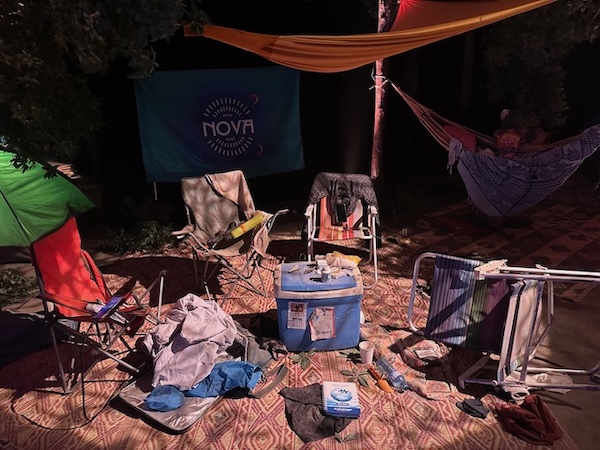
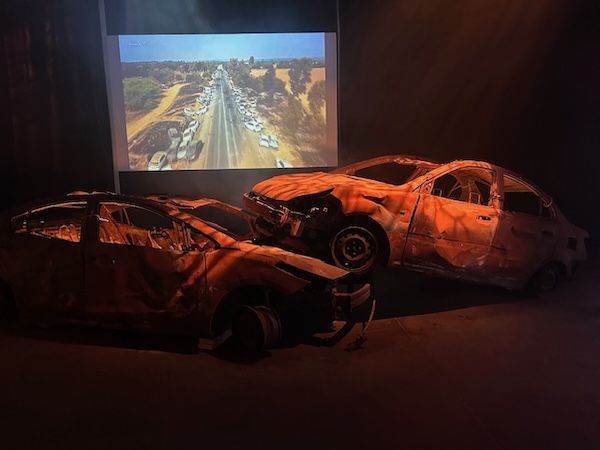
The Nova Exhibition commemorates the massacre at the Nova music festival on Oct. 7, 2023. The exhibit is in Toronto until June 8. (photo by Lorraine Katzin)
My friend Karen Shalansky and I, from Congregation Har El, went on a Jewish National Fund tour to Israel in April 2024, traveling with some congregants from Congregation Beth Israel. We were based in Tel Aviv but drove to the south to see the Nova Festival Memorial and the car cemetery. (See jewishindependent.ca/reflections-on-april-mission.)
When I heard of the Nova Exhibition, which had been traveling to New York, Los Angeles and then Miami, I Googled to see if it was going to be in Toronto. While we live in Vancouver, my husband and I were going to be heading to Toronto for our granddaughter’s Grade 1 siddur celebration. I was able to purchase tickets to the exhibition for May 6, during the time we (and our daughter) were going to be in the city.
Normally, when we go to Toronto, we attend Saturday morning services at our son’s synagogue, the Village Shul. It just so happened that, on the Shabbat of our visit, the guest speaker was Ophir Amir, one of the founders of the Nova music festival and one of the producers of the Nova Exhibition. Amir was shot in both legs by Hamas terrorists on Oct. 7, 2023. He survived, but so many of his friends did not. He shared: “While I was hiding from the terrorists, I thought about my wife, who was pregnant, and that’s what saved me.”
(photo by Lorraine Katzin)
The Nova Exhibition tells the stories of the victims and helps this community begin to heal – we will dance again.
The first part of the exhibit is a movie. It shows people having fun, enjoying life, singing and dancing, until 6:29 a.m. on Oct. 7, when the music stops and security starts shouting “Red alert! Tzeva adom!” as they could see the rockets flying over Israel. They tell everyone to go home. The movie ends.
We were then led to another room for a reenactment of what came next. There were different TV screens showing how the Hamas terrorists came through the fence, the continuous firing of their weapons, the continuous shouting of “Allah Akbar!”
The next area is filled with belongings from the festival, which include tents, sleeping bags, chairs, clothes, snacks, trees, the market, featuring various items, portable toilets, the bar, freezer chests, burnt-out cars, shelters, and more. By each display there is a TV screen with a survivor telling their story. One young girl lost 15 friends, another young man lost more than 40 friends, a mother lost two of her daughters. Many different stories of loss, as well as stories of heroism.
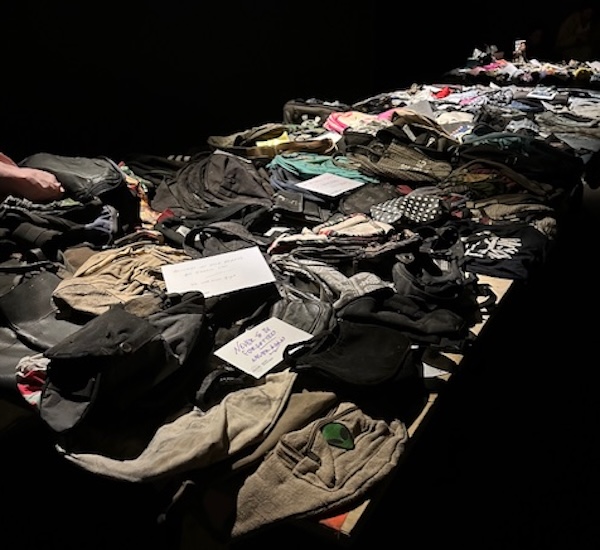
On one wall of the exhibit are photos of the Nova hostages still held in captivity by Hamas. On another wall are photos of all the people at the Nova festival who were murdered on Oct. 7 – as well as their hats, shoes, other clothing and knickknacks.
(photo by Lorraine Katzin)
As you walk through the exhibit, it shows how the larger community is helping with the psychological trauma, the grieving process, the bereavement, the difficulties of survivors to function day-to-day. All the proceeds from the exhibition are dedicated to helping heal and rehabilitate survivors, commemorate those who were lost, and support the bereaved families.
We spent two-and-a-half hours walking around and reading testimonies. We came out emotionally drained. Our Israeli brethren are resilient, they have ruach, spirit, and they are dancing again.
The Nova Exhibition runs until June 8 at 1381 Castlefield Ave., in Toronto. For more information, visit novaexhibition.com.
Images from the exhibition:
(photo by Lorraine Katzin)(photo by Lorraine Katzin)(photo by Lorraine Katzin)(photo by Lorraine Katzin)