Skip to content
  • Home
  • Subscribe / donate
  • Events calendar
  • Business Directory
  • FAQ
  • News
    • Local
    • National
    • Israel
    • World
    • עניין בחדשות
      A roundup of news in Canada and further afield, in Hebrew.
  • Opinion
    • From the JI
    • Op-Ed
  • Arts & Culture
    • Performing Arts
    • Music
    • Books
    • Visual Arts
    • TV & Film
  • Life
    • Celebrating the Holidays
    • Travel
    • The Daily Snooze
      Cartoons by Jacob Samuel
    • Mystery Photo
      Help the JI and JMABC fill in the gaps in our archives.
  • Community Links
    • Organizations, Etc.
    • Other News Sources & Blogs
  • JI Chai Celebration
  • JI@88! video

Recent Posts

  • Or Shalom reopens its doors
  • JFS from past to future
  • Need holistic approach
  • Sharing stories, advice
  • Journalist shares fears
  • Skills to live together
  • Road to independence
  • Cutting grass with scissors
  • Zionism as a solution
  • Deceit, desire & the divine
  • Reclaiming sacredness
  • Creative project ideas
  • Summer squares and cobbler
  • Thou shalt … summer commandments
  • Legal help for students
  • Revisiting myth of Lilith
  • Wrong person rebuked
  • Canada’s mixed messages
  • Questions for museum
  • Symposium on antizionism
  • Making soccer political
  • CJPAC lauds Pulver’s impact
  • City recognizes Vrba’s legacy  
  • Organ donation saves lives
  • Theodore’s March premiere
  • A healing Shabbaton
  • Supplying healthy food
  • A chime of metal tags
  • Yellowknife seder a first
  • Ishai energizes, unifies
  • A Lag b’Omer to remember
  • Expanding the healing
  • Hannah Senesh – a unique hero
  • Community milestones … May 2026
  • Деньги до зарплаты на карту Займ до зп онлайн за 5 минут 2026
  • Микрокредит онлайн в Казахстане Микрозайм в Акшамат

Archives

Follow @JewishIndie
image - The CJN - Visit Us Banner - 300x600 - 101625

Tag: tikkun olam

Na’amat Canada marks 100

Na’amat Canada marks 100

Susan Inhaber, president, Na’amat Canada (left), with Dalia Margalit-Faircloth, president, Na’amat Vancouver. (photo by Heather Freed)

Na’amat Canada and NA’AMAT USA came together last month to celebrate a milestone: 100 years of community work.

The Centennial Celebration, held in Toronto May 16-18, brought together leaders, members and supporters for a weekend filled with joy, reflection and renewed purpose. The program featured tributes, performances and presentations from Na’amat International leaders. Together, participants honoured a century of activism and achievement while charting the course for the work ahead.

Na’amat was “the first and last women’s organization for which I ever worked,” said the late Golda Meir, national secretary (president) of Na’amat in the 1930s, decades before she became Israel’s prime minister.

Founded in 1925, Na’amat Canada is a Jewish nonprofit volunteer organization dedicated to improving the lives of women, children and families in Israel and Canada through education, advocacy and social services.

“From our humble beginnings as a single organization to the growth of two vibrant organizations dedicated to empowering women and children in Israel, we can take great pride in our rich and storied history,” said event co-chairs Jan Gurvitch (NA’AMAT USA) and Susan Inhaber (Na’amat Canada). “This celebration honours not only the trailblazers who came before us but also the dedicated individuals who continue to give their time and energy to carry our mission forward.”

The weekend began with welcomes and candlelighting, continued with performances and storytelling, and culminated in a  tribute to Na’amat’s past national presidents, women who helped shape the organization’s direction for generations. Attendees also heard from Na’amat Israel leaders Hagit Pe’er and Shirli Shavit, who shared updates on urgent needs and inspiring progress on the ground.

“Today, as we honour this remarkable milestone, we celebrate not only the achievements of the past but also the enduring partnership that continues to drive our mission forward,” said Pe’er, president of Na’amat Israel and Na’amat International. “Together, we have built a legacy of resilience, compassion and progress that will inspire future generations.”

The event captured the deep sense of community that defines Na’amat: from singing and dancing, to laughter and reflection, to sharing dreams for the next 100 years.

Kanot Youth Village

After wrapping up the centennial, the occasion served as the launchpad for Na’amat Canada’s next major initiative: a fundraising campaign to equip a brand-new middle school building at Kanot Youth Village, a life-changing boarding school for at-risk youth in Israel.

“We help children cross the bridge – from being lonely to being socially connected, from failing in school to succeeding, from mistrust and alienation to belonging, connection and pride in being part of society,” said Dr. Hezi Yosef, director of Kanot, who is an expert in cognitive-behavioural psychotherapy and lectures at educational institutions and organizations in Israel and worldwide.

Founded by Na’amat in 1952, Kanot today serves 700 students, many of whom face poverty, trauma or loss. The new building – a collaborative project between Na’amat Canada, donors and Israel’s Ministry of Education – is nearly complete but, to open its doors in September 2025, it must be fully furnished and equipped.

Na’amat aims to raise $180,000 CAD to provide classroom furniture, lab tools, creative arts supplies and technology to transform the space into a vibrant learning environment.

To learn more about Na’amat’s impact or to support the Kanot campaign, visit naamat.com or call 1-888-278-0792. 

– Courtesy Na’amat Canada
Format ImagePosted on June 27, 2025June 27, 2025Author Na’amat CanadaCategories NationalTags Canada, fundraising, Israel, Kanot Youth Village, milestones, Na'amat, tikkun olam, women, youth-at-risk

Seeing the divine in others

I recently participated in a conference panel on hope in a time of divisive politics. A friend in the Jewish community couldn’t do it, so she asked me to help instead. I won’t lie, I felt nervous.

I worried that I wouldn’t measure up to some of the speakers, who had big job titles, awards and experience. This was compounded by a few missteps that left me feeling embarrassed and humbled. First, my friend’s name was left on the conference program and mine wasn’t listed, even though organizers had ample time to update the panelists’ names. Second, social media amplified the panel on Facebook and Instagram, but listed my name with incorrect, made-up undergraduate degrees. I’d provided my graduate degrees in religious studies and education because I felt they were relevant. Somehow, five years of education went away due to clerical errors.

The weird part was that my brief talk, and my presence at the panel, was to elevate Jewish experience and Jewish hope in an approachable way. Two academics spoke, using big concepts and bigger words, while minimizing their personal approach to the issues. Then, an amazing African Canadian legal professional spoke of her family’s journey and deep roots in Canada – it was personal, compelling and important. I was up next.

I’d prepared my notes in advance. I spoke from them, but, first, I changed gears. The night before the panel, held at Winnipeg’s Canadian Museum for Human Rights, I encountered members of the Persian community, holding up their lion flags to represent the Iranian people and their opposition to the Islamic Republic. I stopped to tell a young woman holding the flag that our hearts were with her, and we were thinking of her, and hoping the people of Iran were safe. She seemed shocked. Surprised that I saw her, knew what she represented, and embraced this message against extremism and violence of the Islamic Republic of Iran. She asked where I was from, I smiled and only said, “Winnipeg.” 

The day of the panel, I struggled with a parking meter. Then I crossed a street, sharing a warm smile with an Indigenous man on a bicycle who passed by. My heart thumped hard. Though I’ve done plenty of public events and teaching, I felt on edge. Maybe it was because I was one of the only representatives of the Jewish community in that multi-faith gathering. Maybe it was because I’d been checking on where the Iranian missiles were landing in Israel right before I came. I worried about repercussions following me into the Canadian Museum for Human Rights.

Pretending to check if the microphone was on, I said, “Welcome. Thank you for coming …” and, looking at the crowd, I greeted everyone with a “Hello y’all!” After that informal start, I made sure to mention the Jewish concept of the world as a broken pot, in which the vessel’s shards, our souls, are in each of us. I talked about tikkun olam, repairing the world, and putting those shards back together, as an act of hope that we work towards, as an act of ongoing creation – a human and divine partnership. Throughout the morning, I took time to look at people, greet them and try to see G-d in each of them. I decided that the way to confront my feelings of embarrassment, and the erasure of my name and credentials, was to fully see others the way I would want to be treated.

At this conference, there were many references to reconciliation. An Anglican bishop who is also a residential school survivor spoke during our panel question period. When I recounted all this later to my family, we recognized an important theme.

As a professor, my husband often attends events with a land acknowledgement. Working with a group of Indigenous students last year, he asked them how they feel about the “workshopped” statement the university uses. They said it was often done by rote and perhaps lost its meaning as a result. They didn’t feel seen by it. 

Almost immediately, I recalled that our congregation had changed its Prayer for Canada. The new one feels genuine to me. It includes aspects of a land acknowledgement by mentioning by name the first inhabitants of the land. It also includes the current Canadian political infrastructure. It’s a prayer to maintain our diversity, so that never again will Canada say, “None is too many,” in reference to the antisemitic exclusion of Jewish refugees fleeing Europe during the Second World War.

My husband will meet again this summer with a new group of Indigenous students. He’s considering a different discussion. What does it mean when society suggests that some people’s innate connection to the land must be acknowledged, but others don’t deserve a similar acknowledgement of their homeland? This issue isn’t “just” about Israel, either. What about the Kurds? What about the Druze? The dispossessed list is a long one.

When we moved to Winnipeg 16 years ago, celebrations for Canada Day included enormous festivals and bombastic firework displays. Over time, due to the pandemic and to a change in how we perceive the day, this has changed. Many Indigenous Canadians don’t celebrate Canada Day. 

Having my name left out and hard-earned credentials jumbled was difficult, but it reminded me of how acknowledgement works. We can choose, as Canadians, to look up from our phones and really see one another. We all deserve to take up space and be here, recognized for our special contributions, in this land of plenty. We may not be able to control the huge geopolitical events around us, but we can see one another and pray for our loved ones and our neighbours, too, both here and elsewhere. Recognizing the divine, individual spark in each person is crucial.

I’m hoping for a family cookout at home this Canada Day. We might talk about how we connect to Canada, and how we fit in the Jewish diaspora and homeland. It’s a complicated equation, worth talking about during a war. We should also choose to see, greet and value all those we walk with on this land and in the world. Let’s recognize everyone’s names, identities – and souls – as meaningful, too. 

Joanne Seiff has written regularly for the Winnipeg Free Press and various Jewish publications. She is the author of three books, including From the Outside In: Jewish Post Columns 2015-2016, a collection of essays available for digital download or as a paperback from Amazon. Check her out on Instagram @yrnspinner or at joanneseiff.blogspot.com.

Posted on June 27, 2025June 26, 2025Author Joanne SeiffCategories Op-EdTags Canada Day, civil society, interfaith relations, Judaism, lifestyle, tikkun olam

When crisis hits, we show up

As a member of the Jewish community, I’ve come to recognize a powerful truth: when crisis strikes, we show up. That’s who we are.

It’s not performative. It’s not for headlines. It’s rooted in Jewish values that demand action – to heal the world (tikkun olam), to care for the stranger (ve’ahavta et hager) and to take responsibility for one another (arevut hadadit).

So, when tragedy struck our Filipino neighbours at the Lapu Lapu festival in Vancouver, the Jewish community responded – as we always strive to do, with compassion. Our community mobilized within hours. Not just with condolences, but with coordinated, tangible action. A dedicated fund was quickly established for affected families. We partnered with Filipino BC, the United Way, the Archdiocese of Vancouver, the City of Vancouver and other local organizations to ensure a compassionate, coordinated response.

These aren’t symbolic gestures – they are meaningful efforts to help a community recover, rebuild and feel supported in its darkest moment. And it’s not the first time our community has responded like this – not even close.

We’ve shown solidarity with Indigenous communities through Truth and Reconciliation events, advocating for justice, supporting families of missing and murdered women, and bringing in speakers.

After the Quebec mosque shooting, we stood with our Muslim neighbours, condemning Islamophobia, and supported Syrian and Afghan refugees with sponsorship, fundraising, housing, and provided immigration help.

In response to George Floyd’s murder and rising anti-Asian hate, we participated in rallies, spoke out and called for systemic change in policing.

We’ve actively supported LGBTQ+ rights by participating in Vancouver’s Pride Parade and advocating for policies against discrimination.

In the wake of floods and wildfires, we provided aid, opened our homes and joined environmental campaigns for climate justice.

From Haiti to Ukraine, and East Africa to Nepal, our community has raised money and supported global aid efforts to provide humanitarian relief to those affected.

We don’t burn flags, we build bridges. We don’t chant hateful slogans, we extend hands in solidarity. We don’t destabilize, we stabilize, support and stand together. That is the spirit that lives within the Jewish community here in Vancouver. In moments of crisis, we don’t disappear – we show up.

That is the spirit embedded in Jewish life. These values are part of who we are. They guide us – especially in moments of pain and need. We act when it matters most.

That’s why I’m proud to be Jewish. Proud to be part of a people whose instinct is to act with compassion – no matter who is in need. Tzedakah, tikkun olam and arevut hadadit are not just words we recite. They are the path we walk. That’s who we are.

Lana Marks Pulver is board chair, Jewish Federation of Greater Vancouver.

Posted on May 30, 2025May 29, 2025Author Lana Marks PulverCategories Op-EdTags arevut hadadit, climate justice, human rights, humanitarian relief, Judaism, multicultural, multifaith, solidarity, tikkun olam, tzedakah
A Purim-Ramadan oasis

A Purim-Ramadan oasis

Members of the local Jewish and Muslim communities who came together in the Downtown Eastside March 16 to commemorate Shushan Purim and Ramadan by giving out food to those in need. (photo from Rabbi Philip Bregman’s Facebook page)

On Sunday, March 16, on the corner of Main and Hastings, members of the local Jewish and Muslim communities converged for a joint commemoration of Shushan Purim (the day after Purim) and the holy month of Ramadan.

Both these sacred occasions call upon their observers to feed those who are food insecure, often through charity. Muslims refer to this as “zakah,” Jews describe it as “tzedakah.” Both words denote righteousness. United in this shared charge on that day, these two Abrahamic religious traditions met at ground zero of Greater Vancouver’s mental health, addiction and housing crisis to nourish some of the residents of the Downtown Eastside. This was assuredly a “righteous” act for all participants, inspiring renewed hope for our troubled world.

The gathering was mainly the initiative of Vancouver-Granville Member of Parliament Taleeb Noormohamed, a few religious leaders of the Vancouver Muslim community and rabbis Dan Moskovitz, Philip Bregman, Jonathan Infeld and Arik Labowitz. In a social media post describing the event, Rabbi Bregman wrote: “We may not be able to solve the world’s political issues but we can come together to deal with in a small way a local issue (feeding the hungry) that affects us all.” 

It was my great honour to be a part of this group as an ordained cantor and member of the Vancouver Jewish community. My day job often places me at this street corner, serving a similar clientele. I work as a multifaith chaplain on Vancouver Coastal Health’s ACT (Assertive Community Treatment) teams, providing spiritual care to clients and staff as they navigate the existential angst, cumulative grief and moral distress that accompanies the city’s overdose crisis. Many days bring me to the same area to help provide spiritual comfort and solace through presence and song. The task often is daunting. (On the day that I wrote these words, our ACT team lost another longtime client to a preventable overdose death at the age of 29.) Standing alongside my Jewish siblings and Muslim cousins and handing out food that our respective communities had prepared and purchased brought a whole new level of hope.

I particularly needed the spiritual uplift that Sunday, which, like so many Sundays before, again witnessed my Jewish community’s impassioned rallies, calling for the release of all the remaining hostages – those alive and dead – who were taken to Gaza during the barbaric Oct. 7 pogrom that waged war against Israel’s right to exist.

I also needed the spiritual uplift that day because March 16 marked the date when 23-year-old American Jewish nonviolent human rights activist Rachel Corrie (April 10, 1979-March 16, 2003) was crushed to death by an Israeli bulldozer as she protested the demolition of Palestinian homes in Gaza. This horrific anniversary led me to spend that early morning reflecting once again on how to reconcile my abiding love of Israel with my vehement disagreement with those Israeli and American governmental policies that have violated human rights, killed innocent children and civilians and threatened ethnic cleansing.

As if to emphasize the point, earlier that same morning, I had breakfast with a Jewish friend with whom I had engaged in a book club to discuss Peter Beinart’s latest treatise, Being Jewish After the Destruction of Gaza: A Reckoning. Another Conservative cantor I know well and respect recently challenged me to open myself to voices I would not otherwise have considered regarding world affairs. I took that charge to heart and decided to read Beinart’s latest work, which I would not have been likely to peruse previously. Like the death of Corrie, reflecting on this book over breakfast proved sobering, as I continue to realize the many blind spots in my own thinking over the years.

While my mind and spirit were still reeling from navigating these concurrent realities, the Purim-Ramadan event provided me with a palpable spiritual uplift, as I witnessed Jews and Muslims standing in unity side by side with wide smiles, handing out nourishment to those deprived of food. 

The spiritual boost also came from meeting devout Muslims in their bountiful humanity.

There was Aroun, who shared with some Jewish attendees and I how members of his mosque (Al-Jamia Al-Masjid) often come downtown to provide food to the poor on Ramadan. Aroun had us all in stitches when he jokingly indicated how hard it was to handle so many edibles while observing Ramadan’s required daytime fasting. In the same breath, he  reminded us that though there are indeed extremists on both sides of the aisle, events like the present one proved that we do not have to toe their party line.

I likewise will never forget talking with another Muslim participant, Mohammed Zaid, to whom I explained the traditional duties of a cantor as a chanter of prayer. Mohammed responded by offering to demonstrate his own chanting of Quranic verses in Arabic, one of five languages that he speaks. I listened to his mellifluous voice echo the similar Middle Eastern musical modes that I employ when leading synagogue services. In his prayer, I heard words such as “Rahman,” an Arabic cognate for the Hebrew “Rachaman,” meaning Merciful One, and, of course “salaam,” which I knew as “shalom.” His singing reminded me of my late friend Imam Sohaib Sultan, z”l, who was a fellow classmate in my first chaplaincy training class years ago, and with whom I traded our traditions’ sacred melodies. 

Our spirits were raised even during the traditionally dreaded cleanup time, as we together refolded the tables we had brought, and shlepped them into vans. My friend Ben Lubinizki and I shot the breeze with young Muslim men while we waited to gain access to the trash and recycling room. At that moment, I felt inspired to pull out my recent Purim costume’s toque, on which was boldly sprawled the phrase: “Canada is not for sale.” In response to this gesture, my Muslim cousins laughed and cheered me on in solidarity. Here was another front on which we were united. 

As we said our chag sameachs, Ramadan mubaraks and salaam/shaloms, I realized that a key to interfaith dialogue – even on the most fraught issues – can occur through shared life-affirming experiences such as this one. 

The memory of that Sunday morning gathering gives me hope that our mutual striving for lovingkindness can overcome all else. As Rabbi Moskovitz reflected on the occasion, two divided communities had aligned “to feed the hungry and also to collaboratively feed our soul’s hunger for shared humanity.”

May we never forget these universal lessons for our time, lessons brought to us from a very real temporary oasis, built on the most infamous intersection in the poorest postal code in Canada. If humanity can achieve this here, of all places, we can do so in Israel, Gaza and the world. 

Cantor Michael Zoosman is a board-certified chaplain with the Canadian Association for Spiritual Care. He serves as a spiritual health practitioner for the Assertive Community Treatment teams of Vancouver Coastal Health, working with individuals in the community living with severe mental health disorders and addiction. He sits as an advisory committee member at Death Penalty Action and is the co-founder of L’chaim! Jews Against the Death Penalty. He served as cantor of Congregation Beth Israel 2008-2012. 

Format ImagePosted on March 28, 2025March 27, 2025Author Cantor Michael ZoosmanCategories Op-EdTags Downtown Eastside, interfaith, Jews, Muslims, Purim, Ramadan, spirituality, Taleeb Noormohamed, tikkun olam
Continuing a giving legacy

Continuing a giving legacy

Rose’s Angels co-founder Courtney Cohen, left, with May Stefanov, tenant relations coordinator with Tikva Housing Society. (photo from Rose’s Angels)

Rose’s Angels recently completed its 12th year of giving, donating collected items to 14 Richmond not-for-profits, including Richmond Family Place, Colt Young Parent Program, Mamas for Mamas, Turning Point Recovery Society, Jewish Food Bank, Tikva Housing Society and Pathways Clubhouse.

Rose’s Angels, which operates under the auspices of the Kehila Society of Richmond, was created in 2012 by Courtney Cohen and co-founder Lynne Fader, in memory of Cohen’s grandmothers, Rose Lewin and Babs Cohen, who were both philanthropic and believed in giving back to community.

This year, an abundance of personal care items, non-perishable food, children’s arts and crafts, books and baby formula was donated. For many recipient agencies, baby formula and diapers are among their top priority items, and Rose’s Angels was able to give a large quantity of these items this year.

Donors, volunteers and other community members are integral to the success of Rose’s Angels. Letters were sent out to partner agencies, family, friends and others in January. Last month, monetary and physical donations were collected, Richmond Jewish Day School hosted a hygiene-item drive, and gift cards to grocery stores were purchased. Donations were then packaged and delivered by volunteers.

Cohen reflected on her hope to continue the legacy of her parents and grandparents.

“I hope to instil in my children the importance of tikkun olam (repairing the world) by focusing on one mitzvah at a time,” she said.

To learn more about or donate to Rose’s Angels, email [email protected] or call the Kehila Society at 604-241-9270. 

– Courtesy Rose’s Angels

Format ImagePosted on March 28, 2025March 27, 2025Author Rose’s AngelsCategories LocalTags Courtney Cohen, Kehila Society, Lynne Fader, Richmond, Rose’s Angels, tikkun olam
O Canada! tote bag line

O Canada! tote bag line

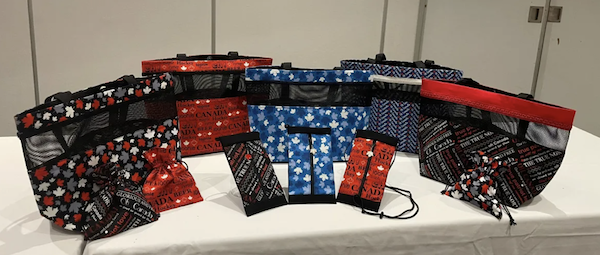
Tikun Olam Gogos’ O Canada! bags proclaim dedication to the ethic of improving the world in friendship with other nations, raising much-needed funds for grandmothers in sub-Saharan Africa who are raising their grandchildren due to the HIV & AIDS pandemic. (photo from Tikun Olam Gogos)

As proud Canadians and fundraisers for the Stephen Lewis Foundation Grandmothers to Grandmothers Campaign, Tikun Olam Gogos have launched a special edition line of O Canada! tote bags – determined to respond to the threats American tariffs pose to Canada, and to the suspension of USAID, which is devastating to the Gogos’ partner organizations in Africa. 

According to Stephen Lewis, “Lives will be lost. Our best contribution at this perilous moment is to attempt to replace the resources that America has expunged.”

Tikun Olam Gogos’ response to the White House is to raise more funds by intensifying its efforts to handcraft and market its O Canada! line of large tote bags, zippered and drawstring pouches.

Tikun Olam Gogos (TOG) is part of the Greater Vancouver Gogos, which includes about 20 Gogo groups across the Lower Mainland. Gogo is the Zulu word for “grandmother” and tikkun olam is Hebrew for “repair of the world.” TOG is a volunteer group of grandmothers and grand-others (non-members who help out the group periodically) in Vancouver that was founded in May 2011 and is sponsored by the Sisterhood of Temple Sholom. Its mission is to raise awareness, build solidarity and mobilize support in Canada for grandmothers in sub-Saharan Africa who are raising their grandchildren due to the HIV & AIDS pandemic. 

In 14 years of operation, Tikun Olam Gogos has raised more than half a million dollars for the SLF Grandmothers to Grandmothers Campaign. With its partners in Africa reeling from the withdrawal of other international programs, TOG is more determined than ever to fulfil its motto: “we will not rest until they can rest.”

Priced at $50, just $5 more than TOG’s original signature totes, the O Canada! bags proclaim dedication to the ethic of improving the world in friendship with other nations. So, wear your maple leaf and your heart proudly on your O Canada! tote. You are telling the world “Canada cares.”

To order your O Canada! tote bags, zippered pouches and drawstring pouches, visit tikunolamgogos.org or call Joyce Cherry at 604-261-5454. 

– Courtesy Tikun Olam Gogos

Format ImagePosted on March 14, 2025March 13, 2025Author Tikun Olam GogosCategories LocalTags Canada, fundraising, Grandmothers to Grandmothers campaign, Stephen Lewis, tariffs, tikkun olam, Tikun Olam Gogos, United States
Na’amat – 100 years of service

Na’amat – 100 years of service

From 1925 to today, Na’amat volunteers across Canada and the United States continue to empower women and children in Israel and abroad. (photo from Na’amat Canada)

At a time when charities are fighting to survive, an organization that’s been helping women and children in Israel and North America is celebrating its 100th anniversary. 

Na’amat Canada and Na’amat USA, which began as a North American chapter in 1925, will mark the centenary at a gala conference in Toronto in May with delegates from across Canada and the United States. 

“It’s a huge deal. It’s a milestone,” said Vivian Reisler, executive vice-president of Na’amat Canada. “We’ve come a long way from Golda Meir sending a message that we need $100 to build X, Y, Z.” 

The forerunner of Na’amat was founded in 1921, in what would later become the modern state of Israel, to empower women, including providing vocational training and advocating for improved working conditions and equal pay.  

Four years later, a North American branch was born and Na’amat chapters were formed across Canada and the United States over the ensuing decades. Today, thousands of volunteers are continuing to empower women and children in Israel and abroad.

“The success of the organization is due to the dedication of the members, volunteers and donors – because, without them, we wouldn’t be where we are today,” said Reisler. 

Na’amat Canada president Susan Inhaber, a member of the organization for 25 years, agrees.

 “We just want to keep building, get our name out there, build the membership and thank all the donors, supporters and members who are making everything possible,” she said. “This is an exciting time for us to be together. It’s nice that we have an organization that’s lasted so long.” 

While the North American branch of Na’amat (a Hebrew acronym for “Movement of Working Women and Volunteers”) began in 1925, Na’amat Canada and Na’amat USA became two autonomous divisions in 1965.

“We were together, we split, and now we’re back together (informally, at the Toronto conference) celebrating 100 years,” said Reisler. 

Na’amat is the largest women’s organization in Israel. It provides a wide variety of services, including a daycare network for thousands of children, legal aid centres, technological high schools for students who have trouble succeeding in other classroom settings, boarding schools for underprivileged students, and the Na’amat Canada Glickman Centre for Family Violence Prevention.

photo - Na’amat Canada members at the Glickman Centre for Family Violence Prevention
Na’amat Canada members at the Glickman Centre for Family Violence Prevention. (photo from Na’amat Canada)

Established in 1993 in Tel Aviv, the Glickman Centre was the first women’s shelter in Israel. It has three distinct sections: the shelter, a counseling and treatment area, and the Rhodie Blanshay Benaroch Children’s Centre wing, a haven for children living in the shelter.  

The Rhodie Blanshay Benaroch Children’s Centre houses a computer room, baby nursery, kindergarten, audiovisual education corner, library, learning centre and outdoor playground, named in honour of Rhodie’s granddaughter, Rho Schneiderman. A musical playground was built in honour of Rhodie’s two granddaughters. Blanshay Benaroch was a dynamic third-generation Na’amat member who was committed to building a safe, loving environment for children who needed it most. 

Recently, Na’amat Canada was instrumental in building a new middle school at Kanot Youth Village. More than 300 students will now have a state-of-the-art school to enhance their education.  

In the aftermath of the Israel-Hamas war, Israel needs Na’amat’s help as much – or even more – than it did a century ago, said Doris Wexler-Charow, past national president of Na’amat Canada.

“I think that Oct. 7 changed everything,” she said of the deadliest attack against Jews since the Holocaust.

Everyone in Israel is suffering from PTSD, said Wexler-Charow, a retired social worker. “Everybody’s been traumatized,” she said, explaining that Na’amat is providing more counseling services than ever. “Israel needs us. It’s important for us to keep going. The cause is a good one and I think we need our young people to continue where we leave off.” 

– Courtesy Na’amat Canada

Format ImagePosted on March 14, 2025March 13, 2025Author Na’amat CanadaCategories NationalTags anniversaries, Doris Wexler-Charow, history, milestones, Na’amat Canada, philanthropy, Susan Inhaber, tikkun olam, Vivian Reisler, women
Determined to help others 

Determined to help others 

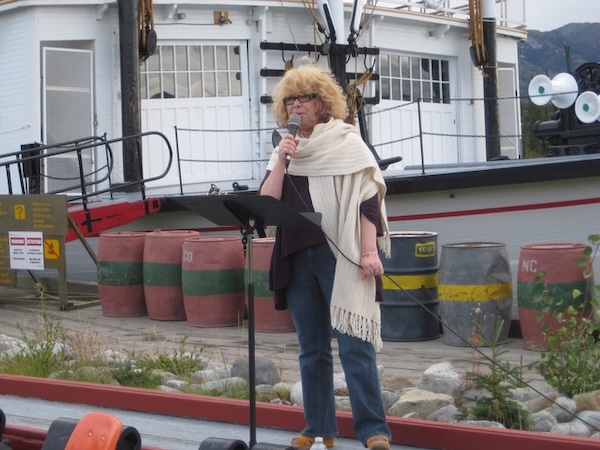
Photos from the book include Joy Karp speaking to a group of people at a Terry Fox Run in Whitehorse. (photo from Rick Karp)

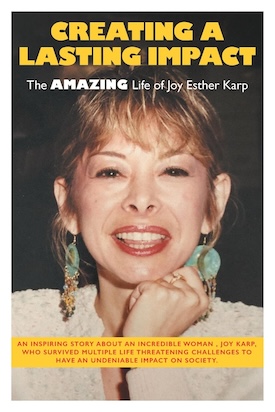
Creating a Lasting Impact: The Amazing Life of Joy Esther Karp was recently published.

Written by Rick Karp, who was married to Joy for 49 years – many of them spent in the Yukon – the account tells of her determination to make a difference and how she made numerous contributions to society, while having to overcome life-threatening issues every few years.

Joy Karp died in 2017.

image - Creating a Lasting Impact book cover“I promised Joy a few weeks before she passed that I would ‘tell her story,’ and that is what I have done. People need to know who she was, what she accomplished throughout her life, how caring and supportive she was for others,” Rick Karp told the Independent. 

Two of the setbacks Joy Karp faced were a heart attack, after giving birth to twins in her early 20s, and a car accident, in which she was thrown from the vehicle onto a frozen Lake Ontario, smashing the bones in her left foot; she had to wear specially made shoes thereafter.

In 1986, the Karps moved from Ottawa to Whitehorse, where they brought the first McDonald’s to the North and were deeply involved in the economic, social and cultural fabric of the Yukon. But this didn’t protect the couple from life’s vicissitudes. 

Joy was kidnapped in 1992 and buried in her car for close to 17 hours.  The kidnappers shackled her wrists and ankles, blindfolded her, put a bag over her head and left her there without needed medication, despite knowing she had heart issues.

“After the kidnapping, Joy suffered horribly for years from PTSD and, a couple of years later, her heart gave out and she had to have a quadruple bypass operation,” Rick Karp said.

In addition, Joy’s foot was severely damaged after the kidnapping, and doctors considered amputation. The Karps, though, demanded that the doctors pursue another course, which allowed her to keep her foot.

A few years later, Joy had her first case of cancer and required operations, chemotherapy and radiation. The cancer returned after several years and proved incurable.

“The doctors thought it was a heart issue and all that Joy needed was a pacemaker,” Karp said. “The X-rays that they did to determine the positioning of the pacemaker showed that the issue was a cancerous growth that had developed in her right lung and had reached out and attached to her heart. 

photo - Rick Karp’s book about his wife, Joy, was recently released
Rick Karp’s book about his wife, Joy, was recently released. (photo from Rick Karp)

“They said that it was inoperable and that Joy only had about three months left, but she survived for close to 11 months.”

Despite all these adversities, Joy had an innate ability to understand and see the potential in others, to learn what they needed, and then make things happen for them, said Karp. People were always drawn to her, he said.

“This was one of the amazing things about Joy. She thought of others. She was a great listener. As a student, she helped her fellow students with assignments, and she had the ability to resolve issues.”

One of Joy Karp’s legacies is the McDonald’s Hands-On Business Training Program. The story begins in Ontario in the 1970s, with a job she had helping an owner-operator grow to five stores, and managing the head office. Confronted with a high turnover rate in some towns, the owner approached Joy for a solution. 

She created a training program in 1978 and implemented it at local McDonald’s restaurants. By the early 1980s, according to Karp, the program was used throughout the fast-food chain.

“This is a three-year program that takes employees, or others that apply, through training and development that solidifies their knowledge of all of the stations in McDonald’s, training in customer service, and all aspects of how the restaurant operates,” he said.

“Then, to the right people, the program offers the chance to rise from crew person to crew trainer, to swing manager, to assistant manager and to manager – it offers career opportunities. Also, embedded in the program is the concept of ‘promote from within,’ which has been adopted by businesses, well, everywhere.”

Among other accomplishments, Joy organized service and customer satisfaction workshops for the Whitehorse Chamber of Commerce when the city played host to the Canada Winter Games in 2007. Her efforts, Karp said, were recognized by the event’s organizers.

Additionally, she played a key role in bringing the Special Olympics to Whitehorse, helped arrange for an outdoor play area and training computers at the Yukon Child Development Centre, and was pivotal in obtaining funding to make the Yukon Arts Centre wheelchair accessible. In 2013, she wrote The Power of Service: Service Through the Eyes of Customers, a book that emphasizes the importance for businesses to develop relationships and trust with those they serve.

Creating a Lasting Impact can be purchased on the Bookstore page at rwkarp.ca. A signed copy can be ordered by emailing Karp at [email protected]. 

Sam Margolis has written for the Globe and Mail, the National Post, UPI and MSNBC.

Format ImagePosted on March 14, 2025March 13, 2025Author Sam MargolisCategories BooksTags business, health, history, Joy Karp, McDonald's, memoir, Rick Karp, tikkun olam
Growing a garden together

Growing a garden together

Volunteers, seniors and youth dedicate their time each week to tending, planting and harvesting at the Vancouver Jewish Community Garden. (photo courtesy VJCG)

The Vancouver Jewish Community Garden (VJCG), which opened in May 2023, began as a dream – a vision shared by Vancouver Talmud Torah, Jewish Family Services Vancouver and Congregation Beth Israel. The dream was made possible by the Diamond Foundation, which secured a long-term lease of the land for future development and has allowed for the opportunity to use it for a Jewish community garden on a temporary basis. Significant seed gifts from the Ronald S. Roadburg Foundation and the Jewish Community Foundation also played a vital role in its creation.

photo - A Vancouver Jewish Community Garden volunteer
A Vancouver Jewish Community Garden volunteer. (photo courtesy VJCG)

Generous donors, volunteers, students, garden experts, builders, designers and a project manager all contribute to its success. Every seed planted, every helping hand and every heart involved makes a meaningful impact – both on those who tend the garden and those who benefit from its harvest. As Rabbi Shimon bar Yochai said, “A garden is not just a patch of soil, but a place for the cultivation of the soul.”

Reflecting on two years of growth – including a full harvest season – it is possible to truly appreciate the impact the VJCG has on the Vancouver Jewish community. Under the care of garden coordinator Maggie Wilson, the VJCG has blossomed into a hub for connection, learning and nourishment. Sacred spaces are woven among beds of fruits, vegetables and flowers. 

“The garden is more than a place to grow food – we’ve built a wonderful community where people can experience the healing effects of digging in the soil, and witness the miracle of nature,” said Wilson. “Some participants are having their first experience planting a seed or picking a fresh bean. They are learning what it takes to grow food, and understanding, in a concrete way, how their work contributes to tikkun olam.”

Volunteers, seniors and youth dedicate their time each week to tending, planting and harvesting, ensuring that fresh, nutritious produce reaches Jewish Family Services to support community members facing food insecurity. Beyond its bounty, the garden is also an outdoor classroom. Students engage in hands-on workshops, learning about sustainability, collaboration and the growth cycle.

The VJCG is a community treasure that needs the community’s support to continue to thrive. Feb. 20 will be the first-ever Day of Giving in support of the VJCG. Donations will help sustain the garden, expand programming and continue to provide nourishment, education and inspiration. To contribute, visit jewishcommunitygarden.ca. 

– Courtesy Vancouver Jewish Community Garden

Format ImagePosted on February 14, 2025February 13, 2025Author Vancouver Jewish Community GardenCategories LocalTags Day of Giving, gardening, philanthropy, tikkun olam, Vancouver Jewish Community Garden, VJCG, volunteering
Rescuing Afghan women MPs

Rescuing Afghan women MPs

Corey Levine has helped bring many Afghan women MPs and their families to safety in Canada. She will speak about her experiences at the Wallenberg-Sugihara Civil Courage Society event honouring her. (photo from Corey Levine)

The Wallenberg-Sugihara Civil Courage Society’s Civil Courage Award honours individuals who help others escape from unjust and dangerous situations at great risk to themselves, as both Sweden’s Raoul Wallenberg and Japan’s Chiune Sugihara did during the Second World War to help Jews flee the Nazis. On Jan. 19, at the society’s 20th Annual Raoul Wallenberg Day event, this year’s award will be given to Corey Levine, who has been helping women flee Afghanistan.

There were 69 women in Afghanistan’s parliament when the country experienced a brief period of democracy. When Kabul fell and the Taliban retook control on Aug. 15, 2021, these women had to flee or they would have been murdered. Most of them made it to Greece, Albania or elsewhere, where they lived until they were able to make their way to Canada or the United States. Others made it to Pakistan, where they live in hiding, in danger of being deported back to Afghanistan if found.

Levine has been doing human rights work in war zones for about 30 years. “I really embrace the idea of tikkun olam, that it is our individual responsibility to contribute to repairing the world,” she said.

Her first trip to Afghanistan, in March 2002, was as a consultant with the Canadian International Development Agency’s peace-building unit. “The Taliban had just been routed, and Western countries were starting to engage,” she said.

That was the start of a 23-year-and-counting relationship with the country, both as a consultant with various international organizations and personally.

The last time she was on a paid contract in Afghanistan, it was with UN Women. She was there for nine months, “seconded to work with Afghan women parliamentarians, to support them and develop some strategies, etc. I left Afghanistan six weeks before the Taliban took over the second time and, basically, from the time that I left, but especially the day that Kabul fell, Aug. 15, 2021, people started contacting me. At first, it was Afghan friends and colleagues – because I’d been going there for 20 years at that point – asking me for help. And I said, I don’t know, I’ll see what I can do. I couldn’t have imagined then that it would end up being a 24/7 crisis management [project] that I ended up doing for the past three-and-a-half years all on my own, voluntarily.”

Calls for help started coming from people Levine didn’t know. “In a way, it was almost like an underground railway,” she said, with so many people, as individuals or as part of organizations, trying to get out of the country, Afghans at risk of being killed by the Taliban. Helping people escape was unfamiliar work for many of the people involved. “We were all kind of flying by the seat of our pants,” she said.

“It’s one thing to get people into safe houses. That’s only a temporary Band-Aid solution. It’s how to help them afterwards, how to help them reach safety. And then I started organizing private sponsorship. Canada has this unique program where groups of people in a community can come together and raise money and privately sponsor refugees.”

Levine has managed to organize seven private sponsorship groups in Victoria, where she lives, and is working on an eighth. Amid this work, she returned to Afghanistan in June 2022. While there on that trip, she tried to help some of the women MPs who had been left behind, and this work became part of her ongoing efforts to rescue at-risk Afghans.

“In September 2022,” said Levine. “I went to a conference in Ottawa and I met a few MPs…. I don’t know how, but I put together an all-party group of MPs that were interested in helping me get these women out.”

The resulting group comprises Bloc Québécois citizenship and immigration critic Alexis Brunelle-Duceppe, who was a co-chair of the Special Committee on Afghanistan; Conservative MP Alex Ruff, who twice served in Afghanistan with Canada’s military and was also on the special committee; Liberal MP Marcus Powlowski, who had spoken out, even before the Taliban retook Afghanistan, about the need for Canada to help Afghans; Green Party leader Elizabeth May, who used to be Levine’s MP and who had already helped Levine in this area; NDP foreign affairs critic Heather McPherson and Liberal MP Leah Taylor Roy, who were also keen to participate, said Levine.

“One of the women we were trying to help, and the event is dedicated to her memory, she was killed by the Taliban in January 2023,” said Levine, referring to Mursal Nabizada. “She was one of the women I had met when I was in Afghanistan in June of 2022…. Before that, we had been working under the radar with the government…. But then, once her death happened, because it was international news … the MPs released a statement about it, which got a lot of traction. The government stepped up after that, and we went back underground, so to speak,” mainly for security reasons.

However, the MP group has since become more public – a CBC documentary on their work aired last October. Its members continue to negotiate for more Afghan women MP refugees to be able to come to Canada and, from their efforts so far, seven Afghan families are here safely, said Levine. “One of them is going to be speaking at the event on the 19th.”

Former Afghan MP Gulalai Mohammadi, who escaped to Canada with her family last year, is that speaker. In addition to Mohammadi and Levine, May will also participate, representing the MP panel.

The Jan. 19, 1:30 p.m., event will take place at the Peretz Centre for Secular Jewish Culture. Admission is free, but donations are welcome, with donations of $36 or more receiving a tax receipt. A reception will follow the program.

For more information on the Wallenberg-Sugihara Civil Courage Society, visit wsccs.ca. 

Format ImagePosted on January 17, 2025January 14, 2025Author Cynthia RamsayCategories LocalTags Afghanistan, Civil Courage Award, Corey Levine, refugees, Taliban, tikkun olam, Wallenberg-Sugihara Civil Courage Society

Posts pagination

Previous page Page 1 Page 2 Page 3 … Page 30 Next page
Proudly powered by WordPress