Skip to content
  • Home
  • Subscribe / donate
  • Events calendar
  • News
    • Local
    • National
    • Israel
    • World
    • עניין בחדשות
      A roundup of news in Canada and further afield, in Hebrew.
  • Opinion
    • From the JI
    • Op-Ed
  • Arts & Culture
    • Performing Arts
    • Music
    • Books
    • Visual Arts
    • TV & Film
  • Life
    • Celebrating the Holidays
    • Travel
    • The Daily Snooze
      Cartoons by Jacob Samuel
    • Mystery Photo
      Help the JI and JMABC fill in the gaps in our archives.
  • Community Links
    • Organizations, Etc.
    • Other News Sources & Blogs
    • Business Directory
  • FAQ
  • JI Chai Celebration
  • JI@88! video

Recent Posts

  • Sharing her testimony
  • Fall fight takes leap forward
  • The balancing of rights
  • Multiple Tony n’ Tina roles
  • Stories of trauma, resilience
  • Celebrate our culture
  • A responsibility to help
  • What wellness means at JCC
  • Together in mourning
  • Downhill after Trump?
  • Birth control even easier now
  • Eco-Sisters mentorship
  • Unexpected discoveries
  • Study’s results hopeful
  • Bad behaviour affects us all
  • Thankful for the police
  • UBC needs a wake-up call
  • Recalling a shining star
  • Sleep well …
  • BGU fosters startup culture
  • Photography and glass
  • Is it the end of an era?
  • Taking life a step at a time
  • Nakba exhibit biased
  • Film festival starts next week
  • Musical with heart and soul
  • Rabbi marks 13 years
  • Keeper of VTT’s history
  • Gala fêtes Infeld’s 20th
  • Building JWest together
  • Challah Mom comes to Vancouver
  • What to do about media bias
  • Education offers hope
  • Remembrance – a moral act
  • What makes us human
  • המלחמות של נתניהו וטראמפ

Archives

Follow @JewishIndie
image - The CJN - Visit Us Banner - 300x600 - 101625

Tag: survivors

Oct. 7 heroes support Team Israel-Premier Tech

Oct. 7 heroes support Team Israel-Premier Tech

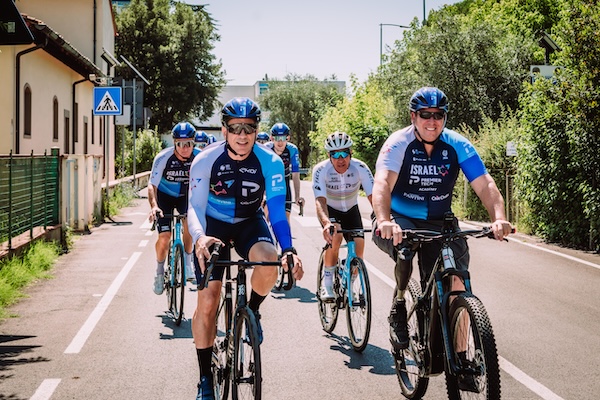
Oct. 7 survivors Sharon Shabo, left, and Avida Bachar lead Team Israel-Premier Tech riders in the team’s final training session before the Tour de France started on June 29 in Florence, Italy. (photo by Noa Arnon)

Three injured heroes from the Oct. 7 Hamas terror attacks came to support Team Israel-Premier Tech at the Tour de France. As well, they held signs bearing the names of hostages, some of whom are their close friends, and called for their release. Alongside them stood Israel-Premier Tech owners Sylvan Adams and Ron Baron.

“My friends from the kibbutz are suffering there. We can’t wait another moment,” said Avida Bachar. He lost his son and wife, who were murdered in their shelter in Be’eri on the morning of Oct. 7, while he himself was severely injured and lost his leg. Despite adapting to his prosthetic, Bachar insisted on riding his bike for the first time since his injury to lead the Israeli team in their final training session. “It was an immense moment, one of the most emotional of my life,” he said.

Joining Bachar was his good friend Sharon Shabo, who was seriously injured in a Hamas ambush on the morning of Oct. 7 while riding his bike, and 20-year-old Oded Gelbstein, a young combat engineer soldier who was critically wounded in Gaza and is currently undergoing rehabilitation in Florence.

“Avida and Sharon will be our great inspiration at the Tour de France,” said Adams to the team riders before the race started.

The Tour de France lasts three weeks, during which the riders cycle more than 3,400 kilometres. Twenty-two teams are taking part in the 21-stage race, which culminates in Nice, France, on July 21. 

– Courtesy Team Israel-Premier Tech

Format ImagePosted on July 12, 2024July 10, 2024Author Team Israel-Premier TechCategories WorldTags hostages, Oct. 7, resilience, survivors, Tour de France
Heroic survival at kibbutz

Heroic survival at kibbutz

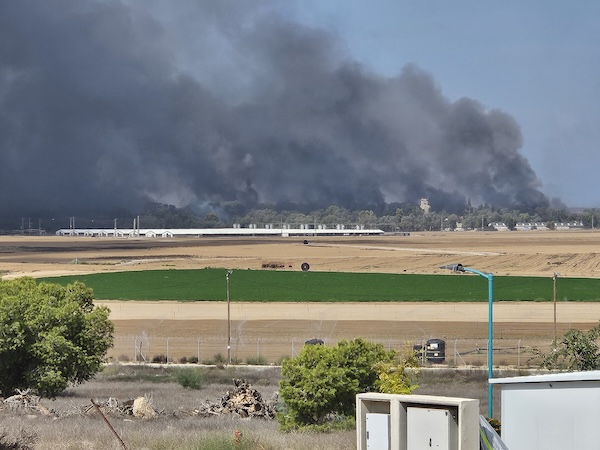
A photo Dekel Agami took Oct. 7, 2023, of Kibbutz Nir Oz in flames. (phot by Dekel Agami)

On Oct. 7, Kibbutz Magen, from which residents can see the Gazan city of Khan Yunis, was infiltrated by dozens of terrorists from Gaza. While two of the approximately 400 kibbutzniks were murdered and two seriously injured, a more horrific outcome was avoided, thanks to the heroic acts of a small squad of kibbutz civilian defenders, who held off the terrorists during a seven-hour gun battle.

A member of that response team was in Vancouver last week, sharing his story.

Kibbutz Magen is a kilometre away from Kibbutz Nir Oz, a village with a similar population, but which suffered exponentially more tragic outcomes that day – 46 Nir Oz residents were murdered and 71 taken hostage.

One reason for the less catastrophic death toll in Magen is that the terrorist infiltrators blew apart the perimeter fence a good distance from the kibbutz’s residential area. But the heroism and tireless response of Magen’s civilian emergency squad played a big role.

photo - Dekel Agami, left, and his partner Nufar Gal-Yam, share their Oct. 7 experiences with Vancouver audiences April 14. Itai Bavli, right, a University of British Columbia academic, grew up with Agami on Kibbutz Magen, near the Gaza border
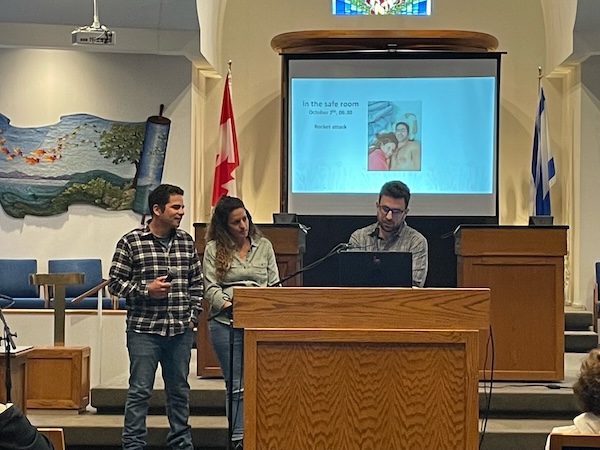
Dekel Agami, left, and his partner Nufar Gal-Yam, share their Oct. 7 experiences with Vancouver audiences April 14. Itai Bavli, right, a University of British Columbia academic, grew up with Agami on Kibbutz Magen, near the Gaza border. (photo by Daphna Kedem)

Dekel Agami, who grew up on the kibbutz, and his partner, Nufar Gal-Yam, who grew up in Sde Boker, the kibbutz most noted as the home of David Ben-Gurion, had moved in together on Kibbutz Magen on Oct. 4.

Since both had grown up in southern Israel, close to Gaza, the red alerts on Oct. 7 did not disturb them unduly. Around 7 a.m., Agami, an Israel Defence Forces veteran who served in the special forces, headed out with his weapon to meet other members of the security squad, a group of civilians and off-duty soldiers ranging in age from 20 to 70. He quickly realized this was not a routine day.

As he walked to meet his colleagues, Agami saw figures near the kibbutz border. The first one he encountered was wearing an Israel Defence Forces uniform – as numerous terrorists were that day – and so he did not shoot.

He came across the head of his security team, Baruch Cohen, who had been shot in the leg. As Agami was delivering first aid, an anti-tank missile hit the vehicle they were next to. Agami does not know how they survived.

In the event of an emergency, civilian and off-duty military personnel on kibbutzim are expected to manage on their own for 20 to 30 minutes until the arrival of the IDF. On Oct. 7, the dozen emergency squad members in Kibbutz Magen battled 30 to 40 terrorists on their own from 7 in the morning until 2 in the afternoon.

The terrorists breached the fence at a location relatively remote from the residential area of the kibbutz, giving the defenders a small tactical advantage. Fighting soon moved to the terrorists’ targets, the kibbutz’s homes, and, after providing first aid to Cohen, Agami fought the terrorists from one of the houses. The kibbutzniks successfully flushed the infiltrators back to the fence, where some of them fled – maybe back to Gaza, possibly off to murder easier prey.

During the fighting, Agami took a photo of nearby Nir Oz, where multiple plumes of smoke were rising in an ominous foreshadowing of their potential fate. The photo went viral in Israel.

“When I took this picture, I thought we were next,” Agami said to an audience at Temple Sholom on the evening of April 14. He and Gal-Yam also spoke at the weekly rally earlier that day, outside the Vancouver Art Gallery.

When the IDF finally made it to Kibbutz Magen, about 2 p.m., they killed the remaining terrorists. Then the larger trauma began to dawn on Agami and his fellow kibbutzniks.

Agami’s two daughters from a previous relationship were with their mother at a moshav a few kilometres away. During the battle, he didn’t worry about them – partly because, he said, he “couldn’t go there” but more because it never crossed his mind that the battle he was engaged in was part of a much larger crisis. When he finally did get in touch, he found out the three were safe.

The Magen fighters were too occupied keeping the terrorists at bay – Agami alone expended 15 magazines, about 450 bullets – to check their phones to see what was going on elsewhere. They did, though, have cellular connectivity, which was not the case in many kibbutzim. The terrorists were strategic, first targeting army bases and bringing down communications systems.

As the smoke cleared midafternoon on Oct. 7, several stunning realities came to light.

Three wounded residents – Cohen, Nadav Rot and Avi Fleisher – had been transported by the kibbutz doctor to a nearby community, from which they were helicoptered to hospital. Fleisher did not survive. Cohen would eventually have his leg amputated. No one – including those who made the journey – understand how they made it to safety. The terrorists had taken control of all the roads in the region, killing every Israeli they encountered. Even the military had not breached the area by the time the medical transport got through.

The exhausted kibbutz defenders soon discovered that what they had experienced was a comparatively small part of the worst terror attack in Israel’s history. In just a hint of the depths of preparation that went into the attacks, the fleeing terrorists left behind not only weapons, flashlights and food for an extended siege, but even supplies of blood for infusions.

Agami and Gal-Yam were brought to Vancouver by Itai Bavli, a postdoctoral fellow and lecturer in public health at the University of British Columbia. He and Dekel grew up together in Magen.

The friends estimate that 60 alumni of their regional high school died on Oct. 7. Including those killed in the subsequent war, they estimate 100 of their circle of friends are dead, including Bavli’s stepbrother, Tamir Adar, who lived in Nir Oz.

Agami downplays his heroism, but Bavli is emphatic.

“He saved my family,” Bavli said.

Gal-Yam, who is expecting a baby in July, just completed a five-month call-up as a major in the IDF. She and Agami are now in temporary accommodations on her home kibbutz of Sde Boker. Agami spent five months relocated in Eilat.

“It’s like some area after a hurricane,” Gal-Yam said of the chaos at Kibbutz Magen, which was founded in 1949 and is one of the oldest communities adjacent to the Gaza Strip.

She has since returned to her day job, but everything has changed, she said.

“It seems unimportant to do again whatever it was I was doing before Oct. 7,” she said, noting that creating a normal routine is impossible. “Nothing is normal now. I’m not normal. I’m a completely different person. We are living completely different lives than before. Nothing is the same. Nothing at all.”

The Israeli visitors demurred from making predictions about the political or military ramifications of events.

“Some people are going to have to give answers after all this will be over,” Gal-Yam said.

The length of time the hostages have been in captivity – more than six months – is something that was unimaginable on that first, terrible day, she said. “Not a person in Israel thought it would take more than six months to bring them home,” she said. “This is a reality none of us expected.”

An audience member asked how they view residents of Gaza now.

Bavli reflected on how, before Hamas took over the Gaza Strip, workers from Gaza came to their kibbutz, even staying overnight.

“People from Gaza worked on our kibbutz and were treated as family,” he said. “We wanted to have them as neighbours, to find political solutions, to find a way to live together.

“We don’t have anything against people from Gaza,” he said. “What broke our hearts was, at Kibbutz Nir Oz, the first wave [of infiltrators on Oct. 7] was Hamas, but the second wave was just people who came to steal. But they also killed people. That’s what broke our hearts, confused us.”

For the future, Bavli sees the willingness of Gazans to live in peace as key.

“Hopefully,” he said, “there are enough good people there to find a way to live together.”

Format ImagePosted on April 26, 2024April 26, 2024Author Pat JohnsonCategories IsraelTags Dekel Agami, Israel, Itai Bavli, Kibbutz Magen, Nufar Gal-Yam, Oct. 7, survivors, Temple Sholom, terrorism
Immersed in animation

Immersed in animation

Alex Greenberg’s family experience drove his work for the Dallas Holocaust Museum. (photo from Alex Greenberg)

It was a winding road for Alex Greenberg to become head of animation at a leading creative technology firm in Vancouver. 

Born in Moldova, Greenberg and his family made aliyah in 1990, when he was 11 years old. After a “pretty regular childhood” in Israel, high school graduation, military service and a bit of travel around the world, Greenberg settled down to study animation.

“Unfortunately, two months into school, the director of the school took the money and split,” he said. “My luck. All the money was gone, the money I got from my [military] service.”

He started looking for schools in Canada and the United States where he could continue his studies. He discovered the Art Institute of Vancouver and moved here, by himself, in 2003.

Fast-forward … Greenberg is immersed in immersive technology. As head of animation for ngx Interactive, he has his finger in many projects – including one that shares the testimonies of Holocaust survivors and which, of everything he has worked on, is closest to his heart.

Founded more than two decades ago in Vancouver, ngx’s 80 or so employees, according to the company’s website, help clients “reimagine what’s possible in physical and digital spaces.”

“We work with four main sectors,” said Greenberg. 

The museum sector is a big one. The company took part in a major re-envisioning of the National Portrait Gallery in London, UK. It reopened last year featuring 41 multimedia exhibits, including an artificial intelligence-powered portrait experience, an animated projection wall featuring some of the gallery’s most stunning portraits, interactive touch screens, and documentary films produced by ngx.

The medical sector is another area and, if you have ever taken your kids or grandkids to BC Children’s Hospital, you may have seen the interactive aquarium ngx developed for the emergency room so that young patients and their families have something to take their minds off the stressful reasons for their visit.

A third area is themed attractions, which have engaged audiences in such diverse spaces as Vancouver’s Science World, SeaWorld Abu Dhabi, Jurassic World in Beijing and the Canada Pavilion at Expo 2020 in Dubai.

Their corporate and institutional work, another core area for ngx, includes an interpretive exhibition in the pharmaceutical sciences building at the University of British Columbia, where visitors explore the world of health, and a project for Roche Canada, in the Toronto area, where the global pharmaceutical company has an interactive space for employees to engage with the Roche brand story.

Other projects help visitors explore cultural institutions like the Citadel Heritage Centre in Halifax, Indigenous cultural storytelling at Wanuskewin Heritage Park in Saskatoon, and interpretive exhibits about nature at Wind Cave National Park in South Dakota.

Greenberg’s specific role in ngx projects is lighting and look development.

“When you are working on a project, there’s a certain style to it, lighting, a certain mood, something that will convey the story,” he said. “We don’t just create these experiences to make them look cool. There’s a lot of thought that is being put behind them, thinking about the colours and thinking about the movement and [in the case of the BC Children’s Hospital virtual aquarium] how kids are going to interact with it to help them relax.” 

In his seven years with the company, one project stands out among the rest for Greenberg.

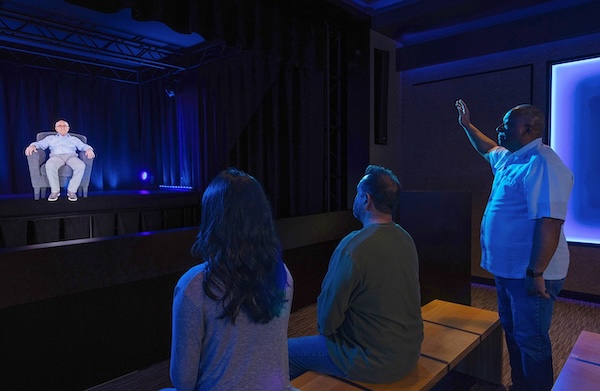
Visitors to the Dallas Holocaust Museum, in Texas, enter a room that transforms into a home in eastern Europe at the start of the Holocaust. Survivors share their testimonies as the home becomes no longer a refuge but a backdrop for the projection of scenes of atrocities. Then the screen rises and a holographic version of a survivor engages with the audience.

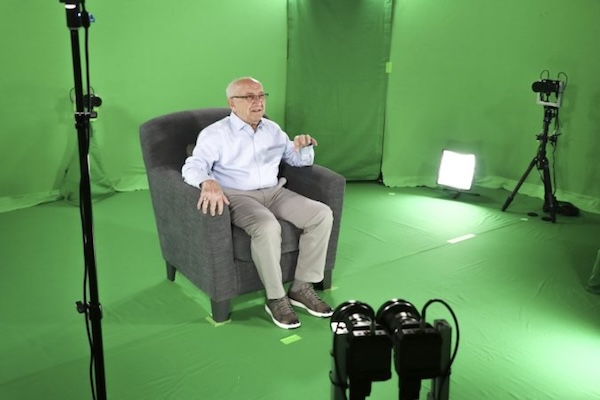
Hundreds of hours of interviews with survivors using 360-degree cameras allow for the realistic perspective of meeting these individuals in person. The project, called Dimensions in Testimony and developed in partnership with Steven Spielberg’s USC Shoah Foundation, introduces school groups and other museum visitors to a different survivor and their experiences each week of the year.

photo - Visitors to the Dallas Holocaust Museum, in Texas, can interact with holographic versions of survivors
Visitors to the Dallas Holocaust Museum, in Texas, can interact with holographic versions of survivors. (photo from Dallas Holocaust Museum)
photo - Hundreds of hours of interviews with survivors using 360-degree cameras allow for the realistic perspective of meeting these individuals in person
Hundreds of hours of interviews with survivors using 360-degree cameras allow for the realistic perspective of meeting these individuals in person. (photo from Dallas Holocaust Museum)

“This was one of the most impactful projects that I ever worked on,” Greenberg said. “You feel like you’re sitting in their living room. As you hear the story, the room begins to change. Lights going off, you hear marching of the boots outside, the rooms become slowly, almost unnoticeably dilapidated, just to show that the people were driven out of their homes and these homes are left with nothing but memories and a few photographs.

“After that introduction, the screen goes up and there’s a hologram production of that survivor. That’s the technology that the USC [Shoah] Foundation has developed. You can ask a question – for example, ‘What was your favourite sport when you were little?’ – and that would trigger a story where the survivor will be talking about where he used to play soccer with his friends when they were little.”

The project was close to home for Greenberg, whose grandfather lost his entire family in the Shoah.

“There was a big part of me in that experience,” said Greenberg. “I can tell and I can educate other people, people that are coming to this museum and people around the world that still don’t know what the Holocaust is, don’t know what a genocide is. It’s almost like I was telling my story.” 

Format ImagePosted on April 12, 2024April 10, 2024Author Pat JohnsonCategories Visual ArtsTags Alex Greenberg, culture, Dallas Holocaust Museum, Dimensions in Testimony, history, holograms, ngx Interactive, survivors, technology, USC Shoah Foundation

Pinsky pens family memoir

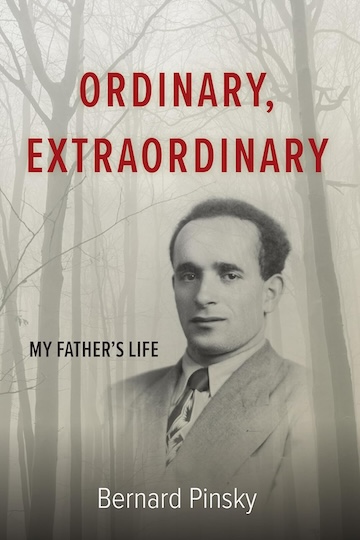
In his ambiguously titled book Ordinary, Extraordinary: My Father’s Life, Vancouver lawyer and community leader Bernard Pinsky shares the biography of Rubin Pinsky. As the pages turn, the reader realizes that ordinariness and extraordinariness really do describe the tale of a life that veers from historically monumental to surprisingly, and gratefully, commonplace. 

image - Ordinary, Extraordinary book coverAt 1 p.m., Jan. 28, Pinsky will officially launch the book, in honour of International Holocaust Remembrance Day, at a prologue event to the Cherie Smith JCC Jewish Book Festival. He will present in conversation with Marsha Lederman.

Pinsky’s book is based on videotaped testimonies that his father, Rubin, gave in 1983 and 1990 to the Vancouver Holocaust Education Centre (which is co-presenting the Jan. 28 event), as well as family memories and what is clearly intensive research.

Rubin was born (probably) in 1924, about 100 kilometres north of Pinsk in what is now Belarus but was then Poland. Pinsky sets the stage beautifully, evoking shtetl life, where the smallest of the children slept atop the bakery oven in the tiny home after his father, Baruch, had baked challah and cakes during the day to eke out a meagre living.

After the German occupation, the Nazis quickly identified the men in the Jewish community who had leadership qualities and said they were needed for an important mission in a nearby area. They were marched just out of earshot and mass murdered. In a later selection, Baruch, his wife Henya and 10-year-old Rachel were marched off and never seen again.

Rubin and his sister Chasia were deemed useful for forced labour and spared the executions. Older brother Herzl had earlier been conscripted into the Red Army.

Every survivor narrative includes a series of unimaginable interventions, coincidences and happenstances, often made possible by acts of incredible daring by the survivor. Through a series of audacious escapades – they weighed off what appeared to be likelihood of certain death with the faint hope of survival – Rubin, Chasia and a few others escaped a selection process and fled to the forest. They lived off berries, roots, tree bark and what small game they could capture. In one instance, Rubin slew a timber wolf in a competition for the same rabbit. 

The group connected with a diffuse but apparently well-organized network of Jewish and other partisan fighters. Despite the challenges of mere survival, Rubin and Chasia participated in anti-Nazi actions that included cutting telephone lines, destroying railway tracks and undermining the establishment of Nazi garrisons.

Typhus swept through the Jews in the forest. In the winter of 1943/44, Rubin was delirious with fever and expected to die. In one of the terrible choices people were forced to make in such situations, the partisan cadre decided to leave him behind to save the group. Chasia refused to go. The two siblings hid in a ditch and, to the best of her ability, she nursed him back to comparative health.

Each of these unlikely survival stories makes one wonder how many similar stories did not have the relatively happy ending Rubin’s did, how many survivor testimonies or second generation narratives were never written because the fever did not break, or the hero did not take a risk on a faint hope, or any of a million chance escapes or saving miracles did not occur in time.

In July 1944, the forest in which Rubin and Chasia had hid, fought and barely survived was liberated by the Soviet army. Concentration and death camps were repurposed into displaced persons camps after the war and Rubin and Chasia were in Bergen-Belsen. Chasia left and searched for three weeks, eventually finding Herzl and bringing him with her to Bergen-Belsen, where the three surviving members of the family were reunited.

Zionists tried to recruit them to go to Palestine, but Rubin knew that would be a continuation of the conflict, uncertainty and fighting he wanted to put behind him. 

“Rubin therefore made up his mind,” writes Pinsky. “He needed a skill or trade in demand in America. He and Herzl made a pact. They would study together, each in a different trade, and go together to the New World. They would help each other and never be separated again.”

The story of how Rubin and Herzl (in the New World, he would be known as Harry) were able to migrate to Canada is another example of chutzpah – an hilarious drama of subterfuge – that has to be read to be believed. Chasia, whose marriage in the DP camp did not last, joined them soon after.

Rubin married Jenny Moser in 1951 and they would have three children: the author, Bernard, his older sister Helen and younger brother Max – all now mainstays of the Vancouver Jewish community. Rubin’s life in Canada was that of a hardscrabble entrepreneur – and not without its seemingly miraculous near-misses and fortunate endings.

As an appendix, Pinsky shares writings from a 2012 family roots trip back to Gzetl, where a dedicated teacher is keeping alive the memory of Gzetl’s Jews.

Pinsky’s memoir is indeed a story both extraordinary and ordinary, of what human resilience can summon in a world turned upside-down – and how the strength developed in unimaginable adversity can carry a survivor through challenges when life becomes, in comparison, ordinary. 

Register for the event at jccgv.com/jewish-book-festival/events.

Format ImagePosted on January 12, 2024January 11, 2024Author Pat JohnsonCategories BooksTags Bernard Pinsky, family, history, Holocaust, Jewish Book Festival, memoir, survivors
Survivors play brings tears

Survivors play brings tears

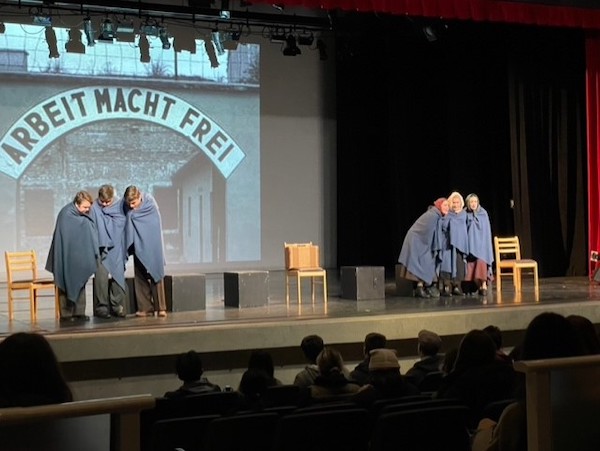
On Oct. 29, six young actors offered a powerful rendering of Survivors, a play by Wendy Kout, at the University of Victoria’s Phoenix Theatre. The production will tour BC and other Western provinces. (photo by Peter Nadler)

On Oct. 29, six young actors offered a powerful rendering of Survivors, a play by Wendy Kout about 10 Holocaust survivors. The performance at the University of Victoria’s Phoenix Theatre had the audience, many of whom were decades older than the actors, reaching for handkerchiefs as the last words of the play, “never again,” were spoken in unison on stage.

The Victoria organizers, who have been given the rights to perform Survivors across the Western provinces, are hoping the play and its message will eventually reach, inform and educate students about the Holocaust and the dangers of hate.

Suitable for audience members from Grade 6 and up, Survivors is intended to provide students the ability to recognize the short- and long-term effects of prejudice, discrimination and, ultimately, genocide. Other objectives are to foster critical thinking in young (and older) people and impress upon them the importance of human rights and social justice advocacy.

The six actors – Julie McGuire, Ryan Kniel, Sarah-Michelle Lang, Nolan McConnell-Fidyk, Sophie Radford and Brandon Sugden – took on the roles of the 10 Holocaust survivors and dozens of other characters pertaining to their respective stories during the 65-minute performance.

Survivors progresses chronologically, portraying events leading up to, during and after the Holocaust, bringing to the stage the experiences of Jewish children and teenagers from Europe. The professional cast portrays the survivors, starting at innocence and continuing through the terrifying rise and rule of bigotry, xenophobia and violence, before they immigrate to America.

Among others, the play includes the stories of a teen who watched her boyfriend being taken away to a concentration camp, a girl who was separated from her parents and relocated to England through the Kindertransport, and a boy whose family struggled to escape to China.

Four of the 10 survivors on whom the play is based were still alive when the play premièred in New York in 2018. Though each story is unique, all the survivors “went through this horror and came through the other side to build meaningful, contributing, beautiful lives,” notes Kout. “We’re not just telling history. We’re telling history as a cautionary tale for the present and the future.”

Several prominent members of the public, such as MLAs Murray Rankin and Rob Fleming, were in attendance at the UVic performance. In remarks made after the show, Rankin suggested he would press the Ministry of Education and Child Care to bring Survivors to schools in the province.

Rankin’s comments preceded the announcement by Premier David Eby the following day, Oct. 30, that Holocaust education would become mandatory in high schools throughout British Columbia beginning in the 2025-26 academic year. The move made British Columbia the second province, after Ontario, to mandate study of the Shoah.

There is a tangible sense of urgency by the organizers of Survivors to have the play viewed as widely as possible.

“We need to capture young minds of young people at an early stage before hate and racism becomes normalized,” their literature states. “We need to do this in the schools, because that is where most young people can be reached and it’s an opportunity to educate children and engage teachers.”

Survivors, with its aim to educate young people about hate, comes at a time when clear evidence of the ignorance of history has been in the news. In September, Anthony Rota, the speaker of the House of Commons, stepped down after honouring a Ukrainian veteran who fought with a Nazi unit during the Second World War.

More broadly, the organizers of Survivors cite a report by the Azrieli Foundation, Yad Vashem and others, which found that 62% of millennials did not know that six million Jews were killed in the Holocaust, 22% of millennials had not heard or were not sure if they had heard of the Holocaust, and 23% of all Canadians believe that two million or fewer Jews were killed during the Holocaust.

The Victoria production of Survivors that played last fall in school auditoriums, theatres and libraries, and had four public performances was the first international tour of the play. (See jewishindependent.ca/survivors-a-cautionary-tale and jewishindependent.ca/theatre-that-educates.) There are other tours currently on both coasts of the United States, and Kout, along with the New York company that developed Survivors, is creating a documentary on how the play came to be.

Survivors was originally commissioned and developed by CenterStage Theatre in Rochester, NY, in 2017, when Kout was asked to write a Holocaust play about survivors who had immigrated to the city. Shortly thereafter, while watching neo-Nazis march in Charlottesville, Va., Kout expressed the feeling that she was not simply writing an historical play but also a “warning play.”

For the Victoria troupe, Zelda Dean, the director, said, “Our goal is to expand the tour to more of Vancouver Island, to Vancouver on the mainland, and to select schools in the interior. The following year we will expand to include more schools throughout BC and other Western Canadian provinces.”

To learn more about Survivors and to donate, visit holocausttheatre.com.

Sam Margolis has written for the Globe and Mail, the National Post, UPI and MSNBC.

Format ImagePosted on November 10, 2023July 21, 2025Author Sam MargolisCategories Performing ArtsTags Holocaust education, survivors, theatre, Wendy Kout, Zelda Dean
Theatre that educates

Theatre that educates

Wendy Kout’s play Survivors is based on 10 real-life stories of young people’s Holocaust experiences. (photo by Peter Nadler)

Last year, Victoria-based Bema Productions and the Victoria Shoah Project collaborated on a pilot project: a nine-performance tour to middle and secondary schools of Survivors, a Holocaust-themed play by Wendy Kout. The success of the tour, which reached more than 1,100 students and 500 adults in the Victoria area, has led the organizations to broaden their reach throughout Vancouver Island, Metro Vancouver and other Western provinces beginning this autumn.

“Following our pilot tour in Victoria, we were asked to cover the Western provinces, and I happily accepted the challenge,” said Zelda Dean, the director of the play. “We will be touring to 30 schools on Vancouver Island in October 2023. In the fall of 2024, we will tour on the Mainland and in Alberta. Saskatchewan and Manitoba will be toured in 2025 – 150 performances in total will be presented.”

Citing a 2018 Canadian survey produced by the Azrieli Foundation, Yad Vashem, the United States Holocaust Memorial Museum and the Claims Conference, the Victoria organizers offer compelling reasons why Holocaust education is necessary today, particularly (but not only) for youth. According to the survey, 52% of millennials cannot name a concentration camp or ghetto; 62% of millennials did not know that six million Jews were killed in the Holocaust; 22% of millennials haven’t heard or are not sure if they have heard of the Holocaust; and 23% of all Canadians believe that substantially fewer than six million Jews were killed (two million or fewer) during the Holocaust, while another 24% were unsure of how many were killed.

“I have been alarmed at the ongoing rise in antisemitism for some years and have been looking for a suitable educational play. I had previously produced a play by Wendy and loved her work,” said Dean, regarding the selection of Survivors.

The intention of the one-hour play, suitable for those from Grade 6 to adulthood, is to provide a vehicle to teach lessons from the Shoah to younger audiences. Based on 10 real-life stories of young people’s Holocaust experiences, the play hopes to enable students to recognize the short- and long-term causes and effects of prejudice, discrimination and, ultimately, genocide. It also aims to foster critical thinking and bring the importance of human rights and social justice advocacy to the forefront.

Survivors goes through the chronological history of the Holocaust by enacting the experiences of Jewish children and teenagers from Europe. The young cast of six professional actors portrays the survivors, starting at innocence and continuing through the terrifying rise and rule of bigotry, xenophobia and violence, before they immigrate to America.

The play includes the true stories of a teen who watched her boyfriend being taken away to a concentration camp, a girl who was separated from her parents and relocated to England through the Kindertransport and a boy whose family struggled to escape to China.

Dean credited the young actors in the production for their diligence and dedication to their parts. “I put a casting call out and was delighted that a large number of very skilled young actors tried out for the roles. Those who were cast were tasked with doing considerable research into the Holocaust prior to rehearsals starting,” she said.

Survivors was originally commissioned and developed by CenterStage Theatre in Rochester, N.Y., in 2017, when Kout was asked to write a Holocaust play about survivors who had immigrated to the city. Shortly thereafter, while watching neo-Nazis march in Charlottesville, Va., Kout expressed the feeling that she was not simply writing an historical play but also a “warning play.”

The Victoria production in November and December 2022 – which played in school auditoriums, theatres and libraries, and had four public performances – was the first international tour of the play. There are other tours currently on both coasts of the United States, with Kout, along with the New York company that developed Survivors, creating a documentary on how the play came to be.

“Sharing the history of the Holocaust with students provides an important historical example of the dangers of allowing hatred and intolerance to take hold within a society,” said former B.C. minister of education Rob Fleming about the Victoria tour.

Additionally, several students who saw the play offered their input concerning how the performance affected them.

“I want to continue to learn more about the Holocaust and people’s stories. I’ve read [Elie Wiesel’s] Night and seen this play but other than that I haven’t heard many personal stories, so I’d like to learn more,” said one.

“I learned once again that I should not judge others selfishly based on race, religion, appearance or prejudice, and I will try to [remember that] whenever I meet new people from now on,” contributed another.

The organizers are looking for financial support to fund the upcoming Western Canadian tours.

“Over $450,000 is required to offer this powerful educational play to so many students, and we are actively fundraising to individuals, corporations, foundations, etc. We are running a campaign inviting folks to sponsor a school in their area for only $500,” Dean explained.

For more information about the play and to contribute, visit holocausttheatre.com or email [email protected].

Sam Margolis has written for the Globe and Mail, the National Post, UPI and MSNBC.

Format ImagePosted on July 7, 2023November 9, 2023Author Sam MargolisCategories Performing ArtsTags Bema Productions, education, Holocaust, survivors, theatre, Victoria Shoah Project, Wendy Kout, Zelda Dean
Reflecting back 80 years

Reflecting back 80 years

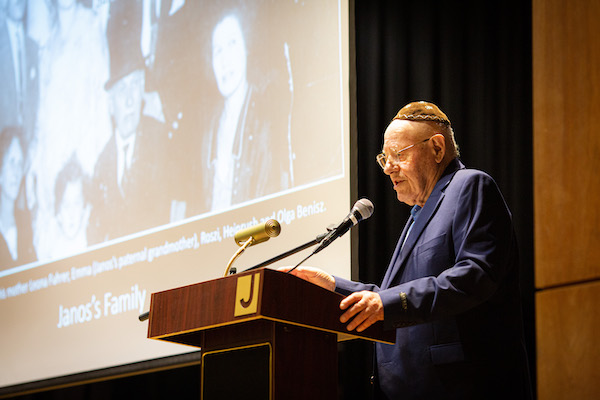
At the community’s commemoration of Yom Hashoah, child survivor Janos Benisz spoke about his experiences during the Holocaust. (photo by Rhonda Dent)

Over the past year, Janos Benisz has watched the news of Ukrainian parents fleeing to Poland and elsewhere in Europe to find safety for their families. While “overjoyed” for the families finding refuge today, he cannot help but reflect back eight decades to his own family’s catastrophic history in that violence-ravaged region.

Benisz was born in the summer of 1938 in the Hungarian city of Esztergom. He is one of the very few children to survive the Nazi concentration camps and is now one of an even smaller number of survivors alive to share their stories of survival. He spoke April 17 at the annual Yom Hashoah Commemoration presented by the Vancouver Holocaust Education Centre, on the 80th anniversary of the beginning of the Warsaw Ghetto Uprising.

Benisz lost his mother in 1943, when she was 38, after she went to hospital for a routine procedure but was, he said, murdered by a fascist there. His father remarried and his stepmother would prove a saviour for the boy.

The following year, the Nazis began rounding up Hungarian Jews and preparing to transport them to forced labour and death camps.

“Like a plague of locusts, the SS came marching into our city,” he recalled. “As they marched past our house, there was a great fear in our family. My father closed the windows and pulled the curtains down and his fear was passed on to me. The next day, we left our home and on the front of our white stucco home was a yellow Magen David. Within hours, an SS commander came to our house and put stickers on our valuables.”

His father took young Janos and his stepmother to relations who were Catholic. It was the last time he saw his father.

“Life was wonderful for six weeks until one of the neighbours reported us and informed that Jews were in this home,” said Benisz.

An SS officer accompanied by Hungarian Arrow Cross fascists knocked on the door and seized Janos and his stepmother, who were sent to the Strasshof concentration camp, in Austria. They remained there for eight or nine months, until liberated by Soviet forces. Benisz credits his stepmother’s determination for his survival.

“It was like a lioness protecting her cub,” he said. “She would go into the circle where the food was, or the slop was, with the big cup and she would always bring food to me. I would drink it and that sustained me.”

After liberation, Janos, 7, and his now-mother made their way back to Esztergom. The devastation was nearly total.

“I had many, many cousins and they all were massacred,” he said. “My mother’s family … it was like the earth had opened up and killed them all.”

The experiences left Janos’s stepmother mentally broken and Janos was placed in an orphanage.

“The only thing I remember is cod liver oil in the morning and brushing my teeth with about 10 or 15 guys beside me brushing their teeth as well,” he said. “After two-and-a-half years in the orphanage, somebody from the Joint [Distribution Committee] picked me up, took me to the train station. There were 14 or 15 other Jewish orphans there and they told us, ‘You’re going to America – North America.’”

The group first spent six months in France, where “they tried to educate us,” he said, but the young survivors were like “a bunch of wild animals.”

The group arrived in Halifax on Dec. 3, 1948. They were given hot soup and delicious sandwiches, as well as ice cream, of which Benisz said he must have eaten a gallon with his bare hands.

On the train across Canada, orphans disembarked at different cities and Benisz arrived in Winnipeg in the midst of a blizzard.

“My first Canadian Jewish home proved to be a disaster,” he said. “I was bounced around like a basketball between foster homes.… I was never part of the family. I was always an outsider.”

The terrors that followed him from Europe, which led to screaming in the night, did not make him a welcome addition to potential foster homes.

“Who wants to have a stranger’s scream waking [one] up every night?” he asked.

He was put in a reformatory for about six months before a Jewish welfare agency rescued him and found him suitable housing and got him caught up in his education.

At a young age, Benisz got a job as a copy boy at the Winnipeg Free Press. A life in the news business followed, especially covering sports, which he did at newspapers across Western Canada. An editor changed his byline from Janos Benisz to Jack Bennett, which became his professional designation.

Eventually, he arrived to a new job at a Vancouver daily just as the press launched what would become a year-long strike. Jack Diamond, the late Jewish businessman and philanthropist, gave Benisz a job. Years later, after a corporate buyout, Benisz had a $25,000 windfall and he and a partner opened a business in Gastown, “and, over the next 15, 18 years, we made a lot of money.”

He spoke of his gratitude for the community of survivors, especially the Child Survivors Group, based at the Vancouver Holocaust Education Centre. For two decades, he has spoken to school groups and others about his Holocaust experiences.

“I speak on behalf of the six million who have no voice, that includes 1.5 million children who were murdered,” he said.

At the commemorative event, Rabbi Dan Moskovitz of Temple Sholom reflected on the longer, formal name of the day, which is Yom HaZikaron laShoah ve-laG’vurah, Holocaust and Heroism Remembrance Day. He emphasized the resistance and revolt inherent in both the name of the day and the fact that Yom Hashoah is marked annually on the anniversary of the Warsaw Ghetto Uprising.

“Our sacred purpose is so much more important, so much more vital, because the life-memory is fading. We gather here this evening at the twilight of an era. As the Survivors’ Declaration hauntingly observes, the age of the Holocaust survivors is drawing to a close. Before long, no one will be left to say, I was there, I saw, I remember what happened…. It is in this void that the deniers and the distortionists will come, they always do, as they have continually on every night and every day since even before the liberation of the camps, to say that this didn’t happen, that it wasn’t so bad or the relativism of comparing trauma to trauma.”

There is one significant difference between the contemporary generation and the generation of the 1930s, said the rabbi.

“That difference is that we have the experience that they didn’t have. We know it can happen because it did,” he said. “We know the antisemitism, if it is not confronted vigourously, forcefully and immediately defeated, can develop into monstrous dimensions. So, we don’t have the luxury or the privilege to say, let’s wait and see how things will develop, how this turns out.”

The VHEC’s Abby Wener Herlin, granddaughter of survivors Aurelia and David Gold, spoke as a representative of the third generation.

“In our family, in order to build a life and live each day, they could not speak about their experiences,” she recalled of her late grandparents. “In order to protect themselves and us from the atrocities and traumas of their past, they shared very little.

“There is a sense of weight that comes from being the grandchild of Holocaust survivors,” Wener Herlin continued, “to know that I am part of the last generation that will ever hear those stories firsthand. I feel it is my duty and responsibility to carry it forward and it is my duty to remember.”

In a video presentation, former Canadian justice minister Irwin Cotler discussed the 1994 genocide against the Tutsis in Rwanda, as well as the Holocaust, and said that what makes both historical instances so horrific are not just the horrors themselves but that both atrocities were preventable.

“Nobody could say that we did not know. We knew but we did not act,” said Cotler.

He addressed remarks specifically to survivors: “You have endured the worst of inhumanity, but somehow you found the resources of your own humanity, the ability to carry on, to build families and to make an enduring contribution to Canada and to the communities in which you settled.”

Corinne Zimmerman, board president of the VHEC, read from a statement Prime Minister Justin Trudeau released for Yom Hashoah and Moskovitz read a message from B.C. Premier David Eby. Sarah Kirby-Yung, Vancouver city councilor, read a proclamation from Mayor Ken Sim.

Cantor Yaacov Orzech chanted El Moleh Rachamim, the memorial prayer for the martyrs. An extensive musical program, produced by Wendy Bross Stuart and Ron Stuart, featured Bross Stuart on piano, Eric Wilson on cello, with Cantor Shani Cohen, Kat Palmer, Lisa Osipov Milton singing, as well as eight young voices collectively dubbed the Yom Hashoah Singers.

The evening was presented by the VHEC with the Jewish Community Centre of Greater Vancouver and Temple Sholom.

Format ImagePosted on April 28, 2023April 26, 2023Author Pat JohnsonCategories LocalTags Abby Wener Herlin, Canadian Jewish Holocaust Survivors and Descendants, child survivor, Corinne Zimmerman, Dan Moskovitz, immigration, Irwin Cotler, Janos Benisz, survivors, Temple Sholom, Vancouver Holocaust Education Centre, VHEC, Yaacov Orzech, Yom Hashoah
Survivors share their stories

Survivors share their stories

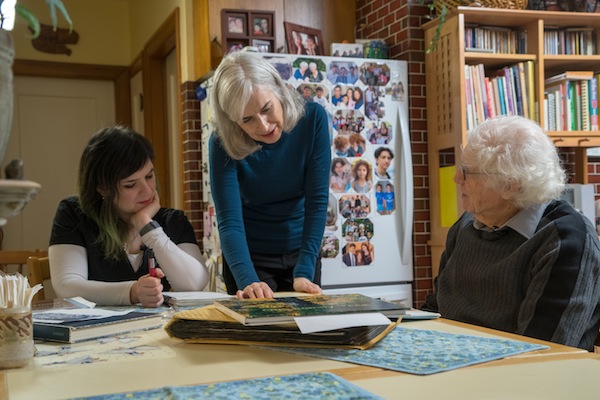
Charlotte Schallié, a University of Victoria scholar and Holocaust historian who is leading the graphic novel project, with survivor David Schaffer and graphic artist Miriam Libicki, left, at Schaffer’s home in Vancouver in January 2020. (photo by Mike Morash)

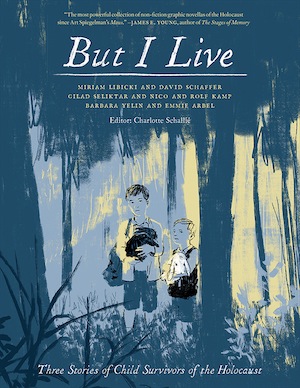
A University of Victoria project, first announced in January 2020, came to fruition this spring with the release of But I Live, a graphic novel that tells the stories of four Holocaust survivors.

But I Live involved an international team of researchers, students and institutional partners from three continents, and brought together four survivors and three graphic artists to create an autobiographic series recounting one of the darkest periods in human history. The survivors who told their stories were Emmie Arbel (Israel), Nico and Rolf Kamp (Holland) and David Schaffer (Canada). Their stories were transformed into art by Barbara Yelin (Germany), Gilad Seliktar (Israel) and Miriam Libicki (Canada). The project was edited and organized by Charlotte Schallié, chair of the department of Germanic Slavic studies at UVic and head of Narrative Art and Visual Storytelling in Holocaust and Human Rights Education at the university.

image - But I Live: Three Stories of Child Survivors of the Holocaust book cover
But I Live: Three Stories of Child Survivors of the Holocaust was published by New Jewish Press (2022).

“Many people in North America have learned about the history of the Holocaust through survivor stories that are repeated in popular culture, which largely focus on survival in the concentration camps or experiences of hiding in Nazi-occupied territory,” said Schallié. “The three stories in But I Live complicate these mainstream narratives by exploring complex topics such as the burden of memory, the need to testify, the ripple effects of trauma and the impact of the Holocaust on descendants of survivors, for example. As historical documents, they are also important for centring the survivors’ experiences and enabling them to tell their own stories.”

Though the gravity of the crimes committed during the Holocaust is well documented, the majority of visual records were largely produced by the Nazis and their collaborators. “These are important historical sources,” said Schallié, “but a sole focus on documentation produced by perpetrators ignores the value of survivors as living knowledge-keepers.”

An objective of the project, therefore, was to turn the perspective over to the survivors. “A survivor-centred approach to gathering testimony about the Holocaust honours the integrity and humanity of the person’s lived experience, while respecting their right to tell their own story,” Schallié said.

Another consideration in the project was time – the majority of Holocaust survivors alive today were young children during the war and are now in their 80s and 90s. The importance of learning from these knowledge-keepers is increasingly vital.

“If we don’t engage them in our research now, their expertise and experience will soon be lost,” Schallié stressed.

There is, in her view, a moral obligation and duty to collect and preserve survivor testimonies. “Each voice that was marked to be silenced by the perpetrators of these atrocities matters greatly and needs to be heard and acknowledged,” she said.

An additional goal of But I Live is to interest young readers in Canada, where high schools are not mandated to include the study of the Holocaust in their curricula.

“We hope that our visual storytelling work will appeal to youths and young adult readers, and elicit within them a deep sense of empathy that leads them to think critically about the historical past and present,” said Schaille.

“Holocaust survivor stories that are presented as heroic narratives, where the storyline progresses from dark to light – or from a site of danger to one of safety – place a heavy burden and responsibility on survivors, whose life stories and memories are unlikely to conform to that model, and simplifies the reality of their lived experiences. But I Live holds space for fragmented memories, difficult emotions and the afterlife of trauma. In doing so, it complicates mainstream tropes, clichés and iconographic imagery that is sometimes misappropriated or exploited in popular culture,” she explained.

image - A panel from “A Kind of Resistance,” a graphic narrative by Miriam Libicki from interviews with David Schaffer
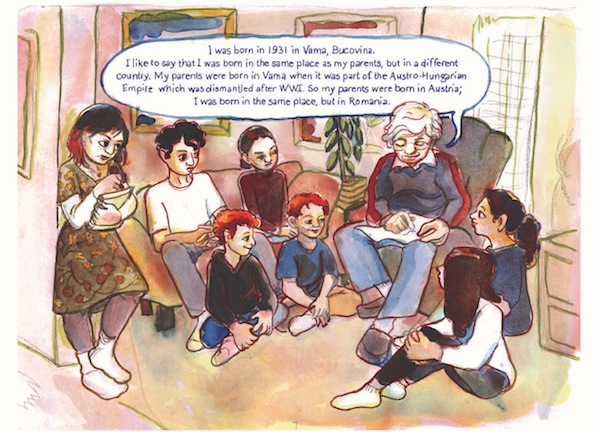
A panel from “A Kind of Resistance,” a graphic narrative by Miriam Libicki from interviews with David Schaffer. (image by Miriam Libicki)

The work at UVic expands on previous projects, such as the book On Listening to Holocaust Survivors: Beyond Testimony by Henry Greenspan of the University of Michigan, which focuses on survivor accounts while being mindful of the trauma such memories can evoke.

“Eliciting experiences and memories of extreme human suffering from the survivors necessitated a research process and practice that privileged their safety by minimizing the risk of re-traumatization, managing potential triggers and providing sustained support for all participating project partners,” Schallié said. “This approach ensured that we – the stewards of survivor memories – honoured what we felt was our obligation and duty to amplify the voices of the Holocaust survivors.”

But I Live was released by New Jewish Press, a division of University of Toronto Press. A German edition, Aber ich lebe, was published by C.H. Beck in July and has received positive coverage in the German broadsheets Der Tagesspiegel and Die Zeit. In November, the book received a German LUCHS-Preis for literature.

On Oct. 23, But I Live won the 2022 Canadian Jewish Literary Award for biography, presented at York University in Toronto. At the ceremony, the project was lauded for exemplifying “the power of the non-fiction graphic novel to convey the experience and aftereffects of the Shoah.… The historical essays, an illustrated postscript from the artists and personal words from each of the survivors offer a profound meditation on the past and its reach into the present.”

But I Live will be featured at the Cherie Smith JCC Jewish Book Festival here in Vancouver on Feb. 12.

Sam Margolis has written for the Globe and Mail, the National Post, UPI and MSNBC.

Format ImagePosted on December 9, 2022December 8, 2022Author Sam MargolisCategories BooksTags Charlotte Schallié, graphic novel, Holocaust, Jewish Book Festival, survivors, University of Victoria, UVic

Talking with authors

The 35th annual Vancouver Writers Festival includes many members of the Jewish community among the more than 115 authors from across Canada and around the globe who will join the events on Granville Island and elsewhere Oct. 17-23.

The festival will celebrate the five shortlisted Scotiabank Giller Prize finalists; engage in conversations with Booker Prize-winner Douglas Stuart, as well as Canadian superstars Heather O’Neill, Billy-Ray Belcourt and Wayne Johnston. It’ll host conversations between emerging Canadian and American poets, novelists and memoirists, and feature flagship favourites like the Literary Cabaret, Sunday Brunch and Afternoon Tea.

The guest curator of this year’s festival is 2021 Scotiabank Giller Prize winner Omar El Akkad, who has invited a wide range of authors, including Noor Naga (Egypt), Elamin Abdelmahmoud (Ontario) and Threa Almontaser (United States) – and many others – to join him for six conversations that focus on home, identity and storytelling

Among the Jewish community members participating in the festival are Méira Cook, with her adult-young adult crossover novel, The Full Catastrophe, in Mecca, Mitzvah and Milestones, and in Wry Humour for Modern Life; Tilar J. Mazzeo (Sisters in Resistance: How a German Spy, a Banker’s Wife and Mussolini’s Daughter Outwitted the Nazis) speaks with Marsha Lederman (Kiss the Red Stairs: The Holocaust, Once Removed); Sarah Leavitt facilitates a workshop led by University of British Columbia’s creative writing department; and Guy Gavriel Kay (All The Seas of the World) takes part in Fabulous Historical Fantasy.

Lederman is one of the authors participating in the The Power of Story: Live Recording for CBC’s The Next Chapter, she hosts Generational Fiction: Stories of Lineage, History and Things Passed Down, and moderates Bestseller to Blockbuster. Actor, theatre critic and UBC professor emeritus Jerry Wasserman moderates Building Suspense, on writing thrillers, and Dr. Gabor Maté talks with Globe and Mail reporter Andrea Woo about his latest book, The Myth of Normal: Trauma, Illness and Healing in a Toxic Culture.

Festival tickets ($25) can be bought online at writersfest.bc.ca or at the event venue, starting 45 minutes prior to the performance. There are discounts offered for regular events to seniors (10%) and youth under 30 (50%).

– From writersfest.bc.ca

Posted on October 7, 2022October 5, 2022Author Vancouver Writers FestivalCategories BooksTags fiction, Gabor Maté, Guy Gavriel, health, Holocaust, Jerry Wasserman, Marsha Lederman, Méira Cook, memoir, nonfiction, Sarah Leavitt, survivors, Tilar J. Mazzeo, Writers Festival, young adult
Revisiting oral histories

Revisiting oral histories

Manfred Gottfried and a group of men on the stairs to the Dr. Sun Yat-sen mausoleum. (photo from VHEC: RA001-5-o7-5-9-0339x)

A little over 20 years ago, the Vancouver Holocaust Education Centre started the Shanghai Oral History Project. Led by Roberta Kremer and Daniel Fromowitz, the project recorded the oral histories of Vancouver’s small Shanghai Jewish survivor community. They interviewed 10 survivors and/or their descendants, learning about their rich and unique experiences of survival in Shanghai.

This project, along with loaned artifacts and memorabilia, became the basis for VHEC’s 1999 exhibition Shanghai: A Refuge During the Holocaust. It opened alongside another exhibition, Visas for Life: The Story of Feng Shan Ho. Both were well received, and included film screenings on the topic of Jewish refugees in Shanghai, and a demonstration of mahjong, a game which remains popular in the Jewish community in Vancouver. Once the exhibitions concluded, materials were returned to their lenders or safely placed under the VHEC’s care, and the interviews were catalogued and filed away.

In January 2022, I began my co-op position as digital projects coordinator with the VHEC. One of the first tasks assigned to me was to help improve accessibility to the Shanghai interviews and the audiotape transcriptions. In the 20 years since these oral history transcriptions were created, the VHEC has changed its digital file management and storage system. Some files were missing while others were mislabeled. Many files would no longer open within the current version of Microsoft Word. At the top of some transcriptions was a disclaimer: “The whole tape is not transcribed, only that which is related to Shanghai.” Throughout the transcriptions, comments like “(side discussions)” denote what the original transcriber believed to be unrelated to the subject matter.

image - In 1999, the Vancouver Holocaust Education Centre held the exhibit Shanghai: A Refuge During the Holocaust
In 1999, the Vancouver Holocaust Education Centre held the exhibit Shanghai: A Refuge During the Holocaust. (image from VHEC)

Rummaging through these transcriptions, it became apparent that I would not simply be “tidying up.” By revisiting the Shanghai Oral History Project, my goal was to do more than just emphasize the unique experiences of this small group of individuals. As I listened to their interviews and transcribed their words, I wanted to offer a glimpse into how Shanghai Jewish survivors expressed themselves and reflected on their time in Shanghai, while also highlighting things that weren’t considered when the exhibition first opened 20 years ago.

On the list of possible interviewees for the Shanghai Oral History Project, George Melcor’s was the only name with “very elderly” added beside it in parentheses. Listening to George’s interview, it became clear that this would be a challenging transcription. George sometimes mumbled, which made it difficult to comprehend his words, or he would mix up his stories. But, for 88-year-old George, Shanghai left an impression. When asked by interviewer Daniel Fromowitz what memories of Shanghai come to mind, George lit up with excitement. “Shanghai was alive all the time. Never closed, always open.… Clubs and gambling, everything was free. Shanghai was a very free city.” At this point, the slow progression of the interview sped up: the emotions in George’s voice suggest that he was reliving his 16-year-old self. For a moment, George was not elderly.

What is striking listening to the Shanghai audiotapes is the dialogue between the interviewer and interviewee. Lore Marie Wiener was interviewed about her experiences in Shanghai by both Roberta and Daniel. But rather than just giving answers, Lore proceeded to converse with both interviewers, asking about where they were born, their experiences growing up and whether they faced antisemitism. Lore was also very reflective. She questioned the nature of Jewishness and what it consists of; she questioned “… why did we not interfere in Rwanda, and we do interfere in Yugoslavia?” With the former, there was a back-and-forth between Roberta and Lore, but, with the latter, Daniel was not sure how much to engage. These side stories provide a picture of Lore that is more than just her experiences of escaping the threat of Nazi violence and survival in Shanghai; it is the continuation of her life after the Holocaust.

Lastly, how did the interviewees recall, if any, their connection to the local Chinese and Japanese communities? In general, although interviewees were in Shanghai, Chinese people featured only in the background. They were acquaintances, as was the case for Anne Chick and the two Chinese kids living in her neighbourhood. For most interviewees who did interact with Chinese people, it was through a working relationship with Chinese servants, workers or amahs.

For Lore, she employed several Chinese tailors in her shop, as well as a chauffeur and a cook called Dun-zen. Interracial relationships were also possible. Kurt Weiss noted that, after divorcing his first wife, he had a Chinese girlfriend until he left Shanghai. Gerda Gottfried Kraus mentioned in passing how, in postwar Shanghai, one of her acquaintances married a Chinese woman and wanted to bring her with him to the United States. Knowledge of some Chinese, particularly Shanghainese, was also a common theme found in these interviews, though many interviewees state that they’ve either forgotten it after not using it for so long, or knew only the absolute basics. Additionally, they never learned how to read Chinese characters.

photo - Gerda Gottfried Kraus, 1940s
Gerda Gottfried Kraus, 1940s. (photo from VHEC: RA0001-05-00-02-0099)

Knowledge of Japanese people was more limited. Kurt’s success as a suit salesman was due to his patron relationship with a Japanese engineer named Kato. Lore mentioned she was helped by a Japanese engineer when she and her mother were stranded in Harbin. But the one individual whom most interviewees referenced was Ghoya, the Japanese commandant of Hongkew ghetto. Ghoya developed a reputation as an unpredictable ruler: while Lore mentioned that her father and husband were treated well by Ghoya due to their academic connections, other interviewees mentioned episodes of violence committed by Ghoya and his guards against the Hongkew inhabitants. Their brutality is matched only by their treatment of the local Chinese. Most interviewees mentioned the mistreatment that local Chinese faced.

The experiences of Shanghai Jewish survivors are often overlooked when compared to those who survived in Europe. Lore was very concerned about this. At the end of her interview, she stated: “I’m not uncomfortable with anything. [But] … just try to be careful about the parts where I am too pleased with my life because there are so many people who suffered.” With the “global turn” in academic research into the Holocaust, the sub-category of “Shanghai survivor” has been gaining strength. It is a term that validates the experiences of refugee Jews and others who survived the Holocaust in Shanghai, while also acknowledging the unique circumstances and challenges they faced.

It is heartening to know that, in the 20-plus years since the VHEC’s Shanghai exhibition, research into this dimension of the Holocaust and the voices of these survivors have not been obscured, but, instead, have expanded into a vibrant subfield. By revisiting past projects and exhibitions, and making them more accessible, we can hopefully gean new information about the Holocaust and the multiplicity of survivors’ experiences.

 Ryan Cheuk Him Sun is a PhD candidate in the University of British Columbia department of history. His research examines the entangled histories between Jewish refugees escaping Nazi oppression and the British colonies of Hong Kong and Singapore. He is also interested in the journeys that took Jewish refugees to East Asia, and their experiences in transit onboard ships and trains. He can be reached at [email protected]. This article was originally published in the VHEC’s Spring 2022 issue of Zachor.

Format ImagePosted on September 2, 2022September 1, 2022Author Ryan Cheuk Him SunCategories Local, WorldTags history, Holocaust, oral history, refugees, research, Shanghai, survivors, VHEC

Posts pagination

Previous page Page 1 Page 2 Page 3 … Page 6 Next page
Proudly powered by WordPress