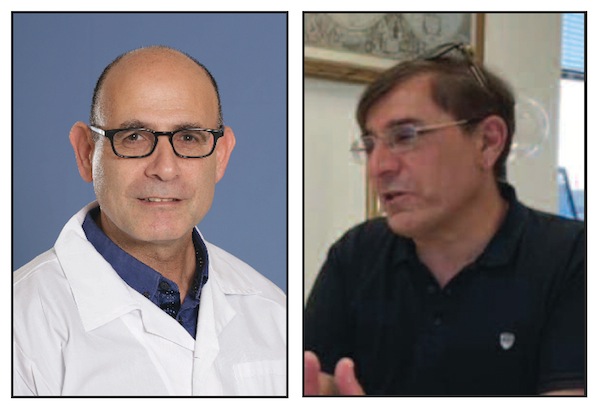
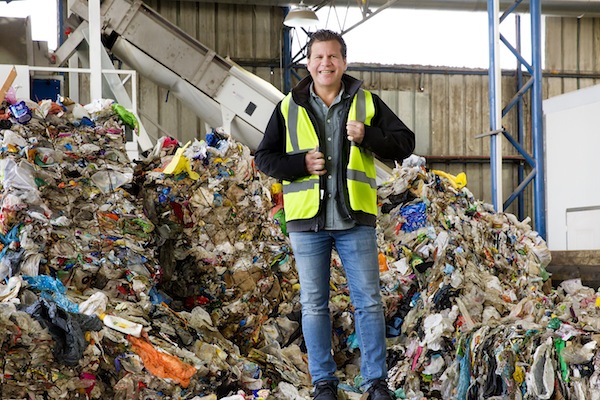
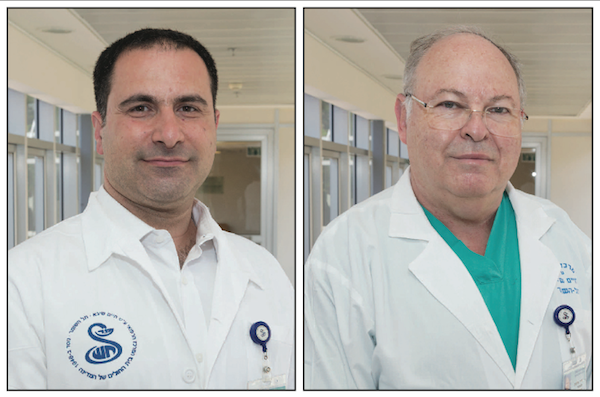
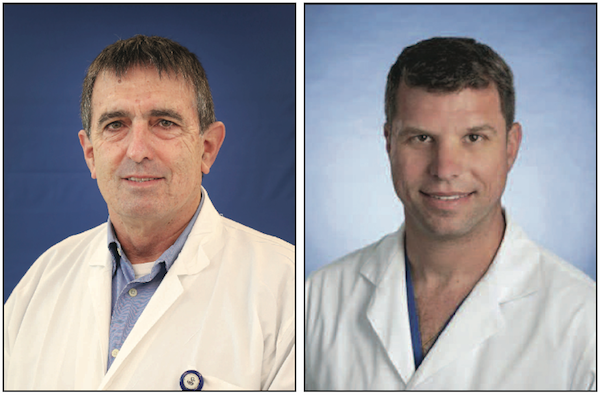
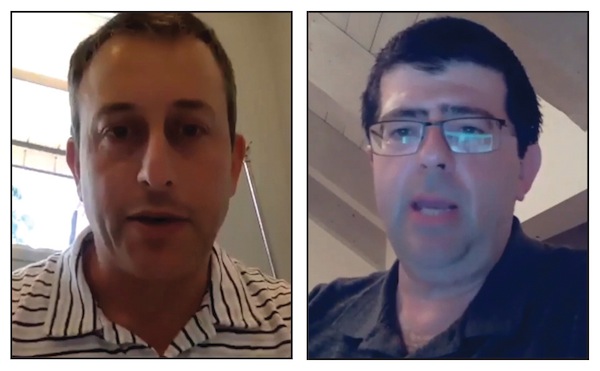
Prof. Ori Efrati, left, and Dr. Michael Cohen. (photos from IMP)
With the arrival of the coronavirus vaccine, there has also been a spike in morbidity, clearly indicating that we’re not out of the woods yet. In fact, hospitals in Israel have warned that they are steadily approaching maximum capacity, as the numbers of severely ill COVID patients breaks all records.
When COVID-19 first erupted in March 2020, health authorities warned that a surfeit in severely ill coronavirus patients would overwhelm the system due, in large part, to a lack of ventilation machines – the standard of care for coronavirus patients whose condition deteriorates to pneumonia. In the ensuing months, Prof. Eyal Leshem, director of the Centre for Travel Medicine and Tropical Diseases at Sheba Medical Centre, explained that, in addition to the shortage of ventilators, one of the most pressing issues is the lack of highly trained intensive-care-unit staff to monitor patients attached to those devices.
An innovation by Yehonatan Medical addresses both of these issues.
Yehonatan Medical, in collaboration with Prof. Ori Efrati, director of the pediatric pulmonary unit at Sheba Medical Centre, devised a first-of-its-kind ventilation system that can treat multiple patients.
“Conventional ventilators, aside from being very costly, are limited in that they can only be used with one patient at a time,” explained Efrati. “Their capacity factor and programming functions were designed for single-patient use, and there is also the danger of cross-contamination.”
The new ventilation system resolves issues that corona ICU wards have been grappling with as the number of severely ill patients rises.
“We were able to use the relatively simple and inexpensive BipaP non-invasive ventilation machine as the basis for the advanced ventilation technology,” said Efrati. “Thanks to the high-power output and built-in disinfecting mechanism, the new system can safely treat three to five patients simultaneously.”
Moreover, a system that can treat multiple patients at one time necessitates fewer ICU-trained staff. Thanks to the remote interface, the medical team can monitor patients from a safe distance.
“This tremendous breakthrough is nothing less than a game-changer when it comes to caring for large numbers of corona patients,” Efrati added.
Dr. Michael Cohen, an engineer and scientist and the founder of Yehonatan Medical, said, “All in all, we’re talking about a system that delivers personalized care in a multi-user format.”
Additional features based on artificial-intelligence technology include the ability to have a hierarchy and classification of alerts; the ability for automatic parameter correction according to set criteria; respiratory rehabilitation for the patient by adjusting to changes in the patient responsiveness; and more. The streamlined, relatively low-cost system can be implemented in makeshift clinical settings, such as field hospitals, as well as in step-down units within the hospital, in the internal and other wards.
Yehonatan Medical is the medical department of Mofet Etzion, a company that for more than two decades has developed various security and military innovations for the Israel Defence Forces and foreign armies. Cohen has developed dozens of life-saving innovations, including in the area of cardiology, in collaboration with cardiologists and cardiothoracic surgeons from Israel, the United States and Canada.
“Some of the insights for the development of this revolutionary ventilation system were provided by cardiologists who helped us to devise the various accoutrements and sensors,” Cohen said, making specific mention of Dr. David Adams, professor and system chair of the cardiovascular surgery department at Mount Sinai Hospital in New York; Dr. David Tirone, chief of cardiac surgery at Toronto General Hospital; and Dr. Gideon Cohen, cardiothoracic surgeon at Sunnybrook Health Sciences Centre in Toronto. The development of the system itself took place in Israel, marking the first time that an invasive ventilation machine has been built in Israel.
The advanced ventilation technology is currently in advanced phase trials at the MSR Medical Simulation Centre at Sheba, where it is being tested on artificial lungs, and is expected to be ready for mass marketing in the coming months.
– Courtesy International Marketing and Promotion (IMP)
UBQ chief executive officer Tato Bigio in the factory at Kibbutz Tse’elim, in the Negev. (photo from UBQ)
Garbage is piling up everywhere – in landfills and elsewhere on the ground, in oceans and other bodies of water, and even in outer space. And there is growing awareness that our attempts at reducing garbage through recycling has not worked as first imagined – only a small percentage of what we put in our recycling bins ends up being recycled. However, a new Israeli company offers some hope for improvement.
Based in Kibbutz Tse’elim in the Negev, UBQ is producing plastic pellets out of household garbage. The name UBQ is not an acronym, but an abbreviation of the word ubiquitous, conveying that the problem of garbage is everywhere and ever-present. The company launched in 2018, after six years of research. Its chief executive officer, Jack “Tato” Bigio, recently spoke with the Jewish Independent via Zoom from his office in Tel Aviv.
Originally from Peru, Bigio came to Israel in 1984, when he was 18, to attend the Hebrew University of Jerusalem. In the following years, he went from corporation to corporation, developing his business and management skills, until, in 2012, he joined UBQ.
A concept was proposed: to take household waste, such as paper, cardboard, plastics, diapers, food scraps, etc., and turn it into a thermoplastic composite material. This, Bigio explained, “means turning all this waste into a new plastic that can replace conventional plastic materials made out of oil, to make end products.”
Thermoplasticity is a characteristic of a material that is affected by heat – that is liquid when hot and solid when cool, such as sugar or wax.
“UBQ is a plastic that has mechanical properties … very similar to common plastics made out of oil,” said Bigio.
The UBQ process is able to take any garbage stream and, instead of it going to landfill, converting it – upcycling it – into UBQ plastic, regardless of the exact mix of garbage collected.
“The waste balance will be different in different places, depending on the way they handle the source [garbage],” said Bigio. “If the proportions are a little different, the reaction process of UBQ knows how to handle these differences.
“One of the incredible things we’ve developed is kind of a reactor. Once we know what is in the source of our waste, we can manage a process where different percentages are balanced out in the end material.”
While the exact process, which produces no waste itself, remains a protected secret, Bigio said, “There is enough water in the waste, so we don’t need water. And we will convert the waste, 100% of it, into UBQ material. We don’t use any additives or any chemicals, no accelerates or enzymes. It’s just a very incredible system that involves physical and chemical reactions with temperature … sheer forces, conditions like oxygen, certain gases…. It’s a very green and low-temperature conversion, which makes it really hard to believe.”
All of UBQ’s factory and office trash is recycled in the making of the plastic.
The location of the initial UBQ factory was selected for a number of reasons.
“We chose that kibbutz, which is in the south of Israel, because we wanted to develop this amazing technology in a perfect place to be able to enjoy the practices of being revolutionary – not only in the material and science, but also in the engagement of different communities,” said Bigio. “Today, we have Bedouins, Russians and Israelis working together at UBQ.”
UBQ plans to open more plants around the world, beginning in Europe. And, soon, consumers around the world will have more opportunities to choose between products made from conventional plastic and those made from UBQ plastic.
“Waste is an unlimited source of material,” said Bigio. “So, if you buy a product made with UBQ, you will not only be enjoying the product you buy – if it’s a box, or chair, or table – but, by buying it, you will be making good with the environment. You’ll be saving waste, you’ll be saving carbon emissions, and it doesn’t cost a penny more than regular plastics…. We’ve come out with a technology that makes our material competitive to regular plastics.
“One of the reasons for it is that we use waste, and waste is a negative cost – they pay us to take waste. The other benefit of UBQ is that it works in temperatures that are very low compared to regular plastics. We work at 200°C; regular plastic made out of oil is between 800 to 1200°C. Also, we don’t use any water, because there is enough water in the waste.”
Though it might take a few years before Canadians have the option of buying things made with UBQ plastic created from our own garbage, products made out of UBQ plastic produced in the Israeli plant are already finding their way into local stores. UBQ products can be recycled just like other plastics.
UBQ opened a second and much bigger plant in the Netherlands, and the list of countries interested in having plants includes Japan, Australia, Singapore, Thailand, Argentina and Chile.
“It will take some time until we reach all these markets, but we expect to be, in the next 10 years, phenomenally dominating the plastic market,” said Bigio.
Right now, landfill waste is something Bigio said “pollutes oceans, rivers, natural environments, and is killing animal life … at the end of the day, it creates a lot of harm to human beings. If you really care about the future or [coming] generations, you better start working on helping make a difference.”
Bigio encouraged others to think innovatively to find new ways of reusing existing materials. “It’s just a matter of wanting to do it,” he said. “Governments, multinational companies … individuals can choose to do the right thing.”
Rabbi Dr. Yosef Wosk speaks at a Vancouver Public Library event in 2017. (photo by Cynthia Ramsay)
The Order of Canada is one of our country’s highest civilian honours. Its companions, officers and members take to heart the motto of the order: “Desiderantes meliorem patriam” (“They desire a better country”).
Created in 1967, the Order of Canada recognizes outstanding achievement, dedication to the community and service to the nation. Appointments are made by the governor general on the recommendation of the Advisory Council for the Order of Canada. This year, among the 114 new appointees, are Vancouver Jewish community members Dr. Carol Herbert and Rabbi Dr. Yosef Wosk. Each recipient will be invited to accept their insignia at a ceremony to be held at a later date.
Herbert was appointed a Member of the Order of Canada for her contributions to the fields of clinical and academic medicine, as a family physician, medical educator, researcher and administrator. She and three colleagues were appointed.
“The appointment of Drs. B. Lynn Beattie, Joseph Connors, Carol Herbert and Roger Wong to the Order of Canada is a demonstration of their incredible commitment to the health and well-being of all Canadians,” said Dr. Dermot Kelleher, dean of the University of British Columbia’s faculty of medicine and vice-president, health, at UBC, said in a press release. “We are very proud of each of their contributions, and deeply moved by their passion for improving the lives of patients and families here in B.C., and across the nation.”
Herbert, an adjunct professor in the School of Population and Public Health, “is internationally known for her leadership in primary care research, and for her work in clinical health promotion, patient-physician decision-making, and participatory action research with Indigenous communities, focused on diabetes and on environmental effects on human health,” notes the UBC release. “She was formerly head of the department of family practice, founding head of the division of behavioural medicine and a founder of the UBC Institute of Health Promotion Research.”
This only touches on Herbert’s extensive experience. She also was dean of medicine and dentistry at Western University in London, Ont., from 1999 to 2010, was a practising family physician from 1970 to 2013, and has been involved in medical education since 1971.
Yosef Wosk, PhD, was appointed Officer of the Order of Canada for his far-reaching contributions to his community as a scholar, educator and writer, and for his generous philanthropy. BC Booklook (bcbooklook.com/2020/11/27/41941) cites the governor general: “Yosef Wosk is a Renaissance man of the 21st century. A rabbi, scholar, businessman and art collector, he is a revered educator and community activist who inspired many to become engaged in global issues and local challenges. Former director of interdisciplinary programs in continuing studies at Simon Fraser University, he founded the Philosophers’ Café and the Canadian Academy of Independent Scholars. A poet, explorer and dedicated philanthropist involved with museums, the arts, social services, publishing, nature and heritage conservation, he has endowed hundreds of libraries worldwide.”
Wosk has established more than 400 libraries, including 20 libraries in remote Himalayan villages and 37 in Jewish communities throughout the world. (See jewishindependent.ca/many-milestones-for-wosk-in-2019.) He has supported a range of local building preservation, public garden and other civic enhancement projects. He has helped fund the production of more than 250 books and videos, and has written numerous works, most recently Memories of Jewish Poland: The 1932 Photographs of Nachum Tim Gidal and the forthcoming GIDAL: The Letters of Tim Gidal and Yosef Wosk (Douglas & McIntyre, 2021). He supports several literature, writing, poetry, art and design initiatives, and is founding benefactor of the Dance Centre.
In addition to other honours, Wosk has received the Queen’s Golden and Diamond Jubilee Medals and a Mayor’s Arts Award, as well as the Order of British Columbia.
***
As part of its belief in and commitment to supporting emerging architecture practitioners, the Arthur Erickson Foundation and the Yosef Wosk Family Foundation recently announced a $110,000 donation to Indspire – Canada’s national, award-winning Indigenous registered charity – in support of Indigenous youth in Canada. The donation will fund an awards program focused on increasing Indigenous student success by growing the number of Indigenous architects and landscape architects in Canada.
Central to Arthur Erickson’s work as an architect and theorist was his belief in and commitment to education and research. Having served on the faculties of architecture at the University of Oregon and the University of British Columbia, Erickson understood the need of each generation to contribute to the training of the next. One of the ways the foundation honours Erickson’s belief is by working with donors to develop prizes and scholarships intended to reward and assist students studying architecture and landscape architecture.
“The Arthur Erickson Foundation and Yosef Wosk Family Foundation, along with Indspire, are pleased to announce the establishment of an awards program supporting Indigenous education in architecture and landscape architecture,” said Michael Prokopow, vice-president (East) Arthur Erickson Foundation. “The organizations recognize the profound importance of the shared work of decolonization and reconciliation in Canada for the transformation of society. These awards recognize the deep power of Indigenous thinking and wisdom around the making of habitation and space for well-being across generations and the vitally important stewardship of the natural world.”
Mike DeGagné, president and chief executive officer of Indspire, stated, “This new investment is a significant step in supporting First Nations, Inuit and Métis architecture and landscape architecture students to achieve their potential through education and training. They can in turn enrich their communities and create positive change in Canada. We are grateful for the support of the Arthur Erickson Foundation and the Yosef Wosk Family Foundation for investing in Indigenous achievement and education.”
***
Dr. Gloria Gutman (photo from sfu.ca)
Simon Fraser University Gerontology Research Centre (GRC) founder Dr. Gloria Gutman and her team – Avantika Vashisht, Taranjot Kaur, Mojgan Karbakhsh, Ryan Churchill and Amir Moztarzadeh – received the Best Paper Award at the International Conference on Gerontechnology, held Nov. 25-27. SFUGero tweeted the news Dec. 1, noting that the paper was a “[f]easibility study of a digital screen-based calming device for managing BPSD [behavioural and psychological symptoms of dementia] during bathing in a long-term care setting.”
A brief biography for Gutman, PhD, appears on the conference website. She is president of the North American chapter of the International Society for Gerontechnology, vice-president of the International Longevity Centre-Canada, past-president of the Canadian Association on Gerontology and the International Association of Gerontology and Geriatrics. She is co-editor (with Andrew Sixsmith) of Technologies for Active Aging (Springer, 2013) and has published widely on seniors housing, long-term care, health promotion, prevention of elder abuse, and seniors and disasters. She is on the advisory of MindfulGarden Digital Health and is the principal investigator on the first feasibility clinical studies for MindfulGarden, which is a digital treatment of hyperactive dementia in long-term care setting. She established the GRC and department of gerontology at SFU and is recipient of many awards and honours, including the Order of Canada.
***
The third edition of the Western Canada Jewish Book Awards, presented by the Cherie Smith JCC Jewish Book Festival in Vancouver, took place Dec. 6. Daniella Givon, chair of the awards committee, opened the evening on Zoom and the five honours were awarded by five different presenters.
Winning the Nancy Richler Memorial Prize for Fiction was Rhea Tregebov for Rue des Rosiers, in which a young Canadian woman’s search for her own identity brings her to Paris in 1982, and face-to-face with the terror of an age-old enemy. Tregebov (Vancouver) is the author of fiction, poetry and children’s picture books. She is associate professor emerita in the University of British Columbia creative writing program.
The Pinsky Givon Family Prize for nonfiction went to Naomi K. Lewis for Tiny Lights for Travellers. When her marriage suddenly ends, and a diary documenting her beloved Opa’s escape from Nazi-occupied Netherlands in the summer of 1942 is discovered, Lewis decides to retrace his journey to freedom. Lewis (Calgary) is the author of the novel Cricket in a Fist and the short story collection I Know Who You Remind Me Of.
Ellen Schwartz was awarded the Diamond Foundation Prize for children’s and youth literature for The Princess Dolls, a story about friendship between a Jewish girl and a Japanese girl, set against the backdrop of 1942 Vancouver. Schwartz (Burnaby) is the author of 17 children’s books, including Abby’s Birds and Mr. Belinsky’s Bagels.
The Lohn Foundation Prize for poetry was given to Alex Leslie for Vancouver for Beginners. In this collection, the nostalgia of place is dissected through the mapping of a city, where readers are led past surrealist development proposals, post-apocalyptic postcards and childhood landmarks long gone. Leslie (Vancouver) is the author of two short story collections and the winner of the 2015 Dayne Ogilvie Prize for LGBTQ Emerging Writers.
The Kahn Family Foundation Prize for writing about the Holocaust was given to Olga Campbell for A Whisper Across Time, a personal and moving story of her family’s experience of the Holocaust through prose, art and poetry, creating a multi-dimensional snapshot of losses and intergenerational trauma. Campbell is a visual artist whose media include photography, sculpture, mixed media painting and digital photo collage.
The jury for the 2020 Western Canada Jewish Book Awards comprised Shula Banchik, arts and culture manager of the Calgary JCC; Judy Kornfeld, former librarian at Langara College; Els Kushner, author and librarian; Norman Ravvin, writer, critic and Concordia University professor; and Laurie Ricou, professor emeritus of English at UBC.
After short acceptance speeches and readings from the authors, Dana Camil Hewitt, director of the JCC Jewish Book Festival, concluded the evening thanking the sponsors, the judges, the awards committee and the extended virtual audience, and inviting everyone to purchase and enjoy the books.
Dr. Liran Levy, left, and Dr. Milton Saute. (photo from IMP)
Sheba Medical Centre in Israel and Canada’s Toronto General Hospital are collaborating to advance the field of lung transplantation in Israel and to enhance medical education in both countries.
In the last year, Sheba’s Institute of Pulmonary Medicine has established a new lung transplant program, headed jointly by Dr. Liran Levy – who, in 2019, completed four years of clinical, research and surgical training at Toronto General – together with surgeon Dr. Milton Saute, an expert in lung transplantation. According to Sheba’s head of pulmonary medicine, Dr. Amir Onn, collaboration with Toronto General will “put Sheba on the map of lung transplantation,” due, in large part, to revolutionary technology that can increase the number of donor lungs by almost 50%.
Toronto General is renowned for having performed the world’s first successful lung transplant, in 1983. They have since expanded their lung transplantation program, both clinically and in terms of research. One of the most groundbreaking discoveries was made in 2013 by Dr. Marcelo Cypel, a staff thoracic surgeon at Toronto General and director of their ECLS (extracorporeal life-support) program. This technique, said Cypel, “effected a change in paradigm for how we do lung transplants.”
Dr. Amir Onn, left, and Dr. Marcelo Cypel. (photo from IMP)
The innovation, called ex vivo lung prefusion (EVLP), doubles the amount of time that the donor lungs can remain outside of the body. “Previously, donor lungs could be kept for only six to eight hours,” Cypel explained. “Patients had to uproot their lives to live near a transplant centre, and staff had to race against the clock to transfer the organ from the donor to the recipient, often forced to perform the complex surgery in the middle of the night.”
The valuable hours gained don’t just optimize the logistics of the operation, they actually allow for recovery of the organ itself.
“As a rule, over 80% of donor lungs are unsuitable for lung transplantation, due to poor functioning, infection, blood clots or injury,” said Cypel. By pumping a solution of oxygen, proteins and nutrients into the injured donor lungs, the EVLP system enables injured cells to heal themselves, or to be prepared for more sophisticated repair techniques. “The method doubled the number of lung transplants performed in Toronto in the last seven years,” he said.
With the help of Toronto General, Saute estimated that the EVLP program will become operational at Sheba by the middle of 2021. “We anticipate that [EVLP] will make a huge impact and significantly increase the pool of donors for lung transplantation in Israel, especially now, during COVID, with donors reduced by more than 50%,” he said.
According to Cypel, some of the reasons for the reduction in donor lungs during the pandemic include deaths that occur at home, due to reluctance of patients to seek hospital care, and the fewer car accidents (whose victims supply donor lungs) that occur while populations are in lockdown.
Collaboration will encompass clinical care, as well, including consultations regarding challenging patients, as well an exchange of trainees, in both directions. “We hope to send members of our team to Sheba to learn from their unique expertise,” Cypel said.
Onn added that COVID-19 has created new potential candidates for lung transplant. He is currently treating patients in Sheba’s designated post-COVID clinic who present with an unusual combination of symptoms – shortness of breath, chest pain and forgetfulness. Some, he said, have sustained irrevocable damage to the lungs.
A growing population of “COVID-19 survivors,” are being referred to the lung transplant centre. “We are in the process of identifying those who may be potential transplant cases,” said Levy.
Levy remarked that he is looking forward to working with his former colleagues and mentors from Toronto General. Looking back on his years spent in Canada with his wife and four children, he admitted that it was hard to leave. “The Jewish community made us feel very much at home, and we still miss Toronto,” he said. “But I think we have a very important mission here in Israel.”
When the teams from both hospitals met one year ago to discuss collaboration, Cypel and Saute were delighted to discover that they both hail from the same city in southern Brazil. “Although we didn’t meet in Brazil, Dr. Saute told me that he knew my grandparents quite well, and that was very emotional for me,” Cypel shared. Saute added that they both had the same mentor in thoracic surgery and, thus, “We have the same ideas.”
The scope of research and complexity of cases at Toronto General have made it a national and international source for discovery, education and patient care. Sheba Medical Centre, home to the ARC Innovation Centre, and where 25% of all clinical research in Israel takes place, has likewise distinguished itself in patient care, particularly in the era of COVID-19. Patients in both countries, and worldwide, can look forward to the fruits of this collaboration.
– Courtesy International Marketing and Promotion (IMP)
Scanning Israeli news this week has a feel of a sci-fi fantasy. Most eye-catching of all is the assertion by a Tel Aviv University researcher, in a peer-reviewed article, that hyperbaric oxygen therapy can “reverse aging” by lengthening telomeres, the structures found at the ends of chromosomes, by more than 20% on average.
“This means we can start to look at aging as a reversible disease,” Prof. Shai Efrati said, as reported in the Times of Israel. Some gerontologists are skeptical of the claims and some suggest it could open a Pandora’s box of related health issues, but, from ancient times through the 16th-century conquistador Juan Ponce de León to, apparently, contemporary Israel, humankind has dreamed of and sought out a figurative or literal fountain of youth. Whether Efrati’s research will fulfil that dream will be watched closely.
And there are other scientific headlines this week.
Also coming out of Tel Aviv University is news that scientists have destroyed cancerous cells in mice by pinpointing affected cells with “tiny scissors,” while leaving everything around them intact and with no side effects. With trials possibly to begin in humans within two years, they are hopeful that this could be a revolution that could effectively cure cancer.
A third scientific bombshell comes from Israelis in Canada. Eliav Shaked and Roy Kirshon, expatriate biomedical engineers working in Toronto, are developing a speedy, non-invasive diagnostic for patients who are likely decades away from showing symptoms of dementia. While there is no cure yet for dementias like Alzheimer’s disease, the pair believe that an early diagnosis will not only permit individuals to prepare for eventual care but allow doctors to study the progression of the disease and thereby gain valuable insights.
In these pages, we frequently highlight Israeli technological and medical advancements but the news this week really seemed like a dream sequence from a futuristic utopia. Of course, none of these initiatives is a sure bet but they read like a hat trick against some of the most damning health challenges facing our generations.
Is it a coincidence that these are all emerging from Israel? It is no secret that the tiny state is a locus of a massively disproportionate amount of the world’s achievements in a range of fields.
Some books, like Start-up Nation: The Story of Israel’s Economic Miracle, by Dan Senor and Saul Singer, and many other observers have posited that Israel’s successes are achieved not in spite of the adversities the country and its people have faced, but as a direct result of them. So many of the scientific, social and economic advances that have come out of Israel in recent decades are civilian benefits redounding from military research and development, though Israel is by no means the only country for which this is case.
No less significant are the social impacts of compulsory service in a national defence force that some have called the least hierarchical in the world. Individuals who made life-and-death choices for themselves and their colleagues at age 19 or 20 may be less timid in taking major entrepreneurial or other life risks at 25 or 30 than an average North American or European at that age. Not to discount the value of peace and all the benefits it would bring, the circumstances in which Israel exists have created a thoroughly unique social and economic environment.
Coincidentally or not, also in the news this week was a vote at the United Nations in which 163 countries, including Canada, voted for a condemnatory resolution against Israel; five voted against. It is one of 17 resolutions expected in this General Assembly session targeting Israel, while just seven country-specific resolutions are expected to be aimed at condemning every other injustice on the planet. Canadian Jewish organizations and pro-Israel commentators are furious at Canada’s vote, which directly contradicts pledges made by Prime Minister Justin Trudeau, including during the last election campaign.
While many are appalled at the hypocritical obsession with Israel, and certainly Israeli diplomats are in the fray denouncing the vote, average Israelis, it is safe to say, remain sanguine. They have seen far worse attacks than that by the world community in the comparatively impotent global parliament that the UN General Assembly has become.
While it would be nice if the world judged Israel with moral measuring sticks commensurate with those we use for every other country, in the end it doesn’t seem to make much difference, thankfully. Even through the pandemic, Israelis have continued to try and turn science fiction into scientific reality. This week’s news alone included the possibility of cures for cancer, dementia and aging itself. And the benefits of such research do not accrue solely to Israelis, but to all of us – whether the nations of the world at the General Assembly recognize and appreciate that fact or not.
Aaron Friedland, creator and host of the podcast Impact in the 21st Century. (photo from Aaron Friedland)
If you’re looking for a new, uplifting podcast to cast away the oppressive weight of pandemic blues, consider Impact in the 21st Century, recently launched by Vancouverite Aaron Friedland. The Vancouver-based founder of the Simbi Foundation, which promotes literacy and education worldwide, felt it was time to give voice to the inspiring things that people are doing.
“There’s a lot of really bad news and horrible things going on and, as a species, we seem to be more interested in those stories,” Friedland told the Independent in a recent interview. “There are lots of podcasts available that celebrate big businesses and a very capitalist ideology. Our goal is to help showcase the amazing, impactful things that many brilliant people are doing and that often go unnoticed, and to mainstream what positive impact really means.”
To date, Friedland has interviewed Neil deGrasse Tyson, an astrophysicist and scientific educator; David Suzuki, an academic, broadcaster and environmentalist; Maryanne Wolf, a Jewish author and Harvard academic researching the brain; Ndileka Mandela, the granddaughter of Nelson Mandela; and Alex Honnold, a rock climber and subject of the movie Free Solo. “It’s so nice to be the one doing the interviewing, and the people I’m speaking with are such brilliant minds with brilliant insights to share,” Friedland said. “I feel deeply privileged to be getting that information firsthand.” The plan is to release a new podcast every two to three weeks.
The Royal Bank of Canada has sponsored Impact in the 21st Century, but Friedland said he’s always looking for more sponsors. “Our goal is to reach a point where we have enough podcast sponsors that, with each episode we release, we can build another Bright Box,” he said. The Bright Boxes, which cost $55,000 per box, are classrooms comprised of shipping containers, refurbished with solar technology and aimed at enhancing learning in overcrowded classrooms in places that have little or no access to electricity.
Friedland’s next podcast will be an interview with Canadian cultural anthropologist Wade Davis. His dream interviewees are Elon Musk and David Attenborough, but he’s biding his time until those happen. “It could be they’re not ready yet,” Friedland quipped. “We look for subjects who have a track record of creating longstanding positive impact, and whose vision and values really align with ours.”
Listeners can stream Impact in the 21st Century anywhere they access their podcasts, or online at simbifoundation.org.
Lauren Kramer, an award-winning writer and editor, lives in Richmond. To read her work online, visit laurenkramer.net.
Medical myth-buster Dr. James McCormack speaks Nov. 22 via Zoom. (photo from too-much-medicine.com)
Dr. James McCormack is a bit of an anomaly as a voice in today’s medical debates. In a politically driven climate where most people tend to stand as either “all in” or “all out” with regards to their belief in science and research, McCormack’s approach is more pragmatic.
McCormack, a tenured professor in the faculty of pharmaceutical sciences at the University of British Columbia, a podcast host and a YouTube content creator, is a strong believer in evidence-based medicine. Well-known as a medical myth-buster, he dispels misinformation that often prevents doctors and their patients from making the most informed decisions possible. He will present some of his many thoughts and findings at the Jewish Seniors Alliance Virtual Fall Symposium Nov. 22, 2 p.m., which will be held on Zoom.
McCormack’s presentation will highlight some of the more common myths around what medications are actually effective and how doctors and patients can better work together to make evidence-based decisions. In a phone interview with the Jewish Independent, the doctor said his ultimate objective is to find out what the best available existing evidence is in healthcare to help doctors and patients make shared decisions on treatment plans.
This process is often “tricky,” he said, because of the many false conclusions and deceptive statistics that surround the medical field. For example, there are hundreds of clinical trials showing that statins, one of the most popular drugs in the world, help patients with high cholesterol, reducing the risk of heart attacks among 50-to-60-year-old patients from five percent to four percent.
“If you take a statin you can reduce your chance of a heart attack by about one percent,” he explained. “But what you will hear is that this is a 20% reduction in heart attacks – 20% is not a lie, but it’s misleading.
“If I come to you and say, ‘You have high blood pressure. That’s a silent killer. Do you want it to be treated?’ That’s not shared decision-making,” he argued. “If I said, ‘Your blood pressure is this number and your chance of a heart attack is 10% over the next 10 years and we can reduce it from 10% down to eight percent, what do you think of that?’ If that two percent seems like something you might want to consider, then we can try the drug, start with a low dose, make sure we don’t blow you away with any side effects, and then go from there.”
McCormack hinted at the large amount of medical misunderstanding around the world by noting his belief that at least half of all medical prescriptions are either wrong, unnecessary or the incorrect dose – a problem he says is driven by the challenges pharmaceutical companies face in getting their products to market.
“When a new drug comes onto the market, almost for sure the recommended dose is too high,” he said. “[Pharmaceutical companies] have to show that the medicine works. To show that it works, they have to recommend a dose that everybody responds to because, if you choose lower doses, you might not show enough people responding.”
He likened this process to attempting to estimate how much alcohol any specific person would need to drink in order to get drunk – a question for which there would be almost as many answers as there are people.
“This is a fundamental flaw in how we get a drug onto the market,” he said.
McCormack also brought up the alarming lack of evidence-based research on some of the most popular ideas in modern medicine and nutrition. Some of these myths include what we think about vitamins, the lack of evidence showing the health benefits of green vegetables like broccoli, and even our daily water intake.
“You see the same things with nutrition, where there are so many recommendations that are BS – like the idea of [needing to drink] eight glasses of water a day,” he noted. “Almost everyone in the world knows that’s the number of glasses of water you’re supposed to have every day, but there is not a single study that’s ever looked at that. It’s a made-up number mentioned by someone maybe 50 years ago, but it becomes incredibly powerful when everyone assumes it to be true. The evidence is pretty clear when it comes to water – you drink when you’re thirsty.”
McCormack became a myth-buster when, earlier in his career, he discovered a lack of evidence backing up the so-called facts that many of his mentors presented to him.
“I went looking for the evidence and I wondered why they were telling me this if [there was a lack of] evidence. It didn’t make any sense,” he said. “If good, smart people who are trying to do a good thing are telling me unintentional BS, why is that? So, ever since then, I’ve been very inquisitive.”
While he does his best to provide as much myth-busting content as possible to the public, McCormack warned that there’s no simple solution to helping patients understand the great nuances surrounding medical options.
“It’s very tricky,” he said. “Patients don’t feel empowered to make a decision because that’s not part of the ethos of how we do medicine. There are people who would say to their doctor, ‘Just tell me what to do.’ And that’s totally fine as long as the doctor or the pharmacist knows the best available evidence.”
While McCormack will share some of his key discoveries at the symposium, fans of his work can also listen to any of the 460-plus episodes of his podcast, The Best Science Medicine Podcast, which he has nicknamed The BS Medicine Podcast.
“We take the BS out of the BS,” he laughed, before emphasizing that he and co-host Michael Allan approach their shows with a sense of humour.
McCormack also produces various music video parodies on his YouTube channel under his own name. The videos, he said, are a labour of love. “I do [them] because I’m a tenured professor and I can do whatever I want,” he said, tongue-in-cheek. “Which is kind of nice.”
JSA members/supporters will receive an email with the Zoom link to join the virtual symposium. For more information on and to register for the JSA symposium, contact the JSA office at office@jsalliance.org or 604-732-1555.
Kyle Berger is Jewish Community Centre of Greater Vancouver sports coordinator, and a freelance writer living in Richmond.
***
Editor’s note: This article has been amended from the print version to include more detailed information on how to access the event on Zoom.
Drs. David Fisman, left, and Jacob Moran-Gilad discuss climate change and future pandemics. (screenshots)
The Jewish National Fund of Canada recently brought together Toronto-based epidemiologist Dr. David Fisman and Israeli clinical microbiologist Dr. Jacob Moran-Gilad to discuss the relationship between climate change and potential future pandemics.
“It is important to remember that there are a lot of linkages,” said Fisman, a professor of epidemiology at the University of Toronto’s Dalla Lana School of Public Health and a physician at Michael Garron Hospital. Both climate change and viruses like COVID-19 share similar drivers, such as human population growth, environmental degradation and the need for expanded food production, he explained.
Rising temperatures around the globe create a more fertile breeding ground for infectious diseases and accelerate their evolution, he said. Furthermore, climate change is exacerbated by the tearing down of natural environments, which then brings humans in closer proximity to animal habitats – increasing the chances of diseases being passed on to humans from other species.
“We do have a lot of mouths to feed on the planet. Intensive factory farming has been a driver of some really important challenges in infectious diseases,” said Fisman.
It is crucial to act early, Fisman argued. “With climate change, there are different time scales than with the pandemic. You want to shut down the carbon increase way early. If we wait until we are in the soup, it comes with great cost,” he cautioned.
Trade and travel have been around throughout history, he acknowledged. The difference now, he said, is “turning the dial up on temperature, which makes everything worse.”
Moran-Gilad, chair of Israel’s national advisory committee for microbiology and member of the country’s epidemic management team, went through some of the possible ways to prevent the next pandemic.
“We are now all experts in flattening curves – as compared to four months ago – which shows how effectively we can disseminate information,” Moran-Gilad observed.
While not discounting the severity of COVID-19, he said it has not been the pandemic that people who study infectious diseases have been preparing for, one known in the scientific community as Disease X, which would cause a mortality rate of 10 to 30%.
“COVID-19, in this sense, can be viewed cautiously as a drill to the real thing,” Moran-Gilad said, adding that a pandemic of much greater magnitude “could occur in one year, 10 years or 100 years from now.”
About COVID-19, he admitted, “The dynamics of the disease are still not clear. Without a vaccine, we are going to see coronavirus with us for a couple of years.”
Moran-Gilad advocated for investments in scientific research in the area of pathogen discovery, to understand the viruses in animal hosts better, which, he said, could help prevent the global economy from experiencing the losses encountered this year. He recommended, as well, that further studies could examine whether human exposure had taken place before the outbreak emerged.
He warned, though, of the propensity of academic research in high-quality journals to stop printing papers on diseases once they recede from public consciousness. He said this happened with SARS and Ebola, and expressed hope that the legacy of COVID-19 would be a continuation of studies on the virus “or we will find ourselves unprepared for the next pandemic.”
Returning to the proverbial pachyderm in the room – climate change – the doctors did offer a glimmer of hope: action on the environment would bring with it a health dividend. Riding a bike instead of driving a car, for example, has health benefits and reduces emissions.
Extreme weather events also have a deleterious impact on health, and thus we would be acting in our own self-interest to address climate change, the scientists said. They noted that, in the Canadian response to COVID-19, all governments had to do was ask people to maintain a two-metre distance from one another and wear a mask in public, and people mostly did as instructed. The desire, then, would be that similar policy guidelines could be used to ward off environmental disasters.
In his closing remarks, Fisman praised the Japanese approach to fighting the pandemic by avoiding closed and crowded spaces. He also called into question the opening of bars in certain regions of Canada before opening schools. And he stood for an aggressive testing approach.
“There are vaccine candidates that look amazingly promising,” said Fisman. “It’s very hard to fly and land an airplane while we are building it. A positive outcome of the current pandemic would be if vaccine development could be done proactively.
“Our ultimate challenge as scientists,” he concluded, “is to show people what an alternative universe looks like and why it is important to take early and immediate action.”
Sam Margolishas written for the Globe and Mail, the National Post, UPI and MSNBC.
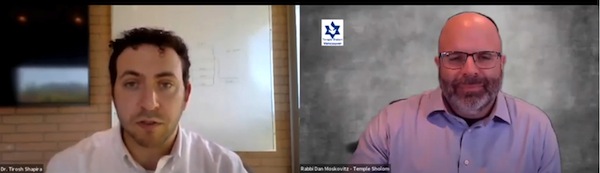
University of British Columbia’s Dr. Tirosh Shapira, left, spoke at a June 18 Temple Sholom-hosted webinar emceed by Rabbi Dan Moskovitz. (screenshot)
“COVID-19 or SARS-CoV-2 has a different type of genetic material than we have. It is an excellent saboteur … and can mutate easily. Thus, if we develop a drug against it, we will likely, over time, begin to see some resistance,” University of British Columbia microbiologist Tirosh Shapira told a Zoom audience in a June 18 webinar.
“In my research,” he said, “instead of looking for one drug, I am looking for four. I am trying to create a cocktail similar to what is applied with treating HIV. We are looking for drug combinations.”
There is an added level of complexity involved in seeking such combinations, he noted, as certain drugs can negate the effects of others.
Shapira is among a select group of Canadian scientists hunting for a cure to COVID-19. He earned his PhD from Australia’s University of Queensland, where he specialized in molecular toxicology for global food security. Before devoting his efforts to COVID-19, his research at UBC led to a novel treatment against tuberculosis and the development of methods to improve drug discovery.
To the web audience hosted by Temple Sholom, Shapira spoke on the topic of drug development in British Columbia, particularly as it pertains to the new coronavirus. He also provided an overview of modern drug discovery and a look at the advanced facility for virology research at UBC.
“Viruses are a large array of different agents,” explained Shapira, “each with unique characteristics, and depend on their hosts in order to replicate and create more copies of themselves … they vary greatly. However, some share similar properties.”
Knowing, for example, the similarities of the common cold and SARS, scientists can gain a better understanding of how the biology of COVID-19 might play out. This type of application led to the discovery of the effectiveness of the drug Remdesivir against the MERS virus, for instance.
Citing the history of combating viruses through treatments, Shapira showed a graph of the downward trend of infections from tuberculosis, starting in the late 19th century. He used this to elucidate the factors needed beyond drugs to control an epidemic, such as economics, sanitation and education.
“On a global scale, sanitation and containment are extremely important for an immediate response to an immediate threat,” he said. “Understanding SARS-CoV-2 is based on understanding similar viruses. The best way to defeat new viruses is through social adjustments.”
Shapira distinguished between the classical and modern approach to drug discovery. The classical approach, he said, is to look under a microscope and examine what is there, while the modern approach considers all possible compounds and is less concerned about the biology.
According to Shapira, the modern approach essentially throws everything at a problem. This, in turn, reduces the research bias on the part of the scientist, has fewer developmental pitfalls and is more “statistically robust,” thereby making it more likely for discoveries to pass clinical trials.
Biology, he hastened to add, is still important – the quality of the test model will determine the quality of the outcome. “Good, sound biology brings good, sound compounds that are good pharmaceuticals,” he said.
When considering how to target a virus, Shapira told the online group that a researcher will look at known antivirals, U.S. Food and Drug Administration-approved drugs, drugs in clinical trials and natural products, the source of most new antibiotics and antivirals.
Drug development is a complex, multi-stage process which has greatly advanced in the past 20 years, he said. In the United States, for example, it begins with pre-clinical trials in labs and with animal testing. Next come clinical trials focusing on safety and efficacy, before moving to randomized testing. Afterwards, there are FDA trials and ultimately production.
UBC’s FINDER (Facility for Infectious Diseases and Epidemic Research), where Shapira conducts his research, has an automated workstation and screening microscopes that handle the large workload of sorting through tens of thousands of compounds without introducing human error.
Due to restricted access to the highly infectious coronavirus, research in Canada can only be performed at a limited number of contamination-free facilities, which also include the University of Toronto and the National Microbiology Laboratory in Winnipeg.
In their studies, UBC’s researchers use lab-grown organs in a dish and a live virus, explained Shapira. FINDER has previous experience with this model from the outbreak of the Zika virus. At FINDER, the UBC team screens the thousands of compounds with collaborators around the world.
Shapira, the only microbiologist conducting research on the COVID-19 virus in British Columbia, estimated that there are 200 biologists and another 2,000 people working on various studies, including in economic areas, related to COVID-19 in Canada.
“SARS-CoV-2, despite being a present threat, will pass,” said Shapira. “But other infectious diseases will emerge in this age of easy travel. Preparedness is key. We will gradually reopen as we are better able to monitor the spread of the virus. We will find a treatment.”
Sam Margolishas written for the Globe and Mail, the National Post, UPI and MSNBC.
On July 6, using a Shavit-2 rocket, Israel successfully launched the Ofek 16 reconnaissance satellite into Earth’s orbit. The first Israeli satellite (Ofek 1) was launched in 1988. Investment in this field produces strategic defence systems, but also innovations that assist industries in coping with various technological obstacles. Israel is one of 13 countries in the world with full space capabilities (launching satellites), alongside the United States, Italy, France, Japan, India, the United Kingdom, Ukraine, China, Russia, Iran, North Korea and South Korea.