For more cartoons, visit thedailysnooze.com.
Tag: science
Germs, humans, numbers
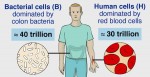
How many microbes inhabit our body on a regular basis? For the last few decades, the most commonly accepted estimate in the scientific world puts that number at around 10 times as many bacteria as human cells. In research published earlier this year in Cell, a recalculation of that number by Weizmann Institute of Science researchers reveals that the average adult has just under 40 trillion bacterial cells and about 30 trillion human ones, making the ratio much closer to 1:1.
The bacteria living in our bodies are important for our health. The makeup of each person’s microbiome plays a role in both the tendency to become obese and in each individual’s reaction to drugs. Some scientists have begun referring to it as the “second genome,” recognizing that it needs to be taken into account when treating patients.
The rising importance of the microbiome in current scientific research led the institute’s Prof. Ron Milo, Dr. Shai Fuchs and research student Ron Sender to revisit the common wisdom concerning the ratio of “personal” bacteria to human cells. Their research was undertaken as part of their work for the book Cell Biology by the Numbers, which was recently published by Milo and Prof. Rob Philips of the California Institute of Technology.
The original estimate that bacterial cells outnumber human cells in the body by 10 to one was based on, among other things, the assumption that the average bacterium is about 1,000 times smaller than the average human cell. The problem with this estimate is that human cells vary widely in size, as do bacteria. For example, fat or muscle cells are at least 100 times larger than red blood cells, and the microbes in the large intestine are about four times the size of the often-used “standard” bacterial cell volume. The Weizmann scientists weighted their computations by the numbers of the different-sized human cells, as well as those of the various microbiome cells. They also weighted their calculations for the quantities of “guest” bacteria in different organs in the body. For example, the bacteria in the large intestine dominate, in terms of overall numbers, all the other organs combined.
* * *
Feeling sick is an evolutionary adaptation, according to a hypothesis put forward by Prof. Guy Shakhar of the Weizmann Institute’s immunology department and Dr. Keren Shakhar of the psychology department of the College of Management Academic Studies, in a recent paper published in PLoS Biology.
We tend to take it for granted that infection is what causes the symptoms of illness, assuming that the microbial invasion directly impinges on our well-being. In truth, many of our body’s systems are involved in being sick: the immune system and endocrine systems, as well as our nervous system. Moreover, the behavior we associate with sickness is not limited to humans. Anyone who has a pet knows that animals act differently when they are ill. Some of the most extreme “sickness behavior” is found in such social insects as bees, which typically abandon the hive to die elsewhere when they are sick.
The symptoms that accompany illness appear to negatively affect one’s chance of survival and reproduction. Symptoms, say the scientists, are not an adaptation that works on the level of the individual. Rather, they suggest, evolution is functioning on the level of the “selfish gene.” Even though the individual organism may not survive the illness, isolating itself from its social environment will reduce the overall rate of infection in the group.
In the paper, the scientists go through a list of common symptoms, and each seems to support the hypothesis.
Appetite loss, for example, hinders the disease from spreading by communal food or water resources. Fatigue and weakness can lessen the mobility of the infected individual, reducing the radius of possible infection. The sick individual also can become depressed and lose interest in social and sexual contact, again limiting opportunities to transmit pathogens.
The scientists have proposed several ways of testing the hypothesis, but they hope its message sinks in: when you feel sick, it’s a sign you need to stay home. Millions of years of evolution are not wrong.
For more, visit wis-wander.weizmann.ac.il.
Researcher moves to London
The Canadian government’s policies toward local research and innovation are being streamlined with industry, making it so researchers are no longer free to look outside the box. This is one of the reasons Dr. Robert Brownstone gives for his decision to leave Canada to live in England and teach at the University College of London.

Brownstone, who was born and raised in Winnipeg, has spent most of his research career in Canada. He is a neurosurgeon who has treated people with movement disorders, pain and epilepsy, and who researches neural circuits that control movement. Prior to recently leaving the country, he was working as a professor of surgery (neurosurgery) and medical neuroscience at Dalhousie University.
“While it could be argued that there have been no cuts to the Canadian Institutes and Health Research (CIHR), funding has been flat (which is in effect a cut) and funding has been directed to specific programs (which is a cut to investigator-driven fundamental research),” said Brownstone in an interview with the Independent.
Minister of State (Science and Technology) spokesperson Scott French challenged this claim, however. “Since being elected in 2006, our government has made record investment in science, technology and innovation to push the frontiers of knowledge, create jobs and improve the quality of life of Canadians – including providing over $1 billion in funding toward neuroscience research alone,” he said.
French added that CIHR directs two-thirds of its funding envelope to basic or discovery science to strengthen Canada’s position as a world leader in health research.

McGill University’s Dr. John Bergeron – researcher, professor and chair of anatomy and cell biology for 13 years – explained the issue using a hockey analogy. “For whatever reason,” he said, “we decided that talent and accountability to genuine discovery would not be part of our funding mechanism. That decision was made by administrators and, in my mind at least, it’s sort of like saying, ‘We’re going to get the best logos in hockey and that will make us win the championship, the NHL cup, or whatever.’ And saying, ‘We don’t need talent…. We just need to look good on camera.’ Of course, that’s not sensible.”
Bergeron acknowledged that generous sums of public money are targeted for research and development. However, he said that an accountability mechanism should be considered to see if that money is targeting talent that generates genuine discoveries.
“By any deductive measure, Canada is not doing well,” said Bergeron. “The most recent is the latest rankings of research universities (viewable at shanghairanking.com). We’ve had zero Nobel Prizes in medicine since our one and only award in 1923 (for the discovery of insulin). All big pharma pre-clinical research labs have left Canada and we have only one living Lasker Award winner – James Till of Toronto.
“It is the university presidents and heads of our funding agencies who have failed the Canadian taxpayer. It is young, genuine talent that is needed across Canada, and the lack of accountability of our university presidents and heads of funding agencies is what is holding us back.”
Bergeron said we are shooting ourselves in the foot by funding research without having an infrastructure to apply the discoveries and reap the rewards of our efforts. “One of my goals is to try to use the Merck labs, get them going to put together a world-class institute to exploit genuine discoveries that are made here in Canada.”
As an example, Bergeron pointed to the work of McGill University Canadian-Israeli educator Dr. Nahum Sonenberg.
“With Dr. Sonenberg’s basic science discovery, he went from figuring out all of the machinery involved in making proteins to stumbling across the fact that if you target a small molecule with some of the proteins he’s discovered, it improves memory. So, colleagues in the U.S. and Britain teamed up with biotechs and big pharmas and have now used this discovery to develop drugs to treat senility, Alzheimer’s, memory loss.
“This is going to be a market creating hundreds of millions of dollars that we’re not going to exploit [in Canada]…. We don’t have any infrastructure to do this, all because these crazy administrators know nothing about what real discoveries have been historically.”
Bergeron sits on grant panels for the European Commission that provide 10 million euro grants a year, as well as U.S. funding agencies panels that give out more than a million dollars in grants per year.
“When you’re in Canada, the average grant in the last competition for the open operating grant averaged out to about $125,000 a year per investigator,” said Bergeron. “That’s serious taxpayer money, but it’s not competitive with what’s going on in the rest of the world. We’re spending over $30 billion a year in research and development, yet we don’t use peer review. Funding decisions are made by administrators that know nothing about discovery.”

Jim Woodgett, investigator and director of research of the Lunenfeld-Tanenbaum Research Institute at Toronto’s Mount Sinai Hospital Joseph and Wolf Lebovic Health Complex, also said that funding has been stagnant in recent years and that restructuring at CIHR has resulted in further hoops researchers need to jump through to access funding.
“To access funds here, in Canada, you have to bring to the table equivalent funds from other sources,” said Woodgett. “They can be philanthropic sources, etc. These types of programs, the government has been quite keen on promoting as a means of leveraging additional support. And some types of research just don’t have that kind of accessibility or the researchers don’t have accessibility to those matching funds, so that does become a bit of a limiting problem.”
Woodgett said there needs to be a balance, and better ways to access funding that do not require fundraising. “You need to balance discovery research and applied research, otherwise what happens is you just dry up after awhile,” he said. “All the ideas dry up and there’s nothing then to translate into applied research.
“You can argue you should spend 10 percent of your funds on discovery and 90 percent on applied … and say that the private sector shouldn’t be funding basic science … they should be only funding applied science.”
Internationally, many government-supported research funds go toward the discovery end of the spectrum. Canada needs to do the same if it wants to retain top researchers, said Brownstone.
Acknowledging that he is not a politician nor an economist, he said, “I feel there is intrinsic value in knowledge or a knowledge economy. Good things come from knowledge. Just look at leaders in the field, like Switzerland and Silicon Valley, unlike oil economies, such as Saudi Arabia.”
As far as creating change and reinventing research in Canada, Brownstone said, “Changing culture is hard, but it can be done with leadership. Look at [U.S. President John F.] Kennedy and landing a man on the moon.”
Rebeca Kuropatwa is a Winnipeg freelance writer.
Brush up kids’ STEM
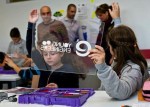
(photo from e2 Young Engineers)
The Israeli education revolution is here. e2 Young Engineers, which started operating in 2008, is pioneering the concept of “edutainment” in the classroom, combining education and entertainment. The edutainment method is used to develop children’s knowledge and understanding of STEM (science, technology, engineering and mathematics) subjects. In turn, Young Engineers is helping foster the next generation of engineers.
e2 Young Engineers was founded by Amir Asor, a young Israeli entrepreneur. Asor, who dealt with learning difficulties as a child, understood from firsthand experience that the way schools teach STEM does not engage all children, challenge them or give them the desire to continue learning these subjects. Inspired to change this reality, Asor began to develop the Young Engineers’ curricula. In its first year of operation, the company opened 10 centres across Israel. During the following year, 2009, the company grew to 90 centres.
The curricula created by Asor are aimed at children between the ages of 4 and 15, and operate in community centres, after-school programs, private schools, teen centres, private homes and more. e2 Young Engineers lessons are built on a logical progression of teaching theoretical material in a lively way – using engaging stories, demonstrations and experiments – and then giving the children the opportunity to build a K’nex (for the younger age group) or LEGO bricks model that illustrates the principle being studied in that lesson. At the end of the year, children who have participated in a e2 Young Engineers lesson will be able to explain, for example, what transmission is, the difference between a power-increasing transmission and a speed-increasing transmission, what centripetal and centrifugal force are and how Bernoulli’s Law works. These concepts and basic principles of physics and engineering are not sufficiently covered by traditional school curricula, and e2 Young Engineers’ courses give children great exposure and access to these professions.
e2 Young Engineers operates from north to south in Israel, and continues to grow. International recognition arrived for the company in 2011, when Asor was awarded the Youth Business International Entrepreneur of the Year prize, presented by YBI’s founder, HRH Prince Charles. Building on this, e2 Young Engineers’ franchise operation was launched in 2012; in the space of two years, franchisees from 15 different countries spanning five continents signed up, forming a family of 40 franchisees – a number that is still growing. In addition, the University of Carnegie Mellon has chosen to market Young Engineers courses through its subsidiary, iCarnegie.
The company is continuing to develop its curricula at both the technological and pedagogical levels. An intensive project to bring digital technology to the classroom is nearing completion, with the development of a 3-D application exclusive to e2 Young Engineers. The application, which is used on a tablet, contains all the building stages for every model, which can be viewed 360°. It also contains pop quizzes, fun and educational cartoons (featuring Eureka, the e2 Young Engineers mascot), and a very popular function that allows the child take a photo of themselves with the model they built and email it to their parents – or whomever they choose – via the app. In this way, parents can receive instant insight into what their child is learning and how much they are enjoying themselves.
As an Israeli company, Young Engineers has a particularly special connection with Jewish communities worldwide and, to this end, has generated much interest from Jewish schools and educators across the world, supported by the company’s active approach to cultivating such ties. The Jewish community in Vancouver – and the wider British Columbia area – has been identified as having potential for being a flag-bearer for the company in Canada. The company is open to potential franchisees from across British Columbia. Find out more by visiting youngeng.net/franchise or by emailing [email protected].
3-D compass in the brain
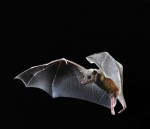
Researchers have shown that the brains of bats contain neurons that sense which way the bat’s head is pointed and could, therefore, support the animal’s navigation in 3-D space. (photo from wis-wander.weizmann.ac.il)
Pilots are trained to guard against vertigo: a sudden loss of the sense of vertical direction that renders them unable to tell up from down, and can lead to crashes. Coming up out of a subway station can produce similar confusion: for a few moments, you are unsure which way to go, until you regain your sense of direction. In both cases, the disorientation is thought to be caused by the temporary malfunction of a brain circuit that operates as a three-dimensional compass.
Weizmann Institute scientists have now for the first time demonstrated the existence of such a 3-D compass in the mammalian brain. The study was performed by graduate student Arseny Finkelstein in the laboratory of Prof. Nachum Ulanovsky of the neurobiology department, together with Dr. Dori Derdikman, Dr. Alon Rubin, Jakob N. Foerster and Dr. Liora Las. As reported in Nature on Dec. 3, the researchers have shown that the brains of bats contain neurons that sense which way the bat’s head is pointed and could, therefore, support the animal’s navigation in 3-D space.
Navigation relies on spatial memory: past experience of different locations. This memory is formed primarily in a deep-seated brain structure called the hippocampal formation. In mammals, three types of brain cells, located in different areas of the hippocampal formation, form key components of the navigation system: “place” and “grid” cells, which work like a GPS, allowing animals to keep track of their position; and “head-direction” cells, which respond whenever the animal’s head points in a specific direction, acting like a compass. Much research has been conducted on place and grid cells, whose discoverers were awarded the 2014 Nobel Prize in physiology or medicine, but until recently, head-direction cells have been studied only in two-dimensional settings, in rats, and very little was known about the encoding of 3-D head direction in the brain.
To study the functioning of head-direction cells in three dimensions, Weizmann Institute scientists developed a tracking apparatus that allowed them to video-monitor all the three angles of head rotation – in flight terminology, yaw, pitch and roll – and to observe the movements of freely behaving Egyptian fruit bats. At the same time, the bats’ neuronal activity was monitored via implanted microelectrodes. Recordings made with the help of these microelectrodes revealed that in a specific sub-region of the hippocampal formation, neurons are tuned to a particular 3-D angle of the head: certain neurons became activated only when the animal’s head was pointed at that 3-D angle.
The study also revealed for the first time how the brain computes a sense of the vertical direction, integrating it with the horizontal. It turns out that, in the neural compass, these directions are computed separately, at different levels of complexity. The scientists found that head-direction cells in one region of the hippocampal formation became activated in response to the bat’s orientation relative to the horizontal surface, that is, facilitating the animal’s orientation in two dimensions, whereas cells responding to the vertical component of the bat’s movement – that is, a 3-D orientation – were located in another region. The researchers believe that the 2-D head-direction cells could serve for locomotion along surfaces, as happens in humans when driving a car, whereas the 3-D cells could be important for complex manoeuvres in space, such as climbing tree branches or, in the case of humans, moving through multi-storey buildings or piloting an aircraft.
By further experimenting on inverted bats, those hanging head-down, the scientists were able to clarify how exactly the head-direction signals are computed in the bat brain. It turned out that these computations are performed in a way that can be described by an exceptionally efficient system of mathematical coordinates (the technical term is toroidal). Thanks to this computational approach used by their brain, the bats can efficiently orient themselves in space whether they are moving head up or down.
This research supports the idea that head-direction cells in the hippocampal formation serve as a 3-D neural compass. Though the study was conducted in bats, the scientists believe their findings should also apply to non-flying mammals, including squirrels and monkeys that jump between tree branches, as well as humans.
“Now this blueprint can be applied to other species that experience
3-D in a more limited sense,” writes Prof. May-Britt Moser, one of the 2014 Nobel laureates, in the News and Views opinion piece that accompanies the Weizmann study in Nature.
Weizmann Institute news releases are posted at wis-wander.weizmann.ac.il, and are also available at eurekalert.org.
No more ice scraping
Who would have thought a solution to ice stickiness would come from a semi-tropical country like Israel?
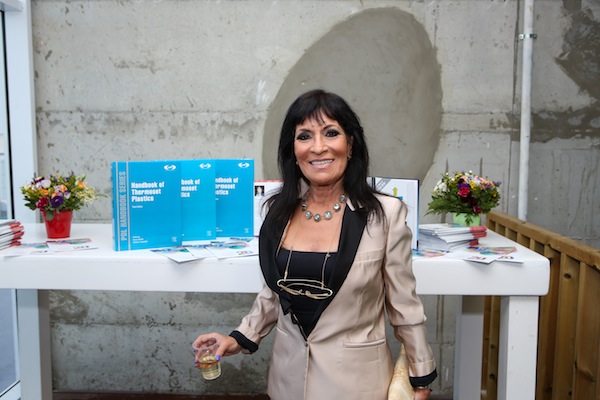
Prof. Hanna Dodiuk heads up the department of polymers and plastics engineering at Shenkar College in Ramat Gan. She specializes in adhesion and adhesives science and technology, characterization and formulation of polymer adhesives, special coatings, surface and interfaces analysis, nanotechnology and aging of polymeric materials.

Born in 1948 in Krakow, Poland, to two Schindler’s List Holocaust survivors, the family made aliyah to Israel in 1949. Dodiuk served in the air force, and then studied chemistry at Tel Aviv University. In 1979, she joined the Israeli Armament Development Authority (ADA), also known as Rafael. From September 1991 to June 1997, Dodiuk was the ADA’s director of its materials and processes department.
Her research led to the creation of a surface to which ice cannot stick, a material she created while on sabbatical with a large bio company in Germany. “They invited me to develop surfaces that don’t adhere to anything, that are easy to clean, and that have super-hydrotropic surfaces,” she said. The company needed this to develop what Dodiuk referred to as “a microfluidic machine.”
“This small machine can only work with very small water droplets at minus-12 degrees,” she said. “To take such a little amount, you have to ensure the fluid is not absorbed on the surfaces.”
In her research, Dodiuk turned to biology and nature, studying how leaves react with water.
“While most leaves are weighted by water, lotus leaves, even if in mud and water, aren’t, so they remain fresh and clean forever,” she said.
Using a high-resolution microscope, Dodiuk found that the morphology of the lotus leaf is very unique. “It has small mountains of microns that have a very small circle in the diametre of a nano range, which is 10 to minus-nine metres. A water drop cannot enter the width between two nano particles, so it begins to fall off and slide. Therefore, the water doesn’t add weight.”
Dodiuk said this is not a new chemistry concept. It has been used in Teflon-like materials for years. But, while Teflon works well with oil, water can still get it wet and weigh it down.
Early on, Dodiuk found great success with the lotus leaf. Three years into the research, ADA asked her to help create a super-hydrotropic coating usable on glass to prevent ice from interfering with navigational systems by sticking and blocking the view. Dodiuk found a lab that would allow her to imitate ice adhesion in Quebec, where she conducted the experiments.
“We’re the only [technology] in the world that can reduce the adhesion of ice,” said Dodiuk. “You cannot avoid it totally, but you can reduce by a factor of 18. If you reduce the adhesion of ice by a factor of 18, you really avoid ice adhesion.”
This surface has numerous significant applications. “Airplane wings can take off, but the special coating that was so great at reducing the adhesion of ice was simply not durable,” she said. “If, for example, they were to apply very high winds, it would start coming off and nano particles would be lost, as the adhesion of the micro and nano particles wasn’t good.
“With the lotus plant, if its surface is damaged, it will repair itself. But, technology doesn’t know [how] to repair itself, so they had to find another solution. That is when the University of Massachusetts stepped in with funding and lab facilities.”
Aided by two university students in the plastics engineering department working to create a special film with the right properties at a very low cost, Dodiuk said they are now halfway to completion. The final product will be a stick-on film, like Scotch tape, but with nano particles on one side, not visible to the naked eye. It will be able to be applied to anything, from windows and wings of airplanes to car windows during the winter.
“We always laugh at the end of the day,” said Dodiuk. “Israel [doesn’t] have an ice-adhesion problem, yet we invented the solution.
“Once you talk about super-isophobic, easy-cleaning or self-cleaning [technologies], everyone is sold.
“Even with textile, it would be one that never gets dirty. For things to get dirty, the dirt has to adhere. If you avoid adhesion, you’ll stay clean forever. Can you imagine not needing to wash your things, as nothing will adhere to [them]?”
“Can you imagine all of New York and Vancouver never needing to be cleaned?”
The potential application possibilities are endless and multi-directional, with spin-offs that can be used in elemental technology, like car or high-rise windows with no need to clean off dust or dirt. “Can you imagine all of New York and Vancouver never needing to be cleaned?” asked Dodiuk.
“With this special coating, those windows will remain totally clean. Just a little bit of rain will take off all the dust. The rain won’t stick to the window, only to the dust.”
Through it all, Dodiuk emphasized, she succeeded in accomplishing all of this work, to date, in a “male-dominated environment. I really think [women] should go into science and technology. [Many women] are going into many areas today, but not science and technology.”
Rebeca Kuropatwa is a Winnipeg freelance writer.