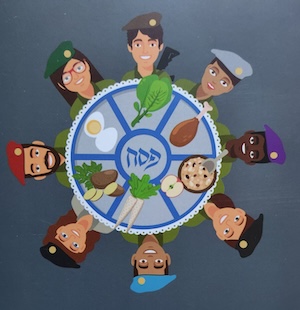
Last week, the Jewish Federation of Greater Vancouver, in conjunction with the Centre for Israel and Jewish Affairs, released the results of a community survey on antisemitism. There were, perhaps, few surprises.
Of those surveyed, 85% said that antisemitism has “increased a lot” since Oct. 7, 2023. More than 60% of respondents said they avoid displaying items that would identify them publicly as Jewish and almost two in three said they avoid particular places and events out of concern for their safety.
A public opinion poll released around the same time indicated that the often-discussed “silent majority” is on our side – most British Columbians are concerned about antisemitism. More than three-quarters of respondents to a Research Co. poll said they are concerned about “aggressive behaviour by pro-Palestinian protesters,” “protesters targeting Jewish neighbourhoods and Jewish-owned businesses” and “rising prejudice against Jewish Canadians.”
While we would appreciate if the solidarity expressed in this survey were articulated more vocally and visually, it is reassuring to know that the targeting of our community is not unnoticed or uncontested. The survey is, in any event, a rare encouraging sign.
It may seem delusional to seek rays of light amid reports of unabating antisemitism. But is one narrative of Passover not precisely to remind us that we have met and overcome suffering and subjugation in the past? When we celebrate the holiday, we are reanimating our collective experience of resistance to tyranny and oppression, the birth pangs of our peoplehood, and the victory over apathy and forgetting. An unequivocal through-line across Jewish history is resilience.
We retell the story of Exodus every year during the seder not as history but as a living, spiritual framework for Jewish identity and values.
While this is a very difficult time, it also has the capacity to bring out tenacity, determination and unity among the Jewish people.
Difficulty can also create cracks in unity. This is the night when, more than other nights, we reflect on liberation from literal or figurative slavery – in today’s situation, perhaps, freedom from violence and discrimination – and the imperative of Jews to protect and advocate for liberation. So, as we witness growing fissures in the Jewish world, let us rededicate ourselves to the project of liberation and peoplehood based on fundamental values of freedom, love, unity and community.
On Passover, we are reminded that there are pharaohs in every generation who seek to destroy and oppress. We utter the words “You shall tell your children,” because a vivid memory of the past is central to facing our present and creating our future. Every generation faces its own “Egypt.” The work of liberation is not yet finished.
May those who are held captive in Gaza, those who are fighting to defend Israel, those experiencing violence and discrimination, or seeking freedom in any form, be redeemed.
“A people driven by hate are not – cannot be – free.” (Rabbi Lord Jonathan Sacks, z”l) (photo from flickr)
According to Exodus 1:8, a new Egyptian king rose to power who did not know Joseph. He did not remember, or did not care, that Joseph, as Egypt’s chief food administrator, had saved the country from famine. As such, this new pharaoh felt no special gratitude toward the Hebrews who had settled in his land so long before. But, while the Torah text deals with pharaoh’s relationship to the Hebrews, it does not address the relationship between the Hebrew slaves and their native Egyptian neighbours.
If we look deeper in the Book of Exodus, we learn that the Hebrew slaves did know the Egyptians – they lived among them. Not only that, but the Hebrews were on good terms with their Egyptian neighbours. Thus, when it was time for the Hebrews to flee from Egypt, their neighbours gave them gifts.
The send-off was carried out in stages. In the first stage, G-d instructs Moses to tell the Hebrews that “each man should ask his neighbour for and each woman of her neighbour, jewels of silver and jewels of gold.” (11:2) It is worth noting that, depending on the context, modern Hebrew might translate neighbour as friend, buddy or colleague. Moreover, the word ask might be translated as borrow – though, since the departing Hebrews had no intention of returning to Egypt, ask is the word to use in this context.
Perhaps G-d was not totally sure how things would work out, so, just to make sure things went as He wanted them to, “He gave the people favour in the eyes of the Egyptians.” This point is apparently so critical that it is repeated soon afterwards: “the Lord gave the people favour in the eyes of the Egyptians that they let the Hebrews have what they asked for.”
Some commentators have said that the Egyptians could not be expected to offer gifts of their own initiative, so the departing Hebrew slaves encouraged them by saying, let us part as friends and we’ll take a parting gift. Others – like Philo in his Life of Moses – observe that the Hebrews were prompted not by love of gain, but by the desire to recoup some of the wages due to them for their slave labour.
The Egyptians, on their part, might have been only too happy to see the Hebrews go, as they were tired of suffering from the increasingly hard-to-take plagues. Thus, in the first chapter of the Book of Exodus, the Hebrews are told to ask for the jewelry and to receive the riches, then they are commanded to “put them on your sonsand daughters.”
While it may seem extravagant to gift someone gold and silver, the ancient Egyptians all wore jewelry, it was more commonplace. According to the article “Egyptian Jewelry: A Window into Ancient Culture,” by Morgan Moroney of Johns Hopkins University and the Brooklyn Museum, “From the predynastic through Roman times, jewelry was made, worn, offered, gifted, buried, stolen, appreciated and lost across genders, generations and classes. Egyptians adorned themselves in a variety of embellishments, including rings, earrings, bracelets, pectorals, necklaces, crowns, girdles and amulets. Most Egyptians wore some type of jewelry during their lifetimes.”
That said, gold and silver are important “not only from an economic but also from a symbolic point of view. Gold, for instance, was regarded as a divine and imperishable substance, its untarnishing nature providing a metaphor of eternal life and its brightness an image of the brilliance of the sun…. The very bones of the gods were said to be of silver, just as their flesh was thought to be of gold,” writes Richard H. Wilkinson in his book Symbol & Magic in Egyptian Art.
Taking this point a step further, we might be able to interpret the Egyptians’ giving of silver and gold as an act of bestowing mystical characteristics on the ancient Hebrews. Certainly, it is a recognition that the Egyptian people viewed the Hebrews well.
However, Rabbi Judah, in the name of Samuel, takes a totally different approach. He claimed that the gold and silver had been collected by Joseph when he stored and then sold corn.
Reportedly, the Hebrews took all the gold and silver when they left Egypt and it was eventually taken to the Land of Israel. It remained there until the time of Rehoboam, the son of Solomon, then changed hands many times. It came back to ancient Israel and stayed until Zedekiah. It changed hands between the various conquerors of Israel and eventually was taken by the Romans. It has stayed in Rome ever since.
While the ancient Egyptians seemingly felt comfortable bestowing gold, silver and clothing on the Hebrews, this act is seen by some as more of a taking than a giving. In 2003, Nabil Hilmy, then dean of the faculty of law at Egypt’s Zagazig University, planned to sue the Jews of the world for the trillions of dollars that he claimed the ancient Hebrews had taken from his country. He theorized: “If we assume that the weight of what was stolen was one ton” and its worth “doubled every 20 years, even if annual interest is only 5% … hence, after 1,000 years, it would be worth 1,125,898,240 million tons.… This is for one stolen ton. The stolen gold is estimated at 300 tons, and it was not stolen for 1,000 years, but for 5,758 years, by the Jewish reckoning. Therefore, the debt is very large.”
That the Egyptians gave the Israelites gifts – willingly or not – is noteworthy. Significantly, in the article “Letting Go,” the late Rabbi Lord Jonathan Sacks notes that Deuteronomy 23:7 tells us that we should not hate Egyptians because you lived as a stranger in their land.
“A people driven by hate are not – cannot be – free,” writes Sacks. “Had the people carried with them a burden of hatred and a desire for revenge, Moses would have taken the Israelites out of Egypt, but he would not have taken Egypt out of the Israelites. They would still be there, bound by chains of anger as restricting as any metal. To be free you have to let go of hate.”
The gifts of gold and silverallowed the former slaves to reach some kind of emotional closure; to feel that a new chapter was beginning; to leave without anger and a sense of humiliation.
Further, Sacks cites 20th-century commentator Benno Jacob, who “translated the word venitzaltem in Exodus 3:22 as ‘you shall save,’ not ‘you shall despoil’ the Egyptians. The gifts they took from their neighbours were intended, Jacob argues, to persuade the Israelites that it was not the Egyptians as a whole, only Pharaoh and the leadership, who were responsible for their enslavement…. They were meant to save the Egyptians from any possible future revenge by Israel.”
This is something to contemplate as we read the Haggadah at our seder this year.
Deborah Rubin Fieldsis an Israel-based features writer. She is also the author of Take a Peek Inside: A Child’s Guide to Radiology Exams, published in English, Hebrew and Arabic.
After the Israelites escape from Egypt and the Sea of Reeds has returned to its normal flow, with the enslavers either drowned or on the opposite side, Miriam leads the women in singing a song of praise. Apparently, it is the only time in the Torah where women are recorded as seinging their own song.
They did so with instruments they had brought along with whatever necessities one takes when fleeing a bad situation. The women had such a strong belief that they and their people would be free, that there would be occasions to celebrate with song, music, dance, that they made room among their provisions for instruments.
Miriam is older than her brothers Moses and Aaron. “Having been born at the time when the bitter enslavement began, her parents named her ‘Miriam’ (from the Hebrew word meaning ‘bitterness’),” explains an article on chabad.org. However, she was anything but bitter. She was extraordinarily hopeful, continually thinking of the future and how it would be better.
“Miriam was about 6 years old when Pharaoh decreed that all Israelite baby boys be killed,” notes another chabad.org article. “Hearing this, Miriam’s father, Amram, divorced his wife, Yocheved, because he couldn’t bear the possibility of having a son who would be killed. Seeing the actions of Amram, one of the leaders of the generation, all of the other Israelite men followed and divorced their wives as well.
“Miriam told her father, ‘Your act is worse than Pharaoh’s! He decreed that only male children not be permitted to live, but you decreed the same fate for both male and female children!’ She then predicted that her parents would give birth to a son who would save Israel from Egypt.”
The young girl convinced her father to remarry her mother; the other men remarried their wives, as well. Moses and Aaron would not have been born, the Israelites would not have been freed, if not for Miriam.
She also looked over Moses after Yocheved placed him in a basket in the Nile to save him from Pharaoh’s decree. Miriam made sure that Pharaoh’s daughter, Batyah, who rescued Moses, chose Yocheved as his wet-nurse.
There are other stories of Miriam’s courage. Another translation of her name is “rebellion,” and she lives up to this interpretation in many ways. She and her mother were among the midwives who defied Pharaoh’s order to kill any Hebrew boys born, for example, and Miriam is said to have spoken up to Pharaoh when she was only 5 years old.
The multiple symbolisms of Miriam and the often-overlooked importance of women throughout history seemed to call for a medium of similar complexity with roots as ancient. And so, I chose embroidery as the means to express the image of Miriam, timbrel in hand, optimistic about her people’s future, the Sea of Reeds and their lives as slaves behind them.
My kids were volunteering at the Purim carnival, helping younger kids do games and offering other support. My husband was there to help. I went home early “for a break.” Meanwhile, I receive “helpful” warnings from Jewish websites and other moms on social media. “Passover is coming!” they mention with cheerful purpose. Perhaps this fills some people with glee. Mostly, I feel doom in the pit of my stomach.
Following influencers who run their large observant Jewish households like a well-oiled machine actually has been useful, to some extent. Oh, if she started making chicken broth or cleaned her pantry, maybe it’s time for me to do it, too? By following these tips, sometimes I feel I can manage better.
Then, however, the system fails me. Many of these capable influencers live in large Jewish centres, surrounded by kosher grocery stores, take-out and supportive extended families. They also have the finances to travel with their families to Passover resort vacations. If they travel, they don’t have to clean their houses or cook for the holiday. If they stay home, some use catering or even disposable plates for the whole holiday, which produces mountains of trash. My environmentally conscious household would never go for that.
For those who lack a large Jewish community infrastructure, or financial and family supports, making holidays happen can feel overwhelming. We hover in between, operating in a weird middle ground that is both freeing and isolating. Our families live far away. Since public school and work don’t stop for Pesach, we don’t travel for this holiday. We care about keeping Pesach. I cook and clean for weeks in advance, but I can’t do it all. I gave up on changing the dishes the year I gave birth to twins. While I may feel some guilt, I haven’t looked back.
Facing the next holiday’s prep feels exhausting. Maybe that’s because I just finished baking dozens of cookies (hamantashen and palmiers) for our Purim mishloach manot treat bags.
I’m thinking about how successful businesses and governments work. A business that runs smoothly depends on internal systems, competent managers to keep things working and other staff at various levels. A functional government also relies on an efficient bureaucracy. Right now, we’re hearing of how President Trump’s government is “cutting bureaucracy” and creating “efficiency.” However, what has followed is chaos.
Yes, there are always cases of bloated bureaucracy or waste, but, in many contexts, efficiency can mean that only one person knows how to do something essential. If that person has an accident or falls ill or is fired? Bad things happen.
I think of this while trying to keep my Jewish household on track through our holidays and the secular calendar. It takes mental energy and organizing skill to get kids through homework, afterschool extracurriculars, volunteering, and planning for summer activities in advance. Meanwhile, the dog needs grooming and her teeth brushed. Our house could use a good vacuuming.
Running a home is historically a Jewish woman’s domain. It’s a lot of work. There are Jewish literary references to a balabusta (Jewish housewife) and even Eishet Chayil, a Woman of Valour, from the book of Proverbs, which is traditionally recited to some women on Shabbat.
Many liberal households long ago ditched the tradition of reciting Eishet Chayil on Friday nights. Neither my childhood household nor my married one has everincluded this. Instead, like many other Jewish households where women are professionals, in my family, women work alongside household management. So, the historic celebration of a “women’s place” at home got scrapped, but the expectations increased.
Last night, I stayed up late after the whole household watched the movie Barbie together. Although I’m no Barbie fan, I enjoyed the subversive, witty tricks of this movie’s plot. Yet, I still had to place a grocery order afterwards. My husband was folding laundry. My twins changed their bedding before their bedtime, too. The exhaustion reminded me of one of the elements of a functional bureaucracy.
When things run smoothly, it’s because everyone has jobs – and no one’s job requires them to do everything. There is necessary duplication at work. More than one person knows how to do something, so that if a person goes away or gets sick, the system doesn’t collapse. Overlapping work roles and slack in a system are necessary. When an emergency happens, there’s extra capacity when systems overload.
Running a household smoothly, so that everyone’s well fed, valued and has their needs met, is a complicated endeavour. In the Babylonian Talmud, Tractate Sanhedrin, pages 86-88, there’s a lengthy conversation about what it means to be a “rebellious elder” and whether there are ever times when one must be executed for teaching inappropriate information. The rabbis suggest there are three different courts of appeal for these cases. Yet, there is also an understanding that some rebellious elders teach rulingsbased on tradition, from their teachers, and, other times, they offer a reasoned argument, based on what is “the correct understanding in my eyes.”That is, using logic, texts and real-life examples to draw conclusions.
Historically, women oversaw their households, that’s what our texts say, but times change. Now, we also expect women to be, at least theoretically, equals in the workplace. But the research indicates that women still bear the brunt of household chores, and the mental gymnastics and emotional work related to keeping everything afloat.
It’s time to rethink business models that preach that any duplication is redundant. If we want our homes to run smoothly, we must expect that more than one person be responsible for making Passover, or even afterschool carpools, happen. We moms cannot keep this schedule up any longer.
As I wrote this, one of my children rang the doorbell. He has a key but expects me to open the door for him anyway. That same child went out this afternoon to shop for Passover foods with his dad, who also picked up the weekly grocery order and did a lot of laundry today. Like Barbie’s weird movie world, or the topsy turvy Purim story, we must keep turning things around or even upside down. We cannot expect even “women of valour” to do everything. It’s time for everybody to learn more of the jobs to make our households function. Over here in Winnipeg, this mom is tired. It’s time for everybody to pitch in.
Joanne Seiff has written regularly for the Winnipeg Free Press and various Jewish publications. She is the author of three books, including From the Outside In: Jewish Post Columns 2015-2016, a collection of essays available for digital download or as a paperback from Amazon. Check her out on Instagram @yrnspinner or at joanneseiff.blogspot.com.
This year, the Jewish community will greet Passover with mixed emotions. On a holiday where we celebrate the 3,500-year-old Exodus from Egyptian slavery to freedom, we also mourn the modern-day hostages held captive for so long and the loss of those who will never return to their loved ones.
Passover offers a unique opportunity for families and friends to gather around the seder table, retell the story of the Exodus, eat symbolic foods and, most challenging of all, attempt to keep the younger children engaged until the meal.
It can be difficult to explain to our children the enduring importance of Passover – a tale of survival, courage and resilience. The story of the Jewish people facing an impossible obstacle and conquering it, of our people standing up against oppression, proud of our Jewish identity, confronting and overcoming baseless hatred.
For more than a year, Jewish students have been made to feel othered, embarrassed, threatened and, sometimes, compelled to hide their Jewish identity. Since Oct. 7, 2023, online Jew-hatred and anti-Israel vitriol have become all too common. While cities, overrun by hate-filled protests, seem almost completely desensitized to the hate, we see our children suffering.
An excerpt from the Passover Haggadah reminds us that “in every generation, one must see oneself as having personally come forth from Egypt … and you will tell your child on that day.…” As we sit down at the seder table this year, we will, once again, tell the next generation the story of the Jewish people’s victory against oppression and that pride in our identity is the way to fight oppression.
The younger guests at our seder – our children, our grandchildren, our nieces and nephews – are the next generation of leaders. It will be their responsibility to challenge antisemitism head-on, and it’s our responsibility to educate them about how to do it.
The Centre for Israel and Jewish Affairs remains committed to protecting the quality of Jewish life in Canada. Our team is working with government officials to advocate for the introduction of safe access (bubble) legislation to protect schools and places of worship from the threat of violence or harassment. We are also advocating to enforce existing legislation that combats both online and real-world hate.
We continue to demand accountability from social media platforms, institutions and organizations. We urge the government to support the provinces’ education for judges, Crown attorneys and law enforcement regarding antisemitism and hate crimes. We continue to stand by our policy priorities that include advocating for community safety, for maintaining public order and for fighting antisemitism in schools and on campus.
The community, after a long year-and-a-half, is tired. Some of us are scared. And yet, we remain proud. We know more work must be done to protect ourselves, our children and our Jewish identity. So, this year, as we retell our ancestors’ story to our children, we are reminded that we remember the past to protect our present – and our children’s future. It starts at the seder table. But it doesn’t end there.
Judy Zelikovitz is vice-president, university and local partner services, at the Centre for Israel and Jewish Affairs.
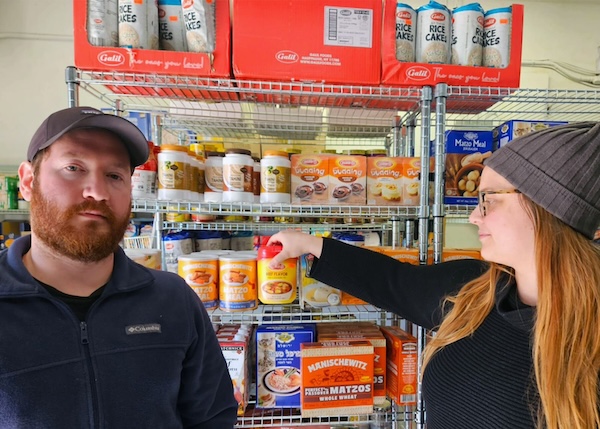
Tal Kinstlich and Stephanie Schneider, the owners of Vancouver’s Kosher Food Warehouse. (photo from Kosher Food Warehouse)
Canada is exempting key imported Passover foods from the current diplomatic trade war with the United States. The ministry of finance sent The CJN a list of kosher-for-Passover products imported from the United States, which are going to be allowed into Canada without being hit by the extra 25% retaliatory import tariffs that Ottawa began imposing on March 4.
The list includes matzah and related matzah products, cake mixes, chocolate, margarine, most juices (but not apple), gefilte fish, and canned fruit and vegetables. However, US exports of nuts, spices, dairy, wine, coffee, chicken and meat products are not exempt.
The development comes after Canada’s biggest kosher food importer recently predicted that the on-again-off-again tariff dispute would rocket prices for imported kosher-for-Passover food by up to 60%. Canadian Jewish leaders have been lobbying Ottawa to give relief to the country’s Jewish community as it heads into the holiday season.
While the news will likely bring a sigh of relief to consumers, it is only a temporary reprieve: it covers only Passover foods and runs only until the end of Passover.
For more on how these food tariffs are impacting Canadian kosher food stores and suppliers across Canada, and what advice they have for you, listen to the episode of The CJN Daily that features the owners of Vancouver’s Kosher Food Warehouse, Tal Kinstlich and Stephanie Schneider. Jack Hartstein also joins: he’s the vice-president of Montreal-based Altra Foods, the largest importer of kosher foods in Canada. The link is thecjn.ca/podcasts/key-passover-imports-will-be-exempt-from-tariff-war-with-u-s-ottawa-confirms.
Ilan Rabchinskey’s photograph of Tamarind Street Corn Cups in Sabor Judío: The Jewish Mexican Cookbook inspired me to make them. (photo by Ilan Rabchinskey)
Since reviewing Sabor Judío: The Jewish Mexican Cookbook by Ilan Stavans and Margaret E. Boyle for the Independent’s Hanukkah issue, I’ve tried several more recipes. And I’ve really enjoyed everything. So much so, that I pulled out the cookbook to try some Passover meals, and found some foods I would never have thought to make.
Stavans and Boyle have a section on Passover (Pésaj) in which they discuss some of the Mexican Jewish traditions. For example, some families incorporate Mexican history into the seder discussions, and the bitter herbs on the seder plate can include a variety chiles. They list 12 seder favourites, but, throughout the cookbook, they point out which dishes – like Stuffed Artichoke Hearts – are considered essential components of the Passover meal by some.
Snapper Ceviche con Maror, from Sabor Judío: The Jewish Mexican Cookbook by Ilan Stavans and Margaret E. Boyle. (photo by Ilan Rabchinskey)
Of the seder favourites, I made Snapper Ceviche con Maror, Tamarind Street Corn Cups, Apricot Almond Charoset Truffles and Tahini Brownies. The photos by Ilan Rabchinskey drew me into the corn cups, as I’m not a huge corn fan and might not have made them otherwise. I will do so again, however – they were easy, and they were a very tasty break from the ordinary. The snapper ceviche, too, will be a repeat, and the brownies were some of the best I’ve tasted, not too sweet, and very light, almost fluffy, but moist – I broke up a chocolate bar instead of using chocolate chips, which worked really well, and the sea salt on the top tasted so good. While the truffles were also delicious, they tasted more familiar, and were very date forward – I might try to mix up the date-apricot balance when I make them again.
The Jewish connections were obvious for some of these recipes, not so much for others. The snapper is served with a dollop of horseradish: “The use of maror, or horseradish, in this recipe was an invention during a Passover seder in Mexico City, creating a savoury contrast among the fish, the jalapeño and the horseradish,” write Stavans and Boyle.
The Jewish link to the corn cups is that the tamarind-flavoured hard candies the recipe calls for – Tamalitoz – were created by Jack Bessudo, who is of Mexican Jewish descent, and his husband, Declan Simmons. Since Tamalitoz are not available here, I bought another tamarind-flavoured candy from a local Mexican store and it worked quite well.
The brownies recipe comes from Israeli immigrants to Mexico, who shared with the cookbook writers that “tahini is also infused into their adaptations of mole, the sesame flavour substituting for more common varieties that rely on peanut or almond.”
Chag sameach!
SNAPPER CEVICHE CON MAROR (serves 6; prep time 25 min plus chilling)
3/4 cup fresh lime 1/4 cup fresh lemon juice 1 small jalapeño chile, seeds removed, finely chopped 1 small red bell pepper, seeds removed, finely chopped (about 1/2 cup) 1 small yellow bell pepper, seedsremoved, finely chopped (about 1/2 cup) 1/2 small red onion, thinly sliced 1 small garlic clove, minced, grated, or pushed through a press 1/8 tsp ground cumin 1/2 tsp kosher salt 1 pound red snapper fillets, skin removed 2 tbsp finely chopped fresh cilantro 1 tsp extra-virgin olive oil prepared horseradish, for topping (optional)
1. In a large bowl, stir together the lime juice, lemon juice, jalapeño chile, red and yellow bell peppers, red onion, garlic, cumin and salt.
2 . Using a sharp knife or kitchen shears, cut the fish fillets into 1/2-inch pieces and add to the citrus mixture, stirring to combine. Cover the bowl and refrigerate for 30 minutes.
3. Just before serving, stir in the cilantro and oil. Serve immediately, dolloped with horseradish, if desired.
TAMARIND STREET CORN CUPS (serves 4; prep time 40 min)
for the corn 3 tbsp unsalted butter 1/2 large white onion, finely chopped 2 medium garlic cloves, peeled and finely chopped 1/2 serrano chile, seeds removed, if desired, and finely chopped 1 1/4 tsp kosher salt, plus more as needed 2 fresh epazote leaves (whole) or 1 tsp dried oregano 5 cups fresh corn kernels (from about 10 cobs of corn, or use frozen corn kernels) 2 1/2 cups water 1/4 cup mayonnaise
for serving crumbled Cotija cheese crushed chile piquin or red pepper flakes crushed Tamalitoz candies,tamarind flavour fresh lime juice
1. Melt the butter in a large frying pan set over medium heat. Add the onion and garlic and cook, stirring occasionally, until soft and translucent, about5 minutes.
2. Add the serrano chile, salt and epazote leaves (or oregano), followed by the corn kernels and the water. (The water should barely cover the mixture.) Raise the heat to high and bring to a boil, then lower the heat to medium and cook, stirring occasionally, until the corn is tender and the liquid has almost completely evaporated, 30-35 minutes. Taste and add more salt, if needed.
3. Remove from the heat and discard the epazote. Add the mayonnaise and stir to combine.
4. Divide the corn mixture into four tall cups. Top with the Cotija cheese, chile piquin and crushed tamarind candies, to taste. Drizzle each cup with a little lime juice just before serving.
TAHINI BROWNIES (serves 6; prep time 15 min, baking time 22 min)
3 tbsp almond flour 1/4 cup cocoa powder 1/2 tsp kosher salt 1/4 cup extra-virgin olive oil 1/2 cup well-stirred tahini 4 ounces baking chocolate, roughly chopped 2 large eggs 1/2 cup granulated sugar 1 tsp vanilla extract 1/2 cup chocolate chips flaky sea salt, for sprinkling
1. Heat the oven to 350˚F and lightly grease an 8-by-8-inch dish. In a small bowl, whisk together the almond flour, cocoa powder and kosher salt and set aside.
2. Combine the oil, tahini and chopped baking chocolate in a small saucepan set over medium-low heat and cook, stirring often, until the chocolate is melted and the mixture is smooth. Remove from the heat and let cool slightly.
3. Meanwhile, in a large bowl, vigorously whisk together the eggs and sugar until frothy, 3-5 minutes. Whisk in the vanilla, followed by the cooled chocolate mixture.
4. Add the dry ingredients to the chocolate mixture and stir to combine, then fold in the chocolate chips.
5. Transfer the batter to the prepared pan, smoothing the top, then sprinkle lightly with flaky sea salt. Bake until a tester inserted in the centre comes out clean, 18-22 minutes. Remove from the oven and place the pan on a wire rack to cool. Serve warm or at room temperature.
APRICOT ALMOND CHAROSET TRUFFLES (makes about 3 dozen; prep time 15 min plus chilling)
2 cups pitted and chopped medjool dates 1 cup chopped dried apricots 1 cup golden raisins 1 cup roasted salted almonds 1 tbsp honey 3 tbsp sweet red wine (or grape juice)
1. Working in batches, add the dates, apricots, raisins, almonds and honey to a food processor and pulse until a textured paste forms. Transfer the mixture to a bowl and stir in the wine, 1 tablespoon at a time.
2. Scoop out tablespoons of the mixture and, using lightly moistened hands, roll them into balls. Place the truffles on a baking sheet or large plate lined with parchment paper as you go.
3. Refrigerate the truffles (uncovered is fine) for 2 hours, then transfer to a container with a lid and continue to refrigerate until needed. Serve chilled or at room temperature.
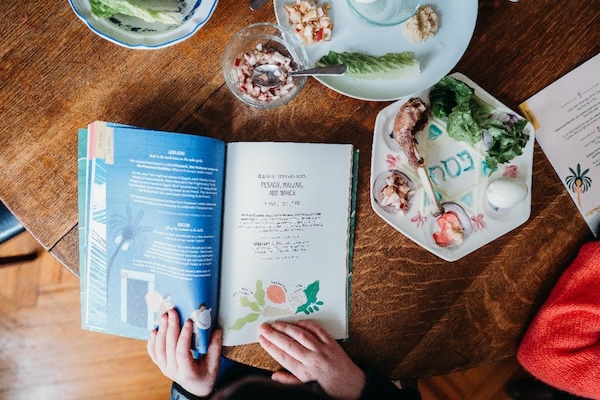
In Every Generation: A PJ Library Family Haggadah can be downloaded from pjlibrary.org/passover. (photo from PJ Library)
Passover is the ultimate Jewish story – a tale of freedom, hope and food – which makes it the perfect holiday to share with the entire family. Passover is time for gathering, reflecting, telling stories and working towards a world with freedom for all. But planning to cover all that with kids may feel lofty – especially if you’re a little hazy on the details yourself. The free Jewish book program PJ Library has you covered as a go-to destination for making Passover special.
Visit PJ Library’s Passover Hub at pjlibrary.org/passover to find everything you need to plan your Passover seder, set your table and answer your kids’ questions. There, you’ll find PJ Library’s free downloadable Passover Guide, a family-oriented primer that lays out how to prepare for the seders and the foods you need for your table, as well as offering up meaningful activities to make the most out of all eight days. The guide covers three main sections: how to get ready, what you need to get through the seder, and what comes after the festive meals have come to a close.
Also available for digital download from the hub is In Every Generation: A PJ Library Family Haggadah. It follows the arc of a traditional Haggadah and features all the major songs, prayers and moments, but also incorporates helpful framing and stories for kids so they can get the most out of this experiential meal. It also has new question prompts to help you reinvigorate your seder. The online version can be downloaded for free, while the PJ Library Haggadah is available for purchase in paperback from Amazon.ca.
Beyond the guide and the Haggadah, the Passover Hub features downloadable activities to keep little ones entertained during the seder, book lists, a step-by-step video playlist to help kids learn (or brush up on) the Four Questions, and recipes. There are fun and easy recipes like Charoset Breakfast Balls, a perfect grab-and-go breakfast that’s healthy and packed with protein, Chicken Skewers with Avocado Dip, or cholent, a classic hearty Jewish dish made in the slow cooker.
About PJ Library
PJ Library’s goal is to inspire joyful Jewish experiences by sending free storybooks and activities to families with children ages 0-12 and offering ways to connect with community. The program was founded in 2005 by the Harold Grinspoon Foundation and, with the support of donors and partners, now distributes books in seven languages to more than 650,000 children in more than 40 countries every month. The PJ Library family experience is built around the monthly storybooks and also includes family-focused holiday guides and other free gifts. Anyone who visits PJ Library’s website can hear original storytelling podcasts and explore a vast collection of Jewish parenting resources. The program welcomes families across the diversity of Jewish life. Learn more or sign up for monthly children’s books at pjlibrary.org.
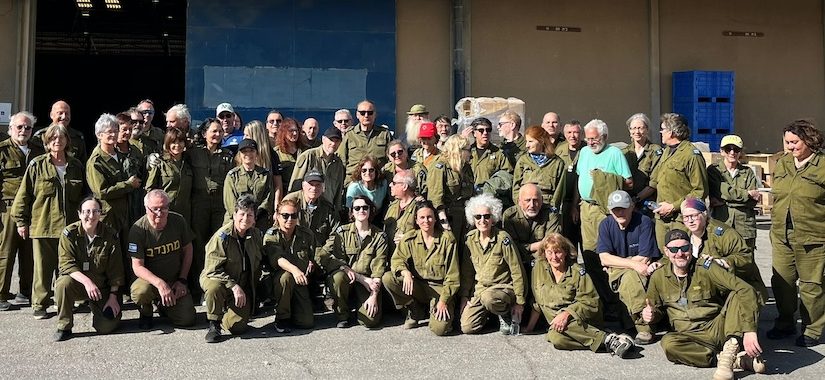
Volunteers with Sar-El in Israel last March. (photo from Marina Sonkina)
Last year, about this time, I was in Israel, volunteering with Sar-El, an organization that connects the Israel Defence Forces with volunteers from more than 30 countries, who provide the army with non-combat support. So many others had wanted to help after Oct. 7 that I had to wait several months for my documents to be processed.
The mood was understandably sombre. Not just the trauma of the Hamas terror attacks, with hostages captive, but also the antisemitism that engulfed the Western world like fire.
I asked some of my fellow volunteers why they had come to Israel during such a dangerous time. The answers I got, especially from non-Jews, both surprised and comforted me. A Christian volunteer from Detroit wanted Israel to know that it did not stand alone. A middle-aged Australian had been sponsored by her church in Sydney to help people of the Holy Land under an attack. Two Romanian girls didn’t speak a word of Hebrew or English, but answered me in Italian: “Aiuto” (“Help”).
“I had a very good life. I had a chance to travel all over the world. But, until now, I’ve been traveling horizontally,” a Parisian Jew of Algerian descent told me. “Now, it’s time to travel vertically,” she said, raising her eyes to the sky. “This land is sacred. I feel it here like nowhere else. And now it’s in peril.”
In spite of rockets being fired into Israel from Lebanon, Gaza and Yemen, the volunteers felt more protected in Israel than they did back home. Many felt relieved that, finally, there was no need to conceal one’s true feelings or to hide one’s Jewishness.
“I don’t feel safe in the US anymore,” said a New York lawyer who had been attacked from behind in the streets of Manhattan, his yarmulke yanked off his head.
A German woman from Munich was on her 10th visit to Israel. “I’m not Jewish, and I can’t explain it,” she said. “All I know is that I love people here. Love their warmth. Chaos? Yes! They talk loud, they are emotional, but I don’t mind that. I plan to spend half a year here once I retire.”
Initially, I wasn’t sure how we, civilians, could help the IDF fight Hamas in Gaza, but my first day at the medical military base near Tel Aviv made it clear. Hundreds of different medications and medical devices that had come from warehouses across the country had to be sorted out, their expiration dates checked. Those who accuse Israel of racism should see these medicines, each labeled in four languages: Hebrew, Arabic, English and Russian. (Thanks to Soviet antisemitism and, lately, to Putin’s war on Ukraine, 15% of Israel’s population comes from Russia.)
On the military base, I saw clearly what is best in Israel: its people. The IDF mirrors the diversity and inclusiveness of a society that, in its short history, has accepted refugees from more than 100 countries.
Without Moshe, for example, we would have had no idea how to sort the truckloads of medications arriving every day. Having come to Israel from Bukhara (in Central Asia) as a child, Moshe kibitzed in three languages, instructing us by means of his hands while talking on his cellphone. From his easy smile, I would never have guessed that his wife had recently died of cancer, that his two sons were fighting in Gaza and that, every day after his work with us, he went to a synagogue to pray. One morning, Moshe directed us to place boxes in long rows on the floor, in an unusual configuration. The next morning, a group of children with autism and down syndrome came to finish the sorting, also helping their people’s army.
Paul, a mathematician who came from France, was in charge of the military base’s math department. Ruth, who had made aliyah from the Netherlands as a teenager, was serving as one of the madrichot (female soldiers tasked with organizing and looking after Sar-El’s volunteers); after the army, she hoped to become a specialist in Japanese culture.
On another military base, about 20 kilometres from Gaza, in the Negev Desert, one of our tasks was to assemble care packages for soldiers spending Passover at the front, away from home. In two days, we filled 15,000 boxes with grape juice, matzah and other traditional items. Asoldier with a distinct Californian accent came to help us. He was a “lone soldier,” a soldier who has no family in Israel. Various families take turns welcoming lone soldiers for Shabbat, feeding them and giving them a sense of home.
The cover of a Haggadah that Sar-El volunteers inserted into thousands of Passover boxes that were sent to Israeli soldiers in Gaza. It shows the multicultural character of the Israel Defence Forces. (photo from Marina Sonkina)
Once, an officer joined us, helping make up the boxes, which was unusual, given his rank. Later, I saw him in the mess hall speaking in Hebrew to the base commander, who was originally from India. I found out that the officer was Druze. Living mainly in the country’s north, in the Galilee region, the Druze community enjoys all the civil rights of other Israelis, while maintaining their Arabic language and customs. Many Druze reach high echelons in the army, in medicine and other professions. When a Hezbollah rocket struck the Druze town of Majdal Shams, killing 12 children playing soccer, Prime Minister Binyamin Netanyahu went there, addressing community members as “brothers and sisters.” He promised that Hezbollah would “pay a heavy price” for killing their children, and he kept his word.
When I think of the soldiers I met and talked to, one thing sets them apart from young people of their age in North America: a seriousness of purpose, and the burden of responsibility. They know that the survival of Israel lies on their shoulders. They also know that, while defending theircountry, they may not survive. Death lurks behind every corner in Gaza and Lebanon. It has hidden in an effigy of a child pleading, in Hebrew, for help, but booby-trapped with explosives. It was underground, in the tunnels, some going 50 kilometres deep. It disguised itself in doctors’ scrubs, inside Kamal Adwan Hospital in Gaza, which was appropriated by Hamas terror operatives.
Every fallen soldier is loved and mourned as one’s own child. Army service acts as a social glue in a country into which millions of refugees, speaking different languages, have poured. The IDF is still the backbone and pride of this society.
At a party for troops just returned from Gaza, I saw a religious Jew in a yarmulke (skullcap) and tzitzit (prayer shawl) hanging from under his uniform, with a baby girl in each arm and an automatic rifle dangling behind his back. I talked to a medic, a corporal who was more outspoken than many – a college history teacher in times of peace, he had three young children at home.
“Is there any possibility of peace between Palestinians and Jews?” I asked him.
“Before Oct. 7, I supported a two-state solution because I wanted peace, but the Palestinians do not want peace,” he responded. “We’ve tried it many times in the past. They want only one state, an Islamic Caliphate with Sharia rule. We, Jews, are in their way and they want us dead…. We have to fight – if we want to survive.”
“What about your children?” I asked. “Will they have to fight, too?”
“Yes, them, too,” he said. “They’ll be left with no other choice.”
I shook my head in distress but said nothing.
“Look,” said the man, “illusions cost us very dearly. We can’t afford them anymore.”
I remembered Golda Meir’s words, spoken in 1957: “Peace will come when the Arabs will love their children more than they hate us.”
There is a truce in Gaza now. But, while some 20,000 Hamas fighters have been eliminated, 10,000 armed fighters are still at large.
Marina Sonkinais a fiction writer, and teaches in the Liberal Arts Program 55+ at Simon Fraser University.