Skip to content
  • Home
  • Subscribe / donate
  • Events calendar
  • Business Directory
  • FAQ
  • News
    • Local
    • National
    • Israel
    • World
    • עניין בחדשות
      A roundup of news in Canada and further afield, in Hebrew.
  • Opinion
    • From the JI
    • Op-Ed
  • Arts & Culture
    • Performing Arts
    • Music
    • Books
    • Visual Arts
    • TV & Film
  • Life
    • Celebrating the Holidays
    • Travel
    • The Daily Snooze
      Cartoons by Jacob Samuel
    • Mystery Photo
      Help the JI and JMABC fill in the gaps in our archives.
  • Community Links
    • Organizations, Etc.
    • Other News Sources & Blogs
  • JI Chai Celebration
  • JI@88! video

Recent Posts

  • SFU honours Gloria Gutman
  • Lifting people’s spirits
  • Wedding a ray of light
  • Indigeneity and Zionism
  • Rule of law broken: councilor
  • Football and its roles
  • The burden of defence
  • Fish Café returns after fire
  • All right in what goes wrong
  • Nuns & mermaids at TUTS
  • Camp offers holiday retreat
  • Students and mentors inspire
  • Once-in-a-lifetime trip
  • 100 dancers, one heart
  • Money for the sciences
  • What “Jewish food” means
  • Have a cookie, schnitzel too
  • Federation now across BC
  • Israel fighting for its existence
  • Deal strengthens Iran
  • Patriotic belonging diminishes
  • A campaign to engage
  • Upstanders’ first live event
  • Responding to Carney
  • Having your own home
  • Music a family tradition
  • Musical to warm heart
  • Community milestones … June 2026
  • Sharing her passion for Israel
  • Or Shalom reopens its doors
  • JFS from past to future
  • Need holistic approach
  • Sharing stories, advice
  • Journalist shares fears
  • Skills to live together
  • Road to independence

Archives

Follow @JewishIndie
image - CJN box ad Rockowers 2026

Tag: JNF

It’s that time of year

It’s that time of year

Tu b’Shevat is a popular day to go into the fields and plant saplings. (photo from usa.jnf.org)

‘In Israel, just before the Hebrew month of Shevat, the landscape begins to change. It has been winter; the fruit trees bare, their leafless, light grey branches silhouetted against dark clouds. Then, as Shevat is ushered in, they begin to bud, and reddish leaflets burst forth. Fields that have been covered with pale crocuses, white narcissus and cyclamens give way to red anemones, tulips and broom bushes starred with flowers. And the almond trees burst into blossom – the first harbinger of spring. It is at this time we celebrate Tu b’Shevat, the 15th of Shevat, which is known as the New Year of the Trees.

Tu b’Shevat, which falls this year on Jan. 17, is mentioned in the Mishnah as one of the four “natural” new years. The first of Nisan is the “new year for Jewish kings and seasonal feasts”: that is, for calculating the reigns of Israelite kings and determining the cycle of calendar festivals. The first of Elul is the new year “for tithing cattle” and the first of Tishri is the new year for calculating septennial cycles and 50-year jubilees.

The new year for the trees was moved from the first of Shevat to the 15th in accordance with the opinion of Rabbi Hillel (30 BCE – 10 CE), for it is then that the sap begins to rise with the full moon, in Israel’s fruit trees. The Babylonian and Jerusalem Talmuds also designate Tu b’Shevat as the date to calculate taxes on fruit: “You shall tithe all the yield of your seed, which comes forth from the field year by year.” (Deuteronomy 14:22)

During the days of winter, Israel’s fruit trees are dormant. It is wet and cold and, because of the low temperatures, the trees cannot absorb the nutrients from the soil. But, regarding the 15th of Shevat: “Till this day [the trees] live off the water of the past year; from this day on, they live off the water of this year.” (Jerusalem Talmud, Rosh Hashanah 1.2)

This date is the start of the fruit’s formation. Arabs also mark it, calling it “the second ember,” when fruit trees begin to absorb water. According to Arab folklore, there are three “embers,” which began as fire falling from the sky and changed to caterpillars. The first falls from the sky when the earth begins to warm up; the second when the warmth spreads. They follow this with a third “ember,” as summer begins.

Tu b’Shevat is one of Judaism’s popular celebrations that does not involve special synagogue services. It is a day when it is customary to eat the fruits of Israel: apples, almonds, carobs, figs, nuts and pomegranates. Many scholars stay up late on the eve of the holiday, reciting biblical passages dealing with fruits or the earth’s fertility. They read from Genesis how trees were created along with all the plants of the earth; from Leviticus, the Divine promise of abundance as a reward for keeping the commandments; and from Ezekiel 17, the parable of the spreading vine, symbolizing the people of Israel.

Kabbalists hold a special seder for Tu b’Shevat and they celebrate, not so much the new year of the trees, but the New Year of the Tree, meaning the Tree of Life, which is rich with mystical connotations. At the seder, they drink four cups of wine, beginning with white wine and ending with red, with the second cup a mixture more of white and the third more of red wine. It is rather like how the landscape changes from white (the pale narcissus and crocus) to red (anemones and tulips) as Tu b’Shevat approaches.

Tu b’Shevat is a popular day to go into the fields and plant saplings. Over the last several decades, Israeli schoolchildren have helped Keren Kayemeth, the Jewish National Fund, plant 130 million trees, many of them on Tu b’Shevat, and these evergreens have become the backbone of the reforestation program.

Tu b’Shevat affirms that the soil of Israel is holy. And the New Year of the Trees reminds us annually of the wonder of God’s creation.

Dvora Waysman is a Jerusalem-based author. She has written 14 books, including The Pomegranate Pendant, which was made into a movie, and her latest novella, Searching for Sarah. She can be contacted at [email protected].

Format ImagePosted on January 14, 2022January 13, 2022Author Dvora WaysmanCategories Celebrating the HolidaysTags Israel, JNF, Judaism, new year, ritual, spring, tradition, tree-planting, trees, Tu b'Shevat
Challenging VIFF Films

Challenging VIFF Films

Michal Wiets uses her great-grandfather’s diaries as the basis for her film Blue Box. (image courtesy)

At press time, the Vancouver International Film Festival lineup had not yet been announced. But the Independent received the names of some of the movies to be presented, as well as a couple of screeners.

Starting with the more challenging VIFF choices, most Jewish community members will either take a pass – with a roll of the eyes as to what film festivals often consider appropriately provocative fare – or get up the fortitude to watch the disparaging portrayals of Israel, so as to be better prepared to confront the criticisms, and perhaps learn from them. I admit that I have taken both routes in life and it was with great skepticism and high anxiety that I watched Michal Weits’s Blue Box.

Weits is the great-granddaughter of Yosef Weits (aka Weitz), a Russian immigrant to Palestine in the early 1900s who was instrumental in foresting Israel, as well as purchasing land for the Jewish government from the Arabs who owned it at the time (who were mostly absentee landlords and not the people who lived on and worked the land). Depending on one’s point of view, Weits was either a legendary pioneer to be tributed, as “the father of Israel’s forests,” or a notorious pirate of sorts, stealing land from Arabs and expelling them from it, as “the architect of transfer.” His great-granddaughter seems to believe he’s the latter, while he himself was conflicted.

The basis of the documentary is Yosef Weits’s diaries, some 5,000 pages. In them, he expresses his belief in the need for the reestablishment of the Jewish homeland and his fears for Jews’ continued existence (even before the Holocaust). He also details aspects of his work, with whom he negotiated land sales and meetings with David Ben-Gurion and other Israeli leaders. Presciently, he admits to misgivings about the way in which the Arab populations were being treated, predicting that such treatment would end up causing Israel severe problems if not dealt with.

The diary entries are fascinating and reveal some of the complexities of that era and of Yosef Weits’s legacy. The archival footage and photographs are compelling and expertly edited to make clear director Weits’s viewpoint – there is no mention of events that don’t fit her narrative, such as the expulsion of Jews from Arab lands.

Weits interviewed several family members about what she discovered from the diaries and other research. Their reactions are varied, with the generations closer to that of her great-grandfather more defensive and those closer to hers, more questioning, even condemning.

It might be helpful to watch this film with a non-Jew, as I did. In doing so, I found there were a few parts – such as the Israeli government’s relationship with the Jewish National Fund and why Weits named her film after the JNF’s donation box – that could have been better explained to viewers without prior knowledge. As well, a non-Jew is perhaps better able to keep in mind that every country deals with similar issues relating to how they were established, who was displaced, etc., and that Blue Box could be seen not only as a personal tale of one family, but as the beginning of a conversation about nation-building in general rather than as a stifling condemnation of Israel.

The same may or may not be said about The First 54 Years: An Abbreviated Manual for Military Occupation, directed by Avi Mograbi. There was no screener available for this documentary, which is described as “a ‘how-to’ guide to civilian subjugation along ethnic and religious lines, through the example of the Israeli occupation of Palestine. This is jet black, ice-cold political satire. But the harrowing statements of 38 former Israeli military personnel must be taken at face value as eyewitness testimony of decades of state-licensed crimes against humanity.”

Noam Imber plays a pothead teen in Quality Time
Noam Imber plays a pothead teen in Quality Time. (image courtesy)

Thankfully, there are at least a couple of more innocuous films in this year’s VIFF. One is the short Quality Time, written and directed by Omer Ben-David. When mom goes on a brief vacation, father (Shalom Korem) and son (Noam Imber) are left on their own together, and the awkwardness of their relationship is highlighted. Imber plays a pot-dealing and -smoking teen who’s just received his draft notice, while Korem is his recently retired – from the defence ministry – father. Both actors are wonderful and the story is quirky and fun, even if it doesn’t hold up logically at the end. While Israel-specific – a gym bag being blown up by the bomb squad is a key element – it has universal meanings.

The JI always sponsors a film at VIFF and, this year, we’ve chosen the animated feature Charlotte, about Charlotte Salomon, a German-Jewish artist who created her masterpiece work – called Life? Or Theatre? (comprising nearly 800 paintings) – between 1940 and 1942. She died in Auschwitz in 1943, at 26 years old. We’ll review that film next issue.

For more on the festival, visit viff.org.

Format ImagePosted on September 10, 2021May 2, 2024Author Cynthia RamsayCategories TV & FilmTags Adath Israel, Arab-Israeli conflict, David Ben-Gurion, history, Israel, Jewish National Fund, JNF, Michal Weits, Omer Ben-David, politics, Vancouver International Film Festival, VIFF, Yosef Weits
JNF Pacific’s fresh face

JNF Pacific’s fresh face

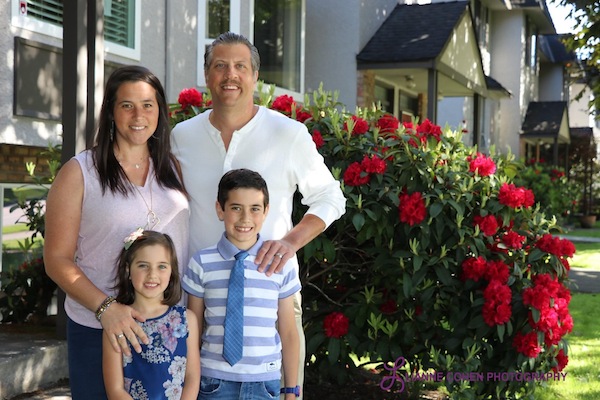
Michael Sachs, the new executive director of Jewish National Fund of Canada, Pacific region, with his wife Shira, a Hebrew and Judaics teacher at Vancouver Talmud Torah, and their children Izzy, 8, and Desi, 5-and-a-half. (photo by Michael Sachs)

The Jewish National Fund, founded by Theodor Herzl in 1901, is inextricably tied up in the history of the land and the state of Israel. Associated in the minds of generations of Diaspora Jews with planting trees in Israel, the agency – and its Canadian arm – have expanded into almost every area of civil infrastructure in that country.

The Jewish National Fund of Canada raises awareness and funds for projects that still include planting trees, but many years ago expanded into constructing water reservoirs, preserving natural habitats and building parks and bicycle trails. More recently, the focus has included social service infrastructures for vulnerable populations, such as at-risk youth, victims of domestic abuse, children with special needs, veterans and those with economic disadvantages.

For many years, JNF was represented in British Columbia by a shaliach, an emissary, sent here to advocate and raise funds for projects in Israel. Ilan Pilo was the last shaliach appointed and, when the Israeli office of JNF decided to stop funding the position, Jewish National Fund of Canada hired him and he continued in the role as executive director. Pilo and his family returned to Israel permanently this year after eight years in the community here.

Immediately after Passover, on April 5, Michael Sachs becomes the first non-Israeli to helm the Pacific region office. “I’m making history without doing anything,” he joked.

Sachs has spent the past decade working in the wholesale diamond sector as vice-president of sales at ERL Diamonds. In his off hours, he has been involved in an array of community organizations, including serving as president of the Bayit, a Richmond synagogue, during a time of exponential growth in membership. He has also served on the boards of the Kehila Society of Richmond, Vancouver Hebrew Academy, Tikva Housing, and on the development committee of Jewish Family Services. His efforts have been recognized both with a Jewish Independent 18 Under 36 Award, as well as a Jewish Federation of Greater Vancouver Young Leadership Award.

Although his community work has been extensive, Sachs may be familiar to most as a member of the family that ran Kaplan’s Deli for years. His mother and stepfather, Sally and Marshall Cramer, owned the restaurant and young Mike worked the counter.

“I always joked that one of the best sitcoms ever written would be something about being behind the counter of a Jewish deli because you hear everything that’s going on in the community, you meet everybody and it’s like watching a show,” he said.

In his early 20s, Sachs traveled to Israel on Birthright and he was transformed. “I came back and I longed for that connection,” he said, “because, when you’re there, it is electrifying through the soles of your feet; the energy, the buzz.”

Taking a leadership role in JNF may be a direct legacy of the impact of that visit.

Sachs refers to his new position as “an absolute dream.” He said, “Something like this is a once-in-a-lifetime opportunity.” And added, “JNF is, in my eyes, the global Jewish community’s hand in building Israel.”

Sachs and Pilo have been in contact and the former executive director will be on hand from his new home in Israel to assist virtually in the transition. Meanwhile, Sachs has set his sights on expanding the geographic reach of the Pacific region office. He aims to increase the agency’s presence in the Okanagan, on Vancouver Island and in the outlying Metro Vancouver communities.

Speaking before he formally takes on the role, Sachs said he doesn’t want to prejudge what changes might come, but he guarantees two things: “Excitement and energy.”

The staff of two in the regional office – Liisa King and Moran Nir – “do the work of five people,” he said.

“I don’t think I’ve ever seen such a group of dedicated community members as I have on the board of JNF,” he added, specifically citing Pacific region president Bernice Carmeli and vice-president Shannon Gorski.

Carmeli and Sachs would like to not only reach a broader geographic area, but a larger demographic. Just before the pandemic hit, Carmeli told the Independent, they were about to launch in earnest a new young adult division called JNF Future. As the reopening continues, both she and Sachs hope to develop that cohort and build a strong base of support among the next generation.

Carmeli sees Sachs, who turned 40 on March 27, as the ideal fit for expanding JNF’s message to wider audiences. She shares Sachs’ overt enthusiasm for the future.

“Onward and upward,” she said. “We have a new ED, a lot of exciting things are going to happen.”

Format ImagePosted on April 2, 2021March 31, 2021Author Pat JohnsonCategories LocalTags Jewish National Fund, JNF, Mike Sachs, milestones, philanthropy
3,200-year-old fortress now open to public

3,200-year-old fortress now open to public

An aerial photo of the remains of a 3,200-year-old Canaanite fortress built near today’s town of Kiryat Gat. (photo by Emil Aladjem/IAA via Ashernet)

The Kiryat Gat fortress site, which was opened to visitors this week, was prepared by the Israel Antiquities Authority (IAA) and Jewish National Fund (KKL).

According to archeologists Saar Ganor and Itamar Weissbein of the IAA, “The fortress we found provides a glimpse into the geopolitical reality described in the Book of Judges, in which the Canaanites, Israelites and Philistines are fighting each other. In this period, the land of Canaan was ruled by the Egyptians and its inhabitants were under their control. During the 12th century BCE, two new players entered the game: the Israelites and the Philistines. This led to a series of violent territorial disputes. The Israelites settled in non-fortified settlements at the Benjamin and Judean mountains. Meanwhile, the Philistines accumulated power in the Southern Coastal Plain and established cities such as Ashkelon, Ashdod and Gat in an attempt to conquer more areas. The Philistines confronted the Egyptians and the Canaanites on the borderline, which probably passed at the Guvrin River, between the Philistine kingdom of Gat and the Canaanite kingdom of Lachish. It seems that the Galon fortress was built as a Canaanite/Egyptian attempt to cope with the new geopolitical situation. However, in the middle of the 12th century BCE, the Egyptians left the land of Canaan and returned to Egypt. Their departure led to the destruction of the now-unprotected Canaanite cities – a destruction that was probably led by the Philistines.”

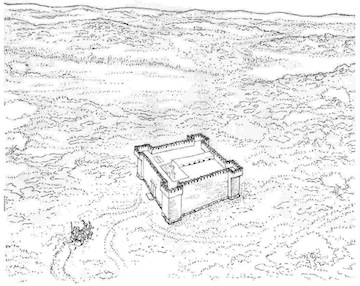
image - A drawing of what the fortress probably looked like
A drawing of what the fortress probably looked like. (drawing by Itamar Viskin/IAA via Ashernet)

The dimension of the fortress is 18 metres square and watchtowers were built in the four corners. A threshold, carved from one rock weighing around three tons, was preserved at the entrance of the building. Inside the fortress was a courtyard paved with stone slabs and featuring columns in the middle. Rooms were constructed on both sides of the courtyard. Hundreds of pottery vessels, some still whole, were found in the rooms.

The remains of the fortress were uncovered with the help of students from the Israel studies department at Be’er Sheva’s Multidisciplinary School, students from the Nachshon pre-military preparatory program and other volunteers. This was done as part of the IAA’s policy to bring the general public, and especially the younger generation, closer to archeology.

Format ImagePosted on August 28, 2020August 27, 2020Author Edgar AsherCategories IsraelTags archeology, education, history, IAA, Israel, Israel Antiquities Authority, Jewish National Fund, JNF, Kiryat Gat, tourism
Reflections of a lone soldier

Reflections of a lone soldier

Joel Chasnoff spoke at a Zoom event presented by Jewish National Fund of Canada on June 1 and he’ll speak at a CHW Montreal Zoom event on June 21. (photo from APB Speakers)

Michael Levin grew up in Philadelphia, joined the Israel Defence Forces as a lone soldier and died in a battle with Hezbollah in southern Lebanon in 2006. At that time, most Israelis weren’t familiar with the concept of a lone soldier – a legal term for a volunteer, usually (but not always) from outside Israel, who enlists to defend the Jewish state.

Levin’s death at 22 came just days after he returned hastily from his leave back home in the United States when he learned of the start of the Second Lebanon War. He flew back to Israel, hitched a ride to his platoon in Lebanon and took up the fight against the Iranian-backed terrorists. He was killed in an intense firefight in the Hezbollah-controlled village of Aita al-Shaab.

His grieving mother, Harriet Levin, was concerned that her son’s funeral would not have a minyan to say Kaddish and so, on arriving in Israel, she asked a few people to come to the military cemetery to ensure a proper Jewish burial. On her way to Mount Herzl, traffic was so congested she feared she would be late for her son’s funeral but, when she did get there, she discovered that the few people she had asked to spread the appeal for a minyan had shared the news widely. Media picked it up and more than 10,000 Israelis showed up to pay their respects.

It was a turning point in the Israeli consciousness, according to Joel Chasnoff.

Chasnoff is a stand-up comedian and writer who shared his own story of leaving his Chicago-area home two decades ago to become a lone soldier. In a Zoom event presented by Jewish National Fund of Canada June 1, Chasnoff, who now lives in Israel, spoke of the changing understanding of lone soldiers – and his reflections on now being the father of soldiers. A decade ago, he chronicled his experiences as an IDF volunteer in the book The 188th Crybaby Brigade: A Skinny Jewish Kid from Chicago Fights Hezbollah.

Today, lone soldiers are a better understood phenomenon in Israel and supports are in place that were not when Chasnoff volunteered in 1997. There is now a network of Lone Soldiers Centres – commonly called Michael Levin Centres – around Israel, to help overseas volunteers adapt and smooth their way to a successful integration, coordinate holiday and Shabbat homestays and deal with the myriad complications that arise for a newcomer to Israel.

image - The 188th Crybaby Brigade book coverChasnoff shared comedic experiences, including the challenge of proving he was indeed a lone soldier without Israeli parents, when government officials insisted that Levin’s father had never left Israel after his first visit in 1976. The stakes were basic – a lone soldier’s salary at the time was $160 a month instead of $80, plus a few privileges. But it required a sheath of documents from the States to prove that his father was indeed an Illinoisan, not an Israeli.

“Never mind that he had raised me in the U.S. and I have a very strong and good relationship with my dad. The Israelis believed that my dad was actually living in Israel the whole time and I was just trying to pretend that I was a lone soldier to get the extra $80 a month,” Chasnoff said.

His decision to join the IDF was sparked by a visit to Israel as a teenager.

“I got off the plane,” he said, “and, you know, you’re 17, your hormones are raging. What’s the first thing you notice being a teenager coming to Israel? How beautiful the Israelis are. The women were all tan and fit, the men were these hunks with muscles and crew cuts. It’s so odd because they have the same roots as we do, right? Except they look like supermodels and we look like Jews. How does that happen? That’s not fair.”

The soldiers he met were just a year older than he was.

“They were 18, and they had machine guns and berets and Ray-Ban sunglasses and forearms like bricks,” said Chasnoff. “And then there was me, slathered in sunscreen, wearing a fanny pack … stuffed with lactose pills.”

One of the eye-opening things Chasnoff discovered about the Israeli army, he said, is how democratic it was.

“I would even say insanely democratic,” he said, noting that soldiers argued about orders and fought with their superiors. “People ask me what’s it like in the Israeli army. I think the best way to describe it is, imagine a bunch of Israelis running an army. That is the Israeli army.”

This is why one of his platoon-mates was a darling among commanders: he didn’t speak Hebrew. The young man was raised in an evangelical Christian home in Oklahoma, but, at a certain age, learned that his mother had converted from Judaism. One thing led to another and he volunteered for the IDF.

“So, they made him a tank gunner,” Chasnoff said, “because, to be a tank gunner, you basically need to know six words – stop, go, left, right, forward, back. Tim was one of the best soldiers in our platoon because he didn’t have the Hebrew to argue back. When the commander would give orders, the guys would argue. Tim, by not having Hebrew, just did what he was told. And was an excellent soldier for that reason and one of our commander’s favourites.”

Unfortunately, a lack of Hebrew can be deadly in moments of military conflict. Chasnoff said some casualties in conflicts in Gaza may have resulted from linguistic challenges and he believes the military is doing a better job ensuring fluency in such situations.

While lone soldiers is a term associated with overseas volunteers, Chasnoff said that about half of the 6,000 lone soldiers are Israelis, mostly Charedim whose volunteer service or other factors estrange them from their families.

While lone soldiers were not so much in the Israeli consciousness a few decades ago, they are now a welcome oddity.

“I think, when you get a lone soldier in your platoon, people are very excited about it,” Chasnoff said. “Everyone wants to bring him or her home to show the family the sort of strange character who came all the way from New York City or Sydney, Australia, or whatever. People are really interested in what motivates them to serve, so they are invited. It’s very, very different than the old days.”

Addressing the broader differences between Israelis and Diaspora Jews, Chasnoff riffed like the comic he is.

“We grow up with this myth that Israelis are, you know, just like us. They are Jews and we are Jews and we’re one big happy family. And then you get to Israel and you realize the Israelis are nothing like the American Jew. They speak their minds. They shout. They argue,” he said. “You’ll never be with an Israeli and wonder to yourself, ‘I wonder what she really thinks about me right now.’ I’m married to an Israeli for 21 years and I can honestly say that once in those 21 years has my Israeli wife apologized to me because, in the Middle East, apologies make you look weak and nobody wants to look weak. We had one huge fight where she actually apologized and it wasn’t even a real apology, it was an Israeli apology: she came up to me a few days later and said, ‘Yoeli, motek, I am sorry you’re such an idiot.’”

He also has plenty of material about growing up Jewish in America.

“My mom was actually one of these Jewish mothers who – let’s be honest – they have a special ability to worry about every situation,” he said. “You give them any scenario, they will figure out the potential thing that could hurt you in that scenario.”

For their annual family visit to Texas to see his paternal grandparents, Chasnoff’s mother would book the family on two separate flights so that, if a plane went down, the entire family wouldn’t be lost.

“That’s a typical Jewish upbringing,” he said.

When his zaidie gave him a jersey with the number of his favourite player and his own name, Joel, on the back, Chasnoff’s mother refused to let him wear it outside the house because a stranger would know his name.

“And, because he knew my name, I would think he knew me, so I would go with him,” he said. “You know why? Because I’m an idiot. That’s why there are no Jewish athletes. Not that we’re bad at sports, our mothers won’t let us wear the jersey.”

Readers will have another chance to hear Chasnoff speak this month. CHW Montreal is hosting a Zoom BBQ with the comedian on Father’s Day, June 21, at noon, Pacific time. Visit facebook.com/chwmontreal and click on Events for details. Funds raised benefit hospital workers at the Shamir Medical Centre and Hadassah Hospital in Israel.

Format ImagePosted on June 12, 2020June 11, 2020Author Pat JohnsonCategories IsraelTags army, comedy, IDF, Israel, Jewish life, Jewish National Fund, JNF, memoir
Mystery photo … Feb. 28/20

Mystery photo … Feb. 28/20

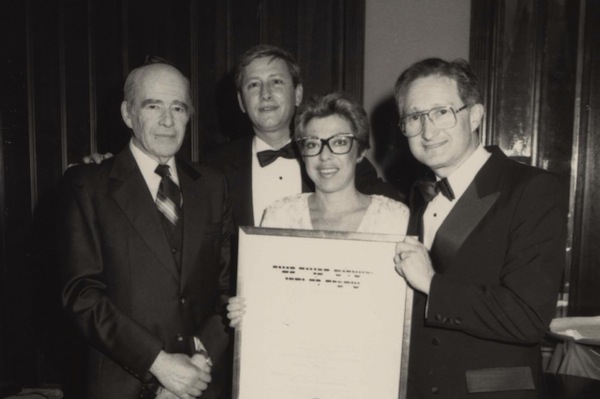
Two unidentified people on the left with Gail and Michael James on the right holding a certificate at a Jewish National Fund event. (photo from JWB fonds, JMABC L.12042)

If you know someone in these photos, please help the JI fill the gaps of its predecessor’s (the Jewish Western Bulletin’s) collection at the Jewish Museum and Archives of B.C. by contacting [email protected] or 604-257-5199. To find out who has been identified in the photos, visit jewishmuseum.ca/blog.

Format ImagePosted on February 28, 2020February 26, 2020Author JI and JMABCCategories Mystery PhotoTags history, Jewish museum, Jewish National Fund, JNF
Mystery photo … July 19/19

Mystery photo … July 19/19

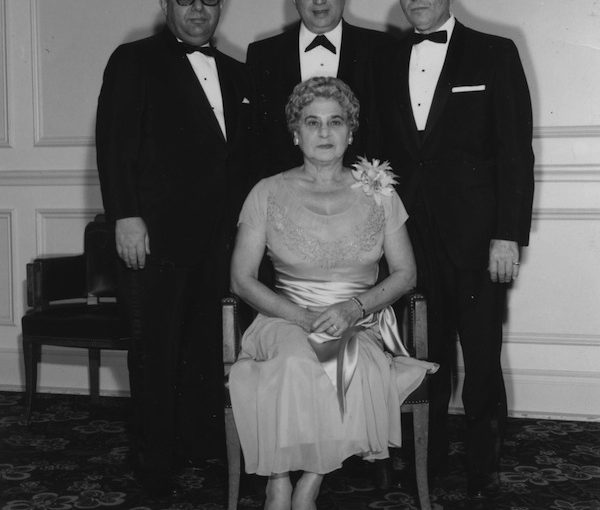
Lil Shapiro with three unidentified men, at a Jewish National Fund event, 1960. (photo from JWB fonds, JMABC L.11896)

If you know someone in these photos, please help the JI fill the gaps of its predecessor’s (the Jewish Western Bulletin’s) collection at the Jewish Museum and Archives of B.C. by contacting [email protected] or 604-257-5199. To find out who has been identified in the photos, visit jewishmuseum.ca/blog.


Format ImagePosted on July 19, 2019August 27, 2019Author JI and JMABCCategories Mystery PhotoTags history, Jewish museum, Jewish National Fund, JNF, Lil Shapiro
Friendly below the radar

Friendly below the radar

At the JNF Negev Gala April 14, left to right: comedian Elon Gold, JNF Pacific Region president Bernice Carmeli, Ambassador Ron Prosor, JNF Pacific Region executive director Ilan Pilo and JNF Canada chief executive officer Lance Davis. (photo from JNF Pacifoc Region)

The diplomatic cold shoulder Israel has received from African, Asian and Arab countries has been thawing in recent years, and a former Israeli ambassador to the United Nations says the situation is even more encouraging under the radar screen.

Ambassador Ron Prosor, who was the Jewish state’s representative at the world body from 2011 to 2015, spoke at the Jewish National Fund of Canada’s Negev Gala Sunday night.

The UN General Assembly is a den of hypocrisy, Prosor said, citing the presence of the most oppressive countries on committees dealing with human rights. The UN Human Rights Council has been dominated by states with the world’s worst human rights records. Moreover, the council, which is supposed to be concerned with human rights abuses all over the world, has a specific article that singles out only one country for routine, ritual denunciation.

“Surprise, surprise – Israel,” Prosor said. “The structural and institutional bias against Israel is unbelievable. There is stuff that I can’t even invent. The Saudis chairing the conference on the status of women. The Iranians … they’re deputy chairs on nonproliferation and arms control.

“What is amazing is not the bad guys,” he continued. “The bad guys are easy to explain. What is really difficult to explain is the so-called like-minded countries.”

European nations and some of the other democracies that make up a minority of the countries at the General Assembly routinely side with despotic regimes against Israel. In such a situation, small victories count heavily. Prosor took heart when countries opted to abstain from votes rather than side against Israel.

He shared an anecdote about Pablo, the ambassador of Panama, an apparent reference to Pablo Antonio Thalassinós.

“‘Pablo, are you with us on this vote? Are you going to vote for us?’” Prosor recounts asking. “‘No. How can I vote? The Arabs are threatening me. What do we do?’ I look at Pablo. He looks at me. I say, ‘Pablo, I feel you’re beginning to catch the flu.’” In the story, the Panamanian begins to cough.

Prosor shared stories of similar conversations with other ambassadors, convincing them to abstain or not show up for votes, and even making him their proxy vote in these latter instances.

While a great many votes relating to Israel are still deeply lopsided, he said, ambassadors like him have helped some others understand that abstaining is better than a no vote.

“The United States of America moves the embassy to Jerusalem. The Europeans take the Americans to the General Assembly,” Prosor said. “One hundred and thirty-nine countries vote against, 32 countries vote for and 21 countries have huge navigation problems finding the General Assembly. Huge navigation problems. Not coincidental.”

Behind the scenes, Israel is not the isolated pariah it appears, he contended.

“In essence, Israel talks with everyone,” Prosor told the audience at Schara Tzedeck Synagogue. “The only ones we do not talk to, or I didn’t talk to, are the Syrian ambassador and the Iranian ambassador. We talk to countries that you guys would be amazed. First of all, most of the Arab countries, countries that we don’t have diplomatic ties with. As the Germans would say, we don’t have to kiss each other on the main road.”

For example, Prosor said, India’s relationship with Israel has grown very warm in recent years.

“The ambassador of India loves Israel,” he noted. “India votes against Israel in every committee and every subcommittee. When we hit the atomic reactor in Syria, the ambassador came to me, ‘Ron, amazing work. It’s good that you showed them.’ Then he goes over to the Security Council [and says], ‘We absolutely condemn Israel.…’ So, there is a difference between relations and voting patterns.”

Relations between Israel and the Sunni Arab world are changing dramatically, he said, due to shared concerns over the Shiite theocracy in Iran.

“I can tell you that what you see happening now in the Arab world, the Sunni world, is something that has been prepared for many years,” he said. “What you see now is not because the Sunni world – the Saudis and the others – really give a toss about the Palestinians. They fear that the rope is tightening around their necks because of Iran and they have decided they have coinciding interests with Israel. I don’t care why – this is an amazing opportunity for us to coordinate and cooperate.”

Prosor remains defiant despite the pillorying his country continues to receive at the world body.

“We have nothing to be ashamed of. They have [things] to be ashamed of,” he said of Israel’s critics. “Political structures, attitude toward women, gays … we have nothing to be ashamed of.”

Of the 193 countries at the UN, he noted, only 87 are democracies. Twenty-two are members of the Arab League, 56 are part of the Organization of Islamic Cooperation and 126 countries are part of the so-called nonaligned group. By contrast, Israel is the only country at the UN that is not a part of any regional grouping. This means Israel cannot sit on any committees or subcommittee of the body.

In such a context, he said, humour and sarcasm go a long way. Elon Gold, a comedian who followed Prosor on the bimah Sunday, remarked that the ambassador was funnier than he was. Prosor shared stories of what seem like diplomatic pranks.

“There are six [official] languages at the United Nations,” he said. “One of them is Arabic. I had, on my team, Arab speakers. I decided to tell them that they have to speak and respond in the different committees in Arabic. Suddenly, someone presses the microphone and, in Arabic, bashes the Arabs. Arabs don’t know what’s happening. Europeans are surprised. They don’t know where it’s coming from.”

Overall, the ambassador said, things that are not clearly visible bode well for the future.

“Under the radar screen, there is huge support for Israel,” he said. But, he warned of evolving tactics by Israel’s enemies to weaken it.

“The battle that we are in may be the toughest battle that we’ve been in since the beginning of the state of Israel,” he said. “They tried to take us out with military means and that didn’t work out. They tried economic boycotts. Today, they are trying to put a wedge between Israel and the Jewish communities abroad, going after the mutual values that we all respect, that we all live with. It’s lies, half-truths, Chinese torture – drop, drop, drop – and we have to be out there and call it and fight it and not look away. We have to confront it and work together.

“Inside the United Nations, I saw flags of 193 countries,” he concluded. “I saw 15 flags with a crescent on them, 25 flags with a cross on them but only one flag with the Magen David, and we should all work, every day, to make sure that this flag flies strong, high and proud in the family of nations where it belongs.”

photo - Funds from the Jewish National Fund of Canada’s Negev Gala will support an animal-assisted therapy centre in the city of Sderot
Funds from the Jewish National Fund of Canada’s Negev Gala will support an animal-assisted therapy centre in the city of Sderot. (photo from hanof.kkl.org.il)

In addition to comedian Gold (see story, jewishindependent.ca/jnf-gala-features-comic-gold), the evening featured a few speakers, including Sanford Cohen paying tribute to the philanthropic work of honourary event chairs Bob Markin and Ralph Markin at a gala dinner before the main program, and JNF Pacific Region president Bernice Carmeli offering remarks at the dinner and during the program. Schara Tzedeck’s Rabbi Andrew Rosenblatt spoke about humour in Jewish theology. Actor and writer Josh Epstein emceed. Shannon Gorski chaired the event and Shirley Hirsch was convenor. Ilan Pilo, Jerusalem emissary and executive director of JNF Pacific Region, recognized past president David Goldman.

Funds from the event will support an animal-assisted therapy centre in the city of Sderot, where children and adults live with post-traumatic stress disorder due to years of rocket and mortar attacks from nearby Gaza. The project was described to the audience by Lance Davis, chief executive director of Jewish National Fund of Canada.

Format ImagePosted on April 19, 2019April 17, 2019Author Pat JohnsonCategories LocalTags Elon Gold, Jewish National Fund, JNF, Negev Gala, Ron Prosor, United Nations
JNF gala features comic Gold

JNF gala features comic Gold

Elon Gold performs in Vancouver on April 14 at the JNF Negev Gala. (photo from elongold.com)

Comedian Elon Gold loves doing charity events, especially Jewish ones. The Independent caught him for a phone interview as he was on the road – with his family – to Las Vegas from Los Angeles to do gigs for the Adelson Education Campus and then the Israeli-American Coalition. On April 14, he will be in Vancouver to co-headline, with Ambassador Ron Prosor, the Jewish National Fund, Pacific Region, Negev Gala. The event raises funds for Sderot Animal-Assisted Therapy Centre.

“I feel like I’m doing a mitzvah by making my people laugh. And I’m also helping this cause that’s really important, and Israel is really important to me,” said Gold. “And we’re living in a highly antisemitic time, it’s dark out there, so anything I can do to bring light into our world and make my fellow Jew happy, I’m there for it.”

Gold’s resumé is impressive. He starred in the television series Stacked and In-Laws, had a recurring role on Bones and on The Dana Carvey Show. He guest starred just recently on HBO’s Crashing and, longer ago, on shows including Frasier and The Mentalist. He has appeared in films, his one-hour Netflix special, Elon Gold: Chosen and Taken, is available on Amazon and his show Elon Gold: Pro-Semite premièred at the Montreal Comedy Festival. He has made multiple appearances on The Tonight Show and his July 2018 segment on The Late Late Show With James Corden – how, like everyone else, Jews love sex, money and food, but just in a different order – has been watched and shared by countless people on the internet, as has his routine on why Jews shouldn’t have Christmas trees and so many others.

Despite all of his accomplishments and his years in the business, Gold still gets excited about his work, and he shared what he described as a “wow” moment, one of the best days of his life, almost immediately when talking with the JI.

“Yesterday,” he said, “I was filming a scene of Curb Your Enthusiasm with Larry David…. It was really, truly a dream come true.”

But Gold didn’t take his being hired by David as a sign that he had “made it.”

“The truth is, I have been a guy with lucky breaks and hard breaks for the last 20 years,” said Gold. “This is another achievement, and one that’s beyond anything I would dream of…. I’m gratified in the sense that I finally feel like I’m in a place, not where I’ve made it, but where I actually have fans, and my clips are viral and people are sharing my bits on Facebook, WhatsApp or whatever. I did the James Corden show and, again, that doesn’t mean I’ve arrived … but what’s cool to me is that I did that set and then everyone’s sharing it, especially Jews. My biggest fans are my people.”

It’s been a 25-year journey, said Gold of his career, “with all sorts of great highs, like yesterday, and huge lows, like having a sitcom that you pitched and created and started get canceled. There are so many lows, and then there is the daily rejection that is show business. And that’s why I’m so glad I’m a comedian and an actor. I get rejected all day in Hollywood at auditions, but then, at night, I’ll go to the Laugh Factory comedy club and I’ll have 300 people roaring, and that will validate [me] – I knew they were wrong! I knew I could do this. See, I’m funny. These people think so, at least.”

Gold said his resilience, his ability to keep trying, likely comes from stand-up. “Because stand-up is all about bombing and killing, and the killing is so worth it that even the terrible, dejected feeling of bombing [is manageable].”

As far as his career, he said, “I have no other choice. I don’t love doing anything else and I’m not good at anything else.”

Known for his impressions, he said, “I used to impersonate my teachers in eighth grade.” His goal wasn’t to ridicule people, he said, but to make even the teachers laugh.

He enjoyed making people laugh, and writing comedy. One of the first things he wrote, he said, was a Purim shpiel. “And I’ll never forget the feeling of having the entire high school laughing, and thinking, there has never been anything more gratifying than what I just did, I want to do this more. Everybody says it’s like a drug…. It’s so addictive. Once you get a taste of it, that’s it, you’re hooked. And very little can discourage a comedian [so much that they get] out of comedy; certainly not a bad set, because we all know that we all have them.”

A combination of things drives him.

“It’s probably disingenuous to say that I do this because I love to make others laugh,” he admitted. There is a selfish aspect to it, he said. While making people happy is a “key component” of why he does comedy, he said, “I also love everything about it… I love the process of having an observation and then writing it and tinkering with it and working on it. I love doing it and I love the fact that I have so much freedom in my days because I don’t have that nine-to-five job most people have…. I’m always working. At the same time, I’m always on vacation.”

Gold loves getting the laughs, and said that’s probably 70% of the reason he does comedy; the other 30% is making people happy.

“There is so much misery in the world,” he said, “to make people happy is a great thing, but it’s only a part of it.”

On the acting side, Gold said his favourite kind of acting is for sitcoms “with a live studio audience because you’re still getting the laugh but now you’re not looking at the audience and talking to them, you’re looking at your fellow actor … and, peripherally, you hear and see these people cracking up.”

Ultimately, he said, “I just love performing.”

The only “grueling part,” he said, is the memorizing “and the pressure of 200 people staring at you, saying, ‘You better know your lines, pal, because we’re all here and we all want to go home…. Acting is challenging, but it’s also just fun…. It’s fun to get into a character and just play.”

Gold, who is from the Bronx originally, recalled his first open-mic night at the Comic Strip Live in Manhattan; he was 16 years old. “Fortunately, I had beginner’s luck because I was doing impressions – my early act was all impressions – and impressions are like magic tricks, they just wow the audience.”

Despite being a touring comedian by university (he got a bachelor’s in economics at Boston U), it took years, he said, to develop his own voice, to figure out what he wanted to talk about and how to talk about it.

“I’m obsessed with Jewish stuff because I live such a Jewish life,” he said. “I’m an observant Jew, I keep Shabbos and all that stuff, keep kosher. So much of my life is in the Jewish world, I can’t help myself but to come up with observations about our traditions, our holidays, our rituals. A lot of what I talk about is what I live…. The other part of my life is being married, being a dad, so I talk about that.”

Gold and his wife, Sasha, have four kids, two sons and two daughters, ranging in age from 9 to 18. The couple is coming up to their 25th anniversary in June.

As he stopped to fill up his car with gas on the way to Vegas, he told the JI about why he likes performing at Jewish events, while simultaneously directing his kids to be quick about heading into the gas station, as they were running late.

“There are not a lot of comedians out there that will go that deep into the Jewish experience and, for me, there are not a lot of audiences I can share my Jewish experiences with,” he said. “I can’t do lulav and etrog jokes on James Corden…. At the same time, we’re raising money, we’re raising awareness for incredible organizations…. It’s all win-win for me – I’m raising money, I’m making money, I’m getting laughs, I’m getting to do material I don’t do anywhere else…. And I love Jewish audiences; I love connecting on more than just a human level…. We’re connecting about a shared experience that is almost indescribable to anyone else.”

For tickets to the JNF Pacific Region evening event on April 14, which will be held at Schara Tzedeck, call 604-257-5155.

Format ImagePosted on March 22, 2019March 20, 2019Author Cynthia RamsayCategories Performing ArtsTags animals, comedy, Elon Gold, fundraising, Israel, Jewish National Fund, JNF, Negev Gala, philanthropy, Sderot, tikkun olam

JNF Canada explains position

On behalf of JNF Canada (JNF), I wish to respond to allegations made by Independent Jewish Voices Canada, longstanding opponents of JNF Canada, as well as the opinion piece you published [“Tax troubles start year,” Jewish Independent, Jan. 11].

With regard to the substantive issues that have been raised about our projects in Israel we wish to reiterate our position.

• JNF has in the past carried out projects mainly of a charitable nature, such as parks, playgrounds and recreational facilities on land owned by the Israel Defence Forces. Our charitable funds never flowed to the IDF. The charitable funds were directed toward the hiring of indigent labourers to construct these projects. These expenditures represent under one percent of our expenditures over the past decade.

In your coverage, you suggest that we took action based upon an alert from the CRA. This, in fact, is not the case. Rather, it was our legal counsel who advised us several years ago that the indirect association with the IDF may be misconstrued or criticized by the CRA, so we ended our participation at that time. We have not for several years carried out projects located on IDF land, and we continue to operate in accordance with CRA regulations governing our status as a charitable organization. We stopped these projects on the advice of counsel well before this issue was brought to the public’s attention by a group trying to sensationalize it.

• With regard to projects located in disputed territory, JNF is committed to continuing to work with CRA to ensure we are in full compliance.

• Finally, in terms of governance and reporting, JNF operates in compliance with the Canada Income Tax Act. We have Israeli staff on site to direct our projects in Israel and regularly report on our activities.

Thank you for highlighting our work and for acknowledging that “Israel is Israel, is large part, thanks to JNF.” We take pride in having supported the building of water reservoirs, collaborated with dozens of educational institutions, built numerous recreational/educational facilities, planted millions of trees and supported pioneering research in green technology. Key projects for this year include supporting a trauma centre in Sderot, a project to feed Israel’s hungry, the rehabilitation of the Be’eri and Kissufim forests, and more.

JNF’s management and lay leadership are committed to improving our operations. For the past number of years, we have been making changes to strengthen our governance and controls. What will not change, however, is our commitment to helping build the foundations of Israel’s future. We will always stand shoulder to shoulder with the people of Israel to benefit the social service and environmental fabric of the state of Israel.

Lance Davis is chief executive officer of Jewish National Fund Canada.

Posted on January 25, 2019January 24, 2019Author Lance DavisCategories Op-EdTags CRA, IJV, Independent Jewish Voices, Israel, Jewish National Fund, JNF, taxes

Posts pagination

Previous page Page 1 Page 2 Page 3 … Page 6 Next page
Proudly powered by WordPress