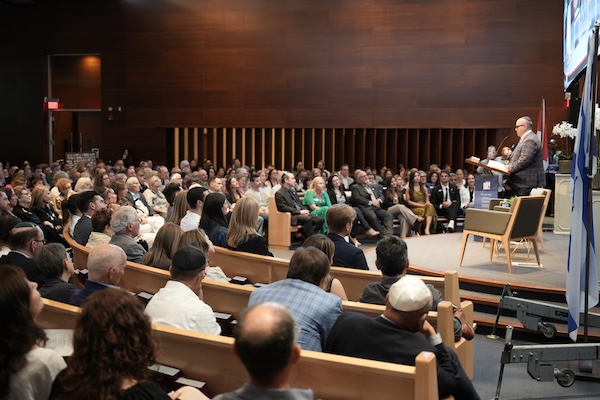
Australian actor and Israel advocate Nathaniel Buzz speaks at the June 19 JNF Canada, Pacific region, Negev Event, as National Post editor-in-chief Rob Roberts and Nova festival survivor Noa Argamani look on. (photo from JNF Pacific region)

Australian actor and Israel advocate Nathaniel Buzz speaks at the June 19 JNF Canada, Pacific region, Negev Event, as National Post editor-in-chief Rob Roberts and Nova festival survivor Noa Argamani look on. (photo from JNF Pacific region)

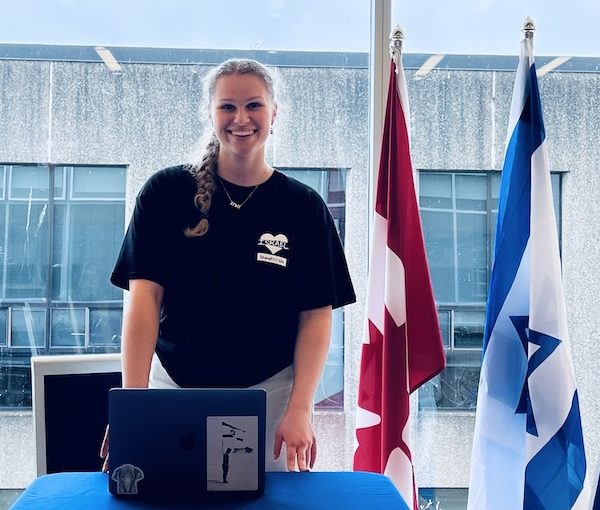
Zara Nybo leads an Israel on Campus meeting at the University of British Columbia. Nybo is the new BC representative for StandWithUs Canada. (photo from Zara Nybo)
When Zara Nybo transferred to the University of British Columbia from Camosun College on Vancouver Island, she wasn’t sure if Hillel was a place where she belonged, since she is not Jewish. Her partner encouraged her to check it out anyway – and it set her on a course to become an ally for Jewish students.
Recently, Nybo was hired as educational outreach and content manager for StandWithUs Canada, a nonprofit dedicated to pro-Israel education and advocacy. Though still finishing her degree in sociocultural anthropology and Jewish studies, she works full-time, overseeing the Emerson Fellowship for university students in British Columbia and the Leventhal Internship for high school students in Western Canada. She’s also responsible for non-Jewish outreach and community partnerships across the province.
“I think a lot of people assume this work is just for Jewish students,” Nybo said, “but education is the pathway to peace, for everyone.”
That idea fuels her days managing fellowships, mentoring students and helping young people navigate what have become among the most emotionally and politically charged issues on campus: Israel and antisemitism. In recent years, as anti-Zionist activism – and antisemitism – have surged across Canadian universities, Jewish students have increasingly found themselves isolated and targeted. Nybo has been impacted by what she has seen.
“What really struck me,” she said, “was watching Jewish and Israeli students grow afraid to go to class, to speak openly, to walk freely with a Star of David necklace. I wanted them to know – you’re not alone. There are people who see you, who care, and who are willing to stand with you.”
Nybo’s advocacy didn’t come out of nowhere. Raised in a family that prioritized global experience over staying in one place – she moved 13 times before age 13 – she learned early how to build bridges. But it was through Hillel and a series of fellowships, including the Campus Media Fellowship, a joint initiative of Allied Voices for Israel and Honest Reporting Canada, and the Israel Leadership Network, which consisted of more than 150 of the top Israel-focused student leaders from within the Hillel movement across North America, that she gained the knowledge, tools and confidence to become a leading pro-Israel advocate at UBC.
“I used to think of antisemitism as a historic form of hatred,” she said. “But once you learn to see the invisible forms of antisemitism, you realize how present and widespread it really is. Once you see it, you can’t unsee it.”
As a 2024/25 Canadian Emerson Fellow and Campus Media Fellowship alumna, Nybo staffed tables, hosted dialogues and wrote op-eds that challenged misinformation and promoted empathy. She’s continued to write ever since, crediting those programs with awakening her voice.
Now, in her leadership role, she trains others to do the same – Jewish and non-Jewish students alike.
“The Emerson Fellowship isn’t about slogans,” she said. “It’s about education. It’s about staying calm in hard conversations, being grounded in facts and speaking with authenticity – even when it’s scary.”
Nybo acknowledges she sometimes feeling “shaky” while tabling on campus. But she refuses to let fear stop her and she sees it as an important part of her role to encourage others to stand up even when it is daunting.
“Our job isn’t to scare students out of advocacy,” she said. “It’s to empower them to do it anyway.”
As tensions around Israel and antisemitism continue in Canada – on campus and beyond – Nybo is one of a small but crucial group of non-Jewish individuals who have stepped up to contest the atmosphere that is making Jews on campus uncomfortable and vulnerable.
“This isn’t just about being pro-Israel,” she said. “It’s about being anti-hate. No student – Jewish or otherwise – should walk around feeling like there’s a target on their back.”
In her new role, Nybo has already filled the BC positions open next year to Jewish and non-Jewish students seeking to broaden their knowledge and skills by participating in the programs StandWithUs Canada offers. She will oversee the students as they proceed through the range of learning and experiential projects she herself engaged in last year. These students, like Nybo, will go on to amplify the voices of Jews and allies on campus and, after graduation, take their places as leaders in the fight against antisemitism and anti-Zionism.
Susan Inhaber, president, Na’amat Canada (left), with Dalia Margalit-Faircloth, president, Na’amat Vancouver. (photo by Heather Freed)
Na’amat Canada and NA’AMAT USA came together last month to celebrate a milestone: 100 years of community work.
The Centennial Celebration, held in Toronto May 16-18, brought together leaders, members and supporters for a weekend filled with joy, reflection and renewed purpose. The program featured tributes, performances and presentations from Na’amat International leaders. Together, participants honoured a century of activism and achievement while charting the course for the work ahead.
Na’amat was “the first and last women’s organization for which I ever worked,” said the late Golda Meir, national secretary (president) of Na’amat in the 1930s, decades before she became Israel’s prime minister.
Founded in 1925, Na’amat Canada is a Jewish nonprofit volunteer organization dedicated to improving the lives of women, children and families in Israel and Canada through education, advocacy and social services.
“From our humble beginnings as a single organization to the growth of two vibrant organizations dedicated to empowering women and children in Israel, we can take great pride in our rich and storied history,” said event co-chairs Jan Gurvitch (NA’AMAT USA) and Susan Inhaber (Na’amat Canada). “This celebration honours not only the trailblazers who came before us but also the dedicated individuals who continue to give their time and energy to carry our mission forward.”
The weekend began with welcomes and candlelighting, continued with performances and storytelling, and culminated in a tribute to Na’amat’s past national presidents, women who helped shape the organization’s direction for generations. Attendees also heard from Na’amat Israel leaders Hagit Pe’er and Shirli Shavit, who shared updates on urgent needs and inspiring progress on the ground.
“Today, as we honour this remarkable milestone, we celebrate not only the achievements of the past but also the enduring partnership that continues to drive our mission forward,” said Pe’er, president of Na’amat Israel and Na’amat International. “Together, we have built a legacy of resilience, compassion and progress that will inspire future generations.”
The event captured the deep sense of community that defines Na’amat: from singing and dancing, to laughter and reflection, to sharing dreams for the next 100 years.
Kanot Youth Village
After wrapping up the centennial, the occasion served as the launchpad for Na’amat Canada’s next major initiative: a fundraising campaign to equip a brand-new middle school building at Kanot Youth Village, a life-changing boarding school for at-risk youth in Israel.
“We help children cross the bridge – from being lonely to being socially connected, from failing in school to succeeding, from mistrust and alienation to belonging, connection and pride in being part of society,” said Dr. Hezi Yosef, director of Kanot, who is an expert in cognitive-behavioural psychotherapy and lectures at educational institutions and organizations in Israel and worldwide.
Founded by Na’amat in 1952, Kanot today serves 700 students, many of whom face poverty, trauma or loss. The new building – a collaborative project between Na’amat Canada, donors and Israel’s Ministry of Education – is nearly complete but, to open its doors in September 2025, it must be fully furnished and equipped.
Na’amat aims to raise $180,000 CAD to provide classroom furniture, lab tools, creative arts supplies and technology to transform the space into a vibrant learning environment.
To learn more about Na’amat’s impact or to support the Kanot campaign, visit naamat.com or call 1-888-278-0792.
– Courtesy Na’amat Canada
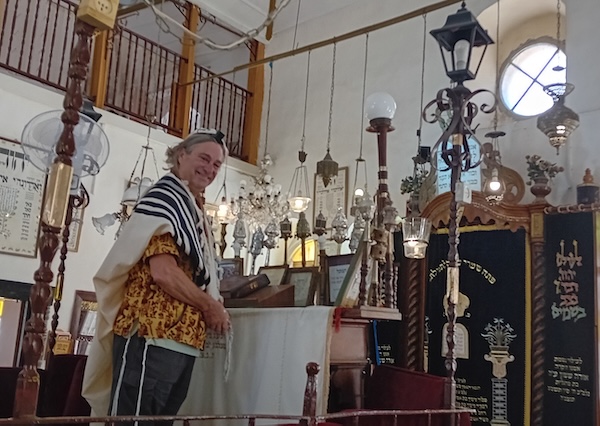
On June 21, at Ohel Yitzhak in Nahalat Shiva, Gil Zohar celebrated the 57th anniversary of his bar mitzvah. (photo Gil Zohar)
Man plans, God laughs, goes the Yiddish aphorism. For the last half year, I have been diligently learning the trope of Parshat Shelach Lecha (the Torah portion meaning Send for Yourself) to celebrate the 57th anniversary of my bar mitzvah, which I had when I was a boy in Toronto. My wife Randi and I had planned a kiddush at the historic Beit HaRav Kook synagogue near our home in downtown Jerusalem. We are members there, and enjoy the leadership of Rabbi Yitzhak Marmorstein, formerly of Vancouver’s Or Shalom. Alas, the war with Iran started. In accordance with the Home Front Command orders against large public assemblies, the shul closed. And so, we considered canceling the simchah.
While all but Jerusalem’s most essential businesses were locked down tight as a drum, the wartime defence regulations allowed synagogues near a bomb shelter to keep their doors open, with limited attendance. Hence, Ohel Yitzhak, the Sephardi synagogue in our courtyard in Nahalat Shiva, built in 1888, remained open. And so, we switched the venue from the former home and yeshivah of Abraham Isaac Kook (1865-1935) – the first Ashkenazi chief rabbi of British Mandatory Palestine – to the equally historic synagogue where Ben-Zion Meir Uziel (1880-1953) – Kook’s Sephardi counterpart, who served as nascent Israel’s chief Sephardi rabbi until his death – used to pray.
The illustrious Sephardi landmark, resembling a house of worship in a mellah in Morocco, is close to the Herbert Samuel Hotel, which opened its miklat (bomb shelter) to the public as well as hotel guests. So, on June 21, undeterred by the spectre of a ballistic missile salvo, I was called up to chant Maftir and read the Haftarah.
What’s it like when the air-raid sirens sound nightly and warplanes roar through the starry sky? Lori Nusbaum of Toronto, who came with her son, Ryan De Simone, for my second bar mitzvah, has been posting on Facebook:
“The 3rd night in Jerusalem and the 3rd siren alert went off; it was 4:35 a.m. Sleep is hard. You don’t want to be in a deep sleep and miss the [cellphone] notifications so you try to have ‘one eye open.’ There’s something strangely intimate about being in a smallish space with a bunch of strangers, some in bathrobes, carrying pillows and blankets, wearing slippers, with sleep still in their eyes. You aren’t sure if you should make eye contact or not. It’s nighttime, so conversation is not really happening. I think we all want to keep sleep in our brains, hope we can go back upstairs quickly and close our eyes for a peaceful rest of the night.”
Like many guests at the synagogue, Lori found my wartime bar mitzvah intensely emotional. “My somewhat unaffiliated son had an aliyah at one of the oldest shuls in Jerusalem,” she posted on Facebook. “Our friend, whose bar mitzvah we came to witness, literally took the tallit off his back to wrap around my son so he could go to the bimah. With tears in my eyes, so many emotions washed over me. Too many to describe adequately. This is what Israel is all about. The people who in the middle of a war come together, pray, help each other and celebrate life together. And give you the proverbial shirt off their back.”
The grim situation in which we find ourselves today parallels the Torah reading of Shelach Lecha (Numbers 13:1-15:41) and its equally pertinent Haftarah (Joshua 2:1-24).
Returning after 40 days of reconnoitring the Promised Land, the spies sent by Moses reported: “We went into the land to which you sent us, and it does flow with milk and honey! Here is its fruit [showing a huge cluster of grapes hanging from a stave, today the symbol of the Ministry of Tourism, proudly worn by every licensed tour guide]. But the people who live there are powerful, and the cities are fortified and very large.”
Then, Calev ben Yefune shushed the crowd declaring, “We should go up and take possession of the land, for we can certainly do it.”
Ten of his fellow spies (all except Joshua) disagreed – “We can’t attack those people; they are stronger than we are” – and they spread a slanderous report about the land they had probed. Misunderstanding the many funerals they had witnessed because of the plague God had sent so that the spies would go unnoticed, they said, “The land we explored devours its inhabitants. All the people we saw there are of great size. We saw the Nephilim there [the descendants of the giant Anak]. We seemed like grasshoppers in our own eyes, and we looked the same to them.”
Grasshoppers? They might as well have called the Jewish people cockroaches.
In the words of Rabbi Lord Jonathan Sacks ztz”l, this dibbat ha’aretz (slanderous report about the Land of Israel) is the language of fear and demoralization. They are big, we are small. They are strong, we are weak. They do not fear us, but we fear them. We cannot prevail.
Was this, in fact, the case? As the Haftarah makes clear, the 10 scouts could not have been more mistaken. A generation later, Joshua bin Nun too sent two spies – the same Calev, and Pinchas ben Zimri. They slept on the roof of a house belonging to Rahav the prostitute, which formed part of the walls of Jericho. Hearing about the spies, the city’s king ordered his soldiers to arrest them, but Rahav hid them and misdirected the guards. What is more interesting is what she tells the spies of the feelings of Jericho’s residents when they heard that the Israelites were on their way:
“I know that the Lord has given this land to you and that a great fear of you has fallen on us, so that all who live in this country are melting in fear because of you. We have heard how the Lord dried up the water of the Red Sea for you when you came out of Egypt, and what you did to Sihon and Og, the two kings of the Amorites east of the Jordan, whom you completely destroyed. When we heard of it, our hearts melted and everyone’s courage failed because of you, for the Lord your God is in heaven above and on the earth below.”
Like contemporary Gazans and Iranians, the people of Jericho were anything but giants – they were terrified of us. The spies of Moses’s day should have known this. They had already said in the song they sang at the Red Sea: “Nations heard and trembled; terror gripped Philistia’s inhabitants / The chiefs of Edom were dismayed / Moab’s leaders were seized with trembling / The people of Canaan melted away.”
How did 10 of the spies so misinterpret the situation? They misunderstood Moses’s instructions: “Alu zeh b’Negev v’alitem et ha-har” – ascend (alu) through the south, and ascend (va’alitem) the mountain. The word “ascend” (aliyah in Hebrew) also means to overcome. (When Martin Luther King Jr. famously said, “We shall overcome,” he was citing this verse.) The spies lacked the faith that the land would be theirs, despite God’s promises, and 39 years of wandering in the desert followed.
The Jewish people, in Israel and the diaspora, experienced a crisis of confidence in 1313 BCE following the Exodus from Egypt, on the eve of entering the Promised Land. Not so today. We have no such hesitations as the Israel Defence Forces battle the regime of the latter-day Haman in Iran and its Hamas, Hezbollah and Houthi proxies. Our response is to follow Moses’s instructions: “Alu.” Ascend. Overcome. Make aliyah.
To that end, I invite you to celebrate Parshat Shelach Lecha with me at Beit Ha Rav Kook (9 Rabbi Kook St.) on June 13, 2026. Next year, in peaceful Jerusalem.
Gil Zohar is a writer and tour guide in Jerusalem.
בתור אחד שגר בישראל ארבעים וחמש שנים אני מכיר מקרוב את היהירות הישראלית שרק הולכת ומתעצמת כל הזמן. הישראלים יודעים הכל, הם מבינים הכל, ישראל היא המדינה החשובה בעולם, והישראלים יכולים להסביר בקלות ללא ישראלים: מה צריך לעשות, כיצד לפעול, מה חשוב באמת ועד כמה הישראלים הם מה שבאמת חשוב
נראה לי שהניצחון הגדול במלחמת ששת הימים שהפך את ישראל למעצמה צבאית עליונה, כאשר כל מדינות העולם מכירות בהצלחתה הגדולה, היא נקודת הציון המשמעותית, כאשר מאותה עת היהירות בישראל הלכה וגדלה, הלכה והתעצמה
אנו זוכרים היטב את הכבוד הגדול לו זכרו הבכירים בצבא לאור הניצחון במלחמה שארכה רק שישה ימים. כל הדלתות נפתחו בפניהם, כולם רצו להיצמד אליהם וליהנות מחברתם. מאז גם מדד השחיתות בישראל החל לעלות וכיום הוא נוגע בשמים
תוצאות המלחמה הביאו את ישראל לשלוט בשטחים הכבושים ומאז נולדה תנועת המשיחיות שהקימה התנחלויות באזורים אלה ופגעה קשות באזרחים המקומיים הפלסטינים. גם אצל המתנחלים שמספרם הולך וגדל במשך השנים, היהירות היא תכונה בולטת אשר גורמת לנזק גדול למדינה ואזרחיה
בין הבודדים שיצא נגד חגיגות הניצחון במלחמה היה פרופ’ ישעיהו ליבוביץ’, שטען כי הניצחון ובעקבותיו אחזקת השטחים הכבושים יביאו נזק גדול לישראל בהמשך הזמן. נביא הזעם ליבוביץ’ צדק וישראל הולכת בכיוון הלא נכון, אזרחיה מפוצלים ללא אפשרות של איחוד, ממשלתה מושחתת והיא מבודדת יותר מתמיד בעולם
לאור היהירות הישראלית בעקבות תוצאות מלחמת ששת הימים, ישראל לא הייתה מוכנה וחטפה על הראש מהמצרים והסורים במלחמת יום כיפור. לממשלה, לצבא ולאזרחים בכלל היה ברור כי אף אחד לא יוכל על ישראל ואין סיכוי שהיא תופתע. המציאות הוכיחה אחרת
אחרי מלחמת יום כיפור ועדת החקירה הממלכתית, חשבנו לרגע שתהיה ירידה משמעותית במדד היהירות הישראלי אך טעינו. לא מעט ישראלים ירדו מהמדינה לאור השבר הגדול שנוצר אז, אך בחו”ל הם המשיכו לנהוג ביהירות ושחצנות לא פחותה מזו שבישראל
ואם לא הספיק המחדל הנוראי של מלחמת יום כיפור, כעבור חמישים שנה שוב היהירות והשחצנות הישראלית, הביאו את המחדל הקשה ביותר בתולדות המדינה והוא של השבעה באוקטובר. בישראל חשבו שהצבא מוכן, שהמודיעין יודע, שהגדר האלקטרונית תגן על ישראל ובעיקר יודעת הכל ממשלת נתניהו היהירה והמושחתת – וכמובן כל המערכות קרסו מול מחבלי החמאס הנוראים
אייר קנדה לא חוזרת לישראל
אייר קנדה חברת התעופה הקנדית, שהייתה אמורה לחדש את טיסותיה לישראל במהלך חודש יוני הודיעה על דחייה נוספת וצפויה לחדש טיסותיה רק בספטמבר. זאת בעקבות המצב הביטחוני והטיל ששוגר מתימן ונחת בשטח נמל התעופה בן גוריון
מנכ”לית אייר קנדה בישראל, רות בן צור, אומרת כי לאחר בדיקה מעמיקה עם גורמי הביטחון, הוחלט בחברה שלא לחדש את הטיסות לישראל. אייר קנדה מחוייבת לישראל ולהמשיך לטוס אליה, כי שהיא עושה כבר למעלה משלושים שנה. כמובן החברה מחוייבת גם ללקוחות הרבים שלה. אייר קנדה תמשיך לפעול בנחישות כאשר יתאפשר לה לחדש את הטיסות לישראל, ולספק את השירות המקצועי והאיכותי שהלקוחות רגילים אליו. אליו הערכים החשובים לאייר קנדה
כזכור אל על הפסיקה את הטיסות הישירות לקנדה במהלך חודש אוקטובר לפני כשלוש שנים. באל על הסבירו את ההחלטה על רקע חוסר כדאיות כלכלית, והמטוסים הוסטו ליעדים רווחים יותר. מדובר בהחלטה תמוהה במקצת לאור כך שבקנדה יש את אחד מהריכוזים הגדול של יהודים וישראלים בעולם
You may not know there is an election underway. Voting to elect delegates to the Canadian Zionist Federation closes Sunday, so you still have time to cast your ballot.
Although some of us have been receiving emails urging us to vote, it’s likely that most of us don’t even know there is campaign going on. It’s not front-page news.
Those chosen in the CZF election on Sunday will become delegates to the 39th World Zionist Congress, in Jerusalem, in October. (The legendary First Zionist Congress was convened by Theodor Herzl, in Basel, Switzerland, in 1897.)
Even if you haven’t yet heard about the elections, we think it’s worth taking a few moments to familiarize yourself with the slates, their platforms, and the role of CZF in connecting Canadian Jews to Israel. We encourage you to take this opportunity to have a small but important voice in the future of Zionism and our relationship with the Jewish homeland. Registering to vote costs $2.
The Canadian Zionist Federation is a national affiliate of the World Zionist Organization, and is comprised of 11 national Jewish Zionist organizations. These include the religiously affiliated groups ARZA Canada, “the Zionist voice of the Canadian Reform movement,” the Conservative movement’s MERCAZ Canada, and the Orthodox Eretz HaKodesh; political groups affiliated with Israeli parties, including Likud Canada, Herut Canada and Meretz Canada; ethnically oriented groups like Shas Olami, affiliated with the Sephardi and Mizrahi Orthodox party Shas, and Mizrahi Canada; and a linguistic grouping, the Canadian Forum of Russian-Speaking Jewry, as well as the non-denominational, non-partisan youth group Young Judaea, and Ameinu Canada, “a national, multi-generational community of progressive Jews in Canada, the United States, Australia and Brazil.” The slates in this election reflect and overlap within and across these groupings.
The World Zionist Organization styles itself as “the parliament of the Jewish people,” and it convenes every five years. WZO sets priorities for the Zionist movement worldwide. It is the main global voice on policy around Israel-diaspora relations, on such topics as Jewish education funding abroad, aliyah and religious recognition. The WZO allocates hundreds of millions of dollars in funding through Zionist institutions like the Jewish Agency, Keren Hayesod (United Israel Appeal) and Jewish National Fund.
Through the Canadian Zionist Federation – and then via the World Jewish Congress – each of us is granted a say in these essential issues. If you care about Israel and its relationship with the diaspora, and you would like to have a voice in the direction of that relationship, this is one important avenue.
Take time to peruse the platforms of the various groups vying for your vote. You may want to place particular attention on issues around the preservation of Israeli democracy, and legal protections and social equality for women and minorities in the country. Perhaps one or more of the platforms will reflect your views on how Israel can work toward peace while protecting its citizens and ensuring the long-term security of its borders.
Read the materials and see which slate best reflects your opinion on how many millions of dollars should be spent to strengthen Jewish life in Israel and worldwide. These elections – and the decisions to be taken at the Congress to which the delegates will be sent – represent the values and priorities of world Jewry.
Israel and Jews collectively are at an unprecedented moment – and while, by definition, every moment is unprecedented, especially in Jewish history, this feels different.
Perhaps you didn’t know you were eligible to vote. Maybe you were only vaguely aware of the Canadian Zionist Federation and what it does. You had probably heard of the First Zionist Congress but maybe didn’t know that the through-line in Zionist history continues from Basel in 1897 to Jerusalem in 2025.
Now you know a little more. Dive deeper. And, on or before Sunday, vote at czf.ca.
Pelicans and cranes gather at Hula Lake in Israel. (photo from commons.wikimedia.org)
Beginning with the Book of Genesis, we read about the raven and especially about the dove: “After 40 days, Noah opened a window he had made in the ark and sent out a raven, and it kept flying back and forth until the water had dried up from the earth. Then, he sent out a dove to see if the water had receded from the surface of the ground. But the dove could find nowhere to perch because there was water all over the surface of the earth; so, it returned to Noah in the ark. He reached out his hand and took the dove and brought it back to himself in the ark.
“He waited seven more days and again sent out the dove from the ark. When the dove returned to him in the evening, there, in its beak, was a freshly plucked olive leaf! Then Noah knew that the water had receded from the earth. He waited seven more days and sent the dove out again, but this time it did not return to him.”
In Deuteronomy 32, we read that God Himself is compared to a bird: “Like an eagle who rouses its nestlings / Gliding down to its young / So did [God] spread wings and take them / Bear them along on pinions.”
Eagles are so important to our culture that Israel’s 1949/50 rescue of 46,000 Yemenite Jews was named Operation on the Wings of Eagles.
Jews had lived in Yemen for millennia, experiencing both relatively good and more oppressive times. In the 20th century, especially following the United Nations Partition Plan of 1947, conditions worsened. Arab rioters in Aden – then a British protectorate on the southern tip of Yemen – killed at least 82 Jews and, in early 1948, accusations that Jews murdered two Muslim Yemeni girls led to further violence and looting of Jewish homes and businesses.
When news of the young state of Israel’s planned evacuation reached Yemeni Jews, they walked and walked, some from hundreds of miles away, to a refugee camp in Aden. Few of them had seen an airplane before and, to convince them to go aboard, someone painted an eagle with outstretched wings over the door of each craft, reflecting Isaiah’s prophesy: “They shall mount up with wings as eagles.”
Despite the attempt to keep the evacuation secret, the planes going from Yemen to Israel were routinely fired on by Egyptian forces. Pilots were warned that, if they were forced to land in enemy territory, the passengers and perhaps the crew risked being executed. Luckily, this never happened.
Di goldene pave, or the golden peacock, refers to a mythical bird that is a common symbol in Yiddish poetry. For Itzik Manger, the golden peacock symbolized Jewish resilience and optimism, and Israeli singer Chava Alberstein sings a song about the golden peacock, which you can listen to on YouTube.
There is a legend that King Solomon gave the hoopoe – Israel’s national bird – a gold crown, after the bird spreads its wings to protect the king from the sun’s rays. But then people began hunting the hoopoe for its crown. When the bird told this to the king, the king replaced the crown with a crest of feathers.
Although there are several negative comments about the raven and the ostrich in Jewish texts, there are also some positive statements made about them. For instance, the raven brought Elijah bread and meat in the morning and bread and meat in the evening. (I Kings 17:7)
In his prophecy, Micah (1:8) uses the ostrich to show what will become of the faithless. But, while the ostrich generally receives a “bum rap” in Scripture, there is no mention in any sacred Jewish writing of ostriches hiding their heads in the sand. When a threat does appear, the ostrich flattens itself on the ground. With its colouring, it is often able to camouflage itself. Furthermore, when an ostrich senses the danger is too close, it can rapidly run away.

Storks are mentioned in Psalms 104:16-17 and in Jeremiah 8:7 for their beauty, grace and devoted parenting: “Storks in the sky know their seasons; swallows and cranes their migration times; but my people do not know the rulings of Adonai!”
Further, the stork appears on decorative Torah wimpels, long strips of fabric used to bind the scroll when it’s not in use. Once, they were made from the swaddling clothes of a newborn baby. (This custom began in the second half of the 16th century and lasted for a few hundred years.) After the circumcision ceremony, the fabric was cut into segments that were sewn together to form a long sash, which was embellished with painted or embroidered inscriptions and images and donated to the synagogue.
Most storks use Israel just as a stopping off point on their way to and from Europe to Africa. Sadly, according to Israeli wildlife veterinarian Dr. Rona Nadler Valency, many migrating storks are killed or injured along their journey. She blames Israeli electric and wind turbine companies, which, she claims, do not invest in measures to protect the birds.
Although the type of bird is not mentioned, it is said that birds guided the Jewish people and kept watch over their crossing during the splitting of the Reed Sea.
Psalms 84 mentions the sparrow and the swallow: “Even the sparrow has found a home / and the swallow a nest for herself / where she may have her young….”
According to Uzi Paz, author of The Birds of Israel, there are about 470 bird species in Israel today. There are three main reasons for why Israel is a haven for birds. First, for European and West Asian birds, Israel is located on a main migration route to and from Africa; these birds stay in Africa during the European winter and return to Europe when spring comes in Europe. Second, Israel provides a range of habitats. And, third, Israel stands at the crossroads of three continents and assorted climate zones.
When you visit Israel, stop near Caesarea to see the remains of a large mosaic floor that was apparently part of a Byzantine villa. It is called the Bird Mosaic because the centre part of the floor features 120 medallions, each of which contains a bird.
Deborah Rubin Fields is an Israel-based features writer. She is also the author of Take a Peek Inside: A Child’s Guide to Radiology Exams, published in English, Hebrew and Arabic.
מלחמת הזדון של הממשלה נגד המדינה והחברה הישראלית נמשכת ללא הפוגה. התוצאות ניכרות בכל אתר. יו”ר ועדת החוקה ממשיך את מלחמתו נגד המערכת המשפטית. מצרים מאשימה את ישראל בהפרת הסכם השלום ומצמצת את שיתוף הפעולה הדיפלומטי. הולנד ונורווגיה מאיימות בהפסקת שיתוף הפעולה הצבאי והמדיני. ישראל מפליאה להכות בתימן, אבל מספיק טיל תימני אחד כדי לצמצם את מספר הטיסות לישראל מהלך שמבודד את ישראל
הצהרות מדיניות של שרים, בורים ביחב”ל מחבלות במעמדה הבינלאומי של ישראל. דירוג האשראי מצביע על סיכונים כלכליים. מתרחב הנתק בין ביבי נתניהו לדונלד טראמפ. עוד ועוד כתבות של אנשי ימין מוכיחות את הצורך המידי בהחלפת הממשלה שפשטה את הרגל גם מבחינה מדינית וגם מבחינה מוסרית
הסוציאל דמוקרטיה הישראלית מתה והחליפה אותה מין יהדות יהירה, שחצנית מבית שמאי. בעוד ההלכות כמעט כולן הן על-פי בית הילל
ומה נאמר על טראמפ: הוא שונא לוזרים. ברגע שהוא סימן את נתניהו כלוזר, כינה אותו מחסום דרכים להגיע להסדרים ואמר כי מתקפה עצימה חדשה בעזה כפי שנתניהו מתכנן היא מאמץ מבוזבז, הוא לקח אליו את המושכות והטיל את נתניהו לצד הדרך. בממשל האמריקאי גוברת תחושת המיאוס מנתניהו אחרי שטראמפ קרע את המסכה מעל פניו: הוא יודע שהוא נלחם למען הישרדותו הפוליטית בלבד, שהרי טראמפ מבין בזה דבר או שניים, כי גם הוא נרקיסיסט הפועל בעיקר למען עצמו. וברגע שטראמפ הפנים שנתניהו מהתל בו, שאין לו כוונה לסיים את המלחמה בעזה, שאין לו תכנית ליום שאחרי
טראמפ הגיע להסכמות עם החות’ים שלא כללו את ישראל, הודיע על משא ומתן ישיר עם איראן בלי לתת לנתניהו הצצה לפרטיו, ועכשיו כשהוא בסעודיה, חומד את ארמונותיה וכספה, הוא הולך להגיע כנראה להסכמים שלא כוללים נורמליזציה עם ישראל כתנאי לשיתוף פעולה עם ארצות־הברית. נותרנו מאחור, כי ראש הממשלה נתניהו הדיר עצמו – לא כי הוא חשב שהמהלכים שמקדם טראמפ הם רעים, אלא כי הם לא מתחברים לנוכלות האופפת אותו ולא מתאימים למתווה שהגה במוחו כדי להישאר בשלטון ויהי מה
טראמפ נענה לתביעותיו של נתניהו לפני כעשר שנים לצאת מהסכם הגרעין, שאמנם לא היה מושלם אבל היה טוב. היו אלו הימים שבהם נתניהו התייחס לטראמפ בהתנשאות כאל אידיוט שימושי, וניצל את חוסר הבנתו במהלכים מדיניים־ביטחוניים כדי לסובב אותו על האצבע הקטנה. הגלגל התהפך: עכשיו, טראמפ הוא זה שזוקר את אצבעו ונותן לנתניהו להסתחרר עליה. הוא עושה מה שהוא רוצה ומה שנכון בעיניו: מדבר ישירות עם חמאס כדי לשחרר חטופים. גם הוא מבין ששלום עושים עם האויב, גם כשהוא מר ואכזר. מנעד הרגשות של טראמפ מצומצם, אבל נושא החטופים נגע לליבו, והוא נרתם להביא לשחרורם מהמנהרות בעזה
טראמפ דוהר עתה למזרח התיכון כשהוא נחוש לשנות אותו מהיסוד: משימתו היא להביא לסיום המלחמה בעזה, לשחרור החטופים ולשיקום הרצועה. הוא מגייס את סעודיה ושאר מדינות המפרץ כדי להוביל מהלך גדול: גם הסכם עם איראן שנתניהו לא שותף בסודותיו, גם שיתוף מדינות ערב בתכניות היום אחרי בעזה
בימין הישראלי שמחו וצהלו על בחירתו של טראמפ וסילוקו של ביידן. הם טעו לחשוב שהוא יהיה המריונטה שלהם. טראמפ הראה להם שהוא לא סופר אותם: הוא חדור מטרה להביא למהפך של שלום באזור, שישרת אותו היטב – הוא גם יקבל מקטאר ארמון מעופף, וגם סעודיה תזרים מילארדים לארצות־הברית
Last month, 16 students from three different high schools in the Galilee visited Vancouver, where they participated in several activities. (photo by Kristin McIlhenney)
“It is nearly impossible to put into words the profound experience we had in Vancouver,” Dr. Rachel Ravid, co-director of Galilee Dreamers, told the Independent. “For the first time, host families welcomed us directly at the airport – a moment of emotion I will never forget. The level of care and thought given to our visit was evident even before our arrival, through a preliminary Zoom meeting during which we shared about the Galilee Dreamers program and the backgrounds of the students they would be hosting. From afar, we could already feel the warmth that awaited us.”
Galilee Dreamers is a program of Oranim College of Education, in Israel. Established nearly a decade ago, it “brings together Jewish and Arab high school students from northern Israel, cultivating dialogue, empathy and mutual respect, while helping participants explore their personal and collective identities,” Ravid said.
A key aspect of the program is connecting these Israeli students with peers abroad and Galilee Dreamers groups have traveled to cities in several countries, including Canada, where Toronto has participated in previous years. Last month, 16 students from three different high schools in the Galilee came to Vancouver, where they were hosted by 12 local families, visited a few schools and participated in several activities. The delegation then headed to Seattle.
There were six students from Akhva-brotherhood High School in Yarka, a Druze school; five students from Jewish schools Einot Yarden and Misgav Regional High School; and five students from Atid Bir al-Maksur, a Muslim school representing a Bedouin way of life, said Ravid. “The students ranged in age from 16 to 18 and were selected for their leadership potential and their capacity to develop leadership skills.”
The co-director of Galilee Dreamers, Dr. Malek Hujeirat, who is deputy principle at Atid, led the group from there, and Diana Mulla, a Druze English teacher, led the delegation from the Druze school. “I was responsible for accompanying the Jewish students and overseeing the delegation,” said Ravid.
While the process of planning the April 18-25 trip was challenging, Ravid said “the spirit of volunteerism and support from community members in Vancouver was truly remarkable. Marion Rom led the planning team with vision and dedication, alongside Dalia Margalit, who offered support from both near and afar.

“The intention was to create as many opportunities as possible for interaction with different parts of the Vancouver community, in order to better understand the local realities and challenges,” said Ravid. “In parallel, we aimed to connect the visiting students with the natural environment, the region’s history and its diverse cultures.
“Alongside school visits with Jewish students – where we discussed the core values of the Galilee Dreamers and universal values such as solidarity, listening, compassion and empathy – our students also learned what daily life looks like for peers their own age in a different society.
“A key element of the itinerary was community volunteering,” said Ravid, and, at the Jewish Community Garden, the group spent some time working and learning.
The host families also “initiated activities rooted in their own strengths and passions, allowing each student to experience something unique within each household,” added Ravid.
One of those families – Tal and Avital Jarus Hakak, who had two Jewish students stay at their home – “hosted a dinner that included another host family of two Druze students and a hike afterwards. One of us also helped with a tour of UBC,” the couple said.
“The positive impact of this trip on the students’ attitudes towards their peers and teachers from different communities and cultures was heartwarming. We felt like these impacts have a great importance for the future,” said the couple, who were motivated to take part because, they said, “The idea of a youth program for facilitating dialogue between Jewish, Arab and Druze sounded very appealing and interesting, particularly in this time of local and global conflicts.”
Kristin McIlhenney found out about the visit from a friend.
“Knowing I had previously hosted international students, she encouraged me to consider it,” said McIlhenney, who hosted a student from the Bedouin school and teacher Hujeirat, “who also serves as the principal overseeing multiple schools in his village.”
“As an educator, I deeply believe in the transformative power of travel and intercultural exchange to build empathy and global awareness,” she said. “That belief, combined with my background, made me genuinely enthusiastic about supporting the Galilee Dreamers by becoming a host.”
Beyond providing room, board and transportation for her guests, McIlhenney said “the experience organically evolved into something much richer. Groups often gathered in the evenings, leading to shared dinners and deeper connections, both in our home and in others’. It was incredibly moving to hear three languages spoken under our roof, and to learn everything from simple cultural details – like the high price of sushi where they live – to complex and personal perspectives on life in a conflict-affected region.”
For McIlhenney, there were two particularly special benefits of being a host. “First,” she said, “my two elementary-aged sons formed a strong bond with the student who stayed with us. A gifted soccer player, he spent hours playing with them and they even accompanied him to a match where they watched [Lionel] Messi play against the Whitecaps – a memory they’ll cherish for years. Second, as a former educator, I deeply appreciated the profound conversations I had with the principal. Whether while preparing meals, driving or winding down in the evening, our discussions gave me a rare and meaningful glimpse into his reality – and helped me reflect more critically on my own.”
Both McIlhenney and the Jarus Hakaks would “absolutely” host again. And trip co-organizer Rom would “definitely help bring those kids in the northern Galilee next year if they want to come back.”
Rom, Margalit’s brother and Galilee Dreamers co-founder Dr. Desmond Kaplan all went to high school together in South Africa, explained Rom of the local connection to the program and how the Vancouver stop came to be.
Rom and Margalit found the host families, and Margalit, who was out of town when the visit took place, “gave this program ‘legs’ in the early stages of planning,” said Rom.
“I wanted to help because I believe that dialogue and interaction of the Jewish, Bedouin and Druze high school youth in the northern Galilee is one of the most impressive paths to peace in that region,” said Rom.
“The most moving part,” she added, “was when the youth and host families all met together one evening to talk about life in northern Israel since Oct. 7, 2023, and what this program means to them.”
“For my part,” said Margalit, “I agreed to assist in arranging the visit when I heard that the group would be made up of students from the Bedouin, Druze and Jewish communities. At this time of tensions between Israel and Palestine, I felt this was a particularly important aspect of the visit, and of daily life in Israel, that would be very important for the Vancouver Jewish community to hear about.”
“As the region faces heightened tensions and conflict, the lack of mutual understanding and shared vision between Arab and Jewish communities threatens the very fabric of society,” said Ravid. “These divisions are compounded by systemic separations: Jewish and Arab teenagers grow up in separate neighbourhoods and towns, attend schools where different languages are spoken, and rarely – if ever – encounter one another in meaningful ways that could challenge stereotypes and foster understanding. Frameworks that nurture mutual respect, empathy and collaboration are critically absent.
“This reality not only affects the people of Israel,” she said, “but also perpetuates a global lack of awareness about the rich and diverse voices that make up Israeli society. Around the world, young people often have little understanding of the complexities of life in Israel and few models for overcoming divisions to build shared futures.”
Galilee Dreamers “creates safe and meaningful spaces where young people from different backgrounds – who might otherwise remain strangers – build real relationships based on trust, empathy and common purpose,” said Ravid.
“Equally important is the program’s impact on the communities that host us – whether in Israel or abroad,” she continued. “By sharing their personal stories and experiences of living in a complex, multicultural society, Galilee Dreamers offer host communities a window into what grassroots peacebuilding can look like. These encounters inspire interfaith dialogue, foster global solidarity and leave lasting impressions on local families, educators and youth who engage with the group. The mutual learning is profound, and many host communities describe the visit as hopeful, eye-opening and deeply moving.”
While some communities and institutions in Israel and the diaspora “have become more cautious about engaging with programs like Galilee Dreamers” since Oct. 7, “the program continues to operate, with participants expressing a renewed commitment to dialogue and understanding,” Ravid said.

The students who participated in the delegation that came to Vancouver shared with Ravid “that they had never experienced such a meaningful and warm form of hospitality. They spoke about the deep love and care shown to them, and how much the host families prioritized their personal well-being,” she said. “They expressed sincere gratitude for the time and attention their hosts gave to hearing their personal stories – and the stories of their families. The connection was so strong that many of the students affectionately referred to their hosts as their ‘second parents.’
“In addition to the emotional connection, the students also appreciated the opportunity to take part in activities they had never experienced in Israel: from ice hockey games and bike rides, to hiking in nature, riding a ferry, and taking a cable car up a snow-covered mountain. Perhaps most enthusiastically, they spoke about the unique food experiences, especially the sheer number of donuts they joyfully consumed without pause!”
For Ravid, “One of the most emotional moments of the trip was the community gathering toward the end of our stay,” she said. “Each of us shared reflections and feelings from the journey. I was particularly moved by the words of Ezra Shanken, chief executive officer of the Jewish Federation of Greater Vancouver, who said that the Galilee Dreamers’ visit brought out the strengths of the local Jewish community and its ability to mobilize around a meaningful initiative. His emphasis on solidarity was incredibly powerful and deeply relevant – especially in these days, when personal and collective security in Israel and around the world feels fragile.”
Both the Jewish Community Centre of Greater Vancouver and the Jewish Federation contributed to the local visit, the latter helping with the planning as well as funding. There were many other organizations and people that Rom, Margalit and Ravid thanked.
“On the day of departure,” said Ravid, “I saw many tears and heartfelt hugs – testament to the meaningful connections and impact this journey had on both the students and the families.”
The Nova Exhibition commemorates the massacre at the Nova music festival on Oct. 7, 2023. The exhibit is in Toronto until June 8. (photo by Lorraine Katzin)
My friend Karen Shalansky and I, from Congregation Har El, went on a Jewish National Fund tour to Israel in April 2024, traveling with some congregants from Congregation Beth Israel. We were based in Tel Aviv but drove to the south to see the Nova Festival Memorial and the car cemetery. (See jewishindependent.ca/reflections-on-april-mission.)
When I heard of the Nova Exhibition, which had been traveling to New York, Los Angeles and then Miami, I Googled to see if it was going to be in Toronto. While we live in Vancouver, my husband and I were going to be heading to Toronto for our granddaughter’s Grade 1 siddur celebration. I was able to purchase tickets to the exhibition for May 6, during the time we (and our daughter) were going to be in the city.
Normally, when we go to Toronto, we attend Saturday morning services at our son’s synagogue, the Village Shul. It just so happened that, on the Shabbat of our visit, the guest speaker was Ophir Amir, one of the founders of the Nova music festival and one of the producers of the Nova Exhibition. Amir was shot in both legs by Hamas terrorists on Oct. 7, 2023. He survived, but so many of his friends did not. He shared: “While I was hiding from the terrorists, I thought about my wife, who was pregnant, and that’s what saved me.”

The Nova Exhibition tells the stories of the victims and helps this community begin to heal – we will dance again.
The first part of the exhibit is a movie. It shows people having fun, enjoying life, singing and dancing, until 6:29 a.m. on Oct. 7, when the music stops and security starts shouting “Red alert! Tzeva adom!” as they could see the rockets flying over Israel. They tell everyone to go home. The movie ends.
We were then led to another room for a reenactment of what came next. There were different TV screens showing how the Hamas terrorists came through the fence, the continuous firing of their weapons, the continuous shouting of “Allah Akbar!”
The next area is filled with belongings from the festival, which include tents, sleeping bags, chairs, clothes, snacks, trees, the market, featuring various items, portable toilets, the bar, freezer chests, burnt-out cars, shelters, and more. By each display there is a TV screen with a survivor telling their story. One young girl lost 15 friends, another young man lost more than 40 friends, a mother lost two of her daughters. Many different stories of loss, as well as stories of heroism.
On one wall of the exhibit are photos of the Nova hostages still held in captivity by Hamas. On another wall are photos of all the people at the Nova festival who were murdered on Oct. 7 – as well as their hats, shoes, other clothing and knickknacks.

As you walk through the exhibit, it shows how the larger community is helping with the psychological trauma, the grieving process, the bereavement, the difficulties of survivors to function day-to-day. All the proceeds from the exhibition are dedicated to helping heal and rehabilitate survivors, commemorate those who were lost, and support the bereaved families.
We spent two-and-a-half hours walking around and reading testimonies. We came out emotionally drained. Our Israeli brethren are resilient, they have ruach, spirit, and they are dancing again.
The Nova Exhibition runs until June 8 at 1381 Castlefield Ave., in Toronto. For more information, visit novaexhibition.com.
Images from the exhibition: