Skip to content

  • Home
  • Subscribe / donate
  • Events calendar
  • News
    • Local
    • National
    • Israel
    • World
    • עניין בחדשות
      A roundup of news in Canada and further afield, in Hebrew.
  • Opinion
    • From the JI
    • Op-Ed
  • Arts & Culture
    • Performing Arts
    • Music
    • Books
    • Visual Arts
    • TV & Film
  • Life
    • Celebrating the Holidays
    • Travel
    • The Daily Snooze
      Cartoons by Jacob Samuel
    • Mystery Photo
      Help the JI and JMABC fill in the gaps in our archives.
  • Community Links
    • Organizations, Etc.
    • Other News Sources & Blogs
    • Business Directory
  • FAQ
  • JI Chai Celebration
  • JI@88! video
image - Weizmann Canada Physics Tournament 2025
image - The CJN - Visit Us Banner - 300x600 - 101625

Recent Posts

  • Vrba monument is unveiled
  • Music to build bridges
  • A better future possible
  • Anne Frank exhibit on now
  • Human rights in sport
  • Telling the story of an icon
  • Crawl bigger than ever
  • JCC Maccabi in Toronto
  • A way to meet fellow Jews
  • Time to include
  • Add Jewish joy to the mix
  • Reminder of humanity’s light
  • From the archives … editorials
  • Year-round holiday recipes
  • מדוע עזבתי את ישראל ואינני חושב לחזור ארצה
  • OJC hosts Oct. 7 memorial
  • A journey beyond self
  • Antisemitism a problem
  • Young man is missed
  • Orr action sparks complaint
  • Prison sentence for hate
  • Etgar Keret comes to Vancouver
  • New fall lecture series
  • Series explores music
  • Doc on Zapiro screens Nov. 6
  • Joy of shared existence
  • Community milestones … October 2025
  • MAID vs Jewish values
  • Cheshvan a great month, too
  • Bull, bear or bubble?
  • From the archives … a coin, etc.
  • מדוע האנטישמיות הולכת וגואה בעולם
  • New bio gives Vrba his due
  • Joy brighter than ever
  • When approaches differ
  • New leadership at the JCCV

Archives

Follow @JewishIndie

Tag: bar mitzvah

Parshat Shelach Lecha

Parshat Shelach Lecha

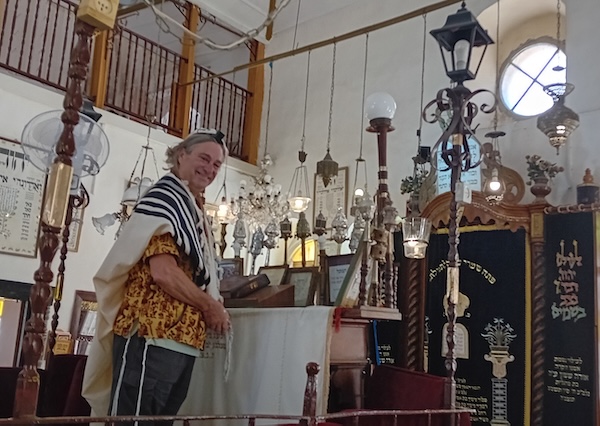
On June 21, at Ohel Yitzhak in Nahalat Shiva, Gil Zohar celebrated the 57th anniversary of his bar mitzvah. (photo Gil Zohar)

Man plans, God laughs, goes the Yiddish aphorism. For the last half year, I have been diligently learning the trope of Parshat Shelach Lecha (the Torah portion meaning Send for Yourself) to celebrate the 57th anniversary of my bar mitzvah, which I had when I was a boy in Toronto. My wife Randi and I had planned a kiddush at the historic Beit HaRav Kook synagogue near our home in downtown Jerusalem. We are members there, and enjoy the leadership of Rabbi Yitzhak Marmorstein, formerly of Vancouver’s Or Shalom. Alas, the war with Iran started. In accordance with the Home Front Command orders against large public assemblies, the shul closed. And so, we considered canceling the simchah.

While all but Jerusalem’s most essential businesses were locked down tight as a drum, the wartime defence regulations allowed synagogues near a bomb shelter to keep their doors open, with limited attendance. Hence, Ohel Yitzhak, the Sephardi synagogue in our courtyard in Nahalat Shiva, built in 1888, remained open. And so, we switched the venue from the former home and yeshivah of Abraham Isaac Kook (1865-1935) – the first Ashkenazi chief rabbi of British Mandatory Palestine – to the equally historic synagogue where Ben-Zion Meir Uziel (1880-1953) – Kook’s Sephardi counterpart, who served as nascent Israel’s chief Sephardi rabbi until his death – used to pray.

The illustrious Sephardi landmark, resembling a house of worship in a mellah in Morocco, is close to the Herbert Samuel Hotel, which opened its miklat (bomb shelter) to the public as well as hotel guests. So, on June 21, undeterred by the spectre of a ballistic missile salvo, I was called up to chant Maftir and read the Haftarah. 

What’s it like when the air-raid sirens sound nightly and warplanes roar through the starry sky? Lori Nusbaum of Toronto, who came with her son, Ryan De Simone, for my second bar mitzvah, has been posting on Facebook:

“The 3rd night in Jerusalem and the 3rd siren alert went off; it was 4:35 a.m. Sleep is hard. You don’t want to be in a deep sleep and miss the [cellphone] notifications so you try to have ‘one eye open.’ There’s something strangely intimate about being in a smallish space with a bunch of strangers, some in bathrobes, carrying pillows and blankets, wearing slippers, with sleep still in their eyes. You aren’t sure if you should make eye contact or not. It’s nighttime, so conversation is not really happening. I think we all want to keep sleep in our brains, hope we can go back upstairs quickly and close our eyes for a peaceful rest of the night.”

Like many guests at the synagogue, Lori found my wartime bar mitzvah intensely emotional. “My somewhat unaffiliated son had an aliyah at one of the oldest shuls in Jerusalem,” she posted on Facebook. “Our friend, whose bar mitzvah we came to witness, literally took the tallit off his back to wrap around my son so he could go to the bimah. With tears in my eyes, so many emotions washed over me. Too many to describe adequately. This is what Israel is all about. The people who in the middle of a war come together, pray, help each other and celebrate life together. And give you the proverbial shirt off their back.”

The grim situation in which we find ourselves today parallels the Torah reading of Shelach Lecha (Numbers 13:1-15:41) and its equally pertinent Haftarah (Joshua 2:1-24).

Returning after 40 days of reconnoitring the Promised Land, the spies sent by Moses reported: “We went into the land to which you sent us, and it does flow with milk and honey! Here is its fruit [showing a huge cluster of grapes hanging from a stave, today the symbol of the Ministry of Tourism, proudly worn by every licensed tour guide]. But the people who live there are powerful, and the cities are fortified and very large.”

Then, Calev ben Yefune shushed the crowd declaring, “We should go up and take possession of the land, for we can certainly do it.”

Ten of his fellow spies (all except Joshua) disagreed – “We can’t attack those people; they are stronger than we are” – and they spread a slanderous report about the land they had probed. Misunderstanding the many funerals they had witnessed because of the plague God had sent so that the spies would go unnoticed, they said, “The land we explored devours its inhabitants. All the people we saw there are of great size. We saw the Nephilim there [the descendants of the giant Anak]. We seemed like grasshoppers in our own eyes, and we looked the same to them.”

Grasshoppers? They might as well have called the Jewish people cockroaches.

In the words of Rabbi Lord Jonathan Sacks ztz”l, this dibbat ha’aretz (slanderous report about the Land of Israel) is the language of fear and demoralization. They are big, we are small. They are strong, we are weak. They do not fear us, but we fear them. We cannot prevail.

Was this, in fact, the case? As the Haftarah makes clear, the 10 scouts could not have been more mistaken. A generation later, Joshua bin Nun too sent two spies – the same Calev, and Pinchas ben Zimri. They slept on the roof of a house belonging to Rahav the prostitute, which formed part of the walls of Jericho. Hearing about the spies, the city’s king ordered his soldiers to arrest them, but Rahav hid them and misdirected the guards. What is more interesting is what she tells the spies of the feelings of Jericho’s residents when they heard that the Israelites were on their way:

“I know that the Lord has given this land to you and that a great fear of you has fallen on us, so that all who live in this country are melting in fear because of you. We have heard how the Lord dried up the water of the Red Sea for you when you came out of Egypt, and what you did to Sihon and Og, the two kings of the Amorites east of the Jordan, whom you completely destroyed. When we heard of it, our hearts melted and everyone’s courage failed because of you, for the Lord your God is in heaven above and on the earth below.”

Like contemporary Gazans and Iranians, the people of Jericho were anything but giants – they were terrified of us. The spies of Moses’s day should have known this. They had already said in the song they sang at the Red Sea: “Nations heard and trembled; terror gripped Philistia’s inhabitants / The chiefs of Edom were dismayed / Moab’s leaders were seized with trembling / The people of Canaan melted away.”

How did 10 of the spies so misinterpret the situation? They misunderstood Moses’s instructions: “Alu zeh b’Negev v’alitem et ha-har” – ascend (alu) through the south, and ascend (va’alitem) the mountain. The word “ascend” (aliyah in Hebrew) also means to overcome. (When Martin Luther King Jr. famously said, “We shall overcome,” he was citing this verse.) The spies lacked the faith that the land would be theirs, despite God’s promises, and 39 years of wandering in the desert followed.

The Jewish people, in Israel and the diaspora, experienced a crisis of confidence in 1313 BCE following the Exodus from Egypt, on the eve of entering the Promised Land. Not so today. We have no such hesitations as the Israel Defence Forces battle the regime of the latter-day Haman in Iran and its Hamas, Hezbollah and Houthi proxies. Our response is to follow Moses’s instructions: “Alu.” Ascend. Overcome. Make aliyah.

To that end, I invite you to celebrate Parshat Shelach Lecha with me at Beit Ha Rav Kook (9 Rabbi Kook St.) on June 13, 2026. Next year, in peaceful Jerusalem. 

Gil Zohar is a writer and tour guide in Jerusalem.

Format ImagePosted on June 27, 2025June 26, 2025Author Gil ZoharCategories Op-EdTags bar mitzvah, Israel, Judaism, Ohel Yitzhak, Shelach Lecha, Torah portion, war

Complexities of celebration

My family’s in the middle of a month of celebrations. June is always this way at our house, but it’s even more intense this time around.

In a “usual” June, we celebrate two family birthdays and a wedding anniversary; it’s also the end of school for our kids. This year, we started off with a bang. Our twins had their birthday on Erev Shavuot. In the morning, we joined the huge Pride Parade festivities. In the evening, our community, in Winnipeg, had a Tikkun Leil Shavuot (a traditional night of study at the beginning of the holiday) with hundreds participating from four congregations. While we ate dairy foods and celebrated, to our surprise, the whole room sang our kids a rousing version of Yom Huledet Sameach (Happy Birthday). It was something to remember – they were surrounded by smiles and learning.

Shavuot is celebrated in a lot of ways. It’s a first fruits and first wheat harvest holiday. It’s also the day that we celebrate the giving of the Torah and read the Book of Ruth. Some observe this holiday as a day of radical inclusion, when everyone, no matter your age or gender, should hear the Ten Commandments read.

Radical inclusion is something I think about a lot. This year, my nephew in Virginia, LJ, who has cerebral palsy and uses a power wheelchair and assisted communication device, celebrated Shavuot with his confirmation class at Temple Rodef Shalom, a Reform congregation near Washington, DC. He gave a speech at the service, carefully planned, about the intersection of his identities as a Jewish and disabled person and as an advocate for accessibility. He spoke eloquently about how Judaism teaches us to pursue justice, and how he works to help make that possible. LJ has given many speeches: on how others can learn about assisted communication, on how to teach math to those with visual disabilities, and on myriad other topics. At 16, LJ is already an accomplished advocate who rolls into rooms filled with adults and shows them new ways to help learners with disabilities.

During his recent speech, LJ mentioned how his religious school helpers have gone on to helping professions: speech pathology, special education, and more. It’s true that some see people with disabilities as having high needs, but all people have things to teach others and to give the world. LJ’s need for physical support results in a huge net positive. He positively affects the lives of many others around him.

At the Tikkun Leil Shavuot I attended, Rabbi Yosef Benarroch (who served in the 1990s as spiritual leader of Beth Hamidrash in Vancouver) gave the keynote. Benarroch is retiring from Congregation Adas Yeshurun-Herzlia here in Winnipeg and moving back to Israel to join his family. His address reminded us about all the ways in which we can help one another and perform acts of chesed (kindness) towards others. His summary of a day in the life of a congregational rabbi made me feel tired! However, it was filled with ways he was of service to others, while getting to do mitzvot (commandments) and sharing important moments in people’s lives.

I’d be the first to say that, sometimes, as a mom, helping meet others’ needs can be exhausting. There are years where I look ahead to June and think, “Wow, I’ll be making a lot of birthday cake – and how many holiday and celebratory meals?” Yet, hearing these two different perspectives, on Jewish advocacy and acts of kindness, really raised me up. It reminded me of how much there is to do in the world, and how lucky we are if we’re healthy, capable and able to do it.

Right now, in Manitoba, we’re coping with huge wildfires and many evacuees. As the bossy mom, I forced everyone to go through their closets so we could participate in the donation drives, because something like 17,000 people have been forced to flee their homes. One of my family members said, “We just donated stuff! We probably don’t have anything to offer!” Three bags of clothing (women’s, men’s and teens’) and blankets later, we were dropping off what we could find before Shavuot started. I reminded my 14-year-olds that this was their birthday mitzvah – the traditional extra commandment that they took on – and we celebrated it through the smoky morning. 

If you’re like me, it can be a struggle to relax into a wholehearted celebration while holding so much in our hearts at once. Whether it’s the hostages in Gaza, the war, the wildfires, antisemitism worldwide or issues closer to home, it’s understandable if it’s difficult to be completely joyful. Yes, we are commanded to celebrate at certain times, but I am reminded of the traditions of Jewish weddings. At every Jewish wedding, we break a glass to remind ourselves of the loss of the Temple in Jerusalem. We hold a bittersweet feeling of grief and pain even at our most meaningful moments. This acknowledgement doesn’t keep us from continuing to hope, to celebrate, while including everyone.

Today, I’ve had the honour of visiting a longtime family friend in the hospital. I brought her snacks and flowers from our garden. She’s just undergone surgery after a fall. I was relieved to find her in good humour. I’ve gotten to cook a bit for her family, as well as mine, and found time to work, walk the dog and even pull up copious weeds. Every handful of invasive greenery removed showed me the flowering plants underneath. I celebrated the riotous colour of both the weeds and the irises. 

There’s no guarantee that every moment will be happy or every summer a celebration. Still, we have so many opportunities to do kindnesses, perform mitzvahs and be there to advocate for one another. If Shavuot sticks with me long after it ends, it’s not because of cheesecake or even first fruits. During a month of family celebration this year, Shavout also offered the opportunity to celebrate our tradition, which offers us great gifts if we make the most of them: learning, Torah and radical inclusion, too. 

Joanne Seiff has written regularly for the Winnipeg Free Press and various Jewish publications. She is the author of three books, including From the Outside In: Jewish Post Columns 2015-2016, a collection of essays available for digital download or as a paperback from Amazon. Check her out on Instagram @yrnspinner or at joanneseiff.blogspot.com.

Posted on June 13, 2025June 12, 2025Author Joanne SeiffCategories Op-EdTags bar mitzvah, Judaism, lifestyle, mitzvah, radical inclusion, Shavuot

Importance of rite of passage

Our son, Nissim Shalom, recently became a bar mitzvah, and it is a living reminder for us of our family’s remarkable and ancient history. According to Jewish law, a Jewish boy reaching the age of 13 becomes a bar mitzvah and is responsible for assuming the mitzvot of Jewish adulthood. (A girl becomes a bat mitzvah at the age of 12.) Once a bar mitzvah, a person may be counted in a minyan (prayer quorum) and may lead religious services in the family and the community.

The bar mitzvah age was selected because it roughly coincides with physical puberty (Talmud Niddah, 45b). Prior to a child becoming a bar mitzvah, the child’s parents are responsible for the child’s actions, but b’nai mitzvah bear responsibility for their own actions with respect to Jewish ritual law, ethics and tradition and are able to participate in all areas of Jewish community life.

Upon a boy’s becoming a bar mitzvah, a celebration is made in his honour. The current scale of celebrations is much greater than it used to be in the mellah, or shtetl, of the old countries. In the past, this rite of passage was a joyous matter of course for every Jewish child without exception. In more recent times, however, this milestone is unfortunately not as absolute as it once was. Hence, we celebrate the occasion with more ostentation to highlight the cherished continuity of our heritage.

In the Moroccan community, we have many unique customs.

On the eve of the celebration, the bar mitzvah gets a haircut in the presence of his family and, as in every Moroccan celebration, traditional henna is put on his hand. On the celebratory day, it is customary for the family to help the bar mitzvah boy don tallit and tefillin, thereby showing him how dear this mitzvah is.

Many in the Moroccan community had the custom of taking the boy to a mikvah, stressing the idea of purity and holiness. Some had the custom of snatching the tefillin from the boy, so that the father would be obliged to redeem them with money, thereby demonstrating their importance.

When the bar mitzvah is called to the Torah, it is customary for the women to ululate “lulululu.” This custom originates from a kabbalistic source stating that, in every holy and happy occasion, the evil inclination (yetzer harah) is challenged to act. Thus, the women scream out in order to confuse and to chase away the yetzer harah.

It is hardly an exaggeration to say that the future of the Jewish people depends in large measure upon the bar (and bat) mitzvah event. Education, and particularly education of our young, has been and remains the means by which we continue to thrive, to exist, to ensure the future of Klal Israel. Is it any wonder that we celebrate with such gusto, as families and communities, this uniquely Jewish simchah by which we renew ourselves and our time in Jewish history?

Rabbi Ilan Acoca is a veteran rabbi and educator. He is the rabbi emeritus of Vancouver’s Congregation Beth Hamidrash and currently serves as the rabbi of the Sephardic Congregation of Fort Lee-Bet Yosef, in Fort Lee, N.J., and rav beit hasefer of Yeshivat Ben Porat Yosef, in Paramus, N.J. He is the writer of the book The Sephardic Book of Why and has written hundreds of articles on various topics for different publications.

Posted on February 23, 2018February 21, 2018Author Rabbi Ilan AcocaCategories LifeTags bar mitzvah, bat mitzvah, continuity, education, Judaism
New b’nai mitzvah app

New b’nai mitzvah app

(screenshot from mitzvahtools.com)

Mitzvah Tools 2.0 aims to make every aspect of bar and bat mitzvah preparation easier for everyone involved. The app schedules meetings, keeps track of progress, enables long-distance learning, organizes essential information like the Torah portions and honors at the ceremony, and makes resources for studying available to the student. The architect of the app is Rabbi Dan Moskovitz of Temple Sholom, who is founder and chief executive officer of Mitzvah Tools.

Moskovitz’s interest in digital Torah education tools goes way back. He has been a computer geek since his own bar mitzvah, which took place in the days of the Atari 400. In rabbinical school, he developed software to help him with the Jewish calendar and, while working in a Los Angeles synagogue in 1998, he created a database to track the progress of children studying for their b’nai mitzvah. In 2003, he developed Mitzvah Tools 1.0, a much more limited version of the current platform.

screenshot - from mitzvahtools.comMitzvah Tools 2.0, which was released in June, was developed with the help of Cantor Mark Britowich, director of sales and operations at Mitzvah Tools, who has more than 20 years of experience in b’nai mitzvah education. Vancouver’s Mark Fromson was the project manager and Australia-based Salim Jordan led an international team of programmers.

Mitzvah Tools was completely updated to help synagogues prepare their b’nai mitzvah students. According to the app’s website, “the original was locked in the rigidity of fixed browser widths and ’90s graphics. We kicked some new life into this trusty tool with a fresh identity and comprehensive design system to define its look and feel.”

The entire b’nai mitzvah educational team can interact using Mitzvah Tools to manage the study process together. Each student’s resources and their assignments can be accessed, and the student can attach recordings and send them to their tutor to review. Tutors and other team members can work from any location, and Mitzvah Tools enables video chats between tutor and student.

The app’s multimedia resource bank includes the chanting of every Torah and Haftorah portion. Recordings of prayers, various Torah commentaries and pages of the Tikkun (a book of the text as it appears in the Torah scroll) can all be stored and shared, as well as any other relevant files. All members of the team can communicate with each other, and students and parents can communicate with their team members, as well, with privacy settings available to restrict who can access different conversations.

Since its release in June, Mitzvah Tools is already in some 30 congregations. For more information, visit mitzvahtools.com.

Matthew Gindin is a Vancouver freelance writer and journalist. He blogs on spirituality and social justice at seeking her voice (hashkata.com) and has been published in the Forward, Tikkun, Elephant Journal and elsewhere.

Format ImagePosted on August 19, 2016August 25, 2016Author Matthew GindinCategories LocalTags app, bar mitzvah, bat mitzvah, Mitzvah Tools, Moskovitz, Torah
Proudly powered by WordPress