Pyramids on the Mind

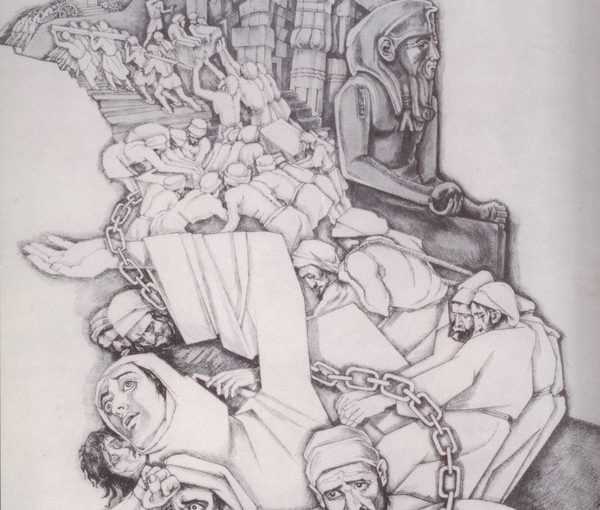
An image from the author’s 1941 Passover Haggadah by Saul Raskin.

Although they are not specifically mentioned in either the Haggadah or in the Torah, Egyptian pyramids have come to be associated with the Pesach story. That many modern Haggadot include illustrations of the pyramids points to how these structures play a key role in our collective memory.

At the Pesach seder, we say, “tze u l’mad,” “go out and learn.” In A Haggadah Happening, Rabbi Shlomo Riskin explains the idea as, “make sure your learning accompanies you wherever you go.” So what better way is there to appreciate the Hebrew slaves’ hardships than to visually present them by tangible symbols, such as the items on the seder plate, as well as the Four Sons, songs like “Ehad Mi Yodaya” (“Who Knows One”) and, of course, the pyramids?

But what specifically drew the Haggadah compilers to the pyramids? First of all, for a period of time, the Hebrews did live in Egypt. Thus, in Exodus, Chapter 5, we read about their involvement in Egyptian construction, where they are portrayed primarily as Egyptian brick-makers, not as builders: “‘Ye shall no more give the people straw to make brick, as heretofore. Let them go and gather straw for themselves.’ And the taskmasters of the people went out, and their officers, and they spoke to the people, saying: ‘Thus saith Pharaoh: “I will not give you straw.”’ So the people were scattered abroad throughout all the land of Egypt to gather stubble for straw. And the taskmasters were urgent, saying: ‘Fulfil your work, your daily task, as when there was straw.’”

Archeologists maintain that, in antiquity, Egyptian homes were constructed from mud bricks. Pyramids, however, were reportedly built of quarried, hewn stone and mud bricks. So, the more persuasive answer as to why modern Jews include pyramids in their Haggadot seems to be the pyramids’ sheer durability. That there are extant pyramids carries tremendous weight when retelling the story of the Hebrews’ time in Egypt – it connects us to our past.

Furthermore, that pyramids are still viewable is not a chance happening, apparently. According to freelance science writer Dr. Craig Freudenrich, the pharaohs built the pyramids knowing that the pyramid, with its square base and four equilateral triangular sides, is “the most structurally stable shape for projects involving large amounts of stone or masonry.”

Moreover, Donald Redford, a professor at Penn State University, reports that the ancient Egyptians probably chose that distinctive form for their pharaohs’ tombs because of their solar religion. The Egyptian sun god Ra, considered the father of all pharaohs, was said to have created himself from a pyramid-shaped mound of earth before creating all the other gods. The pyramid’s shape is thought to have symbolized the sun’s rays.

The shape of the pyramids was carefully chosen to reflect underlying aspects of divine unity. The pyramid has four faces: three faces to the heavens and one face to the earth. Architecture-by-astronomy was common in the ancient world, says archeoastronomer Giulio Magli. The Great Pyramid of Giza, for example, is aligned with amazing precision along the compass points, which would have required the use of the stars as reference points.

Three pyramids were built at Giza, and many smaller pyramids were constructed around the Nile Valley. The tallest of the Great Pyramids reaches nearly 500 feet into the sky and spans an area greater than 13 acres.

What is truly startling is that, with no connection to Egypt, other ancient cultures built pyramids in such far away places as Latin America and in what is, today, southern Illinois, in the United States. Like the ancient Egyptians, these other cultures understood the power and sway the pyramid structure had over the general population. According to history.com editors: “The Americas actually contain more pyramid structures than the rest of the planet combined. Civilizations like the Olmec, Maya, Aztec and Inca all built pyramids to house their deities, as well as to bury their kings. In many of their great city-states, temple-pyramids formed the centre of public life and were the site of holy rituals, including human sacrifice.”

While Egyptian pyramids are closely connected to the sun, Peruvian pyramids were considered to be replicas of mountains; they were thought to possess all the powers the mountains themselves possessed.

Twenty minutes away from St. Louis, Mo., are the remains of the United States’ first high-rises. They are more than 850 years old, constructed by the Cahokia Indians of Illinois. At 5,000 square feet, the house of the great chief or high priest (or another type of leader, since we really don’t know) was the most impressive of all the buildings. From the flat top of this colossus, with a footprint of 14 acres, it is larger at its base than the Great Pyramid of Khufu, Egypt’s largest.

So important is the pyramid as a symbol that it was used on the U.S. one dollar bill. According to the bill’s designer, the pyramid was used because it “signifies strength and duration … a new order of the ages.”

According to Bill Ellis, a professor emeritus of American studies at Penn State, “The pyramid was seen as the kind of human structure that lasted out the ages.” He said America’s Founding Fathers wanted the country to last as long as the pyramid – though the pyramid didn’t show up on the dollar bill until 1935, when Franklin Delano Roosevelt’s administration added them. “New order” is printed in Latin, under the pyramid, and historians say this refers to the birth of a new country and FDR liked the way it synced with his New Deal program.

Whether, in fact, the Hebrew slaves actually built the Egyptian pyramids is of secondary importance, as so many freedom struggles have been based on the tale that the Hebrews had to construct these mammoth buildings until they fled the slavery of Egypt.

Deborah Rubin Fields is an Israel-based features writer. She is also the author of Take a Peek Inside: A Child’s Guide to Radiology Exams, published in English, Hebrew and Arabic.
Kirman Library spans the arts

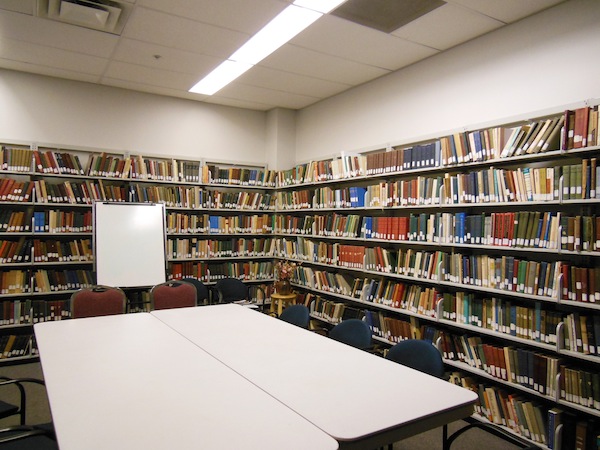
The Kirman English and Yiddish Library at the Peretz Centre for Secular Jewish Culture is available for anyone in the community to access. (photo from Peretz Centre)

“Books are humanity in print” – Barbara Tuchman

The Kirman English and Yiddish Library at the Peretz Centre for Secular Jewish Culture was set up in 1976 by Paula and Shaya Kirman, members of the Peretz Institute – as it was then known – and dedicated Yiddishists. The two main purposes in establishing the library were, first, to collect and preserve the books that were scattered in different places in the community, and, second, to make these books available to the whole community in a lending library.

Paula Kirman, who worked as a cataloguer at the University of British Columbia library, volunteered many hours to set up a card catalogue and shelve the Peretz library in an organized way. Eventually, she resigned from her volunteer position because of a perceived lack of support from the Peretz Institute’s board of directors.

In 1999, in preparation for the construction of the Peretz Centre’s present building (in the same location the institute had been since the 1960s), the library books and card catalogue had to be boxed and removed. With the completion of the new building in 2000-2001, the organization was renamed the Peretz Centre for Secular Jewish Culture and the words of I.L. Peretz, considered by many as the “father” of modern Jewish culture, were prominently displayed above the entrance foyer: “A people’s memory is history; without a history, a people can grow neither wiser nor better.”

Sporadic attempts to restore the library were made, but, when Al Stein returned to Vancouver and joined the centre’s board of directors in 2001, much of the library was still in boxes and Kirman’s card catalogue was in disarray. Stein volunteered to lead the effort to restore the library, if the board would support it in two ways: vote for funding for new shelving and support Stein’s effort to obtain a grant from the Jewish Community Foundation of Greater Vancouver to hire a library technician and digitize the entire library, including the Yiddish books.

The grant proposal was successful. A newly graduated library technician, unfamiliar with Yiddish, was contracted and many hundreds of hours were spent properly transliterating each Yiddish book and journal title, digitizing the entire collection in accordance with the latest electronic library standards, relabeling each book, arranging for electronic hosting of the library catalogue, supervising the installation of new shelving and then, finally, shelving the books and journals in an organized fashion.

Thanks to large and small donations of both English and Yiddish books from individuals, from the Winnipeg Jewish Library and from the Isaac Waldman Jewish Public Library at the Jewish Community Centre of Greater Vancouver, as well as a small number of purchases, the Kirman Library of the Peretz Centre now contains nearly 4,000 books and journals and is almost at capacity. The collection includes titles by kabbalists, rabbis, atheists, historians, politicians, musicians, artists, humourists, and those who wrote fiction, plays and poetry – in other words, the entire spectrum of Jewish creativity, encompassing all the arts.

Most of the collection is now in English and is a unique treasure trove of information and pleasure for the casual reader and the scholar. Two collections are of note. The late Dr. Gersh Winrob donated his English-language collection of Holocaust literature, memoirs, history and analyses, certainly one of the largest in the community. And the late poet Miriam Waddington donated part of her library, mostly English-language literature and essays, with a bit of Yiddish poetry.

The Peretz Centre is a proud member of the Yiddish Book Centre, now the largest Jewish cultural organization in the United States.

The Peretz’s library catalogue may be searched from any computer via the Peretz Centre website, peretz-centre.org: click the Kirman Library tab and then the Catalog link. The library ID is Kirman Library. No password is needed.

Books and periodicals can be borrowed for a $10/year fee. Four items may be borrowed at a time, for a period of four weeks, which may be renewed if no hold has been placed on the item. And the library may be used whenever the Peretz office is open, so call ahead before coming down, or for more information about library policy in general, such as its overdue or lost items policy, or to obtain a library card: 604-325-1812, ext. 1, or execdirector@peretz-centre.org.

If you have any specific questions or comments about the library, or wish to make a donation to it, Stein can be reached at 604 731-1193 or alstein577@gmail.com.

The first of several stories – JMABC @ 50

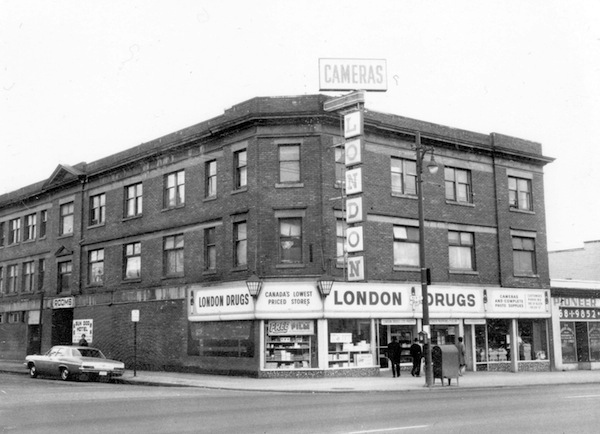
The first London Drugs was located at 800 Main St. The drugstore chain was started by Sam Bass in 1945. (photo from City of Vancouver)

In the 163 years that Jewish people have been living in British Columbia, they have experienced a great many things, and our community history is comprised of millions of stories. It is the ongoing work of the Jewish Museum and Archives of British Columbia to collect, preserve and share these stories.

This year, 2021, is a special one for the museum and archives – it’s the organization’s 50th anniversary. To mark the occasion, the JMABC will be releasing a special commemorative book. The volume is being designed as a keepsake to share with your children and grandchildren, or whichever young people you care about and whom you want to share your story with. It will provide a survey of our community’s rich history, fostering a connection between generations present and the past.

Dozens of community organizations are contributing their own organizational histories. Families and individuals are also invited to participate, either by contributing their family history or by nominating someone who has made a significant impact on the community, the region, or the world through their work, volunteer work, or philanthropy.

Full details about nominating or contributing are available at jewishmuseum.ca/fifty-years. Let the museum know who you think should be included.

Over the next several months, we’ll be publishing profiles of families and individuals to give you a taste of what you can expect in the anniversary publication. In this article, we share the story of Sam Bass, an innovative entrepreneur who left a lasting impact on the local Jewish community, the city of Vancouver and Canada as a whole.

Bass was someone who was never satisfied with the status quo. His restless creativity and business savvy made him an innovator of the modern drugstore. Born in 1915 on a Winnipeg farm to immigrant parents from Kiev, Ukraine, Bass received a diploma in pharmacy in 1939 from the faculty of pharmacy at the University of Manitoba. Following graduation, Bass enlisted, as a pharmacist, in the Royal Canadian Air Force for the Second World War. After the war, he decided to move to California; however, his planned brief stopover in Vancouver turned into permanent settlement.

Shortly after his arrival here in 1945, Bass purchased the old Schoff Drug Store at the corner of Main and Union streets. His first order of business was to change the name to London Drugs, named after London, England, the home of Canada’s then-king, King George VI.

Bass implemented the policy of a low-percentage markup on prescription drugs, he drastically increased the hours for dispensing prescription drugs (9 a.m. to midnight) and opened his store on Sundays. These actions flew in the face of existing conventions that drugstores only sold drugs during regular office hours at an industry-wide agreed-upon dispensing fee.

Bass’s new business model was extraordinarily successful, attracting customers from all over the city. He fought for years to defend his right to offer customers good-quality products and low prices. He went to the extent of advocating his position to the Supreme Court of Canada by appearing before a commission implemented by the federal government to investigate the cost of drugs. The commission eventually proposed five recommendations, three of which were found in Bass’s brief.

He shook up the pharmacy market in yet another important way, offering more than just pharmaceutical and medical items at a time when all stores offered exclusively specialized stock. Soon after the first London Drugs opened, Bass bought a full inventory of cameras and sold them at a discounted price. The gamble was a success and, to this day, cameras and home electronics remain cornerstone items at London Drugs. The practice has now become commonplace, with many large stores selling a wide diversity of products.

This tendency towards innovation gave London Drugs a competitive advantage and brought the company growing profitability. Over the next 20 years, Bass expanded the company to locations throughout the Lower Mainland. In 1968, after 23 years of ownership, he sold London Drugs to an American firm, the Daylin Corp., remaining on as London Drugs’ president until 1976, and overseeing further expansion. In 1976, the company was sold to the H.Y. Louis Group and, today, its stores number 78 across Western Canada.

Bass and his wife Muriel were very involved in the Jewish community and their family has continued their legacy. The Muriel and Sam Bass Family Fund continues to make contributions to Vancouver’s Jewish community following Sam Bass’s death in 1990, and Muriel Bass’s death in 2003.

Sam Bass’s life as a local entrepreneur stretched far beyond his personal success as a business owner. His legacy is represented by the widespread success of London Drugs across Western Canada. Its stores still reflect the business model that he revolutionized more than a half-century ago.

Looking for Sklut family

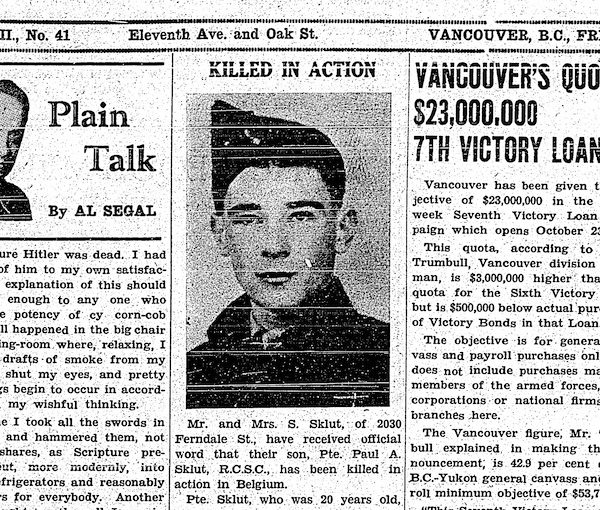
In looking through the Jewish Independent’s archives, after reading this article, this photo of Pte. Paul Sklut was found.

A Belgian tour guide and historian, Niko Van Kerckhoven, wrote to me recently. Van Kerckhoven, 50, and his teenaged son, regularly visit the graves of the Canadian soldiers who were killed liberating his town, called Wommelgem, during the Battle of the Scheldt, which was the Canadian campaign in the area surrounding the crucial port of Antwerp in fall 1944. It cost more than 6,000 Canadian casualties to take it, including that of Jewish volunteer Pte. Paul Sklut.

Van Kerckhoven has found photos of nearly all of the Canadian “boys” whose graves he visits, but not Sklut’s. As he wrote to me, “I’m quite desperate. You are pretty much my last chance for a picture!”

Sklut was the son of Russian-Jewish parents, and the family lived on Ferndale Avenue in Vancouver. It was a short walk to Britannia High School, where he was in the cadet corps, before he graduated.

Sklut’s name was often mentioned in the Vancouver newspapers, for he played competitive tennis, and also gave piano recitals at a venue on Granville Street.

Sklut was studying at the University of British Columbia when he was called up. He had just turned 19 on April 15, 1943. His two brothers, Harry and Donald, were already in uniform, with the army and the Royal Canadian Air Force, respectively. Sklut qualified as an infantry signaller in Kingston, Ont., then shipped out for England in July 1944. He was sent to France on Sept. 11, 1944, attached to the Calgary Highlanders. He was sent into action on Sept. 26. Twelve days later, he was dead.

“Many of them were just arriving here in Europe when they were thrown in this terrible battle of the Scheldt. I know the area well,” Van Kerckhoven wrote. “Many of the replacements died due to lack of training and experience. They really were used to plug the gaps in the infantry, although they were specialists by trade.”

Sklut was wounded on Oct. 8, 1944, and brought to a Canadian medical station that the Royal Canadian Army Medical Corps had set up inside one of the 19th-century forts near Antwerp, known as Fort 2, in Wommelgem. Military records confirm this happened.

Canadian medical personnel with the 18th Canadian Field Ambulance received Sklut at 13:00 hours. He was in really bad shape: he’d already lost his right leg at the knee, and his left leg and knee were fractured. He also had shell wounds in his chest and abdomen.

By 14:00 hours, Sklut was evacuated to the 21st Canadian Field Dressing Station and, then, still in shock, they took him to the Ninth Canadian Field Dressing Station, where he died at 16:30 hours. He was 20 years old.

Locals buried Sklut with other foreign soldiers, about 40 of them, mostly Canadians, in the civilian area of the Candoncklaer Hospital Cemetery in Wommelgen. Later, their bodies were reinterred at the Commonwealth War Graves cemetery in Bergen-op-Zoom, across the border in Holland.

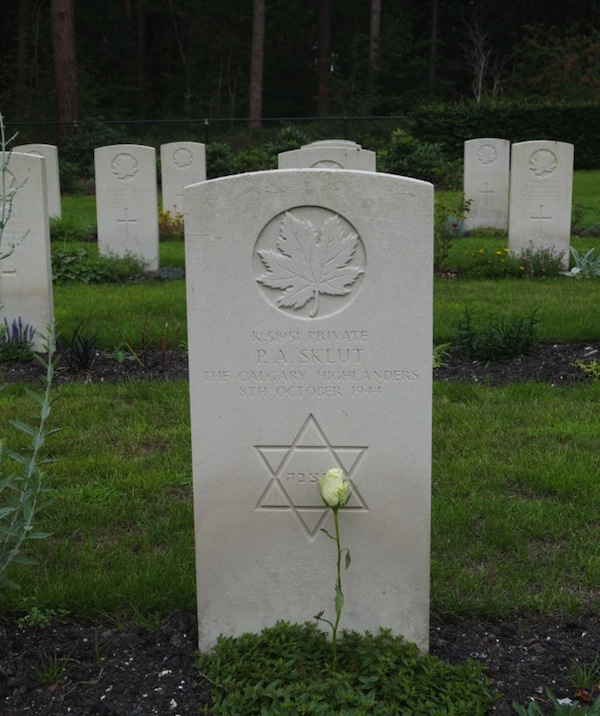
photo - Grave of Pte. Paul Sklut in the Bergen-op-Zoom war cemetery, in Holland
Grave of Pte. Paul Sklut in the Bergen-op-Zoom war cemetery, in Holland. (photo from Niko Van Kerchkoven)

That’s where my Belgian correspondent visits Skult’s grave. Van Kerckhoven is a member of his local historical society in Wommelgen, known as De Kaeck. He would like to find the Sklut family to tell them their relative has not been forgotten; he is also looking for a photo of Sklut.

Contact me through my website, ellinbessner.com, if you are able to help this man as he continues to carry out a mitzvah, although I am not sure he is aware of what that word means. (I will explain it.)

 Ellin Bessner is a Canadian journalist based in Toronto. She is the author of a new book about Canada’s Jewish servicemen and women who fought in the Second World War, called Double Threat: Canadian Jews, the Military and World War II, which was published by University of Toronto Press (2019). She also contributed a chapter to Northern Lights, published by the Lola Stein Institute (2020); it is the story of the contribution of Canada’s Jewish community to the country’s military record from 1750 to today.

Court verdict on Grabowski

Jan Grabowski (photo from facebook.com/TheCJN)

A Polish court’s ruling that a Canadian Holocaust scholar must apologize for tarnishing the memory of a wartime mayor in Poland continues to reverberate around the world.

The case is being condemned by Jewish organizations and historians as an attack on free academic inquiry. Scholars warn the ruling could further chill an already touchy area of research: the role played by Poles in the murder of Jews in Nazi-occupied Poland.

In a long-awaited ruling on Feb. 9, a civil court in Warsaw ordered two prominent Holocaust scholars to apologize to an elderly woman who claimed they had defamed her late uncle over his wartime actions.

Prof. Jan Grabowski, an historian at the University of Ottawa, and Prof. Barbara Engelking, a sociologist and founder of the Polish Centre for Holocaust Research, were accused of defaming Edward Malinowski, the wartime mayor of Malinowo, a village in northeast Poland, by suggesting in a book that he delivered several dozen Jews to Nazi occupiers.

The professors were ordered to apologize for a passage in Night Without End: The Fate of Jews in Selected Counties of Occupied Poland, a two-volume work they co-edited, which the court said “violated Malinowski’s honour” by “providing inaccurate information.”

The court declined a demand for monetary damages of 100,000 Polish zlotys (about $34,000 Cdn) but ordered the scholars to apologize to Malinowski’s niece, 81-year-old Filomena Leszczynska, who brought the case; publish a statement on the website of the Centre for Holocaust Research; and correct the passage in any future edition.

Leszczynska had argued that her uncle had actually aided Jews and was acquitted of collaboration in 1950.

Grabowski, whose father survived the Holocaust, called the outcome “a sad day for the history of the Holocaust in Poland and beyond Poland. I have no idea what will be the consequences as well as the implications of this trial. But I can say for certain this thing will be studied for a long time by historians,” he told the Globe and Mail.

Prior to the verdict, he warned that, if the lawsuit were successful, “then basically it will mean the end to the independent writing of the history of the Holocaust in Poland.”

The professors were sued under a Polish law allowing for civil action against anyone claiming that the Polish nation or state was responsible for Nazi atrocities. The law was amended in 2018 to drop plans to criminalize the offence.

In her ruling, the judge said the decision “must not have a cooling effect on academic research,” but that is how it is being perceived.

As a senior tenured professor, the verdict, Grabowski conceded in a Postmedia interview from Poland, is “unpleasant. But, imagine you are a 25-year-old graduate student of history. Do you think you’re going to embark upon discovery of difficult history? I don’t think so.”

Grabowski and Engelking said they will appeal the ruling.

Mina Cohn, director of the Centre for Holocaust Education and Scholarship at Carleton University in Ottawa, called the campaign against Grabowski and Engelking “ugly.”

“The Polish government’s attempt to discredit them, and to silence and distort the historical facts of the Holocaust in Poland is appalling,” Cohn told The CJN. “It endangers the basic right of the future freedom of historical research of the Holocaust in that country.”

She said that, as daughter and granddaughter of Holocaust survivors with roots in Poland, “I find this blatant attempt by the Polish government to reject the reality of inherent antisemitism within Polish society before and during the Holocaust, and to discredit survivors’ testimonies, very offensive.”

For Prof. Piotr Wrobel, a specialist in Polish history at the University of Toronto’s Munk School of Global Affairs, the case is an example of the current Polish government’s attempt to control the historical record.

“They try to shape the ‘official’ version and persecute people who do not share [it],” he told The CJN. “This is very sad.”

It was “very clearly” the intention of those behind the lawsuit “to freeze scholarly research into the Holocaust. This was supposed to be a warning. Young people should remember this. If your opinions [and] historical interpretations are different than the official ones, then do not touch the Holocaust,” Wrobel said. “There is a choice between comfort and truth.”

In a statement on Feb. 10, the University of Ottawa offered its “unwavering support” to Grabowski and his “widely respected” Holocaust research. The university called the verdict “unjust.”

“Prof. Grabowski’s critical examination of the fate of Polish Jews during World War II shows how knowledge of the past remains vitally relevant today,” said university president Jacques Frémont. “The impact his work has had in Poland, and the censorious reaction it has generated, demonstrates this truth.”

The university “emphatically supports” Grabowski’s “right to pursue historical inquiry unencumbered by state pressure, free from legal sanction and without fear of extrajudicial attack.”

In Israel, the Yad Vashem Holocaust memorial and museum decried the ruling as “an attack on the effort to achieve a full and balanced picture of the history of the Holocaust.”

Even before the verdict, David Silberklang, a senior Holocaust historian in Israel, said the libel case intended for the two scholars to be “sued into submission.”

The decision “damages an open and honest coming to terms with the past,” said Gideon Taylor, president of the Conference on Jewish Material Claims Against Germany, which sponsors historical research on the Holocaust.

Taylor said Poland “must encourage open inquiry into its history, both the positive and the negative aspects.”

Canadian historian Frank Bialystok, who has written extensively about the Holocaust, sees the verdict against Grabowski and Engelking as a flipping of political extremes in Poland.

The murder of Jews in Poland, even after the war, was documented at the time. “This research was acceptable during the communist era as a weapon against nationalism,” said Bialystok. Now, the two professors are being “vilified” by the nationalist camp.

Friends of Simon Wiesenthal Centre said the ruling could have “a devastating impact on Holocaust research and education.” The organization said it is reaching out to senior government leaders, urging them to speak out against “Holocaust distortion in Poland.”

The American Historical Association went so far as to write Polish President Andrzej Duda, saying “a legal procedure is not the place to mediate historical debates” and urged Polish leaders to “uphold the rights of historians to investigate the past without legal harassment and with no fear of reprisals for making public their historical- and evidence-based findings.”

In 2018, Grabowski announced he was suing the government-funded group that backed Leszczynska’s libel case for allegedly libeling him. He claimed that the ultranationalist Polish League Against Defamation had itself defamed him by questioning his findings about the complicity of Poles in the wartime murder of Jews.


This article originally was published on facebook.com/TheCJN. For more on Prof. Jan Grabowski, see jewishindependent.ca/revealing-truth-elicits-threats.

Celebrate Jewish power

I watched inauguration day with great emotion, for numerous reasons, including the fact that a Black Indian woman is in the White House for the first time in history. I was equally excited not only about the corollary fact that there is a second gentleman for the first time in history, but that he is a Jew – the first in history to enter the White House. And yet, I noticed that the very same media outlets celebrating

Kamala Harris’s mark on history failed entirely to mention her husband’s mark on history. If Doug Emhoff were of African, East Asian, Middle Eastern or Latino descent (as, for the record, a critical mass of Jews are), I believe it would have been another story entirely.

Case in point: there was fanfare over the fact that Alejandro Mayorkas, appointed to head of Homeland Security, is the first Latino and the first immigrant to fill the position. There was nary a peep, however, about the fact that he is also the first Sephardi Jew in American history to serve in a cabinet. Given the fact that Sephardi Jews are invisible not only in the American mainstream but even in the Jewish mainstream, his appointment is a significant milestone.

But still, silence.

I believe this silence is rooted in the deeply embedded, twisted and, for the most part, unexamined brand of racism against Jews – namely, that Jews are rich, all-powerful and controlling the world. Over the millennia, across the globe, this ideology has been used to fuel and justify anything from discrimination to genocide of Jews – ironically underscoring the lack of Jewish power, given how easy it has been to beat down and upend Jews, no matter what leadership positions or financial assets we may have accumulated under our collective belt.

Despite the many obstacles to Jewish power and wealth, in this country as elsewhere, Jewish accomplishment in either realm is typically put under a microscope, resented and/or derided. At best, it is envied, with an undertone that Jews don’t deserve it, and that there is something dirty or sinister about Jewish money and power.

Take a personal example from the late 1980s, when I was a student at Columbia University, and Professor Griff from Public Enemy came to campus: speaking to a packed audience, he launched a pointed attack on Jews – among other things, referring to the school as Columbia Jewniversity. This, despite the fact that a scant 50 years prior, Jews were barred admission at Columbia and throughout the Ivy League, simply for being Jews.

Another example: Hollywood routinely comes under attack as being run by Jews, instead of getting recognized and celebrated as a hallmark of Jewish creativity and survival. And yet, as documented in the film Hollywood: An Empire of Their Own, Jewish immigrants created the industry from the ground up, specifically because, as Jews, they were barred from the spectrum of other professions in America.

“RichJewish” mindlessly rolls off people’s tongues like one word, and people routinely ascribe supernatural business powers to anyone with Jewish blood. But how many are aware of the historic racism and persecution behind each of these ideas? While the particulars varied according to time and place, in Christian- and Muslim-dominated societies alike, throughout the millennia, Jews were prohibited from owning land, banned from most or all established professions, and barred entry into schools from elementary to university levels. Jews thus were forced into entrepreneurship and innovation, in the interest of survival, leveraging whatever scraps or cracks in the system that were available at the time.

Of particular note, for centuries in Christian Europe, Jews deliberately were banned from all professions except that of the despised userer – effectively forcing Jews into a “dirty business,” then punishing Jews for it, through genocide. While times have changed, the image of the crooked Jew persists, if only through a vague sense of distaste or mistrust.

As a colleague once noted, “Religion creates culture.” While we live in a predominantly secular society today, American ideas and values are shaped by a primarily Christian legacy, including the embedded notion that Jews are all-powerful. So, it’s understandable, albeit questionable, that most Americans could not comprehend the significance of the first Jew in the White House or the first Sephardi Jew in the cabinet.

I, however, did. So, after watching Harris and Emhoff walking down Pennsylvania Avenue, with Ella Harris in tow, sporting a classic JewFro, I took matters into my own hands and wrote a song, “Jew in the White House,” blending an ancient Iraqi Jewish prayer with original music and lyrics, celebrating Emhoff’s stamp on history. It was telling that a number of Jewish friends – in real life and on social media – were distinctly uncomfortable with my song airing on YouTube, afraid that calling attention to a Jew in power might stir the rancour of racists and lead to a wave of anti-Jewish violence. After all, Proud Boys and QAnon ideology is rooted in classic tropes of Jews running the world, so why add fuel to the fire?

Exactly my point.

At its best, Jewish power is conditional, tenuous and fragile. It is neither handed over nor readily available to Jews. It is not a privilege. It is hard-won – the outcome of scrappiness and sacrifice over the course of generations, in the face of overwhelming odds. And it is high time that we not only recognize it as such, but full-on celebrate it.

Loolwa Khazzoom (KHAZZOOM.com) is an Iraqi-American Jewish musician, writer and educator. Her work has been featured in top media, including the New York Times, Marie Claire and Rolling Stone. This article was originally published by jewthink.org.

Jewish Poland in 1932

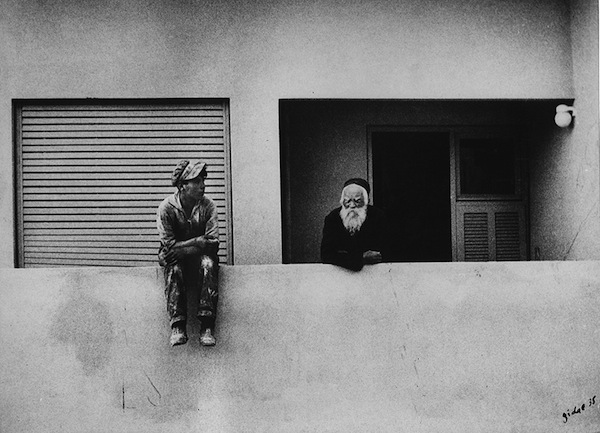
This photo, called “Generations,” was taken by Tim Gidal in Tel Aviv in 1935. (courtesy Zack Gallery)

The current show at the Sidney and Gertrude Zack Gallery, Invisible Curtain: The 1932 Polish Photographs of Nachum Tim Gidal, was organized in partnership with the Cherie Smith JCC Jewish Book Festival, which runs Feb. 20-25. Gidal (better known as Tim Gidal or Tim N. Gidal) was a renown photojournalist of the last century and the exhibit’s images come from the new book Memories of Jewish Poland: The 1932 Photographs of Nachum Tim Gidal. (For a review, click here.)

The driving force behind the book’s publication was Yosef Wosk, who wrote its preface. Wosk approached Zack Gallery director Hope Forstenzer and Jewish Book Festival director Dana Camil Hewitt about a year ago, Forstenzer told the Independent. “He suggested we have a Tim Gidal show at the gallery to coincide with the festival and his newly published book,” she said.

Both Wosk and Forstenzer curated the exhibit. “Together, we chose about 50 images for the show, as many as the gallery could fit. It couldn’t include all the images in the book, of course,” said Forstenzer.

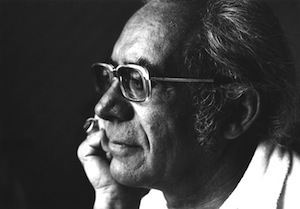
photo - A self-portrait by photographer Tim Gidal, taken in 1974
A self-portrait by photographer Tim Gidal, taken in 1974. (courtesy Zack Gallery)

The history of the photographs is best described by the photographer himself in the book’s introduction. In 1932, Gidal, then 23, traveled with two friends to Poland from his hometown of Munich, Germany. It was his first trip abroad. “My knowledge of the political, economic and social conditions of the Jews in Poland didn’t seem to square with my feelings about their spiritual life,” he wrote. “So I decided to go and see for myself.”

Gidal, who passed away in 1996, took numerous photographs of people and places, as he went from shtetl to shtetl on his three-week “little odyssey.” He wrote: “I encountered spiritual and material heights and depths: material well-being and abject poverty, rejuvenation and dissolution. Some were rich, but many more were very poor. It was a hopeless poverty, endured with an incredible humility. I met men of faith and hypocrites … atheists, socialists and communists, Zionists and Bundists, Orthodox and assimilationists. We also experienced the all-pervading Jewish humor.”

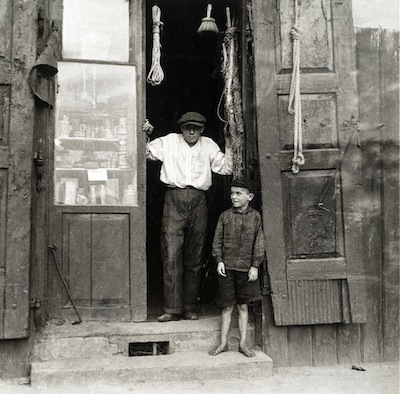
photo - Tim Gidal’s cousin Gershon in the doorway of the family’s rope shop, in Lowicz, Poland. The photo was taken by Gidal in 1932
Tim Gidal’s cousin Gershon in the doorway of the family’s rope shop, in Lowicz, Poland. The photo was taken by Gidal in 1932. (courtesy Zack Gallery)

Everything the young photographer experienced was reflected in his images, including those now on display at the Zack. We see children laughing and women looking far older than their real years. We see ancient eyes and tired, worn hands. We see educated men reading in front of a synagogue, and broken windows and peeling walls the next street over. And we know something Gidal didn’t know at the time, which makes this book and the show all the more poignant: not many years later, most of these people would be murdered in the Holocaust, and they and their entire way of life would be lost. But, in Gidal’s photos, his subjects remain alive. According to Wosk, “Each photograph is a monument, a letter in light.”

Gidal’s 1932 Polish photo essay comprises only a small portion of the master’s body of work. His photography journey spanned almost seven decades and encompassed most major players and momentous events of the 20th century.

One of the pioneers in the field of modern photography, Gidal made his debut in 1929 with his first published photo report. He was a proponent of the style of the “picture story” and he captured most of his subjects unaware, instead of staging elaborate scenes. Very few of his subjects posed for his photos, and every image tells a story.

Four years after his trip to Poland, Gidal moved to Palestine. During the Second World War, he served as a staff reporter for a British army magazine. A wanderer and a chronicler of life, he traveled a lot and lived in the United States for awhile. He taught and illustrated books. He exhibited widely.

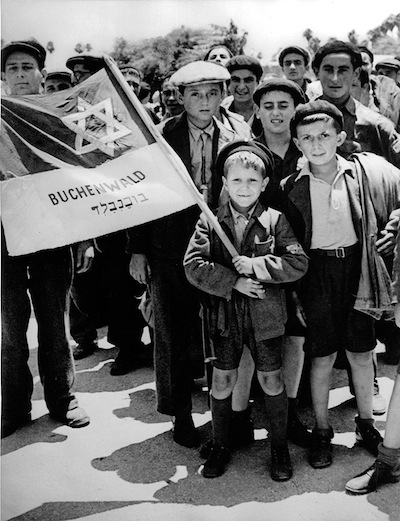
photo - Tim Gidal took this photograph of Buchenwald survivors arriving in Palestine in 1945. It is one of the images featured in the exhibit Invisible Curtain, on display until Feb. 25
Tim Gidal took this photograph of Buchenwald survivors arriving in Palestine in 1945. It is one of the images featured in the exhibit Invisible Curtain, on display until Feb. 25. (courtesy Zack Gallery)

A portion of the Zack exhibition is dedicated to Gidal’s artistic photography after 1932. The pictures demonstrate his technical progress, as well as his breadth of interests and subjects. There is a lyrical photo, “Generations,” taken in Tel Aviv in 1935 and another – a dramatic portrait of the youngest survivors of Buchenwald, taken in 1945 upon their arrival in Palestine. There is a photo of Mahatma Gandhi at the All-India Congress in Bombay in 1940 and the fascinating picture called “Handshake,” taken in Florence in 1934, which shows two men shaking hands in front of a wall covered with multiple posters of Mussolini.

Half a century before Photoshop was invented, Gidal experimented with his images, compiling them in different combinations and creating something unique, like his triptych of Winston Churchill of 1948 or the Rhomboid photomontage of 1975.

As a photo reporter, Gidal used his camera to record the 20th century in all its glorious and painful contradictions, and his early 1932 Polish photographs serve as a symbol of his multifaceted canon.

Invisible Curtain opened on Jan. 5 and the exhibit will continue until Feb. 25. To see the show’s digital equivalent, visit online.flippingbook.com/view/891736. To book an appointment to see it at the gallery, email Forstenzer at gallery@jccgv.bc.ca. To attend the virtual book launch on Feb. 11, 7 p.m., and to see the full book festival lineup, visit jccgv.com/jewish-book-festival.

Olga Livshin is a Vancouver freelance writer. She can be reached at olgagodim@gmail.com.

Gidal’s photos speak volumes

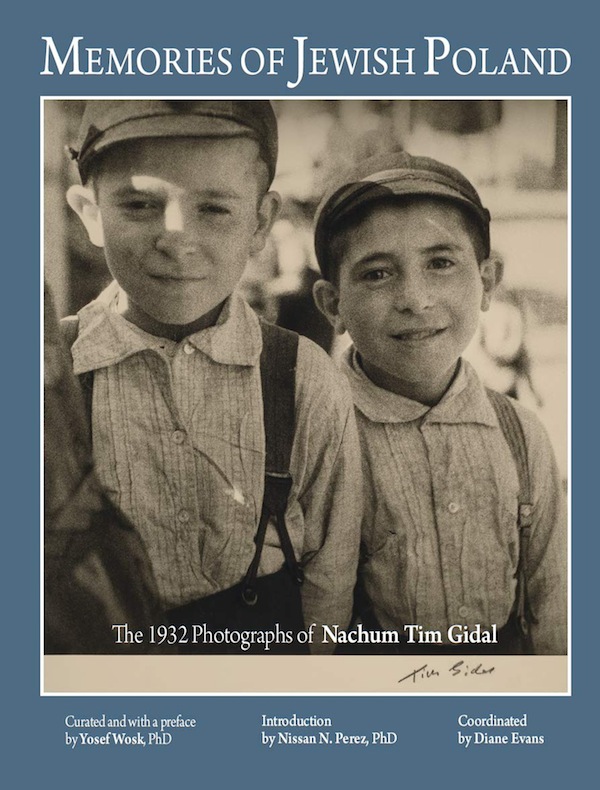
The book Memories of Jewish Poland: The 1932 Photographs of Nachum Tim Gidal lets the photos do most of the talking. And they speak strongly and with passion of a lively, bustling and diverse community, the vast majority of whom were killed in the Holocaust.

“Of the 3.3 million Jewish residents of Poland before World War II, only 380,000 were still alive by 1945,” notes the book’s curator, local scholar, writer and philanthropist Yosef Wosk, in the preface. Wosk will help launch the release of Memories of Jewish Poland on Feb. 11, in a “prologue” event of the Cherie Smith JCC Jewish Book Festival, which opens Feb. 20. He also helped organize Invisible Curtain, the current exhibit of Gidal’s work that is being co-presented by the festival with the Zack Gallery.

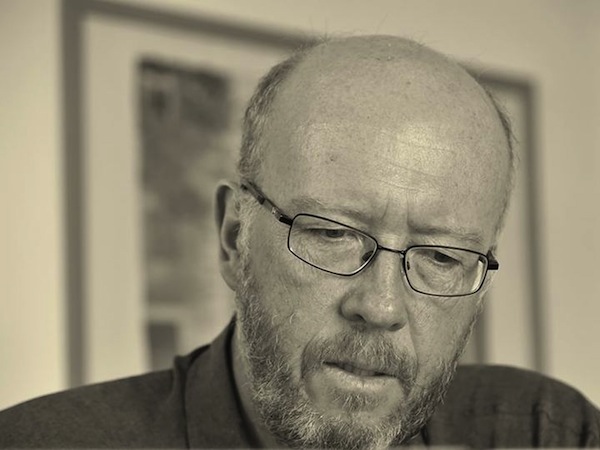
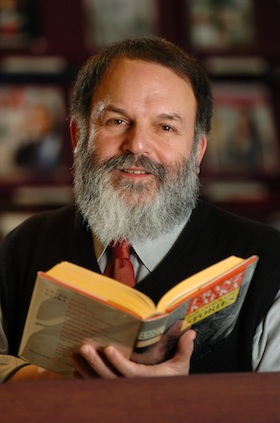
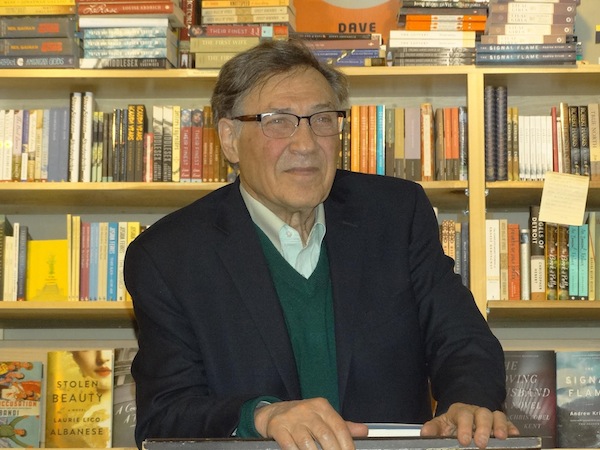
photo - Yosef Wosk will launch the book Memories of Jewish Poland: The 1932 Photographs of Nachum Tim Gidal on Feb. 11 at a virtual Jewish Book Festival event
Yosef Wosk will launch the book Memories of Jewish Poland: The 1932 Photographs of Nachum Tim Gidal on Feb. 11 at a virtual Jewish Book Festival event. (photo by Joshua Berson)

Wosk was friends with Gidal, who he met in Jerusalem, where Gidal lived. Born in Munich in 1909, Gidal had made aliyah in 1936, but then lived in various places before returning to Jerusalem in 1970; he passed away in 1996. It was not only Gidal’s dying wish that the 1932 Polish photos be published in book form, but that they be allowed to “speak for themselves.” And that request has been honoured. In addition to Wosk’s brief preface, the book opens with some notes written by Gidal for a 1984 exhibit and includes an introduction to Gidal’s work by photography historian, researcher, author and curator Nissan N. Perez, founder of the Israel Museum’s photography department. At the end, there is a list of the plates included in the book and a brief biography of Gidal. A map of Poland, indicating the locations in which the photos were taken, bookends the commentary and photographs.

“This book illustrates the largest number of photographs from Gidal’s Polish photo essay ever assembled. It is not, however, a catalogue raisonné: more than 20 images are not included,” writes Wosk. The reproductions included in the volume are taken from prints in Wosk’s collection and that of the Israel Museum. Wosk thanks Diane Evans, “master teacher, photographer, bookseller and friend in photography,” for serving “as a patient, experienced and disciplined midwife in giving birth to this book.”

Gidal – born Ignaz Nachum Gidalawitsch – was motivated to travel to Poland “by his desire to know more about his family’s background,” writes Perez. The photographs Gidal took were “actually a rather small chapter of his oeuvre at the beginning of his outstanding career, an exercise in perfecting his vision.”

“He gains the interest of the viewer not by staging elaborate scenes, but by capturing expressions and gestures that can only be described as both intimate and straightforward,” explains Perez. “As he said in one of the many meetings conducted toward the exhibition in 1995, ‘My photographs, I like to think, are variations on the everlasting tragicomedy of human life.’”

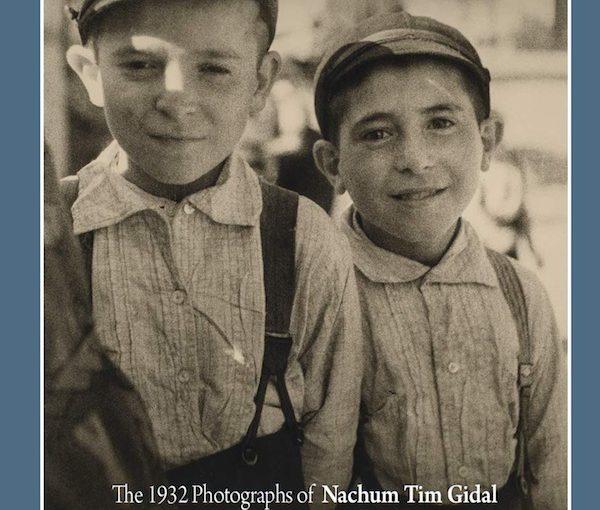
image - Memories of Jewish Poland: The 1932 Photographs of Nachum Tim Gidal book cover

The images in Memories of Jewish Poland are prime examples of Gidal’s ability to capture images of life as it is happening, in all its unromantic but beautiful distinction.

“In the heterogenous assembly of the Polish galut (diaspora), I myself became immersed in the flow of Jewish life from the past to the future,” wrote Gidal for the 1984 exhibit. “When we left Poland after three weeks, I had passed through an invisible curtain, which had separated East and West. Now the curtain had opened, and I was made to feel the unifying presence of Jewry.”

A selection of Gidal’s 1932 Polish photos is currently on display at the Zack Gallery (for the full story, click here). The Memories of Jewish Poland book will be launched at a virtual Cherie Smith JCC Jewish Book Festival prologue event Feb. 11, 7 p.m. For tickets to the prologue and other Jewish Book Festival events, visit jccgv.com/jewish-book-festival.

Fairy tales still relevant

Jack Zipes gives the lecture Resurrecting Dead Fairy Tales on Facebook Feb. 17. (photo from MISCELLANEOUS Productions)

Some fairy tales are timeless in that they still have lessons to impart. For example, The Pied Piper, a story dating back to the Middle Ages, “is a tale of plague, greed, betrayal, conformity/confinement with allusions to child abuse,” explained Elaine Carol, co-founder and artistic director of MISCELLANEOUS Productions.

MISCELLANEOUS’s Plague project will have participating youth, along with professional artists, interpreting the Brothers Grimm’s The Pied Piper “from an intersectional, anti-racist, anti-oppression, queer feminist perspective.” In preparation, Carol told the Independent, “we have been reading our way through the mountain of brilliant writing by Jack Zipes, asking him many questions – even our film editor of Resurrecting Dead Fairy Tales is now reading two of his hundred or more published books.”

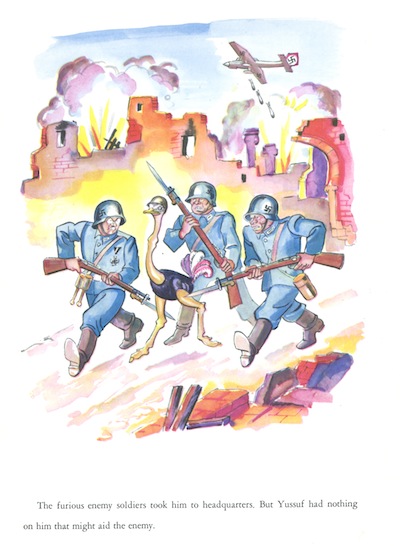
image - In Yussuf the Ostrich, political caricaturist Emery Kelen tells the story of a young ostrich who helps defeat the Nazis in northern Africa during the Second World War.
In Yussuf the Ostrich, political caricaturist Emery Kelen tells the story of a young ostrich who helps defeat the Nazis in northern Africa during the Second World War.

Zipes’ recorded Facebook Watch talk, Resurrecting Dead Fairy Tales, will be streamed Feb. 17, followed by a live Q&A with Zipes. Some of the lecture will be part of the documentary being created about the youth-centred theatre project, which will include various workshops and an eventual stage production at the Scotiabank Dance Centre in 2022.

“I have also been working with young professional artists Tiffany Yang, who was a youth in our Monsters production, national and international tours, and Julia Farry, our production assistant/outreach worker,” said Carol. “Tiffany has translated four indigenous Taiwanese folk tales that are stories of plague – mostly in coastal communities, including animal wonder tales of fantastical fishes and other fascinating narratives. Julia has translated three Japanese folk tales focusing on plagues. There are many plague stories that we still hope to collect, including the facts of disease spread by European settlers to the Indigenous people of Turtle Island, as research materials for our project-in-development.

“We are currently collecting these tales to bring to our youth cast after it is deemed safe to work with them in person,” Carol continued, “as we will be using theatre, hip hop/streetdance, contemporary dance, marimba and world music, urban music, performance art, etc., to co-create a new play. This play will be used as a vehicle for the youth to discuss their own experiences of living in a world pandemic.”

Zipes’ lecture was filmed in Minneapolis by MISCELLANEOUS Productions’ professionals. The professor emeritus of German and comparative literature at the University of Minnesota is an expert on folklore and fairy tales. He is a storyteller himself and the founder of the publishing house Little Mole and Honey Bear.

“My parents and grandmother always told me tales of different kinds,” Zipes told the Independent. “When I began studying for a PhD at Columbia University, I wrote my dissertation on ‘The Great Refusal: Studies of the German and American Romantics in the 19th Century.’ My interest in fairy tales grew as I realized that these imaginary tales hold more truth than the so-called realistic future. And I also was angered by Bruno Bettelheim’s book about fairy tales in which he imposed a Freudian interpretation on readers. Since then, I have been trying to reveal how relevant fairy tales are to our lives.”

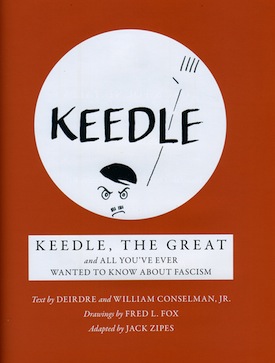
image - One of the fairy tales Jack Zipes has resurrected is Keedle, The Great, first published in 1940
One of the fairy tales Jack Zipes has resurrected is Keedle, The Great, first published in 1940.

The examples given in the lecture’s press release are from two books Zipes has translated and published: “For example, in Yussuf the Ostrich, well-known political caricaturist Emery Kelen tells the story of a young ostrich who helps defeat the Nazis in northern Africa during World War II. In Keedle, The Great, first published in 1940, Deirdre and William Conselman Jr. sought to give Americans hope that the world can overcome dictatorships. To the authors, the title character Keedle represented more than Hitler, but all dictators then and now.”

Zipes said, “I don’t think that my being Jewish accounts for my interest in fairy tales. My Jewishness makes me a bit meshuggah, and this is why I try to think out of the box and have developed a storytelling program for children without sanitizing the fairy tales. The best of folk and fairy tales have never been sanitized, and I use tales to tell so that children will be enabled to tell their own miraculous tales.”

“My Jewishness is complex,” said Carol, “because I am mixed-race Sephardic-Romani and Ashkenazi. One of one million reasons I love Jack Zipes and think his work is crucial is his lucid critique of the Disneyfication of fairy tales and folklore.”

Resurrecting Dead Fairy Tales starts at 5pm on Feb. 17 and is intended for older youth and adult audiences. On the day and time, click here for link to watch.

Courage of journalists

Journalists in Canada do not face the sorts of threats – sometimes life-endangering ones – that colleagues in many other countries do. But other factors impinge on the right of Canadians to diverse and thorough reporting of contentious issues, says an academic on the subject.

Robert Hackett, professor emeritus of communication at Simon Fraser University, spoke on the civil courage of journalists as part of the annual Raoul Wallenberg Day in Vancouver. The virtual commemoration, sponsored by the Wallenberg-Sugihara Civil Courage Society Jan. 17, featured a number of recorded events, including the screening of two films.

In recent decades, there has been a return to “partisan media,” said Hackett.

“Media, going back a couple of hundred years, were initially partisan media, reflecting the viewpoint of particular factions or parties,” he said. “We see that returning with a vengeance since the 1980s, with Fox News and so on.”

The internet has lowered attention spans and the “growing entertainment orientation” of the news media has changed the way reporting is done. Contradictory forces have upset the journalism sector in recent decades, he said. On the one hand, concentration and monopoly have placed control of “legacy media” – daily news, for instance – in fewer and fewer hands, reflecting a narrowing of perspectives. On the other hand, digital media and journalism startups have led to a fragmentation of public attention.

As the revenue structures of journalism have become strained due to competition for advertising avenues, resources for newsroom staff have declined, with commensurate impacts on the quality of reporting. Journalists who are expected to pump out several stories a day are unable to do the sort of investigative work common a generation or two ago and so rely on media releases. General reporters have replaced beat reporters with deep contacts and extensive background knowledge in an area of expertise. These structural changes have been accompanied by growing cultural skepticism toward expertise and even the definition of truth, said Hackett.

“It’s a different cognitive world,” he said. “We no longer seem to even have a shared reality.”

Some of Hackett’s recent research, in conjunction with the Canadian Centre for Policy Alternatives, has focused on fossil fuel industries and their influence on Canada’s press. He sees Canada’s largest print media company, Postmedia, as a booster of fossil fuels.

While Canadian journalists are fortunate not to face some of the life-threatening risks of reporters in many other places, there remain serious challenges to the ideal of a free media.

“There is still a certain degree of legal harassment and risk, especially for freelancers who don’t have a big organization behind them,” said Hackett. “The cost of a lawsuit for defamation, even if it’s a spurious lawsuit, is prohibitive. It’s intimidating. I know for a fact that freelancers have said they aren’t proceeding with stories because of fears of being sued.”

In addition, he added: “We don’t have effective shield or whistleblower laws, by and large, that would allow journalists to protect their sources.”

The online event, marking the 16th annual commemoration of Raoul Wallenberg Day in Vancouver, also featured two documentaries.

A Dark Place was produced by the Organization for Security and Cooperation in Europe’s Representative on Freedom of the Media. It follows female journalists around the world and the threats they receive online in reaction to their reporting on contentious stories. Threats of rape and murder, as well as other forms of intimidation, are almost ubiquitous. One study said that 60% of female journalists have experienced some form of online harassment or threats, according to the film. A panel discussion featured the film’s director, Javier Luque, and Arzu Geybulla, an Azerbaijani journalist who endured harrowing harassment and accusations of being a “traitor” for coverage of conflicts in the Caucasus.

The other documentary, Mohamed Fahmy: Half Free, by filmmaker David Paperny, follows Egyptian-Canadian journalist Mohamed Fahmy, who was jailed in Egypt for his reporting on the Arab Spring uprising in Cairo. Fahmy’s experience is one of many that journalists face daily in conflict zones and under repressive regimes, risking their freedom and their lives to report on events. Fahmy spent 438 days in an Egyptian prison before being pardoned by the country’s president, Abdel Fattah el-Sisi. Fahmy is now an adjunct professor at the University of British Columbia.

Alan Le Fevre, a director of the Wallenberg-Sugihara Civil Courage Society, welcomed participants to the annual event, which highlights the Second World War heroism of Raoul Wallenberg and Chiune Sugihara.

Wallenberg, a Swedish diplomat in Hungary, issued “protective passports” that identified bearers as Swedish subjects awaiting repatriation, thereby preventing their deportation from Hungary to death camps in Poland. Wallenberg disappeared in 1945 after the Soviets invaded Hungary. In 1957, the Soviet Union released a statement dated 1947, saying that Wallenberg had died of natural causes that year. Reports that Wallenberg was seen alive after 1947 have added to confusion and controversy around his fate.

Sugihara was vice-consul of the Imperial Japanese legation in Lithuania. At risk to his career and his life, Sugihara issued thousands of transit visas permitting Jews to travel through the Soviet Union to Japan and across the Pacific. Ostensibly, because a destination was required for a transit visa, the holders were destined for Curaçao. Many of those who escaped ended up on the West Coast of North America and there are several Vancouver families who owe their lives to “Sugihara visas.”